VOLUME VII SLICE IX Dagupan to David (continued 2)
Reading edition
Table V.—Comparison of the Constituents of Food carried off in Milk, and in the Fattening Increase of Oxen.
[1 Gallon = 10.33 ℔] Nitrogenous Substance. Fat. Non- Nitrogenous Substance not Fat (Sugar). Mineral Matter. Total Solid Matter.
In Milk per Week.
If:— ℔ ℔ ℔ ℔ ℔
4 quarts per head per day 2.64 2.53 3.33 0.54 9.04
6 ” ” ” 3.96 3.80 4.99 0.81 13.56
8 ” ” ” 5.28 5.06 6.66 1.08 18.08
10 ” ” ” 6.60 6.33 8.32 1.35 22.60
12 ” ” ” 7.92 7.59 9.99 1.62 27.12
14 ” ” ” 9.24 8.86 11.65 1.89 31.64
16 ” ” ” 10.56 10.12 13.32 2.16 36.16
18 ” ” ” 11.88 11.39 14.98 2.43 40.68
20 ” ” ” 13.20 12.65 16.65 2.70 45.20
In Increase in Live-Weight per Week.—Oxen.
If 10 ℔ increase 0.75 6.35 .. 0.15 7.25
If 15 ℔ increase 1.13 9.53 .. 0.22 10.88
With regard to the very wide range of yield of milk per head per day which the figures in the following table assume, it may be remarked that it is by no means impossible that the same animal might yield the largest amount, namely, 20 quarts, or 5 gallons, per day near the beginning, and only 4 quarts, or 1 gallon, or even less, towards the end of her period of lactation. At the same time, an entire herd of, for example, Shorthorns or Ayrshires, of fairly average quality, well fed, and including animals at various periods of lactation, should not yield an average of less than 8 quarts, or 2 gallons, and would seldom exceed 10 quarts, or 2½ gallons, per head per day the year round.
For the sake of illustration, an average yield of milk of 10 quarts, equal 2½ gallons, or between 25 and 26 ℔ per head per day, may be assumed, and the amount of constituents in the weekly yield at this rate may be compared with that in the weekly increase of the fattening ox at the higher rate assumed in the table, namely, 15 ℔ per 1000 ℔ live-weight, or 1.5% per week. It is seen that whilst of the nitrogenous substance of the food the amount stored up in the fattening increase of an ox would be only 1.13 ℔, the amount carried off as such in the milk would be 6.6 ℔, or nearly six times as much. Of mineral matter, again, whilst the fattening increase would only require about 0.22 ℔, the milk would Carry off 1.35 ℔, or again about six times as much. Of fat, however, whilst the fattening increase would contain 9.53 ℔, the milk would contain only 6.33 ℔, or only about two-thirds as much. On the other hand, whilst the fattening increase contains no other non-nitrogenous substance than fat, the milk would carry off 8.32 ℔ in the form of milk-sugar. This amount of milk-sugar, reckoned as fat, would correspond approximately to the difference between the fat in the milk and that in the fattening increase.
It is evident, then, that the drain upon the food is very much greater for the production of milk than for that of meat. This is especially the case in the important item of nitrogenous substance; and if, as is frequently assumed, the butter-fat of the milk is at any rate largely derived from the nitrogenous substance of the food, so far as it is so at least about two parts of such substance would be required to produce one of fat. On such an assumption, therefore, the drain upon the nitrogenous substance of the food would be very much greater than that indicated in the table as existing as nitrogenous substance in the milk. To this point further reference will be made presently.
Table VI.—Constituents consumed per 1000℔ Live-Weight per Day, for Sustenance and for Milk-Production. The Rothamsted Herd of 30 Cows, Spring 1884.
Total Dry Substance. Digestible.
Nitrogenous Substance. Non- Nitrogenous Substance (as Starch). Total Nitrogenous and Non- Nitrogenous Substance.
℔ ℔ ℔ ℔
3.1 ℔ Cotton cake 2.76 1.07 1.50 2.57
2.7 ℔ Bran 2.33 0.33 1.09 1.42
2.8 ℔ Hay-chaff 2.34 0.15 1.18 1.33
5.6 ℔ Oat-straw-chaff 4.64 0.08 2.21 2.29
62.8 ℔ Mangel 7.85 1.01 5.73 6.74
Total 19.92 2.64* 11.71* 14.35
Required for sustenance 0.57 7.40 7.97
Available for milk 2.07 4.31 6.38
In 23.3 ℔ milk 0.85 3.02 3.87
Excess in food 1.22 1.29 2.51
Per 1000 ℔ Live-Weight.
℔ ℔ ℔ ℔
Wolff 24 2.5 12.5** 15.4
* Albuminoid ratio, 1-4.4.
** Exclusive of 0.4 fat; albuminoid ratio, 1-5.4.
Attention may next be directed to the amounts of food, and of certain of its constituents, consumed for the production of a given amount of milk. This point is illustrated in Table VI., which shows the constituents consumed per 1000 ℔ live-weight per day in the case of the Rothamsted herd of 30 cows in the spring of 1884. On the left hand are shown the actual amounts of the different foods consumed per 1000 ℔ live-weight per day; and in the respective columns are recorded—first the amounts of total dry substance which the foods contained, and then the amounts of digestible nitrogenous, digestible non-nitrogenous (reckoned as starch), and digestible total organic substance which the different foods would supply; these being calculated according to Lawes and Gilbert’s own estimates of the percentage composition of the foods, and to Wolff’s estimates of the proportion of the several constituents which would be digestible.
The first column shows that the amount of total dry substance of food actually consumed by the herd, per 1000 ℔ live-weight per day, was scarcely 20 ℔ whilst Wolff’s3 estimated requirement, as stated at the foot of the table, is 24 ℔. But his ration would doubtless consist to a greater extent of hay and straw-chaff, containing a larger proportion of indigestible and effete woody fibre. The figures show, indeed that the Rothamsted ration supplied, though nearly the same, even a somewhat less amount of total digestible constituents than Wolff’s.
Of digestible nitrogen substance the food supplied 2.64 ℔ per day, whilst the amount estimated to be required for sustenance merely is 0.57 ℔; leaving, therefore, 2.07 ℔ available for milk production. The 23.3 ℔ of milk yielded per 1000 ℔ live-weight per day would, however, contain only 0.85 ℔; and there would thus remain an apparent excess of 1.22 ℔ of digestible nitrogenous substance in the food supplied. But against the amount of 2.64 ℔ actually consumed, Wolff’s estimate of the amount required for sustenance and for milk-production is 2.5 ℔, or but little less than the amount actually consumed at Rothamsted. On the assumption that the expenditure of nitrogenous substance in the production of milk is only in the formation of the nitrogenous substances of the milk, there would appear to have been a considerable excess given in the food. But Wolff’s estimate assumes no excess of supply, and that the whole is utilized; the fact being that he supposes the butter-fat of the milk to have been derived largely, if not wholly, from the albuminoids of the food.
It has been shown that although it is possible that some of the fat of a fattening animal may be produced from the albuminoids of the food, certainly the greater part of it, if not the whole, is derived from the carbohydrates. But the physiological conditions of the production of milk are so different from those for the production of fattening increase, that it is not admissible to judge of the sources of the fat of the one from what may be established in regard to the other. It has been assumed, however, by those who maintain that the fat of the fattening animal is formed from albuminoids, that the fat of milk must be formed in the same way. Disallowing the legitimacy of such a deduction, there do, nevertheless, seem to be reasons for supposing that the fat of milk may, at any rate in large proportion, be derived from albuminoids.
Thus, as compared with fattening increase, which may in a sense be said to be little more than an accumulation of reserve material from excess of food, milk is a special product, of a special gland, for a special normal exigency of the animal. Further, whilst common experience shows that the herbivorous animal becomes the more fat the more, within certain limits, its food is rich in carbohydrates, it points to the conclusion that both the yield of milk and its richness in butter are more connected with a liberal supply of the nitrogenous constituents in the food. Obviously, so far as this is the case, it may be only that thereby more active change in the system, and therefore greater activity of the special function, is maintained. The evidence at command is, at any rate, not inconsistent with the supposition that a good deal of the fat of milk may have its source in the breaking up of albuminoids, but direct evidence on the point is still wanting; and supposing such breaking up to take place in the gland, the question arises—What becomes of the by-products? Assuming, however, that such change does take place, the amount of nitrogenous substance supplied to the Rothamsted cows would be less in excess of the direct requirement for milk-production than the figures in the table would indicate, if, indeed, in excess at all.
The figures in the column of Table VI. relating to the estimated amount of digestible non-nitrogenous substance reckoned as starch show that the quantity actually consumed was 11.71 ℔, whilst the amount estimated by Wolff to be required was 12.5 ℔, besides 0.4 ℔ of fat. The figures further show that, deducting 7.4 ℔ for sustenance from the quantity actually consumed, there would remain 4.31 ℔ available for milk-production, whilst only about 3.02 ℔ would be required supposing that both the fat of the milk and the sugar had been derived from the carbohydrates of the food; and, according to this calculation, there would still be an excess in the daily food of 1.29 ℔. It is to be borne in mind, however, that estimates of the requirement for mere sustenance are mainly founded on the results of experiments in which the animals are allowed only such a limited amount of food as will maintain them without either loss or gain when at rest. But physiological considerations point to the conclusion that the expenditure, independently of loss or gain, will be the greater the more liberal the ration, and hence it is probable that the real excess, if any, over that required for sustenance and milk-production would be less than that indicated in the table, which is calculated on the assumption of a fixed requirement for sustenance for a given live-weight of the animal. Supposing that there really was any material excess of either the nitrogenous or the non-nitrogenous constituents supplied over the requirement for sustenance and milk-production, the question arises—Whether, or to what extent, it conduced to increase in live-weight of the animals, or whether it was in part, or wholly, voided, and so wasted.
Table VII.—Percentage Composition of Milk each Month of the Year; also Average Yield of Milk, and of Constituents, per Head per Day each Month, according to Rothamsted Dairy Records.
Average Composition of Milk each Month, 1884. (Dr Vieth—14,235 analyses.) Rothamsted Diary.
Average Yield of Milk per Head per Day, 6 Years. Estimated Quantity of Constituents in Milk per Head per Day each Month.
Specific Gravity. Butter- Fat. Solids not Fat. Total Solids. Butter- Fat. Solids not Fat. Total Solids.
% % % ℔ ℔ ℔ ℔
January 1.0325 3.55 9.34 12.89 20.31* 0.72 1.90 2.62
February 1.0325 3.53 9.24 12.77 22.81 0.80 2.11 2.91
March 1.0323 3.50 9.22 12.72 24.19 0.85 2.23 3.08
April 1.0323 3.43 9.22 12.65 26.50 0.91 2.44 3.35
May 1.0324 3.34 9.30 12.64 31.31 1.05 2.91 3.96
June 1.0323 3.31 9.19 12.50 30.81 1.02 2.83 3.85
July 1.0319 3.47 9.13 12.60 28.00 0.97 2.56 3.53
August 1.0318 3.87 9.08 12.95 25.00 0.97 2.27 3.24
September 1.0321 4.11 9.17 13.28 22.94 0.94 2.11 3.05
October 1.0324 4.26 9.27 13.53 21.00 0.89 1.95 2.84
November 1.0324 4.36 9.29 13.65 19.19 0.84 1.78 2.62
December 1.0326 4.10 9.29 13.39 19.31 0.79 1.79 2.58
Mean 1.0323 3.74 9.22 12.96 24.28 0.90 2.24 3.14
* Average over five years only, as the records did not commence until February 1884.
As regards the influence of the period of the year, with its characteristic changes of food, on the quantity and composition of the milk, the first column of the second division of Table VII. shows the average yield of milk per head per day of the Rothamsted herd, averaging about 42 cows, almost exclusively Shorthorns, in each month of the year, over six years, 1884 to 1889 inclusive; and the succeeding columns show that amounts of butter-fat, of solids not fat, and of total solids in the average yield per head per day in each month of the year, calculated, not according to direct analytical determinations made at Rothamsted, but according to the results of more than 14,000 analyses made, under the superintendence of Dr Vieth, in the laboratory of the Aylesbury Dairy Company in 1884;4 the samples analysed representing the milk from a great many different farms in each month.
It should be stated that the Rothamsted cows had cake throughout the year; at first 4 ℔ per head per day, but afterwards graduated according to the yield of milk, on the basis of 4 ℔ for a yield of 28 ℔ of milk, the result being that then the amount given averaged more per head per day during the grazing period, but less earlier and later in the year. Bran, hay and straw-chaff, and roots (generally mangel), were also given when the animals were not turned out to grass. The general plan was, therefore, to give cake alone in addition when the cows were turned out to grass, but some other dry food, and roots, when entirely in the shed during the winter and early spring months.
Referring to the column showing the average yield of milk per head per day each month over the six years, it will be seen that during the six months January, February, September, October, November and December the average yield was sometimes below 20 ℔ and on the average only about 21 ℔ of milk per head per day; whilst over the other six months it averaged 27.63 ℔, and over May and June more than 31 ℔ per head per day. That is to say, the quantity of milk yielded was considerably greater during the grazing period than when the animals had more dry food, and roots instead of grass.
Next, referring to the particulars of composition, according to Dr Vieth’s results, which may well be considered as typical for the different periods of the year, it is seen that the specific gravity of the milk was only average, or lower than average, during the grazing period, but rather higher in the earlier and later months of the year. The percentage of total solids was rather lower than the average at the beginning of the year, lowest during the chief grazing months, but considerably higher in the later months of the year, when the animals were kept in the shed and received more dry food. The percentage of butter-fat follows very closely that of the total solids, being the lowest during the best grazing months, but considerably higher than the average during the last four or five months of the year, when more dry food was given. The percentage of solids not fat was considerably the lowest during the later months of the grazing period, but average, or higher than average, during the earlier and later months of the year. It may be observed that, according to the average percentages given in the table, a gallon of milk will contain more of both total solids and of butter-fat in the later months of the year; that is, when there is less grass and more dry food given.
Turning to the last three columns of the table, it is seen that although, as has been shown, the percentage of the several constituents in the milk is lower during the grazing months, the actual amounts contained in the quantity of milk yielded per head are distinctly greater during those months. Thus, the amount of butter-fat yielded per head per day is above the average of the year from April to September inclusive; the amounts of solids not fat are over average from April to August inclusive; and the amounts of total solids yielded are average, or over average, from April to August inclusive.
From the foregoing results it is evident that the quantity of milk yielded per head is very much the greater during the grazing months of the year, but that the percentage composition of the milk is lower during that period of higher yield, and considerably higher during the months of more exclusively dry-food feeding. Nevertheless, owing to the much greater quantity of milk yielded during the grazing months, the actual quantity of constituents yielded per Cow is greater during those months than during the months of higher percentage composition but lower yield of milk per head. It may be added that a careful consideration of the number of newly-calved cows brought into the herd each month shows that the results as above stated were perfectly distinct, independently of any influence of the period of lactation of the different individuals of the herd.
The few results which have been brought forward in relation to milk-production are admittedly quite insufficient adequately to illustrate the influence of variation in the quantity and composition of the food on the quantity and composition of the milk yielded. Indeed, owing to the intrinsic difficulties of experimenting on such a subject, involving so many elements of variation, any results obtained have to be interpreted with much care and reservation. Nevertheless, it may be taken as clearly indicated that, within certain limits, high feeding, and especially high nitrogenous feeding, does increase both the yield and the richness of the milk.5 But it is evident that when high feeding is pushed beyond a comparatively limited range, the tendency is to increase the weight of the animal—that is, to favour the development of the individual, rather than to enhance the activity of the functions connected with the reproductive system. This is, of course, a disadvantage when the object is to maintain the milk-yielding condition of the animal; but when a cow is to be fattened off it will be otherwise.
It has been stated that, early in the period of six years in which the Rothamsted results that have been quoted were obtained, the amount of oil-cake given was graduated according to the yield of milk of each individual cow; as it seemed unreasonable that an animal yielding, say, only 4 quarts per day, should receive, beside the home foods, as much cake as one yielding several times the quantity. The obvious inference is, that any excess of food beyond that required for sustenance and milk-production would tend to increase the weight of the animal, which, according to the circumstances, may or may not be desirable.
It may be observed that direct experiments at Rothamsted confirm the view, arrived at by common experience, that roots, and especially mangel, have a favourable effect on the flow of milk. Further, the Rothamsted experiments have shown that a higher percentage of butter-fat, of other solids, and of total solids, was obtained with mangel than with silage as the succulent food. The yield of milk was, however, in a much greater degree increased by grazing than by any other change in the food; and at Rothamsted the influence of roots comes next in order to that of grass, though far behind it, in this respect. But with grazing, as has been shown, the percentage composition of the milk is considerably reduced; though, owing to the greatly increased quantity yielded, the amount of soil-constituents removed in the milk when cows are grazing may nevertheless be greater per head per day than under any other conditions. Lastly, it has been clearly illustrated how very much greater is the demand upon the food, especially for nitrogenous and for mineral constituents, in the production of milk than in that of fattening increase.
Manurial Value of Food consumed in the Production of Milk
In any attempt to estimate the average value of the manure derived from the consumption of food for the production of milk, the difficulty arising from the very wide variation in the amount of milk yielded by different cows, or by the same cow at different periods of her lactation, is increased by the inadequate character of information concerning the difference in the amount of the food actually consumed by the animal coincidently with the production of such different amounts of milk. But although information is lacking for correlating, with numerical accuracy, the great difference in milk-yield of individual cows with the coincident differences in consumption to produce it, it may be considered as satisfactorily established that more food is consumed by a herd of cows to produce a fair yield of milk, of say 10 or 12 quarts per head per day, than by an equal live-weight of oxen fed to produce fattening increase. In the cases supposed it may, for practical purposes, be assumed that the cows would consume about one-fourth more food than the oxen. Accordingly, in the Rothamsted estimates of the value of the manure obtained on the consumption of food for the production of milk, it is assumed that one-fourth more will be consumed by 1000 ℔ live-weight of cows than by the same weight of oxen; but the estimates of the amounts of the constituents of the food removed in the milk, or remaining for manure, are nevertheless reckoned per ton of each kind of food consumed, as in the case of those relating to feeding for the production of fattening increase. It may be added that the calculations of the amounts of the constituents in the milk are based on the same average composition of milk as is adopted in the construction of Table V. Thus the nitrogen is taken at 0.579 (= 3.65 nitrogenous substance)%, the phosphoric acid at 0.2175%, and the potash at 0.1875% in the milk.
Table VIII. shows in detail the estimate of the amount of nitrogen in one ton of each food, and in the milk produced from its consumption, on the assumption of an average yield of 10 quarts per head per day; also the amount remaining for manure, the amount of ammonia corresponding to the nitrogen, and the value of the ammonia at 4d. per ℔. Similar particulars are also given in relation to the phosphoric acid and the potash consumed in the food, removed in the milk, and remaining for manure, &c. This table will serve as a sufficient illustration of the mode of estimating the total or original value of the manure, derived from the consumption of the different foods for the production of milk in the case supposed; that is, assuming an average yield of a herd of 10 quarts per head per day.
In Table IX. are given the results of similar detailed calculations of the total or original manure-value (as in Table VIII. for 10 quarts), on the alternative assumptions of a yield of 6, 8, 12 or 14 quarts per head per day. For comparison there is also given, in the first column, the estimate of the total or original manure-value when the foods are consumed for the production of fattening increase.
So much for the plan and results of the estimations of total or original manure-value of the different foods, that is, deducting only the constituents removed in the milk, and reckoning the remainder at the prices at which they can be purchased in artificial manures. With a view to direct application to practice, however, it is necessary to estimate the unexhausted manure-value of the different foods, or what may be called their compensation-value, after they have been used for a series of years by the outgoing tenant and he has realized a certain portion of the manure-value in his increased crops. In the calculations for this purpose the rule is to deduct one-half of the original manure-value of the food used the last year, and one-third of the remainder each year to the eighth, in the case of all the more concentrated foods and of the roots—in fact, of all the foods in the list excepting the hays and the straws. For these, which contain larger amounts of indigestible matter, and the constituents of which will be more slowly available to crops, two-thirds of the original manure-value is deducted for the last year, and only one-fifth from year to year to the eighth year back. The results of the estimates of compensation-value so made are given for the five yields of 6, 8, 10, 12 and 14 quarts of milk per head per day respectively in Lawes and Gilbert’s paper6 on the valuation of the manures obtained by the consumption of foods for the production of milk, which may be consulted for fuller details. It must, however, be borne in mind that when cows are fed in sheds or yards the manure is generally liable to greater losses than is the case with fattening oxen. The manure of the cow contains much more water in proportion to solid matter than that of the ox. Water will, besides, frequently be used for washing, and it may be that a good deal of the manure is washed into drains and lost. In the event, therefore, of a claim for compensation, the management and disposal of the manure requires the attention of the valuer. Indeed, the varying circumstances that will arise in practice must be carefully considered. Bearing these in mind, the estimates may be accepted as at any rate the best approximation to the truth that existing knowledge provides; and they should be found sufficient for the requirements of practical use. Obviously they will be more directly applicable in the case of cows feeding entirely on the foods enumerated in the list, and not depending largely on grass; but, even when the animals are partially grass-fed, the value of the manure derived from the additional dry food or roots may be estimated according to the scale given.
Table VIII.—Estimates of the Total or Original Manure-Value of Cattle Foods after Consumption by Cows for the Production of Milk. Valuation on the assumption of an average production by a herd of 10 quarts of milk per head per day.
Nos. Description of Food. Nitrogen. Phosphoric Acid. Potash. Total or Original Manure- Value per Ton of Food consumed.
In 1 Ton of Food. In Milk from 1 Ton of Food. In Manure. In 1 Ton of Food. In Milk from 1 Ton of Food. In Manure. In 1 Ton of Food. In Milk from 1 Ton of Food. In Manure.
Total remaining for Manure. Nitrogen equal Ammonia. Value of Ammonia at 4 d. per ℔. Total remaining for Manure. Value at 2 d. per ℔. Total remaining for Manure. Value at 1½ d. per ℔.
℔ ℔ ℔ ℔ £ s. d. ℔ ℔ ℔ s. d. ℔ ℔ ℔ s. d. £ s. d.
1 Linseed 80.64 25.04 55.60 67.52 1 2 6 34.50 9.34 25.16 4 2 30.69 8.02 22.67 2 10 1 9 6
2 Linseed cake 106.40 20.86 85.54 103.87 1 14 7 44.80 7.79 37.01 6 2 31.36 6.71 24.65 3 1 2 3 10
3 Decorticated cotton cake 147.84 19.27 128.57 156.13 2 12 1 69.44 7.18 62.26 10 5 44.80 6.22 38.58 4 10 3 7 4
4 Palm-nut cake 56.00 17.86 38.14 46.31 0 15 5 26.88 6.68 20.20 3 4 11.20 5.73 5.47 0 8 0 19 5
5 Undecorticated cotton cake 84.00 15.66 68.34 82.99 1 7 8 44.80 5.85 38.95 6 6 44.80 5.07 39.73 5 0 1 19 2
6 Cocoanut cake 76.16 15.66 60.50 73.47 1 4 6 31.36 5.85 25.51 4 3 44.80 5.07 39.73 5 0 1 13 9
7 Rape cake 109.76 12.50 97.26 118.11 1 19 4 56.00 4.69 51.31 8 7 33.60 4.09 29.51 3 8 2 11 7
8 Peas 80.64 17.86 62.78 76.24 1 5 5 19.04 6.68 12.36 2 1 21.50 5.73 15.77 2 0 1 9 6
9 Beans 89.60 17.86 71.74 87.12 1 9 0 24.64| 6.68 17.96 3 0 29.12 5.73 23.39 2 11 1 14 11
10 Lentils 94.08 17.86 76.22 92.56 1 10 10 16.80 6.68 10.12 1 8 15.68 5.73 9.95 1 3 1 13 9
11 Tares (seed) 94.08 17.86 76.22 92.56 1 10 10 17.92 6.68 11.24 1 10 17.92 5.73 12.19 1 6 1 14 2
12 Maize 38.08 17.38 20.70 25.14 0 8 5 13.44 6.50 6.94 1 2 8.29 5.56 2.73 0 4 0 9 11
13 Wheat 40.32 17.38 22.94 27.86 0 9 3 19.04 6.50 12.54 2 1 11.87 5.56 6.31 0 9 0 12 1
14 Malt 38.08 17.86 20.22 24.55 0 8 2 17.92 6.68 11.24 1 10 11.20 5.73 5.47 0 8 0 10 8
15 Barley 36.96 17.38 19.58 23.78 0 7 11 16.80 6.50 10.30 1 9 12.32 5.56 6.76 0 10 0 10 6
16 Oats 44.80 16.68 28.12 34.15 0 11 5 13.44 6.24 7.20 1 2 11.20 5.40 5.80 0 9 0 13 4
17 Rice meal 42.56 16.68 25.88 31.43 0 10 6 (13.44) 6.24 7.20 1 2 (8.29) 5.40 2.89 0 4 0 12 0
18 Locust beans 26.88 13.90 12.98 15.76 0 5 3 .. 5.19 .. .. .. 4.42 .. .. ..
19 Malt coombs 87.36 15.66 71.70 87.07 1 9 0 44.80 5.85 38.95 6 6 44.80 5.07 39.73 5 0 2 0 6
20 Fine pollard 54.88 16.68 38.20 46.39 0 15 6 64.96 6.24 58.72 9 9 32.70 5.40 27.30 3 5 1 8 8
21 Coarse pollard 56.00 15.66 40.34 48.99 0 16 4 78.40 5.85 72.55 12 1 33.60 5.07 28.53 3 7 1 12 0
22 Bran 56.00 13.90 42.10 51.12 0 17 0 80.64 5.19 75.45 12 7 32.48 4.42 28.06 3 6 1 13 1
23 Clover hay 53.76 8.94 44.82 54.43 0 18 2 12.77 3.35 9.42 1 7 33.60 2.94 30.66 3 10 1 3 7
24 Meadow hay 33.60 8.36 25.24 30.65 0 10 3 8.96 3.10 5.86 1 0 35.84 2.62 33.22 4 2 0 15 5
25 Pea straw 22.40 7.83 14.57 17.69 0 5 11 7.84 2.91 4.93 0 10 22.40 2.46 19.94 2 6 0 9 3
26 Oat straw 11.20 6.95 4.25 5.16 0 1 9 5.38 2.60 2.78 0 6 22.40 2.29 20.11 2 6 0 4 9
27 Wheat straw 10.08 5.98 4.10 4.98 0 1 8 5.38 2.23 3.15 0 6 17.92 1.96 15.96 2 0 0 4 2
28 Barley straw 8.96 5.46 3.50 4.25 0 1 5 4.03 2.04 1.99 0 4 22.40 1.80 20.60 2 7 0 4 4
29 Bean straw 20.16 5.68 14.48 17.58 0 5 10 6.72 2.14 4.58 0 9 22.40 1.80 20.60 2 7 0 9 2
30 Potatoes 5.60 2.07 3.53 4.29 0 1 5 3.36 0.78 2.58 0 5 12.32 0.66 11.66 1 5 0 3 3
31 Carrots 4.48 1.46 3.02 3.67 0 1 3 2.02 0.54 1.48 0 3 6.27 0.49 5.78 0 9 0 2 3
32 Parsnips 4.93 1.67 3.26 3.96 0 1 4 4.26 0.63 3.63 0 7 8.06 0.49 7.57 0 11 0 2 10
33 Mangel wurzels 4.93 1.32 3.61 4.38 0 1 6 1.57 0.49 1.08 0 2 8.96 0.49 8.47 1 1 0 2 9
34 Swedish turnips 5.60 1.14 4.46 5.42 0 1 10 1.34 0.44 0.90 0 2 4.93 0.33 4.60 0 7 0 2 7
35 Yellow turnips 4.48 0.93 3.55 4.31 0 1 5 1.34 0.34 1.00 0 2 4.93 0.33 (4.60) 0 7 0 2 2
36 White turnips 4.03 0.84 3.19 3.87 0 1 3 1.12 0.31 0.81 0 2 6.72 0.33 6.39 0 10 0 2 3
Cheese and Cheese-Making
For generations, perhaps for centuries, the question has been discussed as to why there should be so large a proportion of bad and inferior cheese and so small a proportion of really good cheese made in farmhouses throughout the land. That the result is not wholly due to skill and care or to the absence of these qualities on the part of the dairymaid may now be taken for granted. Instances might be quoted in which the most painstaking of dairymaids, in the cleanest of dairies, have failed to produce cheese of even second-rate quality and character, and yet others in which excellent cheese has been made under commonplace conditions as to skill and equipment, and with not much regard to cleanliness in the dairy. The explanation of what was so long a mystery has been found in the domain of ferments. It is now known that whilst various micro-organisms, which in many dairies have free access to the milk, have ruined an incalculable quantity of cheese—and of butter also—neither cheese nor butter of first-rate quality can be made without the aid of lactic acid bacilli. As an illustrative case, mention may be made of that of two most painstaking dairymaids who had tried in vain to make good cheese from the freshest of milk in the cleanest of dairies in North Lancashire. Advice to resort to the use of the ferment was acted upon, and the result was a revelation and a transformation, excellent prize-winning cheese being made from that time forward. By the addition of a “starter,” in the form of a small quantity of sour milk, whey or buttermilk, in an advanced stage of fermentation, the development of acidity in the main body of milk is accelerated. It has been ascertained that the starter is practically a culture of bacteria, which, if desired, may be obtained as a pure culture. Professor J. R. Campbell, as the result of experiments on pure cultures for Cheddar cheese-making, states7 that (1) first-class Cheddar cheese can be made by using pure cultures of a lactic organism; (2) this organism abounds in all samples of sour milk and sour whey; (3) the use of a whey starter is attended with results equal in every respect to those obtained from a milk-starter. It is well within the power of any dairyman to prepare what is practically a pure culture of the same bacterium as is supplied from the laboratory. Moreover, the sour-whey starter used by some of the successful cheese-makers before the introduction of the American system is in effect a pure culture, from which it follows that these men had, by empirical methods, attained the same end as that to which bacteriological research subsequently led. Wherever a starter is necessary, the use of a culture practically pure is imperative, whether such culture be obtained from the laboratory or prepared by what may be called the “home-made starter.” Pure cultures may be bought for a few shillings in the open market.
Table IX.—Comparison of the Estimates of Total or Original Manure-Value when Foods are consumed for the Production of Fattening Increase, with those when the Food is consumed by Cows giving different Yields of Milk.
Nos. Description of Food. Total or Original Manure-Value per Ton of Food consumed—that is, only deducting the Constituents in Fattening Increase or in Milk.
For the Production of Fattening Increase. For the Production of Milk, supposing the Yield per Head per Day to be as under—
6 qts. 8 qts. 10 qts. 12 qts. 14 qts.
£ s. d. £ s. d. £ s. d. £ s. d. £ s. d. £ s. d.
1 Linseed 1 19 2 1 14 7 1 12 0 1 9 6 1 7 1 1 4 5
2 Linseed cake 2 11 11 2 8 1 2 6 0 2 3 10 2 1 9 1 19 8
3 Decorticated cotton cake 3 14 9 3 11 2 3 9 2 3 7 4 3 5 4 3 3 4
4 Palm-nut cake 1 6 4 1 3 2 1 1 4 0 19 5 0 17 9 0 15 11
5 Undecorticated cotton cake 2 5 3 2 2 4 2 0 8 1 19 2 1 17 6 1 15 11
6 Cocoa-nut cake 1 19 10 1 16 11 1 15 3 1 13 9 1 12 3 1 10 6
7 Rape cake 2 16 5 1 14 2 2 12 11 2 11 7 2 10 4 2 9 1
8 Peas 1 16 5 1 13 1 1 11 2 1 9 6 1 7 8 1 5 9
9 Beans 2 1 11 1 18 7 1 16 10 1 14 11 1 13 1 1 11 4
10 Lentils 2 0 8 1 17 5 1 15 7 1 13 9 1 12 2 1 10 1
11 Tares (seed) 2 1 1 1 17 11 1 16 0 1 14 2 1 12 6 1 10 7
12 Maize 0 16 7 0 13 4 0 11 7 0 9 11 0 8 1 0 6 5
13 Wheat 0 18 11 0 15 8 0 13 11 0 12 1 0 10 5 0 8 8
14 Malt 0 17 7 0 14 5 0 12 7 0 10 8 0 9 0 0 7 1
15 Barley 0 17 2 0 14 0 0 12 3 0 10 6 0 8 8 0 6 11
16 Oats 0 19 9 0 16 8 0 15 0 0 13 4 0 11 7 0 9 10
17 Rice meal (0 18 6) 0 15 5 0 13 9 0 12 0 0 10 5 0 8 7
18 Locust beans .. .. .. .. .. ..
19 Malt coombs 2 6 7 2 3 9 2 2 0 2 0 6 1 18 11 1 17 4
20 Fine pollard 1 15 2 1 12 0 1 10 5 1 8 8 1 6 11 1 5 3
21 Coarse pollard 1 18 1 1 15 2 1 13 6 1 12 0 1 10 5 1 8 9
22 Bran 1 18 6 1 15 11 1 14 6 1 13 1 1 11 8 1 10 3
23 Clover hay 1 7 0 1 5 5 1 4 5 1 3 7 1 2 8 1 1 8
24 Meadow hay 0 18 7 0 17 0 0 16 3 0 15 5 0 14 5 0 13 7
25 Pea straw 0 12 2 0 10 9 0 10 0 0 9 3 0 8 5 0 7 8
26 Oat straw 0 7 5 0 6 2 0 5 5 0 4 9 0 4 0 0 3 3
27 Wheat straw 0 6 6 0 5 5 0 4 10 0 4 2 0 3 6 0 3 0
28 Barley straw 0 6 5 0 5 6 0 4 10 0 4 4 0 3 9 0 3 2
29 Bean straw 0 11 5 0 10 4 0 9 9 0 9 2 0 8 7 0 8 0
30 Potatoes 0 4 1 0 3 9 0 3 6 0 3 3 0 3 1 0 2 11
31 Carrots 0 2 9 0 2 6 0 2 4 0 2 3 0 2 1 0 1 11
32 Parsnips 0 3 6 0 3 3 0 3 1 0 2 10 0 2 8 0 2 7
33 Mangel wurzels 0 3 2 0 3 0 0 2 10 0 2 9 0 2 7 0 2 5
34 Swedish turnips 0 2 11 0 2 9 0 2 8 0 2 7 0 2 5 0 2 3
35 Yellow turnips (0 2 6) 0 2 4 0 2 3 0 2 2 0 2 1 0 2 0
36 White turnips 0 2 7 0 2 5 0 2 4 0 2 3 0 2 2 0 2 0
The factory-made cheese of Canada, the United States and Australasia, which is so largely imported into the United Kingdom, is all of the Cheddar type. The factory system has made no headway in the original home of the Cheddar cheese in the west of England. The system was thus described in the Journal of the British Dairy Farmers’ Association in 1889 by Mr R. J. Drummond:—
“In the year 1885 I was engaged as cheese instructor by the Ayrshire Dairy Association, to teach the Canadian system of Cheddar cheese-making. I commenced operations under many difficulties, being a total stranger to both the people and the country, and with this, the quantities of milk were very much less than I had been in the habit of handling. Instead of having the milk from 500 to 1000 cows, we had to operate with the milk from 25 to not over 60 cows.
“The system of cheese-making commonly practised in the county of Ayr at that time was what is commonly known as the Joseph Harding or English Cheddar system, which differs from the Canadian system in many details, and in one particular is essentially different, namely, the manner in which the necessary acidity in the milk is produced. In the old method a certain quantity of sour whey was added to the milk each day before adding the rennet, and I have no doubt in my own mind that this whey was often added when the milk was already acid enough, and the consequence was a spoiled cheese.
“Another objection to this system of adding sour whey was, should the stuff be out of condition one day, the same trouble was inoculated with the milk from day to day, and the result was sure to be great unevenness in the quality of the cheese. The utensils commonly in use were very different to anything I had ever seen before; instead of the oblong cheese vat with double casings, as is used by the best makers at the present time, a tub, sometimes of tin and sometimes of wood, from 4 to 7 ft. in diameter by about 30 in. deep, was universally in use. Instead of being able to heat the milk with warm water or steam, as is commonly done now, a large can of a capacity of from 20 to 30 gallons was filled with cold milk and placed in a common hot-water boiler, and heated sufficiently to bring the whole body of the milk in the tub to the desired temperature for adding the rennet. I found that many mistakes were made in the quantity of rennet used, as scarcely any two makers used the same quantity to a given quantity of milk. Instead of having a graduated measure for measuring the rennet, a common tea-cup was used for this purpose, and I have found in some dairies as low as 3 oz. of rennet was used to 100 gallons of milk, where in others as high as 6½ oz. was used to the same quantity. This of itself would cause a difference in the quality of the cheese.
“Coagulation and breaking completed, the second heating was effected by dipping the whey from the curd into the can already mentioned, and heated to a temperature of 140° F., and returned to the curd, and thus the process was carried on till the desired temperature was reached. This mode of heating I considered very laborious and at the same time very unsatisfactory, as it is impossible to distribute the heat as evenly through the curd in this way as by heating either with hot water or steam. The other general features of the method do not differ from our own very materially, with the exception that in the old method the curd was allowed to mature in the bottom of the tub, where at the same stage we remove the curd from the vat to what we call a curd-cooler, made with a sparred bottom, so as to allow the whey to separate from the curd during the maturing or ripening process. In regard to the quality of cheese on the one method compared with the other, I think that there was some cheese just as fine made in the old way as anything we can possibly make in the new, with one exception, and that is, that the cheese made according to the old method will not toast—instead of the casein melting down with the butter-fat, the two become separated, which is very much objected to by the consumer—and, with this, want of uniformity through the whole dairy. This is a very short and imperfect description of how the cheese was made at the time I came into Ayrshire; and I will now give a short description of the system that has been taught by myself for the past four years, and has been the means of bringing this county so prominently to the front as one of the best cheese-making counties in Britain.
“Our duty in this system of cheese-making begins the night before, in having the milk properly set and cooled according to the temperature of the atmosphere, so as to arrive at a given heat the next morning. Our object in this is to secure, at the time we wish to begin work in the morning, that degree of acidity or ripeness essential to the success of the whole operation. We cannot give any definite guide to makers how, or in what quantities, to set their milk, as the whole thing depends on the good judgment of the operator. If he finds that his milk works best at a temperature of 68° F. in the morning, his study the night before should tend toward such a result, and he will soon learn by experience how best to manage the milk in his own individual dairy. I have found in some dairies that the milk worked quite fast enough at a temperature of 64° in the morning, where in others the milk set in the same way would be very much out of condition by being too sweet, causing hours of delay before matured enough to add the rennet. Great care should be taken at this point, making sure that the milk is properly matured before the rennet is added, as impatience at this stage often causes hours of delay in the making of a cheese. I advise taking about six hours from the time the rennet is added till the curd is ready for salting, which means a six-hours’ process; if much longer than this, I have found by experience that it is impossible to obtain the best results. The cream should always be removed from the night’s milk in the morning and heated to a temperature of about 84° before returning it to the vat. To do this properly and with safety, the cream should be heated by adding about two-thirds of warm milk as it comes from the cow to one-third of cream, and passed through the ordinary milk-strainers. If colouring matter is used, it should be added fifteen to twenty minutes before the rennet, so as to become thoroughly mingled with the milk before coagulation takes place.
“We use from 4 to 4½ oz. of Hansen’s rennet extract to each 100 gallons of milk, at a temperature of 86° in spring and 84° in summer, or sufficient to coagulate milk firm enough to cut in about forty minutes when in a proper condition. In cutting, great care should be taken not to bruise the curd. I cut lengthwise, then across with perpendicular knife, then with horizontal knife the same way of the perpendicular, leaving the curd in small cubes about the size of ordinary peas. Stirring with the hands should begin immediately after cutting, and continue for ten to fifteen minutes prior to the application of heat. At this stage we use a rake instead of the hands for stirring the curd during the heating process, which lasts about one hour from the time of beginning until the desired temperature of 100° or 102° is reached. After heating, the curd should be stirred another twenty minutes, so as to become properly firm before allowing it to settle. We like the curd to lie in the whey fully one hour after allowing it to settle before it is ready for drawing the whey, which is regulated altogether by the condition of the milk at the time the rennet is added. At the first indication of acid, the whey should be removed as quickly as possible. I think at this point lies the greatest secret of cheese-making—to know when to draw the whey.
“I depend entirely on the hot-iron test at this stage, as I consider it the most accurate and reliable guide known to determine when the proper acidity has been developed. To apply this test, take a piece of steel bar about 18 in. long by 1 in. wide and ¼ in. thick, and heat to a black heat; if the iron is too hot, it will burn the curd; if too cold, it will not stick; consequently it is a very simple matter to determine the proper heat. Take a small quantity of the curd from the vat and compress it tightly in the hand, so as to expel all the whey; press the curd against the iron, and when acid enough it will draw fine silky threads ¼ in. long. At this stage the curd should be removed to the curd-cooler as quickly as possible, and stirred till dry enough to allow it to mat, which generally takes from five to eight minutes. The curd is now allowed to stand in one end of the cooler for thirty minutes, when it is cut into pieces from 6 to 8 in. square and turned, and so on every half-hour until it is fit for milling. After removing the whey, a new acid makes its appearance in the body of the curd, which seems to depend for its development upon the action of the air, and the presence of which experience has shown to be an essential element in the making of a cheese. This acid should be allowed to develop properly before the addition of salt. To determine when the curd is ready for salting, the hot-iron test is again resorted to; and when the curd will draw fine silky threads 1½ in. long, and at the same time have a soft velvety feel when pressed in the hand, the butter-fat will not separate with the whey from the curd. I generally advise using 1 ℔ of salt to 50 ℔ of curd, more or less, according to the condition of the curd. After salting, we let the curd lie fifteen minutes, so as to allow the salt to be thoroughly dissolved before pressing.
“In the pressing, care should be taken not to press the curd too severely at first, as you are apt to lose some of the butter-fat, and with this I do not think that the whey will come away so freely by heavy pressing at first. We advise three days’ pressing before cheese is taken to the curing-room. All cheese should have a bath in water at a temperature of 120° next morning after being made, so as to form a good skin to prevent cracking or chipping. The temperature of the curing-room should be kept as near 60° as possible at all seasons of the year, and I think it a good plan to ventilate while heating.”
With regard to the hot-iron test for acidity, Mr F. J. Lloyd, in describing his investigations on behalf of the Bath and West of England Society, states that cheese-makers have long known that in both the manufacture and the ripening of cheese the acidity produced—known to the chemist as “lactic acid”—materially influences the results obtained, and that amongst other drawbacks to the test referred to is the uncertainty of the temperature of the iron itself. He gives an account,8 however, of a chemical method involving the use of a standard solution of an alkali (soda), and of a substance termed an “indicator” (phenolphthalein), which changes colour according to whether a solution is acid or alkaline. The apparatus used with these reagents is called the acidimeter. The two stages in the manufacture of a Cheddar cheese most difficult to determine empirically are—(1) when to stop stirring and to draw the whey, and (2) when to grind the curd. The introduction of the acidimeter has done away with these difficulties; and though the use of this apparatus is not actually a condition essential to the manufacture of a good cheese, it is to many makers a necessity and to all an advantage. By its use the cheese-maker can determine the acidity of the whey, and so decide when to draw the latter off, and will thus secure not only the proper development of acidity in the subsequent changes of cheese-making, but also materially diminish the time which the cheese takes to make. Furthermore, it has been proved that the acidity of the whey which drains from the curd when in the cooler is a sufficiently accurate guide to the condition of the curd before grinding; and by securing uniformity in this acidity the maker will also ensure uniformity in the quality and ripening properties of the cheese. Speaking generally, the acidity of the liquid from the press should never fall below 0.80% nor rise above 1.20%, and, the nearer it can be kept to 1.00% the better. Simultaneously, of course, strict attention must be paid to temperature, time and every other factor which can be accurately determined. Analyses of large numbers of Cheddar cheeses manufactured in every month of the cheese-making season show the average composition of ripe specimens to be—water, 35.58%; fat, 31.33; casein, 29.12; mineral matter or ash, 3.97. It has been maintained that in the ripening of Cheddar cheese fat is formed out of the curd, but a comparison of analyses of ripe cheeses with analyses of the curd from which the cheeses were made affords no evidence that this is the case.
The quantity of milk required to make 1 ℔ of Cheddar cheese may be learnt from Table X., which shows the results obtained at the cheese school of the Bath and West of England Society in the two seasons of 1899 and 1900. The cheese was sold at an average age of ten to twelve weeks. In 1899 a total of 21,220 gallons of milk yielded 20,537 ℔ of saleable cheese, and in 1900, 31,808 gallons yielded 29,631 ℔. In the two years together 53,028 gallons yielded 50,168 ℔, which is equivalent to 1.05 gallon of milk to 1 ℔ of cheese. For practical purposes it may be taken that one gallon, or slightly over 10 ℔ of milk, yields 1 ℔ of pressed cheese. The prices obtained are added as a matter of interest.
Cheshire cheese is largely made in the county from which it takes its name, and in adjoining districts. It is extensively consumed in Manchester and Liverpool, and other parts of the densely populated county of Lancaster.
Table X.—Quantities of Milk employed and of Cheese produced in the Manufacture of Cheddar Cheese.
When Made. Milk. Green Cheese. Saleable Cheese. Shrinkage. Price.
galls. ℔ ℔ per cwt.
April 1899 3077 3100 2924 6 per cent. 60s.
May 4462 4502 4257 6½ ℔ per cwt. 63s.
June 4316 4434 4141 7 ℔ 6 oz. per cwt. 70s.
July 3699 3785 3545 7 ℔ 2 oz. per cwt. 74s.
August 2495 2539 2353 8 ℔ 3 oz. per cwt. 74s.
Sept. and Oct. 3171 3583 3317 8 ℔ 5 oz. per cwt. 74s.
April 1900 3651 3505 3292 6 per cent. 63s.
May 6027 6048 5577 7¾ per cent. 64s.
June 5960 5889 5466 7¼ per cent. 68s.
July and Aug. 7227 7177 6630 7½ per cent. 66s.
Sept. and Oct. 8943 9635 8666 10 per cent. 66s.
The following is a description of the making of Cheshire cheese:—
The evening’s milk is set apart until the following morning, when the cream is skimmed off. The latter is poured into a pan which has been heated by being placed in the boiling water of a boiler. The new milk obtained early in the morning is poured into the vessel containing the previous evening’s milk with the warmed cream, and the temperature of the mixture is brought to about 75° F. Into the vessel is introduced a piece of rennet, which has been kept in warm water since the preceding evening, and in which a little Spanish annatto (¼ oz. is enough for a cheese of 60 ℔) is dissolved. (Marigolds, boiled in milk, are occasionally used for colouring cheese, to which they likewise impart a pleasant flavour. In winter, carrots scraped and boiled in milk, and afterwards strained, will produce a richer colour; but they should be used with moderation, on account of their taste.) The whole is now stirred together, and covered up warm for about an hour, or until it becomes curdled; it is then turned over with a bowl and broken very small. After standing a little time, the whey is drawn from it, and as soon as the curd becomes somewhat more solid it is cut into slices and turned over repeatedly, the better to press out the whey.
The curd is then removed from the tub, broken by hand or cut by a curd-breaker into small pieces, and put into a cheese vat, where it is strongly pressed both by hand and with weights, in order to extract the remaining whey. After this it is transferred to another vat, or into the same if it has in the meantime been well scalded, where a similar process of breaking and expressing is repeated, until all the whey is forced from it. The cheese is now turned into a third vat, previously warmed, with a cloth beneath it, and a thin loop of binder put round the upper edge of the cheese and within the sides of the vat, the cheese itself being previously enclosed in a clean cloth, and its edges placed within the vat, before transfer to the cheese-oven. These various processes occupy about six hours, and eight more are requisite for pressing the cheese, under a weight of 14 or 15 cwt. The cheese during that time should be twice turned in the vat. Holes are bored in the vat which contains the cheese, and also in the cover of it, to facilitate the extraction of every drop of whey. The pressure being continued, the cheese is at length taken from the vat as a firm and solid mass.
On the following morning and evening it must be again turned and pressed; and also on the third day, about the middle of which it should be removed to the salting-chamber, where the outside is well rubbed with salt, and a cloth binder passed round it which is not turned over the upper surface. The cheese is then placed in brine extending half-way up in a salting-tub, and the upper surface is thickly covered with salt. Here it remains for nearly a week, being turned twice in the day. It is then left to dry for two or three days, during which period it is turned once—being well salted at each turning—and cleaned every day. When taken from the brine it is put on the salting benches, with a wooden girth round it of nearly the thickness of the cheese, where it stands a few days, during which time it is again salted and turned every day. It is next washed and dried; and after remaining on the drying benches about seven days, it is once more washed in warm water with a brush, and wiped dry. In a couple of hours after this it is rubbed all over with sweet whey butter, which operation is afterwards frequently repeated; and, lastly, it is deposited in the cheese- or store-room—which should be moderately warm and sheltered from the access of air, lest the cheese should crack—and turned every day, until it has become sufficiently hard and firm. These cheeses require to be kept a considerable time.
As a matter of fact, there are three different modes of cheese-making followed in Cheshire, known as the early ripening, the medium ripening and the late ripening processes. There is also a method which produces a cheese that is permeated with “green mould” when ripe, called “Stilton Cheshire”; this, however, is confined to limited districts in the county. The early ripening method is generally followed in the spring of the year, until the middle or end of April; the medium process, from that time till late autumn, or until early in June, when the late ripening process is adopted and followed until the end of September, changing again to the medium process as the season advances. The late ripening process is not found to be suitable for spring or late autumn make. There is a decided difference between these several methods of making. In the early ripening system a larger quantity of rennet is used, more acidity is developed, and less pressure employed than in the other processes. In the medium ripening process a moderate amount of acidity is developed, to cause the natural drainage of the whey from the curd when under press. In the late ripening system, on the other hand, the development of acidity is prevented as far as possible, and the whey is got out of the curd by breaking down finer, using more heat, and skewering when under press. In the Stilton Cheshire process a larger quantity of rennet is used, and less pressure is employed, than in the medium or late ripening systems.
It is hardly possible to enunciate any general rules for the making of Stilton cheese, which differs from Cheddar and Cheshire in that it is not subjected to pressure. Mr J. Marshall Dugdale, in 1899, made a visit of inspection to the chief Leicestershire dairies where this cheese is produced, but in his report9 he stated that every Stilton cheese-maker worked on his own lines, and that at no two dairies did he find the details all carried out in the same manner. There is a fair degree of uniformity up to the point when the curd is ladled into the straining-cloths, but at this stage, and in the treatment of the curd before salting, diversity sets in, several different methods being in successful use. Most of the cheese is made from two curds, the highly acid curd from the morning’s milk being mixed with the comparatively sweet curd from the evening’s milk. Opinion varies widely as to the degree of tightening of the straining-cloths. No test for acidity appears to be used, the amount of acidity being judged by the taste, feel and smell of the curd. When the desired degree of acidity has developed, the curd is broken by hand to pieces the size of small walnuts, and salt is added at the rate of about 1 oz. to 4 ℔ of dry curd, or 1 oz. to 3½ ℔ of wet curd, care being taken not to get the curd pasty. If a maker has learnt how to rennet the milk properly, and how to secure the right amount of acidity at the time of hooping—that is, when the broken and salted curd is put into the wooden hoops which give the cheese its shape—he has acquired probably two of the most important details necessary to success. It was formerly the custom to add cream to the milk used for making Stilton cheese, but the more general practice now is to employ new milk alone, which yields a product apparently as excellent and mellow as that from enriched milk.
As a cheese matures or becomes fit for consumption, not only is there produced the characteristic flavour peculiar to the type of cheese concerned, but with all varieties, independently of the quality of flavours developed, a profound physical transformation of the casein occurs. In the course of this change the firm elastic curd “breaks down”—that is, becomes plastic, whilst chemically the insoluble casein is converted into various soluble decomposition products. These ripening phenomena—the production of flavour and the breaking down of the casein (that is, the formation of proper texture)—used to be regarded as different phases of the same process. As subsequently shown, however, these changes are not necessarily so closely correlated. The theories formerly advanced as explanatory of the ripening changes in cheese were suggestive rather than based upon experimental data, and it is only since 1896 that careful scientific studies of the problem have been made. Of the two existing theories, the one, which is essentially European, ascribes the ripening changes wholly to the action of living organisms—the bacteria present in the cheese. The other, which had its origin in the United States, asserts that there are digestive enzymes—that is, unorganized or soluble ferments—inherent in the milk itself that render the casein soluble. The supporters of the bacterial theory are ranged in two classes. The one, led by Duclaux, regards the breaking down of the casein as due to the action of liquefying bacteria (Tyrothrix forms). On the other hand, von Freudenreich has ascribed these changes to the lactic-acid type of bacteria, which develop so luxuriantly in hard cheese like Cheddar.
With regard to the American theory, and in view of the important practical results obtained by Babcock and Russell at the Wisconsin experiment station, the following account10 of their work is of interest, especially as the subject is of high practical importance. In 1897 they announced the discovery of an inherent enzyme in milk, which they named galactase, and which has the power of digesting the casein of milk, and producing chemical decomposition products similar to those that normally occur in ripened cheese. The theory has been advanced by them that this enzyme is an important factor in the ripening changes; and as in their experiments bacterial action was excluded by the use of anaesthetic agents, they conclude that, so far as the breaking down of the casein is concerned, bacteria are not essential to this process. In formulating a theory of cheese-ripening, they have further pointed out the necessity of considering the action of rennet extract as a factor concerned in the curing changes. They have shown that the addition of increased quantities of rennet extract materially hastens the rate of ripening, and that this is due to the pepsin which is present in all commercial rennet extracts. They find it easily possible to differentiate between the proteolytic action—that is, the decomposing of proteids—of pepsin and galactase, in that the first-named enzyme is incapable of producing decomposition products lower than the peptones precipitated by tannin. They have shown that the increased solubility—the ripening changes—of the casein in cheese made with rennet is attributable solely to the products peculiar to peptic digestion. The addition of rennet extract or pepsin to fresh milk does not produce this change, unless the acidity of the milk is allowed to develop to a point which experience has shown to be the best adapted to the making of Cheddar cheese. The rationale of the empirical process of ripening the milk before the addition of the rennet is thus explained. In studying the properties of galactase it was further found that this enzyme, as well as those present in rennet extract, is operative at very low temperatures, even below freezing-point. When cheese made in the normal manner was kept at temperatures ranging from 25° to 45° F. for periods averaging from eight to eighteen months, it was found that the texture of the product simulated that of a perfectly ripened cheese, but that such cheese developed a very mild flavour in comparison with the normally-cured product. Subsequent storage at somewhat higher temperatures gives to such cheese a flavour the intensity of which is determined by the duration of storage. This indicates that the breaking down of the casein and the production of the flavour peculiar to cheese are in a way independent of each other, and may be independently controlled—a point of great economic importance in commercial practice. Although it is generally believed that cheese ripened at low temperatures is apt to develop a more or less bitter flavour, the flavours in the cases described were found to be practically perfect. Under these conditions of curing, bacterial activity is inoperative, and these experiments are held to furnish an independent proof of the enzyme theory.
Not only are these investigations of interest from the scientific standpoint, as throwing light on the obscure processes of cheese-curing, but from a practical point of view they open up a new field for commercial exploitation. The inability to control the temperature in the ordinary factory curing-room results in serious losses, on account of the poor and uneven quality of the product, and the consumption of cheese has been greatly lessened thereby. These conditions may all be avoided by this low-temperature curing process, and it is not improbable that the cheese industry may undergo important changes in methods of treatment. With the introduction of cold-storage curing, and the necessity of constructing centralized plant for this purpose, the cheese industry may perhaps come to be differentiated into the manufacture of the product in factories of relatively cheap construction, and the curing or ripening of the cheese in central curing stations. In this way not only would the losses which occur under present practices be obviated, but the improvement in the quality of the cured product would be more than sufficient to cover the cost of cold-storage curing.
The characteristics of typical specimens of the different kinds of English cheese may be briefly described. Cheddar cheese possesses the aroma and flavour of a nut—the so-called “nutty” flavour. It should melt in the mouth, and taste neither sweet nor acid. It is of flaky texture, neither hard nor crumbly, and is firm to the touch. It is early-ripening and, if not too much acid is developed in the making, long-keeping. Before all others it is a cosmopolitan cheese. Some cheeses are “plain,” that is, they possess the natural paleness of the curd, but many are coloured with annatto—a practice that might be dispensed with. The average weight of a Cheddar cheese is about 70 ℔. Stilton cheese is popularly but erroneously supposed to be commonly made from morning’s whole milk with evening’s cream added, and to be a “double-cream” cheese. The texture is waxy, and a blue-green mould permeates the mass if well ripened; the flavour is suggestive of decay. The average weight of a Stilton is 15 ℔. Cheshire cheese has a fairly firm and uniform texture, neither flaky on the one hand nor waxy on the other; is of somewhat sharp and piquant flavour when fully ripe; and is often—at eighteen months old, when a well-made Cheshire cheese is at its best—permeated with a blue-green mould, which, as in the case of Stilton cheese, contributes a characteristic flavour which is much appreciated. Cheshire cheese is, like Cheddar, sometimes highly-coloured, but the practice is quite unnecessary; the weight is about 55 ℔. Gloucester cheese has a firm, somewhat soapy, texture and sweet flavour. Double Gloucester differs from single Gloucester only in size, the former usually weighing 26 to 30 ℔, and the latter 13 to 15 ℔. Leicester cheese is somewhat loose in texture, and mellow and moist when nicely ripened. Its flavour is “clean,” sweet and mild, and its aroma pleasant. To those who prefer a mild flavour in cheese, a perfect Leicester is perhaps the most attractive of all the so-called “hard” cheese; the average weight of such a cheese is about 35 ℔. Derby cheese in its best forms is much like Leicester, being “clean” in flavour and mellow. It is sometimes rather flaky in texture, and is slow-ripening and long-keeping if made on the old lines; the average weight is 25 ℔. Lancashire cheese, when well made and ripe, is loose in texture and is mellow; it has a piquant flavour. As a rule it ripens early and does not keep long. Dorset cheese—sometimes called “blue vinny” (or veiny)—is of firm texture, blue-moulded, and rather sharp-flavoured when fully ripe; it has local popularity and the best makes are rather like Stilton. Wensleydale cheese, a local product in North Yorkshire, is of fairly firm texture and mild flavour, and may almost be spread with a knife when ripe; the finest makes are equal to the best Stilton. Cotherstone cheese, also a Yorkshire product, is very much like Stilton and commonly preferable to it. The blue-green mould develops, and the cheese is fairly mellow and moist, whereas many Stiltons are hard and dry. Wiltshire cheese, in the form of “Wilts truckles,” may be described as small Cheddars, the weight being usually about 16 ℔. Caerphilly cheese is a thin, flat product, having the appearance of an undersized single Gloucester and weighing about 8 ℔; it has no very marked characteristics, but enters largely into local consumption amongst the mining population of Glamorganshire and Monmouthshire. Soft cheese of various kinds is made in many localities, beyond which its reputation scarcely extends. One of the oldest and best, somewhat resembling Camembert when well ripened, is the little “Slipcote,” made on a small scale in the county of Rutland; it is a soft, mellow, moist cheese, its coat slipping off readily when the cheese is at its best for eating—hence the name. Cream cheese is likewise made in many districts, but nowhere to a great extent. A good cream cheese is fairly firm but mellow, with a slightly acid yet very attractive flavour. It is the simplest of all cheese to make—cream poured into a perforated box lined with loose muslin practically makes itself into cheese in a few days’ time, and is usually ripe in a week.
In France the pressed varieties of cheese with hard rinds include Gruyère, Cantal, Roquefort and Port Salut. The first-named, a pale-yellow cheese full of holes of varying size, is made in Switzerland and in the Jura Mountains district in the east of France; whilst Cantal cheese, which is of lower quality, is a product of the midland districts and is made barrel-shape. Roquefort cheese is made from the milk of ewes, which are kept chiefly as dairy animals in the department of Aveyron, and the cheese is cured in the natural mountain caves at the village of Roquefort. It is a small, rather soft, white cheese, abundantly veined with a greenish-blue mould and weighs between 4 and 5 ℔. The Port Salut is quite a modern cheese, which originated in the abbey of that name in Mayenne; it is a thin, flat cheese of characteristic, and not unattractive odour and flavour. The best known of the soft unpressed cheeses are Brie, Camembert and Coulommiers, whilst Pont l’Evêque, Livarot and other varieties are also made. After being shaped in moulds of various forms, these cheeses are laid on straw mats to cure, and when fit to eat they possess about the same consistency as butter. The Neufchâtel, Gervais and Bondon cheeses are soft varieties intended to be eaten quite fresh, like cream cheese.
Of the varieties of cheese made in Switzerland, the best known is the Emmenthaler, which is about the size of a cart-wheel, and has a weight varying from 150 to 300 ℔. It is full of small holes of almost uniform size and very regularly distributed. In colour and flavour it is the same as Gruyère. The Edam and Gouda are the common cheeses of Holland. The Edam is spherical in shape, weighs from 3 to 4 ℔, and is usually dyed crimson on the outside. The Gouda is a flat cheese with convex edges and is of any weight up to 20 ℔. Of the two, the Edam has the finer flavour. Limburger is the leading German cheese, whilst other varieties are the Backstein and Munster; all are strong-smelling. Parmesan cheese is an Italian product, round and flat, about 5 in. thick, weighing from 60 to 80 ℔ and possessed of fine flavour. Gorgonzola cheese, so called from the Italian town of that name near Milan, is made in the Cheddar shape and weighs from 20 to 40 ℔. When ripe it is permeated by a blue mould, and resembles in flavour, appearance and consistency a rich old Stilton.
For descriptions of all the named varieties of cheese, see Bulletin 105 of the Bureau of Animal Industry (U.S. Department of Agriculture, Washington), issued 27th of June 1908, compiled by C. F. Doane and H. W. Lawson.
Butter and Butter-Making
As with cheese, so with butter, large quantities of the latter have been inferior not because the cream was poor in quality, but because the wrong kinds of bacteria had taken possession of the atmosphere in hundreds of dairies. The greatest if not the latest novelty in dairying in the last decade of the 19th century was the isolation of lactic acid bacilli, their cultivation in a suitable medium, and their employment in cream preparatory to churning. Used thus in butter-making, an excellent product results, provided cleanliness be scrupulously maintained. The culture repeats itself in the buttermilk, which in turn may be used again with marked success. Much fine butter, indeed, was made long before the bearing of bacteriological science upon the practice of dairying was recognized—made by using acid buttermilk from a previous churning.
In Denmark, which is, for its size, the greatest butter-producing country in the world, most of the butter is made with the aid of “starters,” or artificial cultures which are employed in ripening the cream. Though the butter made by such cultures shows little if any superiority over a good sample made from cream ripened in the ordinary way—that is, by keeping the cream at a fairly high temperature until it is ready for churning, when it must be cooled—it is claimed that the use of these cultures enables the butter-makers of Denmark to secure a much greater uniformity in the quality of their produce than would be possible if they depended upon the ripening of the cream through the influence of bacteria taken up in the usual way from the air.
Butter-making is an altogether simpler process than cheese-making, but success demands strict attention to sound principles, the observance of thorough cleanliness in every stage of the work, and the intelligent use of the thermometer. The following rules for butter-making, issued by the Royal Agricultural Society sufficiently indicate the nature of the operation:—
Prepare churn, butter-worker, wooden-hands and sieve as follows:—(1) Rinse with cold water. (2) Scald with boiling water. (3) Rub thoroughly with salt. (4) Rinse with cold water.
Always use a correct thermometer.
The cream, when in the churn, to be at a temperature of 56° to 58° F. in summer and 60° to 62° F. in winter. The churn should never be more than half full. Churn at number of revolutions suggested by maker of churn. If none are given, churn at 40 to 45 revolutions per minute. Always churn slowly at first.
Ventilate the churn freely and frequently during churning, until no air rushes out when the vent is opened.
Stop churning immediately the butter comes. This can be ascertained by the sound; if in doubt, look.
The butter should now be like grains of mustard seed. Pour in a small quantity of cold water (1 pint of water to 2 quarts of cream) to harden the grains, and give a few more turns to the churn gently.
Draw off the buttermilk, giving plenty of time for draining. Use a straining-cloth placed over the hair-sieve, so as to prevent any loss, and wash the butter in the churn with plenty of cold water: then draw off the water, and repeat the process until the water comes off quite clear.
To brine butter, make a strong brine, 2 to 3 ℔ of salt to 1 gallon of water. Place straining-cloth over mouth of churn, pour in brine, put lid on churn, turn sharply half a dozen times, and leave for 10 to 15 minutes. Then lift the butter out of the churn into sieve, turn butter out on worker, leave it a few minutes to drain, and work gently till all superfluous moisture is pressed out.
To drysalt butter, place butter on worker, let it drain 10 to 15 minutes, then work gently till all the butter comes together. Place it on the scales and weigh; then weigh salt, for slight salting, ¼ oz.; medium, ½ oz.; heavy salting, ¾ oz. to the ℔ of butter. Roll butter out on worker and carefully sprinkle salt over the surface, a little at a time; roll up and repeat till all the salt is used.
Never touch the butter with your hands.
Well-made butter is firm and not greasy. It possesses a characteristic texture or “grain,” in virtue of which it cuts clean with a knife and breaks with a granular fracture, like that of cast-iron. Theoretically, butter should consist of little else than fat, but in practice this degree of perfection is never attained. Usually the fat ranges from 83 to 88%, whilst water is present to the extent of from 10 to 15%.11 There will also be from 0.2 to 0.8% of milk-sugar, and from 0.5 to 0.8% of casein. It is the casein which is the objectionable ingredient, and the presence of which is usually the cause of rancidity. In badly-washed or badly-worked butter, from which the buttermilk has not been properly removed, the proportion of casein or curd left in the product may be considerable, and such butter has only inferior keeping qualities. At the same time, the mistake may be made of overworking or of overwashing the butter, thereby depriving it of the delicacy of flavour which is one of its chief attractions as an article of consumption if eaten fresh. The object of washing with brine is that the small quantity of salt thus introduced shall act as a preservative and develop the flavour. Streaky butter may be due either to curd left in by imperfect washing, or to an uneven distribution of the salt.
Equipment of the Dairy
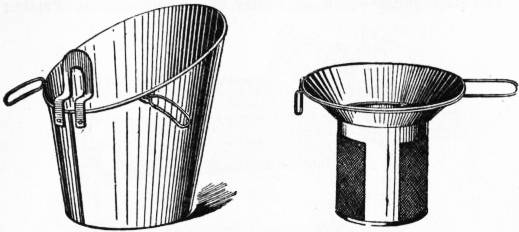
Fig. 1.—Milking-Pail. Fig. 2.—Milk Sieve.
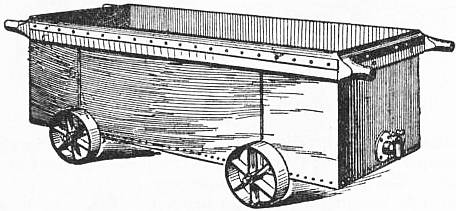
Fig. 3.—Rectangular Cheese-Vat.
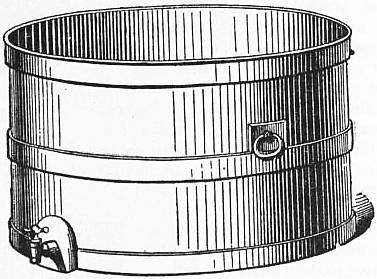
Fig. 4.—Cheese-Tub.
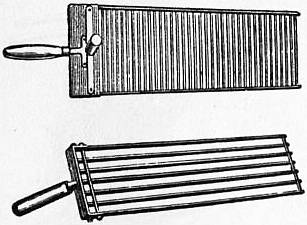
Fig. 5.—Curd-Knives.
The improved form of milking-pail shown in fig. 1 has rests or brackets, which the milker when seated on his stool places on his knees; he thus bears the weight on his thighs, and is entirely relieved of the strain involved in gripping the can between the knees. The milk sieve or strainer (fig. 2) is used to remove cow-hairs and any other mechanical impurity that may have fallen into the milk. A double straining surface is provided, the second being of very fine gauze placed vertically, so that the pressure of the milk does not force the dirt through; the strainer is easily washed. The cheese tub or vat receives the milk for cheese-making. The rectangular form shown in fig. 3 is a Cheshire cheese-vat, for steam. The inner vat is of tinned steel, and the outer is of iron and is fitted with pipes for steam supply. Round cheese-tubs (fig. 4) are made of strong sheets of steel, double tinned to render them lasting. They are fitted with a strong bottom hoop and bands round the sides, and can be double-jacketed for steam-heating if required. Curd-knives (fig. 5) are used for cutting the coagulated mass into cubes in order to liberate the whey. They are made of fine steel, with sharp edges; there are also wire curd-breakers. The object of the curd-mill (fig. 6) is to grind consolidated curd into small pieces, preparatory to salting and vatting; two spiked rollers work up to spiked breasts. Hoops, into which the curd is placed in order to acquire the shape of the cheese, are of wood or steel, the former being made of well-seasoned oak with iron bands (fig. 7), the latter of tinned steel. The cheese is more easily removed from the steel hoops and they are readily cleaned. The cheese-press (fig. 8) is used only for hard or “pressed” cheese, such as Cheddar. The arrangement is such that the pressure is continuous; in the case of soft cheese the curd is merely placed in moulds (figs. 9 and 10) of the required shape, and then taken cut to ripen, no pressure being applied. The cheese-room is fitted with easily-turned shelves, on which newly-made “pressed” cheeses are laid to ripen.
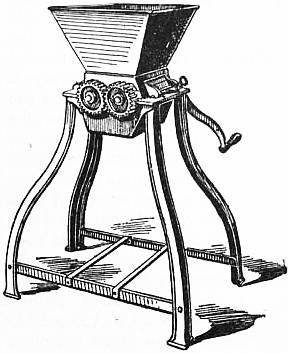
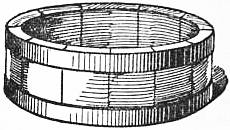
Fig. 6.—Curd-Mill. Fig. 7.—Hoop for Flat Cheese.
Fig. 8.—Cheese-Press. Fig. 9.—Cheese-Mould (Gervais). Fig. 10.—Cheese-Mould (Pont l’Évêque).
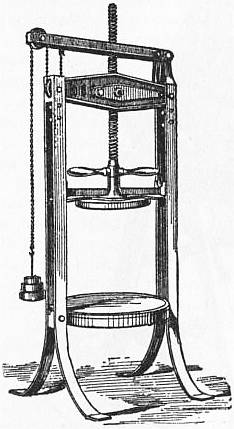
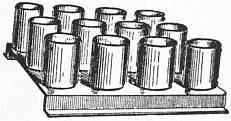
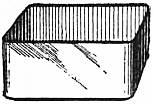
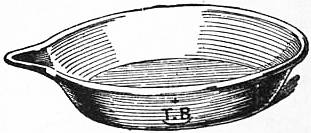
Fig. 11.—Milk-Pan.
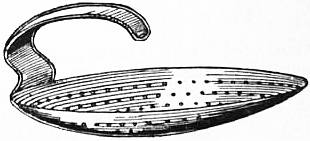
Fig. 12.—Skimmer.
In the butter dairy, when the centrifugal separator is not used, milk is “set” for cream-raising in the milk-pan (fig. 11), a shallow vessel of white porcelain, tinned steel or enamelled iron. The skimming-dish or skimmer (fig 12), made of tin, is for collecting the cream from the surface of the milk, whence it is transferred to the cream-crock (fig. 13), in which vessel the cream remains from one to three days, till it is required for churning. Many different kinds of churns are in use, and vary much in size, shape and fittings; the one illustrated in fig. 14 is a very good type of diaphragm churn. The butter-scoop (fig. 15) is of wood and is sometimes perforated; it is used for taking the butter out of the churn. The butter-worker (fig. 16) is employed for consolidating newly-churned butter, pressing out superfluous water and mixing in salt. More extended use, however, is now being made of the “Délaiteuse” butter dryer, a centrifugal machine that rapidly extracts the moisture from the butter, and renders the butter-worker unnecessary, whilst the butter produced has a better grain. Scotch hands (fig. 17), made of boxwood, are used for the lifting, moulding and pressing of butter.
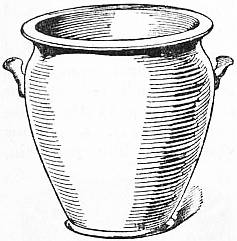
Fig. 13.—Cream-Crock.
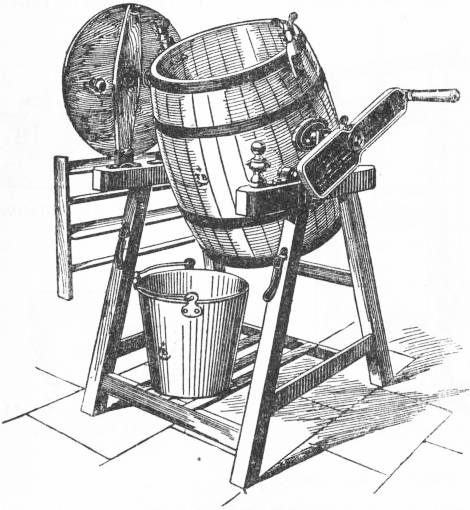
Fig. 14.—Churn.
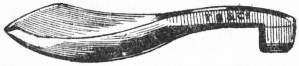
Fig. 15.—Butter-Scoop.
In the centrifugal cream-separator the new milk is allowed to flow into a bowl, which is caused to rotate on its own axis several thousand times per minute. The heavier portion which makes up the watery part of the milk flies to the outer circumference of the bowl, whilst the lighter particles of butter-fat are forced to travel in an inner zone. By a simple mechanical arrangement the separated milk is forced out at one tube and the cream at another, and they are collected in distinct vessels. Separators are made of all sizes, from small machines dealing with 10 or 20 up to 100 gallons an hour, and worked by hand (fig. 18), to large machines separating 150 to 440 gallons an hour, and worked by horse, steam or other power (fig. 19). Separation is found to be most effective at temperatures ranging in different machines from 80° to 98° F., though as high a temperature as 150° is sometimes employed. The most efficient separators remove nearly the whole of the butter-fat, the quantity of fat left in the separated milk falling in some cases to as low as 0.1. When cream is raised by the deep-setting method, from 0.2 to 0.4% of fat is left in the skim-milk; by the shallow-setting method from 0.3 to 0.5% of the fat is left behind. As a rule, therefore, “separated” milk is much poorer in fat than ordinary “skim” milk left by the cream-raising method in deep or shallow vessels.
The first continuous working separator was the invention of Dr de Laval. The more recent invention by Baron von Bechtolsheim of what are known as the Alfa discs, which are placed along the centre of the bowl of the separator, has much increased the separating capacity of the machines without adding to the power required. This has been of great assistance to dairy farmers by lessening the cost of the manufacture of butter, and thus enabling a large additional number of factories to be established in different parts of the world, particularly in Ireland, where these disc machines are very extensively used.
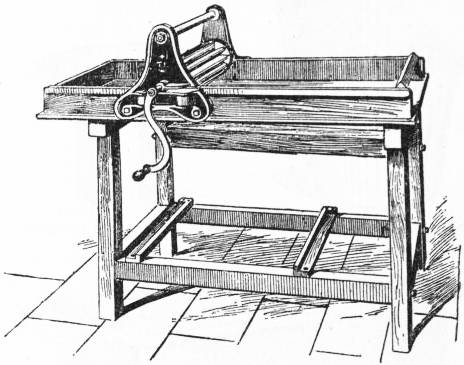
Fig. 16.—Butter-Worker.
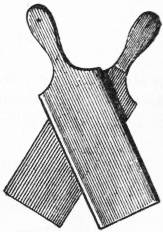
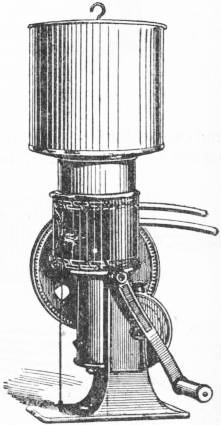
Fig. 17.—Scotch Hands. Fig. 18.—Hand-Separator.
The pasteurizer—so named after the French chemist Pasteur—affords a means whereby at the outset the milk is maintained at a temperature of 170° to 180° F. for a period of eight or ten minutes. The object of this is to destroy the tubercle bacillus, if it should happen to exist in the milk, whilst incidentally the bacilli associated with several other diseases communicable through the medium of milk would also be killed if they were present. Discordant results have been recorded by experimenters who have attempted to kill tubercle bacilli in milk by heating the latter in open vessels, thereby permitting the formation of a scum or “scalded layer” capable of protecting the tubercle bacilli, and enabling them to resist a higher temperature than otherwise would be fatal to them. At a temperature not much above 150° F. milk begins to acquire the cooked flavour which is objectionable to many palates, whilst its “body” is so modified as to lessen its suitability for creaming purposes. Three factors really enter into effective pasteurization of milk, namely (1) the temperature to which the milk is raised, (2) the length of time it is kept at that temperature, (3) the maintenance of a condition of mechanical agitation to prevent the formation of “scalded layer.” Within limits, what a higher temperature will accomplish if maintained for a very short time may be effected by a lower temperature continued over a longer period. The investigation of the problem forms the subject of a paper12 in the 17th Annual Report of the Wisconsin Agricultural Experiment Station, 1900. The following are the results of the experiments:—
1. An exposure of tuberculous milk in a tightly closed commercial pasteurizer for a period of ten minutes destroyed in every case the tubercle bacillus, as determined by the inoculation of such heated milk into susceptible animals like guinea-pigs.
2. Where milk is exposed under conditions that would enable a pellicle or membrane to form on the surface, the tubercle organism is able to resist the action of heat at 140° F. (60° C.) for considerably longer periods of time.
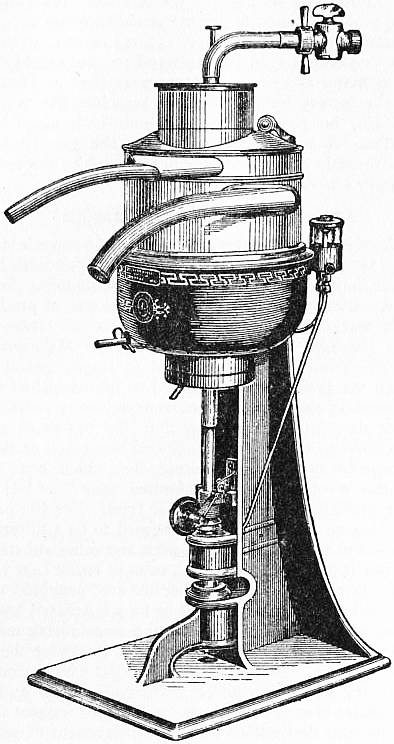
Fig. 19.—Power Separator.
3. Efficient pasteurization can be more readily accomplished in a closed receptacle such as is most frequently used in the commercial treatment of milk, than where the milk is heated in open bottles or open vats.
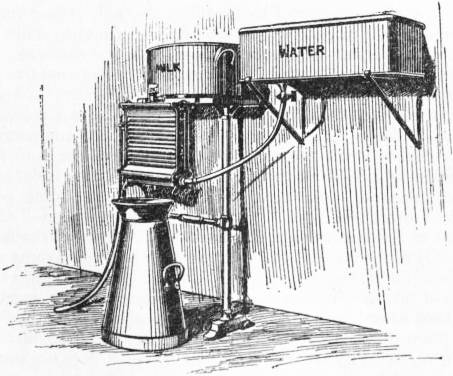
Fig. 20.—Refrigerator and Can.
4. It is recommended, in order thoroughly to pasteurize milk so as to destroy any tubercle bacilli which it may contain, without in any way injuring its creaming properties or consistency, to heat the same in closed pasteurizers for a period of not less than twenty minutes at 140° F.
Under these conditions one may be certain that disease bacteria such as the tubercle bacillus will be destroyed without the milk or cream being injured in any way. For over a year this new standard has been in constant use in the Wisconsin University Creamery, and the results, from a purely practical point of view, reported a year earlier by Farrington and Russell,13 have been abundantly confirmed.
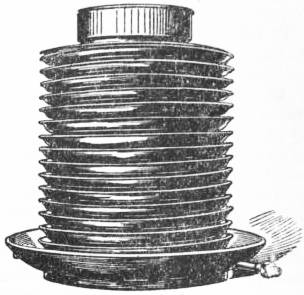
Fig. 21.—Cyclindrical Cooler or Refrigerator.
Fig. 22.—Butyrometer.
Dairy engineers have solved the problem as to how large bodies of milk may be pasteurized, the difficulty of raising many hundreds or thousands of gallons of milk up to the required temperature, and maintaining it at that heat for a period of twenty minutes, having been successfully dealt with. The plant usually employed provides for the thorough filtration of the milk as it comes in from the farms, its rapid heating in a closed receiver and under mechanical agitation up to the desired temperature, its maintenance thereat for the requisite time, and finally its sudden reduction to the temperature of cold water through the agency of a refrigerator, to be next noticed.
Refrigerators are used for reducing the temperature of milk to that of cold water, whereby its keeping properties are enhanced. The milk flows down the outside of the metal refrigerator (fig. 20), which is corrugated in order to provide a larger cooling surface, whilst cold water circulates through the interior of the refrigerator. The conical vessel into which the milk is represented as flowing from the refrigerator in fig. 20 is absurdly called a “milk-churn,” whereas milk-can is a much more appropriate name. For very large quantities of milk, such as flow from a pasteurizing plant, cylindrical refrigerators (fig. 21), made of tinned copper, are available; the cold water circulates inside, and the milk, flowing down the outside in a very thin sheet, is rapidly cooled from a temperature of 140° F. or higher to 1° above the temperature of the water.
The fat test for milk was originally devised by Dr S. M. Babcock, of the Wisconsin, U.S.A., experiment station. It combines the principle of centrifugal force with simple chemical action. Besides the machine itself and its graduated glass vessels, the only requirements are sulphuric acid of standard strength and warm water. The machines—often termed butyrometers—are commonly made to hold from two up to two dozen testers. After the tubes or testers have been charged, they are put in the apparatus, which is rapidly rotated as shown (fig. 22); in a few minutes the test is complete, and with properly graduated vessels the percentage of fat can be read off at a glance. The butyrometer is extremely useful, alike for measuring periodically the fat-producing capacity of individual cows in a herd, for rapidly ascertaining the percentage of fat in milk delivered to factories and paying for such milk on the basis of quality, and for determining the richness in fat of milk supplied for the urban milk trade. Any intelligent person can soon learn to work the apparatus, but its efficiency is of course dependent upon the accuracy of the measuring vessels. To ensure this the board of agriculture have made arrangements with the National Physical Laboratory, Old Deer Park, Richmond, Surrey, to verify at a small fee the pipettes, measuring-glasses, and test-bottles used in connexion with the centrifugal butyrometer, which in recent years has been improved by Dr N. Gerber of Zürich.
Dairy Factories
In connexion with co-operative cheese-making the merit of having founded the first “cheesery” or cheese factory is generally credited to Jesse Williams, who lived near Rome, Oneida county, N.Y. The system, therefore, was of American origin. Williams was a skilled cheese-maker, and the produce of his dairy sold so freely, at prices over the average, that he increased his output of cheese by adding to his own supply of milk other quantities which he obtained from his neighbours. His example was so widely followed that by the year 1866 there had been established close upon 500 cheese factories in New York state alone. In 1870 two co-operative cheeseries were at work in England, one in the town of Derby and one at Longford in the same county. There are now thousands of cheeseries in the United States and Canada, and also many “creameries,” or butter factories, for the making of high-class butter.
The first creamery was that of Alanson Slaughter, and it was built near Wallkill, Orange county, N.Y., in 1861, or ten years later than the first cheese factory; it dealt daily with the milk of 375 cows. Cheeseries and creameries would almost certainly have become more numerous than they are in England but for the rapidly expanding urban trade in country milk. The development of each, indeed, has been contemporaneous since 1871, and they are found to work well in conjunction one with the other—that is to say, a factory is useful for converting surplus milk into cheese or butter when the milk trade is overstocked, whilst the trade affords a convenient avenue for the sale of milk whenever this may happen to be preferable to the making of cheese or butter. Extensive dealers in milk arrange for its conversion into cheese or butter, as the case may be, at such times as the milk market needs relief, and in this way a cheesery serves as a sort of economic safety-valve to the milk trade. The same cannot always be said of creameries, because the machine-skimmed milk of some of these establishments has been far too much used to the prejudice of the legitimate milk trade in urban districts. Be this as it may, the operations of cheeseries and creameries in conjunction with the milk trade have led to the diminution of home dairying. A rapidly increasing population has maintained, and probably increased, its consumption of milk, which has obviously diminished the farmhouse production of cheese, and also of butter. The foreign competitor has been less successful with cheese than with butter, for he is unable to produce an article qualified to compete with the best that is made in Great Britain. In the case of butter, on the other hand, the imported article, though not ever surpassing the best home-made, is on the average much better, especially as regards uniformity of quality. Colonial and foreign producers, however, send into the British markets as a rule only the best of their butter, as they are aware that their inferior grades would but injure the reputation their products have acquired.