VOLUME VII SLICE IX Dagupan to David (continued 10)
Reading edition
DARESTE DE LA CHAVANNE, RODOLPHE MADELEINE CLÉOPHAS (1824- ), French jurist, was born in Paris on the 25th of December 1824. He studied at the École des Chartes and the École de Droit, and starting early on a legal career he rose to be counsellor to the court of cassation (1877 to 1900). His first publication was an Essai sur François Hotman (1850), completed later by his publication of Hotman’s correspondence in the Revue historique (1876), and he devoted the whole of his leisure to legal history. Of his writings may be mentioned Les Anciennes Lois de l’Islande (1881); Mémoire sur les anciens monuments du droit de la Hongrie (1885), and Études d’histoire du droit (1889). On Greek law he wrote some notable works: Du prêt à la grosse chez les Athéniens (1867); Les Inscriptions hypothécaires en Grèce (1885), La Science du droit en Grèce: Platon, Aristote, Thêophraste (1893), and Étude sur la loi de Gortyne (1885). He collaborated with Théodore Reinach and B. Haussoullier in their Recueil des inscriptions juridiques grecques (1905), and his name is worthily associated with the edition of Philippe de Beaumanoir’s Coutumes de Beauvaisis, published by Salmon (2 vols., 1899, 1900).
DARFUR, a country of east central Africa, the westernmost state of the Anglo-Egyptian Sudan. It extends from about 10° N. to 16° N. and from 21° E. to 27° 30′ E., has an area of some 150,000 sq. m., and an estimated population of 750,000. It is bounded N. by the Libyan desert, W. by Wadai (French Congo), S. by the Bahr-el-Ghazal and E. by Kordofan. The two last-named districts are mudirias (provinces) of the Anglo-Egyptian Sudan. The greater part of the country is a plateau from 2000 to 3000 ft. above sea-level. A range of mountains of volcanic origin, the Jebel Marra, runs N. and S. about the line of the 24° E. for a distance of over 100 m., its highest points attaining from 5000 to 6000 ft. East to west this chain extends about 80 m. Eastward the mountains fall gradually into sandy, bush-covered steppes. North-east of Jebel Marra lies the Jebel Medob (3500 ft. high), a range much distorted by volcanic action, and Bir-el-Melh, an extinct volcano with a crater 150 ft. deep. South of Jebel Marra are the plains of Dar Dima and Dar Uma; S.W. of the Marra the plain is 4000 ft. above the sea. The watershed separating the basins of the Nile and Lake Chad runs north and south through the centre of the country. The mountains are scored by numerous khors, whose lower courses can be traced across the tableland. The khors formerly contained large rivers which flowed N.E. and E. to the Nile, W. and S.W. to Lake Chad, S. and S.E. to the Bahr-el-Ghazal. The streams going N.E. drain to the Wadi Melh, a dry river-bed which joins the Nile near Debba, but on reaching the plain the waters sink into the sandy soil and disappear. The torrents flowing directly east towards the Nile also disappear in the sandy deserts. The khors in the W., S.W. and S.,—the most fertile part of Darfur—contain turbulent torrents in the rainy season, when much of the southern district is flooded. Not one of the streams is perennial, but in times of heavy rainfall the waters of some khors reach the Bahr-el-Homr tributary of the Bahr-el-Ghazal. (For some 200 m. the Bahr-el-Homr marks the southern frontier of the country.) In the W. and S. water can always be obtained in the dry season by digging 5 or 6 ft. below the surface of the khors.
The climate, except in the south, where the rains are heavy and the soil is a damp clay, is healthy except after the rains. The rainy season lasts for three months, from the middle of June to the middle of September. In the neighbourhood of the khors the vegetation is fairly rich. The chief trees are the acacias whence gum is obtained, and baobab (Adansonia digitata); while the sycamore and, in the Marra mountains, the Euphorbia candelabrum are also found. In the S.W. are densely forested regions. Cotton and tobacco are indigenous. The most fertile land is found on the slopes of the mountains, where wheat, durra, dukhn (a kind of millet and the staple food of the people) and other grains are grown. Other products are sesame, cotton, cucumbers, water-melons and onions.
Copper is obtained from Hofrat-el-Nahas in the S.E., iron is wrought in the S.W.; and there are deposits of rock-salt in various places. The copper mines (in 9° 48′ N. 24° 5′ E.) are across the Darfur frontier in the Bahr-el-Ghazal province. The vein runs N.W. and S.E. and in places rises in ridges 2 ft. above the general level of ground. There is an immense quantity of ore, (silicate and carbonate) specimens containing 14% of metal. Camels and cattle are both numerous and of excellent breeds. Some of the Arab tribes, such as the Baggara, breed only cattle, those in the north and east confine themselves to rearing camels. Horses are comparatively rare; they are a small but sturdy breed. Sheep and goats are numerous. The ostrich, common in the eastern steppes, is bred by various Arab tribes, its feathers forming a valuable article of trade.
Inhabitants.—The population of Darfur consists of negroes and Arabs. The negro For, forming quite half the inhabitants, occupy the central highlands and part of the Dar Dima and Dar Uma districts; they speak a special language, and are subdivided into numerous tribes, of which the most influential are the Masabat, the Kunjara and the Kera. They are of middle height, and have rather irregular features. The For are described as clean and industrious, somewhat fanatical, but generally amenable to civilization, and freedom-loving. The Massalit are a negro tribe which, breaking off from the For some centuries back, have now much Arab blood, and speak Arabic; while the Tunjur are an Arab tribe which must have arrived in the Sudan at a very early date, as they have incorporated a large For element, and no longer profess Mahommedanism. The Dago (Tago) formerly inhabited Jebel Marra, but they have been driven to the south and west, where they maintain a certain independence in Dar Sula, but are treated as inferiors by the For. The Zaghawa, who inhabit the northern borders, are on the contrary regarded by the For as their equals, and have all the prestige of a race that at one time made its influence felt as far as Bornu. Among other tribes may be mentioned the Berti and Takruri, the Birgirid, the Beraunas, and immigrants from Wadai and Bagirmi, and Fula from west of Lake Chad. Genuine Arab tribes, e.g. the Baggara and Homr, are numerous, and they are partly nomadic and partly settled. The Arabs have not, generally speaking, mixed with the negro tribes. They are great hunters, making expeditions into the desert for five or six days at a time in search of ostriches.
Slaves, ostrich feathers, gum and ivory used to be the chief articles of trade, a caravan going annually by the Arbain (“Forty Days”) road to Assiut in Egypt and taking back cloth, fire-arms and other articles. The slave trade has ceased, but feathers, gum and ivory still constitute the chief exports of the country. The principal imports are cotton goods, sugar and tea. There is also an active trade in camels and cattle.
The internal administration of the country is in the hands of the sultan, who is officially recognized as the agent of the Sudan government. The administrative system resembles that of other Mahommedan countries.
Towns.—The capital is El-Fasher, pop. about 10,000, on the western bank of the Wadi Tendelty in an angle formed by the junction of that wadi with the Wadi-el-Kho, one of the streams which flow towards the Bahr-el-Homr. Fasher is the residence of the sultan. There are a few fine buildings, but the town consists mainly of tukls and box-shaped straw sheds. It is 500 m. W.S.W. of Khartum. Dara, a small market town, is 110 m. S. of El-Fasher. Shakka is in the S.E. of the country near the Bahr-el-Homr, and was formerly the headquarters of the slave dealers.
History.—The Dago or Tago negroes, inhabitants of Jebel Marra, appear to have been the dominant race in Darfur in the earliest period to which the history of the country goes back. How long they ruled is uncertain, little being known of them save a list of kings. According to tradition the Tago dynasty was displaced, and Mahommedanism introduced, about the 14th century, by Tunjur Arabs, who reached Darfur by way of Bornu and Wadai. The first Tunjur king was Ahmed-el-Makur, who married the daughter of the last Tago monarch. Ahmed reduced many unruly chiefs to submission, and under him the country prospered. His great-grandson, the sultan Dali, a celebrated figure in Darfur histories, was on his mother’s side a For, and thus was effected a union between the negro and Arab races. Dali divided the country into provinces, and established a penal code, which, under the title of Kitab Dali or Dali’s Book, is still preserved, and shows principles essentially different from those of the Koran. His grandson Soleiman (usually distinguished by the Forian epithet Solon, the Arab or the Red) reigned from 1596 to 1637, and was a great warrior and a devoted Mahommedan. Soleiman’s grandson, Ahmed Bahr (1682-1722), made Islam the religion of the state, and increased the prosperity of the country by encouraging immigration from Bornu and Bagirmi. His rule extended east of the Nile as far as the banks of the Atbara. Under succeeding monarchs the country, involved in wars with Sennar and Wadai, declined in importance. Towards the end of the 18th century a sultan named Mahommed Terab led an army against the Funj, but got no further than Omdurman. Here he was stopped by the Nile, and found no means of getting his army across the river. Unwilling to give up his project, Terab remained at Omdurman for months. He was poisoned by his wife at the instigation of disaffected chiefs, and the army returned to Darfur. The next monarch was Abd-er-Rahman, surnamed el-Raschid or the Just. It was during his reign that Napoleon Bonaparte was campaigning in Egypt; and in 1799 Abd-er-Rahman wrote to congratulate the French general on his defeat of the Mamelukes. To this Bonaparte replied by asking the sultan to send him by the next caravan 2000 black slaves upwards of sixteen years old, strong and vigorous. To Abd-er-Rahman likewise is due the present situation of the Fasher, or royal township. The capital had formerly been at a place called Kobbé. Mahommed-el-Fadhl, his son, was for some time under the control of an energetic eunuch, Mahommed Kurra, but he ultimately made himself independent, and his reign lasted till 1839, when he died of leprosy. He devoted himself largely to the subjection of the semi-independent Arab tribes who lived in the country, notably the Rizighat, thousands of whom he slew. In 1821 he lost the province of Kordofan, which in that year was conquered by the Egyptians. Of his forty sons, the third, Mahommed Hassin, was appointed his successor. Hassin is described as a religious but avaricious man. In the later part of his reign he became involved in trouble with the Arab slave raiders who had seized the Bahr-el-Ghazal, looked upon by the Darfurians as their especial “slave preserve.” The negroes of Bahr-el-Ghazal paid tribute of ivory and slaves to Darfur, and these were the chief articles of merchandise sold by the Darfurians to the Egyptian traders along the Arbain road to Assiut. The loss of the Bahr-el-Ghazal caused therefore much annoyance to the people of Darfur. Hassin died in 1873, blind and advanced in years, and the succession passed to his youngest son Ibrahim, who soon found himself engaged in a conflict with Zobeir (q.v.), the chief of the Bahr-el-Ghazal slave traders, and with an Egyptian force from Khartum. The war resulted in the destruction of the kingdom. Ibrahim was slain in battle in the autumn of 1874, and his uncle Hassab Alla, who sought to maintain the independence of his country, was captured in 1875 by the troops of the khedive, and removed to Cairo with his family. The Darfurians were restive under Egyptian rule. Various revolts were suppressed, but in 1879 General Gordon (then governor-general of the Sudan) suggested the reinstatement of the ancient royal family. This was not done, and in 1881 Slatin Bey (Sir Rudolf von Slatin) was made governor of the province. Slatin defended the province against the forces of the Mahdi, who were led by a Rizighat sheik named Madibbo, but was obliged to surrender (December 1883), and Darfur was incorporated in the Mahdi’s dominions. The Darfurians found Dervish rule as irksome as that of the Egyptians had been, and a state of almost constant warfare ended in the gradual retirement of the Dervishes from Darfur. Following the overthrow of the khalifa at Omdurman in 1898 the new (Anglo-Egyptian) Sudan government recognized (1899) Ali Dinar, a grandson of Mahommed-el-Fadhl, as sultan of Darfur, on the payment by that chief of an annual tribute of £500. Under Ali Dinar, who during the Mahdia had been kept a prisoner in Omdurman, Darfur enjoyed a period of peace.
The first European traveller known to have visited Darfur was William George Browne (q.v.), who spent two years (1793-1795) at Kobbé. Sheik Mahommed-el-Tounsi travelled in 1803 through various regions of Africa, including Darfur, in search of Omar, his father, and afterwards gave to the world an account of his wanderings, which was translated into French in 1845 by M. Perron. Gustav Nachtigal in 1873 spent some months in Darfur, and since that time the country has become well known through the journeys of Gordon, Slatin and others.
Authorities.—Browne’s account of Darfur will be found in his Travels in Africa, Egypt and Syria (London, 1799); Nachtigal’s Sahara und Sudan gives the results of that traveller’s observations. The first ten chapters of Slatin Pasha’s book Fire and Sword in the Sudan (English edition, London, 1896) contain much information concerning the country, its history, and a full account of the overthrow of Egyptian authority by the Mahdi. See also The Anglo-Egyptian Sudan (London, 1905), edited by Count Gleichen, and the bibliography given under Sudan.
DARGAI, the name of a mountain peak and a frontier station in the north-west Frontier Province of India. The mountain peak is situated on the Samana Range, and the Kohat border, and is famous for the stand made there by the Afridis and Orakzais in the Tirah Campaign. (See Tirah Campaign.) Dargai station is situated on the Peshawar border, and is the terminus of the frontier railway running from Nowshera to the Malakand Pass.
DARGOMIJSKY, ALEXANDER SERGEIVICH (1813-1869), Russian composer, was born in 1813, and educated in St Petersburg. He was already known as a talented musical amateur when in 1833 he met Glinka and was encouraged to devote himself to composition. His light opera Esmeralda was written in 1839, and his Roussalka was performed in 1856, but he had but small success or recognition either at home or abroad, except in Belgium, till the ’sixties, when he became one of Balakirev’s circle. His opera The Stone Guest then became famous among the progressive Russian school, though it was not performed till 1872. Dargomijsky died in January 1869. His compositions include a number of songs, and some orchestral pieces.
DARIAL, a gorge in the Caucasus, at the east foot of Mt. Kasbek, pierced by the river Terek for a distance of 8 m. between vertical walls of rock (5900 ft.). It is mentioned in the Georgian annals under the names of Ralani, Dargani, Darialani; the Persians and Arabs knew it as the Gate of the Alans; Strabo calls it Porta Caucasica and Porta Cumana; Ptolemy, Porta Sarmatica; it was sometimes known as Portae Caspiae (a name bestowed also on the “gate” or pass beside the Caspian at Derbent); and the Tatars call it Darioly. Being the only available passage across the Caucasus, it has been fortified since a remote period—at least since 150 B.C. In Russian poetry it has been immortalized by Lermontov. The present Russian fort, Darial, which guards this section of the Georgian military road, is at the northern issue of the gorge, at an altitude of 4746 ft.
DARIEN, a district covering the eastern part of the isthmus joining Central and South America. It is mainly within the republic of Panama, and gives its name to a gulf of the Carribbean Sea. Darien is of great interest in the history of geographical discovery. It was reconnoitred in the first year of the 16th century by Rodrigo Bastidas of Seville; and the first settlement was Santa Maria la Antigua, situated on the small Darien river, north-west of the mouth of the Atrato. In 1513 Vasco Nuñez de Balboa stood “silent upon a peak in Darien,”1 and saw the Pacific at his feet stretching inland in the Gulf of San Miguel; and for long this narrow neck of land seemed alternately to proffer and refuse a means of transit between the two oceans. The first serious attempt to turn the isthmus to permanent account as a trade route dates from the beginning of the 18th century, and forms an interesting chapter in Scottish history. In 1695 an act was passed by the Scottish parliament giving extensive powers to a company trading to Africa and the Indies; and this company, under the advice of one of the most remarkable economists of the period, William Paterson (q.v.), determined to establish a colony on the isthmus of Darien as a general emporium for the commerce of all the nations of the world. Regarded with disfavour both in England and Holland, the project was taken up in Scotland with the enthusiasm of national rivalry towards England, and the “subscriptions sucked up all the money in the country.” On the 26th of July 1698 the pioneers set sail from Leith amid the cheers of an almost envious multitude; and on the 4th of November, with the loss of only fifteen out of 1200 men, they arrived at Darien, and took up their quarters in a well-defended spot, with a good harbour and excellent outlook. The country they named New Caledonia, and two sites selected for future cities were designated respectively New Edinburgh and New St Andrews. At first all seemed to go well; but by and by lack of provisions, sickness and anarchy reduced the settlers to the most miserable plight; and in June 1699 they re-embarked in three vessels, a weak and hopeless company, to sail whithersoever Providence might direct. Meanwhile a supplementary expedition had been prepared in Scotland; two vessels were despatched in May, and four others followed in August. But this venture proved even more unfortunate than the former. The colonists arrived broken in health; their spirits were crushed by the fate of their predecessors, and embittered by the harsh fanaticism of the four ministers whom the general assembly of the Church of Scotland had sent out to establish a regular presbyterial organization. The last addition to the settlement was the company of Captain Alexander Campbell of Fonab, who arrived only to learn that a Spanish force of 1500 or 1600 men lay encamped at Tubacanti, on the river Santa Maria, waiting for the appearance of a Spanish squadron in order to make a combined attack on the fort. Captain Campbell, on the second day after his arrival, marched with 200 men across the isthmus to Tubacanti, stormed the camp in the night-time, and dispersed the Spanish force. On his return to the fort on the fifth day he found it besieged by the Spaniards from the men-of-war; and, after a vain attempt to maintain its defence, he succeeded with a few companions in making his escape in a small vessel. A capitulation followed, and the Darien colony was no more. Of those who had taken part in the enterprise only a miserable handful ever reached their native land.
See J. H. Burton, The Darien Papers (Bannatyne Club, 1849); Macaulay, History of England (London, 1866); and A. Lang, History of Scotland, vol. iv. (Edinburgh, 1907).
1 Keats, in his famous sonnet beginning:—“Much have I travelled in the realms of gold,” of which this is the concluding line, inaccurately substitutes Cortez for Balboa.
DARIUS (Pers. Dārayavaush; Old Test. Daryavesh), the name of three Persian kings.
1. Darius the Great, the son of Hystaspes (q.v.). The principal source for his history is his own inscriptions, especially the great inscription of Behistun (q.v.), in which he relates how he gained the crown and put down the rebellions. In modern times his veracity has often been doubted, but without any sufficient reason; the whole tenor of his words shows that we can rely upon his account. The accounts given by Herodotus and Ctesias of his accession are in many points evidently dependent on this official version, with many legendary stories interwoven, e.g. that Darius and his allies left the question as to which of them should become king to the decision of their horses, and that Darius won the crown by a trick of his groom.
Darius belonged to a younger branch of the royal family of the Achaemenidae. When, after the suicide of Cambyses (March 521), the usurper Gaumata ruled undisturbed over the whole empire under the name of Bardiya (Smerdis), son of Cyrus, and no one dared to gainsay him, Darius, “with the help of Ahura-mazda,” attempted to regain the kingdom for the royal race. His father Hystaspes was still alive, but evidently had not the courage to urge his claims. Assisted by six noble Persians, whose names he proclaims at the end of the Behistun inscription, he surprised and killed the usurper in a Median fortress (October 521; for the chronology of these times cf. E. Meyer, Forschungen zur alten Geschichte, ii. 472 ff.), and gained the crown. But this sudden change was the signal for an attempt on the part of all the eastern provinces to regain their independence. In Susiana, Babylon, Media, Sagartia, Margiana, usurpers arose, pretending to be of the old royal race, and gathered large armies around them; in Persia itself Vahyazdāta imitated the example of Gaumata and was acknowledged by the majority of the people as the true Bardiya. Darius with only a small army of Persians and Medes and some trustworthy generals overcame all difficulties, and in 520 and 519 all the rebellions were put down (Babylon rebelled twice, Susiana even three times), and the authority of Darius was established throughout the empire.
Darius in his inscriptions appears as a fervent believer in the true religion of Zoroaster. But he was also a great statesman and organizer. The time of conquests had come to an end; the wars which Darius undertook, like those of Augustus, only served the purpose of gaining strong natural frontiers for the empire and keeping down the barbarous tribes on its borders. Thus Darius subjugated the wild nations of the Pontic and Armenian mountains, and extended the Persian dominion to the Caucasus; for the same reasons he fought against the Sacae and other Turanian tribes. But by the organization which he gave to the empire he became the true successor of the great Cyrus. His organization of the provinces and the fixing of the tributes is described by Herodotus iii. 90 ff., evidently from good official sources. He fixed the coinage and introduced the gold coinage of the Daric (which is not named after him, as the Greeks believed, but derived from a Persian word meaning “gold”; in Middle Persian it is called zarīg). He tried to develop the commerce of the empire, and sent an expedition down the Kabul and the Indus, led by the Carian captain Scylax of Caryanda, who explored the Indian Ocean from the mouth of the Indus to Suez. He dug a canal from the Nile to Suez, and, as the fragments of a hieroglyphic inscription found there show, his ships sailed from the Nile through the Red Sea by Saba to Persia. He had connexions with Carthage (i.e. the Karkā of the Nakshi Rustam inscr.), and explored the shores of Sicily and Italy. At the same time he attempted to gain the good-will of the subject nations, and for this purpose promoted the aims of their priests. He allowed the Jews to build the Temple of Jerusalem. In Egypt his name appears on the temples which he built in Memphis, Edfu and the Great Oasis. He called the high-priest of Saïs, Uzahor, to Susa (as we learn from his inscription in the Vatican), and gave him full powers to reorganize the “house of life,” the great medical school of the temple of Saïs. In the Egyptian traditions he is considered as one of the great benefactors and lawgivers of the country (Herod. ii. 110, Diod. i. 95). In similar relations he stood to the Greek sanctuaries (cf. his rescript to “his slave” Godatas, the inspector of a royal park near Magnesia, on the Maeander, in which he grants freedom of taxes and forced labour to the sacred territory of Apollo. See Cousin and Deschamps, Bulletin de corresp. hellén., xiii. (1889), 529, and Dittenberger, Sylloge inscr. graec., 2); all the Greek oracles in Asia Minor and Europe therefore stood on the side of Persia in the Persian wars and admonished the Greeks to attempt no resistance.
About 512 Darius undertook a war against the Scythians. A great army crossed the Bosporus, subjugated eastern Thrace, and crossed the Danube. The purpose of this war can only have been to attack the nomadic Turanian tribes in the rear and thus to secure peace on the northern frontier of the empire. It was based upon a wrong geographical conception; even Alexander and his Macedonians believed that on the Hindu Kush (which they called Caucasus) and on the shores of the Jaxartes (which they called Tanais, i.e. Don) they were quite near to the Black Sea. Of course the expedition undertaken on these grounds could not but prove a failure; having advanced for some weeks into the Russian steppes, Darius was forced to return. The details given by Herodotus (according to him Darius had reached the Volga!) are quite fantastical; and the account which Darius himself had given on a tablet, which was added to his great inscription in Behistun, is destroyed with the exception of a few words. (See R. W. Macan, Herodotus, vol. ii. appendix 3; G. B. Grundy, Great Persian War, pp. 48-64; J. B. Bury in Classical Review, July 1897.)
Although European Greece was intimately connected with the coasts of Asia Minor, and the opposing parties in the Greek towns were continually soliciting his intervention, Darius did not meddle with their affairs. The Persian wars were begun by the Greeks themselves. The support which Athens and Eretria gave to the rebellious Ionians and Carians made their punishment inevitable as soon as the rebellion had been put down. But the first expedition, that of Mardonius, failed on the cliffs of Mt. Athos (492), and the army which was led into Attica by Datis in 490 was beaten at Marathon. Before Darius had finished his preparations for a third expedition an insurrection broke out in Egypt (486). In the next year Darius died, probably in October 485, after a reign of thirty-six years. He is one of the greatest rulers the east has produced.
2. Darius II., Ochus. Artaxerxes I., who died in the beginning of 424, was followed by his son Xerxes II. But after a month and a half he was murdered by his brother Secydianus, or Sogdianus (the form of the name is uncertain). Against him rose a bastard brother, Ochus, satrap of Hyrcania, and after a short fight killed him, and suppressed by treachery the attempt of his own brother Arsites to imitate his example (Ctesias ap. Phot. 44; Diod. xii. 71, 108; Pausan. vi. 5, 7). Ochus adopted the name Darius (in the chronicles called Nothos, the bastard). Neither Xerxes II. nor Secydianus occurs in the dates of the numerous Babylonian tablets from Nippur; here the dates of Darius II. follow immediately on those of Artaxerxes I. Of Darius II.’s reign we know very little (a rebellion of the Medes in 409 is mentioned in Xenophon, Hellen. i. 2. 19), except that he was quite dependent on his wife Parysatis. In the excerpts from Ctesias some harem intrigues are recorded, in which he played a disreputable part. As long as the power of Athens remained intact he did not meddle in Greek affairs; even the support which the Athenians in 413 gave to the rebel Amorges in Caria would not have roused him (Andoc. iii. 29; Thuc. viii. 28, 54; Ctesias wrongly names his father Pissuthnes in his stead; an account of these wars is contained in the great Lycian stele from Xanthus in the British Museum), had not the Athenian power broken down in the same year before Syracuse. He gave orders to his satraps in Asia Minor, Tissaphernes and Pharnabazus, to send in the overdue tribute of the Greek towns, and to begin war with Athens; for this purpose they entered into an alliance with Sparta. In 408 he sent his son Cyrus to Asia Minor, to carry on the war with greater energy. In 404 he died after a reign of nineteen years, and was followed by Artaxerxes II.
3. Darius III., Codomannus. The eunuch Bagoas (q.v.), having murdered Artaxerxes III. in 338 and his son Arses in 336, raised to the throne a distant relative of the royal house, whose name, according to Justin x. 3, was Codomannus, and who had excelled in a war against the Cadusians (cf. Diod. xvii. 5 ff., where his father is called Arsames, son of Ostanes, a brother of Artaxerxes). The new king, who adopted the name of Darius, took warning by the fate of his predecessors, and saved himself from it by forcing Bagoas to drink the cup himself. Already in 336 Philip II. of Macedon had sent an army into Asia Minor, and in the spring of 334 the campaign of Alexander began. In the following year Darius himself took the field against the Macedonian king, but was beaten at Issus and in 331 at Arbela. In his flight to the east he was deposed and killed by Bessus (July 330).
The name Darius was also borne by many later dynasts of Persian origin, among them kings of Persis (q.v.), Darius of Media Atropatene who was defeated by Pompeius, and Darius, king of Pontus in the time of Antony.
(Ed. M.)
DARJEELING, a hill station and district of British India, in the Bhagalpur division of Bengal. The sanatorium is situated 367 m. by rail north of Calcutta. In 1901 it had a population of 16,924. It is the summer quarters of the Bengal government and has a most agreeable climate, which neither exceeds 80° F. in summer, nor falls below 30° in winter. The great attraction of Darjeeling is its scenery, which is unspeakably grand. The view across the hills to Kinchinjunga discloses a glittering white wall of perpetual snow, surrounded by towering masses of granite. There are several schools of considerable size for European boys and girls, and a government boarding school at Kurseong. The buildings and the roads suffered severely from the earthquake of the 12th of June 1897. But a more terrible disaster occurred in October 1899, when a series of landslips carried away houses and broke up the hill railway. The total value of the property destroyed was returned at £160,000.
The district of Darjeeling comprises an area of 1164 sq. m. It consists of two well-defined tracts, viz. the lower Himalayas to the south of Sikkim, and the tarai, or plains, which extend from the south of these ranges as far as the northern borders of Purnea district. The plains from which the hills take their rise are only 300 ft. above sea-level; the mountains ascend abruptly in spurs of 6000 to 10,000 ft. in height. The scenery throughout the hills is picturesque, and in many parts magnificent. The two highest mountains in the world, Kinchinjunga in Sikkim (28,156 ft.) and Everest in Nepal (29,002 ft.), are visible from the town of Darjeeling. The principal peaks within the district are—Phalut (11,811 ft.), Subargum (11,636), Tanglu (10,084), Situng and Sinchal Pahai (8163). The chief rivers are the Tista, Great and Little Ranjit, Ramman, Mahananda, Balasan and Jaldhaka. None of them is navigable in the mountain valleys; but the Tista, after it debouches on the plains, can be navigated by cargo boats of considerable burthen. Bears, leopards and musk deer are found on the higher mountains, deer on the lower ranges, and a few elephants and tigers on the slopes nearest to the plains. In the lowlands, tigers, rhinoceroses, deer and wild hogs are abundant. A few wolves are also found. Of small game, hares, jungle fowl, peacocks, partridges, snipe, woodcock, wild ducks and geese, and green pigeons are numerous in the tarai, and jungle fowl and pheasants in the hills. The mahseer fish is found in the Tista.
In 1901 the population was 249,117, showing an increase of 12% since 1891, compared with an increase of 43% in the previous decade. The inhabitants of the hilly tract consist to a large extent of Nepali immigrants and of aboriginal highland races; in the tarai the people are chiefly Hindus and Mahommedans. The Lepchas are considered to be the aboriginal inhabitants of the hilly portion of the district. They are a fine, frank race, naturally open-hearted and free-handed, fond of change and given to an out-door life; but they do not seem to improve on being brought into contact with civilization. It is thought that they are now being gradually driven out of the district, owing to the increase of regular cultivation, and to the government conservation of the forests. They have no word for plough in their language, and they still follow the nomadic form of tillage known as jum cultivation. This consists in selecting a spot of virgin soil, clearing it of forest and jungle by burning, and scraping the surface with the rudest agricultural implements. The productive powers of the land become exhausted in a few years, when the clearing is abandoned, a new site is chosen, and the same operations are carried on de novo. The Lepchas are also the ordinary out-door labourers on the hills. They have no caste distinctions but speak of themselves as belonging to one of nine septs or clans, who all eat together and intermarry with each other. In the upper or northern tarai, along the base of the hills, the Mechs form the principal ethnical feature. This tribe inhabits the deadly jungle with impunity, and cultivates cotton, rice and other ordinary crops, by the jum process described above. The cultivation of tea was introduced in 1856, and is now a large industry. Cinchona cultivation was introduced by the government in 1862, and has since been taken up by private enterprise. There is a coal mine at Daling. The Darjeeling Himalayan railway of 2 ft. gauge, opened in 1880, runs for 50 m. from Siliguri in the plains on the Eastern Bengal line.
The British connexion with Darjeeling dates from 1816, when, at the close of the war with Nepali, the British made over to the Sikkim raja the tarai tract, which had been wrested from him and annexed by Nepal. In 1835 the nucleus of the present district of British Sikkim or Darjeeling was created by a cession of a portion of the hills by the raja of Sikkim to the British as a sanatorium. A military expedition against Sikkim, rendered necessary in 1850 by the imprisonment of Dr A. Campbell, the superintendent of Darjeeling, and Sir Joseph Hooker, resulted in the stoppage of the allowance granted to the raja for the cession of the hill station of Darjeeling, and in the annexation of the Sikkim tarai at the foot of the hills and of a portion of the hills beyond. In August 1866 the hill territory east of the Tista, acquired as the result of the Bhutan campaign of 1864, was added to the jurisdiction of Darjeeling.
DARLEY, GEORGE (1795-1846), Irish poet, was born in Dublin in 1795. His parents, who were gentle folks of independent means, emigrated to America, leaving the boy in charge of his grandfather at Springfield, Co. Dublin. He was educated at Trinity College, Dublin, graduating in 1820; but an unfortunate stammer prevented him from going into the church or to the bar, and he established himself in London, where he published his first volume of poems, the Errors of Ecstasie, in 1822, and became a regular contributor to The London Magazine. He was intimate with Cary, the translator of Dante, and with Charles Lamb. In 1826 he published under the name of “Grey Penseval” a volume of prose tales and sketches, Labour in Idleness (1826), one of which, “The Enchanted Lyre,” is plainly autobiographical. Sylvia, or the May Queen (1827, reprint 1892), a fairy opera, met with no success, but about 1830 he became dramatic and art critic to the Athenaeum. His other works are: Nepenthe (1835, reprint 1897), his most considerable poem; introduction to the works of Beaumont and Fletcher (1840); with two plays, Thomas à Becket (1840), and Ethelstan (1841). He died in London on the 23rd of November 1846.
Selections from the Poems of George Darley, with an introduction by R. A. Streatfield, appeared in 1904. See also the edition by Ramsay Colles in the “Muses’ Library” (1906).
DARLING, GRACE HORSLEY (1815-1842), British heroine, was born at Bamborough, Northumberland, on the 24th of November 1815. Her father, William Darling, was the keeper of the Longstone (Farne Islands) lighthouse. On the morning of the 7th of September 1838, the “Forfarshire,” bound from Hull to Dundee, with sixty-three persons on board, struck on the Farne Islands, forty-three being drowned. The wreck was observed from the lighthouse, and Darling and his daughter determined to try and reach the survivors. They recognized that though they might be able to get to the wreck, they would be unable to return without the assistance of the shipwrecked crew, but they took this risk without hesitation. By a combination of daring, strength and skill, the father and daughter reached the wreck in their coble and brought back four men and a woman to the lighthouse. Darling and two of the rescued men then returned to the wreck and brought off the four remaining survivors. This gallant exploit made Grace Darling and her father famous. The Humane Society at once voted them its gold medal, the treasury made a grant, and a public subscription was organized. Grace Darling, who had always been delicate, died of consumption on the 20th of October 1842.
See Grace Darling, her true story (London, 1880).
DARLING, a river of Australia. It rises in Queensland and flows into New South Wales, forming for a considerable distance the boundary of the two colonies; in its upper reaches it is known as the Barwon, but from Bourke to its junction on the Victorian border with the river Murray, it is called the Darling. Its length is 1160 m., and with its affluents it drains an area of about 200,000 sq. m. During the dry season its course is marked by a series of shallow pools, but during the winter, when it is subject to sudden floods, it is navigable as far as Bourke for steamers of light draft. Excepting a narrow strip on the banks of the river, the country through which it passes is, for the most part, an arid plain.
DARLINGTON, a market town and municipal and parliamentary borough of Durham, England, 232 m. N. by W. of London, on the North-Eastern railway. Pop. (1891) 38,060; (1901) 44,511. It lies in a slightly undulating plain on the small river Skerne, a tributary of the Tees, not far from the main river. Its appearance is almost wholly modern, but there is a fine old parish church dedicated to St Cuthbert. It is cruciform, and in style mainly transitional Norman. It has a central tower surmounted by a spire of the 14th century, which necessitated the building of a massive stone screen across the chancel arch to support the piers. Traces of an earlier church were discovered in the course of restoration. Educational establishments include an Elizabethan grammar school, a training college for school-mistresses (British and Foreign School Society), and a technical school. There is a park of forty-four acres. The industries of Darlington are large and varied. They include worsted spinning mills; collieries, ironstone mines, quarries and brickworks; the manufacture of iron and steel, both in the rough and in the form of finished articles, as locomotives, bridge castings, ships’ engines, gun castings and shells, &c. The parliamentary borough returns one member. The town was incorporated in 1867, and the corporation consists of a mayor, six aldermen and eighteen councillors. Area, 3956 acres.
Not long after the bishop and monks of Lindisfarne had settled at Durham in 995, Styr the son of Ulf gave them the vill of Darlington (Dearthington, Darnington), which by 1083 had grown into importance, probably owing to its situation on the road from Watling Street to the mouth of the Tees. Bishop William of St Carileph in that year changed the church to a collegiate church, and placed there certain canons whom he removed from Durham. Bishop Hugh de Puiset rebuilt the church and built a manor house which was for many years the occasional residence of the bishops of Durham. Boldon Book, dated 1183, contains the first mention of Darlington as a borough, rated at £5, while half a mark was due from the dyers of cloth. The next account of the town is in Bishop Hatfield’s Survey (c. 1380), which states that “Ingelram Gentill and his partners hold the borough of Derlyngton with the profits of the mills and dye houses and other profits pertaining to the borough rendering yearly four score and thirteen pounds and six shillings.” Darlington possesses no early charter, but claimed its privileges as a borough by a prescriptive right. Until the 19th century it was governed by a bailiff appointed by the bishop. The mention of dyers in the Boldon Book and Hatfield’s Survey probably indicates the existence of woollen manufacture. Before the 19th century Darlington was noted for the manufacture of linen, worsted and flax, but it owes its modern importance to the opening of the railway between Darlington and Stockton on the 27th of September 1825. “Locomotive No. 1,” the first that ever ran on a public railway, stands in Bank Top station, a remarkable relic of the enterprise. As part of the palatinate of Durham, Darlington sent no members to parliament until 1862, when it was allowed to return one member. The fairs and markets in Darlington were formerly held by the bishop and were in existence as early as the 11th century. According to Leland, Darlington was in his time the best market town in the bishopric with the exception of Durham. In 1664 the bishop, finding that the inhabitants of the town had set up a market “in the season of the year unaccustomed,” i.e. from the fortnight before Christmas to Whit Monday, prohibited them from continuing it. The markets and fairs were finally in 1854 purchased by the local authority, and now belong to the corporation.
DARLINGTONIA (called after William Darlington, an American botanist), a Californian pitcher-plant, belonging to the order Sarraceniaceae. There is only one species, D. californica, which is found at 5000 ft. altitude on the Sierra Nevadas of California, growing in sphagnum-bogs along with sundews and rushes. The pitcher-like leaves form a cluster, and are 1 to 2 ft. high, slender, erect, and end in a rounded hooded top, from which hangs a blade shaped like a fish-tail which guards the entrance to the pitcher. Insects are attracted to the leaves by the bright colouring, especially of the upper part; entering they pass down the narrow funnel guided by downward pointing hairs which also prevent their ascent. They form a putrefying mass in the bottom of the pitcher, and the products of their decomposition are presumably absorbed by the leaf for food.
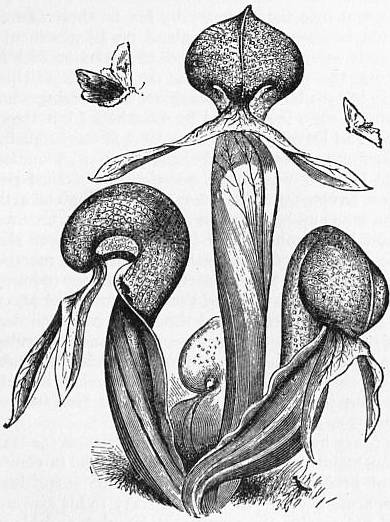
Darlingtonia californica.
DARLY, MATTHIAS, 18th-century English caricaturist, designer and engraver. This extremely versatile artist not only issued political caricatures, but designed ceilings, chimney-pieces, mirror frames, girandoles, decorative panels and other mobiliary accessories, made many engravings for Thomas Chippendale, and sold his own productions over the counter. He was apparently an architect by profession. The first publication which can be attributed to him with certainty is a coloured caricature, “The Cricket Players of Europe” (1741). In 1754 he issued A new Book of Chinese Designs, which was intended to minister to the passing craze for furniture and household decorations in the Chinese style. It was in this year that he engraved many of the plates for the Director of Thomas Chippendale. He published from many addresses, most of them in the Strand or its immediate neighbourhood, and his shop was for a long period perhaps the most important of its kind in London. In his book Nollekens and his Times, J. T. Smith, writing of Richard Cosway, says:—“So ridiculously foppish did he become that Matth. Darly, the famous caricature print seller, introduced an etching of him in his window in the Strand as the ‘Macaroni Miniature Painter.’” Darly was for many years in partnership with a man named Edwards, and together they published many political prints, which were originally issued separately and collected annually into volumes under the title of Political and Satirical History. Darly was a member both of the Incorporated Society of Artists and the Free Society of Artists, forerunners of the Royal Academy, and to their exhibitions he contributed many architectural drawings, together with a profile etching of himself (1775). Upon one of these etchings, published from 39 Strand, he is described as “Professor of Ornament to the Academy of Great Britain.” Darly’s most important publication was The Ornamental Architect or Young Artists’ Instructor (1770-1771), a title which was changed in the edition of 1773 to A Compleat Body of Architecture, embellished with a great Variety of Ornaments. He also issued Sixty Vases by English, French and Italian Masters (1767). In addition to his immense mass of other productions Darly executed many book plates, illustrated various books and cabinet-makers’ catalogues, and gave lessons in etching. His skill as a caricaturist brought him into close personal relations with the politicians of his time, and in 1763 he was instrumental in saving John Wilkes, whose partisan he was, from death at the hands of James Dunn, who had determined to kill him. Darly, who described himself as “Liveryman and block maker,” issued his last caricature in October 1780, and as his shop, No. 39 Strand, was let to a new tenant in the following year, it is to be presumed that he had by that time died, or become incapable of further work. As a designer of furniture Darly travelled in a dozen years or so from the extremes of pseudo-Chinese affectation to classical severity of the type popularized by the brothers Adam.
DARMESTETER, JAMES (1849-1894), French author and antiquarian, was born of Jewish parents on the 28th of March 1849 at Château Salins, in Alsace. The family name had originated in their earlier home of Darmstadt. He was educated in Paris, where, under the guidance of Michel Bréal and Abel Bergaigne, he imbibed a love for Oriental studies, to which for a time he entirely devoted himself. He was a man of vast intellectual range. In 1875 he published a thesis on the mythology of the Zend Avesta, and in 1877 became teacher of Zend at the École des Hautes Études. He followed up his researches with his Études iraniennes (1883), and ten years later published a complete translation of the Zend Avesta, with historical and philological commentary (3 vols., 1892-1893), in the Annales du musée Guimet. He also edited the Zend Avesta for Max Müller’s Sacred Books of the East. Darmesteter regarded the extant texts as far more recent than was commonly believed, placing the earliest in the 1st century B.C., and the bulk in the 3rd century A.D. In 1885 he was appointed professor in the Collège de France, and was sent to India in 1886 on a mission to collect the popular songs of the Afghans, a translation of which, with a valuable essay on the Afghan language and literature, he published on his return. His impressions of English dominion in India were conveyed in Lettres sur l’Inde (1888). England interested him deeply; and his attachment to the gifted English writer, A. Mary F. Robinson, whom he shortly afterwards married (and who in 1901 became the wife of Professor E. Duclaux, director of the Pasteur Institute at Paris), led him to translate her poems into French in 1888. Two years after his death a collection of excellent essays on English subjects was published in English. He also wrote Le Mahdi depuis les origines de l’Islam jusqu’à nos jours (1885); Les Origines de la poésie persane (1888); Prophètes d’Israël (1892), and other books on topics connected with the east, and from 1883 onwards drew up the annual reports of the Société Asiatique. He had just become connected with the Revue de Paris, when his delicate constitution succumbed to a slight attack of illness on the 19th of October 1894.
His elder brother, Arsène Darmesteter (1846-1888), was a distinguished philologist and man of letters. He studied under Gaston Paris at the École des Hautes Études, and became professor of Old French language and literature at the Sorbonne. His Life of Words appeared in English in 1888. He also collaborated with Adolphe Hatzfeld in a Dictionnaire général de la langue française (2 vols., 1895-1900). Among his most important work was the elucidation of Old French by means of the many glosses in the medieval writings of Rashi and other French Jews. His scattered papers on romance and Jewish philology were collected by James Darmesteter as Arsène Darmesteter, reliques scientifiques (2 vols., 1890). His valuable Cours de grammaire historique de la langue française was edited after his death by E. Muret and L. Sudre (1891-1895; English edition, 1902).
There is an éloge of James Darmesteter in the Journal asiatique (1894, vol. iv. pp. 519-534), and a notice by Henri Cordier, with a list of his writings, in The Royal Asiatic Society’s Journal (January 1895); see also Gaston Paris, “James Darmesteter,” in Penseurs et poètes (1896, pp. 1-61).
DARMSTADT, a city of Germany, capital of the grand-duchy of Hesse-Darmstadt, on a plain gently sloping from the Odenwald to the Rhine, 21 m. by rail S.E. from Mainz and 17 m. S. from Frankfort-on-Main. Pop. (1905) 83,000. It is the residence of the grand-duke and the seat of government of the duchy. Darmstadt consists of an old and a new town, the streets of the former being narrow and gloomy and presenting no attractive features. The new town, however, which includes the greater part of the city, contains broad streets and several fine squares. Among the latter is the stately Luisenplatz, on which are the house of parliament, the old palace and the post office, and in the centre of which is a column surmounted by the statue of the grand-duke Louis I., the founder of the new town. The square is crossed by the Rhein-strasse, the most important thoroughfare in the city, leading directly from the railway station to the ducal palace. This last, a complex of buildings, dating from various centuries, but possessing few points of special interest, is surrounded by grounds occupying the site of the old moat. Opposite to it, on the north side, and adjoining the pretty palace gardens, are the court theatre and the armoury, and a little farther west the handsome buildings of the new museum, erected in 1905 and containing the valuable scientific and art collections of the state, which were formerly housed in the palace: a library of 600,000 volumes and 4000 MSS., a museum of Egyptian and German antiquities, a picture gallery with masterpieces of old German and Dutch schools, a natural history collection and the state archives. To the right of the entrance to the palace gardens is the tomb of the “great landgravine,” Caroline Henrietta, wife of the landgrave Louis IX., surmounted by a marble urn, the gift of Frederick the Great of Prussia, bearing the inscription femina sexu, ingenio vir. To the south of the castle lies the old town, with the market square, the town hall (lately restored and enlarged) and the town church. Of the eight churches (seven Evangelical) only the Roman Catholic is in any way imposing. There are two synagogues. The town possesses a technical high school, having (since 1900) power to confer the degree of doctor of engineering, and attended by about 2000 students, two gymnasia, a school of agriculture, an artisans’ school and a botanical garden. The chemist, Justus von Liebig, was born in Darmstadt in 1803. Among the chief manufactures are the production of machinery, carpets, playing cards, chemicals, tobacco, hats, wine and beer.
The surroundings of Darmstadt are attractive and contain many features of interest. To the east of the town lies the Mathildenhöhe, formerly a park and now converted into villa residences. Here are the Alice hospital and the pretty Russian church, built (1898-1899) by the emperor Nicholas II. of Russia in memory of the empress Maria, wife of Alexander II. In the vicinity is the Rosenhöhe, with the mausoleum of the ducal house, with the tomb of the grand-duchess Alice, daughter of Queen Victoria of England.
Darmstadt is mentioned in the 11th century, but in the 14th century it was still a village, held by the counts of Katzenelnbogen. It came by marriage into the possession of the house of Hesse in 1479, the male line of the house of Katzenelnbogen having in that year become extinct. The imperial army took it in the Schmalkaldic War, and destroyed the old castle. In 1567, after the death of Philip the Magnanimous, his youngest son George received Darmstadt and chose it as his residence. He was the founder of the line of Hesse-Darmstadt. Its most brilliant days were those of the reign of Louis X. (1790-1830), the first grand-duke, under whom the new town was built.
See Walther, Darmstadt wie es war und wie es geworden (Darms. 1865); and Zernin und Wörner, Darmstadt und seine Umgebung (Zürich, 1890).
DARNLEY, HENRY STEWART or STUART, Lord (1545-1567), earl of Ross and duke of Albany, second husband of Mary, queen of Scots, was the eldest son of Matthew Stewart, earl of Lennox (1516-1571), and through his mother Lady Margaret Douglas (1515-1578) was a great-grandson of the English king Henry VII. Born at Temple Newsam in Yorkshire on the 7th of December 1545, he was educated in England, and his lack of intellectual ability was compensated for by exceptional skill in military exercises. After the death of Francis II. of France in 1560 Darnley was sent into that country by his mother, who hoped that he would become king of England on Elizabeth’s death, and who already entertained the idea of his marriage with Mary, queen of Scots, the widow of Francis, as a means to this end. Consequently in 1561 both Lady Margaret and her son, who were English subjects, were imprisoned by Elizabeth; but they were soon released, and Darnley spent some time at the English court before proceeding to Scotland in February 1565. The marriage of Mary and Darnley was now a question of practical politics, and the queen, having nursed her new suitor through an attack of measles, soon made up her mind to wed him, saying he “was the properest and best proportioned long man that ever she had seen.” The attitude of Elizabeth towards this marriage is difficult to understand. She had permitted Darnley to journey to Scotland, and it has been asserted that she entangled Mary into this union; but on the other hand she and her council declared their dislike of the proposed marriage, and ordered Darnley and his father to repair to London, a command which was disobeyed. In March 1565 there were rumours that the marriage had already taken place, but it was actually celebrated at Holyrood on the 29th of July 1565.
Although Mary had doubtless a short infatuation for Darnley, the union was mainly due to political motives, and in view of the characters of bride and bridegroom it is not surprising that trouble soon arose between them. Contrary to his expectations Darnley did not receive the crown matrimonial, and his foolish and haughty behaviour, his vicious habits, and his boisterous companions did not improve matters. He was on bad terms with the regent Murray and other powerful nobles, who disliked the marriage and were intriguing with Elizabeth. Scotland was filled with rumours of plot and assassination, and civil war was only narrowly avoided. Unable to take any serious part in affairs of state, Darnley soon became estranged from his wife. He believed that Mary’s relations with David Rizzio injured him as a husband, and was easily persuaded to assent to the murder of the Italian, a crime in which he took part. Immediately afterwards, however, flattered and cajoled by the queen, he betrayed his associates to her, and assisted her to escape from Holyrood to Dunbar. Owing to these revelations he was deserted and distrusted by his companions in the murder, and soon lost the queen’s favour. In these circumstances he decided to leave Scotland, but a variety of causes prevented his departure; and meanwhile at Craigmillar a band of nobles undertook to free Mary from her husband, who refused to be present at the baptism of his son, James, at Stirling in December 1566. The details of the conspiracy at Craigmillar are not clear, nor is it certain what part, if any, Mary took in these proceedings. The first intention may have been to obtain a divorce for the queen, but it was soon decided that Darnley must be killed. Rumours of the plot came to his ears, and he fled from Stirling to Glasgow, where he fell ill, possibly by poisoning, and where Mary came to visit him. Another reconciliation took place between husband and wife, and Darnley was persuaded to journey with Mary by easy stages to Edinburgh. Apartments were prepared for the pair at Kirk o’ Field, a house just inside the city walls, and here they remained for a few days. On the evening of the 9th of February 1567 Mary took an affectionate farewell of her husband, and went to attend some gaieties in Edinburgh. A few hours later, on the morning of the 10th, Kirk o’ Field was blown up with gunpowder. Darnley’s body was found at some distance from the house, and it is supposed that he was strangled whilst making his escape. The remains were afterwards buried in the chapel at Holyrood.
Much discussion has taken place about this crime, and the guilt or innocence of Mary is still a question of doubt and debate. It seems highly probable, however, that the queen was accessory to the murder, which was organized by her lover and third husband, Bothwell (q.v.). As the father of King James I., Darnley is the direct ancestor of all the sovereigns of England since 1603. Personally he was a very insignificant character and his sole title to fame is his connexion with Mary, queen of Scots.
For further information, and also for a list of the works bearing on his life, see the article Mary, Queen of Scots.
DARRANG, a district of British India, in the province of Eastern Bengal and Assam. It lies between the Bhutan and Daphla Hills and the Brahmaputra, including many islands in the river. The administrative headquarters are at Tezpur. Its area is 3418 sq. m. It is for the most part a level plain watered by many tributaries of the Brahmaputra. The two subdivisions of Tezpur Mangaldai differ greatly in character. Tezpur is part of Upper Assam and shares in the prosperity which tea cultivation has brought to that part of the valley. In this portion of the district there are still large areas of excellent land awaiting settlement, and the cultivator finds a market for his produce in the flourishing tea-gardens, to which large quantities of coolies are imported every year. In Mangaldai, on the other hand, most of the good rice land was settled about 1880-1890 when the subdivision had a population of 146 to the square mile, as against 42 for Tezpur; the soil is not favourable for tea, and the population is stationary or receding. In 1901 the population of the whole district was 337,313, showing an increase of 10% in the decade. The principal grain-crop is rice. The principal means of communication is by river. A steam tramway of 2½ ft. gauge has been opened from Tezpur to Balipara, a distance of 20 m.
Darrang originally formed, according to tradition, part of the dominions of Bana Raja, who was defeated by Krishna in a battle near Tezpur (“the town of blood”). The massive granite ruins found near by prove that the place must have been the seat of powerful and civilized rulers. In the 16th century Darrang was subject to the Koch king of Kamarupa, Nar Narayan, and on the division of his dominions among his heirs passed to an independent line of rajas. Early in the 17th century the raja Bali Narayan invoked the aid of the Ahoms of Upper Assam against the Mussulman invaders; after his defeat and death in 1637 the Ahoms dominated the whole district, and the Darrang rajas sank into petty feudatories. About 1785 they took advantage of the decay of the Ahom kingdom to try and re-establish their independence, but they were defeated by a British expedition in 1792, and in 1826 Darrang, with the rest of Assam, passed under British control.
DARTFORD, a market town in the Dartford parliamentary division of Kent, England, on the Darent, 17 m. E.S.E. of London by the South-Eastern & Chatham railway. Pop. of urban district (1891), 11,962; (1901) 18,644. The town lies low, flanked by two chalky eminences, called East and West Hills. It possesses a town hall, a grammar school (1576), and a Martyr’s Memorial Hall. The most noteworthy building, however, is the parish church, restored in 1863, which contains a curious old fresco and several interesting brasses, and has a Norman tower. The prosperity of the town depends on the important works in its vicinity, including powder works, paper mills, and engineering, iron, chemical and cement works. One of the first attempts at the manufacture of paper in England was made here by Sir John Spielman (d. 1607), jeweller to Queen Elizabeth. Dartford was the scene, in 1235, of the marriage, celebrated by proxy, between Isabella, sister of Henry III., and the Emperor Frederick II.; and in 1331 a famous tournament was held in the place by Edward III. The same monarch established an Augustinian nunnery on West Hill in 1355, of which, however, few remains exist. After the Dissolution it was used as a private residence by Henry VIII., Anne of Cleves and Elizabeth. The chantry of St Edmund the Martyr which stood on the opposite side of the town was a part of Edward III.’s endowment to the priory, and became so famous as a place of pilgrimage, especially for those on their way to Canterbury, that the part of Watling Street which crossed there towards London was sometimes called “St Edmund’s Way.” It was here also that Wat Tyler’s insurrection began in 1377, and the house in which he resided is shown. On Dartford Heath is a lunatic asylum of the London County Council, and, at Long Reach, the infectious diseases hospital of the Metropolitan Asylums Board. Stone church, 2 m. E. of Dartford, mainly late Early English (1251-1274), and carefully restored by G. E. Street in 1860, is remarkable; the richness of the work within increases from west to east, culminating in a choir arcade decorated with work among the finest of its period extant; the period is that of the choir of Westminster Abbey, and from a comparison of building materials, choir arcades and sculpture of foliage, a common architect has been suggested. Greenhithe, on the banks of the Thames, has large chalk quarries in its neighbourhood, from which lime and cement are manufactured.
DARTMOOR, a high plateau in the south-west of Devonshire, England. Its length is about 23 m. from N. to S. and its extreme breadth 20 m., the mean altitude being about 1500 ft. The area exceeding 1000 ft. in elevation is about 200 sq. m. It is the highest and easternmost in a broken chain of granitic elevations which extends through Cornwall to the Scilly Isles. The higher parts are open, bleak and wild, strongly contrasting with the more gentle scenery of the well-wooded lowlands surrounding it. Sloping heights rise from the main tableland in all directions, crested with broken masses of granite, locally named tors, and often singularly fantastic in outline. The highest of these are Yes Tor and High Willhays in the north-west, reaching altitudes of 2028 and 2039 ft. Large parts of the moor, especially in the centre, are covered with morasses; and head-waters of all the principal streams of Devonshire (q.v.) are found here. Two main roads cross the moor, one between Exeter and Plymouth, and the other between Ashburton and Tavistock, intersecting at Two Bridges. Both avoid the higher part of the moor, which, for the rest, is traversed only in part by a few rough tracks. The central part of Dartmoor was a royal forest from a date unknown, but apparently anterior to the Conquest. Its woods were formerly more extensive than now, but a few small tracts in which dwarf oaks are characteristic remain in the lower parts. Previous to 1337, the forest had been granted to Richard, earl of Cornwall, by Henry III., and from that time onward it has belonged to the duchy of Cornwall. The districts immediately surrounding the moor are called the Venville or Fenfield districts. The origin of this name is not clear. The holders of land by Venville tenure under the duchy have rights of pasture, fishing, &c. in the forest, and their main duty is to “drive” the moor at certain times in order to ascertain what head of cattle are pastured thereon, and to prevent trespassing. The antiquarian remains of Dartmoor are considered among those of Devonshire.
Dartmoor convict prison, near Princetown, was adapted to its present purpose in 1850; but the original buildings were erected in 1809 for the accommodation of French prisoners. A tract of moorland adjacent to the prison has been brought under cultivation by the inmates.
See S. Rowe, Perambulation of the ... forest of Dartmoor (Plymouth, 1848); J. L. W. Page, Exploration of Dartmoor (London, 1889); S. Baring-Gould, Book of Dartmoor (London, 1900).
DARTMOUTH, a town in Halifax county, Nova Scotia, Canada, on the north-eastern side of Halifax harbour, connected by a steam ferry with Halifax, of which it is practically a suburb. Pop. (1901) 4806. It contains a large sugar refinery, foundries, machine shops, saw mills, skate, rope, nail, soap and sash factories.
DARTMOUTH, a seaport, market town, and municipal borough in the Torquay parliamentary division of Devonshire, England, 27 m. E. of Plymouth. Pop. (1901) 6579. It is beautifully situated on the west bank and near the mouth of the river Dart, which here forms an almost land-locked estuary. The town is connected by a steam ferry with Kingswear on the opposite bank, which is served by a branch of the Great Western railway. The houses of Dartmouth, many of which are ancient, rise in tiers from the shore, beneath a range of steep hills. An embankment planted with trees fronts the river. The cruciform church of St Saviour is of the 14th and 15th centuries, and contains a graceful rood-screen of the 16th century, an ancient stone pulpit and interesting monuments. Dartmouth Castle, in part of Tudor date, commands the river a little below the town. Portions of the cottage of Thomas Newcomen, one of the inventors of the steam-engine, are preserved. Dartmouth is a favourite yachting centre, and shipbuilding, brewing, engineering and paint-making are carried on. Coal is imported, and resold to ships calling at the harbour. The borough is under a mayor, four aldermen and twelve councillors. Area, 1924 acres.
History.—Probably owing its origin to Saxon invaders, Dartmouth (Darentamuthan, Dertemue) was a seaport of importance when Earl Beorn was buried in its church in 1049. From its sheltered harbour William II. embarked for the relief of Mans, and the crusading squadron set sail in 1190, while John landed here in 1214. The borough, first claimed as such in the reign of Henry I., was in existence by the middle of the 13th century, since a deed of Gilbert Fitz-Stephen, lord of the manor, mentions the services due from “his burgesses of Dertemue,” and a borough seal of 1280 is extant. The king in 1224 required the bailiffs and good men of Dartmouth to keep all ships in readiness for his service, and in 1302 they were to furnish two ships for the Scottish expedition, an obligation maintained throughout the century. The men of the vill were made quit of toll in 1337, and in 1342 the town was incorporated by a charter frequently confirmed by later sovereigns. Edward III. in 1372 granted that the burgesses should be sued only before the mayor and bailiffs, and Richard II. in 1393 granted extended jurisdiction and a coroner; further charters were obtained in 1604 and 1684. A French attack on the town was repulsed in 1404, and in 1485 the burgesses received a royal grant of £40 for walling the town and stretching a chain across the river mouth. Dartmouth fitted out two ships against the Armada, and was captured by both the royalists and parliamentarians in the Civil War. It returned two representatives to parliament in 1298, and from 1350 to 1832. In the latter year the representation was reduced to one, and was merged in that of the county in 1868. Manorial markets were granted for Dartmouth in 1231 and 1301. These were important since as early as 1225 the fleet resorted there for provisions. During the 14th and 15th centuries there was a regular trade with Bordeaux and Brittany, and complaints of piracies by Dartmouth men were frequent.
DARTMOUTH COLLEGE, an American institution of higher education, in Hanover, New Hampshire. It is Congregational in its affiliations, but is actually non-sectarian. The college is open only to men except during the summer session, when women also are admitted. Dartmouth embraces, in addition to the original college, incorporated in 1769, a medical school, dating from the establishment of a professorship of medicine in the college in 1798; the Thayer school of civil engineering, established in 1867 by the bequest of Gen. Sylvanus Thayer; and the Amos Tuck school of administration and finance, established in 1900 by Edward Tuck—a remarkable feature, as it was the first, and, until the establishment at Harvard of a similar graduate school, the only commercial school in the country whose work is largely post-graduate. The Chandler school of science and the arts was founded by Abiel Chandler in 1851, in connexion with Dartmouth, and was incorporated into the collegiate department in 1893 as the Chandler scientific course in the college. From 1866 to 1893 the New Hampshire college of agriculture and the mechanic arts, now at Durham, was connected with Dartmouth. The medical school offers a four years’ course, and each of the other two professional schools a two years’ course, the first year of which may, under certain conditions, be counted as the senior year of the undergraduate department. The college has a beautiful campus or “yard”; a library of more than 100,000 volumes, housed in Wilson Hall (1885); instruction halls, residence halls—Thornton and Wentworth (1828), Hallgarten (1874), Richardson (1897), and Fayerweather (1900); a gymnasium (Bissell Hall, built in 1867); an athletic field, known as Alumni Oval; Bartlett Hall (1890-1891), the house of the College Young Men’s Christian Association; Rollins Chapel (1885); College Hall (1901), a social headquarters; an astronomical and meteorological observatory (Shattuck Observatory, 1854); the Mary Hitchcock hospital (1893), associated with the medical college; museums (especially the Butterfield Museum); Culver Hall (1871), the chemical laboratory; and Wilder Hall (1899), the physical laboratory. The college in 1908 had 100 officers of administration and instruction and 1219 students. It is maintained chiefly by the proceeds of a productive endowment fund amounting to $2,700,000 and by tuition fees ($125 a year for each student). The government is entrusted to a board of twelve trustees, five of whom are elected upon the nomination of the alumni.
Dartmouth is the outgrowth of Moor’s Indian charity school, founded by Eleazer Wheelock (1711-1779) about 1750 at Lebanon, Connecticut; this school was named in 1755 in honour of Joshua Moor, who in this year gave to it lands and buildings. In 1765 Samson Occom (c. 1723-1792), an Indian preacher and former student of the school, visited England and Scotland in its behalf and raised £10,000, whereupon plans were made for enlargement and for a change of site to Hanover. In 1769 the school was incorporated by a charter granted by George III. as Dartmouth College, being named after the earl of Dartmouth, president of the trustees of the funds raised in Great Britain. The first college building, Dartmouth Hall (closely resembling Nassau Hall at Princetown and the University Hall of Brown University), was built in 1784-1791 and is still standing, as are the typical college church, built in 1796 and enlarged in 1877 and 1889, and Moor Hall, the second building for Moor’s charity school, since 1852 called the Chandler building. During the War of Independence the support from Great Britain was mostly withdrawn. In 1815 President John Wheelock (1754-1817), who had succeeded his father in 1779, and was a Presbyterian and a Republican, was removed by the majority of the board of trustees, who were Congregationalists and Federalists, and Francis Brown was chosen in his place. Wheelock, upon his appeal to the legislature, was reinstated at the head of a new corporation, called Dartmouth University. The state courts upheld the legislature and the “University,” but in 1819 after the famous argument of Daniel Webster (q.v.) in behalf of the “College” board of trustees as against the “University” board before the United States Supreme Court, that body decided that the private trust created by the charter of 1769 was inviolable, and Dr Francis Brown and the old “College” board took possession of the institution’s property. This was one of the most important decisions ever made by the United States Supreme Court.
See Frederick Chase, A History of Dartmouth College and the Town of Hanover (Cambridge, 1891). For the Dartmouth College Case see Shirley, The Dartmouth College Causes (St Louis, Missouri, 1879); Kent, Commentaries on American Law (vol. i. Boston, 1884); and Joseph Story, Commentaries on the Constitution (vol. ii., Boston, 1891).
DARTMOUTH, EARL OF, an English title borne by the family of Legge from 1710 to the present day.
William Legge (c. 1609-1670), the eldest son of Edward Legge (d. 1616), vice-president of Munster, gained some military experience on the continent of Europe and then returning to England assisted Charles I. in his war against the Scots in 1638. He was also very useful to the king during the months which preceded the outbreak of the Civil War, although his attempt to seize Hull in January 1642 failed. During the war Legge distinguished himself at Chalgrove and at the first battle of Newbury, and in 1645 he became governor of Oxford. However, he only held this position for a few months, as he shared the disgrace of Prince Rupert, to whom he was very devoted; but he was largely instrumental in putting an end to the quarrel between the king and the prince. Legge helped Charles to escape from Hampton Court in 1647, and after attending upon him he was arrested in May 1648. He was soon released, but was again captured in the following year while proceeding to Ireland in the interests of Charles II. Regaining his freedom in 1653, he spent some years abroad, but in 1659 he was once more in England inciting the royalists to rise. Legge enjoyed the favour of Charles II., who offered to make him an earl. The old royalist died on the 13th of October 1670.
Legge’s eldest son, George, Baron Dartmouth (1647-1691), served as a volunteer in the navy during the Dutch war of 1665-1667, and quickly won his way to high rank. He was also a member of the household of the duke of York, afterwards James II.; was governor of Portsmouth and master-general of the army; in 1678 he commanded as colonel the troop at Nieuport, and in 1682 he was created Baron Dartmouth. In 1683 as “admiral of a fleet” he sailed to Tangiers, dismantled the fortifications and brought back the English troops, a duty which he discharged very satisfactorily. Under James II. Dartmouth was master of the horse and governor of the Tower of London; and in 1688, when William of Orange was expected, James II. made him commander-in-chief of his fleet. Although himself loyal to James, the same cannot be said of many of his officers, and an engagement with the Dutch fleet was purposely avoided. Dartmouth, however, refused to assist in getting James Edward, prince of Wales, out of the country, and even reproved the king for attempting this proceeding. He then left the fleet and took the oath of allegiance to William and Mary, but in July 1691 he was arrested for treason, and was charged with offering to hand over Portsmouth to France and to command a French fleet. Macaulay believed that this accusation was true, but there are those who hold that Dartmouth spoke the truth when he protested his innocence. Further proceedings against him were prevented by his death, which took place in the Tower of London on the 25th of October 1691.
Lord Dartmouth’s only son, William, 1st Earl of Dartmouth (1672-1750), succeeded to his father’s barony in 1691. In 1702 he was appointed a member of the board of trade and foreign plantations, and eight years later he became secretary of state for the southern department and joint keeper of the signet for Scotland. In 1711 he was created viscount Lewisham and earl of Dartmouth; in 1713 he exchanged his offices for that of keeper of the privy seal, which he held until the end of 1714. After a long period of retirement from public life he died on the 15th of December 1750. Dartmouth’s eldest son George, viscount Lewisham (c. 1703-1732), predeceased his father. Other sons were: Heneage Legge (1704-1759), judge of the court of exchequer; Henry Legge (q.v.), afterwards Bilson-Legge; and Edward Legge (1710-1747), who served for some time in the navy and died on the 19th of September 1747.
William, 2nd Earl of Dartmouth (1731-1801), was a son of George, viscount Lewisham, and a grandson of the 1st earl, whom he succeeded in 1750. For a few months in 1765 and 1766 he was president of the board of trade and foreign plantations; in 1772 he returned to the same office holding also that of secretary for the colonies; and in 1775 he became lord privy seal. With regard to the American colonies Dartmouth advised them in 1777 to accept the conciliatory proposals put forward by Lord North, but in 1776 he opposed similar proposals and advocated the employment of force. In March 1782 he resigned his office as lord privy seal and in 1783 he was lord steward of the household; he died on the 15th of July 1801. Dartmouth was a friend of Selina, countess of Huntingdon, and his piety and his intimacy with the early Methodists won for him the epithet of the Psalm-singer. Dartmouth College was named after him, and among his papers preserved at Patshull House, Wolverhampton, are many letters from America relating to the struggle for independence. His sixth son, Sir Arthur Kaye Legge (d. 1835), was an admiral of the blue, and his seventh son, Edward Legge (d. 1827), was bishop of Oxford.
George, 3rd Earl of Dartmouth (1755-1810), the eldest son of the 2nd earl, was lord warden of the stannaries and president of the board of control; later he was lord steward and then lord chamberlain of the royal household. He died on the 1st of November 1810, when his eldest son, William (1784-1853), became 4th earl. William’s son, William Walter (1823-1891), became 5th earl in 1853 and was succeeded in 1891 by his son William Heneage Legge (b. 1851) as 6th earl of Dartmouth. As Lord Lewisham this nobleman was a member of parliament from 1878 to 1891, and was vice-chamberlain of the household in 1885-1886, and again from 1886 to 1892.
DARU, PIERRE ANTOINE NOËL BRUNO, Count (1767-1829), French soldier and statesman, was born at Montpellier on the 12th of January 1767. He was educated at the military school of Tournon, conducted by the Oratorians, and entered the artillery at an early age. His fondness for literature, however, soon made itself felt, and he published several slight pieces, until the outbreak of the French Revolution called him to a sterner occupation. In 1793 he became commissary to the army, protecting the coasts of Brittany from projected descents of the British, or of French royalists. Thrown into prison on a frivolous charge of friendliness to the royalists and England, he was released after the fall of Robespierre in the summer of 1794, and rose in the service until, in 1799, he became chief commissary to the French army serving under Masséna in the north of Switzerland. In that position he won repute for his organizing capacity, great power of work and unswerving probity—the last of which qualities was none too common in the French armies at that time. These exacting tasks did not absorb all his energies. He found time, even during the campaign, to translate part of Horace and to compose two poems, the Poème des Alpes and the Chant de guerre. The latter celebrated in indignant strains the murder of the French envoys to the congress of Rastadt.
The accession of Napoleon Bonaparte to power in November 1799 led to the employment of Daru as chief commissary to the Army of Reserve intended for North Italy, and commanded nominally by Berthier, but really by the First Consul. Conjointly with Berthier and Dejean, he signed the armistice with the Austrians which closed the campaign in North Italy in June 1800. Daru now returned, for a time, mainly to civil life, and entered the tribunate, where he ably maintained the principles of democratic liberty. On the renewal of war with England, in May 1803, he again resumed his duties as chief commissary for the army on the northern coasts. It was afterwards asserted that, on Napoleon’s resolve to turn the army of England against Austria, Daru had set down at the emperor’s dictation all the details of the campaign which culminated at Ulm. The story is apocryphal; but Napoleon’s confidence in him was evinced by his being appointed to similar duties in the Grand Army, which in the autumn of 1805 overthrew the armies of Austria and Russia. After the battle of Austerlitz, he took part in the drafting of the treaty of Presburg. At this time, too, he became intendant-general of the military household of Napoleon. In the campaigns of 1806-1807 he served, in his usual capacity, in the army which overthrew the forces of Russia and Prussia; and he had a share in drawing up the treaty of Tilsit (7th of July 1807). After this he supervised the administrative and financial duties in connexion with the French army which occupied the principal fortresses of Prussia, and was one of the chief agents through whom Napoleon pressed hard on that land. At the congress of Erfurt, Daru had the privilege of being present at the interview between Goethe and Napoleon, and interposed tactful references to the works of the great poet. Daru fulfilled his usual duties in the campaign of 1809 against Austria. Afterwards, when the subject of the divorce of Josephine and the choice of a Russian or of an Austrian princess came to be discussed, Daru, on being consulted by Napoleon, is said boldly to have counselled his marriage with a French lady; and Napoleon, who admired his frankness and honesty, took the reply in good part.
In 1811 he became secretary of state in succession to Maret, duc de Bassano, and showed his usual ability in the administration of the vast and complex affairs of the French empire, including the arrangements connected with the civil list and the imperial domains. But neither his devotion to civic duty nor to the administration of the affairs of the Grand Army could ward off disaster. Late in the year 1813 he took up the portfolio of military affairs. After the first abdication of Napoleon in 1814, Daru retired into private life, but aided Napoleon during the Hundred Days. After the second Restoration he became a member of the Chamber of Peers, in which he ably defended the cause of popular liberty against the attacks of the ultra-royalists. He died at Meulan on the 5th of September 1829.
Few men of the Napoleonic empire have been more generally admired and respected than Daru. On one occasion when he expressed a fear that he lacked all the gifts of a courtier, Napoleon replied, “Courtiers! They are common enough about me; I shall never be in want of them. What I want is an enlightened, firm and vigilant administrator; and that is why I have chosen you.” At another time Napoleon said, “Daru is good on all sides; he has good judgment, a good intellect, a great power for work, and a body and mind of iron.” The only occasion on which he is known to have sunk beneath the weight of his duties was in the course of writing letters at the emperor’s dictation for the third night in succession.
Of Daru’s literary works may be mentioned his Histoire de Venise, published at Paris in 7 vols. in 1819; the Histoire de Bretagne, in 3 vols. (Paris, 1826); a poetical translation of Horace (of which Le Brun remarked: “Je ne lis point Daru, j’aime trop mon Horace”); Discours en vers sur les facultés de l’homme (Paris, 1825), and Astronomie, a didactic poem in six cantos (Paris, 1820).
See the “Notice” by Viennet prefixed to the fourth edition of Daru’s Histoire de la république de Venise (9 vols., 1853), and three articles by Sainte-Beuve in Causeries du lundi, vol. ix. For the many letters of Napoleon to Daru see the Correspondance de Napoléon Ier (32 vols., Paris, 1858-1870).
(J. Hl. R.)
DARWEN, a municipal borough in the Darwen parliamentary division of Lancashire, England, 20 m. N.W. from Manchester by the Lancashire & Yorkshire railway. Pop. (1891) 34,192; (1901) 38,212. It lies on the river Darwen, which traverses a densely populated manufacturing district, and is surrounded by high-lying moors. Darwen is a centre of the cotton trade and has also blast furnaces, and paper-making, paper-staining and fire-clay works. In the neighbourhood are collieries and stone quarries. The market hall is the chief public building; there are technical schools, a free library, and two public parks. Darwen was incorporated in 1788. The corporation consists of a mayor, six aldermen and eighteen councillors.
DARWIN, CHARLES ROBERT (1809-1882), English naturalist, author of the Origin of Species, was born at Shrewsbury on the 12th of February 1809. He was the younger of the two sons and the fourth child of Dr Robert Waring Darwin, son of Dr Erasmus Darwin (q.v.). His mother, a daughter of Josiah Wedgwood (1730-1795), died when Charles Darwin was eight years old. Charles Darwin’s elder brother, Erasmus Alvey (1804-1881), was interested in literature and art rather than science: on the subject of the wide difference between the brothers Charles wrote that he was “inclined to agree with Francis Galton in believing that education and environment produce only a small effect on the mind of anyone, and that most of our qualities are innate” (Life and Letters, London, 1887, p. 22). Darwin considered that his own success was chiefly due to “the love of science, unbounded patience in long reflecting over any subject, industry in observing and collecting facts, and a fair share of invention as well as of common sense” (l.c. p. 107). He also says: “I have steadily endeavoured to keep my mind free so as to give up any hypothesis, however much beloved (and I cannot resist forming one on every subject), as soon as facts are shown to be opposed to it” (l.c. p. 103). The essential causes of his success are to be found in this latter sentence, the creative genius ever inspired by existing knowledge to build hypotheses by whose aid further knowledge could be won, the calm unbiassed mind, the transparent honesty and love of truth which enabled him to abandon or to modify his own creations when they ceased to be supported by observation. The even balance between these powers was as important as their remarkable development. The great naturalist appeared in the ripeness of time, when the world was ready for his splendid generalizations. Indeed naturalists were already everywhere considering and discussing the problem of evolution, although Alfred Russel Wallace was the only one who, independently of Darwin, saw his way clearly to the solution. It is true that hypotheses essentially the same as natural selection were suggested much earlier by W. C. Wells (Phil. Trans., 1813), and Patrick Matthew (Naval Timber and Arboriculture, 1831), but their views were lost sight of and produced no effect upon the great body of naturalists. In the preparation for Darwin Sir Charles Lyell’s Principles of Geology played an important part, accustoming men’s minds to the vast changes brought about by natural processes, and leading them, by its lucid and temperate discussion of Lamarck’s and other views, to reflect upon evolution.
Darwin’s early education was conducted at Shrewsbury, first for a year at a day-school, then for seven years at Shrewsbury School under Dr Samuel Butler (1774-1839). He gained but little from the narrow system which was then universal. In 1825 he went to Edinburgh to prepare for the medical profession, for which he was unfitted by nature. After two sessions his father realized this, and in 1828 sent him to Cambridge with the idea that he should become a clergyman. He matriculated at Christ’s College, and took his degree in 1831, tenth in the list of those who do not seek honours. Up to this time he had been keenly interested in sport, and in entomology, especially the collecting of beetles. Both at Edinburgh, where in 1826 he read his first scientific paper, and at Cambridge he gained the friendship of much older scientific men—Robert Edmond Grant and William Macgillivray at the former, John Stevens Henslow and Adam Sedgwick at the latter. He had two terms’ residence to keep after passing his last examination, and studied geology with Sedgwick. Returning from their geological excursion together in North Wales (August 1831), he found a letter from Henslow urging him to apply for the position of naturalist on the “Beagle,” about to start on a surveying expedition. His father at first disliked the idea, but his uncle, the second Josiah Wedgwood, pleaded with success, and Darwin started on the 27th of December 1831, the voyage lasting until the 2nd of October 1836. It is practically certain that he never left Great Britain after this latter date. After visiting the Cape de Verde and other islands of the Atlantic, the expedition surveyed on the South American coasts and adjacent islands (including the Galapagos), afterwards visiting Tahiti, New Zealand, Australia, Tasmania, Keeling Island, Maldives, Mauritius, St Helena, Ascension; and Brazil, de Verdes and Azores on the way home. His work on the geology of the countries visited, and that on coral islands, became the subject of volumes which he published after his return, as well as his Journal of a Naturalist, and his other contributions to the official narrative. The voyage must be regarded as the real preparation for his life-work. His observations on the relation between animals in islands and those of the nearest continental areas, near akin and yet not the same, and between living animals and those most recently extinct and found fossil in the same country, here again related but not the same, led him even then to reflect deeply upon the modification of species. He had also been much impressed by “the manner in which closely allied animals replace one another in proceeding southwards” in South America. On his return home Darwin worked at his collections, first at Cambridge for three months and then in London. His pocket-book for 1837 contains the words: “In July opened first note-book on Transmutation of Species. Had been greatly struck from about the month of previous March [while still on the voyage and just over twenty-eight years old] on character of South American fossils, and species on Galapagos Archipelago. These facts (especially latter) origin of all my views.” From 1838 to 1841 he was secretary of the Geological Society, and saw a great deal of Sir Charles Lyell, to whom he dedicated the second edition of his Journal. On the 29th of January 1839 he married his cousin, Emma Wedgwood, the daughter of Josiah Wedgwood of Maer. They lived in London until September 1842, when they moved to Down, which was Darwin’s home for the rest of his life. His health broke down many times in London, and remained precarious during the whole of his life. The immense amount of work which he got through was only made possible by the loving care of his wife. For eight years (1846 to 1854) he was chiefly engaged upon four monographs on the recent and fossil Cirripede Crustacea (Roy. Soc., 1851 and 1854; Palaeontograph. Soc., 1851 and 1854). Towards the close of this work Darwin became very wearied of it, especially of the synonymy. For a time he hoped to start a movement which should discourage the habit of appending the name of the describer to the name of the species, a custom which he thought led to bad and superficial work. From this time he was engaged upon the numerous lines of inquiry which led to the great work of his life, the Origin of Species, published in November 1859.
Soon after opening his note-book in July 1837 he began to collect facts bearing upon the formation of the breeds of domestic animals and plants, and quickly saw “that selection was the keystone of man’s success. But how selection could be applied to organisms living in a state of nature remained for some time a mystery to me.” Various ideas as to the causes of evolution occurred to him, only to be successively abandoned. He had the idea of “laws of change” which affected species and finally led to their extinction, to some extent analogous to the causes which bring about the development, maturity and finally death of an individual. He also had the conception that species must give rise to other species or else die out, just as an individual dies unrepresented if it bears no offspring. These and other ideas, of which traces exist in his Diary, arose in his mind, together with perhaps some general conception of natural selection, during the fifteen months after the opening of his note-book. In October 1838 he read Malthus on Population, and his observations having long since convinced him of the struggle for existence, it at once struck him “that under these circumstances favourable variations would tend to be preserved, and unfavourable ones to be destroyed. The result of this would be the formation of new species. Here, then, I had a theory by which to work.” In June 1842 he wrote out a sketch, which two years later he expanded to an essay occupying 231 pages folio. The idea of progressive divergence as an advantage in itself, because the competition is most severe between organisms most closely related, did not occur to him until long after he had come to Down. During the growth of the Origin Sir Joseph Hooker was his most intimate friend, and on the 11th of January 1844 he wrote: “At last gleams of light have come, and I am almost convinced (quite contrary to the opinion I started with) that species are not (it is like confessing a murder) immutable” (l.c. ii. 13). In 1855 he began a correspondence with the great American botanist Asa Gray, and in 1857 explained his views in a letter which afterwards became classical. In 1856, urged by Lyell, he began the preparation of a third and far more expanded treatise, and had completed about half of it when, on the 18th of June 1858, he received a manuscript essay from A. R. Wallace, who was then at Ternate in the Moluccas. Wallace wanted Darwin’s opinion on the essay, which he asked should be forwarded to Lyell. Darwin was much startled to find in the essay a complete abstract of his own theory of natural selection. He forwarded it the same day, writing to Lyell, “your words have come true with a vengeance—that I should be forestalled.” He placed himself in the hands of Lyell and Hooker, who decided to send Wallace’s essay to the Linnean Society, together with an abstract of Darwin’s work, which they asked him to prepare, the joint essay being accompanied by a preface in the form of an explanatory letter written by them to the secretary. The title of the joint communication was “On the Tendency of Species to form Varieties; and on the Perpetuation of Varieties and Species by Natural Means of Selection.” It was read on the 1st of July 1858, and appears in the Linn. Soc. Journal (Zoology) for that year. In this statement of the theory of natural selection, Darwin’s part consisted of two sections, the first being extracts from his 1844 essay, including a brief account of sexual selection, and the second an abstract of his letter to Asa Gray dated the 5th of September 1857. This latter, probably his first attempt to expound natural selection, cannot be surpassed as a clear statement of the theory. Darwin explained at the outset, what he insisted on elsewhere, that the facts of adaptation or contrivance in nature are the real difficulty to be explained by a theory of evolution, the stumbling-block of every previous suggestion. Until he could explain “the mistletoe, with its pollen carried by insects, and seed by birds—the woodpecker, with its feet and tail, beak and tongue, to climb the tree and secure insects,” he was “scientifically orthodox.” Nevertheless he was led to believe in evolution, apart from any possible motive-cause, by “general facts in the affinities, embryology, rudimentary organs, geological history, and geographical distribution of organic beings.” He then proceeds to describe the manner in which he met the difficulty of adaptation by “his notions on the means by which Nature makes her species.” The essentials of the statement are as follows:—I. Man has made his domestic breeds of animals and plants by selection, conscious or unconscious, of very slight or greater variations. II. The material for selection exists in nature, namely, slight variations of all parts of the organism. III. The “unerring power” which sifts these variations is “natural selection ... which selects exclusively for the good of each organic being.” The rate of increase is such that only a few in each generation can live: hence the never sufficiently appreciated struggle for life. “What a trifling difference must often determine which shall survive and which perish!” The remaining heads explain the complex nature of the struggle, the reasons for deficient direct evidence, the advantage of divergence, &c. In the joint essay the phrases “natural selection” and “sexual selection” were first made public by Darwin, the “struggle for existence” by Wallace. Darwin and Wallace had met only once before the departure of the latter for the East. Their rivalry in the discovery of the great principle of natural selection was the beginning of a lifelong friendship. Wallace was lying ill with intermittent fever at Ternate in February 1858 when he began to think of Malthus’s Essay on Population, read several years before: suddenly the idea of the survival of the fittest flashed upon him. In two hours he had “thought out almost the whole of the theory,” and in three evenings had finished his essay. Darwin, also inspired after reading Malthus, in October 1838, did not publish until nearly twenty years had elapsed, and then only when Wallace sent him his essay. Canon H. B. Tristram was the first to apply the new theory, explaining by its aid the colours of desert birds, &c. (Ibis, October 1859).