VOLUME II SLICE VIII Atherstone to Austria (continued 9)
Reading edition
In 1885 Messrs Garde and Eherlin made similar observations at Nanortalik near Cape Farewell in Greenland, but using a base of only 1250 metres (about ¾ m.). Their results were very similar to Paulsen’s. On one occasion twelve observations, extending over half an hour, were made on a single arc, the calculated heights varying in a fairly regular fashion from 1.6 to 12.9 km. (about 1 to 8 m.). The calculated horizontal distances of this arc varied between 5 and 24 km. (about 3 and 15 m.), the motion being sometimes towards, sometimes away from the observers, but not apparently exceeding 3 km. (nearly 2 m.) per minute. Heights of arcs have often been calculated from the apparent altitudes at stations widely apart in Europe or America. The heights calculated in this way for the under surface of the arc, have usually exceeded 100 m.; some have been much in excess of this figure. None of the results so obtained can be accepted without reserve, but there are several reasons for believing that the average height in Greenland is much below that in lower latitudes. Heights have been calculated in various less direct ways, by observing for instance the angular altitude of the summit of an arc and the angular interval between its extremities, and then making some assumption such as that the portion visible to an observer may be treated as a circle whose centre lies over the so-called auroral pole. The mean height calculated at Arctic stations, where careful observations have been made, in this or analogous ways, has varied from 58 km. (about 36 m.) at Cape Thorsden (Gyllensköld) to 227 km. (about 141 m.) at Bossekop (Bravais). The height has also been calculated on the hypothesis that auroral light has its source where the atmospheric pressure is similar to that at which most brilliancy is observed when electric discharges pass in vacuum tubes. Estimates on this basis have suggested heights of the order of 50 km. (about 31 m.). There are, of course, many uncertainties, as the conditions of discharge in the free atmosphere may differ widely from those in glass vessels. If the Godthaab observations can be trusted, auroral discharges must often occur within a few miles of the earth’s surface in Arctic regions. In confirmation of this view reference may be made to a number of instances where observers—e.g. General Sabine, Sir John Franklin, Prof. Selim Lemström, Dr David Walker (at Fort Kennedy in 1858-1859), Captain Parry (Fort Bowen, 1825) and others—have seen aurora below the clouds or between themselves and mountains. One or two instances of this kind have even been described in Scotland. Prof. Cleveland Abbe (20) has given a full historical account of the subject to which reference may be made for further details.
21. Brightness.—In auroral displays the brightness often varies greatly over the illuminated area and changes rapidly. Estimates of the intensity of the light have been based on various arbitrary scales, such for instance as the size of type which the observer can read at a given distance. The estimate depends in the case of reading type on the general illumination. In other cases scales have been employed which make the result mainly depend on the brightest part of the display. At Jan Mayen (8) in 1882-1883 a scale was employed running from 1, taken as corresponding to the brightness of the milky way, to 4, corresponding to full moonlight. The following is an analysis of the results obtained, showing the number of times the different grades were reached:—
Scale of Intensity. 1. 2. 3. 4. Mean Intensity.
Arcs 27 53 13 1 1.87
Bands 46 83 49 22 2.24
Rays 30 116 138 28 2.21
Corona 3 14 12 12 2.81
On one or two occasions at Jan Mayen auroral light is described as making the full moon look like an ordinary gas jet in presence of electric light, whilst rays could be seen crossing and brighter than the moon’s disk. Such extremely bright auroras seem very rare, however, even in the Arctic. There is a general tendency for both bands and rays to appear brightest at their lowest parts; arcs seldom appear as bright at their summits as nearer the horizon. It is not unusual for arcs and bands to look as if pulses or waves of light were travelling along them; also the direction in which these pulses travel does not seem to be wholly arbitrary. Movements to the east were twice as numerous at Jan Mayen and thrice as numerous at Traurenberg as movements to the west. In some cases changes of intensity take place round the auroral zenith, simulating the effect that would be produced by a cyclonic rotation of luminous matter. In the case of isolated patches the intensity often waxes and wanes as if a search-light were being thrown on and turned off.
22. Colour.—The ordinary colour of aurora is white, usually with a distinct yellow tint in the brighter forms, but silvery white when the light is faint. When the light is intense and changing rapidly, red is not infrequently present, especially towards the lower edge. Under these circumstances, green is also sometimes visible, especially towards the zenith. Thus a bright auroral ray may seem red towards the foot and green at its summit, with yellow intervening. In some cases the green may be only a contrast effect. Other colours, e.g. violet, have occasionally been noticed but are unusual.
23. Spectrum.—The spectrum of aurora consists of a number of lines. Numerous measurements have been made of the wave-lengths of the brightest. One line, in the yellow green, is so dominant optically as often to be described as the auroral line. Its wave-length is probably very near 5571 tenth-metres, and it is very close to, if not absolutely coincident with, a prominent line in the spectrum of krypton. This line is so characteristic that its presence or absence is the usual criterion for deciding whether an atmospheric light is aurora. The Swedish Expedition (17) of 1899-1902, engaged in measuring an arc of the meridian in Spitsbergen, were unusually well provided spectrographically, and succeeded in taking photographs of aurora in conjunction with artificial lines—chiefly of hydrogen—which led to results claiming exceptional accuracy. In the spectrograms three auroral rays—including the principal one mentioned above—were pre-eminent. For the two shorter wave-lengths, for whose measurement he claims the highest precision, the observer, J. Westman, gives the values 4276.4 and 3913.5. In addition, he assigns wave-lengths for 156 other auroral lines between wave-lengths 5205 and 3513. The following table gives the wave-lengths of the photographically brightest of these, retaining four significant figures in place of Westman’s five.
Table VII.
4830 4489 4329 3997 3861
4709 4420 4242 3986 3804
4699 4371 4230 3947 3793
4661 4356 4225 3937 3704
4560 4344 4078 3880 3607
4550 4337 4067 3876 3589
There are a number of optically bright lines of longer wave-length. For the principal of these Angot (1) gives the following wave-lengths (unit 1 µµ or 1 × 10⁻⁹ metre):—630, 578, 566, 535, 523, 500.
Out of a total of 146 auroral lines, with wave-lengths longer than 3684 tenth-metres, Westman identifies 82 with oxygen or nitrogen lines at the negative pole in vacuum discharges. Amongst the lines thus identified are the two principal auroral lines having wave-lengths 4276.4 and 3913.5. The interval considered by Westman contains at least 300 oxygen and nitrogen lines, so that approximate coincidence with a number of auroral lines was almost inevitable, and an appreciable number of the coincidences may be accidental. E.C.C. Baly (21), making use of the observations of the Russian expedition in Spitsbergen in 1899, accepts as the wave-lengths of the three principal auroral lines 5570, 4276 and 3912; and he identifies all three and ten other auroral lines ranging between 5570 and 3707 with krypton lines measured by himself. In addition to these, he mentions other auroral lines as very probably krypton lines, but in their case the wave-lengths which he quotes from Paulsen (22) are given to only three significant figures, so that the identification is more uncertain. The majority of the krypton lines which Baly identifies with auroral lines require for their production a Leyden jar and spark gap.
If, as is now generally believed, aurora represents some form of electrical discharge, it is only reasonable to suppose that the auroral lines arise from atmospheric gases. The conditions, however, as regards pressure and temperature under which the hypothetical discharges take place must vary greatly in different auroras, or even sometimes in different parts of the same aurora. Further, auroras are often possessed of rapid motion, so that conceivably spectral lines may receive small displacements in accordance with Doppler’s principle. Thus the differences in the wave-lengths of presumably the same lines as measured by different Arctic observers may be only partly due to unfavourable observational conditions. Many of the auroral lines seen in any single aurora are exceedingly faint, so that even their relative positions are difficult to settle with high precision.
24. Whether or not auroral displays are ever accompanied by a characteristic sound is a disputed question. If sound waves originate at the seat of auroral displays they seem hardly likely to be audible on the earth, unless the aurora comes very low and great stillness prevails. It is thus to the Arctic one looks for evidence. According to Captain H.P. Dawson (26), in charge of the British Polar Station at Fort Rae in 1882-1883, “The Indians and voyageurs of the Hudson Bay Company, who often pass their nights in the open, say that it [sound] is not uncommon ... there can be no doubt that distinct sound does occasionally accompany certain displays of aurora.” On the one occasion when Captain Dawson says he heard it himself, “the sound was like the swishing of a whip or the noise produced by a sharp squall of wind in the upper rigging of a ship, and as the aurora brightened and faded so did the sound which accompanied it.” If under these conditions the sound was really due to the aurora, the latter, as Captain Dawson himself remarks, must have been pretty close.
25. Usually the electric potential near the ground is positive compared to the earth and increases with the height (see Atmospheric Electricity). Several Arctic observers, however, especially Paulsen (18) have observed a diminution of positive potential, or even a change to negative, for which they could suggest no explanation except the presence of a bright aurora. Other Arctic observers have failed to find any trace of this phenomenon. If it exists, it is presumably confined to cases when the auroral discharge comes unusually low.
26. Artificial Phenomena resembling Aurora.—At Sodankylä, the station occupied by the Finnish Arctic Expedition of 1882-1883, Selim Lemström and Biese (23) described and gave drawings of optical phenomena which they believed to be artificially produced aurora. A number of metallic points, supported on insulators, were connected by wires enclosing several hundred square metres on the top of a hill. Sometimes a Holtz machine was employed, but even without it illumination resembling aurora was seen on several occasions, extending apparently to a considerable height. In the laboratory, Kr. Birkeland (19) has produced phenomena bearing a striking resemblance to several forms of aurora. His apparatus consists of a vacuum vessel containing a magnetic sphere—intended to represent the earth—and the phenomena are produced by sending electric discharges through the vessel.
27. Theories.—A great variety of theories have been advanced to account for aurora. All or nearly all the most recent regard it as some form of electrical discharge. Birkeland (19) supposes the ultimate cause to be cathode rays emanating from the sun; C. Nordmann (24) replaces the cathode rays by Hertzian waves; while Svante Arrhenius (25) believes that negatively charged particles are driven through the sun’s atmosphere by the Maxwell-Bartoli repulsion of light and reach the earth’s atmosphere. For the size and density of particles which he considers most likely, Arrhenius calculates the time required to travel from the sun as forty-six hours. By modifying the hypothesis as to the size and density, times appreciably longer or shorter than the above would be obtained. Cathode rays usually have a velocity about a tenth that of light, but in exceptional cases it may approach a third of that of light. Hertzian waves have the velocity of light itself. On either Birkeland’s or Nordmann’s theory, the electric impulse from the sun acts indirectly by creating secondary cathode rays in the earth’s atmosphere, or ionizing it so that discharges due to natural differences of potential are immensely facilitated. The ionized condition must be supposed to last to a greater or less extent for a good many hours to account for aurora being seen throughout the whole night. The fact that at most places the morning shows a marked decay of auroral frequency and intensity as compared to the evening, the maximum preceding midnight by several hours, is certainly favourable to theories which postulate ionization of the atmosphere by some cause or other emanating from the sun.
Authorities.—The following works are numbered according to the references in the text:—(1) A. Angot, Les Aurores polaires (Paris, 1895); (2) H. Fritz, Das Polarlicht (Leipzig, 1881); (3) Svante August Arrhenius, Lehrbuch der kosmischen Physik; (4) Joseph Lovering, “On the Periodicity of the Aurora Borealis,” Mem. American Acad. vol. x. (1868); (5) Sophus Tromholt, Catalog der in Norwegen bis Juni 1878 beobachteten Nordlichter; (6) Observations internationales polaires (1882-1883), Expédition Danoise, tome i. “Aurores boréales”; (7) Carlheim-Gyllensköld, “Aurores boréales” in Observations faites au Cap Thorsden Spitzberg par l’expédition suédoise, tome ii. 1; (8) “Die Österreichische Polar Station Jan Mayen” in Die Internationale Polarforschung, 1882-1883, Bd. ii. Abth. 1; (9) Henryk Arctowski, “Aurores australes” in Expédition antarctique belge ... Voyage du S. Y. “Belgica”; (10) G.C. Amdrup, Observations ... faites par l’expédition danoise; H. Ravn, Observations de l’aurore boréale de Tasiusak; (11) K. Sven. Vet.-Akad. Hand. Bd. 31, Nos. 2, 3, &c.; (12) Sitz. d. k. Akad. d. Wiss. (Vienna), Math. Naturw. Classe, Bd. xcvii. Abth. iia, 1888; (13) Proc. Roy. Soc., 1906, lxxvii. A, 141; (14) Kongl. Sven. Vet.-Akad. Hand. Bd. 15, No. 5, Bd. 18, No. 1; (15) Bull. Acad. Roy. Danoise, 1889, p. 67; (16) Voyages ... pendant les années 1838, 1839 et 1840 sur ... la Recherche, “Aurores boréales,” by MM. Lottin, Bravais, &c.; (17) Missions scientifiques ... au Spitzberg ... en 1899-1902, Mission suédoise, tome ii. VIIIe Section, C. “Aurores boréales”; (18) Bull. Acad. R. des Sciences de Danemark, 1894, p. 148; (19) Kr. Birkeland, Expédition norvégienne 1899-1900 pour l’étude des aurores boréales (Christiania, 1901); (20) Terrestrial Magnetism, vol. iii. (1898), pp. 5, 53, 149; (21) Astrophysical Journal, 1904, xix. p. 187; (22) Rapports présentés au Congrès International de Physique réuni à Paris, 1900, iii. 438; (23) Expédition polaire finlandaise (1882-1884), tome iii.; (24) Charles Nordmann, Thèses présentées à la Faculté des Sciences de Paris (1903); (25) Terrestrial Magnetism, vol. 10, 1905, p. 1; (26) Observations of the International Polar Expeditions 1882-1883 Fort Rae ... by Capt. H.P. Dawson, R.A.
(C. Ch.)
AURUNCI, the name given by the Romans to a tribe which in historical times occupied only a strip of coast on either side of the Mons Massicus between the Volturnus and the Liris, although it must at an earlier period have extended over a considerably wider area. Their own name for themselves in the 4th century B.C. was Ausŏnes, and in Greek writers we find the name Ausŏnia applied to Latium and Campania (see Strabo v. p. 247; Aristotle, Pol. iv. (vii.) 10; Dion. Hal. i. 72), while in the Augustan poets (e.g. Virgil, Aen. vii. 795) it is used as one of many synonyms for Italy. In history the tribe appears only for a brief space, from 340 to 295 B.C. (Mommsen, C.I.L. x. pp. 451, 463, 465), and their struggle with the Romans ended in complete extermination; their territory was parcelled out between the Latin colonies of Cales (Livy viii. 16) and Suessa Aurunca (id. ix. 28) which took the place of an older town called Ausona (id. ix. 25; viii. 15), and the maritime colonies Sinuessa (the older Vescia) and Minturnae (both in 295 B.C., Livy x. 21). The coin formerly attributed to Suessa Aurunca on the strength of its supposed legend Aurunkud has now been certainly referred to Naples (see R.S. Conway, Italic Dialects, 145, and Verner’s law in Italy, p. 78, where the change of s to r is explained as probably due to the Latin conquest). Seeing that the tribe was blotted out at the beginning of the 3rd century B.C., we can scarcely wonder that no record of its speech survives; but its geographical situation and the frequency of the co-suffix in that strip of coast (besides Aurunci itself we have the names Vescia, Mons Massicus, Marica, Glanica and Caedicii; see Italic Dialects, pp. 283 f.) rank them beyond doubt with their neighbours the Volsci (q.v.).
(R. S. C.)
AUSCULTATION (from Lat. auscultare, to listen), a term in medicine, applied to the method employed by physicians for determining, by the sense of hearing, the condition of certain internal organs. The ancient physicians appear to have practised a kind of auscultation, by which they were able to detect the presence of air or fluids in the cavities of the chest and abdomen. Still no general application of this method of investigation was resorted to, or was indeed possible, till the advance of the study of anatomy led to correct ideas regarding the locality, structure and uses of the various organs of the body, and the alterations produced in them by disease. In 1761 Leopold Auenbrugger (1722-1809), a Viennese physician, published his Inventum Novum, describing the art of percussion in reference more especially to diseases of the chest. This consisted in tapping with the fingers the surface of the body, so as to elicit sounds by which the comparative resonance of the subjacent parts or organs might be estimated. Auenbrugger’s method attracted but little attention till the French physician J.N. Corvisart (1755-1828) in 1808 demonstrated its great practical importance, and then its employment in the diagnosis of affections of the chest soon became general. Percussion was originally practised in the manner above mentioned (immediate percussion), but subsequently the method of mediate percussion was introduced by P.A. Piorry (1794-1879). It is accomplished by placing upon the spot to be examined some solid substance, upon which the percussion strokes are made with the fingers. For this purpose a thin oval piece of ivory (called a pleximeter, or stroke-measurer) may be used, with a small hammer; but one or more fingers of the left hand applied flat upon the part answer equally well, and this is the method which most physicians adopt. Percussion must be regarded as a necessary part of auscultation, particularly in relation to the examination of the chest; for the physician who has made himself acquainted with the normal condition of that part of the body in reference to percussion is thus able to recognize by the ear alterations of resonance produced by disease. But percussion alone, however important in diagnosis, could manifestly convey only limited and imperfect information, for it could never indicate the nature or extent of functional disturbance.
In 1819 the distinguished French physician R.T.H. Laënnec (1781-1826) published his Traité de L’auscultation médiate, embodying the present methods of auscultatory examination, and venturing definite conclusions based on years of his own study. He also invented the stethoscope (στῆθος, the breast, and σκοπεῖν, to examine). Since then many men have widened the scope of auscultation, notably Skoda, Wintrich, A. Geigel, Th. Weber and Gerhardt. According to Laënnec the essential of a good stethoscope was its capability of intensifying the tone vibrations. But since his time the opinion of experts on this matter has somewhat changed, and there are now two definite schools. The first and older condemns the resonating stethoscope, maintaining that the tones are bound to be altered; the second and younger school warmly advocates its use. In America, more than elsewhere, there is a type of phonendoscope much used by the younger men, which has the advantage that it can be used when the older type of instrument fails, viz. when the patient is recumbent and too ill to be moved. By slipping it beneath the patient’s back a fairly accurate idea of the breathing over the bases of the lungs behind can often be obtained.
Stethoscopes have been made of many forms and materials. They usually consist of a hollow stem of wood, hard rubber or metal, with an enlarged tip slightly funnel-shaped at one end, and an ear-plate with a hole in the middle, fastened perpendicularly to the other end. To enable the instrument to be more conveniently carried, the ear-plate can be unscrewed from the tube. The length of the stem of the instrument is of minor importance, but its bore should be as nearly as possible that of the entrance of the external ear. A flexible stethoscope in general use both in England and America transmits the sound from a funnel through tubes to the ears of the observer. This is the common form of a binaural resonating stethoscope. It is convenient and gives a loud tone, but is condemned by the older school, who say that the resonance is confusing, and that the slightest movement in handling gives rise to perplexing murmurs. Nevertheless, it is this form of instrument which has by far the greatest vogue. It is probable, however, that the most skilled physicians of all find a special use in each form, the monaural non-resonating type being more sensitive to high-pitched sounds, and of greater assistance in differentiating the sounds and murmurs of the heart, the ordinary binaural form being more useful in examining the lungs and other organs. In using the stethoscope, it must be applied very carefully, so that the edge of the funnel makes an air-tight connexion with the skin, and in the monaural form the ear must be but lightly applied to the ear-plate, not pressing heavily on the patient.
The numerous diseases affecting the lungs can now be recognized and discriminated from each other with a precision which, but for auscultation and the stethoscope, would have been altogether unattainable. The same holds good in the case of the heart, whose varied and often complex forms of disease can, by auscultation, be identified with striking accuracy. But in addition to these its main uses, auscultation is found to render great assistance in the investigation of many obscure internal affections, such as aneurysms and certain diseases of the oesophagus and stomach. To the accoucheur the stethoscope yields valuable aid in the detection of some forms of uterine tumours, and especially in the diagnosis of pregnancy—the only evidence now accepted as absolutely diagnostic of that condition being the hearing of the foetal heart sounds.
AUSONIUS, DECIMUS MAGNUS (c. 310-395), Roman poet and rhetorician, was born at Burdigala [Bordeaux]. He received an excellent education, especially in grammar and rhetoric, but confesses that his progress in Greek was unsatisfactory. Having completed his studies, he practised for some time as an advocate, but his inclination lay in the direction of teaching. He set up (in 334) a school of rhetoric in his native place, which was largely attended, his most famous pupil being Paulinus, afterwards bishop of Nola. After thirty years of this work, he was summoned by Valentinian to the imperial court, to undertake the education of Gratian, the heir-apparent. The prince always entertained the greatest regard for his tutor, and after his accession bestowed upon him the highest titles and honours, culminating in the consulship (379). After the murder of Gratian (383), Ausonius retired to his estates near Burdigala. He appears to have been a (not very enthusiastic) convert to Christianity. He died about 395.
His most important extant works are: in prose, Gratiarum Actio, an address of thanks to Gratian for his elevation to the consulship; Periochae, summaries of the books of the Iliad and Odyssey; and one or two epistolae; in verse, Epigrammata, including several free translations from the Greek Anthology; Ephemeris, the occupations of a day; Parentalia and Commemoratio Professorum Burdigalensium, on deceased relatives and literary friends; Epitaphia, chiefly on the Trojan heroes; Caesares, memorial verses on the Roman emperors from Julius Caesar to Elagabalus; Ordo Nobilium Urbium, short poems on famous cities; Ludus Septem Sapientum, speeches delivered by the Seven Sages of Greece; Idyllia, of which the best-known are the Mosella, a descriptive poem on the Moselle, and the infamous Cento Nuptialis. We may also mention Cupido Cruciatus, Cupid on the cross; Technopaegion, a literary trifle consisting of a collection of verses ending in monosyllables; Eclogarum Liber, on astronomical and astrological subjects; Epistolae, including letters to Paulinus and Symmachus; lastly, Praefatiunculae, three poetical epistles, one to the emperor Theodosius. Ausonius was rather a man of letters than a poet; his wide reading supplied him with material for a great variety of subjects, but his works exhibit no traces of a true poetic spirit; even his versification, though ingenious, is frequently defective.
There are no MSS. containing the whole of Ausonius’s works. Editio princeps, 1472; editions by Scaliger 1575, Souchay 1730, Schenkl 1883, Peiper 1886; cf. Mosella, Böcking 1845, de la Ville de Mirmont (critical edition with translation) 1889, and De Ausonii Mosella, 1892, Hosius 1894. See Deydou, Un Poète bordelais (1868); Everat, De Ausonii Operibus (1885); Jullian, Ausone et Bordeaux (1893); C. Verrier and R. de Courmont, Les Épigrammes d’Ausone (translation with bibliography, 1905); R. Pichon, Les Derviers Écrivains profanes (1907).
AUSSIG (Czech Oustí nad Labem), a town of Bohemia, Austria, 68 m. N. of Prague by rail. Pop. (1900) 37,255, mostly German. It is situated in a mountainous district, at the confluence of the Biela and the Elbe, and, besides being an active river port, is an important junction of the northern Bohemian railways. Aussig has important industries in chemicals, textiles, glass and boat-building, and carries on an active trade in coal from the neighbouring mines, stone and stoneware, corn, fruit and wood. It was the birthplace of the painter, Raphael Mengs (1728-1779). Aussig is mentioned as a trading centre as early as 993. It was made a city by Ottokar II. in the latter part of the 13th century. In 1423 it was pledged by King Sigismund to the elector Frederick of Meissen, who occupied it with a Saxon garrison. In 1426 it was besieged by the Hussites, who on the 16th of June, though only 25,000 strong, defeated a German army of 70,000, which had been sent to its relief, with great slaughter. The town was stormed and sacked next day. After lying waste for three years, it was rebuilt in 1429. It suffered much during the Thirty Years’ and Seven Years’ Wars, and in 1830 it had only 1400 inhabitants. Not far from Aussig is the village of Kulm, where, on the 29th and 30th of August 1813, a battle took place between the French under Vandamme and an allied army of Austrians, Prussians and Russians. The French were defeated, and Vandamme surrendered with his army of 10,000 men.
AUSTEN, JANE (1775-1817), English novelist, was born on the 16th of December 1775 at the parsonage of Steventon, in Hampshire, a village of which her father, the Rev. George Austen, was rector. She was the youngest of seven children. Her mother was Cassandra Leigh, niece of Theophilus Leigh, a dry humorist, and for fifty years master of Balliol, Oxford. The life of no woman of genius could have been more uneventful than Miss Austen’s. She did not marry, and she never left home except on short visits, chiefly to Bath. Her first sixteen years were spent in the rectory at Steventon, where she began early to trifle with her pen, always jestingly, for family entertainment. In 1801 the Austens moved to Bath, where Mr Austen died in 1805, leaving only Mrs Austen, Jane and her sister Cassandra, to whom she was always deeply attached, to keep up the home; his sons were out in the world, the two in the navy, Francis William and Charles, subsequently rising to admiral’s rank. In 1805 the Austen ladies moved to Southampton, and in 1809 to Chawton, near Alton, in Hampshire, and there Jane Austen remained till 1817, the year of her death, which occurred at Winchester, on July 18th, as a memorial window in the cathedral testifies.
During her placid life Miss Austen never allowed her literary work to interfere with her domestic duties: sewing much and admirably, keeping house, writing many letters and reading aloud. Though, however, her days were quiet and her area circumscribed, she saw enough of middle-class provincial society to find a basis on which her dramatic and humorous faculties might build, and such was her power of searching observation and her sympathetic imagination that there are not in English fiction more faithful representations of the life she knew than we possess in her novels. She had no predecessors in this genre. Miss Austen’s “little bit (two inches wide) of ivory” on which she worked “with so fine a brush”—her own phrases—was her own invention.
Her best-known, if not her best work, Pride and Prejudice, was also her first. It was written between October 1796 and August 1797, although, such was the blindness of publishers, not issued until 1813, two years after Sense and Sensibility, which was written, on an old scenario called “Eleanor and Marianne,” in 1797 and 1798. Miss Austen’s inability to find a publisher for these stories, and for Northanger Abbey, written in 1798 (although it is true that she sold that MS. in 1803 for £10 to a Bath bookseller, only, however, to see it locked away in a safe for some years, to be gladly resold to her later), seems to have damped her ardour; for there is no evidence that between 1798 and 1809 she wrote anything but the fragment called “The Watsons,” after which year she began to revise her early work for the press. Her other three books belong to a later date—Mansfield Park, Emma and Persuasion being written between 1811 and 1816. The years of publication were Sense and Sensibility, 1811; Pride and Prejudice, 1813; Mansfield Park, 1814; and Emma, 1816—all in their author’s lifetime. Persuasion and Northanger Abbey were published posthumously in 1818. All were anonymous, agreeably to their author’s retiring disposition.
Although Pride and Prejudice is the novel which in the mind of the public is most intimately associated with Miss Austen’s name, both Mansfield Park and Emma are finer achievements—at once riper and richer and more elaborate. But the fact that Pride and Prejudice is more single-minded, that the love story of Elizabeth Bennet and D’Arcy is not only of the book but is the book (whereas the love story of Emma and Mr Knightley and Fanny Price and Edmund Bertram have parallel streams), has given Pride and Prejudice its popularity above the others among readers who are more interested by the course of romance than by the exposition of character. Entirely satisfactory as is Pride and Prejudice so far as it goes, it is, however, thin beside the niceness of analysis of motives in Emma and the wonderful management of two housefuls of young lovers that is exhibited in Mansfield Park.
It has been generally agreed by the best critics that Miss Austen has never been approached in her own domain. No one indeed has attempted any close rivalry. No other novelist has so concerned herself or himself with the trivial daily comedy of small provincial family life, disdaining equally the assistance offered by passion, crime and religion. Whatever Miss Austen may have thought privately of these favourite ingredients of fiction, she disregarded all alike when she took her pen in hand. Her interest was in life’s little perplexities of emotion and conduct; her gaze was steadily ironical. The most untoward event in any of her books is Louisa’s fall from the Cobb at Lyme Regis, in Persuasion; the most abandoned, Maria’s elopement with Crawford, in Mansfield Park. In pure ironical humour Miss Austen’s only peer among novelists is George Meredith, and indeed Emma may be said to be her Egoist, or the Egoist his Emma. But irony and fidelity to the fact alone would not have carried her down the ages. To these gifts she allied a perfect sense of dramatic progression and an admirably lucid and flowing prose style which makes her stories the easiest reading.
Recognition came to Miss Austen slowly. It was not until quite recent times that to read her became a necessity of culture. But she is now firmly established as an English classic, standing far above Miss Burney (Madame d’Arblay) and Miss Edgeworth, who in her day were the popular women novelists of real life, while Mrs Radcliffe and “Monk” Lewis, whose supernatural fancies’ Northanger Abbey was written in part to ridicule, are no longer anything but names. Although, however, she has become only lately a household word, Miss Austen had always her panegyrists among the best intellects—such as Coleridge, Tennyson, Macaulay, Scott, Sydney Smith, Disraeli and Archbishop Whately, the last of whom may be said to have been her discoverer. Macaulay, whose adoration of Miss Austen’s genius was almost idolatrous, considered Mansfield Park her greatest feat; but many critics give the palm to Emma. Disraeli read Pride and Prejudice seventeen times. Scott’s testimony is often quoted: “That young lady had a talent for describing the involvements, feelings and characters of ordinary life which is to me the most wonderful I have ever met with. The big bow-wow I can do myself like any one going; but the exquisite touch which renders commonplace things and characters interesting from the truth of the description and the sentiment is denied to me.”
Many monographs on Miss Austen have been written, in addition to the authorized Life by her nephew J.E. Austen Leigh in 1870, and the collection of her Letters edited by Lord Brabourne in 1884. The chief books on her and around her are Jane Austen, by S.F. Malden (1889); Jane Austen, by Goldwin Smith (1890); Jane Austen: Her Contemporaries and Herself, by W.H. Pollock; Jane Austen: Her Homes and Her Friends, by Constance Hill (1902); Jane Austen and Her Times, by G.E. Mitton (1905); Jane Austen’s Sailor Brothers, by J H. and E.C. Hubback (1906); and the essay on her in Lady Richmond (Thackeray) Ritchie’s Book of Sibyls (1883).
(E. V. L.)
AUSTERLITZ (Czech Slavkov), a town of Austria, in Moravia, 15 m. E.S.E. of Brünn by rail. Pop. (1900) 3145, mostly Czech. It contains a magnificent palace belonging to the prince of Kaunitz-Rietberg, and a beautiful church.
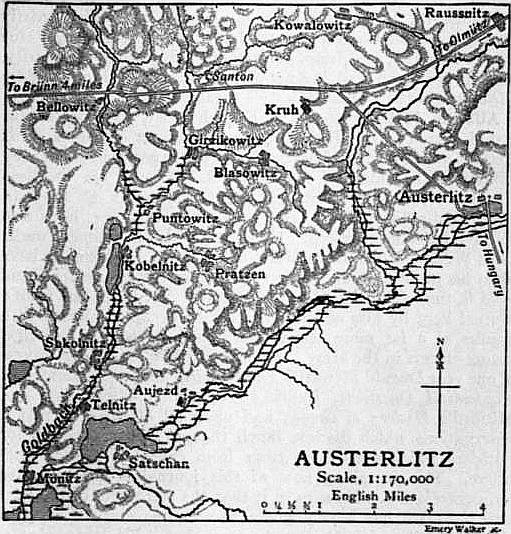
The great battle in which the French under Napoleon I. defeated the Austrians and Russians on the 2nd of December 1805, was fought in the country to the west of Austerlitz, the position of Napoleon’s left wing being almost equi-distant from Brünn and from Austerlitz. The wooded hills to the northward throw out to the south and south-west long spurs, between which are the low valleys of several rivers and brooks. The scene of the most important fighting was the Pratzen plateau. The famous “lakes” in the southern part of the field were artificial ponds, which have long since been drained. On the west or Brünn side of the Goldbach is another and lower ridge, which formed in the battle the first position of the French right and centre. On the other wing is the mass of hills from which the spurs and streams descend: here the Olmütz-Brünn road passes. The road from Brunn to Vienna, Napoleon’s presumed line of retreat, runs in a southerly direction, and near the village of Raigern (3 m. west of Monitz) is very close to the extreme right of the French position, a fact which had a great influence on the course of the battle. (The course of events which led to the action is described under Napoleonic Campaigns.) Napoleon, falling back before the advance of the allied Austrians and Russians from Olmütz, bivouacked west of the Goldbach, whilst the allies, holding, near Austerlitz, the junction of the roads from Olmutz and from Hungary, formed up in the valleys east of the Pratzen heights. The cavalry of both sides remained inactive, Napoleon’s by express order, the enemy’s seemingly from mere negligence, since they had 177 squadrons at their disposal. Napoleon, having determined to fight, as usual called up every available battalion; the splendid III. corps of Davout only arrived upon the field after a heavy march, late on the night of December 1st. The plan of the allies was to attack Napoleon’s right, and to cut him off from Vienna, and their advanced guard began, before dark on the 1st of December, to skirmish towards Telnitz. At that moment Napoleon was in the midst of his troops, thousands of whom had made their bivouac-straw into torches in his honour. The glare of these seemed to the allies to betoken the familiar device of lighting fires previous to a retreat, and thus confirmed them in the impression which Napoleon’s calculated timidity had given. Thus encouraged, those who desired an immediate battle soon gained the upper hand in the councils of the tsar and the emperor Francis. The attack orders for the 2nd of December (drawn up by the Austrian general Weyrother, and explained by him to a council of superior officers, of whom some were hostile, the greater part indifferent, and the chief Russian member, General Kutusov, asleep) gave the five columns and the reserve, into which the Austro-Russian army was organized, the following tasks: the first and second (Russians) to move south-westward behind the Pratzen ridge towards Telnitz and Sokolnitz; the third (Russian) to cross the southern end of the plateau, and come into line on the right of the first two; the fourth (Austrians and Russians under Kolowrat) on the right of the third to advance towards Kobelnitz. An Austrian advanced guard preceded the 1st and 2nd columns. Farther still on the right the 5th column (cavalry under Prince John of Liechtenstein) was to hold the northern part of the plateau, south of the Brunn-Olmutz road; across the road itself was the corps of Prince Bagration, and in rear of Liechtenstein’s corps was the reserve (Russians under the grand-duke Constantine). Thus, the farther the four main columns penetrated into the French right wing, the wider would the gap become between Bagration and Kolowrat, and Liechtenstein’s squadrons could not form a serious obstacle to a heavy attack of Napoleon’s centre. The whole plan was based upon defective information and preconceived ideas; it has gone down to history as a classical example of bad generalship, and its author Weyrother, who was perhaps nothing worse than a pedant, as a charlatan.
Napoleon, on the other hand, with the exact knowledge of the powers of his men, which was the secret of his generalship, entrusted nearly half of his line of battle to a division (Legrand’s) of Soult’s corps, which was to be supported by Davout, some of whose brigades had marched, from Vienna, 90 m. in forty-eight hours. But the ground which this thin line was to hold against three columns of the enemy was marshy and densely intersected by obstacles, and the III. corps was the best in the Grande Armée, while its leader was perhaps the ablest of all Napoleon’s marshals. The rest of the army formed in the centre and left. “Whilst they march to turn my right,” said Napoleon in the inspiriting proclamation which he issued on the eve of the battle, “they present me their flank,” and the great counterstroke was to be delivered against the Pratzen heights by the French centre. This was composed of Soult’s corps, with Bernadotte’s in second line. On the left, around the hill called by the French the Santon (which was fortified) was Lannes’ corps, supported by the cavalry reserve under Murat. The general reserve consisted of the Guard and Oudinot’s grenadiers.
The attack of the allies was begun by the first three columns, which moved down from their bivouacs behind the Pratzen plateau before dawn on the 2nd, towards Telnitz and Sokolnitz. The Austrian advanced guard engaged at daybreak, and the French in Telnitz made a vigorous defence; both parties were reinforced, and Legrand drew upon himself, in fulfilling his mission, the whole weight of the allied attack. The contest was long and doubtful, but the Russians gradually drove back Legrand and a part of Davout’s corps; numerous attacks both of infantry and cavalry were made, and by the successive arrival of reinforcements each side in turn received fresh impetus. Finally, at about 10 A.M., the allies were in possession of the villages on the Goldbach from Sokolnitz southwards, and Davout’s line of battle had reformed more than a mile to rearward, still, however, maintaining touch with the French centre on the Goldbach at Kobelnitz. Between the two lines the fighting continued almost to the close of the battle. With 12,500 men of all arms the Marshal held in front of him over 40,000 of the enemy.
In the centre, the defective arrangements of the allied staff had delayed the 4th column (Kolowrat), the line of march of which was crossed by Liechtenstein’s cavalry moving in the opposite direction. The objective of this column was Kobelnitz, and the two emperors and Kutusov accompanied it. The delay had, however, opened a gap between Kolowrat and the 3rd column on his left; and towards this gap, and the denuded Pratzen plateau, Napoleon sent forward St Hilaire’s division of Soult’s corps for the decisive attack. Kutusov was pursuing this march to the south-west when he was surprised by the swift advance of Soult’s men on the plateau itself. Napoleon had here double the force of the allies; Kutusov, however, displayed great energy, changed front to his right and called up his reserves. The French did not win the plateau without a severe struggle. St Hilaire’s (the right centre) division was fiercely engaged by Kolowrat’s column, General Miloradovich opposed the left centre attack under Vandamme, but the French leaders were two of the best fighting generals in their army. The rearmost troops of the Russian 2nd column, not yet committed to the fight on the Goldbach, made a bold counter stroke against St Hilaire’s right flank, but were repulsed, and Soult now turned to relieve the pressure on Davout by attacking Sokolnitz. The Russians in Sokolnitz surrendered, an opportune cavalry charge further discomfited the allied left, and the Pratzen plateau was now in full possession of the French. Even the Russian Guard failed to shake Vandamme’s hold. In the meanwhile Lannes and Murat had been engaged in the defence of the Santon. Here the allied leaders displayed the greatest vigour, but they were unable to drive back the French. The cavalry charges in this quarter are celebrated in the history of the mounted arm; and Kellermann, the hero of Marengo, won fresh laurels against the cavalry of Liechtenstein’s command. The French not only held their ground, but steadily advanced and eventually forced back the allies on Austerlitz, thereby barring their retreat on Olmütz. The last serious attempt of the allies in the centre led to some of the hardest fighting of the day; the Russian Imperial Guard under the grand-duke Constantine pressed closely upon St Hilaire and Vandamme on the plateau, and only gave way when the French Guard and the Grenadiers came into action. After the “Chevalier Guards” had been routed by Marshal Bessières and the Guard cavalry, the allies had no more hope of victory; orders had already been sent to Buxhöwden, who commanded the three columns engaged against Davout, to retreat on Austerlitz. No further attempt was made on the plateau, which was held by the French from Pratzen to the Olmütz road. The allied army was cut in two, and the last confused struggle of the three Russian columns on the Goldbach was one for liberty only. The fighting in Telnitz was perhaps the hardest of the whole battle, but the inevitable retreat, every part of which was now under the fire of the French on the plateau, was terribly costly. Soult now barred the way to Austerlitz, and the allies turned southward towards Satschan. As they retreated, the ice of the Satschan pond was broken up by the French artillery, and many of the fugitives were drowned. In the twelve hours from 7 A.M. to nightfall, the 65,000 French troops had lost 6800 men, or about 10%; the allies (82,500 engaged) had 12,200 killed and wounded, and left in the enemy’s hands 15,000 prisoners (many wounded) and 133 guns.
AUSTIN, ALFRED (1835- ), English poet-laureate, was born at Headingley, near Leeds, on the 30th of May 1835. His father, Joseph Austin, was a merchant of the city of Leeds; his mother, a sister of Joseph Locke, M.P. for Honiton. Mr Austin was educated at Stonyhurst, Oscott, and London University, where he graduated in 1853. He was called to the bar four years later, and practised as a barrister for a short time; but in 1861, after two comparatively false starts in poetry and fiction, he made his first noteworthy appearance as a writer with a satire called The Season, which contained incisive lines, and was marked by some promise both in wit and observation. In 1870 he published a volume of criticism, The Poetry of the Period, which was again conceived in a spirit of satirical invective, and attacked Tennyson, Browning, Matthew Arnold and Swinburne in no half-hearted fashion. The book aroused some discussion at the time, but its judgments were extremely uncritical. In 1881 Mr Austin returned to verse with a tragedy, Savonarola, to which he added Soliloquies in 1882, Prince Lucifer in 1887, England’s Darling in 1896, The Conversion of Winckelmann in 1897, &c. A keen Conservative in politics, for several years he edited The National Review, and wrote leading articles for The Standard. On Tennyson’s death in 1892 it was felt that none of the then living poets, except Swinburne or William Morris, who were outside consideration on other grounds, was of sufficient distinction to succeed to the laurel crown, and for several years no new poet-laureate was nominated. In the interval the claims of one writer and another were much canvassed, but eventually, in 1896, Mr Austin was appointed. As poet-laureate, his occasional verses did not escape adverse criticism; his hasty poem in praise of the Jameson Raid in 1896 being a notable instance. The most effective characteristic of Mr Austin’s poetry, as of the best of his prose, is a genuine and intimate love of nature. His prose idylls, The Garden that I love and In Veronica’s Garden, are full of a pleasant, open-air flavour, which is also the outstanding feature of his English Lyrics. His lyrical poems are wanting in spontaneity and individuality, but many of them possess a simple, orderly charm, as of an English country lane. He has, indeed, a true love of England, sometimes not without a suspicion of insularity, but always fresh and ingenuous. A drama by him, Flodden Field, was acted at His Majesty’s theatre in 1903.
AUSTIN, JOHN (1790-1859), English jurist, was born on the 3rd of March 1790. His father was the owner of flour mills at Ipswich and in the neighbourhood, and was in good circumstances. John was the eldest of five brothers. One of his brothers, Charles (1799-1874), obtained great distinction at the bar. John Austin entered the army at a very early age; he is said to have been only sixteen. He served with his regiment under Lord William Bentinck in Malta and Sicily. He seems to have liked his profession, and to have joined in the amusements and even in the follies of his brother officers. Yet it appears from a journal kept by him at the time that he occupied himself with studies of a far more serious kind than is common amongst young officers in the army. He notes having read in the course of one year Dugald Stewart’s Philosophical Essays, Drummond’s Academical Questions, Enfield’s History of Philosophy, and Mitford’s History of Greece, and upon all of these he makes observations which disclose much thought and a capacity for criticism which must have come from extensive reading elsewhere. The prevailing note of this journal is one of bitter self-depreciation. He says in it that the retrospect of the past year (1811) “has hardly given rise to one single feeling of satisfaction,” and farther on he says that “indolence, always the prominent vice of my character,” has “assumed over me an empire I almost despair of shaking off.” It is difficult to believe that a man only just of age, whose serious reading consisted of such books, and who (as appears from the same journal) was in the habit of turning to the classics as an alternative, could have deserved the reproach of indolence.
In 1812, he resigned his commission in the army, and returned home. He then began to read law in the chambers of a barrister. He was called to the bar in the year 1818, and joined the Norfolk circuit, but he never obtained any large practice, and he finally retired from the bar in 1825. In 1819 he married Sarah Taylor (see Austin, Sarah).
Although Austin had failed to attain success at the bar it was not long before he had an opportunity of exercising his abilities and in a manner peculiarly suited to his particular turn of mind. In 1826 a number of eminent men were engaged in the foundation of University College, and it was determined to establish in it a chair of jurisprudence. This chair was offered to Austin and he agreed to accept it. As he was not called upon to begin his lectures immediately, he resolved to proceed to Germany in order to prepare himself for his duties by studying the method of legal teaching pursued at German universities. He resided first at Heidelberg, and afterwards at Bonn, where he lived on terms of intimacy with such distinguished lawyers as Savigny and K.J.A. Mittermaier; and such eminent men of letters as Niebuhr, Brandis, Schlegel and A.W. Heffter. He began lecturing in 1828, and at first was not without encouragement. His class was a peculiarly brilliant one. It included a number of men who afterwards became eminent in law, politics and philosophy—Sir George Cornewall Lewis, Charles Buller, Charles Villiers, Sir Samuel Romilly and his brother Lord Romilly, Edward Strutt afterwards Lord Belper, Sir William Erie and John Stuart Mill were all members of his class. All of these have left on record expressions of the profound admiration which the lectures excited in the minds of those who heard them. But the members of his class, though exceptional in quality, were few in number, and as there was no fixed salary attached to the professorship, Austin could not afford to remain in London, and in 1832 he resigned. In that year he published his Province of Jurisprudence determined, being the first ten of his delivered lectures compressed into six.
There is ample testimony that Austin’s lectures were very highly appreciated by those who heard them. Their one fault was that they were over-elaborated. In his desire to avoid ambiguity, he repeats his explanations and qualifications to an extent which must have tired his hearers. Nevertheless the lectures excited an admiration which almost amounted to enthusiasm. Nor was Austin’s influence confined to his lectures. Sir William Erle says in a letter written to him in 1844, “The interchange of mind with you in the days of Lincoln’s Inn I regard as a deeply important event in my life, and I ever remember your friendship with thankfulness and affection.” John Stuart Mill, whose views on political subjects were entirely opposed to those of Austin, spoke of him after his death as the man “to whom he (Mill) had been intellectually and morally most indebted,” and he expressed the opinion “that few men had contributed more by their individual influence, and their conversation, to the formation and growth of the most active minds of the generation.”
In 1833 a royal commission was issued to draw up a digest of criminal law and procedure. Of this commission Austin was a member. The first report was signed by all the commissioners, and was presented in June 1834. Nevertheless it appears from some notes made at the time that Austin, though he thought it his duty to sign the report, strongly objected to some passages which it contained. It is pretty obvious from the nature of these objections that nothing would have satisfied him short of a complete recasting of the criminal law, whereas what the commissioners were ordered to produce was not a code but a digest. Probably Austin felt, as Mr Justice Wills felt some years later, that the anomalies which a code would remove would “choke a digest.”
In 1834 the benchers of the Inner Temple appointed Austin to give lectures on the “General Principles of Jurisprudence and International Law.” He delivered a few lectures in the spring of that year, but in June the course was by order of the benchers suspended on account of the smallness of the attendance, and it was never resumed. He then went to live with his wife and only child Lucie (afterwards Lady Duff-Gordon) at Boulogne. Here he remained for about a year and a half. He then accepted an appointment offered him by Sir James Stephen to go as royal commissioner to Malta in conjunction with Mr (afterward Sir George) Cornewall Lewis, to inquire into the nature and extent of the grievances of which the natives of that island complained.
The Austins remained in Malta until July 1838. After their return they lived a good deal abroad, and in 1844 they settled in Paris, where they remained until driven out of France by the revolution of 1848. They then took a house at Weybridge, and there Austin remained until his death in December 1859. He was urged by his friends to publish a second edition of the Province of Jurisprudence, which was then out of print, and he went so far as to allow a prospectus to be issued by Mr Murray of an extended work on “The Principles and Relations of Jurisprudence and Ethics.” But nothing came of it.
In 1842 Austin published in the Edinburgh Review an attack upon Friedrich List’s system of trade protection (Das nationale System der politischen Okonomie). And in 1859 he published a pamphlet entitled “A Plea for the Constitution.” This was occasioned by the publication of Lord Grey’s essay on “Parliamentary Government.” Its main object was to show that the consequences to be anticipated from Parliamentary Reform were all of them either impossible of realization or mischievous. He thought any attempt on the part of the poorer classes to improve their position was barred by the inexorable laws of political economy; and that if they obtained power they would only use it to plunder the rich; whilst, on the other hand, he seems not to have had any suspicion that the “proprietary class” were likely to disregard the interests of the poor. He thinks that political power is safest in the hands of those possessed of hereditary or acquired property; and that without property even intelligence and knowledge afford no presumption of political capacity. Undoubtedly Austin was a utilitarian in the Benthamite sense, and remained so to the end of his life. It must be remembered that Bentham’s sole and immutable test of human action was the greatest happiness of the greatest number. This is a principle which an aristocrat may adopt if he chooses, no less than a democrat; an individualist no less than a socialist; and there is nothing in the “Plea for the Constitution” which contravenes this. But Austin thought, and in this no doubt he differed from Bentham, that the mass of the people did not know their own interests so well as “an aristocracy of independent gentlemen” who might be trusted to provide for the wants of all classes alike.
Austin’s position as a jurist is much more difficult to estimate. Twice his influence appeared likely to produce some impression upon English law, but upon both occasions it lasted only a short time, and never extended very far. The men whom he influenced were very eminent, but in numbers they were few. As a rule, students for the bar never at any time paid any attention to his teaching. The first published lectures were almost forgotten when Mr (afterwards Sir Henry) Maine was appointed to lecture on jurisprudence at the Inner Temple. Both in his private and public lectures Maine constantly urged upon his hearers the importance of Austin’s analytical inquiries into the meaning of legal terms. He used to say that it was Austin’s inquiries which had made a philosophy of law possible. Undoubtedly Maine’s influence revived for a short time the interest in Austin’s teaching. Maine was lecturing about the time of Austin’s death, and in 1861 Mrs Austin published a second edition of the Province of Jurisprudence, and this was followed soon after by two volumes which contained in addition in a fragmentary form the remaining lectures delivered at University College and other notes (Lectures on Jurisprudence; or The Philosophy of Positive Law).
It cannot be said that Austin’s views of jurisprudence have had, as yet, any visible influence whatever on the study of English law. But if we consider what it was that Austin endeavoured to teach, it can hardly be said that the subject is one which a lawyer can with impunity neglect. He proposes to distinguish law from morals; to explain the notions which have been entertained of duty, right, liberty, injury, punishment and redress; and their connexion with, and relations to, sovereignty; to examine the distinction between rights in rem and rights in personam, and between rights ex contractu and rights ex delicto; and further to determine the meaning of such terms as right, obligation, injury, sanction, person, thing, act and forbearance. These are some of the terms, notions and distinctions which Austin endeavoured to explain. They are daily in the mouth of every practising lawyer. The only portion of Austin’s work which has attracted much attention of recent years is his conception of sovereignty, and his dictum that all laws properly so called must be considered as sanctioned expressly or tacitly by the sovereign. This has been indignantly denied. It has been considered enough to justify this denial to point out that there are in existence states where the seat of sovereignty, and the ultimate source of law, cannot be accurately indicated. But this criticism is entirely misplaced; for as pointed out by Maine (Early History of Institutions, Lecture xii.), in an elaborate discussion of Austin’s views, which in the main he accepts, what Austin was engaged upon was not an inquiry into the nature of sovereignty as it is found to exist, but an inquiry into what was the connexion between the various forms of political superiority. And this inquiry was undertaken in order to enable him to distinguish the province of jurisprudence properly so called from the province of morality; an inquiry which was hopeless unless the connexion just stated was clearly conceived. Austin’s views of sovereignty, therefore, was an abstraction, useless it is true for some purposes, but by no means useless for others. “There is,” as Maine says, “not the smallest necessity for accepting all the conclusions of these great writers (i.e. Bentham and Austin) with implicit deference, but there is the strongest necessity for knowing what these conclusions are. They are indispensable, if for no other object, for the purpose of clearing the head.” These last words exactly express the work which Austin set himself to do. It was to clear his own head, and the heads of his hearers, that he laboured so hard. As Austin once said of himself, his special vocation was that of untying intellectual knots. The disentangling of classifications and distinctions, the separation of real from accidental distinctions, the analysis of ideas confusedly apprehended, these (as has been truly said) were the characteristics of Austin’s work which specially distinguished him. Austin thought that this somewhat irksome task was a necessary preliminary both to the study of law as a science, and to the production of a code. It is a curious reflection that whilst the lectures in which these inquiries were begun (though not completed) excited the admiration of his contemporaries, hardly any one now thinks such inquiries worth pursuing.
The Lectures on Jurisprudence were reviewed by J.S. Mill in the Edinburgh Review of October 1863, and this review is republished in Mill’s Dissertations and Discussions, vol. 3, p. 206. Professor Jethro Brown has published (1906) an edition of Austin’s earlier lectures, in which they are stated in an abbreviated form. There is a sketch of his life by his widow in the preface to the Lectures on Jurisprudence, which she published after his death.
(W. Ma.)
AUSTIN, SARAH (1793-1867), English author, was born in 1793, the daughter of John Taylor (d. 1826), a wool-stapler and a member of the well-known Taylor family of Norwich. Her great grandfather, Dr John Taylor (1694-1761), had been pastor of the Presbyterian church there, and wrote a once famous polemical work on The Scripture Doctrine of Original Sin (1738), which called forth celebrated treatises by Jonathan Edwards on Original Sin. Her mother, Susannah Cook, was an exceedingly clever woman who transmitted both her beauty and her talent to her daughter. Their friends included Dr Alderson and his daughter Mrs Opie, Henry Crabbe Robinson, the Gurneys and Sir James Mackintosh. Sarah Taylor married in 1820 John Austin (q.v.). They lived in Queen Square, Westminster, where Mrs. Austin, whose tastes, unlike her husband’s, were extremely sociable, gathered round her a large circle, Jeremy Bentham, James Mill and the Grotes being especially intimate. She received many Italian exiles, who found a real friend in her. In 1821 was born her only child, Lucie, afterwards Lady Duff-Gordon. Mrs. Austin never attempted any considerable original work, contenting herself chiefly with translations, of which the most important are the History of the Reformation in Germany and the History of the Popes (1840), from the German of Leopold von Ranke, Report on the State of Public Instruction in Prussia (1834) from the French of V. Cousin, and F.W. Carove’s The Story without an End (1864). After her husband’s death in 1859 she edited his Lectures on Jurisprudence. She also edited the Memoirs of Sydney Smith (1855) and Lady Duff-Gordon’s Letters from Egypt (1865). She died at Weybridge on the 8th of August 1867.
See Three Generations of Englishwomen (1888), by her grand-daughter, Mrs Janet Ross.
AUSTIN, STEPHEN FULLER (1793-1836), American pioneer, was born in Austinville, Wythe county, Virginia, on the 3rd of November 1793. He was the son of Moses Austin (1767-1821), a native of Durham, Connecticut, who in 1820 obtained from Mexico a grant of land for an American colony in Texas, but died before he could carry out his project. The son was educated in New London, Connecticut, and at Transylvania University, Lexington, Kentucky, and settled in Missouri, where he was a member of the territorial legislature from 1813 to 1819. In 1819 he removed to Arkansas Territory, where he was appointed a circuit judge. After his father’s death he obtained a confirmation of the Texas grants from the newly established Mexican government, and in 1821-1823 he established a colony of several hundred American families on the Brazos river, the principal town being named, in his honour, San Felipe de Austin. He was a firm defender of the rights of the Americans in Texas, and in 1833 he was sent to the city of Mexico to present a petition from a convention in Texas praying for the erection of a separate state government. While there, despairing of success for his petition, he wrote home recommending the organization of a state without waiting for the consent of the Mexican congress. This letter falling into the hands of the Mexican government, Austin, while returning home, was arrested at Saltillo, carried as a prisoner back to Mexico, and imprisoned for a year without trial. Returning to Texas in 1835, he found the Texans in armed revolt against Mexican rule, and was chosen commander-in-chief of the revolutionary forces, but after failing to take San Antonio he resigned the command, for which he had never considered himself fitted, and in November 1835 went to the United States as a commissioner to secure loans and supplies, and to learn the position the United States authorities would be likely to take in the event of a declaration of Texan independence. He succeeded in raising large sums, and received assurances that satisfied him that Americans would look with great favour on an independent Texas. Returning to Texas in the summer of 1836, he became a candidate, rather reluctantly, for the presidency of the newly established republic of Texas, but was defeated by Samuel Houston, under whom he was secretary of state until his sudden death on the 7th of December 1836.
See A Comprehensive History of Texas, edited by D.G. Wooten (2 vols., Dallas, 1898).
AUSTIN, a city and the county-seat of Mower county, Minnesota, U.S.A., on the Red Cedar river and Turtle creek, (by rail) 105 m. S. of Minneapolis and 100 m. from St Paul. Pop. (1900) 5474; (1905, state census) 6489 (913 foreign-born); (1910, U.S. census) 6960. It is served by the Chicago Great Western and the Chicago, Milwaukee & St Paul railways. Austin is the seat of the Southern Minnesota Normal College and Austin School of Commerce (1896), and has a Carnegie library, court house and city hall. It is a market for livestock, and for dairy and farm products, and has slaughtering and packing establishments, flour mills, creameries and cheese factories, canning and preserving factories, carriage works, a flax fibre mill and grain elevators. Brick, tile, sewer-pipe, and hydraulic cement are manufactured, and there are railway repair shops. A valuable water-power is utilized for manufacturing purposes. Fresh-water pearls of considerable value and beauty are found in the Red Cedar river. The city owns and operates its own water-supply system and electric-lighting plant. Austin was settled in 1855, was incorporated as a village in 1868, and was chartered as a city in 1873.
AUSTIN, the capital of Texas, U.S.A., and the county-seat of Travis county, on the N. bank of the Colorado river, near the centre of the state and about 145 m. W.N.W. of Houston. Pop. (1890) 14,575; (1900) 22,258, of whom 5822 were negroes; (1910 census) 29,860. Austin is served by the Houston & Texas Central, the International & Great Northern, and the Missouri, Kansas & Texas railways. The city is built on high bluffs 40-120 ft. above the river, which is spanned here by a bridge, built in 1874. The Texas State Capitol, a handsome building of red Texas granite, with a dome 318 ft. high, cost more than $3,500,000, and stands in a square in the centre of the city. It was built (1881-1888) by Chicago capitalists in exchange for a land grant of 3,000,000 acres. It is in the form of a Greek cross, with an extreme length of 556.5 ft. and an extreme width of 288.8 ft. Next to the National Capitol at Washington, it is the largest capitol building in the United States, and it is said to be one of the ten largest buildings in the world. Austin is the seat of the University of Texas (opened in 1883; co-educational); the medical department of the state university is at Galveston, and the departments in Austin are the college of arts, department of education, department of engineering, department of law, school of pharmacy, and school of nursing. The government of the university is vested in a board of eight regents nominated by the governor and appointed with the advice and consent of the state senate. At Austin are also state institutions and asylums for the insane, the blind, the coloured deaf and blind; the state school for the deaf and dumb; the state Confederate home; the Confederate woman’s home (1907; for wives and widows of Confederate soldiers and sailors), maintained by the Daughters of the Confederacy; St Mary’s Academy (Roman Catholic, under the supervision of the Sisters of the Holy Cross, founded 1875, chartered 1886); St Edward’s College (Roman Catholic, chartered 1885); the Austin Presbyterian Theological Seminary (Presbyterian Church, South), opened in 1902 by the Synod of Texas, and after 1905 partly controlled by the Synod of Arkansas; Tillotson College (a negro school under Congregational control, founded by the American Missionary Association, chartered in 1877, and opened in 1881), and Samuel Huston College (for negroes; Methodist Episcopal; opened in 1900 and named in honour of an Iowan benefactor). The principal newspapers of Austin are the Statesman (Democratic, established in 1871), a morning paper, and the Tribune (Democratic, established in 1891), an evening paper. The Quarterly of the Texas State Historical Society is published here. Austin is the principal trade and jobbing centre for central and western Texas, is an important market for livestock, cotton, grain and wool, and has extensive manufactories of flour, cotton-seed oil, leather goods, lumber and wooden ware; the value of the factory product in 1905 was $1,569,353, being 105.2% more than in 1900. The city owns and operates its water-supply system. In 1890-1893 one of the largest dams in the world, an immense structure of granite masonry, 1200 ft. long. 60-70 ft. high, and 18 to 66 ft. thick, was constructed across the Colorado river 2 m. above the city for the purpose of supplying water and power, creating a reservoir (Lake M‘Donald) about 30 m. long. Freshets in the spring of 1900, however, undermined the wall, and on the 7th of April the dam broke with a resulting loss of several lives and about $1,000,000 worth of property. The rebuilding of the dam was projected in 1907. Austin was first settled in 1838 and was named Waterloo, but in 1839, when it was chosen as the site of the capital of the Republic of Texas, it was renamed in honour of Stephen F. Austin, one of its founders. Under the influence of General Sam Houston the capital was for a time in 1842-1845 removed from Austin to Houston, but in 1845 an ordinance was passed making Austin the capital, and it remained the state capital after Texas entered the Union, although Huntsville and Tehuacana Springs in 1850 and Houston in 1872 attempted in popular elections to be chosen in its place. The first Anglo-American settlement in Texas, established on the Brazos river in 1823 by members of the Austin colony, was San Felipe de Austin now San Felipe. In 1909 Austin adopted a commission form of government.
AUSTRALASIA, a term used by English geographers in a sense nearly synonymous with the Oceania of continental writers. It thus comprises all the insular groups which extend almost continuously from the south-eastern extremity of Asia to more than half-way across the Pacific. Its chief divisions are Malaysia with the Philippines; Australia with Tasmania and New Zealand; Melanesia, that is, New Guinea, New Britain, New Ireland, Admiralty, the Solomons, New Hebrides, Santa Cruz, Fiji, Loyalties and New Caledonia; Micronesia, that is, the Ladrones, Pelew and Carolines, with the Marshall and Gilbert groups; lastly, Polynesia, that is, Samoa, Tonga, Cook, Tahiti, the Marquesas, Ellice, Hawaii and all intervening clusters. The term is so far justified in that it harmonizes better than Oceania did with the names of the other continents, and also embodies the two essential facts that it is a south-eastern extension of Asia, and that its central and most important division is the great island-continent of Australia. In a more restricted sense the term Australasia corresponds to the large division including Australia, Tasmania and New Zealand.
See Australasia, 2 vols. Stanford Compendium Series, new issue (London, 1907-1908).
AUSTRALIA, the only continent entirely in the southern hemisphere. It lies between 10° 39′ and 39° 11½’ S., and between 113° 5′ and 153° 16′ E. Its greatest length is 2400 m. from east to west, and the greatest breadth 1971 m. from north to south. The area is, approximately, 2,946,691 sq. m., with a coast line measuring about 8850 m. This is equal to 1 m. to each 333 sq. m. of land, the smallest proportion of coast shown by any of the continents.
Physical Geography
Physiography.—The salient features of the Australian continent are its compact outline, the absence of navigable rivers communicating with the interior, the absence of active volcanoes or snow-capped mountains, its General character. isolation from other lands, and its antiquity. Some of the most profound changes that have taken place on this globe occurred in Mesozoic times, and a great portion of Australia was already dry land when vast tracts of Europe and Asia were submerged; in this sense, therefore, Australia has been rightly referred to as one of the oldest existing land surfaces. It has been described as at once the largest island and the smallest continent on the globe. The general contours exemplify the law of geographers in regard to continents, viz. as to their having a high border around a depressed interior, and the highest mountains on the side of the greatest ocean. On the N. Australia is bounded by the Timor Sea, the Arafura Sea and Torres Strait; on the E. by the Pacific Ocean; on the S. by Bass Strait and the Southern Ocean; and on the W. by the Indian Ocean. It stands up from the ocean depths in three fairly well-marked terraces. The basal plain of these terraces is the bed of the ocean, which on the Pacific side has an average depth of 15,000 ft. From this profound foundation rise Australia, New Guinea and Melanesia, in varying slopes. The first ledge rising from the ocean floor has a depth averaging 8000 ft. below sea-level. The outer edge of this ledge is roughly parallel to the coast of Western Australia, and more than 150 m. from the land. Round the Australian Bight it continues parallel to the coast, until south of Spencer Gulf (the basal ledge still averaging 8000 ft. in depth) it sweeps southwards to lat. 55°, and forms a submarine promontory 1000 m. long. The edge of the abysmal area comes close to the eastern coasts of Tasmania and New South Wales, approaching to within 60 m. of Cape Howe. The terrace closest to the land, known as the continental shelf, has an average depth of 600 ft., and connects Australia, New Guinea, and Tasmania in one unbroken sweep. Compared with other continents, the Australian continental shelf is extremely narrow, and there are points on the eastern coast where the land plunges down to oceanic depths with an abruptness rarely paralleled. Off the Queensland coast the shelf broadens, its outer edge being lined by the seaward face of the Great Barrier Reef. From Torres Strait to Dampier Land the shelf spreads out, and connects Australia with New Guinea and the Malay Archipelago. An elongation of the shelf to the south joins Tasmania with the mainland. The vertical relief of the land above the ocean is a very important factor in determining the climate as well as the distribution of the fauna and flora of a continent.
The land mass of Australia rises to a mean height much less than that of any other continent; and the chief mountain systems are parallel to, and not far from, the coast-line. Thus, taking the continent as a whole, it may be described as a plateau, fringed by a low-lying well-watered coast, with a depressed, and for the most part arid, interior. A great plain, covering quite 500,000 sq. m., occupies a position a little to the east of a meridional line bisecting the continent, and south of the 22nd degree, but portions of it stretch upwards to the low-lying country south of the Gulf of Carpentaria. The contour of the continent in latitude 30° 5′ is as follows:—a short strip of coastal plain; then a sharp incline rising to a mountain range 4000 ft. above sea-level, at a distance of 40 m. from the coast. From this a gently-sloping plateau extends to almost due north of Spencer Gulf, at which point its height has fallen almost to sea-level. Then there is a gentle rise to the low steppes, 500 to 1000 ft. above sea-level. A further gentle rise in the high steppes leads to the mountains of the West Australian coast, and another strip of low-lying coastal land to the sea.
With a circumference of 8000 m. Australia presents a contour wonderfully devoid of inlets from the sea except on its northern shores, where the coast-line is largely indented. The Gulf of Carpentaria, situated in the north, is enclosed on the east by the projection of Cape York, and on the west by Arnheim Land, and forms the principal bay on the whole coast, measuring about 6° of long. by 6° of lat. Farther to the west, Van Diemen’s Gulf, though much smaller, forms a better-protected bay, having Melville Island between it and the ocean; while beyond this, Queen’s Channel and Cambridge Gulf form inlets about 14° 50′ S. On the north-west of the continent the coast-line is much broken, the chief indentations being Admiralty Gulf, Collier Bay and King Sound, on the shores of Tasman Land. Western Australia, again, is not favoured with many inlets, Exmouth Gulf and Shark’s Bay being the only bays of any size. The same remark may be made of the rest of the sea-board; for, with the exception of Spencer Gulf, the Gulf of St Vincent and Port Phillip on the south, and Moreton Bay, Hervey Bay and Broad Sound on the east, the coast-line is singularly uniform. There are, however, numerous spacious harbours, especially on the eastern coast, which are referred to in the detailed articles dealing with the different states. The Great Barrier Reef forms the prominent feature off the north-east coast of Australia; its extent from north to south is 1200 m., and it is therefore the greatest of all coral reefs. The channel between the reef and the coast is in places 70 m. wide and 400 ft. deep. There are a few clear openings in the outer rampart which the reef presents to the ocean. These are opposite to the large estuaries of the Queensland rivers, and might be thought to have been caused by fresh water from the land. The breaks are, however, some 30 to 90 m. away from land and more probably were caused by subsidence; the old river-channels known to exist below sea-level, as well as the former land connexion with New Guinea, seem to point to the conditions assumed in Darwin’s well-known subsidence theory, and any facts that appear to be inconsistent with the theory of a steady and prolonged subsidence are explainable by the assumption of a slight upheaval.
With the exception of Tasmania there are no important islands belonging geographically to Australia, for New Guinea, Timor and other islands of the East Indian archipelago, though not removed any great distance from the continent, do not belong to its system. On the east coast there are a few small and unimportant islands. In Bass Strait are Flinders Island, about 800 sq. m. in area, Clarke Island, and a few other small islands. Kangaroo Island, at the entrance of St Vincent Gulf, is one of the largest islands on the Australian coast, measuring 80 m. from east to west with an average width of 20 m. Numerous small islands lie off the western coast, but none has any commercial importance. On the north coast are Melville and Bathurst Islands; the former, which is 75 m. long and 38 m. broad, is fertile and well watered. These islands are opposite Port Darwin, and to the westward of the large inlet known as Van Diemen’s Gulf. In the Gulf of Carpentaria are numerous islands, the largest bearing the Dutch name of Groote Eylandt.
Along the full length of the eastern coast extends a succession of mountain chains. The vast Cordillera of the Great Dividing Range originates in the south-eastern corner of the continent, and runs parallel with and close to the eastern Mountains. shore, through the states of Victoria and New South Wales, right up to the far-distant York Peninsula in Queensland. In Victoria the greatest elevation is reached in the peaks of Mount Bogong (6508 ft.) and Mount Feathertop (6303 ft.), both of which lie north of the Dividing Range; in the main range Mount Hotham (6100 ft.) and Mount Cobberas (6025 ft.) are the highest summits. In New South Wales, but close to the Victorian border, are found the loftiest peaks of Australia, Mount Kosciusco and Mount Townsend, rising to heights of 7328 and 7260 ft. respectively. The range is here called the Muniong, but farther north it receives the name of Monaro Range; the latter has a much reduced altitude, its average being only about 2000 ft. As the tableland runs northward it decreases both in height and width, until it narrows to a few miles only, with an elevation of scarcely 1500 ft.; under the name of the Blue Mountains the plateau widens again and increases in altitude, the chief peaks being Mount Clarence (4000 ft.), Mount Victoria (3525 ft.), and Mount Hay (3270 ft.). The Dividing Range decreases north of the Blue Mountains, until as a mere ridge it divides the waters of the coastal rivers from those flowing to the Darling. The mass widens out once more in the Liverpool Range, where the highest peak, Mount Oxley, reaches 4500 ft., and farther north, in the New England Range, Ben Lomond reaches an elevation of 5000 ft. Near the Queensland border, Mount Lindsay, in the Macpherson Range, rises to a height of 5500 ft. In the latitude of Brisbane the chain swerves inland; no other peak north of this reaches higher than Mount Bartle Frere in the Bellenden Ker Range (5438 ft.). The Southern Ocean system of the Victorian Dividing Range hardly attains to the dignity of high mountains. An eastern system in South Australia touches at a few points a height of 3000 ft.; and the Stirling Range, belonging to the south-western system of South Australia, reaches to 2340 ft. There are no mountains behind the Great Australian Bight. On the west the Darling Range faces the Indian Ocean, and extends from Point D’Entrecasteaux to the Murchison river. North of the Murchison, Mount Augustus and Mount Bruce, with their connecting highlands, cut off the coastal drainage from the interior; but no point on the north-west coast reaches a greater altitude than 4000 ft. Several minor ranges, the topography of which is little known, extend from Cambridge Gulf, behind a very much broken coast-line, to Limmen Bight on the Gulf of Carpentaria. Nothing is more remarkable than the contrast between the aspect of the coastal ranges on the north-east and on the south-east of the continent. The higher Australian peaks in the south-east look just what they are, the worn and denuded stumps of mountains, standing for untold ages above the sea. Their shoulders are lifted high above the tree-line. Their summits stand out gaunt and lonely in an unbroken solitude. Having left the tree-line far behind him, nothing is visible to the traveller for miles around but barren peaks and torn crags in indescribable confusion. A verdure of herbage clothes the valleys that have been scooped from the summits downwards. But there are no perpetual snow-fields, no glaciers creep down these valleys, and no alpine hamlets ever appear to break the monotony. The mountains of the north-east, on the contrary, are clothed to their summits with a rich and varied flora. Naked crags, when they do appear, lift themselves from a sea of green, and a tropical vegetation, quite Malaysian in character, covers everything.
The absence of active volcanoes in Australia is a state of things, in a geological sense, quite new to the continent. Some of the volcanoes of the western districts of Victoria have been in eruption probably subsequent to the advent of the black-fellow. In some instances the cones are quite intact, and the beds of ash and scoriae are as yet almost unaffected by denuding agencies. Late in the Tertiary period vast sheets of lava poured from many points of the Great Dividing Range of eastern Australia. But it is notable that all recent volcanic action was confined to a wide belt parallel to the coast. No evidences of recent lava flows can be found in the interior over the great alluvial plain, the Lower, or the Higher Steppes. Nor has the continent, as a whole, in recent times been subjected to any violent earth tremors; though in 1873, to the north of Lake Amadeus, in central Australia, Ernest Giles records the occurrence of earthquake shocks violent enough to dislodge considerable rock masses.
Australia possesses one mountain which, though not a volcano, is a “burning mountain.” This is Mount Wingen, situated in a spur of the Liverpool Range and close to the town of Scone. Its fires are not volcanic, but result from the combustion of coal some distance underground, giving off much smoke and steam; geologists estimate that the burning has been going on for at least 800 years.
The coastal belt of Australia is everywhere well watered, with the exception of the country around the Great Australian Bight and Spencer Gulf. Flowing into the Pacific Ocean on the east coast there are some fine rivers, but the majority have Rivers. short and rapid courses. In Queensland a succession of rivers falls into the Pacific from Cape York to the southern boundary of the state. The Burdekin is the finest of these, draining an area of 53,500 sq. m., and emptying into Upstart Bay; it receives numerous tributaries in its course, and carries a large body of fresh water even in the driest seasons. The Fitzroy river is the second in point of size; it drains an area of 55,600 sq. m., and receives several tributary streams during its course to Keppel Bay. The Brisbane river, falling into Moreton Bay, is important chiefly from the fact that the city of Brisbane is situated on its banks. In New South Wales there are several important rivers, the largest of which is the Hunter, draining 11,000 sq. m., and having a course of 200 m. Taking them from north to south, the principal rivers are the Richmond, Clarence, Macleay, Hastings, Manning, Hunter, Hawkesbury and Shoalhaven. The Snowy river has the greater part of its course in New South Wales, but its mouth and the last 120 m. are in Victoria. The other rivers worth mentioning are the Yarra, entering the sea at Port Phillip, Hopkins and Glenelg. The Murray (q.v.), the greatest river of Australia, debouches into Lake Alexandrina, and thence into the sea at Encounter Bay in South Australia. There are no other rivers of importance in South Australia, but the Torrens and the Gawler may be mentioned. Westward of South Australia, on the shores of the Australian Bight, there is a stretch of country 300 m. in length unpierced by any streams, large or small, but west of the bight, towards Cape Leeuwin, some small rivers enter the sea. The south-west coast is watered by a few streams, but none of any size; amongst these is the Swan, upon which Perth, the capital of Western Australia, is built. Between the Swan and North-West Cape the principal rivers are the Greenough, Murchison and Gascoyne; on the north-west coast, the Ashburton, Fortescue and De Grey; and in the Kimberley district, the Fitzroy, Panton, Prince Regent and the Ord. In the Northern Territory are several fine rivers. The Victoria river is navigable for large vessels for a distance of about 43 m. from the sea, and small vessels may ascend for another 80 m. The Fitzmaurice, discharging into the estuary of the Victoria, is also a large stream. The Daly, which in its upper course is called the Katherine, is navigable for a considerable distance, and small vessels are able to ascend over 100 m. The Adelaide, discharging into Adam Bay, has been navigated by large vessels for about 38 m., and small vessels ascend still farther. The South Alligator river, flowing into Van Diemen’s Gulf, is also a fine stream, navigable for over 30 m. by large vessels; the East Alligator river, falling into the same gulf, has been navigated for 40 m. Besides those mentioned, there are a number of smaller rivers discharging on the north coast, and on the west shore of the Gulf of Carpentaria the Roper river discharges itself into Limmen Bight. The Roper is a magnificent stream, navigable for about 75 or 80 m. by vessels of the largest tonnage, and light draught vessels can ascend 20 m. farther. Along the portion of the south shore of the Gulf of Carpentaria which belongs to Queensland and the east coast, many large rivers discharge their waters, amongst them the Norman, Flinders, Leichhardt, Albert and Gregory on the southern shore, and the Batavia, Archer, Coleman, Mitchell, Staaten and Gilbert on the eastern shore. The rivers flowing into the Gulf of Carpentaria, as well as those in the Northern Territory, drain country which is subject to regular monsoonal rains, and have the general characteristics of sub-tropical rivers.
The network of streams forming the tributaries of the Darling and Murray system give an idea of a well-watered country. The so-called rivers have a strong flow only after heavy rains, and some of them do not ever reach the main drainage line. Flood waters disappear often within a distance of a few miles, being absorbed by porous soil, stretches of sand, and sometimes by the underlying bed-rocks. In many cases the rivers as they approach the main stream break up into numerous branches, or spread their waters over vast flats. This is especially the case with the tributaries of the Darling on its left bank, where in seasons of great rains these rivers overspread their banks and flood the flat country for miles around and thus reach the main stream. Lieutenant John Oxley went down the Lachlan (1817) during one of these periods of flood, and the great plains appeared to him to be the fringe of a vast inland sea. As a matter of fact, they are an alluvial deposit spread out by the same flood waters. The great rivers of Australia, draining inland, carve out valleys, dissolve limestone, and spread out their deposit over the plains when the waters become too sluggish to bear their burden farther. From a geological standpoint, the Great Australian Plain and the fertile valley of the Nile have had a similar origin. Taking the Lachlan as one type of Australian river, we find it takes its rise amongst the precipitous and almost unexplored valleys of the Great Dividing Range. With the help of its tributaries it acts as a denuding agent for 14,000 sq. m. of country, and carries its burden of sediment westwards. A point is reached about 200 m. from the Dividing Range, where the river ceases to act as a denuding agent, and the area of deposition begins, at a level of 250 ft. above the sea, but before the waters can reach the ocean they have still to travel about 1000 m.
The Darling is reckoned amongst the longest rivers in the world, for it is navigable, part of the year, from Walgett to its confluence with the Murray, 1758 m., and then to the sea, a further distance of 587 m.—making in all 2345 m. of navigable water. But this gives no correct idea of the true character of the Darling, for it can hardly be said to drain its own watershed. From the sources of its various tributaries to the town of Bourke, the river may be described as draining a watershed. But from Bourke to the sea, 550 m. in a direct line, the river gives rather than receives water from the country it flows through.
The annual rainfall and the area of the catchment afford no measure whatever as to the size of a river in the interior of Australia. The discharge of the Darling river at Bourke does not amount to more than 10% of the rainfall over the country which it drains. It was this remarkable fact which first led to the idea that, as the rainfall could not be accounted for either by evaporation or by the river discharge, much of the 90% unaccounted for must sink into the ground, and in part be absorbed by some underlying bed-rock. All Australian rivers, except the Murray and the Murrumbidgee, depend entirely and directly on the rainfall. They are flooded after rain, and in seasons of drought many of them, especially the tributaries of the Darling, become chains of ponds. Springs which would equalize the discharge of rivers by continuing to pour water into their beds after the rainy season has passed seem entirely absent in the interior. Nor are there any snowfields to feed rivers, as in the other continents. More remarkable still, over large tracts of country the water seems disposed to flow away from, rather than to, the river-beds. As the low-lying plains are altogether an alluvial deposit, the coarser sediments accumulate in the regions where the river first overflows its banks to spread out over the plains. The country nearest the river receiving the heaviest deposit becomes in this way the highest ground, and so continues until a “break-away” occurs, when a new river-bed is formed, and the same process of deposition and accumulation is repeated. As the general level of the country is raised by successive alluvial deposits, the more ancient river-beds become buried, but being still connected with the newer rivers at some point or other, they continue to absorb water. This underground network of old river-beds underlying the great alluvial plains must be filled to repletion before flood waters will flow over the surface. It is not surprising, therefore, that comparatively little of the rainfall over the vast extent of the great central plain ever reaches the sea by way of the river systems; indeed these systems as usually shown on the maps leave a false impression as to the actual condition of things.
The great alluvial plain is one of Australia’s most notable inland features; its extent is upwards of 500,000 sq. m., lying east of 135° W. and extending right across the continent from the Gulf of Carpentaria to the Murray river. The interior Steppes. of the continent west of 135° and north of the Musgrave ranges is usually termed by geographers the Australian Steppes. It is entirely different in all essential features from the great alluvial plains. Its prevailing aspect is characterized by flat and terraced hills, capped by desert sandstone, with stone-covered flats stretching over long distances. The country round Lake Eyre, where some of the land is actually below sea-level, comes under this heading. The higher steppes, as far as they are known, consist of Ordovician and Cambrian rocks, with an average elevation of 1500 to 3000 ft. above sea-level. Over this country water-courses are shown on maps. These run in wet seasons, but in every instance for a short distance only, and sooner or later they are lost in sand-hills, where their waters disappear and a line of stunted gum-trees (Eucalyptus rostrata) is all that is present to indicate that there may be even a soakage to mark the abandoned course. The steppes cover a surface of 400,000 sq. m., and from this vast expanse not a drop of the scanty rainfall reaches the sea; there is no leading drainage system and there are no rivers. Another notable feature of the interior is the so-called lake area, a district stretching to the north of Spencer Gulf. These Lakes. lakes are expanses of brackish waters that spread or contract as the season is one of drought or rain. In seasons of drought they are hardly more than swamps and mud flats, which for a time may become a grassy plain, or desolate coast encrusted with salt. The country around is the dreariest imaginable, the surface is a dead level, there is no heavy timber and practically no settlement. Lake Torrens, the largest of these depressions, sometimes forms a sheet of water 100 m. in length. To the north again stretches Lake Eyre, and to the west Lake Gairdner. Some of these lake-beds are at or slightly below sea-level, so that a very slight depression of the land to the south of them would connect much of the interior with the Southern Ocean.