VOLUME II SLICE VIII Atherstone to Austria (continued 6)
Reading edition
See Ornithology; also Audubon and his Journals (1897), by his grand-daughter Maria R. Audubon, with notes by Elliot Coues.
AUE, a town of Germany, in the kingdom of Saxony, at the confluence of the Mulde and Schwarzwasser, 21 m. S.W. from Chemnitz on the railway to Adorf. It has a school of lace-making, foundries, and manufactures of machinery, tin-plate and cotton goods. Pop. (1905) 17,102.
AUERBACH, BERTHOLD (1812-1882), German novelist, was born on the 28th of February 1812 at Nordstetten in the Württemberg Black Forest. His parents were Jews, and he was intended for the ministry; but after studying philosophy at Tübingen, Munich and Heidelberg, and becoming estranged from Jewish orthodoxy by the study of Spinoza, he devoted himself to literature. He made a fortunate beginning in a romance on the life of Spinoza (1837), so interesting in itself, and so close in its adherence to fact, that it may be read with equal advantage as a novel or as a biography. Dichter und Kaufmann followed in 1839, and a translation of Spinoza’s works in 1841, when Auerbach turned to the class of fiction which has made him famous, the Schwarzwälder Dorfgeschichten (1843), stories of peasant life in the Black Forest. In these, as well as in Barfüssele (1856), Edelweiss (1861), and other novels of greater compass, he depicts the life of the south German peasant as “Jeremias Gotthelf” (Albrecht Bitzius) had painted the peasantry of Switzerland, but in a less realistic spirit. When this vein was exhausted Auerbach returned to his first phase as a philosophical novelist, producing Auf der Höhe (1865), Das Landhaus am Rhein (1869), and other romances of profound speculative tendencies, turning on plots invented by himself. With the exception of Auf der Höhe, these works did not enjoy much popularity, and suffer from lack of form and concentration. Auerbach’s fame continues to rest upon his Dorfgeschichten, although the celebrity of even these has been impaired by the growing demand for a more uncompromising realism. Auerbach died at Cannes on the 8th of February 1882.
The first collected edition of Auerbach’s Schriften appeared in 22 vols. in 1863-1864; the best edition is in 18 vols. (1892-1895). Auerbach’s Briefe an seinen Freund J. Auerbach (with a preface by F. Spielhagen) were published in 2 vols. (1884). See E. Zabel, B. Auerbach (1882); and E. Lasker, B. Auerbach, ein Gedenkblatt (1882).
AUERSPERG, ANTON ALEXANDER, Graf von (1806-1876), Austrian poet, who wrote under the pseudonym of Anastasius Grün, was born on the 11th of April 1806, at Laibach, the capital of the Austrian duchy of Carniola, and was head of the Thurn-am-Hart branch of the Carniolan cadet line of the house of Auersperg. He received his university education first at Graz and then at Vienna, where he studied jurisprudence. In 1830 he succeeded to his ancestral property, and in 1832 appeared as a member of the estates of Carniola on the Herrenbank of the diet at Laibach. Here he distinguished himself by his outspoken criticism of the Austrian government, leading the opposition of the duchy to the exactions of the central power. In 1832 the title of “imperial chamberlain” was conferred upon him, and in 1839 he married Maria, daughter of Count Attems. After the revolution of 1848 at Vienna he represented the district of Laibach at the German national assembly at Frankfort-on-the-Main, to which he tried in vain to persuade his Slovene compatriots to send representatives. After a few months, however, disgusted with the violent development of the revolution, he resigned his seat, and again retired into private life. In 1860 he was summoned to the remodelled Reichsrat by the emperor, who next year nominated him a life member of the Austrian upper house (Herrenhaus), where, while remaining a keen upholder of the German centralized empire, as against the federalism of Slavs and Magyars, he greatly distinguished himself as one of the most intrepid and influential supporters of the cause of liberalism, in both political and religious matters, until his death at Graz on the 12th of September 1876.
Count Auersperg’s first publication, a collection of lyrics, Blätter der Liebe (1830), showed little originality; but his second production, Der letzte Ritter (1830), brought his genius to light. It celebrates the deeds and adventures of the emperor Maximilian I. (1493-1519) in a cycle of poems written in the strophic form of the Nibelungenlied. But Auersperg’s fame rests almost exclusively on his political poetry; two collections entitled Spaziergänge eines Wiener Poeten (1831) and Schutt (1835) created a sensation in Germany by their originality and bold liberalism. These two books, which are remarkable not merely for their outspoken opinions, but also for their easy versification and powerful imagery, were the forerunners of the German political poetry of 1840-1848. His Gedichte (1837), if anything, increased his reputation; his epics, Die Nibelungen im Frack (1843) and Der Pfaff vom Kahlenberg (1850), are characterized by a fine ironic humour. He also produced masterly translations of the popular Slovenic songs current in Carniola (Volkslieder aus Krain, 1850), and of the English poems relating to “Robin Hood” (1864).
Anastasius Grün’s Gesammelte Werke were published by L.A. Frankl in 5 vols. (Berlin, 1877); his Briefwechsel mit L.A. Frankl (Berlin, 1897). A selection of his Politische Reden und Schriften has been published by S. Hock (Vienna, 1906). See P. von Radics, Anastasius Grün (2nd ed., Leipzig, 1879).
AUFIDENA, an ancient city of the Samnites Caraceni, the site of which is just north of the modern Alfedena,1 Italy, a station on the railway between Sulmona and Isernia, 37 m. from the latter. Its remains are fully and accurately described by L. Mariani in Monumenti dei Lincei (1901), 225 seq.: cf. Notizie degli scavi, 1901, 442 seq.; 1902, 516 seq. The ancient city occupied two hills, both over 3800 ft. above sea-level (in the valley between were found the supposed remains of the later forum), and the walls, of rough Cyclopean work, were over a mile in length. A fortified outpost lay on a still higher hill to the north. Not very much is as yet known of the city itself (though one public building of the 5th century B.C. was excavated in 1901, and a small sanctuary in 1902), attention having been chiefly devoted to the necropolis which lay below it; 1400 tombs had already been examined in 1908, though this number is conjectured to be only a sixteenth of the whole. They are all inhumation burials, of the advanced iron age, and date from the 7th to the 4th century B.C., falling into three classes—those without coffin, those with a coffin formed of stone slabs, and those with a coffin formed of tiles. The objects discovered are preserved in a museum on the spot. In the Roman period we find Aufidena figuring as a post station on the road between Sulmo and Aesernia, which, however, runs past Castel di Sangro, crossing the river by an ancient bridge some 5 m. to the north-east. Castel di Sangro has remains of ancient walls, but these are attributed to a road by Mariani, and in any case the fortified area there was quite small, only one-sixteenth the size of Aufidena. The attempted identification of Castel di Sangro with Aufidena must therefore be rejected, though we must allow that it was probably the Roman post station; the ancient city, since its capture by the Romans in the 3rd century B.C., having lost something of its importance.
(T. As.)
1 Two churches here contain paintings of interest in the history of Abruzzese art, and one of them, the Madonna del Campo, contained fragments of a temple of considerable size.
AUGEAS, or Augeias, in Greek legend, a son of Helios, the sun-god, and king of the Epeians in Elis. He possessed an immense wealth of herds, including twelve bulls sacred to Helios, and white as swans. Eurystheus imposed upon Heracles the task of clearing out all his stalls unaided in one day. This he did by turning the rivers Alpheus and Peneus through them. Augeas had promised him a tenth of the herd, but refused this, alleging that Heracles had acted only in the service of Eurystheus. Heracles thereupon sent an army against him, and, though at first defeated, finally slew Augeas and his sons.
Apollodorus ii. 5, 7; Pindar, Olympia, xi, 24; Diodorus iv. 13; Theocritus, Idyll 25.
AUGER (from the O. Eng. nafu-gár, nave-borer; the original initial n having been lost, as in “adder,” through a confusion in the case of a preceding indefinite article), a tool for boring (q.v.) or drilling.
AUGEREAU, PIERRE FRANÇOIS CHARLES, duke of Castiglione (1757-1816), marshal of France, was born in Paris in a humble station of life. At the age of seventeen he enlisted in the carabineers and thereafter came into note as a duellist. Having drawn his sword upon an officer who insulted him, he fled from France and roamed about in the Levant. He served in the Russian army against the Turks; but afterwards escaped into Prussia and enlisted in the guards. Tiring of this, he deserted with several others and reached the Saxon frontier. Service in the Neapolitan army and a sojourn in Portugal filled up the years 1788-1791; but the events of the French Revolution brought him back to his native land. He served with credit against the Vendeans and then joined the troops opposing the Spaniards in the south. There he rose rapidly, becoming general of division on the 23rd of December 1793. His division distinguished itself even more when transferred to the army of Italy; and under Bonaparte he was largely instrumental in gaining the battle of Millesimo and in taking the castle of Cosseria and the camp of Ceva. At the battle of Lodi (May 10, 1796), the turning movement of Augereau and his division helped to decide the day. But it was at Castiglione that he rendered the most signal services. Marbot describes him as encouraging even Bonaparte himself in the confused situation that prevailed before that battle, and, though this is exaggerated, there is no doubt that Augereau largely decided the fortunes of those critical days. Bonaparte thus summed up his military qualities: “Has plenty of character, courage, firmness, activity; is inured to war; is well liked by the soldiery; is fortunate in his operations.” In 1797 Bonaparte sent him to Paris to encourage the Jacobinical Directors, and it was Augereau and the troops led by him that coerced the “moderates” in the councils and carried through the coup d’état of 18 Fructidor (4th of September) 1797. He was then sent to lead the united French forces in Germany; but peace speedily ensued; and he bore a grudge against the Directors and Bonaparte for their treatment of him at that time. He took no part in the coup d’état of Brumaire 1799, and did not distinguish himself in the Rhenish campaign which ensued. Nevertheless, owing to his final adhesion to Bonaparte’s fortunes, he received a marshal’s baton at the beginning of the Empire (May 19, 1804). In the campaign of 1805 he did good service around Constance and Bregenz, and at Jena (October 14, 1806) his corps distinguished itself. Early in 1807 he fell ill of a fever, and at the battle of Eylau he had to be supported on his horse, but directed the movements of his corps with his wonted bravery. His corps was almost annihilated and the marshal himself received a wound from which he never quite recovered. When transferred to Catalonia, he gained some successes but tarnished his name by cruelty. In the campaign of 1812 in Russia and in the Saxon campaign of 1813 his conduct was little more than mediocre. Before the battle of Leipzig (October 16, 18, 19, 1813), Napoleon reproached him with not being the Augereau of Castiglione; to which he replied, “Give me back the old soldiers of Italy, and I will show you that I am.” In 1814 he had command of the army of Lyons, and his slackness exposed him to the charge of having come to an understanding with the Austrian invaders. Thereafter he served Louis XVIII., but, after reviling Napoleon, went over to him during the Hundred Days. The emperor repulsed him and charged him with being a traitor to France in 1814. Louis XVIII., when restored to the throne, deprived him of his military title and pension. He died at his estate of La Houssaye on the 12th of June 1816. In person he was tall and commanding, but his loud and vulgar behaviour frequently betrayed the soldier of fortune.
As authorities consult: Kock’s Mémoires de Masséna; Bouvier, Bonaparte en Italie; Count A.F. Andréossi, La Campagne sur le Mein, 1800-1801; Baron A. Ducasse, Précis de la campagne de l’armée de Lyon en 1814; and the Memoirs of Marbot.
(J. Hl. R.)
AUGHRIM, or Aghrim, a small village in Co. Galway, Ireland, 4 m. W. by S. of Ballinasloe. It is rendered memorable by the decisive victory gained here on the 12th of July 1691 by the forces of William III. under General Ginkel, over those of James II. under the French general St Ruth, who fell in the fight. The Irish numbering 25,000, and strongly posted behind marshy ground, at first maintained a vigorous resistance; but Ginkel having penetrated their line of defence, and their general being struck down by a cannon ball at this critical moment, they were at length overcome and routed with terrible slaughter. The loss of the English did not exceed 700 killed and 1000 wounded; while the Irish, in their disastrous flight, lost about 7000 men, besides the whole material of the army. This defeat rendered the adherents of James in Ireland incapable of further efforts, and was speedily followed by the complete submission of the country.
AUGIER, GUILLAUME VICTOR ÉMILE (1820-1889), French dramatist, was born at Valence, Drôme, on the 17th of September 1820. He was the grandson of Pigault Lebrun, and belonged to the well-to-do bourgeoisie in principles and in thought as well as by actual birth. He received a good education and studied for the bar. In 1844 he wrote a play in two acts and in verse, La Ciguë, refused at the Théâtre Français, but produced with considerable success at the Odéon. This settled his career. Thenceforward, at fairly regular intervals, either alone or in collaboration with other writers—Jules Sandeau, Eugène-Marie Labiche, Éd. Foussier—he produced plays which were in their way eventful. Le Fils de Giboyer (1862)—which was regarded as an attack on the clerical party in France, and was only brought out by the direct intervention of the emperor—caused some political excitement. His last comedy, Les Fourchambault, belongs to the year 1879. After that date he wrote no more, restrained by an honourable fear of producing inferior work. The Academy had long before, on the 31st of March 1857, elected him to be one of its members. He died in his house at Croissy on the 25th of October 1889. Such, in briefest outline, is the story of a life which Augier himself describes as “without incident”—a life in all senses honourable. Augier, with Dumas fils and Sardou, may be said to have held the French stage during the Second Empire. The man respected himself and his art, and his art on its ethical side—for he did not disdain to be a teacher—has high qualities of rectitude and self-restraint. Uprightness of mind and of heart, generous honesty, as Jules Lemaitre well said, constituted the very soul of all his dramatic work. L’Aventurière (1848), the first of Augier’s important works, already shows a deviation from romantic models; and in the Mariage d’Olympe (1855) the courtesan is shown as she is, not glorified as in Dumas’s Dame aux Camélias. In Gabrielle (1849) the husband, not the lover, is the sympathetic, poetic character. In the Lionnes pauvres (1858) the wife who sells her favours comes under the lash. Greed of gold, social demoralization, ultramontanism, lust of power, these are satirized in Les Effrontés (1861), Le Fils de Giboyer (1862), Contagion, first announced under the title of Le Baron d’Estrigaud (1866), Lions et renards (1869)—which, with Le Gendre de M. Poirier (1854), written in collaboration with Jules Sandeau, reach the high-water mark of Augier’s art; in Philiberte (1853) he produced a graceful and delicate drawing-room comedy; and in Jean de Thommeray, acted in 1873 after the great reverses of 1870, the regenerating note of patriotism rings high and clear. His last two dramas, Madame Caverlet (1876) and Les Fourchambault (1879), are problem plays. But it would be unfair to suggest that Émile Augier was a preacher only. He was a moralist in the great sense, the sense in which the term can be applied to Molière and the great dramatists—a moralist because of his large and sane outlook on life. Nor does the interest of his dramas depend on elaborate plot. It springs from character and its evolution. His men and women move as personality, that mysterious factor, dictates. They are real, several of them typical. Augier’s first drama, La Ciguë, belongs to a time (1844) when the romantic drama was on the wane; and his almost exclusively domestic range of subject scarcely lends itself to lyric outbursts of pure poetry. But his verse, if not that of a great poet, has excellent dramatic qualities, while the prose of his prose dramas is admirable for directness, alertness, sinew and a large and effective wit. Perhaps it wanted these qualities to enlist laughter on his side in such a war as he waged against false passion and false sentiment.
(F. T. M.)
AUGITE, an important member of the pyroxene (q.v.) group of rock-forming minerals. The name (from αὐγή, lustre) has at various times been used in different senses; it is now applied to aluminous pyroxenes of the monoclinic series which are dark-greenish, brownish or black in colour. Like the other pyroxenes it is characterized crystallographically by its distinct cleavages parallel to the prism-faces (M), the angle between which is 87°. A typical crystal is represented in fig. 1, whilst fig. 2 shows a crystal twinned on the orthopinacoid (r′). Such crystals, of short prismatic habit and black in colour, are common as phenocrysts in many basalts, and are hence known as “basaltic augite”; when the containing rock weathers to a clayey material the augite is left as black isolated crystals, and such specimens, usually from Bohemia, are represented in all mineral collections. Though typical of basaltic rocks, augite is also an important constituent of many other kinds of igneous rocks, and a rock composed almost wholly of augite is known as augitite. It also occurs in metamorphic rocks; for example, in the crystalline limestones of the Fassathal in Tirol, where the variety known as fassaite is found as pistachio-green crystals resembling epidote in appearance.
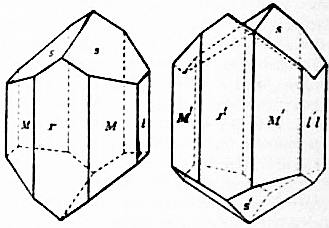
Fig. 1. Fig. 2.
Chemically, augite resembles diopside in consisting mainly of CaMgSi2O6, but it contains in addition alumina and ferric iron as (Mg, Fe″) (Al, Fe″′)2 SiO6; the acmite (NaFe″′Si2O6,) and jadeite (NaAlSi2O6) molecules are also sometimes present. Variations in the amount of iron in mixtures of these isomorphous molecules are accompanied by variations in the optical characters of the augite.
(L. J. S.)
AUGMENT (Lat. augere, to increase), in Sanskrit and Greek grammar the vowel prefixed to indicate the past tenses of a verb; in Greek grammar it is called syllabic, when only the ε is prefixed; temporal, when it causes an initial vowel in the verb to become a diphthong or long vowel.
AUGMENTATION, or enlargement, a term in heraldry for an addition to a coat of arms; in music, for the imitation in longer notes of an original theme; in biology, an addition to the normal number of parts; in Scots law, an increase of a minister’s stipend by an action called “Process of Augmentation.” The “Court of Augmentation” in Henry VIII.’s time was established to try cases affecting the suppression of monasteries, and was dissolved in Mary’s reign.
AUGSBURG, a city and episcopal see of Germany, in the kingdom of Bavaria, chief town of the district of Swabia. Pop. (1885) 65,905; (1900) 89,109; (1905) 93,882. It lies on a high plateau, 1500 ft. above the sea, between the rivers Wertach and Lech, which unite below the city, 39 m. W.N.W. from Munich, with which, as with Regensburg, Ingolstadt and Ulm, it is connected by main lines of railway. It consists of an upper and a lower town, the old Jakob suburb and various modern suburbs. Its fortifications were dismantled in 1703 and have since been converted into public promenades. Maximilian Street is remarkable for its breadth and architectural beauty. One of its most interesting edifices is the Fugger Haus, of which the entire front is painted in fresco. Among the public buildings of Augsburg most worthy of notice is the town-hall in Renaissance style, one of the finest in Germany, built by Elias Holl in 1616-1620. One of its rooms, called the “Golden Hall,” from the profusion of its gilding, is 113 ft. long, 59 broad and 53 high. The palace of the bishops, where the memorable Confession of Faith was presented to Charles V., is now used for government offices. Among the seventeen Reman Catholic churches and chapels, the cathedral, a basilica with two Romanesque towers, dates in its oldest portions from the 10th century. The church of St Ulrich and St Afra, built 1474-1500, is a Late Gothic edifice, with a nave of magnificent proportions and a tower 300 ft. high. The church stands on the spot where the first Christians of the district suffered martyrdom, and where a chapel was erected in the 6th century over the grave of St Afra. There are also a Protestant church, St Anne’s, a school of arts, a polytechnic institution, a picture gallery in the former monastery of St Catherine, a museum, observatory, botanical gardens, an exchange, gymnasium, deaf-mute institution, orphan asylum, several remarkable fountains dating from the 16th century, &c. Augsburg is particularly well provided with special and technical schools. The newer buildings, all in the modern west quarter of the city, include law courts, a theatre, and a municipal library with 200,000 volumes. The “Fuggerei,” built in 1519 by the brothers Fugger, is a miniature town, with six streets or alleys, three gates and a church, and consists of a hundred and six small houses let to indigent Roman Catholic citizens at a nominal rent. The manufactures of Augsburg are of great importance. It is the chief seat of the textile industry in south Germany, and its cloth, cotton goods and linen manufactories employ about 10,000 hands. It is also noted for its bleach and dye works, its engine works, foundries, paper factories, and production of silk goods, watches, jewelry, mathematical instruments, leather, chemicals, &c. Augsburg is also the centre of the acetylene gas industry of Germany. Copper-engraving, for which it was formerly noted, is no longer carried on; but printing, lithography and publishing have acquired a considerable development, one of the best-known Continental newspapers being the Allgemeine Zeitung or Augsburg Gazette. On the opposite side of the river, which is here crossed by a bridge, lies the township of Lechhausen.
Augsburg (the Augusta Vindelicorum of the Romans) derives its name from the Roman emperor Augustus, who, on the conquest of Rhaetia by Drusus, established here a Roman colony about 14 B.C. In the 5th century it was sacked by the Huns, and afterwards came under the power of the Frankish kings. It was almost entirely destroyed in the war of Charlemagne against Tassilo III., duke of Bavaria; and after the dissolution and division of that empire, it fell into the hands of the dukes of Swabia. After this it rose rapidly into importance as a manufacturing and commercial town, becoming, after Nuremberg, the centre of the trade between Italy and the north of Europe; its merchant princes, the Fuggers and Welsers, rivalled the Medici of Florence; but the alterations produced in the currents of trade by the discoveries of the 15th and 16th centuries occasioned a great decline. In 1276 it was raised to the rank of a free imperial city, which it retained, with many changes in its internal constitution, till 1806, when it was annexed to the kingdom of Bavaria. Meanwhile, it was the scene of numerous events of historical importance. It was besieged and taken by Gustavus Adolphus in 1632, and in 1635 it surrendered to the imperial forces; in 1703 it was bombarded by the electoral prince of Bavaria, and forced to pay a contribution of 400,000 dollars; and in the war of 1803 it suffered severely. Of its conventions the most memorable are those which gave birth to the Augsburg confession (1530) and to the Augsburg alliance (1686).
See Wagenseil, Geschichte der Stadt Augsburg (Augs., 1820-1822); Werner, Geschichte der Stadt Augsburg (1899); Roth, Augsburg’s Reformationsgeschichte (1902).
AUGSBURG, CONFESSION OF, the most important Protestant statement of belief drawn up at the Reformation. In summoning a diet for April 1530, Charles V. offered a fair hearing to all religious parties in the Empire. Luther, Justus Jonas, Melanchthon and Johann Bugenhagen were appointed to draw up a statement of the Saxon position. These “Torgau Articles” (March 1530) tell merely why Saxony had abolished certain ecclesiastical abuses. Melanchthon, however, soon found that, owing to attacks by Johann Eck of Ingolstadt (“404 Articles”), Saxony must state its position in doctrinal matters as well. Taking the Articles of Marburg (see Marburg, Colloquy of) and of Schwabach as the point of departure, he repudiated all connexion with heretics condemned by the ancient church. On the 11th of May he sent the draft to Luther, who approved it, adding that he himself “could not tread so softly and gently.” On the 23rd of June the Confession, originally intended as the statement of Electoral Saxony alone, was discussed and signed by a number of other Protestant princes and cities, and read before the diet on the 25th of June. Articles 1-21 attempt to show that the Evangelicals had deviated from current doctrine only in order to restore the pure and original teaching of the church. In spite of significant omissions (the sole authority of scripture; rejection of transubstantiation), the Confession contains nothing contradictory to Luther’s position, and in its emphasis on justification by faith alone enunciates a cardinal concept of the Evangelical churches. Articles 22-28 describe and defend the reformation of various “abuses.” On the 3rd of August, shorn of much of its original bitterness, the so-called Confutatio pontificia was read; it well expresses the views approved in substance by the emperor and all the Catholic party. In answer, Melanchthon was ordered to prepare an Apology of the Confession, which the emperor refused to receive; so Melanchthon enlarged it and published the editio princeps of both Confession and Apology in 1531.
As he felt free to make slight changes, the first edition does not represent the exact text of 1530; the edition of 1533 was further improved, while that of 1540, rearranged and in part rewritten, is known as the Variata. Dogmatic changes in this seem to have drawn forth no protest from Luther or Brenz, so Melanchthon made fresh alterations in 1542. Later, the Variata of 1540 became the creed of the Melanchthonians and even of the Crypto-calvinists; so the framers of the Formula of Concord, promulgated in 1580, returned to the text handed in at the Diet. By mistake they printed from a poor copy and not from the original, from which their German text varies at over 450 places. Their Latin text, that of Melanchthon’s editio princeps, is more nearly accurate. The textus receptus is that of the Formula of Concord, the divergent Latin and German forms being equally binding.
Acceptance of the Confession and Apology was made a condition of membership in the Schmalkalden League. The Wittenberg Concord (1536) and the Articles of Schmalkalden (1537) reaffirmed them. The Confession was the ultimate source of much of the Thirty-nine Articles. The Religious Peace of Augsburg (1555) recognized no Protestants save adherents of the Confession; this was modified in 1648. To-day the Invariata is of symbolical authority among Lutherans generally, while the Variata is accepted by the Reformed churches of certain parts of Germany (see Löber, pp. 79-83.)
Editions of the received text: J.T. Müller, Die symbolischen Bücher der evangelisch-lutherischen Kirche (10th ed., Gütersloh, 1907), with a valuable historical introduction by Th. Kolde; Theodor Kolde, Die Augsburgische Konfession (Gotha, 1896), (contains also the Marburg, Schwabach and Torgau Articles, the Confutatio and the Variata of 1540). For translations of these, as well as of Zwingli’s Reckoning of his Faith, and of the Tetrapolitan Confession, see H.E. Jacobs, The Book of Concord (Philadelphia, 1882-83). The texts submitted to the emperor, lost before 1570, are reconstructed and compared with the textus receptus by P. Tschackert, Die unveranderte Augsburgische Konfession (Leipzig, 1901). For the genesis of the Confession, see Th. Kolde, Die alteste Redaktion der Augsburger Konfession (Gütersloh, 1906), also Kolde’s article, “Augsburger Bekenntnis,” in Herzog-Hauck, Realencyklopädie (3rd ed., vol. ii., Leipzig, 1897). The standard commentary is still G.L. Plitt, Einleitung in die Augustana (Erlangen, 1867 ff.); compare also J. Ficker, Die Konfutation des Augsburgischen Bekenntnisses in ihrer ersten Gestalt (Leipzig, 1891); also A. Petzold, Die Konfutation des Vierstädtebekenntnisses (Leipzig, 1900). On its present use see G. Löber, Die im evangelischen Deutschland geltenden Ordinationsverpflichtungen geschichtlich geordnet (Leipzig, 1905), 79 ff.
(W. W. R.*)
AUGSBURG, WAR OF THE LEAGUE OF, the name applied to the European war of 1688-1697. The league of Augsburg was concluded on the 9th of July 1686 by the emperor, the elector of Brandenburg and other princes, against the French. Spain, Sweden, England and other non-German states joined the league, and formed the Grand Alliance by the treaty of Vienna (July 12, 1689). (See Grand Alliance, War of the.)
AUGURS, in ancient Rome, members of a religious college whose duty it was to observe and interpret the signs (auspices) of approval or disapproval sent by the gods in reference to any proposed undertaking. The augures were originally called auspices, but, while auspex1 fell into disuse and was replaced by augur, auspicium was retained as the scientific term for the observation of signs.
The early history of the college is obscure. Its institution has been attributed to Romulus or Numa. It probably consisted originally of three members, of whom the king himself was one. This number was doubled by Tarquinius Priscus, but in 300 B.C. it was only four, two places, according to Livy (x. 6), being vacant. The Ogulnian law in the same year increased the number to nine, five plebeian being added to the four patrician members. In the time of Sulla the number was fifteen, which was increased to sixteen by Julius Caesar. This number continued in imperial times; the college itself was certainly in existence as late as the 4th century. The office of augur, which was bestowed only upon persons of distinguished merit and was much sought after by reason of its political importance, was held for life. Vacancies were originally filled by co-optation, but by the Domitian law (104) the selection was made, by seventeen out of the thirty-five tribes chosen by lot, from candidates previously nominated by the college. The insignia of office were the lituus, a staff free from knots and bent at the top, and the trabea, a kind of toga with bright scarlet stripes and a purple border. The science of augury was contained in various written works, which were consulted as occasion arose: such were the libri augurum, a manual of augural ritual, and the commentarii augurum, a collection of decrees or answers given by the college to the senate in certain definite cases.
The natural region to look to for signs of the will of Jupiter was the sky, where lightning and the flight of birds seemed directed by him as counsel to men. The latter, however, was the more difficult of interpretation, and upon it, therefore, mainly hinged the system of divination with which the augurs were occupied. It was the duty of the augur, before the auspices properly so called (those from the sky and from birds) were taken, to mark out with his staff the templum or consecrated space within which his observations were intended to be made. The method of procedure was as follows. At midnight, when the sky was clear and there was an absence of wind, the augur, in the presence of a magistrate, took up his position on a hill which afforded a wide view. After prayer and sacrifice, he marked out the templum both in the sky and on the ground and dedicated it. Within its limits he then pitched a tent, in which he sat down with covered head, asked the gods for a sign, and waited for an answer. As the augur looked south he had the east, the lucky quarter, on his left, and therefore signs on the left side were considered favourable, those on the right unfavourable. The practice was the reverse in Greece; the observers of signs looked towards the north, so that signs on the right were regarded as the favourable ones, and this is frequently adopted in the Roman poets. The augur afterwards announced the result of his observations in a set form of words, by which the magistrate was bound. Signs of the will of the gods were of two kinds, either in answer to a request (auspicia impetrativa), or incidental (auspicia oblativa). Of such signs there were five classes: (1) Signs in the sky (caelestia auspicia), consisting chiefly of thunder and lightning, but not excluding falling stars and other phenomena. Lightning from left to right was favourable, from right to left unfavourable; but on its mere appearance, in either direction, all business in the public assemblies was suspended for the day. Since the person charged to take the auspices for a certain day was constitutionally subject to no other authority who could test the truth or falsehood of his statement that he had observed lightning, this became a favourite device for putting off meetings of the public assembly. Restrictions were, however, imposed in later republican times. When a new consul, praetor or quaestor entered on his first day of office and prayed the gods for good omens, it was a matter of custom to report to him that lightning from the left had been seen. (2) Signs from birds (signa ex avibus), with reference to the direction of their flight, and also to their singing, or uttering other sounds. To the first class, called alites, belonged the eagle and the vulture; to the second, called oscines, the owl, the crow and the raven. The mere appearance of certain birds indicated good or ill luck, while others had a reference only to definite persons or events. In matters of ordinary life on which divine counsel was prayed for, it was usual to have recourse to this form of divination. For public affairs it was, by the time of Cicero, superseded by the fictitious observation of lightning. (3) Feeding of birds (auspicia ex tripudiis), which consisted in observing whether a bird—usually a fowl—on grain being thrown before it, let fall a particle from its mouth (tripudium sollistimum). If it did so, the will of the gods was in favour of the enterprise in question. The simplicity of this ceremony recommended it for very general use, particularly in the army when on service. The fowls were kept in cages by a servant, styled pullarius. In imperial times decuriales pullarii are mentioned. (4) Signs from animals (pedestria auspicia, or ex quadrupedibus), i.e. observation of the course of, or sounds uttered by, quadrupeds and reptiles within a fixed space, corresponding to the observations of the flight of birds, but much less frequently employed. It had gone out of use by the time of Cicero. (5) Warnings (signa ex diris), consisting of all unusual phenomena, but chiefly such as boded ill. Being accidental in their occurrence, they belonged to the auguria oblativa, and their interpretation was not a matter for the augurs, unless occurring in the course of some public transaction, in which case they formed a divine veto against it. Otherwise, reference was made for an interpretation to the pontifices in olden times, afterwards frequently to the Sibylline books, or the Etruscan haruspices, when the incident was not already provided for by a rule, as, for example, that it was unlucky for a person leaving his house to meet a raven, that the sudden death of a person from epilepsy at a public meeting was a sign to break up the assembly.
Among the other means of discovering the will of the gods were the casting of lots, oracles of Apollo (in the hands of the college sacris faciundis), but chiefly the examination of the entrails of animals slain for sacrifice (see Omen). Anything abnormal found there was brought under the notice of the augurs, but usually the Etruscan haruspices were employed for this. The persons entitled to ask for an expression of the divine will on a public affair were the magistrates. To the highest offices, including all persons of consular and praetorian rank, belonged the right of taking auspicia maxima; to the inferior offices of aedile and quaestor, the auspicia minora; the differences between these, however, must have been small. The subjects for which auspicia publica were always taken were the election of magistrates, their entering on office, the holding of a public assembly to pass decrees, the setting out of an army for war. They could only be taken in Rome itself; and in case of a commander having to renew his auspicia, he must either return to Rome or select a spot in the foreign country to represent the hearth of that city. The time for observing auspices was, as a rule, between midnight and dawn of the day fixed for any proposed undertaking. In military affairs this course was not always possible, as in the case of taking auspices before crossing a river. The founding of colonies, the beginning of a battle, the calling together an army, the sittings of the senate, decisions of peace or war, were occasions, not always but frequently, for taking auspices. The place where the ceremony was performed was not fixed, but selected with a view to the matter in hand. A spot being selected, the official charged to make the observation pitched his tent there some days before. A matter postponed through adverse signs from the gods could on the following or some future day be again brought forward for the auspices. If an error (vitium) occurred in the auspices, the augurs could, of their own accord or at the request of the senate, inform themselves of the circumstances, and decree upon it. A consul could refuse to accept their decree while he remained in office, but on retiring he could be prosecuted. Auspicia oblativa referred mostly to the comitia. A magistrate was not bound to take notice of signs reported merely by a private person, but he could not overlook such a report from a brother magistrate. For example, if a quaestor on his entry to office observed lightning and announced it to the consul, the latter must delay the public assembly for the day.
On the subject generally, see A. Bouché-Leclercq, Histoire de la divination dans l’antiquité (1879), and his articles, with bibliography, in Daremberg and Saglio’s Dictionnaire des antiquités, also articles “Augures,” “Auspicium,” by Wissowa in Pauly’s Realencyclopädie (II. pt. ii., 1896), and by L.C. Purser (and others) in Smith’s Dictionary of Greek and Roman Antiquities (3rd ed., 1890). (See also Divination, Omen, Astrology, &c.)
1 There is no doubt that auspex = avi-spex (“observer of birds”), but the derivation of augur is still unsettled. The following have been suggested: (1) augur (or augus) is a substantive originally meaning “increase” (related to augustus as robur to robustus), then transferred to the priest as the giver of increase or blessing; (2) = avi-gur, the second part of the word pointing to (a) garrire, “chatter,” or (b) gerere, the augur being conceived as “carrying” or guiding the flight of the birds; (3) from a lost verb augo = “tell,” “declare.” It is now generally agreed that the science of augury is of Italian, not Etruscan, origin.
AUGUST (originally Sextilis), the sixth month in the pre-Julian Roman year, which received its present name from the emperor Augustus. The preceding month, Quintilis, had been called “July” after Julius Caesar, and the emperor chose August to be rechristened in his own honour because his greatest good fortune had then happened. In that month he had been admitted to the consulate, had thrice celebrated a triumph, had received the allegiance of the soldiers stationed on the Janiculum, had concluded the civil wars, and had subdued Egypt. As July contained thirty-one days, and August only thirty, it was thought necessary to add another day to the latter month, in order that the month of Augustus might not be in any respect inferior to that of Julius.
AUGUSTA, a city and the county-seat of Richmond county, Georgia, U.S.A., at the head of steamboat navigation on the Savannah river, 132 m. N.W. of Savannah by rail and 240 m. by river course. Pop. (1890) 33,300; (1900) 39,441, of whom 18,487 were negroes and only 995 were foreign-born; (1910 census) 41,040. Augusta is served by the Southern, the Augusta Southern (controlled by the Southern), the Atlantic Coast Line, the Charleston & Western Carolina (controlled by the Atlantic Coast Line), the Georgia and the Central of Georgia railways, by an electric line to Aiken, South Carolina, and by a line of steamers to Savannah. The city extends along the river bank for a distance of more than 3 m., and is connected by a bridge with Hamburg, and with North Augusta, South Carolina, two residential suburbs. Augusta is well known as a winter resort (mean winter temperature, 47° F.), and there are many fine winter homes here of wealthy Northerners. There are good roads, stretching from Augusta for miles in almost every direction. In North Augusta there is a large hotel, and there is another in Summerville (pop. in 1910, 4361), 2½ m. N.W., an attractive residential suburb and winter resort, in which there are a country club and a large United States arsenal, established in 1831. Broad Street is the principal thoroughfare of Augusta, and Greene Street, with a park in the centre and flanking rows of oaks and elms, is the finest residential street. Of historical interest is St Paul’s church (Protestant Episcopal); the present building was erected in 1819 and is the third St Paul’s church on the same site. The first church was “built by the gentlemen of Augusta” in 1750. In the crypt of the church General Leonidas Polk is buried; and in the churchyard are the graves of George Steptoe Washington, a nephew of George Washington, and of William Longstreet, the inventor. Among the city’s principal buildings are the Federal building, the Richmond county court house, the Augusta orphan asylum, the city hospital, the Lamar hospital for negroes, and the buildings of Richmond Academy (incorporated in 1783), of the Academy of the Sacred Heart (for girls), of Paine’s Institute (for negroes), of Houghton Institute, endowed in 1852 to be “free to all the children of Augusta,” and of the medical school of the university of Georgia, founded in 1829, and a part of the university since 1873. A granite obelisk 50 ft. high was erected in 1861 as a memorial to the signers for Georgia of the Declaration of Independence; beneath it are buried Lyman Hall (1726-1790) and George Walton (1740-1804). There are two Italian marble monuments in honour of Confederate soldiers, and monuments to the Southern poets, Paul Hamilton Hayne and Richard Henry Wilde (1789-1847).
In commerce and manufacturing, Augusta ranks second among the cities of Georgia. As a centre of trade for the “Cotton Belt,” it has a large wholesale and retail business; and it is an important cotton market. The principal manufacture is cotton goods; among the other products are lumber, flour, cotton waste, cotton-seed oil and cake, ice, silk, boilers and engines, and general merchandise staples. Water-power for factories is secured by a system of “water-power canals” from a large dam across the Savannah, built in 1847 and enlarged in 1871; the principal canal, owned by the city, is so valuable as nearly to pay the interest on the municipal debt. In 1905 the value of the city’s total factory product was $8,829,305, of which $3,832,009, or 43.4%, was the value of the cotton goods. The principal newspaper is the Augusta Chronicle, founded in 1785.
Augusta was established in 1735-1736 by James Edward Oglethorpe, the founder of Georgia, and was named in honour of the princess of Wales. The Carolina colonists had a trading post in its vicinity before the settlement by Oglethorpe. The fort, built in 1736, was first named Fort Augusta, and in 1780, at the time of the British occupation, was enlarged and renamed Fort Cornwallis; its site is now marked by a Memorial Cross, erected by the Colonial Dames of Georgia in the churchyard of St Paul’s. Tobacco was the principal agricultural product during the 18th century, and for its culture negro slaves were introduced from Carolina, before the restrictions of the Georgia Trustees on slavery were removed. During the colonial period several treaties with Indians were made at Augusta; by the most important, that of 1763, the Choctaws, Creeks, Chickasaws, Cherokees and Catawbas agreed (in a meeting with the governors of North and South Carolina, Virginia and Georgia) to the terms of the treaty of Paris. At the opening of the American War of Independence, the majority of the people of Augusta were Loyalists. The town was taken by the British under Lieut.-Col. Archibald Campbell (1739-1791) in January 1779, but was evacuated a month later; it was the seat of government of Georgia for almost the entire period from the capture of Savannah in December 1778 until May 1780, and was then abandoned by the Patriots and was occupied chiefly by Loyalists under Lieut.-Col. Thomas Brown. In September 1780 a force of less than 500 patriots under Col. Elijah Clarke marched against the town in three divisions, and while one division, attacking a neighbouring Indian camp, drew off most of the garrison, the other two divisions entered the town; but British reinforcements arrived before Brown could be dislodged from a building in which he had taken refuge, and Clarke was forced to withdraw. A stronger American force, under Lieut.-Col. Henry Lee, renewed the siege in May 1781 and gained possession on the 5th of June. From 1783 until 1795 Augusta was again the seat of the state government. It was the meeting-place of the Land Court which confiscated the property of the Loyalists of Georgia, and of the convention which ratified for Georgia the Constitution of the United States. In 1798 it was incorporated as a town, and in 1817 it was chartered as a city. Augusta was the home of the inventor, William Longstreet (1759-1814), who as early as 1788 received a patent from the state of Georgia for a steamboat, but met with no practical success until 1808; as early as 1801 he had made experiments in the application of steam to cotton gins and saw-mills at Augusta. Near Augusta, on the site now occupied by the Eli Whitney Country Club, Eli Whitney is said to have first set up and operated his cotton gin; he is commemorated by a mural tablet in the court house. The establishment of a steamboat line to Savannah in 1817 aided Augusta’s rapid commercial development. There was a disastrous fire in 1829, an epidemic of yellow fever in 1839, and a flood in 1840, but the growth of the city was not seriously checked; the cotton receipts of 1846 were 212,019 bales, and in 1847 a cotton factory was built. During the Civil War Augusta was the seat of extensive military factories, the tall chimney of the Confederate powder mills still standing as a memorial. The economic development has, since the Civil War, been steady and continuous. An exposition was held in Augusta in 1888, and another in 1893.
AUGUSTA, the capital of Maine, U.S.A., and the county-seat of Kennebec county, on the Kennebec river1 (at the head of navigation), 44 m. from its mouth, 62 m. by rail N.E. of Portland, and 74 m. S.W. of Bangor. Pop. (1890) 10,527; (1900) 11,683, of whom 2131 were foreign-born; (1910, census) 13,211. It is served by the Maine Central railway, by several electric lines, and by steamboat lines to Portland, Boston and several other ports. It is built on a series of terraces, mostly on the west bank of the river, which is spanned here by a bridge 1100 ft. long. The state house, built of granite quarried in the vicinity, occupies a commanding site along the south border of the city, and in it is the state library. The Lithgow library is a city public library. Near the state house is the former residence of James G. Blaine. On the other side of the river, nearly opposite, is the Maine insane hospital. Among other prominent buildings are the court house, the post office and the city hall. In one of the parks is a soldiers’ and sailors’ monument. By means of a dam across the river, 17 ft. high and nearly 600 ft. long, good water-power is provided, and the city manufactures cotton goods, boots and shoes, paper, pulp and lumber. A leading industry is the printing and publishing of newspapers and periodicals, several of the periodicals published here having an enormous circulation. The total value of the factory products in 1905 was $3,886,833. Augusta occupies the site of the Indian village, Koussinoc, at which the Plymouth Colony established a trading post about 1628. In 1661 Plymouth sold its interests, and soon afterward the four purchasers abandoned the post. In 1754, however, their heirs brought about the erection here of Fort Western, the main building of which is still standing at the east end of the bridge, opposite the city hall. Augusta was originally a part of the township of Hallowell (incorporated in 1771); in 1797 the north part of Hallowell was incorporated as a separate town and named Harrington; and later in the same year the name was changed to Augusta. It became the county-seat in 1799; was chosen by the Maine legislature as the capital of the state in 1827, but was not occupied as such until the completion of the state house in 1831; and was chartered as a city in 1849.
1 The Kennebec was first explored to this point in 1607.
AUGUSTA, a seaport of the province of Syracuse, Sicily, 19 m. N. of it by rail. Pop. (1901) 16,402. It occupies a part of the former peninsula of Xiphonia, now a small island, connected with the mainland by a bridge. It was founded by the emperor Frederick II. in 1232, and almost entirely destroyed by an earthquake in 1693, after which it was rebuilt. The castle is now a large prison. The fortified port, though unfrequented except as a naval harbour of refuge, is a very fine one. There are considerable saltworks at Augusta. To the south, on the left bank of the Molinello. 1½ m. from its mouth, Sicel tombs and Christian catacombs, and farther up the river a cave village of the early middle ages, have been explored (Notizie degli Scavi, 1902, 411, 631; Römische Quartalschrift, 1902, 205). Whether there was ever a town bearing the name Xiphonia is doubted by E.A. Freeman (Hist. of Sic. i. 583); cf., however, E. Pais, Atakta (Pisa, 1891), 55, who attributes its foundation, under the name of Tauromenion (which it soon lost), to the Zancleans of Hybla (afterwards Megara Hyblaea).
(T. As.)
AUGUSTA BAGIENNORUM, the chief town of the Ligurian tribe of the Bagienni, probably identical with the modern Bene Vagienna, on the upper course of the Tanaro, about 35 m. due south of Turin. The town retained its position as a tribal centre in the reorganization of Augustus, whose name it bears, and was erected on a systematic plan. Considerable remains of public buildings, constructed in concrete faced with small stones with bands of brick at intervals, an amphitheatre with a major axis of 390 ft. and a minor axis of 305 ft., a theatre with a stage 133 ft. in length, and near it the foundations of what was probably a basilica, an open space (no doubt the forum), an aqueduct, baths, &c., have been discovered by recent excavations, and also one of the city gates, flanked by two towers 22 ft. sq.
See G. Assandria and G. Vacchetta in Notizie degli Scavi (1894), 155; (1896), 215; (1897), 441; (1898), 299; (1900), 389; (1901), 413.
(T. As.)
AUGUSTAN HISTORY, the name given to a collection of the biographies of the Roman emperors from Hadrian to Carinus (A.D. 117-284). The work professes to have been written during the reigns of Diocletian and Constantine, and is to be regarded as the composition of six authors,—Aelius Spartianus, Julius Capitolinus, Aelius Lampridius, Vulcacius Gallicanus, Trebellius Pollio and Flavius Vopiscus—known as Scriptores Historiae Augustae, writers of Augustan history. It is generally agreed, however, that there is a large number of interpolations in the work, which are referred to the reign of Theodosius; and that the documents inserted in the lives are almost all forgeries. The more advanced school of critics holds that the names of the supposed authors are purely fictitious, as those of some of the authorities which they profess to quote certainly are. The lives, which (with few exceptions) are arranged in chronological order, are distributed as follows:—To Spartianus: the biographies of Hadrian, Aelius Verus, Didius Julianus, Septimius Severus, Pescennius Niger, Caracallus, Geta (?); to Vulcacius Gallicanus: Avidius Cassius; to Capitolinus: Antoninus Pius, Marcus Aurelius Antoninus, Verus, Pertinax, Clodius Albinus, the two Maximins, the three Gordians, Maximus and Balbinus, Opilius Macrinus (?); to Lampridius: Commodus, Diadumenus, Elagabalus, Alexander Severus; to Pollio: the two Valerians, the Gallieni, the so-called Thirty Tyrants or Usurpers, Claudius (his lives of Philip, Decius, and Gallus being lost); to Vopiscus: Aurelian, Tacitus, Florian, Probus, the four tyrants (Firmus, Saturninus, Proculus, Bonosus), Carus, Numerian, Carinus.
The importance of the Augustan history as a repertory of information is very considerable, but its literary pretensions are of the humblest order. The writers’ standard was confessedly low. “My purpose,” says Vopiscus, “has been to provide materials for persons more eloquent than I.” Considering the perverted taste of the age, it is perhaps fortunate that the task fell into the hands of no showy declaimer who measured his success by his skill in making surface do duty for substance, but of homely, matter-of-fact scribes, whose sole concern was to record what they knew. Their narrative is unmethodical and inartificial; their style is tame and plebeian; their conception of biography is that of a collection of anecdotes; they have no notion of arrangement, no measure of proportion, and no criterion of discrimination between the important and the trivial; they are equally destitute of critical and of historical insight, unable to sift the authorities on which they rely, and unsuspicious of the stupendous social revolution comprised within the period which they undertake to describe. Their value, consequently, depends very much on that of the sources to which they happen to have recourse for any given period of history, and on the fidelity of their adherence to these when valuable. Marius Maximus and Aelius Junius Cordus, to whose qualifications they themselves bear no favourable testimony, were their chief authorities for the earlier lives of the series. Marius Maximus, who lived about 165-230, wrote biographies of the emperors, in continuation of those of Suetonius, from Nerva to Elagabalus; Junius Cordus dealt with the less-known emperors, perhaps down to Maximus and Balbinus. The earlier lives, however, contain a substratum of authentic historical fact, which recent critics have supposed to be derived from a lost work by a contemporary writer, described by one of these scholars as “the last great Roman historian.” For the later lives the Scriptores were obliged to resort more largely to public records, and thus preserved matter of the highest importance, rescuing from oblivion many imperial rescripts and senatorial decrees, reports of official proceedings and speeches on public occasions, and a number of interesting and characteristic letters from various emperors. Their incidental allusions sometimes cast vivid though undesigned light on the circumstances of the age, and they have made large contributions to our knowledge of imperial jurisprudence in particular. Even their trivialities have their use; their endless anecdotes respecting the personal habits of the subjects of their biographies, if valueless to the historian, are most acceptable to the archaeologist, and not unimportant to the economist and moralist. Their errors and deficiencies may in part be ascribed to the contemporary neglect of history as a branch of instruction. Education was in the hands of rhetoricians and grammarians; historians were read for their style, not for their matter, and since the days of Tacitus, none had arisen worth a schoolmaster’s notice. We thus find Vopiscus acknowledging that when he began to write the life of Aurelian, he was entirely misinformed respecting the latter’s competitor Firmus, and implying that he would not have ventured on Aurelian himself if he had not had access to the MS. of the emperor’s own diary in the Ulpian library. The writers’ historical estimates are superficial and conventional, but report the verdict of public opinion with substantial accuracy. The only imputation on the integrity of any of them lies against Trebellius Pollio, who, addressing his work to a descendant of Claudius, the successor and probably the assassin of Gallienus, has dwelt upon the latter versatile sovereign’s carelessness and extravagance without acknowledgment of the elastic though fitful energy he so frequently displayed in defence of the empire. The caution of Vopiscus’s references to Diocletian cannot be made a reproach to him.
No biographical particulars are recorded respecting any of these writers. From their acquaintance with Latin and Greek literature they must have been men of letters by profession, and very probably secretaries or librarians to persons of distinction. There seems no reason to accept Gibbon’s contemptuous estimate of their social position. They appear particularly versed in law. Spartianus’s reference to himself as “Diocletian’s own” seems to indicate that he was a domestic in the imperial household. They address their patrons with deference, acknowledging their own deficiencies, and seem painfully conscious of the profession of literature having fallen upon evil days.
Editio princeps (Milan, 1475); Casaubon (1603) showed great critical ability in his notes, but for want of a good MS. left the restoration of the text to Salmasius (1620), whose notes are a most remarkable monument of erudition, combined with acuteness in verbal criticism and general vigour of intellect. Of recent years considerable attention has been devoted by German scholars to the History, especially by Peter, whose edition of the text in the Teubner series (2nd ed., 1884) contains (praef. xxxv.-xxxvii.) a bibliography of works on the subject preceding the publication of his own special treatise. The edition by Jordan-Eyssenhardt (1863) should also be mentioned. Amongst the most recent treatises on the subject are: A. Gemoll, Die Scriptores Historiae Augustae (1886); H. Peter, Die Scriptores Historiae Augustae (1892); G. Tropea, Studi sugli Scriptores Historiae Augustae (1899-1903); J.M. Heer, Der historische Wert der Vita Commodi in der Sammlung der Scriptores Historiae Augustae (1901); C. Lécrivain, Études sur l’histoire Auguste (1904); E. Kornemann, Kaiser Hadrian und der letzte grosse Historiker von Rom (1905), according to whom “the last great historian of Rome” is Lollius Urbicus; O. Schulz, Das Kaiserhaus der Antonine und der letzte Historiker Roms (1907). On their style, see C. Paucker, De Latinitate Scriptorum Historiae Augustae (1870); special lexicon by C. Lessing (1901-1906). An English translation is included in The Lives of the Roman Emperors, by John Bernard (1698). See further Rome: History (anc. ad fin.), section “Authorities”; M. Schanz, Geschichte der römischen Litteratur, iii. p. 69 (for Marius Maximus and Junius Cordus), iv. p. 47; Teuffel-Schwabe, Hist. of Roman Literature (Eng. tr.), § 392; H. Peter, bibliography from 1893 to 1905 in Bursian’s Jahresbericht, cxxix. (1907).
AUGUSTA PRAETORIA SALASSORUM (mod. Aosta, q.v.), an ancient town of Italy in the district of the Salassi, founded by Augustus about 24 B.C. on the site of the camp of Varro Murena, who subdued this tribe in 25 B.C., and settled with 3000 praetorians. Pliny calls it the last town of Italy on the north-west, and its position at the confluence of two rivers, at the end of the Great and Little St Bernard, gave it considerable military importance, which is vouched for by considerable remains of Roman buildings. The ancient town walls, enclosing a rectangle 793 by 624 yds., are still preserved almost in their entire extent. The walls are 21 ft. high. They are built of concrete faced with small blocks of stone, and at the bottom are nearly 9 ft. thick, and at the top 6 ft. There are towers at the angles of the enceinte, and others at intervals, and two at each of the four gates, making a total of twenty towers altogether. They are roughly 32 ft. square, and project 14 ft. from the wall. The Torre del Pailleron on the south and the Torre del Leproso in the west are especially well preserved. The east and south gates exist (the latter, a double gate with three arches flanked by two towers, is the Porta Praetoria, and is especially fine), while the rectangular arrangement of the streets perpetuates the Roman plan, dividing the town into 16 blocks (insulae). The main road, 32 ft. wide, divides the city into two equal halves, running from east to west, an arrangement which makes it clear that the guarding of the road was the main raison d’être of the city. Some arcades of the amphitheatre (the diameters of which are 282 ft. and 239 ft.), and the south wall of the theatre are also preserved, the latter to a height of over 70 ft., and a market-place some 300 ft. square, surrounded by storehouses on three sides with a temple in the centre, and two on the open (south) side, and the thermae, have been discovered. Outside the town is a handsome triumphal arch in honour of Augustus. About 5 m. to the west is a single-arched Roman bridge, the Pondel, which has a closed passage lighted by windows for foot passengers in winter, and above it an open footpath, both being about 3½ ft. in width. There are considerable remains of the ancient road from Eporedia (mod. Ivrea) to Augusta Praetoria, up the Valle d’ Aosta, which the modern railway follows, notably the Pont St Martin, with a single arch with a span of 116 ft. and a roadway 15 ft. wide, the cutting of Donnaz, and the Roman bridges of Châtillon (Pont St Vincent) and Aosta (Pont de Pierre), &c.
See C. Promis, Le antichità di Aosta (Turin, 1862); E. Bérard in Atti della Società di Archeologia di Torino, iii. 119 seq.; Notizie degli Scavi, passim; A. d’Andrade, Relazione dell’ Ufficio Regionale per la consenazione dei Monumenti del Piemonte e della Liguria (Turin, 1899), 46 seq.
(T. As.)
AUGUSTI, JOHANN CHRISTIAN WILHELM (1772-1841), German theologian, born at Eschenberga, near Gotha, was of Jewish descent, his grandfather having been a converted rabbi. He was educated at the gymnasium at Gotha and the university of Jena. At Jena he studied oriental languages, of which he became professor there in 1803. Subsequently he became ordinary professor of theology (1812), and for a time rector, at Breslau. In 1819 he was transferred to the university of Bonn, where he was made professor primarius. In 1828 he was appointed chief member of the consistorial council at Coblenz. Here he was afterwards made director of the consistory. He died at Coblenz in 1841. Augusti had little sympathy with the modern philosophical interpretations of dogma, and although he took up a position of free criticism with regard to the Biblical narratives, he held fast to the traditional faith. His works on theology (Dogmengeschichte, 1805; 4th ed., 1835) are simple statements of fact; they do not attempt a speculative treatment of their subjects. In 1809 he published in conjunction with W.M.L. de Wette a new translation of the Old Testament. Mention should also be made of his Grundriss einer historischkritischen Einleitung ins Alte Testament (1806), his Exegetisches Handbuch des Alten Testaments (1797-1800), and his edition of Die Apokryphen des A. T. (1804). In addition to these, his most important writings are the Denkwürdigkeiten aus der Christlichen Archäologie, 12 vols. (1817-1831), a partially digested mass of materials, and the Handbuch der Christ. Archäologie, 3 vols. (1836-1837), which gives the substance of the larger work in a more compact and systematic form.
AUGUSTINE, SAINT (354-430), one of the four great fathers of the Latin Church. Augustinus—the praenomen Aurelius is used indeed by his disciples Orosius and Prosper, and is found in the oldest Augustine MSS., but is not used by himself, nor in the letters addressed to him—was born at Tagaste, a town of Numidia, now Suk Ahras in Constantine, on the 13th of November 354. His father, Patricius, was a burgess of Tagaste and still a pagan at the time of his son’s birth. His mother, Monica, was not only a Christian, but a woman of the most tender and devoted piety, whose beautiful faith and enthusiasm and patient prayer for both her husband and son (at length crowned with success in both cases) have made her a type of womanly saintliness for all ages. She early instructed her son in the faith and love of Jesus Christ, and for a time he seems to have been impressed by her teaching. Falling ill, he wished to be baptized; but when the danger was past, the rite was deferred and, in spite of his mother’s admonitions and prayers, Augustine grew up without any profession of Christian piety or any devotion to Christian principles.
Inheriting from his father a passionate nature, he formed while still a mere youth an irregular union with a girl, by whom he became the father of a son, whom in a fit of pious emotion he named Adeodatus (“by God given”), and to whom he was passionately attached. In his Confessions he afterwards described this period of his life in the blackest colours; for in the light of his conversion he saw behind him only shadows. Yet, whatever his youthful aberrations, Augustine was from the first an earnest student. His father, noticing his early promise, destined him for the brilliant and lucrative career of a rhetorician, for which he spared no expense in training him. Augustine studied at his native town and afterwards at Madaura and Carthage, especially devoting himself to the works of the Latin poets, many traces of his love for which are to be found in his writings. His acquaintance with Greek literature was much more limited, and, indeed, it has been doubted, though without sufficient reason, whether he could use the Greek scriptures in the original. Cicero’s Hortensius, which he read in his nineteenth year, first awakened in his mind the spirit of speculation and the impulse towards the knowledge of the truth. But he passed from one phase of thought to another, unable to find satisfaction in any. Manichaeism, that mixed product of Zoroastrian and Christian-gnostic elements, first enthralled him. He became a fervent member of the sect, and was admitted into the class of auditors or “hearers.” Manichaeism seemed to him to solve the mysteries of the world, and of his own experiences by which he was perplexed. His insatiable imagination drew congenial food from the fanciful religious world of the Manichaeans, decked out as this was with the luxuriant wealth of Oriental myth. His strongly developed sense of a need of salvation sought satisfaction in the contest of the two principles of Good and Evil, and found peace, at least for the moment, in the conviction that the portions of light present in him would be freed from the darkness in which they were immersed. The ideal of chastity and self-restraint, which promised a foretaste of union with God, amazed him, bound as he was in the fetters of sensuality and for ever shaking at these fetters. But while his moral force was not sufficient for the attainment of this ideal, gradually everything else which Manichaeism seemed to offer him dissolved before his criticism. Increasingly occupied with the exact sciences, he learnt the incompatibility of the Manichaean astrology with the facts. More and more absorbed in the problems of psychology, he realized the insufficiency of dualism, which did not solve the ultimate questions but merely set them back. The Manichaean propaganda seemed to him invertebrate and lacking in force, and a discussion which he had with Faustus, a distinguished Manichaean bishop and controversialist, left him greatly disappointed.
Meanwhile nine years had passed. Augustine, after finishing his studies, had returned to Tagaste, where he became a teacher of grammar. He must have been an excellent master, who knew how to influence the whole personality of his pupils. It was then that Alypius, who in the later stages of Augustine’s life proved a true friend and companion, attached himself to him. He remained in his native town little more than a year, during which time he lived with his mother, who was comforted by the bishop for the estrangement of her son from the Catholic faith (“a son of so many tears cannot be lost”: Confess. III. xii. § 21), comforted also, and above all, by the famous vision, which Augustine thus describes: “She saw herself standing on a certain wooden rule, and a shining youth coming towards her, cheerful and smiling upon her the while she grieved, and was consumed with grief: and when he had inquired of her the causes of her grief and daily tears (for the sake, as is their wont, of teaching, not of learning) and she had made answer that she was bewailing my perdition, he bade her be at ease, and advised her to look and observe, ‘That where she was, there was I also.’ And when she looked there, she saw me standing by her on the same rule” (Confess. III. xi.). Augustine now returned for a second time to Carthage, where he devoted himself zealously to work. Thence, probably in the spring of 383, he migrated to Rome. His Manichaean friends urged him to take this step, which was rendered easier by the licentious lives of the students at Carthage. His stay at Rome may have lasted about a year, no agreeable time for Augustine, since his patrons and friends belonged to just those Manichaean circles with which he had in the meantime entirely lost all intellectual touch. He, therefore, accepted an invitation from Milan, where the people were in search of a teacher of rhetoric.
At Milan the conflict within his mind in search of truth still continued. It was now that he separated himself openly from the Manichaean sect. As a thinker he came entirely under the influence of the New Academy; he professed the Sceptic philosophy, without being able to find in it the final conclusion of wisdom. He was, however, not far from the decision. Two things determined his further development. He became acquainted with the Neo-Platonic philosophy; its monism replaced the dualism, its intellectualized world of ideas the materialism of Manichaeism. Here he found the admonition to seek for truth outside the material world, and from created things he learnt to recognize the invisible God; he attained the certainty that this God is, and is eternal, always the same, subject to change neither in his parts nor in his motions. And while thus Augustine’s metaphysical convictions were being slowly remodelled, he met, in Ambrose, bishop of Milan, a man in whom complete worldly culture and the nobility of a ripe Christian personality were wonderfully united. He heard him preach; but at first it was the orator and not the contents of the sermons that enchained him. He sought an opportunity of conversation with him, but this was not easily found. Ambrose had no leisure for philosophic discussion. He was accessible to all who sought him, but never for a moment free from study or the cares of duty. Augustine, as he himself tells us, used to enter without being announced, as all persons might; but after staying for a while, afraid of interrupting him, he would depart again. He continued, however, to hear Ambrose preach, and gradually the gospel of divine truth and grace was received into his heart. He was busy with his friend Alypius in studying the Pauline epistles; certain words were driven home with irresistible force to his conscience. His struggle of mind became more and more intolerable, the thought of divine purity fighting in his heart with the love of the world and the flesh. That sensuality was his worst enemy he had long known. The mother of his child had accompanied him to Milan. When he became betrothed he dismissed her; but neither the pain of this parting nor consideration for his not yet marriageable bride prevented him from forming a fresh connexion of the same kind. Meanwhile, the determination to renounce the old life with its pleasures of sense, was ever being forced upon him with more and more distinctness. He then received a visit from a Christian compatriot named Pontitian, who told him about St Anthony and the monachism in Egypt, and also of a monastery near Milan. He was shaken to the depths when he learnt from Pontitian that two young officials, like himself betrothed, had suddenly formed a determination to turn their backs upon the life of the world. He could no longer bear to be inside the house; in terrible excitement he rushed into the garden; and now followed that scene which he himself in the Confessions has described to us with such graphic realism. He flung himself under a fig tree, burst into a passion of weeping, and poured out his heart to God. Suddenly he seemed to hear a voice bidding him consult the divine oracle: “Take up and read, take up and read.” He left off weeping, rose up, sought the volume where Alypius was sitting, and opening it read in silence the following passage from the Epistle to the Romans (xiii. 13, 14): “Not in rioting and drunkenness, not in chambering and wantonness, not in strife and envying. But put ye on the Lord Jesus Christ, and make not provision for the flesh to fulfil the lusts thereof.” He adds: “I had neither desire nor need to read further. As I finished the sentence, as though the light of peace had been poured into the heart, all the shadows of doubt dispersed. Thus hast Thou converted me to Thee, so as no longer to seek either for wife or other hope of the world, standing fast in that rule of faith in which Thou so many years before hadst revealed me to my mother” (in qua me ante lot annos ei revelaveras: Confess. VIII. xii. § 30).1
The conversion of Augustine, as we have been accustomed to call this event, took place in the late summer of 386, a few weeks before the beginning of the vacation. The determination to give up his post was rendered easier by a chest-trouble which was not without danger, and which for months made him incapable of work. He withdrew with several companions to the country estate of Cassisiacum near Milan, which had been lent him by a friend, and announced himself to the bishop as a candidate for baptism. His religious opinions were still to some extent unformed, and even his habits by no means altogether such as his great change demanded. He mentions, for example, that during this time he broke himself of a habit of profane swearing, and in other ways sought to discipline his character and conduct for the reception of the sacred rite. He received baptism the Easter following, in his thirty-third year, and along with him his son Adeodatus and his friend Alypius were admitted to the Church. Monica, his mother, had rejoined him, and at length rejoiced in the fulfilment of her prayers. She died at Ostia, just as they were about to embark for Africa, her last hours being gladdened by his Christian sympathy. In the account of the conversation which he had with his mother before her end, in the narrative of her death and burial (Confess. IX. x.-xi., §§ 23-28), Augustine’s literary power is displayed at its highest.
The plan of returning home, remained for the present unaccomplished. Augustine stayed for a year in Rome, occupied in literary work, particularly in controversy with Manichaeism. It was not until the autumn of 388 that he returned to Tagaste, probably still accompanied by his son, who, however, must have died shortly afterwards. With some friends, who joined him in devotion, he formed a small religious community, which looked to him as its head. Their mode of life was not formally monastic according to any special rule, but the experience of this time of seclusion was, no doubt, the basis of that monastic system which Augustine afterwards sketched and which derived its name from him (see Augustinians). As may be imagined, the fame of such a convert in such a position soon spread, and invitations to a more active ecclesiastical life came to him from many quarters. He shrank from the responsibility, but his destiny was not to be avoided. After two and a half years spent in retirement he went to Hippo, to see a Christian friend, who desired to converse with him as to his design of quitting the world and devoting himself to a religious life. The Christian community there being in want of a presbyter and Augustine being present at the meeting, the people unanimously chose him and he was ordained to the presbyterate. A few years afterwards, 395 or 396, he was made coadjutor to the bishop, and finally became bishop of the see.
Henceforth Augustine’s life is filled up with his ecclesiastical labours, and is more marked by the series of his numerous writings and the great controversies in which they engaged him than by anything else. His life was spent in a perpetual strife. During the first half this had been against himself; but even when others stepped into his place, it always seems as though a part of Augustine himself were incarnate in them. Augustine had early distinguished himself as an author. He had written several philosophical treatises, and, as teacher of rhetoric at Carthage, he had composed a work De pulchro et apto, which is no longer extant. Whenat Cassisiacum he had combated the scepticism of the New Academy (Contra Academicos), had treated of the “blessed life” (De Vita beata), of the significance of evil in the order of the world (De ordine), of the means for the elucidation of spiritual truths (Soliloquia). Shortly before the time of his baptism, he was occupied with the question of the immortality of the soul (De immortalitate animae), and in Rome and at Tagaste he was still engaged with philosophical problems, as is evidenced by the writings De quantitate animae and De magistro. In all these treatises is apparent the influence of the Neo-Platonic method of thought, which for him, as for so many others, had become the bridge to the Christian. While still in Rome, he began to come to a reckoning with the Manichaeans, and wrote two books on the morals of the Catholic Church and of the Manichaeans (De moribus ecclesiae Catholicae et de moribus Manichaeorum libri duo). For many years he pursued this controversy in a long series of writings, of which the most conspicuous is the elaborate reply to his old associate and disputant, Faustus of Mileve (Contra Faustum Manichaeum, A.D. 400). It was natural that the Manichaean heresy, which had so long enslaved his own mind, should have first exercised Augustine’s great powers as a theological thinker and controversialist. He was able from his own experience to give force to his arguments for the unity of creation and of the spiritual life, and to strengthen the mind of the Christian Church in its last struggle with that dualistic spirit which had animated and moulded in succession so many forms of thought at variance with Christianity.
But the time was one of almost universal ecclesiastical and intellectual excitement; and so powerful a mental activity as his was naturally drawn forth in all directions. Following his writings against the Manichaeans came those against the Donatists. The controversy was one which strongly interested him, involving as it did the whole question of the constitution of the Church and the idea of catholic order, to which the circumstances of the age gave special prominence. The Donatist controversy sprang out of the Diocletian persecution in the beginning of the century. A party in the Church of Carthage, fired with fanatic zeal on behalf of those who had courted martyrdom by resistance to the imperial mandates, resented deeply the appointment of a bishop of moderate opinions, whose consecration had been performed, they alleged, by a traditor, viz. a bishop who had “delivered” the holy scriptures to the magistrates. They set up, in consequence, a bishop of their own, of the name of Majorinus, succeeded in 315 by Donatus. The party made great pretensions to purity of discipline, and rapidly rose in popular favour, notwithstanding a decision given against them both by the bishop of Rome and by the emperor Cons tan tine. Augustine was strongly moved by the lawlessness of the party and launched forth a series of writings against them, the most important of which survive. Amongst these are “Seven Books on Baptism” (De baptismo contra Donatistas, c. A.D. 400) and a lengthy answer, in three books, to Petilian, bishop of Cirta, who was the most eminent theologian amongst the Donatist divines. At a later period, about 417, Augustine wrote a treatise concerning the correction of the Donatists (De correctione Donatistarum) “for the sake of those,” he says in his Retractations, “who were not willing that the Donatists should be subjected to the correction of the imperial laws.” In these writings, while vigorously maintaining the validity of the Church as it then stood in the Roman world, and the necessity for moderation in the exercise of church discipline, Augustine yet gave currency, in his zeal against the Donatists, to certain maxims as to the duty of the civil power to control schism, which were of evil omen, and have been productive of much disaster in the history of Christianity.
The third controversy in which Augustine engaged was the most important, and the most intimately associated with his distinctive greatness as a theologian. As may be supposed, owing to the conflicts through which he had passed, the bishop of Hippo was intensely interested in what may be called the anthropological aspect of the great Christian idea of redemption. He had himself been brought out of darkness into “marvellous light,” only by entering into the depths of his own soul, and finding, after many struggles, that there was no power but divine grace, as revealed in the life and death of the Son of God, which could bring rest to human weariness, or pardon and peace for human guilt. He had found human nature in his own case too weak and sinful to find any good for itself. In God alone he had found good. This deep sense of human sinfulness coloured all his theology, and gave to it at once its depth—its profound and sympathetic adaptation to all who feel the reality of sin—and that tinge of darkness and exaggeration which has as surely repelled others. When the expression “Augustinism” is used, it points especially to those opinions of the great teacher which were evoked in the Pelagian controversy, to which he devoted the most mature and powerful period of his life. His opponents in this controversy were Pelagius, from whom it derives its name, and Coelestius and Julianus, pupils of the former. Nothing is certainly known as to the home of Pelagius. Augustine calls him Brito, and so do Marius Mercator and Orosius. Jerome points to his Scottish descent, in such terms, however, as to leave it uncertain whether he was a native of Scotland or of Ireland. He was a man of blameless character, devoted to the reformation of society, full of that confidence in the natural impulses of humanity which often accompanies philanthropic enthusiasm. About the year 400 he came, no longer a young man, to Rome, where he lived for more than a decade, and soon made himself conspicuous by his activity and by his opinions. His pupil Coelestius, a lawyer of unknown origin, developed the views of his master with a more outspoken logic, and, while travelling with Pelagius in Africa, in the year 411, was at length arraigned before the bishop of Carthage for the following, amongst other heretical opinions:—(1) that Adam’s sin was purely personal, and affected none but himself; (2) that each man, consequently, is born with powers as incorrupt as those of Adam, and only falls into sin under the force of temptation and evil example; (3) that children who die in infancy, being untainted by sin, are saved without baptism. Views such as these were obviously in conflict with the whole course of Augustine’s experience, as well as with his interpretation of the catholic doctrine of the Church. And when his attention was drawn to them by the trial and excommunication of Coelestius, he undertook their refutation, first of all in three books on the punishment and forgiveness of sins and the baptism of infants (De peccatorum meritis et remissione et de baptismo parvulorum), addressed to his friend Marcellinus, in which he vindicated the necessity of baptism of infants because of original sin and the grace of God by which we are justified (Retract. ii. 23). This was in 412. In the same year he addressed a further treatise to the same Marcellinus on The Spirit and the Letter (De spiritu et littera). Three years later he composed the treatises on Nature and Grace (De natura et gratia) and the relation of the human to the divine righteousness (De perfectione iustitiae hominis). The controversy was continued during many years in no fewer than fifteen treatises. Upon no subject did Augustine bestow more of his intellectual strength, and in relation to no other have his views so deeply and permanently affected the course of Christian thought. Even those who most usually agree with his theological standpoint will hardly deny that, while he did much in these writings to vindicate divine truth and to expound the true relations of the divine and human, he also, here as elsewhere, was hurried into extreme expressions as to the absoluteness of divine grace and the extent of human corruption. Like his great disciple in a later age—Luther—Augustine was prone to emphasize the side of truth which he had most realized in his own experience, and, in contradistinction to the Pelagian exaltation of human nature, to depreciate its capabilities beyond measure.
In addition to these controversial writings, which mark the great epochs of Augustine’s life and ecclesiastical activity after his settlement as a bishop at Hippo, he was the author of other works, some of them better known and even more important. His great work, the most elaborate, and in some respects the most significant, that came from his pen, is The City of God (De civitate Dei). It is designed as a great apologetic treatise in vindication of Christianity and the Christian Church,—the latter conceived as rising in the form of a new civic order on the crumbling ruins of the Roman empire,—but it is also, perhaps, the earliest contribution to the philosophy of history, as it is a repertory throughout of his cherished theological opinions. This work and his Confessions are, probably, those by which he is best known, the one as the highest expression of his thought, and the other as the best monument of his living piety and Christian experience. The City of God was begun in 413, and continued to be issued in its several portions for a period of thirteen years, or till 426. The Confessions were written shortly after he became a bishop, about 397, and give a vivid sketch of his early career. To the devout utterances and aspirations of a great soul they add the charm of personal disclosure, and have never ceased to excite admiration in all spirits of kindred piety. Something of this charm also belongs to the Retractations, that remarkable work in which Augustine, in 427, towards the end of his life, held as it were a review of his literary activity, in order to improve what was erroneous and to make clear what was doubtful in it. His systematic treatise on The Trinity (De Trinitate) which extends to fifteen books and occupied him for nearly thirty years, must not be passed over. This important work, unlike most of his dogmatic writings, was not provoked by any special controversial emergency, but grew up silently during this long period in the author’s mind. This has given it something more of completeness and organic arrangement than is usual with Augustine, if it has also led him into the prolonged discussion of various analogies, more curious than apt in their bearing on the doctrine which he expounds. Brief and concise is the presentation of the Catholic doctrine in the compendium, which, about 421, he wrote at the request of a Roman layman named Laurentius (Encheiridion, sive de fide spe et caritate). In spite of its title, the compendious work on Christian doctrine (De doctrina Christiana), begun as early as 393, but only finished in 426, does not belong to the dogmatic writings. It is a sort of Biblical hermeneutic, in which homiletic questions are also dealt with. His catechetical principles Augustine developed in the charming writing De catechizandis rudibus (c. 400). A large number of tractates are devoted to moral and theological problems (Contra mendacium, c. 420; De bono conjugali, 401, &c.). A widespread influence was exercised by the treatise De opere monachorum (c. 400), in which, on the ground of Holy Scripture, manual work was demanded of monks. Of less importance than the remaining works are the numerous exegetical writings, among which the commentary on the Gospel of St John deserves a special mention. These have a value owing to Augustine’s appreciation of the deeper spiritual meaning of scripture, but hardly for their exegetical qualities. His Letters are full of interest owing to the light they throw on many questions in the ecclesiastical history of the time, and owing to his relations with such contemporary theologians as Jerome. They have, however, neither the liveliness nor the varied interest of the letters of Jerome himself. As a preacher Augustine was of great importance. We still possess almost four hundred sermons which may be ascribed to him with certainty. Many others only pass under his celebrated name.
The closing years of the great bishop were full of sorrow. The Vandals, who had been gradually enclosing the Roman empire, appeared before the gates of Hippo, and laid siege to it. Augustine was ill with his last illness, and could only pray for his fellow-citizens. He passed away during the siege, on the 28th of August 430, at the age of seventy-five, and thus was spared the indignity of seeing the city in the hands of the enemy.
The character of Augustine, both as a man and as a theologian, has been briefly indicated in the course of our sketch. None can deny the greatness of Augustine’s soul—his enthusiasm, his unceasing search after truth, his affectionate disposition, his ardour, his self-devotion. And even those who may doubt the soundness of his dogmatic conclusions, cannot but acknowledge the depth of his spiritual convictions, and the logical force and penetration with which he handled the most difficult questions, thus weaving all the elements of his experience and of his profound scriptural knowledge into a great system of Christian thought. Of the four great Fathers of the Church he was admittedly the greatest—more profound than Ambrose, his spiritual father, more original and systematic than Jerome, his correspondent, and intellectually far more distinguished than Gregory the Great, his pupil on the papal throne. The theological position and influence of Augustine may be said to be unrivalled. No single name has ever exercised such power over the Christian Church, and no one mind ever made so deep an impression upon Christian thought. In him scholastics and mystics, popes and the opponents of the papal supremacy, have seen their champion. He was the fulcrum on which Luther rested the thoughts by which he sought to lift the past of the Church out of the rut; yet the judgment of Catholics still proclaims the ideas of Augustine as the only sound basis of philosophy.
The best complete edition of Augustine’s works is that of the Maurines, in 11 vols. fol. published at Paris, 1679-1700, and reprinted in Migne’s Patrologie (Paris, 1841-1842). Of the new critical edition in the Corpus Scriptorum Ecclesiasticorum Latinorum, issued by the Vienna Academy, thirteen volumes had been published in 1908, including the Confessions, the Retractations, De civitate Dei, and a number of exegetical and of dogmatic polemical works, together with a portion of the Letters. An English translation of nearly the whole of Augustine’s writings will be found in the Select Library of the Nicene and post-Nicene Fathers of the Christian Church (series 1, Buffalo, 1886, &c.). Tillemont, in his Mémoires pour servir à l’histoire ecclésiastique des VI premiers siècles, has devoted a quarto volume (vol. xiii.) to Augustine’s life and writings. The most complete monographs are those on the Catholic side by Kloth (Aix-la-Chapelle, 1839-1840, 3 vols.) and J.J.F. Poujoulat (7th ed., Paris, 1886, 2 vols.), and on the Protestant side by Bindemann (Berlin, Leipzig, Greifswald, 1844-1869, 3 vols,). There are interesting sketches, from quite different points of view, by von Hertling, Augustinus (2nd ed., Mainz, 1904), and Joseph McCabe, St Augustine and His Age (London, 1902). See also Nourrisson, La Philosophie de St Augustin (2nd ed., Paris, 1866, 2 vols.); H.A. Naville, St Augustin, étude sur la développement de sa pensée jusqu’à l’époque de son ordination (Geneva, 1872); Dorner, Augustinus (Berlin, 1873); Reuter, Augustinische Studien (Gotha, 1886); F. Scheel, Die Anschauung Augustins über Christi Person und Werk (Tübingen, 1901); A. Hatzfeld, Saint Augustin (6th ed., Paris, 1902); G. von Hertling, Augustin (Mainz, 1902); A. Egger, Der heilige Augustinus (Kempten, 1904); J.N. Espenberger, Die Elemente der Erbsunde nach Augustin und der Fruhscholastik (Mainz, 1905); S. Angus, The Sources of the First Ten Books of Augustine’s De Civitate Dei (Princeton, 1906); and the more modern text-books of the history of dogma, especially Harnack.
(G. K.)
1 The reference is to the vision described above.
AUGUSTINE, SAINT (d. c. 613), first archbishop of Canterbury, occupied a position of authority in the monastery of St Andrew at Rome, when Gregory I. summoned him to lead a mission to England in A.D. 596. The apprehensions of Augustine’s followers caused him to return to Rome, but the pope furnished him with letters of commendation and encouraged him to proceed. He landed in Thanet in A.D. 597, and was favourably received by Æthelberht, king of Kent, who granted a dwelling-place for the monks in Canterbury, and allowed them liberty to preach. Augustine first made use of the ancient church of St Martin at Canterbury, which before his arrival had been the oratory of the Queen Berhta and her confessor Liudhard. Æthelberht upon his conversion employed all his influence in support of the mission. In 601 Augustine received the pallium from Gregory and was given authority over the Celtic churches in Britain, as well as all future bishops consecrated in English territory, including York. Authority over the see of York was not, however, to descend to Augustine’s successors. In 603 he consecrated Christ Church, Canterbury, and built the monastery of SS. Peter and Paul, afterwards known as St Augustine’s. At the conference of Augustine’s Oak he endeavoured in vain to bring over the Celtic church to the observance of the Roman Easter. He afterwards consecrated Mellitus and Justus to the sees of London and Rochester respectively. The date of his death is not recorded by Bede, but MS. F of the Saxon Chronicle puts it in 614, and the Annales Monasterienses in 612.