VOLUME II SLICE VIII Atherstone to Austria (continued 7)
Reading edition
See Bede, Eccl. Hist. (ed. by Plummer), i. 23-ii. 3.
AUGUSTINIAN CANONS, a religious order in the Roman Catholic Church, called also Austin Canons, Canons Regular, and in England Black Canons, because their cassock and mantle were black, though they wore a white surplice: elsewhere the colour of the habit varied considerably.
The canons regular (see Canon) grew out of the earlier institute of canonical life, in consequence of the urgent exhortations of the Lateran Synod of 1059. The clergy of some cathedrals (in England, Carlisle), and of a great number of collegiate churches all over western Europe, responded to the appeal; and the need of a rule of life suited to the new regime produced, towards the end of the 11th century, the so-called Rule of St Augustine (see Augustinians). This Rule was widely adopted by the canons regular, who also began to bind themselves by the vows of poverty, obedience and chastity. In the 12th century this discipline became universal among them; and so arose the order of Augustinian canons as a religious order in the strict sense of the word. They resembled the monks in so far as they lived in community and took religious vows; but their state of life remained essentially clerical, and as clerics their duty was to undertake the pastoral care and serve the parish churches in their patronage. They were bound to the choral celebration of the divine office, and in its general tenor their manner of life differed little from that of monks.
Their houses, at first without bonds between them, soon tended to draw together and coalesce into congregations with corporate organization and codes of constitutions supplementary to the Rule. The popes encouraged these centralizing tendencies; and in 1339 Benedict XII. organized the Augustinian canons on the same general lines as those laid down for the Benedictines, by a system of provincial chapters and visitations.
Some thirty congregations of canons regular of St Augustine are numbered. The most important were: (1) the Lateran canons, formed soon after the synod of 1059, by the clergy of the Lateran Basilica; (2) Congregation of St Victor in Paris, c. 1100, remarkable for the theological and mystical school of Hugh, Richard and Adam of St Victor; (3) Gilbertines (see Gilbert of Sempringham, St); (4) Windesheim Congregation, c. 1400, in the Netherlands and over north and central Germany (see Groot, Gerhard), to which belonged Thomas à Kempis; (5) Congregation of Ste Geneviève in Paris, a reform c. 1630. During the later middle ages the houses of these various congregations of canons regular spread all over Europe and became extraordinarily numerous. They underwent the natural and inevitable vicissitudes of all orders, having their periods of depression and degeneracy, and again of revival and reform. The book of Johann Busch, himself a canon of Windesheim, De Reformatione monasteriorum, shows that in the 15th century grave relaxation had crept into many monasteries of Augustinian canons in north Germany, and the efforts at reform were only partially successful. The Reformation, the religious wars and the Revolution have swept away nearly all the canons regular, but some of their houses in Austria still exist in their medieval splendour. In England there were as many as 200 houses of Augustinian canons, and 60 of them were among the “greater monasteries” suppressed in 1538-1540 (for list see Tables in F.A. Gasquet’s English Monastic Life). The first foundation was Holy Trinity, Aldgate, by Queen Maud, in 1108; Carlisle was an English cathedral of Augustinian canons. In Ireland the order was even more numerous, Christ Church, Dublin, being one of their houses. Three houses of the Lateran canons were established in England towards the close of the 19th century. Most of the congregations of Augustinian canons had convents of nuns, called canonesses; many such exist to this day.
See the works of Amort and Du Molinet, mentioned under Canon. Vol. ii. of Helyot’s Hist. des ordres religieux (1792) is devoted to canons regular of all kinds. The information is epitomized by Max Heimbucher, Orden und Kongregationen, i. (1896), §§ 54-60, where copious references to the literature of the subject are supplied. See also Otto Zöckler, Askese und Mönchtum, ii. (1897), p. 422; and Wetzer und Welte, Kirchenlexicon (2nd ed.), art. “Canonici Regulares” and “Canonissae.” For England see J.W. Clark, Observances in use at the Augustinian Priory at Barnwell (1897); and an article in Journal of Theological Studies (v.) by Scott Holmes.
(E. C. B.)
AUGUSTINIAN HERMITS, or Friars, a religious order in the Roman Catholic Church, sometimes called (but improperly) Black Friars (see Friars). In the first half of the 13th century there were in central Italy various small congregations of hermits living according to different rules. The need of co-ordinating and organizing these hermits induced the popes towards 1250 to unite into one body a number of these congregations, so as to form a single religious order, living according to the Rule of St Augustine, and called the Order of Augustinian Hermits, or simply the Augustinian Order. Special constitutions were drawn up for its government, on the same lines as the Dominicans and other mendicants—a general elected by chapter, provincials to rule in the different countries, with assistants, definitors and visitors. For this reason, and because almost from the beginning the term “hermits” became a misnomer (for they abandoned the deserts and lived conventually in towns), they ranked among the friars, and became the fourth of the mendicant orders. The observance and manner of life was, relatively to those times, mild, meat being allowed four days in the week. The habit is black. The institute spread rapidly all over western Europe, so that it eventually came to have forty provinces and 2000 friaries with some 30,000 members. In England there were not more than about 30 houses (see Tables in F.A. Gasquet’s English Monastic Life). The reaction against the inevitable tendencies towards mitigation and relaxation led to a number of reforms that produced upwards of twenty different congregations within the order, each governed by a vicar-general, who was subject to the general of the order. Some of these congregations went in the matter of austerity beyond the original idea of the institute; and so in the 16th century there arose in Spain, Italy and France, Discalced or Barefooted Hermits of St Augustine, who provided in each province one house wherein a strictly eremitical life might be led by such as desired it.
About 1500 a great attempt at a reform of this kind was set on foot among the Augustinian Hermits of northern Germany, and they were formed into a separate congregation independent of the general. It was from this congregation that Luther went forth, and great numbers of the German Augustinian Hermits, among them Wenceslaus Link the provincial, followed him and embraced the Reformation, so that the congregation was dissolved in 1526.
The Reformation and later revolutions have destroyed most of the houses of Augustinian Hermits, so that now only about a hundred exist in various parts of Europe and America; in Ireland they are relatively numerous, having survived the penal times. The Augustinian school of theology (Noris, Berti) was formed among the Hermits. There have been many convents of Augustinian Hermitesses, chiefly in the Barefooted congregations; such convents exist still in Europe and North America, devoted to education and hospital work. There have also been numerous congregations of Augustinian Tertiaries, both men and women, connected with the order and engaged on charitable works of every kind (see Tertiaries).
See Helyot, Hist. des ordres religieux (1792), iii.; Max Heimbucher, Orden und Kongregationen, i. (1896), § 61-65; Wetzer und Welte, Kirchenlexicon (2nd ed.), art. “Augustiner”; Herzog, Realencyklopädie (3rd ed.), art. “Augustiner.” The chief book on the subject is Th. Kolde, Die deutschen Augustiner-Kongregationen (1879).
(E. C. B.)
AUGUSTINIANS, in the Roman Catholic Church, a generic name for religious orders that follow the so-called “Rule of St Augustine.” The chief of these orders are:—Augustinian Canons (q.v.), Augustinian Hermits (q.v.) or Friars, Premonstratensians (q.v.), Trinitarians (q.v.), Gilbertines (see Gilbert of Sempringham, St). The following orders, though not called Augustinians, also have St Augustine’s Rule as the basis of their life: Dominicans, Servites, Our Lady of Ransom, Hieronymites, Assumptionsts and many others; also orders of women: Brigittines, Ursulines, Visitation nuns and a vast number of congregations of women, spread over the Old and New Worlds, devoted to education and charitable works of all kinds.
See Helyot, Ordres religieux (1792), vols. ii., iii., iv.; Max Heimbucher, Orden und Kongregationen, i. (1896), § 66-85; Wetzer und Welte, Kirchenlexicon, i., 1665-1667.
St Augustine never wrote a Rule, properly so called; but Ep. 211 (al. 109) is a long letter of practical advice to a community of nuns, on their daily life; and Serm. 355, 356 describe the common life he led along with his clerics in Hippo. When in the second half of the 11th century the clergy of a great number of collegiate churches were undertaking to live a substantially monastic form of life (see Canon), it was natural that they should look back to this classical model for clerics living in community. And so attention was directed to St Augustine’s writings on community life; and out of them, and spurious writings attributed to him, were compiled towards the close of the 11th century three Rules, the “First” and “Second” being mere fragments, but the “Third” a substantive rule of life in 45 sections, often grouped in twelve chapters. This Third Rule is the one known as “the Rule of St Augustine.” Being confined to fundamental principles without entering into details, it has proved itself admirably suited to form the foundation of the religious life of the most varied orders and congregations, and since the 12th century it has proved more prolific than the Benedictine Rule. In an uncritical age it was attributed to St Augustine himself, and Augustinians, especially the canons, put forward fantastic claims to antiquity, asserting unbroken continuity, not merely from St Augustine, but from Christ and the Apostles.
The three Rules are printed in Dugdale, Monasticon (ed. 1846), vi. 42; and in Holsten-Brockie, Codex Regularum, ii. 121. For the literature see Otto Zöckler, Askese und Mönchtum (1897), pp. 347, 354.
(E. C. B.)
AUGUSTOWO, a city of Russian Poland, in the government of Suwalki, 20 m. S. of the town of that name, on a canal (65 m.) connecting the Vistula with the Niemen. It was founded in 1557 by Sigismund II. (Augustus), and is laid out in a very regular manner, with a spacious market-place. It carries on a large trade in cattle and horses, and manufactures linen and huckaback. Pop. (1897) 12,746.
AUGUSTUS (a name1 derived from Lat. augeo, increase, i.e. venerable, majestic, Gr. Σεβαστός), the title given by the Roman senate, on the 17th of January 27 B.C., to Gaius Julius Caesar Octavianus (63 B.C.-A.D. 14), or as he was originally designated, Gaius Octavius, in recognition of his eminent services to the state (Mon. Anc. 34), and borne by him as the first of the Roman emperors. The title was adopted by all the succeeding Caesars or emperors of Rome long after they had ceased to be connected by blood with the first Augustus.
Gaius Octavius was born in Rome on the 23rd of September 63 B.C., the year of Cicero’s consulship and of Catiline’s conspiracy. He came of a family of good standing, long settled at Velitrae (Velletri), but his father was the first of the family to obtain a curule magistracy at Rome and senatorial dignity. His mother, however, was Atia, daughter of Julia, the wife of M. Atius Balbus, and sister of Julius Caesar, and it was this connexion with the great dictator which determined his career. In his fifth year (58 B.C.) his father died; about a year later his mother remarried, and the young Octavius passed under her care to that of his stepfather, L. Marcius Philippus. At the age of twelve (51 B.C.) he delivered the customary funeral panegyric on his grandmother Julia, his first public appearance. On the 18th of October 48 (or ? 47) B.C. he assumed the “toga virilis” and was elected into the pontifical college, an exceptional honour which he no doubt owed to his great-uncle, now dictator and master of Rome. In 46 B.C. he shared in the glory of Caesar’s African triumph, and in 45 he was made a patrician by the senate, and designated as one of Caesar’s “masters of the horse” for the next year. In the autumn of 45, Caesar, who was planning his Parthian campaign, sent his nephew to study quietly at the Greek colony of Apollonia, in Illyria. Here the news of Caesar’s murder reached him and he crossed to Italy. On landing he learnt that Caesar had made him his heir and adopted him into the Julian gens, whereby he acquired the designation of Gaius Julius Caesar Octavianus. The inheritance was a perilous one; his mother and others would have dissuaded him from accepting it, but he, confident in his abilities, declared at once that he would undertake its obligations, and discharge the sums bequeathed by the dictator to the Roman people. Mark Antony had possessed himself of Caesar’s papers and effects, and made light of his young nephew’s pretensions. Brutus and Cassius paid him little regard, and dispersed to their respective provinces. Cicero, much charmed at the attitude of Antonius, hoped to make use of him, and flattered him to the utmost, with the expectation, however, of getting rid of him as soon as he had served his purpose. Octavianus conducted himself with consummate adroitness, making use of all competitors for power, but assisting none. Considerable forces attached themselves to him. The senate, when it armed the consuls against Antonius, called upon him for assistance; and he took part in the campaign in which Antonius was defeated at Mutina (43 B.C.). The soldiers of Octavianus demanded the consulship for him, and the senate, though now much alarmed, could not prevent his election. He now effected a coalition with Antonius and Lepidus, and on the 27th of November 43 B.C. the three were formally appointed a triumvirate for the reconstitution of the commonwealth for five years. They divided the western provinces among them, the east being held for the republic by Brutus and Cassius. They drew up a list of proscribed citizens, and caused the assassination of three hundred senators and two thousand knights. They further confiscated the territories of many cities throughout Italy, and divided them among their soldiers. Cicero was murdered at the demand of Antonius. The remnant of the republican party took refuge either with Brutus and Cassius in the East, or with Sextus Pompeius, who had made himself master of the seas.
Octavianus and Antonius crossed the Adriatic in 42 B.C. to reduce the last defenders of the republic. Brutus and Cassius were defeated, and fell at the battle of Philippi. War soon broke out between the victors, the chief incident of which was the siege and capture by famine of Perusia, and the alleged sacrifice of three hundred of its defenders by the young Caesar at the altar of his uncle. But peace was again made between them (40 B.C.). Antonius married Octavia, his rival’s sister, and took for himself the eastern half of the empire, leaving the west to Caesar. Lepidus was reduced to the single province of Africa. Meanwhile Sextus Pompeius made himself formidable by cutting off the supplies of grain from Rome. The triumvirs were obliged to concede to him the islands in the western Mediterranean. But Octavianus could not allow the capital to be kept in alarm for its daily sustenance. He picked a quarrel with Sextus, and when his colleagues failed to support him, undertook to attack him alone. Antonius, indeed, came at last to his aid, in return for military assistance in the campaign he meditated in the East. But Octavianus was well served by the commander of his fleet, M. Vipsanius Agrippa. Sextus was completely routed, and driven into Asia, where he perished soon afterwards (36 B.C.). Lepidus was an object of contempt to all parties, and Octavianus and Antonius remained to fight for supreme power.
The five years (36-31 B.C.) which preceded the decisive encounter between the two rivals were wasted by Antony in fruitless campaigns, and in a dalliance with Cleopatra which shocked Roman sentiment. By Octavian they were employed in strengthening his hold on the West, and his claim to be regarded as the one possible saviour of Rome and Roman civilization. His marriage with Livia (38 B.C.) placed by his side a sagacious counsellor and a loyal ally, whose services were probably as great as even those of his trusted friend Marcus Agrippa. With their help he set himself to win the confidence of a public still inclined to distrust the author of the proscriptions of 43 B.C. Brigandage was suppressed in Italy, and the safety of the Italian frontiers secured against the raids of Alpine tribes on the north-west and of Illyrians on the east, while Rome was purified and beautified, largely with the help of Agrippa (aedile in 33 B.C.). Meanwhile, indignation at Antony’s un-Roman excesses, and alarm at Cleopatra’s rumoured schemes of founding a Greco-Oriental empire, were rapidly increasing. In 32 B.C. Antony’s repudiation of his wife Octavia, sister of Octavian, and the discovery of his will, with its clear proofs of Cleopatra’s dangerous ascendancy, brought matters to a climax, and war was declared, not indeed against Antony, but against Cleopatra.
The decisive battle was fought on the 2nd of September 31 B.C. at Actium on the Epirot coast, and resulted in the almost total destruction of Antony’s fleet and the surrender of his land forces. Not quite a year later (Aug. 1, 30 B.C.) followed the capture of Alexandria and the deaths by their own hands of Antony and Cleopatra. On the 11th of January 29 B.C. the restoration of peace was marked by the closing of the temple of Janus for the first time for 200 years. In the summer Octavian returned to Italy, and in August celebrated a three days’ triumph. He was welcomed, not as a successful combatant in a civil war, but as the man who had vindicated the sovereignty of Rome against its assailants, as the saviour of the republic and of his fellow-citizens, above all as the restorer of peace.
He was now, to quote his own words, “master of all things,” and the Roman world looked to him for some permanent settlement of the distracted empire. His first task was the re-establishment of a regular and constitutional government, such as had not existed since Julius Caesar crossed the Rubicon twenty years before. To this task he devoted the next eighteen months (Aug. 29-Jan. 27 B.C.). In the article on Rome: History (q.v.), his achievements are described in detail, and only a brief summary need be given here. The “principate,” to give the new form of government its most appropriate name, was a compromise thoroughly characteristic of the combination of tenacity of purpose with cautious respect for forms and conventions which distinguished its author. The republic was restored; senate, magistrates and assembly resumed their ancient functions; and the public life of Rome began to run once more in the familiar grooves. The triumvirate with its irregularities and excesses was at an end. The controlling authority, which Octavian himself wielded, could not indeed be safely dispensed with. But henceforward he was to exercise it under constitutional forms and limitations, and with the express sanction of the senate and people. Octavian was legally invested for a period of ten years with the government of the important frontier provinces, with the sole command of the military and naval forces of the state, and the exclusive control of its foreign relations. At home it was understood that he would year by year be elected consul, and enjoy the powers and pre-eminence attached to the chief magistracy of the Roman state. Thus the republic was restored under the presidency and patronage of its “first citizen” (princeps civitatis).
In acknowledgment of this happy settlement and of his other services further honours were conferred upon Octavian. On the 13th of January 27 B.C., the birthday of the restored republic, he was awarded the civic crown to be placed over the door of his house, in token that he had saved his fellow-citizens and restored the Republic. Four days later (Jan. 17) the senate conferred upon him the cognomen of Augustus.
But it was not only the machinery of government in Rome that needed repair. Twenty years of civil war and confusion had disorganized the empire, and the strong hand of Augustus, as he must now be called, could alone restore confidence and order. Towards the end of 27 B.C. he left Rome for Gaul, and from that date until October 19 B.C. he was mainly occupied with the reorganization of the provinces and of the provincial administration, first of all in the West and then in the East. It was during his stay in Asia (20 B.C.) that the Parthian king Phraates voluntarily restored the Roman prisoners and standards taken at Carrhae (53 B.C.), a welcome tribute to the respect inspired by Augustus, and a happy augury for the future. In October 19 B.C. he returned to Rome, and the senate ordered that the day of his return (Oct. 12) should thenceforward be observed as a public holiday. The period of ten years for which his imperium had been granted him was nearly ended, and though much remained to be done, very much had been accomplished. The pacification of northern Spain by the subjugation of the Astures and Cantabri, the settlement of the wide territories added to the empire by Julius Caesar in Gaul—the “New Gaul,” or the “long-haired Gaul” (Gallia Comata) as it was called by way of distinction from the old province of Gallia Narbonensis (see Gaul)—and the re-establishment of Roman authority over the kings and princes of the Near East, were achievements which fully justified the acclamations of senate and people.
In 18 B.C. Augustus’s imperium was renewed for five years, and his tried friend Marcus Agrippa, now his son-in-law, was associated with him as a colleague. From October of 19 B.C. till the middle of 16 B.C. Augustus’s main attention was given to Rome and to domestic reform, and to this period belong such measures as the Julian law “as to the marriage of the orders.” In June of 17 B.C. the opening of the new and better age, which he had worked to bring about, was marked by the celebration in Rome of the Secular games. The chief actors in the ceremony were Augustus himself and his colleague Agrippa,—while, as the extant record tells us, the processional hymn, chanted by youths and maidens first before the new temple of Apollo on the Palatine and then before the temple of Jupiter on the Capitol, was composed by Horace. The hymn, the well-known Carmen Saeculare, gives fervent expression to the prevalent emotions of joy and gratitude.
In the next year (16 B.C.), however, Augustus was suddenly called away from Rome to deal with a problem which engrossed much of his attention for the next twenty-five years. The defeat of Marcus Lollius, the legate commanding on the Rhine, by a horde of German invaders, seems to have determined Augustus to take in hand the whole question of the frontiers of the empire towards the north, and the effective protection of Gaul and Italy. The work was entrusted to Augustus’s step-sons Tiberius and Drusus. The first step was the annexation of Noricum and Raetia (16-15 B.C.), which brought under Roman control the mountainous district through which the direct routes lay from North Italy to the upper waters of the Rhine and the Danube. East of Noricum Tiberius reduced to order for the time the restless tribes of Pannonia, and probably established a military post at Carnuntum on the Danube. To Drusus fell the more ambitious task of advancing the Roman frontier line from the Rhine to the Elbe, a work which occupied him until his death in Germany in 9 B.C. In 13 B.C. Augustus had returned to Rome; his return, and the conclusion of his second period of rule, were commemorated by the erection of one of the most beautiful monuments of the Augustan age, the Ara Pacis Augustae (see Roman Art, Pl. II, III). His imperium was renewed, again for five years, and in 12 B.C., on the death of his former fellow-triumvir Lepidus, he was elected Pontifex Maximus. But this third period of his imperium brought with it losses which Augustus must have keenly felt. Only a few months after his reappointment as Augustus’s colleague, Marcus Agrippa, his trusted friend since boyhood, died. As was fully his due, his funeral oration was pronounced by Augustus, and he was buried in the mausoleum near the Tiber built by Augustus for himself and his family. Three years later his brilliant step-son Drusus died on his way back from a campaign in Germany, in which he had reached the Elbe. Finally in 8 B.C. he lost the comrade who next to Agrippa had been the most intimate friend and counsellor of his early manhood, Gaius Cilnius Maecenas, the patron of Virgil and Horace.
For the moment Augustus turned, almost of necessity, to his surviving step-son. Tiberius was associated with him as Agrippa had been in the tribunician power, was married against his will to Julia, and sent to complete his brother Drusus’s work in Germany (7-6 B.C.). But Tiberius was only his step-son, and, with all his great qualities, was never a very lovable man. On the other hand, the two sons of Agrippa and Julia, Gaius and Lucius, were of his own blood and evidently dear to him. Both had been adopted by Augustus (178. c.). In 6 B.C. Tiberius, who had just received the tribunician power, was transferred from Germany to the East, where the situation in Armenia demanded attention. His sudden withdrawal to Rhodes has been variously explained, but, in part at least, it was probably due to the plain indications which Augustus now gave of his wish that the young Caesars should be regarded as his heirs. The elder, Gaius, now fifteen years old (5 B.C.), was formally introduced to the people as consul-designate by Augustus himself, who for this purpose resumed the consulship (12th) which he had dropped since 23 B.C., and was authorized to take part in the deliberations of the senate. Three years later (2 B.C.) Augustus, now consul for the 13th and last time, paid a similar compliment to the younger brother Lucius. In 1 B.C. Gaius was given proconsular imperium, and sent to re-establish order in Armenia, and a few years afterwards (A.D. 2) Lucius was sent to Spain, apparently to take command of the legions there. But the fates were unkind; Lucius fell sick and died at Marseilles on his way out, and in the next year (A.D. 3) Gaius, wounded by an obscure hand in Armenia, started reluctantly for home, only to die in Lycia. Tiberius alone was left, and Augustus, at once accepting facts, formally and finally declared him to be his colleague and destined successor (A.D. 4) and adopted him as his son.
The interest of the last ten years of Augustus’s life centres in the events occurring on the northern frontier. The difficult task of bringing the German tribes between the Rhine and the Elbe under Roman rule, commenced by Drusus in 13 B.C., had on his death been continued by Tiberius (9-6 B.C.). During Tiberius’s retirement in Rhodes no decisive progress was made, but in A.D. 4 operations on a large scale were resumed. From Velleius Paterculus, who himself served in the war, we learn that in the first campaign Roman authority was restored over the tribes between the Rhine and the Weser, and that the Roman forces, instead of returning as usual to their headquarters on the Rhine, went into winter-quarters near the source of the Lippe. In the next year (A.D. 5) the Elbe was reached by the troops, while the fleet, after a hazardous voyage, arrived at the mouth of the same river and sailed some way up it. Both feats are deservedly commemorated by Augustus himself in the Ancyran monument. To complete the conquest of Germany and to connect the frontier with the line of the Danube, it seemed that only one thing remained to be done, to break the power of the Marcomanni and their king Maroboduus. In the spring of A.D. 6 preparations were made for this final achievement; the territory of the Marcomanni (now Bohemia) was to be invaded simultaneously by two columns. One, starting apparently from the headquarters of the army of Upper Germany at Mainz, was to advance by way of the Black Forest and attack Maroboduus on the west; the other, led by Tiberius himself, was to start from the new military base at Carnuntum on the Danube and operate from the south-east.
But the attack was never delivered, for at this moment, in the rear of Tiberius, the whole of Pannonia and Dalmatia burst into a blaze of insurrection. The crisis is pronounced by Suetonius to have been more serious than any which had confronted Rome since the Hannibalic war, for it was not merely the loss of a province but the invasion of Italy that was threatened, and Augustus openly declared in the senate that the insurgents might be before Rome in ten days. He himself moved to Ariminum to be nearer the seat of war, recruiting was vigorously carried on in Rome and Italy, and legions were summoned from Moesia and even from Asia. In the end, and not including the Thracian cavalry of King Rhoemetalces, a force of 15 legions with an equal number of auxiliaries was employed. Even so the task of putting down the insurrection was difficult enough, and it was not until late in the summer of A.D. 9, after three years of fighting, that Germanicus, who had been sent to assist Tiberius, ended the war by the capture of Andetrium in Dalmatia.
Five days later the news reached Rome of the disaster to Varus and his legions, in the heart of what was to have been the new province of Germany beyond the Rhine. The disaster was avowedly due entirely to Varus’s incapacity and vanity, and might no doubt have been repaired by leaders of the calibre of Tiberius and Germanicus. Augustus, however, was now seventy-two, the Dalmatian outbreak had severely tried his nerve, and now for the second time in three years the fates seemed to pronounce clearly against a further prosecution of his long-cherished scheme of a Roman Germany reaching to the Elbe.
All that was immediately necessary was done. Recruiting was pressed forward in Rome, and first Tiberius and then Germanicus were despatched to the Rhine. But the German leaders were too prudent to risk defeat, and the Roman generals devoted their attention mainly to strengthening the line of the Rhine.
The defeat of Varus, and the tacit abandonment of the plans of expansion begun twenty-five years before, are almost the last events of importance in the long principate of Augustus. The last five years of his life (A.D. 10-14) were untroubled by war or disaster. Augustus was ageing fast, and was more and more disinclined to appear personally in the senate or in public. Yet in A.D. 13 he consented, reluctantly we are told, to yet one more renewal of his imperium for ten years, stipulating, however, that his step-son Tiberius, himself now over fifty, should be associated with himself on equal terms in the administration of the empire. Early in the same year (January 16, A.D. 13) the last triumph of his principate was celebrated. Tiberius was now in Rome, the command on the Rhine having been given to Germanicus, who went out to it immediately after his consulship (A.D. 12), and the time had come to celebrate the Dalmatian and Pannonian triumph, which the defeat of Varus had postponed. Augustus witnessed the triumphal procession, and Tiberius, as it turned from the Forum to ascend the Capitol, halted, descended from his triumphal car, and did reverence to his adopted father.
One last public appearance Augustus made in Rome. During A.D. 13 he and Tiberius conducted a census of Roman citizens, the third taken by his orders; the first having been in 28 B.C. at the very outset of his rule. The business of the census lasted over into the next year, but on the 11th of May, A.D. 14, before a great crowd in the Campus Martius, Augustus took part in the solemn concluding ceremony of burying away out of sight the old age and inaugurating the new. The ceremony had been full of significance in 28 B.C., and now more than forty years later it was given a pathetic interest by Augustus himself. When the tablets containing the vows to be offered for the welfare of the state during the next lustrum were handed to him, he left the duty of reciting them to Tiberius, saying that he would not take vows which he was never destined to perform.
It was apparently at the end of June or early in July that Augustus left Rome on his last journey. Travelling by road to Astura (Torre Astura) at the southern point of the little bay of Antium, he sailed thence to Capri and to Naples. On his way at Puteoli, the passengers and crew of a ship just come from Alexandria cheered the old man by their spontaneous homage, declaring, as they poured libations, that to him they owed life, safe passage on the seas, freedom and fortune.
At Naples, in spite of increasing disease, he bravely sat out a gymnastic contest held in his honour, and then accompanied Tiberius as far as Beneventum on his way to Brundusium and Illyricum. On his return he was forced by illness to stop at Nola, his father’s old home. Tiberius was hastily recalled and had a last confidential talk on affairs of state. Thenceforward, says Suetonius, he gave no more thought to such great affairs. He bade farewell to his friends, inquired after the health of Drusus’s daughter who was ill, and then quietly expired in the arms of the wife who for more than fifty years had been his most intimate and trusted guide and counsellor, and to whom his last words were an exhortation to “live mindful of our wedded life.” He died on the 19th of August, A.D. 14, in the same room in which his father had died before him, and on the anniversary of his entrance upon his first consulship fifty-seven years before (43 B.C.). The corpse was carried to Rome in slow procession along the Appian Way. On the day of the funeral it was borne to the Campus Martius on the shoulders of senators and there burnt. The ashes were reverently collected by Livia, and placed in the mausoleum by the Tiber which her husband had built for himself and his family. The last act was the formal decree of the senate by which Augustus, like his father Julius before him, was added to the number of the gods recognized by the Roman state.
If we except writers like Voltaire who could see in Augustus only the man who had destroyed the old republic and extinguished political liberty, the verdict of posterity on Augustus has varied just in proportion as his critics have fixed their attention, mainly, on the means by which he rose to power, or the use which he made of the power when acquired. The lines of argument followed respectively by friendly and hostile contemporaries immediately after his death (Tac. Ann. i. 9, 10) have been followed by later writers with little change. But of late years, our increasing mistrust of the current gossip about him, and our increased knowledge of the magnitude of what he actually accomplished, have conspicuously influenced the judgments passed upon him. We allow the faults and crimes of his early manhood, his cruelties and deceptions, his readiness to sacrifice everything that came between him and the end he had in view. On the other hand, a careful study of what he achieved between the years 38 B.C., when he married Livia, and his death in A.D. 14, is now held to give him a claim to rank, not merely as an astute and successful intriguer, or an accomplished political actor, but as one of the world’s great men, a statesman who conceived and carried through a scheme of political reconstruction which kept the empire together, secured peace and tranquillity, and preserved civilization for more than two centuries.
Bibliography.—The most comprehensive work on Augustus and his age is that of V. Gardthausen, Augustus und seine Zeit (2 vols., Leipzig, 1891-1904), which deals with all aspects of Augustus’s life, vol. ii. consisting of elaborate critical and bibliographical notes. See also histories of Rome generally, and among special works:—E.S. Shuckburgh, Augustus (London, 1903; reviewed by F.T. Richards in Class. Rev. vol. xviii.), containing the text of the Monumentum Ancyranum (see also Gardthausen, book xiii.); J.B. Firth, Augustus Caesar (London, 1903), in “Heroes of the Nations” series; O. Seeck, “Kaiser Augustus” (Monographien zur Weltgeschichte, xvii., 1902), nine essays on special problems, e.g. the campaigns of Mutina, Perusia and against Sextus Pompeius, “das Augustische Zeitalter”; A. Duméril, “Auguste et la fondation de l’empire romain,” in the Annales de la Fac. des lett. de Bordeaux (1890); a suggestive monograph on the reforms of Augustus in relation to the decrease of population is Jules Ferlet’s L’Abaissement de la natalité à Rome (Paris, 1902).
(H. F. P.)
1 On the name see Neumann, in Pauly-Wissowa’s Realencyclopädie f. cl. alterth., s.v. 2374.
AUGUSTUS I. (1526-1586), elector of Saxony, was the younger son of Henry, duke of Saxony, and consequently belonged to the Albertine branch of the Wettin family. Born at Freiberg on the 31st of July 1526, and brought up as a Lutheran, he received a good education and studied at the university of Leipzig. When Duke Henry died in 1541 he decreed that his lands should be divided equally between his two sons, but as his bequest was contrary to law, it was not carried out, and the dukedom passed almost intact to his elder son, Maurice. Augustus, however, remained on friendly terms with his brother, and to further his policy spent some time at the court of the German king, Ferdinand I., in Vienna. In 1544 Maurice secured the appointment of his brother as administrator of the bishopric of Merseburg; but Augustus was very extravagant and was soon compelled to return to the Saxon court at Dresden. Augustus supported his brother during the war of the league of Schmalkalden, and in the policy which culminated in the transfer of the Saxon electorate from John Frederick I., the head of the Ernestine branch of the Wettin family, to Maurice. On the 7th of October 1548 Augustus was married at Torgau to Anna, daughter of Christian III., king of Denmark, and took up his residence at Weissenfels. But he soon desired a more imposing establishment. The result was that Maurice made more generous provision for his brother, who acted as regent of Saxony in 1552 during the absence of the elector. Augustus was on a visit to Denmark when by Maurice’s death in July 1553 he became elector of Saxony.
The first care of the new elector was to come to terms with John Frederick, and to strengthen his own hold upon the electoral position. This object was secured by a treaty made at Naumburg in February 1554, when, in return for the grant of Altenburg and other lands, John Frederick recognized Augustus as elector of Saxony. The elector, however, was continually haunted by the fear that the Ernestines would attempt to deprive him of the coveted dignity, and his policy both in Saxony and in Germany was coloured by this fear. In imperial politics Augustus acted upon two main principles: to cultivate the friendship of the Habsburgs, and to maintain peace between the contending religious parties. To this policy may be traced his share in bringing about the religious peace of Augsburg in 1555, his tortuous conduct at the diet of Augsburg eleven years later, and his reluctance to break entirely with the Calvinists. On one occasion only did he waver in his allegiance to the Habsburgs. In 1568 a marriage was arranged between John Casimir, son of the elector palatine, Frederick III., and Elizabeth, a daughter of Augustus, and for a time it seemed possible that the Saxon elector would support his son-in-law in his attempts to aid the revolting inhabitants of the Netherlands. Augustus also entered into communication with the Huguenots; but his aversion to foreign complications prevailed, and the incipient friendship with the elector palatine soon gave way to serious dislike. Although a sturdy Lutheran the elector hoped at one time to unite the Protestants, on whom he continually urged the necessity of giving no cause of offence to their opponents, and he favoured the movement to get rid of the clause in the peace of Augsburg concerning ecclesiastical reservation, which was offensive to many Protestants. His moderation, however, prevented him from joining those who were prepared to take strong measures to attain this end, and he refused to jeopardize the concessions already won.
The hostility between the Albertines and the Ernestines gave serious trouble to Augustus. A preacher named Matthias Flacius held an influential position in ducal Saxony, and taught a form of Lutheranism different from that taught in electoral Saxony. This breach was widened when Flacius began to make personal attacks on Augustus, to prophesy his speedy downfall, and to incite Duke John Frederick to make an effort to recover his rightful position. Associated with Flacius was a knight, William of Grumbach, who, not satisfied with words only, made inroads into electoral Saxony and sought the aid of foreign powers in his plan to depose Augustus. After some delay Grumbach and his protector, John Frederick, were placed under the imperial ban, and Augustus was entrusted with its execution. His campaign in 1567 was short and successful. John Frederick surrendered, and passed his time in prison until his death in 1595; Grumbach was taken and executed; and the position of the elector was made quite secure.
The form of Lutheranism taught in electoral Saxony was that of Melanchthon, and many of its teachers and adherents, who were afterwards called Crypto-Calvinists, were favoured by the elector. When Augustus, freed from the fear of an attack by the Ernestines, became gradually estranged from the elector palatine and the Calvinists, he seemed to have looked with suspicion upon the Crypto-Calvinists, who did not preach the pure doctrines of Luther. Spurred on by his wife the matter reached a climax in 1574, when letters were discovered, which, while revealing a hope to bring over Augustus to Calvinism, cast some aspersions upon the elector and his wife. Augustus ordered the leaders of the Crypto-Calvinists to be seized, and they were tortured and imprisoned. A strict form of Lutheranism was declared binding upon all the inhabitants of Saxony, and many persons were banished from the country. In 1576 he made a serious but unsuccessful attempt to unite the Protestants upon the basis of some articles drawn up at Tolgau, which inculcated a strict form of Lutheranism. The change in Saxony, however, made no difference to the attitude of Augustus on imperial questions. In 1576 he opposed the proposal of the Protestant princes to make a grant for the Turkish War conditional upon the abolition of the clause concerning ecclesiastical reservation, and he continued to support the Habsburgs.
Much of the elector’s time was devoted to extending his territories. In 1573 he became guardian to the two sons of John William, duke of Saxe-Weimar, and in this capacity was able to add part of the county of Henneberg to electoral Saxony. His command of money enabled him to take advantage of the poverty of his neighbours, and in this way he secured Vogtland and the county of Mansfeld. In 1555 he had appointed one of his nominees to the bishopric of Meissen, in 1561 he had secured the election of his son Alexander as bishop of Merseburg, and three years later as bishop of Naumburg; and when this prince died in 1565 these bishoprics came under the direct rule of Augustus.
As a ruler of Saxony Augustus was economical and enlightened. He favoured trade by encouraging Flemish emigrants to settle in the country, by improving the roads, regulating the coinage and establishing the first posts. He was specially interested in benefiting agriculture, and added several fine buildings to the city of Dresden. His laws were numerous and comprehensive. The constitution of 1572 was his work, and by these laws the church, the universities and the police were regulated, the administration of justice was improved, and the raising of taxes placed upon a better footing (see Saxony).
In October 1585 the electress Anna died, and a few weeks later Augustus married Agnes Hedwig, a daughter of Joachim Ernest, prince of Anhalt. His own death took place at Dresden on the 21st of January 1586, and he was buried at Freiberg. By his first wife he had fifteen children, but only four of these survived him, among whom was his successor, the elector Christian I. (1560-1591). Augustus was a covetous, cruel and superstitious man, but these qualities were redeemed by his political caution and his wise methods of government. He wrote a small work on agriculture entitled Künstlich Obstund Gartenbüchlein.
See C.W. Böttiger and T. Flathe, Geschichte Sachsens, Band ii. (Gotha, 1870); M. Ritter, Deutsche Geschichte im Zeitalter der Gegenreformation, Band i. (Stuttgart, 1890); R. Calinich, Kampf und Untergang des Melanchthonismus in Kursachsen (Leipzig, 1866); J. Falke, Geschichte des Kurfürsten August in volkswirtschaftlicher Beziehung (Leipzig, 1868); J. Janssen, Geschichte des Deutschen Volks seit dem Ausgang des Mittelalters (Freiburg, 1885-1894); W. Wenck, Kurfürst Moritz und Herzog August (Leipzig, 1874).
AUGUSTUS II., king of Poland, and, as Frederick Augustus I., elector of Saxony (1670-1733), second son of John George III., elector of Saxony, was born at Dresden on the 12th of May 1670. He was well educated, spent some years in travel and in fighting against France, and on account of his immense strength was known as “the Strong.” On the death of his brother, John George IV., in 1694, he became elector of Saxony, and in 1695 and 1696 led the imperial troops against the Turks, but without very much success. When John Sobieski died in 1696, Augustus was a candidate for the Polish throne, and in order to further his chances became a Roman Catholic, a step which was strongly resented in Saxony. By a lavish expenditure of money, and by his promptness in entering the country, he secured his election and coronation in September 1697, and his principal rival F.L. de Bourbon, prince of Conti, abandoned the contest and returned to France. Augustus continued the war against the Turks for a time, and being anxious to extend his influence and to find a pretext for retaining the Saxon troops in Poland, made an alliance in 1699 with Russia and Denmark against Charles XII. of Sweden. The Poles would not assist, and at the head of the Saxons Augustus invaded Livonia, but for various causes the campaign was not a success, and in July 1702 he was defeated by Charles at Klissow. Augustus was then deposed in Poland, and after holding Warsaw for a short time he fled to Saxony. The alliance with Russia was renewed and in reply Charles invaded Saxony in 1706, and compelled the elector to sign the treaty of Altranstädt in September of that year, to recognize Stanislaus Leszczynski as his successor in Poland, and to abandon the Russian alliance. During the War of the Spanish Succession, Augustus fought with the imperialists in the Netherlands, but after the defeat of Charles XII. at Poltawa in July 1709, he turned his attention to the recovery of Poland. Declaring the treaty of Altranstädt void and renewing his alliance with Russia and Denmark, he quickly recovered the Polish crown. He then attacked Swedish Pomerania. He was handicapped by the mutual jealousy of the Saxons and the Poles, and a struggle broke out in Poland which was only ended when the king promised to limit the number of his army in that country to 18,000 men. Peace was made with Sweden in December 1719 at Stockholm after the death of Charles XII., and Augustus was recognized as king of Poland. His remaining years were spent in futile plans to make Poland a hereditary monarchy, to weaken the power of the Saxon nobles, and to gain territory for his sons in various parts of Europe. He was a man of extravagant and luxurious tastes, and, although he greatly improved the city of Dresden, he cannot be called a good ruler. He sought to govern Saxony in an absolute fashion, and, in spite of his declaration that his conversion to Roman Catholicism was personal only, assisted the spread of the teachings of Rome. His wife was Christine Eberhardine, a member of the Hohenzollern family, who left him when he became a Roman Catholic, and died in 1727. Augustus died at Warsaw on the 1st of February 1733, leaving a son Frederick Augustus, who succeeded him in Poland and Saxony, and many illegitimate children, among whom was the famous general, Maurice of Saxony, known as Marshal Saxe (q.v.).
See Otwikowski, History of Poland under Augustus II. (Cracow, 1849); F. Förster, Die Hofe und Kabinette Europas im achtzehnten Jahrhtmdert (Potsdam, 1839); Jarochowski, History of Augustus II. (Posen, 1856-1874); C.W. Böttiger and T. Flathe, Geschichte des Kurstaates und Königreichs Sachsen (Gotha, 1867-1873).
AUGUSTUS III., king of Poland, and, as Frederick Augustus II., elector of Saxony (1696-1763), the only legitimate son of Augustus II. (“the Strong”), was born at Dresden on the 17th of October 1696. Educated as a Protestant, he followed his father’s example by joining the Roman Catholic Church in 1712, although his conversion was not made public until 1717. In August 1719 he married Maria Josepha, daughter of the emperor Joseph I., and seems to have taken very little part in public affairs until he became elector of Saxony on his father’s death in February 1733. He was then a candidate for the Polish crown; and having purchased the support of the emperor Charles VI. by assenting to the Pragmatic Sanction, and that of the czarina Anne by recognizing the claim of Russia to Courland, he was elected king of Poland in October 1733. Aided by the Russians, his troops drove Stanislaus Leszczynski from Poland; Augustus was crowned at Cracow in January 1734, and was generally recognized as king at Warsaw in June 1736. On the death of Charles VI. in October 1740, Augustus was among the enemies of his daughter Maria Theresa, and, as a son-in-law of the emperor Joseph I., claimed a portion of the Habsburg territories. In 1742, however, he was induced to transfer his support to Maria Theresa, and his troops took part in the struggle against Frederick the Great during the Silesian wars, and again when the Seven Years’ War began in 1756. Saxony was in that year attacked by the Prussians, and with so much success that not only was the Saxon army forced to capitulate at Pirna in October, but the elector, who fled to Warsaw, made no attempt to recover Saxony, which remained under the dominion of Frederick. When the treaty of Hubertsburg was concluded in February 1763, he returned to Saxony, where he died on the 5th of October 1763. He left five sons, the eldest of whom was his successor in Saxony, Frederick Christian; and five daughters, one of whom was the wife of Louis, the dauphin of France, and mother of Louis XVI. Another daughter was the wife of Charles III., king of Spain, but she predeceased her father. Augustus, who showed neither talent nor inclination for government, was content to leave Poland under the influence of Russia, and Saxony to the rule of his ministers. He took great interest in music and painting, and added to the collection of art treasures at Dresden.
See C.W. Böttiger and T. Flathe, Geschichte des Kurstaates und Königreichs Sachsen (Gotha, 1867-1873); R. Röpell, Polen um die Mitte des 18. Jahrhunderts (Gotha, 1876).
AUGUSTUSBAD, a watering-place of Germany, in the kingdom of Saxony, 10 m. E. from Dresden, close to Radeberg, in a pleasant valley. Pop. 900. It has five saline chalybeate springs, used both for drinking and bathing, and specific in feminine disorders, rheumatism, paralysis and neuralgia. The spa is largely frequented in summer and has agreeable public rooms and gardens.
AUK, a name commonly given to several species of sea-fowl. A special interest attaches to the great auk (Alca impennis), owing to its recent extinction and the value of its eggs to collectors. (See Garefowl; also Guillemot, Puffin, Razorbill.)
AULARD, FRANÇOIS VICTOR ALPHONSE (1849- ), French historian, was born at Montbron in Charente in 1849. Having obtained the degree of doctor of letters in 1877 with a Latin thesis upon C. Asinius Pollion and a French one upon Giacomo Leopardi (whose works he subsequently translated into French), he made a study of parliamentary oratory during the French Revolution, and published two volumes upon Les Orateurs de la constituante (1882) and upon Les Orateurs de la legislative et de la convention (1885). With these works, which were reprinted in 1905, he entered a fresh field, where he soon became an acknowledged master. Applying to the study of the French Revolution the rules of historical criticism which had produced such rich results in the study of ancient and medieval history, he devoted himself to profound research in the archives, and to the publication of numerous most important contributions to the political, administrative and moral history of that marvellous period. Appointed professor of the history of the French Revolution at the Sorbonne, he formed the minds of students who in their turn have done valuable work. To him we owe the Recueil des actes du comité de salut public (vol. i., 1889; vol. xvi., 1904); La Société des Jacobins; recueil de documents pour l’histoire du club des Jacobins de Paris (6 vols., 1889-1897); and Paris pendant la reaction thermidorienne et sous le directoire, recueil de documents pour l’histoire de l’esprit public à Paris (5 vols., 1898-1902), which was followed by an analogous collection for Paris sous le consulat (2 vols., 1903-1904). For the Société de l’Histoire de la Révolution Française, which brought out under his supervision an important periodical publication called La Révolution française, he produced the Registre des déliberations du consulat provisoire (1894), and L’État de la France en l’an VIII et en l’an IX, with the reports of the prefects (1897), besides editing various works or memoirs written by men of the Revolution, such as J.C. Bailleul, Chaumette, Fournier (called the American), Hérault de Séchelles, and Louvet de Couvrai. But these large collections of documents are not his entire output. Besides a little pamphlet upon Danton, he has written a Histoire politique de la Révolution française (1901), and a number of articles which have been collected in volumes under the title Études et leçons sur la Révolution française (5 vols., 1893-1908). In a volume entitled Taine, historien de la Révolution française (1908), Aulard has submitted the method of the eminent philosopher to a criticism, severe, perhaps even unjust, but certainly well-informed. This is, as it were, the “manifesto” of the new school of criticism applied to the political and social history of the Revolution (see Les Annales Révolutionnaires, June 1908).
See A. Mathiez, “M. Aulard, historien et professeur,” in the Revue de la Révolution française (July 1908).
(C. B.*)
AULIC COUNCIL (Reichshofrat), an organ of the Holy Roman Empire, originally intended for executive work, but acting chiefly as a judicature, which worked from 1497 to 1806. In the early middle ages the emperor had already his consiliarii; but his council was a fluctuating body of personal advisers. In the 14th century there first arose an official council, with permanent and paid members, many of whom were legists. Its business was largely executive, and it formed something of a ministry; but it had also to deal with petitions addressed to the king, and accordingly it acted as a supreme court of judicature. It was thus parallel to the king’s council, or concilium continuum, of medieval England; while by its side, during the 15th century, stood the Kammergericht, composed of the legal members of the council, in much the same way as the Star Chamber stood beside the English council. But the real history of the Aulic Council, as that term was understood in the later days of the Empire, begins with Maximilian I. in 1497-1498. In these years Maximilian created three organs (apparently following the precedent set by his Burgundian ancestors in the Netherlands)—a Hofrat, a Hofkammer for finance, and a Hofkanzlei. Primarily intended for the hereditary dominions of Maximilian, these bodies were also intended for the whole Empire; and the Hofrat was to deal with “all and every business which may flow in from the Empire, Christendom at large, or the king’s hereditary principalities.” It was thus to be the supreme executive and judicial organ, discharging all business except that of finance and the drafting of documents; and it was intended to serve Maximilian as a point d’appui for the monarchy against the system of oligarchical committees, instituted by Berthold, archbishop of Mainz. But it was difficult to work such a body both for the Empire and for the hereditary principalities; and under Ferdinand I. it became an organ for the Empire alone (circ. 1558), the hereditary principalities being removed from its cognizance. As such an imperial organ, its composition and powers were fixed by the treaty of Westphalia of 1648. (1) It consisted of about 20 members—a president, a vice-president, the vice-chancellor of the Empire, and some 18 other members. These came partly from the Empire at large, partly (and in greater numbers) from the hereditary lands of the emperor. There were two benches, one of the nobles, one of doctors of civil law; six of the members must be Protestants. The council followed the person of the emperor, and was therefore stationed at Vienna; it was paid by the emperor, and he nominated its members, whose office terminated with his life—an arrangement which made the council more dependent than it should have been on the emperor’s will. (2) Its powers were nominally both executive and judicial. (a) Its executive powers were small: it gradually lost everything except the formal business of investiture with imperial fiefs and the confirmation of charters, its other powers being taken over by the Geheimräte. These Geheimräte, a narrow body of secret counsellors, had already become a determinate concilium by 1527; and though at first only concerned with foreign affairs, they acquired, from the middle of the 16th century onwards, the power of dealing with imperial affairs in lieu of the Aulic Council. (b) In its judicial aspect, the Aulic Council, exercising the emperor’s judicial powers on his behalf, and thus succeeding, as it were, to the old Kammergericht, had exclusive cognizance of matters relating to imperial fiefs, criminal charges against immediate vassals of the Empire, imperial charters, Italian affairs, and cases “reserved” for the emperor. In all other matters, the Aulic Council was a competitor for judicial work with the Imperial Chamber1 (Reichskammergericht, a tribunal dating from the great diet of Worms of 1495: see under Imperial Chamber). It was determined in 1648 that the one of these two judicial authorities which first dealt with a case should alone have competence to pursue it. An appeal lay from the decision of the council to the emperor, and judgment on appeal was given by those members of the council who had not joined in the original decision, though in important cases they might be afforced by members of the diet. Neither the council nor the chamber could deal with cases of outlawry, except to prepare such cases for the decision of the diet. To-day the archives of the Aulic Council are in Vienna, though parts of its records have been given to the German states which they concern.
Authorities.—R. Schröder, Lehrbuch der deutschen Rechtsgeschichte (Leipzig, 1904), gives the main facts; S. Adler, Die Organisation der Centralverwaltung unter Maximilian I. (Leipzig, 1886), deals with Maximilian’s reorganization of the Council; and J. St. Pütter, Historische Entwickelung der heutigen Staatsverfassung des Teutschen Reichs (Göttingen, 1798-1799), may be consulted for its development and later form.
(E. Br.)
1 The Aulic Council is the private court of the emperor, with its members nominated by him; the Imperial Chamber is the public court of the Empire, with its members nominated by the estates of the Empire.
AULIE-ATA, a town and fort of Russian Turkestan, province of Syr-darya, 152 m. N.E. of Tashkent, on the Talas river, at the western end of the Alexander range, its altitude being 5700 ft. The inhabitants are mostly Sarts and Tajiks, trading in cattle, horses and hides. Pop. (1897) 12,006.
AULIS, an ancient Boeotian town on the Euripus, situated on a rocky peninsula between two bays, near the modern village of Vathy, about 3 m. S. of Chalcis. Its fame was due to the tradition that it was the starting-place of the Greek fleet before the Trojan War, the scene of the sacrifice of Iphigenia. The temple of Artemis was still to be seen in the time of Pausanias.
AULNOY (or Aunoy), MARIE CATHERINE LE JUMEL DE BARNEVILLE DE LA MOTTE, Baronne D’ (c. 1650-1705), French author, was born about 1650 at Barneville near Bourg-Achard (Eure). She was the niece of Marie Bruneau des Loges, the friend of Malherbe and of J.G. de Balzac, who was called the “tenth Muse.” She married on the 8th of March 1666 François de la Motte, a gentleman in the service of César, duc de Vendôme, who became Baron d’Aulnoy in 1654. With her mother, who by a second marriage had become marquise de Gudaigne, she instigated a prosecution for high treason against her husband. The conspiracy was exposed, and the two women saved themselves by a hasty flight to England. Thence they went (February 1679) to Spain, but were eventually allowed to return to France in reward for secret services rendered to the government. Mme. d’Aulnoy died in Paris on the 14th of January 1705. She wrote fairy tales, Contes nouvelles ou les Fées a la mode (3 vols., 1698), in the manner of Charles Perrault. This collection (24 tales) included L’Oiseau bleu, Finette Cendron, La Chatte blanche and others. The originals of most of her admirable tales are to be found in the Pentamerone (1637) of Giovanni Battista Basile. Other works are: L’Histoire d’Hippolyte, comte de Duglas (1690), a romance in the style of Madame de la Fayette, though much inferior to its model; Mémoires de la cour d’Espagne (1679-1681); and a Relation du voyage d’Espagne (1690 or 1691) in the form of letters, edited in 1874-1876 as La Cour et la ville de Madrid by Mme. B. Carey; Histoire de Jean de Bourbon (1692); Mémoires sur la cour de France (1692); Mémoires de la cour d’Angleterre (1695). Her historical writings are partly borrowed from existing records, to which she adds much that must be regarded as fiction, and some vivid descriptions of contemporary manners.
The Diverting Works of the Countess d’Anois, including some extremely untrustworthy “Memoirs of her own life,” were printed in London in 1707. The Fairy Tales of Madame d’Aulnoy, with an introduction by Lady Thackeray Ritchie, appeared in 1892. For biographical particulars see M. de Lescure’s introduction to the Contes des Fées (1881).
AULOS (Gr. αὐλός; Lat. tibia; Egyptian hieroglyphic, Ma-it; medieval equivalents, shalm, chalumeau, schalmei, hautbois), in Greek antiquities, a class of wood-wind instruments with single or with double reed mouthpiece and either cylindrical or conical bore, thus corresponding to both oboe and clarinet. In its widest acceptation the aulos was a generic term for instruments consisting of a tube in which the air column was set in vibration either directly by the lips of the performer, or through the medium of a mouthpiece containing a single or a double reed. Even the pipes of the pan-pipes (syrinx polycalamus,1 σῦριγξ πολυκάλαμος) were sometimes called auloi (αὐλοί). The aulos is also the earliest prototype of the organ, which, by gradual assimilation of the principles of syrinx and bag-pipe, reached the stage at which it became known as the Tyrrhenian aulos (Pollux iv. 70) or the hydraulos, according to the method of compressing the wind supply (see Organ: Early History; and Syrinx). The aulos in its earliest form, the reed pipe, during the best classical period had a cylindrical bore (κοιλία) like that of the modern clarinet, and therefore had the acoustic properties of the stopped pipe, whether the air column was set in vibration by means of a single or of a double reed, for the mouthpiece does not affect the harmonic series.2 To the acoustic properties of open or stopped pipes are due those essential differences which underlie the classification of modern wind instruments. A stopped pipe produces its fundamental tone one octave lower than the tone of an open pipe of corresponding length, and overblows the harmonics of the twelfth, and of the third above the second octave of the fundamental tone, i.e. the odd numbers of the series; whereas the open pipe gives the whole series of harmonics, the octave, the twelfth, the double octave, and the third above it, &c.
To produce the diatonic scale throughout the octaves of its compass, the stopped pipe requires eleven lateral holes in the side of the pipe, at appropriate distances from each other, and from the end of the pipe, whereas the open pipe requires but six. The acoustic properties of the open pipe can only be secured in combination with a reed mouthpiece by making the bore conical. The late Romans (and therefore we may perhaps assume the Greeks also, since the Romans acknowledge their indebtedness to the Greeks in matters relating to musical instruments, and more especially to the cithara and aulos) understood the acoustic principle utilized to-day in making wind instruments, that a hole of small diameter nearer the mouthpiece may be substituted for one of greater diameter in the theoretically correct position. This is demonstrated by the 4th-century grammarian Macrobius, who says (Comm. in Somn. Scip. ii. 4, 5): “Nec secus probamus in tibiis, de quarum foraminibus vicinis inflantis ori sonus acutus emittitur, de longinquis autem et termino proximis gravior; item acutior per patentiora foramina, gravior per angusta” (see Bassoon). Aristotle gives directions for boring holes in the aulos, which would apply only to a pipe of cylindrical bore (Probl. xix. 23). At first the aulos had but three or four holes; to Diodorus of Thebes is due the credit of having increased this number (Pollux iv. 80). Pronomus, the musician, and teacher of Alcibiades (5th century B.C.), further improved the aulos by making it possible to play on one pair of instruments the three musical scales in use at his time, the Dorian, the Phrygian, and the Lydian, whereas previously a separate pair of pipes had been used for each scale (Pausanias ix. 12. 5; Athenaeus xiv. 31). These three modes would require a compass of a tenth in order to produce the fundamental octave in each.
There are two ways in which this increased compass might have been obtained: (1) by increasing the number of holes and covering up those not required, (2) by means of contrivances for lowering the pitch of individual notes as required. We have evidence that both means were known to the Greeks and Romans. The simplest device for closing holes not in use was a band of metal left free to slide round the pipe, and having a hole bored through it corresponding in diameter with the hole in the pipe. Each hole was provided with a band, which was in some cases prevented from slipping down the pipe by narrow fixed rings of metal. The line on fig. 1 between r and s is thought to have been one of these rings.
Some pipes had two holes pierced through the bands and the bone, in such a manner that only one could be exposed at a time. This is clearly shown in the diagram (fig. 1) of fragments of an aulos from the museum at Candia, for which the writer is greatly indebted to Professor John L. Myres, by whom measured drawings were made from the instrument in 1893. These highly interesting remains, judging from the closed end (5), seem to belong to a side-blown reed-pipe similar to the Maenad pipes in the Castellani collection at the British Museum, illustrated below; they are constructed like modern flutes, but played by means of a reed inserted into the lateral embouchure.
In the Candia pipe, it seems likely that Nos. 1 and 2 represented the bell end, slightly expanded, No. 3 joining the broken end of No. 2 at l; there being a possible fit at the other end at s with a in No. 4 (the drawings must in this case be imagined as reversed for parts 3 and 4), and No. 5 joining on to No. 4 at k.
According to Professor Myres there are fragments of a pair of pipes in the Cyprus Museum of precisely the same construction as the one in Candia. In the drawing, the shape and relative position of the holes on the circumference is approximate only, but their position lengthways is measured.
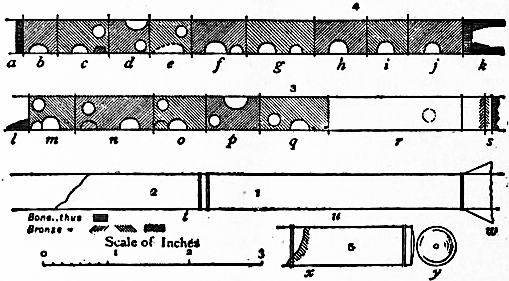
(From a drawing by Prof. John L. Myres.)
Fig. 1.—Diagram of the Fragments of an Aulos (Candia Mus.).
a, Triple wrapping of bronze as well as slide. b, Slide with hole. c, Slides with two holes not uncovered together. d, Slides with two holes not uncovered together, one hole at back. e, Slide. f, Slide missing. g, Slide missing, scars of slide holes. h, Slide. i and j, Slide. k, Socket. l, Male half of joint. m, n, o, Slides, the top hole being in the slide only. p and q, Slides, with two holes; the small hole shown is in the pipe, there being a corresponding hole in the slide at the back. r, Bronze covering (and slide?). s, Male joint. t, The wavy line shows the extreme length of fragment. u, 13 mm. inside diameter, 14 mm. outside diameter. w, Engraved lines and conical form of bronze covering. x, Wavy line shows extreme length of fragment. y, Stopped end of pipe with engraved lines.
The line between r and s is either a turned ring or part of bronze cover. The double lines to the right of t are engraved lines.
Bands of silver were found on the ivory pipes from Pompeii3 (fig. 2), as well as on two pipes belonging to the Castellani collection (fig. 4) and on one from Halicarnassus, in the British Museum. In order to enable the performer to use these bands conveniently, a contrivance such as a little ring, a horn or a hook termed keras (κέρας) was attached to the band.4
Thirteen of the bands on the Pompeian pipes still have sockets which probably originally contained kerata. Pollux (iv. 80) mentions that Diodorus of Thebes, in order to increase the range of the aulos, made lateral channels for the air (πλάγιαι ὁδοί). These consisted of tubes inserted into the holes in the bands for the purpose of lengthening the column of air, and lowering individual notes at will, the sound being then produced at the extremity of the tube, instead of at the surface of the pipe. It is possible that some of the double holes in the slides of the Candia pipe were intended for the reception of these tubes. These lateral tubes form the archetype of the modern crook or piston.5 The mouthpiece of the aulos was called zeugos (ζεῦγος),6 the reed tongue glossa7 or glotta (γλῶσσα or γλῶττα), and the socket into which the reed was fixed glottis8 (γλωττίς).
The double reed was probably used at first, being the simplest form of mouthpiece; the word zeugos, moreover, signifies a pair of like things. There is, however, no difficulty in accepting the probability that a single beating reed or clarinet mouthpiece was used by the Greeks, since the ancient Egyptians used it with the as-it or arghoul (q.v.).

(Drawn from a photo by Brogi.)
Fig. 2.—Roman Ivory Aulos found at Pompeii (Naples Mus.), showing slides and rings.
The beak-shaped mouthpiece of a pipe found at Pompeii (fig. 3) has all the appearance of the beak of the clarinet, having, on the side not shown, the lay on which to fix a single or beating reed.9 It may, however, have been the cap of a covered reed, or even a whistle mouthpiece in which the lip does not show in the photograph. It is difficult to form a conclusion without seeing the real instrument. On a mosaic of Monnus in Trèves10 is represented an aulos which also appears to have a beak-shaped mouthpiece.
The upper part of the aulos, as in the Pompeian pipes, frequently had the form of a flaring cup supported on a pear-shaped bulb, respectively identified as the holmos (ὄλμος) and the hypholmion (ὑφόλμιον), the support of the holmos. An explanation of the original nature and construction of the bulb and flaring cup, so familiar in the various representations of the aulos, and in the real instruments found in Pompeii, is provided by an ancient Egyptian flute belonging to the collection of G. Maspero, illustrated and described by Victor Loret.11 Loret calls the double bulb the beak mouthpiece of the instrument, and describes its construction; it consists of a piece of reed of larger diameter than that of the flute, and eight centimetres long; this reed has been forcibly compressed a little more than half way down by means of a ligature of twine, thus reducing the diameter from 6 mm. to 4 mm. The end of the pipe, covered by rows of waxed thread, fits into the end of the smaller bulb, to which it was also bound by waxed thread exactly as in the Elgin pipe at the British Museum, described below. There is no indication of the manner in which the pipe was sounded, and Loret assumes that there was once a whistle or flageolet mouthpiece. To the present writer, however, it seems probable that the constricted diameter between the two bulbs formed a socket into which the double reed or straw was inserted, and that, in this case at least, the reed was not taken into the mouth, but vibrated in the upper bulb or air-chamber. This simple contrivance was probably also employed in the earliest Greek pipes, and was later copied and elaborated in wood, bone or metal, the upper bulb being made shorter and developing into the flaring cup, in order that the reeds might be taken directly into the mouth. During the best period of Greek music the reeds were taken directly into the mouth12 and not enclosed in an air-chamber. The two pipes were kept in position while the fingers stopped the holes and turned the bands by means of the φορβεία (Lat. capistrum), a bandage encircling mouth and cheeks, and having holes through which the reed-mouthpiece passed into the mouth of the performer; the phorbeia also relieved the pressure of the breath on the cheeks and lips,13 which is felt more especially by performers on oboe and bassoon at the present day.

(From a photo by Brogi.)
Fig. 3.—Beak mouthpiece. Found at Pompeii (Naples Mus.).
In the pair of wooden pipes belonging to the Elgin collection at the British Museum, one of the bulbs, partly broken, but preserved in the same case as the pipes, was fastened to the pipes by means of waxed thread, the indented lines being still visible on the rim of the bulb. The aulos was kept in a case called sybene14 (συβήνη) or aulotheke15 (αὐλοθήκη), and the little bag or case in which the delicate reeds were carried was known by the name of glottokomeion15 (γλωττοκομεῖον).16 Two Egyptian flute cases are extant, one in the Louvre,17 and the other in the museum at Leiden. The latter case is of sycamore wood, cylindrical in shape, with a stopper of the same wood; there is no legend or design upon it. The case contained seven pipes, five pieces of reed without bore or holes, and three pieces of straw suitable for making double-reed mouthpieces.18
Aristoxenus gives the full compass of a single pipe or pair of pipes as over three octaves:—“For doubtless we should find an interval greater than the above mentioned three octaves between the highest note of the soprano clarinet (aulos) and the lowest note of the bass-clarinet (aulos); and again between the highest note of a clarinet player performing with the speaker open, and the lowest note of a clarinet player performing with the speaker closed.”19
This, according to the tables of Alypius, would correspond to the full range of the Greek scales, a little over three octaves from to It is evident that the ancient Greeks obtained this full compass on the aulos by means of the harmonics. Proclus (Comm. in Alcibiad. chap. 68) states that from each hole of the pipe at least three tones could be produced. Moreover, classic writers maintain that if the performer press the zeugos or the glottai of the pipes, a sharper tone is produced.20 This is exactly how a performer on a modern clarinet or oboe produces the higher harmonics of the instrument.21 The small bore of the aulos in comparison to its length facilitated the production of the harmonics (cf. Zamminer p. 218), as does also the use of a small hole near the mouthpiece, called in Greek syrinx (σῦριγξ) and in the modern clarinet the “speaker,” which when open enables the performer to overblow with ease the first harmonic of the lowest fundamental tones. To Mr Albert A. Howard of Harvard University is due the credit of having identified the syrinx of the aulos with the speaker of the clarinet.22 This assumption is doubtless correct, and is supported by classical grammarians,23 who state that the syrinx was one of the holes of the aulos. It renders quite clear certain passages in Aristoxenus, Aristotle and Plutarch, and a scholion to Pindar’s 12th Pythian, which before were difficult to understand (see Syrinx).


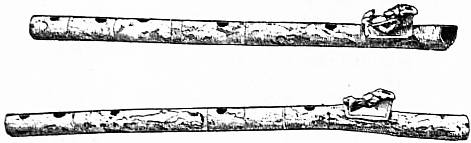
Fig. 4.—The Plagiaulos. Castellani Collection (Maenad Pipes), British Museum.
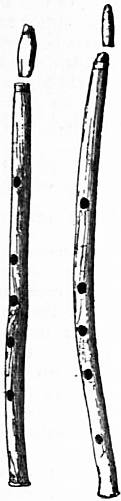
Fig. 5.—Ancient Greek Double Pipes. Elgin Collection, British Museum.
The aulos or tibia existed in a great number of varieties enumerated by Pollux (Onomast. iv. 74 et seq.) and Athenaeus (iv. 76 et seq.). They fall into two distinct classes, the single and the double pipes. There were three principal single pipes, the monaulos, the plagiaulos and the syrinx monocalamos. The double pipes were used by the great musicians of ancient Greece, and notably at the musical contests at Delphi, and what has been said above concerning the construction of the aulos refers mainly to the double pipes. The monaulos, a single pipe of Egyptian origin, which, by inference, we assume to have been played from the end by means of a reed, may have been the archetype of the oboe or clarinet. The plagiaulos photinx or tibia obliqua, invented by the Libyans (Pollux iv. 74), or, according to Pliny (vii. 204), by Midas of Phrygia, was held like the modern flute, but was played by means of a mouthpiece containing a reed. Three of the existing pipes at the British Museum (the two in the Castellani collection, and the pipe from Halicarnassus) belong to this type. The mouthpiece projects from the side of the pipe and communicates with the main bore by means of a slanting passage; the end nearest the mouthpiece is stopped as in the modern flute; in the latter, however, the embouchure is not closed by the lips when playing, and therefore the flute has the acoustic properties of the open pipe, whereas the plagiaulos having a reed mouthpiece gave the harmonics of a closed pipe. The double pipes existed in five sizes according to pitch, in the days of Aristoxenus, who, in a treatise on the construction of the auloi (Περὶ αὐλῶν τρήσεως), unfortunately not extant,24 divides them thus:—
(1) Parthenioi auloi (παρθένιοι αὐλοί), the maiden’s auloi, corresponding to the soprano compass.
(2) Paidikoi auloi (παιδικοὶ αὐλοί), the boy’s pipes or alto auloi, used to accompany boys’ songs and also in double pairs at feasts.
(3) Kitharisterioi auloi (κιθαριστήριοι αὐλοί), used to accompany the cithara.
(4) Teleioi auloi, the perfect aulos, or tenor’s pipes; also known as the pythic auloi (πυθικοὶ αὐλοί); used for the paeans and for solos at the Pythean games (without chorus). It was the pythic auloi and the kitharisterioi auloi more especially which were provided with the speaker (syrinx) in order to improve the harmonic notes (see Syrinx).
(5) Hyperteleioi auloi (ὑπερτέλειοι αὐλοί) or andreioi auloi (ἀνδρεῖοί αὐλοί) (see Athenaeus iv. 79), the bass-auloi.
The Phrygian pipes or auloi Elymoi25 were made of box-wood and were tipped with horn; they were double pipes, but differed from all others in that the two pipes were unequal in length and in the diameter of their bores;26 sometimes one of the pipes was curved upwards and terminated in a horn bell;27 they seem to have had a conical bore, if representations on monuments are to be trusted. We may conclude that the archetype of the oboe with conical bore was not unknown to the Greeks; it was frequently used by the Etruscans and Romans, and appears on many has-reliefs, mural paintings and other monuments. For illustrations see Wilhelm Froehner, Les Musées de France, pl. iii., “Marsyas playing the double pipes.” There the bore is decidedly conical in the ratio of at least 1 : 4 between the mouthpiece and the end of the instrument; the vase is Roman, from the south of France. See also Bulletino della Commissione Archeologica Comunale di Roma, Rome, 1879, vol. vii., 2nd series, pl. vii. and p. 119 et seq., “Le Nozze di Elena e Paride,” from a bas-relief in the monastery of S. Antonio on the Esquiline; Wilhelm Zahn, Die schonsten Ornamente und die merkwurdigsten Gemälde aus Pompeji, Herkulaneum und Stabiae (German and French), vol. iii., pl. 43 and 51 (Berlin, 1828-1859).
For further information on the aulos, consult Albert A. Howard, “The Aulos or Tibia,” Harvard Studies, iv., 1893; François A. Gevaert, Histoire de la musique dans l’antiquité, vol. ii. p. 273 et seq.; Carl von Jan’s article “Flote” in August Baumeister’s Denkmaler des klassischen Altertums (Munich, 1884-1888), vol. i.; Dr Hugo Riemann, Handbuch der Musikgeschichte, Bd. I.T. 1, pp. 93-112 (Leipzig, 1904); Caspar Bartholinus, De Tibiis Veterum (Amsterdam, 1779).
(K. S.)
1 See Pollux, Onom. iv. 69.
2 See Friedrich Zamminer, Die Musik und musikalischen Instrumente in ihrer Beziehung zu den Gesetzen der Akustik (Giessen, 1855), p. 305.
3 These pipes were discovered during the excavations in 1867, and are now in the museum at Naples. Excellent reproductions and descriptions of them are given in “The Aulos or Tibia,” by Albert A. Howard, Harvard Studies, vol. iv. (Boston, 1893), pl. ii. and pp. 48-55.
4 For illustrations of auloi provided with these contrivances, see illustration (fig. 2) of an aulos from Pompeii; a relief in Vatican, No. 535; Helbig’s Wandgemãlde, Nos. 56, 69, 730, 765, &c.
5 For illustrations of ὁδοί showing the holes at the ends of the tubes, see Description des marbres antiques du Musée Campana, by H. d’Escamps, pl. 25; Wilhelm Froehner’s Catalogue of the Louvre, No. 378; Glyptothek Museum at Munich, No. 188; Albert A. Howard, “The Aulos or Tibia,” Harvard Studies, iv. (Boston, 1893), pl. 1, No. 1.
6 For a description of the reed calamus from which pipe and mouthpiece were made see Theophrastus, Hist. Plant. iv. 11.
7 Aeschines 86. 29; Aristotle, H.A. 6, 10, 9, &c.
8 Lucian, Harm. 1.
9 Cf. article Mouthpiece.
10 See Antike Denkmaler, Deutsches archäol. Inst., Berlin, 1891, vol. i. pi. 49.
11 See “Les Flûtes égyptiennes antiques,” Journal asiatique, 8th ser. vol. xiv. (Paris, 1889), pp. 212-215.
12 See Aristotle, De Audib. p. 802 b, 18, and p. 804a; Festus, ed. Mueller, p. 116.
13 See Albert A. Howard, op. cit. p. 29, and Dr Hugo Riemann, Gesch. d. Musik, Bd. i. T. 1, p. 111 (Leipzig, 1904).
14 Pollux, Onomasticon, vii. 153.
15 Hesychius.
16 Pollux ii. 108, vii. 153, x. 153-154; A.A. Howard, op. cit. pp. 26-27. An illustration of the little bag is given in Denkmaler des klassischen Altertums, by August Baumeister, vol. i. p. 554, fig. 591.
17 Two Egyptian pipes now in the Louvre were found in a case ornamented with a painting of a female musician playing a double pipe. See E. de Rougé, Notice sommaire des monuments égyptiens exposés dans les galeries du Louvre, p. 87.
18 See Victor Loret, “Les Flûtes égyptiennes antiques,” in Journal asiatique, vol. xiv. (Paris, 1889), pp. 199, 200 and 201 (note), pp. 207, 211 and 217, and Conrad Leemans, Description raisonnée des monuments égyptiens du Musée d’Antiquités de Leyde, p. 132, No. 489; contents of case Nos. 474-488.
19 Aristoxenus, Harm. bk. i. 20 and 21, H.S. Macran’s edition with translation (Oxford, 1902), p. 179.
20 Aristotle, De audib. p. 804a; Porphyry, ed. Wallis, p. 249; ibid. p. 252.
21 Zamminer, op. cit. p. 301.
22 Op. cit. p. 32-35.
23 See Etymologicum magnum (Augsburg. 1848), s.v. “Syrinx.”
24 See Athenaeus xiv. 634, who quotes from Didymus.
25 Pollux iv. 74.
26 Servius ad Aen. ix. 615.
27 Tibullus ii. 85; Virg. Aen. xi. 735; Ovid, Met. iii. 533, Ex Ponto i. 1. 39.
AUMALE, HENRI EUGÈNE PHILIPPE LOUIS D’ORLÉANS, Duc d’ (1822-1897), French prince and statesman, fifth son of Louis Philippe, duke of Orleans, afterwards king of the French, and of Marie Amélie, princess of the Two Sicilies, was born at Paris on the 16th of January 1822. While still young he inherited a large fortune from the prince de Condé. Brought up by his parents with great simplicity, he was educated at the college of Henri IV., on leaving which at the age of seventeen he entered the army with the rank of a captain of infantry. He distinguished himself during the conquest of Algeria, and was appointed governor of that colony, in which capacity he received the submission of the amir Abd-el-Kader. After the revolution of 1848 he retired to England and busied himself with historical and military studies, replying in 1861 by a Letter upon the History of France to Prince Napoleon’s violent attacks upon the house of Orleans. On the outbreak of the Franco-Prussian War he volunteered for service in the French army, but his offer was declined. Elected deputy for the Oise department, he returned to France, and succeeded to the fauteuil of the comte de Montalembert in the French Academy. In March 1872 he resumed his place in the army as general of division; and in 1873 he presided over the court-martial which condemned Marshal Bazaine to death. About this period, being appointed commandant of the VII. army corps at Besançon, he retired from political life, and in 1879 became inspector-general of the army. By the act of exception passed in 1883 all members of families that had reigned in France serving in the army were deprived of their military positions; consequently the duc d’Aumale was placed on the unemployed supernumerary list. Subsequently, in 1886, another law was promulgated which expelled from French territory the heads of former reigning families, and provided that henceforward all members of those families should be disqualified for any public position or function, and for election to any public body. The duc d’Aumale protested energetically, and was himself expelled. By his will of the 3rd of June 1884, however, he had bequeathed to the Institute of France his Chantilly estate, with all the art-collection he had gathered there. This generosity led the government to withdraw the decree of exile, and the duke returned to France in 1889. He died at Zucco in Sicily on the 7th of May 1897. Of his marriage, contracted in 1844 with his first cousin, Caroline de Bourbon, daughter of the prince of Salerno, were born two sons: the prince de Condé (d. 1866), and the due de Guise (d. 1872). The due d’Aumale’s principal literary work was an Histoire des princes de Condé, which he left unfinished.
See Georges Picot, M. le duc d’Aumale (Paris, 1898); Ernest Daudet, Le duc d’Aumale (Paris, 1898).
(M. P.*)
AUMALE, a town of northern France, in the department of Seine-Inférieure, on the left bank of the Bresle, 47 m. N.E. of Rouen on the Northern railway. Pop. (1906) 1999. The church is an interesting building of the 16th and 17th centuries, and has a portal attributed to Jean Goujon. The town has glass and steel works.
The territory of Aumale (Albemarle, Aubemale, Aumerle; Lat. Alba Marla) in Normandy, a dependency of the archbishopric of Rouen, was granted to Odo of Champagne, brother-in-law of William the Conqueror, who founded the first line of counts of Aumale. Hawise (Hadwide, Havoise or Avoie), countess of Aumale, after the death of her first husband William de Mandeville, earl of Essex (d. 1189), married William des Forts (de Fors, or de Fortz; Lat. de Fortibus), a military adventurer who had been one of the commanders of the fleet under Richard I. during his first crusade. He died in 1195, and his widow married Baldwin de Betun, who became count of Aumale in her right. He died in 1213, and in 1214 William de Fortibus, son of Hawise by her second husband, was confirmed by King John in all his mother’s lands. Meanwhile, however, the territory of Aumale shared the fate of the rest of Normandy, and was annexed to the French crown by King Philip Augustus; but the title of earl of Albemarle, derived from it, continued to be borne in England by William de Fortibus, and was passed on to his heirs (see Albemarle). Aumale itself was conferred by Philip Augustus as an appanage on his son Philip. It was subsequently granted by Louis VIII. to Simon, count of Dammartin, whose daughter, Jeanne, countess of Dammartin, transferred it, together with the countship of Ponthieu, to the house of Castile, by her marriage with Ferdinand III., king of Castile, called the Saint (1238). It then remained in the possession of a branch of her descendants bearing the name of Ponthieu, until it passed to the house of Harcourt on the marriage of Blanche of Ponthieu with John, count of Harcourt (1340). Marie d’Harcourt (d. 1476), heiress of Aumale, married Anthony of Lorraine, count of Vaudémont, and Aumale was created a duchy in the peerage of France for Claude and Francis of Lorraine in 1547. By the marriage of Anne of Lorraine with the duke of Nemours in 1618 the duchy of Aumale passed to the house of Savoy-Nemours. In 1686 Marie Jeanne Baptiste, duchess of Nemours and of Aumale, and wife of Charles Emmanuel II., duke of Savoy, sold Aumale to Louis XIV., who gave it to his natural son, the duke of Maine. After the death of that prince, the dukedom devolved upon his brother, the count of Toulouse, subsequently passing to the latter’s son, the duke of Penthièvre, whose daughter married the duke of Orleans. Since the reign of Louis Philippe, king of the French, the title of duke of Aumale has been borne by a son of the duke of Orleans.
AUMONT, the name of a family which played an important part in French history. The origin of the name is uncertain, but it has usually been derived from Aumont, now a small commune in the department of the Somme. The family was of great antiquity, a Jean, sire d’Aumont, having accompanied Louis IX. on crusade. It was already powerful in the 14th century, and during the English wars of that period its members fought in the armies of the kings of France. Towards the end of the century, the family took the part of the dukes of Burgundy, but returned to the side of France on the death of Charles the Bold. Jean d’Aumont, lieutenant-general to the king of France in the government of Burgundy, rendered important services to Louis XII. and Francis I. Another Jean d’Aumont (d. 1595), a marshal of France and knight of the order of the Holy Ghost since its institution in 1578, fought against the Huguenots under the last of the Valois kings; but he was among the first to recognize Henry IV., and was appointed governor of Champagne and of Brittany, where he had to fight against the League. His grandson Antoine (1601-1669) was also a marshal of France (1651), governor of Paris (1662), duke and peer (1665). Louis Marie Augustin, duc d’Aumont (1709-1782), was a celebrated collector of works of art. Louis Marie Celeste d’Aumont, due de Piennes, afterwards duc d’Aumont (1762-1831), emigrated during the Revolution and served in the army of the royalists, as also in the Swedish army. During the Hundred Days he effected a descent upon Normandy in the Bourbon interest, and succeeded in capturing Bayeux and Caen.
AUNCEL (from the Anglo-Fr. auncelle, a confused derivation from l’auncelle, Ital. lancella, a little balance), a balance formerly used in England; now, in dialectical use, a term for the weighing of meat by hand instead of by scales.
AUNDH, a native state of India, in the Deccan division of Bombay, ranking as one of the Satara Jagirs. Its area is 447 sq. m.; its population was 63,921 in 1901, showing a decrease of 2% in the decade. Estimated revenue £9422. The chief, whose title is Pant Pratinidhi, is a Brahman by caste. The state has suffered severely from plague. The town of Aundh is situated 26 m. S.E. of Satara. Pop. about 3500.
AUNGERVYLE, RICHARD (1287-1345), commonly known as Richard de Bury, English bibliophile, writer and bishop, was born near Bury St Edmunds, Suffolk, on the 24th of January 1287. He was the son of Sir Richard Aungervyle, who was descended from one of William the Conqueror’s soldiers, settled in Leicestershire, where the family came into possession of the manor of Willoughby. His education was undertaken by his uncle, John de Willoughby, and after leaving the grammar school of his native place he was sent to Oxford, where he is said to have distinguished himself in philosophy and theology. John Pits1 says, but apparently without authority, that he became a Benedictine monk. He was made tutor to Prince Edward of Windsor (afterwards Edward III.), and, according to Dibdin, inspired him with some of his own love of books. He was mixed up with the sordid intrigues which preceded the deposition of Edward II., and supplied Queen Isabella and Mortimer in Paris with money in 1325 from the revenues of Guienne, of which province he was treasurer. For some time he had to hide in Paris from the officers sent by Edward II. to apprehend him. On the accession of Edward III. his services were rewarded by rapid promotion. He was cofferer to the king, treasurer of the wardrobe and afterwards clerk of the privy seal. The king, moreover, repeatedly recommended him to the pope, and twice sent him, in 1330 and 1333, as ambassador to the papal court, then in exile at Avignon. On the first of these visits he made the acquaintance of a fellow bibliophile in Petrarch, who records his impression (Epist. Famil. lib. iii. Ep. 1) of the Englishman as “not ignorant of literature and ... from his youth up curious beyond belief of hidden things.” He asked him for information about Thule, but Aungervyle, who promised information when he should once more be at home among his books, never sent any answer, in spite of repeated enquiries. The pope, John XXII., made him his principal chaplain, and presented him with a rochet in earnest of the first vacant bishopric in England.