Volume 2 — CHAPTER III. 1758, 1759 — BEGINNING OF CORRESPONDENCE WITH MRS. CARTER, WITH DR. JOHNSON, AND WITH BURKE.
Reading edition
1758
1758 commences with a letter on March 2, from Mrs. Montagu to her husband, who had left London for Sandleford. In it she says—
“I shall enclose an Advertizer in which you will find a curious article from Warsaw. It astonished all Europe to find the King of Prussia had got copies of the plans of the Imperial Court and Dresden, the means by which he obtained them are now discover’d. To this contrivance his Prussian Majesty and his Country owe their present being, but one cannot envy the state of a King if it is necessary to take such means for preservation as would startle a vulgar man of Honour. To get false keys to cabinets is but a poor low trick, and it is very strange to see a hero guilty of burglary, but as Mr. Pope observes, ‘the story of the great is generally a tale that blends their glory with their shame.’ Mr. Stanhope call’d on me as I was writing, and I am to dine with my brother Morris, so must abridge my letter. I can’t hear what pass’d in the House of Lords yesterday in Delany’s trial.... I was at the Oratorio last night, where I heard the Dublin man-of-war was sent to Mr. Boscawen to supply the loss of the Invincible. I am to be at Lady Hillsborough’s assembly to-night.”
The Delany trial had lasted for nearly ten years. It was on account of Dr. Delany, in inadvertence, having burnt a paper of importance belonging to his first wife. Sometimes it appeared to be at an end, but it was as often renewed. At last, on March 5, Lord Mansfield,[180] after an hour and a half’s speech, decided in favour of Delany. The cost of the suit exceeded the disputed sum, but the relief to the good dean and his wife on its decision balanced everything.
BISHOP CLAYTON
On March 9 Mrs. Montagu writes—
“I met Mrs. Delany to-day at Mrs. Donnellan’s, and she is very happy, the Irish decree is reversed, tho’ even as matters stand, they will have little left when the £7000 is paid. Lady Frances Williams is still in grief for her husband,[181] who in his madness has writt (sic) letters to half the crowned heads in Europe. I am going to the play to-night, to-morrow I shall give up the Oratorio to stay with Lady Frances Williams as comforter.
“That bright luminary of the Church, Dr. Clayton, Bishop of Clogher, is dead.... The Bishop has left his wife his whole fortune, which is very considerable. It is thought we shall not send troops to the King of Prussia, but whether he will accept of our money[182] we shall not know till the return of the Express. The King of Pegu has wrote a letter to the King on a gold plate, and the stops are made with rubies; I should be glad of his correspondence tho’ his letters had no wit in them.”
EMIN ADDRESSES PITT
Emin, anxious for re-employment, now addressed Mr. Pitt. The letter was addressed to Mr. Pitt, Secretary of State.
“Sir,
“Though I never had the honour to be known to you, yet I have the boldness to write. I have been over a great variety of the world, and have seen much people, but I wanted to see men; for the Design of my Travel was knowledge, and I thought knowledge of real men was better than books, therefore I have turned my Eyes upon all ways and at last had the great happyness of seeing and hearing you in that potent House of Commons, and there I discovered like the light breaking upon me, what my Friends had often told me, of your great love to your Country and your wise Eloquence that conquers more than the Sword of a Hero. I own I grew a little envious; for I thought no man loved his country better than I have mine, but I confess it that I am nothing, tho’ I have been sailor, porter, slave, and suffered everything in every shape, to make my country what you have made yours. This is my small merit and the only recommendation I can make to you. Sir, I will observe that a cloudy day in winter is light enough to see what is about us and to serve common business, but permitt me to say no man is happy nor in good spirit untill the sun shines out. Then there is joy upon all men’s faces. Thus it is, great Sir, with me in this country, I along with the rest in this happy land, find Benefit of the Light you give us all by your great wisdom of governing, but I am not happy, and my Life is dead untill I see the Vezirazam of England.
“If you do me this high Honour, you will see a poor soldier whose only Fortune is a character with all people which I have been amongst. I was a Porter for learning not for livlihood, and I was honest in that low way. This is known when by the goodness of great Souls I was raised from that. I was not idle nor ingreatefull; I have been high and low and I was not bad. When I served the last campaign in Germany, all the officers, both English and the German, will say more of me than I dare think of myself. I have, Sir, in my studies for my country, found the way to advance it, and do some service to your noble Nation at the same time. My humble plan for this good design I will do myself the Honour to show to you and be instructed by your great Wisdom and to give me new rights in this great matter. My scheme has two Qualities which make some laugh at me, others seem to like me for it. Whatever it is, it is little without your assistance. If you approve of it, I laugh at those that laugh at me, at any rate I am resolved and nothing shall stop me but Death, which is common to everybody, and an honest Heart need not fear any. I am, with the greatest Respect and Veneration,
“Great Sir,
“Your most obedient most obliged
devoted humble Servant,
“J. Emin.
“In the Month of March, 1758, “To the R. H. William Pitt, etc., etc.”
In her next letter to her husband Mrs. Montagu says—
“Emin dines with Lady Medows to-day, if joy can give appetite, he will make a good meal, for by the solicitation of Lady Yarmouth,[183] Mr. Pitt has received him, and promised to see what can be done for him, as great minds are akin. Mr. Pitt was much pleased with him. Emin repeated to me his discourse to Mr. Pitt, and it was full of Asiatick fire and figure—if it did not touch the man, it must the Orator. Mr. Pitt made him great compliments. I hope they will be realized, and they surely will if Lady Yarmouth continues her desire to serve him.”
EMIN JOINS MARLBOROUGH
Emin was sent to join the English army under the Duke of Marlborough in their attempted invasion of France at St. Malo, and wrote on June 11 to say that “Captain Howe had burnt 73 ships and from 10 to 16 guns, besides small vessels.” After this expedition, Emin joined the army with the King of Prussia.
AFFAIRS IN PARLIAMENT
Writing to Dr. Stillingfleet on June 13, after alluding to the attack on St. Malo, Mrs. Montagu says—
“So much for war and war’s alarms; as to our civil occurences, they have been so boisterously carried I need not change the tone of my narrative; the Judges, the Lord Keeper, the Chief Justice, and the late Lord Chancellor gave their opinions against the Habeas Corpus bill.[184] Lord Temple, much in wrath, insulted the Judges in some of his questions; Lord Lyttelton warmly and sharply reproved him upon which words rose high, the House of Lords interfered. The last day of this bill, Lord Mansfield and Lord Hardwicke[185] spoke so full to the matter, even Tory Lords, and these most violent in their wishes for it, declared they were convinced the new bill was dangerous to liberty in many respects, in many absurd; so that had there been a division there would not have been four votes for it, but Mr. Pitt’s Party discreetly avoided a division. This affair has not set the legislative wisdom of the House of Commons in a very high light, but the great Mr. Beckford,[186] whom no argument can convince, no defeat make ashamed, nor mistake make diffident, did on the motion for a vote of credit stand up in the House of Commons and say he would not oppose that measure, as he had an opinion of the two Commoners in the administration, but in the Peers that composed it, he had no confidence, and ran in foul abuse of them and then ended with a severe censure of the House of Lords in general. Lord Royston[187] answered him that this was unparliamentary where personal, and indecent in regard to the House of Peers in general, to which Mr. Pitt answered with great heat that he was sorry to hear such language from a gentleman who was to be a Peer; he set forth the great importance and dignity of Mr. Beckford personally, and above all the dignity and importance of an alderman, concluding it was a title he should be more proud of than that of a Peer. This speech has enraged the Lords, offended the Commons, and the City ungratefully say was too gross. Those who wish well to this country, and consequently to a union of parties at this juncture, are sorry for these heats; it is well if they do not unsolder the Union.... I began Islington Waters to-day.... You make a false judgment of your own letters. I will allow you to say it gives you some trouble to write them, but pray do not assert that I have not great pleasure in reading them; it becomes not a descendant of the great Bishop Stillingfleet[188] to tell a fib.”
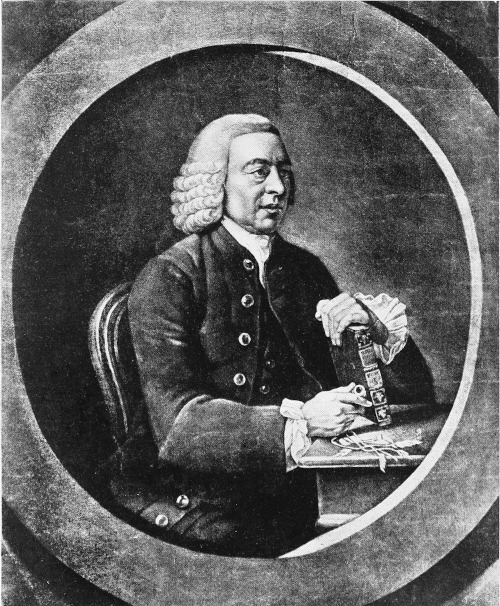
BENJAMIN STILLINGFLEET.
JOHN ROGERS — ROGERS’ WILL
Mention has been made of Mr. John Rogers, first cousin on his mother’s side to Mr. Montagu, also of Mr. Montagu becoming his trustee in 1746, when he was pronounced a lunatic. At first it seems that he suffered from epileptic fits, which increased to lunacy, but of a mild order. On June 23 Mr. Edward Steuart wrote to say Mr. Rogers was seriously ill, and his death expected hourly; he was being attended by Dr. Askew, then a famous north-country doctor, and several surgeons, for a mortification in his leg.[189] On the 24th he expired, in his seventy-fourth year, at his house in Pilgrim Street, Newcastle-on-Tyne. Mr. Montagu was his principal heir. Mrs. Montagu, in a letter respecting the estate of East Denton, etc., wrote in later days, “Mr. M. has half the estate by descent, a share by testamentary disposition, and a part by purchase.” Mr. Rogers’ lunacy seems to have been made worse by the death of his wife, Anne Delaval, daughter of Sir John Delaval, whom he married in 1713, and who died in 1722–23. His will was made in 1711, and a codicil added 1715, in which he left his property, after the death of his mother, Mrs. Elizabeth Rogers, to his wife, and failing issue by her, to the Montagus and Creaghs, all first cousins. Mary Creagh had married Dominick Archdeacon, and her sister Margaret, Anthony Isaacson; Mr. Montagu’s two brothers, Crewe and John, being dead, the only other heir was Jemima, Mrs. Medows, afterwards Lady Medows. The estates were very large; besides Denton, with its coal-mines, houses in Newcastle, and in Bramston, Lamesley, Harburn, Parkhead, and Jarrow, in the county of Durham; lands at Hindley, Sugley, Throckley, Newbiggin, Scotswood, etc., etc.; collieries and saltpans in Cullercoats, Monkseaton, Whitley, and Hartley, etc., etc. Mrs. Montagu was at Ealing with the Bothams when the express came. She writes to her husband, “It gives me pleasure to think I shall see you with unblemished integrity and unsoiled with unjust gain, enjoying that affluence many purchase with the loss of honesty and honour.”
Her brother Morris fetched her from Ealing in order to accompany her husband to the north. Mr. Rogers was embalmed and buried on July 5 at St. Nicholas’ church in Newcastle. The Montagus did not start for the North till Tuesday, August 1. A letter from Dr. Monsey of June 26, while staying with the Garricks at Hampton, congratulates Mrs. Montagu on her inheritance, but scolds her for leaving her friends to go North. This contains the first mention of his acquaintance with the Garricks, who were great friends of Dr. Monsey’s, and he says, “Mr. Garrick[190] was very near in a apoplectic fit when he found you were gone.... Mrs. Garrick[191] also abus’d herself for not pressing you to return to the Temple[192] and enjoy another half-hour.”
ELIZABETH CARTER — MRS. MONTAGU’S LETTER
The next letter is the first I possess to Elizabeth Carter, whose learned translation of Epictetus was first printed in April of 1758. Miss Carter, or Mrs. Carter (as courtesy termed her), was the daughter of a clergyman, the Rev. Nicholas Carter, D.D., Perpetual Curate of Deal, Kent, where he resided; he had been twice married, and Elizabeth was his child by his first marriage. To his children by both marriages Mr. Carter gave an excellent education, and at an early age Elizabeth studied Latin, Greek, and eventually Hebrew. She was a proficient in French, and taught herself Italian, Spanish, and German; later in life Portuguese and Arabic were added. Her application to study produced severe headaches, principally brought on by drinking green tea and taking snuff to keep herself awake. It appears that Mrs. Montagu had met her in 1757, but Mrs. Carter had rather avoided such a brilliant acquaintance, being herself of a most humble and unambitious character, despite her learning. From the following portions of Mrs. Montagu’s letter we learn that Miss Carter had been paying her a visit:—
“Hill Street, July 6, 1758.
“What must my dear Miss Carter think of the signs of brutal insensibility which I have given in not answering her obliging letter? As my heart has had no share in the omission, I have no apologies to make for it; no day has passed since you left us in which I have not thought of you with esteem and affection; I look upon my introduction to your acquaintance as one of the luckiest incidents of my life, if I can contrive to improve it into friendship; this is, and has been the state of my mind and I am proud of it: as to my conduct in the commencement of our correspondence, I am ashamed of it. I was ill when I received your polite and agreeable letter. I have ever since been drinking Islington waters, from which I receive some benefit, but with this inconvenience, that I am unable to write till late at night, and even then not without headache. The death of a relation of Mr. Montagu’s in the North, which happened about a fortnight ago, with a large accession of fortune, has brought me the usual accompaniment of riches, a great deal of business, a great deal of hurry, and a great many ceremonious engagements. The ordering funeral ceremonies, putting a large family in mourning, preparing for a journey of 280 miles, and receiving and paying visits on this event, has made me the most busy miserable creature in the world. As the gentleman from whom Mr. Montagu inherits had been mad above 40 years and almost bed-ridden the last ten, I had always designed to be rather pleased and happy when he resigned his unhappy being and his good estate. I thought in fortune’s as in folly’s cup, still laughed the bubble joy; but though this is a bumper, there is not a drop of joy in it, nor so much as the froth of a little merriment. As soon as I rise in the morning, my housekeeper with a face full of care, comes to know what must be packed up for Newcastle; to her succeeds the Butler, who wants to know what wine, etc., is to be sent down; to them succeed men of business and money transactions; then the post brings twenty letters, which must be considered and some answered. In about a week we shall set out for the North, where I am to pass about three months in the delectable conversation of Stewards and managers of coal mines, and this by courtesy is called good fortune, and I am congratulated upon it by every one I meet; while in truth, like a poor Harlequin in the play, I am acting a silly part dans l’embarras des richesses. I would not have troubled you with this detail, but as part of my defence for not having written to you. I can perfectly understand why you were afraid of me last year, and I will tell you, for you won’t tell me; perhaps you have not told yourself. You had heard I set up as a wit, and people of real merit and sense hate to converse with witlings, as rich merchant-ships dread to engage privateers, they may receive damage and can get nothing but dry blows. I am happy you have found out I am not to be feared; I am afraid I must improve myself much before you will find I am to be loved. If you will give affection for affection tout simple I shall get it from you....”
Mention is made of Emin’s joining the King of Prussia, so he was known to Mrs. Carter, probably through Lord Lyttelton.
“I have the pleasure of hearing infinite commendations of Epictetus every day; from such as are worthy I taste a particular pleasure; from the multitude I take it in the gross, as it makes the sum of universal fame. Some praises I heard a few days ago at the Bishop of London’s I put in the first class.”
LORD LYTTELTON TO DR. MONSEY
A most amusing letter from Lord Lyttelton to Dr. Monsey of July 24 now occurs, in which he returns a letter of Mrs. Montagu’s to the doctor, and summons him to a duel of words in her praise on Hagley turf. He teases Dr. Monsey with the idea of her going north, and advises him “to quit Lord Godolphin to follow love, follow him over the Cheviot Hills and down to the coal-pits at Newcastle.” After a great deal of chaff it ends, “Your most affectionate, humble Servant,—Lyttelton.”
MRS. MONTAGU’S SYMPTOMS
This frightened Monsey, so on July 30 he writes from St. James’s and gives her strings of advice as to her health.
“I know the generality of Physicians will be cautious of blooding you, as being what is called nervous; I know nothing of nerves in the usual sense of the word, if indeed it has any precise meaning at all, it is used by the wise to quiet fools, and by fools to cover ignorance.” Then he adds in high fever she may be blooded, “5, 6 or 7 ounces, and if you flag a blister! will set matters to right. I say nothing of vomits, you can’t bear ’em, but you will gentle purging, your lemon mixture and contrayserva with a little saffron, be cautious of hot medicines, but do not wholly throw them away, as to spasms and cramps they are such Proteuses, one does not know how to catch or hold them, Valerian and Castor are in such reputation for vanquishing those Hussars.... Assafœtida you can’t bear, I wish you cou’d ... if feverish 3 spoonfuls of a decoction of the bark by boyling one ounce and half in a quart of water to a pint, and if your stomach flags put in from 5 to 10 drops of Elixir of Vitriol, so arm’d a common cold will not have courage to attack you.”
Finally he consigns her to a Dr. Ramsay’s care, should she require a physician!
On August 1 Mrs. Boscawen wrote from Hatchlands a long letter describing a visit to London. Her letters are sprightly, but too much larded with French words and phrases; the end is interesting—
“Enfin we left this dear odious London at 4 in the afternoon, chemin faisant I thought within myself, what if I should meet an express from America, and sure enough upon Cobham Common I met a post-chaise containing an officer, on him I star’d attentively, he star’d again; then he cry’d ‘Stop,’ I echoed ‘Stop,’ enfin I heard him ask ‘is Admiral Boscawen’s[193] lady in that coach?’ I make quick reply in the affirmative, and soon he produced himself at my coach window, and told me he was express sent by the Governor of Nova Scotia with news of our troops having taken the Forts of Beau Sejour and Chignecto, that he attended Admiral Boscawen for his orders twenty-three days ago, and left him in perfect health; he added that Admiral Boscawen had saved North America, where all our Colonies were in the utmost danger, as well as consternation till he came. Papers having been found which showed the French had a design to destroy Halifax, where the people imagin’d the French wou’d let in the Indians to massacre them.... He added, ‘Mr. Boscawen had taken, or as the phrase there is detain’d, six French merchant ships, and had blocaded Louisbourg.’”
She adds that her letters from her husband were with Mr. Cunninghame (the Officer), addressed to Mr. Cleveland, so she let them go, and sent on her black servant “Tom” next day to fetch them, and was going to Portsmouth to meet the Admiral, who thought he should soon be back.
ON THE WAY NORTHWARDS
To return to the Montagus, they set out on August 1 for the North, and the first letter is from her to Lord Lyttelton on August 6, from Darlington—
“I am now about 25 miles short of Newcastle, having travelled above 250 miles since last Tuesday, and am better to-night than I was when I left London, so I will no longer endure that Dr. Monsey shall call me flimsy animal, puny insect, and such opprobrious names. I have had a surfeit of being in a post-chaise, that I have not made many excursions to see the fine places that lay in the road. In my way to Nottingham I went to see Sir Robert Clifton’s,[194] which appears to me for beauty of prospect equal to any place I ever saw. You are led to it from the turnpike road by a fine terrace on the side of the Trent. From a pavillion in the garden you see the town and Castle of Nottingham standing in the most smiling valley imaginable, in which the Trent serpentizes in a most beautiful manner.... I return your Lordship many thanks for having lent me so agreeable a companion as Antonio de Solis.”[195]
MARY WEST
To this Lord Lyttelton writes from Hagley on August 17, to say how glad he is she bore the journey so well, and the book entertained her. He had been drinking the waters at Sunning Hill, Berks, and found benefit. In the end of a long letter he writes, “Miss West and Captain[196] Hood will be as happy next Monday as mutual love can make them.” Miss West was Gilbert West’s sister, and her future husband, Captain Hood, became afterwards first Viscount Bridport. Mary West lived till 1786, but had no children. Lord Lyttelton alludes to her not being very young and “having no time to lose.”
In another letter of August 22, written from Lindridge Vicarage, Worcestershire, where the Vicar, Mr. Meadowcourt, was a great friend of his Lordship’s, he writes—
“Tom and I came this afternoon to this sweet abode on our way to Hampton Court.... I told you in my last that Miss West was to be married to Captain Hood. Yesterday I had the pleasure to give her away to him at Hagley Church, after which we made a party to Mr. Shenstone’s[197] Arcadian Farm in very fine weather. The pastoral scene seemed to suit the occasion, and the bride owned to me that the cascades and rills never murmured so sweetly before.... The Dean[198] came to Hagley just time enough to give Hood and her the Nuptial Benediction.”
Further on, alluding to Mr. Montagu’s going north to take possession of the Rogers’ estate, he says—
“I suppose this will find you, like Guyon in Mammon’s Cave, got down the bottom of your mines,[199] and beholding your treasures with all the indifference that the Knight of temperance showed when the Demon of Riches revealed to him his hidden wealth. I paint to myself the wonder and admiration of the subterraneous inhabitants when you first came among them. Since the time that Proserpina was carried by her husband to his Stygian Empire, the infernal regions have not seen such a charming goddess. But is it sure they will let you return again to daylight? Upon my word I am afraid you are in some danger, as the Habeas Corpus Bill was thrown out; for all the women of the upper world will make interest with the Judges to let you stay there. Yet I verily think Baron Smith will release you in spite of them all, and even if he should fail, you have still a resource, Emin shall come back and deliver you from the Shades as Hercules did Alcestis.”
ARRIVAL AT CARVILLE — “HURRYS AND CEREMONIES”
The best description of the Montagus’ arrival in the north is contained in a letter to Dr. Stillingfleet at “Robert Price’s, Esqre., Herefordshire,” sent open to Dr. Monsey, who forwards it with a few words of his own. It is dated, “Carville, ye 22nd day of August.” Carville Hall had been hired by them; it was situated at the end of the Roman Wall, called Wallsend. Portions of the letter I give—
“I desired Dr. Monsey to acquaint you with the death of Mr. Rogers. Many letters were to be written in order to procure him most pompous funeral obsequies, according to the fashion of Northumberland, as he was allied to the people of the first rank in the county, and they were all to be at the funeral.... The 7th of August at noon we got to Durham, and there began hurrys and ceremonies that have continued to this day, and I know not when I shall see a quiet hour. At Durham we were met by a great number of Mr. Rogers’ relations, and the Receivers and Agents of his estate, who attended in great form till we got to Newcastle, where we were to stay two or three days, with a relation of Mr. Montagu’s till our house was aired. We had not been an hour at Newcastle before we had the compliments of the principal persons of the Corporation and in the town. The next morning visits began.... We had fifteen people to dine here on Sunday, a family yesterday, people about business to-day, and three families to dine here to-morrow; in the morning I am up to the elbows in dusty parchments and accounts, after dinner as busy as an hostess of an Inn attending her guests, at night as sick as an invalid in Hospital, and these are the woes of wealth, and I am not une malade imaginaire.... Mr. Rogers’ family Mansion[200] having been uninhabited many years, was not fit for our reception, his house[201] in Newcastle was not agreeably situated for the summer, so we hired a house on the banks of the Tyne for the occasion. It is a very pretty house, extreamly well furnished and most agreeably situated, ships and other vessels from Newcastle are sailing by every hour. The river here is broad and of a good colour, and we have a fine reach of it: we have a very good turnpike road to the sea-side, where I should pass a great deal of my time if it was not all engross’d by company, but we are in the midst of the largest neighbourhood I ever saw, and some of these gentlemen by means of coal mines have immense fortunes.”
NEWCASTLE
In a letter to her sister, Mrs. Scott, Newcastle is described.
“The town of Newcastle is horrible, like the ways of thrift it is narrow, dark and dirty, some of the streets so steep one is forced to put a dragchain on the wheels: the night I came I thought I was going to the center. The streets are some of them so narrow, that if the tallow chandler ostentatiously hangs forth his candles, you have a chance to sweep them into your lap as you drive by, and I do not know how it has happened that I have not yet caught a coach full of red herrings, for we scrape the Citty wall on which they hang in great abundance. There are some wide streets and good houses. Sir Walter Blackett’s seems a noble habitation.”
Mention is made of the Claverings, Bowes, and Lord Ravensworth calling.
In a letter of August 25 to Mrs. Carter, Mrs. Montagu tells her, that en route to Newcastle, she had visited “Althorpe, the seat of Mr. Spencer, worthy of regard only on account of a very fine collection of pictures. The park is planted in a dull uniformity, the ground flatt (sic), little prospect, has not the advantage of a river or lake.” After repeating the details of her journey, she adds that Denton Hall
“had not been inhabited for 30 years, the poor gentleman having long been a lunatick, so I imagined the rats and ghosts[202] were in such full possession, it would require time to eject them, and I am now placed as I could wish, being within 4 miles of Tinmouth.... We have a very good land as well as water prospect. We see from our windows the place where once lived the Venerable Bede,[203] some little ruins show still, I believe, where the Monastery stood: the place is called Jarrow, the estate belong’d to Sir Thomas Clavering and the late Mr. Rogers. I shall visit it more from respect to the old Historian than curiosity to see a new possession.”
ITS NEIGHBOURHOOD
On August 27 Mrs. S. Montagu wrote to young Tom Lyttelton a long letter describing the country round Newcastle.
“After dinner I ferried over the river Wear to Sunderland, a good sea-port town. They are making a new pier there, which is done at the expense of the coal-owners, who have mines near the Wear. I got a very pleasant walk on the sea-shore; several ships were sailing out of the harbour fraught only with the comforts and conveniences of life, they carry out coal and salt and bring home money. I question whether those who carry out death and bring home glory are concerned in so good merchandize, though they account their occupation more honourable. On Thursday I went to see Lumley Castle; it is a noble habitation, but so modernized by sash windows and other fashionable ornaments, I admired it only as a good house. There are many family pictures in the Hall, a succession of 16 Lumleys, all martially accoutred, the Lumley arms on their shields, their figure and attitudes make them look like scaramouches. They hang so high I could not read the inscriptions, but I imagine it is intended one should suppose each picture was taken from life; but from the dress and character, I am sure they have been done by one hand from the genealogical tree. There are many old pictures in the house, and many fair testimonies of the ancient nobility of the family, but I cannot pass them sixteen[204] generations. There are large plantations of firs at Lumley Castle, a large park behind the Castle, to the front a good prospect, and the river Wear at a due distance.”
Mrs. Montagu was connected with the Lumleys, her cousin, Mrs. Laurence Sterne, being the daughter of the Rev. Robert Lumley, of Lumley Castle. At the end of the letter she complains of the tediousness of the post—three weeks before she had any letters from her friends!
THE CAPTURE OF LOUISBURG
This accounts for the news of the taking of Louisburg on July 27, under Admiral Boscawen, General Amherst, and Wolfe, not having reached her when she wrote, as Lord Lyttelton wrote to congratulate her on August 22, “upon the glorious success of Admiral Boscawen. I wrote last post to his lady, whom I love for a thousand good qualities in herself and because she loves you. Had her husband commanded in the Mediterranean, and Amherst or Wolfe at Fort St. Philips, we had not lost Minorca.”
TOM LYTTELTON
In another letter of August 31, Lord Lyttelton having had a pleasant tour to Lady Coningsby’s,[205] where he met Sir Sidney Smith, and to Lord Oxford’s,[206] Brampton Brian,[207]—
“I carried Tom with me through the whole tour, and a more delightful fellow traveller I never can have, unless his Mother was raised from the dead or Heaven would give me another Lucy! Wherever we went he won all hearts, and you may believe mine beat with joy at the sight of his conquests, my only fear is that hereafter he may please the ladies too well. You must instruct him, Madonna, as Minerva did Telemachus to avoid the dangers of the Calypsos he may meet with in his travels, and let him learn by admiring you that no charms are truly amiable, but those that are under the government of wisdom and virtue.”
Tom was fifteen at this time, having been born January 30, 1743–4. His father’s fears as to his attractions for the fair sex were prophetic.
Tom writes to Mrs. Montagu on September 9, giving her an account of his travels. Here is a description of Hampton Court, Herefordshire, the seat of Lady Coningsby—
“The house stands at the end of a line of regular planted trees, and looks more like a Monastery than a nobleman’s house. The garden is very large, and would have been pretty enough if Nature had been left in it unmolested. In the middle of it is a piece of water of about an acre, cut into two square lines, in which, to the astonishment of the beholder, you see Neptune upon his throne, and twenty Tritons waiting behind him. The carver has express’d great fierceness in his countenance, and well may the god who shakes the earth with his Trident, be angry at being confined in a Pool, which would scarce hold two hundred fish. From the garden one might see a noble lawn bounded with an amphitheatre of wood, was it not for the high Yew Hedges clipt into a thousand ridiculous shapes which hinder the eye from passing them, the park, too, is very large, but so overrun with Bushes that some of the Lawns resemble bogs.... From my Lady Coningsby’s we went to my Lord Oxford’s, a place where nature has done a great deal, which by a little money judiciously laid out may be made the prettiest ferme ornée in England. My Lord’s House is a very good one, built in a remarkable good taste for the times of Queen Anne.”
Lord Lyttelton, as usual, adds a few words at the end of the letter, and congratulates Mrs. Montagu on the King of Prussia’s “most glorious success, but I am in pain till I hear what has become of Emin.”
Dr. Monsey writes from Claremont on September 6—
“Dear Madam,
“I should be asham’d of myself to be in the house of a Prime Minister, and not let you know the King sent a long letter from the King of Prussia hither this evening, giving a long detail of his last victory[208] over the Russians, but it being in French and the Duke of N(ewcastle) not being the best reader, I am unable to give you an account, though my Lord G(odolphin) heard it as well as I, and wou’d have interpreted for me, if he cou’d. However there is an English account too of which I will give you some particulars. Eighteen thousand killed by their own account, 6 generals killed, I don’t remember how many wounded, 7 Generals prisoners in the King’s Camp, 73 pieces of cannon taken, the military chest with 850,000 Rubles. General Brown killed, refusing quarter. The Russian infantry as they had behaved like Bears, fought like Lyons, part of Count Dohna’s foot gave way, or else it had been a most compleat victory. The King himself took the colours in his hand and brought ’em on again, sure this is too bold for anybody but an immortal and invulnerable. He had two aide-de-camps killed.”
Monsey picked up the cover to the letter, addressed—
“A Monsieur mon frère, “Le Roy de grande Bretagne.”
This he intended to send Mrs. Montagu, but the Duke asked for it. It was sealed with two large seals, the arms and royal Crown under a camp canopy in black wax.
EMIN DISCONSOLATE — THE KING OF PRUSSIA
On September 9 Emin wrote a long letter from the Duke of Marlborough’s Quarter in Germany, whither he had retired disconsolate at not being allowed to fight in the battle by General Yorke, Lady Anson’s brother, to whom he had been recommended by her. Meanwhile he had marched four days with the Army, and the King of Prussia had taken notice of him, staring at him hard and saying to Mr. Mitchell he wished he had 12,000 men like him. Emin wished he had a letter to the King, and was furious at General Yorke’s forbidding him to fight; probably the General was too anxious for his safety. The following description of the King of Prussia is so interesting I insert it, the whole letter to Mrs. Montagu, a folio sheet closely written, being too long:—
“I will do my endeavour to describe the King of Prussia’s person, and his way of living. He is no taller than Emin the Persian, he has a short neck, he has one of the finest made heads ever I saw in my life, with a noble forehead; he wears a false wigg, he has very handsome nose. His eyes are grey, sharp and lively, ready to pearce one through and through. He likes a man that looks him in the face when he is talking to him. He is well made everywhere, with a bend back, not stupid (sic, stooped?) at all, like many Europeans. His voice is the sweetest and clearest ever I heard. He takes a great quantity of Spanish snuff, from his nose down to the buckles of his shoes or boots is all painted with that confounded stuff. His hands are as red as paint, as if he was a painter, grizy all over. He dines commonly between twelve and one, and drinks a bottle of wine at his dinner. I was told that he was very unhealthy in the time of peace, but since this war he has grown healthy, and left off drinking a great quantity of coffee, which he did formerly. All the satisfaction that I have, which is great enough that I have seen Cæsar alive, nay twenty times greater, he is more like King Solomon, for he rules his nation by wisdom and understanding.... His armies are not only disciplined to the use of arms, but very religious, and say their prayers three times a day: it is never neglected, even when they are on the march.”
Emin winds up with a message of apology to Mr. Burke at not having written to him from want of time.
A STRUGGLE FOR LIFE
Meanwhile his adored Mrs. Montagu had nearly lost her life through the carelessness of a maid. It happened on September 3. Writing to Sarah Scott, she gives this description—
“On this day sennight at 4 in the morn I was seized with a fainting fit, in which I lay some time, my maids in their fright let the eau de luce fall into my eye, nostril and mouth, my eyes were enflamed and nostril, the mouth and uvula of the throat excoriated. After a long and cruel struggle for life,[209] a most sharp contention with this medicine, I awaken’d to find myself in this terrible condition. Dr. Askew unhappily lay at Durham that night, so had no assistance till 2 at noon, then I was blooded, which abated the inflammation so far I could articulate. The Doctor told me my safety depended on frequent gargling and drinking, so for, four days, I was never a quarter of an hour without doing so, the spitting was more violent than from a mercurial salivation.... When I came out of my fit, to see blood running from eye, nose and mouth drove Mr. Montagu almost distracted, and I knew not which way my agonies would end.... Mr. Montagu has shown on this occasion the most passionate love imaginable. Dr. Askew has been very careful, and an excellent apothecary has watched me night and day.”
In a second letter she says, “On the fourth day when I was able to look up I was surprized at the impression concern had made on Mr. Montagu, and I should hardly have known him, he looked 20 years older at least.”
In a letter of Monsey’s we learn eau de luce was made of strong sal ammoniac and quicklime.
LADY BURLINGTON
Mr. Montagu’s sister, now Lady Medows, wrote on September 14 to say her brother-in-law, Sir Philip, had been nearly killed in the same way by hartshorn. At the end of the letter she says, “Lady Bath dyed at two this morning of the Palsy.” This was the wife of Pulteney, Earl of Bath, soon after this to become one of Mrs. Montagu’s most intimate friends. Lady Bath’s maiden name was Maria Gumley, daughter and heiress of a great glass manufacturer. She had the character of great penuriousness, and her husband was credited with the same character, but I hope to show later that he could be very generous. When the news of Mrs. Montagu’s accident spread amongst her numerous friends, many were the letters of condolence and rejoicing at her safety from Lord Lyttelton and a host of others. Dr. Monsey had been staying with the Garricks; he was a great admirer of Mrs. Garrick, whom he often quotes in his letters. It was whilst staying with them he heard of it. Both he and Lord Lyttelton were quite frantic at the risk she had run, and distressed at her fainting fit. Monsey was suffering from a bad cough, for which, when staying with Sir John Evelyn at Wooton, he tried bleeding, cathartics, and syrup of white poppies. He returned to St. James’s, where Mrs. Garrick came to sit with him, and cheer him up. In a letter of his to Mrs. Montagu of September 23, mention is made of Lady Burlington’s death. “Lady Burlington is dead. Mrs. G(arrick) gets nothing, but rid of her, and that’s a great deal, I think. She gives the Duke of D. £3000 per annum ... not a farthing to any one servant, she had some lived with her 20 or 25 years.”
MRS. GARRICK
Lady Burlington, widow of the 3rd Earl, the celebrated amateur architect, was the daughter of William, Marquis of Halifax. On Eva Marie Viegel’s[210] arrival in England from Austria, the Empress Queen, Maria Theresa, gave her a recommendation to Lady Burlington, who received her at Burlington House as an inmate. It is said “La Violette,” as she was called from her exquisite dancing in the operas, had attracted the Emperor of Austria’s attention so much as to alarm the Empress, and that she therefore sought to remove her from Austria. Lady Burlington strongly objected to Garrick’s attachment to La Violette, having more ambitious projects for her protégée, but it was a true love affair from the beginning even to the end, and not one word could ever be said against Mrs. Garrick; theirs was indeed a love match, and after fifteen years of married life Garrick presented her with a ring on her birthday, with the most touching love verses. From the letters, I gather it was Dr. Monsey who brought Mrs. Montagu into personal intercourse with the Garricks.
Dr. Monsey was so disturbed at Mrs. Montagu’s accident that he wrote almost daily to her, and no one who reads his letters could imagine, however eccentric he was, that he was a free thinker in religion, as is asserted in the “Dictionary of National Biography.” His letters are so long that it is impossible to print them in full in this book. He had a bad cough and a sort of vertigo at this time, in the midst of which he was called to the Earl of Northumberland, who was desperately ill, whose sufferings Monsey succeeded in alleviating. In a letter of October 8 we learn that his birthday and Mrs. Montagu’s were on the same day, viz. October 2.[211] He promises in joke to marry Mrs. Stuart, a widow lady who had nursed Mrs. Montagu with the greatest attention. To add to Mrs. Montagu’s troubles, her faithful housekeeper, Mrs. Crosby, a lady by birth, but reduced to poverty, died of a quinsy in twelve days.
In a letter of Dr. Monsey’s of October 27, mention is made of Lord Godolphin drinking “absent friends” as a toast, coupled with special mention of Mrs. Montagu, and also of Allan Ramsay,[212] the artist. “Ramsay is one of us, he was born on October 2. I jumped for joy, but hang it, ’tis the old October. I tell him he must be regenerated, become a child of grace, and then he shall be adopted into our family....” Dr. Monsey’s little grand-daughter “loves Missy Montagu dearly.”
A letter of Atkinson, the farm bailiff at Sandleford, on October 3, to Mrs. Crosby, the late housekeeper, shows the current price of food: “Everything continues dear for ye pour, and will do so all this winter, I am afraid, befe is sold in our market for 3d. for a pd. Muton 4d. to 4½d., it is beyond prise wich I never heard before at this time of ye year, pork and veal 5d. a pound.”
MRS. SHERLOCK — GEORGINA POYNTZ
Mrs. Donnellan wrote from Fulham on October 21 condoling with Mrs. Montagu on her accident, and the loss of Mrs. Crosby. She says—
“I told you how near we were losing our respectable friend Mrs. Sherlock, she is now quite recovered ... they say there never was a more moving scene than between her and the Bishop,[213] who would be carried up to her in the worst of her illness; he got hold of her hand and it was with difficulty they could get him to let it go and separate them.” (Bishop Sherlock was born in 1678, so was then eighty years of age.) “I went yesterday pour égayer a little to see Mrs. Spencer[214] after her lying in, and there is nothing but joy and magnificence; the child[215] is likely to live tho’ it came, they reckon, six weeks before its time. Mrs. Poinne showed me all the fineries; the pap boat is pure gold, etc., etc. I like Mrs. Spencer, she is a natural good young woman, no airs, no affectation, but seems to enjoy her great fortune by making others partakers, and happy with herself.”
This was Georgina, née Poyntz, who had married Mr. John Spencer, afterwards 1st Earl Spencer, by whom she had Georgiana, afterwards the beautiful Duchess of Devonshire; George John,[216] who was born on September 1, 1758, was the owner of the gold pap boat. and Lady Besborough. Mrs. Donnellan adds—
“Mrs. Poinne (Poyntz) has the practical moral virtues, and when I see her good works I think she is worth a hundred such poor spectators as I am; her present business is attending the foundling Hospital, and she has six and twenty children nursing under her care.... The Duchess of Portland and her family are at Bath.”
The next letter is from Lord Lyttelton on October 10, full of anxiety as to Mrs. Montagu’s health, and urging her to return South as soon as possible. In this he says—
“You inquire about my new house,[217] and my History,[218] both are going on but the first much faster and better than the other. When the History will be finished I cannot tell, and when it is, I fear it will be little better than a gothick house modernised. The Goths will think it too Græcian and the Græcians too Gothic.” He winds up with, “Adieu, best Madonna, take great care of yourself, your late danger has shown you how dear you are to your friends. Don’t try their affection that way any more.”
CARVILLE
Writing on October 20 to Dr. Stillingfleet, who was exploring Wales with Charles Lyttelton, the Dean of Exeter and brother of Lord Lyttelton, Mrs. Montagu says—
“Carville[219] is just at the end of the Picts’ Wall, it makes part of our enclosures, and we have a Roman Altar in the stables. The din of War has so frightened the rural Deities that even the long time that has passed since the Union with Scotland, has not brought them to make their residence with us. Pan, Ceres, and Pomona, seem to neglect us; we are under the domination of the god of mines. There is a great deal of rich land in this country, but agriculture is ill understood. The great gain made by several branches of the coal trade has turned all attention that way. Every gentleman in the country, from the least to the greatest, is as solicitous in the pursuit of gain as a tradesman. The conversation always turns upon money; the moment you name a man, you are told what he is worth, the losses he has had, or the profit he has made by coal mines. As my mind is not naturally set to this tune, I should often be glad to change it for a song from one of your Welch Bards.”
“ATHENIAN” STUART
Mrs. Lowther had asked her to spend some time at Lowther Hall,[220] of which she says, “Lowther is much greater than Gibside, which is too great for me.” In the next letter of Lord Lyttelton’s he mentions Mr. Anson and Mr. Steward being at Hagley—
“Stuart seems almost as fond of my hall as of the Thessala Tempe,[221] which I believe you heard him describe when I brought him to see you.... He is going to embellish one of the Hills with a true Attick building, a Portico of six pillars, which will make a fine object to my new house, and command a most beautiful view of the country. He has also engaged to paint me a Flora and four pretty little Zephyrs in my drawing-room ceiling, which is ornamented with flowers in Stucco, but has spaces left for these pictures. He thinks all my Stucco work is well done.”
This was James Stuart,[222] nicknamed “Athenian Stuart,” traveller and antiquary, author of “The Antiquities of Athens.” Alluding to Tom, he says, “Dr. Bernard[223] offered to putt him into the Remove, but rather advised him to stay in the fourth form in order to learn more Greek, which advice he has prudently and cheerfully followed.”
Mrs. Montagu, being attacked by a choleraic disorder, which kept her in her room a week, and being still very hoarse from the eau de Luce, Mr. Montagu insisted on her returning to London before himself, so as to be in reach of Dr. Monsey. On November 6, from Wexford, she writes to Sarah Scott to inform her she is returning to London. Mr. Montagu had accompanied her three days’ journey; he then returned to Carville. She had left behind the post-chaise, and travelled in the “body coach, but my horses are so stout I believe they will perform the journey from Carville to London in seven days.” En route she picks up Mr. Tom Pitt,[224] nephew of Miss Pitt and a friend of his, and carries them to Durham, putting her maid into their post-chaise. “My gentlemen leave me at Stilton, from whence they go to Cambridge.” She mentions that Mr. Montagu had bought all the jewels belonging to Mr. Rogers for her, “and to-day intimated he should give me a great purse of old gold which fell to his share in the division; some of the pieces are curious, but there will be between £60 to £70 of money that one may spend with a good conscience.”
VIPER BROTH
Arrived in London, Mrs. Montagu writes to her husband that his sister, Lady Medows,[225] was in very bad health, and she had recommended her to take “Viper broth!” if her doctor approved it, “as it is a nourishing food, and by its quality supplies deficiency of food.” I believe vipers are still used as medicine in France, but whether in England I know not; perhaps “Brusher Mills,”[226] the famous New Forest snake-catcher, could inform one; it does not sound inviting! In the same letter she mentions having secured a berth as midshipman for Montagu Isaacson,[227] Mr. Montagu’s cousin, with Admiral Boscawen. The Admiral had been most graciously received by the King, “and nothing can exceed the honours the Admiral meets with from all quarters.”
A Scotch gardener had been hired for Sandleford, and she adds, “The Scotch Gardener was tired a little, so I thought you would not dislike his recreating himself and resting his horse a little. I have sent him to the play to-night.”
In the next letter she writes, “The Carville gardener will set out to-morrow, he is more happy in London than a young toast, he has seen St. Paul’s, Westminster Abbey, etc., and sees them with taste; his mind was made for a higher condition of life.” Mentioning the horses, she says she shall send three to Sandleford, “it is a shame for a little animal as I am to keep 7 horses in town.” The team for a big coach was then six, but a seventh was ridden alongside by a servant in case of accidents on the way.
ANXIETIES AND ILLNESSES
George II. had been very ill. “Princess Emilia not well, and the Duke[228] has got the gout.... Sixteen thousand pounds a year of annuities on the Duke of Marlborough[229] expire with him, so there are many sincere mourners; the Duchess[230] bears her loss better than could have been imagined. Lord Bath[231] is so apparently rejoiced at his deliverance, it makes people smile, he ordered a plentiful table to be kept as soon as she was dead, and is gay and jolly, and at the Bath like a young heir just come to his estate.... It is thought Mr. Charles Montagu[232] can live but a few days.”
Great anxiety reigned for some days about the health of little Morris Robinson, Morris’s son. Dr. Monsey stayed with the child four days and nights, and he pulled through, but it painfully reminded his aunt of her loss in little “Punch,” Morris being much of the same age. Dr. Monsey wrote to Mr. Montagu to say he had insisted, when the child was at its worst, that Mrs. Montagu should not come to see it. Mention is made of young Mr. Pitt “just come to town, not so well as when you saw him; he was here on Tuesday night, and I thought looked ill; his chairmen were drunk and threw him in the street, and cut his face and hurt him a little, and he had a bad fit that night from the surprise.” This was Thomas Pitt, junior, son of Thomas Pitt, of Boconoc, Cornwall, brother of Mr. William Pitt, and afterwards 1st Lord Camelford.
MEETING OF PARLIAMENT
On November 23 both houses of Parliament met at Westminster, and Mrs. Montagu writes on the 28th to her husband—
“Mr. Pitt opened the session on Tuesday with a very fine speech, Mr. Beckford stood up and said the turn things had taken of late had put him in good humour, so that he was willing to give two millions towards the war on the Continent; he thought it too little to be of service, but rather more than could be got. Mr. Pitt answered the sum must not be limited, a great deal indeed would be wanted, he knew not how it would be raised, for he did not concern himself with Treasury business, but the honourable gentleman, signifying Mr. Legge, understood these matters, and he did not doubt would raise a proper sum. Poor Legge looked distressed. No one knows how these great sums are to be raised, taxes on Dogs and publick diversions are talked of, the King is much pleased with his Secretary’s declaration of a support of the continent interest at any rate. I hear Mr. Pitt’s speech was much admired, and nowhere more than at St. James’s.... Mr. Pitt has a personal dignity that supports open measures, and I am glad he does not learn the political art of prevarication. He has the people’s intire confidence, and I hope he will use it to good ends.”
EMIN HOME AGAIN
On December 2, writing to Mr. Montagu, she says—
“Emin is come home, he has a great loss of the Duke of Marlborough, who called him his Lion and kept him always with him. He has been a sort of aide-de-camp to Count Schullenburg; he has lately been in Holland where the Armenians have promised to assist his schemes. Lady Yarmouth has him with her in a morning and promises him her interest with a very great man; Lord Northumberland, Lord Anson, and General York are to be his advocates with Mr. Pitt. He is an astonishing creature to take thus with all kinds of people. He hopes to go home in January in a sort of public character. He is full of anecdotes of the King of Prussia. He says his eyes and forehead are just like mine, and he is as particular in his description of him as a portrait painter would be. He marched with him seven days, the Prussian Hero is as easy and familiar as a private man, knowing his character will give him more respect than his rank: it is not advisable in general for Princes to lay aside their rank lest they should not otherwise gain respect, but a truly great man is above all respect that is not personal.”
A set of verses sent by Dr. Monsey from North Mimms to Lord Lyttelton is amusing, but too prolix to insert. Lyttelton had a bad cold, and wanted to go to Eton to see his boy—
“L. I must go to Eaton.”
“M. You shall not go to Eaton.”
Much allusion is made to Mrs. Montagu in the verses, which are rank doggerel.
Louisburg had been taken on July 27. On December 7 Mrs. Montagu writes, “The House of Commons yesterday returned thanks to Admiral Boscawen and General Amherst for their services at Louisburg, and to Admiral Osborne for his conduct in the Mediterranean.”
Dr. Monsey had been reading the “Memoirs of Madame de Maintenon,” in whom he sees a strong likeness to Mrs. Montagu.
“I take her into my hand and you into my mind as I go along ... tho’ Lewis was a scrub of a scoundrel and not worthy a crown which he would not put upon her head, he now and then thought right about her, instead of a foreign Princess whom he must study to please, he chose a woman who made it her whole business to please him, the only one who could inspire him with a lasting passion, and so revered that in the admiration which the recital of her vertues occasioned he cried, ‘Let us go and shut ourselves up to talk of this woman.’ That’s my Lord (Lyttelton), and I!”
LORD ARRAN DEAD
On December 17 the Earl of Arran died; he had married Mr. Montagu’s relation, Elizabeth, daughter of Lord Crewe of Stene, who brought him a large fortune. It was an unhappy marriage, and Mrs. Montagu hints that, had Lady Arran treated her husband as he deserved, her money would have come to Mr. Montagu and Lady Mary Gregory. He died at eighty-eight. His sister, Lady Emily Butler,
“is a surprising woman, healthy and lively at past 99! Mr. Boscawen yesterday show’d us a box of horrid implements with which the French cannon was charged at Louisbourg, rusty locks, pieces of pokers, curling tongs, nails in abundance and all sorts of iron instruments, and this not for want of ammunition, but wanton cruelty. He found the cannons loaded with these as well as ball. General Wolfe had a gridiron shot at him; it fell short of him, but he had it taken up and straiten’d and eat a beef steak broil’d upon it.”
EDMUND BURKE
In a letter undated, but presumably at the end of December, Mrs. Montagu says—
“Lord Bath said there had been but three speeches in Parliament this year; one was Lord Middleton’s,[233] who said he would give all he was worth to support the war; the other Sir Michael Grosvenor’s,[234] who said he would lend all he was worth; and the third, Mr. Pitt’s, who said he would take all they were both worth.... If Mr. Isaacson wants any enquiries made at Cork, I can get good intelligence by means of Mr. Burke, a young lawyer by profession, tho’ an author by practice, for he wrote Natural History[235] preferable to Artificial; he has several acquaintance of credit at Cork, you have often heard me mention him.”
This is the third mention of Edmund Burke, the first being in a letter of Emin’s, whose patron he was, to Dr. Monsey.
On December 28, writing to her husband, who was still at Carville, Mrs. Montagu says—
“The Parliaments meet on the 16th ... the ardour for carrying on the war is such it will be rather a point of contention who shall give most money. Some people think Mr. Boscawen will be sent against Quebec. General Conway is taken into favour again, he is going to settle ye dispute between us and the Dutch concerning the ships we have taken. The Princess of Orange is thought in a desperate state of health.... My Father call’d on me on Monday; he was not well, which put him a little out of sorts, he seems uneasy that he is not immortal, however, he takes the best means for long life, and I daresay will attain it unless fears of the inevitable moment should hurt his spirits. Life has been to him one long play day, he must not expect the rattles and sugar plumbs will hold good to the last. He has never tasted business, care, or study; vivre du jour la journée, as the French saying is, has been his moral maxim; it may make a merry day, but it does not make the best evening; the mind that has employ’d itself in study and application or in active life has more to look back upon, and old age’s joy is in the retrospect.”
This ends the letters for 1758.
1759
HELVETIUS
On January 2, 1759, writing to Mr. Montagu, who was still in the north, his wife says—
“I am now reading a very ingenious, pernicious French author, his name is Helvetius,[236] a descendant of the famous Helvetius;[237] he is a man of fortune in France, very amiable in his private character, good-natured, liberal and witty, so has many disciples at Paris from respect to his person; I fear he will have many here from respect to his doctrines well adapted to the corruptions of the human heart. He endeavours to show it is custom makes virtue and vice, like Epicurus, placing his good in pleasure but not his pleasure in good. He thinks a less strict observation of some moral rules would make man in general happier. He would trust everything to laws, Legislature is to be the god and conscience of mankind. He does not consider how many by their situation are above laws, how many one may say are below it, and how many more by fraud, evasions, concealment would hope to escape it. I hope conscience, call’d by Mr. Pope ‘the god within the mind,’ will keep her empire in spite of Mr. Helvetius.... The church has obliged him to a retractation, which indeed may in some measure mortify the author but will not alter the argument of his book.... Lord Clarendon’s other volume[238] will soon be published.... I forgot to tell you I have receiv’d great compliments from Mr. Pitt, the Secretary, since I came to town, congratulations on your accession of fortune, congratulations on my recovery from the eau de Luce, high expressions of esteem and friendship, but being a person of moderate ambition, I have not ask’d for a place at Court.”
SOCIAL FESTIVITIES
In the next letter of January 4 she says—
“I was last night at Lady Cowper’s concert, where there was much good company and good musick. The night before I was at an assembly at Mrs. Pitt’s, where I found Sir John Mordaunt playing at cards with Lady Hester Pitt; this might be accident, but among political folks one is apt to look deeper perhaps than the truth lies, but this and General Conway being received into grace and sent to Le Cas[239] to settle the cartel for exchange of prisoners, makes me suspect some coalition may be designed between the folks at Leicester House and the D(uke).... I am to go to the play with Miss Pitt to-morrow night. Mr. Garrick is to act Anthony, he will make but a diminutive hero; I should not think it a part he would shine in, but he has taken great pains about it.”
On January 18, writing to her husband, Mrs. Montagu says—
“It is apprehended the loss of the King of Spain[240] will be a misfortune to Great Brittain. There is a great conspiracy discovered in Portugal; it was at first surmised that the assassination[241] of the King arose from jealousy, but people now think there was more of ambition than jealousy in it. The Marquis of Tavora’s family had a nearer claim to the crown than that Duke of Braganza who got it, but not being personally so well qualified for so great an attempt, or for want of alliances or other means, they were quietly governed by Spain, but when the Braganzas gained the Royal dignity, they grudged it to them, and ambition and envy may easily form conspiracy and assassination. Twelve of the first nobility will be brought to the scaffold.”
ROUSSEAU
On the 24th occurs a very long letter to Mrs. Carter. In this mention is made of Rousseau: “There is a letter from Rousseau to Mr. D’Alembert[242] upon the project of settling a theatre at Geneva, which treats of Dramatical performances in general; it is ingeniously written and with great eloquence.” She also adds that she is sending Mrs. Carter Dr. Newton’s “Dissertation on the Prophecies,” Leland’s “Life of Philip of Macedon.”
“Lord Lyttelton’s History is not yet ready to appear; the work goes on slowly, as the writer is scrupulously exact in following truth. His delicacy in regard to characters, his candour in regard to opinions, his precision in facts, would entitle him to the best palm history can claim, if he had not added to these virtues of History (if I may call them so) the highest ornaments of style, and a most peculiar grace of order and method.... I shall send you a treatise on the ‘Sublime and Beautiful,’[243] by Mr. Burke, a friend of mine. I do not know that you will always subscribe to his system, but think you will find him an elegant and ingenious writer. He is far from the pert pedantry and assuming ignorance of modern witlings; but in conversation and writing an ingenious and ingenuous man, modest and delicate, and on great and serious subjects full of that respect and veneration which a good mind and a great one is sure to feel, while fools mock behind the altar, at which wise men kneel and pay mysterious reverence.”
KITTY FISHER
Soon after this letter, Mrs. Carter paid her first visit to Mrs. Montagu in Hill Street. Mrs. Carter had been much troubled by the severe illness of Miss Talbot, her bosom friend, and of Archbishop Secker, with whom the Talbots lived. Mrs. Montagu, writing to condole about this, mentions that Lord Waldegrave[244] was going to marry the illegitimate daughter of Sir Edward Walpole, and she continues—
“Miss Kitty Fisher modestly asked Earl Pembroke[245] to make her a Countess; his family love forms, so perhaps the fair one thought he would approve the legal form of cohabitation; but he hesitated, and so the agreement is made for life, a £1000 per annum, and a £1000 for present decorations.”
Mr. Montagu had now returned to his wife, having bought another portion of the Denton estate from Mr. Archdeacon, his cousin. He made a codicil to his previous will of 1752, leaving his wife the whole property, as well as all he possessed besides. The codicil was witnessed by Ben Stillingfleet, William Archdeacon, and Samuel Torriano, on April 12, 1759.
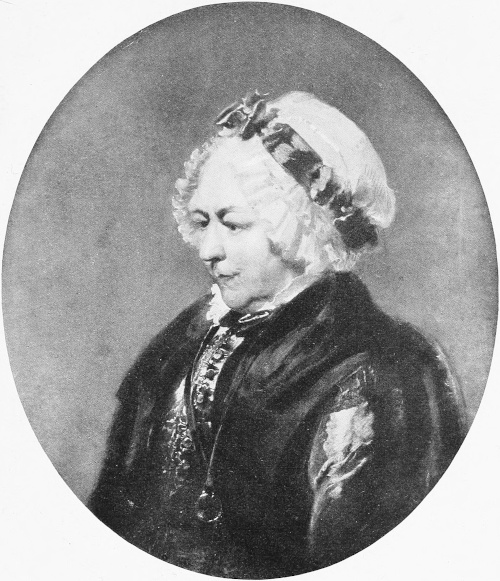
MRS. ELIZABETH CARTER.
On June 7, writing to Mrs. Carter, who was drinking the waters at Bristol, Mrs. Montagu chaffs her as to her surroundings. “Do you like pompons or aigrettes in your hair? if you put on rouge, dance minuets and cottillions? that I may describe and define you in your Bristol State.” Mention is made of Mr. Mason’s “Caractacus.”
“It is a Drama not dramatized; his Melpomene is too chaste, too cold for the theatre. She is a very modest virgin, pure in sentiment and diction and void of passion; her sober ornaments are a Greek veil and some Druidical Hieroglyphicks, all which I mightily respect and do not like at all.... Lord Northampton had a fine suit for the birthday, the wastecoat silver and gold, the coat gold and silver.”
DR. JOHNSON
On June 9 occurs the first letter of Dr. Johnson[246] to Mrs. Montagu.
“Madam,
“I am desired by Mrs. Williams to sign receipts with her name for the subscribers which you have been pleased to procure, and to return her humble thanks for your favour, which was conferred with all the grace that elegance can add to Beneficence.
“I am,
“Your most obedient
and humble servant,
“Sam. Johnson.
“June 9, 1759.”
This letter is printed in Boswell’s “Life of Johnson,”[247] vol. ii. p. 113; but who introduced him first to her I have not yet been able to discover, but I fancy it might be through Mrs. Carter. His mother had died at the age of ninety in January of this year. His “Rasselas,” published in the following April, is said to have been written to pay the expenses of the funeral of his beloved parent. Mrs. Williams was one of Dr. Johnson’s protégées, a woman of talent and literary attainments, who had been a constant companion of his late wife. Her eyes being affected with an incurable cataract, she became blind, and Dr. Johnson was trying to raise money enough to buy an annuity for her. In 1766 she became a permanent inmate of Johnson’s house, and on Mr. Montagu’s death in 1775, Mrs. Montagu settled £10 per annum on her.
Dr. Johnson’s writing is singularly clear, and, once seen, is unmistakable, from his peculiar long s’s.
On June 9 also, Emin wrote on board the Prince Edward, from the Mole of Genoa, where they were in quarantine. The letter begins, “To the most learned and most magnanimous Mrs. Montagu.” He was on his way to see Prince Heraclius with letters of recommendation from his father and all the principal Armenians of Calcutta and India to the Prince and the Archbishop of Armenia. At last his transcendent merit as a leader had been acknowledged by his own countrymen, who now designated him “their chief, their Shepherd and Protector.” Emin’s affectionate heart was rent at the thought of parting with his kind English protectors, and in this letter he says he was almost glad when he found most of them out or away from home when he called to bid adieu. He was to cross Turkey by land to get to Armenia, a most dangerous Journey, and on the way out two ships had chased them for four or five hours off Spain.
LADY ESSEX’S DEATH
Writing from Sandleford on July 25 to Mrs. Carter, Mrs. Montagu narrates the sad death of Lady Essex, carried away at the early age of nineteen by puerperal fever and throat disease. She was the daughter of Lady Frances Williams, who was bowed down with this affliction, added to the terrible lunacy of her husband. Mrs. Carter was at Bristol drinking the waters for her constant violent headaches. At the end of the letter we read—
“I am glad you agree with me in detestation of Voltaire’s Optimism. Are not you provoked that such an animal calls itself a Philosopher? What pretence can he have to philosophy who has not that fear of God which is the beginning of wisdom? This creature is a downright rebel to his God. Some good may arise indeed from the division of Satan’s household; Voltaire directly opposes Lord Bolingbroke and those who affirm whatever is is right, and that there wants not a future state to make the system just.”
“CALVES PLUCK WATER”
Lady Medows writes that her appetite has been mended by drinking “Calves Pluck water!”
HARLEYFORD
On August 3 Mrs. Montagu thanks Lady Barbara Montagu for “the great favour you have done me in behalf of Mr. Burke,” but what that favour was I know not. The letter proceeds thus—
“I conducted Mrs. Pitt to Maidenhead Bridge on Tuesday, and on Wednesday dined at Mrs. Clayton’s[248] at Harleyford.[249] I think it the most agreeable situation I have seen on the Thames, I mean as a place of residence, every object speaks peace and plenty, the silver Thames glides at the foot of their garden, lofty trees crown the summit, they have fine prospects, sweet lawns, fine cornfields and distant villages.... I could not get permission from Mr. Montagu to stay a day or two, but had barely leave for a dining visit; to my great mortification, my Landlord at the Bridge told me that to go by Marlow would carry me 8 or 9 miles out of the Road, so I gave up my scheme, but met Mr. Amyand, who was travelling through Maidenhead town: he jumped out of his post-chaise, got into the coach to tell me all the news of the town, and on my complaining of my disappointment in regard to Mrs. Clayton, he assured me if I would go two miles out of my road I should find myself on the bank of the river opposite Mrs. Clayton’s house, that then I might go on board a flat-bottom’d boat and invade her territories. I followed his directions, but as my coach could not pass the river, I proposed only to drink a dish of Chocolate, walk round her gardens, and proceed to Reading. She kindly desired to carry me thither early in the afternoon, said she would get Mrs. Southwell[250] of the party, that my coach should go on to Reading and I should find my horses refreshed and ready to set forward for Sandleford: no magical wand could have made a metamorphosis more to my advantage than converting the rose Parlour at the Inn in Reading into an elegant salon, and my Landlord and his wife into Mrs. Clayton and Mrs. Southwell; and an empty coach into one filled with good company. A most incomparable dinner appeared, and Mrs. Southwell; we went together to Reading, and by 11 I got back to my darksome pines.”
Soon after her return to Sandleford, Mr. Montagu fell ill of a bad throat, caught, she thought, at a place built by a Mr. Cottington near Newbury, on such a hill that, as she says to Lyttelton,
“it would have made a good situation for a college of Augurs, for here they might conveniently make observations on the flight of Birds; the ascent is so steep a goat can hardly climb to it; he built a Belvidere at the top of the house, where perhaps he hoped to sit as umpire in the battles between the cranes and the pigmies, for as to looking down from it, it is rather horrible.”
Fortunately, Dr. Monsey was at Sandleford, and promptly “blooded” and doctored Mr. Montagu. Mention is made of a “magnificent epistle of Emin to the noble daughters of Brittain,” too long to be inserted here.
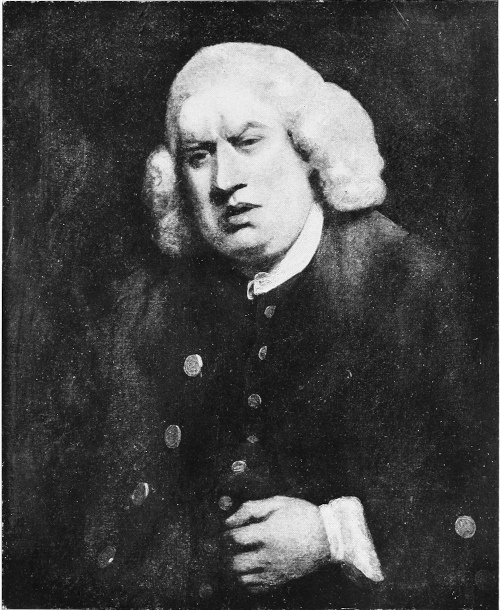
DR. SAMUEL JOHNSON.
INVERARY
Lord Lyttelton and “Tom” were taking a tour to the Highlands, having gone from Hagley to Durham, thence to Lord Ravensworth’s and Morpeth, “on our way to Alnwick.” Lord Lyttelton alludes to the Battle of Minden, fought on August 1, between the English, Hessians, and Hanoverians, against the French. Prince Ferdinand[251] of Brunswick commanded, and under him Lord George Sackville,[252] who commanded the English and Hanoverians, and incurred some obloquy on the score of disobeying orders; but Lyttelton says—
“The necessity the French will be under of restoring their army in Germany by large reinforcements must, I think, putt an end to their intended invasion, and you Ladies of Britain will not be exposed to the outrages and brutalities which the poor Ladies of Hildesheim have suffered from the rage of those polished barbarians.... I had writt thus far at Taymouth, Lord Breadalbane’s fine seat, but was forced by some interruption to delay ending my letter till I came to Inverary, from whence I now write. The House deserves to be call’d, as it was stil’d by Lord Leicester, ‘the Royall Palace of the King of the Goths.’ He reigns here in great state, but Nature reigns in still greater. I have scarce ever seen her more sublimely majestick; nor does she want some sweet graces to soften her dignity and make it more amiable. As the Duke of Argyll[253] is one of your admirers, and, I think, a favoured one too, you ought to make him a visit here when next you return to your northern dominions.”
ALNWICK
Tom Lyttelton, who was travelling with his father in Scotland, writes on September 10 from Edinburgh to Mrs. Montagu. Some portions of his letter I copy—
“The first place I shall mention to you is Alnwick, the seat of the Earl of Northumberland. The Castle is very gracious, and stands on the brow of a hill; it was formerly very strong. His Lordship has shown great judgment in the manner of fitting it up, for instead of using the modern stile of architecture (as Mr. Lumley has done at Lumley Castle), he has left it for the most part as it was in Harry Percy’s time, with this difference, that two or three rooms which were before ill proportioned and quite unfurnished, are now much enlarged and fitted very handsomely in the Gothick stile. He will add many more rooms on the other side of the court, and will make it in time a very good house, still preserving its original character. From thence we went to Berwick to Sir Hugh Dalrymple’s.... The Bass Island is all a vast Rock broken into many rough and irregular pieces; it is inaccessible to very large ships, there is but one place where a boat may safely land; in the middle of the ascent there are still the remains of an old castle, which was a state prison with houses for soldiers built in the rock; they tell you that within these sixty years it was garrisoned, but it is now become the habitation only of an infinite number of sea birds, of which the Solan goose is the most remarkable.... We went to dine with Mr. Charters, and from thence the same night reached Edinburgh, and were lodged in the Royal Palace called Holy Rood House.... My next shall be from Bishops Auckland (a seat of the Bishop of Durham’s)....”
As usual, Lord Lyttelton adds a postscript, and in it says—
“We dined to-day with the Magistrates and corporation of Edinburgh, and supped with the Duke of Argyll, who honoured me with his presence at the dinner, a distinction he never paid to any other than upon this occasion. Tom and I had our freedoms given us, as we have had from many other towns with as great compliments as if I had been a minister of State, or the Head of a faction.”
Young Edward Wortley Montagu writes on September 13 to Mr. Montagu from “Mrs. Lyster’s in Hyde Street, Bloomsbury Market,” to say—
“I am really greatly concern’d that it has hitherto been out of my power to wait upon you, and I am afraid will be so the whole summer, for my book is sold off, and Millar presses me for a second edition, which I am now about, and since I wish it should appear in the world as perfect as possible, I must beg the favour of you to let me know what corrections you think it may want; the world received the first edition with great indulgence, but the second will have a right to approbation when it has received a greater degree of perfection from the corrections of a gentleman of your abilities.”
YORK
In an answer to Lord Lyttelton’s letter from Inverary, too long to be inserted, Mrs. Montagu mentions that she is sending the letter to York—
“I shall be glad to hear that your Lordship and Mr. Lyttelton like York, to which perhaps I am partial as to the place of my nativity. One of the strongest pictures in my mind is the funeral of a Dean of York, which I saw performed with great solemnity in the Cathedral when I was about 4 years old.... I know, my lord, you will rejoice with me for Mr. Boscawen’s[254] victory, both from public spirit and private friendship.”
Emin, after a serious illness, was setting off on his dangerous journey through Turkey, and on September 20 wrote “To the Montagu the Great,” ending up with, “My dearest, brightest and the wisest Queen of the East, your very affectionate and faithful, obedient, humble servant and soldier, Emin of Hasnasari in Persia.”
Lord Lyttelton and his son travelled from Edinburgh to Lord Hopetoun’s place, Hopetoun House. In a letter to Mrs. Montagu of September 21, Tom says, “There is one chimney piece done by Risback that cost £600, my father thinks it the finest he ever saw.” Thence they proceeded to Stirling, and paid visits to Lord Cathcart and Lord Kinnoull; thence to Glamis Castle, which he describes “as a very old castle, but has not a tolerable apartment, and can never be altered much for the better.” He does not mention the ghost; probably he was not told about it. From thence to the Duke of Athole’s at Dunkeld, where he is enraptured with the country, and mentions the window at the Hermitage,[255] “through which the falls of the Braan appear as a surprise to the visitor.” The Lytteltons accompanied the duke to his other seat, Blair Athole, after which they proceeded to Taymouth, Lord Breadalbane’s splendid place, which enchanted Tom.
SCOTCH CHARACTERISTICS
He now gives Mrs. Montagu a sort of character sketch of the Scottish nobility—
“The characteristical virtues of the Scotch are courage, temperance, prudence, economy and hospitality. This last is not only peculiar to the nobility, but is universally practised by all kinds of people. Good breeding, though it cannot be properly styled a virtue, is of the highest consequence to Society. This the Scotch universally possess, and there is not in the North such a character as that of an English country Squire, whose whole life is spent in the laudable customs of hunting, drinking, swearing and sleeping.... Scotch ladies are very handsome and very sweet-tempered. It is their general character to be rather too free of their favours before marriage; however that may be, they are very chaste after that ceremony. They breed up their children in a particular manner, for they are accustomed from their infancy to go without shoes and stockings, nor in the coldest weather do their parents permit them to wear a great-coat; if they are of a puny constitution they die, if not, they are the better for it all their life.”
He also remarks that “few of the nobility omit going to Church on a Sunday, and what is of more importance, when they are there they do not trifle, but seem seriously to reflect upon the duty they owe their Maker.” This description from a boy of fifteen is remarkable, and throws light upon English manners of that period. After several other visits, Tom returned to his studies at Eton.
MR. EDMUND BURKE
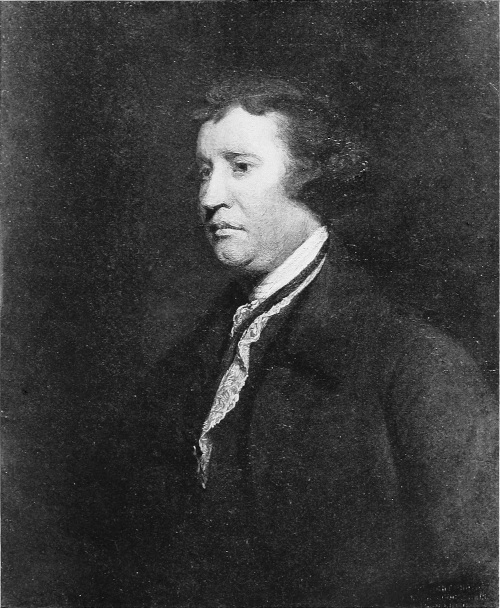
EDMUND BURKE.
CONSULSHIP AT MADRID
Next to this comes a letter from Mr. Burke, which, being the first, is given in extenso. His handwriting is beautiful and very even, but of a feminine cast.
“Madam,
“I have now the honour of writing to you for the first time, and the subject of my letter is an affair that concerns myself. I should stand in need of many more apologies than I know how to make both for the liberty I take and for the occasion of it, if I had not learned by experience that I give you a pleasure when I put it in your power to exert your good-nature. I know it is your foible to carry this principle to an extream, and one is almost sure of success in any application, or at least for pardon for having made an improper one, when we know judiciously to take advantage of a person’s weak point. I do not know anything else which could give me confidence enough to take the Liberty I am now going to use. The Consulship of Madrid has been vacant for several months; I am informed that it is in the gift of Mr. Secretary Pitt, and that it is valuable. I presume, however, that it is not an object for a person who has any considerable pretensions, by its having continued so long vacant, else I should never have thought of it. My interest is weak, I have not at all the honour of being known to Mr. Pitt; nor much to any of his close connections. For which reason I venture to ask your advice whether I can with propriety proceed at all in this affair, and if you think I ought to undertake it, in what manner it would be proper for me to proceed. If my little suit either in itself or in the persons through whose hands it must necessarily pass, should be attended with any circumstances that may make it disagreeable to you to interfere in it, I shall take it as a favour equal to that I have asked, if you will be so good to tell me you can do nothing in it. I shall think such a declaration a great mark of your confidence. I am sensible that there are in all people’s connections many points that may make a person of delicacy unwilling to ask a favour in some quarters, and yet more unwilling from the same delicacy to tell the person for whom it is to be asked that they have such difficulties. There are undoubtedly many circumstances of propriety in every person’s situation, which none can feel properly but themselves. I am not, however, if I know myself, one of those expectants who think everything ought to be sacrificed to their Interest. It occurred to me that a letter from you to Miss Pitt might be of great service to me. I thought too of mentioning Mrs. Boscawen. The Admiral has such great merit with the Ministry and the Nation, that the want of it will be the more readily overlooked in any person for whom he may be induced to apply. But these are crude notions and require the understanding they are submitted to, to bring them to form and dwelt so long upon so indifferent a subject. Your Patience is almost equal to the rest of your virtues if you can bear it. I dwell with far more pleasure on my acknowledgments for what you have done for my friend[256] in so obliging and genteel a manner. He has but just now succeeded after a world of delays, and no small opposition. He will always retain a very grateful sense of what you have done in his favour. Mrs. Burke[257] desires me to present her respects to you, and her best wishes for your health. When last I had the pleasure of seeing Dr. Monsey, he told me that the country still agreed with you, else I should most wickedly wish this fine weather over that you might be the sooner driven to town. This fine weather suffers nothing good to be in Town but itself. We are much obliged to the Doctor for the satisfaction he gave you in uniting his care with yours for Mr. Montagu’s recovery. I congratulate you very sincerely on that event. If I could find some agreeable circumstance in your affairs for congratulation as often as I wish I should be the most troublesome correspondent in England, for nobody can be with greater respect and gratitude,
“Madam,
“Your most obliged and
obedient humble servant,
“Edmund Burke.
“Wimple Street, Cav. Sq., Sepʳ 24, 1759.”
GENERAL TOWNSHEND — GENERAL WOLFE
In a letter to Lord Lyttelton of October 23, Mrs. Montagu mentions visiting Lady Townshend to congratulate her on the taking of Quebec, which had happened on September 13, and in which her son, General Townshend, had taken a prominent part. In this she says—
“The encomiums on Mr. Wolfe run very high, a great action is performed and every one can endure to give praise to a dead man; and there was certainly something very captivating in his character; he took the public opinion by a coup de main, to which it surrenders more willingly than to a regular siege. The people had not time to be tired of hearing him called the brave; he is the subject of all people’s praise, and I question whether all the Duke of Marlborough’s conquests gained him greater honour.”
In answer to this Lord Lyttelton says—
“I wish that a French invasion from Havre de Grace, which I have particular reasons to be more afraid of than ever, may not correct the extravagance of our joy for our unexpected success at Quebec, and the false security it has produced in the minds of our ministers.... Mr. Bonus, the picture cleaner, has come down and has restored my old family pictures to such a state of perfection that I can hardly believe my eyes when I see them. Few gentlemen, I assure you, have a finer collection than mine appears to be now. If Lady Coventry ever comes here, she will cry at the sight of some of the beauties of Charles the Second’s court, which by Mr. Bonus’ help exceed hers as much as she does my milkmaids. There is particularly a Duchess of Richmond whom you have read of under the name of Mademoiselle Stuart in the ‘Memoirs of the Count de Grammont,’ whose charms are so divine that my nephew Pitt is absolutely falling in love with her and does nothing but gaze upon her from morning till night. What would you living beauties give if twenty years hence, when you begin to suffer by time, there could be found a Mr. Bonus to restore you again, as he has done this fair lady and others at Hagley? Pray come and see the miracles of his art....
“Pitt sends his best compliments, and we both agree you have indeed a great deal of a witch about you, but nothing of a Hag.”
Mrs. Montagu evidently refused to exert her influence in favour of Mr. Burke’s desire to obtain the Madrid Consulship, as on October 6 he writes—
“Madam,
“For many publick as well as private reasons I am sorry that you have not an influence on Ministers of State; but the qualities which some persons possess are by no means those which lead to Ministerial influence. The reasons you have been pleased to give me for not making the application are very convincing and obliging. Before I applied I was well aware of the difficulties that stood in my way.”
Further down in the letter (which is not sufficiently interesting to be given in extenso) he says—
“It is not very easy to have access to Mr. Pitt, especially for me, who have so very few friends. I mentioned those methods, not that I was satisfied of their propriety, but because I would try every method which occurred to me.”
MRS. OGLE
On December 17 Dr. Johnson writes—
“Madam,
“Goodness so conspicuous as yours will be often solicited and perhaps sometimes solicited by those who have little pretension to your favour. It is now my turn to introduce a petitioner, but such as I have reason to believe you will think worthy of your notice. Mrs. Ogle who kept the music room in Soho Square, a woman who struggles with great industry for the support of eight children, hopes by a Benefit Concert to set herself free from a few debts, which she cannot otherwise discharge. She has, I know not why, so high an opinion of me as to believe that you will pay less regard to her application than to mine. You know, Madam, I am sure you know, how hard it is to deny, and therefore would not wonder at my compliance, though I were to suppress a motive which you know not, the vanity of being supposed to be of any importance to Mrs. Montagu. But though I may be willing to see the world deceived for my advantage, I am not deceived myself, for I know that Mrs. Ogle will owe whatever favours she shall receive from the patronage which we humbly entreat on this occasion, much more to your compassion for honesty in distress than to the request of, Madam,
“Your most obedient
and most humble servant,
“Sam. Johnson.
“Gray’s Inn, Dec. 17, 1759.”
This letter is printed in Croker’s edition of Boswell’s “Life of Johnson,” vol. ii. p. 115, published in 1880 by George Bell and Sons. He probably received the copy, as he did a former letter, from my grandfather, the 4th Baron Rokeby, as he would have been too young to obtain it from Mrs. Montagu, who died in 1800, and John Wilson Croker was not born till 1780.
“TRISTRAM SHANDY” — THE REV. LAURENCE STERNE
Though undated, the following letter of Laurence Sterne may be placed here. Early in 1759 he had been writing the first two volumes of “Tristram Shandy,” towards the end of the year he was in London arranging for their publication with Dodsley the publisher, who declined the venture. They were printed for and sold by John Hinxham, bookseller in Stonegate, according to Mr. Traill’s volume on Sterne in the “Englishmen of Letters” series. The allusions to the Dean of York, etc., referred to a dispute between a Dr. Topham and Dr. Fountayne (Dean of York), in which Sterne sided with the Dean when he wrote his “History of a Good Warm Watchcoat,” “a sarcastic apologue,” as Mr. Traill terms it. I have not time or knowledge enough to enter into the details of this affair, but hope the letter may throw light upon it to students of Sterne’s character.