Volume 2 — CHAPTER I. (continued 2)
Reading edition
Writing to West from Sandleford of her neighbours at Hayes, she regrets the society of Mrs. Herring and the Archbishop,[67] and desires her regards to them. He answers—
“I made your compliments to the Archbishop and Mrs. Herring, who dined with us the very day I received your letter. He is very well and as amiable and polite as ever. Dick[68] has been very dilligent and very successful in partridge shooting, and t’other day sent the prime fruits of his labours, a landrail, as a present to his Grace of Canterbury.”
BRIGHTHELMSTONE
At the beginning of September, through the influence of West, the Bishop of London gave the living of Ealing to Mr. Botham. Botham was at Brighthelmstone with his two boys for sea-bathing, as they were not in health. The joy of Mrs. Montagu was great at this preferment, as the bishop permitted Mr. Botham to continue to hold Albury as well, placing a curate in the living he did not occupy.
“PRECIEUSES RIDICULES”
Writing again to West, Mrs. Montagu says—
“Dr. Mangey kept a curate at Ealing as he did not reside there, but undoubtedly Mr. Botham will discharge the duties of the living he resides at without assistance; the Bishop of London required Mr. Botham’s residence: as the girls and boys are growing up and must soon live with him, they will be better placed at Ealing in a good neighbourhood than at Albury. They will learn nothing there but eating and drinking plentifully of Lord Aylesford, and Mr. Godschall’s house is generally full of poetic Misses, who are addressing each other by the names of Parthenia, Araminta, etc., with now and then a little epistle to Strephon or Damon. I was uneasy whenever they were at home, for fear they should enter into the precieuse character of Mrs. Godschall.”
This style of conversation is taken off in Molière’s “Precieuses Ridicules.”
West’s mother, Lady Langham was now paying her son a visit. Mrs. Montagu writes—
“I think the vast territories of imagination could not afford any view so pleasing as the meeting of such a son and such a mother; the pictures not only pleased my mind, but warm’d my heart ... that you may at Lady Langham’s age be as well able to take a journey, and your son as well deserve, and as joyfully receive such a visit is my sincerest and most earnest wish ... another pleasure attends you all, and which your benevolence and not your pride will feel, that of setting an example of those various charities, of parent, child, husband and wife, which make the happiness of domestic life; and there is surely more honour in filling well the circle mark’d of Heaven in these spheres of relation, than in running the wild career of Ambition in its most shining track. Indeed there is no part of a conduct that so certainly deserves our approbation as an acquittance of family regards. Actions of a public nature often are inspired by vanity, domestic behaviour has not popular applause for its object, tho’ with the sober judgment, as Mr. Pope says of silence, ‘its very want of voice makes it a kind of fame.’”
She then proceeds to thank West eloquently for Botham’s presentation to Kingston (this must be a mistake for Ealing), and ends with desiring some paper hangings “she and Mrs. Isted had laboriously adorned” to be taken down with care at her house at Hayes, but leaves the rest of the hangings to the landlord. “I presume some retail grocer, haberdasher of small wares, or perhaps a tallow chandler, will shortly be in possession of my Castle at Hayes.”
MR. HATELEY
At Sandleford were staying young Mr. Hateley, an artist, and Miss Anstey. The latter being in treaty for a house in London, accepted Mr. Montagu’s escort thither, and Mr. Hateley wishing to accompany them a portion of the way, mounted a horse, which flung him at the first start off and grievously cut and bruised him. The doctor was summoned after the departure of Mr. Montagu and Miss Anstey, who “blooded him, and he was ordered to take no food but balm tea lest he should have a fever.... The Harvest Home Supper last night was very jolly, the guests had as good appetite as those who meet to eat Turtle,” writes Mrs. Montagu to her husband on September 23.
Miss Anstey, having lost her parents, and Trumpington having become her brother’s property, had determined to live in London. She took Mr. Montagu to help her in choosing a residence in Queen Street, a new-built house for £800. Miss Anstey executed several commissions for Mrs. Montagu, amongst which she mentions, “I have sent several prints of Nun’s habits, some one of which I hope may become the beautiful Eloise, and I shall very much rejoice to hear she has taken the Veil.”
Mention is made in a previous letter of Mrs. Montagu’s of Hateley painting a picture of Eloise, but who sat for it I cannot say. Hateley recovered from his accident. A new post-chaise had been ordered for the Montagus, and Mr. Montagu found it “nothing showy or brilliant,” but his wife assures him, “I shall find no fault with the plainness of the post-chaise, neatness being all that is aimed at.”
LILLINGSTON DAYRELL
West, writing on October 8 from Wickham, says—
“I have the honour to agree with my dearest and most excellent cousin in looking upon writing letters as one of the evils of Human Life, and for that reason I have always declined engaging in a correspondence of that kind with anybody but her, tho’ I was once invited to it by the great Mr. Pope.... I am now turning my thoughts towards Chelsea, where I hope to be settled for the whole winter by the beginning of next month. My Mother and Mrs. Ives[69] go from hence to my brother’s[70] house in the country, where they will remain a week or ten days, and from there return to Lillingston.[71] Mr. and Mrs. Dayrell were prevented by the death of two of his Aunts from making us a visit at Wickham, by which accident and the absence of my sister Molly, my Mother lost the opportunity of exhibiting the pleasing picture of a Hen gathering with a careful and maternal tenderness all her chickens at once under her wings, but she will have them by turns.”
From this it would appear that Mrs. Dayrell was a daughter of Lady Langham’s. The Dayrells have owned Lillingston Dayrell for some eight hundred years!
Mrs. Medows writes from Chute on October 16 to Mrs. Montagu—
“I am impatient to wait on you; all the horses and all the Maids have been taken up with Wey Hill Fair,[72] now I hope to hire a couple of cart-horses: I dare not venture with a common postboy and horses, because the postboys are not used to a four-wheeled chaise, nor the Road I must go.... I wish you joy of a pleasure for life at least, the good you have done to Mr. Botham and his family.... I am pleased you have hired the wood, now one may walk in the bowling green without coveting what is your neighbour’s. I hope hiring is a step to purchasing; laying field to field is a natural thought and not a blameable one, when no injustice is meant. I have often thought what a pretty place Sandleford would be if it was bounded by the little river, Newbury Wash, and Greenham Heath.”
This wood was on the east side of Sandleford, and was eventually purchased, and Sandleford at this moment is bounded exactly as Mrs. Medows wished.
“A Buck, we are told, is come to Grateley, his name is Mitchell, he has laid out a £1000 in furnishing it completely, altho’ he could not be sure of having it more than a year. He intends to keep Stags in the paddocks, and turn them out on the Downs, which will give him fine chases. He says the Drawing room is a good drinking room.”
BATH EASTON
Sarah Scott and Lady Bab Montagu had taken a house at Bath Easton for use in the summer, and desiring plants for the garden there, Mrs. Montagu sends on November 6 to them a vast number of pinks, roses and honeysuckles, together with a home-cured ham. In the accompanying letter she mentions Ealing being
“two hundred pounds a year, his house a very pretty one, a good garden with a great deal of wall fruit, and there is a neighbourhood of genteel people, who have all shown him great civility.... Mr. Hateley is still with us, he has made a very pretty Landskip (sic) with Eloisa, and her figure is pretty, her face amiably triste. He has done my portrait so like, and got a good likeness, and with a spirit in the countenance and attitude that is very uncommon.”
“HISTORY OF BATH”
To this Sarah writes on November 17, to thank her for the plants and to say she and Lady Barbara had returned to Bath for the winter, Bath Easton being too near the water for them. She says—
“Have I sent you word of a subscription making for Nash? I believe it began since I wrote last. It is entitled a subscription for a ‘History of Bath and Tunbridge for these last 40 years,’ by Richard Nashe, Esqre., with an Apology for the Author’s life. The whole money, two guineas, is to be paid down at once, for he does not pretend any book is to come out. Some have subscribed 10 guineas, many five, and a great many hundred pounds are already subscribed. It is to be kept open for life, and people give to him who will not part with a guinea to relieve the greatest real and unmerited distress imaginable. The pretence is that he has but little more than £200 a year, which is not supposed true, but if it was, surely it is full equal to his merits, whether one considers them as moral or entertaining. To such ladies as have secret histories belonging to them, he hints that he knows every one’s private life and shall publish it. This place grows so full of subscriptions that no person of moderate fortune will long be able to come to it. The people of the rooms are endeavouring to obtain a subscription of half a guinea each man, and a crown each woman for the season. As yet it has not been complied with, but they require it with such insolence, that I make no doubt it will be complied with. I shall be glad to hear you are safely settled in Hill Street. I assure you the picture[73] you were so good as to give me is a great ornament to a pretty room, and people are so civil to me as to see the likeness, which I take well of them; as it is placed near the fire it may grow warmer, which is all that can improve it.”
“Beau” Nash had reigned a despotic Master of the Ceremonies over Bath for fifty years, living in a most expensive style, mainly supported by his success at the gaming tables. The Act of Parliament against gambling put an end to his chief means of obtaining money. The Corporation, however, settled a pension of 120 guineas on him for his services. He was eighty-one years old at this period, having been born in 1673. His rules for general behaviour and manners are most amusing, but are too long to insert.
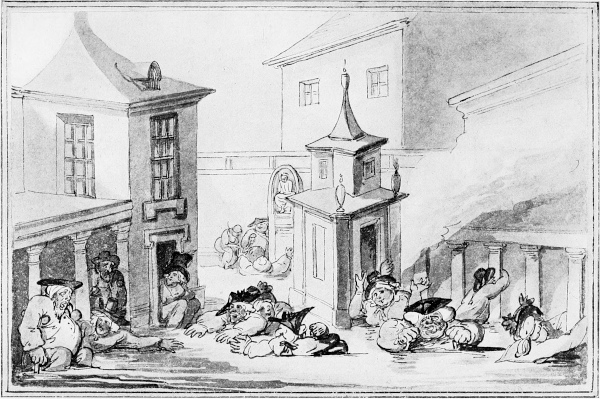
T. Rowlandson, pxt.]
THE KING’S BATH, AT BATH.
MR. PITT’S ENGAGEMENT
At this time Mr. Pitt became engaged to Lady Hester Grenville, daughter of Mr. Richard Grenville and his wife, Lady Temple, and sister of Viscount Cobham. She was a cousin of West’s and Sir George Lyttelton’s.
On November 5 Mrs. Montagu writes to West—
“My dear Cousin,
“Since the days that Cupid set Hercules to the distaff, he has not had a nobler conquest than over the elevated soul of Mr. Pitt. I congratulate you on the affinity, and I hope he will be happy: his long acquaintance with the lady makes the hazard much less than where people marry without knowing the disposition of the person they choose. I believe Lady Hester Grenville is very good-humoured, which is the principal article in the happiness of the Marriage State. Beauty soon grows familiar to the lover, wit may be pernicious, and many brilliant qualities troublesome; but a companion of gentle disposition softens cares and lightens sorrows. The sober matches made on reflection, are often happier than those made by sudden and violent passion, and I hope this will prove of this kind; and there is an authority in the character of Mr. Pitt, that will secure him the deference and obedience of his wife; proud of him abroad, she will be humble to him at home; and having said so much, I consign them over to Hymen, who, I hope, will join their hands in the most auspicious hour. I was prevented writing to you by Sunday’s post, Dr. Pococke having stayed with us on Saturday night, and the first Sunday of the month I always go to Newbury Church;[74] the length of the service made me too late to write. I am glad Mr. Cambridge has been with you at Wickham.... We were in Wiltshire last week to visit Mrs. Medows.”
She ends with expressing a wish to exchange the country for London, but is determined not to say a word to Mr. Montagu, whose health had been recently restored by country air.
REV. W. WARBURTON — THOMAS HEARNE
In her next letter to West, of November 14, she says—
“As the Virtues and Graces as well as Cupid and Hymen will assist at Mr. Pitt’s nuptials, I think he could not choose a better place for their celebration than Wickham, their capital seat. I wish them many happy years together, and God bless them with health and every good.... I hope while you are at Croydon the good Archbishop will animate you to defy that foul fiend my Lord Bolingbroke; I believe I shall take some of Ward’s sneezing powder to clear my head of the impieties and impurities of his book. I am not satisfied with Mr. Warburton’s[75] answer, the levity shocks me, the indecency displeases me, the grossièreté disgusts me. I love to see the doctrine of Christianity defended by the spirit of Christianity. When absurdity is mix’d with impiety, it ceases to be a jest. I can laugh at his Lordship’s cavils at Mr. Locke, his envy to Plato and all the old Philosophers, but I could with great seriousness apply to him the words of his friend and Poet to the Dunces—
“‘’Tis yours a Bacon and a Locke to blame, A Newton’s genius or a Milton’s flame. But oh! with one, immortal one dispense The source of Newton’s light or Bacon’s sense.’
But I must do his Lordship the justice to say that what he wants in faith he makes up in confidence, for after having assured you it is absurd to affirm God is just or good, he declared he is willing to trust the being whose attributes he cannot know, to dispose of him in another world, not at all doubting that the Supreme Being will be good to him, without goodness, and just to him without justice! He laughs at the faith of Abraham, and I should do so too, if Abraham had disputed God’s veracity, and then trusted to His promises. I never read such a mass of inconsistencies and contradictions, such a vain ostentation of learning, and if I durst, I would say it, all that can show ‘the trifling head, or the corrupted heart.’ I think I may venture to say trifling, for whatever does not relate to the argument is so, and to teize the gentle reader with all the miserable sophisms that perplex’d the world 2000 years ago, is barbarous. I wanted to apply to him the Epigram on Hearne[76] the antiquarian—
“‘Fye on thee! quoth Time to Thomas Hearne, Whatever I forget, you learn....’
I thank his Lordship, though, for making me once more look into Mr. Locke and Doctor Clarke,[77] in the veneration of whom I believe I shall live and dye.”
MR. PITT’S MARRIAGE — THE HONEYMOON
The return letter from West is so interesting that I give it in extenso—
“Croydon, November 18, 1754.
“My dear Cousin,
“Your admirable letter found me at the Archiepiscopal Palace at Croydon, where Mrs. West, Dick and I had been ever since Wednesday; and it was lucky that it found me there, as I had by that means an opportunity of showing the Archbishop, whom you very properly style good, your most ingenious and judicious Reflections of Lord Bolingbroke’s pompous Rhetorical and inconsistent Declamations with which his Grace (who, by the bye agrees entirely with you in the censure you there pass’d upon Mr. W(arburton)’s way of answering him,) was so pleas’d that he desired me to give him a copy of the whole paragraph, promising that if he show’d it to anybody he would, however, cautiously conceal the name of the author. After this I need not tell you how much we both said in praise of you; I shall only add that I, this morning, received his commands to present his respects to you, and to tell you in his name that if you allow’d yourself the liberty of saying fine things of him, he would be even with you. These are his own words, grounded on a piece of information I had given him of the great honour and esteem you had for him. We quitted Wickham, as I told you, on Wednesday last, that we might throw no obstacle in the way of that amorous impatience which Mr. Pitt had in all his notes express’d of bringing Lady Hester to our sweet and hospitable Habitation, as he call’d it; but to our great surprise, and to the no small mortification of Mrs. West in particular, who was afraid that all the good things, with which she had fill’d her larder, would be spoil’d by their delay—the happy Bridegroom and his Bride did not arrive till Saturday, on which morning they were married[78] by Dr. Ayscough[79] with the Archbishop’s License. They came down alone, and have continued alone ever since, and, I imagine, will continue during their stay at Wickham, in that Paradisaical Solitude, tho’ by the quantity of provisions which Mr. Campion[80] brought with him, and more which he has since sent for from Croydon, we conclude he expected some visitants from Town, as Lord Temple, etc.,[81] but having heard of no such visitants being expected, I suppose that all this profusion was owing to Mr. Campion’s solicitude to testify in his own way his respects to his new Lady, and make his compliments on this joyous occasion, in the polite, that is, in the French Phraseology: this is all the intelligence I can at present give you of this important affair, for we have had no communication by messages, either to or from Mr. Pitt, whom we were unwilling to disturb, or interrupt the free course of those pleasures, which for a time at least, possess the whole mind, and are most relished when most private; for this reason I cannot yet acquaint you when we shall leave Wickham, but I believe it will be about the middle of this week, and I suppose we shall not be able to go to Chelsea before the latter end of the next, or the beginning of the week after, and by that time I am still in hopes you will come to Hill Street, and by giving me the pleasure of seeing you there in good health, compleat the happy change which you observe is already begun in the once gloomy month of November. I do often, my dear Cousin, look back with pleasure and thankfulness on many incidents of my past Life, and compare them with my present situation, so much changed for the better in a thousand instances, such as Health, fortune and Friendship, among which there is none that has given me more happiness than yours, and which therefore I hope will continue, till it is lost where only it can be lost, in the brighter and warmer radiance of an unchangeable and everlasting Society, where I hope to have it continued to me through all eternity. I am going to take the air with the good and amiable Archbishop, and therefore must conclude.
“Adieu, my dear, dear Cousin, and assure yourself that all that period I shall continue
“Ever most affectionately Yours, etc.,
“Gil. West.
“Mrs. West and Mrs. Herring desire their compliments to Mrs. Montagu and Miss Anstey.”
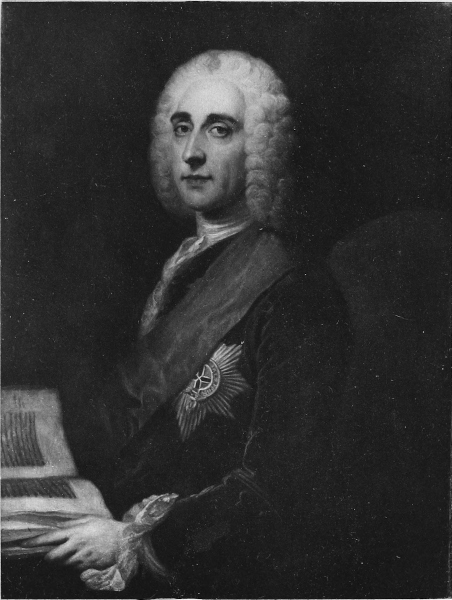
W. Hoare R A Pinx. Emery Walker Ph. Sc.
Philip, 4th Earl of Chesterfield.
“GOSSIP” JOAN
I give a portion of the reply to the foregoing letter—
“Hill Street, November 23, 1754.
“My dearest Cousin,
“From country Joan I am, according to my ambitious views, turned into ‘Gossip’ Joan, and by no supernatural metamorphosing power, but merely by the help of so ordinary a vehicle as a post-chaise, which wrought this happy change between the hours of 7 in the morning and 5 in the afternoon; the subject, no doubt was well prepared that would so easily receive the alteration. In my town character I made 15 visits last night: I should not so suddenly have assumed my great Hoop if I had not desired to pay the earliest respect to Lady Hester Pitt. I came to town on Wednesday night, and was too weary to write to you. I proposed doing it on Thursday evening, but my brother Robinson hinder’d me by making a long visit. Yesterday morning was divided amongst Milliners, Mantua makers, Mercers and such as deal in the small wares of vanity.”
MR. HOOKE
The year ends with a letter from Mr. Nathaniel Hooke—
“Cookham, December 22, 1754.
“Madam,
“If it were not for a certain text of Scripture, I should be very impatient for the time to come when I must be in London for some days. The idea of Hill Street and what is to be seen and heard there, is very lively and pressing. But alas! What says St. John the Divine? Little children keep yourselves from Idols. If you can satisfy my conscience in this point I shall be much obliged to you, and I beg you will study it thoroughly, and let me have your Resolution by a line, directed to be left at Mr. Watson’s in Cavendish Street. ’Tis uncertain just now when I shall move, but I think it will be some time this week. Till then I am not your religious worshipper, but Madam,
“Your most obliged and most obedient
and most humble Servant,
“N. Hooke.
“Give me leave to add best compliments to Mr. Montagu.”