Volume 2 — CHAPTER II.
Reading edition
1755–1757 — IN LONDON, AT SANDLEFORD, AT TUNBRIDGE WELLS, AND WITH THE BOSCAWENS AT HATCHLANDS — LETTERS ON EVENTS OF THE WAR.
1755
LORD MONTFORT’S SUICIDE
In January, 1755, but with no date of day, is a letter of Mrs. Montagu’s to Sarah Scott on Lord Montfort[82] committing suicide after gambling heavily.
“I imagine that you will be glad to hear the history of the times, which indeed bring forth daily wonders; nor is it the least that the most profound arithmetician and the greatest calculator, one who carried Demoivre’s[83] ‘Probabilités de la Vie Humaine’ in his pocket, never foresaw that spending ten times his income would ruin his fortune, and that he found no way to make the book of debtor and creditor even, but paying that debt which dissolves all other obligations. You will guess I mean Lord Montfort and his pistol. He had not discovered any marks of insanity, on the contrary, all was deliberate, calm and cool; having said so much of his indiscretion, I think, with the rest of the world, I may acquit him of the imputation of cunning and sharping, but what can one say in defence of a conduct that had all the appearance of deep knavery and the consequences of inconsiderate rashness and folly.... Many reasons have been given for his Lordship’s violent act, but by what I learn from those best acquainted with his person and fortune, he was not under the pressure of any very heavy debt, but had a true Epicurean character, loved a degree of voluptuousness that his fortune could not afford, and a splendour of life it could not supply, much of his relish for the world was lost, and like one that has no appetite to ordinary fare, chose to rise from table unless fortune would make him a feast.... When Lord Montfort’s children were paid their demands on his estate, I hear he had only £1200 a year clear, and in table, equipage and retinue he equalled, and in the first article perhaps excell’d, the largest fortunes. To retrench or die was the question, he reasoned like Hamlet, but left out the great argument of a future state.”
In the same letter is—
“I have lately been engaged in a melancholy employment, condolence with poor Mr. and Mrs. West on the loss of their son, who died of a bilious fever, occasioned by his want of attendance to the jaundice, which attacked him in the season of plays and Operas, and he preferred them to the care of his health; he died very suddenly, the poor parents bear the blow with surprising patience. Mr. Lyttelton[84] is going to S. Carolina as Governor, and his sister dreading such a separation desires to accompany him.
“Pray have you read Mr. Hume’s History of James I. and Charles I.? I am afraid it will rather promote Jacobitism, but it is entertaining and lively and will amuse you.... I suppose you know there are two volumes of Madame de Sevigné’s letters come out this winter; they are amusing as the anecdotes of a person one has a great regard for, but they were rejected in former editions as not being so brilliant as those published before. My brother Robinson is emulating the great Diogenes and other budge Drs. of the Stoic fur; he flies the delights of London and leads a life of such privacy and seriousness as looks to the beholder like wisdom, but for my part, I think no life of inaction deserves that name.”
This is the first mention of Matthew’s increasing love of retirement and the hermit-like habits which he adopted at Horton.
MRS. POCOCKE
In March occurs a long letter from Mrs. Pococke, of Newtown, the very learned lady mentioned before. She dispensed money for charitable purposes given by Mrs. Montagu. She mentions that her son, Dr. Pococke, is coming for a few days to see her before going abroad, “probably for the last time, unless I live to the age of the late Bishop of Man.” She mentions having walked eight miles that day as an excuse for bad writing, which was superfluous, as her handwriting is amazingly good and clear, and she was between eighty and ninety! Mens sana in corpore sano!
LORD BALTIMORE’S HOUSE
On June 9, presumably in this year, Mrs. Montagu writes—
“I suppose you know that Lady Sandwich has at last left her kind Lord. To complete the measure of his good usage, he keeps her daughter to educate with the Miss Courtenays. I hope her Ladyship will be happier than she has been for many years, she has nothing to harass her but the apprehensions for Lady Mary, but God knows that is a dreadful object. She has taken a house at Windsor for the summer.” This daughter died June 25, 1761.
And in the same month to Sarah Scott, she says—
Mrs. Boscawen and Miss Pitt came from Hatchlands to London to spend two days with me; we went to Vauxhall each night, and Mrs. Anstey and I went with them as far as Epsom: we saw Lord Baltimore’s house, [sic] which speaks bad french, so I will not rehearse what I saw there. Why should I teize your imagination with strawberry colour’d wainscotts, doors of looking-glass, fine landskips on gilt leather, and painted pastorals with huge headed Chloes and gouty legg’d Strephons, with french mottoes to explain those tender glances. We were glad to quit this palace of bad taste for a little arbor in the garden of the inn at Epsom. The Sunday following Mr. Montagu and I went to dine with Mr. Bower at Sidcop, his little habitation has the proper perfections of a cottage, neatness, chearfulness, and an air of tranquillity, a pretty grove with woodbines twining round every Elm, a neat kitchen garden, with an Arbor from whence you look on a fine prospect. Here he may write of heresies and schisms, of spiritual pride and papal usurpations, while peaceful retirement and the amenity of the scene about him, rob controversy of its acrimony, and allay the bitterness of censure by a mixture of gentle pity.”
SANDLEFORD
Writing to Mrs. Boscawen from Sandleford, June 19, Mrs. Montagu begins—
“‘When the Mower whets his scythe, And the Milk-maid singeth blythe, And every Shepherd in the dale Under the Hawthorn tells his tale,’
there am I, and no longer in the sinfull and smoaking City of London; this happy change was brought about on Tuesday, by very easy and speedy measures. We got into our post-chaise between 10 and 11, arrived at Maidenhead Bridge about one; were refreshed by a good dinner, and amused by good company. Mr. Hooke[85] meeting us at our inn, we staid with him till after 5, and about ten arrived at Sandleford.... I have not for these ten years been so early in the Season at Sandleford, and it appears therefore with greater charms. It cannot afford to lose any of its natural beauties, as it owns none to Art, it is merely a pretty shepherdess, who has no graces but those of youth and simplicity; but my dear Mrs. Boscawen may turn it into a paradise when she pleases. When may I hope to see her here.... I spent two days at Wickham last week; our good friends had left the Archbishop of Canterbury only a few days before I went to them. Mr. West seemed a good deal affected by this return to Wickham, as to Mrs. West I cannot so well judge, the cheerfulness she puts on is outré.... Mr. West told me he would alter the room where poor Dick dyed, for he did not like to go into it, and then a soft tender shower fell down his cheeks, he added he had lost much of his relish for Wickham; however on the whole I found them better than I could have expected!”
Directly after this, West was ordered to Tunbridge Wells, where he was accompanied by Lady Cobham, Miss Speed, and his wife. He writes to Mrs. Montagu that he hopes she will like a long stay in the country, as its tranquillity will not
“produce the same effect which an Admiral of my acquaintance found from the tranquillity of his friend’s house in the country, to which coming directly from his ship, where he had been so long accustomed to noise and bustle as to be grown fond of it, said, after having passed a restless night, ‘Pox on this house, ’tis so quiet there is no sleeping in it.’”
To this letter she answers—
“Mr. Montagu has been studiously disposed ever since we came to Sandleford, so that I pass seven or eight hours every day entirely alone. Five months are to pass before I return to the Land of the Living, but I can amuse myself in the regions of the dead: if it rains so that I cannot walk in the garden, Virgil will carry me into the Elysian fields, or Milton into Paradise.”
MR. TORRIANO’S MARRIAGE
Mention is also made of Sam Torriano’s engagement to Miss Scudamore, “who is said to have been handsome, and it was on both sides a marriage of inclination. He has delicacy enough to make him very happy or very miserable, and restlessness enough to be very uneasy in a state too insipid to allow of neither.”
Mrs. Montagu might well make this remark on Torriano’s marriage, as her friend Sir George Lyttelton’s[86] second matrimonial contract had by mutual consent ended in a separation. In a former letter it will be remembered that the haughty tone and unpleasant manners of the lady were commented on. It was a case of incompatibility of temper and thought, and a constant imagination of bad health on her part. Lady Lyttelton was a great friend of the Wests, and from a letter of Lyttelton’s to West of this year it is evident that a little coldness, which did not endure long, had sprung up between West and his friend.
MR. WEST ILL
On July 8 and July 14 Sir George Lyttelton writes to Archibald Bower a complete diary of his tour in North Wales, accompanied by “Parson Durant and Mr. Payne.” These letters Bower gave to Mrs. Montagu. They contain many messages to the “Madonna,” but are, though interesting, too long to insert here. At this period West was at Tunbridge Wells, seeking health, but depressed at the absence of Pitt, Lyttelton, Torriano, and, above all, Mrs. Montagu; and from this letter it appears that 1750 was the year in which they first made friends at Tunbridge. “Where are the happy seasons of 1750, 1751, 1752, and 1753?” he cries. “In the ‘Stone House’ are Mr. Walpole and Lady Rachel, persons with whom I have no concern.” The only people he now consorts with are Mrs. Vesey, to whom he talks of Mrs. Montagu, “we both love and honour you;” and Bishop Gilbert and his daughter.[87] The Bishop of London was expected. West laments “a difficulty of breathing, accompanied with wheezing,” he thought asthma. “The Doctors said Hysterical as only fit for petticoats!” They prescribed assafœtida, valerian, and gum ammoniac. He laments that Torriano “has done the irrevocable deed, and is married on £500 per annum.”
In Mrs. Montagu’s answer to West of July 13 she laments Torriano’s marriage not only as
“the world will lose him, but as he is to lose the world, which with all its faults is not to be entirely quitted; man and wife should always have something to charge with their ennui, the impertinence of society bears the blame very well, in solitude they must accuse each other of all they suffer of it. I do not understand why they should live in Herefordshire, unless they are very fond of cyder, for, in my opinion, London is the best place for people of moderate circumstances. In the country people are respected merely according to the acres they possess, an equipage is necessary, and company must be entertained at a great expense.... I am afraid his friend Stillingfleet[88] has left Herefordshire.... Last Tuesday Mr. Botham came hither, as did Dr. Gregory,[89] an ingenious agreeable man. Miss Pitt[90] has arrived here to my great joy, and we are to go to Hatchlands on Thursday.”
HATCHLANDS
Hatchlands, near Guildford, belonged to Admiral Boscawen. Writing thence to her husband Mrs. Montagu says—
“We were received by Mrs. Boscawen with the most joyful welcome, as we found her in great spirits on account of the taking of the two French men of war. Mr. Hoquart had been taken twice by Mr. Boscawen in the last war, but did not surrender himself in this engagement till 44 men were killed on board of his ship. Mr. Boscawen writes that he lived at great expence, having 11 French officers at his table, whom he entertains with magnificence, and there were 8 companies of soldiers on board the Alcide and the Lys. I hope as Admiral Holborn has joined Mr. Boscawen, we may soon hear of a more considerable victory.... The Duke[91] declares himself well pleased with Mr. Boscawen for his enterprise.... Mr. Boscawen was very much concern’d that the Dauphin, which had stands of arms and some silver on board, has escaped by means of a fog....”
On July 27, to West, is this—
“Monsieur Mirepoix[92] threatened us with la guerre la plus sanglante qui fut jamais, but by his dépit I imagine the French would have been better pleased if we would have let them silently and quietly possess themselves of the West Indies.
“I walked round the park this morning, it does not consist of many acres, but the disposition of the ground, the fine verdure and the plantations make it very pretty: it resembles the mistress of it, having preserv’d its native simplicity, tho’ art and care has improv’d and soften’d it, and made it elegant.”
She mentions a miserable inn on Bagshot Heath, which they drove over, “situated in the middle of a dreary Heath, which has been famous for robberies and murders. The inn has for its sign the effigies of a man who practised this dreadful trade 40 years.”
SHEEP LEAS
Whilst at Hatchlands Mrs. Boscawen took her guest to Sheep Leas, belonging to Mr. Weston, also to Sir John Evelyn’s and Mr. Hamilton’s places. Of Sheep Leas, in a letter to Sarah, who was with Lady Barbara at Badminton, is this description—
“The Sheep Lees consists of a most beautiful down, adorn’d with noblest beeches, commanding a rich gay and extensive prospect, a prodigious flock of sheep enliven the scene; it has a noble simplicity, and one imagines it to be the abode of some Arcadian Prince.... Our next visit was to Sir John Evelyn’s,[93] you pass over a high hill, finely planted, at the bottom of which lies the good old seat, which is venerable and respectable, and put me in mind of the song of ‘the Queen’s old Courtier,’ and it has a library of good old books, handsome apartments furnished and fitted up just as left them by their ancestor, the Sylvan Evelyn.[94] I cannot but own that tired of papier maché ceilings and gilt cornices, I was glad to see an old hall such as ancient hospitality and the plain virtues of our ancestors used to inhabit before country gentlemen used to make fortunes in Parliament or lose them at ‘White’s,’ hunted foxes, instead of Ministers, and employ’d their finesse in setting partridges. The garden at Sir John Evelyn’s is adorn’d with jets d’eaux in the old style, then you pass on to the woods, which are great and noble, and lye on each side a fine valley.”
PAINSHILL
Mrs. Ann Evelyn is mentioned as deserving this habitation.
“Pray follow me to Mr. Hamilton’s:[95] I must tell you it beggars all description, the art of hiding art is here in such sweet perfection, that Mr. Hamilton cheats himself of praise, you thank Nature for all you see, tho’ I am inform’d all has been reformed by Art. In his 300 acres you have the finest lawns, a serpentine river playing in the sweetest valley, hills finely planted, which command charming prospects, winding walks made gay with flowers and flowering Shrubs, part of a rude forest, sombre woods, a river deep and still, gliding round the woods and shaded by trees that hang over the bank, while the serpentine river open and exposed to the sun, adorn’d with little Islands and enlivened by waterfowls, gladdens the vallies.”
At the end of this letter mention is made of Travile, a poor lady originally recommended by Lady Sandwich as lady’s-maid to Mrs. Montagu. She was dying of consumption. Three doctors had treated her, and now Dr. Gregory put her on a diet of vegetable and asses’ milk.
Mr. Botham, writing from Albury, July 23, 1755, says—
“A Captain Cunningham past through Guildford last night express from the Governor of Hallifax in Nova Scotia with advice that Col. Warburton of the land forces had taken a fort at the back of Louisbourg called Bouche, (by the bye the most material Fort belonging to the French settlements), 500 men and 20 cannon; that the Colonel had blocked up Louisbourg by land, and Admiral Boscawen had done the same by sea; that the town was very bare of provisions and must soon surrender, and the sooner as the Colonel has turned in the 500 brethren to help to consume the faster; so that there is great reason to suppose we shall soon be masters of Louisbourg, and the Admiral of the 4 French men of war blocked in the Harbour. We have taken papers of the utmost consequence, which let us into the secret schemes of the French, which were nothing less than a design of taking all our Plantations from us in America, and Hallifax in the first place, was destined for destruction.”
West, writing on August 22 from Tunbridge Wells, mentions that Lady Cobham and Harriet had left them for Stoke, Mrs. Vesey was returning to Ireland, and the Bishop of London had just left, “but while he was here put into my hands some sheets of a third Volume of Discourses now printing, which, as I had the chief hand in prevailing upon him to publish, I received as a mark of his regard for me.” The bishop was then in very bad health. West was persuaded by the three doctors, Duncan, Burgess, and Morley, to stay on at Tunbridge Wells.
READING
In a letter to Miss Anstey, who was with her friends, Lord and Lady Romney, at Brighthelmstone, Mrs. Montagu says that Miss Pitt had left her to join her brother, Mr. Pitt, and Lady Hester, at Sunninghill.[96] Mrs. Montagu accompanied her as far as Reading,
“where we dined in the garden of the inn, from whence there is a fine gay prospect, and after dinner we walked to see the ruins of the old Abbey, which was most delightfully situated. The river winds about the richest meadows I ever saw; hills crowned with woods and adorn’d by some gentlemen’s houses bound the prospect, and make it the most soft and agreeable landscape imaginable.”
She and Mr. Montagu were contemplating visiting Mrs. Scott and Lady Bab Montagu at Bath Easton, “but I do not propose to leave poor Travile as long as she continues in this life; her end draws very near.” The invalid seems to have been most religious, and one learns that by her request Mrs. Montagu nightly read her the Service for the Sick.
On September 26, West informs Mrs. Montagu that the Archbishop of Canterbury[97] had written to tell him of the release of Governor Lyttelton, who, with his sister, had been taken prisoners by the French in the Blandford, which was conveying the Governor to his province, South Carolina. This was William Henry, brother of Sir George, and his sister Hester. The Blandford was soon after this given up by the French. Mary Pitt, writing to Mrs. Montagu, said that Governor Lyttelton’s only loss was his wine and provisions on the Blandford, he having sent most of his baggage by another ship.
Mr. Pitt was then at Bath, while Lady Hester awaited her confinement at the Pay Office, of which Pitt was then master. Miss Pitt says, the sudden arrival of Governor Lyttelton “has proved very fortunate for Sir George at Bewdley,[98] where, by the Election of a Bayliff, the Borough was gone, if his brother had not thus dropt out of the clouds to give his vote and the turn to the scale.”
MRS. SCOTT’S DAILY LIFE
Travile becoming slightly better, Mrs. Montagu went to Bath Easton to visit Mrs. Scott and Lady Bab Montagu. In a letter to Dr. Gilbert West, October 16, after her return to Sandleford, the following account is given of the life led by the two lady friends:—
“My sister rises early, and as soon as she has read prayers to their small family, she sits down to cut out and prepare work for 12 poor girls, whose schooling they pay for; to those whom she finds more than ordinarily capable, she teaches writing and arithmetic herself. The work these children are usually employed in is making child-bed linen and clothes for poor people in the neighbourhood, which Lady Bab Montagu and she, bestow as they see occasion. Very early on Sunday morning these girls, with 12 little boys whom they also send to school, come to my sister and repeat their catechism, read some chapters, have the principal articles of their religion explained to them, and then are sent to the parish church. These good works are often performed by the Methodist ladies in the heat of enthusiasm, but thank God, my sister’s is a calm and rational piety. Her conversation is lively and easy, and she enters into all the reasonable pleasures of Society; goes frequently to the plays, and sometimes to balls, etc. They have a very pretty house at Bath for the winter, and one at Bath Easton for the summer; their houses are adorned by the ingenuity of the owners, but as their income is small, they deny themselves unnecessary expenses. My sister[99] seems very happy; it has pleased God to lead her to truth, by the road of affliction; but what draws the sting of death and triumphs over the grave, cannot fail to heal the wounds of disappointment. Lady Bab Montagu concurs with her in all these things, and their convent, for by its regularity it resembles one, is really a cheerful place.”
MISS POCOCKE
Writing to Sarah Scott of their safe return from Bath Easton, Mrs. Montagu says—
“You would hardly imagine that the calm, meek Miss Pococke[100] is as great a heroine as Thalestris, Boadicea, or any of the termagant ladies in history. One Wednesday night, she was awaken’d by a robber, who threw himself across her bed and demanded her money; she started up, seized him with one hand and rang her bell with the other, and held him till the maid came into the room, but at last he broke from her, and by the ill-management of her assistants made his escape. He is our late Gardener’s son, whom you may remember a boy in the gardens, his name Moses. He attempted to break open our house two nights before, opened the parlour sash, but could not force the shutters, which I am glad he did not do, for any alarm to the poor sick woman would have been a grievous thing.”
GARRETT WELLESLEY
Mrs. Donnellan, in a letter from Fulham, August 28, reproached Mrs. Montagu “for not having visited Mrs. Southwell and me, for actually from Bagshot to her house is not quite 3 miles and a straight road.... My very near relation and friend, my Lord Mornington[101] and his son[102] and my godson young Wesley, are at London and come often to me.”
“I shall hope to make you acquainted with them next winter; you have known my regards to them, the son is the best creature I ever knew of his age, his whole attention is to make his Father as happy as he can, who is greatly hurt since the death of his daughter, Mrs. Fortescue.[103] The young man’s behaviour to me is like a tender child to a parent, so you may believe he must engage me; he says he shall not think of marrying till he is of age, and assures me I shall have a negative in his choice, you may believe he is not likely to meet one from the ladies as his estate will be a good ten thousand a year all within 25 miles of Dublin.... The Duke and Duchess of Portland, and the Marquis, and young ladies have been at D’Ewes[104] at Wellesbourne in a tour.”
Mrs. Donnellan was in very bad health at this time.
HAGLEY
Now occurs a joint letter from Mr. Bower and Sir George Lyttelton on October 6; the first writing in Italian from Hagley. Bower calls Hagley, “questo Paradiso ed O! Madonna che paradiso! Non v’é luogo sulla terra più degno di tal nome.” Further on he assures her that the first volume of the “Life of Henry II.” which Sir George was engaged upon, should, as soon as printed, be sent to her. Sir George adds—
“Till Bower came we were very uneasy at your not writing a line to Miss West, nor am I yet without great anxiety for fear that your attendance on the Deathbed of your servant should hurt your health. The goodness of your heart, most amiable Madonna, is too much for its strength. I hope by this time your servant is releas’d from her sufferings here, and you from the sight of them; otherwise I am sure this melancholy office of Virtue and Friendship will cost you dear. I do not blame your obeying the impulse of that most sweet Nature which is all tenderness and Benevolence; but remember you have other friends interested in your health, and for whose sake you ought to take care of it. I have a 1000 more things to say to you, but there is a country gentleman just come to visit me whom I must attend, and Bower brought me his letter, so that the post is just going out. I shall be in London at latest by 10th of November. I need not tell you that Mr. Pitt has made Fox, Secretary of State. After a hard struggle, I have secured my Borough of Bewdley. Adieu, this vexatious man will have me come to him, and the post will not wait.”
On October 15, Admiral Boscawen writes to inform Mrs. Montagu of the birth of a daughter stillborn, but that Mrs. Boscawen was doing well.
On October 20 West writes to say that Miss Pitt
“is gone this morning to congratulate Lady Hester and her brother on the birth of a daughter[105] of which Lady Hester after a hard and long labour was delivered on Saturday.... Miss Pitt returns to us after she has paid her compliments to the happy Father and Mother, and taken an exact survey of this future fair and fine lady.”
In a letter to Mr. West of November 1, after congratulating him on the birth of Miss Pitt, Mrs. Montagu says—
“I wish her nurse in the first place, and then her governess, would keep a journal of all the instructions the young lady has, and all her employments, and the world might get a better treatise of education than any yet extant. Mr. Pope says of Voiture ‘that trifles themselves were elegant in him,’ a moderate praise to a man who dealt only in trifles, but Mr. Pitt mixes the elegant with the sublime.”
EXPECTED INVASION
Great fears were entertained at this time of an invasion by the French. Mrs. Medows writes from Chute to say her brother-in-law, Sir Philip Medows
“has with a grave face told me that in troublesome times such places as Conhault Farm often escaped, by being unseen and out of the way, as it possesses both these advantages, I hope we shall have the benefit of them, and seriously offer you our retreat if anything should happen to make you prefer it to being near a town.”
At last, Travile having breathed her last, and Parliament being summoned, the Montagus started for London on November 10, dining that night with Miss Anstey at her new house. Mrs. Montagu tells Mrs. Scott that
“I find the town very busy; the men are full of Politicks, the Ladies of the Birthday Cloaths. New Ministers and new fashions are interesting subjects, but I hear Messrs. Legge, Pitt, and Grenville, tho’ against the subsidy, are not to be turned out. What gives me most concern is Mr. Boscawen’s delay; the Admiralty do not know where he is or what he is doing, he may be gathering laurels, but as they are a deadly plant, I could wish he was at his inglorious fireside. I am very uneasy for the poor woman (Mrs. Boscawen) who is still at Portsmouth, if any accident should happen to him I should go post to her. It is thought that a certain great, very great Dowager[106] has given some discontent to her Father-in-law.[107] I shall call on the Marechalle D’Ancre the first time I go out to hear what they say on the present situation of affairs. I think between his mysteriousness and her openness one may find out something. I don’t believe Signor Concini advised the Dowager to offend the old gentleman. The bell is very clamorous.”
This last sentence I place here, as I do not think I have mentioned that at this period a postman was sent round with a bell to collect all the latest letters.
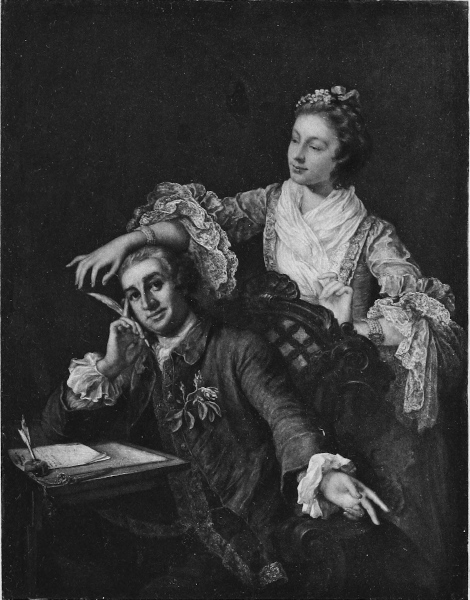
W. Hogarth Pinx. Emery Walker Ph. Sc.
Garrick and his wife from the picture in the possession of H.M. The King.
MR. GARRICK’S PLAYHOUSE
“There is a great bustle at Mr. Garrick’s playhouse[108] about some dancers, though they are chiefly Germans and Swiss, the mob considers them French, and I imagine they will be driven off the stage, tho’ the dancers and scenery have cost Mr. Garrick an immense sum; this evening is to decide their fate, and I imagine that at this time there may be a very bloody engagement. I rejoice with you on the gallant behaviour of Captain Stevens animated by your brother, to whom L’Esperance struck to Admiral West,[109] but I met Lord Cadogan last night at Mrs. Southwell’s, who said the French did not strike till Mr. West came up to them.”
In this letter it is stated that Admiral Boscawen had just returned.
THE SUBSIDIES
On November 25, in a letter to Sarah Scott, Mrs. Montagu says—
“The House of Commons sat till after 5 o’clock in the morning on the motion for the address, which was carried by 311 against 105, there were many speeches made which were talk’d of in all the drawing rooms in town; with the same cool spirit of criticism you would hear the speeches in a new Play of Mr. Whitehead’s,[110] and Garrick and Mrs. Cibber’s manner of speaking them examined.... I expected to find the town full of the subsidies,[111] they are entirely forgot and never did the publick stand by more quiet and contented. Mr. Fox and Mr. Pitt say a great many very lively things to each other, which those who are not personally attach’d to either hear with a great deal of pleasure. Messrs. Legge, Pitt, and Grenville are dismiss’d, but no one positively named to succeed them; Lord Egmont, Lord Dupplin, Mr. Doddington, and Charles Townsend are talk’d of. Sir George Lyttelton is Chancellor of the Exchequer, which place he was sollicited to accept. I wish the fatigue of it may not impair his health, which is very delicate.”
THE EARTHQUAKE AT LISBON
Remarking on their friend, Miss Grinfield, being dismissed as Maid of Honour to the Princess of Wales, Mr. Montagu writes—
“I suppose Lord B(ute)’s interest got Mrs. Ditched her place, there is no man has such instinct for the Heir Apparent as his Lordship. I would have him take the ‘Ich dien’ for his motto, he serves and will serve, the hour of his ministry will never come. I wish he would leave behind him a treatise on hope, or at least answer Plautus who grossièrement decides that hunger, thirst and expectation are the greatest evils of human life.... The news will tell you the sad tydings of an earthquake[112] at Lisbon, some say a 100,000 persons were destroyed by it. The commotion began in the Atlantick Ocean.... As to the fuss of an invasion, it chiefly possesses those who have money in the public funds, the state of things consider’d it appears probable. The Boom across the Thames perhaps is to hinder such insults from the French as we once receiv’d from the Dutch; I cannot describe it particularly to you, not having seen it.... Lord Temple[113] very generously wrote a letter to Mr. Pitt in polite and earnest terms to desire his acceptance of a £1000 a year while he continues out of place.
“Voltaire, in compliance with the taste of the age, has written a Chinese tragedy, it is called ‘L’orphelin de la Chine.’... I have not seen Dr. Delany’s remarks on Lord Orrery’s[114] letters, but they certainly deserved the animadversions of Dr. Swift’s particular friend.”
Through Sir George Lyttelton’s influence, Gilbert West was reinstated in his office at Chelsea, which from the change of parties would lapse to the paymaster. The following letter from Sir George hints at the trifling coolness between himself and West:—
“Hill Street, December 13, 1755.
“My dear West,
“My endeavours to serve you, which from Lord Dupplin’s goodness have proved successful, are indeed marks of affection, but not of returning affection. Mine for you has been constant and uniform. What variations may have happened in yours for me I can’t tell. Your behaviour has certainly indicated some, and I could not but observe it. However, I can most truly assure you that one of my greatest pleasures in my present situation has been it’s enabling me to show you that my heart will ever be most eagerly warm in your service. Indeed no Friend you have can more honour your vertue or more affectionately desire your happiness than I,” etc.
The last letter of the year, December 31, to West from Mrs. Montagu, contains this mention of Sir George Lyttelton’s son, Thomas[115]—
“Master Lyttelton paid me a visit yesterday morning, it gave me great pleasure to find he had an air of health and strength beyond what I had ever hoped for him; every sentence he utters shows an understanding that is very astonishing. Mr. Torriano and Mr. Stillingfleet came in while he was with me, the share he took in a very grave conversation surprized them very much.”
DEATH OF MR. WEST
1756 begins with two letters of West’s. At the end of January he moved to Chelsea; soon after this a stroke of the palsy brought him to the grave on March 26.
MR. WORTLEY MONTAGU’S PAMPHLET
On March 30 Mrs. Montagu writes to her sister—
“Ye 30th March.
“I imagine my dear sister would see a paragraph in the newspaper that would excuse my not having written to her a farther account of my poor friend, Mr. West. On the melancholy event I brought his sister to Hill Street, where she is to stay a few days to recover in some measure the consequences of her fatigue and the shock her spirits have received. Mrs. West is with Lady Cobham. She is sensible of her great loss, but says she will behave under her affliction worthy the example of her excellent and worthy husband, and his sentiments of resignation to the will of God, this resolution join’d to natural good spirits and vivacity of mind, supports her in a surprizing manner. I wish the good man could have known she would have endured her misfortune so well, apprehensions for her were all that disturbed the peace, I might almost say the joy of his deathbed. Miss West went thro’ the sad duties of nursing with great fortitude, but, she is much affected by her loss; the Admiral[116] his brother is in deep affliction, Lady Langham[117] finds great resources in a very extraordinary degree of piety. For my part, tho’ I went thro’ the most melancholy scenes every day between the sick and the afflicted, I have not suffered so much in my health as might have been expected.... Lord Chesterfield[118] has gone to Blackheath in a very bad state of health. The King has had an ague but is well again.... Mr. Wortley Montagu[119] has published a pious pamphlet titled, ‘Reflections physical and moral upon the uncommon Phenomena in the air, water or earth which have happened from the Earthquake at Lima, to the present time.’ I think you will send to Mr. Lake’s for it, it is written on the Hutchinsonian[120] principles.”
Miss West being ordered to Bath, Mrs. Montagu gave her an introduction to Mrs. Scott and Lady Bab Montagu, then residing in Beaufort Square. In this letter mention is made of Miss Anstey’s death, and her not having left a will. “Poor Mr. Anstey is not likely to survive his sister, he has a violent fever.” We also hear of William Robinson,[121] then recently ordained a curate at Kensington. William seems to have been rather a souffre douleur all his life, which annoyed his sister perpetually: his harping on small worries and domestic trifles is constantly alluded to. Mr. Botham bids him “fight a good fight, and by diligence and spirit in his curacy to show himself worthy of a good living.”
DEATH OF CAPT. ROBERT ROBINSON
A heavy affliction now fell on the sisters; early in June came the tidings that their favourite brother Robert, the sea captain, had died at sea. This was acutely felt by Sarah Scott, as he was her favourite brother, probably from being nearest in age to her.
On June 24, in a letter to Mrs. Boscawen, this sad subject is touched on—
“I know not how to reconcile myself to the loss of one of the companions of my youth, the recollections of one’s earliest season, the spring of life is usually pleasant and gay, but whenever it offers itself to my mind, I cannot help asking where are those who were my playfellows? Faith should answer, with their Maker, reason, patience, resignation, should take place, but there is a weakness and stubbornness too in the human habit.... My poor sister bears her loss patiently, but it touches her heart very sorely.”
ADMIRAL BYNG
Mrs. Montagu had been extremely unwell, and had spent some weeks at Ealing Vicarage, lent to her by Mr. Botham. Dr. Shaw ordered her to Tunbridge Wells. Mrs. Boscawen had asked for her letters to Mr. West to be returned; Mrs. West promises to do this. At the end of the letter one reads this—
“Mr. Montagu had just come in from the coffee-house. Mr. Byng’s[122] expedition is unfortunate, not to say disgraceful, instead of throwing succour into Minorca, it was agreed in the Council of War that as there were 18,000 Frenchmen there, it would be these men; then it was agitated whether they should engage with the French, that was also carried in the negative; the third question was whether they should go to take care of Gibraltar, which was agreed on. Alas! Alas! the report to-day is that Admiral West’s son is dead: one should lament this if we had not greater reason to lament that the English spirit is dead. Arthur was going to make illuminations and bonfires yesterday, and Lord Anson came in and forbade it.”
A letter to Sir George Lyttelton to Hagley in return for his condolences runs thus—
“Your publick life will raise a high expectation of your son, it is but just that you should give some of your private hours to qualify him so as to answer it: his happy genius makes him worthy of such a Preceptor.... You need but do justice to my affection for him to give me some share of his love.”
Sir George had specially commended his son “Tom” to the “Madonna’s” care, and they kept up a correspondence. Alas! that in future years, despite his brilliantly intellectual qualities, and his careful bringing up, he should almost break his father’s heart by his wild and dissolute life. She continues—
“Most people think that Mr. Byng will have some good excuse, if not justification, for what he has done; but however that may be, Sir Edward Hawke[123] and Captain Saunders (now made an Admiral) are gone to take command of the fleet.”
In a letter of July 28, from Tunbridge to Mr. Montagu, one finds—
“The people at the Walks were all rejoicing poor Admiral Byng was arrested at Portsmouth. I cannot think of him without some compassion, a criminal is not always an object of mercy, but frail man is ever an object of pity. People here seem to think that a shameful death must end his shameful life. Birth and Station bring a man into an elevated station, but do not give to him the qualities necessary to become it.”
Lyttelton, in a letter of August 8, writes to the “Madonna,” “the Admiral (Temple West) triumphs and pouts, and is gone to George Grenville’s[124] with Jenny Grenville. He blames Byng, though unwillingly, because he would rather condemn those that sent him.”
In another letter is—
“Dr. Shaw tells me that the mob at Portsmouth would not suffer Mr. Byng to be brought away, lest he should escape punishment. It is said that Mr. Boscawen has taken a great number of Martinico ships, and that part of the Brest squadron have got out, and gone to join M. Galissionière.[125] Mr. Bower’s affidavit has had a very good effect. I hope Mr. Millar has got some of them to distribute among his friends in the country. I am sure his good heart will rejoice to see innocence re-instated in reputation.”
MR. BOWER’S ENEMIES
Bower’s enemies had set about many evil reports of him at that period, and Mr. Hooke had specially warned Mrs. Montagu against Bower, but she refused to give up her friendship with one who had been introduced to her by the saintly Gilbert West, and was the intimate friend of Lyttelton. Bower’s change in religion from Roman Catholicism to Protestantism exposed him to all the virulence of the priests, who in revenge formulated all sorts of charges against him.
Mrs. Montagu now took a house on Mount Ephraim at Tunbridge Wells, leaving Mr. Montagu in London, from whence he went to Sandleford. She requiring wine, he sends her, from a “new wine merchant,” Madeira, port, and claret.
MR. DAVID HUME
At Tunbridge mention is made of David Hume[126] and his wife, who were there, the latter in bad health: “I remember her twenty years ago as a fine woman, though swarthy, but she is now a most melancholy object.”
Writing to her husband at Sandleford, she says—
“Dr. Smith inquired after you this morning, he is much pleased with your present of Dr. Barrow’s[127] bust to the Library.[128]... He is angry with Mrs. Middleton for being so tardy as to Dr. Middleton’s bust, at which, I own, I am a little offended.... All the people here are impatient for the tryal of Mr. Byng. They say he was surprised at the reception, tho’ he had so much reason to expect the treatment he has found. Sir William Milner and his Lady are here, they are people of considerable fortune in Yorkshire, they seem very good-natured and obliging.”
Mention is made of Miss Dashwood[129] being at Tunbridge, much gone off in looks: “Miss Dashwood dined with me yesterday. This place must appear as melancholy to a lady who has formerly been a reigning beauty, and is on the decline, as the coronation of an usurper to a dethroned Prince!”
MR. MORRIS ROBINSON’S MARRIAGE
During this summer Morris Robinson, Mrs. Montagu’s third brother, married Miss Jane Greenland, daughter of John Greenland, of Lovelace, Co. Kent, who was the eldest son of Augustine Greenland, of Belle Vue, Kent. Her mother was Jane Weller, of Kingsgate House, Rolveden, Kent, of a good family. Mrs. Montagu did not like the marriage, though she finally adopted their second son, her nephew,[130] Matthew Robinson, and made him take the name of Montagu. There never was any cordiality between the sisters-in-law. Mrs. Morris Robinson was a violent-tempered woman, and, despite her good birth, very illiterate, which, to a person like her sister-in-law, was extremely annoying, the more so as Morris was one of her favourite brothers, and extremely clever. As mentioned before, he belonged to the Six Clerks’ office, and managed both the legal affairs of the Duke of Montagu and Mr. Montagu.
Writing from Hagley[131] on August 11, Miss West gives an account of her brave young nephew, who had been wounded, not killed, as at first reported—
“My nephew[132] is at Portsmouth, not being able to bear travelling. He has been in danger from his wound, it beginning to mortify, but he is now in a fair way of recovery. He has shown a spirit suited to his profession, and to the grandson of Admiral John Balchen,[133] for when his Father proposed to send him on board a frigate, with Byng’s nephew, who was ordered to leave my brother’s ship by his uncle, Admiral Byng, before the engagement began, being, like my nephew, too young to be of use. My nephew remonstrated very strongly, ‘that Mr. Byng was only a passenger, but he belonged to the ship he was in, and therefore it would be such a disgrace that he could never show his head again, should he quit it at such a juncture:’ this joined to lamentation and importunity prevailed; when he received his wound his Father ran to pick him up and said, ‘I hope you are not much hurt?’ ‘I believe I am killed, but pray don’t mind me, Papa,’ answered the poor fellow.... Hagley is now blessed with its master, who came on Monday last with good health, looks and spirits. I was glad to see him accompanied by Stillingfleet, so worthy a man deserves such a countenance, and he is so unexceptionable that no censure can arise from any favours confer’d on him.”
MATTHEW ROBINSON’S ECCENTRICITIES
Sarah Scott at this time had a dangerous fever at Clifton, where she and Lady Bab had gone to drink the waters. Writing to her, Mrs. Montagu remarks upon the growing eccentricities of their brother Matthew,[134] who lived upon almost raw meat, and never touched bread at all, considering corn as exotic, and therefore diminishing British trade, at the same time avoiding sugar for the same reason, substituting honey for it.
He lived in the plainest, simplest manner himself, but was mighty hospitable to all who came to Horton. He gradually pulled down the many walled gardens round the house, as well as hedges, and threw the whole of his grounds into one large park, where his cattle roamed at will. He dressed plainly, and allowed his beard (then an unusual hirsute ornament) to grow; but as Sir Egerton Brydges,[135] who eventually became his nephew by marriage, remarks, “he carried his hatred of artificialities through everything.... He was the reverse of his Father, who was never happy out of the high and polished society and clubs of London, and thought a country life a perfect misery.” Matthew was, however, greatly esteemed by his neighbours and constituents, was a great reader, and wrote some clever political pamphlets.
MR. PITT BUYS HAYES
Mr. Pitt had taken such a fancy to Hayes since Mrs. Montagu had lent him her house there, that he bought it soon after her tenancy expired, as will be seen by this passage in a letter of Bower’s to Mrs. Montagu—
“Mr. Pitt is doing great things at Hayes, he has bought the house, and the house hard by, and some fields. He has built a wall towards the public road 13 feet high. He intends to pull down the old house, and build another in the middle of the garden. His neighbour Elly asks an exorbitant price for his house, £500.”
Mary Pitt, writing from Hayes on September 16, mentions she is leaving to go to Howberry to the Nedhams,[136] in order to make room for Lady Hester’s extra attendants, as Lady Hester was expecting her confinement. Mrs. Montagu went for ten days to Bath Easton to see Mrs. Scott. Lord Lyttelton, writing to Mrs. Montagu on October 23, to enquire as to her health and Mrs. Scott’s, says—
“Mr. Fox[137] has determined to lay down the seals, because he says he has not support or credit sufficient to carry on the King’s business in the House of Commons, and Mr. Pitt will not take them under the Duke of Newcastle. What will be the consequence of all this I can’t tell, my fears are great for the publick, for myself I have none in any event: the worst that can happen to me is to remain in the office I am in under the Duke of Newcastle, but I will remain for the same sense of honour and duty upon which I came into it, if the King and his Grace shall determine to stand the attacks made upon them. How happy are Mr. Stillingfleet and Mr. Torriano to enjoy the Madonna’s conversation, instead of hearing the nonsensical speculations of the town.... Little Tom is quite well and desires his best compliments. I am charmed with his sister upon my acquaintance with her during her week’s stay at Hagley. To make her as perfect as I could wish she wants nothing but the society of the Madonna.”
This was his little daughter Lucy,[138] afterwards Lady Valentia. She appears to have been brought up at first by the Fortescues, her mother’s family.
VISCOUNT PITT’S BIRTH
On November 4 Mary Pitt writes from Howberry, “I thank you for your congratulations on the birth of my nephew, he seems to give prodigious satisfaction at Hayes.” This was John Pitt, afterwards Viscount Pitt; he was born on October 9.
On November 6 Admiral Boscawen wrote from the Admiralty Office to Mrs. Montagu, then at Sandleford—
“Last week the Duke of Newcastle and Mr. Fox resigned, and the following are those that come in:—the Duke of Devonshire, Mr. Legge, Mr. Nugent, Lord Duncannon and Mr. James Grenville for the Treasury; Lord Temple, Mr. Boscawen, Mr. West, Mr. Thomas Pitt, Dr. Hay, Mr. Hunter, Mr. Elliot of Scotland for the Admiralty; Lord Bateman, Treasurer of the household, Mr. Edgecumbe, Comptroller of the Household, Lord Berkeley, the band of pensioners, Mr. George Grenville, Treasurer of the Navy, Sir Richard Lyttelton,[139] the jewel office: these have all kissed hands. Mr. Pitt having the gout at Wickham is not yet Secretary of State. Mr. Amyand is to be a Commissioner of the Customs, Sir G. Lyttelton and Lord Hillsbury have both kissed hands for peerages.”
LORD LYTTELTON
On November 19 Charles Lyttelton, Dean of Exeter, afterwards Bishop of Carlisle, wrote an almost similar account of the new Ministry, and said—
“Mr. Pitt was in his bed at Hayes with a sharp attack of gout in his feet; as soon as he is able to get abroad he will kiss hands as Secretary of State.... Sir George’s patent for a peerage is making out, which the King granted him in the most gracious manner, which is a solid consolation to him for loss of so considerable employment.”
On November 16 Mrs. Montagu writes to Lord Lyttelton from Sandleford—
“My Lord,
“I think you should have written me a letter of congratulation on Sir George Lyttelton’s being made a peer: who can feel more joy for any honour, virtue, etc., he obtains? We congratulate our friends on the most transient prosperity, but this peerage is a most solid and lasting advantage, happily timed and accompanied with such agreeable circumstances, on which I reflect with so much sincere satisfaction.... I imagine when you take your seat in the House of Peers, the ghost of Henry II.[140] will claim his seat in the Temple of Fame near the Heroes, recorded by Livy and the great Historians of Antiquity, assuring them that your Lordship is making out his Patent for Eternal Fame.”
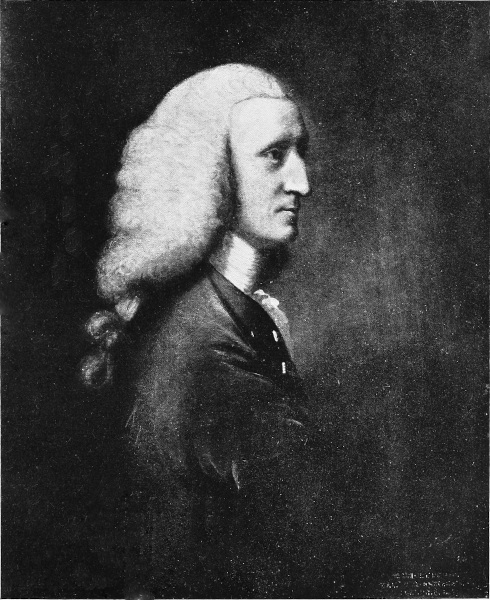
GEORGE, LORD LYTTELTON.
To this Lyttelton replies—
“Hill Street, November 18, 1756.
“Madam,
“Whatever advantages there may be in a peerage, which you set forth with an eloquence peculiar to yourself, mine has given me no greater pleasure than your most obliging congratulations.” He then alludes to his principal pleasure being the advantage to his son, whose talents he praises, and continues, “An early acquaintance and intimacy with the Madonna will be a further advantage to him, if she will be so good as to favour him with it, which will form his mind to all that is worthy and noble, and make him amends for the loss of a Mother whose instructions she alone can ever supply.”
Sarah Scott’s husband, George Lewis Scott, was now made a Commissioner of the Excise. Writing on Christmas Day to Mrs. Montagu, Sarah says about this—
“Lady Car Fox[141] told Lady Bab that to her certain knowledge the Prince of Wales[142] had desired he might not be placed about him, but unless he has committed some very heinous offence against Lord B(ute) I make no doubt of the Princess[143] providing for him, as the contrary would be unparalleled, and not to her honour.”
ADMIRAL BYNG
The letters for the year wind up with one from Sam Torriano, of November 13. It begins—
“Madam,
“If the brave and victorious Admiral Byng should be so lucky as to meet with so tender an advocate for him as you have been for me, he stands a good chance of an easy death,[144] and so the mob will be disappointed, who now wish that everybody may be hanged but himself....”
DR. MESSENGER MONSEY
Further he alludes to Pitt being laid up with gout at Hayes, “a legacy you left him,” alluding to her formerly owning Pitt’s residence at that place. Then he mentions Stillingfleet having been staying at Sandleford, and says, “Monsey swears he will make out some story of you and him before you are much older; you shall not keep blew stockings at Sandleford for nothing.” This is the first allusion to blue stockings, but that Stillingfleet’s wearing blue stockings gave the name to the coterie entirely, must be false. He was, however, a very learned man, especially upon botany. In later letters allusion is made to his having left off wearing blue stockings! The coterie of friends probably was named thus after the famous bas bleu assemblies of Paris, held in the salons of Madame de Polignac in the Rue St. Honoré, where the wearing of blue stockings was the rage: but Dr. Monsey is mentioned for the first time here. Dr. Messenger Monsey was the son of a clergyman; he was born in 1698, so was fifty-eight years old at this date. He was a doctor and surgeon, and became private physician to the Earl of Godolphin, and afterwards physician to Chelsea Hospital. He was most eccentric, and, if his portrait at the Soane Museum was like him, hideous in appearance; but he had a coarse rough-and-tumble wit, and evidently was so droll in manner, that he became a sort of pet buffoon of the Montagu and Lyttelton circle. His letters are interminably long; written in such small though neat writing, a magnifying glass is required for careful perusal. He was at this time a widower, with one married daughter, Charlotte, whose husband, William Alexander, was elder brother to the 1st Earl of Caledon. Mrs. Alexander had one child, a daughter, Jemima, who married the Rev. Edmund Rolfe, and was mother eventually of the 1st Baron Cranworth. Monsey’s letters are so coarse one can hardly imagine the bas bleus putting up with them. Dr. Monsey begged Dr. Cruickshank, in case of his dying away from his own doctor (Dr. Forster), to dissect his body before the students, set up his skeleton for instruction, and put his flesh in a box and throw it into the Thames. He must either have been very swarthy, or disliked soap and water, as Torriano, in allusion to Monsey’s threat of inventing a story about Stillingfleet and Mrs. Montagu, says, “Your fame, which was as fair as Dian’s visage, will be soon black and begrim’d like the Doctor’s own face!”
EMIN
During this year Mrs. Montagu had also formed an acquaintance with an Armenian named Joseph Ameen, or Emin. He was the son of a merchant, and born at Hamadan, whither his father had been carried captive by the Persians. His father at last escaped to Calcutta, after being slave to Kouli Khan for many years. The Persians, ever since 1604, under Shah Abbas, had frequently made inroads into Armenia, captured the majority of the inhabitants, and carried them away as slaves into Persia. Emin grew up with a passionate desire to free his country from oppression and the yoke of unbelievers, for the Armenians were then, as now, Christians. Emin says of his father in a letter to his patron, the Earl of Northumberland[145]—
“My Father taught me like other Armenians only to write and read in our own language, and to get Psalms by heart to sing in Church, but he did not show me how to handle arms to fight for that Church, as my Uncle did who was killed at his Church door, nor anything to kindle up my heart to understand great affairs.”
EMIN’S TROUBLES — EMIN’S FORTUNES
Burning to learn “the art of war” as practised by the British soldiers in India, and his father opposing him, Emin determined on flight to England, and, taking what money he possessed, he “kissed the feet of Capt. Fox of the ship Walpole a hundred times to let me work[146] my passage to Europe before he would heed to me, but he did at last admit me, and I came to England with much labour.” Arrived in England, he entered Mr. Middleton’s Academy, and was first a scholar, and then, when his money was exhausted, worked there as a servant for his learning. His master becoming bankrupt, Emin lost his all, and was reduced to the streets. At last he obtained service with a Mr. Rogers, a grocer, as porter. “In this time I carried burthens of near 200 lbs. upon my back, and paid out of my wages to learn geometry, complete my writing, and learn a little French.” Overstraining himself, he could no longer carry such heavy burthens, and was reduced to living on 1½d. a day, but a friend recommended him to a Mr. Webster, an attorney in Cheapside, with whom he got work for a time. His uncle sent £60 to Governor Davis to take Emin home to India, but after a while, meeting “by chance some gentlemen[147] who encouraged me and lent me books, and advised me to kiss Colonel Dingley’s hands and show him my business, he was a brave soldier, took me by the hand, spoke to his own Sergeant, an honest man, to teach me Manuel Exercise, and gave me ‘Bland’s Military Discipline’ and promised to help me learn gunnery and fortification.” Unfortunately Colonel Dingley died, and Emin, in despair, and by the advice of the gentlemen mentioned before, who appear from the letters to have been a Calcutta lawyer and Edmund Burke, applied to the Earl of Northumberland in a long letter, passages of which I have quoted. Emin proposes that his lordship should apply to Governor Davis for some of the money his uncle had sent to pay for his passage back to India to enable him (Emin) to join the “black Armenians in the mountains, as I heard they had never been conquered,” to teach him the art of war. The Earl of Northumberland at last—after Emin waiting at his house often from 10 a.m. to 6 p.m.!—took notice of him, and sent his servant to fetch him to see him, and on hearing his story, said, “Ameen, it is very hard to live in this country without friends and without money, almost four years, therefore the Lord is with you, be contented, I will from this time provide and furnish you with all necessaries,” and, said he, “I will mediate to the son of our King, and after you have learned the art of war, I will send you to your Father and your Uncles: the noble lady[148] comforted me also likewise.” Lord Northumberland introduced Emin to Sir Charles Stanhope,[149] and he in turn to Lord Cathcart,[150] who gave him great encouragement. Lord Northumberland now introduced him to the Duke of Cumberland, who henceforth took an interest in him. Emin applied for military service in a long letter to Heraclius II., King of Georgia and Armenia, who was anxious to shake off the yoke of the Persians, but evidently the reply was delayed, and the next we hear of him is that he had been sent to Woolwich Academy, “to Mr. Heaton’s on Church Hill,” to learn the “art of war.” Having effected a reconciliation with his father, it is interesting to read what presents he desired him to send this noble patron, the Earl of Northumberland—
“Send to my protector Nobleman, spices of the finest Pulam of Radnagar, 2 pieces of the finest Mul-mul, and 2 pieces of Madras red handkerchiefs, 2 pieces of Cuzombzar Silk handkerchiefs to be ornamented at both ends at Dacca.”
So ends 1756.
1757
“MY QUEEN OF SHEBA”
On May 10, 1757, Emin writes from Woolwich to implore Mrs. Montagu to use her influence with her brother-in-law, Mr. Medows, who was intimate with the Duke of Marlborough, to get him a commission in the Royal Artillery, in order to enable him to join the British army then fighting to defend Hanover, and assist the King of Prussia against the inroads of the French.
This letter, speaking of Mrs. Montagu, addresses her as “My Queen of Sheba,” and alludes to all “the noble ladies of her circle,” and Dr. Monsey as “my honest, dear Dr. Monsey.”
From a letter printed in my grandfather’s collection of his aunt’s letters, dated March 8, 1757, but which I do not possess, Mrs. Montagu writes to Dr. Monsey, then at Gog Magog, Lord Godolphin’s Cambridgeshire seat—
“Dear Doctor,
“That is because you have made me well! Dear Sir, because you make me laugh!”
In this letter, too long to insert here, she says “there have been great efforts to save Mr. Byng.” She says Stillingfleet had left off his blue stockings, and was at gay operas and assemblies each night.
THE WINDSOR ELECTION
From Windsor Castle, where Lady Sandwich had been granted apartments, and was living with her sister, Miss Fane, this interesting letter from Mrs. Montagu, who was on a visit there, is dated—
“Windsor Castle, Friday.
“My Dearest,
“I know you will be curious to hear how the famous election has been carried at Windsor, and the greatest pleasure I can have is to impart any to you. Mr. Fox[151] had a majority of 52, the Mayor, who is Mr. Bowles’ friend, owns he had a legal majority of nine. The boxers and the bruisers Mr. Fox had on his side beat the Windsor mob out of the Field, but they had once the courage to attack Mr. Fox’s person, and pulled off his wig, and threw it in his face. In short the affair has been very tumultuous. The town is quiet, none are actually dead, but four or five are dangerously ill, and the Doctors and Apothecarys had a great harvest of bruises and fractures.... The ladies wore party gowns, Fox’s is partly yellow and green, and the others blue; our sex have a wise way of expressing their political principles.”
On June 28, being returned to Sandleford, writing to Mr. Montagu, she mentions—
“The poor are very riotous on Market days, and it was rumoured, as I am told, that you had some corn in the granary,[152] and also the same of Mr. Herbert,[153] at which they were very angry; but I hope they will patiently wait its going to Market, for there is still a great while to Harvest. Corn fell last week, and bears but 8s. 6d. a bushell, but gin and idleness give the poor a riotous and licentious spirit.... Lady Sandwich has got a very pretty habitation in the Castle, we went into the little park in the evening, that and all I saw of the environs of Windsor delighted me extreamly.”
Mr. Montagu thanked his wife on July 10 for telling him about the election, and says, “I hear it cost him (Mr. Fox) £3000, that he gave £50 apiece for many of his votes, and carried it by 31.”
DR. STILLINGFLEET
The first letter of Dr. Stillingfleet’s[154] I possess is written on July 23 to Mrs. Montagu. His handwriting is clear, but he always uses a small “i” alone instead of a capital “I,” except at the beginning of a sentence. Portions I copy—
“I have been at Malvern about twelve days, where with difficulty i have got a lodging, the place is so very full, nor do i wonder at it, there being some instances of very extraordinary cures in cases looked on as desperate, even by Dr. Wall,[155] the Physician, who first brought the waters into vogue. I do not doubt but that the air and exercise, which at present is absolutely necessary here, the Well being at over two miles[156] from the town, contribute very much towards restoring the health of the patients. The road is very fine, and made on purpose for the drinkers. It is on the side of a hill, which i am told is found by exact mensuration in some part to be half a mile perpendicularly high, above a wide plain that lies at the bottom. Towards the well the road ascends considerably, so that i imagine the end of it is not much less than halfway up to the top. A gentleman in the neighbourhood has, at his own expense, made a walk a little above the well; this walk runs on a level for about 600 yards, winding with the breaks of the hill, and makes the noblest terrace i ever saw, the plain over which you look being bounded by some fine hills, and on it, lying on one side, Worcester, on the other Gloucester. The hill is fed with sheep, here and there some cattle graze, overhead I see my favourite bird, the Kite, sailing, and all the while i tread on porphyry, the consciousness of which, you may guess, adds not a little to my satisfaction, when i consider that Princes are proud to have a few pillars of this material.... The town lies high on the side of the hill, and still on Porphyry. The church, which stands a little lower, was a Priory.... Not far below the Church is a spring of the same nature with that of Tunbridge.... I wish this place was nearer to London, for it seems exactly adapted to do you good.... There is a subscription going forward for building a large lodging-house near the Well. At present there is only one old house in the town, turned entirely to that purpose, which contains about fifteen persons, and one large room in it, where once a week there is a sort of public breakfast and dinner. We have had one public tea-drinking and card-playing in the afternoon, by particular invitation; to-day it will begin on another footing, and is to be weekly.”
TO “KILLUM.” — “KILLUM.”
Soon after the receipt of this letter, Mrs. Montagu set out on a visit to Lady Bab Montagu and Mrs. Scott at Bath Easton, and Mr. Montagu, on July 28, writes to say he purposes driving to “Killum”[157] to see his friend Mr. Stevens.[158] “Killum” was Culham Court, Berks. George Stevens, a very eccentric character, afterwards, in 1766, published an edition of Shakespeare, and three years later some notes were incorporated in it of Dr. Johnson’s. Mr. Montagu writes this description of “Killum”—
“His house is a very good one, built about fifty years ago, the rooms large and wainscoated with oak, and three very good bedchambers with beds that at some time cost a good deal of money, but are the worse for time. He has been pulling down walls, and everything lyes rough and without order or neatness, and to finish the account of it, very much resembled its owner. Its situation is what I think fine and much pleases me, it is in a Valley which begins at the foot of that hill which we see on Maidenhead Thickett, and goes as far as Henley and further. The Thames runs quite through it, is of good breadth, and with a great number of little islands scatter’d here and there makes a most beautyfull appearance. On the bank of this river, on a terrass the house is built, it is of considerable extent, and if adorn’d with plantations and buildings would be very pretty and pleasant, but to do this may require a greater expense than may be convenient, so that all he at present thinks of doing is the improving the lawn.... You might blame me if I omitted giving you some account of one of a kind very uncommon. I mean Mr. Hart’s[159] Chinese house. This stands in a beech wood of Mr. Stevens about half a mile from him. Consists of a suite of rooms pav’d with pantyles and hung with paper, and on the outside is embellish’d with very costly decoration of the Chinese manner. Mr. Stevens says the cost has been about two thousand pounds, but I don’t believe three would pay for it. It seems to me no more than a whim, and so much money flung away. It stands very high, and has a more extensive view than Mr. Stevens’. It might be agreeable to entertain a company there in the finest and warmest weather, but one cannot think of it as an habitation without shuddering. At present no use is made of it; three servants are kept there who have no other business than to look after the house, keep the wood walks in order, and breed pheasants; in about 15 years the lease expires, and then it comes to Mr. Stevens.” Mr. Montagu says, “I have some other thoughts of taking another ramble about the middle of the week to Winchester, and perhaps Southampton.”
Mrs. Montagu had written to ask for a pair of horses and a coachman to be sent to Bath Easton, in order to convey herself and sister to stay at King’s Weston with Mrs. Southwell, “a man at Bath Easton will feed each horse at 6d. a day!” Mr. Montagu sends them, but says, “They may possibly serve to carry you to King’s Weston, and bring you part of the way home, but for any expeditions out of the Turnpike roads I fear they will not endure it.”
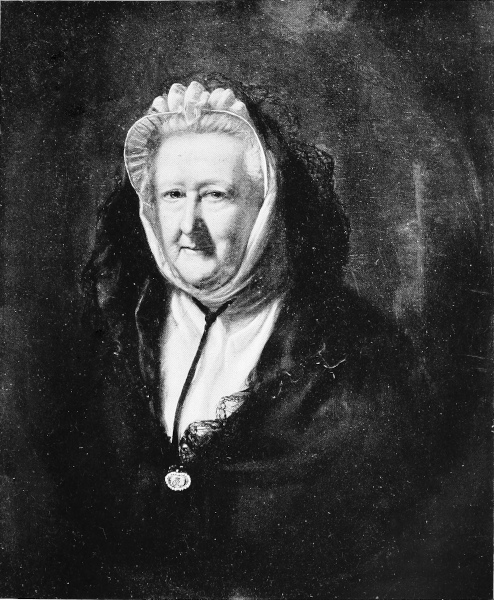
MRS. MARY DELANY.
MR. STEVENS
In replying to her husband, the following character of Mr. Stevens is given:—
“I look upon Mr. Stevens as a man who has disfranchised himself from all slavery to custom and fashion, and who as seldom brushes up or new trims his modes of living as his coat, but wears both as long as they fit him, in spite of what fops and taylors may say. I hope he will come to Sandleford, for he has parts enough to make his singularities amusing. I dare say he was very happy in the visit you made him, both for the pleasure of your conversation and from a little vanity, for tho’ the modes of singularity may give a man an air of designing to live alone and of contemplation, in the world, I believe one may venture to say, none are more desirous of regard and notice than those who affect to retire and be singular; they rather design their peculiarities for a badge of distinction than a line of separation between them and Society; and a man in low life may go ungarter’d or cross-garter’d, who in another station would have been ambitious of a blue garter, and their installment into a particular character is a matter of great wit.... We had a report that the Duke had killed 3000 French, but he is well off if he can keep on the defensive. I had a letter from Mr. Emin that the Duke of Cumberland received him in the most gracious manner, and he is so pleased, I believe he thinks one more step will put him on the Persian throne. It is happy to be born of a hoping constitution; his day dreams are very pleasant. I wish his patriot spirit was communicated to a dozen or two of our great men.”
EMIN’S LETTER
Emin had joined the English army under the Duke of Cumberland, then fighting the French. On July 30 he wrote to Dr. Monsey, enclosing a letter to his patronesses, to be copied for each lady. In the postscript is the first mention of Edmund Burke.
“Now I would have you ask Mr. Burke’s advice about this letter before you coppy it for my friends. Pray don’t be mad because my friend is an Irish gentleman, but I can tell you that he is your beloved son-in-laws[160] countryman. I dare say you will be mighty pleased at being acquainted with him.”
Emin’s letter begins—
“Limburg, August 1, 1757.
“To all the ladies and Patronesses of Joseph Emin. “My noble Ladies,
“I believe your ladyships have been in a long expectation to hear from this part of the world, more especially of the battle which began on the 23rd of July. In the morning we were ordered out with 25 horses and 200 foot irregulars to secure a post, where we found 300 husars and 700 foot soldiers, upon which we began immediately to fire, and they retreated very soon; and in the afternoon his highness, hearing that the French were advancing with their whole army, ordered that the part of his army were to advance also, but it was very unlucky for us that our infantry was too late; and before they could come up, the enemy begun from some distance to fire upon us with their cannon, with no manner of execution. His Royal Highness thought proper to return to his camp in Aferden. The next day, the enemy, still advancing from their camp at Halla all along the river Vizer,[161] and were retreating untill we halted upon a high hill with full of trees, and they on another; were the firing of cannon began again on both sides, and lasted till evening. Our situation not being so well as we could wish, we still retreated till we come to Hamelin,[162] there we posted the right of our army, and our left at Onsburg, and unfortunate Hastenbek[163] between us and the enemy, which was soon burnt down. The 25th, about four in the morning, the enemy began to advance with their musicks and drums, making a very great noise, more like Indians than Europeans, and was soon silenced; as a few of our balls, and cannonading begun of both sides briskly. At that time your slave was upon a hill with no more than 200 irregulars, commanded by my friend, Major Freydag, a man of good conduct and judgment, where we could see the two armies very plain. It was a place had it not been so dangerous as the cannon balls were flying like so many flies over our heads, I would wish my noble friend ladies who are my patronesses and who are so fond of Heros and hearing of battles, to have seen it, which would really have been worth their while; then I would have wished again that the heavenly chariots where descended from the gods above, to have transported them to their native and blessed Island, peradventure they should have been in the greatest of dangers, for wee saw about eleven of the clock the enemy with no less than six thousand of Horses and Foot comming up to us of all sides with a great fury, except a little grass that led us down to our army, but this bravery of theirs was greatly owing to an information which they had of us a day before. Knowing that we were no more than two hundred men, or else they woud not be so furious in their attack, for they are vastly like the black Indians, fire at a great distance and run away. However, we stood almost half an hour, our men ralyed three times and killed no less than 300 of them; for our men are brought up from their infantry (sic!) as huntsmen, they never miss their mark. I have seen them shoot at 300 yards’ distance; they are like the mountiniers of Armenia and Dagastun, the French husars run away as soon as they see us. You see, my noble ladies, what great advantage it is to a Nation who has the liberty not only to kill the partridges but to kill as many deers and other animals as they please. The loss of ours was but 20 and 6 wounded, we could not support any longer and where obliged to retreat, and join the army, and about 2 a-clock in the afternoon, the enemy retreated with the loss of eleven cannon, and had taken some of ours, but we retaken them again, but the battle continued still and lasted from 4 in the morning to 6 in the afternoon, the loss of their side was about 3000 and about 1200 of ours, we don’t look upon this as a battle in Persia, but as a scarmish (sic!). The inventor of gunpowder tho’ he is cursed by many ignorant people but his invention has been a very great service towards preservation of Mankind, gunpowder is a thing which makes a great noise like lightning and thunder keep mankind distant with an awe. ‘The thought of gunpowder,’ says the great Marshal de Saxe, ‘is more than the danger itself.’ I woud wish to have no more than 1500 Persian Horse if it is not too bold and your humble servant the teacher of them, we could soon show the French that the effect of symiters (sic) would be greater than that of gunpowder tho’ their number of what we hear is one hundred fifty thousand men and ours are you very well know. At present we are upon marches and countermarches.”
At the end of the letter he says he has received nothing as yet from his royal master, and that if he does not, he must unwillingly return to his father in India, as he will not be a “begar” any longer on his noble patrons.
THE HEALTH OF H.R.H.’S LEG
This battle was that of Hastenbeck. The Duke of Cumberland had placed the archives and valuable effects from Hanover in the town of Stadt, and from Stadt came a letter from Emin to Dr. Monsey, on September 13, just after the famous Convention of Kloster-Seven had, by the intervention of the King of Denmark, been signed, and peace arranged. In reply to Dr. Monsey’s inquiry about the Duke of Cumberland’s health, Emin says, “You are desirous to know how my royal master is. Mr. Andrews (valet), with his compts. to you, says his Royal highness’s leg is quite well, so you may be easy.”
To return to Mrs. Montagu, staying at Bath Easton, on August 1, writing to her husband, she expresses herself uneasy, as Admiral Boscawen was recalled from the fleet, for what he knew not. “Mr. Boscawen will be busy enquiring the cause of his being recalled, he has merit and a powerful family, and I hope his ennemies cannot oppress tho’ they may oppose him. Do not mention this affair.”
In July Mrs. Morris Robinson had presented her husband with a son and heir, who was christened Morris, after his father, and became eventually 3rd Baron Rokeby. “Morris’ little boy goes on well.... Mr. Potter made a fine harangue to the Bath Corporation on Mr. Pitt’s Election. The circus,[164] I am told, is but little nearer finish’d than when we were here.”
In the next letter, after comments on the beauties of things at Weston, she writes—
“Yesterday morning Mrs. Southwell and I got into her postchaise early, and went to the passage of the Severn, got into the Ferry boat and cross’d over to Chepstow in Monmouthshire, and from Chepstow we went to Mr. Morris’ called Piercefield, a place so far exceeding any thing I ever saw or expect to see, I must reserve the description till I see you. A reach of the Severn of forty miles is one of the most inconsiderable advantages of the place, every beauty of land, sea, rocks, verdure, cultivation, old ruins, villages, churches are there in the highest perfection; the river Wye forms a most beautiful half island in one part as the Severn Sea adorns the other.”
WORTLEY MONTAGU
Mr. Montagu replies—
“On Tuesday night, as I was at Supper about 10 o’clock, who should come in to me but my cousin Wortley,[165] he had been making a visit to somebody near Wallingford ... he missed his way, the roads were so bad and rough that two of the glasses of his new chaize were broken and he could not get any reparation at Newbury.” In commenting on political subjects, he adds, “I suppose now everybody will be sensible of the folly we have been guilty of in so long suffering the Wild Boar of Germany to enter and destroy our vineyard.”
Mrs. Montagu answers—
“I assure you it is with a melancholy pleasure I often look on this charming country, perhaps this is the last summer I may ever be an idle traveller thro’ a peaceable country; however, I have one comfort, that as you are innocent of the evils that may overwhelm us, you will the better support yourself and me under them, and that the best we can hope is to be tributary vassals to France, perhaps they will invade and conquer us, but God forbid.”
ELIZABETH WILMOT
Mrs. Talbot,[166] writing from Barrington,[167] bids Mrs. Montagu to come and stay with her. The letter is not a remarkable one, but it says, “Have you heard lately from Lady Sandwich? I find the old Countess[168] is dead at last at Paris.” This was the eccentric Elizabeth Wilmot, sister of the Earl of Rochester, and grandmother of John, Lord Sandwich, widow of the 3rd Earl. It is said she governed her husband to such a degree that he was almost a cypher and a prisoner in his own house, she being, though an indifferent wife, a most brilliant spirited woman. After her lord’s death in 1729, she lived in Paris, where she was the friend of Ninon de l’Enclos and St. Evremont. Both Pope and Lord Chesterfield have mentioned her as extremely spirited and having great intellectual ability.
Her daughter-in-law, Lady Hinchinbroke, née Elizabeth Popham, lost her husband, Lord Hinchinbroke, in 1722, and I have several curious letters written by her to Mrs. Montagu in 1739, respecting her son John, 4th Earl of Sandwich (“Jemmy Twitcher”). He was then eleven years old, and his mother sent him to sea. Probably he was even then very unruly, but he could not bear the sea, and through Mr. Montagu she applied to their common connection, John, Duke of Montagu, to get him a commission in the Army, buying it “as an ensign in a marching regiment.” The duke’s reply to this is singularly indifferent in expression, and his spelling terrible.
On August 6, writing from Bath Easton to her husband, Mrs. Montagu alludes to the defeat of Frederick the Great at Kollin in Bohemia, on June 18, by General Daun. Emin had written to her, saying—
“The French seem afraid of us, tho’ so much inferior in numbers.... I hear the King of Prussia takes to himself the whole blame of his disgrace in the late affair, and says if he had followed the advice of the Prince of Bevern, it had not happen’d; there is something more great perhaps in a Monarch owning his error than in gaining a victory, but it will not have the same effect in establishing his affairs in Germany, so that in his situation the least advantage over the Empress Queen[169] would have been of better consequence. Sir John Mordaunt, General Conway,[170] and Col. Cornwallis are going abroad with some forces as the Newspapers tell us, and the French seem again disposed to disturb us with the apprehension of an invasion.”
DESCRIPTION OF EMIN
Writing to Dr. Stillingfleet on August 7, in return for his description of Malvern, Mrs. Montagu gives this fine description of Emin—
“Mr. Emin was most graciously received by the Duke, had offers of money and all marks of regard from his Royal Highness, so that his letters express the highest satisfaction ... there must be a nobler seat than the Persian throne reserved for that fine spirit which, born in slavery and nurtured in ignorance, aspired to give liberty, knowledge, and civil arts to his country. To compass this he risqued his life, and endured the greatest hardships, and ventured all dangers and uncertainties in a country whose very language he was a stranger to; how different from so many of our countrymen, who for little additions of power and greater gratifications of luxury, in spite of their pride of birth and advantage of a liberal education and the incitements of the great examples of all ages and nations, will hazard enslaving us to a nation our forefathers despised.”
In this letter we learn that Lord Lyttelton had returned from a Welsh tour very unwell, had spent two days with her and Mrs. Scott at Bath Easton, en route to Hagley, and that on her return to Sandleford she expected a visit from Dr. Monsey.
LADY LYTTELTON’S TEMPER
In a letter from Rev. Charles Lyttelton from Hagley of August 17, one catches a glimpse of the second Lady Lyttelton’s temper. He says—
“My brother Lord Lyttelton returned from his Welsh expedition the same day I came home, and you will easily believe how welcome he was to Miss West and me, as we had nobody to converse with or rather to eat with, but ye amiable Lady of ye house, for she does not deign to converse or hardly say a single word to either of us. On Saturday, Hester[171] arrived, so we are now a strong party, and her Ladyship may be as sulkey and silent as she pleases.... Lord Lyttelton is got pure well.”
This expression is often used in the eighteenth-century writings; apparently it meant perfect health at that time.
From Merton, on August 30, Lady Frances Williams[172] writes to Mrs. Montagu, and in her letter alludes with joy to Emin’s safety, and then adds—
“By the accounts arrived from Lord Loudoun,[173] the Mediterranean tragedy seems to be acting over again in the American seas. A Council of War was call’d to advise whether the 10,000 men brought to Louisburgh[174] should be landed or not; it was determined in the negative upon finding the French had 2 more ships than we had. Lord Charles Hay’s only entering his protest, and they are returned to Halifax to wait a reinforcement.
“This brings to my mind the death of Admiral West, and the disgust given our friend Admiral Boscawen, which I look upon as a retaliation from the Pittites for the dismission of the former last Spring.”
THE HAWKE EXPEDITION
In a letter from Fulham on September 15 Mrs. Donnellan alludes to the expedition under Sir Edward Hawke[175] and Sir John Mordaunt against the French, which was kept very secret.
“They say Sir John Mordaunt said to the officers, ‘You will have but a short bout, but it will be a brisk one, and I hope we shall all behave as we ought to.’ ’Tis supposed we shall hear in less than a week something about it.... Whatever it is, Mr. Pit (sic) will either have the glory or disgrace of it, for every one calls it his scheme. The King, they say, had a fainting fit about a week ago as he sat at cards, but is now well and seems cheerful.... Lord Bolingbroke and Lady, were in such a hurry of passion they could not wait for settlements but were married upon an Article; may one not think of an old Proverb, ‘Marry in haste.’”
Lady Bolingbroke was a daughter of Charles Spencer, Duke of Marlborough, and Mrs. Donnellan’s prophecy came true, but not till 1768, when she was divorced, and married Topham Beauclerk, son of Lord Sydney Beauclerk.
AN HUMOROUS AFFECTION
On September 15 Mrs. Montagu wrote a long letter to Dr. Stillingfleet from Sandleford. In this she alludes to the humorous affection for her which Dr. Monsey had developed.
“You must know Sir, Dr. Monsey is fallen desperately in love with me, and I am most passionately in love with him, the darts on both sides have not been the porcupine’s, but the grey goose quill. We have said so many tender things to each other by the post, that at last we thought it would be better to sigh in soft dialogue than by letter. We agreed to meet, and the rather, as all the lovers we had read of (and being in love with each other only du coté de l’esprit, you may suppose we woo by book) had always complained of absence as the most dreadful thing imaginable. He said, nay he swore, he would come to Sandleford, and twice had named the day, but each time his grand-daughter fell sick, and I know not whether he will keep the third appointment, which is for next Monday. These disappointments have made me resolve, and I really believe it will not be difficult to keep the resolution, never again to fall in love with a man who is a grandfather. In all other respects the Doctor is a perfect Pastor Fido, and I believe when we get to Elysium, all the lovers who wander in the Myrtle Groves there will throw their garlands at our feet.”
Further on she alludes to Emin, who was at Stadt, and had written her a most devoted letter.
“I do not indeed hope to see him on the Persian throne, or giving laws to the East, but I know he sits on the summit of human virtue, and obeys the laws of Him who made that world the ambitious are contending for, and to such only my esteem pays homage.”
MRS. BOSCAWEN
In a letter to Mrs. Scott of this period occurs Mrs. Montagu’s opinion of the character of her friend, Mrs. Boscawen.[176]
“She is in very good spirits, and sensible of her many felicities, which I pray God to preserve to her; but her cup is so full of good, I am always afraid it will spill. She is one of the few whom an unbounded prosperity could not spoil. I think there is not a grain of evil in her composition. She is humble, charitable, pious, of gentle temper, with the firmest principles and with a great deal of discretion, void of any degree of art, warm and constant in her affections, mild towards offenders, but rigorous towards offence.”
HER TRUST IN PROVIDENCE
I make extracts from a splendid letter to Mrs. Boscawen of October 25. Admiral Boscawen had just received a commission rather unexpectedly, owing to the failure of the Hawke and Mordaunt expedition.
“I am a little uneasy lest the surprize should have hurt you, satisfy me in that matter and my imagination will then sit down and weave laurel garlands for your husband’s head, and I too will rejoice in the advantage which I hope his country will reap from his arms, but think me not ignoble if I own, glory is but a bright moonshine when compared to your welfare, and think me not below the standard of true patriotism, if I confess, it is for the sake of such as you, my country is a name so dear. I know you are too reasonable to wish Mr. Boscawen might avoid the hazards of his profession. The Duke of Marlbro’ his kinsman, lived to old age and survived perhaps all the cowards that were born on the same day, the accidents of life are more than the chances of war. Be not afraid, but commit it all to the great and wise Disposer of all events; a firm hope and cheerful reliance on Providence I do believe to be the best means to bring about what we wish, and that such confidence does it far better than all our anxious foresight, our provident schemes and measuring of security. I remember with sorrow and shame, I trusted much to a continual watching of my son,[177] I would not have committed him to a sea voyage, or for the world in a town besieged, I forgot at Whose will the waves are still, and Who breaketh the bow and knappeth the spear asunder. What was the reward of this confidence of my own care and diffidence of His who only could protect him? Why, such as it deserved, I lost my beloved object, and with him my hopes, my joys, and my health, and I lost him too, not by those things I had feared for him, but by the pain of a tooth. Pray God keep you from my offence and the punishment of it. I do not mean that you should be void of anxiety in times of hazard, but offer them to God every night and sleep in peace, the same every morning, and rise with confidence.... I am much pleased with his Majesty’s confidence in Mr. Boscawen....
“The Duke,[178] it seems, is gone to plant cabbages; as soon as these great folks are disgusted they go into the country; the indignant statesman plants trees upon which he wishes all his enemies hanged, his occupations are changed, but his passions not altered. The angry warrior rides a-hunting, ‘mais le chagrin monte en croupe et galope avec lui,’ nor can the hounds and horn ‘that cheerily rouse the slumbering morn’ content the sense that wants ‘to hear piercing fife and spirit-stirring drum.’”
Not having been well, she adds she is moving to London to consult her doctors, leaving Mr. Montagu to plant trees, etc.; before joining her. “I expect a cargo of Morgans and good folk from Newbury to dine here; I always endeavour to depart the country in an odour of civility.”
THE MORDAUNT AFFAIR
A letter from Mrs. Donnellan throws a light on the Mordaunt affair.
“All I can gather of this most shameful affair is that there will be no more known till there is a publick enquiry,[179] and then if the scheme is proved by the General Officers to have been impracticable, those who sent them on it must suffer, but if it is found that they might have made more of it, I suppose they will.... It will be defered (the enquiry, I mean) till the sitting of parliament. Sir J. Mordaunt and Admiral Hawke have both been to Court, the Admiral was received graciously, the other taken no notice of, ’tis said he stooped to kiss the royal hand, but it was pulled back from him; wou’d it not have been more kingly to have forbidden his coming? ’Tis said soon after some of the troops were in the boats in order to land; there was a council of war called, and when Hawke thought they were landed, they were ordered on board again; ’tis certain there were 5 or 6 days spent on councils of war, and then Hawke, who was not concerned in them, desired them to come to some resolution, for he wou’d either land them or return home. Colonel Conway, I hear, showed the most spirit, and that our commen men showed no unwillingness to action.... The Duke came thro’ the city on Thursday at four in the afternoon. I saw some who saw him, there was no sort of notice taken of him; I think he was well off. I suppose you have seen the King of Prussia’s letter to our King, ’tis denyed but believed to be genuine. I think your remarks on the correspondence between the King of Prussia and Voltair (sic) very just; however, I forgive him some levity when conversed with a wit, and part since he knows when ’tis proper to the King.... I have got since I came home, Taylor’s Sermons, he is so good he frightens me, and so witty he makes me laugh.”