Chapter VII · TREATMENT IN DESIGN
Reading edition
APPRECIATION of design by the individual is largely a matter of temperament, though it may be due to some extent to acquired knowledge. Generally, few are conscious of any guiding principle, and selection in their case is mostly the result of fashion or custom. To others certain colours and forms have an appeal, though they may be quite unconscious of, or unable to explain the attraction other than it suits their taste.
In the last few years it has been recognised that colour may be employed beneficially in curative treatment, but the normal healthy individual is often indifferent to environment other than that of material gratification.
When any artistic work creates pleasurable emotion, it is purely a matter of cause and effect. To design successfully involves some understanding of the causes or factors which constitute the appeal.
Natural Attraction
The attraction of colour and form is undoubtedly universal, and may be generally understood, though there are delicate degrees of proportion and association in both that may only be appreciated by the cultivated eye. Early essays in drawing generally exhibit an undesirable redundancy in curves, and in many instances the student is slow to realise that those that approximate to the elliptic form are proportionately of more interest than those obviously composed of segments of circles. Undoubtedly this subtlety of line is one of the predominant factors in appreciation of form.
A factor in pattern that is largely responsible for the charm is the presence of small detail in juxtaposition with larger forms. This is entailed in instances by technical conditions, such, for instance, as in some tapestries where inhabited pattern is essential to the process of production.
Decorative Materials
Some materials are employed partly for their decorative effect, such as naturally figured woods and certain varieties of stone; and design mainly consists of judicious selection, use and treatment. Oak and walnut being woods extremely suitable for structural work and furniture have always been in request when obtainable.
Polishing is to some extent a preservative, but work in oak or walnut, especially when carved, should be kept comparatively dull, otherwise confusion between the relief and the natural figuring would result. In mahogany or satinwood, where the chief interest exists in the figuring and colour, carving is undesirable and the best effects are obtained by high polish. It may be urged that in the Chippendale period the work was invariably carved, but the detail was always in very low relief, and the finishing dark in colour, in which the figuring was subdued. Mahogany in its more general employment owes its chief beauty to the development of figuring and colour.
Certain marbles are used for their decorative effect, and the natural colour and figuring developed by polish. Statuary marble that is sometimes employed, is more suitable for carved details, and appears at its best when unpolished, though in this state it is extremely subject to discolouration owing to its absorbent nature.
Granite, so popular in our cemeteries, is often polished, when the natural figuring is unpleasantly aggressive. An extremely hard stone and laborious to work, it is not suitable for carving, and is best left roughly tooled or frosted, when the natural chrystaline formation appears to the best advantage.
Justification of Treatment
The softer woods used in interior structural work are generally painted, partly as a preservative and largely because they do not possess any figuring of particular interest.
Graining in imitation of more precious woods is often condemned as inartistic, but it may be urged in extenuation that it is the most economic treatment, as it helps to minimise the effect of wear and incidental damage.
The use of pattern wall-papers and floor coverings can be justified on the same grounds, as in those with plain surfaces any disfigurement is readily seen. Wallpaper, however, is quite a legitimate form of decoration and not necessarily imitative, though to some extent it is reminiscent of the early custom of employing tapestries as wall coverings. A more durable and artistic treatment of interiors is that of the wainscotting of the Georgian period, but the initial cost is proportionately great, though probably when maintenance is taken into consideration it would be cheaper in the long run. Apart from the question of cost, the modern tendency is favourable to change of effect and environment, due partly to the facility afforded by the comparative cheapness of wall-paper, but even more to the prevalent short tenancies.
Undesirable Imitation
Many excellent designs are produced in wall-papers, though there is a tendency at times to reproduce textural effects which can only be justified on æsthetic grounds. Those of the frankly imitative kind cannot be condoned. It is still possible to have the hall and stairs papered and varnished to resemble slabs of precious marble, or patterns in mosaic, which were undreamt of in Byzantine times; and the orthodox design for the bathroom is still that of tiles with the joints neatly printed. Similar imitation is also apparent in linoleum, when the pattern simulates the appearance of either wood parquet or mosaic, or even worse—that of a Turkey or Axminster carpet.
There is an element of priggishness in such cheap art in which, as though ashamed of poverty of material, there is an assumption of something better; and it is lamentable that there is not merely a market for these shams and imitations but curiously enough they also find appreciation.
There are phases of work where simulation may to some extent be justified, for instance, silver is sometimes gilt. For this there is the excuse that silver, although a beautiful metal, is subject to oxidation and requires constant attention to keep bright. Gilding acts as a preservative, and is therefore justified in certain forms of silver work, which it is not convenient to clean in the ordinary way.
Technical Considerations
It has already been suggested that Design is not merely a question of idea and draughtsmanship, but is also dependent upon materialistic conditions, which, in practical work, must be understood and properly considered.
Whether the intended design be for some form of flat pattern, such as weaving, etc., or for any particular craft expression, it is essential that the limitations of the process and material involved be clearly kept in view, and that suitable elements for expression be chosen.
Convention, to a large extent, exists in the adaptation of forms, natural or otherwise, to the exigencies of production, a proper understanding of which will not only tend to economy in cost, but also to more effective results, if full advantage be taken of the craft or mechanical conditions, which should always be foreseen in design.
Methods of Expression
Methods of expression vary, according to position and material, and may be Flat—either silhouette, or with appearance of relief, or in actual relief.
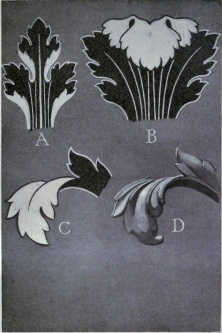
No. 254. A. B. C. Flat Treatment, Silhouette important. D. Relief Treatment of C.
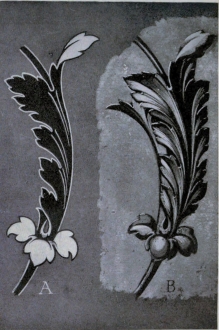
No. 255. A. Flat Treatment. B. Relief of Husk Leaf.
Contrast exists always, thus in the Flat with or without outline the contrast is in Light and Dark, whether colour is involved or not.
In Relief the contrast is in Light and Shade. Contrast exists also in both treatments in lines straight and curved—in the variety of the latter, in lines with mass forms, and in dominant forms with smaller detail.
In the treatment of Flat Ornament the most important considerations are play of line and silhouette, and forms should be displayed in interesting profile; perspective and foreshortening being eliminated whenever they would result in distorted or inharmonious shapes.
In Relief treatment the designer is concerned with the effect of Light and Shade in harmonious arrangement of mass and line.
Perspective and foreshortening are permissible to some extent, but are largely dependent upon the work, greater license being allowable in high than in low relief.
Treatment of Leaves
In Flat ornament, leaves are invariably in profile, but in Relief expression they may be folded, that is, wrapped round the stem. Greater freedom is possible in the turn-overs.
Relief ornament should recognise ground by details being occasionally displayed in lower relief.
Whether expressed in Flat or Relief, the composing lines should always be emphatic, and their direction traceable through the details, floral or otherwise.
Surface Interest
In addition to the foregoing, a further consideration is that of interest of surface, which may consist of contrast in textures of rough surface with smooth, of patterning on form, veining and striation of leaves and flowers, and of the employment of trellis or imbricated pattern. The latter in conjunction with other details, occur in the decorative work of the later French Renaissance.
Painted Decoration
The technical means of obtaining the interest of surfaces is, of course, incidental to the process involved. If the decoration be the result of painting, the design is free and untrammelled by any other than purely æsthetic conditions. Such, for instance, as the desirable recognition of surface, and the pattern sense suggested by recurrence, if a decorative rather than a pictorial effect is desired.
When the decorations consist of ornament, wholly or partly, they are occasionally rendered in a conventional manner, based upon the appearance of Relief, as in the Pompeian wall decorations and the painted work of the Italian Renaissance. There is ample precedent for this treatment in traditional painted decoration, but deliberate attempts at realistic effects are not only undesirable but to be deplored.
The interest in Painted Decoration, apart from colour, design or subject, would be that of the individual manifestation of the designer and painter.
Stencilled Work
Stencilled decoration is a compromise between painting and mechanical printing, and is restricted by the unit. The repetition of this is practically mechanical, though considerable license is possible in the treatment of colour, which has to be personally applied and is therefore amenable to controlled variation.
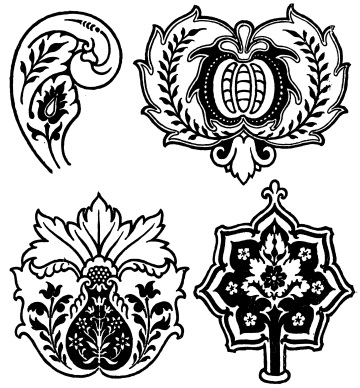
No. 256. Inhabited Details from Woven Fabrics. Interest imparted by patterning on forms.
The design in stencilled work is not limited to one unit, and is not subject to hard and fast rules, the plates being of a size convenient to handle. Alternate units, or a series can be employed, the interest, apart from colour and subject consisting mainly of contrast in detail, and in the individualism expressed.
Mechanical Production, Printed and Woven
In textiles, where such mechanical processes as printing and weaving are involved, the design is restricted to the unit, the repetition of which is infallible both as to form and colour.
Apart from colour, the surface interest consists of suggested or actual contrasts of texture, the result of veining and striating leaves and flowers or of patterning forms or backgrounds with smaller details.
Needlework
Needlework, being a personal performance, has no such mechanical restriction; the design can, and should be, complete within the area, and the expression perfectly free. Beside Design and Colour, the surface interest is that of contrast in the different textures resulting from the various stitches, and the employment of darning, knots, laid-work, etc.
Appliqué
In Appliqué work, interest is imparted by the mass effects enriched by embroidery, the large shapes entailing detail of the inhabited variety to keep them from puckering. In all needlework the effect is due to some extent to light and shade, particularly in Appliqué, where a corded edge is employed.

No. 257. Needlework, contrasting effect of various stitches.
(Photo: V & A Museum).
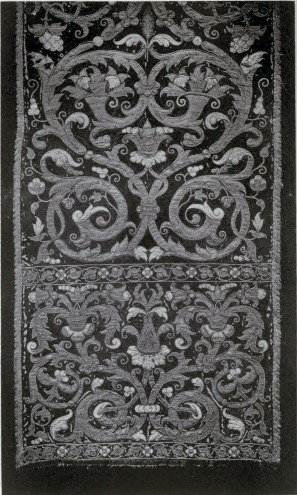
No. 258. Needlework Appliqué. Interest due to contrast of material, effect of relief imparted by corded edges, and to embroidery on applied details.
(Photo: V & A Museum).
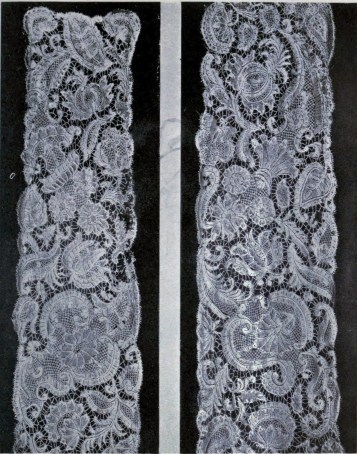
No. 259. Lace. Surface interest due to contrast of various fillings. (Photo: V & A Museum).
Lace
In Lace, the interest consists solely of textural contrast, not only in the treatment of the various details, but in the patterning of intervals due to the necessary fillings. Design may be complete, or a repeated unit, according to the purpose and variety of lace.
Wood Inlay
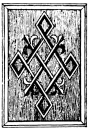
No. 260. Wood Inlay. Geometric arrangement.
Design for Inlays in Wood-work may be free in expression, or a unit, at discretion. The latter variety frequently takes the form of lines spaced with regard to good proportion, forming borders, chequers and geometric shapes of various kinds. Floral or other forms simple in character and profile may be used, the design being expressed in silhouette.
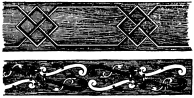
No. 261. Wood Inlay.
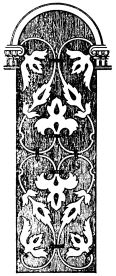
No. 262. Wood Inlay. Simple silhouette depending on natural colour.
Intarsia
In the Intarsia detail of the Italian Renaissance, the inlaid forms were elaborated by surface markings and graduated effects were obtained by means of hot sand; but the natural contrast in the varied colour and fibres of the material employed probably form the more legitimate interest in all inlaid work.
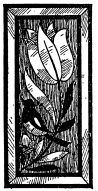
No. 263. Wood Inlay. Simple silhouette.
Veneer, Marquetry
In Veneer work and in Marquetry, where the work is quartered and juxtaposed, the interest consists in the patterning of the figured woods, particularly when these are arranged to form reciprocal shapes.
Boule Work
The interest of Buhl or Boule work, an inlay of metal employed in the French Renaissance in the decoration of furniture, often in conjunction with tortoiseshell, is that of contrast of texture.
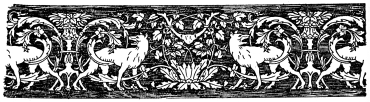
No. 264. Italian Intarsia. Forms elaborated by incised lines.
In the design, profile or silhouette is the primary consideration, being used:
1. As a form of framing,
2. In angles or centres on table-tops,
3. In panels in furniture:
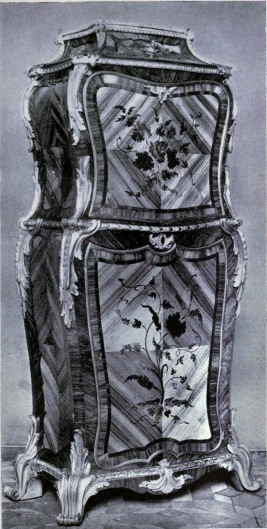
No. 265. Louis XV Cabinet with Ormolu Mounts.
Marquetry, veneer quartered and inlaid with floral detail. (Photo: V & A Museum).
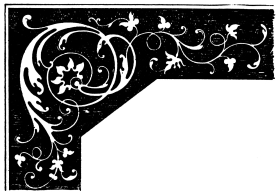
No. 266. Boule Work. Period of Louis XVI.
The design can invariably be complete within the area. Coloured grounds are employed as well as tortoiseshell.
Mosaic
Mosaic designs may be complete in themselves or be the result of repetition, according to attitude and purpose, and with regard to variety and colour, only restricted by æsthetic considerations.
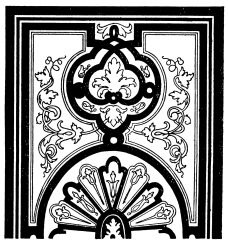
No. 267. Boule Work. Period of Louis XVI.
Owing to technical limitations, modelling can only be broadly suggested; therefore forms should be generally in silhouette except when on a large scale.
When employed on walls and vaults, gold is frequently used in the backgrounds. This not only serves to define detail, but affords contrast to the general surface, the inevitable joints in the tessaræ adding also to the interest.
Byzantine Use of Marble
Associated with Mosaic decoration in the Byzantine Period was the employment of marble in shafts of columns and for lining walls by banding or slabbing, frequently quartered, so as to display the markings in reciprocal forms. Such marbles were chosen for figuring and colour, the former in its variety being an important factor in the surface interest.
Similar employment of slabs occurs in the treatment of floors, where contrast in colour is the chief consideration. It is sometimes associated with Mosaic of small tesseræ, also in marble, whereas that used on walls and in vaults was frequently of glass.
The foregoing is a broad summary of ornamental expression in the Flat, with the exception of Book Decoration.