Chapter II · HISTORIC REVIEW (continued 2)
Reading edition
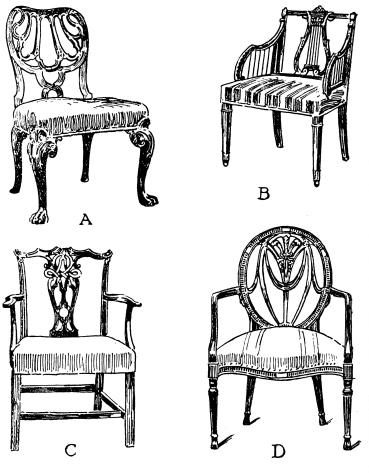
No. 122.A. Transitional Chair, 18th century.
B. Mahogany“ “ “ Sheraton.
C. “ “ “ “ Chippendale.
D. Walnut “ “ “ Hepplewhite.
later examples have straight square legs. The chairs were fitted with loose upholstered seats covered with morocco leather.
Furniture was generally in mahogany, which had been introduced a little earlier from the West Indies, and had become popular on account of the colour and figure developed by polishing. Mahogany lends itself to fine mouldings and detail, and this was evidently appreciated, as relief decoration on furniture in this wood received a more restrained treatment, while plain surfaces were made more extensive.
Mayhew
Contemporary workers were Mainwaring and Mayhew. Mayhew was responsible for a form of fretwork decoration which is often ascribed to Chippendale.
Adam Style
Prominent among his contemporaries, more perhaps for his influence on interior decoration, was Robert Adam, who died at the age of ninety-four in 1792.
A student of the later antique Roman work, and inspired by the remains of Diocletian’s Palace at Spalatro, he evolved a style which bears his name, that was personal and distinctive. A style that had many followers, and which largely influenced the work of Sheraton.
Simple as to structural form, and delicate in detail, it carried on the tradition of the later Graeco-Roman work on which it was founded, avoiding absolute reproduction.
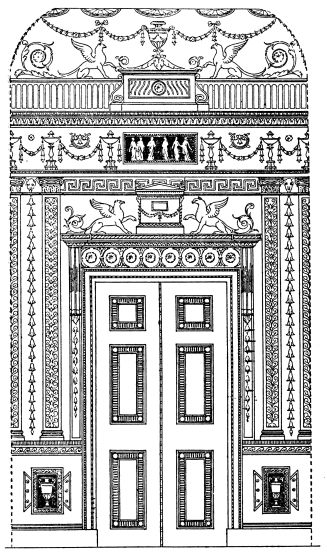
No. 123. Interior Decoration. “Adam.”
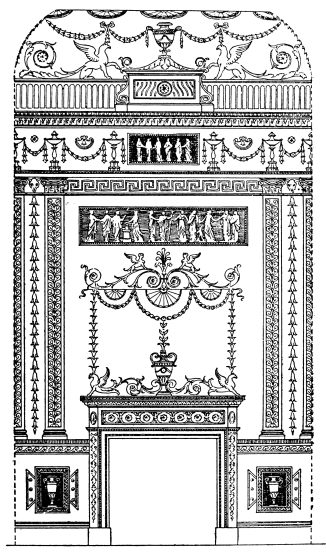
No. 124. Interior Decoration. “Adam.”
The Adam influence is evident also in the pottery of this period, and in the details of Sheffield plate.
Examples of Robert Adam’s architectural design may be seen in London at the Adelphi, which was built as a speculation, in the Admiralty screen in Whitehall, and houses in Portland Place, W.
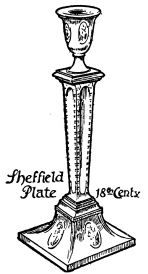
No. 125. Adam influence.
Hepplewhite
Hepplewhite also was designing and manufacturing about this time, and is noted principally for his japanned or painted furniture. In this process the wood was first coated with a preparation after the manner of Chinese or Japanese lacquer, and then decorated with fruit and flowers in gold on a background. Subsequently, furniture of this character, instead of being japanned, was merely painted white. Hepplewhite’s chair-backs differ in form from Chippendale’s, being shield or oval shaped.
Satinwood came into use, and much of the work ascribed to Sheraton was made of it.
Painted decoration of a delicate character, the details including ribbons, borders and medallions, was applied to table-tops, harpsichord cases, chair-backs and other objects. The names of Angelica Kauffmann and Cipriani are associated with this form of decoration.
Hepplewhite and Sheraton were apparently influenced by the work of the brothers Adam, which was a distinct departure from the earlier style. The cabriole leg was rarely used, its place being taken by gracefully tapered forms.
Sheraton
Although some of Sheraton’s furniture had painted detail, he more often used marqueterie and inlay of fine design.
Panels were treated in marqueterie, with ovals or other simple shapes surrounded by narrow bands or lines of contrasting colour.
Sheraton sideboards were usually without backs, and were sometimes furnished with brass rails on top.
Bookcases had glass doors with well designed and finely worked sash bars.
The general tendency was towards elegance and refinement, and led to simplicity of treatment rather than over enrichment.
Indeed this may be taken as the culminating period for the finest production of furniture, not only with regard to design and exquisite workmanship, but in carefully studied utility. This consideration may be seen in the dressing-tables and secretaires, which were full of ingenious devices, and secret drawers and contrivances for hiding papers and valuables were quite a feature of the work.
Louis XVI
Towards the end of the reign of Louis XV there was a distinct change in taste, and consequently in style. This was manifested by a return to simplicity of line,
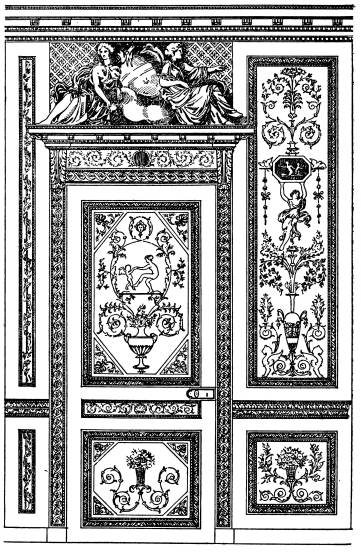
No. 126. Painted Interior Decoration. Marie Antoinette Boudoir. Louis XVI.
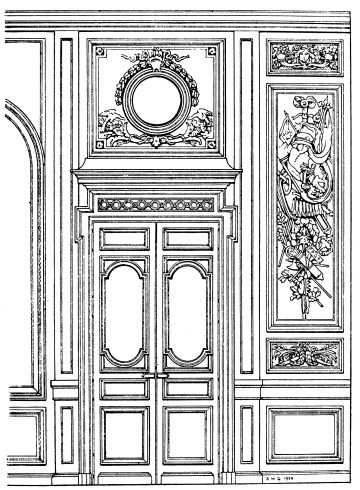
No. 127. Interior Treatment. Louis XVI.
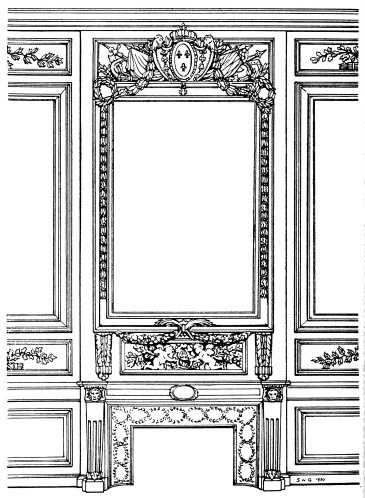
No. 128. Chimney-piece with Mirror. Louis XVI.
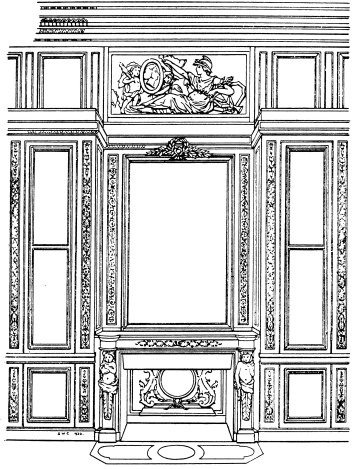
No. 129. Library with fitted Book-cases. Louis XVI.
a more sparing use of enrichments and greater refinement of detail.
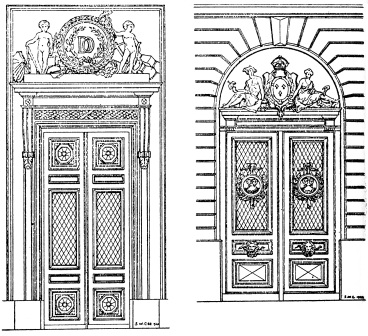
No. 130. Door Treatment. Louis XVI.
Probably the same influence that inspired Adam was at work in France, when the license that marked the Rococo gave place to a more severe and restrained expression in the succeeding Louis XVI style, in which the curvilinear and plastic forms became once more structural in feeling and refined in detail.
Associated with this change was Jacques Gondouin, who died at Paris in 1818 at the age of eighty-one, whose most celebrated work is the Ecole de Médécine. He was also entrusted with the erection of the column in the Place Vendôme.
Riesener and Gouthière
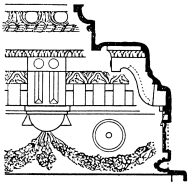
No. 131. Detail of Cornice. Louis XVI.
The most familiar names associated with the wood-work at the Louis XVI period are Riesener and Gouthière. Riesener is famous for his furniture, and Gouthière for the highly finished chased mounts with which this furniture was decorated.
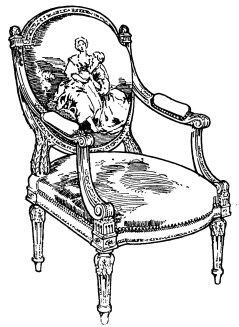
No. 132. Arm-chair covered with Beauvais Tapestry. Louis XVI.
Interior woodwork was generally of oak, painted white. Pilasters were used, and were either carved or painted in colours. Mouldings were frequently gilt.
Chairs and sofas were, in many instances, painted white and partly gilt. They were upholstered in silk or Beauvais tapestry, the designs of which were in panel form specially made for the purpose.
Cabinets, tables and other pieces of furniture were often exquisitely inlaid with various woods, tulip, rosewood, pear, holly and ebony were the most common, and Sèvres porcelain placques and gilt metal mounts were also used to embellish them.
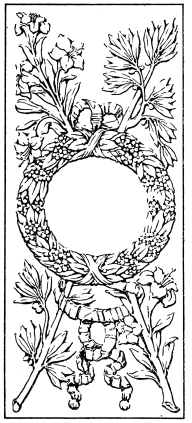
No. 133. Carved Oak Panel. Louis XVI.
Furniture supports, such as table and chair legs, were straight, tapered and fluted, with husks in the hollows of the flutes.
Among the decorative details were torches, quivers and other emblems, trophies, musical instruments, bouquets and festoons of flowers, and ribbons with peculiarly square and crisp folds. The laurel leaf was much used in borders, festoons and wreaths.
The style of the Louis XVI period was more severe than the preceding one, and was, in fact, a reaction from the flippancy which characterised the reign of Louis XV. There was a tendency to return to more classic forms, which prepared the way for the still more austere Empire phase which was deliberately based on the Roman and Greek styles.
Empire
Furniture was made in mahogany, rosewood and ebony, and was decorated with brass mounts or with carved ornaments, which were gilded.
Furniture legs and supports were fashioned after Greek and Roman forms, human figures and sphinxes being often employed.
Inlay was used of ivory and metal, and this class of work attained a very high degree of excellence.
Metal-work was unquestionably good, except that the details were somewhat hard in character.
The most striking decorative features were sphinxes, winged figures of Liberty, masks, the thyrsus of Bacchus, laurel wreaths and festoons, which were all severe in treatment and delicate in execution.
Empire in England
The Empire style spread to other parts of Europe, and was closely imitated in England, where it was chiefly remarkable for the extreme nicety and finish of the metal-work, metal being extensively used for the enrichment of furniture, for clocks, vases, candlesticks, inkstands and other objects.
Later English Architecture
Probably the most important name associated with English architecture towards the end of the eighteenth century is that of Sir William Chambers, who died in 1796.
Chambers, who at one time held the position of Surveyor General in the Board of Works, was one of those concerned in the establishment of the Royal Academy of Arts in 1768. During his professional career he executed commissions in various parts of the country, his principal work being Somerset House, which was commenced in 1776.
Another name associated with this period is that of George Dance, who designed the Mansion House of the City of London, which was built during the years 1739-53. Dance died in 1768, and was succeeded by his son, who was the architect of Newgate Prison, the site of which is now occupied by a modern building.
A pupil of Sir William Chambers, James Gandon, had the distinction of carrying off the first gold medal given for architecture by the newly-founded Royal Academy of Arts in 1768.
He designed, among other works, the Customs House, the Four Courts, and the building which is now the Bank of Ireland, all at Dublin.
French Influence on Europe
Throughout this necessarily brief summary it will be noted that attention is mainly given to the architectural development in France and England. The rest of Europe was similarly affected more or less, both in the Gothic period and in the revival known as the Renaissance, in which the initiative was taken by France early in the seventeenth century. From which period may be dated the decline in Italian taste.
French feeling, both as to form and detail, is apparent in not only Dutch and Flemish work, but in the more southern parts of Europe, particularly the phase known as Rococo.
Even in England, though the architectural traditions of Inigo Jones and Sir Christopher Wren became national in character, French feeling is evident in much of the decorative work, as in the designs of Chippendale and his contemporaries; with the exception of the brilliant period of Grinling Gibbons, whose distinctive manner and robust treatment survived, and constituted a school of carving typically English and unique in its artistry and craftsmanship.