Book Decoration
Reading edition
In Black and White, which is chiefly employed, the designs may be in tone or line with suggestion of rotundity or relief; or line decoratively employed, according to subject, or purely decorative.
The same applies to renderings in colour. Designs for covers are controlled by the processes involved, whether printed, stamped or tooled.
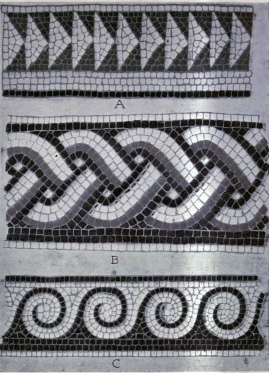
No. 268. Mosaic Borders.
A. From Carthage. B. & C. Withington, Gloucester.
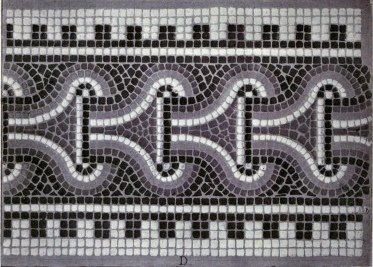
No. 269. Mosaic Border, Roman.
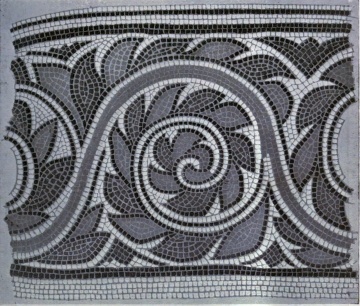
No. 270. Roman Mosaic. Woodchester, Gloucester.
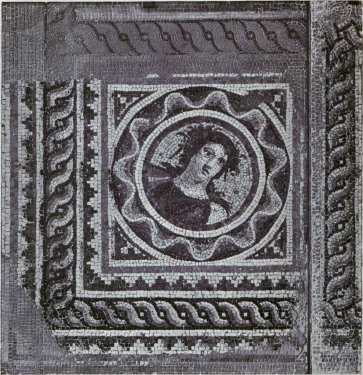
No. 271. Roman Mosaic. Treatment in Light and Shade suggestive of relief. (Photo: V & A Museum).
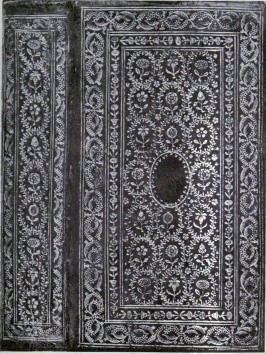
No. 272. Tooled Bookbinding in Leather. Repetition due to tools or stamps. (Photo: V & A Museum).
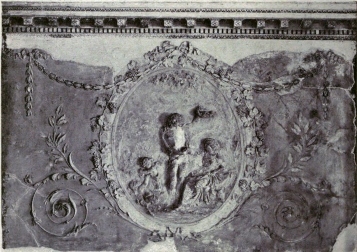
No. 273. Modelled Plaster, shewing relatively large ground area. (Photo: V & A Museum).
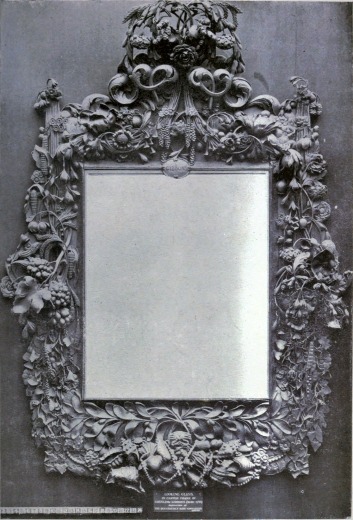
No. 274. Wood Carving. Grinling Gibbons. Attention devoted to detail with elimination of ground. (Photo: V & A Museum).
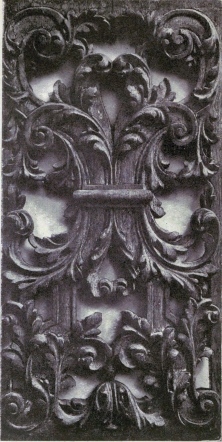
No. 275. Wood Carving. French, Louis XIV. (Photo: V & A Museum).
Bindings
In the two latter the ornament should be in profile or silhouette. In tooled bindings, repetition of unit or motif is essential, the design being the direct result of available tools.
In such bindings further interest may be imparted by gilding either the detail or by introducing gold as powdering on shapes or backgrounds, or by the so-called inlaying of other colours.
Relief—Economic Result of Method
In Relief ornament, design and character should be the result of technical expression. If considered from an economic point of view, the tendency would naturally be to obtain the maximum effect with the minimum of labour; and this would invariably result, when the decoration is built up or applied to an existing ground as in modelled work, in slight occupation, with comparatively large intervals.
In carving, where the original surface forms the highest relief, and has to be cut back to form the ground, the result would be reversed, the individual worker being more attracted to the treatment of detail than to clearing away uninteresting spaces. Carving, whether in wood or stone, is employed in various decorative positions, and except in the enrichment of friezes or mouldings—when the repeating unit is desirable—the design should be complete in itself.
Desirable Treatment in Carving
The treatment should evidence the direct employment of the tool, any attempt to efface or soften will result in loss of character and suggest the plastic effect incidental to modelling.
For convenience, and possibly in the absence of more desirable examples, students are often allowed in their early attempts at carving to reproduce casts of plastic origin. This is undoubtedly pernicious, as the model is probably unsuitable, and the student is thereby biassed. Examples should be selected in which the characteristic treatment is sufficiently evident if a true and thorough appreciation of the craft is to be instilled.
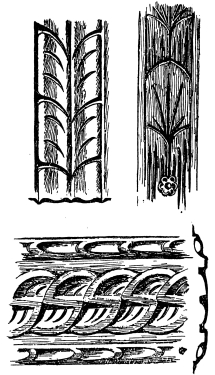
No. 276. Simple Jacobean Wood Carving. Direct gouge work.
In the design—which may occupy or fill the shape and can be symmetrically arranged on a central axis, or balanced—the effect is due mainly to Light and Shade. Further interest may be imparted by the sectional form or modelling of the details, groovings, striations or other textural suggestions.
Backgrounds
The employment of punched grounds in carved work is to be deprecated as mechanical in effect. Sufficient interest is obtainable by the process of cutting back, in the perfect levelling of which the carver need not be too concerned. Suspiciously uniform grounds are suggestive of work fret-sawed and applied.
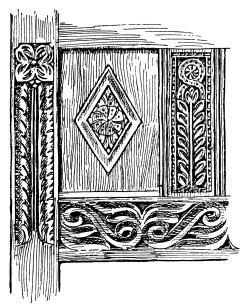
No. 277. Wood Carving. English. Late Elizabethan or Early Jacobean.
When carving in wood is in very high relief, it is occasionally, as in the Grinling Gibbons work, built up. This may not be a matter of great objection if properly attached, and the grain of fibre matched, but is, however, better avoided.
Reproduction Processes
Modelled ornament is generally employed in reproduction processes, such as moulding of Terra-cotta, plaster, etc. The design can be free in expression, or a unit of repetition according to requirement.
The detail which is applied to an existing surface is invariably more open, with a resulting display in the background.
The surface interest consists of contrasts in texture, the result of veining, striating and patterning forms. The relief is not, as in carved work, controlled by an original surface, but, being built up, is susceptible to greater variation. Mouldings may be broken by lapping and overlapping details, and though in some traditional work similar treatment occurs in wood-carving, it must be remembered that such details are too suggestive of, and more proper to, plastic renderings.
In economic moulded work undercutting of details should be avoided as this is only possible in piece or elastic moulds. In wood-carving, however, there is no restriction.
Metal Repoussé
Freedom and variety in detail are possible in Metal Repoussé, but as the light and shade is considerably modified by the nature of the surface, the design which is plastic in character incidental to method of working, should have regard for silhouette or profile display, and not be dependent upon surface modelling. The principal factor in effect is Light, both direct and reflected. Surface interest is the result of imparting by chasing various textures in striations or matt.
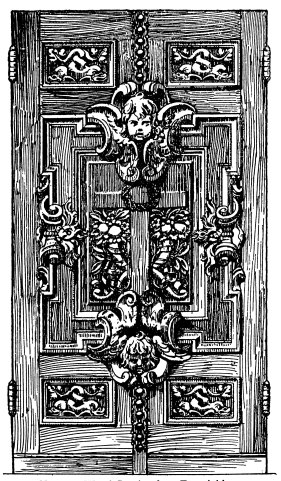
No. 278. Wood Carving from Fontainbleau. Early French Renaissance.
Excellent effect can be obtained by outlining with the tracing tool, leaving the surface of detail plain and uniform in height, and imparting texture with the matt tools in the intervals for the sake of contrast.
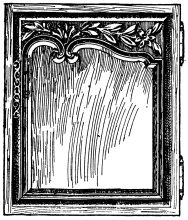
No. 279. Economic Wood Carving.
The method of working is simple, entailing manipulation from the face of the metal only, and the detail is left in slight relief by the ground being set back in the texturing. This treatment is only suitable where the ornamented area is enclosed. When the design is freely displayed on a ground without enclosing lines, it should appear in relief, the result of raising from the back; and texturing should be employed only on the details in contrast to the smooth ground. As in all applied work, the economic result is slight occupation.
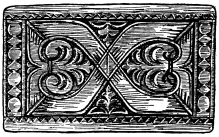
No. 280. Oak Box decorated with flat carving. Icelandic. 18th Century.
Metal, Cast
Cast metal is produced in sand moulds, a model or pattern being employed of which the casting is a reproduction. The
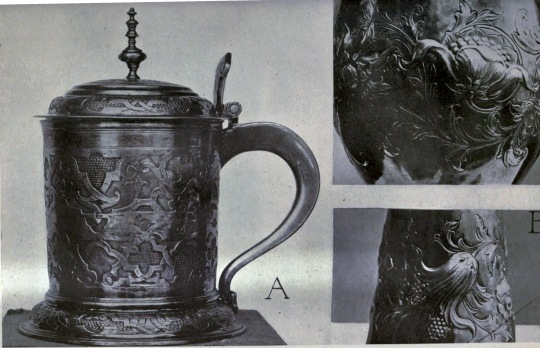
No. 281. Repoussé Work.
A. Pattern defined by tracing tool and interest imparted by different textures of ground.
B. Pattern raised from back, and defined and enriched by tracing and matt tools on face, affording textural contrast with plain ground.
(Photo of A. V & A Museum).
pattern may be originally modelled or carved, and this determines the character of the metal result, though it is a matter of indifference when the necessary finishing is by turning or filing.
Castings in iron are left as they leave the mould, but in bronze, except in Cire Perdu casting, the surface has to be entirely worked down. In common work, however, this is accomplished by means of small files or riffles and by chasing the more elaborate details.
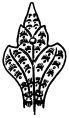
No. 282. Wrought Iron, simple form enriched by use of punches.
Character of Cast Work
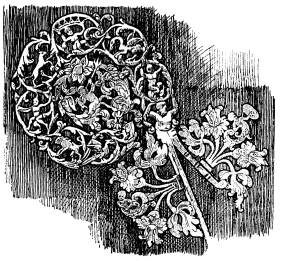
No. 283. Gondola Prow. Wrought Iron, comparative flat surface enriched by chiselled work.
As a matter of opinion it is consistent that the
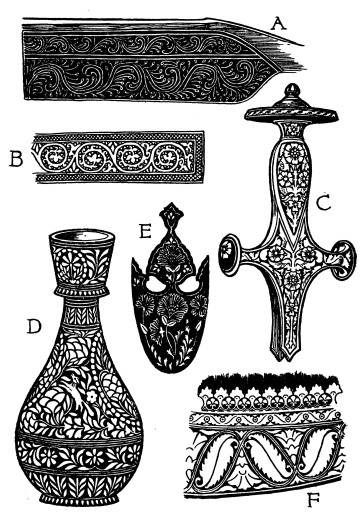
No. 284. Surface Interest in Metal.
A. Blade of State Battle-axe, damascened with silver, Indian.
B. Blade of Khyber Knife, engraved, Indian.
C. Hilt of Tulwar, damascened with gold, Indian.
D. Vase, Bidri Ware, pewter inlaid with silver, Indian.
E. Scabbard End, gold inlay, Indian.
F. Ornament on Gauntled Sword, damascened with gold, Indian.
character of cast work should be plastic, and if the original pattern is the result of carving, care should be taken to impart the desired feeling, the pattern being merely a means to the end.
Much depends upon the final finish; if this is to be bright, surface modelling should be a secondary consideration to surface interest resulting from contrast of textures. It, however, becomes of proportionate importance as the work is dull or toned, and therefore is subject to the ordinary conditions of Light and Shade.