Standing and Running Balance.
Reading edition
Millers as a rule know that a stone in standing balance is not always in running balance, and vice versa, yet they are well aware that a stone should be in both. The reason these two balances do not always exist at the same time, or why the light side of a stone standing should seem the heavy side on running, is not clearly understood, and hence the difficulty in obviating the trouble. The importance of a correct standing balance and at the same time a true running balance, cannot well be over-estimated. Suppose the balancing weights in a runner are so adjusted that the stone stands in balance on the cock-head when raised above the bed-stone, but on starting, instead of its face remaining true and running steady, one side droops, and it runs with an apparent vibration or oscillation of the face. It will be found, however, upon examination, that it will always run with the same side low—going to show that the difficulty is centered in one certain point.
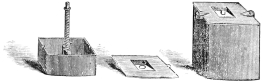
In these cuts are shown the improved balance boxes adopted by us. The one on the right is the box complete. They are placed in the runner with the rounding part in contact with the band, with the lid of the box a little below the plaster back. The figure to the left illustrates the inner adjustable box and screw for adjusting the same when in the stone. It will be noticed it has two parts divided by a partition. The cover to this inner box shown in the middle figure is secured with a screw, and fits down upon the box and close over the division, so that either side may be used when the weight is wanted at a point between any two of the balance boxes. We put five of them in a runner stone. This number is deemed entirely sufficient. They are made of cast-iron and fit up in good style, the wrought screws being all tapped into the iron. We find this balance box gives the miller entire control of the runner, and easy to operate, simply by removing the curb and letting the stone rest in position. A wrench is all the tool needed; the weights when in position are not subject to derangement, as those ordinarily used.
Now that we have the means explained by which this important work is to be done, next comes the question, How shall I do it? First, we would say, put the runner in standing balance in the usual manner, and lowering the required weight to the bottom of the boxes. In mills with the old style of stiff driving irons the spindle and driver must be carefully trammed to the runner, as well as a proper bearing and a good fit of the cock-head into the cockeye; unless this is attended to it will be no use to proceed. Where our self-tramming driving irons are used, the process of putting in a balance will be a pleasure instead of a long disagreeable process, and it will be more perfect than is possible with any other appliance for this purpose.
The runner being in standing balance, place two boards planed evenly and ⅜ of an inch in thickness between the stones, (they may be 4 to 8 inches wide) allowing the ends to project sufficiently to fasten securely to a block or piece of timber fastened to the husk; place them about midway between the spindle and outer edge of stone, and put the stone in motion, letting it down upon the boards until its face runs steady and true; then turn off the plaster back perfectly true with the face, from a firm rest properly supported; now try the standing balance again. By turning off the back it may have been changed. Next find the light side of the stone by elevating the runner from the boards, and run it as fast as it will bear without too much vibration, as in cases where the stone is much out of balance the full speed should be approached gradually in the process. Hold a pencil against the rest plank and approach it slowly until it touches the turned back of the stone, say 4 to 6 inches in from the band or skirt. It will of course mark the side which runs high. The principle or real cause of this side of the stone running high is that the center of gravity or weight on this side is too low, (below the cock-head and point of suspension,) while the center of weight on the side that runs low is too high and above the center. To change this so as to bring the center of weight of each side respectively on the same level, is what we must accomplish.
As we know which side of the stone was high, now take, say two to six pounds, as the case may require, of iron, broken into small pieces, or shot, and take one-half of the amount and put into the inside box screwed to the top of the box on the side that runs high, and the other half in the box or boxes opposite, and lowered by the screw into the bottom of the balance box. Then test the stone and make a new mark, add weight carefully until the face runs true up to the full grinding speed. Be careful to divide the weight, as it may be added, so as not to disturb the standing balance.
Standing balance is simply an equal weight on all sides.
Running balance is having the center of gravity just as far from the face on one side as the other.
Irregular motion, and no matter how fast, will not affect the runner when balanced as we have explained.
If this important item is properly attended to, as well as keeping the stones in good flouring face, there will be less killing of the life of flour, and allowing middlings and unclean bran to escape. The value of the flour, both as regards nourishment and health, depends on the amount of nutritious, aromatic and saccharine properties retained in the flour which the wheat contains.
This result depends upon the flouring process the meal has been subjected to between the stones. On the amount of these properties in the flour also depend the weight and sweetness of the loaf when baked; likewise its light and white qualities when used for any purpose.
