Measurement of Water in a Stream.
Reading edition
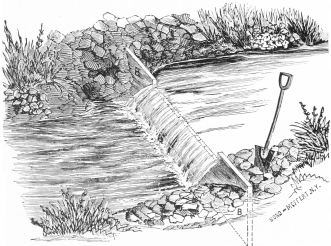
It is very important to ascertain the quantity of water that flows in a stream, and the head and fall, to determine the exact amount of power and the work it is capable of doing. It is frequently the case that mills are constructed before finding the power of the stream, and upon trial are found to fall short of their calculations. We give a very plain way which will determine this. Place a wide board as a dam across the stream (called a weir.) When the quantity of water is considerable, it must be made in sections to get it sufficiently wide and long; then cut a notch as shown in the engraving and about two-thirds the width of the stream, placing the bottom of the notch level, and let the ends of the weir dam (B B) be well bedded on each side of the stream. Observe in cutting the opening or notch to bevel the edges down stream to within say ⅛ of an inch of the side up stream; that the edges of the notch sides and bottom be almost sharp but true and square, and the whole opening sufficient for the water to pass; the bottom of the notch can be leveled by letting the water pass over in a thin sheet; then drive a stake three to four feet above the dam to one side or the middle of the stream, and the upper end of it on a level with the bottom of the notch in weir. And now that you have the dam made and in position so that all the water will pass through the notch and no leaks, allow the water to reach its full depth, then take square or rule and measure the exact distance from the top of the stake driven in the stream to the top of the water flowing towards the weir; 2d. Width of notch; 3d. Head and fall, and send to us, and we will give you the power of your stream, size of wheel to do the desired labor, &c.

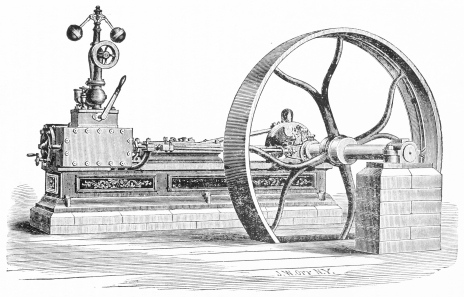
STEAM ENGINE.