Act 5 — ACT V
Reading edition
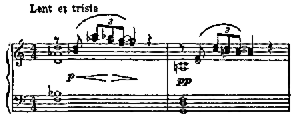
The last act opens with a dolorous phrase derived from the variant of the Mélisande theme noted on page 82 of the piano score. It is played by the violas, with harp accompaniment. The violins repeat it, and two flutes announce a new theme (page 268, measure 5), the motive of Pity:
XXII. PITY
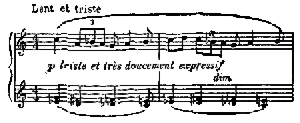
As Golaud bends with Arkël over the unconscious figure of Mélisande where she lies stretched upon her bed, muted horns and 'cellos play a gentle variant of the Fate theme, followed by the Mélisande motive as Golaud exclaims that they had but "kissed like little children." The theme of Pity accompanies Mélisande's awakening, and a new motive is heard as she responds, to Arkël's question: "I have never been better." This new theme (page 274, measure 4), of extraordinary poignancy, is given out by an oboe supported by two flutes, and its expression is marked triste et très doucement expressif. I shall call it the motive of Sorrow, for it seems like the comment of the music upon the transporting and utter sadness of the play's dénouement. It voices a gentle and passive commiseration, rather than a profound and shaking grief:
XXIII. SORROW
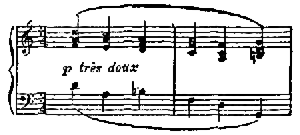
A third new theme, also of searching pathos, occurs in the strings, p, très doux, as Mélisande quietly greets her husband (page 279, measure 1), and later, when she says that she forgives him (page 282, measure 1). It may be called the motive of Mélisande's Gentleness:
XXIV. MÉLISANDE'S GENTLENESS
As Golaud's still unvanquished doubts and suspicions torture him into harsh interrogations, and he asks her if she loved Pelléas "with a forbidden love," an oboe and two flutes recall, p et doux, the Rapture motive. Later, in succession, we hear (on a solo violin over flute and clarinets) the Pelléas theme (page 289, measure 2), the motive of Gentleness, for the last time (page 290, measure 3), and the Mélisande theme (pages 290-292). As Mélisande recognizes Arkël, and asks if it be true "that the winter is coming," a solo violin, solo 'cello, and two clarinets play an affecting phrase (page 294, measure 5). She tells Arkël that she does not wish the windows closed until the sun has sunk into the sea, and the orchestra accompanies her in a passage of curiously delicate sonority (page 295, measure 6).
The final scene of the act is treated with surpassing reticence, dignity, and simplicity, yet with piercing intensity of expression. Nothing could be at the same time more sparing of means and more exquisitely eloquent in result than Debussy's setting of the scene of Mélisande's death—it is music which dims the eyes and subdues the spirit. The pianissimo-repeated chords in the divided strings which accentuate Arkël's warning words (page 304, measure 8); the blended tones of the harp and the distant bell at the moment of dissolution (page 306, measure 11); Arkël's simple requiem over the body of the little princess, with the grave and tender orchestral commentary woven out of familiarly poignant themes (pages 308-309); the murmurous coda, with its muted trumpet singing a gentle dirge under an accompaniment of two flutes (page 310, measure 7),—these things are easy to
XXV.
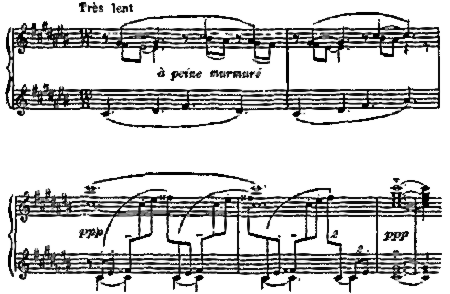
value, but they may not easily be praised with adequacy.
Concerning felicities of structural and technical detail in the work as a whole, this has not been the place to speak; but if curious appreciators, or others who are merely curious, should perhaps be induced, by what has been written here, to explore for themselves Debussy's beautiful and in many ways incomparable score, the purpose of this study will have been achieved.