Act 1 — ACT I
Reading edition
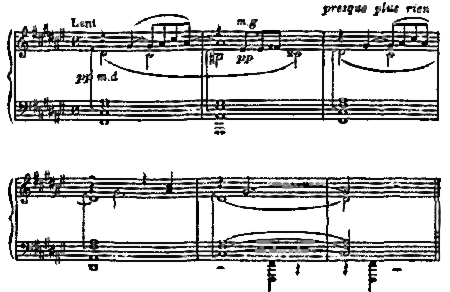
A brief orchestral prelude, less than twenty measures in length, introduces the opening scene of the first act. Divided and muted 'cellos, double-basses, and bassoons intone, pp, a solemn and brooding theme[6] designed to evoke the thought of the forest, which, sombre, mysterious, and oppressive, forms the background against which the events of the drama are projected (page 1, measure 1):[7]
I.THE FOREST
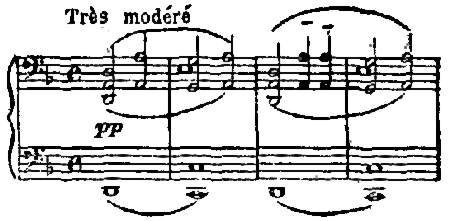
This is immediately followed by one of the most important themes in the opera, that which seems to typify the veiled and overshadowing destiny which is very close to the central thought of Maeterlinck's play. Strangely harmonized, this Fate theme (it is in the second measure that its kernel is contained, and it is this portion of it that is most frequently repeated) is sounded, pp, très modéré, by oboes, English horn, and clarinets (page 1, measure 5):
II. FATE
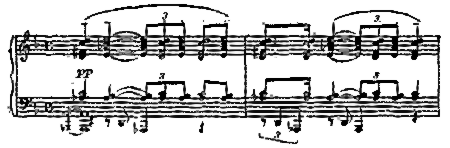
These two themes are repeated, with altered harmonization; then follows one of the two principal themes of the score—that of Mélisande, sung, doux et expressif, by the oboe over tremolos in the divided strings (page 1, measure 14):
III. MÉLISANDE
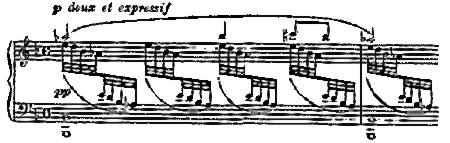
It is followed by a derivative theme which, in the drama, suggests the naïveté of Mélisande's personality (page 1, measure 1):
IV. MÉLISANDE'S NAÏVETÉ
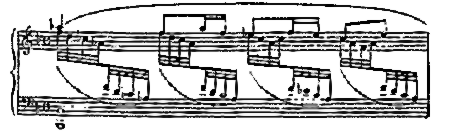
Flute, oboe and clarinet repeat it over a counterpoint formed by the Fate theme (2 horns), and the curtain opens to the accompaniment of the Forest motive. This latter theme, with the motive of Fate, underscores the earlier portions of the dialogue between Golaud and Mélisande. At Golaud's words: "Oh! you are beautiful!" we hear (page 7, measure 1) an ardent phrase in the strings expressive of his awakened passion for the distressful little princess:
V. GOLAUD'S LOVE
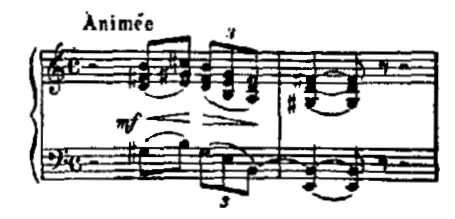
This theme is sounded again, with peculiarly penetrating effect, in the divided strings, as Golaud entreats Mélisande not "to weep so" (page 9, measure 4), and, later in the scene (page 19, measure 1), when he tells her that she must not stay in the forest alone after nightfall, and urges her to go with him. As he informs her that he is "Prince Golaud, grandson of Arkël, the aged king of Allemonde," we hear, on the bassoons and horns, his own motive (page 14, measure 8):
VI. GOLAUD
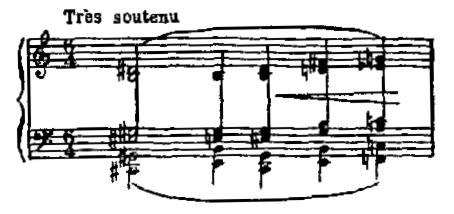
"You look like a mere child," he says, and the Mélisande theme is given out, doux et calme, by the divided strings (page 18, measure 2). As the two go out together, the motive of Fate is quietly intoned by the horns (page 22, measure 3).
An interlude of some fifty measures, in which the Forest, Fate, and Mélisande themes are exploited, introduces the second scene of the act. To an accompaniment of long-sustained chords varied by recurrences of the Mélisande theme, Geneviève reads to the venerable Arkël Golaud's letter to his brother. The entrance of Pelléas is accompanied by the theme which characterizes him throughout—the second of the two motives (that of Mélisande being the other) which most conspicuously dominate the score. It is announced (page 33, measure 10) by three flutes and a clarinet, over a viola accompaniment:
VII. PELLÉAS
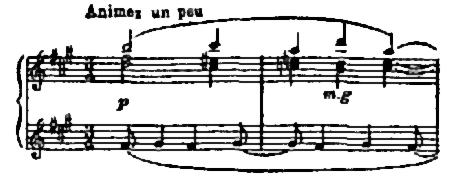
The scene closes with a variant of this, and there is an interlude in which the orchestra weaves a commentary out of the themes of Fate and Golaud's Love.
As the third scene opens (before the castle), the Mélisande theme is sung, mélancolique et doux, by the oboe against a murmuring accompaniment of the strings. Together with the Pelléas theme, it accompanies the opening portion of the scene. A suggestive use is made of a fragment of the Fate theme at Mélisande's words, after Pelléas prophesies the approach of a storm: "And yet it is so calm now!" (page 44, measure 5). Just before the voices of the departing sailors are heard, the curious student will note a characteristic passage in the orchestra (page 45, measure 1)—a sequence of descending "ninth-chords" built on a downward scale of whole tones. The Fate theme, combined with that of Mélisande, colors the rest of the scene to the end. The conclusion of the act is striking: two flutes outline a variant of the Mélisande motive; a horn sounds the first three notes of the second measure of the Fate theme, and four horns and flute sustain, pp, an unresolved suspension—C#-F#-A#-D#-G#.
VIII.