Act 4 — ACT IV
Reading edition
A variant of the Pelléas theme, with the opening notes of the Fate motive as an under voice, begins the short prelude to the fourth act; there is a hint of the Yniold theme, and the first two notes of the Pelléas motive introduce the first scene. The interview between Mélisande and her lover, in which they arrange their tryst at the fountain in the park, is treated with restraint; an expressive phrase sung by the 'cellos (page 194, measure 11) may be noted at the point where Pelléas informs Mélisande that she will look in vain for his return after he has gone. The Mélisande theme, in a new form, opens the moving scene between Mélisande and Arkël in which he tells her of his compassionate observation of her since first she came to the castle. During his speech and her replies we hear her motive and that of Fate (page 205), the latter theme announcing the entrance of Golaud, distraught, blood-bespattered, seeking, he says, his sword. The music of the ensuing scene does not call for extended description—rather for the single comment that in it Debussy has proved once for all his power of forceful, direct, and tangible dramatic utterance: the music here, to apply to it Golaud's phrase in the play, is compact of "blood and iron"—as well it needed to be for the accentuation of this perturbing and violent episode. The Fate motive courses ominously through its earlier portions. We hear, too, what I have called the "second" Mélisande theme—that which seems to denote her naïveté (see Ex. IV), and a strange variant of the first Mélisande theme (page 212, measure 4). At the climax of the scene, when Golaud seizes his wife by her long hair and flings her from side to side, the music is as brutal, as "virile," as the most exigent could reasonably demand. Later, as he hints at his purpose,—"I shall await my chance,"—the trombones, tubas, and double-basses pizzicato mutter, pp, the motive of Vengeance. The orchestral interlude is long and elaborate. We hear a variant of the Fate theme, which reaches a climax in a fortissimo outburst of the full orchestra. The theme in this form is developed at length; there is a reminiscence of the Mélisande theme, and the music, by a gradual diminuendo, passes into the third scene of the act—in the park, before the Fountain of the Blind. At the beginning occurs the incident of the passing flock of sheep observed by Yniold. This scene need not detain us long, since it is musically as well as dramatically episodic. There are no new themes, and no significant recurrences of familiar ones, though the music is rich in suggestive and imaginative details; as I have previously noted, it is omitted in the performances at the Opéra-Comique.
Pelléas enters, and there is an impassioned declaration of his theme, scored, f, for wood-wind, horns, and strings, as he observes that he is about to depart, "crying out for joy and woe like a blind man fleeing from his burning house." There is a return of the Mélisande theme; and then, as she herself enters, and Pelléas urges her not to stay at the edge of the moonlight, but to come with him into the shadow of the linden, there enters a theme of great beauty and tenderness, announced, mystérieusement, by horns and 'cellos (page 236, measure 6). I may call it, for want of a better name, the motive of The Shadows, since it appears only in association with the thought of sheltering darkness and concealment:
XVII. THE SHADOWS
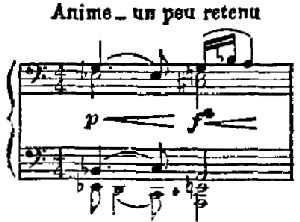
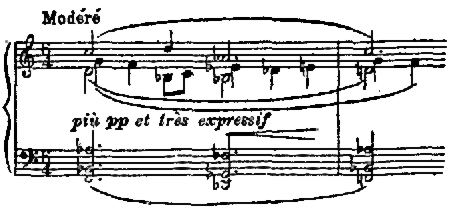
We hear the Fate motive when Mélisande warns Pelléas that it is late, that they must take care, as the gates of the castle will soon be closed for the night. There is a gracious variant of this motive as Mélisande tells how she caught her gown on the nails of the gate as she left the castle, and so was delayed. Then comes a reminiscence of the Fountain theme (the authentic wonder of which is that it is not a theme at all, but merely a single chord introduced by a grace-note; yet the vividness of its effect is indisputable), suggested, pp, by horns and harp, at Mélisande's words: "We have been here before." As Pelléas asks her if she knows why he has bidden her to meet him, strings and horn give out, pp et très expressif, a lovely phrase derived from the Pelléas theme (page 242, measure 1). Their mutual
XVIII.
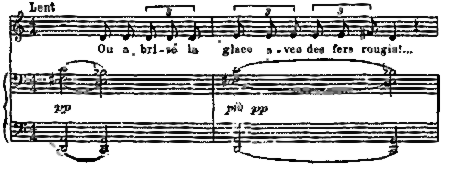
confessions of love, so simply uttered in the text, are entirely unaccompanied by the orchestra; but as Pelléas exclaims: "The ice is melted with glowing fire!" four solo 'cellos, with sustained harmonics in the violins and violas, sound,
pianissimo
, a ravishing series of "ninth-chords" (page 244, measure 6)—a sheer Debussy-esque effect, for the relation between the chords is as absolutely anarchistic as it is deeply beautiful. "Your voice seems to have
XIX.
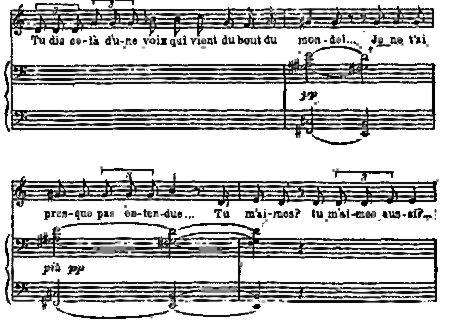
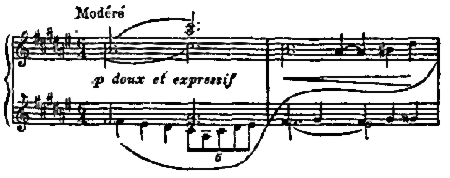
blown across the sea in spring," says Pelléas, and a horn, accompanied by violins in six parts, announces the motive of
Ecstasy
(page 245, measure 7):
XX. ECSTASY
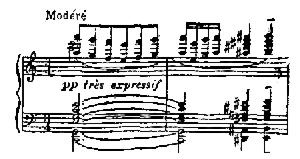
The 'cellos intone the Mélisande theme as Pelléas tells her that he has never seen anyone so beautiful as she; the theme of Ecstasy follows in the strings, horns, and wood-wind, forte; the theme of The Shadows returns as Pelléas again invites her into the darkness beneath the trees; there is a dolorous hint of the Mélisande theme as she says that she is happy, yet sad. And then the amorous and caressing quality of the music is sharply altered. There is a harsh and sinister muttering in the double-basses as Pelléas, startled by a distant sound, cries that they are closing the gates of the castle, and that they are shut out. The Golaud motive is recalled with sombre force in the strings as the rattle of the great chains is heard. "All the better! All the better!" cries Mélisande; and, as they embrace in sudden abandonment, we hear, introduced by an exquisite interplay of tonalities, the motive of Rapture, announced, pp, by divided strings and flutes (page 258, measure 12):
XXI. RAPTURE
As Mélisande whispers suddenly to Pelléas that there is some one behind them, a menacing version of the Vengeance theme is played, pp, by the basses, trombones, and timpani. This theme and that of Rapture hasten the music toward its culminating point of intensity. The Pelléas theme is given out by the 'cellos, the Mélisande theme (this is not indicated in the piano version) by the violins, and as the lovers embrace desperately, a crescendo leads to a fortissimo proclamation, by all the orchestral forces, of a greatly broadened version of the motive of Ecstasy. As Golaud rushes upon them and strikes down Pelléas, the Fate theme is declaimed by four horns in unison over string tremolos; and, as he turns and silently pursues the fleeing Mélisande through the forest, his Vengeance theme brings the act, by a rapid crescendo, to a crashing close.