Act 2 — ACT II
Reading edition
The Pelléas theme, sung by two flutes, opens the brief introduction to the second act. It is repeated, interwoven with harp arpeggios. Immediately preceding the entrance of Pelléas and Mélisande a muted horn, two flutes, two oboes, and harp sound a chord of singularly liquid quality—one of those fragmentary effects in the invention of which Debussy is so curiously happy. It is the motive of The Fountain.[8]
IX. THE FOUNTAIN
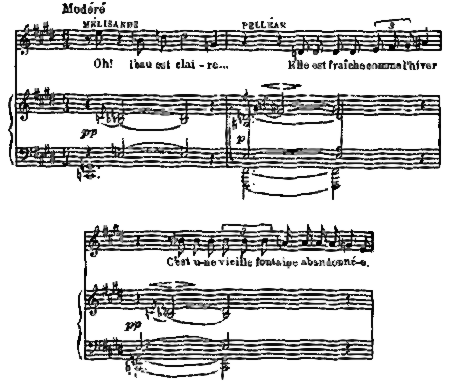
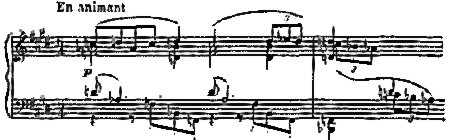
It is repeated, with still more magical effect (scored for divided violins and violas, two muted horns, and harp), as Mélisande remarks upon the clearness of the water, while the violins and violas weave about it a shimmering figure in sixteenth-notes with which its appearances are usually associated. As Pelléas warns Mélisande to take care, while she leans above the water along the marble edge of the basin, the clarinet, over a string accompaniment, announces an impassioned phrase (page 62, measure 3)—the theme of Awakening Desire:
X. AWAKENING DESIRE
As Pelléas questions Mélisande about the ring with which she is playing,—her wedding-ring,—and when it falls into the water while she is tossing it in the air, we hear persistently the theme of Fate, which, with the Golaud theme (portentously sounded, pp, by horns and bassoons), closes the scene. There is an interlude in which the Golaud, Mélisande, and Fate themes are heard.
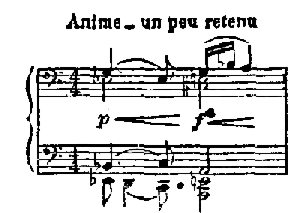
The rhythm of the latter theme mutters ominously in the bass as the second scene is disclosed. When Golaud, lying wounded on his bed, describes to Mélisande how, "at the stroke of noon," his horse "swerved suddenly, with no apparent cause," and threw him, as he was hunting in the forest ("could he have seen something extraordinary?"), the oboe recalls the theme of Awakening Desire, which was first heard as Mélisande and Pelléas sat together by the fountain in the forest during the heat of midday. The rhythm of the Fate motive is hinted by violas, 'cellos, and horns as Golaud, in answer to Mélisande's compassionate questioning, observes that he is "made of iron and blood." Mélisande weeps, and the oboe sounds a plaintive variant of her motive (page 82, measure 2); the strings repeat it as she complains that she is ill. Nothing has happened, no one has harmed her, she answers, in response to Golaud's questionings: "It is no one. You do not understand me. It is something stronger than I," she says; and we hear the Pelléas theme, dulcetly harmonized, in the strings. When, later, Golaud mentions his brother's name inquiringly, and she replies that she thinks he dislikes her, although he speaks to her sometimes, we hear, very softly, the theme of Awakening Desire. As their talk progresses to its climax, there is a recurrence of the Fate theme; then, as Golaud, upon discovering the loss of her wedding-ring, harshly tells her that he "would rather have lost everything than that," the trombones and tuba declaim (page 99, measure 5) a threatening and sinister phrase which will later be more definitely associated with the thought of Golaud's vengeful purpose:
XI. VENGEANCE
This is repeated still more vehemently three measures further on, and there is a return of the Fate motive as Mélisande, at the bidding of Golaud, goes forth to seek the missing ring. An interlude, in which are blended the variant of the Mélisande theme, which denotes her grieving, and the shimmering figure in sixteenth-notes heard during the dialogue at the fountain, leads into the scene before the grotto.
As Pelléas and Mélisande stand in the darkness of the cavern we hear again (page 110, measure 2) the variant of the Fate motive which marked the close of the preceding scene; then, as a sudden shaft of moonlight illuminates the grotto, it is expanded and transmuted into a gleaming flood of orchestral and harmonic color (two flutes, oboe, two harps glissando, string tremolos, cymbals pp). While they talk of the beggars sleeping in a corner of the cave, an oboe and flute trace a tenuous and melancholy phrase (doux et triste) which continues almost to the end of the scene; it leads into a quiet coda formed out of the theme of Fate.