DAYS TO REMEMBER
Reading edition
DAYS TO REMEMBER
THE BRITISH EMPIRE IN THE GREAT WAR
BY
JOHN BUCHAN
AND
HENRY NEWBOLT
THOMAS NELSON AND SONS, LTD. LONDON, EDINBURGH, NEW YORK TORONTO, AND PARIS
First Impression 1922 Second Impression 1923 Third Impression 1925 Fourth Impression 1925 Fifth Impression 1928 Sixth Impression 1935 Seventh Impression 1937
CONTENTS
PART I.
INTRODUCTORY.
CHAPTER
THE CAUSES OF THE WAR
A BIRD'S-EYE VIEW OF THE WAR
THE TURN AT THE MARNE
PART II.
THE WORCESTERS AT THE FIRST BATTLE OF YPRES
THE CANADIANS AT THE SECOND BATTLE OF YPRES
THE TAKING OF LOOS
DELVILLE WOOD
THE THIRD BATTLE OF YPRES
THE TANKS AT CAMBRAI
THE SOUTH AFRICANS AT MARRIÈRES WOOD
THE BATTLE OF THE LYS
THE SECOND BATTLE OF THE MARNE
THE BEGINNING OF THE END
THE AUSTRALIANS AT MONT ST. QUENTIN
THE LAST BATTLE
PART III.
THE "SIDE SHOWS".
THE LANDING AT GALLIPOLI
THE LANDING AT GALLIPOLI (continued)
THE DEPARTURE FROM GALLIPOLI
THE CAPTURE OF JERUSALEM
ALLENBY'S GREAT DRIVE
PART IV.
THE SILENT SERVICE.
THE SILENT SERVICE
CORONEL
THE FALKLANDS
MYSTERY SHIPS
JUTLAND
THE BRITISH SUBMARINE SERVICE
THE BRITISH SUBMARINE SERVICE (continued)
THE MERCANTILE MARINE AND FISHING FLEETS
ZEEBRUGGE
PART V.
BEHIND THE LINES.
BEHIND THE LINES AND AT HOME
PART VI.
VICTORY.
THE LAST DAY
LOOKING BACKWARD
LIST OF ILLUSTRATIONS
PORTRAITS.
Field-Marshal Sir John French (Earl of Ypres)
Field-Marshal Sir Douglas Haig (Earl Haig of Bemersyde)
Marshal Foch
Field-Marshal Sir Edmund Allenby (Viscount Allenby of Megiddo)
Admiral Sir John Jellicoe (Viscount Jellicoe of Scapa)
Admiral Sir David Beatty (Earl Beatty of the North Sea)
Field-Marshal Earl Kitchener
MAPS.
The Critical Day in the First Battle of Ypres
The Second Battle of Ypres
Battle of Loos: Advance to Loos and Hill 70
Battle of the Somme: Longueval and Delville Wood
Cambrai: the Advance of the Infantry Divisions
The Second Battle of the Marne.
First Stages of the last Allied Offensive
The Landing Beaches at Gallipoli
Evacuation of the Gallipoli Peninsula
Palestine: the Decisive Battle
Battle of Coronel
Battle of the Falkland Islands—First Phase
Battle of the Falkland Islands—Second Phase
Battle of the Falkland Islands—Last Phase
Battle of Jutland: Track Chart
Zeebrugge.
The Front on the Eve of the Allied Offensive, and on the Day of the Armistice
PART I.
INTRODUCTORY.
DAYS TO REMEMBER.
CHAPTER I.
THE CAUSES OF THE WAR.
It is never easy to fix upon one cause as the origin of a great war, and the war of 1914 was the outcome of several causes combined. For twenty years there had been growing up in Europe a sense of insecurity; the great Powers had become restless and suspicious of one another, and one Power, Germany, was seriously considering the possibility of some bold stroke which would put her beyond the reach of rivalry. Germany, since her victory over France in 1870, had become a very great and rich nation; she had spread her commerce over the world; and she was anxious to create an empire akin to those of Britain and France. But she began the task too late in the day; she could succeed only at the expense of her neighbours. The ambition of Germany was, therefore, one perpetual source of danger.
Another danger was her nervousness, which frequently accompanies ambition. There was an alliance between France and Russia, and a growing friendliness between Britain and France, and Germany feared that her rivals were combining to hem her in and put a stop to what she considered her natural development. Russia had fallen very low after the war with Japan, but was rapidly recovering both in wealth and armed strength. France was making strenuous efforts to increase her army, so that she should not be at a disadvantage as compared with the far greater population of Germany. Britain had no ambitions of conquest; her aim was the peaceful development of her Empire. But that was an oversea Empire, and she required a large navy; and the size of this navy seemed to Germany to be a menace to her future.
The result was that in the summer of 1914 the rulers of Germany had decided that some great effort must soon be made; they must put their land in such a position that for the future it would have no cause to dread the aggression, or even the rivalry, of other Powers. If they delayed too long they feared that the growing wealth of Russia and the increased military strength of France would make such an effort for ever impossible.
On June 28, 1914, the Archduke Francis Ferdinand, the heir to the Austrian throne, was murdered, along with his wife, in the little Bosnian town of Serajevo. Austria had long been jealous of the movement towards unity among the Slav peoples in the Balkans, with Serbia at their head, and she believed, or pretended to believe, that the murder had been connived at by the Serbian Government. Germany, for reasons of her own, was equally desirous to see the power of the Balkan states diminished. She had a grandiose design of extending her influence eastward through Constantinople to the Persian Gulf, with Turkey as her ally or her tool, and planting a German outpost on the flank of our Indian Empire; and a strong Serbian kingdom, or a union of Slav peoples, would effectually bar the way. With the approval of Germany, therefore, Austria sent an ultimatum to Serbia, demanding certain concessions which would have made Serbia no longer a sovereign state. Serbia, while willing to grant most of the demands, was compelled to refuse others, and Austria promptly declared war.
Russia now interfered in support of Serbia, and mobilized her armies on her southern frontiers. Every attempt was made by the statesmen of Western Europe, and notably by the British Foreign Secretary, Sir Edward Grey, to limit the quarrel and to persuade Austria to listen to reason. Germany, however, had no desire for a peaceful settlement. She induced Austria to refuse all mediation, and presently, after a peremptory request to the Tsar to demobilize, she declared war upon Russia. Russia and France were allies, and war with France followed naturally within twenty-four hours.
The position of Britain had become extremely difficult She had no formal alliance with France, but in her own interests she could not allow her nearest neighbour to be crushed, and the balance of power in Europe to be entirely changed. Britain had never seriously considered the possibility of a European war, and was extremely averse from interfering in a quarrel in which she had no direct concern. She might well have hesitated till it was too late to act with effect, or have blundered into some foolish compromise with Germany.
The situation was saved by Belgium. The German scheme of attack on France was based upon a sudden invasion from the north, and for this a march through Belgium was essential. The neutrality of Belgium had long before been guaranteed by all the great Powers, but Germany argued that her necessity must override the law of nations, and demanded a passage through Belgium. This was refused. The invasion of Belgium accordingly began on Sunday, the 2nd August, and this outrage determined the policy of the British Government and the British people.
On Monday, the 3rd August, Sir Edward Grey announced that the fleet and the army had been mobilized, and that Britain proposed to defend with the sword her treaty obligations to Belgium. That evening an ultimatum was sent to Germany demanding her immediate withdrawal from Belgium; next day we were at war with Germany. On the same afternoon the German Imperial Chancellor made a speech defending his violation of Belgian neutrality. "He who is threatened, as we are threatened, can have but the one thought—how he is to hack his way through." The German Government had believed to the last that Britain would remain neutral, and her entry into the conflict for a moment dashed their zeal for war. "The British change the whole situation," the Emperor told the United States Ambassador. "An obstinate nation! They will keep up the war. It cannot end soon."
Britain had no great military force to throw into the balance, such as the armies of France and Russia. Her small regular army was little more than a garrison for her Oversea Dominions, and her Territorial Force was intended for home defence. But Lord Haldane, when Secretary for War, had foreseen the possibility of a Continental struggle, and had prepared plans by which an Expeditionary Force of about 100,000 men could be placed on the Continent of Europe in a very short time. This force was, for its size, probably the most expert army in the world. It took its place on the left of the French line, and, though small in comparison with the mighty levy of France, it was fated to play a leading part in the first decisive battles.
Behind the regular army was our second line of defence, the Territorials, nominally 300,000 strong. But it was very certain that as soon as war was declared the whole manhood of Britain would be called upon, and that many hundreds of thousands of young men would be eager to serve. Lord Kitchener was appointed Secretary for War, and under his direction recruiting began. Before Christmas nearly two millions of our men were under arms.
But Britain's main weapon was her navy, which was by far the strongest in the world. After that came her wealth and her great manufacturing capacity, by which she could supply the munitions of war required both for her own forces and for those of her allies. If her navy could dominate the seas, then her commerce would go on as before, while that of Germany would cease, and her troops and those of her allies could be moved about the world at her pleasure. "He who commands the sea," as Francis Bacon said long ago, "hath great freedom."
Germany was prepared for a war which she had always foreseen, and had the greater strength; but if the Allies did not suffer an early defeat, their strength was certain to grow with every month, while that of Germany must decline. But if the Allies were thus to grow in power they must be able to maintain free communications with the outer world and with one another, and for this they must rely on the supremacy of the British fleet.
In the very first days of war events happened which proved that the German Emperor was right in dreading the entry of Britain into the struggle. The British Empire overseas awoke to action like a strong man from slumber, and there began an epic of service which was to grow in power and majesty up to the last hour of the campaign. No man can read without emotion the tale of those early days in August, when from every quarter of the globe there poured in appeals for the right to share in Britain's struggle.
The great free nations of the Empire—Canada, South Africa, Australia, and New Zealand—prepared to raise and send troops, and the smallest Crown colonies made their contributions in money or supplies. India, whom Germany believed to be disloyal, at once agreed to send two infantry divisions and one cavalry brigade, and all the native rulers and princes placed their resources at the King-Emperor's call. Almost every Indian chief offered personal service in the field.
This rally of the Empire aroused a sense of an immense new comradeship which stirred the least emotional. The British Commonwealth had revealed itself as that wonderful thing for which its makers had striven and prayed—a union based not upon laws and governors, but upon the deepest feelings of the human spirit. The effect of the muster was not less profound upon our ally across the Channel. No longer, as in 1870, did France stand alone. The German armies might be thundering at her gates, but the ends of the earth were hastening to her aid, and the avenger was drawing nigh.
CHAPTER II.
A BIRD'S-EYE VIEW OF THE WAR.
Germany had foreseen and prepared for just such a conflict as now began, and was able to put into the field in the West larger forces than those of France and Britain combined. These forces were also better trained and better supplied with transport, artillery, and machine-guns. Her plan was to defeat France and Britain in the first month, and then to turn her main armies against Russia, for she assumed that Russia would be slow to mobilize her gigantic numbers. But if the first attack on France should fail the situation would be changed, and Germany would be compelled to fight on two fronts at once, the East and the West.
If the conflict was protracted Germany would lose the advantage of numbers, for then the greater united manpower of the Allies could be trained for the field, and if the British navy continued to rule the seas those new armies could be supplied and moved at the Allies' will. Moreover, though Germany could produce most of the necessaries of life and the apparatus of war within her own borders, yet the Allied control of the sea would cut her off from certain vital kinds of war material.
The Great War falls therefore into three stages. At the start Germany, with the advantage of surprise and long preparation, embarked on a war of movement in the hope of immediate victory. She failed in this, and the campaign then became a siege in which the Allies sat round her entrenched stronghold. That vast stronghold embraced half of Europe and part of Asia; it could produce most things that it needed, and carry on its normal life. Brilliant sallies were made, which more than once nearly dispersed the besiegers; but, nevertheless, for three and a half years the Teutonic Powers were as the garrison of a beleaguered city. Then came the short, last stage, when the outworks of the fortress crumbled, and the Allies pressed in and forced the garrison to surrender.
Germany began the war with Austria as her ally. Within three months she had been joined by Turkey, and by the end of the first year of war Bulgaria mustered on her side. The Allies at the start were France, Britain, Russia, Belgium, Serbia, and Japan; in May 1915 Italy joined them, and in August 1916 Rumania. Before the end Portugal and Greece, among the European Powers, were added; the United States of America joined in April 1917; and in the last year of the war there were altogether eleven Powers in Europe, Asia, and America on their side. The main battles were fought on the Continent of Europe, and the main belligerents, from start to finish, were the European nations. The accession of America, however, was vital for the Allied victory, as it counterbalanced the failure of Russia, which, after the revolution in March 1917, rapidly went to pieces and dropped out of the fighting line.
Before telling of any special incidents of the great struggle it is desirable to have before our minds a general bird's-eye view of the whole war. Germany's first plan of an immediate conquest was defeated by France and Britain at the First Battle of the Marne in September 1914. She made a second attempt upon the shores of the English Channel, which was foiled before Ypres in November of the same year. After that her policy was to stand on the defensive in the West and to aim at the destruction of Russia. In this, during 1915, she nearly succeeded. The Russian armies were driven out of Poland, but they established their line during the autumn, and Germany's ambitious strategy had once more failed.
In 1916 the Allies were ready for a combined advance, Germany was aware of their policy, and tried to anticipate it by her great attack on Verdun in February of that year—a battle which was fiercely contested for months, and finally ebbed away about midsummer. By that time Austria's attack on Italy had also failed and the Allied advance begun. The Russians won great successes in Galicia, and the British and French on the Somme dealt the German armies a blow from which they never really recovered. In Rumania, on the other hand, Germany had a temporary success; but by the close of 1916 it was clear to her commanders that unless some miracle happened the war would end with an Allied victory during the following year.
That miracle happened, in the form of the Russian revolution in the spring of 1917. Thereafter Germany was able to get rid of the war on her eastern frontier and to throw all her strength against the West. During that spring and summer she staved off the French and British attacks at Arras, at Ypres, and on the Aisne, and in the autumn of 1917 she was ready to begin her own offensive. Her first blow was directed against Italy, whom she drove back fifty miles from the Isonzo to the Piave, with immense losses. In March 1918 she struck her great blow in the West. With a large superiority in men and guns, she attacked the British at St. Quentin, and forced them to retreat almost to the gates of Amiens.
It was a success, but only a limited success, and with this last stroke her energy began to ebb. Foch was now Commander-in-Chief of the Allies, and with great skill he maintained a stubborn defensive till such time as he had gathered strength for a counter-attack. Meantime the new armies of America were arriving in France at the rate of 10,000 a day. In July Germany struck her last blow on the Marne in a frantic effort to reach Paris. That blow was likewise warded off, and three days later the Allied counter-offensive began.
Then in a series of great attacks all the prepared German defences were broken down. By the early days of October Turkey and Bulgaria had been defeated in the East, and the surrender of Austria followed before the end of the month. Finally, on November 11, 1918, Germany herself was forced to sue for an armistice in order to save her armies from destruction. An armistice was granted, but its terms involved an unconditional surrender to the will of the Allies.
The episodes contained in the following chapters have been chosen as examples of the achievements of Britain and her Oversea Dominions in the Great War. They are notable episodes, which stand out from the day-to-day routine of the fighting. They are exploits, each of which materially contributed to Germany's defeat. But the qualities which they reveal in the men who shared in them were not confined to those men; they are typical qualities, and were possessed in no less degree by hundreds of thousands of men who fought in obscurity, but whose unrecorded service was equally the cause of victory. A war is won not only by the shining deeds of the few, but also by the faithfulness of the many, though it is the brilliant deeds which stand out most clearly in the world's memory and become the symbols and memorials of all the unrecorded faithfulness.
Most of the chapters belong to the attacks during the time of siege warfare, for it was by those attacks that the heart was taken out of the enemy. But we must not pass over the marvellous story of how Germany was reduced to a state of beleaguerment, and why she did not succeed in her first plan and win in a war of movement. The reason of this was a great battle, in which France played the chief part, but in which the small British army had also an honourable share. Before we begin our record, then, let us look at the stand on the Marne which wrecked the first hope of a German victory in the war.
CHAPTER III.
THE TURN AT THE MARNE.
Germany, as we have seen, began the war in the West with larger forces than those of France and Britain. She had also prepared definite plans of action, most of which she had managed to conceal from her opponents. General Joffre, the French Commander-in-Chief, was aware of her main intention—to outflank the French left wing by a drive through Belgium; but he did not guess how strong the enemy right wing would be, or how wide its wheel. His own plan was to strike first, and to attack the enemy's left and centre in Lorraine and in the Ardennes, where he supposed the German front would be relatively weak.
He was wrong, for he had under-estimated the number of trained divisions which Germany could place at once in the field. His attacks were repulsed both in Lorraine and in the Ardennes. At the same moment he found that the German right wing, sweeping round through Belgium, was double the strength he had expected. He hurried up troops to meet it, but at Charleroi his Fifth Army was beaten, and the British on its left were compelled to retreat along with it. The result was that on Monday, August 24, 1914, all the armies of the Allies were falling back from the northern frontiers. The men did not know what had happened; but, weary and bewildered, they kept their discipline. That the retirement was achieved without serious losses was a proof of the stoutheartedness of the armies of France and Britain.
Joffre was now compelled to make a new plan. He had to find reserves, and these would take time to collect; he could not get reinforcements brought up to his armies in time, so the armies must fall back to the reinforcements. For nearly a fortnight the retreat went on. Notable exploits were performed by every army, and the record of the retreat from Mons contains the fine defensive battle fought by the British at Le Cateau. The Allies lost heavily in the retirement, but it enabled them to reach their supports, while the enemy had weakened his strength by his long advance. On the 4th September the Allies, who at the start had been outnumbered, were now slightly more numerous than the Germans.
On that day, the 4th September, Joffre halted the retreat. He was now ready to turn and strike back. The enemy forces lay in a huge arc 200 miles wide and 30 deep—from the eastern skirts of Paris to Verdun. On the German right was Kluck, who had led the great wheel through Belgium, and next to him in order towards the east were the armies under Bülow, Hausen, the Duke of Wurtemberg, and the Imperial Crown Prince. Beyond the Meuse lay the detached German left wing, under the Crown Prince of Bavaria, threatening Nancy. The German plan was for Kluck to turn the left, and Prince Rupprecht of Bavaria the right, of the French line, while their centre broke the French centre in Champagne.
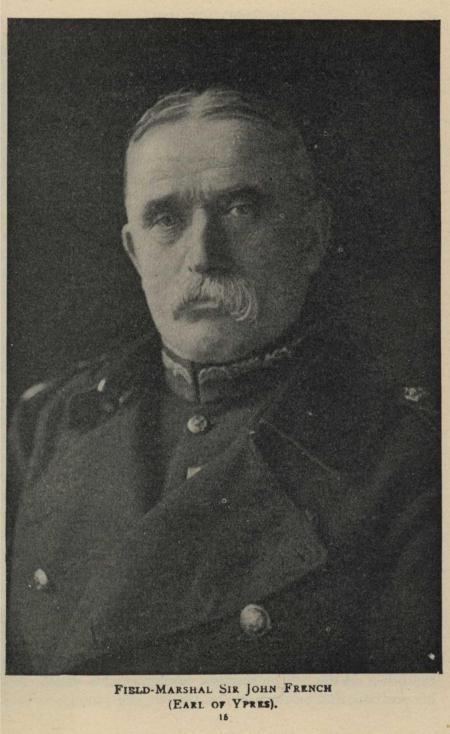
FIELD-MARSHAL SIR JOHN FRENCH (EARL OF YPRES).
The Allies had been forced into a difficult position. From the south of the Marne their line extended to Verdun, consisting of the British Army under Sir John French, and the armies of Franchet d'Esperey, Foch, Langle de Gary, and Sarrail; while facing the Bavarians at Nancy were the armies of Castelnau and Dubail. In the meantime a new French army, the Sixth, had been formed, and this, under Maunoury, lay on the extreme left, covering Paris, and was thus in a position to threaten Kluck's right flank and rear. Joffre's new plan was to strike hard with his left, on the flank of the invader, and for this purpose he had gravely thinned the rest of his front so as to strengthen the forces of Maunoury and Franchet d'Esperey. It was a great hazard, for if the Bavarians forced the gate of Nancy the French right would be turned, and if the German centre broke through the weak French centre the battle would be lost, whatever happened on the French left.
It was one of the moments of crisis on which the world's history depends. The captains who were to win the war for the Allies were all in the field—Foch with an army, Haig with a corps, Pétain and Mangin and Allenby with divisions. Joffre told his men that on the coming fight depended the salvation of their country, and every private in the ranks felt the gravity of the hour. France was fighting on the old ground where, long centuries before, the Hun invasion had been rolled back by Theodoric the Visigoth, and the spirit of her men was kindled to a flame.
The First Battle of the Marne was won not, as many believed, by any single exploit, but by the faithful performance of its duty by each section of the long-drawn line. Let us look first at the French right flank in Lorraine. There the battle began on the 4th September, and three days later came the crisis when, by the slenderest margin, the enemy failed to break Castelnau on the ridge called the Grand-Couronné. The Kaiser himself was a spectator of the fight, for Germany had counted on forcing the pass; but by the 8th she had failed, and by the 9th Castelnau had firmly barred the gate.
The French centre, under Foch, Langle de Gary, and Sarrail, had a longer period of trial. Sarrail, at Verdun, was all but broken on the 8th, and was compelled to fall back to the west bank of the Meuse. All through the 9th and 10th the desperate struggle continued, and by the evening of the last day the French general was preparing for retreat. Suddenly, however, he found the attack ebbing, and by the 12th the enemy was mysteriously withdrawing. Farther west Langle de Gary had his worst moment on the 8th; on the 9th he received reinforcements which eased his position, and on the 10th he too felt the strange weakening of the enemy. The left centre under Foch had the sternest fight of all. He had against him the bulk of Bülow's and Hausen's armies, and on the 8th he found his flanks turned and his whole front split into gaps. Nevertheless he prepared to attack on the 9th with his last ounce of strength. All that day his centre and right were falling back before the enemy's thrust, but he still persevered in his purpose and marched the single division he could muster to the point where he thought he could strike with the greatest effect. The blow was never delivered, for on the evening of the 9th the apparently triumphant advance halted and ebbed. Like Sarrail and Langle de Gary, Foch, having resisted to the limit of human endurance, discovered that the enemy was miraculously disappearing.
The cause of the miracle was the doings of the French left wing. Joffre had hurled Maunoury on Kluck's flank and rear, while Sir John French and Franchet d'Esperey attacked in front. Kluck met the threat with vigour and resolution. He formed front to flank, as the phrase goes—that is, he faced round to what had been his wing—and in the three days' fighting all but defeated Maunoury. On the night of the 7th the outflanking French left found itself outflanked in turn, and its attack turned into a desperate defence. But on the 9th came salvation. Kluck's manoeuvre had left a gap of 30 miles between himself and Bülow, and into this gap were pouring the British force and that of Franchet d'Esperey. Suddenly Maunoury discovered that certain villages in front of him were evacuated, and his airmen told him of enemy convoys moving to the north. At 1 p.m. that day Bülow began his retreat, and Kluck was forced to follow suit. Sir John French and Franchet d'Esperey had pierced the enemy front, and the retreat of the German right caused the retreat of all the German armies. They fell back to a line along the Aisne, through Champagne, and down the east bank of the Meuse—a strong line, which for four years was never really broken. But, none the less, it was a retreat.
The First Battle of the Marne may well rank as the greatest, because the most critical, contest of the war. It was decisive in the sense that it defeated Germany's first plan of campaign. She had hoped for a "battle without a morrow"; but the battle had been fought and the morrow was come. She was now compelled to accept the slow war of entrenchments, and to see every week bringing her nearer to the condition of a beleaguered city. The immediate cause of victory was Maunoury's flank attack, which opened the way for the British and Franchet d'Esperey. But without the daring strategy of Foch and the stubborn endurance of Langle de Gary and Sarrail—above all, without Castelnau's epic resistance at Nancy—the chance in the West could not have been seized, and the Marne might have realized Germany's hopes. It was in a sense the last battle of the old régime of war, a battle of movement and surprise and quick decisions; it was fought and won not by the army as a military machine but by the human quality of the soldier. In the last resort the source of victory was the ancient and unconquerable spirit of France.
PART II.
THE WESTERN FRONT.
CHAPTER IV.
THE WORCESTERS AT THE FIRST BATTLE OF YPRES.
The Battle of the Marne defeated the great plan of the Germans, and their next object was to hold what they had won. The line to which they had retired was open to attack on the west, as was also that of the French, and hence there came a period of rapid movement on both sides, each attempting to outflank the other. It became a "race for the sea," and ended only when the entrenched lines on either side reached the Belgian coast. The enemy then attempted to break through the left of the Allied front, and to seize the Channel ports, so as to threaten the British lines of communication. He transferred large numbers of his best troops to the north; between Armentiéres and the sea he had a total of 402 battalions of infantry and an immense superiority of guns. Two hundred and sixty-seven battalions were all that the Allies could fling into the gap, and their cavalry were outnumbered by two to one.
Germany struck at various points; but being checked at Arras and on the sea-coast, she made her main effort in the last week of October against the British Army, which held the salient east of the city of Ypres. The battle, which is known as the First Battle of Ypres, began on the 21st of the month, and the crisis came on the 29th, when General von Fabeck attacked with a "storm group" of specially selected regiments.
On Saturday, the 31st October, after a furious bombardment, it seemed that the end had come. For eleven days our little army had been holding its own against impossible odds. At the point of the Salient, north of the Menin road, lay the 2nd and 1st British Divisions, and south of them the 7th Division and Byng's cavalry. The men were very weary and their ranks terribly thinned. The 7th Division had fought for nearly two days on a front of 8 miles against forces of four times their number. The desperate character of the fighting was only fully known when the losses came to be reckoned up. That division had 44 officers left out of 400, and 2,336 men out of 12,000. The 1st Brigade of the 1st Division had 8 officers left out of 153, and 500 men out of 5,000. The 2nd Royal Scots Fusiliers, to take one battalion, was reduced to 70 men commanded by a junior subaltern. That is the price which must be paid for fighting one against four. Major Bellenden in Old Mortality considered one to three the utmost possible odds, and "never knew any one who cared to take that except old Corporal Raddlebanes." At the First Battle of Ypres the British Army would have welcomed the Major's odds as a relief.
On that Saturday morning things had grown very desperate. The 1st and 3rd Brigades of the 1st Division were driven out of Gheluvelt, our line gave way, and soon after midday we were back among the woods towards Veldhoek. This retirement uncovered the left of the 7th Division, which was then slowly bent back towards the Klein Zillebeke ridge. The enemy was beginning to pour through the Gheluvelt gap, and at the same time pressed hard on the whole arc of the Salient. We had no reserves except an odd battalion or two and some regiments of cavalry, all of which had already been sorely tried during the past days. Sir John French sent an urgent message to General Foch for reinforcements and was refused. At the end of the battle he learned the reason. Foch had none to send, and his own losses had been greater than ours.
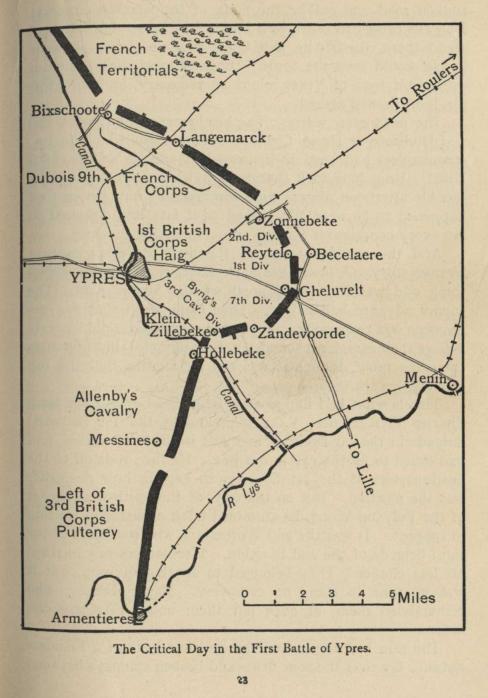
The Critical Day in the First Battle of Ypres.
Between 2 and 2.30 p.m. Sir Douglas Haig, commanding the 1st Corps, was on the Menin road watching the situation. It seemed impossible to stop the gap, though on its northern side some South Wales Borderers were gallantly holding a sunken road and galling the flank of the German advance. He gave orders to retire to a line a little west of Hooge and stand there, though he well knew that no stand, however heroic, could save the town. He considered that a further retirement west of Ypres might be necessary, and with this Sir John French agreed.
The news grew worse. The headquarters of the 1st and 2nd Divisions at Hooge Chateau had been shelled. The two commanders had been badly wounded and six of the Staff killed. Brigadiers took charge of divisions, and during that terrible afternoon officers were commanding any troops that happened to be near. It looked as if fate had designed to lay every conceivable burden on our breaking defences.
And then suddenly out of the mad confusion came a strange story. A breathless Staff officer reported that something odd was happening north of the Menin road. The enemy advance had halted. Then came word that our 1st Division was re-forming. The anxious generals could scarcely believe their ears, for it sounded a sheer miracle; but presently came the proof, though it was not for months that the full tale was known.
This is what had happened. Brigadier-General the Hon. Charles FitzClarence, V.C., commanding the 1st (Guards) Brigade in the 1st Division, had sent in his last reserves, and had failed to fill the gap in our line. He then rode off to the headquarters of the 1st Division to explain how desperate was the position. But on the way, at the south-west corner of the Polygon Wood, he stumbled upon a battalion waiting in support. It was the 2nd Worcesters, who were part of the right brigade of the 2nd Division. FitzClarence saw in them his last chance. They belonged to another division, but it was no time to stand on ceremony. Major Hankey, who commanded them, at once put them under FitzClarence's orders.
The rain had begun and the dull wet haze of a Flanders autumn lay over the sour fields and broken spinneys between Hooge and Gheluvelt. The Worcesters, under very heavy artillery fire, advanced in a series of short rushes for about 1,000 yards between the right of the South Wales Borderers and the northern edge of Gheluvelt. There they dug themselves in, broke up the German advance into bunches, opened a heavy flank fire, and brought it to a standstill. This allowed the 7th Division to get back to its old line, and the 6th Cavalry Brigade to fill the gap between the 7th and 1st Divisions. Before night fell the German advance west of Gheluvelt was stayed, and the British front was out of immediate danger.
That great performance of an historic English county regiment is one of the few instances in any campaign where the prompt decision of a subordinate commander and the prowess of one battalion have turned the tide of a great battle. It was the crucial moment of the First Battle of Ypres. Gheluvelt was lost, but the gap was closed, and the crisis was past. Eleven days later FitzClarence fell in the last spasm of the action—the fight with the Prussian Guard. He had done his work. Ypres was soon a heap of rubble, and for four years the Salient was a cockpit of war, but up to the last hour of the campaign no German entered the ruins of the little city except as a prisoner.
CHAPTER V.
THE CANADIANS AT THE SECOND BATTLE OF YPRES.
The Salient of Ypres was to be a second time the scene of a heroic stand against hopeless odds. In April 1915 the front of the Salient was held by the French on the left, the Canadian Division and the British 28th Division in the centre, and the 27th Division on the right. On the 20th the Germans suddenly began the bombardment of the town with heavy shells. It was a warning to the British Command, for all their roads of supply for the lines of the Salient ran through Ypres, and such a bombardment must herald an attack on some part of their front.
The evening of Thursday, the 22nd, was calm and pleasant, with a light, steady wind blowing from the north-east. About 6.30 our artillery observers reported that a strange green vapour was moving over the French trenches. Then, as the April night closed in and the great shells still rained upon Ypres, there were strange and ghastly scenes on the left between the canal and the Pilkem road. Back through the dusk came a stream of French soldiers, blinded and coughing, and wild with terror. Some black horror had come upon them, and they had broken before a more than human fear. Behind them they had left hundreds of their comrades stricken or dead, with horrible blue faces and froth on their lips.
The rout surged over the canal, and the roads to the west were choked with broken infantry and galloping gun teams lacking their guns. Most of the French were coloured troops from Africa, and in the early darkness they stumbled upon the Canadian reserve battalions. With amazement the Canadians saw the wild dark faces, the heaving chests, and the lips speechless with agony. Then they too sniffed something in the breeze—something which caught at their throats and affected them with a deadly sickness.
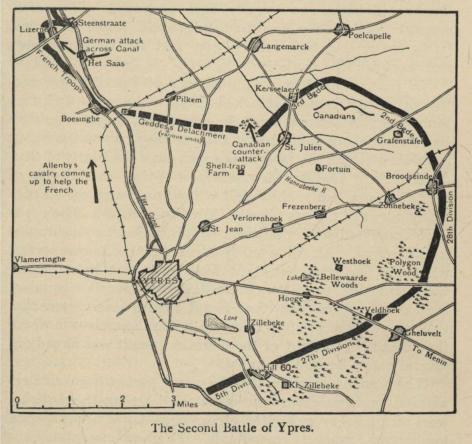
The Second Battle of Ypres.
The immediate result of the stampede was a 5-mile breach in the Allied line. The remnants of the French troops were thrown back on the canal, where they were being pushed across by the German attack, and between them and the left of the Canadians were five miles of undefended country. Through this gap the enemy was pouring, preceded by the poisonous fumes of the gas, and supported by heavy artillery fire.
The Canadian front was held at the moment by the 3rd Brigade under General Turner on the left and the 2nd Brigade under General Currie on the right. The 1st Brigade was in reserve. The 3rd Brigade, on which the chief blow fell, had suffered from the gas, but to a less degree than the French. With his flank exposed General Turner was forced to draw back his left wing. Under the pressure of the four German divisions the brigade bent backwards till its left rested on the wood east of the hamlet of St. Julien. Beyond it, however, there was still a gap, and the Germans were working round its flank.
In that wood there was a battery of British guns, and the Canadians counter-attacked to save the guns and find some point of defence for their endangered flank. Assisted by two battalions from the 1st Brigade they carried the wood. A wilder struggle has rarely been seen than the battle of that April night. The British reserves at Ypres, shelled out of the town, marched to the sound of the firing, with the strange sickly odour of the gas blowing down upon them. The roads were congested with the usual supply trains for our troops in the Salient. All along our front the cannonade was severe, while the Canadian left, bent back almost at right angles, was struggling to entrench itself under cover of counter-attacks. In some cases they found French reserve trenches to occupy, but more often they had to dig themselves in where they could. The right of the German assault was already in several places beyond the canal.
The Canadians were for the most part citizen soldiers without previous experience of battle. Among their officers were men from every kind of occupation—lawyers, professors, lumbermen, ranchers, merchants. To their eternal honour they did not break. Overwhelmed by superior numbers of men and guns, and sick to death with the poisonous fumes, they did all that men could do to stem the tide. All night long with an exposed flank they maintained the gossamer line of the British front.
Very early in the small hours of Friday morning the first British reinforcements arrived in the gap. They were a strange mixture of units, commanded by Colonel Geddes of the Buffs—to be ever afterwards gloriously known as Geddes's Detachment. But our concern for the moment is with the Canadians. The reinforcements from the 1st Brigade counter-attacked, along with Geddes's Detachment, early on the Friday morning. Meantime the Canadian 3rd Brigade was in desperate straits. Its losses had been huge, and its survivors were still weak from the effects of the gas. No food could reach it for twenty-four hours. Holding an acute salient, it was under fire from three sides, and by evening was driven to a new line through St. Julien. The enemy had succeeded in working round its left, and even getting their machine-guns behind it.
About 3 o'clock on the morning of Saturday, the 24th, a violent bombardment began. At 3.30 there came a second gas attack. The gas, pumped from cylinders, rose in a cloud which at its greatest was 7 feet high. It was thickest close to the ground, and filled every cranny of the trenches. Instinct taught some of the men what to do. A wet handkerchief wrapped round the mouth gave a little relief, and it was obviously fatal to run back, for in that case a man followed the gas zone. Its effect was to produce acute bronchitis. Those smitten by it suffered horribly, gasping and struggling for breath, and in many cases becoming temporarily blind. Even 1,000 yards from the place of emission troops were afflicted with violent sickness and giddiness. Beyond that distance it dissipated itself, and only the blanched herbage marked its track.
That day, the 24th, saw the height of the Canadians' battle. The much-tried 3rd Brigade, now gassed for the second time, could no longer keep its place. Its left fell back well to the south-west of St. Julien. Gaps were opened in its front, and General Currie's 2nd Brigade was now left in much the same position as that of the 3rd Brigade on the Thursday evening. About midday a great German attack developed against the village of St. Julien. The remnants of the 13th and 14th battalions—the Royal Highlanders of Montreal and the Royal Montreal Regiment—could not be withdrawn in time, and remained—a few hundred men—in the St. Julien line, fighting till far on in the night their hopeless battle with a gallantry which has shed eternal lustre on their motherland. Not less fine was the stand of the 8th Battalion (the 90th Winnipeg Rifles) in the 2nd Brigade at the very point of the Salient. With its left in the air it held out against crazy odds till reinforcements arrived.
The battle was now passing from the Canadians' hands. On the Saturday the 3rd Brigade was withdrawn, and the 2nd followed on the Sunday evening. But on the Monday the latter, now less than 1,000 strong, was ordered back to the line, and to the credit of their discipline the men went cheerfully. They had to take up a position in daylight and cross the zone of shell-fire—no light task for those who had lived through the past shattering days. That night they were relieved, and on Thursday, the 29th, the whole division was withdrawn from the Salient, after such a week of fighting as has rarely fallen to the lot of any troops of the Empire.
The Canadian Division was to grow into an Army, and to win many famous triumphs before the end of the war. But in the hectic three days between Thursday, the 22nd April, and Monday, the 26th, when the Second Battle of Ypres was decided, the soldiers of Canada performed an exploit which no later achievement could excel. Three battalion commanders died; from the 5th Battalion only ten officers survived; five from the 7th; seven from the 8th; eight from the 10th. Of the machine-gun men of the 13th Battalion thirteen were left out of fifty-eight, and in the 7th Battalion only one. Attacked and outflanked by four divisions, stupefied by a poison of which they had never dreamed and which they did not understand, with no heavy artillery to support them, they endured till reinforcements came, and they did more than endure. After days and nights of tension they had the vitality to counter-attack, and when called upon they cheerfully returned to the inferno which they had left. If the Salient of Ypres will be for all time the classic battle-ground of Britain, that blood-stained segment between the Poelcappelle and Zonnebeke roads will remain the holy land of Canadian arms.
With the Canadians must rank the men of Geddes's Detachment. They were eight battalions, picked out from anywhere in the line—the 2nd Buffs, half of the 3rd Middlesex, half of the 2nd Shropshires, the 1st York and Lancaster, the 5th Royal Lancaster, the 4th Rifle Brigade, the 9th Royal Scots, and the 2nd Cornwalls. Their instructions were to hold the gap on the Canadian left and bluff the enemy. The leading half-battalions were thrown in in twos and threes into the gap, and had to keep up the appearance of an offensive, while the other half of each battalion dug a new line. The duty of the attacking halves was to get as far forward as possible before they fell, and to try not to fall before evening.
All the day of Friday, the 23rd, without guns and without supports, about 2,000 men covered a gap 8,000 yards wide and held up the victorious Germans. Behind them the remaining 2,000 dug the new line, which was to hold fast till the end of the war. Of the half-battalions concerned in this marvellous bluff but little was left. One company of the Buffs entirely disappeared. The men of the 1st York and Lancaster lay all day in their firing lines—immovable, for every one was dead or wounded. The Cornwalls lost all their officers but one, and all their men but ninety-five.
But they succeeded. Colonel Geddes was killed by shellfire on the 28th April, when he was withdrawing his men, but he died knowing that his task had been accomplished. The Second Battle of Ypres lasted far on into May, but the enemy failed on that day, Friday, the 23rd—St. George's Day—when the road to Ypres was barred by two Canadian Brigades and a handful of British regulars and Territorials.
CHAPTER VI.
THE TAKING OF LOOS.
The battle of Loos, which began on Saturday, September 25, 1915, was part of the first combined Allied offensive. It was remarkable among other things because it saw the first appearance in a great battle of the troops of the New Armies raised in response to Lord Kitchener's appeal, and in it more than one new division gained a reputation which made their names become household words.
The battle, though it won much ground for the Allies, failed to break the German front. But it shook that front to its foundations, and indeed at one point came very near to being a decisive victory. It is the story of that point with which this chapter is concerned—the attack of the Scottish 15th Division against the village of Loos. The 15th was a division remarkable for physique and spirit, but as yet untried in war, for it had only been some three months in France. The men were of every trade, rank, and profession, and drawn from all Scotland, both Lowlands and Highlands. On its left was an old regular division, the 1st, and on its right the 47th—a London Territorial Division. The orders of the 15th were to take Loos and the height beyond, known as Hill 70, which looked down upon the northern suburbs of Lens.
Saturday, the 25th, was a drizzling morning, with low clouds and a light wind from the south-west. The attack of the division was made by the 44th Brigade on the right and the 46th on the left, with the 45th Brigade in reserve. At ten minutes to six gas was discharged from our front, but the breeze caused it to eddy back from the hollow round Loos and trouble the left brigade. There Piper Laidlaw of the King's Own Scottish Borderers mounted the parapet and piped his men forward to the tune of "Blue Bonnets over the Border."
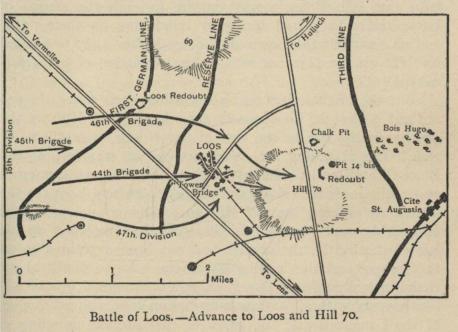
Battle of Loos.—Advance to Loos and Hill 70.
At 6.30 whistles blew and the leading battalions left the trenches. We are concerned particularly with the attack of the 44th Brigade, which had the 9th Black Watch and the 8th Seaforths in front, the 7th Camerons in support, and the 10th Gordons following. A wild rush carried the Highlanders through the whole German front line. Below in the hollow lay Loos with the gaunt Colossus of the mining headgear, which our men called the Tower Bridge, striding above it. In front of the village was the German second line, about 200 yards distant from the crest of the slope. Its defences were strong, and the barbed wire, deep and heavy, had been untouched by our artillery, except in a few places.
After winning the first line the attack was rapidly reorganized, and our men went hurtling down the slope. They had a long distance to cover, and all the time they were exposed to the direct fire of the German machine-guns; but without wavering the line pressed on till it reached the wire. With bleeding faces and limbs and torn kilts and tunics the Highlanders forced their way through it. These decent law-abiding ex-civilians charged like men possessed, singing and cheering. One grave sergeant is said to have rebuked the profanity of his men. "Keep your breath, lads," he cried. "The next stop's Potsdam."
At 7.30 the second line was theirs, and a few minutes later the 44th Brigade was surging through the streets of Loos. Here they had the 47th Londoners on their right, and on their left their own 46th Brigade, and they proceeded to clear up the place as well as the confusion of units permitted.
But the Highlanders had not finished their task. It was not yet 9 o'clock, Loos was in their hands, but Hill 70, the gently sloping rise to the east of the village, was still to be won. The attacking line re-formed—what was left of the Black Watch and Seaforths leading, with the 7th Camerons and 10th Gordons. Now, the original plan had been for the attack to proceed beyond Hill 70 should circumstances be favourable, and though this plan had been modified on the eve of the battle, the change had not been explained to all the troops, and the leading battalions were in doubt about their final objective. The Highlanders streamed up the hill like hounds, with all battalion formation gone, the red tartans of the Camerons and the green of the Gordons mingling in one resistless wave. All the time they were under enfilading fire from both south and north; but with the bayonet they went through the defences, and by 9 o'clock were on the summit of the hill.
On the top, just below the northern crest, was a strong redoubt, destined to become famous in succeeding days. The garrison surrendered—they seemed scarcely to have resisted—but the Highlanders did not wait to secure the place. They poured down the eastern side, now only a few hundreds strong, losing direction as they went. They had reached a district which was one nest of German fortifications. The Highlanders were far in advance of the British line, with no supports on south or north; in three hours they had advanced nearly four miles, and had reached the skirts of the village called Cité St. Auguste.
The colonel of a Cameron battalion took command on Hill 70, now strewn with the remnants of the two brigades, and attempted to recall the pursuit, which was lost in the fog and smoke of the eastern slopes, and to entrench himself on the summit. But very few of the Highlanders returned. All down the slopes towards Lens lay the tartans—Gordon and Black Watch, Seaforth and Cameron—like the drift left on the shore when the tide has ebbed, marking out a salient of the dead which, under happier auspices, might have been a living spear-point thrust into the enemy's heart.
The rest of the doings of the 15th Division—how they held the line of Hill 70 for forty-eight hours longer till they were relieved by the Guards—does not belong to this story. Our concern is with that wild charge which from the beginning was foredoomed to failure, for the Highlanders had no supports except the divisional reserves. The Guards were then 11 miles away, and the two New Army divisions which were brought up—divisions which later on won great glory—were then only raw recruits. The brilliant advance was not war, but a wild berserk adventure—a magnificent but a barren feat of courage.
And yet, looking back from the vantage ground of four years of campaigning, that madness of attack had in it the seeds of the Allies' future success. It was the very plan which Ludendorff used against them with such fatal effect in March 1918. Of what did those German tactics consist? Highly-trained troops attacked various sections of the front, found weak spots, summoned their reserves by special signals, and forced their way through. In this way the front was not only pierced, but crumbled in long lengths. The Highlanders at Loos were the first to employ this deadly process, which the French called "infiltration." They were picked troops beyond question; but there was no serious plan to follow up their success, and no support provided. Yet, even as it was, that lonely charge struck fear into the heart of the whole German line from Douai to Lille. There was no prophetic eye among us which could see what was implied by it, and it was set down as a glorious failure. Four years later, when we had learned all that the enemy could teach us, the same method was applied by the master hand of Foch to break down in turn each of the German defences.
CHAPTER VII.
DELVILLE WOOD.
The Battle of the Somme was the first great British attack to be made with ample supplies of guns and shells, and continued, not for days or weeks, but for months. Slowly we pressed forward to the crest of the ridges between the Somme and the Ancre, and we know from Ludendorff's own confession that we then dealt a blow at Germany's strength from which she never recovered. The third stage of that great battle, which won many miles of the German second position, began on July 14, 1916. The one serious check was on the right wing, where it was necessary to carry the village of Longueval and the wood called Delville in order to secure our right flank. There the South African Brigade entered for the first time into the battle-line of the West, and there they won conspicuous renown.
The place was the most awkward on the battle-front. It was a salient, and, therefore, the British attack was made under fire from three sides. The ground, too, was most intricate. The land sloped upwards to Longueval village, a cluster of houses among gardens and orchards around the junction of two roads. East and north-east of this hamlet stretched Delville Wood, in the shape of a blunt equilateral triangle, with an apex pointing north-westwards. The place, like most French woods, had been seamed with grassy rides, partly obscured by scrub, and along and athwart these the Germans had dug lines of trenches. The wood had been for some days a target for our guns, and was now a maze of splintered tree trunks, matted undergrowth, and shell-holes. North, north-east, and south-east, at a distance of from 50 to 200 yards from its edges, lay the main German positions, strongly protected by machine-guns. Longueval could not be firmly held unless Delville was also taken, for the northern part was commanded by the wood.
On the 14th July two Scottish brigades of the 9th Division attacked Longueval, and won most of the place; but they found that the whole village could not be held until Delville Wood was cleared. Accordingly, the South Africans—the remaining brigade of the division—were ordered to occupy the wood on the following morning. The South African Brigade, under General Lukin, had been raised a year before among the white inhabitants of South Africa. At the start about 15 per cent. were Dutch, but the proportion rose to something like 30 per cent. before the end of the campaign. Men fought in its ranks who had striven against Britain in the Boer War. Few units were better supplied with men of the right kind of experience, and none showed a better physical standard or a higher level of education and breeding.
Two hours before dawn on the 15th July the brigade advanced from Montauban towards the shadow which was Delville Wood, and the jumbled masonry, now spouting fire like a volcano, which had been Longueval. Lieutenant-Colonel Tanner of the 2nd South African Regiment was in command of the attack. By 2.40 that afternoon Tanner reported to General Lukin that he had won the whole wood with the exception of certain strong points in the north-west, abutting on Longueval and the northern orchards.
But the problem of Delville was not so much to carry the wood as to hold it. The German counter-attacks began about 3 o'clock, and the men who were holding the fringe of the wood suffered heavy casualties. As the sun went down the enemy activity increased, and their shells and liquid fire turned the darkness of night into a feverish and blazing noon; often as many as 400 shells were fired in a minute. The position that evening was that the north-west corner of the wood remained with the enemy, but that all the rest was held by South Africans strung out very thin along its edge. Twelve infantry companies, now gravely weakened, were defending a wood a little less than a square mile in area—a wood on which every German battery was accurately ranged, and which was commanded at close quarters by a semicircle of German trenches. Moreover, since the enemy had the north-west corner, he had a covered way of approach into the place.
All through the furious night of the 15th the South Africans worked for dear life at entrenchments. In that hard soil, pitted by unceasing shell-fire, and cumbered with a twisted mass of tree trunks, roots, and wire, the spade could make little way. Nevertheless, when the morning of Sunday, the 16th, dawned, a good deal of cover had been provided. At 10 a.m. an attempt was made by the South Africans and a battalion of Royal Scots to capture the northern entrance to the wood. The attempt failed, and the attacking troops had to fall back to their trenches, and for the rest of the day had to endure a steady, concentrated fire. It was hot, dusty weather, and the enemy's curtain of shells made it almost impossible to bring up food and water or to remove the wounded. The situation was rapidly becoming desperate. Longueval and Delville had proved to be far too strongly held to be over-run at the first attack by one division. At the same time, until these were taken the object of the battle of the 14th had not been achieved, and the safety of the whole right wing of the new front was endangered. Longueval could not be won and held without Delville; Delville could not be won and held without Longueval. Fresh troops could not yet be spared to complete the work, and it must be attempted again by the same wearied and depleted battalions. What strength remained to the 9th Division must be divided between two simultaneous objectives.
That Sunday evening it was decided to make another attempt against the north-west corner. The attempt was made shortly before dawn on Monday, the 17th July, but failed. All that morning there was no change in the situation; but on the morning of Tuesday, the 18th, an attempt was made to the eastward. The Germans, however, in a counter-attack, managed to penetrate far into the southern half of the wood. The troops in Longueval had also suffered misfortunes, with the result that the enemy entered the wood on the exposed South African left.
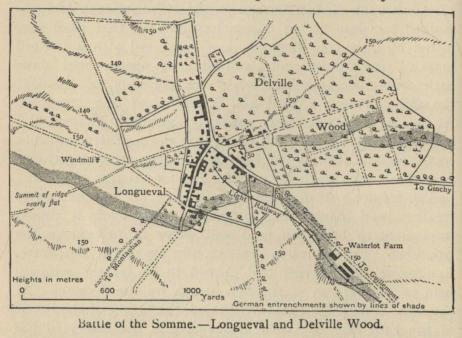
Battle of the Somme.—Longueval and Delville Wood.
At 2.30 that afternoon the position was very serious. Lieutenant-Colonel Thackeray, of the 3rd South African Regiment, now commanding in the wood, held no more than the south-west corner. In the other parts the garrisons had been utterly destroyed. The trenches were filled with wounded whom it was impossible to move, since most of the stretcher-bearers had themselves been killed or wounded.
That evening came the welcome news that the South Africans would be relieved at night by another brigade. But relief under such conditions was a slow and difficult business. By midnight the work had been partially carried out, and portions of the 3rd and 4th South African regiments had been withdrawn.
But as at Flodden, when
"they left the darkening heath
More desperate grew the strife of death."
The enemy had brought up a new division, and made repeated attacks against the South African line. For two days and two nights the little remnant under Thackeray still clung to the south-west corner of the wood against impossible odds, and did not break. The German method of assault was to push forward bombers and snipers, and then to advance in mass formation from the north, north-east, and north-west simultaneously.
Three attacks on the night of Tuesday, the 18th, were repelled with heavy losses to the enemy; but in the last of them the South Africans were assaulted on three sides. All through Wednesday, the 19th, the gallant handful suffered incessant shelling and sniping, the latter now from very close. It was the same on Thursday, the 20th; but still relief tarried. At last, at 6 o'clock that evening, troops of a fresh division were able to take over what was left to us of Longueval and the little segment of Delville Wood. Thackeray marched out with two officers, both wounded, and 140 other ranks, gathered from all the regiments of the South African Brigade.
The six days and five nights during which the South African Brigade held the most difficult post on the British front—a corner of death on which the enemy fire was concentrated from three sides at all hours, and into which fresh German troops, vastly superior in numbers, made periodic incursions, only to be broken and driven back—constituted an epoch of terror and glory scarcely equalled in the campaign. There were other positions as difficult, but they were not held so long; there were cases of as protracted a defence, but the assault was not so violent and continuous.
Let us measure it by the stern test of losses. At midnight on the 14th July, when Lukin received his orders, the brigade numbered 121 officers and 3,032 men. When Thackeray marched out on the 20th he had a remnant of 143, and the total ultimately assembled was about 750. Of the officers, 23 were killed or died of wounds, 47 were wounded, and 15 were missing. But the price was not paid in vain. The brigade did what it was ordered to do, and did not yield until it was withdrawn.
There is no more solemn moment in war than the parade of men after a battle. The few hundred haggard survivors in the bright sunshine behind the lines were too weary and broken to realize how great a thing they had done. Sir Douglas Haig sent his congratulations. The Commander of the Fourth Army, Sir Henry Rawlinson, wrote that "In the capture of Delville Wood the gallantry, perseverance, and determination of the South African Brigade deserves the highest commendation." They had earned the praise of their own intrepid commanding officers, who had gone through the worst side by side with their men. "Each individual," said Tanner's report, "was firm in the knowledge of his confidence in his comrades, and was, therefore, able to fight with that power which good discipline alone can produce. A finer record of this spirit could not be found than the line of silent bodies along the Strand,[#] over which the enemy had not dared to tread." But the most impressive tribute was that of their Brigadier. When the remnant of his brigade paraded before him, Lukin took the salute with uncovered head and eyes not free from tears.
[#] The name of one of the rides in the wood.
CHAPTER VIII.
THE THIRD BATTLE OF YPRES.
The Third Battle of Ypres was in many ways the sternest battle ever fought by British troops. It was not a defence, like the two other actions fought at Ypres, but an attack. It was an attack against the success of which the very stars in their courses seemed to fight. Everything—weather, landscape, events elsewhere on the front—conspired to frustrate its purpose. It was undertaken too late and continued too long; but both errors were unavoidable. All the latter part of it was a struggle without hope, carried on for the sake of our Allies at other parts of the line. To those who fought in it, the Third Battle of Ypres will always remain a memory of misery and horror.
The British scheme for the summer of 1917 was an offensive against the enemy in Flanders, in order to clear the Belgian coast and turn the German right flank in the West. It was a scheme which, if successful, promised the most far-reaching results; but to be successful a beginning must be made as early as possible in the summer, when the waterlogged soil of Flanders became reasonably dry. But the whole plan was altered for the worse at the beginning of the year. The first stage, the Battle of Arras, began too late and, through no fault of the British Command, lasted too long. It was not till June that Sir Douglas Haig was able to begin operations in Flanders and make his preliminary attack upon Messines, and it was not till the end of July that the great battle was begun in the Ypres Salient. By that time the revolution which began in Petrograd in March had broken up the Russian armies and prepared the way for the triumph of Bolshevism; Russia was in ruins, and Germany was moving her troops rapidly from the East to the West. The battle was, therefore, a struggle against time—against the coming of enemy reserves and of the autumn rains.
The famous Salient of Ypres had, during three years, been drawn back till the enemy front was now less than two miles from the town. For twelve months that front had been all but stationary, and the Germans had spent infinite ingenuity and labour on perfecting their defences. In the half-moon of hills round the town they had view-points which commanded the whole countryside, and especially the British lines within the Salient. Any preparations for attack would therefore be conducted under their watchful eyes. Moreover, the heavy waterlogged clay of the flats where our front lay was terribly at the mercy of the weather, and in rain became a bottomless swamp. Lastly, the enemy was acutely conscious of the importance of holding his position, and there was no chance of taking him by surprise.
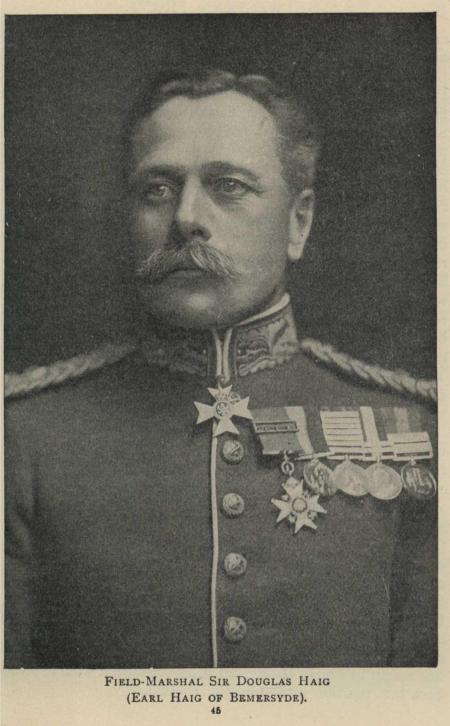
FIELD-MARSHAL SIR DOUGLAS HAIG (EARL HAIG OF BEMERSYDE).
If the British were to succeed at all they must succeed quickly. The high ground east of the Salient must be won in a fortnight if they were to move against the German bases in West Flanders and clear the coast. This meant a gamble against the weather, for the Salient was, after Verdun, the most tortured of the Western battlefields. Constant shelling of the low ground west of the ridges had blocked the streams and the natural drainage, and turned it into a sodden wilderness. Weather such as had been experienced the year before on the Somme would make of it a morass where transport could scarcely move, and troops would be exposed to the last degree of misery. Moreover, the "tanks," which had been first used on the Somme the year before, and had done wonders at Arras in breaking through barbed wire and silencing machine-guns, could not be used in deep mud. Whatever might be the strength and skill of the enemy, it was less formidable than the obstacles which nature herself might place in the British path.
But the German commanders were no despicable antagonists. In Flanders the nature of the ground did not permit of the kind of defence which they had built on the Somme. Deep dug-outs and concrete trenches were impossible because of the waterlogged soil, and they were compelled to employ new tactics. Their solution was the "pill-box." This was a small concrete fort situated among the ruins of a farm or in some piece of shell-torn woodland, often raised only a yard or two above the ground-level, and bristling with machine-guns. The low entrance was at the rear of the pill-box, which held from eight to forty men. Such forts were easy to make, for the wooden or steel framework could be brought up on any dark night and filled with concrete. They were placed with great skill, and in the barbed-wire defences alleys were left so that an unwary advance would be trapped and exposed to enfilading fire. Their small size made them a difficult mark for heavy guns, and since they were protected by concrete at least 3 feet thick they were impregnable to ordinary field artillery.
The enemy's plan was to hold his first line—which was often a mere string of shell craters—with few men, who would fall back before an assault. He had his guns well behind, so that they would not be captured in the first rush, and would be available for a barrage if his opponents became entangled in the pill-box zone. Lastly, he had his reserves in the second line, ready for the counterstroke before the attack could secure its position. Such tactics were admirably suited to the exposed and contorted ground of the Salient. Any attack would be allowed to make some advance; but if the German plan worked well this advance would be short-lived, and would be dearly paid for. Instead of the cast-iron front of the rest of the battleground, the Flanders line would be highly elastic, but after pressure it would spring back into position with a deadly rebound.
The action began on 31st July, and resulted at first in a brilliant success. But with the attack the weather broke, and so made impossible the series of blows which we had planned. For a fortnight we were compelled to hold our hand; till the countryside grew drier, advance was a stark impossibility.
The second stage began on 16th August, and everywhere fell short of its main objective. The ground was sloppy and tangled; broken woods impeded our advance; and the whole front was dotted with pill-boxes, against which we had not yet discovered the proper weapon. The result was a serious British check. Fine brigades had been hurled in succession against a solid wall, and had been sorely battered. They felt that they were being sacrificed blindly; that every fight was a soldier's and not a general's fight; and that such sledge-hammer tactics could never solve the problem. For a moment there was a real wave of disheartenment in the British ranks.
Sir Douglas Haig took time to reorganize his front and prepare a new plan. Sir Herbert Plumer was brought farther north, and patiently grappled with the "pill-box" problem. He had them carefully reconnoitred, and by directing gun fire on each side enabled his troops to get round their undefended rear. Early in September the weather improved, the mud of the Salient hardened, and the streams became streams again, and not lagoons.
On 20th September the third attack was launched, and everywhere succeeded. It broke through the German defence in the Salient, and won the southern pivot, on which the security of the main Passchendaele Ridge depended. Few struggles in the campaign were more desperate or carried out on a more gruesome battlefield. The maze of quagmires, splintered woods, ruined husks of pill-boxes, water-filled shell-holes and foul creeks, which made up the land on both sides of the Menin road, was a sight which to most men must seem in the retrospect a fevered nightmare. The elements had blended with each other to make of it a limbo outside mortal experience and almost beyond human imagining.
But successful though the advance was, not even the first stage of the British plan had been reached. During the rest of September and October, however, attack followed attack, though the main objective was now out of the question. It was necessary to continue the battle for the sake of our Allies, who at the moment were hard pressed in other areas; and, in any case, it was desirable to complete the capture of the Passchendaele Ridge so as to give us a good winter position.
The last stages of this Third Battle of Ypres were probably the muddiest combats ever known in the history of war. It rained incessantly, sometimes quieting to a drizzle or a Scots mist, but relapsing into a downpour on any day fixed for our attack. The British movements became a barometer. Whenever it was more than usually tempestuous it was safe to assume that some hour of advance was near. The few rare hours of watery sunshine had no effect upon the irreclaimable bog. "You might as well," wrote one observer, "try to empty a bath by holding lighted matches over it."
On the 30th October our line was sufficiently far advanced for the attack on Passchendaele itself. On that day the Canadians, assisted by the Royal Naval Division and London Territorials, carried much of the Ridge, and won their way into the outskirts of Passchendaele village. Some days of dry weather followed, and early in the morning of 6th November the Canadians swept forward again and carried the whole main ridge of West Flanders. By this achievement the Salient, where for three years we had been at the mercy of the German guns, was no longer dominated by the enemy position.
The Third Battle of Ypres was strategically a British failure; we did not come within measurable distance of our main purpose. But that was due to no fault of generalship or fighting qualities, but to the malevolence of the weather in a country where the weather was all in all. We reckoned upon a normal August, and we did not get it. The sea of mud which lay around the Salient was the true defence of the enemy.
Ypres was to Britain what Verdun was to France—hallowed soil, which called forth the highest qualities of her people. It was a battleground where there could be no retreat without loss of honour. The armies which fought there in the Third Battle were very different from the few divisions which had held the fort during the earlier struggles. But there were links of connection. The Guards, by more than one fine advance, were recompensed for the awful tension of October 1914, when some of their best battalions had been destroyed; and it fell to Canada, by the victory of Passchendaele, to avenge the gas attack of April 1915. when only her dauntless two brigades stood between Ypres and the enemy.
CHAPTER IX.
THE TANKS AT CAMBRAI.
During the Battle of the Somme a new weapon had appeared on the Allied side. This was the Tank (so called because some unrevealing name had to be found for a device developed in secret). It was a machine shaped like a monstrous toad, which mounted machine-guns and light artillery, and could force its way through wire and parapets and walls, and go anywhere except in deep mud. Its main tactical use was to break down wire entanglements and to clear out redoubts and nests of machine-guns. When first used at the Somme the Tanks won a modified success, and in the following spring at Arras they fully justified themselves. Presently they began to develop into two types, one remaining heavy and slow and the other becoming a "whippet," a type which was easy to handle and attained a fair speed. Ultimately, as we shall see, they were to become the chief Allied weapon in breaking the enemy front, and also to perform the historic task of cavalry and go through the gaps which the infantry had made. In September 1917, while two British Armies were fighting desperately in the Ypres Salient for the Passchendaele Ridge, Sir Julian Byng's Third Army, on the chalky plateau of Picardy, was almost idle. An observer might have noticed that General Hugh Elles, the commander of the Tank Corps, was a frequent visitor to Sir Julian's headquarters at Albert. The same observer might have detected a curious self-consciousness during the following weeks at Tanks headquarters. Tanks officers, disguised in non-committal steel helmets and waterproofs, frequented the forward areas of the Third Army. Tanks motor-cars seemed suddenly to shed all distinguishing badges, and their drivers told lengthy and mendacious tales about their doings. Staff officers of the Tanks were never seen at any headquarters, but constantly in front-line trenches, where, when questioned, they found some difficulty in explaining their business. At the headquarters of one Tanks brigade there was a locked room, with "No Admittance" over the door, and inside—for the eye of the possible enemy spy—a quantity of carefully marked bogus maps. Some mystery was being hatched, but, though many hundreds suspected it, only a few knew the truth.
On the 20th October it had been decided to make a surprise attack towards Cambrai, and to prepare the way for the infantry by Tanks instead of guns. The Third Battle of Ypres had brought the reputation of these machines very low. They had been used in the bottomless mud of the Salient, where they had no chance of being successful, and the generals in command had reported adversely on their merits. It was argued that they could not negotiate bad ground, that the ground on a battlefield must always be bad, and that, consequently, they were of no use on the battlefield. The first statement was doubtful, and the second false; but certainly if all battles had been like the Third Battle of Ypres the conclusion would have been justified.
At Cambrai the Tanks were on their trial. It was their special "show," and if they failed now they would fail for good. Their commander, General Elles, took no chances. With three brigades of Tanks he was to break through the enemy's wire, cross the broad trenches of the Hindenburg Line, and open the way towards Cambrai for the two Army Corps following. The enemy defences were the strongest in the West. There were three trench lines, each of a width extending to 15 feet, and with an outpost line thrown forward as a screen. In front of the main line lay barbed wire at least 50 yards wide, which sometimes jutted out in bold salients flanked by machine-guns. It was calculated that to cut that wire with artillery would have taken five weeks and cost twenty millions of money. The trenches were too wide for an ordinary Tank, so immense bundles of brushwood were made up, which a Tank carried on its nose and dropped into the trench to make a crossing. Each bundle, or "fascine," weighed a ton and a half, and it took twenty Chinese coolies to roll one of them through the mud.
The attack was to be a surprise, and therefore there was to be no preliminary bombardment. Secrecy was so vital, and the chances of discovery so numerous, that the commanders spent anxious days prior to the 20th November. Flotillas of Tanks were assembled in every possible place which afforded cover, notably in Havrincourt Wood. The Tank is not a noiseless machine, and it says much for the ingenuity of the Third Army that the enemy had no inkling of our business. A single enemy aeroplane over Havrincourt might have wrecked the plan. On the night of the 18th an enemy raid took some of our men prisoners, but they must have been very staunch, or the German Intelligence Service very obtuse, for little appears to have been learned from them. The weather favoured Sir Julian Byng. The days before the assault had the low grey skies and the clinging mists of late November.
In the dark of the evening of the 19th the Tanks nosed their way from their lairs towards the point of departure, going across country, since the roads were crowded, and running dead slow to avoid noise. That evening General Hugh Elles issued a special order announcing that he proposed to lead the attack of the centre division in person, like an admiral in his flagship. At 4.30 on the morning of the 20th a burst of German fire suggested that the enemy had discovered the secret, but to the relief of the British commanders it died away, and the hour before the attack opened was dead quiet.
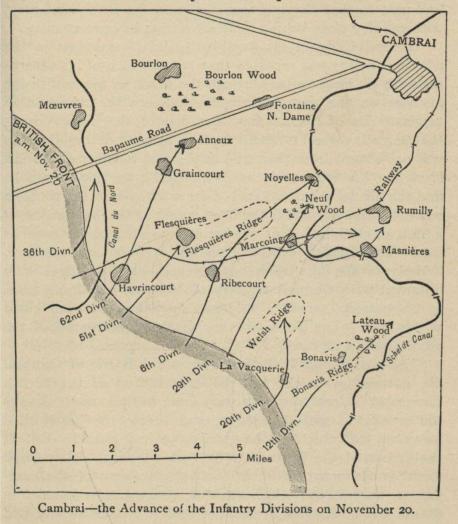
Cambrai—the Advance of the Infantry Divisions on November 20.
Day dawned with heavy clouds that promised rain before evening. At 6 o'clock a solitary gun broke the silence. It was the signal, and from just north of the Bapaume road to the hamlet of Gonnelieu in the south, a stupendous barrage crashed from the British line. The whole horizon was aflame, and volcanoes of earth spouted from the German lines. Wakened suddenly from sleep, and dazed with the gun-fire, the enemy sent up star shell after star shell in appeal to his artillery; but, as he strove to man his trenches, out of the fog of dawn came something more terrible than shells—the blunt noses of 350 Tanks tearing and snapping the wire and grinding down the parapets. The instant result was panic. In a few minutes the German outposts fell; presently the main Hindenburg Line followed, and the fighting reached the tunnels of the reserve line. By half-past 10 that also had vanished, and the British infantry, with cavalry close behind, was advancing in open country.
General Elles, in his flagship "Hilda," was first in the advance, and it was reported that he did much of his observing with his head thrust through the hatch in the roof, using his feet on the gunner's ribs to indicate the direction of targets. The "Hilda" flew the flag of the Tank Corps; that flag was several times hit, but not brought down. Comedy was not absent from that wild day. One member of a Tank crew lost his wig as his head emerged from the man-hole, and the official mind was racked for months with the problem whether this came under the head of loss of field equipment, of a limb, or clothing. Nor was heroism wanting on the enemy's side. The British official dispatch records one instance. "Many of the hits upon our defences at Flesquières were obtained by a German artillery officer who, remaining alone at his battery, served a field-gun single-handed until killed at his gun. The great bravery of this officer aroused the admiration of all ranks."
The trial of the Tanks was over. The Battle of Cambrai did not realize to the full the expectations of the British Command. Great successes were won, but our reserves were too scanty to maintain them, and before the battle died away we lost much of the ground we had gained. But of the success of the Tanks there was no question. They stood forth as the most valuable tactical discovery of the campaigns, the weapon which enabled a commander-in-chief to obtain the advantage of surprise and to attack swiftly and secretly on new fronts. It was this weapon which, in the hand of Foch, was destined to break in turn each section of the German defences, and within a year from Cambrai to give the Allies victory.
CHAPTER X.
THE SOUTH AFRICANS AT MARRIÈRES WOOD.
In the spring of 1918, owing to the Russian Revolution, the Germans were able to concentrate all their strength in the West. Their aim was to break the Allied front by separating the French and the British before the United States of America could send her armies to the field. The attempt came very near success. The first blow fell on Thursday, 21st March; by the Saturday evening Sir Hubert Gough's Fifth Army was in retreat, and it seemed as if nothing could save Amiens.
The South African Brigade was part of the 9th Division, on the extreme left of the Fifth Army. It was in action from the first hour of the battle, and for two days, at the cost of some 900 casualties, it prevented a breach opening up at the worst danger-point—the junction of the armies of Byng and Gough. On the Saturday it was given a short time in reserve, but that afternoon it was again called into the fight. That evening General Tudor, commanding the 9th Division, visited its Brigadier, General Dawson. The 9th Division was holding an impossibly long line, and both its flanks were in the air. The South Africans were instructed to withdraw after dark to a position just west of the Arras-Péronne road and the village of Bouchavesnes. The orders were that this line was to be held "at all costs." Dawson accordingly began to withdraw his men about 9.45, and by 3 a.m. on the morning of Sunday, the 24th, the brigade was in position in the new line.
When the Sunday dawned the two regiments of South Africans were holding a patch of front which, along with Delville Wood, is the most famous spot in all their annals. The ground sloped eastward, and then rose again to another ridge about a thousand yards distant—a ridge which gave the enemy excellent posts for observation and machine-gun positions. There were one good trench and several bad ones, and the whole area was dotted with shell-holes. Dawson took up his headquarters in a support trench some three hundred yards in rear of the front line. The strength of the brigade was about five hundred in all. Dawson's only means of communication with divisional headquarters was by runners, and he had long lost touch with the divisional artillery.
It was a weary and broken little company which waited on that hilltop in the fog of dawn. During three days the five hundred had fought a score of battles. Giddy with lack of sleep, grey with fatigue, poisoned by gas and tortured by the ceaseless bombardment, officers and men had faced the new perils which each hour brought forth with a fortitude beyond all human praise. But wars are fought with the body as well as with the spirit, and the body was breaking. Since the 20th of March, while the men had received rations, they had had no hot food or tea. Neither they nor their officers had any guess at what was happening elsewhere. They seemed to be isolated in a campaign of their own, shut out from all knowledge of their fellows and beyond the hope of mortal aid.
Soon after daylight had struggled through the fog the enemy was seen massing his troops on the ridge to the east, and about 9 o'clock he deployed for the attack, opening with machine-gun fire, and afterwards with artillery. Dawson, divining what was coming, sent a messenger back to the rear with the brigade records. He had already been round every part of the position, and had disposed his scanty forces to the best advantage. At 10 o'clock some British guns opened an accurate fire, not upon the enemy, but upon the South African lines, especially on the trench where brigade headquarters were situated. Dawson was compelled to move to a neighbouring shell-hole. He sent a man on his last horse, followed by two runners, to tell the batteries what was happening, but the messengers do not seem to have reached their goal, and the fire continued for more than an hour, though happily with few casualties. After that it ceased, because the guns had retired. One of our heavies continued to fire on Bouchavesnes, and presently that, too, became silent.
It was the last the brigade heard of the British artillery.
Meantime the enemy gun-fire had become intense, and the whole position was smothered in dust and fumes. Men could not keep their rifles clean because of the debris filling the air. The Germans were now some 750 yards from our front, but did not attempt for the moment to approach closer, fearing the accuracy of the South African marksmanship. The firing was mostly done at this time by Lewis guns, for the ammunition had to be husbanded, and the men were ordered not to use their rifles till the enemy was within 400 yards. The Germans attempted to bring a field-gun into action at a range of 1,000 yards, but a Lewis gunner of the 1st Regiment knocked out the team before the gun could be fired. A little later another attempt was made, and a field-gun was brought forward at a gallop. Once again the fire of the same Lewis gunner proved its undoing. The team got out of hand, and men and horses went down in a struggling mass.
This sight cheered the thin ranks of the defence, and about noon came news which exalted every heart. General Tudor sent word that the 35th Division had arrived at Bray-sur-Somme, and had been ordered to take up position 1,000 yards in rear of the brigade. For a moment it seemed as if they still might make good their stand. But the 35th Division was a vain dream; it was never during that day within miles of the South Africans. Dawson sent back a report on the situation to General Tudor.
It was the last communication of the brigade with the outer world.
At midday the frontal attack had been held, an attack on the south had been beaten off, and also a very dangerous movement in the north. The grass was as dry as tinder. The enemy had set fire to it, and, moving behind the smoke as a screen, managed to work his way to within 200 yards of our position in the north. There, however, he was again checked. But by this time the German thrust elsewhere on the front was having successes. Already the enemy was in Combles on the north, and at Péronne and Cléry on the south. The 21st Division on the right had gone, and the other brigades of the 9th Division on the South African left were being forced back. At about 2.30 an officer, with some 30 men, began to withdraw on that flank, under the impression that a general retirement had been ordered. As they passed headquarters, Major Cochran and Captain Beverley, with Regimental Sergeant-Major Keith of the 4th Regiment, went out under a concentrated machine-gun fire to stop them. The party at once returned to the firing line, and were put into shell-holes on the north flank. Unhappily Cochran was hit in the neck by a machine-gun bullet and died within three minutes.
Early in the afternoon Dawson attempted to adjust his remnant. The enemy now was about 200 yards from his front, and far in on his flank and rear. Major Ormiston took out some 25 men as a flank-guard for the left, in doing which he was dangerously wounded. All wounded men who could hold a rifle were stopped on their way to the dressing-station and sent back to the front line, and in no single instance did they show any reluctance to return. Ammunition was conserved with noble parsimony, and the last round was collected from those who had fallen. But it was now clear that the enemy was well to the west of the brigade, for snipers' fire began to come from the rear. Unless the miracle of miracles happened, the limit of endurance must be reckoned not in hours but in minutes. For the moment the most dangerous quarter seemed to be the north, and Lieutenant Cooper of the 2nd Regiment, with 20 men, was sent out to make a flank-guard in shell-holes 100 yards from brigade headquarters. The little detachment did excellent work, but their casualties were heavy, and frequent reinforcements had to be sent out to them. Lieutenant Cooper himself was killed by a fragment of shell.
As it drew towards 3 o'clock there came a last flicker of hope. The enemy in the north seemed to be retiring. The cry got up, "We can see the Germans surrendering," and at the same time the enemy artillery lengthened their range and put down a heavy barrage 700 yards to the west of the brigade. It looked as if the 35th Division had arrived, and for a little there was that violent revulsion of feeling which comes to those who see an unlooked-for light in darkness. The hope was short-lived. All that had happened was that the enemy machine-guns and snipers to the west of the brigade were causing casualties to his own troops to the east. He therefore assumed that they were British reinforcements.
About this time Lieutenant-Colonel Heal, commanding the 1st Regiment, was killed. He had already been twice wounded in the action, but insisted on remaining with his men. He had in the highest degree every quality which makes a fine soldier. I quote from a letter of one of his officers: "By this time it was evident to all that we were bound to go under, but even then Colonel Heal refused to be depressed. God knows how he kept so cheery all through that hell; but right up to when I last saw him, about five minutes before he was killed, he had a smile on his face and a pleasant word for us all."