DAYS TO REMEMBER (continued 4)
Reading edition
The Vindictive, the Iris, and the Daffodil got away at full speed, and the German salvos followed them with remarkable regularity, but always a few yards behind; the ships were soon covered too by their own smoke. Of the three destroyers two came safely off; the third, the North Star, was sunk by gun-fire near the block-ships, but her men were brought away by the Phoebe. Of the motor-boats (under command of Captain R. Collins) many performed feats of incredible audacity at point-blank range, and all but two returned. The co-operation of all forces was from first to last beyond expectation and beyond praise; a mortal enterprise could hardly come nearer to perfection, whether of foresight, daring, or execution.
During the Zeebrugge attack the wind shifted and blew the smoke off shore. This helped to cover the retirement, but at Ostend it caused a partial failure of the blocking operations. Commodore Hubert Lynes successfully laid his smoke screen, and sent in the Sirius and the Brilliant to be sunk between the piers of the harbour mouth. But the enemy sighted and sunk the motor-boats and their guide lights; the block-ships missed the entrance and were blown up 2,000 yards to the east. The Germans, to guard against a renewal of the attempt, removed the buoy at the entrance and kept a patrol of nine destroyers in the harbour. But on the night of 9th May, Commodore Lynes took in a larger flotilla, and this time the Vindictive herself was the block-ship. In spite of fog and darkness her commander (Godsal, late of the Brilliant), piloted by Acting-Lieutenant Cockburn in a motor-boat, ran her 200 yards up the channel and then ordered her to be sunk. He died in the act, but the work was completed by Lieutenant Crutchley and Engineer-Lieutenant Bury. The losses were heavy, for the Germans had a fair target; but even when day broke the nine destroyers made no attempt at a counterstroke, and the expedition returned triumphant.
This whole attack was a legitimate enterprise planned only for a definite and practical purpose, but in the result it proved a greater affair than had been foreseen: the moral effect of so splendid a feat of arms came as a timely gift from the Navy to the Allied cause.
PART V.
BEHIND THE LINES.
CHAPTER XXX.
BEHIND THE LINES AND AT HOME.
"We are fighting," said Lord Curzon in July 1918, "seven distinct campaigns ourselves—in France, Italy, Salonika, Palestine, Mesopotamia, Persia, and Egypt, and we have raised 7,000,000 men. We have been the feeder, clothier, baker, armourer, and universal provider of the Allies."
The achievement of Britain in the war cannot be judged only from her successes in the field. In 1914 she set herself resolutely to prepare a great fighting-machine which would not only be superior to that of Germany, but which would also serve the needs of all the Powers who fought by her side. It was the perfection of this machine, built up through four patient and laborious years, which enabled her in the final war of movement to deliver the succession of blows which led to victory.
Take first the numbers of enlisted men. In August 1914 the British land forces were made up of 250,000 Regulars, 200,000 trained Reserves, and 250,000 partly-trained Territorials. Lord Kitchener asked for 100,000 volunteers, and these were enrolled in less than a fortnight. In one day 30,000 enlisted. By July 1915 there were 2,000,000 men in arms. In May 1916 the King announced that over 5,000,000 men had enrolled voluntarily in the army and the navy. In August 1918, 8,500,000 men were enrolled in the armed forces of the Crown.
The navy, in August 1914, had 145,000 officers and men and a tonnage of 2,500,000. Four years later the figures were 450,000 men and 8,000,000 tons. In one month in the year 1918 British warships travelled 1,000,000 sea miles in home waters alone, and in the same period auxiliary vessels travelled 6,000,000 miles, or 250 times the circuit of the globe. During the war the British navy transported 20,000,000 men, of whom only 2,700 were lost by enemy action; 2,000,000 horses and mules, 25,000,000 tons of explosives, 51,000,000 tons of oil and fuel, and 130,000,000 tons of food and other materials. All this was done while fighting a constant warfare against enemy submarines.
The work of the British people at home in supplying munitions was one of the main factors in the enemy's defeat. The Ministry of Munitions was formed in June 1915, and soon became the largest of the Government departments, controlling the iron, steel, engineering, and chemical trades, and employing 2,500,000 men and 1,000,000 women. Over 10,000 firms worked for it, and Government factories increased from three in 1914 to 200 in 1918. In 1918 the figure of the first year of war in the production of certain classes of ammunition was multiplied four hundred times, and in the production of guns forty times. During the Battle of the Somme in 1916, Britain issued every week to her armies in France an amount of ammunition equal to the entire stock available for her land service at the outbreak of war; and during the last battles of 1918 the volume of shells fired was more than double that expended in the Battle of the Somme. All the railways of Britain were taken over by the State, and from October 1916 materials for thousands of miles of track, over 1,000 locomotives, and many thousands of wagons were shipped to various theatres of war, in spite of the fact that more than 170,000 railwaymen had been released for service with the army.
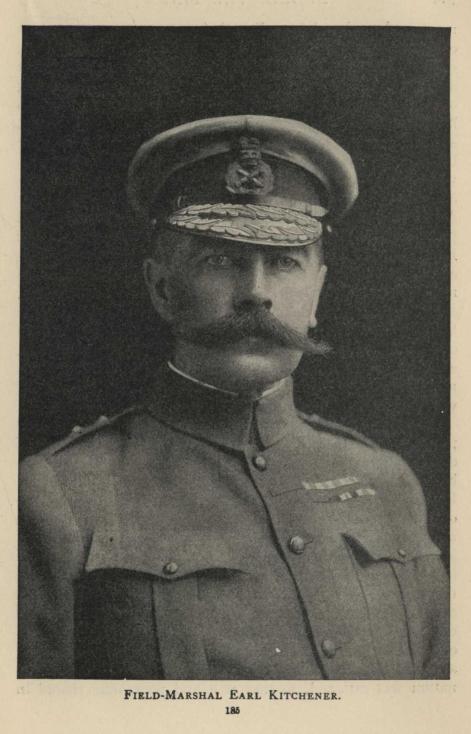
FIELD-MARSHAL EARL KITCHENER.
The business of an army in the field is not merely to fight, or rather, its chief task, fighting, is only possible if there is a first-class organization behind the lines. How brilliant and complete that organization was towards the close of the struggle would take a volume to expound. In France, for example, the British Army had its own Forestry Department, and produced from French forests over 2,000,000 tons of timber. It was its own farmer, and in 1918 it saved the crops of 18,000 French acres, harvesting them at night. It did its own tailoring and boot-making. It did all its mending of every kind, and it saved broken and derelict material to be remade in the factories at home. It did its own catering, and there never was a war in which men and horses were better fed—a remarkable feat when we remember that provision had to be made for men of different races and tastes—curry for the Indians, nut-oil for the Chinese, and coffee for the American soldiers. It did its own banking, insurance, and printing. Its transport service was a miracle. In 1914 the Expeditionary Force landed in France with 40,000 horses and a few hundred lorries, while its railway transport was managed by the French. In 1918 it ran its own railways, and it had 500,000 horses and mules, 33,500 lorries, 1,400 tractors, and 15,800 motor-cars. It did the business of almost all the trades on earth, and did it with exactness, economy, and an amazing flexibility, so that whenever a new call was necessitated by the strategy of the generals, it was fully and promptly met.
The war was therefore a united effort of the whole British people. In Cromwell's day the start of one battle was delayed because it got mixed up with a fox hunt. Even in the Napoleonic wars there were thousands of families in England which lived remote from the struggle, and readers of Jane Austen's novels would not gather from their placid narrative that her country was involved in a European campaign. But between 1914 and 1918 every aspect of national life and every branch of national thought was organized for the purposes of the war. Hospitals sprang up in every town and in hundreds of country districts. Articles of food were controlled to release shipping for war purposes. The country enormously increased its own food supply, and some 4,000,000 acres of pasture were brought under tillage. The whole nation was rationed, so that rich and poor alike shared in the sacrifice. Schoolboys spent their holidays working on the land, and the women of Britain, in munition factories, in land work, and in a thousand other employments, made noble contribution to the common cause. In 1918 there were at least 1,500,000 more women working than before the war, and the tasks on which they were engaged were those which had hitherto been regarded as work which could only be performed by men.
PART VI.
VICTORY.
CHAPTER XXXI.
THE LAST DAY.
By the first days of November 1918 the war was won. In October both Turkey and Bulgaria had been beaten to the ground. On the 4th of November Austria capitulated. Ludendorff had resigned, the German Emperor had sought refuge at Army Headquarters from the troubles of his capital, the German navy had mutinied, and a revolution was beginning in Berlin. Foch was on the eve of his last step in the West. The Americans were moving on Sedan. Haig was in the position of Wellington on the eve of Waterloo, when he raised his hat as a signal for "Everything to go in."
On 1st November Valenciennes fell. On 4th November Haig attacked on the 30 miles between that city and the Sambre. Twenty British divisions scattered thirty-two German divisions, taking 19,000 prisoners and more than 450 guns. That day broke the enemy's resistance. Henceforth he was not in retreat but in flight, and the two wings of his armies were separated for ever. There remained only the 50 miles between Avesnes and Mezières as an avenue of escape for all the German forces of the south, and Foch was preparing to swing his right wing north of Metz to close the last bolt-hole. If a negotiated armistice did not come within a week there would be a compulsory armistice of complete collapse and universal surrender. That day Germany appointed delegates to sue for peace.
On the 8th, Rawlinson occupied Avesnes and Byng reached the skirts of Maubeuge. The first week of that month of November the weather was wet and chilly, very different from the bright August when British troops had last fought in that region. The old regular forces which in 1914 had then borne the shock of Germany's first fury had mostly disappeared. Many were dead, or prisoners, or crippled for life, and the rest had been dispersed through the whole British army. The famous first five divisions, which had made the Retreat from Mons, were in the main composed of new men. But there were some who had fought steadily from the Sambre to the Marne and back again to the Aisne, and then for four years in bitter trench battles, and had now returned, after our patient fashion, to their old campaigning ground. Even the slow imagination of the British soldier must have been stirred by that strange revisiting. Then he had been marching south in stout-hearted bewilderment, with the German cavalry pricking at his flanks. Now he was sweeping to the north-east on the road to Germany, and far ahead his own cavalry and cyclists were harassing the enemy rout, while on all the eastern roads his aircraft were scattering death.
On the 7th the line of the Scheldt broke. On the 8th Condé fell, and on the 9th the British Guards entered Maubeuge. On the 7th Pershing and the Americans had reached Sedan. On the 10th the British left was approaching Mons, and the centre was close on the Belgian frontier. These were feverish days both for victors and vanquished. Surrender hung in the air, and there was a generous rivalry among the Allies to get as far forward as possible before it came. Take, for example, the 8th Division of the British First Army. On the 10th November one of its battalions, the 2nd Middlesex, travelled for seven hours in buses, and then marched 27 miles, pushing the enemy before them. They wanted to reach the spot near Mons where some of them had fired some of the first British shots in the war; and it is pleasant to record that they succeeded.
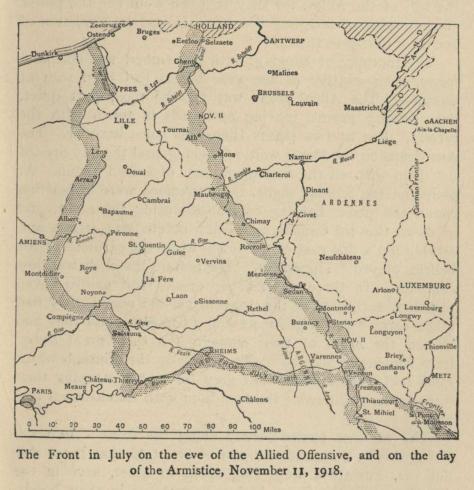
The Front in July on the eve of the Allied Offensive, and on the day of the Armistice, November 11, 1918.
Meantime, in Germany, the revolution had begun. On Saturday the 9th, a republic was declared in Berlin, and throughout the country, in every State, the dynasties fell. On Sunday the 10th, the Emperor left the Army Headquarters at Spa, crossed the Dutch frontier, and sought refuge in a friend's house at Amerongen. The Imperial Crown Prince, like his father, found sanctuary in Holland. The German delegates left Berlin on the afternoon of Wednesday the 6th, and on the 8th met Foch and petitioned for an armistice. They received his terms, and communicated them to Spa and Berlin. On the night of Sunday, 10th November, the terms were accepted, and at 5 o'clock on the morning of Monday, 11th November, the armistice was signed. The acceptance of the terms meant the surrender of Germany to the will of the Allies, for they stripped from her the power of continuing or renewing the war. It was an admission of her utter defeat in the field.
The morning of Monday, 11th November, was cold and foggy, such weather as the year before had been seen at Cambrai. The Allied front was for the most part quiet, only cavalry patrols moving eastwards in touch with the retreat. But at two points there was some activity. The Americans on the Meuse were advancing, and the day opened for them with all the accompaniment of a field action. At Mons, on the Sunday night, the Canadians were in position round the place, fighting continued during the night, and at dawn the 3rd Canadian Division entered the streets and established a line east of the town, while the carillons of the belfries played "Tipperary." For Britain the circle was now complete. In three months her armies had gained seven victories, each greater than any in her old wars; they had taken some 190,000 prisoners and 3,000 guns, and they had broken the heart of their enemy. To their great sweep from Amiens to Mons was due especially the triumph which Foch had won, and on that grey November morning their worn ranks could await the final hour with thankfulness and pride.
The minutes passed slowly along the front. An occasional shell, an occasional burst of fire, told that peace was not yet, but there were long spells of quiet, save in the American area. Officers had their watches in their hands, and the troops waited with the same grave composure with which they had fought. Men were too weary for their imaginations to rise to the great moment, for it is not at the time of a crisis, but long afterwards, that the human mind grasps the drama. Suddenly, as the watch-hands touched 11, there came a second of expectant silence, and then a curious rippling sound which observers, far behind the front, likened to the noise of a great wind. It was the sound of men cheering from the Vosges to the sea.
CHAPTER XXXII.
LOOKING BACKWARD.
The greatness of the contest is not easy to realize, for it was so much the hugest war ever fought in the history of humanity that comparative tests fail us. During its four years it took from the world a far heavier toll of life and wealth than a century of the old Barbarian invasions had done. More than 8,000,000 men died in battle, and the casualties on all fronts were over 30,000,000. If we add deaths from disease and famine it cannot have cost the population of the globe less than 20,000,000 dead, and as many more maimed and weakened for life. At least 40,000 millions sterling of money were spent by the nations in the direct business of war. Let it be remembered that this devastation was wrought not in the loose society of an elder world, but in one where each state was a highly-developed thing, and depended for some necessaries upon its neighbour, and where myriads of human souls could only support life so long as the machine of civilization performed its functions smoothly and securely.
We can best grasp the immensity of the struggle by attempting to grasp the immensity of the battleground. Such a task is for the imagination only, for the soldier saw only his little area, and no man's first-hand experience could cover all the many fields. An observer on some altitude in the north, like the Hill of Cassel, on some evening in September 1918, could look east and note the great arc from the dunes at Nieuport to the coalfields about Lens lit with the flashes of guns and the glare of star-shells, and loud with the mutter of battle. That was a line of 50 miles—far greater than any battlefield in the old wars. Had he moved south to the ridge of Vimy he would have looked on another 50 miles of an intenser strife. South, again, to Bapaume, he would have marked the wicked glow from Cambrai to the Oise. Still journeying, from some little height between the Oise and the Aisne he would have scanned the long front which was now creeping round the shattered woods of St. Gobain to where Laon sat on its hill. From the mounts about Rheims he might have seen Gouraud's battle-line among the bleak Champagne downs, and from a point in the Argonne the trenches of the Americans on both sides of the Meuse, running into the dim wooded country where the Moselle flowed towards Metz. Past the Gap of Nancy, and southward along the scarp of the Vosges, went the flicker of fire and the murmur of combat, till the French lines stretched into the plain of Alsace, and exchanged greetings with the sentinels on the Swiss frontier. Such a battle-ground might well have seemed beyond the dream of mortals, and yet it was but part of the whole.
A celestial intelligence, with sight unlimited by distance, would have looked eastward, and, beyond the tangle of the Alps, witnessed a strange sight. From the Stelvio Pass in the Alps to the Adriatic ran another front, continuous through glacier-camps and rock-eyries and trenches on the edge of the eternal snows, to the foothills of the Lombard plain, and thence, by the gravel beds of the Piave, to the lagoons of Venice. Beyond the Adriatic it ran, through the sombre hills of Albania, past the great lakes, where the wild-fowl wheeled at the unfamiliar sound of guns, beyond the Tcherna and Vardar and Struma valleys to the Ægean shores. It began again, when the Anatolian peninsula was left behind, and curved from the Palestine coast in a great loop north of Jerusalem across Jordan to the hills of Moab. Gazing over the deserts, he would have marked the flicker which told of mortal war passing beyond the ancient valleys of Euphrates and Tigris, up into the wild Persian ranges. And scattered flickers to the north would have led him to the Caspian shores, and beyond them to that tableland running to the Hindu Kush which was the cradle of all the warring races. Still farther north, his eyes would have seen the lights of the Allies from the Pacific coast westward to the Urals and the Volga, and little clusters far away on the shore of the Arctic Sea.
Had the vision of our celestial spectator been unhindered by time as well as by space, it would have embraced still stranger sights. It would have beheld the old Allied Eastern front, from the Baltic to the Danube, pressing westward, checking, and falling east; breaking in parts, gathering strength, and again advancing; and at last dying like a lingering sunset into darkness. Behind would have appeared a murderous glow, which was the flame of revolution. Turning to Africa, it would have noted the slow movement of little armies in west, and east, and south—handfuls of men creeping in wide circles among the Cameroons forests till the land was theirs; converging lines of mounted troopers among the barrens of the German South-West territory, closing in upon the tin shanties of Windhoek; troops of all races advancing through the mountain glens and dark green forests of German East Africa, till, after months and years, the enemy strength had become a batch of exiles beyond the southern frontier. And farther off still, among the isles of the Pacific and on the Chinese coast, it would have seen men toiling under the same lash of war.
Had the spectator looked seaward, the sight would have been not less marvellous. On every ocean of the world he would have observed the merchantmen of the Allies bringing supplies for battle. But in the North Atlantic, in the Mediterranean, and in the English Channel and the North Sea he would have seen uncanny things. Vessels would disappear as if by magic, and little warships would hurry about like some fishing fleet when shoals are moving. The merchantmen would huddle into packs, with destroyers like lean dogs at their sides. He would have seen in the Scottish firths and among the isles of the Orkneys a mighty navy waiting, and ships from it scouring the waters of the North Sea, while inside the fences of Heligoland lay the decaying monsters of the German fleet. And in the air, over land and sea would have been a perpetual coming and going of aircraft like flies above the pool of war.
The observer, wherever on the globe his eyes were turned, would have found no area immune from the effects of the contest. Every factory in Europe and America was humming by night and day to prepare the material of strife. The economic problems of five continents had been transformed. The life of the remotest villages had suffered a strange transformation. Far-away English hamlets were darkened because of air raids; little farms in Touraine, in the Scottish Highlands, in the Apennines, were untilled because there were no men; Armenia had lost half her people; the folk of North Syria were dying of famine; Indian villages and African tribes had been blotted out by plague; whole countries had ceased for the moment to exist, except as geographical names. Such were but a few of the consequences of the kindling of war in a world grown too expert in destruction, a world where all nations were part one of another.
The war was an Allied victory, but let us be very clear what that means. It delivered the world's freedom from a deadly danger, and, though the price was colossal, the cause was worthy. But its positive fruits must be sought elsewhere—in that impulse to international brotherhood caused by the revulsion from the horrors of international strife, and the war's vindication of the essential greatness of our common humanity. Its hero was the ordinary man. Victory was won less by genius in the few than by faithfulness in the many.
The horrors of the four years sickened the world of war, and made thinking men realize that some other way than this monstrous folly must be found of settling disputes between peoples. A League of Nations was one of the first articles of peace, and the League then founded has already, in spite of hindrances and setbacks, and the opposition of an all too narrow patriotism, made itself a power in the world. If civilization is to endure the League must prosper, for the world cannot stand another such carnival of destruction. The League means the enforcement of law throughout the globe, so that the nations as regards each other shall live in that state of orderly liberty which a civilized power ensures for its citizens. That purpose, as we have learned from bitter experience, is not a dream of idealism, but the first mandate of common-sense.
No honest sacrifice can be made in vain. In war sacrifice is mainly of the innocent and the young. This was true of every side. Most men who fell died for honourable things. They were inspired by the eternal sanctities—love of country and home, comradeship, loyalty to manly virtues, the indomitable questing of youth. Against such a spirit the gates of death cannot prevail. We may dare to hope that the seed sown in sacrifice and pain will yet quicken and bear fruit to the purifying of the world, and in this confidence await the decrees of that Omnipotence to whom a thousand years are as one day.
THE END.
PRINTED IN GREAT BRITAIN AT THE PRESS OF THE PUBLISHERS.