DAYS TO REMEMBER (continued 2)
Reading edition
All afternoon the shell-fire had been terrific. A number of light trench-mortars were also firing against the north-east corner of our front and causing heavy losses. The casualties had been so high that the whole line was now held only by a few isolated groups, and control was impossible. About 4 o'clock Christian made his way to Dawson and told him that he feared his men could not hold out much longer. Every machine-gun and Lewis gun was out of action, the ammunition was nearly gone, the rifles were choked, and the breaking-point of human endurance had been reached. The spirit was still unconquered, but the body was fainting.
Dawson had still the shadow of a hope that he might maintain his ground until dark, and then fight his way out. Like all good soldiers in such circumstances, he was harassed by doubts. The brigade was doomed; even if the struggle could be protracted till dusk, only a fragment could escape. Had he wished to withdraw he must have begun in the early morning, as soon as the enemy appeared, for once the battle was joined the position was a death trap. He had orders from the division to hold his ground "at all costs"—a phrase often given a vague meaning in war, but in this case taken literally. He wondered whether the stand might be of value to the British front, or whether it was not a useless sacrifice. He could only fall back for comfort on his instructions. He wrote thus in his diary: "I cannot see that under the circumstances I had any option but to remain till the end. Far better go down fighting against heavy odds than that it should be said we failed to carry out our orders. To retire would be against all the traditions of the Service."
Some time after 4.15, enemy masses appeared to the north-east of brigade headquarters. It was the final attack, for which three fresh battalions had been brought up, and the assault was delivered in close formation. There were now only 100 South Africans, some of them already wounded. There was not a cartridge left in the front line, and very few anywhere except in the pistols of the officers. Had they had ammunition they might have held even this last attack; as it was, it could be met only by a few scattered shots. The South Africans had resisted to the last moment when resistance was possible; and now they had no weapon. The Germans surged down upon a few knots of unarmed men. Dawson, with Christian and Beverley, walked out in front of a group which had gathered round them, and was greeted by the Germans with shouts of "Why have you killed so many of us?" and "Why did you not surrender sooner?" One man said, "Now we shall soon have peace," at which Dawson shook his head. Before he went eastward into captivity he was allowed to find Cochran's body and rescue his papers.
In all that amazing retreat, when our gossamer front refused to be broken by the most overwhelming odds, no British division did more nobly than the 9th. It held a crucial position in the line, and only by its stubborn endurance was a breach between Gough and Byng prevented. Among the brigades of the 9th, the chief brunt was borne by the South African.
Let us take the testimony of the enemy. During the German advance, Captain Peirson, the brigade major of another division, was taken prisoner. When he was examined at German headquarters an officer asked him if he knew the 9th Division; for, said he, "we consider that the fight put up by that division was one of the best on the whole of your front, especially the last stand of the South African Brigade, which we can only call magnificent." In the course of his journey to Le Cateau Captain Peirson was spoken to by many German officers, all of whom mentioned the wonderful resistance of the South Africans. There is a still more striking tribute. On the road to Le Cateau a party of British officers was stopped by the Emperor, who asked if any one present belonged to the 9th Division. "I want to see a man of that division," he said, "for if all divisions had fought as well as the 9th I would not have had any troops left to carry on the attack."
It was no piece of fruitless gallantry. Dawson, as he was tramping eastwards, saw a sight which told him that his decision had been right, and that his work had not been in vain. The whole road for miles east of Bouchavesnes was blocked by a continuous double line of transport and guns, which proved that the South Africans had for over seven hours held up not only a mass of German infantry, but all the artillery and transport advancing on the Bouchavesnes-Combles highway. Indeed, it is not too much to say that on that feverish Sabbath the stand of the brigade saved the British front. It was the hour of Von der Marwitz's most deadly thrust. While Gough was struggling at the Somme crossings, the Third Army had been forced west of Morval and Bapaume, far over our old battle-ground of the First Battle of the Somme. The breach between the two armies was hourly widening. But for the self-sacrifice of the brigade at Marrières Wood and the delay in the German advance at its most critical point, it is doubtful whether Byng could ever have established that line on which, before the end of March, he held the enemy.
CHAPTER XI.
THE BATTLE OF THE LYS.
By 6th April 1918 the great German thrust towards Amiens had failed, and for the moment the gate of the Somme was closed. The city was under fire, the enemy was before its gates, but his strength was exhausted and he could not advance. Therefore his chief plan—of separating the French and the British—had come to nought. Brought to a standstill, he cast about for a diversion, for he could not permit the battle to decline into a stalemate, since he was fighting against time. His main purpose remained the same, but he sought to achieve it by a new method. He would attack the British elsewhere, on some part of the front where they were notoriously weak, and compel Foch to use up his reserves in its defence. Then, when the Allied resources had shrunk, he would strike again at the weakened door of Amiens. On the German side the operation was meant to be merely subsidiary, designed to prepare the way for the accomplishment of the main task farther south. They proposed to choose a battle-ground where even a small force might obtain important results. But so stoutly did the meagre British divisions resist that the enemy was compelled to extend the battle well into May, to squander thirty-five of his fresh divisions, and to forfeit for good his chance of final victory.
The new battle-ground was the area on both sides of the river Lys, between the La Bassée Canal and the Wytschaete Ridge. The German Staff knew that our front line had already been thinned to supply ten divisions for the struggle in the south, and at the moment it was weakly held, mainly by troops exhausted in the Somme battle. The enemy Staff chose their ground well. They had the great city of Lille behind them to screen the assembly. Certain key-points, such as Béthune and Hazebrouck, lay at no great distance behind the British front. The British communications were poor, while the German were all but perfect. If the enemy could break through at once between La Bassée and Armentières and capture Béthune, he could swing north-westward and take Hazebrouck and the hills beyond Bailleul, and so threaten the Channel Ports, on which the British armies depended for supplies.
The attack began on Tuesday, 9th April. A Portuguese division south of the Lys was driven in at the first thrust, and through the gap the enemy streamed in. At a quarter-past ten that morning he was more than a mile to the rear of the division holding the left of the gap, which was accordingly compelled to retreat. On the right of the gap, covering Béthune, lay the 55th West Lancashire Division. The story of the Lys is a story of the successful defence of key-points against critical odds, and Givenchy, where the men of West Lancashire stood, was most vital, for unless it fell Béthune could not be taken, and unless Béthune were captured at once the enemy attack would be cramped into too narrow a gate. The 55th Division did not yield though outnumbered by four to one. They moved back their left flank but they still covered Béthune, and their right at Givenchy stood like a rock. By noon the enemy was in the ruins of Givenchy; in the afternoon the Lancashire men had recovered them; in the evening they were again lost, and in the night retaken. This splendid defence was the deciding event in the first stage of the battle. It was due, said the official report, "in great measure to the courage and determination displayed by our advance posts. Among the many gallant deeds recorded of them, one instance is known of a machine-gun which was kept in action although the German infantry had entered the rear compartment of the pill-box from which it was firing, the gun team holding up the enemy by revolver fire from the inner compartment."
Next day, 10th April, a new German army attacked north of the Lys, captured Messines, and was pouring over the Wytschaete crest. But at Wytschaete stood the 9th Division, which we have previously seen in action on the Somme at Marrières Wood. There its South African Brigade had been completely destroyed, but a new one had been got together, and this second showed all the heroism of the first. That night they retook Messines, and during the evening cleared the Wytschaete Ridge. That stand saved the British northern flank and gave its commander time to adjust his front. For thirty hours the Germans were held up on that ridge, and when they finally advanced the worst danger was past.
The situation was still most critical. The French were sending troops, but with all possible resources utilized we were still gravely outnumbered, and the majority of the men were desperately weary from the Somme battle. On the 11th Sir Douglas Haig issued an Order of the Day, in which he appealed to his men to endure to the last. "There is no other course open to us than to fight it out. Every position must be held to the last man; there must be no retirement. With our backs to the wall and believing in the justice of our cause, each one of us must fight on to the end." Not less solemn was Sir Arthur Currie's charge to the Canadian Corps before they entered the battle. "Under the orders of your devoted officers in the coming battle you will advance or fall where you stand, facing the enemy. To those who fall I say, 'You will not die, but will step into immortality. Your mothers will not lament your fate, but will be proud to have borne such sons. Your names will be revered for ever and ever by your grateful country, and God will take you unto Himself.'" It is a charge which has the noble eloquence of Cromwell or Lincoln.
Within a week it seemed as if the enemy had succeeded. On the evening of 15th April the Germans entered Bailleul, and the next day we withdrew from the ground won in the Third Battle of Ypres to a position a mile east of that town. By the 17th the enemy was in both Meteren and Wytschaete, and this meant that the northern pillar of our defence had gone. The next step for the Germans was to seize Mont Kemmel, the highest ground between them and the Channel, and a position which would presently give them Hazebrouck.
The 17th and 18th of April were perhaps the most critical days of the whole battle. The enemy had reached his greatest strength, and the British troops were not yet reinforced at any point within sight of security. On the 17th the Germans had failed in an attack on the Belgians north of Ypres, and next day they failed no less conclusively in a movement on Béthune. This gave us a breathing space, and by the morning of Sunday, the 21st, French troops had taken over the defence of Mont Kemmel, and we had been able to relieve some of the divisions which had suffered most heavily.
That day saw the end of the main crisis of the battle. Mont Kemmel was lost and regained more than once, but the enemy was quickly becoming exhausted, and his gains, even when he made them, had no longer any strategic value. By the end of April he had employed in that one area of the line thirty-five fresh divisions, and nine which had been already in action. These troops were the cream of his army, and could not be replaced. Moreover, an odd feature had appeared in the last stages of the Lys battle. In March the enemy had succeeded in piercing and dislocating the British front by a new tactical method applied with masterly boldness and precision, the method which has been described as "infiltration."[#] But as the Lys battle dragged on the Germans seemed to have forgotten these new tactics, and to have fallen back upon their old methods of mass and shock. The reason was that the new tactics could only be used with specially trained troops, and with fresh troops; they put too great a strain on weary divisions and raw levies; therefore, as the enemy's losses grew, his tactics would deteriorate in the same proportion.
[#] See p. 36.
If we take 5th May as marking the close of the Battle of the Lys, we may pause to reflect upon the marvels of the forty-five preceding days, since the enemy torrent first broke west of St. Quentin. More history had been crowded into their span than into many a year of campaigning. They had seen the great German thrust for Amiens checked in the very moment of success. They had seen the last bold push for the Channel Ports held up for days by weak divisions which bent but did not break, and finally die away with its purpose still far from achievement. In those forty-five days divisions and brigades had been more than once destroyed as units, and always their sacrifice had been the salvation of the British front. The survivors had behind them such a record of fruitful service as the whole history of the war could scarcely parallel.
CHAPTER XII.
THE SECOND BATTLE OF THE MARNE.
The First Battle of the Marne meant the frustration of Germany's main battle purpose, and the disappearance for ever of her hope of a complete and decisive victory. The Second Battle of the Marne in July 1918 was the beginning of Germany's defeat. In both battles the armies of Britain contributed to victory, but in both battles, as was right and proper, the main work was done by the French, and with them lies the chief glory.
In March Haig had been forced back to the gate of Amiens, and Foch, at last appointed Commander-in-Chief of all the Allies, had for nearly a month looked into the eyes of defeat. But slowly the tide ebbed. Foch was able not only to repel the German assaults but to nurse and strengthen his own reserves. In spite of the desperate crises on the Lys and the Aisne midsummer found him rapidly growing in strength. And as the Allies grew, so the enemy declined.
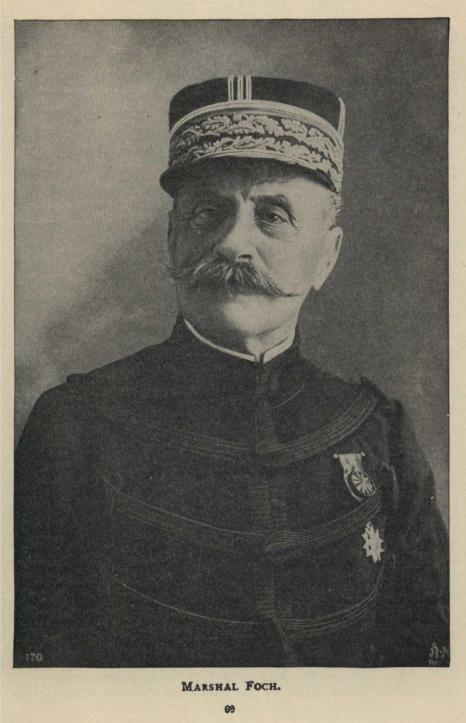
MARSHAL FOCH.
For the first time Foch had the advantage of numbers, and by June there were more than half a million Americans in France. Moreover, he had devised an answer to the German tactics, and in his new light tanks he had a weapon which would give him the advantage of surprise. But like a great and wary commander, he waited till the enemy had struck yet again, so that he might catch him on the rebound. Germany still maintained her confidence. Her press announced that unless the American army could swim or fly it would never arrive in Europe—that at the best the men of the United States were like the soldiers of a child's game, made of paper cuttings. The battle staged for July was to bring the Germans to Paris. One army was to strike east of Rheims and cut the railway from Paris to Nancy. Another was to press across the Marne. When Foch had hurried all his forces to the danger points a third army would break through at Amiens and descend on the capital from the north. Then the British would be finally cut off from the French, the French would be broken in two, and victory, complete and indubitable, would follow.
The enemy was so confident that he made no secret of his plans, and from deserters and prisoners Foch learned the main details long before the assault was launched. The French general resolved to play a bold game. He borrowed a British corps from Haig, and he thinned the Amiens section so that it was dangerously weak. His aim was to entice the enemy south of the Marne, and then in the moment of his weakness to strike at his undefended flank.
At midnight on Sunday, 14th July, Paris was awakened by the sound of great guns, and knew that the battle had begun. At 4 a.m. on the 15th the Germans crossed their parapets. The thrust beyond the Marne was at once successful, for it was no part of Foch's plan to resist too doggedly at the apex of the salient. On a front of 22 miles the Germans advanced nearly three. But the attack east of Rheims was an utter failure. Gouraud's counter-bombardment dislocated the attack before it began, and with trifling losses to himself he held the advance in his battle zone, not losing a single gun. In the west the Americans stood firm, so that the enemy salient could not be widened. These were the troops which, according to the German belief, could not land in Europe unless they became fishes or birds. The inconceivable had been brought to pass—"Birnam Wood had come to Dunsinane."
In two days the German advance had reached its limit—a long narrow salient south of the Marne, representing a progress at the most of 6 miles from the old battle-front. The time had now come for Foch's counterstroke. He had resolved to thrust with all his available reserves against the weak enemy flank from Soissons southward. There, in the shelter of the woods of Villers-Cotterets, lay the army of Mangin, who first won fame at Verdun.
The morning of the 18th dawned after a night of thunderstorms and furious winds. There was no gunfire on the French side, but at 4.30, out from the shelter of the woods came a great fleet of French light tanks, and behind them on a front of 35 miles the French and American infantry crossed the parapets. Before the puzzled enemy could realize his danger they were through his first defences.
The advance of the 18th was like a great bound forward. The chief work was done by Mangin's left wing, which at half-past 10 in the morning held the crown of the Montagne de Paris, on the edge of Soissons. All down the line the Allies succeeded. Sixteen thousand prisoners fell to them and some 50 guns, and at one point Mangin had advanced as much as 8 miles. Foch had narrowed the German salient, crumpled its western flank, and destroyed its communications. He had wrested the initiative from the Germans and brought their last offensive to a dismal close.
He had done more, though at the time no eye could pierce the future and read the full implications of his victory. Moments of high crisis slip past unnoticed. It is only the historian in later years who can point to a half-hour in a crowded day and say that then was decided the fate of a cause or a people. As the wounded trickled back through the tossing woods of Villers-Cotterets, spectators noted a strange exaltation in their faces. When the news reached Paris the city breathed a relief which was scarcely justified with the enemy still so strongly posted at her gates. But the instinct was right. The decisive blow had been struck. When the Allies breasted the Montagne de Paris that July morning they had, without knowing it, won the Second Battle of the Marne, and with it the war. Four months earlier Ludendorff had stood as the apparent dictator of Europe; four months later he and his master were fleeing to a foreign exile.
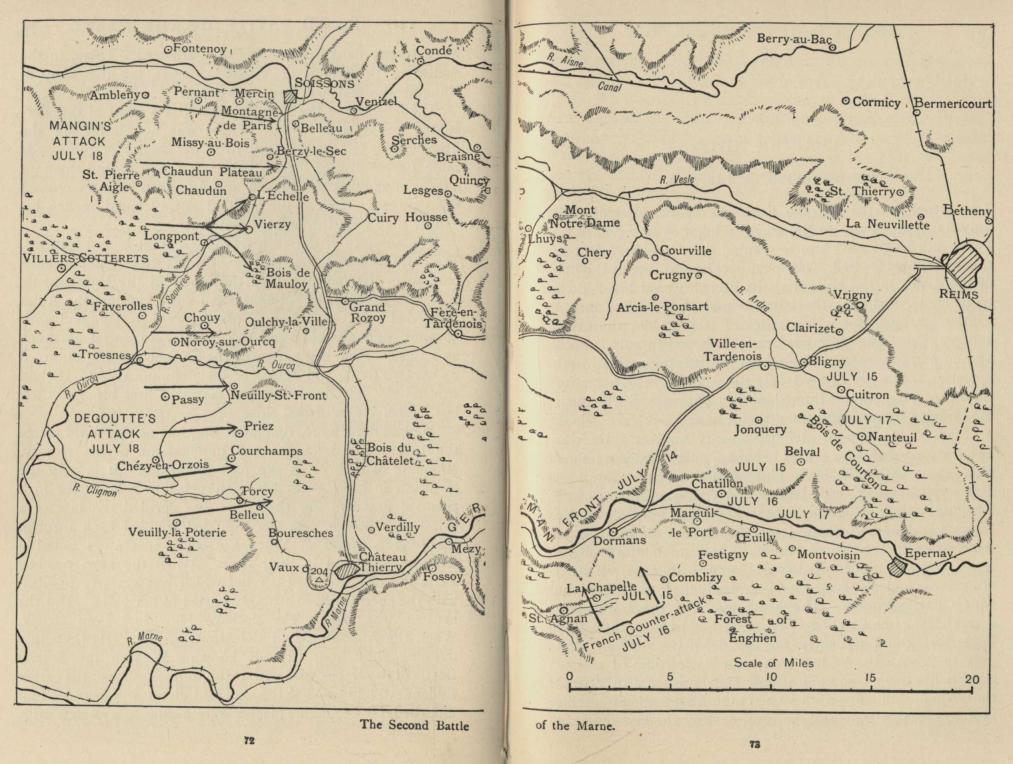
The Second Battle of the Marne.
CHAPTER XIII.
THE BEGINNING OF THE END.
The attack on the German flank on the morning of 18th July had put an end to the enemy's hope of an advance on Paris, and had forced him to assume the defensive. But in this he still persevered. His plan now was to defend the line of the Aisne, in the hope that the French would break their teeth on it, and that the battle would then decline into a fruitless struggle for a few miles of trench, like the other actions of the long siege warfare. He hoped in vain. Foch had no mind to waste a single hour in operations which were not vital. As early as 23rd July the Allies' great scheme for the autumn battles was framed, and on Thursday, 8th August, Sir Douglas Haig opened the attack.
Foch's plan was to give the enemy no rest. He was like a swordsman who avoids his antagonist's sledge-hammer blows, who with lithe blade pinks him again and again and draws much blood, who baffles and confuses him, till the crushing weight of his opponent has been worn down by his own trained and elastic strength. It was his business to wear down the enemy continuously and methodically by a series of attacks on limited fronts, aiming at strictly limited objectives, and to keep him ceaselessly harassed over the whole battle-ground. The campaign had developed like a masterly game of chess. From 21st March to 18th July Foch had stood patiently on the defensive. From 18th July to 8th August he had won back his freedom of action, cleared his main communications, and hopelessly dislocated the German plan. From 8th August to 26th September it was his task to crumble the enemy's front, destroy the last remnant of his reserves, force him beyond all his prepared defences, and make ready for the final battle which would give victory.
On 8th August Haig's striking force was the British Fourth Army, under Sir Henry Rawlinson, and part of the French First Army, under General Debeney. The front of attack was east of Amiens, astride the valleys of the Avre, the Luce, and the Somme. Haig's immediate aim was to free his communications—that is, to push the enemy out of range of the main railways behind his front—as the French had done on the Marne, and to this end the enemy must be driven out of range of Amiens.
The preparations for the attack were most cunningly concealed, and infinite pains were taken to make the surprise complete. By an elaborate piece of "camouflage" the enemy was induced to believe that an attack in Flanders was preparing. The Canadians, who, along with the Australians, were the principal British attacking troops, had been secretly brought down from the north a few days before, and only came into line just before the battle. For the action Sir Douglas Haig had accumulated not less than 400 Tanks, many of the light "whippet" type and most of the newest pattern. He was to employ Foch's tactics in their purest form. There was to be no artillery bombardment except just at the moment of advance; the ground had been perfectly reconnoitred from the air; the objectives to be secured were ambitious but strictly defined; and the troops to be used were among the corps d'élite of the army.
In the first week of August much rain fell, and on the night of the 7th a heavy mist hung over the ground. Just before daybreak on Thursday the 8th an intense bombardment was opened, so intense that the enemy's defences disappeared as if wiped out by a sponge. Four minutes later the bombardment stopped, and the Tanks and infantry moved forward. Rawlinson advanced at 4.20 a.m.; Debeney some twenty minutes later.
Success was immediate and continuous. The Canadians and Australians, pressing along the two great Roman highways to St. Quentin and Roye, marched steadily towards their final objectives, and these they reached long before noon. The enemy was completely surprised. At one place the Tanks captured an entire regimental mess at breakfast. At another the whole staff of a division was seized. In some villages the Germans were taken in their billets before they knew what had happened, and parties of the enemy were actually made prisoners while working in the harvest field. The Canadian cavalry passed through the infantry and captured a train on the railway line near Chaulnes. Indeed, that day the whole British cavalry performed miracles, advancing 23 miles from their point of concentration.
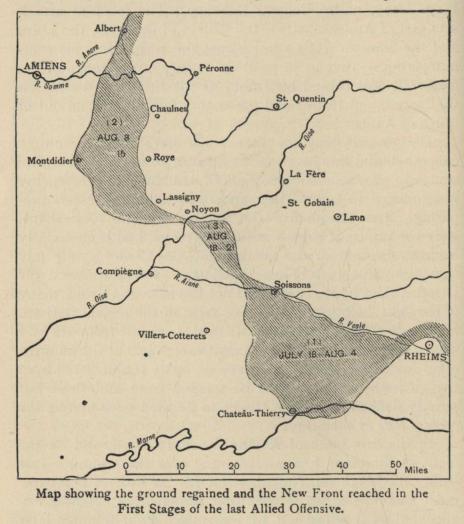
Map showing the ground regained and the New Front reached in the First Stages of the last Allied Offensive.
This success at the beginning of the last battle of the war was due partly to the brilliant tactical surprise, partly to the high efficiency of the new Tanks, and also in some degree to the evident deterioration in the quality of the German infantry in that part of the front. The enemy machine-gunners did not display their old tenacity. The Allied casualties were extraordinarily small, one Canadian division, which was in the heart of the battle, losing only 100 men. It was very clear that the fortitude of the German line was ebbing, and this more than any other fact disturbed the minds of its commanders. Ludendorff has recorded in his Memoirs that after the battle of 8th August he realized that Germany was beaten.
The Tanks played a brilliant and dramatic part in the day's success. One Tank captured a village single-handed, and its wary commander solemnly demanded a receipt for the village before he handed it over to the Australians. But the chief performance of the day was that of the "whippet" Tank "Musical Box," commanded by Lieutenant C. B. Arnold, and carrying as crew Gunner Ribbans and Driver Carney. This Tank started off at 4.20 a.m. in company with the others, and when she had advanced the better part of 2 miles discovered herself to be the leading machine, all the others having been ditched. She came under direct shell-fire from a German field battery, and turned off to the left, ran diagonally across the front of the battery at a distance of 600 yards, and fired at it with both her guns. The battery replied with eight rounds, fortunately all misses, and the Tank now managed to get to the battery's rear under cover of a belt of trees. The gunners attempted to get away, but "Musical Box" accounted for them all.
If a Tank can be said to go mad, this Tank now performed that feat. She started off due east straight for Germany, shooting down Germans whenever she saw them. The Australian infantry were following her, and for some time she was also in touch with two British cavalry patrols. Seeing a party of the enemy in a field of corn, she charged down upon them, killing three or four. She found a patrol of our cavalry dismounted and in trouble with some Germans on a railway bridge, so she made for the bridge and dispersed the Germans. She moved still farther east, and approached a small valley marked on Lieutenant Arnold's map as containing German hutments. As she entered the valley the Germans were seen packing their kits and beginning to move, and "Musical Box" opened fire. There was a general flight, but this did not prevent her guns from accounting for a considerable number. She now turned a little to the left across open country, firing at retreating German infantry at ranges of from 200 to 600 yards, and being heavily fired on by rifles and machine-guns in reply. Unfortunately she was carrying petrol tins on her roof, and these were perforated by the hail of bullets, so that the petrol ran all over the cab. The great heat from her engines and guns, which had been in action for nine or ten hours, made it necessary at this point for the crew to breathe through their box-respirators.
It was now about 2 o'clock in the afternoon, and "Musical Box" was still moving east, shooting at anything she could see, from motor transport to marching infantry, and getting heavily peppered in return. At last Lieutenant Arnold was compelled to withdraw the forward gun. The fumes and the heat were stifling, but the crew managed to endure it till suddenly the gallant "Musical Box" was struck by two heavy shells following close one upon the other, and the cab burst into flames. Carney and Ribbans reached the door and collapsed. Lieutenant Arnold was almost overcome, but managed to get the door open and fall out upon the ground. He was then able to drag out the other two men. Burning petrol was running on to the ground where they were lying, and the clothing of all three was on fire. They struggled to get away from the petrol, and while doing so Carney received his death wound. The enemy were now approaching from all quarters, and, having been thoroughly scared, they not unnaturally treated the two survivors somewhat roughly.
Lieutenant Arnold and Gunner Ribbans, badly burned, incredibly dirty, half-suffocated, and fainting with fatigue, were led off into captivity, after having completed such an Odyssey of devastation as perhaps befell no other two men in the war.
CHAPTER XIV.
THE AUSTRALIANS AT MONT ST. QUENTIN.
Close to the spot where the South Africans made their great stand in the retreat of March 1918, it fell to the lot of troops from another of our Dominions to perform an almost miraculous exploit in the advance eastward to victory. By 30th August, as we have seen, the tide had fully turned. All the British armies were pressing back the enemy over the old Somme battlefield, and that enemy was struggling desperately to hold on to key positions long enough to enable him to retire in good order to the Hindenburg Line, where he hoped to stand on the defence over the winter. But these key positions were now being rushed too fast to permit of an orderly retreat, and so the Hindenburg defences proved of no avail, and before the end of October the Germans were a defeated army.
Of all the key positions the strongest was that of Mont St. Quentin, which commanded the old town of Péronne on the north. Péronne, as readers of Sir Walter Scott will remember, was the scene of some of the adventures of Quentin Durward. It had fallen into British hands in March 1917, when the Germans first retired to the Hindenburg Line. It had been lost in the great enemy onslaught of the following March. It was a very strong place, defended on the south and west by the links of the marshy Somme, and on the north by the low ridge called Mont St. Quentin, which provided superb gun positions. The place was held by one of the best of the German Divisions brought up from the reserve, the 2nd Prussian Guards. Their orders were to maintain it at all costs, for unless Mont St. Quentin was held, Péronne would fall, and if Péronne fell it would be a very battered remnant that would struggle back to the main Hindenburg Line.
Sir Henry Rawlinson, the commander of the British Fourth Army, believed that the fight for Péronne would be long and difficult, and he entrusted it to the Australian Corps, who were unsurpassed for their fighting quality by any army in the world. This corps now performed the impossible, and in a single day's fighting, and with few losses, swept the enemy from Mont St. Quentin, took Péronne, and shook the German II. Army to its foundations. Sir Henry Rawlinson has described their exploit as the finest single action in the war.
No man who once saw the Australians in action could ever forget them. In the famous landing at Gallipoli, in a dozen desperate fights in that peninsula, in the fight for Pozières during the First Battle of the Somme, at the Third Battle of Ypres, and in the action at Villers-Bretonneux just before the final advance, they had shown themselves incomparable in their fury of assault and in reckless personal valour. They had more than gallantry; they had a perfect discipline and a perfect coolness. As types of physical perfection they have probably not been matched since the time of the ancient Greeks—these long, lean men, with their slow, quiet voices, and often the shadows of great fatigue around the deep-set, far-sighted eyes.
Their first task was to cross the Somme—no easy task, since Mont St. Quentin commanded every reach of it. Sir John Monash, the Australian commander, decided not to attempt to force the river south of the town; but in the darkness of night a brigade of the 2nd Australian Division managed to cross and seize the German trenches at Cléry. This placed two of the three Australian Divisions of attack on the east of the river, directly under the ridge of St. Quentin. General Rawlinson visited the Australian headquarters that evening, and whetted their keenness by frankly expressing his disbelief in their success on the morrow. "You think you are going to take Mont St. Quentin with three battalions! What presumption! However, I don't think I ought to stop you. Go ahead and try."
Very early on the morning of 31st August the Australian 2nd Division lay just under the ridge, with the 3rd Division on its left, and on its right the 5th Division south of the Somme. The plan was that the 2nd Division should take Mont St. Quentin, while the 3rd Division completed the capture of the high ground towards Bouchavesnes on the north, and the 5th Division passed troops across the river for the assault on Péronne. There were no Tanks to assist the infantry, and very few heavy guns, for the men had marched far ahead of the artillery.
At 5 a.m. on the 31st, while the morning was still quite dark, the 5th Brigade of the 2nd Division opened the attack. It advanced straight up the hill with the bayonet, and at 8 a.m. Sir John Monash was able to report to General Rawlinson that his men had obtained a footing on Mont St. Quentin. All day the heroic brigade beat off desperate counter-attacks, and by nightfall it still maintained its position.
Meantime the 14th Brigade from the 5th Division crossed the Somme, and passed through the 2nd Division area for the assault on Péronne, for Monash had determined that the right course was to take the defences of the town by a rush while they were still being organized by the enemy. The 14th Brigade had a march of 7 miles before it could be in position to deploy for the attack. It was ten hours on the road, and reached its jumping-off ground in the darkness of the night. There it had on its left the 6th Brigade of the 2nd Division, whose business was to complete the capture of Mont St. Quentin.
The final success came on 1st September. The 6th Brigade advanced well over the crest of Mont St. Quentin, and that fortress was now wholly in British hands. The 14th Brigade took Péronne. Ever since the attack of 8th August it had been the misfortune of that brigade to be the reserve unit of its Division, and therefore it had not shared in any serious fighting; but this day it made up for lost opportunities. "You see," said one company commander, "we had been trying to buy a fight off the other fellows for a matter of three weeks, and that day we got what we had been looking for, so we made the most of it."
Meantime the 3rd Division, on the left, completed the capture of the Bouchavesnes spur. By 3rd September the whole of the Péronne area was in British hands, and the enemy was in headlong retreat. It was clear that he could find no resting-place short of the main Hindenburg Line, and a month later Sir Douglas Haig proved that not even in that position was there an abiding sanctuary.
The actual capture of Mont St. Quentin was achieved by two brigades. It was a straightforward fight with the bayonet—the cream of the British Army against the cream of the enemy. For so resounding a success it was singularly economical of human life; on the hill itself nearly 2,000 prisoners were taken at the expense of some 200 Australian casualties.
CHAPTER XV.
THE LAST BATTLE.
By the 25th of September the German armies were back on the great line devised by Hindenburg in the autumn of 1916. The one chance left to them was to hold out there during the winter, in the hope that they might be able to bargain with the Allies. If the Allies attacked, there were two sections which Ludendorff viewed with anxiety. One was his left wing on the Meuse, where, if the Allies broke through, the Hindenburg Line would be turned on its flank. The other was the German centre from Douai to St. Quentin, the main Hindenburg Line, which was not only the fortress where he hoped to pass the winter, but the one protection of the great railway from Lille by Valenciennes to Mezières, on which his whole position depended. He therefore laboured to keep his left and centre as strong as possible; for, in spite of his experience in August and September, he could not conceive the possibility of an assault on every section.
For Foch this was to be the crowning battle of the war. If he could break through the German centre, and at the same time turn the German left, defeat would stare the enemy in the face, and there would be victory long before Christmas. If the Americans on the Meuse succeeded, they would make retreat imperative; but if Haig in the centre succeeded, he would make retreat impossible, and disaster must follow. The British were assigned the most difficult part. They had to attack in the area where the enemy defences were most highly organized and his forces strongest. If the Hindenburg Line held, the German courage might yet recover, and a new era of resistance begin. Haig's armies had already borne the heaviest share of the summer fighting, and every division had been sorely tried. Yet the attempt must be made, for it was the essential part of the whole strategy, and the measure of difficulty was the measure of the honour in which Foch held the fighting qualities of his British allies.
In deciding to make the attack, and to break the Hindenburg Line at one blow, Sir Douglas Haig stood alone. So difficult seemed the operation that the British Government were in the gravest doubts, and left the burden of responsibility upon the Commander-in-Chief. Even the French generals hesitated. The movement was undertaken on Sir Douglas Haig's initiative; he bore the whole burden of it; and therefore to him belongs the main credit of what was destined to be one of the decisive actions of the war.
Foch began on his right flank, and on 26th September the American army attacked on the Meuse. Next day, the 27th, Haig struck towards Cambrai. The two main defences of the Hindenburg Line were the Canal du Nord, and, behind it, the Scheldt Canal, the latter forming the outwork of the system. The principal German trenches were on the east bank; but on the west bank lay advanced posts, skilfully placed. In one section the canal passed through a tunnel 6,000 yards long, connected by shafts with the trenches above. In another part it lay in a deep cutting, the sides of which were honeycombed with dug-outs. The fortified zone was from 5 to 7 miles wide, and culminated on the east in what was known as the Beaurevoir Line, strongly wired double-trench lines of the same type as those on the western side.
On the 27th the Third Army under Byng, and the First Army under Horne, attacked on the left, crossed the Canal du Nord, and by the evening had reached the edge of the Scheldt Canal. Next day that canal had been partially crossed, and Cambrai was menaced from two sides. These events roused acute apprehension in the mind of the German Staff. The crossing of the Canal du Nord by Tanks on the backs of Tanks, and the passing of the Scheldt Canal at its northern end, had shaken their confidence in the outer Hindenburg defences. Next day, the 29th, came Haig's crowning blow. He struck at the strongest part, and it crumbled before him.
The attack was made by Rawlinson's Fourth Army. For two days his guns had not been silent; the enemy's garrisons were forced into tunnels and deep dug-outs, and the transport of food and ammunition was made all but impossible. The Germans were, therefore, in a state of confusion and fatigue when Haig attacked at 10 minutes to 6 on the morning of Sunday, the 29th.
This action was one of the greatest of the campaign, whether we regard the difficulties to be faced or the strategic value of the gains. Ludendorff was fighting for his last hope, and he had warned his men accordingly. One captured order reminded his troops that "Our present position is our winter position." Another ran: "There can be no question of going back a single step further. We must show the British, French, and Americans that any further attacks on the Hindenburg Line will be utterly broken, and that that Line is an impregnable rampart, with the result that the Entente Powers will condescend to consider the terms of peace which it is absolutely necessary for us to have before we can end the war." Germany was already busy with peace proposals, and she had nothing to bargain with except these defences in the West.
The key of the position was the angle of the Scheldt Canal where it bent east, with the village of Bellenglise in its bend, for if the canal were forced there the defences on either side would be turned. The work was entrusted to the 46th Division of North Midland Territorials, which had a long and brilliant record in the war. Theirs was an amazing performance. The canal before them was some 50 to 60 feet wide, the water in some parts being as much as 10 feet deep. and in others a mere trickle. It was a morning of thick fog when behind the tornado of the barrage the Midlanders, carrying life-belts and mats and rafts, advanced to the attack. Since parts of the canal were impassable, the crossing had to be made on a narrow front. Swimming or wading, and in some cases using foot-bridges which the enemy had left undestroyed, they passed the canal west and north of Bellenglise, swarmed up the farther bank, and took the German trenches beyond. Then, fanning out, they attacked in rear the positions to the south, capturing many batteries still in action. That day this one Division took over 4,000 prisoners and 70 guns.
It was the same everywhere else on the British front. The main Hindenburg defences had been breached, and all next day the Fourth Army pressed through the gap. The greatest battle of the war was now approaching its climax, and the whole 250 miles of front, from the Meuse to the sea, were ablaze. Ludendorff could not have withdrawn even if he had wished it. By 7th October Haig had broken through all the front Hindenburg Line, and was pressing upon the last defences. The time was therefore ripe for a great movement on the broadest possible front, which would destroy the whole zone. For, in the words of the official dispatch, "Nothing but the natural obstacles of a wooded and well-watered country lay between our armies and Maubeuge."
The great movement was begun by Haig early on Tuesday, 8th October. It was a wild, wet, autumn morning when Byng at 4.30 and Rawlinson at 5.10 attacked on a 17-mile front, while a French army extended the battle 4 miles farther south. The enemy resisted desperately, but nothing could stay the rush of the Allied infantry and the deadly penetration of their Tanks. By the evening Haig had advanced between 3 and 4 miles, and the Hindenburg zone was no more. The enemy was falling back to the Oise and the Selle, and for the moment his organization had been broken. Every road converging on Le Cateau was blocked with transport and troops, and our cavalry were galloping eastward to confuse the retreat.
Sir Douglas Haig's battle, which ended on the 10th October, may be considered the determining action in the campaign, and it has been described by Foch as "a classic example of military art." It had no defect either of plan or of execution. The enemy was fairly and clearly defeated in a field action. Foch had played on the whole front a crescendo of deadly music, and the enemy's strategic position was now so desperate that no local stand could save him. There was talk at the time of a German retreat to the Meuse. but it was an idle dream. Long before her broken divisions could reach that river Germany would be upon her knees.
PART III.
THE "SIDE SHOWS."
CHAPTER XVI.
THE LANDING AT GALLIPOLI.
Early in 1915 it seemed to the British Government that, since there were no longer any flanks to be turned on the Western front, the lines in France and Flanders were settling down to a siege and a war of positions. They therefore looked elsewhere for some more promising area of battle, since, if the front door of a fortress is barred, there may be an entrance by a back door. The place which promised best was the narrow straits called the Dardanelles, which led from the Ægean into the Sea of Marmora, and so to Constantinople. There full use could be made of the British fleet. The capture of the Straits would involve the fall of the capital, and this might drive Turkey out of the war. Success there would bring over to our side the hesitating Balkan neutral states. It would open the road for Russia to import munitions of war, and to export her accumulated supplies of wheat. Lastly, Russia was being hard pressed, and had appealed to the Western Allies for aid, and her request could not be refused.
Accordingly, it was decided to make an attempt upon the Dardanelles. The first effort was made by ships alone. But the Turks had powerful forts on both sides of the straits which could not be destroyed by naval guns. It was clear that the Dardanelles could not be opened until the Gallipoli Peninsula on the north side was captured. Unfortunately, the naval attack had forewarned the enemy, and he had enormously strengthened his position on the Gallipoli heights.
The forces put at Sir Ian Hamilton's disposal for the enterprise were the 29th Division of regulars and Territorials, two divisions from Australia and New Zealand, the Royal Naval Division, and a French brigade. Of these troops only the 29th Division had had any experience in war. Sir Ian Hamilton decided that the only possible landing-places were the beaches at the south-west end of the Peninsula, and another beach at Gaba Tepe, some distance up the northern side. His aim was, by landing at the point, to fight his way to Krithia village, and carry the Achi Baba ridge, while the Australians from Gaba Tepe could turn the right wing of the Turkish defence. Once the Achi Baba heights were captured the Straits would be ours.
The day originally fixed for the attempt was 23rd April. But on the 20th a storm rose which for forty-eight hours lashed the Ægean. On the 23rd it abated, and that afternoon the first of the black transports began to move out of Mudros harbour. Next day the rest of the force followed, all in wild spirits for this venture into the unknown. They recalled to one spectator the Athenians departing for the Sicilian expedition, when the galleys out of sheer light-heartedness raced each other to Ægina.
The morning of Sunday, the 25th, was one of those which delight the traveller in April in the Ægean. A light mist fills the air before dawn, but it disappears with the sun, and all day there are clear skies, still seas, and the fresh, invigorating warmth of spring. At the butt end of Gallipoli there are five little beaches, originally nameless, but now for all time to be known by the letters affixed to them on the war maps of the British Army. Beginning from the left, there is Beach Y, and, a little south of it, Beach X. Rounding Cape Tekke, we reach Beach W, where a narrow valley opens between the headlands of Tekke and Helles. Here there is a broad semicircular stretch of sand. South of Helles is Beach V, a place of the same configuration as Beach W, but unpleasantly commanded by the castle and village of Sedd-el-Bahr at its southern end. Lastly, inside the Straits, on the east side of Morto Bay, is Beach S, close to the point of Eski Hissarlik. The landing at Gaba Tepe, on the north side of the peninsula, was entrusted to the Australian and New Zealand troops; that at the Helles beaches to the 29th Division, with some units of the Naval Division. It was arranged that simultaneously the French should land on the Asiatic shore at Kum Kale, to prevent the Turkish batteries from being brought into action against our men at Beaches V and S.
Let us assume that an aeroplane enabled us to move up and down the shores of the peninsula and observe the progress of the different landings. About one in the morning the ships arrive at a point 5 miles from the Gallipoli shores. At 1.20 boats are lowered, and the troops line up on the decks. Then they embark in the flotillas, and steam pinnaces begin to tow them shorewards in the hazy half-light before dawn. The Australians destined for Gaba Tepe are carried in destroyers which take them close in to the shore.
The operations are timed so that the troops reach the beaches at daybreak. Slowly and very quietly the boats and destroyers steal towards the land. A little before 5 an enemy's searchlight flares out. The boats are now in shallow water under the Gaba Tepe cliffs, and the men are leaping ashore. Then comes a blaze of rifle-fire from the Turkish trenches on the beach, and the men who have landed charge them with the bayonet. The whole cliff seems to leap into light, for everywhere trenches and caverns have been dug in the slopes. The fire falls most heavily on the men still in the boats, who have the difficult task of waiting as the slow minutes bring them shoreward.
The Australians do not linger. They carry the lines on the beach with cold steel, and find themselves looking up at a steep cliff a hundred feet high. In open order they dive into the scrub, and scramble up the loose yellow rocks. By a fortunate accident their landing is farther north than was intended, just under the cliffs of Sari Bair. At Gaba Tepe the long slope would have given the enemy a great advantage in defence; but here there is only the 40-foot beach and then the cliffs. He who knows the Ægean in April will remember those fringed sea walls and bare brown slopes. From a distance they look as arid as the Syrian desert, but when the traveller draws near he finds a paradise of curious and beautiful flowers—anemone, grape hyacinth, rock rose, asphodel, and amaryllis. Up this rock garden the Australians race, among the purple cistus and the matted creepers and the thickets of myrtle. They have left their packs at the foot, and scale the bluffs like chamois. It is an achievement to rank with Wolfe's escalade of the Heights of Abraham. Presently they are at the top, and come under the main Turkish fire. But the ground gives good cover, and they set about entrenching the crest of the cliffs to cover the boats' landing. This is the position at Sari Bair at 7 a.m.
As we journey down the coast we come next to Beach Y. There at 7 a.m. all is going well. The 1st King's Own Scottish Borderers and the Plymouth battalion of the Naval Division, landing at a place which the enemy thought wholly impracticable, have without difficulty reached the top of the cliffs. At Beach X things are even better. The Swiftsure has plastered the high ground with shells, and the landing ship, the Implacable, has anchored close to the shore in six fathoms of water. With scarcely a casualty the 2nd Royal Fusiliers have gained the cliff line.
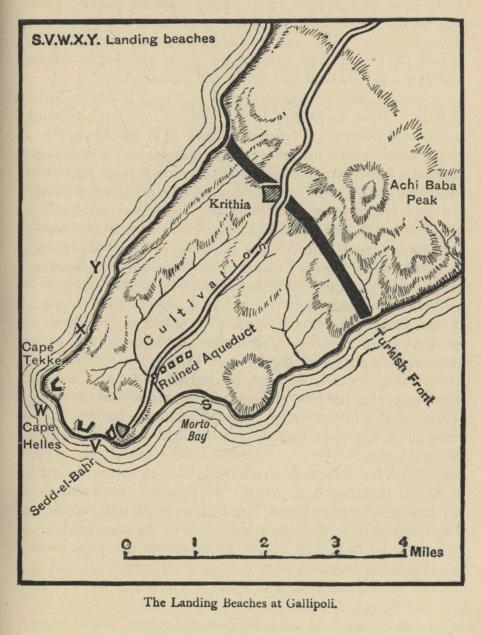
The Landing Beaches at Gallipoli.
There has been a harder fight at Beach W, between Tekke and Helles, where the sands are broader. The shore has been trenched throughout, and wired and mined almost to the water's edge, and in the scrub behind are hidden the Turkish snipers. Though our ships have bombarded the shore for three-quarters of an hour, they cannot clear out the enemy, and do not seem to have made much impression on the wire entanglements. The first troops have landed to the right under the cliffs of Cape Helles, and have reached the top, while a party on the left has scaled Cape Tekke. But the men of the 1st Lancashire Fusiliers who landed on the shore itself have had a fiery trial. They suffered heavily while still on the water, and on landing came up against unbroken lines of wire, while snipers and concealed machine-guns rained death on them. Here we have had heavy losses, and at 7 a.m. the landing has not yet succeeded.
The case is more desperate still at Beach V, under Sedd-el-Bahr. Here, as at Beach W, there are a stretch of sand, a scrubby valley, and flanking cliffs. It is the strongest of the Turkish positions, and troops landing in boats are exposed to every type of converging fire. A curious expedient has been tried. A collier, the River Clyde, with 2,000 men of the 2nd Hampshires, 1st Dublin Fusiliers, and 1st Munster Fusiliers on board, and eight boat-loads towed by steam pinnaces, approached close to the shore. The boat-loads—the rest of the Dublin Fusiliers—suffered horribly, for when they dashed through the shallows to the beach they were pinned to the ground by fire. Three lines of wire entanglements had to be forced, and a network of trenches. A bank of sand, 5 or 6 feet high, runs at the back, and under its cover the survivors have taken shelter. In the steel side of the ship doors have been cut, which open and disgorge men into the lighters alongside, like some new Horse of Troy. But a tornado of shot and shell rained on her, and of the gallant men who leaped from the lighters to the reef and from the reef to the sea, very few reached the land. Those who did have joined their fellows lying flat under the sand-bank on that beach of death. At Beach S, in Morto Bay, all has gone well. Seven hundred men of the 2nd South Wales Borderers have been landed from trawlers, and have established themselves on the cliff tops at the place called De Totts Battery.
CHAPTER XVII.
THE LANDING AT GALLIPOLI (continued).
Let us go back to Sari Bair and look at the position at noonday. We are prospering there, for more than 10,000 men are now ashore, and the work of disembarking guns and stores goes on steadily, though the fire from inland is still deadly. We see a proof of it in a boat full of dead men which rocks idly in the surf. The great warships from the sea send their heavy shells against the Turkish lines, sea-planes are "spotting" for them, and wireless stations are being erected on the beach. Firing from the ships is not easy, for the morning sun shines right in the eyes of the gunners. The Royal Engineers are making roads up the cliff, and supplies are climbing steadily to our firing line. On the turf of the cliff top our men are entrenched, and are working their way forward.
Unfortunately the zeal of the Australians has outrun their discretion, and some of them have pushed on too far. They have crossed three ridges, and have got to a fourth ridge within sight of the Straits. In that broken country such an advance is certain death, and the rash attack has been checked with heavy losses. The wounded are being brought in, and it is no light task getting them down the cliffs on stretchers, and across the beach and the bullet-splashed sea to the warships. Remember that we are holding a position which is terribly conspicuous to the enemy, and all our ammunition and water and food have to be dragged up these breakneck cliffs. Still, the first round has been won, Indian troops are being landed in support, and we are firmly placed at Sari Bair.
As we move down the coast we find that all goes well at Beach X, and that the troops there are working their way forward, but that at Beach Y the Scottish Borderers are being heavily counter-attacked and are making little progress. The Implacable has knocked out of action a Turkish battery at Krithia which gave much annoyance to our men at Beach X. At Beach W we have improved our position. We have cleared the beach and driven the Turks out of the scrub at the valley foot, and the work of disembarking men and stores is proceeding. Our right wing—the 4th Worcesters—is working round by the cliffs above Cape Helles to enfilade the enemy who are holding Beach V, where our men are still in deadly jeopardy.
The scene at Beach V is strange and terrible. From the deep water the Cornwallis and the Albion are bombarding the enemy at Sedd-el-Bahr, and the 15-inch shells from the Queen Elizabeth are screaming overhead. The Trojan Horse is still lying bow on against the reefs, with her men unable to move, and the Turkish howitzers playing on her. If a man shows his head he is picked off by sharpshooters. The troops we have landed lie flat on the beach under cover of the sand ridge, unable to advance or retreat, and under a steady tornado of fire. At Beach S things are satisfactory.
Meantime the French landing at Kum Kale has achieved its purpose. Originally timed for 6 a.m., it did not take place till 9.30. They had a skirmish with the Turks, partly on the height at Kum Kale, and partly on the Trojan plain. Then they advanced along the swell of ground near the coast as far as Yeni Shehr. Next evening they re-embarked and joined our right wing at Beach S. They took 500 prisoners, and could have taken more had there been room for them in the boats. The Turk, who showed himself a dauntless fighter, surrendered with great good-humour when the game was up. He had no crusading zeal in the business.
As darkness fell on that loud Sabbath, the minds of the Allied Staff may well have been anxious. We had gained a footing, but no more, and it was but a precarious lodgment. The complexity and strength of the enemy's defence far surpassed our expectation. He had tunnelled the cliffs, and created a wonderful and intricate trench system, which took full advantage of the natural strength of the ground. The fire from our leviathans on the deep was no more effective against his entrenched positions than it had been against the forts of the Straits.
Let us resume our tour of the beaches about 10 o'clock on the morning of the 26th. At Sari Bair the Australians are facing a counter-attack. It lasts for two hours, and is met by a great bombardment from our ships. The end comes when, about noon, the Australians and New Zealanders advance with the bayonet, and drive back the enemy. But all that day there is no rest for our troops, who are perfecting their trenches under a deluge of shrapnel. Their flanks are indifferently secured, and they have but the one landing-place behind them, from which their front line is scarcely 1,000 yards distant. They are still clinging precariously to the coast scarp.
At Beach Y things have gone badly. Our men there had advanced during the Sunday afternoon, and had been outflanked and driven back to the cliff edge. The Scottish Borderers lost their commanding officer and more than half their men. It was decided to re-embark and move the troops to Beach X, and as we pass the retreat is going on successfully under cover of the ship's fire. At Beach X there has been a hard struggle. Last night we were strongly attacked there, and driven to the very edge of the cliffs, where we hung on in rough shelter trenches. This morning we are advancing again, and making some way.
At Beach W, too, there has been a counter-attack. Yesterday afternoon our right wing there, which tried to relieve the position on Beach V by an enfilading attack on the enemy, got among wire, and was driven back. During the night the Turks came on in force, and we were compelled to fling our beach parties into the firing line, bluejackets and sappers armed with whatever weapons they could find. This morning the situation is easier, we have landed more troops, and are preparing to move forward.
At Beach V the landing is still in its first stage. Men are still sheltering on the deadly beach behind the sandbank. We have gained some positions among the ruins which were once Sedd-el-Bahr, but not enough to allow us to proceed. Even as we look a final effort is beginning, in which the Dublin Fusiliers and the Munster Fusiliers distinguish themselves, though it is hard to select any for special praise among the splendid battalions of the 29th Division. It continues all morning, most gallantly directed till he fell by Lieutenant-Colonel Doughty-Wylie of the Headquarters Staff, and about 2 p.m. it is successful. The main Turkish trenches are carried, the debris of the castle and village are cleared, and the enemy is in retreat. The landing can now go forward, and the men, who for thirty-two hours have been huddled behind the sandbank, enduring torments of thirst and a nerve-racking fire, can move their cramped limbs and join their comrades.
By the morning of Tuesday, the 27th, all the beaches—except Beach Y, which had been relinquished—were in working order, and the advance could proceed. Next morning it began, and by the evening of the 28th we had securely won the butt of the peninsula, and our front ran from 3 miles north-west of Cape Tekke to a mile north of Eski Hissarlik.
So ended the opening stage of the Gallipoli campaign—the Battle of the Landing. It was a fight without a precedent. There had been landings—such as Abercromby's at Aboukir and Wolfe's at the cove west of Louisburg—fiercely contested landings, in our history, but none on a scale like this. Sixty thousand men, backed by the most powerful navy in the world, attacked a shore which nature seemed to have made impregnable, and which was held by not inferior numbers of the enemy, in positions prepared for months, and supported by the latest modern artillery. The mere problem of transport was sufficient to deter the boldest. Every rule of war was set at nought. On paper the thing was impossible, as the Turkish army orders announced. According to the text-books no man should have left the beaches alive. We were fighting against a gallant enemy who was at his best in defence and in this unorthodox type of battle. That our audacity succeeded was due to the unsurpassable fighting quality of our men—the Regulars and Territorials of the 29th Division, the Naval Division, and not least to the dash and doggedness of the Australasian corps. The Gallipoli campaign was to end in failure, but, whatever be our judgment on its policy or its consequences, the Battle of the Landing must be acclaimed as a marvellous, an unparalleled feat of arms.
CHAPTER XVIII.
THE DEPARTURE FROM GALLIPOLI.
By September 1915 it was clear that the Gallipoli expedition could not succeed. All summer the hopeless struggle had continued for the heights of the peninsula. In July reinforcements arrived, and in August these new divisions, together with the Anzacs,[#] made an attack, that of the left wing at Suvla Bay being designed to turn the enemy flank. This supreme effort failed. There was no chance of further reserves, for the entry of Bulgaria into the war meant that the Allies must send troops to Salonika to help Serbia if possible, and in any case to protect the northern frontier of Greece. Only one course was possible—to get off the peninsula as best we could.
[#] So called from the initial letters of the first Australasian Corps—"Australian and New Zealand Army Corps."
After much discussion it was decided to evacuate the positions at Suvla and Anzac, and to retain those at Cape Helles. Nearly everybody concerned in the matter assumed that this would entail a heavy loss. Many estimated it at 15 per cent., and the most hopeful were prepared for the loss of at least one division. An embarkation in the face of the enemy had always meant a stiff rearguard fight and many casualties.
On the 8th December Sir Charles Monro, who was then in command of the British troops in the Ægean, issued orders for evacuation. The difficulties were enormous. It was a question of embarking not a division or two, but three army corps; it was impossible to move them all at once with the available transports; there must be a gap between the operations, and this meant that the enemy would probably be forewarned of the later movements. Moreover, a lengthy embarkation put us terribly at the mercy of the winter weather. Even a mild wind from the south or south-west raised a swell that made communication with the beaches precarious.
The plan was to move the war material, including the heavy guns, by instalments during a period of ten days, working only at night. A large portion of the troops would also be got off during these days, certain picked battalions being left to the last. Everything was to be kept normal during the daylight, and every morning before daybreak the results of the night's work must be hidden. Success depended upon two things mainly—fine weather and secrecy.
From the 8th December onward the troops, night after night, watched the shrinkage of their numbers. There was a generous rivalry as to who should stay till the last—a proof of spirit, when we remember that every man believed that the rearguard was doomed to death or capture. Soon only those in the prime of health and strength were left; all the weak and sickly had gone aboard the transports, which nightly stole in and out of the moonlit bays. Soon the heavy batteries had gone. Then the field guns began to disappear, leaving only enough to keep up the daily pretence of bombardment. It was an eerie business for the last battalions as they heard their protecting guns rumbling shoreward in the darkness. Then the horses and motor-cars were also shipped, and by Friday, the 17th December, very few guns were left. To the Turkish observers the piles of boxes on the beaches looked as if fresh supplies had been landed and we were preparing to hold the place indefinitely.
The weather was warm and clement, with light moist winds and a low-hanging screen of cloud. Coming in the midst of an Ægean winter it seemed to our men a direct interposition of Providence. It was like the land beyond the North Wind, which Elizabethan mariners believed in, where he who pierced the outer crust of the Polar snows found a country of roses and eternal summer. No fisherman ever studied the weather signs more anxiously than did the British commanders during these days. Hearts sank when the wind looked like moving to the west. But the weather held, and when the days fixed for the final embarkation arrived, the wind was still favourable, skies were clear, and the moon was approaching its full. Nature had joined the daring conspiracy.
On Saturday, the 18th December, only a few picked battalions held the Suvla front. The final embarkation had been fixed for the two succeeding nights. The evening fell in a perfect calm. The sea was still as a mill-pond, and scarcely a breath of wind blew in the sky. Moreover, a light blue mist clothed all the plain of Suvla, and a haze shrouded the moon. At 6 p.m. the crews of the warships went to action stations, and in the darkness the transports stole into the bay. Not a shot was fired. In dead quiet, showing no lights, the transports moved in and out. Every unit found its proper place. By 1 a.m. on the morning of Sunday, the 19th, the bay lay empty in the moonlight.
That Sunday was one of the most curious in the war. Our lines looked exactly as they had done during the past four months. We kept up our usual fire and received the Turkish answer, but had any body of the enemy chosen to attack they would have found the trenches held by a mere handful. There were 20,000 Turks on the Suvla and Anzac fronts, and 60,000 in immediate reserve. Had they known it, they had before them the grand opportunity of the campaign. Night again fell with the same halcyon weather. The transports—destroyers, trawlers, picket boats, every kind of craft—slipped once again into the bay, and before midnight the last guns had been got on board. By 3.30 a.m. the last of the troops were on the beach, and long before the dawn broke all were aboard. One man had been hit in the thigh by a bullet, but that was the only casualty.
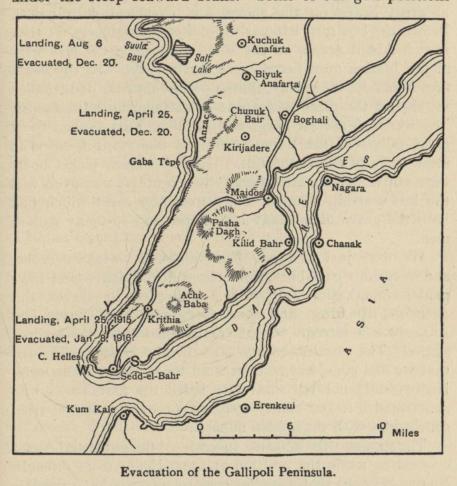
Evacuation of the Gallipoli Peninsula.
The operations at Anzac were conducted on the same lines. The beaches at Suvla were 5 miles from the enemy and open to observation; at Anzac, in places they were less than 2 miles distant, but were concealed from view under the steep seaward bluffs. Some of our gun positions there were on dizzy heights, down which a gun could only be brought part by part. The work was brilliantly performed. On the Saturday night three-fifths of the entire force were got on board the transports. On Sunday night the rest were embarked, with two men wounded as the total casualties. By 5.30 a.m. on Monday morning the last transports moved away from the coast, leaving the warships to follow.
Then on the 12 miles of beach, from Suvla Burnu to Gaba Tepe, there was seen one of the strangest spectacles of the campaign. The useless stores left behind had been piled in great heaps on the shores and drenched with petrol. Before the last men left parties of Royal Engineers set time fuses. About 4 a.m. on the Monday morning the fires were alight, blazing most fiercely near Suvla Point. As the beach fires flared up, the enemy, thinking some disaster had befallen us, shelled the place to prevent us extinguishing the flames. The warships shelled back, and all along that broken coast great pillars of fire flared to heaven like giant beacons in some strife of the Immortals. Up to 8 o'clock picket boats were still collecting stragglers; by 9 a.m. all was over, and the last warship steamed away from the coast which had been the grave of so many high hopes and so many gallant men.
We were just in time. That night the weather broke, and a furious gale blew from the south which would have made embarkation impossible. Rain fell in sheets and quenched the fires, and soon every trench at Suvla and Anzac was a torrent. Great seas washed away the landing stages. The puzzled enemy sat still and waited. He saw that we had gone, but he distrusted the evidence of his eyes. History does not tell what fate befell the first Turks who penetrated into our empty trenches, or what heel first tried conclusions with the hidden mines.
The success—the amazing success—of the Suvla and Anzac evacuation made the position at Cape Helles more difficult. No one believed that a similar performance would be possible there after the enemy had been so fully warned; but on the 27th December it was decided to evacuate Helles, and the work went on during the last days of the month and the first week of the new year. On Friday, January 7, 1916, there was a Turkish attack, which the few men remaining managed to repel. Next day, Saturday, the 8th, was calm and fine, and all was ready for the final effort.
About 4 o'clock in the afternoon the weather changed. A strong south-westerly wind blew up; by 11 p.m. it increased to a gale of 35 miles an hour. This storm covered our movements from the enemy, but it nearly made retirement impossible. On some beaches the piers were washed away and no troops could be embarked. Nevertheless by 3.30 the last men were on board.
All night the Turks gave no sign, but when the transports had moved off the stores left behind were fired simultaneously by time fuses. Red lights instantly burned along the enemy lines, and a bombardment began which continued till sunrise. The Turks proclaimed that the retreat had been attended with desperate losses and great captures of guns. The claim was an absurd falsehood. We blew up and left behind the ruins of seventeen old worn-out pieces. Our total casualties at Helles amounted to one man wounded.
To avoid the disastrous consequences of a defeat is, as a military operation, usually more difficult than to win a victory. There is less chance of the high spirit of the attack, for such is the generosity of the human spirit that safety is less of an incentive to effort than the hope of victory. To embark so great an army secretly and without loss in mid-winter was an extraordinary achievement. It was made possible only by an almost miraculous series of favourable chances, and by the perfect organization and discipline of our men. We had failed at Gallipoli, but we had escaped the worst costs of failure. We had defeated the calculations of the enemy and upset every precedent.
Across the ribbon of the Dardanelles, on the green plain of Troy, the most famous war of the ancient world had been fought. The European shores had now become a no less classic ground of arms. If the banks of Scamander had seen men strive desperately with fate, so had the heights of Achi Baba and the loud beaches of Helles. Had the fashion continued of linking the gods with the strife of mankind, what strange myth might not have sprung from this rescue of the British troops in the teeth of winter gales and uncertain seas I It would have been rumoured, as of old at Troy, that Poseidon had done battle for his children.
CHAPTER XIX.
THE CAPTURE OF JERUSALEM.
At the outset of the war the conquest of Egypt was an important aim of the Turkish Government and their German masters. But early in 1915 the Turkish invasion was scattered on the banks of the Suez Canal, and hopes of an easy victory were shattered. Nevertheless, the defence of Egypt remained an anxious problem for Britain. That country was the base both for Gallipoli and for Mesopotamia, and moreover, as Moltke pointed out long before, was the key of Britain's Eastern possessions. It was soon realized that Egypt could not be properly defended on the Canal, but only on the Palestine frontier, beyond the Sinai Desert.
During 1915 and 1916 Turkey and Germany projected many schemes for an Egyptian invasion, and the British generals in Egypt were no less busy. If the war was to be carried into Palestine railways and water pipes must be laid across the desert. Slowly the British front crept eastward. The Turks were defeated in various desert battles, and in the spring of 1917 the British army crossed the frontier of Palestine.
The British purpose had somewhat changed. The offensive had been substituted for the defensive. So far as possible it was desired to do in Palestine what Sir Stanley Maude was doing in Mesopotamia—to pin down large Turkish forces, and so alarm Turkey about the safety of certain key points in her territory that she would demand aid from Germany and thus confuse the plans of the German General Staff.
The land from the Wadi el Arish—the ancient "River of Egypt"—to the Philistian Plain had for 2,600 years been a cockpit of war. Sometimes a conqueror from the north or the south met the enemy in Egypt or in Syria, but more often the decisive fight was fought in the gates. Up and down the strip of seaward levels marched the great armies of Egypt and Assyria, while the Jews looked fearfully down from their barren hills. In the Philistian Plain Sennacherib smote the Egyptian hosts in the days of King Hezekiah, only to see his army melt away under the stroke of the "angel of the Lord." At Rafa Esarhaddon defeated Pharaoh, and added Egypt and Ethiopia to his kingdoms. At Megiddo, or Armageddon, Josiah was vanquished by Pharaoh Necho, who in turn was routed by Nebuchadnezzar. At Ascalon, during the Crusades, Godfrey of Bouillon defeated the Egyptians, and 150 years later that town fell to the Mameluke Sultan after the battle of Gaza. In this gate of ancient feuds it now fell to Turkey's lot to speak with her enemies.
But at first the British advance was checked. In March and April 1917 two battles were fought at Gaza—two frontal attacks which failed. During the summer Sir Edmund Allenby was appointed to the chief command, and slowly and patiently he perfected his plans. He saw that a direct attack on Gaza was likely to fail, but far to the east he observed a weak point in the enemy front where the town of Beersheba constituted a detached and separate defensive system. If Beersheba could be taken, the whole Gaza position could be turned on the flank.
Beersheba was duly taken at the end of October 1917, and on the 7th November Gaza followed. The enemy suffered severely, and was in full retreat, almost in flight. Sir Edmund Allenby's objective was now Jerusalem, and his problem was less one of manoeuvres than of supply. His troops would advance just as fast as water and food could be brought up behind them.
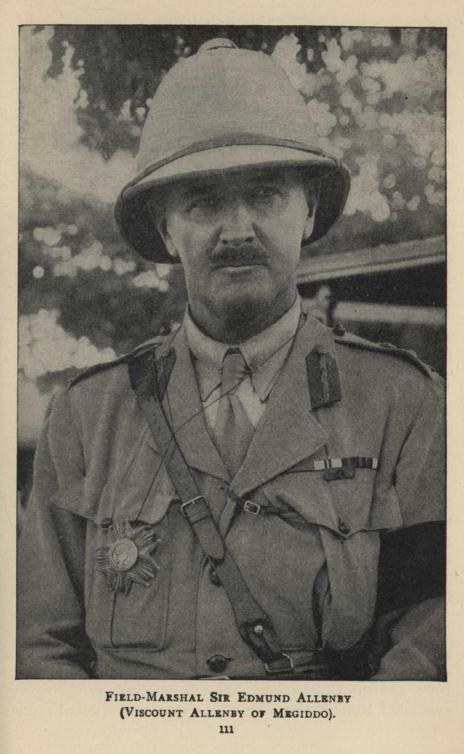
FIELD-MARSHAL SIR EDMUND ALLENBY (VISCOUNT ALLENBY OF MEGIDDO).
The advance was made in two main directions—one from Hebron due north towards Bethlehem; the other by the coastal plain, aiming at the junction where the Jerusalem railway joined the main line to Damascus. The Turkish army was split into two parts, retreating in different directions. Though Enver came from Constantinople and Falkenhayn from Aleppo it was difficult for them to devise a defence. Allenby seized Jaffa, and then swung eastward into the Judæan highlands. Now the progress became slow, while squalid little villages, whose names are famous throughout the whole Christian world, fell to the British troops. On the 30th November the British line had the shape of a sickle, with the centre of the curve flung far forward towards Jerusalem, and it was necessary to bring up the handle, which consisted of the cavalry and infantry which were at Hebron. By the 7th these had taken Bethlehem, and by the 8th British troops were before Jerusalem on the south and west, and within a mile and a half of its walls.
The Turkish garrison did not await the attack. In the night preceding Sunday, the 9th December, the day of the festival of the Hanookah, which commemorates the recapture of the Temple by Judas Maccabæus, detachments of broken Turkish soldiers poured in at the western or Jaffa Gate, while an outgoing stream flowed eastward across the valley of Jehoshaphat. Early in the morning the enemy sent out a white flag of surrender, and before noon British patrols were in the city.
Two days later Sir Edmund Allenby entered by the Jaffa Gate. Close by was the breach made in the walls to admit the German Emperor when he made his foolish pilgrimage in 1898. Far different was the entry of the British general. It was a clear, bright day, and the streets and housetops were thronged with black-coated, tarbushed Syrians and Levantines, picturesquely-clad peasants from the near villages, and Arabs from the fringes of the desert. There was no display of bunting and no bell-ringing or firing of salutes. On foot, accompanied only by his Staff, the commanders of the French and Italian detachments, and the military attachés of France, Italy, and the United States, he was received by the newly appointed Military Governor of the city, and a guard representing all the nationalities engaged in the campaign. He turned to the right into the Mount Zion quarter, and at the Citadel, at the base of the ancient Tower of David, his proclamation was read to the people.
Then he quietly left the city. Yet no conqueror had ever entered it with more prestige. For centuries there had been current an Arab prophecy that a deliverer should come from the West, and in 1898 the people of Palestine had asked if the Kaiser was indeed the man. But the prophecy foretold that such would not be the manner of his coming, for the true saviour would bear the name of a Prophet of God, and would enter Jerusalem on foot, and that he would not appear till the Nile flowed into Palestine. To the peasants of Judæa the prophecy now seemed to be fulfilled, for the name of the English general was in Arabic "the Prophet," and his men had come into the land bringing with them the waters of Egypt.
CHAPTER XX.
ALLENBY'S GREAT DRIVE.
The capture of Jerusalem on December 9, 1917, left a curious military situation. The Turkish army was split into two parts, with its right wing north-east of Jaffa and its left to the north and east of Jerusalem, and between these lay a patch of rocky country without communications. Clearly the next step for Allenby was to cross to the east of the Jordan and cut the Hedjaz railway, with the assistance of the Arab army from the south. If traffic on this railway were interrupted the Turkish forces in Arabia would be at his mercy.
But first he had to secure his advanced bases at Jaffa and Jerusalem. This work was done before the close of the year. He then turned his attention to safeguarding his right flank by driving the enemy beyond the Jordan. Jericho fell to the Australians on the 1st February, and the move eastward across the river began. It proved, however, unexpectedly difficult. The promised Arab assistance was not forthcoming in time, and early in May the British troops, except for a bridge-head garrison, were again on the west side of Jordan. Allenby for a time was compelled to hold his hand. The grave situation in France made it necessary for him to reorganize his forces, for all white troops that could be spared were ordered to the Western front. In their place he received cavalry and infantry from Mesopotamia and India.
We come now to what must rank as one of the most dramatic tales in the whole campaign—an exploit undertaken at the precise moment when its chances were brightest and its influence on the general strategy of the war most vital—an exploit, moreover, which was perfectly planned, perfectly executed, and overwhelming in its success. The little campaign which began three years before on the banks of the Suez Canal had grown slowly to a major operation. In face of every difficulty the Allies had crept forward, first across the Sinai Desert, then, after long delays, through the Turkish defences of the south, and then in a bold sweep to the gates of the Holy City.
This campaign had always been fought with only the margin of strength which could be spared from the greater contests in the West. But it had moved patiently to its appointed end, for it was carried on in the true tradition of those dogged earlier wars of Britain which had created her Empire. Our feet might be stayed for a season, or even retire, but in the long run they always moved forward. The Last Crusade was now approaching its climax, and the Crusaders were such as would have startled the souls of St. Louis and Raymond and Richard of England, could they have beheld that amazing army. For only a modest portion of it was drawn from the Western peoples. Algerian and Indian Moslems, Arab tribesmen, men of the thousand creeds of Hindustan, African negroes, and Jewish battalions were among the liberators of the sacred land of Christendom.
In September 1918 the Turkish armies of Syria held a front from the coast north of Jaffa through the hills of Ephraim to a point half-way between Nablus and Jerusalem, and thence to the Jordan, and down its eastern bank to the Dead Sea. On the right lay the VIIIth Turkish Army, in the centre the VIIth, and east of Jordan the IVth. Far on their left flank they were threatened by the Arabs under Sherif Feisal and Colonel T. E. Lawrence. Allenby's plan was to defeat the enemy west of Jordan, and so either to isolate or compel the retreat of the IVth Army. The communications of the Turkish centre and right wing were poor, and if their front could be broken and our cavalry sent through, it was possible that these might be cut. Allenby therefore thinned his front elsewhere, and concentrated his main energies on breaking up the VIIIth Army in the Plain of Sharon, and thus opening the route for his cavalry.
At 4.30 on the morning of the 19th September British cavalry attacked and won an immediate victory, sweeping through the enemy's defences in the Plain of Sharon. The VIIIth Army was in utter rout, pouring along the northern roads, while the main body of our cavalry was riding for Esdraelon to cut them off. That night the VIIth Turkish Army was also pressed back in the centre. By noon that day the leading troops of our cavalry were 18 miles north of their old front line; that afternoon they were through the barrier of the Samarian hills; and early next morning they reached Nazareth, and all but captured the German commander-in-chief. On the night of the 20th one cavalry division reached Beisan, 80 miles from their starting point, and so shut the last outlet from the south. In thirty-six hours the trap had been closed. Every track and road was choked with the rout. Camps and depots were in flames, and our airmen steadily bombarded each section of the retreat.
There now remained only the IVth Army, east of the Jordan. Till the third day of the battle it had shown no signs of moving, but on the morning of the 23rd it began a leisurely retreat. Meantime the British had joined hands with Feisal's Arabs, and pressed the fugitives along the Hedjaz railway. The game was now wholly in Allenby's hands. His next step was to move on Damascus, and so intercept what was left of the IVth Army in its northward flight. On the afternoon of the 25th, the 4th Cavalry Division moved out of Beisan on its 120 miles' ride, and the Australian Mounted Division followed next day by the northern route. On the 30th British cavalry lay 12 miles south-west of Damascus, and all the northern and north-western exits had been closed. At 6 o'clock on the morning of the 1st October the British and Arabs entered the city.
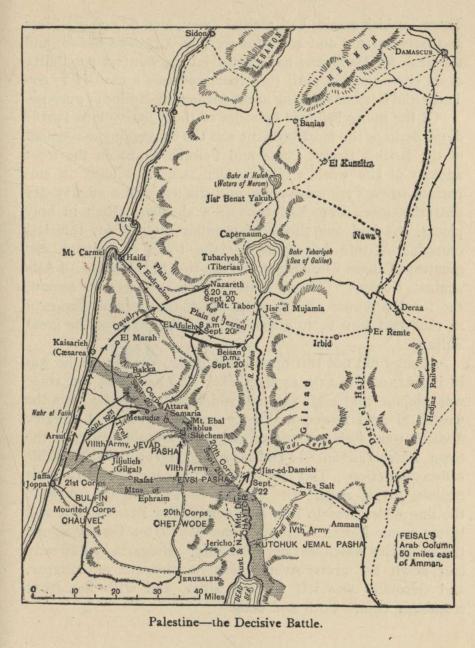
Palestine—the Decisive Battle.
It was the twelfth day from the opening of the attack. Three Turkish armies had melted away, over 60,000 prisoners and between 300 and 400 guns were in Allenby's hands, and the dash for Damascus had destroyed the faintest possibility of an enemy stand. All that remained was a mob of 17,000 Turks and Germans, fleeing north without discipline or purpose.
Of the many brilliant episodes of those marvellous twelve days, perhaps the most brilliant was the converging movement of the British Desert Corps and Feisal's Arabs on the most ancient of the world's cities. Damascus had been an emporium when Tyre was young, and she was still a mighty city centuries after Tyre had become a shadow. Rich in holy places, she had one shrine of peculiar interest for this last crusade. Within her walls lay the tomb of Saladin, the greatest of those who fought in Palestine in the battle of Asia against Europe. One of Feisal's first acts was to remove the tawdry bronze wreath with which the German Emperor in 1898 had seen fit to adorn the sleeping-place of the great Sultan.
Allenby did not rest upon his laurels. On the 8th he was in Beirut, on the 11th in Baalbek. The next and last stage was Aleppo, that mart through which in the Middle Ages the wealth of Asia flowed to Venice and the West. A cavalry division went forward, and on the 26th October entered the town. Patrols advanced 15 miles farther, and occupied Muslimie railway junction. This last was a fitting conclusion to a great exploit, for it meant the cutting of the Bagdad railway, the line which was to link Berlin with the Persian Gulf and threaten our Indian Empire. Four days later Turkey signed the Armistice which was her surrender. Bulgaria had already laid down her arms, Austria was on the eve of collapse, and Germany was left without allies, and with her front crumbling before Foch and Haig.
PART IV.
THE SILENT SERVICE.
CHAPTER XXI.
THE SILENT SERVICE.
The British Navy earned during the war the title of "The Silent Service," and the phrase needs a word of comment, for it is full of meaning. There has always been a feeling in the Service that sea-power is the one thing vitally necessary to the safety of the Empire, and that so long as this is being maintained the less talk about it the better; for where the life of nations is daily and hourly in trust, all advertisement is unworthy and all description inadequate. Then the Great War came, and the landsmen, who form the bulk of our people all over the world, naturally wished to know how the Sea Service was handling the affair; but the rule of silence still held. For the Navy, besides their old tradition, had now the reason of policy on their side; operations at sea can be, and must be, kept secret to a degree which is not possible in a land campaign. To inform the public at home would be to take the chance of being overheard by the enemy.
Moreover the work of the Navy is so multifarious, so technical, and so far-sighted in its aims, that by far the greater part of it would always be difficult to grasp. The ordinary news-reading citizen must be content to judge of it by its results, and he is not always capable of doing even that. Neither in this country, nor in the Dominions overseas, still less in the outer world, has the supreme importance or the decisive achievement of our naval Service been realized. Yet to those who understand, the influence of sea-power on history has never been so conclusively demonstrated. In this war, as in the war of a hundred years before, it was from first to last our ships that lay between a military despot and the domination of the world.
To prove this it is only necessary to make a plain statement of the tasks which the British Navy had to undertake in August 1914, to mark the fact that a failure in any one of them would have involved the ruin of the Allied cause; and to remember that no such failure occurred. The gigantic scope of the effort may then be seen; but even then only by those whose vision is wide enough to survey the whole world at once as one vast field of conflict.
First, then, our Fleet undertook to blockade the enemy; to drive his commerce from the seas; to stop his sea-borne supplies, especially foodstuffs, cotton—the raw material of explosives—and munitions of all kinds; also to disable his credit by the stoppage of his export trade.
Secondly, the protection of our own commerce necessitated the control of all the seas of the world. The Atlantic was our main avenue of supply, but we had also to maintain and guard the routes to and from Australia, New Zealand, India, and China; and a Northern Patrol was necessary to ensure the passage from Denmark, Norway, Sweden, and the north of Russia.
Thirdly, the enemy's main naval force had to be put out of action: that is to say, the North Sea must be effectively controlled by a Grand Fleet capable of dealing with the German High Sea Fleet.
Fourthly, the transfer of enemy troops across the sea must be made impossible; and, in particular, strong flotillas and secondary fleets must be maintained on our own coasts as a guard against possible attempts at invasion.
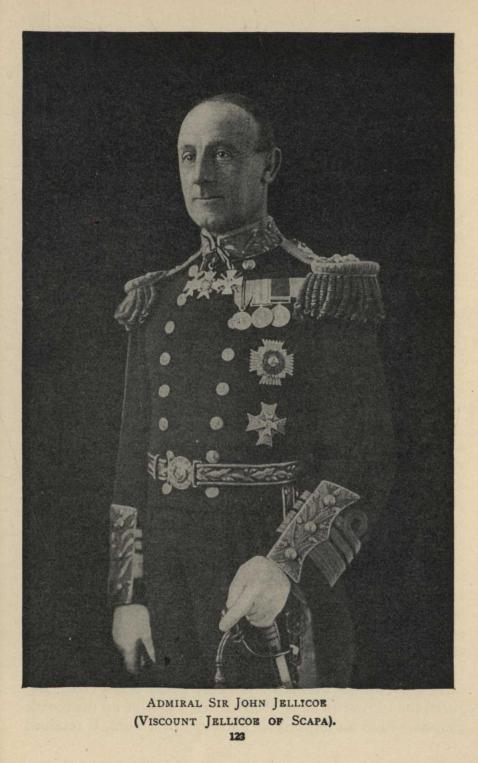
ADMIRAL SIR JOHN JELLICOE (VISCOUNT JELLICOE OF SCAPA).
Fifthly, the transport of our own troops and of those of our Allies must be covered from attack. Under this head alone there were included before the end a number of simultaneous operations entirely beyond example in the history of war. An army of some six millions was passed oversea from the British Isles, from India, from Australia, and New Zealand (and at last more millions from America) to France, to India, to Africa (East and West), to Egypt and Palestine, to Gallipoli and Salonika.