DAYS TO REMEMBER (continued 3)
Reading edition
Sixthly, the supplies to all these forces, and to most of them simultaneously, had to be maintained for more than four full years and on a scale hitherto unimagined.
Seventhly, in several campaigns the Navy had to co-operate in the military operations, notably in Gallipoli, in battles near the Belgian coast, and in the attack on the fortified harbour of Zeebrugge.
These seven heads cover every recognized department of naval war; but it must be added that when this latest war changed its character and became an unrestricted submarine campaign, new developments were necessary and were immediately carried out. Under the second and third of the above headings, an entirely new fleet of mine-sweepers, trawlers, and anti-submarine patrols had to be provided, manned, and equipped, to secure the safety both of our ships of war and of our mercantile marine.
It will be seen that these tasks, taken altogether, formed a work of which only one Power in the world was capable; while taken separately they appear plainly as seven threads upon every one of which the fate of the common cause depended absolutely. The effort of the Allies in this war was distinguished first by the early heroism of the Belgian, Serbian, and Russian troops; then by the long and desperate endurance of the French, British, and Italian armies; finally, it was reinforced by the large contingent of late-comers from America, and carried to victory by the supreme genius of Foch. But behind and beneath all these lay another force, scarcely thought of at the time, and since almost forgotten, though to it they all owed the very possibility of their military existence. During those four years the British Fleet never ceased to carry great armies over sea; to sweep every ocean clean, and guard the territories along their shores; to shut up the hostile Empire within an impassable barrier. In a word, it retained every day and every night, from the first hour of the war to the last, that control which was the most vital condition of success.
In so doing it suffered some losses and achieved stirring successes, of which one or two are related in the pages which follow. But it must always be remembered that these are but incidents; the business of the British Navy is the right use of the sea, and not conquest or display. For it, therefore, victory is not the affair of a day here or a day there, however rousing to the blood: it lies rather in what is neither spectacular nor resounding—in the monotonous but manifold perfection of an indispensable service.
CHAPTER XXII.
CORONEL.
The battle of Coronel will always have a peculiar interest for us: there is a mystery about it which can never be finally cleared up. At the outbreak of war a British admiral, Sir Christopher Cradock, was in charge of a large and important area off the coast of South America. It was his business to keep this area clear of the enemy squadron under Admiral Graf von Spee, which was much stronger than his own, but was believed to be scattered on the trade routes. In the end Cradock found the enemy squadron united and in much superior force. He instantly attacked, and went down in the action, with two of his ships.
The problem is to ascertain what were his motives for this swift decision to fight against overwhelming odds. Not a man in the flagship survived, and we must do the best with what evidence we have before us. We know the admiral's general idea of the work he had to do; we know what his instructions were, what force he asked for and what was given him; we know the speed and gun-power of the enemy ships, and what he as an experienced commander must have thought of them. Finally, we know the nature of the choice which was open to him; and in face of all this the mystery remains.
The key to it probably lies in the character of the man who had to make the decision; and from this point of view the story is a fine one. While every one is free to form an opinion on the facts, the judgment of those who knew Cradock best is the simplest and the most favourable one. A certain margin of discretion must be allowed to every admiral in time of war; and at the moment of crisis a man of powerful character and vision may go even further, and take the great responsibility of departing from the line of strict obedience to orders. To Cradock's friends it seems clear that he saw himself and his squadron as representing the prestige of his country in combat with a superior force which might be disabled, if it could not be destroyed; he saw that duty might be fulfilled, and honour and success attained, though victory should be impossible. So he hunted his great enemy both skilfully and fearlessly, but relied at a pinch rather on courage than on caution.
From the outbreak of war the German China Squadron, as we now know, was never wholly dispersed: Spee detached ships from time to time to the coast of South America, but remained himself with the strongest part of his force in the Pacific, where he was heard of only at intervals. He might possibly be intending to go westwards and raid the Indian Ocean, as the Emden actually did. He moved, in fact, on Samoa, but when he arrived there on September 14, 1914, he found Apia already safe in the hands of the New Zealanders, and not a ship in the harbour. He left again for Suvarov Island, coaled in the Society Islands, bombarded the French capital Papieté on the 22nd September, and appeared to be making for South America; he might be thinking of a dash through the Magellan Straits to attack our trade on the eastern coast.
The British Admiralty knew the danger of this. Spee's two principal ships—the Scharnhorst and the Gneisenau—were fast ships and well armed, with prize gunnery crews. To hunt them satisfactorily a pair of battle-cruisers were required, and these could not well be spared from the Grand Fleet. The Indefatigable was therefore ordered out from the Mediterranean, with the fast cruiser Defence; but the Cabinet refused to spare the Indefatigable, and the Canopus, an old and slow battleship, with 12-inch guns, was sent, with the Defence to follow. Admiral Cradock was ordered to concentrate meanwhile at the Falkland Islands, with his flagship, the Good Hope, the cruisers Monmouth and Glasgow, and some ships of inferior armament.
The Canopus was a whole week late in arriving. Cradock was most anxious to prevent Spee from coming round the Horn to raid the east coast, and he feared that if he kept the old 12-knot battleship with him he might be too late to bar the enemy's passage. In this crisis he took his first great risk: he sent the Canopus by the shorter way, through Magellan's Straits, and took the weaker ships boldly round the Horn. Spee, however, was not in the south; he had spent six days in concentrating at Easter Island, and was at this moment making for the island of Mas-a-Fuera, 500 miles west of Valparaiso.
Cradock now had the Canopus with him again. His instructions were that he was not expected to act without her; but her slow speed continued to hamper him in carrying out his definite orders to search for the enemy and destroy them. He accordingly ordered the Defence to join him from the east coast, where she had been sent by the Admiralty, and went north in the meantime to find the cruiser Leipzig, which was believed to be in front of him, operating alone. Unfortunately the Canopus was once more in need of repairs, and had to be left behind for twenty-four hours.
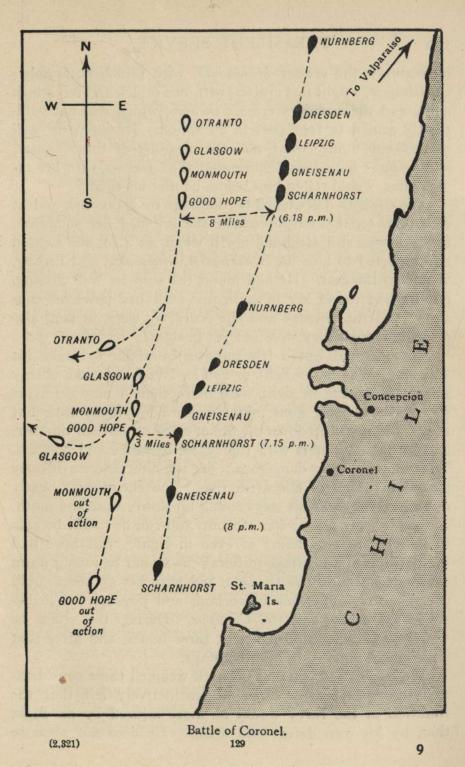
Battle of Coronel.
The two squadrons, British and German, were now, without knowing it, in the act of converging upon one another. Each admiral believed himself to be in pursuit of a single ship, for, while Cradock was after the Leipzig, Spee was in chase of the Glasgow (Captain Luce), who had been sent on to Coronel on the west coast with a message. The force of the opponents was as follows: Admiral von Spee had two powerful ships, the Scharnhorst (flagship) and the Gneisenau, each of 11,420 tons, armed with eight 8-inch and six 6-inch guns; and their gunners were of high repute. His other ships, the Leipzig, Dresden, and Nürnberg, were light cruisers, each carrying ten 4-inch guns. Against these Cradock had the Good Hope, a twelve-year-old cruiser of 14,000 tons, armed with two 9.2-inch guns; the cruiser Monmouth, with 6-inch guns only; the Glasgow, a light fast cruiser, with two 6-inch and ten 4-inch guns, and the auxiliary cruiser Otranto, which was not sufficiently armed to take part in an action. He knew, as well as any one living, what was the meaning of these figures, and he must have been hoping that the Canopus, with her 12-inch guns, would rejoin him before he met his enemy.
The Glasgow despatched her message from Coronel, and at 2.30 p.m. on the 1st November she rejoined her squadron. Cradock was still steaming north when, at 4.40, she sighted and reported to him the Scharnhorst, Gneisenau, and Leipzig, visible to the east. He had found the ship he was chasing, but he had found her in company with her powerful consorts; and the Dresden and the Nürnberg were, in fact, also present, though they were not yet in sight.
Cradock had but a few minutes in which to make his decision. Was he to fight or run? Even the three enemy ships which were in sight were more than a match for his own. His two big guns might make a few lucky hits, but they could not keep down the fire of eight times their number, laid by prize gunners with the choice of range and position. To fight was highly dangerous; yet the alternative evidently looked to him still less attractive. The enemy was nearly due east; the Canopus was coming up slowly from the south, 250 miles away; if he were to turn and run he might be able to join her in nine hours or even in eight. But Spee had the position of advantage inshore; he would be racing down the shorter side of the triangle, and with his 23 knots could overtake the Monmouth for certain, and possibly cut in between the others and the Canopus. During the chase he would have a fighting light for three hours, and after that a moonlight equally to his advantage.
We cannot tell whether Cradock weighed these considerations anxiously, or whether he instinctively felt that the tradition of the Navy would be more injured by his flight than by his own defeat and death. He does not seem to have hesitated. At 5.10 p.m. he signalled to his squadron to concentrate on the Glasgow—the ship nearest the enemy—and attempted to cross Spee's line so as to gain the inshore position. The German admiral, however, kept away successfully, and at 6.18 Cradock made a wireless signal to the Canopus, giving his position, and adding, "I am going to attack enemy now."
At 7 o'clock the sun set, and Spee, having now every advantage of light, opened fire at 12,000 yards. The Good Hope in reply made a hit or two, but her forward 9.2 gun was soon knocked out, and the ship set on fire. The Monmouth was also burning within three minutes. The Glasgow was engaged by both the Leipzig and the Dresden, but was saved by the German smoke which drifted towards her. With the sunset glow behind them, our ships were a fair target, while the British gunners could no longer see anything but the flash of the enemy's guns. Both the Good Hope and the Monmouth were continually on fire, and at 7.45 the flagship blew up with an explosion which sent up flames 200 feet high. By 8 o'clock the Monmouth too was silenced and sinking in the heavy seas; as the moon rose the German ships could just be seen closing on her.
Captain Luce, left alone with the Glasgow and the Otranto, had now to face the most painful duty of his life. His ship had been hit by only five shells out of the six hundred aimed at her, and he was in a position to make use of her superior speed by going to warn the Canopus of the danger towards which she was heading. He steered north-west into the darkness, intending to turn south as soon as he was out of sight. The Monmouth's men were all crowded on her quarterdeck, and they cheered the Glasgow as they saw her going away—a cheer that should never be forgotten when the tale is told. At 9.20 firing was heard again, and from the Glasgow seventy-five flashes were counted—"No doubt," says Captain Luce, "the final attack on the Monmouth." She went down, like the Good Hope, with all hands.
So ended Cradock's forlorn hope, and the mystery of it will remain with us. One thing is certain, that whatever was the motive for his decision, it could not have been a discreditable one—a man does not fling away his command, his professional chances, and his own life out of sheer recklessness. We may safely infer, then, that Cradock was attempting the best that was possible for his country at the hazard of everything that he valued most. For this he took the final responsibility of disobeying his orders; and for this he paid the full price. It is difficult to think him wrong, and not difficult to hold him justified. He gave something to the enemy, but far more to his own Service. When darkness fell on Coronel, Spee's triumph had but thirty-seven days to run. The tradition of Cradock's unflinching devotion will last as long as the British Navy; and it is by such traditions that sea power is built and sustained. Naval supremacy will never be won or kept by the consistent refusal of unequal fights.
CHAPTER XXIII.
THE FALKLANDS.
News of Coronel was received by the Admiralty on the 4th November; it was given to the public unofficially on the 5th and officially on the 17th. By that time the counterstroke had been not only prepared, but launched. Speed and secrecy were an urgent necessity, for the Falkland Islands, a valuable coaling-station with a wireless installation and a fine double harbour, were certain to be in danger from the victorious enemy. The population numbered only 2,000, mostly Scottish shepherds, and the inhabitants of the capital, Port Stanley, proposed to abandon the town and take refuge on the moors. But on the 8th November the Canopus and the Glasgow ran in on their way north, and on the 12th the Canopus returned with orders to remain and defend the coaling-station. Captain Grant grounded his ship on the harbour mud, disguised her by dazzle-painting, and made her into a fort. The work took three weeks.
In the meantime the new Board of Admiralty were taking action on the plan originally proposed by their predecessors. The Grand Fleet had now been reinforced, and could spare the battle-cruisers Invincible and Inflexible. These two ships came round to Devonport on the 8th November for repairs. On the 9th Admiral Sturdee was appointed Commander-in-Chief in the South Atlantic and Pacific—from Pernambuco to China. The service in hand demanded perfect secrecy and perfect efficiency: a sudden and irresistible counterstroke was to be delivered, and the two principal ships were to be returned immediately with unimpaired fighting value. It was a mission offering unique powers and responsibilities.
The admiral had all the qualities necessary for success and one gift more—that of complete and invariable good fortune. He was to concentrate either off the Panama Canal or the islets known as the Abrolhos Rocks far down towards Rio, according as he could best guess at Spee's intentions. He guessed right, and chose the latter rendezvous, where, on the 26th, he met Admiral Stoddart with the Carnarvon, Cornwall, Defence, Kent, Bristol, and Orama.
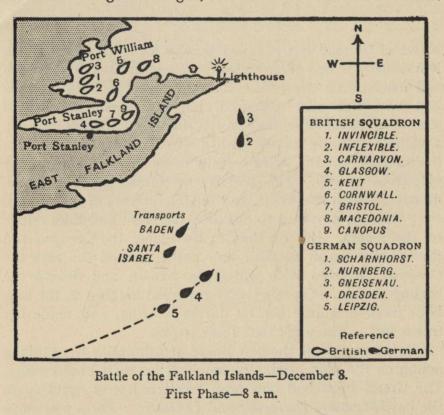
Battle of the Falkland Islands—December 8. First Phase—8 a.m.
On the same day, as it happened, Spee was moving south from St. Quentin Bay for an attack upon the Falklands, and Sturdee was receiving final orders to base himself upon the Falklands and search for Spee round the Horn. The meeting was therefore certain; but the fate of Port Stanley depended on the race between the two opposing squadrons. Fortune again favoured Sturdee: he was delayed at first by false reports, but Spee lost four full days in capturing and plundering a British collier. When he appeared off the Falklands in the early morning of the 8th December, Sturdee had already been nearly eighteen hours in harbour, and his ships had been busily coaling all night.
When Spee was sighted from Port Stanley his arrival was a surprise to the British squadron. The battle-cruisers had not yet received their full supply of coal. But their oil supply was untouched, and by the admiral's foresight steam had been ordered at half an hour's notice for the Kent and the Inflexible, and at two hours' for the rest. The signal to prepare to weigh and to raise steam was made at 8.14 a.m. The Gneisenau and the Nürnberg, after sheering off at a couple of salvos from the Canopus, came on again at 9.30 to attack the Kent and the Glasgow, who were already on guard outside the harbour. The German ships were immediately recalled—their admiral may not have known yet that the battle-cruisers were there; but the report he received convinced him that he was in the presence of a superior force, and must therefore avoid action if possible, in accordance with German naval orders or tradition. He was a brave and chivalrous commander, and it was his misfortune that he was not at liberty to stand in to the harbour mouth and fight his enemy at close range while the squadron was coming out ship by ship. His own armour was superior to that of the battle-cruisers, and his guns were effective up to 13,000 yards; he could not have avoided destruction, but he could certainly have inflicted serious damage.
Instead of acting thus, he signalled to raise steam and steer east with all speed. The battle-cruisers were now out of harbour, and visible to him; the Glasgow and the Kent were ahead, keeping touch, and Admiral Sturdee made the signal for "General Chase." The five German ships were hull down on the horizon, but the sky was clear; there was a light breeze and a calm sea; visibility was at its maximum: a combination fatal for the pursued. More fatal still was the character of the pursuer: a scientific seaman and tactician, a commander spirited and self-confident, cool and decisive. There would be difficulties from wind and smoke, and from the differences in the speed of his ships; but Admiral Sturdee had his chance before him, complete though not perfect, and he would grasp it with no uncertain hand.
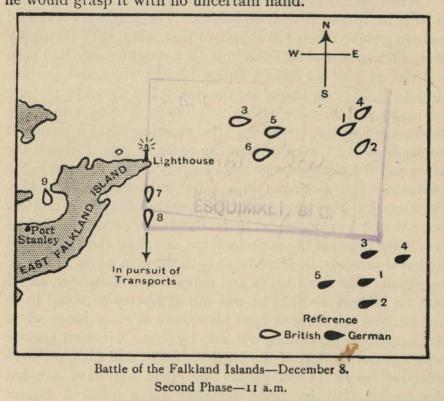
Battle of the Falkland Islands—December 8. Second Phase—11 a.m.
He began by taking the battle-cruisers ahead at 26-½ knots; then slowed down, cleared for action, and piped the men to dinner at 11.30 as usual; changing course at the same time to converge upon the enemy. At 12.20 he increased to 25 knots, and opened fire on the Leipzig, now within 15,000 yards. She was soon on fire, and at 1.20 turned away south-west with the Nürnberg and the Dresden. Admiral von Spee was dividing his squadron, in hope of saving some part of it. But Admiral Sturdee had foreseen this move. Without any fresh signal, the Glasgow, the Kent, and the Cornwall at once followed the light cruisers; Captain Luce was to have the honour of a separate action to himself, while the battle-cruisers and the Carnarvon held on after Spee.
The main action began with an experimental stage; the German ships concentrated their fire on the Invincible, but could not reach her. On the other hand, her smoke was smothering the Inflexible. At 2.5 Sturdee began to close, and Spee, covered by his own smoke, turned to starboard, and went off at full speed after his light cruisers. By 2.45 he was again overtaken. He then turned to port, and reduced the range; he had decided that the time was come to do what damage he could before the inevitable end.
He opened fire with every gun he had; but here, as in the fight of the Sydney against the Emden, and afterwards at Jutland, the German gunners, though highly trained, could not long keep their accuracy under British fire. The duel was practically decided in the first ten minutes: the Gneisenau was badly hit by the Inflexible, the Scharnhorst was set on fire and lost a funnel; both were staggering and smoking desperately. Sturdee seized his advantage, turned eighteen points, and crossed their wake; under his raking fire the Gneisenau listed till her 6-inch guns could no longer fire, the Scharnhorst lost all her funnels and all her port guns. Spee turned gallantly to bring his fresh broadside to bear, but at 4.0 his flagship ceased fire suddenly, and lay down on her beam ends; soon she heeled over, her stern rose steeply, and she went down head foremost. Admiral Sturdee's chivalrous dispatch records that Admiral von Spee's flag was flying to the last.
None of the sinking crew could be saved, for the Gneisenau was still fighting. The three British ships concentrated on her from three sides; at 5.8 her forward funnel fell, and her fire slackened; at 5.15 she hit the Invincible with a single shell; at 5.30 she turned round and stopped dead. At 5.40 she ceased firing, and hauled down one of her two flags; at 5.50, while her three enemies were rushing in at 20 knots to save life, she lay down on her beam ends very suddenly and plunged. Of her complement of 800, some 200 were still alive, and nearly all of these were rescued: 166 recovered; 14 who died of exhaustion were buried next day with full military honours.
Sturdee's next thought was for Captain Luce and his ships. He gave them his own news by wireless, and asked for theirs. The Glasgow replied that she and the Cornwall were over 70 miles to the south, and the Kent out of sight and hearing of them. It seemed not impossible that the Nürnberg had disposed of her by throwing mines overboard during the chase. But this was not so; Sturdee's good fortune was not to be broken. The Dresden, it is true, evaded him, but only because her superior speed and 12 miles' start enabled her to abandon her squadron when she pleased. The other two light cruisers fought gallantly, but failed to escape destruction. In their flight they separated, and the two defeats must be separately described.
When the Dresden decided to run out of action at 27 knots, after the first turn away, Captain Luce wasted no time in chasing her, but laid himself alongside of the Leipzig, the rear ship, in hope of tempting her consorts to fall back to her support. His manoeuvre was to close her repeatedly, engaging with his forward 6-inch gun, and forcing her to turn her broadside to reply. Each time she did so, the Kent and the Cornwall drew nearer, till at 3.36 they could attack the Nürnberg and the Leipzig respectively. The Dresden refused to turn back: she disappeared into the mist, not to be seen again till March 1915, when she surrendered and blew up after a five minutes' action with the Kent and the Glasgow, who had caught her at anchor.
The Nürnberg now turned away east, pursued by the Kent; the Cornwall began to hit the Leipzig, who was already engaged with the Glasgow. Captain Luce, having here the superior speed, turned right round and passed under his enemy's stern, raking her with his fresh broadside; then circled round the Cornwall, and came again into action ahead of her. At 6.0, after nearly two hours of such tactics, he gave the order to close; at 6.35 he received the admiral's wireless message of victory; at 7.17 he saw his own opponent silenced and burning furiously. He waited half an hour for her surrender, and then opened fire again. At that she burned green lights, and he at once lowered his boats. Five officers and thirteen men had been rescued, when the blazing Leipzig turned over to port and sank.
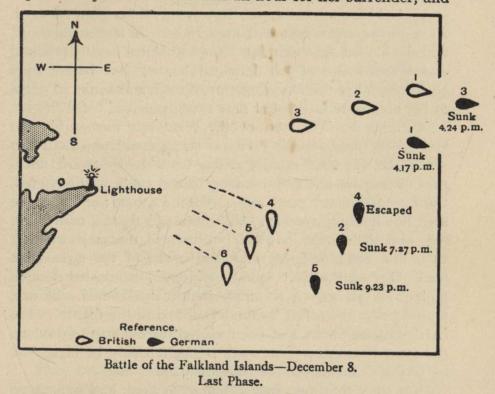
Battle of the Falkland Islands—December 8. Last Phase.
The Kent's success was of a different kind. Normally she had but 23-½ knots of speed to the Nürnberg's 25; but her engine-room department by consummate skill and energy forced their lame duck to a speed which at the end of nearly four hours brought her within 12,000 yards of her enemy. Both ships opened fire, the Kent receiving one hit and making two. The Nürnberg then burst two of her boilers, and dropped to 19 knots, turned eight points to port, and engaged with her broadside. Captain Allen accepted the challenge, ran on, and placed the Kent before her beam at 6,000 yards. By 6.10 he had her burning and almost silenced; he ran on again, and raked her at 3,500 yards, destroying all her guns forward. At 6.30 she was silent and motionless. A few more shots, and she hauled down her flag. Captain Allen hastily repaired and lowered two of his damaged boats; but before they could reach her the Nürnberg turned over and sank. Twelve of her men were found, but only seven survived.
Commander Wharton of the Kent has memorably described the final scene. "It was strange and weird, all this aftermath, the wind rapidly arising from the westward, darkness closing in, one ship heaving to the swell, well battered, the foretop-gallant mast gone. Of the other, nothing to be seen but floating wreckage, with here and there a man clinging, and the 'molly hawks' (vultures of the sea) swooping by. The wind moaned, and death was in the air. Then see! Out of the mist loomed a great four-masted barque under full canvas. A great ghost-ship she seemed. Slowly, majestically, she sailed by, and vanished in the night." The battle-cruisers' fight had been visited, earlier in the day, by the same ghost-ship; manned, it might easily be imagined, by phantom seamen of the Nelsonian age.
Not since that age, and seldom even then, had so impressive a victory been won at sea: it was not a defeat of the enemy, it was his annihilation. Admiral Sturdee had seized all his opportunities, surmounted all his difficulties, and attained all his objects; he was even able to return his most valuable ships to the Grand Fleet practically intact and in the shortest possible time. It may be added that in a fine dispatch he showed once more how a British admiral writes of his enemy's fate and of his own achievement.
CHAPTER XXIV.
MYSTERY SHIPS.
It was towards the end of 1914 that the German Admiralty conceived the idea of blockading the British Isles by means of a submarine fleet. The enterprise was a difficult one; for the pursuit and capture of commerce a submarine is very ill fitted. A frail boat with a small crew cannot afford to hold up and examine a ship on the surface; still less to put a prize crew on board and send the captured vessel into port. It was therefore decided that to carry out the blockade merchant ships must be sunk without examination and without warning. If crews, passengers, or even neutrals perished in this process, the "blame," says Admiral Scheer, "would attach to those who despised our warnings." No civilized power had ever before threatened to kill non-combatants on logical principles of this kind, and as soon as it was seen that the German Admiralty were attempting to carry out their murderous intentions it became necessary to devise means of destroying their U-boats wherever they could be found.
They were accordingly hunted by destroyers, by trawlers, by submarines, and by airships and seaplanes; they were destroyed by gun fire, by mines, by nets, by torpedoes, and by depth charges, and all these were used with the greatest skill and success. Of all the hunting methods, perhaps the most attractive to the English sporting instinct was that of the Mystery Ships, or Q-boats. This was at first merely the use of a simple trap, but was developed by the genius of a single man into an entirely novel campaign of the most heroic kind.
The Special Service ship or Q-boat of 1915 was a tramp or collier with a concealed armament for the decoying and destruction of submarines. The first success was achieved on July 25, 1915, when one of them, the Prince Charles (Lieutenant W. P. Mark-Wardlaw), was pursued and shelled by U36, near North Rona Island. Her crew abandoned ship, leaving their gunners concealed on board. The U-boat thereupon closed; but when she was within five hundred yards of her apparently helpless prey, the British guns were suddenly unmasked, and the submarine sank under their fire, leaving fifteen of her crew to be rescued by the victors.
It was about this same time that a young lieutenant-commander named Gordon Campbell put to sea in charge of the Special Service ship Farnborough, formerly a collier, and now manned from the Mercantile Marine and Royal Naval Reserve. For six months the cruise was unsuccessful, but in the spring of 1916 the Farnborough's look-out at last sighted a U-boat, which, after firing a torpedo at her, broke surface within 1,000 yards, and summoned the supposed tramp with a shot across her bows. Lieutenant-Commander Campbell, who had trained his crew to a perfect knowledge of the game they had to play, stopped the ship, blew off steam ostentatiously, and ordered a "panic abandon ship." The U-boat came nearer, and reopened fire. Lieutenant-Commander Campbell, who was still concealed aboard his ship, then hoisted the white ensign and unmasked his guns. With twenty-one shots from her 12-pounders the Farnborough drove the U-boat under water, then steamed full speed towards her with depth charges, and when she reappeared mortally wounded, sent her to the bottom with five more rounds at point-blank range.
Three weeks afterwards the Farnborough had the good fortune to be attacked by another U-boat, with whom she fought a surface action at a range of nearly 1,000 yards, disabling her at the second shot, and finally blowing her up.
The Germans quickly perceived the deadliness of this new method, which made every attack on a merchant vessel a possible disaster for the U-boat, and their press was instructed to complain of the unscrupulousness of an enemy who used disguised ships and took the attacker by surprise. Commanders of U-boats were instructed to use greater caution in approaching their victims, and it soon became evident to Commander Campbell that they would no longer venture to come near a live ship. He determined to tempt them with a wounded one.
When his new ship, Q5, was attacked by a U-boat early in 1917, he manoeuvred intentionally to get her torpedoed. The crew then abandoned ship as before, while Commander Campbell and his gunners lay hidden in the water-logged vessel, watching until the timid enemy should venture to the surface to finish her off. It took the U-boat twenty minutes to make up her mind. She then came up within 300 yards, and approached to fire a second torpedo, with her captain visible on his conning-tower. The first shot fired from Q5 took off his head, and the boat was then completely shattered; one officer and one man were picked up alive. Q5, with water in her engine-room, boiler-rooms, and holds, then signalled for help, and was taken in tow by Lieutenant-Commander W. W. Hallwright of the Laburnum, with the assistance of the Narwhal, the Buttercup, and the trawler Luneta; after a night of heroic exertions and great danger she was brought safely into port. Commander Campbell received the Victoria Cross. Of his officers and crew he wrote: "They may almost be said to have passed through the supreme test of discipline. The chief engineer and the engine-room watch remained at their posts and kept the dynamos going until driven out by water. They then had to hide on top of the engine-room. The guns' crews had to remain concealed in their gun-houses for nearly half an hour, where we could feel the ship going down by the stern. At that time it appeared touch and go whether the ship would sink before we sank the enemy."
Four months afterwards Campbell and his men were out again, in the Special Service ship Pargust, and were again successful in being torpedoed. This time the U-boat, after some hesitation, came within 50 yards, and was so much injured by the Pargust's fire as to be incapable of submerging. Her crew made tokens of surrender, but when Commander Campbell ceased fire, attempted to make away upon the surface. The Pargust, of course, could not follow, but by a lucky shot she exploded a torpedo aboard the U-boat and destroyed her, saving only two of her crew. She was then herself towed into port by the Crocus. This time the Victoria Cross was given to Lieutenant R. N. Stuart, D.S.O., R.N.R., and to Seaman William Williams, D.S.M., R.N.R., to be worn on behalf of the whole ship's company.
Captain Campbell's next command was the Special Service ship Dunraven, disguised as an armed British merchant vessel. She was zigzagging at eight knots in rough water, when a U-boat opened fire upon her at 5,000 yards. Captain Campbell ran up the white ensign, and returned the fire with a 2-½-pounder, intentionally firing short, and making terrified signals for the U-boat's benefit. Then, as the shells fell closer, he let off a cloud of steam to indicate boiler trouble, and ordered a "panic abandon ship." The Germans now became more confident, and began to make hits; one shell exploded a depth charge on the Dunraven's poop, and blew Lieutenant Charles Bonner, D.S.C., R.N.R., out of his control station. The U-boat then ceased fire, and came past within 500 yards; but she was partly hidden by the smoke from the Dunraven's burning poop, and though Captain Campbell knew that his magazine and depth charges must explode sooner or later, he decided to trust his men and wait until the enemy gave him a better chance.
The U-boat kept him waiting just too long. She was passing the Dunraven's stern, when the poop blew up, hurling the 4-inch gun and the gun's crew into the air, and starting the "open fire" buzzers at the guns. The U-boat was hit, but not fatally, and at once submerged. Captain Campbell hastily collected his wounded, turned hoses on to the burning poop, where the magazine was still intact, and signalled to an approaching warship to keep away and deflect traffic, as his action was not yet ended. The second stage was begun by the enemy torpedoing the Dunraven abaft the engine-room. Captain Campbell at once ordered a "Q abandon ship"—that is, he left his guns visible and pretended that the concealed gunners were now leaving after being detected. The ship continued to burn, and the submarine circled cautiously round, shelling her for forty minutes, then submerged again.
Captain Campbell had still two torpedoes left, and both of these he fired at the submarine. One just missed her head, and the other passed two feet abaft her periscope. He had now lost his last chance of a kill, and signalled urgently for assistance, preparing at the same time for a last fight with a single gun. The American vessel Noma came up immediately, followed by the Attack and the Christopher. The U-boat was driven off, the fire extinguished, and the ship taken in tow by the Christopher. During the night it was found necessary to take off her crew and her wounded, and the Dunraven was sunk at last by a British gunshot.
In reporting this action Captain Campbell brought specially to notice the extreme bravery of Lieutenant Bonner, who received the Victoria Cross, and the 4-inch gun's crew, to whom the same honour was given. "Lieutenant Bonner, having been blown out of his control by the first explosion, crawled into the gun hatch with the crew. They there remained at their posts with a fire raging in the poop below, and the deck getting red hot. One man tore up his shirt to give pieces to the gun's crew to stop the fumes getting into their throats; others lifted the boxes of cordite off the deck to keep it from exploding; and all the time they knew that they must be blown up, as the secondary supply and magazine was immediately below. They told me afterwards that communication with the main control was cut off, and although they knew they would be blown up, they also knew that they would spoil the show if they moved, so they remained until actually blown up with their gun. Then when, as wounded men, they were ordered to remain quiet in various places during the second action, they had to lie there unattended and bleeding, with explosions continually going an aboard, and splinters from the enemy's shell-fire penetrating their quarters. Lieutenant Bonner, himself wounded, did what he could for two who were with him in the wardroom. When I visited them after the action they thought little of their wounds, but only expressed their disgust that the enemy had not been sunk. Surely such bravery is hard to equal."
It may be added that such bravery is still harder to defeat. The discipline and devotion which the genius of this commander had imparted to his ship's company, when added to the long-descended seamanship and enterprise of our Service, proved too much for the unscrupulous courage and mechanical skill of the enemy. It cannot be doubted that in any imaginable war at sea the same qualities would produce the same result; for the mystery, after all, lay rather in the men than in the ships.
CHAPTER XXV.
JUTLAND.
On May 30, 1916, the Grand Fleet put to sea for one of its periodical sweeps. Admiral Jellicoe had information which gave him some hope that the enemy might at last be caught in the North Sea; and in fact, on the morning of the 31st, the German High Sea Fleet did come out, in ignorance of Jellicoe's move, but in "hope of meeting with separate enemy divisions." Admiral Scheer had with him the Battle Fleet of fifteen dreadnoughts and six older ships, with three divisions of cruisers, seven torpedo flotillas, and ten zeppelins; and in advance of these was a squadron of five battle-cruisers, under Admiral Hipper, with his own cruisers and destroyers. Advancing towards Hipper was the British Battle-Cruiser Fleet under Admiral Beatty—the Lion, Princess Royal, Tiger, Queen Mary, Indefatigable, and New Zealand—with the Fifth Battle Squadron under Rear-Admiral Evan-Thomas—the Barham, Valiant, Malaya, and Warspite; and in front of these were three light-cruiser squadrons under Commodore Goodenough, with four destroyer flotillas. Behind, and at a considerable distance, to avoid alarming the enemy too soon, came Admiral Jellicoe with the main fleet—twenty-four dreadnoughts in six divisions abreast of each other, and each in line ahead. He had with him also the Third Battle-Cruiser Squadron, three squadrons of cruisers, and three destroyer flotillas.
The light cruiser Galatea first sighted enemy ships at 2.20 p.m. Soon she reported the smoke of a fleet, and at 3.31 Beatty sighted Hipper and formed his line of battle. At 3.48 the action began at 18,500 yards, Hipper racing back towards his fleet and Beatty pursuing. The firing on both sides was rapid and accurate; in twelve minutes the leading ships on both sides had been seriously hit; six minutes more and a salvo, which reached her magazine, destroyed the Indefatigable.
The Fifth Battle Squadron now drew up and came into action. Immediately afterwards the enemy sent fifteen destroyers and a light cruiser to attack with torpedoes. They were met by our twelve destroyers, who fought with them a most gallant battle within the main battle, repulsing them and forcing their battle-cruisers to turn. The Nestor, the Nomad, and two enemy destroyers were sunk; the battle-cruisers swept on, and the action was resumed.
The enemy's gunners now seemed to be losing their first accuracy, and at 4.18 the third ship of the German line was burning. But a few minutes later a salvo struck the Queen Mary in a vital part abreast of a turret; in one minute the ship was gone, and the Tiger, her next astern, passed over the place where she had been, without seeing any sign of her but smoke and falling debris. Admiral Beatty had lost two of his six battle-cruisers, and his flagship was damaged; but his tactics and his fighting spirit were in no way disturbed.
Twelve minutes later he was cheered by Commodore Goodenough reporting the German Battle Fleet. He had found the enemy at last in the open, and his business now was to draw them on towards the Grand Fleet. He recalled his destroyers and turned his whole force northward. Hipper, still steering south, fought him for a few minutes as they passed one another on opposite courses, and then turned north to follow him. The whole German fleet was now in line; but Beatty, having the superior speed, was able to overlap their head and keep their tail out of action. He engaged their five battle-cruisers with his own four, supported by the Barham and the New Zealand, while the Malaya and the Warspite were hammering their leading battleships.
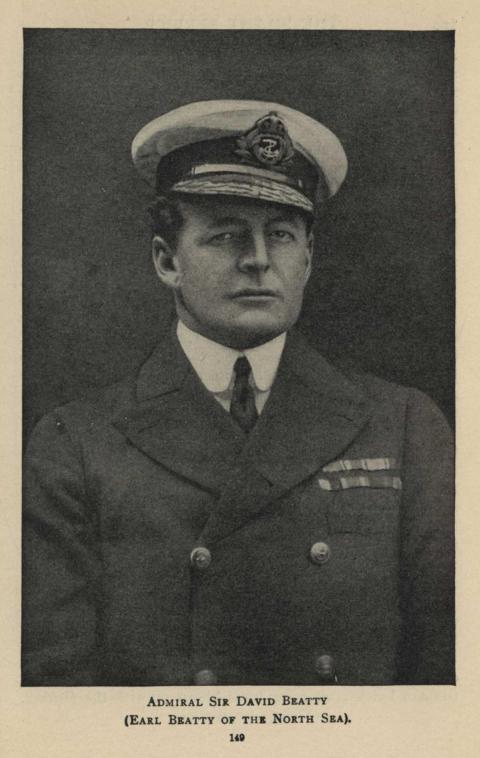
ADMIRAL SIR DAVID BEATTY (EARL BEATTY OF THE NORTH SEA).
The Grand Fleet was now rapidly approaching, and Admiral Jellicoe had to prepare for the extremely difficult manoeuvre of joining battle with an enemy of whose position he was not fully informed. Gun-flashes were reported at 6.5 on the starboard bow, but the only ships visible were the Lion and other battle-cruisers steering east in thick mist. The admiral lost no time; at 6.8 he ordered two torpedo flotillas to his port front and one to starboard; then, after receiving a further report from Admiral Beatty, at 6.16 he ordered his six divisions of battleships to deploy eastwards, forming on the port wing column. He thus threatened to cut off the enemy from his base, and in order to close him the more quickly the deployment was made by divisions instead of in succession. The movement was entirely successful. At the same time the battle-cruisers were getting clear to the south and east, and Admiral Evan-Thomas's four ships were forming astern of the fleet. They did this under fire, but without serious interference; the Warspite, whose helm jammed, was for a few moments carried over towards the enemy, but the German gunnery was no longer steady enough to hit her.
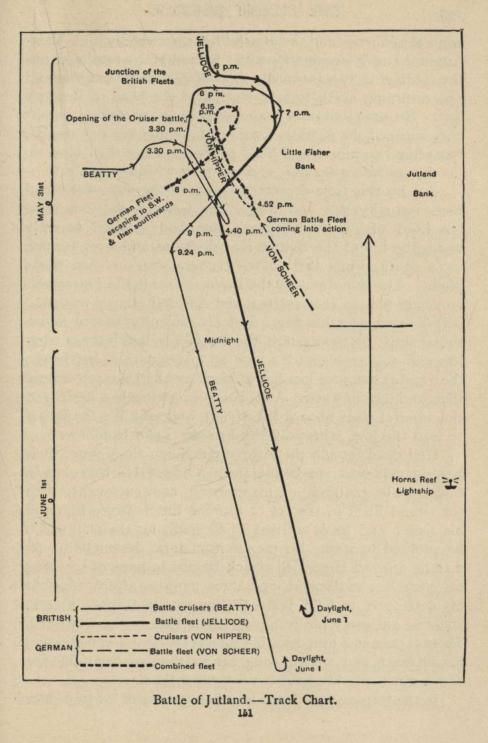
Battle of Jutland.—Track Chart.
For the Germans the horizon was now filled with an unending line of British ships, and the sight, as their own officers said, "took the heart out of the men." They were already "utterly crushed" by the masterly way in which Admiral Jellicoe had brought his huge fleet into action, and they saw that Admiral Beatty was outflanking them by "a model manoeuvre, a performance of the highest order."[#] Their line bent away, first to the east, and then to the south, suffering heavily as it turned, and making not a hit in return.
[#] Captain von Hase.
They had, however, inflicted some losses on the British cruisers while the battleships were deploying. Rear-Admiral Sir Robert Arbuthnot, who had chased the light cruiser Wiesbaden (with the Defence, Warrior, and Black Prince) and crippled her between the lines, came under fire from two German battle-cruisers, and was blown up with the Defence, while the Warrior and the Black Prince were badly hit. Rear-Admiral Hood, too, met his fate; he had been scouting far to the south with the Invincible, Inflexible, and Indomitable, and was returning north to take station at the head of Beatty's line. He executed this manoeuvre in grand style, and at once engaged the gigantic Derfflinger, hitting her repeatedly; but after two minutes of hard pounding a big shell blew up the Invincible's magazine, and she sank with her admiral.
But by this time the action between the main fleets had been virtually lost and won. The German battleships at the head of Admiral Scheer's line had suffered severely under the fire of the British rear divisions and were turning away south, while their battle-cruisers were in even worse plight. Two minutes after the Invincible sank, the Lutzow was no longer able to keep station, and Admiral Hipper was compelled to transfer his flag. But his difficulty was to find a sound ship; his next astern, the Derfflinger, had lost her wireless and was gaping with a hole 20 feet square in her bows; the Seydlitz had also lost her wireless, and had shipped several thousand tons of water. After being some time in a destroyer, the admiral went aboard the Moltke, and sent the Derfflinger to lead the line, with only the Von der Tann to follow.
Half dead though these three remaining ships were, their hardest task was yet before them. Admiral Scheer was in a desperate position, outmanoeuvred and outfought, with the Grand Fleet in the act of forming line between him and his base; and he is entitled to all credit for the plan which he adopted to secure his escape from total destruction. At 7.12 he ordered Hipper to attack Beatty in hope of breaking his encircling movement, and three minutes afterwards sent his destroyers to hold Jellicoe's line with a torpedo attack, while he got away his crumpled battle fleet to the westward. These tactics cost him dear, but he was successful in increasing his distance and withdrawing his battleships from the fire which must speedily have overwhelmed them.
In the torpedo attack not less than twenty of his torpedoes were seen to cross the British line. All were avoided, for Admiral Jellicoe, acting on principles adopted by the Admiralty some time before, ordered his ships to turn away two or more points as soon as the attack was seen. When it was over they at once turned back towards the enemy, but Admiral Scheer had by that time disappeared westward into the mist. Of his twenty-one battleships twelve had been seriously damaged, and their united fire had made but a single hit on the twenty-six British battleships which engaged them—a hit which wounded three men in the Colossus.
The gallant Hipper suffered even more severely. He had no sooner started his attack on Beatty when the Derfflinger met more than her match in the Lion. In eight minutes she is reported by her chief gunnery officer, Captain von Hase, to have received twenty 15-inch shells, which destroyed turret after turret, carried away her fire control and chart-house, and set her on fire fore and aft. With only two heavy guns left, she drew off and went after her fleet, followed by the Von der Tann only. The Seydlitz and the Moltke had already left the line under cover of the smoke from the burning Lutzow. The light was now failing fast; the Lion was still hunting, but could no longer find her prey. In spite of some heavy hits, her admiral and his command were insatiable, and even disappointed. But they had, in fact, achieved a day's fighting which is without a parallel—a battle-cruiser victory complete in itself.
Touch was now lost between the two fleets, and Admiral Jellicoe had to consider his dispositions for the night. He had completely succeeded in interposing between the enemy and their base, and his object was to bar their retreat and secure a final action next day. He therefore placed his battleships to the south in four columns a mile apart, his destroyers 5 miles to their rear, with the battle-cruisers and cruisers to the west, and two light-cruiser squadrons farther north and south. Finally, at 9.30, he sent the mine-laying flotilla leader, Abdiel, to lay a minefield towards the Horn Reef—a precaution which resulted in several explosions among enemy ships during the night.
The German commander-in-chief was well aware that in a daylight action he could expect nothing but destruction. He resolved on a rush for home in the dark, and here again he has the credit of a right decision and a right method. He sent his ships to make their way through in detachments. Some three or four light cruisers first ran into our destroyers, slightly damaged the Castor, received a torpedo hit, and vanished. Another group of cruisers attacked our Second Light Cruiser Squadron at very short range, inflicted heavy casualties on the Dublin and the Southampton, and disappeared, but with the loss of the light cruiser Frauenlob. The destroyer Sparrowhawk was sunk in action with a third group of cruisers, and a little later the Tipperary. At midnight some battleships passed near the same flotilla, and one, the Pommern, was torpedoed and sunk. Another battleship squadron followed soon after, and sank the destroyer Ardent.
At 1.46 a.m. the Twelfth Flotilla, farther north, sighted six Kaiser battleships and attacked them. Captain Stirling, in the Faulkner, torpedoed one, and some time later Commander Champion, in the Nomad, hit another; but the Germans claim that both the wounded ships reached port. The Ninth Flotilla lost the Turbulent, rammed by a large unknown vessel; but at 2.35 the destroyer Moresby, of the Thirteenth Flotilla, attacked four Deutschland battleships and torpedoed one. Lastly, it is believed that the Black Prince, who had been crippled hours before, was seen for a moment under the searchlights and guns of a number of enemy ships, who sank her at once. All this battle by night was fought under the most desperate conditions, the horror of darkness and the glare and crash of sudden death alternating for five hours; but it was far more ruinous to the German fleet than to the British.
When day broke, Admiral Jellicoe formed his fleet in line ahead and turned north; at 5.15 he called in the battle-cruisers; at 6 a.m. he sighted his cruisers, and at 9 the destroyers rejoined. He had now all his force in hand, except the Sixth Division of six battleships under Admiral Burney, whose flagship, the Marlborough, had been hit by a torpedo and was now being sent home under escort to be repaired. This, however, was no cause for delay, and Admiral Jellicoe patrolled the battle area till noon, in search of the enemy, moving first north, then south-west, and finally north by west.
It was clear that Admiral Scheer had no intention of further fighting. He had a zeppelin out scouting, and admits that she reported to him the position of the British fleet. But he was in no condition to move. He had inflicted on us a loss of three battle-cruisers, three armoured cruisers, and eight destroyers; while of his own ships one battleship, one battle-cruiser, four light cruisers, and five destroyers had been sunk. But his effective force had been diminished out of all proportion to ours; his battle-cruisers were in no condition to fight; he had discovered that the whole squadron of pre-dreadnoughts were unable to lie in a modern line of battle, while six of the remaining fifteen were unfit to be anywhere but in dock; of his eleven light cruisers ten had been hit, and four of them sunk. He had, in short, no fleet to make a fight with; whereas Admiral Jellicoe had available twenty-six powerful battleships, all but four of them untouched, six battle-cruisers out of nine, and all his light forces, except three cruisers sunk and three hard hit.
More fatal still, then and for ever, was the injury to the moral stamina and tradition of the German fleet. In that one day they passed from the militant to the mutinous state of mind, and their commander knew it. As Captain Persius wrote afterwards in the Berliner Tageblatt: "The losses sustained by our fleet were enormous, in spite of the fact that luck was on our side; and on June 1, 1916, it was clear to every one of intelligence that this fight would be, and must be, the only one to take place. Those in authority have often admitted this openly." The Kaiser did his best to shout our victory down, and he was seconded, though more feebly, by German admirals who knew better. But the High Sea Fleet had failed completely to challenge the control of the sea, and henceforth degenerated towards the final surrender.
CHAPTER XXVI.
THE BRITISH SUBMARINE SERVICE.
The war record of the British submarine service is unique; the difficulties and dangers which our men faced and overcame were such as no other navy has attempted. The patrol of the shallow Belgian coast and the hunting down of U-boats was a very different task from torpedoing merchant vessels or hospital ships without warning; and the campaigns in the Marmora and the Baltic were conducted under conditions which had no parallel elsewhere.
A glance at the map will show that the Marmora was not only distant from the British naval base, but that the only line of approach was of an uncommonly formidable character. The channel of the Dardanelles is narrow and winding, with a strong tide perpetually racing down it, and setting strongly into its many bays. It was, moreover, protected by forts with powerful guns and searchlights and torpedo tubes, and by barrages of thick wire and netting; it was also patrolled constantly by armed ships. Yet all these defences were evaded or broken through with marvellous courage and ingenuity; for nearly a year a succession of brilliant commanders took their boats regularly up and down the passage, and made the transport of Turkish troops and munitions first hazardous and finally impracticable. Two battleships, a destroyer, and five gunboats fell to them, besides over thirty steamers, many of which were armed, nine transports, seven ammunition and store ships, and no less than 188 sailing ships and dhows with supplies. It is hardly necessary to add that in no case was violence done to neutrals or non-combatants.
The first officer to take a British submarine up the Dardanelles was Lieutenant Norman Holbrook. It was in December 1914 that his attempt was made, and after equipping his boat, B11, with ingenious devices for jumping obstacles, and running several preliminary trials, he trimmed and dived for Sedd-el-Bahr at the moment when the searchlights were extinguished at dawn. Rather more than four hours after his start he had passed the Straits and was at last able to put his periscope above water. He found his fortune at the same moment. There, on his starboard beam, was a large two-funnelled vessel, painted grey, and flying the Turkish ensign. At 600 yards he fired his starboard torpedo, and dipped for a few seconds. An explosion was heard. B11 came quietly to observation depth again of her own motion, and her commander, still at his periscope, saw the grey ship firing a number of guns. His boat dipped again, but he got her up once more, and this time saw his enemy, the battleship Messudiyeh, silent, and sinking slowly by the stern. He turned for home, dived into the channel, and ran along the bottom at full speed; came up to take his bearings, dived again, and by 2 p.m. had cleared the exit. In ten hours he had proved all the possibilities of a novel campaign. He had forced the strongly-barred channel, surprised and sunk a battleship in broad daylight, and returned to report, though he had gone up without information and come down with a damaged compass. Of the boats which followed in the spring and summer of 1915, the most famous were E14 (Lieutenant-Commander E. Courtney Boyle); E11 (Lieutenant-Commander M. E. Nasmith); E12 (Lieutenant-Commander K. M. Bruce); E7 (Lieutenant-Commander Cochrane); E2 (Commander David Stocks); and K1 (Lieutenant Wilfred Pirie). In efficiency all these surpassed everything which had been thought possible of submarines. Their cruises lasted from a fortnight at first to thirty days later, and finally to forty and even forty-eight. During this time they would run 2,000 miles and more, with no resources for supply or repairs beyond what they carried on board. When Commander Boyle brought E14 back to her base in August after her third cruise, she had done over 12,000 miles since leaving England, and had never been out of running order—a record for which her chief engine-room artificer, James Hollier Hague, was promoted to warrant rank.
It is impossible to relate here the adventures, the ingenuities, and the brilliant service which these seven commanders reported in the bald and convincing style of the British Navy. One example only can be given—a typical and not an exceptional one. Lieutenant-Commander Nasmith took E11 up for the first time in May 1915, in succession to Commander Courtney Boyle, who had just returned, leaving the Turks under the belief that the Marmora was infested by a whole flotilla of submarines. By a curious combination of activity and accident, Lieutenant-Commander Nasmith at once confirmed this legend.
On his second day out he "dived unobserved into Constantinople," and torpedoed a Turkish gunboat; five hours later he stopped a small steamer, whose crew did a "panic abandon ship," capsizing all their boats as they were put out. An American gentleman then appeared on the upper deck and conversed amicably, after which he was sent ashore, and the ship, being found to contain a Krupp gun and ammunition, was cleared and sent to the bottom. Two heavily laden store-ships were then attacked. One was sunk and the other driven ashore. Under a hurricane of fire from the shore batteries, the submarine dived and got away towards the Bosphorus. At Galata there was a panic; all shops were closed, troops were disembarked from transports, re-embarked, and again landed. The effect was redoubled next day when the American gentleman returned to tell his story. Probably he had inquired the number of the British submarines on the ground, and had been misunderstood to be asking for the number of the boat he was aboard; for he reported—and the news ran through Constantinople—that there were eleven of our boats in the Marmora, holding up all ships going to the Dardanelles. And E11 did in fact achieve this result. Transports lay idle in the Golden Horn, and as the one real boat and her ten imaginary consorts patrolled the Marmora, Turks and Americans wondered where they had their base, and how it had been prepared in hostile waters.
In August E11 was on duty once more, hunting in couples with E14. Commanders Boyle and Nasmith rendezvoused on the 6th, and concerted a plan for shelling troops next day on the land route to Gallipoli. This operation was very successful; in less than three hours E11's 12-pounder twice broke up columns on the coast road. On the following day Commander Boyle destroyed a 5,000 ton supply steamer with torpedo and gun-fire, while Commander Nasmith sank the battleship Haireddin Barbarossa. This ship was passing north-east of Gallipoli, escorted by a destroyer. E11 was skilfully brought into position on her starboard beam, and two torpedoes got home amidships. The Barbarossa immediately took a list to starboard, altered course towards the shore, and opened a heavy fire. But within twenty minutes a large flash burst from her fore part, and she rolled over and sank.
The Turks attempted to conceal the details of this catastrophe; but they confided to Mr. Einstein of the American Embassy that a gunboat perished with Barbarossa, and one of two transports which she was convoying, while the other ran aground. They added that the attack was made by six submarines, who completely surrounded the battleship and her convoy. Commander Nasmith afterwards sank a large collier and two more transports, and then turned his attention again to cutting the enemy's communications by land.
His lieutenant, D'Oyly Hughes, volunteered to take the most dangerous part in an attack on the Ismid railway. A raft was put together behind Kalolimno Island, capable of supporting one man, and carrying his equipment and a charge of explosives. With this Lieutenant D'Oyly Hughes was to reach the shore, and blow up the railway line, or, if possible, the viaduct. The risk involved not only the volunteer but E11 herself, for so long as he had still a chance of returning, she could not quit the neighbourhood, or even conceal herself by submerging.
At 2 a.m. Commander Nasmith took the boat inshore till her nose just grounded, within three feet of the rocks, where there were cliffs on each side high enough to prevent her conning-tower from being seen. Lieutenant D'Oyly Hughes dropped into the water and swam off, pushing his raft towards a spot about 60 yards to the left. Besides his demolition charge he had only a revolver, a bayonet, an electric torch, and a whistle. He found a landing place, scaled the cliff, and prowled along the railway with his heavy charge till he was brought up by the sound of voices; three Turks were sitting by the side of the line. He laid down his guncotton, and made a wide detour to inspect the viaduct, roused a small farmyard on his way, and was again stopped by finding a number of men working a stationary engine at the near end of the viaduct.
He crept back to his gun-cotton, and decided to blow up a low brickwork support over a small hollow, only 150 yards from the men, but a spot where real damage could be inflicted. He muffled the pistol for firing the fuse, but on so still a night it made a very loud noise. The three Turks heard it, and instantly started to chase their enemy down the line. Lieutenant Hughes had but one chance—to find his way to the shore and swim off. To gain time, he turned and fired at his pursuers; they stopped to return his fire, and he distanced them, gained the shore, and plunged into the water. As he did so he heard with joy the sound of a heavy explosion, with the crash of fragments hurled into the sea. The railway line was effectively cut; but he was three-quarters of a mile from the bay where E11 was lying hid.
He swam out to sea, and after going some 500 yards blew a long blast on his whistle; but the boat failed to hear him. Day was breaking—the time of waiting for him must be short. He swam ashore again, rested on the rocks, and plunged in once more. One by one he had to throw away pistol, torch, and bayonet. At last he rounded the point and his whistle was heard; but at the same moment shouts and rifle fire came from the cliffs above. The boat backed out towards him, determined to save him at any cost.
But now came the most trying part of his adventure. In the early morning mist the bow, the gun, and the conning-tower of the submarine appeared to the distressed swimmer to be three small rowing-boats advancing towards him, and manned, of course, by enemies. He turned back, swam ashore, and tried to hide himself under the cliffs. But he was still cool and clear-headed, and after climbing a few feet looked back and realized his mistake. One last swim of 40 yards, and he was picked up almost exhausted. He had run hard for his life and swum a mile in his clothes. "5.5 a.m.," says E11's log, "dived out of rifle fire, and proceeded out of the Gulf of Ismid."
She ended her cruise with a brilliant week's work; fought an action with three armed tugs, a dhow, and a destroyer, evading the destroyer, and sinking two of the other ships by gun-fire; torpedoed two large transports; bombarded the magazine and railway station at Mudania; battered the viaduct for an hour; and on her return down the Dardanelles passed the obstacles without assistance or misadventure. Her final cruise was in November and December, when she was out forty-eight days, and sank forty-six enemy ships. Her last companion, E2, was recalled two days later, and the campaign was over.
CHAPTER XXVII.
THE BRITISH SUBMARINE SERVICE (continued).
The first of our submarine voyagers in the Baltic was Lieutenant-Commander Max Horton, in E9. He distinguished himself in the early months of the war by sinking a German light cruiser and a destroyer in the North Sea. In January 1915 he entered the Baltic, sank a destroyer on the 29th, a transport on 11th May, and on 5th June another transport and another destroyer. On 2nd July he torpedoed the Pommern, a 13,000 ton battleship, with 11-inch guns. He was then joined by E1 (Commander N. F. Laurence), and on 22nd August by E8, whose log contains the best account of the long, intricate, and dangerous voyage out.
Commander Goodhart started in E8 on 18th August, with 1,500 miles of adventure between him and his new base at Reval. He passed warily up the Skagerrack, avoiding the central line of traffic, and diving once under a whole fleet of steam trawlers. At 7 p.m. he came to the surface again, rounded the Skaw at full speed, and entered the Kattegat. In the fading light several merchantmen were seen going north; the shore and island beacons began to twinkle one by one—Hamnskau, Vinga, Skaw, Trindelen, Anholt. But the night was short; by 3 a.m. he must dive again and lie on shoal ground while traffic passed above him. At 5.25 he ventured up, but was put down quickly by a steamer; to be seen might rouse a hunt. At 7 he came up again and did a survey of l-½ hours in a friendly mist, then down again, to crawl at 3 knots till 1 p.m., when he was off the entrance to the Sound.
Here he must choose between going forward submerged, or waiting for darkness and attempting the channel on the surface. He decided to continue his dive into the Sound and wait for night inside. He went in at 50 feet, came up to 21 feet to verify his position, down again to 50, and altered course to pass through the northern narrows. At 4.10 p.m. he was east of Helsingor Light; at 5.20, after another observation, he went to bottom in 11 fathoms, to wait for darkness. At 8.15 p.m. he rose to the surface; the Danish shore was bright with many lights, the Swedish shore all dark. He steered south-westward on the surface, altering course to avoid being seen by two destroyers which were going north along the Danish shore at a great pace; but now one of them suddenly turned south and stopped. E8 ran on, but into still more dangerous waters. The lights of Copenhagen were bright, and a searchlight was working from Middle Ground Fort; now and again it swept across the submarine. Then came several fishing boats, then two red lights moving south, close over to the Danish shore. There was nothing to show that E8 had been seen, and she headed boldly for Flint Channel.
Off Malmo the shorelights were dazzling, and it was extremely hard to fix a position. There were also many fishing boats about, each carrying two bright lights. Commander Goodhart ordered the boat to be trimmed down, with upper deck awash, and proceeded with one engine only, at 7 knots. He steadied his course through Flint Channel, passing at least twenty vessels with white lights, and one making searchlight signals in the air. No sooner had these been avoided by changing course than a tramp came along, showing first a green light and then three white ones. She seemed to have anchored; but now two other vessels had to be dodged, and then the ship with the searchlight. Immediately afterwards, when just north-east of the lightship's three vertical red lights, E8 was viewed at last; a small torpedo boat sighted her as she was creeping by within 200 yards.
The hunt was up; the enemy showed red and green flares, and altered course to chase. E8 dived, and struck "very strong bottom" at 19 feet, and immediately afterwards at 14 feet. A succession of bumps brought her to a stop. It was 11.40 p.m. After an anxious quarter of an hour Commander Goodhart decided to rise to the surface. On his starboard quarter was the Drogden lightship, ahead of him a large destroyer or small cruiser—the ship which had been signalling with searchlight. She was only 200 yards away, but the commander trimmed his boat deep, and stole past. This took four minutes, and he then found another destroyer right ahead, and within 100 yards. He could but dive; the boat struck bottom at 16 feet heavily, carrying away all blades of the starboard propeller. The pursuers could be heard overhead.
Life was now a matter of minutes and feet. The boat was still moving; at 12.15 a.m. she was at 18 feet, and bumping badly; at 12.19 the commander stopped her and came silently to the surface. The destroyer was still close on his starboard beam, and in one minute he had dived again as slowly as he dared; mercifully the water deepened as E8 glided away. She seemed to be escaping; but at 2.10 a.m. she struck bottom again, and when she ventured up after an hour, there again was the destroyer on her port beam. Happily this time she got down without being seen, and when she came up again at 7.15 there was nothing in sight.
But the danger was not over yet. E8 was nearly out of breath; her battery was running very low. After diving again to avoid a steamer and afterwards a destroyer, Commander Goodhart decided to find a good depth, and lie at the bottom till darkness gave him a chance of recharging. For eight long hours E8 lay like a stone in 23 fathoms. When she came up three or four vessels were patrolling close by, and the moon was too bright. She tried again, but was again put down by a shadowy destroyer to the southward. At last, ten minutes before midnight, she found a bit of quiet sea where she could take breath.
But only for two hours; daylight comes early in northern waters. At 2 a.m. Commander Goodhart dived again, and lay long in 17 fathoms, spending his time in studying the chart. He was now well out of the Sound, and clear of the Swedish coast. Right ahead was the island of Bornholm, and if that could be passed successfully, the Baltic lay open beyond, a long voyage still, but a less crowded thoroughfare.
At 9 a.m. he came to the surface for three hours. By noon he was not far west of Ronne, and as he wished to make sure of getting past Bornholm unobserved, he decided to remain on the bottom till dark, then slip by and recharge his batteries for a long run north by daylight. By 7 p.m. he was on his way; by sunrise on the 21st he was passing the east coast of the great island of Gotland. At 9.2 p.m. he dived for a light cruiser, which passed over him; at 10 he returned to the surface and ran past the entrance to the Gulf of Riga and the island of Oesel. By 1 a.m. on August 22nd he had to dive for daylight, but at 3 he came up again, and ran ahead at full speed. At 8.30 a.m. on August 23rd he sighted Dagerort ahead, and joined Commander Max Horton in E9, passed with her and a Russian destroyer into the Gulf of Finland, and by 9 p.m. secured E8 in Reval harbour. Within twenty-four hours he had docked and overhauled her, replaced her broken propeller, and reported her ready for sea.
Of the warships sunk by E8 and her consorts, and of their blockade of the German traffic in the Baltic, there is no need to speak. Their feats of war, brilliant as they were, formed only a minor part of the glory of their intricate and perilous voyages in a hostile sea.
CHAPTER XXVIII.
THE MERCANTILE MARINE AND FISHING FLEETS.
Among the great deeds of the war there is one which, though hardly to be described in detail, ranks in truth among the greatest of all. It is a collective deed: the conduct of the whole British Mercantile Marine and the Fishing Fleet—Services not less worthy than the professional Navy and Army to represent the "decent and dauntless people" of these islands. It had been prophesied before the war that after three ships had been sunk by enemy submarines no merchantman would put to sea. The prophet, though himself a naval man, can have known little of the resourcefulness of his own Service, and still less of the temper of his fellow-countrymen.
During the four years of the war, British commerce was never held up by any unwillingness of our seamen to face gun-fire or torpedo: skippers, engineers, and deck hands who had had three, four, or five ships sunk under them were constantly asking to be employed again before their clothes were dry. Seventeen thousand of them died in the 9,000,000 tons of shipping that we lost; yet not a man among the survivors drew back. On the contrary, it must be recorded that the enemy owed much of his success to the habitual and imperturbable confidence of the British skipper in his own ship and his own judgment. The men of the Mercantile Marine and Fishing Fleets also took their full share in the work of defending our coasts and hunting down their lawless and cruel enemies; and in this work they showed every quality of a great Service. It was in no empty form of words that the King honoured the memory of "that great company of our men, who, though trained only to the peaceful traffic of the sea, yet in the hour of national danger gave themselves, with the ancient skill and endurance of their breed, to face new perils and new cruelties of war, and in a right cause served fearlessly to the end." Of this skill, endurance, and fearlessness, recorded in a thousand terse and unpretentious logs, an example or two may be picked almost at random.
In 1915, when the U-boat war was still a new experience, a sharp little double action was fought by two armed smacks, the Boy Alfred and the I'll Try, against two German submarines. The British boats were commanded by Skipper Walter S. Wharton and Skipper Thomas Crisp, and were out in the North Sea, when they sighted a pair of U-boats coming straight towards them on the surface. The first came within 300 yards of the Boy Alfred and stopped. Then followed an extraordinary piece of work, intelligible only to the German mind. The U-boat signalled with a flag to the Boy Alfred to come nearer, and at the same time opened fire upon her with rifles or a machine-gun, hitting her in many places, though by mere chance not a single casualty resulted.
Skipper Wharton's time had not yet come; he was neither for submission nor for a duel at long range; he risked all for a close fight. He first threw out his small boat, and by this encouraged the U-boat to approach nearer. She submerged and immediately reappeared within a hundred yards. A man then came out of the conning-tower and hailed the Boy Alfred, giving the order to abandon ship, as he intended to torpedo. But Skipper Wharton had now the range he desired—the hundred yards hammer and tongs range so dear to Nelson's gunners—and instead of "Abandon ship" he gave the order "Open fire." His man at the 12-pounder did not fail him; the first round was just short, and the second just over, but having straddled his target, the gunner put his third shot into the submarine's hull, just before the conning-tower, where it burst on contact. The fourth shot was better still: it pierced the conning-tower and burst inside. The U-boat, with her torpedo unfired, sank like a stone, and a significant wide-spreading patch of oil marked her grave.
In the meantime the second enemy had gone to the east of the I'll Try, who was herself east of the Boy Alfred. He was still more cautious than his companion, and remained submerged for some time, cruising around the I'll Try with only a periscope showing. Skipper Crisp, having a motor fitted to his smack, was too handy for the German, and kept altering course so as to bring the periscope ahead of him, whenever it was visible. The enemy disappeared entirely no less than six times, but at last summoned up courage to break surface. His hesitation was fatal to him—he had given the smack time to make every preparation with perfect order and coolness. When he appeared suddenly at last, his upper deck and conning-tower were no sooner clearly exposed than Skipper Crisp put his helm hard over, brought the enemy on to his broadside, and opened fire with his 13-pounder gun. At this moment a torpedo passed under the smack's stern, missing only by 2 feet, then coming to the surface and running along past the Boy Alfred. It was the U-boat's first and last effort; in the same instant, the I'll Try fired her only shot. The shell struck the base of the conning-tower and exploded, blowing pieces of the submarine into the water on all sides.
The U-boat immediately took a list to starboard and plunged bows first; she disappeared so rapidly that the smack's gunner had not even time for a second blow. The I'll Try hurried to the spot, and there saw large bubbles of air coming up, and a wide and increasing patch of oil. She marked the position with a Dan buoy and stood by with the Boy Alfred for three-quarters of an hour. Finally, as the enemy gave no sign of life, the two smacks returned together to harbour. Their skippers were both rewarded for their excellent work; Skipper Wharton, who had already killed two U-boats and had received the D.S.C. and the D.S.M. with a bar, was now given a bar to the D.S.C. Skipper Crisp already had the D.S.M., and now received the D.S.C.
In another of these fishermen's fights it was the trawl itself which actually brought on the battle at close quarters and made victory possible. One day in February 1915 the trawler Rosetta, Skipper G. A. Novo, had gone out to fish, but she had on deck a 6-pounder gun ingeniously concealed. She joined a small fleet of four smacks and two steam trawlers some 45 miles out, and fished with them all night. Before dawn a voice was heard shouting out of the twilight: it came from one of the steam trawlers. "Cut your gear away, there's a submarine three-quarters of a mile away; he's sunk a smack and I have the crew on board." "All right, thank you," said Skipper Novo; but to get away from the enemy was precisely what he did not want to do. For some fifteen minutes he went on towing his trawl, in hope of being attacked; but as nothing happened, he thought he was too far away from the smacks, and began to haul up his trawl. He was bringing his boat round before the wind, and had all but the last twenty fathoms of the trawl in, when the winch suddenly refused to heave any more, and the warp ran out again about ten fathoms—a thing beyond all experience. "Hullo!" said the skipper, "there's something funny." He jumped down off the bridge and asked the mate what was the reason of the winch running back. "I don't know, skipper; the stop-valve is opened out full." The skipper tried it himself; then went to the engine-man and asked him if full steam was on. "The steam's all right." "Then reverse winch!" said the skipper, and went to give a hand himself, as was his custom in a difficulty; the hauling went on this time, all but to the end.
Suddenly the mate gripped him by the arm. "Skipper, a submarine on board us." And there the enemy was, a bare hundred yards off on the starboard quarter. "Hard a-starboard, and a tick ahead!" shouted the skipper, and rushed for the gun, with the crew following. The gun was properly in charge of the mate, and he got to it first; but the brief dialogue which followed robbed him of his glory. "Right, skipper," he said, meaning thereby "This is my job." But in the same breath the skipper said "All right, Jack, I got him! you run on bridge and keep him astern." The Rosetta's discipline was good; the mate went like a man, and the skipper laid the gun.
He was justified by his success. The enemy was very quickly put out of action, being apparently left altogether behind by the hurricane energy of Skipper Novo. From the moment of breaking surface less than sixty seconds had gone by when the Rosetta's gun found the target. The U-boat was 250 feet long and only 300 feet away; every shot was a hit. The fourth caused an explosion, and flames shot up 4 or 5 feet above the submarine. Evidently she could no longer submerge, and she attempted to make off on the surface. But Skipper Novo was right in his estimate of his own chance—he had "got him." His fifth, sixth, seventh, and eighth shots were all direct hits on the receding target, and at the eighth the enemy sank outright.
The Rosetta then spoke the smack Noel, which had been close to her during the action, and now confirmed all her observations. There was no doubt that the U-boat had been the obstruction which was tangled in the trawl. She had carried it all away, and in order to get clear had been obliged to come to the surface, without knowing where she might find herself, and there she had met her appropriate fate.
A third of these fights was a miniature fleet action, with an epic sound about it. In the Downs, and in the first twilight of a November morning, three of his Majesty's armed drifters—the Present Help, the Paramount, and the Majesty—were beginning their daily sweep for mines, when Skipper Thomas Lane of the Present Help, which was spare ship at the moment, sighted an object a mile distant to the eastward. As day was breaking, she was quickly marked for a German submarine—a huge one, with two big guns mounted on deck, one a 4-inch and one a 22-pounder. Nevertheless the Present Help, the Paramount, and the Majesty opened fire at once with their 6-pounders, not standing off, but closing their enemy, and continuing to close her under heavy fire, until they were hitting her with their own light guns. Even our history can hardly show a grander line of battle than those three tiny ships bearing down upon their great antagonist; and although U48 did not fall to their fire, her surrender was due in the first instance to their determined onset.
It was the Paramount who took and gave the first knocks; her searchlight was shot away, and in reply she succeeded in putting one of the enemy's guns out of action. In the meantime, and none too soon, the Present Help had sent up the red rocket. It was seen by two other armed drifters, the Acceptable and the Feasible, who were less than 2 miles off, and by H.M.S. Gipsy, who was 4 miles away. Skipper Lee, of the Acceptable, immediately sang out "Action," and both boats blazed away at 3,000 yards range, getting in at least one hit on the enemy's conning-tower. At the same moment came the sound of the Gipsy's 12-pounder, as she rushed in at full speed.
The U-boat had started with an enormous and apparently overwhelming advantage of gun-power. She ought to have been a match, twice over, for all six of our little ships, but she was on dangerous ground, and the astounding resolution of the attack drove her off her course. In ten minutes the drifters had actually pushed her ashore on the Goodwin Sands—the Paramount had closed to 30 yards. Drake himself was hardly nearer to the Spanish galleons. Then came the Gipsy, equally determined. Her first two shots fell short, the third was doubtful, but after that she got on to the target, and the enemy's bigger remaining gun was no match for her 12-pounder. After two hits with common pointed shell, she put on eight out of nine lyddite shells, smashed the German's last gun and set him on fire forward. Thereupon the U-boat's crew surrendered and jumped overboard.
It was now 7.20 and broad daylight. Lieutenant-Commander Frederick Robinson, of the Gipsy, gave the signal to cease fire, and the five drifters set to work to save their drowning enemies. The Paramount, who was nearest, got thirteen, the Feasible one, and the Acceptable two. The Gipsy's whaler was got away, and her crew, under Lieutenant Gilbertson, R.N.R., tried for an hour to make headway against the sea, but could not go further than half a mile, the tide and weather being heavily against them. They brought back one dead man, and one prisoner in a very exhausted condition; afterwards they went off again and collected the prisoners from the other ships. Later came the procession back to port—a quiet and unobtrusive return, but as glorious as any that the Goodwins have ever seen. Full rewards followed, and the due decorations for Skippers Thomas Lane, Edward Kemp, and Richard William Barker. But their greatest honour was already their own—they had commanded in victorious action his Majesty's armed drifters the Present Help, the Paramount, and the Majesty.
CHAPTER XXIX.
ZEEBRUGGE.
During the years 1916 and 1917 the Belgian ports of Zeebrugge and Ostend had become more and more important to the Germans as a base for their submarines. Their loss would be, as Admiral Scheer said, "a very disagreeable blow to the U-boat campaign." It was in November 1917 that the British Admiralty first planned a blow against these ports, but the favourable opportunity did not present itself until April 23, 1918. In the meantime, the Allies had succeeded in bringing the last German offensive to a standstill, and there was much anxiety as to its possible renewal. The blow struck by the Navy on St. George's Day was therefore a most timely one, for it not only increased Admiral Scheer's difficulties but resounded over the world as a daring feat of arms and a proof of unbroken national spirit.
The difficulties of the proposed attack were enormous, and real imagination was needed to cope with them. The coast was defended by batteries containing in all 120 heavy guns, some of them of 15-inch calibre. A battery of these was emplaced upon the Mole at Zeebrugge—a solid stone breakwater more than a mile long, which held also a railway terminus, a seaplane station, a number of large sheds for personnel and material, and, at the extreme seaward end, a lighthouse with searchlight and range-finder. The attacking force would also have to reckon with the batteries on shore, the troops who would reinforce the defenders on the Mole, and the destroyers which were lying in the harbour. It was not, of course, proposed to take and hold works so strongly defended; but an attack was indispensable, for the enemy's attention must be diverted from the block-ships, which were to arrive during the fight off both ports and sink themselves in such a position as to impede the passage of U-boats.
The offensive then was directed against Zeebrugge, and the plan of attack was to be the seizure of the Mole by a landing party. They must be strong enough to overrun it, capture the big guns, and keep off enemy reinforcements by destroying the railway viaduct which connected it with the shore. Then, when the block-ships had been sunk, the men must be re-embarked and brought away.
For the fighting itself there was little need to be over-anxious; the real problem was concerned with the difficulty of approaching, throwing the men ashore, and getting them away again without the transports being sunk by the enemy's fire. Nothing could be left to luck or the inspiration of the moment, and the conditions of success were extremely severe. First, the attacking ships must effect a complete surprise, and reach the Mole before the guns of the defence could be brought to bear upon them. The enemy searchlights must therefore be blinded, as far as possible, by an artificial fog or smoke-screen; but again this must not be dense enough to obscure the approach entirely. Secondly, the work must be done in very short time, and to the minute, for though the attack might be a surprise, the return voyage must be made under fire. The shore batteries were known to have a destructive range of 16 miles; to get clear of the danger zone would take the flotilla two hours. Daylight would begin by 3.30 a.m.; it was therefore necessary to leave the Mole by 1.30; and as, for similar reasons, it was impossible to arrive before midnight, an hour and a half was all that the time-table could allow for fighting, blocking, and re-embarking. To do things as exactly as this, a night must be chosen when wind, weather, and tide would all be favourable. The difficulty of finding so precise an opportunity caused four months' delay—the expedition had in fact twice started and been compelled to put back: once it had actually come within 15 miles of the Mole.
The attack was conducted by Vice-Admiral Roger Keyes, commanding at Dover; the force employed was a large and composite one, and required masterly handling. The Ostend expedition, though highly difficult and dangerous, was an affair of blocking only, and was comparatively simple; but for Zeebrugge there were needed, besides the principal ships, a fleet of smoke-boats for making fog, motor launches for showing flares and bringing off men in difficulties, monitors for engaging the batteries, and destroyers for looking after the enemy ships in harbour; lastly, there was an old submarine, C3, to be used as a self-propelling mine for the destruction of the viaduct. The landing on the Mole was to be made from the Vindictive (Captain A. Carpenter), an old light cruiser of 5,720 tons, and she was to be accompanied by two old ferry-boats from the Mersey, the Daffodil and the Iris; the three destroyers were the North Star (Lieutenant-Commander K. C. Helyar), the Phoebe (Lieutenant-Commander H. E. Gore-Langton), and the Warwick, flying the Admiral's flag.
The success which resulted was due not to fortune but to foresight, and to the accurate timing of the work of the various units employed. As the flotilla advanced the smoke-screen craft and motor-boats dashed ahead, laid their screens, drove in the enemy ships, and made it possible for the transports to approach the Mole. The Ostend force parted company at the agreed point, and the monitors opened fire on the shore batteries. Precisely at midnight the Sirius and the Brilliant arrived at Ostend, and at Zeebrugge the Vindictive, emerging from the thick fog of smoke into the brilliant light of German flares, saw the end of the Mole within 400 yards of her. She ran alongside at full speed, and returned the fire of the big guns with her 6-inch and 12-pound armament.
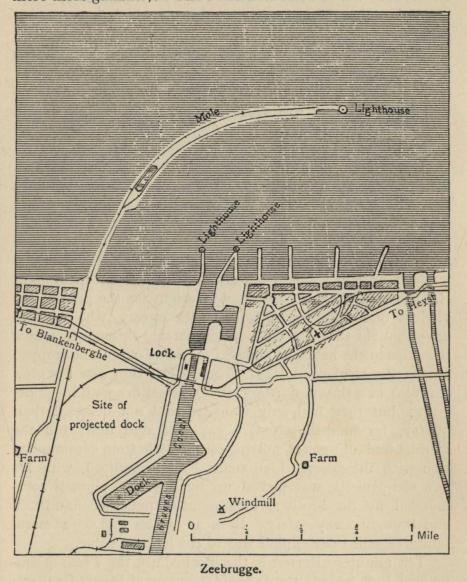
Zeebrugge.
To grapple the Mole was very difficult; the outer wall was high and there was a heavy swell rolling the ships. The Iris was ahead; but the Daffodil, being close astern of the Vindictive, was able to push her into place with her bows and hold her there most gallantly. The Vindictive ran out the "brows" or high gangways with which she was specially fitted, and the storming parties were ready to land. At this moment a shell fell among them and killed Colonel Bertram Elliot of the Marines, while Captain Henry Halanem, who was commanding the bluejackets, fell to machine-gun fire. But their men were unchecked. They rushed upon the brows, which were tossing and crashing on the wall, and with all their heavy accoutrements, bombs, and Lewis guns, cleared the leap down the steep fall to the floor of the Mole, and began fighting their way along it under cover of a barrage from the ship's howitzers. The Iris meantime was grappling the Mole farther ahead, with dearly bought success; the Daffodil's men jumped across to the Vindictive and joined her storming party.
The charge was irresistible; the batteries were taken, the dug-outs cleared, the hangars fired, the store-sheds blown up, and those of the enemy who escaped into a destroyer were sent to the bottom in her by a bombing attack from the parapet. All this was done in fifteen minutes; then followed a tremendous explosion at the shore end of the Mole. The C3, manned by half a dozen officers and men under Lieutenant R. D. Sandford, R.N., had made straight for the piles of the viaduct under the searchlights of the enemy, who seem to have thought that she was bent on passing through to attack the ships in the harbour, and was therefore sure to be trapped among the struts and piles. Then, when they saw her crew reappear in a tiny motor-boat they opened fire with machine-guns; but they had only wounded and not disabled their quarry, for immediately C 3 exploded and destroyed the viaduct and all upon it, cutting off the Mole from communication with the shore. Lieutenant R. D. Sandford, with his five companions, was picked up by a steam pinnace commanded by his brother, Lieutenant-Commander Sandford, and brought away safely. Both as tactics and as a moral reinforcement their exploit was of the highest value.
Ten minutes afterwards the block-ships, the Thetis (Commander R. S. Sneyd), the Intrepid (Lieutenant Stuart Bonham-Carter), and the Iphigenia (Lieutenant V. W. Billyard-Leake), were seen rounding the lighthouse and heading for the entrance of the canal. The Thetis was leading, and received the concentrated fire of the enemy; she ran aground on the edge of the channel and was sunk partially across it, signalling to her consorts, as she went down, to avoid the nets which had fouled her own propeller. The Intrepid and the Iphigenia thereupon passed straight up the canal to a point at which they were two or three hundred yards inside the shore lines and actually behind the German guns on the Mole. They were then blown up and sunk across the channel, and their crews took to the boats and got away out to sea, where they were eventually taken on board the destroyers.
An hour had now passed and the work was done. Even the lighthouse had been sacked, for Wing-Commander Brock, who was in charge of the smoke-screen operations, had not only led the charge into the big gun battery, but had made a special objective of the range-finder in the lighthouse top and came down laden with an armful of spoil. He was last seen lying desperately wounded under the parapet wall of the Mole; but this was not reported until afterwards, and his fate remained uncertain. The siren was shrieking the recall, half drowned by the noise of gun-fire; it was twenty minutes before the word could be given to cast off.