COMMERCIAL LAW (continued 2)
Reading edition
One kind of a sale frequently induced by fraud is void, absolutely, and not voidable. If a person fraudulently induces another to believe that the purchaser is someone else, and purchases goods under this representation, no title passes from the seller, and he may recover the goods from an innocent purchaser.
213. Rule of Caveat Emptor, or Let the Purchaser Beware. One who purchases chattel property from anyone except the grower or manufacturer of the article in question, which is inspected by the purchaser, or may be inspected by the purchaser, purchases at his own risk. If the article turns out to be of poor quality or worthless, in the absence of fraud or warranty, the purchaser has no redress. This rule is called the rule of Caveat Emptor, (let the purchaser beware). Its purpose is to decrease litigation, and make men rely upon their own judgment. If a purchaser is unwilling to rely upon his own judgment, he must exact a warranty from the seller. In the absence of warranty or fraud, the purchaser must abide by the result of his purchase. If the article purchased has defects apparent to anyone upon inspection, the purchaser cannot complain. He should have seen the defects. If the defects are not apparent upon inspection, he must bear the loss. He should have required the seller to warrant the goods against latent defects, if he was unwilling to purchase on his own judgment. In all sales by an owner, however, title to the goods is impliedly warranted, and in case of sale of goods grown or manufactured by the seller, there is an implied warranty against latent defects. In all other sales, the purchaser buys at his own risk, and has no redress against the seller unless the latter warrants the goods. Warranties are discussed in the following section.
214. Express Warranty. Contracts of sale often contain collateral agreements called warranties. Warranties are either express or implied. An express warranty is an agreement in addition to the ordinary agreement to transfer a certain chattel for a consideration in money or money's worth, by which the seller agrees that the thing sold is of a certain quality, or is in a certain condition. An express warranty is not an essential part of a contract of sale. That is, a sale containing no collateral promise to the effect that certain conditions or terms of the contract are warranted, may be made. If the contract of sale does not expressly state that the seller warrants certain terms or conditions, or does not contain words of similar meaning, the contract of sale is without express warranty. An express warranty, by express agreement, adds something to the contract of sale. This additional agreement, called an express warranty, enables the purchaser to recover damages from the seller for failure of the warranty, when he might not be able to have any redress if the sale were made without warranty. Express warranties may be made orally, or in writing.
If the seller, in making the sale expressly states that he warrants certain terms of the contract, or uses language which means that he intends to warrant certain terms of the contract, there is an express warranty. A sells a wagon to B and warrants that it will carry 6,000 lbs. of stone. If it fails to carry this amount, B can recover from A on this warranty. If A had sold the wagon to B without this stipulation, and it had failed to carry 6,000 lbs. of stone, B would have no redress.
A seller is permitted to express his opinion relative to the quality of the article which is the subject of the sale without making a warranty. This is called "trade talk," or "puffing." A seller is permitted to express his own opinion relative to the quality of goods he is endeavoring to sell, without having his words amount to a warranty, but if he makes positive assertions, his words will be construed as a warranty. Such expressions as, This is first class, and This is equal to any on the market, are usually regarded as "trade talk" and not as warranties.
215. Implied Warranties. Some contracts of sale carry with them implied warranties. These warranties are common to all sales of the particular class in question. Implied warranties cannot be said to be in addition to the contract of sale, but are impliedly a part of the contract. The most common implied warranties are warranties of title, warranties of wholesomeness in sale of food, warranties in sales by sample, warranties of merchantability, and warranties of fitness of goods to be used for a particular purpose.
216. Implied Warranty of Title. In every sale, in the absence of an express stipulation to the contrary, there is an implied warranty of title. This means that the ownership is in the seller, and that he has the right to sell the property, and that it is free from incumbrances. This, of course, does not prevent the seller from disposing of just what interest he has in the property if he expressly so contracts. For example, if A negotiates the sale of a horse to B, and tells B that he has purchased the horse a few days previously from C, and does not know whether there are any incumbrances on the horse, but will sell what interest he has, and if B purchases on these representations, he cannot sue A on an implied warranty of title if it subsequently develops that D has a mortgage on the horse. If, however, A offers to sell B a horse, saying nothing about the matter of title, and B purchases the horse, and later is obliged to yield possession to C, who holds a mortgage, B may recover the purchase price of the horse from A upon an implied warranty.
Formerly, a distinction was drawn between sales of property in the possession of the seller, and of property in the possession of some third person, making the seller not liable upon an implied warranty in the latter case. At present, however, the tendency of the courts is to make the seller liable upon an implied warranty, regardless of whether the property is in his possession, or in the possession of a third person at the time the sale is made. When a person sells chattel property, not as owner, but in an official capacity, or as an agent, there is no implied warranty of title. Common examples of this principle are sales by a pledgee, mortgagee, sheriff, guardian, administrator, assignee, or trustee in bankruptcy.
217. Implied Warranty of Wholesomeness in Sales of Food. In the sale of articles to be used for food, there is an implied warranty that the article sold is wholesome and fit for the purpose which it is sold. This rule is based upon the principle of public policy, that it is the duty of the state to protect life and health. A, a grocer, sold canned tomatoes to B, for use in B's family. The tomatoes contained poisonous adulteration. A was held liable in damages to B, for breach of implied warranty of wholesomeness of the article sold for food. Some jurisdictions hold that this rule does not apply in sales of food, where the article is not sold to a consumer. That is, if the article is sold by a wholesaler to a jobber, or to a retailer, the warranty does not apply, but where it is sold by anyone to a consumer, it does apply.
218. Implied Warranty in Sales by Sample. When goods are not inspected by the buyer, but a sample is furnished him, from which he purchases, there is an implied warranty that the goods sold correspond with the sample. The fact that a sample of goods is exhibited by the seller and examined by a purchaser does not necessarily mean that a resulting sale is one by sample. The sample exhibited may not be claimed by the seller to represent in every respect the article to be furnished, or the purchaser may not desire to purchase according to the sample. To constitute a sale by sample, a sample must be exhibited by the seller upon a representation that it is a sample of the goods to be sold. If exhibited for any other purpose, the resulting sale will not be a sale by sample. The purchaser must make the purchase relying upon the sample, and with the understanding that the goods are to correspond with the sample. If the goods are present at the time the sale is made, and the purchaser inspects them, or has the opportunity to inspect them, in the absence of fraud, he cannot claim that the sale is by sample.
219. Implied Warranty of Merchantability. Where goods which have not been inspected or selected by the purchaser are ordered to be delivered in the future, there is an implied warranty that they are of average quality. This is called an implied warranty of merchantability. A ordered a "Buckeye" mowing machine of B, to be delivered the following week. B delivered a machine which would not cut grass. B was held liable to A upon an implied warranty of merchantability. If A had inspected the machine, and made the purchase upon his own selection, in the absence of fraud on the part of B, A would have no redress. But, in case the article is purchased without opportunity for inspection, to be manufactured or delivered in the future, there is an implied warranty that the article is an average one of its kind.
220. Implied Warranty of Fitness of Goods for the Purpose for Which They are to Be Used. When a purchaser makes known to a seller the purpose for which the article is to be used, and the seller is himself the manufacturer or grower of the article, there is an implied warranty that the article is fit for the purpose for which it is to be used. This applies only to articles to be manufactured or delivered in the future, and not to articles inspected and selected by the purchaser. If A goes to B, a manufacturer, and tells him he desires to have manufactured an instrument to hold liquid soap suitable for the use of workingmen in shops, and B agrees to manufacture and sell such an article, there is an implied warranty on B's part that the soap-holders will be suitable for the purpose for which they are to be used. If, however, A furnishes B plans for the manufacture of a liquid soap-holder, and orders a quantity, there is no implied warranty on B's part that the articles will be fit for the purpose intended. A in this case relied upon his own judgment. B's contract is fulfilled when he furnishes the article according to A's plans. The work must, of course, be done in a workmanlike manner, free from defects of material and workmanship. This implied warranty of fitness of an article for the purpose for which it is to be used, applies only where the purchaser reveals the purpose of the article to the grower or manufacturer who agrees to furnish such an article. It does not apply to articles furnished according to furnished plans, or to articles selected by the purchaser.
221. Remedies for Breach of Warranty. In case of breach of warranty, the purchaser may bring a suit for damages against the seller, or he may promptly return the goods, and recover the purchase price. The latter remedy is called rescission. In case of breach of an express warranty, in most jurisdictions the remedy is the same as for breach of implied warranty. In some states, however, the seller is not permitted to return the goods and sue for the purchase price, but is restricted to an action for damages.
222. Seller's Lien, Delivery to Carriers, and Stoppage in Transitu. In case of sales for cash, the seller has the right to retain possession of the goods until he receives payment of the purchase price. If the goods are sold on credit, or if the seller agrees to deliver at a certain place, the seller must comply with his contract. But if the purchaser becomes insolvent before the goods are delivered, the seller may retain possession until paid. He is not obliged to deliver goods on credit, even though such is his contract, if the purchaser subsequently becomes insolvent. The right of a seller to retain possession of goods until the purchase price is paid is called the seller's lien. This lien is lost by the seller's delivery of the goods to the purchaser. If the possession is obtained by fraud on the part of the purchaser, it is regarded as no possession, and the seller may still enforce his lien by retaking possession of the property.
Where goods are ordered by a person in one town from a person in another town, necessitating delivery by a carrier, in the absence of express stipulation to the contrary, title to the goods passes to the vendee upon delivery of same by the vendor to the carrier. If A, in Cleveland, orders a car of pine lumber from B, in Milwaukee, for $1,500.00, title to the lumber passes to A when B delivers the lumber to the transportation company in Milwaukee. If A orders the lumber delivered F. O. B. Cleveland, title does not pass to A until the lumber reaches Cleveland. If A orders the lumber, agreeing to pay $1,500.00 for the same, "freight allowed" to Cleveland, title passes to A when B delivers the lumber to the transportation company in Milwaukee, even though B must allow A to deduct the freight from the purchase price of $1,500.00. This question is important in determining upon whom the loss falls in case of damage of the goods while in the hands of the transportation company. The one who has the title at the time the loss occurs must stand the loss. Such party may recover from the transportation company. This question is discussed in the chapter on Carriers.
While a seller loses his lien by delivery of possession of the goods to the purchaser, if the goods are delivered to a carrier and the purchaser becomes insolvent before the carrier delivers the goods to him the seller may stop delivery of the goods, and retake possession even though title has passed to the purchaser. The seller's lien in this event revives. By insolvency is meant inability to pay one's debts. The right of a seller to stop a carrier from delivering goods to a vendee, in case of insolvency of the latter, is called stoppage in transitu. This question is also discussed in the chapter on Carriers.
A seller may enforce his lien by keeping the goods, and suing the purchaser for damages, or by selling the goods at private or public sale, with notice to the purchaser of the time and place of sale, and then by suing the original purchaser for the difference between the amount he receives for the goods on resale, and the amount the original purchaser agreed to pay. The seller may, of course, hold the goods and demand the original purchase price of the purchaser, and not yield possession until he receives the purchase price.
223. Remedies of Seller. The seller's lien described in the previous section is one of the remedies of a seller. If the purchaser refuses to accept the goods, the seller may keep or resell the goods, and if he receives less than the original purchaser agreed to pay, he may recover the difference as damages from the original purchaser. For example, A agreed to manufacture and deliver a specially constructed cash register for B for $500.00. When it was completed, B refused to accept same. A sold it for $200.00, the fair market price, and recovered from B, $300.00 as damages for B's breach of contract. If the purchaser accepts the goods and fails to pay for them when due, the seller may sue and recover the entire purchase price, together with damages and expenses which are necessarily connected therewith.
224. Remedies of Purchaser. Where title has not passed to the purchaser, if the seller refuses or fails to deliver goods according to the contract of sale, the purchaser may go into the market at the time and place of delivery and purchase goods, and if obliged to pay more than the original contract price, he may recover the excess from the seller. For example, suppose A purchases five hundred pounds of lard of B for $60.00, B agreeing to deliver the lard October 30th, at Chicago. If B fails to deliver the lard in Chicago, October 30th, A may purchase lard of the same quality in Chicago, and if he is obliged to pay $90.00 for the same, he may recover $30.00 damages from B. If there is no market at the place of delivery mentioned in the contract, the purchaser may purchase at the nearest market. If the purchaser makes the purchase for a particular purpose, which he makes known to the seller at the time the sale is made, and he is specially damaged by reason of the failure of the seller to keep his contract, special damages may be recovered for losses arising by reason of the special circumstances. If title to the goods has passed to the purchaser, in case the seller refuses to deliver them, the purchaser may bring an action of replevin to recover their possession. Replevin is a possessory action. (See chapter on Courts and Legal Remedies.)
QUIZ QUESTIONS
BANKING, LOANS, MONEY, AND CREDITS
1. Define a bank.
2. Classify banks.
3. How are national banks created?
4. What are state banks?
5. Define and distinguish banks of discount, banks of cirrculation, and banks of deposit.
6. Are most banks incorporated companies?
7. What are the powers of an incorporated bank?
8. Do banks have the power to deal in real estate?
9. Do banks have the power to collect commercial paper?
10. What are bank deposits?
11. Is a bank required to receive deposits from any one who tenders them?
12. What name is applied to the person authorized to receive bank deposits?
13. Do savings banks permit their customers to draw their deposits by check?
14. Distinguish general and special deposits.
15. Define check.
16. What kinds of banks do a checking business?
17. By what process may a depositor withdraw money from a savings bank?
18. Define a paid voucher.
19. When do banks return checks to their customers?
20. When are checks payable?
21. What should a customer do with paid checks when they are received from his bank?
22. When must checks be presented for payment?
23. Is a bank required to pay the checks of its depositors?
24. If a bank refuses to pay a check what, if anything, must the holder do to hold the maker liable?
25. Are national banks permitted to make loans on real estate?
26. Are savings banks permitted to make loans on real estate?
27. Define credit.
28. By what means is credit information furnished?
29. Distinguish credit and capital.
30. Are forged negotiable instruments void or voidable?
31. Is a bank liable for paying forged checks, or must the depositor whose signature is forged stand the loss?
32. If a forgery is not reported by a depositor until six months after it was committed, who must stand the loss?
33. Is a bank liable if it pays a bona fide holder a check payable to bearer?
34. Under what laws are national banks created?
35. Does the United States Constitution expressly provide for the creation of national banks?
36. What United States officer has supervision over national banks?
37. Are national banks furnished with circulating notes? If so, in what amounts?
38. In case of the bank's insolvency, what is the liability of national bank stockholders?
39. What rate of interest can national banks charge?
40. Can national banks buy and sell bonds?
41. What penalty is imposed upon national banks for usury?
42. Define and distinguish savings banks and trust companies.
43. Are clearing houses banks? What are the functions of clearing houses?
44. In what two ways is the term money used?
45. What is legal tender?
46. Are silver certificates legal tender?
47. Define discount.
48. Distinguish discount and purchase of negotiable paper.
49. Are banks permitted to purchase negotiable paper at a profit in excess of legal rates of interest?
50. Are individuals and business concerns permitted to purchase negotiable paper at a profit in excess of legal rates of interest.
51. Define exchange.
52. Distinguish foreign and domestic exchange.
53. Define interest.
54. Define and give an example of usury.
55. What is the usual penalty for usury?
INSURANCE
1. Define insurance.
2. Are insurance companies controlled by the legislatures of the states?
3. May an individual or a partnership enter into insurance contracts?
4. Is insurance business interstate commerce if transacted between citizens of different states?
5. May one state exclude insurance companies of another state from transacting business within its territory?
6. Does an insurance contract require all the elements of an ordinary contract?
7. In what way does an insurance contract differ from an ordinary contract?
8. How many parties are there to an insurance contract?
9. Define underwriters.
10. Define beneficiary.
11. Name the principal kinds of insurance written at the present time.
12. Define and give an example of insurable interest.
13. Must an insurance contract be in writing to be binding?
14. Are insurance contracts within the Statute of Frauds?
15. Define binder.
16. Define warranty as used in an insurance contract.
17. Distinguish warranty as used in insurance contracts from warranty as used in contracts of sale.
18. Define representation as used in connection with insurance contracts.
19. Distinguish warranty and representations.
20. Does breach of warranty avoid a contract of insurance?
21. Does breach of representation discharge an insurance contract?
22. Define life policy.
23. Define term policy.
24. Define tontine policy.
25. Define marine insurance.
26. What implied warranty enters into a policy for marine insurance?
27. Define general average.
28. Define standard policy.
29. If a policy of insurance contains no stipulation relative to suicide, and the insured takes the policy intending to commit suicide, and does commit suicide, is the policy enforceable?
30. If an insurance policy contains a suicide clause, and the insured commits suicide while insane, is the policy enforceable?
31. May an insurance company stipulate against suicide in such a manner as to avoid the policy if the insured suicides when insane?
32. Define and distinguish fidelity and casualty insurance.
33. What is re-insurance?
34. Is a company writing a policy of re-insurance liable to the party originally insured?
35. May a company re-insure at greater risk than it itself has insured? 36. Can a fire insurance policy be assigned before a loss has occurred?
37. Can a fire insurance policy be assigned after a loss has occurred?
38. Can a life insurance policy be assigned at any time?
39. Define and distinguish open and valued policies.
40. Define other insurance.
41. What limit, if any, is placed upon the amount of life insurance a person may take?
42. May a person insure personal property for more than its actual value?
43. If a person insures his house in three different companies for two-thirds of its value in each company, in case of loss how much an he recover, if anything, on each policy?
SURETYSHIP
1. Define suretyship.
2. Is a suretyship obligation a contract?
3. What contracts is the term suretyship used to designate?
4. How many parties are there to a suretyship contract?
5. Define principal.
6. Give an example of a suretyship contract.
7. Define promisor.
8. Define creditor to a suretyship contract.
9. Give the different technical names that may be applied to a promisor of a suretyship contract depending upon the nature of the liability.
10. Define surety.
11. Give an example of a contract of a surety.
12. Is the liability of a surety conditional upon that of his principal.
13. Define guarantor.
14. A promises a creditor of B to pay B's debt if B does not. Is A's contract that of a surety or of a guarantor?
15. In commercial practice what form of suretyship contract is most frequently used, that of a surety or of a guarantor?
16. Define indorser.
17. Is an indorser's contract found outside of negotiable instruments?
18. Is an indorser bound by any implied contract?
19. What are the warranties of an indorser?
20. Is consideration a necessary element of a contract of suretyship?
21. If a suretyship contract is part of the transaction which it secures must it be supported by a separate consideration?
22. Must any contracts of suretyship be in writing?
23. Is an oral contract of suretyship illegal?
24. What is meant by the Statute of Frauds as applied to suretyship contracts?
25. Define general guaranty.
26. Define limited guaranty.
27. Define special guaranty.
28. Define continuing guaranty.
29. What kinds of notice may a guarantor be entitled to?
30. When, if at all, is a guarantor entitled to notice of default of his principal?
31. When, if at all, is a guarantor entitled to notice of acceptance of his guaranty by a creditor?
32. If A is surety for B upon B's debt to C of $100.00 and B settles his debt with C for $50.00, can C hold A for the balance?
33. If A guarantees B's debt to C of $100.00 due one year and with interest at 6%, and B without A's consent reduces the interest to 5%, is A thereby discharged?
34. If A guarantees B's debt to C of $100.00 payable in one year, and C without A's consent extends the time of payment six months upon B's agreement to pay 6% interest, is A thereby discharged?
35. Is fraud practiced by the principal upon the promisor to a suretyship contract, a defense to the promisor in an action brought by the creditor?
36. In the absence of special statute can a promisor to a suretyship contract compel by notice a creditor to sue a principal?
37. Are surety companies favorites of the law?
38. Define subrogation.
39. Give an example of subrogation.
40. Define indemnity as applied to a suretyship contract.
41. A guarantees B's debt to C of $100.00 upon a promissory note. B defaults and A pays the debt. A then sues B for $100.00 upon the promissory note. Is this an example of indemnity or subrogation? May A sue B for $100.00 independently of the promissory note?
42. Define contribution.
43. A, B, and C guarantee B's debt to E of $300.00. D sues A and collects $100.00. Can A sue B and C for $33.33 each?
PERSONAL PROPERTY
1. Define personal property.
2. Classify personal property.
3. Distinguish chattels real from chattels personal.
4. Define and give an example of chose in action.
5. Define and give an example of chose in possession.
6. How may title to personal property be acquired?
7. May a person obtain title to personal property by finding it?
8. How can personal property be transferred?
9. Upon death of the owner, to whom does title to personal property pass?
SALES
1. Distinguish ownership and possession of personal property.
2. May title and possession of personal property be in different places?
3. Define sale.
4. How does a sale differ from a contract to sell?
5. A promises to deliver a car of coal to B the following month in consideration of B's promise to pay A $300.00 upon delivery of the coal. Is the transaction a sale or a contract to sell?
6. In a contract to sell, if the property is destroyed by fire before the property is delivered, who stands the loss?
7. Distinguish barter from sale.
8. A agrees to deliver to B one hundred bushels of apples for twenty tons of coal at $5.00 per ton. Is the transaction a sale or a barter?
9. Define conditional sale.
10. At the present time is a vendor of a conditional sale contract permitted to take possession of the property after 90% of the purchase price has been paid.
11. A leaves his automobile at B's shop for repairs. Is this transaction a sale?
12. Distinguish sale from bailment.
13. What kinds of personal property may be the subject of a sale?
14. May personal property to be manufactured be the subject of a present sale?
15. What is meant by the Statute of Frauds as applied to sales?
16. What contracts of sales must be in writing?
17. When must personal property sold be delivered?
18. In the absence of any express agreement as to delivery, when and by whom must personal property be delivered?
19. If a sale is made in which delivery is to be made in the future may title pass to the purchaser at once?
20. When does title pass to the purchaser in a sale of personal property?
21. Does the fact that delivery is to be made in the future, of itself, prevent title passing to the purchaser at the time the sale is made?
22. A sells a desk to B for $10.00, agreeing to revarnish the desk and deliver same to B the following Saturday. When does title to the desk pass to B?
23. What, if anything, does intention of the parties have to do with the passing of title to the purchaser?
24. In the absence of an express agreement when must the purchase price be paid?
25. Is the seller permitted to retain possession of the property sold until he receives the purchase price?
26. B, by means of fraud, purchases a bicycle from A. B sells it to C, who does not know of the fraud. Can A recover the bicycle from C?
27. A purchases a bicycle from B telling B that he is C. B knows C by reputation and thinks that he is selling to C. A sells the bicycle to D. Can B obtain possession of the bicycle from D?
28. Define Caveat Emptor.
29. Does the rule of Caveat Emptor apply if the seller expressly warrants the goods sold?
30. Define express warranty.
31. A sells a horse to B assuring B that the horse is perfectly sound. The horse has blemishes. Does A warrant the horse?
32. Define implied warranty.
33. Enumerate the most common implied warranties.
34. Does an implied warranty of title accompany every sale?
35. A purchases an automobile at a sheriff's sale. The automobile is mortgaged. May the mortgagee take the auto from A? If so, can A recover on an implied warranty from the sheriff?
36. What is meant by implied warranty of wholesomeness of food?
37. Does this warranty extend to any purchaser?
38. Give an example of an implied warranty in a sale by sample.
39. Does the implied warranty of merchantability apply when the goods are selected and inspected by the purchaser?
40. Give an example of a sale in which there is an implied warranty of fitness for the purpose for which the goods are to be used.
41. Does this implied warranty exist if the goods are constructed and furnished according to a model furnished by the buyer?
42. Define rescission of a contract.
43. May a contract of sale be rescinded for breach of warranty?
44. Generally, what is a purchaser's remedy for breach of warranty?
45. Define lien.
46. Give an example of seller's lien.
47. Define stoppage in transitu.
48. A, in Cleveland, orders goods of B in Chicago. B delivers the goods to the Adams Express Company, addressed to A. The goods are lost in a railway wreck. Who must bear the loss, A or B?
49. A sells a carriage to B. B refuses to pay for the same. If A has not delivered the carriage to B may he sue B for damages?
50. A purchases a carriage from B. A tenders the price, but B refuses to deliver the carriage. May A obtain possession of the carriage by legal action?
51. May A sue B for damages for refusing to deliver the carriage?
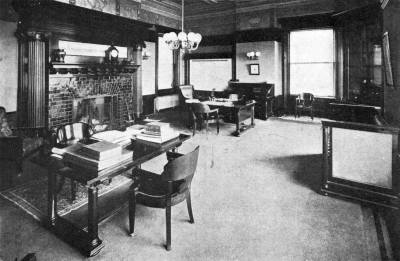
A CORNER IN THE NEW YORK EXECUTIVE OFFICE OF THE WESTERN ELECTRIC COMPANY Occupying a Part of One Floor of the Marshall Field Building