COMMERCIAL LAW (continued 2)
Reading edition
The party drawing a bill of exchange is called the drawer, the party to whom it is made payable is called, the drawee before acceptance, and the acceptor after acceptance. The drawee may accept by signing the instrument, by stating his acceptance on a separate piece of paper, by oral acceptance, or even by conduct making apparent his intention to accept. After acceptance of a draft or bill of exchange, the acceptor is liable to pay the bill according to its terms. He is in the position of a maker of a promissory note.
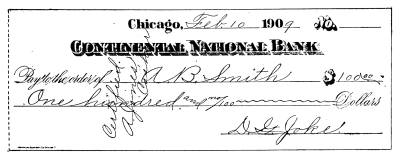
Fig. 4. Certified Check.
126. Checks. A check is an order drawn on a bank or banker. It differs in some respects from an ordinary bill of exchange. It does not have to be presented for acceptance. It is presented for payment. It presupposes funds of the drawer in the hands of the bank or banker on which it is drawn. It is payable at any time after the date fixed for maturity. It need not be presented at maturity. The maker may recover damages for failure to present promptly if he is damaged thereby. For example, if A gives B his check on the X bank, and between the date for payment of the check and the time of presentment for payment by B, the bank fails, A may recover as damages from B, the amount of his loss by reason of B's failure to present the check promptly. No days of grace are allowed in the payment of checks. In this particular, they differ from ordinary bills of exchange.
127. Certification of Checks. By certification of a check is meant a written acknowledgment on checks by an officer or authorized agent of the bank that the check will be paid when presented. In Fig. 4 is shown a common form of certification.
The words accepted or certified, written on a check by an authorized officer or agent of a bank constitute a certification. If the holder of a check has it certified he elects to hold the bank, and thereby releases the maker and prior indorsers. If the maker procures the certification he is still liable thereon. When a check is certified, the bank charges it to the account of the maker, and it then becomes a debt of the bank, regardless of whether or not the maker has funds in the bank with which to meet it. This is the reason that a maker and prior indorsers of a check are released from liability thereon when a holder has it certified. By this act, the holder elects to rely upon the bank, rather than upon maker or indorsers.
128. Bonds. Bonds may be defined to be the promissory notes of corporations, private or governmental. They are made under the seal of the corporation issuing them. At common law, a seal destroyed the negotiability of an instrument. At the present time this is not true of bonds. Private corporations often secure their bonds by a mortgage on their entire property. This is accomplished by means of a mortgage called a trust deed. The mortgage is given to a trust company, or an individual, to be held for the common benefit of all the bond holders. It is not practicable to give each bond holder a mortgage. This would be inconvenient, and some bond holders could obtain preference over others. But one trust deed, covering all the assets held by a trustee for the benefit of all the bond holders, accomplishes the purpose.
Registered bonds are registered on the books of the corporation issuing them, and in case of transfer the transfer is noted on the books of the company. Other bonds contain coupons, or small promissory notes for certain amounts representing the installments of interest payable at certain times. These coupons may be cut from the bond and sold as promissory notes, or they may be cut at maturity and returned for payment.
No. 1. $1000.00
United States of America,
State of Ohio.
Know all men by these presents that the village of X, in the county of Cuyahoga and state of Ohio, acknowledges itself to owe, and for value received hereby promises to pay to bearer, the sum of $1000.00 in lawful money of the United States of America, on the second day of January, 1920, together with interest thereon at the rate of 5% per annum payable semi-annually on the second day of July, and second day of January of each year, as evidenced by the coupons hereto attached, until the principal sum is paid. Both principal and interest are payable at the City Trust Co., Cleveland, Ohio, on the presentation and surrender of this bond, and the coupons hereto attached as they respectively mature.
This bond is issued for the purpose of improving a street of the village of X, from the C. B. Railway to Rocky River by constructing and laying water mains with all necessary connections thereon, under and by authority of Sections 1536-281, and Sec. 2835 of the revised statutes of Ohio, and under and in accordance with resolutions of the council of the village of X, Ohio, adopted Nov. 4, 1908, and Dec. 2, 1908.
It is hereby certified that all proceedings relating to this bond have been in strict compliance with said laws, statutes and resolutions, and all other statutes and laws relating thereto, and that the faith, credit, and revenues, and all real and personal property in the village of X, Ohio are hereby pledged for the payment of principal and interest hereof at maturity.
This bond is one of a series of bonds of like date and effect, but of different amounts and maturities amounting in the aggregate to $3700.00.
In witness whereof, the village of X has caused this bond to be signed by the mayor and clerk of said village, and the corporate seal of said village to be hereunto affixed, and the facsimile signature of the mayor and clerk of said village to be affixed to the attached coupon this second day of January, 1909.
D. B. X._______________________
Mayor.
[SEAL.]
X. Y. Z._______________________
Clerk.
Form of Municipal Coupon Bond.
On the second day of July, 1909, the village of X promises to pay the bearer at the City Trust Co., Cleveland, Ohio, twenty-five dollars, being 6 months' interest on its bond. No. 1 dated Jan. 2, 1909. On the second day of January, 1910, the village of X promises to pay the bearer at the City Trust Co., Cleveland, Ohio, twenty-five dollars, being 6 months' interest on its bond. No. 1 dated Jan. 2, 1909.
D. B. X.______________ D. B. X.______________
Mayor. Mayor.
X. Y. Z.______________ X. Y. Z.______________
Clerk. Clerk.
On the second day of July, 1910, the village of X promises to pay the bearer at the City Trust Co., Cleveland, Ohio, twenty-five dollars, being 6 months' interest on its bond. No. 1 dated Jan. 2, 1909. On the second day of January, 1911, the village of X promises to pay the bearer at the City Trust Co., Cleveland, Ohio, twenty-five dollars, being 6 months' interest on its bond. No. 1 dated Jan. 2, 1909.
D. B. X.______________ D. B. X.______________
Mayor. Mayor.
X. Y. Z.______________ X. Y. Z.______________
Clerk. Clerk.
Interest Coupons Attached to Municipal Bond.
Similar coupons follow for payment at intervals of 6 months until maturity of bond in 1920.
129. Collateral and Judgment Notes. Banks frequently require borrowers to sign collateral notes. These instruments are promissory notes, with an added agreement to the effect that certain collateral security is given the payee by the maker as security for the note. Such security is usually certificates of stock, bonds, other promissory notes, or chattel property. The collateral note contains a stipulation that upon default, the payee may sell the collateral. The following is a common form of collateral note used by banks:
$5,000.00 Cleveland, Ohio, Dec. 26, 1908.
Six months after date, I promise to pay to the order of the Fictitious Bank at its banking rooms in Cleveland, Ohio, the sum of Five thousand dollars for value received, with interest at the rate of 6% per annum. I have deposited with said bank as collateral security for the payment of this note the following property; 20 shares of stock of the Columbia Sewing Machine Co., par value $100.00 each, 2 diamond rings, 1 warehouse receipt of the City Storage Co., covering household furniture valued at $3,000.00. The value of this property is now $5,600.00. It is agreed that the payee, or his assigns, may have the right to call for additional security at any time it considers this collateral security insufficient, and on failure of the maker of this note to furnish additional security to satisfy the holder of this note, the note may be deemed payable at once at the holder's option. The holder shall also have power to accept substitutes for this collateral. Should the maker violate any of the conditions of this note, or fail to pay it when due, the holder shall have the power to sell the collateral or any substitute given therefore, at private or public sale, at any time without notice to anyone, and after deducting all legal expenses connected with the sale, and after paying the note, shall return the balance to the maker.
(Signed)
John Smith.
A judgment note contains a provision that upon default of payment, any attorney at law may appear in court and take judgment thereon by presenting the note, without observing the formalities of an ordinary suit at law. This kind of a note is also called a cognovit note. The following is a common form of judgment note:
$100.00 Boston, Dec. 8, 1909.
One year after date, I promise to pay to the order of John Jones the sum of one hundred dollars with interest at 6%, and I hereby authorize any attorney at law in the United States to appear before any Justice of the Peace, or in any court of record, after this note is due, and waive the service of summons, and confess judgment against me in favor of the holder of this note for the amount which shall then be due and unpaid thereon, together with interest and costs.
(Signed)
Thos. Thomas.
130. Certificates of Deposit. It is customary for banks to issue customer's receipts showing that a deposit of a certain amount has been made by the customer, which will be held for payment of the receipt upon presentation. These receipts ordinarily are made payable to the customer's order, and circulate like money. They are, in effect, the promissory notes of the bank issuing them. They differ from promissory notes in that banks require a special deposit of its customers before issuing them. Banks issuing such receipts are supposed to hold these deposits as a special fund with which to pay the certificate when presented. The following is a common form of certificate of deposit:
—THE PEOPLES BANK OF CHICAGO—
We hereby certify that John Jones has deposited $1,000.00 in this bank, for which this certificate is issued, and which will be paid to the order of John Jones in current funds of this bank when presented.
The Peoples Bank of Chicago,
June 23, 1909. By A. Z. Marshall, Cashier.
The payee of this certificate of deposit may indorse and transfer it. The holder may collect the amount by presenting the certificate to the bank.
131. Requisites of Negotiable Instruments. Certain elements are recognized, by long usage, as being necessary to constitute an instrument a valid negotiable instrument. The instrument must contain words of negotiability, such as or bearer, or order, or words of similar meaning. The instrument must contain a specific promise to pay a certain sum of money at a definite time. The instrument must designate an ascertainable person to whom, or to whose order the money is payable. The instrument must be signed and delivered. It is not necessary that a consideration be stated in the instrument, although in a suit between the original parties, failure of consideration is a defense. For example, if A gives B his promissory note for one hundred dollars ($100.00) payable to B's order, and A received no benefit for giving the note, if B sues A thereon, A may plead that he received no consideration for the note. This would be a complete defense to A. If, however, C purchased the note from B before it was due, paying value for same, and having no notice of its being given without consideration, A could be compelled to pay it to C or his successors. It is not necessary that a negotiable instrument be dated. It is proper, however, and good business policy to date all negotiable instruments. The signature need not be at the bottom of the instrument. This, however, is the proper place for the signature.
I. O. U. $500.00
(Signed) John Jones, is not a promissory note. It is not a promise to pay at a definite time or to a definite person. It is a mere acknowledgment of indebtedness.
132. Parties to Negotiable Instruments. By usage and custom, parties to negotiable instruments are given certain well recognized names. The name of the party to whom a promissory note is made payable is always called the payee. When the payee transfers a negotiable instrument by indorsement, he is called the indorser, and the party to whom he indorses the note is called the indorsee. Indorsers and indorsees are designated as first, second, third, etc., indorsers or indorsees according to their position on the instrument.
The maker of a draft is called the drawer. The one to whom it is given is called the payee. The one on whom it is drawn is called the drawee. After acceptance, the drawee is called the acceptor. The rights and liabilities of these parties are discussed under separate sections.
133. Rights and Liabilities of a Drawee. The term, draft, is sometimes used to designate orders made by one bank on another. For example, A in Cleveland, purchased of his Cleveland bank a New York draft, or an order by the Cleveland bank on a New York bank, payable to the order of A. Technically, orders on persons are bills of exchange, but the term draft, has come to be applied both to orders of one bank on another and to orders of one person on another. In this work the term, draft is applied to both kinds of orders. A drawer is a person who makes a draft on another. It is usually payable to the order of a third person. It may be made payable to the bearer or to the order of the drawer, himself. A drawer enters into a conditional contract. By becoming a drawer, he agrees to pay the bill of exchange or draft, if the payee presents it without delay, and in case of non-payment, or non-acceptance, if notice is promptly given him of this fact. In case the draft is a foreign one, that is, made payable or to be accepted, in a different state or country from which it is drawn, it must be protested by the payee to enable him to hold the drawer. A draft is protested by being presented by a notary public, who, by formal written instrument, declares the refusal of the drawee to accept. Protest is discussed more at length under a separate section. In case these conditions are complied with, and the drawee does not accept the bill or pay the bill after acceptance, the payee may hold the drawer. After the formalities above enumerated are observed by the payee or holders of a draft, if the draft is dishonored, that is, not accepted, or paid by the drawee, the payee may sue the drawer, whose liability is similar to that of the maker of a promissory note.
134. Rights and Liabilities of Acceptor. The person to whom a draft is directed is called the drawee or acceptor. When a draft is presented to the drawee, he may accept it by writing accepted thereon, or he may accept by writing his consent in a separate instrument, such as a letter, or by sending a telegram, or he may accept orally or by his conduct. After a drawee has accepted a draft, he is bound by its terms. He must pay the amount mentioned in the draft. After acceptance, his liability is similar to that of the maker of a promissory note. Sometimes an acceptor does not accept in the exact terms of the draft. He may change the time or place of payment, or attach conditions to the bill or draft. This amounts to a refusal on his part to accept the bill, which will entitle the payee to refuse the qualified acceptance and by giving proper notice to the drawer hold the drawer by reason of non-acceptance by the drawee. If, however, the payee chooses to accept the qualified acceptance of the drawee, he may do so, but by this act he releases the drawer and all prior indorsers from liability thereon.
135. Rights and Liabilities of Maker. Maker is the term applied to the person who originally makes and signs a promissory note. By this act, he agrees to pay at maturity, to the original payee, or to whomever the note has been indorsed or properly transferred, the amount named in the note. The maker of a note is liable absolutely and unconditionally. While it is customary for the holder of a note to present it to the maker at maturity for payment, this is not necessary unless a place of payment is stipulated in the note. The holder may commence suit against the maker at maturity without presenting the note for payment. If the note contains indorsements, the note must be presented to the maker, and if payment is refused, to enable the holder to hold the indorsers liable, notice of the fact must be given the indorsers. If the note is payable at a particular place, as for example, a bank, the holder must present the note at the bank at maturity, or not be able to collect interest thereafter, if the maker proves that he had funds there sufficient to pay the note at maturity. If the maker has been damaged other than by loss of interest, by failure to present a note at a bank when made payable, he may collect damages therefor from the holder.
136. Blank Indorsement. A negotiable instrument, if payable to bearer, may be transferred by delivery. If payable to the order of the payee, it may be transferred by indorsement and delivery. By indorsement is meant the writing the name of the payee upon the back of the negotiable instrument. Indorsement may be made in various forms, depending upon the purpose for which made, and the kind of liability the indorser is willing to undertake, or the kind or degree of liability which he wishes to avoid. The most common kind of indorsement consists of the payee's writing his name only on the back of the instrument. A negotiable instrument with blank indorsement is shown in Fig. 5.
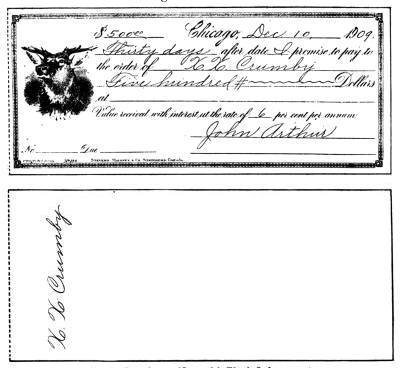
Fig. 5. Promissory Note with Blank Indorsement.
If X. X. Crumby desires to transfer the note to anyone, he signs his name on the back thereof, as indicated in the illustration. This is called a blank indorsement, and makes the note payable to bearer. The note now passes as currency without further indorsement. Subsequent holders may indorse the note if they so desire, or are so required. If the back of a negotiable instrument becomes filled with indorsements, a paper may be attached to carry further indorsements. Such a paper is called an allonge.
137. Indorsement in Full. A holder of a negotiable instrument, not desiring to make it payable to bearer, may indorse it by making it payable to some particular person or to the order of some particular person, followed by his signature. This does not destroy the negotiability of the instrument, but prevents anyone but the person to whom it is indorsed, or such person's indorsees, from securing payment of the instrument. This is not true if the instrument is payable to bearer, or if it has been indorsed in blank. Such instruments are payable to bearer, and circulate as money without requiring further indorsement. If subsequently indorsed in full, only those subsequent holders can hold the indorser in full, who can trace their title through him.
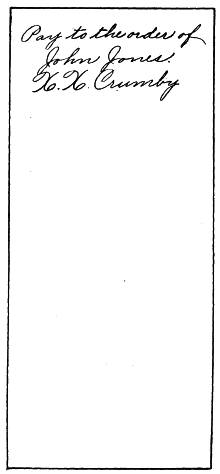
Fig. 6. One Form of Indorsement in Full.
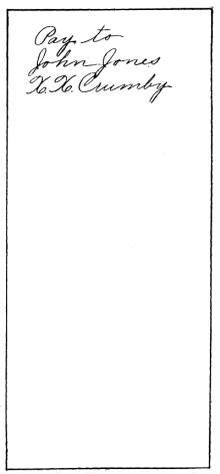
Fig. 7. Another Form of Indorsement in Full.
Fig. 6 is an indorsement in full of X. X. Crumby. By this indorsement, only John Jones, the person to whom he indorses, may obtain payment of the note. If John Jones indorses the note in blank, that is, signs his name to it, the note becomes payable to bearer, and passes like money, without further indorsements.
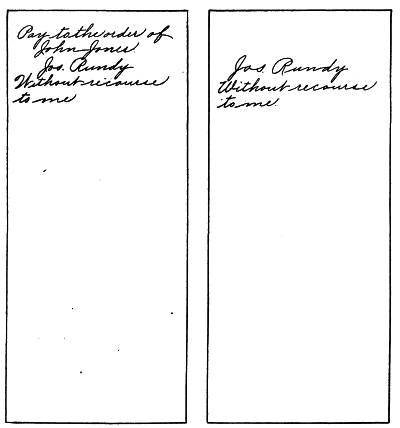
Fig. 8. Indorsement without Recourse.
By the indorsement, Fig. 7 which is also an indorsement in full, X. X. Crumby becomes liable as indorser to John Jones only, and not to anyone to whom John Jones may indorse the paper. X. X. Crumby's indorsement does not contain the words "or order." The face of the note, however, contains the words "or order," which makes the note negotiable. X. X. Crumby's indorsement to John Jones, although not containing words of negotiability, does not destroy the negotiability of the note. John Jones may indorse the note in blank, or in full. The only effect of X. X. Crumby's omitting words of negotiability from his indorsement is to limit his primary liability as an indorser to John Jones.
138. Indorsement without Recourse. Frequently, the holder of a negotiable instrument is unwilling to assume any primary liability by transferring a negotiable instrument which he possesses. He may desire to transfer the right he has in the instrument, without becoming liable thereon. He may do this by indorsing it without recourse.
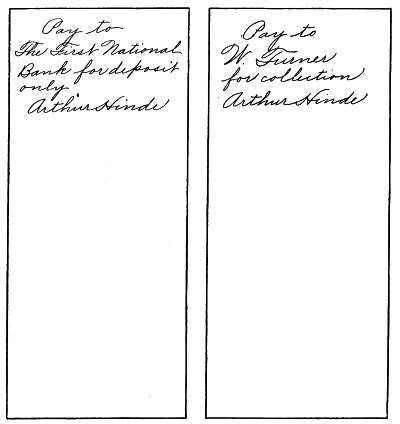
Fig. 9. Indorsement for Collection and for Deposit.
By either of the indorsements, (Fig. 8) the one in blank, or the one in full, Jos. Rundy, transfers his interest in the note to John Jones, and does not become liable thereon as an indorser. It is not quite accurate to say that an indorser without recourse has no liability as an indorser. He impliedly warrants the signatures preceding his own to be genuine, and that the parties making them had legal capacity to sign. The implied liabilities of an indorser are discussed under a separate section.
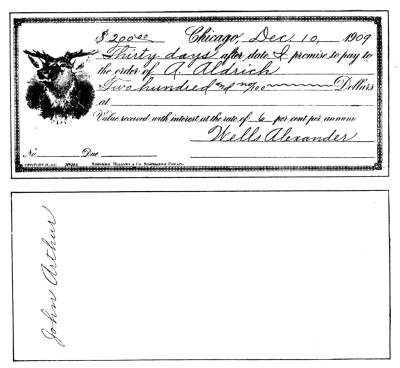
Fig. 10. Promissory Note with Anomalous Indorser.
139. Indorsement for Collection or Deposit. A holder of a negotiable instrument may transfer it for the purpose of collection, thereby making the transferee his agent, for the purpose of carrying out his will, and thereby destroying the negotiability of the instrument. This prevents another from taking the note free from the claim of the original indorser.
Either of the indorsements in Fig. 9 destroys the further negotiability of the note. The indorsers are authorized to collect the note for Arthur Hinde. They are not authorized to transfer the note, except for the purpose of collecting it for Arthur Hinde.
140. Anomalous Indorser. Sometimes, a party writes his name upon the back of a negotiable instrument outside the chain of title. That is, he writes his name thereon, before the payee indorses it. This is for the purpose of adding security to the note.
In this case, Fig. 10, John Arthur signs the note outside the chain of title. He places his name thereon for the purpose of adding security thereto. He is liable on his indorsement to the payee, A. Aldrich, and to the indorsees of A. Aldrich. In some jurisdictions he is liable as a guarantor, in some as a surety, but in most as an ordinary indorser. The liability of a surety and guarantor is discussed in the section on Suretyship.
141. Liability of an Indorser. By placing his name on the back of a negotiable instrument for the purpose of passing title, a person becomes liable on an implied contract. If his indorsement is in blank, or payable to the order of the indorsee, he is liable to any innocent purchaser for the value, without notice. If made payable to a particular person, he is liable only to that person. The implied liability of an indorser has been said to be as follows: "I hereby agree by the acceptance by you of title to this paper, and the value you confer upon me in exchange, to pay you, or any of your successors in title, the amount of this instrument, providing you, or any of your successors in title, present this note to the maker on the date of maturity, and notify me without delay of his refusal to pay. And I warrant that all the parties had proper capacity and authority to sign, and that the obligation is binding upon each of them. And I will respond to the obligations created by these warranties, even though you do not demand payment of the maker at maturity or notify me of default."
142. Forgery and Alteration of Negotiable Instruments. An act by which a negotiable instrument is materially and fraudulently changed and passed or attempted to be passed, is a forgery. The act may consist of fraudulently writing another's name on a negotiable instrument, or changing a name already on a negotiable instrument, or changing the figures, date, rate of interest, or in fact any act of counterfeiting or materially altering a negotiable instrument. Forgery makes the instrument void. The forger, or those who purchase from him, obtain no rights against the party wronged. As to the party whose name or whose instrument is forged, the instrument is void. For example, A has B's valid note for one hundred dollars ($100.00) and changes the note by erasing one hundred dollars ($100.00) and substituting five hundred dollars ($500.00) and sells the note to C. C can recover nothing from B. A, by indorsing the note to C, warrants the genuineness of the note and is liable on his indorsement to C. Neither A nor C can recover even one hundred dollars ($100.00) from B. The instrument has been rendered void by the forgery, and courts will recognize no liability of B thereon.
A negotiable instrument altered in any material respect is void. If fraudulently made, it is regarded as a forgery. If innocently made, the instrument is still void, but the wronged person is liable for the original consideration. If A gives B his promissory note for one hundred dollars ($100.00) with interest at 6%, and B carelessly, but not fraudulently, writes 8% thereon instead of 6%, B cannot recover on the note at all. But he can recover from A one hundred dollars ($100.00) with interest at 6% on the debt for which the note was given. Any alteration of a negotiable instrument which changes the liability of the parties thereto, amounts to a material alteration. Changes in the rate of interest, the name of an indorser, the date, the place, time or manner of payment is a material alteration and renders the instrument void. If the alteration is made by a stranger, a person not a party to the instrument, it does not constitute a material alteration. The instrument may be restored to its proper form and recovery be had thereon.
143. Fraud and Duress. Fraud has been defined to be "a false representation of a material fact, made with knowledge of its falsity or in reckless disregard whether it be true or false, with the intention that it should be relied upon by the complaining party, and actually inducing him to rely and act upon it." Fraud is a defense to a party to a negotiable instrument as against the person inducing it, but not as against subsequent innocent purchasers. A offers to sell B a diamond ring for five hundred dollars ($500.00) assuring him that the diamond is genuine. Relying upon this false statement of A, B takes the ring and gives A his promissory note for five hundred dollars ($500.00) payable to A's order. The ring proves to be paste. A cannot recover on the note from B. If, however, before it is due, A sells the note to C, who pays value for it without notice of the fraud, C can force B to pay the note.
Duress is actual or threatened violence sufficient under the circumstances to compel a person to act against his wishes. In connection with negotiable instruments, duress is treated as the same kind of a defense as fraud. It is a complete defense as against the guilty party, but is not available as against an innocent purchaser.
144. Lost or Stolen Negotiable Instruments. The primary function of negotiable instruments is to circulate like money. If a negotiable instrument is indorsed in blank, or made payable to bearer, it may circulate without further indorsement. If such a negotiable instrument is lost or stolen, and purchased before maturity by an innocent party, the maker is liable thereon. For example, if A makes a promissory note payable to bearer, and it is stolen by B from A's possession, and sold for value to C, an innocent party, C may collect the note from A. If A makes a promissory note payable to the order of B, and B indorses it in blank, that is, writes his name only, on the back thereof, and it is stolen from B's possession by C and sold by C to D, who purchases it innocently and for value, D may collect the note from A. This is the principal distinction between negotiable instruments and ordinary contracts. If the thief changes the instrument in any material way, or is obliged to forge someone's name to pass it, this constitutes a forgery and no recovery can be had thereon.
145. Real and Personal Defenses to Negotiable Instruments. Defenses to negotiable instruments are usually classified as real and personal. If they are good only against a particular person, they are said to be personal. If they are good as against everyone, they are said to be real. If the instrument is forged, given by an infant, a person under legal age, is illegal—for example given for a gambling contract made illegal by statute—or has been materially altered, it is void, regardless of who holds it. These defenses are called real defenses. If the instrument is lost or stolen, and purchased by an innocent party, if given by reason of duress or fraud, or if there is no consideration, the defense is good only as against the guilty party. These defenses are called personal defenses.
146. Consideration. A consideration is usually defined to be something beneficial to the party making a promise, or something detrimental to the party to whom a promise is made. Every ordinary contract must be supported by a consideration. Negotiable instruments differ from ordinary contracts in that they are made to circulate like money. In order that they may circulate like money the maker is not permitted in some instances, to assert that the instrument lacks consideration. As between the immediate parties to a negotiable instrument, there must be a consideration. The maker may successfully defend against an action based thereon for this reason. If, however, the instrument has passed before due, to an innocent purchaser for value, the maker cannot refuse payment on the ground of no consideration. In case of a negotiable instrument, consideration is presumed. Consideration need not be stated in the instrument. It amounts to a defense, only as between immediate parties. If A gives B his promissory note payable to B's order, with the understanding that B is not to use the note, but is to show it to C, his grocer, for the purpose of obtaining credit, and B endeavors to collect the note from A, A may successfully defend on the ground of no consideration. If, however, B sells the note to D before it is due, and for value, D, not knowing there is no consideration, can collect the note from A.
147. Presentment and Acceptance of Drafts. Drafts payable at sight, or after sight, must be presented to the drawee for acceptance. This is for the reason that the time of payment of such drafts is uncertain. If a draft of which presentment is necessary, is not presented for acceptance, the drawer and indorsers are discharged. Presentment for acceptance must be made to the acceptor within a reasonable time after receipt by the payee or indorsee. What consitutes reasonable time for presentment depends upon the circumstances connected with each particular case. Presentment for acceptance is made by exhibiting the bill for acceptance to the person upon whom is it drawn. Presentment for acceptance may be made by the payee, or his indorsee, and may be made to the drawee, his authorized agent or legal representative. Presentment may be made either at the person's place of business, or at his residence. If made at his place of business, it must be made during business hours. It cannot lawfully be made after noon on Saturdays, nor can it be made on Sundays or legal holidays. Acceptance may be indicated by writing accepted or words to that effect on the bill, by a separate writing to that effect, or by oral agreement of the drawee. If the bill contains a stipulation not requiring acceptance, this is called waiver of acceptance, and the bill need not be presented for acceptance. If acceptance is refused, or not made for any reason, anyone may accept the bill. This is called acceptance for honor, or acceptance supra protest. The liability of an acceptor for honor is that if the bill is presented to the drawee at maturity for payment and refused, and notice thereof given the acceptor for honor, the latter will pay it.
A bill or draft payable at a definite time or date need not be presented for acceptance. For example, if a bill is drawn payable December 23, 1909, it need not be presented for acceptance. The time of payment is certain, and if presented for payment on December 23, and dishonored, notice of non-payment to the drawer and prior indorsers is sufficient to enable the payee to hold them liable. If, however, the bill is payable at sight, or three days after sight, or any time after sight, it must be presented for acceptance to fix the date of maturity, If a bill is not paid by the acceptor after acceptance, notice must be given the drawer and prior indorsers by the holder, to enable him to hold the drawer and prior indorsers liable. This is sufficient in case of an inland bill. In case of a foreign bill, one drawn on a person, or made payable to a person in another state or country from the drawee, formal protest must be made in case of non-payment or non-acceptance. Protest is a formal act of a notary public. This is explained under a separate section.
148. Time of Payment and Days of Grace. A negotiable instrument is payable at the time mentioned in the instrument. If a negotiable instrument is payable a stipulated time after date, and the instrument bears no date, its date is the time it was delivered. The term month, is held to mean calendar month, and not a certain number of days. If a note is dated February 6th, and is payable thirty days after date, it matures March 6th. When a negotiable instrument is payable a specified number of days after date, the time is counted by excluding the day on which the instrument is given, and including the final day stipulated. Negotiable instruments may be made payable on demand of the payee or holder. Such paper is payable at the option of the holder. It is sometimes called paper payable on call. Negotiable instruments may be made payable on or before a certain day. These instruments are valid negotiable instruments. They really mature at the day fixed in the instrument, but may be paid at any time after delivery at the option of the payee or holder. According to the Law Merchant, three days were allowed the party liable on a bill or note to make payment, in addition to the time fixed for payment. These were called days of grace. In the majority of the states, days of grace have been abolished by statute. When not abolished by statute, days of grace are still allowed.
149. Innocent Purchaser for Value Without Notice. The feature that distinguishes negotiable instruments from ordinary contracts is that negotiable instruments may be transferred in such a manner that the transferee receives the instrument free from certain defenses which are good against the transferror. For example, one who purchases another's rights under an ordinary contract takes the exact position of the transferror. Any defenses good against the seller are good against the purchaser. However, a purchaser for value before maturity of negotiable instrument, who has no notice of any defenses to the instrument, takes it free from all but real defenses. Real defenses are infancy of the maker, forgery, material alteration, and illegality. But such a defense as fraud, want of consideration, duress, or any except a real defense is not available against an innocent purchaser for value without notice. An innocent purchaser for value without notice, of a negotiable instrument, is also called a bonâ fide holder, or a holder in due course. A person who purchases a negotiable instrument showing defects or defenses on its face, cannot claim to be a bonâ fide holder. A person who purchases negotiable instruments after maturity, takes them subject to all defenses good against the seller. Such a purchaser is not a bonâ fide holder.
150. Presentment for Payment of Negotiable Instruments. So far as the maker or acceptor of negotiable instruments is concerned, in the absence of a place for payment stipulated in the instrument, a negotiable instrument does not have to be presented for payment. As a matter of practice, however, negotiable instruments are presented to the maker and acceptor at their places of business or at their residences for payment at maturity. In order to hold indorsers, however, a negotiable instrument must be presented to the maker or acceptor at maturity, and, in case of failure to pay, notice must be given indorsers, else they are relieved from liability. When a place for payment is specified in a negotiable instrument, presentment at that place is sufficient. When no place of payment is designated in the instrument, presentment to the maker or acceptor personally, wherever he may be found, or at his residence or place of business is sufficient.
151. Notice of Dishonor and Protest. When a negotiable instrument has been presented to a maker or acceptor for payment, and payment has been refused, the holder should notify the drawer, if the instrument is a bill of exchange or draft, and the indorsers, no matter what the form of the negotiable instrument, of the fact of dishonor. If such notice is not given, the acceptor or indorsers are discharged from liability. This notice should be given by the holder of the paper, or his agent, within a reasonable length of time after dishonor. The notice may be given by a verbal notification, by the delivery of written message, or by mailing notice to the residence or place of business of the indorsers or drawer. Everyone whom a holder desires to hold liable, must be notified in case of dishonor. If a drawer of a bill or an indorser of a note waives notice of dishonor by so stipulating in the instrument, notice as to them is unnecessary. In case of an inland bill, mere notice in writing mailed to their usual address, or actual notice is sufficient. By inland bill is meant one made payable, or to be accepted in the same state or country where drawn. In case of a foreign bill of exchange, or one made payable, or to be accepted, in a state or country other than where made or drawn, notice of dishonor must be by protest. This is true of notice to the drawer for failure of a drawee to accept, as well as for failure of an acceptor to pay. Protest is a formal declaration of a notary public, an officer recognized by all countries as authorized to administer oaths. Technically, only bills of exchange need be protested. By practice, however, promissory notes and checks are protested as well.
152. Certificate of Protest. The following is a common form of protest:
State of Ohiobr Cuyahoga Co. SS
I, John Arthur, a notary public, having been duly appointed and sworn, and residing at Cleveland, Cuyahoga Co., Ohio, do certify that on the 10th day of December 1909, I presented the annexed promissory note for payment at the City Trust Co., where same is made payable, and that I did this at the request of the State Trust Co., and that payment was refused. I further certify that I did protest, and I do now publicly protest against the maker, indorsers, and all others concerned, for all costs and damages connected with the failure to pay this instrument. I certify that I am not interested in any way in this instrument. I further certify that I have this day deposited in the Post Office at Cleveland, Ohio, notices of this protest, signed by me as notary public, and addressed to the following persons. (Names and addresses of persons connected with the instrument.) In testimony whereof I have hereto affixed my signature and seal of my office, this 10th day of Dec., 1909.
John Arthur,
Notary Public.
Notary Seal.
QUIZ QUESTIONS
PARTNERSHIPS
1. May a party do business under a name other than his own?
2. If a party uses a trade name does this constitute a partnership?
3. Define partnership, and give an example of an agreement constituting a partnership.
4. How many persons may engage in a single partnership enterprise?
5. Give the principal features of the partnership relation.
6. How is a partnership created?
7. May partnerships be created by oral agreement? If so, give an example of an oral partnership agreement.
8. Must any kind of partnership agreement be in writing? If so, give an example.
9. What is meant by partnership by estoppel?
10. Give an example of an executory partnership agreement.
11. What classes of persons may legally become partners?
12. May an infant become a partner?
13. A, aged twenty-two years, enters into a partnership with B, aged seventeen. May A avoid a contract of the partnership made with C, a third person, on account of the infancy of B?
14. Give an example of an infant ratifying a partnership agreement.
15. Can drunken or insane persons enter into partnerships?
16. What names are partners entitled to take as partnership names?
17. Can a partnership take the name of another partnership? If not, why not?
18. Can a partnership take a name which does not suggest the name of any of the partners interested?
19. Can a partnership ever have more than one name? If so, under what circumstances?
20. Give, and define the names applied to different kinds of partners.
21. Distinguish silent partners and secret partners.
22. May a partnership exist as between the partners, and not exist as to third persons trading with the partnership?
23. May a partnership exist as to third persons dealing with an apparent partnership, while none exists between the apparent partners themselves? If so, give an example.
24. State what constitutes a partnership as to third persons dealing with a partnership.
25. What are the powers of a partnership?
26. Of what may the property of a partnership consist?
27. May a partnership make and own promissory notes?
28. What constitutes holding a person out as a partner?
29. What is the liability of a person held out as a partner?
30. Can a person be liable as a partner who is held out as a partner without his knowledge or consent?
31. What are the duties of partners to each other?
32. Can one partner sue his partner at law?
33. If one partner dishonestly takes possession of partnership assets, how may his partner get legal relief?
34. What is meant by joint liability of partners?
35. What is meant by liability in solido?
36. What is partnership liability to third persons?
37. Is the individual property of members of the partnership liable to be subjected to the payment of partnership claims?
38. When, if at all, can the property of individual partners be subjected to the payment of judgments against the partnership before the property of the partnership has been exhausted?
39. What is the individual liability of the members of a partnership for the partnership debts?
40. What effect, if any, does change of membership have upon a partnership?
41. Does the addition of a new member dissolve a partnership?
42. Does withdrawal of a member discharge a partnership?
43. What effect, if any, does death of a partner have upon a partnership?
44. Define survivorship.
45. What are the rights and duties of survivors of a partnership?
46. In what ways may a partnership be dissolved?
47. In what cases must notice of dissolution of partnership be given?
48. How, and to whom must notice of dissolution of partnership be given?
49. Upon dissolution of a partnership what part of the firm assets belongs to firm creditors, and what part of individual assets belongs to individual creditors?
50. In case a partnership is insolvent, and there is no living solvent partner, what rights have firm creditors in the assets of the individual partners as compared with individual creditors?
51. Define and describe limited partnership.
52. What is the principal distinction between limited and general partnership?
53. Define special partner as used in connection with limited partnerships.
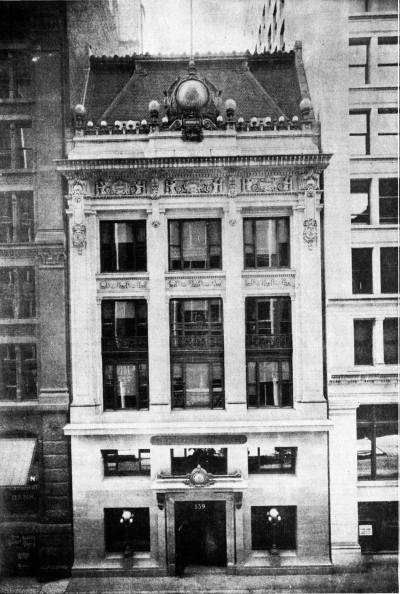
OFFICE BUILDING OF THE CHICAGO EDISON COMPANY, CHICAGO. ILL. Shepley, Rutan & Coolidge, Architects, Chicago. Two Lower Stories of Pink Milford Granite, Polished; Upper Stories of the Same Granite, with Ten-Cut Surface. Built in 1899, Note the Decorative Feature of the Lighting in Lower and Upper Portion of Building.
CORPORATIONS
1. Define corporation.
2. May an association of persons create a corporation by agreement?
3. Is a corporation a natural person?
4. How were corporations originally created?
5. How are corporations created at the present time?
6. Distinguish the creation of a corporation and the creation of a partnership.
7. For what purpose may a corporation be created?
8. What is the franchise of a corporation?
9. Is a partnership distinct from the members composing it?
10. Is a corporation dissolved by a change of membership?
11. When does a partnership cease to exist?
12. Are the members of a corporation agents of the corporation?
13. Who are the authorized agents of a partnership?
14. What are the powers of a corporation?
15. Enumerate the ordinary powers of a corporation.
16. Is the charter of a corporation a contract?
17. May a charter of a corporation be revoked at the will of the legislature that granted it?
18. How are corporations created?
19. What is meant by a corporation's charter?
20. What kinds of corporations, if any, may be organized under United States laws?
21. By what authority are national banks organized?
22. Under what provisions are most corporations organized?
23. Under what conditions may corporate charters be revoked?
24. State briefly the necessary steps in organizing a corporation.
25. Must a corporation have a corporate name?
26. May a corporation change its name?
27. May two corporations use the same name?
28. May a corporation appropriate a name descriptive of an article manufactured?
29. Give an example of a name a corporation is not permitted to appropriate.
30. Classify corporations.
31. Define and distinguish private corporations and public corporations.
32. Give an example of a public corporation; a private corporation.
33. Is a street railway company a private or public corporation?
34. When does a corporation's existence commence?
35. What determines when a corporation's existence commences?
36. Define estoppel.
37. Give an example of a corporation estoppel from denying its corporate existence.
38. Are third persons ever estopped from denying a corporation's legal existence? If so, give an example.
39. Is a corporation's charter a contract?
40. If a corporation's charter is a contract, who are the contracting parties?
41. At the present time can a corporation obtain an irrevocable charter?
42. Define de facto corporation.
43. Define de jure corporation.
44. Can a de facto corporation avoid its liabilities on the ground of incomplete organization?
45. Who can object to a de facto corporation being incompletely organized?
46. What is necessary to create a de facto corporation?
47. Define promoter.
48. Is a promoter personally liable for the obligations made by himself in connection with organizing a corporation?
49. Is a corporation responsible for the obligations created by its promoter?
50. How, if at all, may a corporation adopt the obligations of its promoters?
51. May a corporation be reorganized by consent of its members?
52. Is a reorganized corporation a new corporation, or a continuation of the old corporation?
53. Is a reorganized corporation ever liable for the obligations of the old corporation?
54. May a reorganized corporation ever escape the obligations of the old corporation?
55. How, if at all, may corporations consolidate?
56. Is a consolidated corporation distinct from the corporation from which it is formed?
57. May corporations consolidate by consent of the members of each?
58. Is a consolidated corporation liable for the debts of its component corporations?
59. What is the governing board of a corporation for profit called?
60. How are directors elected?
61. How, and under what circumstances and conditions may corporate meetings be held?
62. Who are entitled to vote at corporate meetings?
63. May a member of a corporation ever have more than one vote?
64. What is meant by cumulative voting?
65. What is meant by ticket voting?
66. Define quorum.
67. What constitutes a quorum?
68. Must a member of a corporation be present to have his shares of stock voted?
69. How, if at all, may a shareholder vote by proxy?
70. Who are members of a corporation?
71. Is a stockholder personally liable for the debts of the corporation?
72. What is the liability of a shareholder in a national bank?
73. What is meant by stockholder's double liability?
74. How may a person become a stockholder in a corporation?
75. What is a certificate of stock?
76. May a person become a stockholder without having a certificate of stock?
77. May a person hold a certificate of stock and not be a stockholder?
78. Must directors of a corporation be stockholders?
79. How, if at all, is the authority of the board of directors limited?
80. What are the principal duties of directors?
81. May a board of directors dispose of the entire assets of the corporation?
82. May directors act for their own private interests in dealing with the corporation?
83. May a director ever contract with the corporation?
84. Define by-laws, rules, and regulations.
85. Distinguish by-laws and resolutions.
86. Define capitalization.
87. Distinguish capitalization from assets of a corporation.
88. Define capital stock.
89. May a corporation sell its shares for less than par?
90. Distinguish par value and face value of stock.
91. If a corporation sells a shareholder stock at 5% of its par value, and the corporation is solvent, who, if any one, may object?
92. Must shares be paid for in money?
93. If a person purchases shares from a stockholder at less than par, not knowing that the shares have not been paid for in full, is he liable to the corporation for the balance of their par value?
94. Define call and assessment.
95. May an assessment be made before a call?
96. May an assessment be made on stock paid for at par?
97. Define and give an example of watered stock.
98. Upon what authority may the capital stock of a corporation be increased or decreased?
99. What is a stock dividend?
100. How many kinds of stock are there?
101. Define preferred stock, and distinguish it from common stock.
102. Do preferred stockholders have any advantage over common stockholders when the affairs of the corporation are wound up, and its assets distributed?
103. How may dividends be paid?
104. May a stockholder force the corporation to pay a dividend?
105. When, if at all, are dividends debts of the corporation?
106. Are certificates of stock negotiable instruments?
107. Distinguish certificates of stock from regular negotiable instruments.
108. How are transfers of stock made by the corporation?
109. What, if any, is the individual liability of a stockholder for the debts of the company?
110. What ownership, if any, does a stockholder have in the property of the corporation?
111. Can a corporation transact business without the aid of officers and agents?
112. How are the officers of a corporation appointed?
113. What are the usual officers of a corporation?
114. What are the duties of the president of a corporation?
115. May the officers of a corporation ever act without the express authority of the board of directors?
116. What is the proper corporate signature to a contract?
117. What is the proper corporate signature to a negotiable instrument?
118. Can a corporation legally sign a contract without using its seal?
119. Define ultra vires.
120. Give an example of an ultra vires act.
121. Are third persons deemed to have notice of the powers and limitations of a corporation.
122. Does a corporation have any rights outside the state of its creator?
123. What kind of corporations, if any, are authorized by the United States Constitution to transact business in any state?
124. What are the general provisions of the states regulating foreign corporations?
125. Explain the meaning of the term doing business as applied to foreign corporations.
126. Is a corporation liable for its torts and crimes.
127. How, if at all, can a corporation be punished?
128. What is meant by dissolution of a corporation?
129. How can a corporation be dissolved?
130. Can a corporation be dissolved by consent of its members?
NEGOTIABLE INSTRUMENTS
1. Name some of the most common forms of negotiable instruments.
2. What is a negotiable instrument?
3. What advantages do negotiable instruments have over money for commercial uses?
4. Define negotiability.
5. Are all promissory notes negotiable instruments?
6. What words are necessary to make an instrument negotiable?
7. May an instrument be negotiable without containing the words or order, or or bearer?
8. What kind of negotiable instrument, if any, can be transferred without indorsement?
9. Define assignment.
10. Can negotiable instruments be assigned?
11. Distinguish assignability from negotiability.
12. What is meant by the law merchant?
13. How do we happen to recognize the rules of the law merchant?
14. When was the law merchant first recognized in England?
15. To what classes of negotiable instruments were the rules of the law merchant originally applied?
16. To what classes of negotiable instruments are the rules of the law merchant now applied?
17. Define promissory note.
18. Name the parties to a promissory note.
19. Give the essential features of a promissory note.
20. Must a promissory note be dated?
21. Distinguish drafts and bills of exchange.
22. Give the names of the parties to a bill of exchange.
23. How is a bill of exchange accepted?
24. What is a check?
25. How does a check differ from a bill of exchange?
26. Are days of grace allowed in the payment of checks?
27. What is certification of a check?
28. What effect does certification of a check by the payee have upon the maker?
29. Are bonds negotiable instruments?
30. What are registered bonds?
31. What are coupon bonds?
32. What are trust deeds?
33. What are collateral notes?
34. Are collateral notes negotiable?
35. By whom are collateral notes commonly used?
36. What is a cognovit note?
37. How does a cognovit note differ from an ordinary note?
38. Define certificate of deposit.
39. How does a certificate of deposit differ from a check?
40. Is a bank liable upon its certificates of deposit?
41. Give the requisites of a negotiable instrument.
42. Does every negotiable instrument require a payee?
43. May a negotiable instrument be signed by mark?
44. Is an "I. O. U." a negotiable instrument?
45. Name the necessary parties to a negotiable instrument.
46. How does a second indorser differ from a first indorser?
47. What is the liability of a drawer of a bill of exchange?
48. Distinguish foreign bills of exchange and inland bills of exchange.
49. What kinds of bills of exchange must be protested?
50. Distinguish between drawee and acceptor.
51. What is the liability of an acceptor?
52. How may a bill of exchange be accepted?
53. What is a qualified acceptance?
54. In case of a qualified acceptance, if the acceptor fails to pay the draft at maturity is the drawer liable?
55. What is the liability of a maker of a promissory note?
56. If a note is made payable at a bank, and is not presented at the bank at maturity, is the maker discharged?
57. Define indorsement.
58. Define blank indorsement.
59. What is the difference as to transferability between a note payable to bearer and one indorsed in blank?
60. Define allonge.
61. Define indorsement in full.
62. Distinguish between the liability of one who indorses in blank and one who indorses in full.
63. If a note indorsed in blank, is subsequently indorsed in full, can it be transferred by delivery without the indorsement of the indorsee in full?
64. Define and explain indorsement without recourse.
65. What is the liability, if any, of an indorser in full?
66. Does an indorsement for collection destroy the negotiability of a note?
67. What is the purpose of an indorsement for collection?
68. Give an example of an anomalous indorser.
69. What is the difference between an anomalous indorser and an indorser outside the chain of title.
70. In most jurisdictions what is the liability of an anomalous indorser?
71. In general, what is the liability of an indorser?
72. Define indorser.
73. What are the warranties of an indorser?
74. Are the warranties of an indorser express or implied?
75. Define forgery.
76. Does forgery render a negotiable instrument void or voidable?
77. Distinguish between forgery and material alteration.
78. If a note is materially altered by a stranger is it void?
79. Define fraud.
80. Distinguish fraud and duress.
81. Are fraud and duress good defenses as against a bonâ fide holder.
82. If a forged note is lost or stolen can it be collected?
83. If a note procured through fraud is lost or stolen can it be collected by an innocent holder?
84. Define real defense to a negotiable instrument.
85. What is meant by personal defense?
86. Enumerate the real defenses to a negotiable instrument.
87. Enumerate the personal defenses to a negotiable instrument.
88. Define consideration.
89. Must consideration be stated in a negotiable instrument?
90. What kind of drafts must be presented for acceptance?
91. How are drafts presented for acceptance?
92. What must a holder do if a draft is dishonored?
93. Define protest.
94. When must negotiable instruments be paid?
95. What are days of grace?
96. Do most jurisdictions recognize days of grace at the present time?
97. Define innocent purchaser for value without notice.
98. Define bonâ fide holder.
99. Define holder in due course.
100. Distinguish bonâ fide holder and assignee of a negotiable instrument.
101. Can a person be a bonâ fide holder of a note who purchases it after it is due?
102. For what purpose must a negotiable instrument be presented for payment?
103. Can indorsers of a negotiable instrument be held if the note is not presented for payment?
104. How is a negotiable instrument presented for payment?
105. Explain notice of dishonor.
106. What is the necessity of giving notice of dishonor?
107. How is notice of dishonor given?
108. What is a certificate of protest?
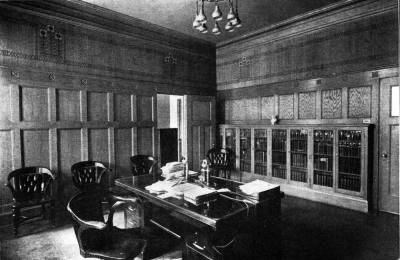
OFFICE OF PRESIDENT, AMERICAN SCHOOL OF CORRESPONDENCE, CHICAGO, ILL.