REDSTONE, One Man’s Dream
Reading edition
of an Ideal Village for Miners (Elevation Approximately 6,500 feet)
John C. Osgood came to Colorado in the early 1880s to make a thorough investigation of all the coal deposits in the state. Those up Coal Creek, a branch of the Crystal River, seemed especially favorable for his plan, and he was able to buy them from their original owners for a few hundred dollars. The dream he had of building a model village for miners in this valley did not materialize for almost twenty years. He organized the Colorado Fuel Co. and later acquired the Colorado Coal & Iron Co. and merged them into one—Colorado Fuel & Iron Co. (CF&I)—and was its first president. Then he set out to carry through his dream and built Redstone, a model village of 40 workmen’s cottages (each styled and painted differently), a modern 40-roomed inn, a school house, a club house, and a library; all electrically lighted and as modern as they could be made at that time.
39
Every workman was given the opportunity of joining the club and making use of the club rooms. Every member had his own locker and was urged to come there after work and bathe or shower, and change into clean clothes before appearing on the street. They elected their own officers and made their own rules; one of which was especially good—treating was not permissible.
The mines were up Coal Creek about 12 miles. There the miners had their own little village in which they took great pride, vieing with Redstone as to neatness and gardening.
All the buildings in this model village were constructed to last, nothing of the overnight box-car type. Yet all this came to an end in less than a decade. Rumor has it that Mr. Osgood became too ambitious: he tried to “buck” John D. Rockefeller and J. P. Morgan. He ran out of millions; they didn’t.
The scenic grandeur of the Crystal River cannot be excelled; sometimes narrow canyons, precipitous cliffs and steep waterfalls; sometimes broad valleys heavily wooded with stately ponderosa pine, Engelmann spruce, Colorado green spruce, blue spruce, Douglas fir, the narrow leaf cottonwood, and the quaking aspen; carpeted with waist high ferns, Oregon grapes, and kinnikinnick (sometimes called Indian tobacco) interspersed with brilliant flowers of every hue, and often rare plants found only in much warmer climes. The reason? Perhaps they are remnants of earlier geological ages; perchance the great combination and variety of rainfall, heat and cold, shade and sunshine, and slope exposure have their influences.
The natural resources are unsurpassable. It is an often stated fact that the Crystal River area from Schofield to Redstone bears the heaviest concentration of known minerals in the United States. Millions of dollars worth of coal deposits, undeveloped; billions of dollars worth of pure white marble waiting to be made into buildings, memorials, and statuaries; gold, silver, copper, lead and zinc deposits that haven’t been scratched. Yes, Mother Nature has been very generous in this fabulous valley.
In its Aug. 25, 1917 issue the Marble Booster had this to say just before it permanently closed its doors:
“Some day this valley will come into its own. Nature has certainly been very bountiful in its distribution of resources up and down the Crystal River Valley, but man has been lame, mighty lame, in developing the same. The right man may yet come along. Speed the day is our fervent wish.”
40
Perhaps this man has come along in the person of Frank E. Kistler who has purchased the Osgood Estate and is busily engaged restoring the property and making it into an all-year resort. He has added 36 rooms to the already 40-room inn, built a glass enclosed swimming pool, and constructed a children’s playground. He is selling home sites, erecting homes, building a ski course, golf course, tennis courts, and minor auxiliary recreational facilities.
Four miles below Redstone the Crystal River runs through a district that contains several hot mineral springs that have medicinal value comparable to any in the United States.
Soon the canyon widens, sometimes on one side, sometimes on the other, into fertile meadows especially adapted to raising strawberries, raspberries, cherries, and apples. A little farther on there are large ranches bordering it. These raise potatoes, oats, alfalfa, and hay; they all depend on the never failing Crystal River for irrigation. It also runs through several stock (sheep and cattle) ranches before it reaches the Roaring Fork River below Carbondale, then, on to join the Colorado River below Glenwood Springs, thence to the Pacific Ocean.
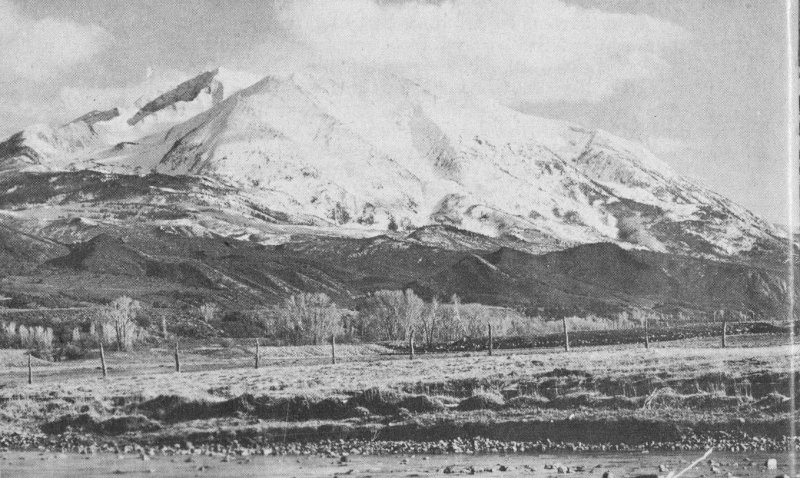
MT. SOPRIS—a majestic lone sentinel guarding the lower Crystal River Valley, as seen from the highway below Carbondale. —Photo courtesy John B. Schutte, Glenwood Spgs., Colo.
41