CRYSTAL, The Miners’ Ideal Camp
Reading edition
(Elevation Approximately 9,000 Feet)
One half mile beyond the junction of the North Fork with the Crystal River it reaches the little hamlet of Crystal City, magnificently located in a small dale surrounded by several lofty peaks: Sheep Mountain, Mineral Point, Crystal Peak, Bear Mountain (the one covered with tall pines), White House, and Treasure Peaks. Crystal City was another typical mining town of 70 houses, several general stores, a school house (still standing), Crystal Club (still standing) and several other saloons, a newspaper—The Silver Lance followed by The Crystal River Current (still standing), a concentration mill and a smelter. The peak of its population was about 650 inhabitants (some say 2,000). While a railroad was never completed from Crested Butte, a telegraph line was installed. John Davisson, now of 855 Elm St., Grand Junction, Colo., patrolled this line on snowshoes as “trouble shooter” during the Winters of 1906-’07-’08.
13
The demonitization of silver in 1893 and the inability to get adequate means of transportation for lead, zinc, and other ores, the town of Crystal City was practically depopulated soon after the turn of the century until 1916. Then it again looked as if the prospectors’ dream might come true: the population again rose to several hundred; the Lead King mine, the Black Queen mine, and the Sheep Mountain tunnel were reopened; the smelter and concentration mill were reconditioned; a blacksmith shop, cook house, and bunk houses were located two miles above Crystal City on Rock Creek. But by the middle of 1917 everything again shut down and the people drifted away.
Aug. 25, 1917, Marble Booster newspaper:
“Crystal mines are in their infancy. It would take a million men a thousand years to exhaust the hills up that way of their silver, copper, lead and zinc.”
Many interesting stories are told of the early days in Crystal City by some of its first settlers. One told by F. W. (Dad) Reyland was that one wintery day when the snow had drifted above the doors of many of the buildings, they decided to liven things up a bit by having a dance. Now the dance hall was one of the buildings completely covered by snow. So they decided to tunnel in to the door, making niches in the sides of the tunnel in the snow every few feet in which to anchor candles to guide the guests to the dance hall. The dance was a huge success and stirred the town out of its boredom.
Another was told by one who was working in the Colorado Trading & Development Co. store at the time. During the winter months the mail was brought up from Marble by a carrier on snowshoes, who as a rule could get through with very little trouble. But once when a very deep feathery snow had fallen he was unable to get through for over a week. The egg supply at the store was exhausted; so they decided to send a man down to try to get some. He made it down all right but had to wait several days for the snow to crust over before coming back. Then he carried the case of eggs strapped on his shoulders the six miles back to Crystal City. In the meantime the price of eggs soared.
In 1938 Emmet S. Gould of Aspen came to Crystal City looking for ore to run through a recently purchased mill. He became interested at once in the area not only for its potential mineral wealth, but also its wild beauty. He bought several mining claims and city lots with their cabins.
14
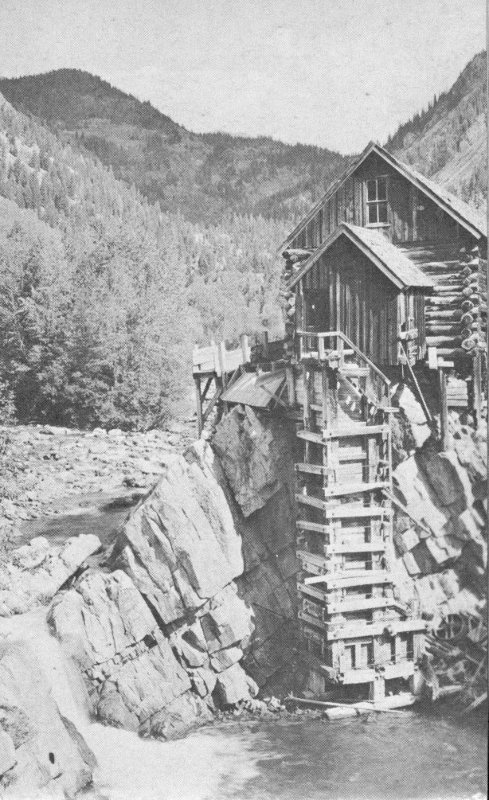
DEADHORSE MILL—just below Crystal City. One of the earliest mills built on the Crystal River. —Photo courtesy John B. Schutte, Glenwood Springs, Colo.
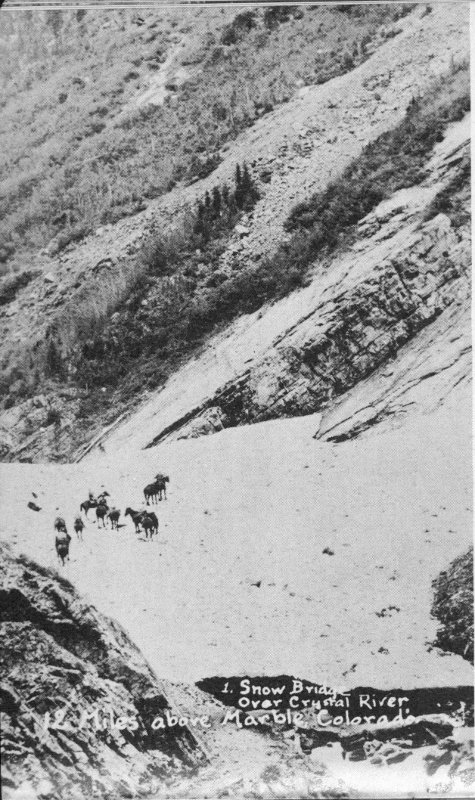
SNOW BRIDGE—across the Crystal River below the Devil’s Punch Bowls. It usually melts by September, but has been known to stay the year ’round. It is caused by slides on each side of the Canyon. —Photo courtesy John B. Schutte, Glenwood Springs, Colo.
15
He made an effort to open the Lucky Boy and the Lead King mines, but unfortunate circumstances once again kept the mines from paying.
His daughters, Mrs. Dorothy Tidwell and Mrs. Helen Collins, and granddaughters, Maxine Fowler and Carolyn Lodge, all of California, still come with their families and friends, and make up a part of Crystal City’s 20 or 30 summer residents.
The Welcome J. Neals who also own mining claims and a house in Crystal City, come every year from Mooresville, Ind., and bring their friends and relatives for a delightful summer’s vacation where the weather is just right, the scenery unsurpassable, and the elusive trout waiting to match his skill against that of the tourist.
Dick CarScadden of Aspen spends his summers in Crystal City conducting tourists on hiking trips: the food and camping equipment being carried by huskies.
Just what the future holds for Crystal City, none can say. The people who own it prefer to keep it as it is, a cool, peaceful relaxing haven. But with the road over Schofield Pass connecting Crested Butte with Marble and Carbondale open, and with the known mineral deposits there, it may again become a thriving mining center.
The Crystal River continues on its way through its narrow canyon, sometimes on a level with the highway, sometimes hundreds of feet below it.
Half way between Crystal City and Marble the river passes Lizzard Lake, one of the most beautiful in Colorado. It is supposed to be the crater of an old volcano. It is quite shallow around the edges for several feet out, then drops abruptly to unknown depths. The Game & Fish Department keeps it well stocked with trout and even amateur fishermen can land their legal limit. This is one of the highly mineralized spots in the valley: gold, silver, copper, etc.
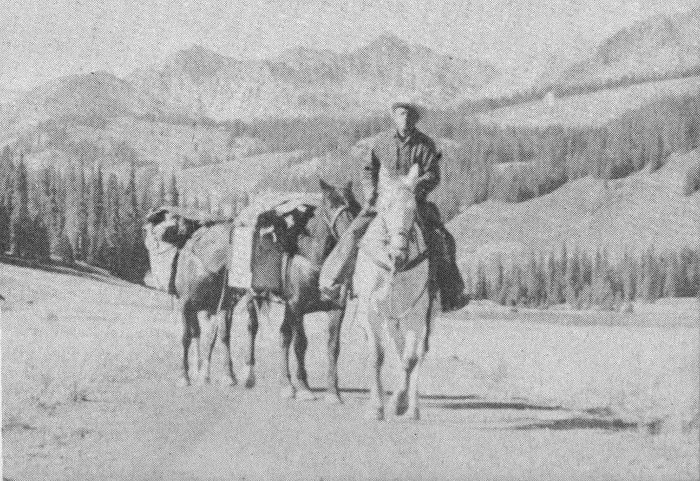
THEODORE (SGT.) JACKSON—ready to start on a pack-trip from Schofield Park into the high country. —Photo courtesy Theodore (Sgt.) Jackson, Delta, Colo.
16
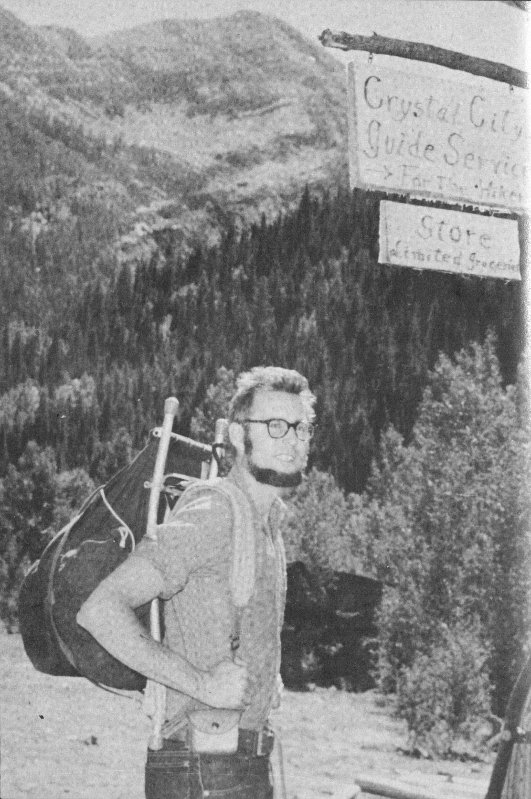
DICK CarSCADDEN—packed and ready to start from Crystal City on one of his guided treks into the wilderness. —Photo courtesy Dick CarScadden, Aspen, Colo.
17