MARBLE, A Lovely Little Hamlet
Reading edition
In a Lovely Glen, named for a Lovely White Calcium Carbonate—Marble (Elevation 7,950 Feet)
The Crystal River next reaches the valley where the town of Marble is located. The Spanish explorers, Escalante and Dominquez, may have come into this territory in 1541, but they left no permanent records. The “Forty-Niners” were supposed to have come this far off their beaten trail on their way to California; gold pans and other mining equipment were found near Prospect Ranch by Bill Gant who trapped beaver in this valley in 1859. Benjamin Graham prospected in the Elk Mountains in the early 1860s. These early explorations are legendary and no accurate information is recorded.
Neither the Ute Indians who silently followed the trails of mountain sheep, elk, deer, and bear through the parks and meadows, green with succulent grasses and gay and fragrant with wild flowers, nor the early prospectors who tramped the mossy banks of the limpid streams, snaring the sunning trout from their pebbly beds, tracking the beaver and marten for their warm pelts, or roaming the mountain peaks in search of precious metals, realized that the white rock that stood out on precipitous mountain sides was more valuable than all the animal pelts and precious metals they sought.
George Yule, a prospector who came into Gunnison County in 1874, is supposed to have been the first white man to discover and assume the value of the white marble up Yule Creek which still bears his name. He was the first elected sheriff of Gunnison County, served two terms, 1878-’82. However he did not prove up on his claims, and they were taken over by Wm. Wood and W. D. Parry in 1882.
The first prospectors to attempt a permanent settlement in the valley were John Mobley and W. F. Mason who located their settlement east of Carbonate Creek and called it Clarence; and William Wood and W. D. Parry who made their camp near the mouth of Yule Creek and named it Marble. When the settlements reached a population large enough to warrant a post office, it was located west of Carbonate Creek, and Marble was the name chosen for it.
18
Sizable amounts of lead and zinc had been discovered in this treasure vault of the Rockies and the ore was being packed out on burros to Crested Butte. This being a very slow means of transportation as well as very expensive, attempts were made to locate a smelter nearer. Finally in 1897 the Hoffman Smelting & Reduction Co. built one just across the Crystal River south of Marble. It ran until 1900.
But the town of Marble did not boom until the value of marble was fully realized. The first quarry was opened on the east side of Yule Canyon in 1892 by J. C. Osgood and one block of marble was taken out at a cost of $1,700 to be sent to the World’s Columbian Exposition (1893) in Chicago. In 1895-97 some blocks were hauled to Carbondale to be shipped east by freight. But it was not until the beginning of the 1900s that the Yule Quarry was opened on the west side of the canyon. Besides the pure white marble there is a great amount of Colorado cloud marble (a smoky mottled grain), serpentine (mottled green), pink, blue, and black (mottled with white and green), found up this canyon.
About this same time two more quarries were opened on the east side of Yule Canyon: the Strauss, by a company of eastern stockholders who built the broad gauge Strauss railroad from Marble to the foot of their quarry on Treasure Mountain; and the White Marble Co. owned by the Mormon Church. While all the development work was completed, no commercial work was ever done by either company and the railroad was never used.
In 1905 a road was cut out on the west side of the canyon and Yule Quarry was started. At first they hauled the marble out on burro pack trains which unloaded their burden in Marble and proceeded seven miles to the Placita mines where they were loaded with coal to be delivered and used at the quarry. There were two of these trains, each composed of 40 burros; one was in the charge of Walter Webb, the other was handled by John Davisson.
Mr. Davisson told me of the above incident; also told another good tale about the early days in Marble. It seems they had a town marshal by the name of Schuyler Hodson who stood “ace-high” with the workmen. Whenever they imbibed a little too freely and became troublesome, he didn’t throw them in jail but tried to get them to go home peaceably and sober up. If they refused to do this, he would take off his badge and gun, and giving them a good thrashing until they agreed to do as he asked.
19
The following is a copy of a letter received from Mr. Davisson:
855 Elm Street, Grand Junction, Colo. Oct. 14, 1958
Dear Mrs. Francis,
In reply to yours of Oct. 10th. I had charge of the telegraph line from Crystal to Crested Butte from 1906 to 1908 inclusive.
I ran the jack train from 1905 until 1908. It might interest you to know I packed a 6-hole range to the top of Whitehouse Mountain; had two jacks, 2×6 timbers lashed to the saddles and the stove in between. It was a zigzag trail and it took three men to turn the jacks on each turn. They said it couldn’t be done, but we did it.
I am sending you a list of some of the old timers and what they did. You might want to use some of it. I have forgotten a lot of them; after all it was over fifty years ago.
Joe Fausson ran a saloon
Bob Aahern ran a saloon
Frank Tracy ran a saloon
Schuyler Hodson ran a saloon and was town marshal
Dan Barnes road overseer
Al Hodges stage driver from Placita to Crystal
Henry Kirk teamster, jack train owner
Charles Bemis teamster, jack train owner
Jack Clayton teamster
Dr. Fuller Confederate Civil War veteran
Editor Evans put out paper when sober
Jim Downing hunter, kept lion and bear dogs
Frank Dickens hunter, kept lion and bear dogs
Henry L. Johnson photographer
Hope this will help a little. Sorry I haven’t a picture of the jack trains.
Good Luck, (Signed) John E. Davisson
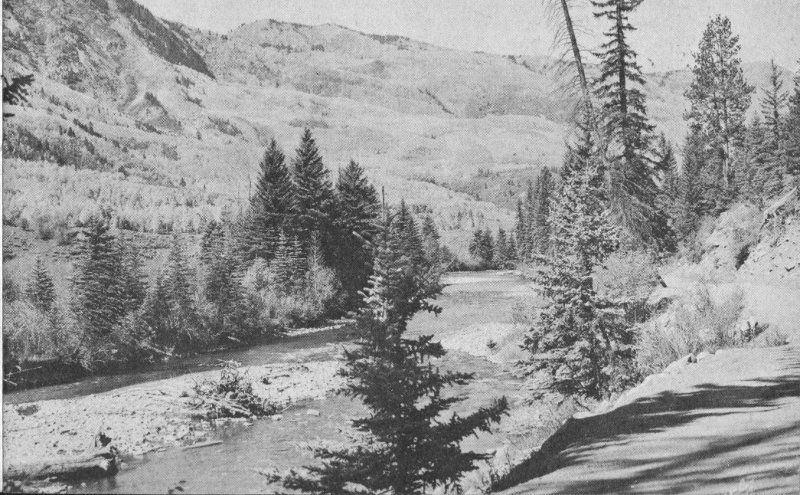
ALONG THE CRYSTAL RIVER—Scene two miles below Marble near the airport. —Photo courtesy John B. Schutte, Glenwood Spgs., Colo.
20
The broad (standard) gauge railroad was extended from Placita to Marble in 1906. The first train came up to Marble November 3, 1906. By this time they were using a donkey engine to bring the marble down from the quarry.
In 1908 Wm. McManus was brought in to assist Homer Harrington, general superintendent of construction, in installing a hydro-electric power house northeast of Marble. Three water pipelines were run into the plant: one from Crystal River, one from Yule Creek, and the other down Lost Trail Creek. They installed a transformer house half way up to the quarry to convert electricity from direct to alternating current. High tension lines were run to the mill and to the quarry, and all the company houses were wired for electricity. Upon the completion of all this, work was really in production.
It took the trained mind of an engineer, Commodore A. J. Mitchell, to see value in the calcium carbonate (marble) deposits that had taken eons to form and place in such a position that man could extract large blocks from their beds; it took the indominable courage and optimism of a man like Col. C. F. Meek to see the possibilities of developing an industry that would make Colorado famous; it took the foresight and energy of the promoter, the engineer, and the mechanic; it took the architect, Harry Bacon, to see the possibilities of erecting a monument of the translucent white marble from the Yule quarries to the memory of the great statesman, Abraham Lincoln.
During the years 1908-16 Marble was really a lively little city. It boasted five general stores, a drug store, a drygoods store, two hotels, two large school buildings, two barber shops, two weekly papers—The Marble City Times and The Marble Booster—picture show, Masonic Hall, two pool halls, and six saloons. I have talked to many of the really “old timers” about the probable population at that time, and the number varies from 1,500 to nearly 10,000. According to the “Company News” column printed each week in the Marble Booster newspaper the pay roll varied from 700 to 850 names. So taking into consideration the number of women and children who must have been here, the population could easily have been several thousand.
On the morning of March 20, 1912, a big snow slide came down Mill Mountain. As it occurred after the night shift had gone home and before the day shift had come to work, no lives were lost but the property damage was very heavy. The Marble Booster newspaper in writing about the slide had this to say:
21
“While the slide was very bad, so well had the cleaning up and repair work been done, that within three days every worker was again plying his trade.”
The Marble Booster, Sept. 14, 1912:
BAD SMASH ON TROLLEY Four Persons Meet Death as Result of Runaway Train on the Highline
Four persons met death as a result of an accident on the trolley line here last Friday a few minutes before noon.
The dead are:
George Healy, motorman of the train.
Robert P. Lytle, a brakeman.
Atansio Negrete, a Mexican passenger.
Mary Tonko, a Polish girl.
In some manner Healy, the motorman, lost control of a heavily loaded train at a point on the line near the old smelter, half a mile from the yard at the mill. Doubtless the airbrakes failed to work. Before the hand brakes could be set the train attained a frightful speed. W. C. Goodwin, a mill employee who was riding on the train, jumped and landed without a scratch. The others stayed on the train.
Just before reaching the bridge over the Crystal River two of the cars in the train left the track and smashed into a rock cliff at the side of the track. Lytle, the brakeman, was on one of these cars. He was thrown with terrible force into the face of the cliff and death was mercifully quick.
Healy, the motorman, stayed with the balance of the train, as did the Mexican and the little girl. The runaway cars held the track until the turn at the loading station in the yards, when everything turned over on the curve and smashed into splinters. Healy was caught beneath a huge block of marble and was crushed to death. He probably never knew what struck him. The Mexican was slammed onto the ground with such force that death was instantaneous. The little girl, eight years old, was alive when rescuers reached the scene and was hurried to the hospital. She died at six o’clock that evening.
Col. C. F. Meek owned controlling interest in the Colorado Yule Marble Co. composed of stockholders from Philadelphia and other eastern cities, and was the president and general manager. Knowing how to handle men as well as finances he was very popular with the company employees. Under his management orders came pouring in and soon Colorado Yule marble was being used all over the United States: From Houston, Tex. to Chicago, Ill.; from Washington, D. C., and New York City to Portland, Ore., Los Angeles and San Francisco, Calif.
22
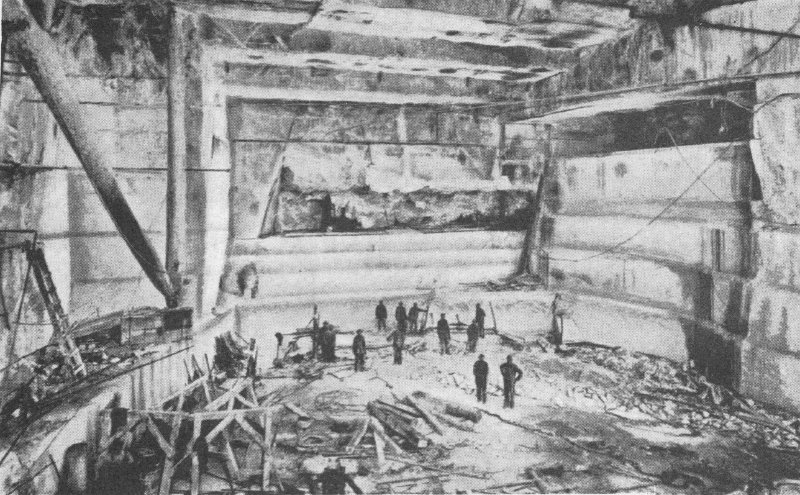
INTERIOR OF QUARRY—One of the “rooms” with floor space—30,000 square feet—producing 3,000 cubic feet of marble per day. —Photo by Henry L. Johnson, Marble, Colo.
23
Col. Meek especially loved his home and family, and managed to spend much time with them regardless of other interests. In addition to being a good manager he was very liberal and considerate of his employees and the town in general. Although a Protestant himself he did donate two lots on Park Avenue to the Catholic Church and was donating marble with which to erect the building, the company employees were donating their labor. The corner stone was laid Oct. 12, 1912, and the church was named “Saint Columbus Catholic Church of Marble.” Father Carrigan of Glenwood Springs officiated at the dedication. Father was a personal friend of Col. Meek and was always entertained at his home on his visits to Marble. He often said the colonel was the best read man he ever knew, always being interested in literature, music, and art, and could converse intelligently on all subjects. The colonel was seriously injured August 10, 1912, on a runaway trolley car coming down from the quarry and died four days later. The new management, not being quite so liberal, would not donate the marble to complete the building so work stopped. After a few years a small wooden structure was built on the front half of the foundation, but green lumber was used and it was poorly constructed; so after a few years it sagged, was condemned, and taken down in 1924. But the marble foundation still stands, a memorial to one of the greatest philanthropists Marble ever had.
J. F. Manning was elected president and general manager of the company Oct. 1, 1913. While he was still eastern sales agent for the company he learned that a memorial to the memory of Abraham Lincoln was to be built in Washington, D. C., and went after the contract. This took considerable doing as samples of marble from all over the world were being sent to Washington.
“To determine the question, whether or not this marble was artistically superior to others, Secretary Garrison referred the matter to the National Fine Arts Commission, which on January 22, 1914 reported as following:
“‘The Commission of Fine Arts at their meeting held today, gave careful consideration to your letter of Jan. 17, 1914, requesting their advice upon certain questions arising in connection with the selection of marble suitable for the construction of the Lincoln Memorial. The Commission made a careful inspection of all samples submitted and have the honor to transmit the following:
“‘The artistic qualities of Colorado Yule marble as compared with others submitted, in the opinion of the Commission of Fine Arts, fit it pre-eminently for a structure of the character of the Lincoln Memorial.’”[1]
24
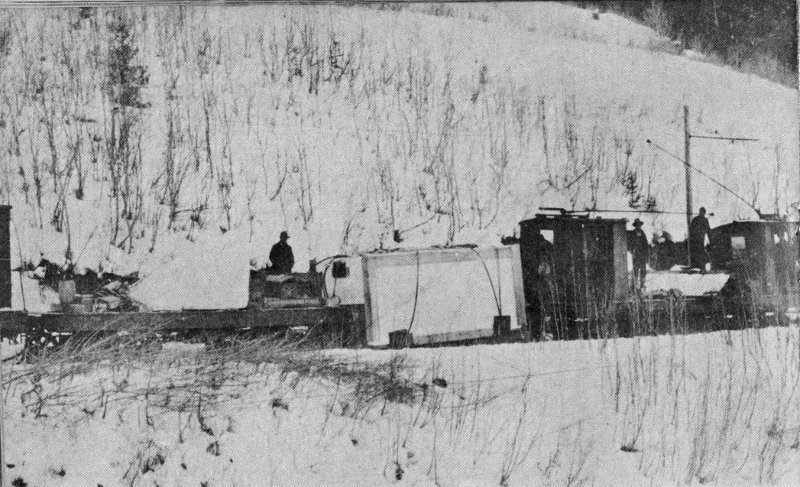
BLOCK OF MARBLE—for the Tomb of the Unknown Soldier being brought down from the quarry on electric train Feb. 3, 1931. —Photo by Henry L. Johnson, Marble, Colo.
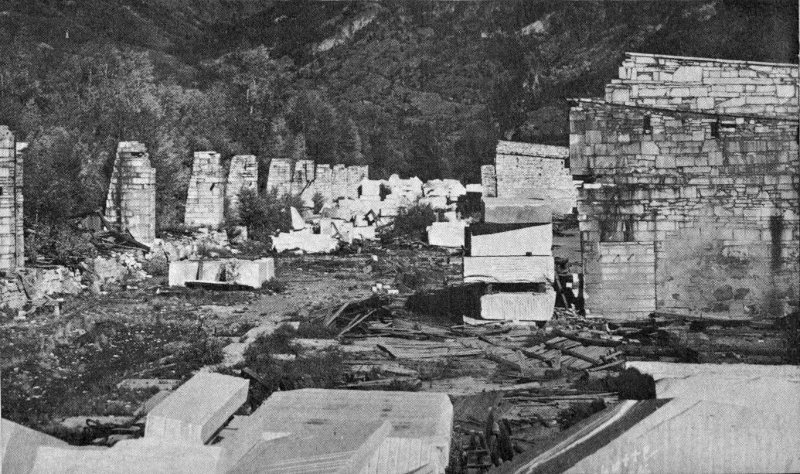
PILLARS AND BLOCKS—support pillars for crane tracks and blocks of marble left in the yard when Colorado Yule Marble Co., branch of Vermont Marble Co. ceased operations in 1942. —Photo courtesy John B. Schutte, Glenwood Spgs., Colo.
25
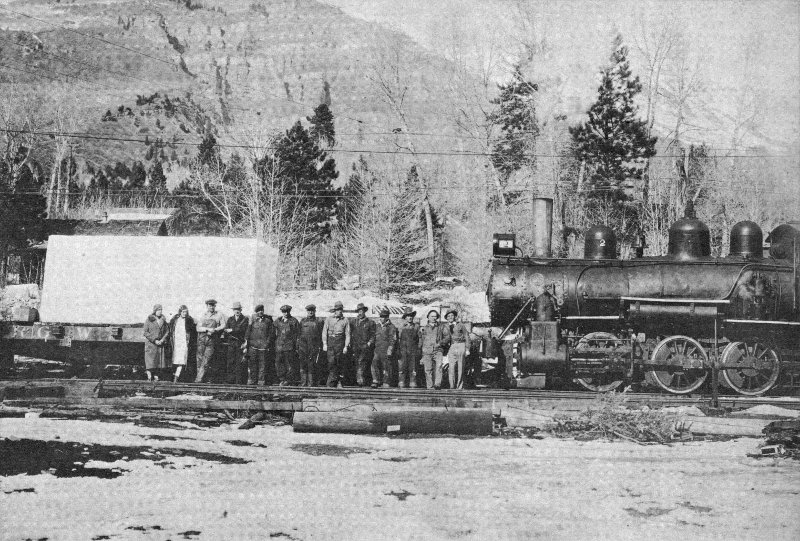
BLOCK OF MARBLE—for the Tomb of the Unknown Soldier loaded on a flat car to be shipped east. This is the largest single block of marble ever quarried in the world. —Photo by Henry L. Johnson, Marble, Colo.
26
The contract for the Lincoln Memorial was obtained March 10, 1914, and was to be completed in two years. It was finished late in 1915, several months ahead of time. During this time several other large buildings were also completed. (See listing of buildings made of Colorado marble. pp. 46 & 47.)
The following information was obtained from “A Statement to the Stockholders of the Colorado Yule Marble Company by J. F. Manning”:
World conditions in 1916 coupled with the huge indebtedness accumulated when opening the quarry, building the mill, buying the necessary machinery, building and equipping the power house, extending the railroad from Placita to Marble, and the vast amount of accrued interest, put the company in very bad financial straits. Then World War I coming on, contracts could not be obtained, so the Colorado Yule Marble Co. went into the hands of a receiver July 16, 1916, and remained closed until April, 1922.
The property was then divided into four parts: the mill, the quarry, the power house, and the railroad. Eventually it was put up for sale and was bought by different parties all interested in one thing, forming one company and putting it on a paying basis. Through the efforts of Commodore A. J. Mitchell the Carrara Yule Marble Company was formed and work was resumed in 1922. On July 24, 1924 the Colorado Consolidated Yule Marble Co. (CCYMC) was formed and was again put up for sale.
On November 18, 1924, Mr. J. B. Jones of the Gray-Knox Marble Co. of Knoxville, Tenn., purchased the stock of the CCYMC and leased the Crystal River & San Juan Railroad with option to buy. Then the name was changed again; this time to Tennessee-Colorado Marble Co., and as such was operated until July 2, 1926, at which time arrangements were made to return the plant and properties to the CCYMC.
This reversion was brought about in a large measure due to the fact that the fabricating plant was partially destroyed by fire April 6, 1926. The loss in machinery and equipment in shops Nos. 3 and 4, and mill B, together with the building was appraised at sound value by disinterested engineers at approximately $531,000.00.
About half of the part destroyed was immediately rebuilt and operations to complete their contracts were resumed.
On December 20, 1927, a rental lease and purchase agreement was made between the company and Mr. Jacob F. Smith of New York and a little later he sold to the Vermont Marble Co. who (to this date, 1959) still own the quarry.
27
While the City of Marble never reached its former status, it was a thriving place, employing several hundred men and marble was once again being shipped to all parts of the United States.
The contract for the block of marble suitable for the tomb of the Unknown Soldier was obtained in 1930, and the largest block of marble (100 tons) ever quarried in the world was cut out early in 1931. It was moved out onto the floor of the quarry and sawed down to specifications, 56 tons plus one ton to be taken off in the finishing. It was lowered down the tramway guided by huge cranes, to the trolley track at the foot of the mountain. Then with one trolley in front (Elmer Bair, motorman) and another behind (Johnny Fenton, motorman) weighted and tied together, it was skidded on the rails down to the mill; taking three days to go the 3.9 miles, arriving at the mill February 3, 1931. Special night and day guards to prevent souvenir hunters from chipping it for momentoes, were stationed near the block the four days it was in the yard. Then it was placed on a flat car, crated, braced and started on its way to Proctor, Vermont. There it was trued to perfection with surveyor’s instruments and sent to Arlington Cemetery, Washington, D. C., where the company sculptors carved the designs on it.
The Vermont Marble Co.’s branch, Colorado Yule Marble Co., continued to operate both the quarry and the mill until the rumblings of World War II, 1941 were being heard. Some of the employees were going back to Europe, some were volunteering to go into the service here in the United States, all steel was going into defense, and contracts could not be obtained, so there was nothing to do but close down again.
August 9, 1941 was a hot sultry day, dark ominous clouds covered the heavens, and a few big drops of rain began to fall. There were several deafening claps of thunder and zigzagging streaks of lightning crossed the sky. Then it all seemed to pass away. I was going about my work as usual when one of my neighbors, Mrs. George T. Harris (nee Anna Reheuser) hurried through the back door. “Oh, Mrs. Herman,” she screamed, “the town is being washed away.”
“Oh, go on with you,” I answered, “it isn’t even raining.”
“I’m not joking, there’s been a cloudburst up Carbonate Creek and the whole town is being washed away.”
The cloud had burst about three miles up the canyon and the water had backed up behind some beaver dams and log jams which had been unable to withstand the pressure and it 28 had all come down at one time, cutting a swath a block wide through the entire town, north to south, to the Crystal River. The property damage was heavy, but no lives were lost.
Another cloudburst occurred July 31, 1945, in very much the same way and approximately at the same time of day. While this one did carry more water and spread over a greater area, the damage had been done four years previous, so we didn’t feel so badly about it.
The mill closed November 15, 1941, and the last payday at the quarry was January 15, 1942. The company had decided that this time instead of keeping caretakers here to look after their property, they would sell everything but the quarry, and when conditions warranted their reopening they would come with new buildings and new machinery and do things the modern way instead of as they were done when the quarry first opened in 1906.
The marble scattered along the right-of-way between Marble and Carbondale are not the result of railroad cars overturning, but were deliberately placed there as ballast to prevent the river undermining the tracks. They are mostly the trimmings cut from building blocks, and the larger pieces are rejects, pieces with fissures, points of flint, or streaks of lime in them.
The single grave two miles below Marble to the left going out, is that of John C. McKee who contracted pneumonia in Schofield. His friends, thinking he just had a severe cold, were attempting to take him on horseback to a doctor in Carbondale. There was no road between Marble and Carbondale at that time, just a horse trail. He died when nearing Marble. It being a hot day and realizing they couldn’t possibly reach Carbondale for two more days, they decided it best to bury him there.
The little cemetery farther down the road to the east was not there at that time. It was started much later. Many ask if there had been an epidemic here at one time: so many baby graves. No, according to the oldest residents of Marble there had never been an epidemic here to their knowledge. The many infant graves there belonged to foreigners who considered childbirth an every day occurrence and no necessity for calling a doctor. So the infant mortality was very high.
The huge piles of marble near town are not rejects, neither were they washed there by floods. Marble doesn’t wash; and the floods never came near them. They are the old stock yards where marble was stored until needed in the mill.
29
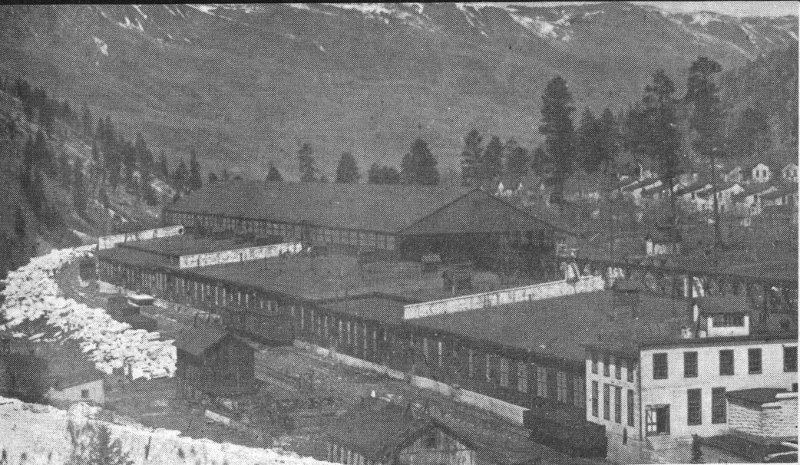
BEFORE—Colorado Yule Marble Mill as it was in 1942. It was 1,700 ft. long and from 100 to 150 ft. wide. At the time it was built (1906-08) it was the largest marble fabricating plant in the world, employing nearly 1,000 workers. —Photo by Henry L. Johnson, Marble, Colo.
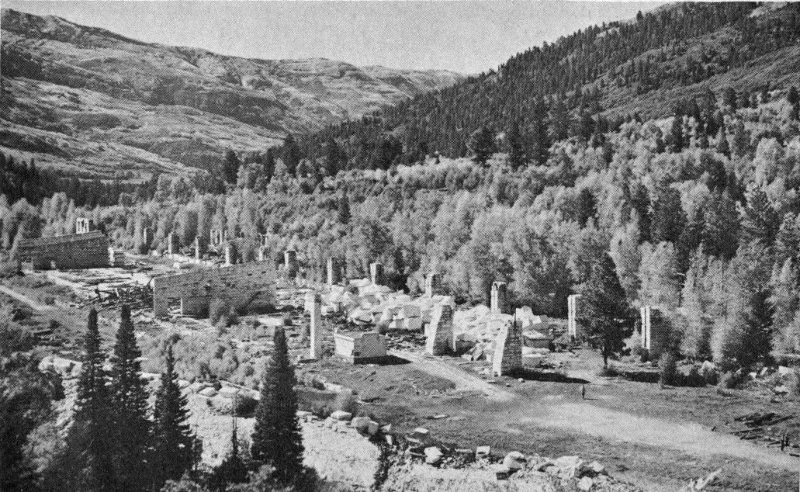
AFTER—Old Mill Site as it is today after the huge building had been dismantled and torn down in 1943. The machinery had been sold to Morse Bros. Reconditioning Co., Denver, Colo., and the building to Holly Campbell, Grand Junction, Colo. —Photo courtesy John B. Schutte, Glenwood Springs, Colo.
30
The tall marble columns in the mill yard are not supports for the building, but were supports for the crane tracks used when moving large blocks.
Elmer Bair is another person who has great faith in the valley. He went to work for the Colorado Yule Marble Co. in 1927 as a sawyer; after six months he was given the job as motorman on one of the trolleys. He held this position for four years—excepting the winters of 1929 and 1930 when he carried the mail on snowshoes and skis up to the mines on Schofield Pass.
Quoting from a letter received from Elmer Bair:
“The year the company purchased the electric snowplow Bus Long was the motorman and he was afraid to come off the hill with the big plow so it was left standing on the side track until mid-winter and the road was snowed in. The company asked Pop Sampson to open the road. He took the car crew and 12 other men with shovels to go get it out. I was one of the 12. When we got there and shoveled out the plow and side track, Pop asked me if I would run the fan on the plow. Everyone was tense and excited. The motorman most of all. The plow had never been tried out and no one knew whether the brakes would hold or not; and the road between the quarry and the town was known to be the ‘steepest, slickest, smoothest railroad in the world.’ Captain Bill Hafner showed me an article in a magazine called Rock of Ages, published somewhere in the east, making that assertion.
“We got along pretty well until we got on top of the hill at the rotary station, the motors were warmed up, the brakes were hot, and everything in excellent shape if we had only kept coming down. But the hill looked pretty steep and the motorman welcomed a chance to relax; so we all went into the station, ate our lunch, and rested about an hour. The plow was chained to the rail and the brakes were set, so we were sure everything was alright. We stayed just long enough for those hot brakes and wheels to form ice and freeze hard. I started the fan and Long unchained the plow and started releasing the air a little at a time until the air was all gone or released, and there we stood on the brow of that steep hill. The grade immediately ahead was 17 per cent.
“Bus next applied one notch of electricity, or juice, as we called it. It just stood there and hummed. Then he gave it two notches, and it still hummed. He then applied three notches and it broke loose—all at once! And we were over the hill at a fast speed. Being excited the motorman applied all the brakes we had, and set all the wheels. We were in a dangerous runaway; the outfit completely out of control.
“There was only one door and that was on the uphill side. Pop gave orders to jump to save our lives, and he led the way. As one would get ready to jump—a tree, or a trolley pole, or a ledge would show up right in the face of the one trying to find a space wide enough to make a safe landing. The snow was deep and jumping at that rate of speed made some comical sights; some landing on others and rolling down the hill together. I, having a greater sense of humor than good common sense, was having the laugh of my life until only two of us remained.
31
“Bus was like a chicken with its head off, running from his controls in front, to the door in the middle of the car. He, being the motorman naturally wanted to be the last man off. He yelled in my ear and said, ‘Hurry up and jump, so I can.’ I said, ‘Go ahead and jump. No-one is holding you.’ I was having too much fun to miss seeing him take his spill. Each jump was more comical on account of the increased speed.
“After I was left alone in this mad race that looked as if it might end in death, I began to see the more serious side of things and decided it was time for me to act in some way to save myself. The least I could do before making my exit would be to shut off the motor that ran the fan. After doing so the snow, not being able to go through the plow, began to pile up in front; within seconds the snow was piled high as the plow and the speed began to slacken off. No one but me, will ever know the feeling of comfort and relief that came over me.
“Then Sampson and the boys came running—some limping—down the track, expecting to find me and the plow piled at the bottom of the hill, instead there I sat with my feet hanging out the door, still laughing. They did not know that there had been a spell of soberness between then and the time they had left me.
“Bus Long was through being motorman and I was drafted to that position. After I quit in the fall of 1931, Frank Morse, who had been continuously with the company through all their operations, told me I was the only motorman who had run the trolley car any length of time without having at least one crackup in a runaway.
“When the big marble block for the tomb of the Unknown Soldier was taken out, there were two motormen who brought it down. I was the head motorman hooked to the front, and Johnny Fenton was hooked on the back with his motor.” (Signed) Elmer Bair
Elmer Bair left the company employment Sept. 30, 1931, and leased all the company’s range land and ran sheep in 1932. He purchased the Chidester, Cookman, Barnes, and Baroni places—approximately 1,000 acres—in 1935. And in 1952 he bought approximately 1,700 acres from the company and now runs 2,100 sheep in this area every summer.
Our tourists with very few exceptions are awed and thrilled by our magnificent scenery. George Rosenberg, managing editor of the Tucson Daily Citizen, Tucson, Ariz. is no exception. He and his family vacationed in Marble and Carbondale for the first time in 1958. His enthusiasm for Marble is recorded in a story with pictures, he published in the Citizen, Aug. 2, 1958, where he says:
“If you haven’t taken your vacation yet, and if you think you can talk the little monsters out of going back to Disneyland ... if either of these shoes fits, then take my advice ... head for the Hills of Marble.”
John Chapman, dramatic critic (New York Daily News), whose hobby is vacation travel, wandered through some ghost 32 towns in his native state of Colorado, took pictures, and wrote an article extolling the grandeur of the Crystal River Valley. This article together with colored pictures appeared in Sports Illustrated, Oct. 7, 1957.
Mrs. Robert J. Hall is another short story writer who visited in Marble in the fall of 1958. She wrote an article which appeared in the Weekly Star Farmer, Kansas City, Mo., Jan. 21, 1959, describing the beauty and resources of the Crystal River Valley in general and Marble in particular.
After the Vermont Marble Co. pulled out, things were rather dull for a few years, then it began to forge ahead as a tourist attraction. Good fishing and hunting, a delightful summer climate, and scenery that can not be duplicated, bring in more and more people every year and it is fast becoming one of the better resort sections of the western slope. It is often referred to as “The Swiss Alps of the United States.”
At present Beaver Lake Lodge and Cabins owned and operated by the Wade C. Loudermilks, formerly of Buckeye, Ariz., is the only tourist accommodation in Marble. But once a person stays in the clean, modern cabins or partakes of the delicious meals served in the lodge, he is sure to return again and again. Other popular services of the lodge are their horse and jeep tours (operated as an insured common carrier) to the various mountain tops of 12,000 feet or more, and the licensed guided pack trips into the wilderness areas.
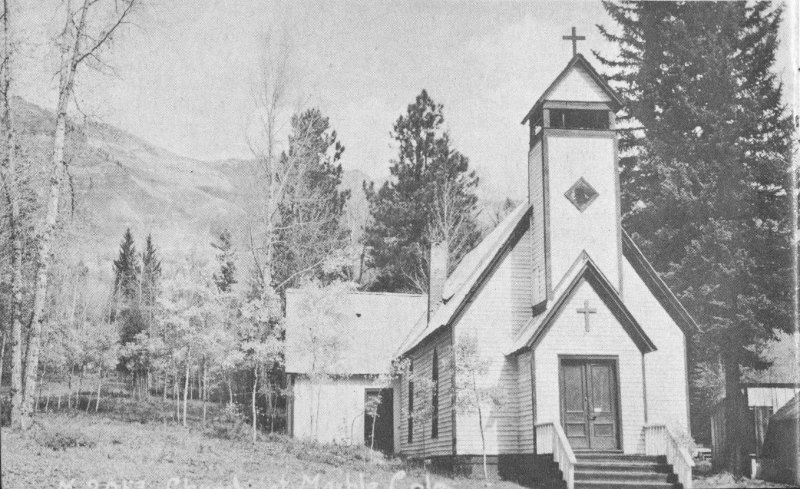
ST. PAUL’S EPISCOPAL CHURCH—Marble, Colo., building moved from Aspen, Colo., in 1909. Bell and altar donated by Mrs. Mortimer Proctor of Proctor & Gamble Soap Co. Now used as a community church. Any denomination welcome to conduct services here. —Photo courtesy Glen L. Gebhardt, Denver, Colo.
33
The Loudermilks and the Frank Rehs, formerly of Washington, D. C., now of Glenwood Springs, Colo., are undertaking a vast land development (700 acres) two miles below Marble paralleling the Crystal River. This is primarily a subdivision for home sites, consisting of approximately 75 tracts that have been surveyed and filed with the Gunnison County recorder. Part of their program calls for an airstrip 5,200 feet long (3,800 feet now completed) and a small business district consisting of hangars, gas pumps, restaurant, curio shop, et cetera.
The Basic Chemical Corporation was organized by Carl Morse in the early 1950s. They bought the Old (Marble) Mill Site from Elmer Bair and installed a rock crusher, intending to make a number of products from the marble left there by the Vermont Co. These were to include marble chips for roofs, smaller pieces for macadam and cement work, chicken grits, dust for strengthening and whitening plaster, and fertilizer for sweeting sour ground.
This was not as successful as it was hoped it would be, and was leased to Vance Baker of Grand Junction in 1957. He now runs it during the summer months and confines most of the work to the making of marble chips. He expects to enlarge his operations to the point where he can cut and sell building blocks, using the trimmings for chips.
The Crystal River flows on down the valley another 3½ miles through Prospect Ranch, once a part of the Osgood Estate of Redstone, purchased from it by the Darien Brothers—Henry, James, and Gus. Now it is a popular summer resort, Prospect Ranch Cabins, owned by Jim and Gus Darien and run by the Gus Dariens of Carbondale.
Any article or series of articles treating of the advantages of the Crystal River Valley as a vacationing playground would not be complete without mentioning one of the prettiest camping and fishing spots in the state, Bogan Flats—located five miles below Marble. The Forestry Department supplies the tables, seats, fireplaces, and restrooms. There are many quiet nooks in the river where the ingenious trout lurks and seldom does any fisherman go away empty-handed.
Next, the river flows through Chair Mountain Ranch, also once a part of the Osgood Estate. The Earl Z. McCullys bought it from Mrs. Lucille Osgood McDonald in 1943, had it ready to open as a guest ranch in 1947, and ran it as such until the fall of 1952 when they sold it to the Ray Somers of Mountain View, Calif., and Mr. and Mrs. (formerly Mrs. Lola Kemp) C. H. Patterson of Farmington, N. Mex.
34
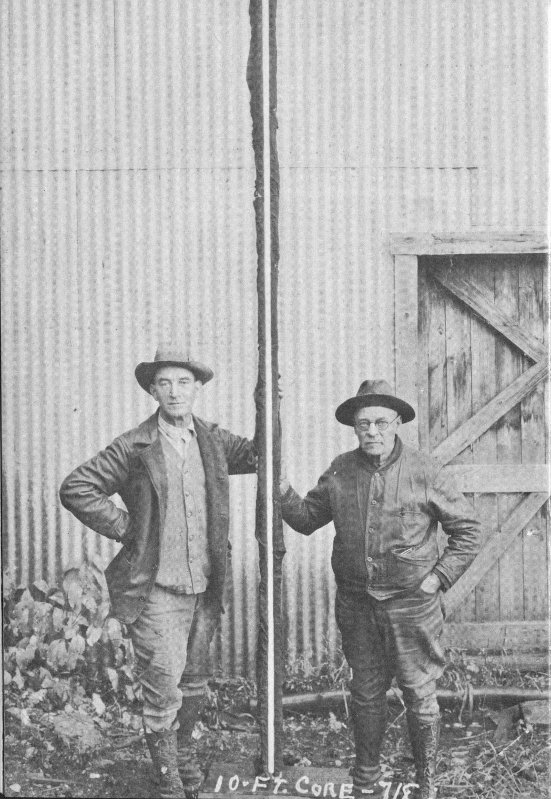
PERFECT MARBLE CORE—this speaks more eloquently for quality of marble produced up Yule Canyon than any words possibly could. In “pulling” cores they usually break at much shorter lengths. —Photo by Henry L. Johnson, Marble, Colo.
35
One evening several of us from this neighborhood were spending a social evening together discussing the various escapades pulled by dude guests. One in particular seemed especially amusing: When the McCullys were still running the ranch, a number of their guests wanted to go for a long horseback ride up in the mountains. “Should you become lost,” he told them, “just tie the reins, drop them on the horses’ necks, and give them their heads; they’ll come home all right.” Sure enough they became lost, so dismounted and did as Mr. McCully had instructed them to do. The horses returned to the ranch all right—riderless. It took the McCullys several hours to find the guests.
“Well, we shouldn’t laugh at dudes, no matter how green,” said Lola, “when we first bought the place we were the greenest dudes on the ranch. Didn’t even know which side of a horse to mount.”
However, they have learned, and Chair Mountain Ranch is now a very popular, well managed resort.
The river flows on to Cleveholm, the famous Redstone castle, built in 1903 by J. C. Osgood for his first wife, the “Lady Bountiful” of Redstone. Every Christmas all the children in the village were urged to write letters to Santa Claus. They were delivered to Mrs. Osgood and she personally saw to it that every child received what she or he asked for; not a cheap, shoddy toy, but the very best money could buy.
One Christmas the school was giving a program and Christmas tree, to which all the people in Redstone had been invited. Right at the height of the festivities the wax candles on the tree set fire to the cedar branches. Some of the men quickly grabbed the tree and threw it through one of the windows, thus averting what might have been a terrible catastrophe. The parents were very grateful for the presence of mind and quick action of the men; the children were very downcast that their carefully planned and often rehearsed program had been so rudely interrupted and their beautiful Christmas tree ruined.
The next year when Mr. Osgood had a firehouse built it was located on a lot adjoining the school house grounds.[2]
36
Cleveholm was patterned after an old English castle. It originally contained 26 rooms, each with an immense fireplace. The wall coverings, upholstering, and covers for the bookcases and reading tables in the library were hand-tooled elephant hide. Light green silk brocade was used for wall coverings, drapes, and upholstering in the music room. Dark maroon plush decorated the walls in the dining room, and all the wood work and furniture were mahogany. The parlor is an especially large room, two full stories high on the inside, and lavishly furnished. It also contained the famous Osgood coat-of-arms.
The tourist court across the river and highway from Cleveholm is Swiss Village Resort owned by the Olyn Parkers of Denton, Tex. It was originally the game-keeper’s house. They bought it in 1949 and have added cabins and improvements every year since then.
The Parkers had spent several summers in various parts of Colorado and had fallen in love with the majestic rugged scenery, the clear fresh air, and the peace and quiet found along the mountain streams away from the city. The idea of having a summer haven in Colorado grew on them until they began corresponding with real estate men in different sections of the state.
Irvin Jarvis, Glenwood Springs, Colo. wrote them that he believed he had just the place they were looking for—his summer home above Redstone. They were interested and arranged to meet him and his wife there on June 8, 1948. It was love at first sight, just the place they were looking for—a place away from the city, in the beautiful high mountain country, the sparkling Crystal River flowing just across the road, tall majestic evergreen trees and lovely aspen gracing the scenery, and many deer, elk, bear and other animals roaming the mountains. Needless to say they bought the place.
The house and barn are of Swiss architecture, built in 1901 and were originally a part of the John C. Osgood estate. The gamekeeper, William Keir, lived here with his family and looked after the private herds of deer, elk, and mountain sheep. Much of the high fence and original posts which enclosed many acres as pasture for these wild animals, are still standing.
Two of the Keir daughters visited the Parkers and related many interesting anecdotes concerning the early life of the game park. One deer they had tamed and named Dolly. She would 37 often jump the high fence and follow them to school. Then it would be their pleasant duty to skip school and take Dolly back home.
Quoting from a letter received from Mrs. Parker, Jan. 19, 1959:
“We started building cabins in 1949 and called our place Swiss Village Resort. Many nice guests came our way that first summer and stayed in our cabins. Since then many people—and they are such lovely people—have come our way and happy are the memories of their laughter ringing out over the place in summers and falls.
“We derive genuine pleasure in seeing our guests happy. Most of them are people who love a quiet vacation away from cities, close to nature. Many enjoy riding into the high country to see nature at its best. So very many enjoy fishing while others like to ride, hike, rest, or play games. All of them, the same as we, love to hear the early history of Redstone, which is most interesting.
“Fond are our memories of gatherings in the living room in front of a roaring fire in the huge fireplace listening to the guests tell of the big fish that got away, or the hunters tell of their day’s experiences in getting their elk, deer or bear.
“Our fondest wish is to keep Redstone and the surrounding area always a place where people like to return year after year, and that God will grant us many more years to live in this lovely spot.
“Yes, we love Redstone and to us the area in and near there is some of the most beautiful country we have ever seen. As we view the majestic, awe inspiring handiwork of God we feel very humble and grateful, and humbly say, ‘Thank you God, for the privilege of seeing and living in this lovely spot.’
“Most sincerely,” (Signed) Virginia Parker
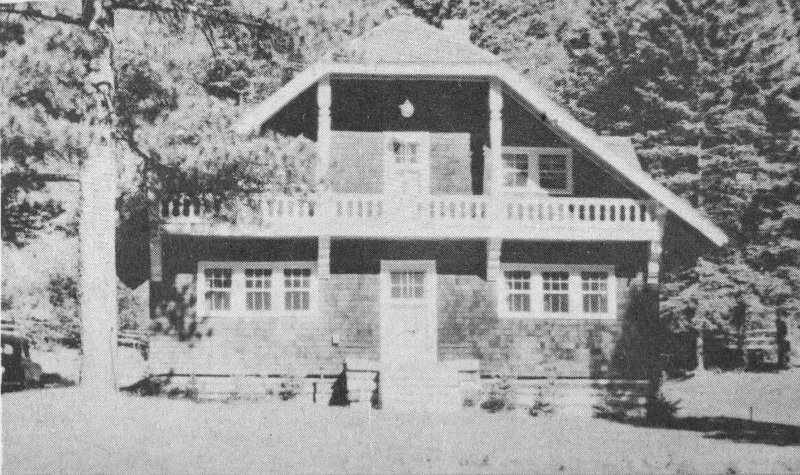
SWISS VILLAGE RESORT—Lodge one mile above Redstone. It was originally the Osgood gamekeeper’s house. —Photo courtesy Mrs. Olyn Parker, Redstone, Colo.
38
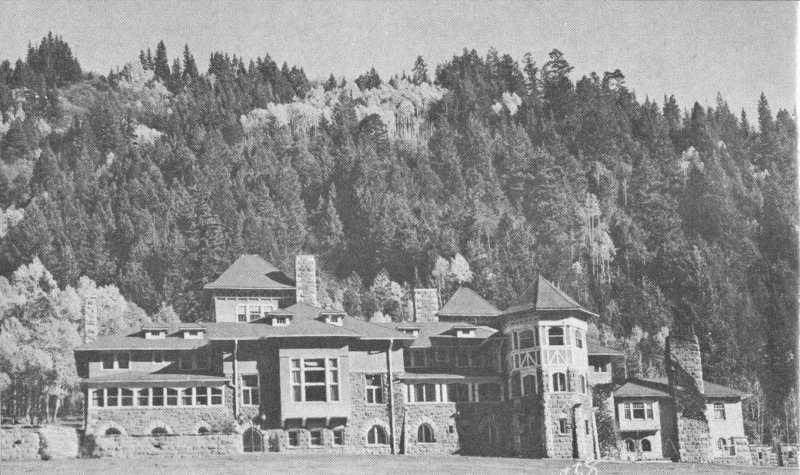
OSGOOD MANOR—“Cleveholm” (across beautiful Crystal River from Swiss Village Resort) patterned after a castle in England. —Photo courtesy John B. Schutte, Glenwood Spgs., Colo.