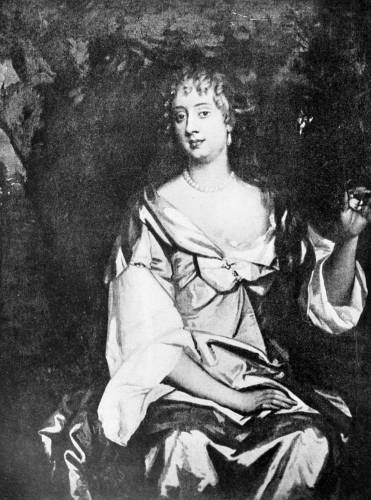
"THE LOVELY JENNINGS," DUCHESS OF TYRCONNEL A SPLENDID FAILURE OF THE RESTORATION
Reading edition
IF the fairies, as is believed in fairyland, come to christenings, we have a fancy that five were present at Frances Jennings's, and that each in turn addressed her thus in fairy fashion, as they clustered round her with their gifts:—
"I bring thee Coquetry, it shall gain thee hearts."
"I bring thee Malice, it shall gain thee enemies."
"I bring thee Virtue, it shall gain thee respect."
"I bring thee Ambition, it shall gain thee power."
"And I," frowned the Wicked Fairy—it is de rigueur that there should be a wicked fairy at christenings—"I bring thee Beauty; thou shalt lose it and all that thou gainest from the gifts of the others."
Those who care to follow the fortunes of the Lovely Jennings will learn that everything came to pass just as the fairies predicted.
But from fancy to fact. The Duchess of York, in order to refute the imputation cast upon her own looks by the ugliness of her maids of honour, decided to form a new Court. And that none but beauties should compose it, she resolved to see all the applicants herself and choose those who pleased her, regardless of their recommendations. Frances Jennings, then about sixteen, was one of those thus selected. Her father was an insignificant country squire of small fortune, and her mother a woman, as we say nowadays, "with a past." We are not told the nature of her excursions into the realms of the unconventional or disreputable, but are left to infer that they were such as even in that day of license were not to be tolerated. Nevertheless, though Mrs. Jennings was not received at Court, the fact was apparently no bar to the advancement of her family. She managed somehow to secure royal patronage for her daughters, Frances and Sarah, who in their turn managed to use it as a stepping-stone by means of which they climbed to very exalted stations.
The elder of the two sisters had no sooner appeared at Court than she attracted the attention of the Duke of York, who regarded his duchess's maids of honour as the sine quâ non of his seraglio. The lovely odalisque, however, had already, young as she was, formed a very decided resolution as to the line of conduct she intended to adopt. Like La Belle Stuart, she meant to use Whitehall as a trap in which to catch a husband. Being naturally sensible, she was aware that the freedom which certain ladies enjoyed at Court was the exception, not the rule; and that, while a Lady Castlemaine or a Countess of Shrewsbury might with impunity, by reason of personality and rank, defy decency, a humble maid of honour in attempting to copy them would very quickly be given her congé. This reasoning was demonstrated by many instances, the latest being that of Miss Price, whose conduct had obliged the Queen to dismiss her. Moreover, to emphasise the value of a good reputation she had that of her mother constantly before her eyes as a warning.
So the Lovely Jennings turned a deaf ear to the entreaties of the royal tempter. But as the world is ever more ready to believe evil than good of one—a platitude especially applicable to a maid of honour at Whitehall—the mere consciousness of being virtuous is not enough for the world. Of virtue the world always demands proofs. It was impossible to believe that a mere chit of a maid of honour—with such a mother too!—could resist a royal duke. He, however, clumsy at love-making as at everything else he undertook, himself furnished the world with proofs of Miss Jennings's innocence. "He thought that writing might perhaps succeed, though ogling, speeches, and embassies had failed. Paper is made to serve many uses, but it unfortunately happened that she had no use for it. Every day notes, containing the tenderest expressions and most magnificent promises, were slipped into her pockets or muff. This, however, could not be done unperceived, and the malicious little creature took care that those who saw them slip in should likewise see them fall out unopened. She had only to shake her muff or pull out her handkerchief as soon as his back was turned, and his notes rained about her for any one to pick up who chose. The Duchess was frequently a witness of this conduct, but could not find it in her heart to chide her maid of honour for want of respect to the Duke. Thus the charm and virtue of Miss Jennings were the only subject of conversation in the two Courts; people could not understand how a young creature fresh from the country should so soon become the ornament of the Court by her attractions and its example by her conduct."
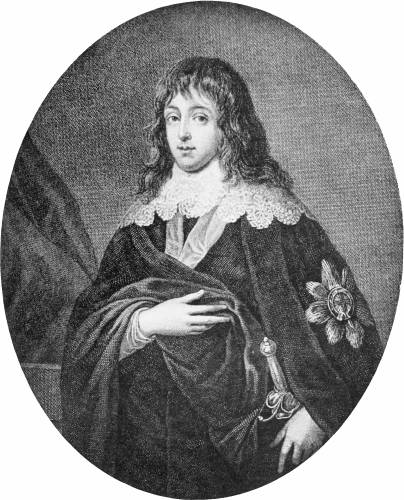
The Duke of York, Afterwards James the Second. After Vandyke.
This discreet behaviour soon rid the maid of honour of her troublesome admirer, for the Duke of York, unlike his brother King Charles, very quickly lost interest in the women who resisted him. Finding the Lovely Jennings prove invincible, James turned his attention to one of her more complaisant companions in attendance on his duchess, and as a consequence had, many years later at St. Germain, the, to him, morbid satisfaction of doing penance for, among other sins, the ruin of Arabella, young John Churchill's sister. James's repentance in this instance, however, was not unnaturally tempered with a just pride, for if ever there was a royal bastard worthy of admiration and honour it was James Fitz-James, Duke of Berwick, the son of the complaisant Miss Churchill and the Duke of York. Without exaggeration it may be said that there were few men of any rank in his day more knightly in the true sense than this illustrious nephew of the Great Marlborough.
But while Frances Jennings had successfully avoided one of the most treacherous pitfalls at Whitehall, she very nearly tumbled into another equally dangerous. The King, whose curiosity was fired by the maid of honour's reputation, piqued himself on succeeding where his brother had failed.
"God knows," said Hamilton, "what might have been the consequence; for he greatly excelled in wit, and besides he was King—two qualities of no small consideration. The resolutions of the Lovely Jennings were commendable and very judicious; but wit had great charms for her, and—royal majesty at the feet of a young person is very persuasive. Miss Stuart, however, would not consent to the King's project."
That cunning prude, to whom the royal admiration was the bait with which she hoped to catch her ducal husband, had strong objections to others with a similar purpose using her bait and fishing in the same stream. Charles allowed himself to be deluded with false hopes by La Belle Stuart, and the Lovely Jennings, though she lost the chance of becoming a maîtresse en titre—a position to which her ambition may have led her fancy—added both to her reputation and admirers by this adventure.
But of all the various kinds of fish that were angled for at Whitehall, husbands were the most difficult to catch. The beauties who hooked theirs out of that fishpond only succeeded in landing them after much practice. Miss Jennings's first attempt might be described as a graceful failure. The fish on her hook, so to speak, was the son of Lionne, Louis XIV.'s Minister for Foreign Affairs. This statesman, rightly considering that the Court of Charles II. was the place par excellence in which a very gauche and shy youth of nineteen would have unrivalled opportunities to "form" himself, had sent his son, the Marquis de Berni, there under Courtin, when that diplomatist went to England for the first time as French Ambassador. The details of the young man's progress have been preserved in the official despatches that Courtin sent to Lionne.
"Your son," wrote the Ambassador, "begins as an honest man; he is a little abashed, but we have given him courage, and M. d'Irval (of the Embassy) has so well seconded him that he has at last"—after a month in London—"made his declaration. It has been very well received by one of the finest girls in England—Miss Jennings, of the household of the Duchess of York. She is small, but with a fine figure, a splendid complexion, the hair such as you remember Madame de Longueville's was, brilliant, keen eyes, and the whitest, smoothest skin I ever saw."
The "forming" of the gauche, shy Berni proceeded apace. Under the influence of the Lovely Jennings he displayed "more ease in conversation, and greater care of his person, and less shyness in society. He arranges to see her every day, and sends her strawberries every evening." As to these graceful practices he added that of following the Duchess of York wherever she went in order to catch a glimpse of her lovely maid of honour, it was soon evident to the whole Court that he was madly in love, and Miss Jennings began to picture herself as a French marquise with a tabouret at Versailles. Whereupon Courtin became alarmed, for marriage was not in the Lionne programme, especially with a paltry Miss Jennings. He tried to impress M. le Marquis with a sense of the fitness of things, and that even an attaché of an Embassy had certain lesser duties to perform besides the supreme one of love-making. M. le Marquis was ordered to draft a despatch. He began, but could never finish it. How could he with the Lovely Jennings ever in his thoughts? Courtin then thought the time had come to send him back to France. "We have sometimes to contend with his timidity," he wrote the anxious father, "and sometimes with his presumption; very often with his sloth, but above all with his vanity, which is fed by all the honours paid to him. I think you would do well to destine him for the Bar!"
Lionne, on receipt of this, promptly and angrily ordered his son to return home, and M. le Marquis went off after three months in England, faithful to the last. "He will be greatly regretted at this Court," wrote Courtin, trying to appease Lionne's anger, "being, as he is, appreciated by the King and Queen and dearly loved by the prettiest young lady in England. Thursday evening the King, in my presence, very much teased Miss Jennings on the subject of your son; the young girl reddened; she never appeared more beautiful. His Majesty told me that your son had asked M. Porter to let him know how she looked on the day he was gone; and at the same time his Majesty assured me that he had never seen such a picture of sadness and desolation as the young gallant offered when on board the yacht of the Queen Mother. He was right, I can tell you, for the young lady loved him dearly." Thus ended Miss Jennings's first romance.
Life, however, was to have others in store for her, and the Frenchman had not long departed when all thoughts of him—the tenderness of which we are inclined to attribute to Courtin's imagination rather than to Miss Jennings's heart—were obliterated by the arrival of a dazzling Irishman. "Dick" Talbot, as he was called, was about twenty years older than the lovely Jennings, and not far off forty when he first met her. Already his life contained, in romance and adventure, sufficient material to equip an incipient Dumas for a literary career. He was a sort of living serial with many a thrilling chapter yet to run before the finish. As he was destined to be the means by which the prophecy of the imaginary Wicked Fairy at Miss Jennings's christening was fulfilled, an epitome of Dick Talbot's romantic past is necessary before describing its still more romantic sequel. His family had been settled for centuries in Ireland—since its conquest by Henry II. Time, the great assimilator, had made them Celts to the core, and "Dick," the last of five sons of a younger branch, was the Irishman par excellence. He was a soldier from necessity and an adventurer from inclination. His birth and poverty made him the former, and the times in which he lived the latter. He was only a boy when Ireland rose against Cromwell, but he enlisted and served, if not with distinction, at least with the characteristic Irish intrepidity. During the bloody defence of Drogheda he was wounded and left for dead on the battlefield, but was succoured by one of Cromwell's officers, who being charged with the burial of the dead noticed signs of returning consciousness in the corpse. On his recovery he managed to escape from his prison disguised as a woman, and joining a relation, under whom he had served, followed him to Spain, whence, possibly as a volunteer in the Spanish army, he made his way to Flanders. Here he found many Royalist fugitives, among whom was his brother Peter, afterwards the Archbishop of Dublin, who introduced him to the Duke of York.
One may easily picture the temper of the exiled Cavaliers. As it is natural, if immoral, that the vanquished should hate their conquerors, it is not at all surprising or, to our mind, shocking that the Duke of York should have wished to have Cromwell assassinated, or that others should have conspired to this end, or that young Dick Talbot should have offered his services for the purpose. Much ignominy has been heaped on Talbot for the ready willingness with which he lent himself to this assassination scheme. But while we personally by no means advocate assassination, we confess we are unable to understand the reasoning that makes the thought of assassinating Cromwell so much more horrible than that of assassinating any other tyrant. When the People, of whom so much insincerity is talked and written, make tyranny impossible there will be no question as to the crime or virtue of assassination.
Young Talbot was sent to England on his terrible errand, where he was arrested, and examined by Cromwell himself at Whitehall. While detained in the palace to await the decision as to his fate, he made the Puritan servants drunk, and, slipping from a window into the Thames, hid on a ship in the river. Rumour had it that, being in reality a spy in his pay, Cromwell had aided him to escape. As Dick Talbot was an expert duellist, and "ready to fight on the smallest provocation or none at all," it is easy to guess how such a calumny, which he denied with oaths, got its quietus. Among the spadassins who composed the Duke of York's regiment, of which, after the above adventure, he got the command in spite of great opposition, Talbot's sword, so quick to fly from its scabbard, gained him the discipline due to fear. With the Duke of York he was always a great favourite, and at the Restoration followed him to England as his gentleman of the bedchamber. None of the Cavaliers were more fortunate, for he had left his country a poor, insignificant lad, and returned at thirty possessed of royal favour which he knew well how to turn to his advantage.
If, as has been wittily said, William of Orange is the hero of the historical romance known as Macaulay's "History of England," the villain is unquestionably Dick Talbot. In those false, fascinating pages he is a consummate scoundrel, "a mere cringing courtier and a pimp." To refute the malevolent prejudices of Macaulay is easy, and he has been exposed over and over again. We know now that his brilliantly arresting portrait of Talbot was no more like him than was the Great Frederick to an equally haunting portrait by the same master. The Talbot of Macaulay's "History" is, as Jusserand says, a caricature. Perhaps, without placing any more confidence in Hamilton—who drew a very flattering picture of him—than in Macaulay, a certain little-known portrait by the Duke of Berwick comes nearest the truth. It utterly refutes the imputation that he lent himself to the scheme to take away the character of the Duchess of York in order that the Duke, who was tired of her, might divorce her. Likewise the charge that he used his influence to enrich himself at the expense of his fellow-countrymen, whose confiscated estates he got returned to them after deducting his commission, falls to the ground. His fellow-countrymen, whose popular representative he was at Whitehall, willingly gave him money for the purpose. "Though he had acquired great possessions," wrote the Duke of Berwick, "it could not be said that he had employed improper means."
But enough of historical recriminations over this almost forgotten man. Hero or villain, he was when Frances Jennings first beheld him one of the tallest and handsomest men in England. Macaulay at least did justice to his looks when he spoke of "that form which had once been the model for statuaries." With his striking appearance and fascinating manners were combined reckless courage, an emotional, passionate temperament, and the Irishman's ready wit. There is an anecdote of the latter which, as an example of thrust and parry in double entente, is hardly to be matched. Once Louis XIV., struck with the handsome Irishman's likeness to himself, on which many had remarked, asked him with a subtle insolence if his mother had not been at the Court of the late King (Louis' father).
"Non, Sire," was Dick Talbot's instant reply; "mais mon père y était."
A man, one would say, with a wit as quick and dangerous as his sword, for which he was noted.
His reputation had been still further increased by a liaison with the notorious Countess of Shrewsbury, and when Miss Jennings met him he had just come back from Ireland, whither he had gone to forget La Belle Hamilton, who had refused him. He was, in fact, very susceptible where the fair sex was concerned, and the ambitious Miss Jennings, having cast a shrewd glance at his two thousand a year in landed property and the valuable royal favour he enjoyed, was not long in bringing him to her feet. The match having been approved by the Duchess of York, Talbot and the beauty were as good as betrothed. This engagement, however, did not last long. Miss Jennings's intimacy with Miss Price occasioned the chivalrous Talbot much concern. Believing his lady-love to be above reproach, and wishing her to remain so, he talked to her with more affection than tact as to the impropriety of making a friend of one who, having been dismissed by the Queen for misconduct, now enjoyed the doubtful distinction of companion to my Lady Castlemaine.
Miss Jennings, who was not the least in love with Talbot, whom she regarded from a purely mercenary point of view as being more eligible than any other of her admirers, objected to be lectured on her choice of friends; and as the society of Miss Price, whatever her reputation, was most amusing company, she haughtily bade her lover mind his own business. This quarrel under ordinary circumstances, owing to the impulsive and generous nature of Talbot, would not have been of long duration. But it chanced to occur just at the time that the "invincible" Jermyn returned to Court after a long absence in the country. Having heard sufficient of the Lovely Jennings to excite his curiosity, he at once paid her court with his customary dishonourable motive. The beauty, however, without adding another to this frivolous coxcomb's many triumphs, nevertheless encouraged his attentions with a shrewd and mercenary eye to his twenty thousand a year. Poor Talbot, who would have forgiven the siren that had bewitched him anything, made several attempts to win back the heart of his fair, but the coquette only laughed at him, and used the quarrel as a means of exchanging one suitor for another more eligible.
The Duchess of York, whose esteem Miss Jennings had cleverly won, was persuaded by the designing maid of honour to sound Jermyn as to his intentions, and succeeded in drawing from him the most satisfactory assurances. The jilting of Talbot and conquest of Jermyn were soon the chief topics of the Court, and the artful beauty flattered herself on the aptitude she showed for intrigue. But Jermyn though hooked was not caught. The irony in the compliments he received on being snared by a girl he had tried to snare cooled his infatuation. He delayed to become a Benedict, and the steps that Miss Jennings took to hasten him constitute one of the best-known episodes in the "Mémoires de Gramont."
One of the customs much in vogue at the time was that of going about the streets masked. "Both the King and Queen and all the Court," says Burnet, "went about masked, and came into houses unknown, and danced there, with a great deal of wild frolic. In all this people were so disguised that, without being in the secret, none could distinguish them." The same form of amusement was popular at the French Court, whence no doubt it had been imported into England. It was, therefore, not surprising that a fast Miss Price or a circumspect Miss Jennings, in the desire to pass a weary hour or two, should have found many a precedent to excuse a frolic to which the risk of discovery gave an additional zest. "Having well considered the matter," said Hamilton, "the best disguise they could think of was to dress themselves like the girls who sell oranges in the theatres and public promenades. This was soon managed; they attired themselves alike, each taking a basket of oranges, and having embarked in a hackney coach, they committed themselves to fortune without any other escort than their own caprice and indiscretion."
Their objective was the motive which had inspired the frolic. Wilmot, Earl of Rochester, the famous wit and rake, having by mistake handed Charles II. a clever, filthy lampoon on himself for one on some one else, had been banished the Court. In his temporary exile he had conceived the idea of disguising himself so that his nearest friends could not have known him, and had established himself near the Tower as a German doctor possessed of "wonderful secrets and infallible remedies." His success was astonishing, and the fame of him having reached the Court, it occurred to Miss Price and Miss Jennings to consult him; the former out of sheer wanton love of excitement, the latter—as the German doctor was also a fortune-teller—to discover, if possible, why Jermyn delayed to marry her. On their way to the fortune-teller's they passed the theatre known as the Duke's House, "where the Queen and the Duchess of York were seated in state." Hereupon Miss Price, with the boldness characteristic of her, suggested to Miss Jennings that they should hawk their oranges in the theatre under the Royal box. Miss Jennings rather timidly consented, and as they were crossing the lobby they encountered a man whom they knew, Killigrew, to whom they offered their oranges. He, not recognising them, but struck with the grace of Miss Jennings's figure, chucked her under the chin, squeezed her, and asked her to come to his lodgings. The beauty was so indignant and frightened that she very nearly betrayed herself, but the more experienced Price got her away in safety.
This little contretemps somewhat dashed their spirits, but they proceeded nevertheless to the fortune-teller's in their cab. Within a few doors of his house they ordered the driver to stop, and having alighted and left their orange-baskets in the cab till their return, they were proceeding on foot when the roué Brounker stopped them. At first "he had no doubt but that Miss Jennings was a young courtezan upon the look-out, and that Miss Price was her business woman." But they, knowing his reputation, no sooner beheld him than they gave themselves up for lost. Their manner betrayed them, and Brounker immediately recognised them, without, however, letting them know of his discovery. "The old fox possessed wonderful self-command on such occasions, and having teased them a little longer to remove all suspicions, he quitted them, telling Price that she was a great fool to refuse his offers, and that the little creature would not, perhaps, get so much in a year as she might with him in one day; that the times were greatly changed since the Queen's and the Duchess's maids of honour nowadays came to the same market as the poor women of the town!"
Brounker, who would not have taken a thousand guineas for this meeting, having passed on, the now thoroughly terrified girls, abandoning all thought of the fortune-teller, returned to their cab, to find the coachman engaged in a fight with some roughs who were trying to steal their oranges. The honest fellow was with the greatest difficulty pacified, and the orange girls, having left their wares to the mob that had collected, drove back to the palace. But, owing to the malice of Brounker, the story of their escapade was soon spread abroad with much exaggeration. Lady Castlemaine, whose sins were seventy times seven, made a taunting comment to the effect that the only one of her sex at Court whose virtue could not be impugned was her infant daughter. But fortunately for Miss Jennings her previous honourable reputation prevented any stigma from attaching to her, and the favour she enjoyed with the Duchess of York saved her from the disgrace and dismissal that might otherwise have overtaken her.
Jermyn, however, already weary of a conquest from which he had gained nothing but ridicule, took advantage of the scandal caused by the frolic to release himself from his entanglement. The means he took were malicious, but his malice recoiled on himself and made him ridiculous. Having for some time pretended to be ill in order to delay his marriage, he suddenly sought and obtained the King's consent to serve as a volunteer in the expedition to Guinea that was fitting out under the command of Prince Rupert. Whereupon he came himself to acquaint Miss Jennings of his heroical project. She quickly realised that the husband she had so cleverly angled for had for the third time escaped capture. Nor did she have the satisfaction of knowing that her wiles could entice back Talbot, whose ardour must have contrasted very unpleasantly now with Jermyn's cold-blooded desertion. For Talbot in a fit of pique had married another. The curse of the Wicked Fairy had begun to work, and for the first time in her life the coquetry, malice, virtue, and ambition bestowed on her by the other fairies were brought to nought.
But in this hour of humiliation she bore herself with all the haughtiness and disdain for which she was afterwards to be noted. "There appeared," says Hamilton, "so much indifference and ease in the raillery with which she complimented Jermyn on his voyage, that he was entirely disconcerted, and so much the more so as he had prepared all the arguments he thought capable of consoling her, upon announcing to her the fatal news of his departure." She told him "that nothing could be more glorious for him, who had triumphed over the liberty of so many persons in Europe, than to go and extend his conquests in other parts of the world; and she advised him to bring home with him all the female captives he might make in Africa, in order to replace those beauties whom his absence would bring to the grave." Her resentment did not, however, stop here, for shortly afterward, the expedition to Guinea being abandoned, she wrote a clever lampoon on Jermyn, which was circulated all over London and covered him with ridicule.
At this juncture, attracted, so to speak, by the blaze of all this, George Hamilton, a moth drawn to every pretty face that smiled on him, fluttered round her. Pique made her encourage him, for though he was good-looking and well-born and fascinating, it was hardly likely that an ambitious girl who had set her cap for Talbots and Jermyns would otherwise have contented herself with an impecunious younger son. Enchanted by his friendly reception, Hamilton quickly forgot La Belle Stuart, Lady Chesterfield, and the others for whom he had sighed in vain, and imagining, as he always did, that his heart was made of the wood with which the fire of a grande passion is kindled, he besought the Lovely Jennings to be his wife. They were married almost immediately, and Hamilton, having been knighted by Charles II., who did not evince an inclination to bestow on him further and more substantial honours, crossed to France with his wife and offered his services to Louis XIV.
Judging from what we know of Lady Hamilton's character, it seems justifiable to attribute to her energy his rapid advancement in the French army. For though George Hamilton was brave, he could hardly be called brilliant, and in order to account for the honours Louis XIV. gave him it must have been due in no small degree to his clever wife that the powerful interest of the Gramonts, to whom he was so closely related, was exerted.
Of the life of the Countess Hamilton, to give her her French title, in France we know nothing. But it did not last long, for a few years after her marriage her husband was killed in Flanders. Once again, with every prospect of winning a brilliant station in life her schemes were upset, and she was left a widow with three little daughters and a petty pension from the French Government on which to eke out a miserable existence. But her courage was not broken; she still had youth, beauty, and ambition—three qualifications with which a clever woman may make a successful bid for fortune. She returned to England, and it was not long before her star was again in the ascendant. Evelyn recorded in his Diary that on the occasion when he went as far as Dover with the new English Ambassador to Paris "there was in the company of my Lady Ambassadress my Lady Hamilton, a sprightly young lady much in the good graces of the family."
It was now when travelling in the suite of these exalted persons that the charming widow met her old lover Dick Talbot, who had been obliged to leave England on account of his supposed implication in the Popish Plot. It was nearly fifteen years since they had met: he was now close on fifty, but still the same handsome, passionate, generous Talbot of the old days, and she was nearly thirty, with the glamour of misfortune to excite sympathy for her beauty. Talbot, whose wife had recently died, at once fell under the old spell, and this time he was not refused. If she could not love him as he loved her, she knew how to satisfy him, and gave him the full benefit of her cunning and ambition in the stormy days in store for them. Just before the death of Charles II. they managed to return to England. The Duke of York, with whom Talbot was always a favourite, at once reinstated him in his old post of groom of the bedchamber, while the new Duchess of York (Mary of Modena) made as much of his beautiful wife as the late one had done of the Lovely Jennings.
The accession of James II. gave the Talbots their opportunity. The favourite was created Earl of Tyrconnel, and sent to Ireland in command of the army. His wife accompanied him, and now there began for them the culminating and most critical period of their lives. Already the shadow of the ruin of the Stuart dynasty could be discerned outlined in the ferment of the times. The spirit of the approaching Revolution of 1688, which cost James II. his crown, was more religious than political; and it was in Catholic Ireland, which had groaned under the iron heel of the Puritans, that the struggle for which all were preparing was to be decided. In that distracted kingdom, with the passionate Papist Talbot in command of the military, and the sleek Protestant Clarendon (the great Chancellor's son) in command of the civil power, the very difference in temper, character, and politics of the two men was enough to lash the factions they represented to fury. The tactics by which Talbot crushed his rival and set the Catholics, eager for revenge, at the throat of the Protestants caused his name to be execrated in England. But terrible as they were, it should be remembered that the revered Cromwell's were not a whit less ruthless. Talbot was the enfant perdu of a doomed faith and a doomed nation; his name has been covered with infamy because he failed, and Macaulay, in making him the villain of his romantic "History," was merely expressing the opinion of triumphant Protestant England.
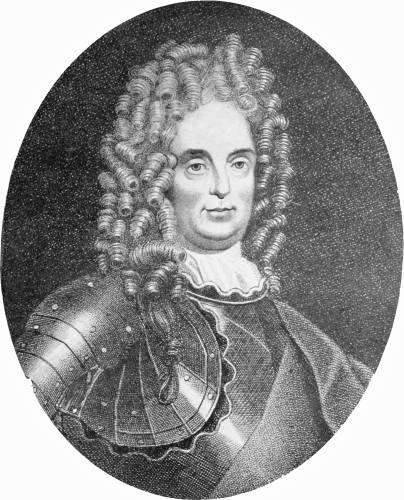
Richard Talbot, Duke of Tyrconnel.
When James II. fled from Whitehall his hopes turned naturally to Ireland and Talbot. The exiled King at once created him Duke of Tyrconnel and Viceroy. There never has reigned at Dublin Castle a more striking figure. Nor was the Vicereine unequal to the position of power, splendour, and intrigue to which she had climbed with such difficulty. Destiny ruled that her magnificent reign should be short and her ruin an arresting contrast to the success of her equally ambitious and clever sister, Sarah, Duchess of Marlborough. She took advantage of her temporary fortune to marry her three daughters by her former husband, Hamilton, to rich and influential Irish noblemen. Of one of these "three viscountesses," as they were popularly known in their day, there is, says Mrs. Jameson, a picturesque legend still current among the Irish peasantry. Laughlen Castle was left to the Viscountess Dillon on the death of her husband with the proviso that she should reside in it during her life. In her widowhood, falling in love with a young Englishman, and being unable to detain him in Ireland or follow him to England while her castle existed, she ordered a banquet to be prepared in her garden and, having set fire to the castle and feasted by the light of the blazing pile, went off to England after supper with her lover!
It is not surprising to learn that the mother of such a daughter had a commanding spirit and temper. "She is said to have ruled her husband without much effort, but as all her prejudices and passions held in the same direction, she on many occasions only added the fuel of her feminine impatience to his headlong self-will." Her influence over Talbot was, in fact, supreme. Struggling, as she did with all her force, to maintain her husband and herself at the summit they had scaled, it was but natural that she should have made enemies among the distracted and desperate Jacobites who surrounded her contemptible master, James. All sorts of efforts were made at St. Germain to induce the fallen King to supersede the Viceroy, or at least banish his wife from Ireland. Lord Melfort, foiled by her intrigues, declared that she had "l'âme la plus noire qui se puisse concevoir."
The Talbot influence was, however, too strong to be easily broken, and James, having decided to fight for his crown in Ireland, trusted implicitly to the Duke of Tyrconnel, who had refused to go over to William of Orange in spite of heavy bribes. From the coming of James and his French army to Ireland in March 1689, to the fatal Battle of the Boyne, the struggle between Roman Catholicism and Protestantism entered upon its final and most distracted phase. In these months of peril the Jacobite camp was honeycombed with anarchy. Round the Viceroy and his wife envy and malice coiled like a hydra. It required all their skill to baffle the intrigues and treachery in their own party. At the same time the terror and hatred of the English vented themselves on the frenzied Duke of Tyrconnel, who, still sure of the support of his weak King, was ruthless in his vengeance and desperate in his measures to out-manœuvre William of Orange, that master of strategy. Of the lampoons that rained upon him the following is a sample:—
"There is an old prophecy found in a bog, That Ireland shall be ruled by an ass and a dog; And now this prophecy is come to pass, For Talbot's a dog and James is an ass!"
The French authorities quoted by Macaulay are probably quite correct in stating that the Duke of Tyrconnel had arranged with James to make Ireland a French protectorate, in case the English crown should again be on the head of a Protestant king. The thought that he was just the Irishman to entertain such a design was sufficient to make him execrable to the Englishmen of his own day, and no less infamous to Macaulay, that strict respecter of conventions, who ferreted his forgotten name out of the oubliettes of history to depict him as the traitor par excellence. But it was certainly not England that Talbot would have betrayed had his schemes succeeded. To him the yoke that crushed his race and creed was foreign. Nor would Ireland have altogether resented his handing her over to France, all bleeding as she was from Protestant and English wounds. Of the two yokes the French would assuredly have been the easier for Ireland—at least so Irishmen have declared on many occasions.
Be all this as it may, perhaps no other but Talbot could have maintained himself against the calumnies and intrigues that began slowly to break down his iron frame. It must have been with something of relief, something of despair, that the high-spirited Duchess of Tyrconnel learnt that the factious Franco-Irish army was finally to meet the common foe. She knew well enough, when on the night of the 30th of June a courier brought her the news that a battle would be fought on the morrow, that on its issue hung all her future. The agony of suspense in which she passed the day of the Battle of the Boyne found her at evening no less exhausted than the conquered and fugitive James when he reached Dublin Castle. Nevertheless, in this hour of her deepest humiliation she rose proudly above despair. As soon as the worst was told her she bore herself with as high a spirit as when years before she had faced Jermyn. When the fleeing King arrived, faint and covered with mud so as to be hardly recognisable, the Duchess of Tyrconnel assembled her household in state, and dressing herself magnificently received him with all the splendour of Court etiquette. Never has Dublin Castle witnessed a function more dramatic than this of Dick Talbot's Vicereine on the night of the Battle of the Boyne. Having on one knee congratulated James on his safety, she invited him to partake of refreshment. His answer is celebrated. Shaking his head sadly, he replied that his breakfast that morning had spoiled his appetite, and ironically complimented her on the swiftness of her husband's countrymen's heels. "At least your Majesty has had the advantage of them," she could not help retorting, stung by the ruin of her hopes and ambitions. When Lauzun, the French general, told her that fifteen Talbots and half as many Hamiltons had been slain, and that her husband had fought like a hero of romance, she might have been acquitted of disloyalty had she cried, as she must have felt, with the Irish soldiers, "Change kings, and we will fight the battle over again!"
At the Council held on the following day it was decided that James should return to France, and the Duchess of Tyrconnel either went with him or followed shortly afterwards. It was no doubt necessary for the Viceroy to have his clever wife to intrigue in his behalf at St. Germain, where his enemies were the most dangerous. She did her best for him in that plot-laden atmosphere, but Tyrconnel and the cause he represented were hopelessly broken, and the doom of the wicked fairy had fallen on the Duchess. Her star had set, never to rise again.
In the following year the patriotic Viceroy died suddenly at Limerick, whither he had gone in brave despair to give battle to the fatal William of Orange once more. Before he died his enemies at St. Germain had triumphed over his wife, and the weak, ungrateful James had at last allowed himself to be persuaded to deprive him of all authority in Ireland. But, so loved as well as feared was he, the despatch which disgraced him was kept a profound secret. His death was generally attributed to poison, but the real cause, according to a more trustworthy opinion, was apoplexy. So exciting were the times, that his end scarcely caused a thrill. Death must have been welcome, for his passionate heart was broken.
Thus perished this questionable hero, whose virtues and abilities have been covered with infamy by failure and the unbounded popular passions of the times in which he lived. Two voices only have ever been lifted in his defence: one was Berwick's, his contemporary, who, when the opportunity was offered, nobly refused to supplant him; the other was Lady Morgan's, a sympathetic critic of a later day. "Of Richard Talbot, Duke of Tyrconnel," she said, "much ill has been written and more believed; but his history, like that of his unfortunate country, has only been written by the pen of party, steeped in gall, and copied servilely from the pages of prejudice by the tame historians of modern times more anxious for authority than authenticity."
His brilliant wife, whom his death reduced to poverty, paid his memory such honour as she could. At her entreaty Anselme, the most popular preacher of the day, pronounced his oraison funèbre in Paris, and the Courts of Versailles and St. Germain assembled to hear it. The obscurity in which the rest of her long life was spent has only been fitfully illuminated. Neglected in the distracted Court of the exiled Stuarts, she was so poor that she was often in want of the necessaries of life. On one occasion temporary relief was afforded her by the gift of four hundred pounds from the pension the Pope gave to James II. Her proud spirit having been embittered by misfortune, she quarrelled with nearly all her relations, living on especially bad terms with her "three viscountesses;" her only child by Talbot that survived, and whom she had married to the Prince of Vintimiglia; and her luckier but no cleverer sister, the Duchess of Marlborough. Many years later, in the reign of Queen Anne, when her famous brother-in-law was at the height of his power and playing his double game between the Whigs and the Jacobites, she was employed for a time in his secret negotiations. But the proceedings are wrapped in mystery. There is a story said to be apocryphal, though Horace Walpole and others believed it, that she was in England in 1705, and sold haberdashery at the Royal Exchange, which was at that time let out in stalls.
"Above stairs," said Walpole, "sat, in the character of a milliner, the reduced Duchess of Tyrconnel, wife of Richard Talbot, Lord Deputy of Ireland under James II. This female, suspected to be his duchess after his death, supported herself for a few days, till she was known and otherwise provided for, by the little trade of the place. She had delicacy enough to wish not to be detected; she sat in a white mask and a white dress, and was known by the name of the White Milliner."
It is certain that three years later she was at Brussels, where she had a meeting of a political nature with the Duke of Marlborough. In describing it to his wife he wrote that he found her grown very old and hoarse, and so much changed as to be hardly recognisable. Through his influence some of her confiscated property in Ireland was restored to her, and she went to Dublin, where she remained for the rest of her life, with what thoughts one would like to know! She lived for nearly thirty years in a most devout and lonely retirement, and, her funds being now more than sufficient for her wants, founded a nunnery for the Order of Poor Clares. "Her death," says Walpole, "was occasioned by falling out of her bed on the floor in a winter's night, and being too feeble to rise or to call out, she was found in the morning so perished with cold that she died in a few hours." Her age was eighty-three, and she had survived the fatal Battle of the Boyne forty years!
Of the beauty for which "the Lovely Jennings" had been so celebrated at Whitehall, when she scattered the Duke of York's love-billets "like hailstones around her," there had long ceased to remain the slightest trace.
"Wanton Shrewsbury." (Anna Maria, Countess of Shrewsbury.) From the portrait by Mary Beale in the possession of Earl Spencer.