LOUISE DE KÉROUAL, DUCHESS OF PORTSMOUTH A SPY OF THE RESTORATION
Reading edition
IF proof were required of anything so obvious as the cynicism of fame, one might cite the subject of this memoir as an example. Of European importance in her own day, and now—excepting Nell Gwynn—unquestionably the best remembered because the most odious of all the women of the Restoration, although "Madam Carwell," as the English people called her, has escaped oblivion, the mere spelling of her name has become a matter of indifference to history.
Kéroual, Kéroualle, Querouralles, Querouailles are some of the ways it is printed, and we only adopt the first as being the most frequent French mode.
A similar uncertainty attaches to her origin.
The Duchess of Portsmouth, however, had no doubt about it and was herself extremely proud of her ancestry, and boasted—when in England, be it understood—an ancient and distinguished lineage. It is characteristic of parvenus. Colbert, Louis XIV.'s famous Finance Minister, claimed a noble Scot, by name Cuthbert, who flourished in the reign of Macbeth or earlier, as the progenitor of his shopkeeper father. But there were many like Madame de Sévigné, whose opinions take precedence over those of most of her contemporaries, who had the greatest contempt for the Duchess of Portsmouth's family pretensions. Be the matter as it may, by Louise de Kéroual's first start in life there hangs a tale.
Her father, whether or not he could trace his ancestry back to the fourteenth century as his daughter declared—when there was a saying in Brittany: "The Kérouals for antiquity, the Kermans for riches, and the Kergournadecs for chivalry"—went to Paris as a boy to seek his fortune. Of this he appears to have amassed in the wool trade sufficient to enable him to retire in middle life to his native Brittany, where, being from all accounts an honest and unpretentious man, he devoted his leisure to the bringing up of his son and two daughters, and dispensing modest hospitality. It was at his house in Brest that Evelyn made his acquaintance, "and being used very civilly, was obliged to return it in London," when "Monsieur Querouaille and his lady, parents to the famous beauty," paid the Duchess of Portsmouth a visit. Her Grace was then, adds Evelyn, "in the height of favour, but he never made any use of it." The bringing-up of his children, however, would seem to have been beyond the abilities of the civil wool merchant, and owing to the dissension of his daughters he placed Louise, the elder and prettier of the two, at a boarding-school in a neighbouring town. Here she developed the insinuating manners that later on were "to tie England and France together with her silken girdle."
Having won the friendship of the head-mistress, she obtained certain social privileges, which, from the reports of the use she made of them, so alarmed the retired wool merchant that he sent her to Paris to the care of a widowed aunt. This lady, whose very name has long since been forgotten, owed in a great measure her means of subsistence to the generosity of the Duc de Beaufort, in whose service her husband had died. According to the author of the curious libel known as "The Secret History of the Duchess of Portsmouth," Louise got round her aunt as easily as she had got round the head-mistress of her boarding-school. For it was not long before she made the acquaintance of the Duc de Beaufort, and interested this powerful nobleman in her behalf. Whereby she was constrained to learn the rudiments of intrigue, a subject in which she was afterwards to become pre-eminently proficient.
It is easy to censure a girl who deliberately prefers to seek her happiness in immorality. It is done every day. But there are few girls of the alert, ambitious nature of Louise de Kéroual, who if placed in her position would not follow her example. What were her prospects? On the one hand she had the choice between returning home and marrying some petty, humdrum bourgeois, or immuring herself for the rest of her life in a convent. On the other, by prudently selling her virtue, she might have the riches, gaiety, and pleasure she craved, and still remain respectable. Of these two prospects, the first was impossible to Louise. But the second was an opportunity—one of those opportunities that Shakespeare says, "if taken at the flood, lead on to fortune"—the great opportunity of life that most of us sigh for and fail to recognise till too late. To Louise de Kéroual it came in the guise of a Duc de Beaufort, High Admiral of France. Her mind never suffered the slightest misgiving, her conscience the least qualm. Like all persons destined for success, she knew what she wanted and took it. A woman so rusée as Louise was not such a fool as to be found out. Her liaison with the Duc de Beaufort was never suspected.
How long it lasted it is impossible to say, but it was brought to an abrupt end in the summer of 1669, when the Duc de Beaufort was given the command of the naval expedition which had for its object the relief of the Venetians who for twenty-four years had been besieged by the Turks in Crete. From this expedition he never returned, but before he sailed Louise took care to provide for her future by obtaining through his influence one of the posts of maid of honour to Madame which had just fallen vacant. This was the beginning of her fortune. The report that she accompanied Beaufort to Crete disguised as a page is a mere fabrication of her libeller. The Kéroual who accompanied the Duc de Beaufort to Crete was her younger brother, Sebastien, whom, no doubt, she now tried to provide for, as she did on a later occasion in England for her sister, Henriette. Sebastien, however, did not long enjoy the fruits of his sister's patronage; he died a few days after his return from Crete.
It was probably through this event that Louise became acquainted with the Comte de Sault, who on Beaufort's death appears to have taken Sebastien into his service, in which he was at the time of his death. This Comte de Sault was the eldest son of the Duc de Lesdiguières, and one of the best-known men at Court. He had won the chief prize a few years before in the famous jousts in front of the Tuileries, which gave their name to the Place du Carrousel. The Comte de Sault soon occupied more or less publicly the same place in the maid of honour's affections that had previously been held by the Duc de Beaufort. In fact, there was so little privacy about their relations that Madame de Sévigné and Louvois did not hesitate to put the worst construction on them, while several years later in England "a great peer taunted her insultingly with the recollection of this old scandal."
This affair was, however, decently conducted, as such things were in France, and Mademoiselle de Kéroual's social standing did not suffer. Perhaps she may have hoped to arrest the notice of the King himself, but if so she was disappointed. During the short time that she was in Madame's service the monarch's attention was too much absorbed by the beautiful Mademoiselle de la Vallière to be diverted by Mademoiselle de Kéroual. From all accounts Louis was scarcely aware of her existence till she was recommended to him as an agent likely to be of use in binding Charles II. hand and foot in the toils of French diplomacy.
As the Imperial policy of Louis XIV. was never so successful as when Louise de Kéroual queened it at Whitehall, some account of the obstacles opposed to it is necessary in order to understand the nature of the game she was unexpectedly called upon to play.
The "hereditary enmity" which until quite recent times so long estranged France and England might be compared to the feud between the Capulets and the Montagues. From time to time, however, this ancient feud was patched up, so to speak, by romantic Romeo and Juliet ententes, which, unfortunately, owing to national incompatibility of temper, always ended, as such love-affairs only too often do in real life, in mutual mistrust and animosity. In no instance was the cause of estrangement ever the same. In the age of Louis XIV. the bone of contention was Religion. It is impossible in this day of religious indifference to realise the force of the passions that tormented these two foolish nations then. England was passionately Protestant, and the Civil War and ten years of Cromwell had made her democratic. For the first time in her history England had found an ideal. France, on the other hand, never found hers till the Revolution, but as the "eldest daughter of the Church" she was bigotedly Catholic, and Richelieu and Mazarin had converted her to despotism. The temper of the two neighbours being such, strife was only a question of time, and the political interests of each only served to whet animosity. By the middle of the seventeenth century it was evident that the great House of Austria was slowly dying in Spain, and France, governed by a vigorous and ambitious king who was surrounded with the ablest brains in Europe, determined by fair means or foul to be its heir. Louis XIV. cast a covetous eye on Flanders, and at the bare thought of having such a virile neighbour in the place of this old decrepit one Protestant Holland turned uneasily towards England. The plunder of Spain did not at that time tempt England. Nor was there any particular reason why she should fight Holland's battles, especially as Holland had come out of the recent Thirty Years' War her commercial rival. On the contrary, it would have been to England's interest to see Holland weakened. But a nation with an ideal has "principles," and England made hers the excuse to defy Catholic and despotic France to plunder Spain at the expense of Protestant and democratic Holland. Consequently England joined the Triple League.
To break this formidable barrier, which prevented him from achieving his ambition, was the object of Louis XIV. It was for this purpose that he had sent Madame to England, and when she returned with the treaty she had coaxed out of her brother it not unnaturally seemed to him that his end was in sight. But within three weeks of leaving Dover Madame had died under circumstances that suggested foul play, and Charles all but tore up the "Traité de Madame." Louis instantly despatched the tactful Marécha de Bellefonds to Whitehall to assure Charles of his sincere grief at the untimely end of his sister and to save the treaty if possible. But the King of England was in no mood to be beguiled by expressions of friendship.
"When do they intend to let the Chevalier de Lorraine back to Court?" he asked rudely of the Marécha when that envoy arrived.
It was evident that Louis' road to Flanders and Madrid was blocked again. Madame's death had aroused to a fever heat the hatred of Protestant England for Catholic France. The people were crying out for vengeance on the murderers of their king's sister. Charles, had he wished for war, would have had the support of the nation.
"Must we abandon the great affair?" wrote the French Ambassador in London to his master at Versailles. "It is feared that the grief of the King of England, which is deeper than can be imagined, and the malevolent talk and rumours of our enemies will spoil everything."
But Charles on this occasion was cooler than his people. He contented himself with coldly accepting Louis' sympathy. The Court of Versailles, which dreaded nothing so much at that moment as a war, breathed freely again, and immediately set to work to restore Charles to the good-humour in which he was before Madame's death. French money poured into England, ministers and mistresses fattened on it. For ten thousand livres a year "wanton Shrewsbury" guaranteed "to make Buckingham do whatever the French King wished." Corruption was everywhere. The French Ambassador was prepared to buy both Houses of Parliament and the "principles" of the nation as well. Even Algernon Sidney, who in the eyes of English Liberalism is surrounded with the nimbus of martyrdom, took five hundred pounds every Parliamentary session from Louis. Charles had as great a weakness for French gold as any of his subjects, but though he willingly sold himself, he never gave full value in return if he could possibly avoid it.
Protestant England was not long in discovering this slippery trait in its own dealings with its sovereign. It is a mistake to imagine that Monk jockeyed Charles on to the throne. The crown of his ancestors was enthusiastically restored to him by an overwhelming majority of the nation. The Restoration of Charles II. was the result of, perhaps, the must honest plebiscite in history. Monk was merely the means the English people employed to notify Charles they wanted him. But in their ardour the foolish people forgot to demand security for the power they gave him; they merely contented themselves with an implied understanding that he was to be, so to speak, the junior partner in the national business. Alas for human credulity! Who would have thought that the amiable, charming King, whose frivolity and sensuality seemed to guarantee a weak and pliable nature, would prove to be more than a match for his people? The versatile and shifty monarch made his power felt from the start, and clearly let it be understood that in the firm of Charles Stuart, England and Company, it was he who furnished the brains and England the capital. In such partnerships as a rule the capitalist buys experience dearly. And so it was in this case. Under that good-natured, happy-go-lucky manner of Charles there lurked the cunning of a Mazarin. Totally devoid of "principles" himself, he secretly despised his people for having them, and perhaps, also, for having given him power, such as no sovereign since Elizabeth had possessed, without a guarantee as to how he would use it. What wonder that with such a king and such a people Charles II. should have sat on the English throne, till he tumbled from it in apoplexy, as securely as a cowboy on a broncho? The comparison is apt; for, spurred by Exclusion Bills, Popish Plots, French harlots, and French gold, England, aglow with its new-found ideal of faith and freedom, bucked furiously and in vain with the subtle and ever-popular (!) Charles on its back. To put the bit into this man's mouth as he had put it into that of his country was one of the chief objects of the reign of Louis XIV.
Louis XIV. After Charles le Brun
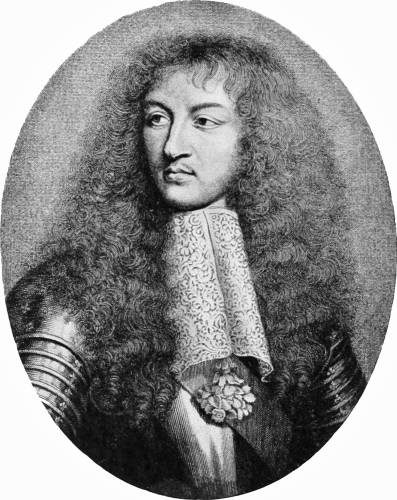
In the nineteenth century it was customary to treat the Grand Monarque and his Grand Siècle with contempt. It was one of those momentary fits of rage into which Progress falls when it beholds its father's ghost in history. The rage has passed—in France at all events—and Louis XIV. and his famous century are receiving more flattery now than even Voltaire bestowed on them. They have become national monuments. Every schoolboy has parsed one of Bossuet's oraisons funèbres; every soldier has heard of Condé, every woman remembers the romance of Mademoiselle La Beaume Le Blanc de la Vallière. And there isn't a Socialist workman who goes with his wife and children on a Sunday to see the fountains play at Versailles but has some difficulty in choking the "Vive la France!" that sneaks in his throat as he strolls through the historic pile dedicated to All the Glories. For everybody has been taught that Louis XIV. in his long reign of seventy-two years—the longest, by the way, in history—did something more than powder his hair with gold-dust, wear high-heeled shoes, and tamely submit to Madame de Maintenon. Among his many shining endowments he possessed the royal faculty of recognising and appreciating talent in others. As in the earlier part of his reign, at all events, there happened to be a profusion of ability in France, he was served as only the very great are ever served. Nowhere was this more apparent than in the agents he sent to England. They were first-rate diplomatists. Their despatches were sprinkled with all sorts of gossip, on dits, and trivial details, which were awaited with impatience and devoured with avidity at Versailles. An English despatch was not unlike a brilliant society novel. Thus it happened that the personnel of Whitehall was as familiar to Louis as that of Versailles; the English people and their "principles" as well known as the condition of his own country; and the life, character, and habits of Charles II. better understood than, perhaps, those of any other person in Europe.
To one so well informed as Louis the key to the riddle, "How is the slippery Charles to be held?" was "Woman." At the time of the death of Madame there was no sultana in the seraglio at Whitehall. This was Louis' chance. His Ambassador and his creatures, the English Ministers, assured him that the Duchess of Cleveland had ceased to be worth her price, that Charles had appeared much smitten with Mademoiselle de Kéroual when she came to England with Madame, and that in their opinion French interests could not better be served than by sending the aforesaid maid of honour to England as soon as possible. Louis and his Council gave the matter their due consideration, and Louise de Kéroual, only too willingly, as her fortunes were now at a very low ebb, started for Whitehall. She was clearly given to understand the capacity in which she was going, the influence that sent her, and the duties expected of her. Buckingham engaged to take her back with him after Madame's funeral, but "he totally forgot both the lady and his promise, and leaving the disconsolate nymph at Dieppe to manage as she could, passed over to England by way of Calais." The English Ambassador in Paris, who was not a "Buckingham man" but an "Arlington" one, never gave Buckingham the time to atone for his forgetfulness. He at once sent Mademoiselle de Kéroual over to Lord Arlington at his own expense, whereby he adroitly made a friend of the future maîtresse en titre for himself and Arlington. For, says Bishop Burnet, "the Duke of Buckingham lost all the merit he might have pretended to, and brought over a mistress whom his own strange conduct threw into the hands of his enemies."
The purpose of this visit was pretty well known to the public, to whom "Madam Carwell" at once became an object of detestation. She was, however, favourably received at Whitehall. Dryden, the laureate at the time, and St. Evremond welcomed her in verse, of which the former is too dull and the latter too indecent to quote. At the sight of her Charles at once brightened up, and appointed her to be one of the maids of honour to Queen Catherine, giving as his excuse that it was out of a "decent tenderness" for his sister's memory. Poor Catherine, knowing the purpose for which her new maid of honour had been appointed, disliked her from the first. But Catherine had learnt wisdom in the course of her married life, and though she hated the new favourite as much as she had ever hated the Castlemaine, she accepted her without a protest.
Not so her Grace of Cleveland. She fought with her characteristic fury to retain her threatened power, and owing to the subtle coyness of Louise appeared to keep her ascendency over the King. For the cunning Breton girl understood that to yield to Charles at the first assault was not the way to keep him, so she adopted the tactics of La Belle Stuart and played the prude. But it was some time before this strategy was appreciated by Louis and his creatures at Whitehall. The French Ambassador became alarmed. "I think it safe," he wrote to Louis, "while undermining the Duchess of Cleveland to keep her on our side by appearing to be with her."
The correspondence that passed between the French Ambassador and the French Court on this subject gives a more vivid impression of the way the game of politics was played by the Great Powers at the time of the Restoration than any history on the subject.
At length the Ambassador was able to write to Louvois, "I believe I can assure you that she has so got round King Charles as to be of the greatest service to our sovereign and master, if she only does her duty."
This news revived the drooping spirits of the Court of France, but it was still impatient for some proof of her power. Arlington, one of the Cabal Ministers, who was as much interested in her success as Louis himself, therefore decided to bring about the long-anticipated dénouement by inviting the Court to Euston, his palatial country seat, where by a counter-strategy it was hoped the cautious Louise would be forced to yield. The Ambassador, in imparting this information to Louvois, wrote:—
"Milord Arlington told me to advise Mademoiselle de Kéroual to cultivate the King's good graces, and so to manage that he should only find in her society enjoyment, peace, and quiet. He added that if Lady Arlington took his advice she would urge the new favourite to yield unreservedly to the King or to retire to a French convent.... The King did me the honour yesterday to sup at the Embassy, when he proved to me, by indulging in a gay and unfettered debauch, that he does not mistrust us."
The satisfaction this news gave to Louis may be judged from the following extract from Louvois' reply:—
"His Majesty was vastly amused with all that was in your letter about Mademoiselle de Kéroual, and will have pleasure in hearing the progress she makes in the King's favour. He even jested on the subject, and says there must either be small love felt for the mistress or great confidence felt in you to suffer you to go to Euston in such jolly company."
As may be imagined, the house party at Euston produced the result expected of it, and the way in which this result was effected is as illuminating as the above correspondence. It was quite in keeping with the total absence of morality which characterised all who were engaged in the intrigue. "Lady Arlington," says Forneron, "under the pretext of killing the tedium of October evenings in a country house, got up a burlesque wedding, in which Louise de Kéroual was the bride and the King the bridegroom, with all the immodest ceremonies which marked, in the good old times, the retirement of the former into her nuptial chamber."
As this book is not conceived in a prurient spirit we shall forbear to give the reader a description of the "ceremonies" connected with this mock-marriage. Suffice it to say that the French Ambassador's report of the "nights at Euston" reads like an account of a Palais Royal farce. In an age of such unashamed publicity as the Restoration, no attempt was made to keep the doings of the Arlingtons' house party out of the press; consequently the pamphlets of the day revelled in reporting the spicy details of this Euston saturnalia with as much zest and in the same spirit of hypocrisy as the press of the present takes in a smart society lawsuit. While the coffee-houses, which corresponded to our modern clubs, rung with gossip of the new French mistress of the King, who was reported to have protested to some noble lord against the scurrility to which she was subjected by the public: "Me no bad woman. If me taut me was one bad woman, me would cut mine own trote."
Of course, what happened at Euston was much exaggerated. Evelyn, who was a guest of the Arlingtons, declares that he never witnessed any of the things the newspapers and lampoons reported. Nevertheless, he admits that he was only twice admitted to the royal circle. At any rate, the sequel that occurred nine months later afforded Louis XIV. and "Madam Carwell" the greatest satisfaction. It is well known that next to a mistress Charles loved nothing so much as a child.
After the visit at Euston Louise de Kéroual was the acknowledged maîtresse en titre in place of the termagant Cleveland, retired. Charles appointed her lady of the bedchamber to the Queen, the duties of which post she had the delicacy to abandon to a deputy, and created her Duchess of Portsmouth. At the same time, as there was every prospect that she would hold long what she had conquered, and as a reward for her services, Louis paid her in advance, so to speak, by giving her the title of Duchesse d'Aubigny. As she played the rôle of maîtresse en titre as it was played in France there is nothing in her story henceforth to shock the most modest susceptibilities. All the grossièretés with which the Duchess of Cleveland, whom she supplanted, embellished the post were by her Grace of Portsmouth refined into political intrigues.
Among the many services she was expected to render to her "master," the French King, the principal were:—
1. To induce Charles to declare war against Holland (!)
2. To convert Charles to Roman Catholicism (!!)
3. To persuade the Duke of York, the King's brother and heir to the throne, to marry a French princess.
For Charles to have plunged his newly restored kingdom into a war with Holland, considering the "principles" of the English nation on the subject, would seem incredible. It was, however, the easiest of the Duchess of Portsmouth's tasks. The "principles" were circumvented, reasoned, excused, explained away, conscientiously, be it understood—oh, very conscientiously!—as is always the way with a brave "principle" when confronted with an interest. At the bottom England was jealous of Holland's naval and commercial supremacy. Charles, like the cowboy, knew his broncho; he declared war on Holland to please his mistress and win his French subsidy, and England bucked, and bucked—and fought.
On the other hand, Charles, being no fool, and knowing his broncho thoroughly, was not to be induced to change the form of faith he professed. He had too vivid a recollection of his exile to play any practical jokes on Fortune. If, as is extremely doubtful, he was a Catholic at bottom, it was certainly not from religious conviction. His Huguenot grandfather, Henri Quatre, had said that "Paris was well worth a Mass." Precisely in the same way he reasoned that the throne of England was well worth a confirmation. The Duchess of Portsmouth was far too indifferent herself on this subject to disagree with Charles, and far too cunning to risk her position in England in order to help Louis XIV. weaken the country with another civil war. She therefore made up her mind, says Forneron, "that there was but a single course to follow. It was by slow degrees to habituate the English to a revival of Catholic ideas, rites, and ceremonies." This was but a polite way of telling Louis that if the conversion of England to Catholicism depended on her it would never be converted. Also, knowing the displeasure such a declaration coming from her would create at the French Court, she made it on purpose to show Louis that she was no mere contemptible spy to be ordered about and scolded, but the Duchess of Portsmouth, maîtresse en titre to His Britannic Majesty. This show of independence was based, no doubt, on the certainty of her hold on Charles. For at this time the French Ambassador wrote angrily to Louvois of her Grace: "She has got the notion that it is possible she may yet be Queen of England. She talks from morning till night of the Queen's ailments as if they were mortal."
Scarcely less inferior in importance to Louis than making Charles declare war on Holland and converting him to Popery was the subjection of his heir, the Duke of York. Louis XIV. thought of the future as much as the present. It was above all things necessary to him that if Charles should be unexpectedly carried off his successor should be the friend of France. The surest way of securing this appeared to be by making a match between James, whose wife, Anne Hyde, the daughter of Clarendon, had just died, and a princess of France. Louis, knowing James as well as he did Charles, was aware that he was one of those men who would be governed entirely by his wife. Consequently he proposed a member of his own family, the Duchesse de Guise, the sister of La Grande Mademoiselle and daughter of his uncle, Gaston d'Orléans. But Madame, before her death, had given her brother such an unfavourable account of this widowed princess, who was exceedingly plain, and had "laid in thrice in two years," that James positively refused to consider her. The French Court hereupon got angry at being defied by a stupid Duke of York, and ordered the Duchess of Portsmouth to put on the screw. But here again she was wiser than her employers. For under the pressure of being urged to do what he disliked there was danger that James might suddenly show resentment and marry an enemy of France.
The Duchess of Portsmouth, therefore, suggested that the distinction it was proposed to confer on the Duchesse de Guise should lapse in favour of her own nominee. This was one of the Mesdemoiselles d'Elbœuf, of the princely family of Lorraine. There was no doubt an arrière pensée in this suggestion by which "little Kéroual," as they scornfully called her at Versailles, wished the world to see that she had risen to a height in which she could patronise princesses of Lorraine. Louis, however, had a grudge of some sort against the d'Elbœufs, and Mary of Modena was chosen instead. But the Duchess of Portsmouth refused to give up the cause of her protégées without a struggle, if only to show Louis what a power his spy had become, and quarrelled with the French Ambassador, the Arlingtons, and the French faction generally. It is true peace was made again between the spy and her employers, but she had gained one thing of the greatest importance to her by the quarrel, and that was the recognition by Louis that "little Kéroual" for the future was to be treated with the respect due so great a personage as the Duchess of Portsmouth.
The independence she displayed in this intrigue was made not from any disloyalty to Louis, but from the necessity of enhancing the value of her services—of making hay, as the saying is, while the sun was shining. No one understood better than she the extreme precariousness of her position. Mistrusted and unpopular at Whitehall, and cordially hated by the people, there was nothing between her and ruin but the slippery, fickle King. It was not enough to be Duchess of Portsmouth with ten thousand pounds a year paid out of the wine licenses; if Charles discarded her she would be forced to return to France as poor as she left it, and it was not from the Court of France that she would get protection then. She had to provide against this emergency, and she did it with a cunning and determination for which no one, judging from her "childish, simple, and baby face," as Evelyn described it, would have given her credit. To bleed Louis as well as Charles was her object, and she pursued it with a rapacity that rivalled that of her Grace of Cleveland.
It was comparatively easy to get what she wanted out of Charles. Nell Gwynn had declared that she would be content with five hundred a year, but she managed to mulct the Treasury of sixty thousand pounds in one year and get her son created Duke of St. Albans, with suitable revenues to maintain the dignity. But the spoils of Nell were modest compared with those of the Duchess of Portsmouth. She was never addicted to gambling to the same extent as the Mazarin and the Cleveland, but she could afford to lose five thousand pounds at one sitting, as she once did. The drafts she made on the national exchequer were enormous. Her allowance of ten thousand pounds was generally swollen to forty thousand, and one year she succeeded in drawing the huge sum of £136,668. Like the Duchess of Cleveland, she sold every office that fell vacant; but she went a step further than her Grace, and took commissions on the bribes with which Louis bought his creatures in England, trafficked in royal pardons, and did a good business in selling convicts to West Indian planters. This rapacity never flagged during her reign. Immediately after Charles's death she put in a claim for ten thousand pounds of her pension, which was in arrears, and his successor did not hesitate to pay it.
The furniture that she accumulated in her apartments at Whitehall represented a fortune far greater than her father had amassed in the wool trade.
"Following his Majesty this morning, through the gallery," said Evelyn, who gives a graphic inventory of her sumptuous abode, "I went with the few who attended him to the Duchess of Portsmouth's dressing-room, within her bedchamber, where she was in her loose morning-gown, her maids combing her, newly out of bed, his Majesty and gallants standing about her. But that which engaged my curiosity was the rich and splendid furniture of this woman's apartment, now twice or thrice pulled down and rebuilt to satisfy her prodigality and expensive pleasures, while her Majesty's does not exceed some gentlemen's wives in furniture and accommodation. Here I saw the new fabric of French tapestry" (from the Gobelins looms just founded by Louis XIV.), "for design, tenderness of work, and incomparable imitation of the best paintings, beyond anything I ever beheld. Some pieces had Versailles, St. Germains, and other palaces of the French king, with huntings, figures, and landscapes, exotic fowls and all to the life, rarely done. Then for Japan cabinets, screens, pendule clocks, great vases of wrought plate, table-stands, chimney-furniture, sconces, branches, braseras, &c., all of massive silver and out of number, besides some of his Majesty's best paintings."
Evidently a virtuoso, this mistress-spy, in which connection we cannot help reflecting on the deep and intimate knowledge that Charles, the most cynical and light-hearted of kings, must have had of women. What with meek, faithful Catherines, devoted, antique-chivalrous Flora Macdonalds, coarse, virago Clevelands, neurotic Mazarins, prudish, cunning Stuarts, gay, insinuating Madames, subtle, artistic Kérouals, Nell Gwynns, Moll Davises, Lady Shannons, Lady Dorchesters, and others too numerous to mention, being an intelligent man, his experience of the fair sex must have been wonderfully illuminating.
But even more important to this curious "little Kéroual," of the "childish, simple, and baby face," than the accumulation of plunder in England was the feathering of a nest in France. Much as she valued her English ducal title, in spite of the mockery heaped upon it, there was an honour in her own country that she valued far more. To this thoroughly patriotic Frenchwoman to be Duchess of Portsmouth was a small thing in comparison with the right to a tabouret at Versailles. This was the supreme ambition of a Frenchwoman in the ancien régime. Volumes could be written on the intrigues that the desire to obtain this distinction caused. It is scarcely an exaggeration to say that some of the greatest events in European history have arisen in the quest of a tabouret. "To think," said Sobieski, the hero-king of Poland, who had married a Frenchwoman whose life was spent in the attempt to get this supreme feminine honour—"to think how she longs for that miserable stool on which nobody can sit at ease!"
The intrigues of the Duchess of Portsmouth to win her tabouret at Versailles might be likened to a game of bridge in which she and Charles II.—whose hand she played—were opposed to Louis XIV. and his Ambassador, Colbert de Croissy (a brother of the famous Colbert). In this diplomatic bridge the cards were so evenly distributed that the odd trick was only to be won by the most careful play. In any case, from the start the honours, so to speak, were held by the Duchess and Charles. We have stated that in recognition for her services at Euston, of which the immediate effect was the declaration by England of war on Holland, Louis XIV. had conferred on his spy the title of Duchesse d'Aubigny. The history of this duchy is rather interesting, and the title was an ace in her Grace's hand.
Aubigny was a French ducal fief that two hundred and fifty years before had been conferred by a King of France upon a cadet of the House of Stuart. It was to return to the French Crown on the demise of the last male heir of the line, and this event had just taken place by the death of La Belle Stuart's husband, who was the last Duke of Richmond as well as of Aubigny. The latter title having been conferred on Louise de Kéroual by Louis, and both having for so long been borne by the head of the same family, she determined to secure the former for her son by Charles, who would thus as her heir once more reunite the two. This, in fact, was effected without the least trouble, and the Dukes of Richmond are also Ducs d'Aubigny down to the present day. But the empty title of Duchesse d'Aubigny by no means satisfied this cunning woman. She wished the ducal terres as well. To possess them was to possess the coveted tabouret at Versailles, to win the odd trick in this game of bridge. For to be able to have the sublime distinction of sitting on a stool in the presence of the King of France one must not only be a duchess in name but own one's duchy in fact. This, then, was the manner in which the Duchess of Portsmouth sought to provide against a rainy day at Whitehall.
Considering that, in spite of inducing Charles to declare war on Holland for the benefit of France, she had failed to convert him to Roman Catholicism, and shown an independence, most unwelcome to the French Court, in the Duke of York's marriage affair, Colbert de Croissy did his best to defeat her. Clever diplomatist though he was, the contempt with which she had treated him during the business of marrying the Duke of York secretly rankled, and he could not resist the temptation to thwart an enemy. To describe all the moves and counter-moves in this sordid intrigue is impossible here. Suffice it to say the Duchess was too much for the Ambassador. Louis was obliged to replace him by the more tactful Ruvigny, an honest Huguenot, who found the work he was required to do such a "filthy traffic" that he too was recalled and replaced by the sly Courtin, at the time the Duchesse de Mazarin suddenly alighted at Whitehall and in a trice all but ruined Louis' subtle schemes.
But the very eagerness the Duchess of Portsmouth displayed in regard to the tabouret gave Louis, who had begun to mistrust her independence, an advantage. He promised to gratify her on the condition that she obeyed him unquestioningly for the future, and gave proof of her loyalty by completing some very delicate business he was now engaged in. The business was indeed delicate, but nothing in comparison with the difficulties the spy had to encounter in performing it. With the tabouret in sight, however, she set to work right bravely.
Louis XIV., having taken the opportunity while England and Holland were at war to plunder Spain of Flanders, was now anxious to swallow the Franche Comté and the Palatinate. Hereupon all Europe became terrified, and England and Holland hastened to patch up their differences. All the Ministers and Members of Parliament whom Louis had bought suddenly turned against him. The patriotism of the whole nation was profoundly stirred. Even Buckingham turned Puritan—for a time. With his broncho bucking like this Charles was obliged to exert all his skill to save himself from being thrown. He disbanded the regiments, to keep up which, in case he should need them, Louis had paid him eight million livres. Moreover, at this critical time, when the Duchess of Portsmouth was of the utmost consequence to Louis, she fell seriously ill. The less said of this illness the better, it was anything but creditable to her royal lover. Misfortune seldom comes alone, and to discourage her Grace still more a large sum of money and her jewels were stolen, while at the same time the Duchesse de Mazarin arrived and fascinated Charles. Never had Louise de Kéroual been so near utter ruin. Even Louis began to neglect her now. "She who was so plucky and fertile in resources," says Forneron, "began to lose courage. Courtin wrote to Louis to communicate to him a scene that took place in her apartment. He went to visit her at Whitehall and found her weeping. She opened her heart to him in the presence of her two French maids, who stood with downcast eyes close to the wall, as if glued to it. Tears flowed from their mistress's eyes; sighs and sobs interrupted her speech. M. Courtin stayed with her until midnight, trying to soothe her wounded spirit. Louvois made fun of her troubles, and coarsely wrote that the scene of la Signora adolorata had vastly amused his Majesty."
But perhaps to "little Kéroual," now so sunk in favour, hourly expecting to be dismissed by the fickle Charles, and to be publicly disgraced like Jane Shore, nothing seemed so hard to bear as the ridicule showered upon her by Nell Gwynn.
Nell inspired her with fear as well as hate. In the bottom of her heart Louise de Kéroual knew what she was; every time she looked into her mirror it was not a duchess but a prostitute she saw reflected in it; in many a moment of triumph shame leered at her suddenly from under the flattery of Ambassadors and Ministers, Court ladies and serving-maids. A prostitute and a prostitute's fate haunted her everywhere. It was to escape the terror of this ghost that she tried to disguise herself as a Duchess of Portsmouth and a Duchesse d'Aubigny. The same reason induced her to make people in England believe she was closely related to the illustrious family of Rohan by going into mourning when one of its junior members died. It was also the underlying motive of her desire to possess the right of a tabouret, whereby she hoped to strangle the scorn of Versailles. And Nell Gwynn stripped her masks from her and dragged her down to her own unspeakable level in a way that no art could baffle. A specimen of Nell's method of torturing her rival would scarcely be suffered in print nowadays, but some idea of it may be got from the following style in which Madame de Sévigné describes it, taking advantage herself of the occasion to sneer at "Kéroual":—
"This is how Gwynn argues: 'That hoity-toity French duchess sets up to be of grand quality. Every one of rank in France is her cousin. The moment some grand lord or lady over there dies, she orders a suit of deep mourning. Well, if she's of such high station, why is she such an (unprintable)? She ought to be ashamed of herself! If I were reared to be a lady, I am sure I should blush for myself. But it's my trade to be a (likewise unprintable), and I was never anything else. The King keeps me; ever since he has done so I have been true to him. He has had a son by me, and I'm going to make him own the brat, for he is as fond of me as of his French miss.'"
She had to endure Nell Gwynn just as Queen Catherine had to endure herself and the Duchess of Cleveland.
It is not likely that Courtin was touched by the sight of her dejection when he paid her the visit mentioned above. Louis XIV.'s Ambassadors in England never wasted sympathy on those who were falling from power. But an event unexpectedly occurred at this critical juncture that proved advantageous to the spy. The Duchesse de Mazarin, "that female Buckingham," as Mrs. Jameson very aptly calls her, recklessly threw her great opportunity away by falling madly in love with the Prince of Monaco, "who came to England for two weeks and prolonged his visit for two years." Hereupon the sly Courtin advised her Grace of Portsmouth to dry her eyes and entertain. This advice was followed with considerable success, and Charles's lukewarmness was once more turned to boiling heat when Louise, who had gone away to Bath to take the waters, returned more blooming than ever. With the restoration of her health all her energy and cunning returned. Feeling the need of powerful English friends, and perhaps, too, from the devotion she always showed to her family, she sent to France for her sister Henriette, and married her to the Earl of Pembroke, on which occasion Charles gave the bride away, and a handsome dowry as well. Her power over her royal lover being once more established, and as an incentive to her loyalty of which at such a critical situation Louis had more need than ever, he now bestowed on her the ducal estates of Aubigny, with the right of transmission to her son, and the coveted tabouret. About the same time Charles created the issue of this amour Duke of Richmond.
The cunning of the Duchess of Portsmouth was never better displayed than on this occasion. For Charles, who was still afraid of her Grace of Cleveland, in order to allay her jealousy, had created his eldest son by this former mistress Duke of Grafton. But far from allaying the jealousy of the Duchess of Cleveland, it aroused that of the Duchess of Portsmouth as well. Each determined that her own son should take precedence of the other's; this could only be settled by one woman getting the letters patent signed before the other. The Duchess of Portsmouth now gave evidence of the ingenuity she possessed, for learning that the Minister whose duty it was to affix the seals to these patents was starting for Bath, she went to him at night just as he was stepping into his carriage, and thus "did" her rival, who arrived the first thing the next morning to find him gone and her object defeated. History does not relate her Grace of Cleveland's language on this occasion.
Fortune once more smiling on "Madam Carwell," she worked for Louis with a right good will. "It is to her," says Forneron very fittingly, "more than to any statesman, that France is indebted for French Flanders, the Franche Comté, her twice secular possession of Alsace, her old ownership of the valley of the Mississippi and Canada, and her lately revived claim on Madagascar." Louis thoroughly understood that if his dream of empire was ever to be realised, it could only be by the aid of England. But the English people were in a white rage with France, due to the unblushing policy of Louis, which directly menaced the existence of England. And political fear was kept alive by religious hate. "They will vote anything against us in the House of Commons," reported Courtin, "and they say they are ready to sell their shirts off their backs to keep the Netherlands from being seized by us. These are the very words they make use of." Active assistance, an alliance, was clearly out of the question. And the temper of the English people being such, could even their passive aid be counted on, would they be content merely to look on angrily while Louis carved up the map of Europe to suit him?
To Courtin this seemed improbable. "Make haste to conquer what you can," he wrote to Louvois dejectedly. "Clearly not the man for the delicate work he has to do," thought Louis. So Courtin was recalled, like Colbert de Croissy and Ruvigny before him. All three were men of exceptional ability—men trained in the school of Mazarin to specialise their talents, and to each of them the Court of Whitehall proved a labyrinth whose man-devouring Minotaur was the Imperial policy of Louis Quatorze.
Courtin was succeeded by Barillon, who, says Forneron, "was master in the art of corrupting men, and of hiding his contempt for those whom he corrupted. He resembled those Ambassadors of Phillip II. who showered doubloons on the Catholic conspirators, affected interest in the democracy of the League, saw their heads fall without a shudder, and when the game was lost, prepared coolly for a new one." As if to render the Machiavellian abilities of this man still more dangerous, nature had gifted him with warm human affections and an exquisite sense of the Beautiful! Barillon is probably the greatest Ambassador that ever represented a foreign nation at the English Court.
He came to do what Courtin had considered improbable, and what would have been impossible but for the help he received from the Duchess of Portsmouth. Between Barillon and the spy there was the most perfect understanding. Only a miracle could keep England passive while Louis XIV. crossed the Rhine, but the two magicians performed it. With all his cunning Charles II. had at last over-reached himself in his dealings with the nation. He had squandered his Fortunatus' purse of power and, like all spendthrifts, he was forced to go to the usurers. There were only two in Europe able to advance Charles the sums he required. These were his partner, England, and Louis Quatorze. The usury exacted by the former became with each call higher and higher; by this fortuitous means the English people were gradually recovering the liberties they had allowed themselves to be swindled out of at the beginning of the reign. At each session of Parliament Charles was obliged by his extravagance to relinquish more and more power. He had so fallen into the hands of this usurer that it was even proposed in the House of Lords to impeach the Duchess of Portsmouth. Whereupon one peer cynically remarked "that they ought rather to erect statues to the ladies who made their lover dependent on Parliament for his subsistence."
Charles was faced with the humiliating prospect of sinking from the head of the firm to the position of mere clerk, when Barillon and the Duchess of Portsmouth offered to set him on his feet again. They stipulated for one condition only: that he would calmly look on while Louis ate up Spain, Holland, Germany, and even the Pope. To have escaped from the hands of the Parliament Charles would willingly have consented if Louis had proposed to make himself master of Asia, Africa, and America as well. But the sum he required to clear him of his difficulties staggered Louis; there was such a thing as paying too big a price even for Europe. "The plea," says Mrs. Jameson, "used by Charles to persuade Louis to come to his terms was, 'that it would render England for ever dependent on him, and put it out of the power of the English to oppose him.' These were the King's own words." France had already spent immense sums in bribes without any satisfactory remuneration, but Louis now exacted usury for the money he advanced. The English Parliament was to be dissolved sine die, in order that Charles should do Louis' bidding without the remonstrance of his subjects. In return for this independence Charles was to receive four million pounds, the receipt of which he was to acknowledge duly. In this way if Charles tried to be slippery Louis could threaten him with exposure. Barillon admits that he had orders to blackmail him the moment he attempted to be independent. Charles's receipts are still to be seen in the French Archives. He had fallen from the frying-pan into the fire with a vengeance. One had to have one's wits about one to get the better of Louis XIV.
The rage of the English people at finding themselves "done" in this way by their King was overmastering. Totally ignorant of Charles's compact with Louis, they nevertheless beheld the result in the triumph of France against coalesced Europe. Nor was England's rage at this triumph lessened by the knowledge that it was due to her own neutrality. "The English people," says Forneron, "were carried away against the Catholics by one of those frenzies of contagious hatred which sometimes take hold of a nation like an epidemic. When a nation is possessed by a fit of such fury, there is always a statesman ready to pander to it."
It is not here that we can describe the character of Ashley Cooper, Earl of Shaftesbury, and all the details of that tissue of iniquity known as the Popish Plot. For this English Dreyfus Affair the reader is recommended to any History of England. "Shiftsbury," or "the most vicious dog in England," as Charles called him, was a seventeenth-century opportunist with a truly marvellous faculty of recognising psychological moments. He was also that exceedingly rare individual, a genuinely bad man. He organised the Popish Plot, and sprung it on the nation at the ripe moment to clear the road for his own ambition. On the wave of terror it created he was carried to power. In the intense excitement of the time the life of no Catholic in the country was safe, and Shaftesbury's creature, Titus Oates, accused even poor Queen Catherine. The Catholic Duke of York, like the coward he was, fled from England; the King himself, for his own security, dismissed his band of French musicians and was ready, if necessary at a moment's notice, to abandon his favourites to the popular fury. Revolution was shaking the throne. Among the strange phenomena that were witnessed in this period of chaos not the least curious was that of Nell Gwynn, posing as the head of the Protestants. It is, perhaps, not too much to say that the part she played in this religious convulsion of the English people explains the leniency, closely resembling popularity, with which she alone of Charles's mistresses is regarded by posterity. Of all the volumes that have been written on the Restoration no light has ever been shed so clearly on the character of the times as the fact that Protestant England could hail with acclaim a king's mistress as its champion. A while before it had been the Duchesse de Mazarin, now it was Nell's turn. The atmosphere of the Restoration had contaminated even morality itself.
In such a state of affairs the position of the Duchess of Portsmouth was very grave. Both Houses of Parliament demanded her impeachment, and the people clamoured that she should be executed in the Tower along with the fallen minister, Danby, who was already there. She fell ill from sheer fright. Barillon, however, alone of mortals, kept his head. He advised her, if possible, to make friends with Shaftesbury, and this, as if to make confusion still more confounded, she succeeded in doing. But in this hour of unparalleled success Shaftesbury made the first blunder of his political career. A severe attack of malignant fever threatening the King's life, the question of the succession became acute. Shaftesbury proposed the Protestant Duke of Monmouth, the King's eldest bastard, as the heir to the throne in place of the Duke of York, and the Duchess of Portsmouth got drawn into this Monmouth intrigue. Hereupon the Prince of Orange, afterwards William III., as a Protestant and the next legitimate male heir after the Duke of York, appeared on the scene—the Prince of Orange, a cold Northern Machiavelli, with an openly avowed and undying hatred of Louis XIV. and France. Shaftesbury and the Popish Plot had turned England into a pandemonium.
"I believe," wrote Barillon to Louis, "each now wishes to save himself at the cost of the others."
A profound darkness seemed to have fallen on the frenzied nation, in which for a time Barillon and the Duchess of Portsmouth became separated. Monmouth was effaced by the lampoons which, owing to the imprudence of her Grace's maid, Mrs. Wall, connected him with the hated Duchess. Shaftesbury was dislodged from power by his rival Sunderland, who maintained himself largely by the aid of the cunning Frenchwoman who by her devotion, by the knowledge she had of Charles's shameful secret understanding with Louis, and by her ability, with which she deeply impressed her royal lover, still continued maîtresse en titre and spy of the Court of France at Whitehall.
But in the darkness in which all groped the adventures of none were more curious than Louis'. He bribed lavishly every one he stumbled against, so to speak, to show him the way towards the light. No price was too great to pay, no abasement too shameless, that would keep the Prince of Orange from succeeding Charles II. History has revealed the extraordinary spectacle of the Presbyterians hobnobbing with his Most Christian Majesty, the Republican party in England allied to the French tyrant!
"Baber continues to work the Presbyterians," wrote Barillon. "It is through him that I have gained two popular preachers who can insinuate things that it would never do to say openly. I know that they have spoken in the pulpit of a matter which would not count anywhere else, unless here, but which in England is no trifle. It is that the Prince of Orange hunts on Sundays."
Barillon had got into the skin of the nation to which he was accredited. Whether Louis laughed at the depth of religious hypocrisy that took his bribes and objected to hunting on Sundays, is not recorded; perhaps not, the situation was too serious even for his sardonic humour.
The first to emerge from the labyrinth of the Popish Plot was the Duchess of Portsmouth. On her heels came Louis and Barillon. Behind them in the dark groped Shaftesbury and Sunderland, Monmouth and the Prince of Orange, and a host of "faith and freedom" men who were taking French money and salving their consciences by trying to cheat those who gave it to them. The tide of revolution was ebbing fast; a calm succeeded the tempest. Whitehall recovered its gaiety and levity; the Restoration its license; King Charles his health and cynicism. By the help of Louis he believed himself secure for the rest of his life, and he did not care in the least what happened to England and the House of Stuart afterwards. Reresby has given us the following account of a typical day in his life at Newmarket about this time: "He walked in the morning till ten o'clock, then he went to the cock-pit till dinner-time. About three he went to the horse-races; at six he returned to the cock-pit for an hour only. Then he went to the play, though the actors were but of a terrible sort; from thence to supper, then to the Duchess of Portsmouth's till bedtime, and so to his own apartment to take his rest."
In this distribution of his time it will be seen that no mention is made of business. As a matter of fact he did none, because, Parliament being dissolved indefinitely, there was none. Such routine work as there was Sunderland and the Duchess did between them. The only business that the English King was called upon to transact was the signing of the receipt for his French subsidy every quarter, which he managed to get paid in advance. The extraordinary indifference he manifested in his deportment accounts entirely for the Duchess of Portsmouth's continued favour. She had long ceased to be his mistress in anything but name, yet never was her position so secure. She had become one of the habits to which Charles had enslaved himself. The dream of her life had been to appear at Versailles for a brief moment and have the exquisite satisfaction of sitting on her tabouret, and compelling the proud, contemptuous ladies of the French Court to treat her as their equal. And it was now that, absolutely confident of her place, she dared to run the risk of losing it by visiting France. She, however, took the precaution to draw her quarter's pension in advance. Her reception at the Court of France was triumphal. "There has never been a parallel for the treatment she meets with," says Saint-Simon. "When, on a high holiday, she went to visit the Capucines in the Rue St. Honoré, the poor monks, who were told beforehand of her intention, came out processionally to receive her, with cross, holy-water, and incense. They received her just as if she had been the Queen, which threw her all in a heap, as she did not expect so much honour." Perhaps it was at this time that "her portrait as the Madonna with her son as the Child was painted for a rich convent in France, and used as an altar-piece."
Her Grace's ostensible reason for visiting her native country had been to take the waters of Bourbon, and on completing her cure she gave herself the pleasure of visiting Aubigny. So pleased was she with her feudal castle, feudal rights, and feudal acres that she could have received the worst news from England with but little genuine distress. Her presence, however, was required at Whitehall as much by Charles as Louis, and after a four months' holiday she returned to England. Her visit was not without profit. Among the items of private business she transacted during her absence were the investing of her English fortune in French securities; the wheedling of an abbey out of Louis for one of her aunts who was a nun; and her recognition of the Duke of York's right to the Succession, whereby she made a friend of James, whose star was once more in the ascendant.
The splendour of her social success in France was, on her return to Whitehall, reflected in the cordiality with which she was welcomed by the great English peeresses who had formerly snubbed her. Far from losing ground during her absence, she had gained it if possible. The English Court regarded her quite as one of the royal family. She received the foreign envoys even before they presented their credentials to the King. For speaking slightingly of her the Dutch Ambassador was obliged to apologise in person; while for the same reason she complained to Queen Catherine of one of her maids of honour, who was punished for her insolence by the loss of a quarter's salary. She effaced Charles's unfortunate consort more completely even than had the Duchess of Cleveland. In justice to her, however, it must be confessed that her conduct to Catherine was nearly always respectful. From the time of the Popish Plot to the end of the reign, nothing of any importance transpired without her initiative or sanction. When Louis decided that it was time to marry the Princess Anne, the Duchess of Portsmouth provided the necessary husband in Prince George of Denmark. It is true she had many enemies, notably the Duchess of York, who despised her, but none of them dared offend her. She was virtually the proconsul whom Louis XIV. had appointed to govern England, which he had reduced to a "province of France."
Philippe de Vendôme, Grand Prieur de France. From an old print in the British Museum.
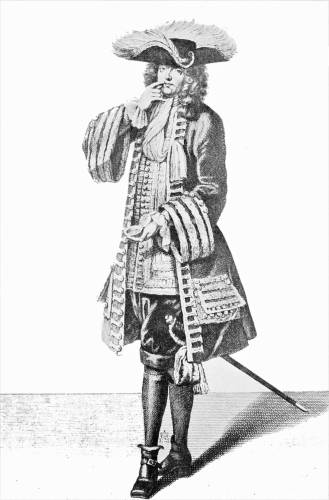
So complete was her power that her life dragged monotonously till there came one to colour it in the person of Philippe de Vendôme, Grand Prieur de France. This man was the grandson of Henri IV. and the Charmante Gabrielle, and his mother was Mazarin's eldest niece, Laure Mancini, the only one about whom there was never any scandal, and who had died shortly after his birth. He was, consequently, a nephew of the Duchesse de Mazarin. He was also the younger brother of the famous Duc de Vendôme of whom Saint-Simon has said so many infamous things. But perhaps his special attraction in the eyes of the Duchess of Portsmouth was that he was the nephew of the Duc de Beaufort, her first lover, and the man who had given her her first start in life. He had been banished from France, for what reason is not clear. Perhaps it was for the cowardice he had displayed in action, for he was an arrant coward and braggart. "He slipped out of a duel," says Forneron, "about the Duchesse de Ludre with M. de Vivonne by riding off to the country and out of the army on the eve of the battle in which Turenne was killed." Be this as it may, he had been obliged to quit France. Like most exiles in the seventeenth century, his personal knowledge of the various countries of Europe was extensive and intimate—especially of the "night-life" of Courts and capitals. Among his adventures was the partnership, terminable without notice, that he formed at Rome with his cousin, the Duchesse de Mazarin's daughter, the Marquise de Richelieu, "a wanderer like himself." If one may believe Saint-Simon, whose portraits of the Vendôme brothers are of the kind that one is inclined to consign to the flames with the tongs, the Grand Prieur "never went to bed sober during thirty years, but was always carried there dead drunk; was a liar, a swindler, and a thief; a rogue to the marrow of his bones, rotted with vile diseases, the most contemptible and yet most dangerous fellow in the world."
Saint-Simon made these agreeable remarks about the Grand Prieur many years after his visit to England. At the time the Duchess of Portsmouth "retained him in London with a tenderness so undisguised as to excite the raillery of the whole Court," he was a handsome and attractive rake of twenty-eight. At first mere love of notoriety made him pay his attentions to the Duchess, who, from some motive best known to herself, appeared to be flattered by them, whereupon King Charles did the Grand Prieur the honour to be jealous of him. As a scandal was the last thing the prematurely worn-out epicurean Charles wished, he dared not show his jealousy openly by ordering Vendôme out of the country. He preferred to apply to Barillon to help him get rid of his odious rival. Barillon, at once alarmed at the consequences the King's jealousy might have upon the Duchess of Portsmouth's position, expostulated with the Grand Prieur. But the grandson of Henri IV. and the charming Gabrielle, recognising from Charles's jealousy and Barillon's anxiety to what profit to himself he could put certain letters her Grace had had the imprudence to write him, refused to quit Whitehall. Tableau: Charles in a white-hot rage (very, very rare with him); the Duchess of Portsmouth in terror; Barillon in a state of stupefaction. Louis, however, helped her Grace out of her scrape by paying the blackmailing Grand Prieur his price, which was the privilege to return to France.
There is no proof whatever that the Duchess was guilty in this affair of anything more serious than the indiscretion of confiding to paper the fascination her dashing countryman had for her. And though her name was coupled wantonly with the Duke of Monmouth, Sunderland, and her favourite minister Danby, it is perhaps safe to say that the Duchess of Portsmouth was the most faithful to Charles of all his mistresses. Certainly, in spite of the ennui the security of her power might have induced, she never again ran the risk of dissipating it by flirtations with unprincipled Grand Prieurs.
Ennui, however, was not an emotion that even a Duchess of Portsmouth, sated with power, could long experience at such a Court as Whitehall. Shortly after her Vendôme fright came the Rye House Plot. This plot within a plot had for its object the guaranteeing of the Protestant Succession. It was really the backwash of the Popish Plot, and was the last vain effort of Shaftesbury to regain power by compelling Charles to summon a Parliament, in which he and his party intended by a coup d'état to humble or, if necessary, to banish the dynasty. By some fatality a group of fanatical Protestants were at the same time independently conspiring to bring about Shaftesbury's end by murdering both Charles and the Duke of York. One of their number proved a traitor. Charles was warned and the assassins captured. The Court, which was perfectly aware of the political aspirations of Shaftesbury and his party, unscrupulously but adroitly seized the opportunity to implicate the principal members of the Protestant or Whig party in the Assassination Plot of which they were wholly ignorant. Never was a triumph more remorseless and complete. With Shaftesbury fled and the others beheaded, the Catholics more than got their revenge for what they had suffered at the time of the Popish Plot. There was no longer any question but that the Duke of York would succeed his brother and France continue to direct the policy of England. Louis XIV. promptly seized Luxemburg. The Grand Siècle was now at its zenith.
The French king, however, was not destined to drink deep of the wine of success; the cup he had so craftily fashioned was to be dashed from his lips by William of Orange, and his fair vineyard utterly devastated by the Duke of Marlborough. But who now would have thought, while under a cloudless sky Louis pressed the juice from his grapes, that at fifty-five Charles II.'s race was run? Or that in three short years "France's Poland" would have for ever freed herself from the Sun King? Certainly not the Duchess of Portsmouth, when one Sunday night in February, 1685, Death entered the Grand Gallery at Whitehall, and in a twinkling confounded all the deep and cunning intrigues of the subtlest brains in Europe.
Everybody remembers the justly celebrated passage in which Macaulay has described the voluptuous scene Whitehall presented on that fatal night. What a picture in the Gallery of History it is, this English tableau of the literary Delaroche! What wealth of colour and detail! Fancy that great gallery of Whitehall, "an admirable relic of the magnificence of the Tudors, crowded with revellers and gamblers," in which Charles sat "chatting and toying" with the Duchesses of Cleveland, Mazarin, and Portsmouth, and listening to the clink of "gold heaped in mountains" at the basset-table while the Mazarin's "French page, a handsome boy, whose vocal performances were the delight of Whitehall, warbled some amorous verses." Then picture the consternation of all those revellers and gamblers in that splendid corridor when the King, suddenly stricken with apoplexy, tumbles into the arms of a courtier standing near! For lack of a lancet they opened his vein with a penknife; a hot warming-pan is placed on his head. "A loathesome volatile salt, extracted from human skulls, was forced into his mouth. He recovered his senses; but was evidently in a situation of extreme danger." For a week he lingers, begging the people who crowd his death-room pardon for the unconscionable time he takes in dying; polite, witty, good-natured to the end, and not forgetting to recommend his mistresses to the care of his successor!
No king that we can recall has ever died in such pomp of flippancy as Charles II. Louis XV. dismissing du Barry and making his amende honorable to God; the Regent d'Orléans dropping dead in the arms of the Duchesse de Falaris; and Louis XIV. solemnly setting out for the Plutonian kingdom with all the etiquette of Versailles, are historic death-scenes that strike the imagination. But to us they all seem to pale beside the studied, godless levity of Charles's. It was characteristic of the era which died with him, for in reality the death-bed of Charles II. was likewise that of the Restoration.
And how fared the Duchess of Portsmouth in this catastrophe? "I found her," wrote Barillon to Louis, "in great grief. But instead of bemoaning her own sad and altered position she took me into a little room and said, 'Monsieur l'Ambassadeur, I am now going to tell you a secret, although its public revelation would cost me my head. The King of England is at the bottom of his heart a Catholic, and there he is, surrounded with Protestant Bishops! There is nobody to tell him of his state or speak to him of God. I cannot decently enter his room. Besides, the Queen is now there constantly.'" (Poor little Catherine, who went into convulsions and sent to beg his pardon, at which Charles exclaimed, "Alas, poor lady! She beg my pardon! I beg hers with all my heart.") "The Duke of York is too busy with his own affairs to trouble himself about the King's conscience. Go and tell him that I have conjured you to warn him that the end is near, and that it is his duty to save without loss of time his brother's soul."
This forethought of the Duchess of Portsmouth, who was religious au fond like all Bretons, for the salvation of Charles's soul disarms criticism. To scold her for not conforming to our twentieth-century code of morals is preposterous in its presumption. And as we are quite unable to satisfy ourselves as to the exact standard of the morals of her own day, we had better not bother about her morals at all.
An hour after Charles's death King James paid her a visit of condolence. James's object, no doubt, was to keep well with Louis through her. But his reign was short and stormy, and the Duchess of Portsmouth was too clever not to foresee the disaster of 1688. After settling her affairs in England she returned to France. But her interests obliged her to be ever in close relations with the former country, which in the wars waged between the two for nearly twenty-five years exposed her to many humiliating suspicions. On one occasion Louis threatened to exile her; on another William of Orange refused to allow her to land in England. Her worthless son ran away from her and compromised her politically. Her wealth took to itself wings and flew away. In the fire that destroyed the Palace of Whitehall she lost all her precious furniture. For years she was pursued by creditors and haunted by bailiffs. But Louis was grateful for her past services and protected her from the law as far as he could. He gave her a pension to make up for the loss of her English one, and this the Regent doubled. She who had had countless thousands a year was reduced to a paltry eight hundred. But she still had her titles, and till old age overtook her she frequently made use of her right to sit on a tabouret at Versailles, and as Duchess of Portsmouth and ex-mistress of Charles II. swelled the ranks of the Jacobites at St. Germain, much to the disgust of Queen Mary. The last years of her life were passed at Aubigny in a strange mixture of miserliness and religious devotion, completely forgotten by the world in which she had played so great a part.
Fifty years after the death of Charles she died in the full possession of her faculties at the age of eighty-five, having seen all she had toiled for undone, the House of Stuart driven from England and even from its refuge in France. She had outlived Louis and all his splendour and all her contemporaries. It was time for this relic of a crumbling despotism to depart. The mills of God had begun to grind. Another fifty years and the Revolution was to sweep the ancien régime away for ever.