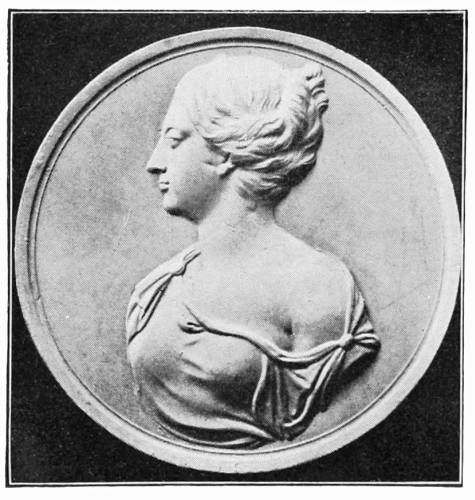
BARBARA VILLIERS, DUCHESS OF CLEVELAND A COURTEZAN OF THE RESTORATION
Reading edition
THE difference between Hortense Mancini and Barbara Villiers is the difference between the refinement and the grossness of vice. If we had met them in fiction we should have said that the former might have been created by Balzac and the latter by Zola. The history of Barbara Villiers is like a study of the progress of vice.
At the first glance it would seem that such a statement was calculated to cause the respectable reader to skip the following biographical account of this British Imperia. But on considering that her name must possess some powerful interest for the imagination, from the quantity of ink that has been spilt over it, and the impassioned diatribes it has inspired, we are inclined to believe that what we have to relate of the famous beauty will fire rather than extinguish curiosity. For no emotion is so pleasant to most of us creatures of circumstance as that of righteous indignation, and that is what her Grace of Cleveland usually excites. Yet it has always seemed to us one of the strangest psychological phenomena that men should fly into a literary passion over the iniquities of persons who have been dead for centuries. Personally, we have never been able, like most people, to look upon Nero as if he were a notorious criminal of our own day, whose trial at the Old Bailey filled a column or two in the morning papers. Nor can we work ourselves up to any heat over a profligate woman, who lived two hundred years ago when she enjoyed considerable public esteem, as if she were still living, when we should, no doubt, have her arrested, tried, and given the full penalty of the law. No people are more ridiculous than the literary policemen who nab historical offenders and prosecute them at the bar of a remote posterity, unless it be the literary whitewashers who defend the same criminals at the same bar. Such convictions and acquittals of the dead are like a burlesque of Justice which lacks the sense of humour. One should remember that Charles II., with all his vices so repugnant to us now, was perhaps from first to last the most popular king that ever sat upon the English throne. People talk of the whole period of the Restoration as if he personally were responsible for its shameless license, quite ignoring the well-known fact that the nation was heartily tired of the "weel-spread looves and lang, wry faces" of the Cromwellian régime. Instead of heaping a late ignominy upon him, it would be more sensible, if equally impractical, to arraign the British people who made him possible. He was but the crowned representative of their own unbridled vices. To us this man, who "never said a foolish thing and never did a wise one," seems, at the distance we have got from him, to be as imaginary as if he had occurred in one of Oscar Wilde's comedies. After two hundred years to treat him seriously is out of the question. His answer to an indignant generation he knows not might very well be his own cynical laugh.
From this it must not be supposed that we intend to flatter the memory of Barbara Villiers. On the contrary, we should prefer to forget her, but this the period in which she lived will not permit us. No mention of the Restoration would be possible without reference to her. So, as we are obliged to consider her, we shall imagine that the "trough of Zolaism" in which we have found her is frozen, and try to skate on it without breaking through.
If Hortense Mancini was non-moral, Barbara Villiers was immoral; she was consciously, unblushingly, gratuitously vicious. There might have been some excuse on grounds of heredity and education for Hortense, but it is impossible to find any excuse whatever for Barbara. It was said of her, when created Duchess of Cleveland, that "the King might add to her titles, but nothing to her birth." She was a Villiers. From her father who died at Oxford, when she was an infant, from wounds received at the battle of Edgehill in the Royalist cause, she should have inherited all the virtues. He must indeed have been a very noble character to judge from the panegyrics pronounced at his death, even by those belonging to a party bitterly opposed to his. But so little did she resemble him, that when we first meet her we find her at sixteen in London—whither she had come to live with her stepfather on the death of her mother—engaged in an intrigue with the second Earl of Chesterfield, a young widower five years her senior, gifted with very agreeable manners and a fine head of hair. That she was allowed full control of her actions by her stepfather may be taken for granted from the following letter addressed to Chesterfield:—
My Lord,
"My friend" (Lady Anne Hamilton) "and I are now abed together contriving how to get your company this afternoon. If you deserve this favour, you will come and seek us at Ludgate Hill at about three o'clock at Butler's shop, where we will expect you, &c."
The consequences of such a correspondence were such as might be expected. Barbara began to look about her for a husband, and as Chesterfield, who at the beginning of this intrigue proved the quality of his passion for the beautiful wanton he was in the habit of meeting at "Butler's shop in Ludgate Hill" by marrying some one else, he was out of the question. In this extremely awkward position she had the luck to meet one of those impressionable, inexperienced youths who, under the glamour of a first and absorbing passion, fancy that nothing is so likely to ennoble, intensify, and immortalise it as the act of marriage. The name of this dupe was Roger Palmer, and he was a young fellow of respectable means and family studying law at the Temple. Where, when, or how Barbara made his acquaintance is unknown; perhaps it is not doing her memory, already sufficiently lurid, an injustice to suggest that the first meeting might have been in the streets when she was on her way to "Butler's shop." For Roger Palmer, excellent young man though he was, by no means belonged to the same rank or moved in the same society as Barbara Villiers. In fact, her stepfather, the Earl of Anglesea, strongly opposed the match, but as he eventually yielded it is to be supposed that Barbara's arguments were irresistible.
Having got the necessary husband, she returned without compunction to her liaison with Chesterfield, whom she was too much in love with to bear him any resentment. As for Palmer, poor creature, he was so blinded with love of his dazzlingly beautiful wife as to remain apparently long in ignorance of the real state of affairs of which he had been the dupe. But the "Mounseer," as his wife spoke of him in her letters to Chesterfield, was not so great a fool as not to be jealous, if still unsuspicious, of the attention Mrs. Palmer received from her admirer. He suggested that they should go into the country to live, where he might have her all to himself.
An unexpected event, however, soon rid him of Chesterfield. This nobleman—of whom Swift many years after declared "I have heard he was the greatest knave in England"—having killed his man in a duel, was obliged to flee the country, and the liaison was interrupted. Shortly afterwards Palmer, who was employed by the Royalists to carry messages to Charles, went to Holland and took his wife with him. Although it is not known with any certainty what sort of reception the Palmers met with at the exiled Court at Breda, there can be little doubt that Barbara, whose character experience had already begun to develop, used Chesterfield, whom she found at Breda, to serve her ends in his turn as cunningly as she had previously used Palmer for the same purpose. It was to her, as all the world knows, that King Charles slunk off privately to spend the first night of the Restoration, treating the joyous acclaim of the people, such as no King of England has ever received before or since, quite as cynically as the pompous official welcome of Sir Harbottle Grimstone, Speaker of the House of Commons. Henceforth, the career of "the finest woman of her age," as she was described by one of her enemies, emerges from obscurity and passes into the full light of history.
So far there was nothing in her life to mark it from that of hundreds of other loose women. She had given no sign of the chef-d'œuvre she was to execute; "like most great artists," says one of her biographers, "she had begun her career by copying conventional methods." But now she was to show a remarkably original talent in the design of vice. Her opportunity, that "tide in the affairs of men" which the great majority of mankind are incapable of using to their advantage, had come; she was not the one to let her chance slip. That she was fully alive to the fortune that dropped on those on whom Royalty smiled is evident from her attempt to capture the favour of the Duke of York while still uncertain of Charles's. We read of a flirtation carried on in church with the heir-presumptive; if she could not be the mistress of the King, she resolved to be that of his brother. Of the necessary qualifications for playing her game successfully, Mrs. Palmer possessed a perfect self-confidence and the power to fascinate. As we do not believe that it is possible to convey any real idea of physical beauty by enumerating its component parts, we will content ourselves with saying, on the authority of her friends and enemies, that Mrs. Palmer was dazzlingly, maddeningly, triumphantly beautiful.
At the Bartholomew Fair, to which she had the hardihood to go, the curses of a mob that threatened to wreck the carriage of the "King's Miss" were turned, at sight of her lovely face, to blessings. She was one of those women who appeal directly to the senses, a rare creature with the irresistible smile of a Circe and the temper of a Medea. Such women do not require intellect.
The siren played her part cunningly. Her husband had at the Restoration been returned to Parliament for Windsor, and lived in London in King Street, Westminster, in the house which had been the regicide Whalley's, now a fugitive in America. Next door, Pepys, as consummate a snob and gossip as he was diarist, used to hear "great doings of music; the King and Dukes at Madam Palmer's, a pretty woman they have a fancy to." It is strange to note how Pepys's admiration for her rose and fell with the King's favour. Exactly nine months after that Restoration night a daughter—afterwards Lady Sussex, bosom friend of the Duchesse de Mazarin—was born in "Whalley's house," about whose birth there was much scandal. The King, already the slave of Mrs. Palmer, acknowledged the child as his, but it was generally believed to be Lord Chesterfield's, "whom she resembled very much." But Palmer, who was either a fool or a very chivalrous man, claimed the baby as his!
Shortly after this scandal the negotiations for Charles's marriage with Catherine of Braganza were begun. At once Mrs. Palmer, who dreaded in the unknown queen a rival to supplant her, prepared to soften her fall and at the same time to prevent it if she could. Already political factions had formed around her, but it was by relying on herself more than on others that she managed to get Charles to send the following note to Morrice, the Secretary of State:—
"Whitehall, 16 Oct., 1661.
"Prepare a warrant for Mr. Roger Palmer to be Baron of Limerick and Earl of Castlemaine in the same form as the last, and let me have it before dinner.—C."
Owing, however, to the hostility of Clarendon, the famous Chancellor, one of those men whose great abilities and integrity are characterised by a total absence of tact, Mr. Palmer did not become Earl of Castlemaine till the 11th of December, instead of "before dinner." In spite of this coveted honour Lady Castlemaine was very nervous as to the future. As she foresaw clearly that with the arrival of the Queen her position was at stake, she determined not to lose it without a struggle. By her termagant temper, by which strangely she held Charles as much as by her beauty, she hectored and caressed the King into appointing her lady of the bedchamber to the Queen. Nevertheless, the interval before the battle-royal began was very trying to her. She quarrelled with Chesterfield and threw him aside like an old glove lest his former connection should damage her at such a juncture in the eyes of Charles. Pepys and his wife saw her at this time at the play of "The French Dancing Mistress," where "with much pleasure we gazed upon my Lady Castlemaine; but it troubles us to see her look dejectedly and slighted by people already."
But nothing tried her temper more than her husband. The poor disillusioned man, thinking of her good name perhaps, if not of his own, had a child born to his wife in these days, of which Charles was undoubtedly the father, baptized as his own by a Roman Catholic priest, to which faith he was a convert. To Lady Castlemaine, hoping to hold the King by the children she had by him, nothing was more vexatious than this well-intentioned spoke in the wheel from a husband whose worth she knew in her heart and whom she had shamefully treated. She burst like a fury upon Castlemaine; had the child re-baptized by the rector of St. Margaret's; and ten days later left her husband for ever, taking with her "the plate, jewels, and other best things, every dish and cloth, and servant, except the porter"—the first indication of the rapacity for which she was later to be famous. On this day, in such a temper as one may imagine, she went to Hampton Court to kiss the Queen's hand for the first time and fight out with her royal rival the battle for which it seems both had been preparing.
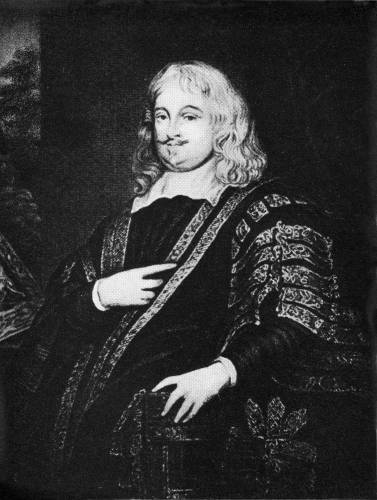
Edward Hyde, Earl of Clarendon. After Sir Peter Lely.
Catherine of Braganza, poor, little, lonely, inexperienced creature, had arrived in England with the fixed determination not to admit Lady Castlemaine into her presence. She came prepared to conquer the heart of her fascinating husband, and lost her own at sight of him. To receive Lady Castlemaine as her lady of the bedchamber was, as Clarendon told the King, "more than flesh and blood could stand." But Charles, who dreaded the ridicule of his courtiers if he yielded to his wife and under the spell of his passionate mistress, remained firm. The Queen was equally obstinate. She declared that rather than submit she would go back to Lisbon "in any little vessel." The honourable Clarendon, to whom such a woman as Lady Castlemaine was personally no less abhorrent than her influence in State affairs was to be dreaded, sided with the Queen, and with his customary tactlessness tried to persuade the King he was in the wrong. The hatred of Lady Castlemaine for Clarendon dates from this period; she never forgave him for "meddling in her business," as she expressed it. As she never hid her dislikes, and in the war of interest fought squarely enough, the Chancellor had much to do to keep his own position secure.
It was she who made Charles write to Clarendon during his thankless rôle of peacemaker—
"Nobody shall presume to meddle in the affairs of the Countess of Castlemaine. Whoever dares to do so will have cause to repent it to the last moment of his life. Nothing will shake the resolution I have taken with regard to her; and I shall consent to be miserable in this world and the next, if I yield in my decision, which is that she shall continue a bedchamber lady to the Queen. I shall to the last hour of my life regard any one who opposes me in this as my enemy; and whosoever shows himself hostile to the Countess will, I swear by my honour, earn my undying displeasure."
The vituperative exaggeration of this letter betrays the real author. Charles merely penned what the beautiful termagant dictated to him.
Such was the state of affairs when Lady Castlemaine left her husband, plundering his house of all it contained before she went, and on the same day got herself presented at the Queen's Drawing-Room by the King himself. Catherine, who till now had never seen her and did not catch her name, received her graciously; a moment later, discovering the trick that had been played upon her, and stung by the publicity with which she had been insulted, the wretched Queen fainted, bursting a blood-vessel. Far from feeling shame at being the cause of such an indecent scandal, not to speak of the misery of a fellow-creature, Lady Castlemaine gloried in her triumph. It is true the Duchess of Richmond, unable to control herself, before the whole Court called her a Jane Shore, and hoped she should live to see her come to the same end! But the Queen's powers of resistance were broken by exhaustion. Not long after Pepys saw the "King, Queen, and my Lady Castlemaine and young Crofts (the Duke of Monmouth) in one coach." Catherine shut her eyes, and Lady Castlemaine moved to Whitehall, into apartments close to the King's.
As for the husband she had degraded and deserted, his state of mind as well as his temperament may be imagined from the fact that he went to France to hide his shame and grief under a cowl in some monastery. This cure for his sick spirit did not, however, prove as efficacious as he had expected. He soon returned and tried a sort of political activity as a substitute, which from time to time drew him for a brief moment out of a respectable obscurity, from which but for his notorious wife he would never have emerged at all.
Great as was her victory and long as her sway lasted, we very much doubt if Lady Castlemaine's power over the King, marked as it was by plunder of the State, was ever so real as before the arrival of the Queen. For some ten years or more, it is true, she continued a sort of maîtresse en titre, but never before or since was such a position assailed by so many storms, or filled by a woman whose actions were so calculated to cause her to forfeit it. No royal mistress has ever treated her lover so brutally, so indecently, so faithlessly as Lady Castlemaine treated Charles, and continued to be a power. He liked wit, and she had none; he liked peace in his establishment, and she scolded him like a Xantippe; he liked flattery, and she reviled him; he dreaded ridicule, and she made him the laughing-stock of his Court and the jest of his people. Even affection was lacking between them; neither of them ever evinced the pretence of it for the other. It is true she had beauty, but others were more beautiful; and after the chain that bound him to her, many times snapped, was finally broken beyond repair, this strange couple continued on good terms. Perhaps psychologists may explain the secret of her hold over him, for never was connection between such a King and such a mistress so inexplicable.
Her first indiscretion, which, one would think, should have proved fatal to her position, occurred shortly after her triumph over the Queen. Charles, whose affection for his numerous progeny was one of the traits of his subtly complex character, had young Crofts, his eldest bastard, brought to Whitehall and publicly acknowledged. He was a singularly handsome and attractive youth, and Lady Castlemaine, under the pretence of "mothering" him, began at once to weave her spells around him. This intrigue did not escape the King; but, instead of overwhelming both with his royal wrath, he paid his mistress the compliment of being jealous, and cynically removed his son from her path by marrying him to the richest heiress in Scotland and creating him Duke of Monmouth. The termagant took her revenge by carrying on a double intrigue with James Hamilton, the brother of the famous Anthony, and Sir Charles Barkeley. It was no secret. "Captain Ferrers and Mr. Howe," wrote gossip Pepys, "both often through my Lady Castlemaine's window have seen her go to bed and Sir Charles Barkeley in her chamber." But Charles merely shrugged his shoulders in his cynical fashion and declared himself "past jealousy." The report, the first of many similar ones, ran "that Lady Castlemaine had fallen from favour." Pepys, however, is able to state that the King still continued to visit her "four nights a week," and was told that "my Lady Castlemaine hath all the King's Christmas presents, made him by the peers, given to her; and that at the great ball she was much richer in jewels than the Queen and Duchess (of York) put together."
It is de rigueur, no doubt, that the reconciliations between a monarch and his mistress should be richly lacquered with gold; but in the annals of royal tiffs there is no gilding so heavy as that which calmed the termagant outbursts of my Lady Castlemaine. If it be true that lovers often quarrel for the pleasure of "making up," how great must that pleasure have been to Barbara Villiers, whose greed of gain was only equalled by her man-hunger!
For these two passions, money and men, consumed her between them. After one of their quarrels Charles gave her £30,000 to pay her debts; after another he made her a present of Berkshire House, a splendid property near St. James's Palace; after yet another her dukedom. But titles were of as little account to this woman with the blood of the Villiers in her veins as silver in the time of King Solomon. What she coveted was cash—cash to squander upon her pleasures, cash to pay her huge debts, cash to stimulate her lovers. As Burnet says of her, "she was enormously ravenous"; so the Customs were farmed for her benefit to the extent of ten thousand a year; likewise she mulcted the revenue derived from the tax on beer of a similar sum, and the Post Office of half this amount annually. But this great income was as nothing compared to the vast sums paid her from the Irish Treasury, instead of from the English, because the corruption was less easily to be detected. As for the Privy Purse, she never went shopping without it. "Make a note that this is to be paid for out of the Privy Purse," she used to say to her maid when anything in the London shops took her fancy. Further, during the period that my Lady Castlemaine played the Montespan to Charles's Louis, all offices that fell vacant, whether spiritual or temporal, were auctioned for her benefit. And, like the true courtezan she was, this literal shower of gold in which she lived ran off her like water through a sieve.
One night she lost £25,000 at play, and her usual stake on a cast was from £1,000 to £1,500. Money had neither meaning nor value for her, but she wanted it and was prepared to get it at all costs. Once too, like the harlot again, she stripped Charles of everything, so that he himself lacked linen and the very servants at Whitehall had not bread to eat!
This abnormal appetite, which consumed even the money set aside for the purchase of the royal stationery, was the concomitant symptom of the nymphomania from which she suffered—a disease perfectly well known to medical science. Without some such explanation it seems impossible to us to account for the innumerable infidelities that Lady Castlemaine indulged in while maîtresse en titre. As Charles had some knowledge of medicine and chemistry, and was very far from being a fool—as the beautiful shrew once called him to his face—one is almost tempted to hazard the suggestion, as an explanation of his long bondage to this woman, that he found a scientific excuse for her conduct which has been overlooked by historians. Be this as it may, it was not long before the lovely Lady Castlemaine found room again for others beside the King in her capacious heart.
To enumerate her lovers, the number of whom exceeded the King's, would not only be impossible but scarcely amusing. Of this legion devoted to the worship of Priapus there are a few, however, that may be cited. As Lady Castlemaine consumed money irrespective of the source from which it was derived, so she never gave a thought to the rank from which her lovers were recruited. My Lady Castlemaine's taste in men was thoroughly catholic. From Barkeley and Hamilton her fancy flitted to her cousin, Buckingham, one of the most extraordinary men of an extraordinary age, of whom more later. From this great Duke what she termed her affections roamed through the various grades of society, and finally rested on a "compound of Hercules and Adonis," who supplemented his living on the tight-rope. With this man, Jacob Hall, she was, as Pepys would say, so "besotted" for a time that she gave him a salary, diverting the money for this purpose from a sum voted by Parliament for the National Defence. From the rope-dancer, who is said to have treated her after her own vituperative fashion, she probably suffered less than from the polished villainy of Buckingham.
Nor, when the ice of the trough on which we are skating is cracking under our feet, should we fail to mention the actor, Hart, a great-nephew of Shakespeare. Her liaison with this handsome and justly celebrated tragic actor had apparently a less voluptuous motive than such amours usually had with her. Pepys, gossiping with Mrs. Knipp, the actress, in his customary prurient curiosity to glean news from any source, learns that "my Lady Castlemaine is mightily in love with Hart, of their house; and he is much with her in private, and she goes to him and do give him many presents; and that the thing is most certain, and by this means she is even with the King's love to Mrs. Davis." (Moll Davis, an "impertinent slut" of an actress, and as beautiful and brazen as my Lady Castlemaine herself.) As one of many instances of the bond, of which history does not afford a parallel, between a king and a maîtresse en titre this attempt of Lady Castlemaine to get "even with" Charles is striking.
How the ice cracks under us!
It is not always on dukes and rope-dancers, actors and dandies that my Lady Castlemaine casts her hungry glance. No one, provided he be fair and shapely to the eye, escapes her attention. History does not relate the number of times Chiffinch let her through that little gate at Whitehall by which the crowd of duchesses, actresses, and meaner beauties passed secretly to and from the private closet of Majesty. But on one of these masked assignations, as my Lady Castlemaine scuttled down the back-stairs, she spied with her observant eyes a page loitering there. The page passed after that meeting with the King's mistress from the back-stairs of Whitehall to the stage, assassination plots, and many a questionable adventure, but for nigh on twenty years my Lady Castlemaine was "interested" in him. His shallow, handsome head being turned, Goodman boasted openly of the patronage he enjoyed. Once at the theatre—it was in William and Mary's time—the audience being seated, the Queen in her box, and the curtain ready to rise, he shouted from behind the scenes to inquire "whether his duchess had come," and forbade the raising of the curtain till she should appear. Fortunately at that moment her Grace of Cleveland arrived and Queen Mary was spared the insult of having to wait an actor's pleasure. Such was her passion for this scoundrel that she was content to share his affections with his wife and another woman of the town. But this was at a later period when her money and rank rather than her charms attracted.
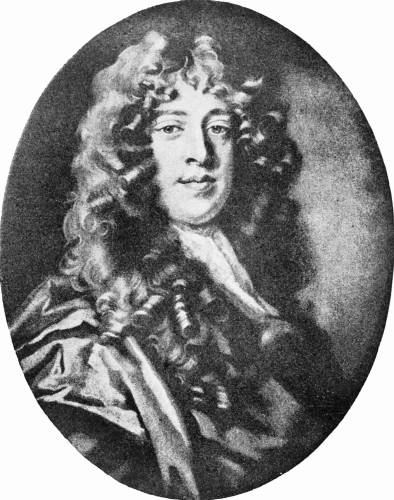
William Wycherley. After Sir Peter Lely.
Perhaps no better instance of the morals of the Restoration could be cited than the manner in which this female Don Juan commenced her notorious acquaintance with Wycherley. He was at the time a good-looking young man, in the bud of his dramatic career, and she was a middle-aged woman with such a past! He had, with design to secure her patronage, flattered her in his play, "Love in a Wood, or a Night in St. James's Park" (!), just then running to crowded houses, when she passed him one morning in her carriage in Pall Mall. With the gross humour of Restoration manners she shouted at him a low epithet that might with perfect justice and much more fittingly have been applied to her own sons. He at once turned, and the following dialogue, according to Dennis, Pope, and others, took place:—
"Madam," said Wycherley, "you have been pleased to bestow on me a title which generally belongs to the fortunate. Will your ladyship be at the play to-night?"
"Well," she replied, "what if I am there?"
"Why, then, I shall be there to wait on your ladyship, though to do so I disappoint a very fine woman."
"So you are sure to disappoint a woman who has favoured you for one who has not?"
"Yes," was the gallant reply, "if she who has not is the finer woman of the two. But he who will be constant to your ladyship till he can find a finer woman, is sure to die your captive."
It is stated that hereupon the lady blushed! But she was at the theatre that night and sat with him in his box.
After this episode, which if it caused talk did not cause scandal, we need no longer wonder at the tone of Wycherley's comedies.
One would think that such flagrant infidelities would have snapped the mysterious spell Lady Castlemaine had cast upon the King. But perhaps there was safety in the openness of her amours, and it was not often that Charles was jealous; he was too cynical, and gave his mistresses the same license he took himself. There were, however, times when his pride was hurt, and two of these are worth citing: one as an incident in the life of the great Marlborough, the other as the means through which Lady Castlemaine finally lost the King.
No light has been shed on the character of Marlborough clearer than that in which it is exposed by the story of his start in life. John Churchill came up to London to seek his fortune with empty pockets, no influence, and a face of such beauty as few young men have ever been endowed with. He was an obscure youth of seventeen, with ambition already unbridled, when the eyes of my Lady Castlemaine first fell upon him. At the first exchange of glances desire was born in both of them. The courtezan saw in him a new emotion to be gratified; he saw in the King's mistress a stepping-stone to fortune. But the game to both was full of danger; detection, in this instance, was thought by Lady Castlemaine to spell her ruin. For she was shrewd enough to perceive that her sway over Charles had begun to wane; and in her falling it was to her interest to fall softly. To bind young Churchill to secrecy was easy; he was naturally cunning, and the prize he sought was slippery. Careful, however, as they both were, they could not escape the alert, vindictive suspicion of his Grace of Buckingham. Five years before this nobleman and his "cousin Barbara" were on the best of terms; she had saved him from the Tower and paved the way for him to the Ministry, but they had now fallen out, over what is not related, and Buckingham, as usual, flung all his ability into his hate. Being informed by his spies of the visits John Churchill paid the courtezan, he laid a trap in which the King might catch the culprits in flagrante delicto. Doubtless every one remembers how the handsome young guardsman—who had already got out of his mistress enormous sums of money as well as his commission in the army—hearing the sound of the King's voice as he lay in her arms, leapt out of the window to escape recognition, while Charles, with his consummate cynicism, cried after him, "I forgive you, for you do it for your bread."
Charles had one great virtue which seems to us at times to cancel most of his vices—a fine sense of humour. May we suggest that the kingly hand may be seen in the fate of the child whom, after this episode, the Duchess of Cleveland bore to Churchill? Surely, it could only be his sense of humour that made a "nun at Pontoise" of the issue of this liaison? For Barbara Villiers, who never had a sense of humour at all, was not religiously inclined, though she once made a bishop and liked to be painted as a madonna; nor was John Churchill the man to give a second thought to liabilities he had helped others to incur—a statement that reminds us of a story of a game of basset at which the Duke of Marlborough refused to lend the Duchess of Cleveland half-a-crown, when he was keeping the bank, and had a thousand pounds lying on the table before him!
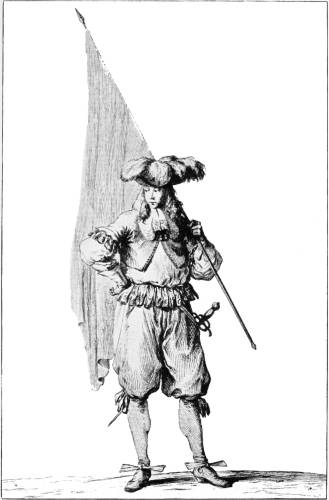
M.R DE MARLEBOROUGH. As he was in 1668 when ensign in the Gardes Françaises. From an Engraving after Vandermeulen.
The other instance in which Charles was recalcitrant was my Lady Castlemaine's fondness for the "invincible Jermyn," with his big head and little legs and forced wit. As the records of the period quite fail to convey the charm this vain, shallow dandy exercised on all the women of the Court, we are inclined to agree with the King that he was a creature to be despised. But Lady Castlemaine, like the rest of her sex, thought differently. This was one of the rare occasions when the termagant was strangely chary about giving offence. To cover up one's tracks at Whitehall was very difficult, and Lady Castlemaine was only partially successful. The arrival of Frances Stuart at Court gave her an opportunity to practise her powers of dissimulation. Lady Castlemaine professed a great friendship for the beauty and had her to sleep in the same bed, not so much as a compliment on the part of my lady as a ruse to throw Charles off the scent. For when the King came, as was his habit, every morning and nearly every night, to visit Lady Castlemaine he found La Belle Stuart in bed beside her ladyship. But while this friendship tended to extinguish Charles's jealousy of Jermyn, it finished by firing my Lady Castlemaine's of Miss Stuart. It is not here that we shall relate in full the amusing particulars of the game of cross-purposes, of which the prize was sexual emotion, that to the ribald delight of the town and the more decorous gratification of Mr. Pepys now took place. The shrew had to fight the prude for her position, her plunder, and her royal paramour. From being friends the rival beauties became deadly enemies. The quarrel was taken up by their servants; the nurses of the mistress's bastards assaulted the maids of the prude; once the King had to leave the Council of State to make peace!
All her powers of coarse vituperation, all her powers of intrigue, all her knowledge of the King's character were brought into play by Lady Castlemaine. She dished her rival, but it is a marvel, with the strange means she employed, that she was not utterly ruined. The secret of her success is to be found, we think, in that she was fighting not for possession of the King's affections, she cared nothing about them, but for the possession of his influence.
It is to be borne in mind that this Stuart-Castlemaine-Jermyn affair continued for nearly five years. Once during this time, on some slighting words from the King, Lady Castlemaine packed her boxes and trunks and, swearing she had shaken the dust of the Court from her feet, quitted the palace for Richmond. But in spite of Miss Stuart, or perhaps on account of her prudery, Charles, after a couple of days, missed the termagant, and went a-hunting in her neighbourhood, to the amusement of the Court. The next day my Lady Castlemaine was back at Whitehall, but before she came she made the King implore her on his knees! The reconciliation was, however, of short duration. The talk of the town was of nothing but the wrangling that went on in the royal palace between the mistresses. Pepys's diary is for the time a thermometer registering the rise and fall of the temperature of a mercurial royal favour and its effect on my Lady Castlemaine's looks and moods.
Had her beautiful prudish rival possessed less virtue and more wit Lady Castlemaine's star would have set long before it did. But she finally ruined La Belle Stuart in the same contemptible, unprincipled fashion as Buckingham later ruined herself. Warned by the pimps of the back-stairs, whom she took care to secure to her interest, she was able to notify Charles in time for him to surprise Miss Stuart in a situation which deprived her of his regard. With the prude's elopement from Whitehall the day after this adventure, Lady Castlemaine's position was more secure than ever, and her reign continued as before, punctuated with infidelities and Billingsgate quarrels.
In the morning of the Restoration decency was not wholly flung to the winds. Then when my Lady Castlemaine presented her lord with a son, the new-born babe was smuggled out of her bed secretly, and "carried off by a coachman under his cloak," to be publicly acknowledged by the King years later when the sun of the Restoration was at its zenith. It is said that several dukes came into the world in this mysterious fashion. But as time passed the coming of a bastard was noised about the Court and the coffee-houses long before he arrived. During the Great Plague, when the Court was at Oxford, Pepys states that "every boy in the streets openly cries, 'The King can't go away till my Lady Castlemaine be ready to come along with him.'" On this occasion the poor Queen, who, under the mask of friendship which she wore even in private, studied revenge for the insults she received from this brazen courtezan, called upon her lady of the bedchamber to fulfil her duties, and my Lady Castlemaine, scarcely able to leave her bed, had to mount and ride in Catherine's suite.
Another time she contented herself with laughing at Lady Castlemaine's jealousy of La Belle Stuart. Yet another, the King himself revenged her. Overhearing his mistress one day making a slighting remark of the Queen, Charles burst into one of his rare fits of anger and ordered the woman to leave Whitehall forthwith. Lady Castlemaine went off imperiously enough, but took the precaution to leave her baggage behind her. At the end of three days, hearing nothing from him, she became alarmed and wrote him submissively to ask for permission to send for her things. He told her she might come in person and fetch them if she wished them, and the quarrel ended as usual in a reconciliation. Her hold over him seemed magical—a hold the secret of which, one would say, was the fearlessness of her abuse. Under that terrible lash Charles cowered to the end like a whipped dog.
During her struggle for supremacy with the Stuart, when even the most witless of frailties would have cunningly manœuvred the whole artillery of flattery, kisses, smiles, sighs, and tears, Lady Castlemaine exploded her vituperative bombs in the royal presence, and taunted the King like a poissarde. Nor, what is perhaps more remarkable, in the duel of these Restoration Brunhildas and Fredregondes for Charles's heart, did either one or the other subject her private inclinations to interest.
When the Queen was supposed to be dying and the gamesters of the Court were backing Miss Stuart for her place, Lady Castlemaine continued her intrigue half-openly, half-secretly with Jermyn. On the authority of a Mr. Cooling, from whom Pepys was in the habit of pumping the gossip of the Court when that gentleman was primed with wine, history learns that Charles, venturing a little cynical raillery on the subject of Jermyn, whom he considered more despicable a rival than Goodman or Hall, remarked that though always willing to oblige the ladies, he could hardly be expected to father all the babes about to be born at Whitehall. To which Lady Castlemaine, who saw an allusion to herself in the remark, "made a slight puh at him with her mouth." In this instance, however, Charles proved very inconsiderate of my Lady Castlemaine's state of health. Whereupon with curses and tears of rage she rushed from the palace to a friend's house in Pall Mall, swearing that "she will have it christened in the Chapel at Whitehall and owned for the King's; or she will bring it into Whitehall gallery and dash the brains of it out before the King's face!"
But whether it was because he was afraid that this woman, unique in the annals of palace prostitution, was capable of putting her Medea-like vengeance into effect, or from the more likely fear of her threat to publish his letters, Charles followed her and prayed her on his knees to return. From one of his Povys, or Fenns, or Coolings the prurient Mr. Pepys learns that my Lady Castlemaine allowed herself to be persuaded to yield, but "not as a mistress, for she scorned him, but as a tyrant to command him! And so she is come to-day, when one would think his mind should be full of some other cares, having this morning broken up such a Parliament with so much discontent, and so many wants upon him, and but yesterday heard such a sermon against adultery."
Nell Gwynn. After Sir Peter Lely.
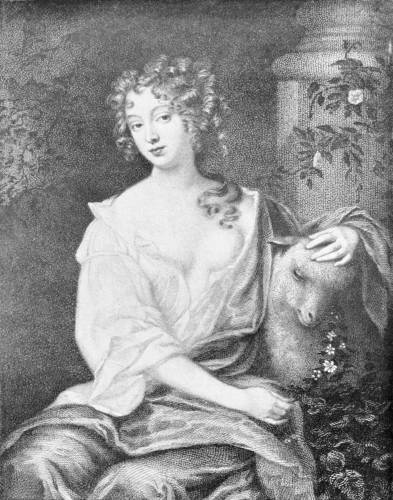
It has been said that the English take their pleasures sadly; it might have been added with more reason that they take their vices grossly. Never was this latter sardonic reproach more applicable than at the Restoration. The contrast between Whitehall and Versailles is striking in this respect. At the former the very duchesses were demi-reps; at the latter even the termagant Montespan never forgot the dignity and breeding due to her position. In England, in our respectable age, the language of a Nell Gwynn or a Duchess of Cleveland are alike impossible of printed quotation. In France, after more than two centuries, the attic wit of a Ninon de Lenclos or a Madame de Maintenon has lost none of its savour. But if we have lacked the refinement of the French we have had compensation. We paid for our gross vices on the spot, cash down, so to speak. We settled our little Restoration bill, with a discount of course, at the Revolution of 1688. A Duchess of Cleveland has, after all, only cost us a couple of dukedoms. France's bill for a similar article was presented in the Reign of Terror, with another for interest in the Commune. In a word, if a nation wishes such luxuries, as nations have done before and may do again, we should recommend on the whole a coarse-mouthed Cleveland to a spirituelle Pompadour. They both wear equally well in the public memory, and the price paid in pounds sterling for the former is incalculably less than that paid in human blood for the latter.
But it must not be supposed that Charles and his favourite were always quarrelling and making up, or that he, in the intervals between one rupture and another, regarded her with indifference while cynically permitting her to plunder the State and enjoy the liberties which he took himself. On the contrary, he treated as personal affronts the many insults offered to her. Overhearing Lady Gerard maligning Lady Castlemaine behind her back, he ordered her to quit the Court. For an obscene jest at her expense he likewise banished Killigrew, the wit, whom personally he liked. On one occasion he ordered the gates of St. James's Park to be shut and everybody found within to be arrested because three masked men assailed her as she was taking a walk and frightened her into a fit by swearing she should die in a ditch like Jane Shore. And his splendid gift of Berkshire House was the means he took of consoling her after a quarrel for the famous "Poor Whores' Petition to the Illustrious Lady of Pleasure, the Countess of Castlemaine," which was followed a few days later by "A Gracious Answer" to the same. But perhaps Charles showed as much defiance as pity in this act; for these lampoons were levelled at the favourite at the time of the riot of London apprentices, who, fired with religious zeal, pulled down the brothels in the city, and when suppressed with bloodshed declared that "they had only done ill in not pulling down in place of the little ones the big one at Whitehall."
The security of her position, which neither her vituperation nor her infidelities, nor the King's, seemed able to shake, naturally caused her to be regarded as a political factor of the greatest importance. Early in her reign Lady Castlemaine became the centre of the cunningest, most dangerous, and most profligate ambitions in the nation. In her apartments the famous Cabal was formed which had the fall of the honest Clarendon for its immediate and the plunder of the State for its ulterior object. She had no political ability, no inclination for political affairs, but she was at once the tool and guiding genius of the Cabal. She was willing to essay the rôle of stateswoman with no other principle than revenge and no other policy than plunder. Never before or since in English history has a conspiracy had baser motives than that which made the nation the slave, dupe, and plaything of Clifford, Ashley, Buckingham, Arlington, and Lauderdale. Never, perhaps, in any country were talents so nearly akin to genius so corrupted. To call these men statesmen is to debase the name, but they ruled the State, thanks to my Lady Castlemaine. Of this crew of brigands Buckingham was the most notorious. As the stately Ormond represents, we think, the highest type of nobleman, so Buckingham represents the lowest. He was one of the most extraordinary men of the century; with the power, had he wished, of rising to the summit of human virtue, he sank to the lowest depths of animal vice. In few men have the possibilities of the good and evil in human nature been so apparent. That such a character had the power to charm the stern Puritan Fairfax, whose daughter and Cromwell's niece he married, and at the same time to appeal to the dissolute Charles, would alone make him remarkable. As the chief ornament of the Court, the lover and foe alike of Barbara Villiers, and her male counterpart, the following striking portrait by the author of "Hudibras" strikes us as worthy of attention. It breathes more than anything else we remember to have read the very atmosphere of the Restoration, and explains all that seems incomprehensible in the characters of Charles, Lady Castlemaine, and the rest of the monstrous anomalies of Whitehall.
"The Duke of Bucks," wrote Butler, "is one that has studied the whole body of vice. He has pulled down all that Nature raised in him and built himself up again after a model of his own. He has dammed up all those lights that Nature made into the noblest prospects of the world and opened other little blind loopholes backward by turning day into night and night into day. His appetite to his pleasures is diseased and crazy, like the pica in a woman, that longs to eat that which was never made for food, or a girl in the green sickness, that eats chalk and mortar. Perpetual surfeits of pleasure have filled his mind with bad and vicious humours, which make him affect new and extravagant ways, as being sick and tired with the old. Continual wine, women, and music put false value upon things, which, by custom, become habitual and debauch his understanding, so that he retains no right notion or sense of things. He rises, eats, and goes to bed by the Julian account, long after all others that go by the new style, and keeps the same hours with owls and the antipodes. He does not dwell in his house, but haunts it like an evil spirit, that walks all night to disturb the family, and never appears by day. He lives perpetually benighted, runs out of his life, and loses his time as men do their ways in the dark, and as blind men are led by dogs, so he is governed by some mean servant or other that relates to his pleasures. He is as inconstant as the moon which he lives under; and though he does nothing but advise with his pillow all day, he is as great a stranger to himself as he is to the rest of the world. His mind entertains all things very freely, but, like guests and strangers, they are not welcome if they stay long. This lays him open to all cheats, quacks, and impostors, who apply to every particular humour while it lasts and afterwards vanish. He deforms Nature while he intends to adorn her, like Indians that hang jewels in their lips and noses. His ears are perpetually drilled with a fiddlestick. He endures pleasure with less patience than other men do their pains."
And this man ruled England after Cromwell! What a swing of the pendulum of fate! Considering the period, it is not at all surprising to learn that he died miserably in a peasant's hovel and was buried in Westminster Abbey. The Restoration is made up of these theatrical contrasts.
Opposed to Lady Castlemaine's Cabal, or the Cabal's Lady Castlemaine—for each was the tool of the other—Clarendon and Ormond tried to protect the honour and dignity of the nation. These men had rejected with scorn the bribes of Louis XIV., which the Cabal were eager to accept; they had lofty and patriotic aims, the respect of the people, and the greatest claim to that of the King. While they held power they acted as a dam to the sea of profligacy that threatened from the day of the King's restoration to inundate the State. But around such a man as Charles it could be but a question of time before their fatherly advice, incorruptible honour, and grave demeanour would become a bore. Nevertheless, though he regarded them as a boy does a schoolmaster, he was not prepared at the instigation of a Buckingham or a Lady Castlemaine to break loose from their tutelage. It was one of the strangest traits of Charles's character that he always respected virtue even while he paraded vice.
And though the Cabal have had the credit of accomplishing the fall of Clarendon and Ormond, it is perhaps truer to say that Charles sacrificed them to public opinion rather than to private spite. To those who are interested in the history of political wire-pulling the intrigues of the Court of Charles II. will afford an entertainment second to none of the same kind. But this is not the place to expose them, and we merely refer to them in passing for the sake of such light as they may throw into the dark corners of Lady Castlemaine's political career.
This woman fought Clarendon and Ormond as she fought the King. Both had offended her in many ways—ways such as a courtezan never forgives. Clarendon had been the best friend of her noble father, and she was Barbara Villiers, the subject of lewd jests alike in the ante-rooms of Whitehall and the coffee-houses of the town. The contrast between them, with the unuttered reproach, pity, and scorn it implied, was sufficient cause for hatred. But Clarendon was tactless; a statesman himself, he laughed at the idea of a woman of her lack of ability attempting to rule the State. Nothing whetted her hatred for him like her powerlessness to hurt him; he seemed to stand out of the reach of her coarse abuse. When it was a question of Clarendon between them, the King told her that "she was a jade that meddled with things she had nothing to do with at all." But neither she nor the Cabal ever dreamt of throwing up the sponge. That such men as Clarendon and Ormond should have been under the necessity of taking her seriously into account was perhaps a greater humiliation than their struggles with Buckingham and Company. The Chancellor having declared, when refusing to put the seals to some grant of a place the courtezan had disposed of, that "the woman would sell everything shortly," she, on its being repeated to her, sent word to tell him that what he said was quite true and that she would sell his place too before long. She used openly to express a desire to see his head on a stake and a "hope to see Ormond hanged," for refusing to pay her drafts on the Irish Treasury. But this great nobleman, whose character was as stainless as the Chancellor's abilities were great, merely replied to her virago outburst that, "far from wishing her ladyship's days shortened in return, his greatest desire was to see her grow old."
Great stress has been laid on Lady Castlemaine's political influence from the fact that Clarendon finally fell. But of this there is no real proof; for, though she succeeded in fastening the King's anger on him at the time of the discovery of Miss Stuart's elopement, his disgrace was already imminent. The Chancellor, like most statesmen, sooner or later, was the victim of unforeseen complications. He made enemies by his want of tact; his popularity had already been impaired when the Dutch War broke out. The reverses sustained then aroused the desire for vengeance, which is one of the most effective ways public opinion has of expressing its will. Charles was not the man to resist the popular clamour, and Clarendon fell. Every schoolboy has heard the story of his fall—how, on leaving Whitehall after his dismissal, Lady Castlemaine jumped out of her bed and reviled her enemy like a fishwife as he passed under her window. Two years later Buckingham got rid of Ormond. In the place of one Minister who made a single mistake—the Dutch War—public opinion got the Cabal. As soon as the welcome news reached France, Louis XIV. sent each member of Lady Castlemaine's junto his portrait framed in jewels, valued at £3,000.
Three years later, as might be expected, Lady Castlemaine and the Cabal fell out, like brigands over their booty. Buckingham, who had once been her lover, gave the coup de grâce to the maîtresse en titre, though it was left to others to provide her successor. Just why or how Charles ceased to crave the society of this woman whose coarse and disgusting behaviour had amused him for ten years is not clear; but the fact remains that he was anxious to break with her, and Buckingham offered him the opportunity, perhaps quite as much from the sheer love of a low intrigue as from hate of a woman who had offended him. Charles, who was still strangely afraid of the terrible termagant, was at a loss for a plausible excuse for dismissing her. To find one after all he had so long suffered from her with indifference, if not delight, indeed required ingenuity. But Buckingham discovered it for him in Jermyn, for whom his aversion was well known. Her liaison with Jermyn had continued more or less masked for years; for though Lady Castlemaine's passion for him had been the cause of more than one rupture with the King, the issue of which even she dreaded, she could not bring herself to give him his congé while bestowing the questionable favour of her regard on a score of others. Buckingham, who kept paid spies for the purpose of shadowing every person at Court, gave himself the contemptible pleasure of enabling Charles to surprise Lady Castlemaine and Jermyn precisely as she had enabled the King to surprise Miss Stuart and the Duke of Richmond.
Jacob Hall, the Rope Dancer.
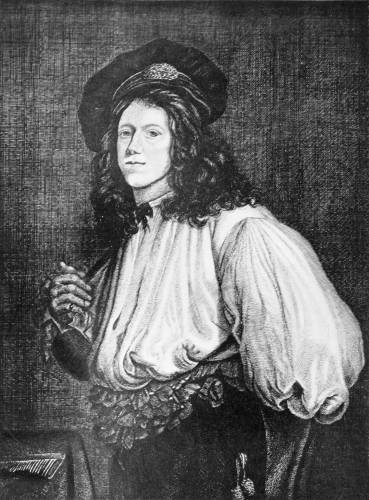
The scandalous finale to the most shameful royal liaison in the history of such things has been told by Count Hamilton with the inimitable gloss that he alone has been able to give to the vulgarity of the Court of Charles II. As an example of the refinement with which it is possible to handle vice no less than the purity of literary style, his account of the way in which Charles broke with Lady Castlemaine is worth reproducing. His Majesty, having summoned up the courage to face her, "advised her rather to bestow her favours upon Jacob Hall, the rope-dancer, who was able to return them, than lavish away her money upon Jermyn to no purpose. She was not proof against his raillery. The impetuosity of her temper broke forth like lightning. She told him that it very ill became him to throw out such reproaches against one who, of all the women in England, deserved them the least; that he had never ceased quarrelling with her, ever since he had betrayed his own mean, low inclinations; that, to gratify such a depraved taste as his, he wanted only such silly things as Stuart, Wells, and that 'petite gueuse de comedienne' (Nell Gwynn). After which, resuming the part of Medea, the scene closed with menaces of tearing her children to pieces and setting his palace on fire. What course could he pursue with such an outrageous fury who, beautiful as she was, resembled Medea less than her dragons when she was thus enraged? The indulgent monarch loved peace, &c."
So the Chevalier de Gramont came to the rescue, and that prince of humorists drew up an agreement that Lady Castlemaine should for ever give up Jermyn, whom, as a proof of her sincerity, she would consent to have banished the town, while she would never abuse any more for ever the fair friends of the King, including that petite gueuse of an actress. In return for such condescension his Majesty would no longer put any restraint on her conduct, and immediately created her Baroness Nonsuch, Countess of Southampton, and Duchess of Cleveland, with parks and privileges and an income suitable to maintain such dignities. There were some at Whitehall who, while laughing over this buffoonery to which the royal seals were affixed, suggested that the Chevalier was not without a personal interest in the income he added to her titles, as he was in the habit of gaming every day at basset with her Grace, and never losing. Thus fell my Lady Castlemaine!
The rest of her career was destined to be no less notorious than that of which we have already given a sketch. As Duchess of Cleveland she still hung about the Court, and for the rest of the reign was treated by Charles with the cynical good-nature that in him passed for friendship, and which he bestowed on all his discarded favourites. The next few years her Grace spent in getting her children acknowledged by the King—we are inclined to agree with his Majesty that they would be wise indeed if they ever knew their real father; but sooner than they should never have had a father at all, he graciously consented to assume that rôle. This urgent and profitable business finished, she set about marrying them, in which she showed as much zeal for their material, as neglect for their moral, welfare. A rather nasty libel action was the result of her match-making; but though she covered herself with ridicule, she got for her daughters the husbands she intrigued for. They were married on the same day, and his Majesty gave the elder £20,000 and the younger £18,000 as a dowry, while the Duchess, with characteristic greed, sent the bill for the wedding banquet and the trousseaux, some £3,000, to her old friend the Privy Purse.
Shortly afterwards she decided, having been so successful at Whitehall, to try her fortune at Versailles. She went to France with her eldest daughter, the Countess of Sussex (the Duchesse de Mazarin's friend) and Barbara, her youngest, and young John Churchill's receipt for the big sums he had got from her. The Duchess remained several years in France, and though very ill-received, as we can well imagine, at polished Versailles, she led her usual life in Paris. Among her adventures in the Ville Lumière, she succeeded in fascinating Montague, the English Ambassador, and ruining him. For this man, having in his infatuation confided to her how little he thought of Charles, had the misfortune some time after to transfer his passion for her Grace to her daughter, Lady Sussex. Whereupon the Duchess, who only objected to her daughters' escapades when they were at her own expense, immediately wrote to the King and informed him of Montague's treachery to him as well as to herself.
She was in England again before the King's death—an event as disastrous for her as it was for the rest of the seraglio of the Merry Monarch. Compared with her past wealth her revenues were now shorn by debt, but she still lived in considerable luxury, and though less and less seen in public, still kept up her amorous intrigues. Her especial favourite, it would seem, was Goodman, with whom on her return to England she had resumed her old relation. Her day with the Buckinghams and Jermyns and men of rank was past; it was now entirely the turn of actors, lackeys, and impostors. The year after Charles's death, when she was forty-five, there was born at her house in Arlington Street a child, "which the town christened Goodman Cleveland."
A little later her daughter Barbara, who had taken the veil at the Convent of the Immaculate Conception in Paris, where she was known as Sister Benedicta, played on the Order to which she belonged an indecent practical joke, that, however, did not prevent her from becoming the prioress of a nunnery at a later and, we hope, a more circumspect day. This "love-jest" of the Sister Benedicta was adopted by its grandmother—almost the only generous act to her credit—and became in time a man of note in the eighteenth century.
Thus, in a partial and ignoble retirement, the Duchess passed the remaining years of the century, to emerge suddenly and with much scandal in the reign of Queen Anne before the curtain dropped upon her for ever.
Those who doubt, not without a certain righteous regret, the existence of the hell our ancestors believed in, may possibly derive some satisfaction from the fact that the Duchess of Cleveland did not escape some punishment in this world at least for her sins. In the tragi-comic close of this woman with the temper of a fishwife, the passions of a prostitute, and the conscience of an embezzler, there was a seeming retribution as terrible as it was deserved. If Buckingham's end was sinister, the Duchess of Cleveland's was grotesque and brutal—a scene fit for a Latin comedy.
In the summer of 1705 her husband, the unlucky Earl of Castlemaine, died, and a little while later, in her sixty-third year, she married a man sixteen years her junior. In his youth he had been called Handsome Feilding and the name was still given him in ridicule, which, however, his blustering vanity prevented him from feeling. Once, when walking in the Mall with a companion, he inquired if his sword touched his right heel and whether the ladies ogled him. "Yes," was the reply. "Well, then," he swaggered, "let them die of love and be d——d!" The anecdote is characteristic of him. But of his original charms he possessed nothing now save the belief in their continued existence—a belief with which he had managed to inspire her Grace. Everybody but the doting old Duchess knew him to be a bully, a coward, and a knave. Fortune, never very kind to him, had completely deserted him; he kept up a certain appearance and out of gaol by gambling. On the wedding-day "he hired a coach and two footmen, who, that they might know to what fop they belonged, were clothed in yellow, and as foppishly wore black sashes, which he bought at a cheap rate as being only old mourning hatbands bought of such as cry about the street 'Old clothes.'" In such fashion did her Grace of Cleveland, who had been in the habit of drawing ad libitum on the purse of the nation, enter upon what she hoped was the late St. Martin's summer of her life.
Her dream was short. In those days a wife and her property were the chattels of her husband. Handsome Feilding at once proceeded to materialise his bargain, and at last the termagant was tamed. Terrible was the life he led his aged bride. He took her money from her violently, and when she could not, or would not, give him more, he was in the habit of "drawing his sword and threatening to kill her, swearing it was no more sin to kill her than a dog." At last the terrified old woman, in deadly fear of her life, who had never before been afraid of any one, plucked up the courage to implore the protection of her children.
"Handsome Feilding." After Wissing.
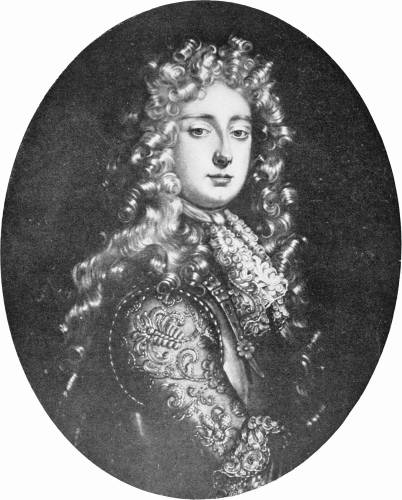
"Just as I came down here," wrote Lady Wentworth from Twickenham to her son, "I heard that the Duchess of Cleveland's Feilding was dead, and she in great grief for him; but it was no such thing, for instead of that she has got him sent to Newgate for threatening to kill her two sons for taking her part when he beat her and broke open her closet and took £400 out. He beat her sadly, and she cried out 'Murder!' in the street out of her window, and he shot a blunderbuss at the people."
During the legal proceedings which followed she was too terrified to testify against him, and the case was dismissed. But immediately afterwards he was arrested on a charge of bigamy, lodged against him by one Mary Wadsworth, "a jilt of the town," whom it was proved he had married three weeks before the Duchess.
His trial was a cause célèbre. Few have ever lent themselves so conspicuously to the venomous humour of the press. Court and coffee-house alike roared over the satires and lampoons that flooded the town at the expense of these two surviving relics of the rakes of the Restoration. Before the idea of marrying the Duchess had occurred to him, Feilding had promised a Mrs. Villars five hundred pounds if she would help him to marry a Mrs. Deleau, a rich City widow, of whom he had heard but never seen. Mrs. Villars, who was Mrs. Deleau's hairdresser, being anxious to get the bribe, passed off the prostitute, Mary Wadsworth, in her name. At the second meeting they were married by a priest from one of the embassies. Dupe of his dupes, Feilding gave a supper on the occasion, at which, to the delight of the lampooners, he gave the supposed rich Mrs. Feilding a ring inscribed with the words Tibi Soli, as a mark of his passion, offering this sentimental token in a song "from the Greek," addressed to "Ianthe the lovely." By the light of Wycherley's comedies one may imagine the Restoration saturnalia of this wedding feast! When Handsome Feilding discovered the joke played upon him we are not told what he thought, but Mrs. Villars in open court assures us what he did. Having tried to persuade Mary Wadsworth that the marriage was a mere pretence, with sufficient success to enable him to marry the Duchess of Cleveland three weeks later, "it is duly set out that he, the said Robert Feilding, did lock five Locks upon the said Charlotte Henrietta Villars, and did beat and abuse her in a most Barbarous and Cruel manner, and did hold up to her head an Instrument or Weapon being a Hatchet on one side and a Hammer on the other, and did say to the said Charlotte Henrietta Villars that he the said Robert Feilding would slit her skull and nose if she should dare say to the Duchess of Cleveland anything of the marriage."
Freed from this horrible nightmare, a foretaste, perhaps, of what awaited her in the next world, her Grace, with the ribald laughter of the world in her ears, shut herself up, a broken old woman, in her house at Chiswick, and soon died there of "a dropsy which swelled her to an enormous bulk."
Her heirs proved her will the day after her death in greedy haste to secure her supposed wealth. But of the vast sums she had plundered from the State nothing remained; they had vanished like the Restoration. As for Handsome Feilding, he was lucky to escape with a light sentence and have the shelter of the attic of his "Ianthe the lovely" to die in.
It is the commonplace habit of the Duchess of Cleveland's historians to sign their portraits of her with a moral. But such hackneyed reflections on the career of a glorified courtezan of yesterday are not apt. An angry moralist, like a schoolmaster with a birch, is an incapable instructor; his stripes are resented by dissimulation. For our part, in passing by the Duchess of Cleveland, as she hangs, whether one likes it or not, for ever in the Gallery of English History, we feel neither indignation nor sympathy. Perhaps the chief impression we have carried away, with which the reader may also agree, is the arresting contrast between the ribald ha-ha of her dropsical and lonely end and Leigh Hunt's portrait of my Lady Castlemaine at twenty. As it is quite as captivating as any of Lely's it is worth reproducing.
"Lady Castlemaine was dressed in white and green, with an open bodice of pink, looped with diamonds. Her sleeves were green, looped up full on the shoulders with jewelry, and showing the white shift beneath richly trimmed with lace. The bodice was long and close with a very low tucker. The petticoat fell in ample folds, but not so long as to keep the ankles unexposed; and it was relieved from an affluence of too much weight by the very weightiness of the hanging sleeves, which counterpoising its magnitude, and looking flowery with lace and ribbons, left the arms free at the elbows and fell down behind on either side. The hair was dressed wide with ringlets at the cheeks, and the fair vision held a fan in one hand, while the Duke led her by the other. When she had crossed the steps and came walking up the terrace, the looseness of her dress in the bosom, the visibility of her trim ankles, and the flourishing massiveness of the rest of her apparel, produced the effect, not of a woman overdressed, but of a dress displaying a woman; and she came on breathing rosy perfection like the queen of the gardens."
The Duchess of Richmond. From the Medal by Rotier. Reproduced by the courtesy of the "Strand Magazine."