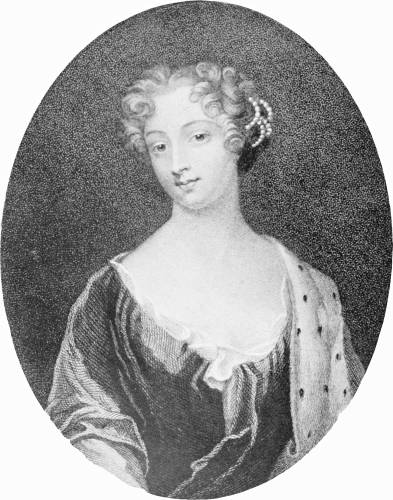
"LA BELLE HAMILTON," COMTESSE DE GRAMONT A GOOD WOMAN OF THE RESTORATION
Reading edition
THE masterpiece of Sir Peter Lely, which forms the frontispiece to this book, scarcely needs the charming testimony of Anthony Hamilton to assure us that the fair subject of this historiette was a good woman. The portrait breathes goodness and refinement. The Court of Charles II. had no ornament so flawless. La Belle Hamilton was as chaste as Lady Castlemaine was polluted, as pure as La Belle Stuart was designing. If the "Mémoires de Gramont" has kept the recollection of the Restoration more vivid than that of perhaps any other period of English history, its heroine, more than all the characters who enliven its inimitable pages, has unquestionably aided the author in his wonderful effort to refine vice of its grossness. Her perfume seems to sweeten the noxious air of her times and to linger subtly in the memory of the unclean palace in which it was spilt.
If it be granted that rules may be proved by their exceptions, one wishing to defend the truth of the cynical aphorism that virtue, like happy nations, has no history, could choose no more convincing argument than to cite La Belle Hamilton. She seems, one is tempted to say, to have been born for the express purpose of proving that purity could exist undefiled in the vicious atmosphere of Whitehall. Her story cannot be compressed into the space of a footnote. It is too closely interwoven with that of her brilliant brother, his fascinating book, and her extraordinary husband.
The Hamiltons, like the Stuarts of Blantyre, were very poor and very highly connected. Miss Hamilton's father, like Miss Stuart's, was a younger son and a Royalist, and fled, like him, to France after the execution of Charles I. We have stated how Stuart of Blantyre was provided for in exile. Sir George Hamilton was no less fortunate. The young King, Louis XIV., gave him a military command, which enabled him to maintain himself, his wife, and his nine children till the Restoration. When Charles II. returned to England, Hamilton, like the rest of the banished cavaliers, returned with him and obtained preferment at Court. Appointments as pages, grooms-in-waiting, and army officers were provided for his sons; while his daughters, thanks to the influence of their uncle, the great Duke of Ormond, without being obliged to accept for their maintenance the doubtful distinction of becoming maids of honour to the Queen or the Duchess of York, lived with their parents and had the entrée to Court.
It was not long before the beauty and charm of Miss Hamilton attracted attention. The Duke of York was the first to admire her. The mind of this prince was so extraordinary that it sought, and apparently found, excuse for his lax morals, as well as at a later period encouragement for his political ambitions, in the zeal of his religious convictions. Where Charles II. took his pleasures with a cynical indifference of God or man, his dull brother pursued his armed with a breviary. His immoralities were as circumscribed as his religious views. When Charles wanted a mistress he went far afield; in his hunt he bagged anything that came his way, from a duchess to a demi-rep. James was only catholic as regards the mission of Rome on this planet; his quest for the same article as his brother was restricted to the entourage of his Duchess. He was satisfied with a maid of honour. As those in the Court of the Duchess of York were, with one or two exceptions, particularly unprepossessing, the cynical, witty Charles used to say that "he believed his brother's mistresses were given him as a penance by the priests."
There were times, however, when beauty appealed to the sanctimonious James. One of these was when he beheld Miss Hamilton. His admiration soon became the talk of the Court without, owing to her tact, compromising her; for she treated him with such dignity that James, who was shy in these matters, could never summon up the courage to get beyond a mild flirtation, while the Duchess of York felt there was so little cause to be jealous of such a rival that she showed her the greatest affection and esteem. This behaviour on the part of Miss Hamilton soon made the ogling of her royal admirer so fatiguing that it was not long before he carried his attentions elsewhere.
The Duke of Richmond, who, when contemplating matrimony was inclined to be guided in the choice of a wife by following in the steps of royalty, succeeded the Duke of York as a suitor for the favour of La Belle Hamilton. This was the Duke of Richmond who was afterwards, when in quest of his third wife, so cleverly hooked by La Belle Stuart. He was now, however, in search of his second Duchess, but, though apparently greatly in love, unable to bring himself to the point of a proposal—not from any timidity, like the Duke of York, but from purely mercenary motives. This man who afterwards married Miss Stuart without a penny hesitated on the present occasion to wed the beautiful Miss Hamilton, who was equally destitute. The King, it is true, from consideration of the claims of her family upon him, offered to overcome the Duke of Richmond's objections by himself dowering the beauty. But as she resented being bargained for like an odalisque in a slave-mart, she decided that the honour it was proposed to confer on her was not worth having.
The "invincible" Jermyn was the next suitor, but as his intentions were no more honourable than the Duke of York's Miss Hamilton soon treated him with the contempt he deserved. While the Duke of Norfolk, with his twenty-five thousand a year, could not get her so much as to look at him. And it was her refusal to become the premier Duchess in the kingdom that kept Lord Falmouth, one of the most talented and ambitious as well as one of the most dissipated of the younger peers of the realm, from declaring a passion which, as he told St. Evremond, "made him regard Miss Hamilton as the only acquisition wanting to complete his happiness."
The list of her unsuccessful lovers would not be complete without mention of the Russells, uncle and nephew. And as the portrait of the elder has been drawn by La Belle Hamilton's brother with a humour that elevates caricature to a fine art, we can do no better than reproduce it from the "Mémoires de Gramont."
"He was," says Anthony Hamilton, "full seventy, and had distinguished himself by his courage and fidelity in the civil wars. His passions and intentions in regard to Miss Hamilton appeared both at once; but his magnificence only appeared by halves in those gallantries which love inspires. It was not long since the fashion of high-crowned hats had been left off, in order to fall into the other extreme. Old Russell, amazed at so terrible a change, resolved to keep a medium, which made him remarkable; he was still more so by his constancy for cut doublets, which he supported a long time after they had been universally suppressed; but, what was more surprising than all, was a certain mixture of avarice and liberality, constantly at war with each other, ever since he had entered the list of love."
This Lord John Russell, whose favourite nephew, a tiresome, stupid young man, was also in love with La Belle Hamilton (though the fact was concealed from his uncle), had some difficulty in finding the courage necessary to propose to his youthful inamorata. But he managed to find it just as he was on the eve of leaving town, and his mode of declaration will complete the above portrait.
"I am," he said, suddenly coming to the point on finding her alone when he came to bid her goodbye, "brother to the Earl of Bedford. I command the regiment of Guards. I have three thousand a year, and fifteen thousand in ready-money. All which, madam, I come to present to you, along with my person. One present, I agree, is not worth much without the other, and therefore I put them together. I am advised to go to some of the watering-places for something of an asthma, which, in all probability, cannot continue much longer, as I have had it for these last twenty years. If you look upon me as worthy of the happiness of belonging to you, I shall propose it to your father, to whom I did not think it right to apply before I was acquainted with your sentiments. My nephew William is at present entirely ignorant of my intention; but I believe he will not be sorry for it, though he will thereby see himself deprived of a pretty considerable estate; for he has a great affection for me, and besides, he has a pleasure in paying his respects to you since he has perceived my attachment. I am very pleased that he should make his court to me, by the attention he pays to you; for he did nothing but squander his money upon that coquette Middleton, while at present he is at no expense, though he keeps the best company in England."
Miss Hamilton, who had a very keen sense of humour, had, as may be imagined, great difficulty to refrain from bursting into laughter. However, she kept her face sufficiently to tell him "that she thought herself much honoured by his intentions towards her, and still more obliged to him for consulting her before he made any overtures to her relations. 'It will be time enough,' she said, 'to speak to them upon the subject at your return from the waters; for I do not think that it is at all probable that they will dispose of me before that time, and in case they should be urgent in their solicitations your nephew William will take care to acquaint you. Therefore, you may set out whenever you think proper; but take care not to injure your health by returning too soon.'"
It is needless to say that neither the absurd uncle nor the stupid nephew succeeded in winning the beauty. Nor was the latter compensated for this loss by the long-anticipated possession of the wealth of the former. The uncle derived so much benefit from that visit to the waters, that he was enabled to defy the asthma for nigh upon another twenty years, so that his nephew grew tired of waiting for the deferred pleasures of this world and went into the next before him.
But while rank and fortune were being laid at the feet of La Belle Hamilton, she was being courted by a man whose remarkable personality had the power of making that of all others seem commonplace. This was Philibert, Chevalier de Gramont.
The Chevalier de Gramont.
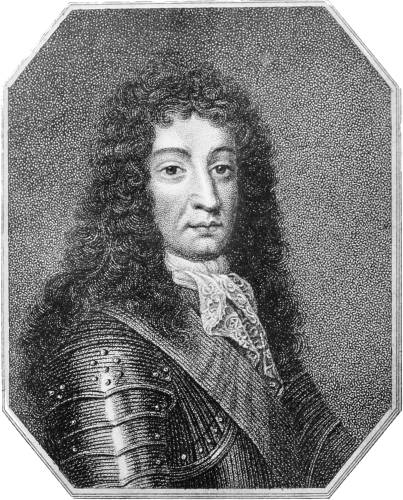
Of all the qualifications he lacked, by the possession of which alone one would have said he would have been acceptable to so charming a creature, he was at least, in point of birth, second to none of her suitors. The de Gramonts were one of the oldest and proudest feudal families in Europe, long settled in Navarre. The Chevalier, who was a younger son, boasted that he was descended from Henri IV. through his grandmother, "La Belle Corisande," one of the many mistresses of that gallant King. His eldest brother was the Maréchal Duc de Gramont, the head of the family, whose ancestral seat was the lordly Château de Gramont "at Bidache on the Bidouze." The titles of this stately house comprised a marquisate borne by the second brother, Louvigny, and a countship, which, together with a large fortune possessed by the third, Toulongeon, were to go in case he died without heirs to the Chevalier, the cadet of the family. Philibert, having nothing but expectations, which seemed extremely doubtful of ever being realised, was destined for the Church. His boyhood was spent at the Château de Seméat, the property of his luckier brother, the Comte de Toulongeon, in preparation for this career. But a trip to Paris made him turn his thoughts from the Church to the army. Like most of the well-born young men of his time, he had the honour of serving under the great Condé and Turenne, and distinguished himself for his insouciante bravery in numerous battles and sieges.
One of the many stories told of him at this period is very characteristic. While besieging some small fortress which capitulated after a short defence the governor, who was surprised at the easy conditions he received, said to him—
"I will tell you a secret, Chevalier; my only reason for capitulating was because I was short of powder."
"And I will tell you another," replied de Gramont; "my only reason for granting you such easy terms was because I was short of ball."
His incurable flippancy, however, stood in the way of his promotion and finally ruined him. For his colossal egotism made him dispute out of bravado the affections of Mademoiselle de la Motte-Houdancourt, whom he did not love, with the young Louis XIV., who promptly banished him. Like many who have been driven into exile, he carried with him nothing but his illustrious birth. At Whitehall, whither he came, he was, however, instantly welcomed by Charles, who never tired of his company. His brilliant wit and manners soon made him generally popular, and he was received everywhere on terms of intimacy. Among his closest friends was St. Evremond, who had preceded him a year, and in whom he was in the habit of confiding his impressions and troubles with that gaiety with which he knew how to captivate La Belle Hamilton and make her disdain splendid offers to marry him, who had neither character nor means of existence, save by gambling, at which he was an adept.
His fascination for the society of the Restoration is easily comprehended. The Chevalier de Gramont had the luck to be born at the right time. This mauvais sujet de l'esprit, as he has been called, was the first appearance in modern Europe of the Petronian cynic and arbiter elegantiarum of which there have been since so many examples. He was the immediate forerunner of the Regent d'Orléans and the Maréchal de Richelieu, the historical father of countless Brummels, d'Orsays, and Oscar Wildes. His wit, said Saint-Simon, who was jealous of it, was "mainly of the sort which shows itself in pleasantry and repartee; it was bold enough to detect a failing and describe it in one or two ineffaceable sentences. He was like a mad dog from whom none escaped. He had wonderful animal spirits and invulnerable self-complacency, never entertaining a serious feeling or a deep thought." This is the character given him by Bussy-Rabutin and St. Evremond, who were his friends, as well as by his brother-in-law, Anthony Hamilton. The portrait of him by the last, who has immortalised him, he himself applauded.
For when the "Mémoires de Gramont" were submitted to the censor Fontenelle before their publication he was so scandalised that he flatly refused his approval. The Chevalier on hearing this at once went to Fontenelle and asked him in his characteristic way "what business he had to be more solicitous of his reputation than he was himself, and demanded that the book should pass if the freedom with which his character was drawn was the only objection." As Mrs. Jameson has very aptly remarked, "Fontenelle might have replied to him as de Gramont did on another occasion to Madame de Hérault. The Count had visited this lady to pay her his condolence on the death of her husband; she received him with an air of extreme coldness, upon which, suddenly changing his tone, he exclaimed gaily, 'Is that the way you take your loss? Well, to tell you the truth, I don't care any more about it than you do!'"
Such an Epicurean as de Gramont scarcely needed the advice of St. Evremond. No one knew the world better than he, or was more deeply acquainted with all its vice, at which, without seriously polluting himself with it, he laughed in the gayest, most cynical way. He had so little religion that once in old age, when his wife in an attempt to convert him recited the Lord's Prayer, he remarked, "That is very fine, who wrote it?" His moral sense was entirely lacking. Women meant to him an amour, nothing more. And even La Belle Hamilton, whose virtue, to his credit be it said, he never attempted to attack, had so little real hold of his affections that on being pardoned by Louis he would have gone back to France without marrying her had it not been for her brothers. Two of them, who had no intention of letting her be compromised by such a desertion, rode after him and overtook him at Dover. "Chevalier," they cried, galloping up and addressing him in his own fashion, "haven't you forgot something in London?"
"Excuse me," he replied gaily, "I have forgotten to marry your sister."
He returned and married her, making her, it must be confessed, the best of husbands. His conduct when married was in this respect in striking contrast with that of the de Gramonts of his time generally. For his brother the Maréchal was notoriously brutal; while the private lives of the Comte de Guiche and the Princess of Monaco, his nephew and niece, could not in the present day be exposed in print.
Many people have often tried to guess the secret of the fascination of this Chevalier de Gramont for La Belle Hamilton, a woman on whom slander never breathed. Without ourselves entering the lists of those who vainly attempt to explain the mysteries of human emotions, we should suggest that a mutual sense of humour was not without its effect on first attracting each to the other. Both were gifted with a very keen sense of the ridiculous. The picture of Miss Hamilton in the exercise of hers is one of the most entertaining incidents in the "Mémoires de Gramont."
A splendid masked ball, which the Queen gave in honour of the King, afforded Miss Hamilton an excellent opportunity to amuse herself innocently at the expense of two silly women of the Court. These persons, whose actions and appearance certainly marked them as victims for the practical joker, were Miss Blague, a maid of honour, and Lady Muskerry. As Miss Hamilton, said her brother, "liked to do things in order, she began with her cousin Muskerry, on account of her rank." The appearance of her ladyship was ridiculous in the extreme. Her face, which was ludicrously plain, matched her figure, which seemed without being so to be perpetually enceinte. This deformity was further heightened by a limp, occasioned by an inequality in the length of her legs. But Lady Muskerry, far from being aware of her defects, was exceedingly vain. "Her two darling foibles were dress and dancing. Magnificence of dress was intolerable with her figure; and though her dancing was still more insupportable, she never missed a ball at Court; and the Queen had so much complaisance for the public as always to make her dance. But in a function so important and splendid as this masquerade it was impossible to give her a part. However, she was dying with impatience for an invitation, which she expected."
It was this impatience on the part of Lady Muskerry that gave Miss Hamilton her opportunity. She sent her ladyship an invitation, as if from the Queen, with the request that she should appear at the ball as a Babylonian princess. Lord Muskerry, who was particularly afraid of ridicule, and aware of the absurd figure his wife would cut if she were present at the ball, had begged her on no account to think of accepting the invitation in case she should receive it. But Lady Muskerry, believing that her husband had taken measures to prevent her being invited, was so exasperated that she had determined to go to the Queen unbeknown to him and ask for an invitation. It was at this juncture that the invitation arrived. She promptly decided to conceal the fact from Lord Muskerry, and "immediately got into her coach in order to get information of the merchants who traded to the Levant as to how the ladies of quality dressed in Babylon."
The practical joke that Miss Hamilton prepared to play upon Miss Blague was of a totally different kind. She had noticed that the maid of honour was in love with the Marquis de Brisacier, a Frenchman as insipid and silly as herself, who was visiting England and paying her considerable attention. Miss Blague had quarrelled with another maid of honour, Miss Price, over some man whom Miss Blague believed had been "drawn away" from her by Miss Price. With this material the inventive mind of La Belle Hamilton prepared to play. The gloves of Martial, a Parisian maker, were then the rage, and Miss Hamilton, who had several pairs of them, sent one to Miss Blague together with some yellow ribbon and a note from the Marquis de Brisacier, couched in the most ridiculous and affectionate language, asking the maid of honour to wear them at the masked ball as the means by which he might recognise her. Then, giving a similar pair of gloves and a piece of yellow ribbon to Miss Price, the merry mischief-maker induced her to wear them by letting her only so far into the secret as to make Miss Blague's enemy determined to cut her out with Brisacier as she had previously done with the former admirer.
To Miss Hamilton's intense delight, as well as that of the persons she had taken into her confidence, both jokes succeeded admirably, and without the betrayal of their originator. But Lady Muskerry got no nearer the ball-room than the state entrance to Whitehall. As it was understood that all the ladies who were to dance in the Queen's quadrille, of whom Lady Muskerry had no doubt that she was one, would be met at the entrance to the palace by their partners, and as in the secrecy she was obliged to practise to prevent her husband from knowing that she had been invited to the ball she had not been able to learn who her partner was, she was still patiently waiting when the Chevalier de Gramont passed her. His costume and the late hour at which he arrived attracted universal attention, and the King asking him the reason of his delay, de Gramont seized the occasion in his characteristic way to tell a witty story, concluding as follows:
"À propos, Sire, I had forgotten to tell you, that to increase my ill-humour" (at the cause of his late arrival), "I was stopped, as I was getting out of my chair, by the devil of a phantom in masquerade dress, who wished by all means to persuade me that the Queen had commanded me to dance with her; and, as I excused myself with the least rudeness possible, she charged me to inquire who was to be her partner, and desired me to send him to her immediately. Your Majesty will, therefore, do well to give orders about it, for she has placed herself in ambush in a coach, to seize upon all who pass through Whitehall."
The Chevalier went on to describe the costume worn by the mask, whose appearance must indeed have been laughable; for poor Lady Muskerry, not having the least idea how a lady of quality dressed in Babylon, had adopted from a crowd of different opinions she had consulted something of each. The Chevalier's description of this fantastic unknown not only amused those who heard it, but excited the greatest curiosity, inasmuch as the Queen declared that all whom she had invited were present. They began to wonder who it could be. The King, whose sense of the ridiculous was much more mocking than Miss Hamilton's, guessed it was the Duchess of Newcastle—a woman even more absurd than Lady Muskerry. For she was afflicted with a dramatic cacoethes scribendi to such a pitch that she would only wear theatrical costumes, and kept a secretary, who, according to Walpole, was often roused in the night to register the Duchess's conceptions, "which," added this English de Gramont of a later generation, "were all of a literary kind, for her Grace left no children."
But Miss Hamilton, thoroughly satisfied with the success of her joke, had no desire to expose her victim to the laughter of the Court by seeing her suddenly appear as a Princess of Babylon. It was therefore with a sense of relief that she saw Lord Muskerry, dreading lest the ridiculous mask should prove to be his wife, go off to ascertain her identity before, exhausted with waiting for her partner, she should come in search of him. The interview at the entrance to Whitehall between the husband and wife was not, as reported to Miss Hamilton, the least amusing feature of her joke. For when the Princess of Babylon at last found her partner, she showed a decided inclination to wait for another, till Lord Muskerry, terrified at the bare thought of the ridicule to which she was exposing him, was obliged to use force in order to get her to return home!
As for the joke played at Miss Blague's expense, its success was sufficient to complete Miss Hamilton's satisfaction and to divert the whole Court. This silly maid of honour, with her "pig's eyes" and long white lashes, in response to the note she had received from the equally silly Marquis de Brisacier, wore the gloves and the ribbon. But it was not until after the stately French dances, with which the ball opened, were over and the country dances and real fun began that La Belle Hamilton and those in her confidence had the pleasure of watching the working of their joke. They observed with the greatest amusement that Miss Blague's "pale hair was stuffed with the citron-coloured ribbon, while to inform Brisacier of his fate she often raised to her head her victorious hands, adorned with the gloves we have before mentioned. However, if the others were surprised to see her in a head-dress that made her look more wan than ever, she herself was far more surprised to see Miss Price share Brisacier's present with her in every particular. Her surprise soon turned to jealousy; for her rival had not failed to join in conversation with him; nor did Brisacier fail to return her first advances, without paying the least attention to the fair Blague, nor to the signs which, exerting herself to desperation, she made to inform him of his happy destiny."
To make matters worse, the Duke of Buckingham innocently brought up Brisacier to Miss Blague, with the request to dance with her on the King's behalf. But Brisacier, who could not dance the English dances, and preferred to sit them out with Miss Price, who could not dance at all, excused himself. This was the last straw to Miss Blague. Feeling herself despised by the man she loved, and cut out by her mortal enemy, "she began to dance, without knowing what she was doing"—a sight that, no doubt, convulsed Miss Hamilton, of whose fondness for practical jokes other examples than those already mentioned could be cited.
How her sense of humour was affected by the circumstances stated above which made her the wife of de Gramont, it is impossible to guess. That the story of the Chevalier in flight from the altar of Hymen and forcibly brought back to it—if true, of which there appears to be some doubt—did not make Madame de Gramont ridiculous in the eyes of the world may be assumed from the high esteem in which she must have been held. For in that age of lampoons the incident is not one that would have been suffered to pass unnoticed. The silence of the coffee-houses on the subject may, therefore, be taken as an eloquent tribute to the popularity La Belle Hamilton enjoyed. Perhaps it is not too much to state that this reputation of his beautiful wife, who was twenty years his junior, was of great assistance to de Gramont's relations in procuring his pardon. Louis XIV. was induced to permit the Chevalier shortly after his marriage to return to his native country, where, with the exception of several visits to England, which altogether ceased on the overthrow of the Stuarts, he and Madame de Gramont remained for the rest of their lives.
The death of his brother, the Comte de Toulongeon, made the Chevalier himself a count and one of the richest men in France. The Comtesse de Gramont was now much at Versailles, and in spite of the jealousy of certain Court ladies, who were inclined to sneer at the English lady-in-waiting of the Queen of France, she succeeded in winning the respect of Louis. He made her a present of a villa in the neighbourhood of Versailles, which became such a fashionable resort that de Gramont declared he should be obliged to ask the King to pay his bills for entertaining, which the acceptance of the royal gift entailed. We are not told if Louis took the hint. Such wit as de Gramont's was not of the sort that the French King appreciated; it was too familiar. He would, for instance, never have laughed, like Charles II., when that King one day dining in state asked de Gramont to observe that he was served on one knee, a mark of respect not usual at other Courts, to which de Gramont replied, "I thank your Majesty for the explanation; I thought they were begging pardon for giving you so bad a dinner."
But, on the other hand, no one knew better than the Comte de Gramont that the way to make his wit acceptable to Louis was to wrap it in flattery. The following anecdote is in striking contrast with the one just related. They both prove the cunning with which the Comte read character. We are told that once when Louis XIV. was playing backgammon he disputed a throw with his opponent. The King appealed to those who were watching the game, but they, not daring to give against him, sought refuge from their dilemma by appealing to de Gramont, who from the other end of the room declared against the King.
"But you have not heard the case," cried Louis.
"Ah, Sire," replied de Gramont, seizing his opportunity, "if your Majesty had but a shadow of right, would these gentlemen have failed to decide in your favour?"
No wonder that people were afraid of his nimble repartees, or that to the end he knew how to stand well with his master.
The flight of James II. brought a host of Jacobites to France, and among them some of the brothers of the Comtesse de Gramont. One, Anthony, found a refuge with his sister, and to him de Gramont at the age of eighty, but still the same flippant, cynical wit that he was when he had first fascinated the Court of Charles II., suggested that they should write the Chevalier's memoirs. De Gramont, who was exceedingly vain of the reputation he had acquired, and anxious to transmit its memory to posterity, was incapable of the literary effort necessary to this end.
This man, who in conversation could sparkle as few have ever done, could not string two sentences together on paper. His wit completely deserted him when he took a pen in his hand. The opposite was the case with Hamilton. His brother-in-law's suggestion appealed to him, and the result of their curious partnership, in which, so to speak, de Gramont furnished the capital and Hamilton the brains, was the famous classic, "Les Mémoires de Gramont."
Of all the high praise that has been heaped upon this "bréviaire de la jeune noblesse" that of the French critics is the most notable. To us, "the adventure of the soul among masterpieces" that we experience when reading it cannot be so great a pleasure as it must have been to Hamilton in his own lifetime to be told that he, a foreigner, had written a book in the French language which in style, atmosphere, wit, what you will, was French to the core—a chef d'œuvre of French literature! Everybody has heard of Count Hamilton's "Mémoires du Comte de Gramont." How many have ever read it? Is it because it is thought to be that ponderous thing, a classic? Without attempting to express our opinions on this curious work we are daring enough to seize this opportunity of answering a question heard everywhere, "What shall I read?" by replying, "The Memoirs of Gramont." Do not be afraid of it because it is a classic; all classics are not tedious because many stupid books have usurped the label of immortality. A true classic is never tedious. The character of the Chevalier de Gramont as conceived by Anthony Hamilton is one of the great creations of literature.
Hamilton also occupied his time in France with writing other things. His fairy tales, very much goûté in their day, would make very dull reading now. One of the best, that of Bélier and the Giant Moulineau, was written to please his sister. It is interesting to note that Hamilton was nearly sixty when he wrote his masterpiece, and past middle life when he first turned his attention to literature. Considering the active military life he had led it was not strange that he should have made his literary début so late. In fact, had it not been for the Revolution of 1688 he might possibly never have written at all. Before that date he had been first, as a youth, in the French army, which he left at the Restoration to serve in that of his own country. Roman Catholic and Jacobite by birth and association, England had for him after the Battle of the Boyne, as for many another, no shelter. A soldier by instinct, he once more turned to France for employment. Of his career in the French service little is known, beyond that he was an officer in Louis' gens d'armes anglais and received the title of count, presumably in lieu of salary; for such money as the French King had to spare he gave to the last of the Stuarts.
Count Anthony Hamilton.
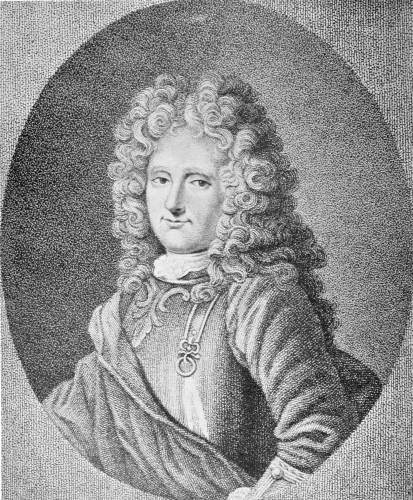
At middle life one does not start a new career with the light heart of youth. Hamilton came to France a disappointed man, and such hopes as he may still have cherished must have been quickly dispelled at James's Court at St. Germain. Here, as in all exiled Courts, poverty, quarrelling, and despair cast their shadows, rendered all the more sombre by the melancholy bigotry of the fallen King. The noble mother of that handsome, unfortunate youth who lived to be known as the Old Pretender alone faced the future with dauntless courage and dignity. How could a Hamilton with a spark of chivalry desert such a woman in such a crisis? It was now that the soldier turned author, like old St. Evremond before him in a similar strait. Hamilton took to literature not as a profession—it is uncertain if he ever earned a sou by his pen, all the profits of the "Mémoires de Gramont" at least went into his brother-in-law's pockets—but as a pastime. Writing was to him the only means he had of killing the intolerable ennui of exile.
But life was not without its compensations; there was the home of the de Gramonts to brighten him. His books brought him fame and friends; his society was courted by an illustrious Duke of Berwick and his "Belle Nanette" and her sister; by the too brilliant Duchesse de Maine, whose court at Sceaux was known as "the galleys of the brain," because the clever people she gathered round her were constantly required to furnish proof of their wit. All this fame, however, brought no financial independence with it, and after the death of the Comtesse de Gramont poor Hamilton had to live on the charity of a niece and to welcome death as a late release for his proud spirit. Perhaps to none of the Jacobites broken in the cause of the bigot James was death so welcome as to this cold, sombre man, who could describe the joie de vivre of the ancien régime with a gaiety which has never been rivalled.
The Comte de Gramont whom he immortalised predeceased him many years. This singular man died at the age of eighty-six, frivolous to the last. Like the celebrated Maréchal de Richelieu of the next generation, who closely resembled him, de Gramont had scarcely ever known what it was to be ill. He used to say that "he hated sick people and only loved them when they recovered their health." His flippancy and irreligion as he grew old alarmed the Comtesse de Gramont, who was very devout, for the safety of his soul. Her attempts to convert him must, serious as they were, have amused her, if she still retained her sense of humour. Once Louis XIV. himself tried to assist her and sent the strict Marquis de Dangeau to offer him religious advice.
"Comtesse," said de Gramont, turning to his wife on learning his visitor's errand, "if you don't look out Dangeau will cheat you out of my conversion."
Madame de Gramont, however, had the satisfaction of bringing her husband to a deathbed repentance, and followed him herself to the grave in a year. Her life, passed in two of the most dissolute Courts in Europe, was from first to last stainless. Of her two daughters, one took the veil, while the other married the Jacobite Earl of Stafford, and inherited all her mother's beauty and virtue and her father's wit.
The great Gramont fortune, which the Chevalier inherited from his brother the Comte de Toulongeon, passed to his nephew, a younger brother of the notorious Comte de Guiche, who had died without a son. This man, whose life is said to have been as scandalous as his brother's, also inherited the fortune and dukedom of his father the Maréchal. It is from him that the de Gramonts of the present day are descended. The tombs of their ancestors are still to be seen amongst the picturesque ruins of the once famous Château de Gramont "at Bidache on the Bidouze," which was destroyed in the Terror.
"The Lovely Jennings." (Duchess of Tyrconnel.)