JOURNAL OF A NATURALIST. (continued 6)
Reading edition
Besides, worms are essentially useful in draining our lands from superfluous moisture, which in many cases, without their agency, would be detained upon or near the surface of the earth, chilling and deteriorating our pastures. A few inches of soil, resting upon a substratum of clay, would commonly, without some natural or artificial drainage, be soaked with water after heavy rains, and thus become a bog, or produce coarse water herbage rather than good grasses; but these worms greatly facilitate the passage of the water by draining horizontally along the bed of clay, and aid the emission of the water by this means, as I have often observed in the trenches, which we cut in our retentive soils, numerous worm-casts on their sides a few days after they had been made, being the exits of the horizontal runs, and through these the water drains into the trenches, and runs off. I do not assert the water would not in any case be discharged without the agency of worms; but that the passages which they make expedite it, which, in situations where the operation would be subjected to delay from the position of the ground, or the under stratum, is of infinite advantage. Thus the soil is not only rendered firm, allowing the admission of 234cattle, but the good herbage, which the long residence of water would vitiate or destroy, is saved from injury, and the aquatic and useless plants starved or checked in their growth; but after great gluts of rain, when the supply of water is greater than can be speedily carried off, it becomes stagnant, and those worms, which cannot burrow beyond its influence, soon perish, and we lose the benefit of these very beneficial creatures. Drainage is therefore one of the most important operations in our agricultural concerns. As by irrigation we turn a quantity of nutritive water over our lands, or by reason of its higher temperature foster the growth of grasses; so, by draining cold and superfluous moisture off, we promote the growth of valuable vegetation. I would advocate the cause of all creatures, had I the privilege of knowing the excellency of them; not willingly assigning vague and fanciful claims to excite wonder, or manifest a base pride by any vaunt of superior observation; but when we see, blind as we are, that all things are formed in justice, mercy, truth, I would tell my tale as a man, glorying as a Christian, and bless the gracious power that permitted me to obtain this knowledge.
Residing, as I constantly do, in the country, and having been long observant of rural things, and the operations of Infinite Wisdom, through the very feeble organs with which I have been endowed, I have often thought, that we, who are daily made sensible of so many manifestations of creative power and mercy, should be more seriously disposed, more grateful for the beneficences of Providence, than those who live in societies removed from these evidences; but yet I neither know nor believe that we in any respect give greater proof of this disposition, or are more sensible of the benevolence of an overruling power, than others. The manufacturer by the combination of artful contrivances effects his purposes, and by aid of man’s wisdom brings his work to perfection; the artisan may eat his bread with all thankfulness and humility of heart, solace his labors and mitigate his fatigue by the grateful flavor and juices of fruits purchased at the stall; but he sees nothing of the machinery, the gradual elaborations of 235nature, nor can he be conversant with the multiplicity of influences and events, which are requisite to bring them to his hand. He who lives in the country knows that an omnipotent impulse must be constantly in action; he may till his land, and scatter his corn, but the early and latter rain must soften his furrows; the snow, as wool, must cover the soil; the hoar-frost, like ashes, lighten his glebe; the sunshine animate the sprouting shoot; and winds evaporate noxious moisture, insects and blights, that hover around, or circulate through the air, must be guided away, or our labors become abortive, or are consumed: we see the bud, the blossom, leaf, and germ, all progressively advance, to afford plenty or yield us enjoyment; we see these things accomplished by the influencing interpositions of a beneficent Providence, and in no way effected by the machinery or artifices of our own hands; and it should operate more powerfully, in disposing those who witness them to particular resignation and gratitude, than others who cannot behold them, but view the ingenuity of man as the agent and means of his prosperity; yet how it happens that this principle is not in more active operation within us, I cannot perceive.
Every age has been the dupe of empiricism; and the greater its darkness, the more impudent appear to have been the pretensions of knavery. We may even now, perhaps, swallow a few matters, the arcana of the needy or the daring, in the various compositions of powders, draughts and pills, which are not quite agreeable to our palates or our stomachs; but our forefathers had more to encounter, as they had more faith to support them, when they were subjected, for the cure of their maladies, to such medicines as album græcum, or the white bony excrement of dogs, bleached on the bank, for their heart-burns and acidities; the powder produced from burnt mice, as a dentifrice; millepedes, or wood-lice, for nephritic and other complaints; and the ashes of earth-worms, administered in nervous and epileptic cases.
Our apple-trees here are greatly injured, and some annually destroyed by the agency of what seems to be 236a very feeble insect. We call it, from habit, or from some unassigned cause, the “American blight” (aphis lanata);[67] this noxious creature being known in some orchards by the more significant name of “white blight.” In the spring of the year a slight hoariness is observed upon the branches of certain species of our orchard fruit. As the season advances this hoariness increases, it becomes cottony, and toward the middle or the end of summer the under sides of some of the branches are invested with a thick, downy substance, so long as at times to be sensibly agitated by the air. Upon examining this substance we find, that it conceals a multitude of small wingless creatures, which are busily employed in preying upon the limb of the tree beneath. This they are well enabled to do, by means of a beak terminating in a fine bristle: this, being insinuated through the bark, and the sappy part of the wood, enables the creature to extract, as with a syringe, the sweet, vital liquor that circulates in the plant. This terminating bristle is not observed in every individual: in those that possess it, it is of different lengths, and is usually, when not in use, so closely concealed under the breast of the animal, as to be invisible. In the younger insects it is often manifested by protruding like a fine termination to the anus; but as their bodies become lengthened the bristle is not in this way observable. The alburnum, or sap wood, being thus wounded, rises up in excrescences and nodes all over the branch, and deforms it; the limb, deprived of its nutriment, grows sickly; the leaves turn yellow, and the part perishes. Branch after branch is thus assailed until they all become leafless, and the tree dies.
Aphides in general attack the young and softer parts of plants; but this insect seems easily to wound the harder bark of the apple, and by no means makes choice of the most tender part of the branch. They give a preference to certain sorts, but not always the most rich fruits; as cider apples, and wildings, are greatly infested by them, and from some unknown cause other varieties seem to be exempted from their depredations. The Wheeler’s russet, and Crofton pippin, I have never observed 237to be injured by them. This insect is viviparous, or produces its young alive, forming a cradle for them by discharging from the extremities of its body a quantity of long cottony matter, which, becoming interwoven and entangled, prevents the young from falling to the earth, and completely envelops the parent and offspring. In this cottony substance we observe, as soon as the creature becomes animated in the spring, and as long as it remains in vigor, many round pellucid bodies, which, at the first sight, look like eggs, only that they are larger than we might suppose to be ejected by the animal. They consist of a sweet glutinous fluid, and are probably the discharges of the aphis, and the first food of its young. That it is thus consumed, I conjecture from its diminution, and its by no means increasing so fast as fæcal matter would do from such perpetually feeding creatures. I have not, in any instance, observed the young to proceed from these globular bodies, though they are found at various ages at all times during the season. This lanuginous vestiture seems to serve likewise as a vehicle for dispersing the animal; for though most of our species of aphis are furnished with wings, I have never seen any individual of this American blight so provided, but the winds wafting about small tufts of this downy matter, convey the creature with it from tree to tree throughout the whole orchard. In the autumn, when this substance is generally long, the winds and rains of the season effectually disperse these insects, and we observe them endeavoring to secrete themselves in the crannies of any neighboring substance. Should the savoy cabbage be near the trees whence they have been dislodged, the cavities of the under sides of its leaves are commonly favorite asylums for them. Multitudes perish by these rough removals, but numbers yet remain; and we may find them in the nodes and crevices, on the under sides of the branches, at any period of the year, the long, cottony vesture being removed, but still they are enveloped in a fine, short, downy clothing, to be seen by a magnifier, proceeding apparently from every suture, or pore of their bodies, and protecting them in their 238dormant state from the moisture and frosts of our climate. This aphis, in a natural state, usually awakens and commences its labors very early in the month of March; and the hoariness on its body may be observed increasing daily: but if an infected branch be cut in the winter, and kept in water in a warm room, these aphides will awaken speedily, spin their cottony vests, and feed, and discharge, as accustomed to do in a genial season.
It is often very difficult to ascertain the first appearance of many creatures not natives of our climate, though, from the progress of science, and more general observation, many things will be recorded. The first visit of the death’s-head moth is very obscure; an extraordinary snail (testacellus halotideus)[68] is now spreading by transplantation in many places, and may hereafter occasion inquiry. The first visit of this aphis to us is by no means clear. The epithet of American blight may be correctly applied; but we have no sufficient authority to conclude, that we derived this pest from that country. Normandy and the Netherlands, too, have each been supposed to have conferred this evil upon us; but extensively as this insect is spread around, and favorable as our climate appears to be to its increase, it bids fair to destroy in progression most of our oldest and long-esteemed fruit from our orchards. The same unknown decree, which regulates the increase and decrease of all created beings, influences this insect; yet wet seasons, upon the whole, seem ungenial to its constitution. In the hot dry summer of 1825, it was abundant everywhere; in the spring of 1826, which was unusually fine and dry, it abounded in such incredible luxuriance, 239that many trees seemed at a short distance as if they had been whitewashed; in the ensuing summer, which was a very dry and hot one, this cottony matter so entirely disappeared, that to superficial observation the malady was not in existence; and it did not become manifest again until September, when, after the rains of that season, it reissued in fine, cottony patches from the old nodes on the trees. Many remedies have been proposed for removing this evil, efficacious perhaps in some cases upon a small scale; but when the injury has existed for some time, and extended its influence over the parts of a large tree, I apprehend it will take its course, and the tree die. Upon young plants, and in places where a brush can be applied, any substance that can be used in a liquid state, to harden into a coat, insoluble by rain, will assuredly confine the ravages of the creature, and smother it. Hard rubbing with a dry brush crushes many, but there are crevices into which the bristle cannot enter: thus some escape, and the propagation continues. I have very successfully removed this blight from young trees, and from recently attacked places in those more advanced, by an easy application. Melt about three ounces of resin in an earthen pipkin, take it from the fire, and pour into it three ounces of fish oil; the ingredients perfectly unite, and, when cold, acquire the consistence of honey. A slight degree of heat will liquefy it, and in this state paint over every node or infected part in your tree, using a common painter’s brush. This I prefer doing in spring, or as soon as the hoariness appears. The substance soon sufficiently hardens, and forms a varnish, which prevents any escape, and stifles the individuals. After this first dressing, should any cottony matter appear round the margin of the varnish, a second application to these parts will, I think, be found to effect a perfect cure.
The prevalence of this insect gives some of our orchards here the appearance of numerous white posts in an extensive drying ground, being washed with lime from root to branch—a practice I apprehend attended with little benefit; a few creatures may be destroyed by accident, but as the animal does not retire to the 240earth, but winters in the clefts of the boughs far beyond the influence of this wash, it remains uninjured, to commence its ravages again when spring returns.
Seasons arrive and pass away, the general features alone remaining impressed upon our minds; but they often produce consequences not commonly expected, and a departed summer or winter has frequently been the cause of some event, which we consider as exclusively occasioned by atmospheric changes, or present temperature. A warm dry summer generally occasions a healthy spring blossom the ensuing year, the bearing wood being ripened and matured to produce in its most perfect state. A wet, damp one usually effects the reverse, by occasioning an abundant flow of sap, producing wood and foliage rather than blossom; and the following spring, in such cases, from the floral vigor being diverted, has generally its blossom weak, and, though perhaps not defective, incompetent to mature the germen. This is mere reasoning upon general consequences; but so imperfect are our theories, and so many circumstances counteract the calculations, the predictions of human wisdom, which can rarely even “discern the face of the sky,” that results must more often be looked for than known. The recording of events is the province of the naturalist; and perhaps occasionally by comparing existing circumstances with past events, something approximating to probability may be obtained. The two burning summers of 1825 and 1826 are remembered by all; but it was in the succeeding year only, that the result of this heat and drought was manifested to us, by effects upon our pasture lands, which we did not expect. Not only in those on the limestone substratum, but in many that were sandy, and in the clayey which were chapped by the heat, the roots of the grasses, which we have generally considered as not being subject to such injuries, were destroyed in some cases, and greatly injured in others; and in their places frequently sprang up crowfeet (ranunculus acris, and bulbosus), and dandelions, a mere useless vegetation, which, as long as the grasses flourished, were kept in subordination and obscurity by 241their superior growth; while bare patches in other places told us of aridity and failure: the meadow grass (poa) and ray grass (lolium perenne) were great sufferers; the dog’s tail (cynosurus) supported itself better; the cockfoot (dactylis), though not killed, was so much hurt, that its ensuing vegetation, instead of the coarse luxuriance it generally manifests, was dry, hard, and deficient in succulency, or, as our laborers emphatically say, was “stunned;” and bent-grass (agrostis vulgaris), that certain indicator of a dry soil, appeared more than it commonly does. But this destruction of the roots in very many places was not obvious, the turf, as it was, remaining; yet some injury was apparent in the succeeding summer and autumn. The crop cut for hay was unusually abundant, and seemed to have exhausted the roots by its growth, as no aftergrass sprang up; nor did the pastures which were fed afford more than a dry, hard, yellow provender, looking tanned, as if seared by severe frost; and in September, when in general we expect our fields to yield an abundance of grass, as food for months, they presented commonly the aspect of hard-fed lands in March, though so much rain had fallen, both in July and August, as to lead us to expect profusion. It did not appear that the roots had actually perished; which could not have been the case, by producing the mowing crops that they did; but this was a single effort: the injury was manifested by the deficiency of the autumnal vigor; this was the actual result, difficult as it is to assign a satisfactory reason. Perhaps these effects upon our pasture lands were unprecedented: but these things pass away, unless recorded; and though we may resort to the oldest memory for evidence, yet memory is oblivious, often exaggerative, and cannot safely be trusted.
June and July, 1825.—The quantity of that sweet clammy fluid, which we find upon certain leaves, and commonly call “honey-dew,” was more than usually abundant during these months. In the day-time, bees, wasps, and tribes of flies collected to feed upon it, and in the evenings, moths and insects of the night frequented the fruit trees on our walls, particularly the 242cherry and the plum, for the same purpose, and their presence brought the bat, so that some places were animated by the flitting about of these creatures. Aphides abounded upon all the young sprays.
June 17, 1828.—Abundance of rain has fallen during the preceding night, and in the morning of this day, about two o’clock, the sun broke out, the air becoming hot and heavy. I was soon surprised by observing multitudes of hive-bees buzzing and crawling about the foliage and young shoots of my laurel bushes (prunus laurocerasus), and feeding upon some sweet matter lodged on them; the blossoms had long before fallen off: no aphides frequent this plant, nor were there any trees near them from whence any sweet matter might have fallen; we have no honey-dew upon our fruit trees, and an aphis is scarcely to be found. Has any saccharine matter fallen, or been emitted by the plant to entice these insects to harbor about them? It clearly appears that honey-dews arise from two causes; that a large portion of it is the discharges from insects of the genus aphis, has long since been manifested by the Abbé Sauvages, Mr. Curtis, and others: insects discharge in all days and hours during the warm months of the year. But there is another kind which we find only at particular times, and in certain states of the atmosphere, lodged on certain plants during the night in such quantities as to hang occasionally in drops from the points of the leaves. The foliage of the oak is at times lucid with this sweet liquor, and this the bees are soon acquainted with, and eagerly collect it, which they only partially do when spread upon the leaves on the wall, the evident discharge of aphides. Some of my neighbors who have hives will occasionally observe, “A heavy honey-dew last night, and the bees are hard at work;” this cannot proceed from insect discharges. That some foliage may condense any matter that may fall upon it, is not improbable; or even excrete it from their pores by the impellent power of the air in certain states, is to be conceived; but all this is conjectural, and our knowledge of the causes which produce these partial honey-dews is yet to be acquired.
243In the years 1825 and 1826, the foliage of our hedges in the spring months was unusually mangled by the caterpillars of different moths; but in 1827 these creatures had increased so much, that the entire leaves of the sloe, and the white thorn, were consumed by them; the hedges, when consisting of these shrubs alone, presented for miles the appearance of winter sprays, covered with a cottony web. The other hedge plants were little injured. The larvæ of several species of small creatures were concerned in this annihilation of verdure; but the little ermine moths (phalæna evonymella, and ph. padella) were the chief performers in this denuding process. In July the perfected moths swarmed about the scene of their birth in vast numbers; yet such was the retrieving power of nature, that by the middle of August only a small portion of the injury occasioned by these creatures was to be observed, the summer shoot bursting out, and covering the sprays with the verdure of spring. The chief singularity in all this was the appearance of the sloe bush, all the foliage being consumed by insects, or crisped away by severe winds, leaving the sprays profusely covered with the small young fruit, perfectly uninjured, and proceeding in its growth; so that, by the time the foliage was renewed in August, it had obtained its usual size. This was the case too with the crab, and some of the orchard fruits, presenting the unusual sight of fruit growing alone on the boughs without leaves; so that in fact the offices of inspiration, transpiration, and all their consequences, usually accomplished by the leaves of plants, must have been suspended, or performed by other organs, as no deficiency of vegetative powers was apparent.
But insects alone were not the cause of all the denudation and unsightly appearance which our orchards and other trees so remarkably presented this year; for the destruction of the foliage was accomplished in part by some malignant influences, not well understood. Like the Egyptian king, we are accustomed to attribute all our evils of this nature to the “blasting of the east wind;” yet we find all aspects and places obnoxious to 244it; one situation may be exempted for a period of many years from such visitations, when others suffer; on a sudden, a partial or a local stream of hot, cold, salt, or what we denominate a pestilential wind, sweeps along, and it is destroyed.
Surrounded by and situate in the midst of an agricultural district, we are eager and persevering “leasers” here; and it becomes in a certain degree profitable to our poor, though they cannot hope, like the dutiful Ruth, to gather their three pecks and over in a day. It may be difficult to comprehend how the picking up a head of corn here, and another there, should be a remunerative employ; but in this case, like all other slow operations, a distant result, rather than an instant effect, must be looked for. I have found some little difficulty in obtaining intelligence sufficient to acquire a knowledge of the gain by this employ. The poor are often jealous and suspicious of the motives, when any attempts are made to procure information regarding their profits or improvements; and indeed the advantages of one year are uncertain in another. Catching, doubtful seasons, when the farmer collects in haste, and is unmindful of trifles, afford the best harvest to the gleaner. In fine, settled weather, the operation of reaping is conducted with more deliberation, and less corn is scattered about. When a woman with two or three active children lease in concert, it becomes a beneficial employ. I have heard of a family in the parish thus engaged, who have in one season obtained eight bushels of clear wheat; but this was excess. I know a single woman also, who has gleaned in the same period four bushels and a half; but this again was under very favorable and partial circumstances. In general, a good leaser is satisfied, if she can obtain, single-handed, a clear three bushels in the season, which gives her about a bushel in the week; and, if taken at seven shillings, is very reasonable, and far from being any great accession or profit—less perhaps than is generally supposed to be the emolument of the gleaner; and this may have been acquired by the active labor of eight or nine hours. Yet such is the ardor for this occupation, the 245enjoyment of this full association, with their neighbors, the prattle, the gossip, the glee, the excitement it occasions, that I am sure the allowance of fourteen pence a day, certain and constant, would hardly be accepted by my leasing neighbors in place of it. Indeed I would not offer it, believing that this gleaning season is looked forward to with anxiety and satisfaction; and is a season, too, in which the children of the family can contribute to its support without pain or undue exertion; and viewing with much approbation and pleasure this long-established custom as a relaxation from domestic refinement, when every cottage is locked up and abandoned by its inmates, to pursue this innocent, healthful, laudable employ, where every grain that is collected is saved from waste, and converted to the benefit of a needy and laborious community. From the result of the pauper leasing, no bad criterion may be obtained of the general product of the season; for, as the collection is made from many stations, and variety of culture, these samples of all afford a reasonable average of the quality. It has been thought, but I trust and believe only in the apprehension of evil, that leasing is injurious to the morals of the poor, affording them an opportunity and initiating them in petty pilfering; but if the disposition existed, it could be practicable but in very few instances; mutual jealousy would prevent individual success, and immediate detection would follow the filching of numbers. The commencement of many ceremonies and solemnities is lost by perversion, or in the obscurity of years; the stream of habit may trickle on from age to age, till it flows in time a steady current, yet the original source remain unknown: but this custom of gleaning the remnant of the field we know existed from the earliest periods, three thousand years and upwards for certain; for, if it were not then first instituted, it was secured and regulated by an especial ordinance of the Almighty to the Israelites in the wilderness, as a privilege to be fully enjoyed by the poor of the land, whenever their triumphant armies should enter into possession of Canaan. By this law, the leasing of three products was granted to the destitute inhabitants of the 246soil,—the olive, the grape-vine, and corn; the olive-tree was to be beaten but once; the scattered grape in the vintage was not to be gathered; and in the field where the corn grew, “clean riddance” was not to be made, the corners were to be left unreaped, and even the forgotten sheaf was not to be fetched away by the owner, but to be left for the “poor and the stranger the fatherless and the widow.” This was not simply declared once, as an act of mercy, but enjoined and confirmed by ordinances thrice repeated, and impressed with particular solemnity; “I am the Lord thy God,” I have given thee all, and I command unreserved obedience to this my appointment.
Revolving in our minds, as we old-mannered people often do, the forms, rites, and usages of earlier days, we occasionally regret that fashions by gradual neglect have passed away, and can never be revived, to give that feeling of pleasure which a natural growth seemed to have inspired. Some, though probably of pagan origin, were innocent and harmless practices; the maypole, with all its flowery wreaths, so often surrounded by the dance and the song, is now but seldom seen, where we have known it, especially in the lace-making counties, the evening and almost sole recreation, after long hours of unhealthy occupation, for happy groups of
“Those pale maids who weave their threads with bone;”
and it gave these poor villagers a transient glow of health, seen then alone; but it is gone with the rest, and we grieve to think how little remains that poverty and innocence can partake of. Others were of monkish introduction, yet seemed to keep in remembrance the revolutions of seasons and events, which, though recorded elsewhere, had become the types of written things. Yet one of them in the irritation of the moment I have at times wished, selfishly enough perhaps, consigned to oblivion with monks and monkish deeds. “Christmassing,” as we call it, the decorating our churches, houses, and market meats with evergreens, is yet retained among us; and we growers of such things annually contribute more than we wish for the 247demand of the towns. Sprays and sprigs may be connived at, but this year I lost most of my beautiful young holly-trees, the cherished nurslings of my hedge-rows. The holly[69] though indigenous with us, is a very slow growing tree, and certainly the most ornamental of our native foresters. Its fine foliage shining in vigor and health, mingling with its brilliant coral beads, gives us the cheering aspect of a summer’s verdure when all besides is desolation and decay. It is not only grateful to the eye, but gives us pleasure, when we contemplate the food it will afford our poor hedgefaring birds, when all but its berries and those of the ivy are consumed; and we are careful to preserve these gay youths of promise, when we trim our fences: but no sooner do they become young trees, in splendid beauty, than the merciless hatchet, in some December’s night, lops off their heads, leaving a naked unsightly stake to point out our loss; and we grieve and are vexed, for they never acquire again comparative beauty. These young heads, that we have been robbed of, are in especial request to form a bush, dependent from the centre of the kitchen or the servants’ hall, which in this season of license and festivity becomes a station for extra liberty, as every female passing under it, becomes subject to the salutation of her male companion. This centre bush is often the object of particular decoration, being surrounded by the translucent berries of the mistletoe, and those of the ivy, dipped in blue and white starch. But at this season I have noticed one remarkable decoration among the natives of the principality. A large white turnip is stuck as full as possible of black oats, so as to hide almost the substance in which they are set, and sometimes having compartments of white oats; and being placed upon a candlestick, or some other elevation, on the mantle-tree, presents an extraordinary hedgehog-like appearance. The first adoption of this purely rural fancy, and its designation, I am perfectly unacquainted with; but, when it is well executed, it requires attentive examination to detect the device.
We are no votarists of fortune here, nor do we trouble ourselves concerning predestinate ordinations, or 248like subtilties; but when we notice passing events, we lament the ills and are pleased with the good luck of a neighbor: and a little turn happened lately to a parishioner, which in former times, when events were viewed under aspects different from those by which we now regard them, might have occasioned more wonderment and comment than it did. An industrious laboring man had been some time unemployed, and having sought an engagement at all those places most likely to have afforded it, but without success, sat himself down upon a bank in one of our potato-fields, carelessly twisting a straw, and ruminating what his next resource might be; when casting his eyes to the ground, he discovered, immediately between his feet, a guinea! a guinea perfect in all its requisites! The finding of such a coin, at such a time, was no common occurrence; but by what casualty did the money come there? The frequenters of our fields, breakers of stone, and delvers of the soil, inhabiters of the tenement and the cot, have no superfluous gold to drop unheeded in their progress, and one should have supposed that the various operations which the field had undergone in the potato culture, would have brought to view any coin of that size and lustre. Upon looking at the land, however, much of our perplexity was removed by observing that the ground had been in part manured by scrapings from our turnpike road, rendering it highly probable that this golden stranger had been dropped by some traveller, not missed by him, or lost in the mire, this mortar from the road possibly so coating it about, as to secrete it for a time some heavy rain dissolving the clod, and bringing it to view. This, I am sensible, is an incident little deserving of narration, but has been done from two motives: we village historians meet with but few important events to detail from the annals of our district; we have no gazettes, few public records or official documents to embellish our pages, and if we will write, must be content with such small matters as present themselves; and to point out how frequently very mysterious circumstances may be elucidated, and appear as consistent events by an unbiassed examination. We may not be 249able always satisfactorily to see why a tide of good fortune should flow at the desire of one, and ebb from the wishes of another; yet many of the occurrences of human life are perhaps not so extraordinary as they are made to appear by the suppression of facts, or our ignorance of circumstances.
The effects of atmospheric changes upon vegetation have been noticed in the rudest ages: even the simplest people have remarked their influence on the appetites of their cattle, so that to “eat like a rabbit before rain” has become proverbial, from the common observance of the fact: but the influence of the electric fluid upon the common herbage has not been, perhaps, so generally perceived. My men complain to-day that they cannot mow, that they “cannot any how make a hand of it,” as the grass hangs about the blade of the scythe, and is become tough and woolly; heavy rains are falling to the southward, and thunder rolls around us; this indicates the electric state of the air, and points out the influence that atmospheric temperature and condition have upon organized and unorganized bodies, though from their nature not always manifested, all terrestrial substances being replete with electric matter. In the case here mentioned, it appears probable that the state of the air induced a temporary degree of moisture to arise from the earth, or to be given out by the air, and that this moisture conducted the electric fluid to the vegetation of the field. Experiments prove that electric matter discharged into a vegetable withers and destroys it; and it appeared to me at the time, but I am no electrician, that an inferior or natural portion of this fluid, such as was then circulating around, had influenced my grass in a lower degree, so as not to wither, but to cause it to flag, and become tough, or, as they call it in some counties, to “wilt;”[70] the farina of the grass appeared damper than is usual, by its hanging about the blades of the scythes more than it commonly does; the stone removed it, as the men whetted them, just at the edge, but they were soon clogged again. As the thunder cleared away, the impediments became less obvious, and by degrees the difficulties ceased. The 250observance of local facts, though unimportant in themselves, may at times elucidate perplexities, or strengthen conclusions.
That purely rural, little noticed, and indeed local occurrence, called by the country people “hummings in the air,” is annually to be heard in one or two fields near my dwelling. About the middle of the day, perhaps from twelve o’clock till two, on a few calm, sultry days, in July, we occasionally hear, when in particular places, the humming of apparently a large swarm of bees. It is generally in some spacious, open spot, that this murmuring first arrests our attention. As we move onward the sound becomes fainter, and by degrees is no longer audible. That this sound proceeds from a collection of bees, or some such insects, high in the air, there can be no doubt; yet the musicians are invisible. At these times a solitary insect or so may be observed here and there, occupied in its usual employ, but this creature takes no part in our aërial orchestra. We investigators, who endeavor to find a reason and a cause for all things, are a little puzzled sometimes in our pursuits, like other people; and, perhaps, would have but little success in attempting an elucidation of this occurrence, which, with those circles in our pastures and on our lawns, that produce such crops of fungi (agaricus oreades), and are called by the common name, for want of a better or more significant one, of “fairy rings,”[71] we will leave as we find them, an odium physiologicum.
1827.—The winds of this autumn have been violent and distressing, but of all variable things, we know of none more so than our seasons and temperatures, produced probably by causes and combinations of which we have no comprehension, or power of foreseeing, “for these things come not by observation; we cannot say, Lo here! or Lo there!” What can be more extraordinary, or inexplicable by table or computation, than the sudden visitation, in the midst of storms and frosts, of such a day of brightness and warmth as we sometimes witness, cheering the aspect of all things,—a portrait of summer, brought from we know not what 251region, in a framework of winter. All these things assuredly have their effects upon the products of the earth, and by their means upon the creatures that are nourished by them, carrying on that imperceptible line of influences and intelligences that is maintained throughout nature. We know that vegetation and the atmosphere are in a constant state of barter and exchange, receiving and modifying; and possibly, from the unseen effects of a frosty morning, a fall of snow, or a few hours’ temperature of the air, a fruitful or an unproductive season may arise. We notice the effects of spring changes, because vegetation has so far advanced as to render influences manifest; but we cannot perceive the injuries of benefits accruing to a hidden circulation from particular events. Every person who has been conversant with cattle, must have remarked how uncertain their progress in improvement has been; that the abundant provision of one year did not prove equally nutritive with the scanty product of some other: this fact originates probably from the effects of atmospheric impulse, either directly upon vegetation, or upon the soil which produced the food collaterally, or upon both collectively. In a wet season, water appears to nourish plants, or to supply their requirements principally: in a dry one, nutriment must be obtained from the soil by means of the fibre of the root, and hence particles are imbibed chemically different; a dry or a drained soil, producing short and scanty herbage, will frequently improve the condition of cattle more than an adjoining meadow having a profusion of food, though probably no chemical analysis could indicate the difference. These periodical winds again, violent and distressing as they often prove, are yet unquestionably essential in the economy of nature: our two seasons, in which these commotions of the air most usually become manifest, are about the equinoxes of autumn and spring, periods which in many respects have a similarity with each other. In the autumn of our year, the foliage of trees and plants, &c., putrefy and decay; marshes and dull waters, clogged by their own products, stagnate, and discharge large portions of hydrogen, carbonic gas, 252&c., injurious and even fatal to animal existence: in summer all these baneful exhalations are neutralized and rendered wholesome by the vast quantities of oxygen, or vital air, discharged from vegetable foliage: but these agents of benefit, by the autumn, are no more—consequently the discharge of oxygen is suspended, but the production of unhealthy air increased by the additional decomposition of the season. To counteract this, is probably the business of the storms of wind and rain prevailing at this season, which, by agitating and dissipating the noxious airs, introduce fresh currents, and render the fluid we breathe salubrious. The same may be advanced in regard to spring: the whole decay of winter, having no neutralizing body to render it wholesome, requires some great influencing power to remove it. But all this is reasoning without actual evidence; a discursive license, from the fallibility of human judgment not often to be indulged in: yet we can so rarely perceive the purport of the movements of nature, that our conceptions, vague as they may be, are almost all that remain to us.
We have here so few operations of nature deserving mention, that I must not omit to notice a rather uncommon appearance in some of our clay-lands, which the surrounding parishes do not present. The soil of a few fields seems to cover for some depth a rock of coarse limestone, which we never burn for use. In a direction bearing nearly east and west, in a line pointing to the Severn, a number of sinkings and pits are observable, like abandoned shafts, or the commencement of mines. They are called by the country people “whirly pits.” In some instances the bottoms of them are not visible, owing to the tortuous irregularity of the passages; in other cases they are only deep hollows, covered with turf. These sinkings are evidently occasioned by the lowering of the surface in consequence of the removal of the support beneath. Where the under parts have been entirely displaced, the upper have fallen in, and formed a chasm; where only partially removed, deep, turfy hollows are formed. These removals have been occasioned, probably, by a stream of water running far 253beneath, and washing away the support; and in part by the superfluous water from the ditches and watercourses above draining into the fissures of the rock, and so gradually mining or wearing away a passage; for they are now frequently the receivers of all the running water from the land, which seems naturally to drain into them, and apparently has been so conducted for a long course of years. Some of them present dark and frightful chasms, and bushes and brambles are encouraged to grow about them, to prevent cattle from falling into the pits. Many a fox, when hard pressed, has been known to make for these “whirly pits,” as his last resource; and, secreting himself in some of the under cavities, has escaped from the pursuit of his enemies above. I once saw one of these animals dead at the bottom. Whether he perished from being unable to return up the crags after one of these retreats, or by any other means, I know not.
In particular years we are much troubled here by the luxuriant growth of a cryptogamous plant, which I believe to be the lichen fascicularis of Linnæus: it may always be found even in the dryest summers, but being in those seasons shrivelled up, is in no way troublesome, nor indeed noticed, unless sought for. This lichen covers the walks of shrubberies at times in shady places, and paths in the kitchen garden, appearing like a dull olivaceous crust, most observable about October or November, and the spring months; but in the summer of 1828, the unusual moisture of that season was so favorable to its growth, that even in August we could not walk in safety in those places where it abounded, our feet sliding along upon the gelatinous, slippery foliage and tubercles. Upon the walks of our culinary gardens we sprinkle coal ashes, and this enables us for some time to pass along with tolerable safety; but in the end it so fosters the growth of this lichen, and small mosses, which retain moisture as a sponge, that the evil we endeavor to remove is by the autumn increased: where gravel is not obtainable, paring off the crest of the walk is the only effectual remedy, and this ultimately we are necessitated to resort to. It is notable that such a very 254insignificant product, this hardly discernible plant, should endanger limb and life, and by circumstances become so formidable to us “lords of the creation,” as to force us to devise contrivances to counteract its injurious tendencies.
There are times when we suffer here greatly by the withering and searing up as it were of the leaves of our vegetation, which we attribute generally to an early morning’s frost. That late spring frosts do occasion such injuries, and that noxious blasts, from causes which we cannot divine, occasion infinite annual mischief, if not destruction, to our wall fruit, is most manifest; yet there is great reason to suspect that a large portion of the injuries which we ascribe to blights, blasts, and frosts, are occasioned by saline sprays brought by strong western or south-western gales from King-road in the Bristol Channel, eight or ten miles distant, or from even more remote waters, and swept over the adjoining country where the wind passes. This saline wind has often been suspected by me as the evil agent that accomplishes most of our blightings here; and on November the 3d, 1825, these suspicions were corroborated—for on this and the preceding days we had strong gales from the water, in consequence of which such windows as were situate to the west and south-west were skimmed over with a light saline scurf, the brass-work of the doors was corroded and turned green, painted works of all kinds were salt to the tongue, as was every thing that could condense the moisture; and the leaves of the shrubs in the hedge-rows, and of trees, all turned brown, and were crisped up. A row of large elms in particular, that fronted the gale, received its full influence; the whole of the windward side, then in full foliage, became perfectly brown and seared, and the leaves shortly afterwards parted from their sprays and left them bare, while the other and sheltered side of the trees preserved its green foliage very slightly influenced by the spray that burned up the other. No period of the leafy season is exempt from these pernicious effects, more or less, if the wind be sufficiently violent and blowing from the water. Portions of the country distant from 255the shores often seem more influenced by these salt sprays than others more near, the wind lifting up the saline moisture, bearing it aloft to remote parts, and dropping it as it travels over the land or meets with impediments.
Our apples in some years are more inclined to become spotted than in others, from causes not quite obvious, as moist summers do not occasion it more decidedly than dry. Particular sorts are more subject to these dark markings than others. The russet, though a rough-coated fruit, seems exempt from spots; whereas some of the smooth-rinded ones, especially the pearmain, are invariably disfigured with them. These marks appear to be an æcidium, which we frequently find to be perfectly matured, the centre occupied with minute, powdery capsules, having burst through their epidermis, or covering, which hangs in fragments round the margin. This æcidium[73] apparently derives its nutriment from the apple; for immediately round the verge of the spot the skin becomes wrinkled in consequence of the juices being drawn off by the fungus. In most cases the presence of plants of this nature is symptomatic of decay; but in this instance we find an exception to a pretty general effect, for the decay of the apple does not always commence at the spot, which does not even apparently contribute to it—for the whole fruit will shrivel up in time by the escape of its juices, without any decay by mortification. Though we are not able always to ascertain the purposes of nature, yet this little cryptogamous plant affords a strong example of her universal tendency to produce, and every vegetable substance seems to afford a soil for her productions. We have even an agaric, with a bulbous root and downy pileus,[72] that will spring from the smooth summit of 256another (agaricus caseus), which has a uniform footstalk, though not of common occurrence. Thus a plant, that itself arises from decay, is found to constitute a soil for another; and the termination of this chain of efficiency is hidden from us.
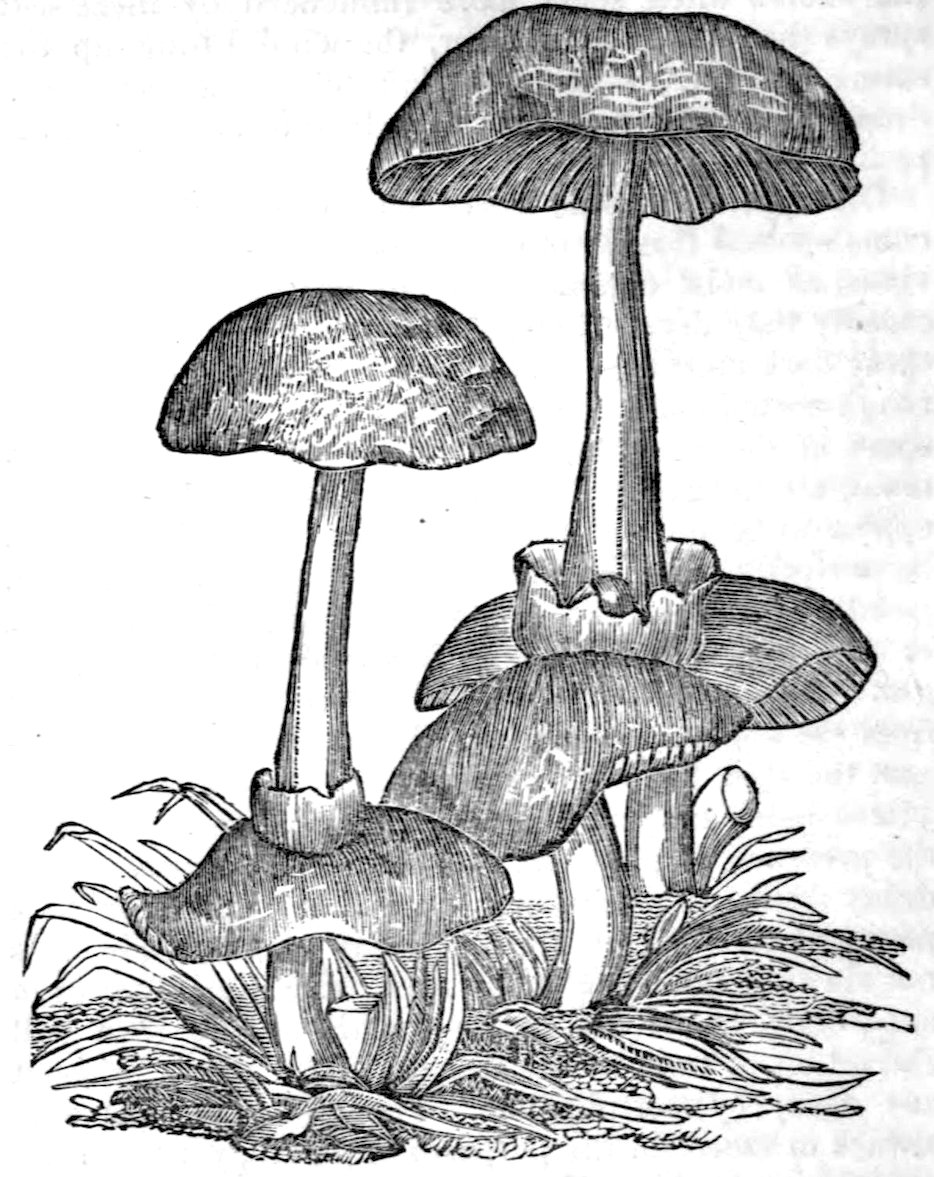
Agaricus Surrectus.
257But the leaves of many vegetables often become singularly spotted during some parts of the summer, and such spots have not certainly been effected by the growth of cryptogamous plants, natural decay, or the punctures of insects, the usual agents in these cases. A very indifferent observer of these things, in strolling round his garden, must have remarked how uniformly and singularly the foliage of some of the varieties of the strawberry are spotted, and corroded as it were into little holes; whereas other kinds have seldom any of these marks visible on them. I have fancied that these spottings were occasioned by the influence of solar heat, a shower of rain falls, small drops collect and remain upon the leaf of the plant; the sun then darts out, converting all these globules of rain into so many little lenses, converging the rays, and scorching or burning a hole at the focus. This conjecture has been rather strengthened by observing, that upon certain sorts, the hautboy, alpine, &c., the rain when it falls uniformly wets the leaves, yet they do not become spotted; but the smooth leaves of others, roseberry, caledonian, upon which it stands in drops, always become marked and perforated: but whatever may be the real cause of these spottings, if the foliage be touched, by way of an experiment, with the point of a heated wire, after a few days they will present an appearance very similar to what is naturally effected.
There seems to be a curious analogy in their functions between the roots of plants and the moving parent of animated beings, a similar obligation being required from them both of providing for those dependent on them, and both will exert their energies in fulfilment of this ordained mandate: the roots of plants wander up and down in every direction, seeking for sustenance; and we frequently see trees, growing on rocks, extending their roots like sensitive beings, searching for moisture; if this is not obtained sufficiently, a sickly foliage 258and impoverished growth point out the condition of the plant.
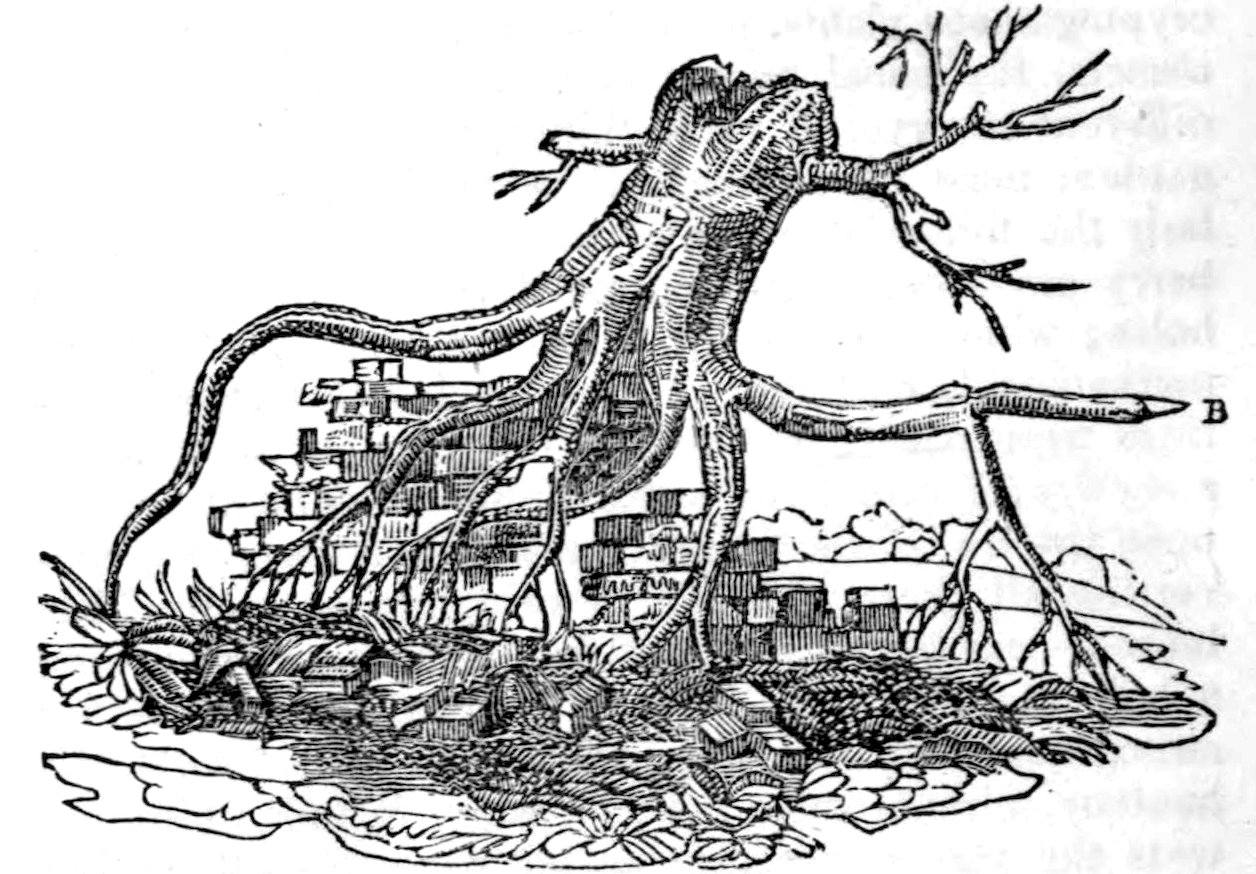
The notable exertions which vegetables occasionally make to obtain nutriment may be instanced by the following rude drawing of an ash,—a tree which, in consequence of the profusion of its seed, we find more often scattered in wild and singular places than any other not propagated by the agency of birds, or conveyed by the winds. This one had originally been rooted in the earth, upon the top of a wall, but nourishment being required beyond what was supplied by the precarious moisture of the scanty soil, its roots proceeded downwards, winding their way through the crevices of the stones into the earth beneath, and remained apparently incorporated with the masonry; the materials of this wall being wanted for an adjoining work, were so pulled out, as to leave the tree with all its roots detached, much as represented, with all its vegetative powers uninjured: the root B had stretched itself along the top of the wall, but how far it had extended in perfection, is uncertain, being broken away when I saw it first. The wood of the ash, when burned in a green state,
will emit a fragrance like that which proceeds from the violet or mezerion, and this it will diffuse in particular states of the air to a considerable distance, a property that, I believe, is not observable in any other British wood: it is in the country only that we can be sensible of this, and it is particularly to be perceived in passing through a village when the cottagers are lighting their fires, or by a farm-house, when this wood, fresh cloven or newly lopped off, is burning;—as the wood dries, this sweet smell is in a great measure exhaled with the moisture, for in this state we are not sensible of any odor arising from it different from other woods.
259
THE YEAR 1825.
We are naturally solicitous to look back upon seasons remarkable for atmospheric phenomena, and compare their results with those passing before us, though we may be fully sensible that no conclusions can safely be drawn from them,—a variety of circumstances not known, or not comprehended, combining to produce results beyond our means of calculation. There have been times when such recollections brought no pleasure with them, by displaying the injuries and sufferings that hurricanes and floods have occasioned; and thus we who were witnesses of the distress occasioned by the lamentable rains of 1793, and the several successive years, when every wheat-sheaf presented a turf of verdant vegetation, cannot recollect it without sorrow, or ever forget that famine in our land. Yet it is amusing, on some occasions, to note the extremes of weather that our island has experienced; for though in general our seasons pass away without any very considerable dissimilitude, still we have known periods of great irregularity, drought or moisture, cold or heat. The freezing of great rivers, with the roasting of animals and passage of carriages upon the ice, our calendars and diaries relate; but instances of an opposite temperature, affording less striking events, are not so fully detailed as might be wished. The winter of 1661 appears to have 260been remarkable for its mildness; and it is rather curious that, in the century following, the winter of 1761 should have been equally notable for the mildness of its temperature. The winter of 1795 seems to have partaken of none of the severity usual to the season; and the summer of 1765 was remarkable for its heat and dryness, and all vegetation being influenced by their effects, brought forth fruits and flowers in unusual perfection.
But perhaps the year 1825, taking all its circumstances, is the most extraordinary to be found in our annals. The winter of 1824–5 had been mild and wet; the ensuing spring dry, but with keen winds and frosty mornings, which greatly injured the fine blossoms that appeared on our fruit trees; and the continued and profuse nightly fall of the honey-dew was quite unusual: the leaves of the oak, the cherry, and the plum, were constantly smeared and dropping with this clammy liquor, which, falling from the foliage on the ground, blackened it as if some dark fluid had been spilled upon it: the leaves of most of our stone fruits curled up, covered with aphides, and became deciduous; and their young shoots were destroyed by the punctures of these insects that clustered on them. This honey-dew continued to fall till about the middle of July, affording an abundant supply of food to multitudes of bees, moths, and other insects which swarmed about the trees. We rarely begin cutting our grass before the first week in July; but in consequence of the heat of June in this year, it was so drawn up, that much hay was made and carried by the 20th of June, which commonly is not accomplished till August. Our crops on good ground were considered as fair, though in general the chilling season of May had occasioned a deficiency; but all our clover crops and artificial grasses were harvested in the finest order, producing good-sized ricks and mows; yet their bulk was delusive, the provender cutting out light and strawy. The heat and drought continued, with very partial and slight showers of rain, all June and July; nor had we any thing like serviceable rain till the second of August. In consequence our grass lands 261were burned up, and our fields parched, presenting deep fissures in all parts. The heat was unusually distressing all day; and evening brought us little or no relief, as every wall radiated throughout the night the heat it had imbibed from the torrid sun of the day. Our bedroom windows were kept constantly open, all apprehension from damps and night airs, which at other times were of the first consideration, being disregarded; a cooler temperature, however obtained, was alone required; and we lingered below, unwilling to encounter the tossings and restlessness that our heated beds occasioned. Our wainscots cracked, furniture contracted and gaped with seams; a sandal-wood box, which had been in use for upwards of twenty years in dry rooms, shrunk and warped out of all form; a capsule of the sandbox tree (hura crepitans), which had remained in repose over a shelf above the fire-place for an unknown length of time, now first experienced an excess of dryness, and exploded in every direction; door frames contracted, window sashes became fixed and immovable. These are trifles to relate, but yet they mark the very unusual dryness of the atmosphere.
Monday and Tuesday, July 18th and 19th, will long be remembered as the acme of our suffering, the thermometer standing in the shade of a passage communicating immediately with the outer air, in an open situation, at 82° of Fahrenheit. A few yards nearer the air, on which the sun shone, it rose to 93°, without any influence from reflection or other causes. In towns, and more confined places, it is said, the heat was much greater. The current of air now felt like that near the mouth of an oven, heavy and oppressive, and occasioning more unpleasant sensations than such a temperature usually creates; animals became distressed, the young rooks of the season entered our gardens, and approached our doors, as in severe frosts, with open bills, panting for a cooler element; horses dropped exhausted on the roads; many of the public conveyances, which usually travelled by day, waited till night, to save the cattle from the overpowering influence of the sun. The leaves of our apple and filbert trees, in dry situations, withered 262up large forest trees, especially the elm, had their leaves so scorched by the sun, that they fell from their sprays as in autumn, rustling along the ground; the larch became perfectly deciduous. In our gardens, the havoc occasioned by the heat was very manifest. The fruit of the gooseberry, burnt up before maturity, hung shrivelled upon the leafless bushes; the strawberry and raspberry quite withered away; the stalk of the early potato was perfectly destroyed, and the tubers near the surface in many places became roasted and sodden by the heat, few obtaining their natural size, and sold at this period in the Bristol market at twenty-four shillings the sack. A few choice plants were saved by watering them daily; but in general the exhalation from the foliage, by reason of the heat of the earth, was greater than the root could supply, the green parts withering as if seared by a frost.
On the 20th of July, some farmers began to cut their wheat; and by the 25th reaping had generally commenced. Our bean crop presented, perhaps, an unprecedented instance of early ripeness, being usually mowed in September; but this year it was universally ripe, indeed more perfectly so than the wheat, by the 1st of August. The crop, however, proved a defective one: water became scarce, and the herbage of the fields afforded so little nutriment, that the cows nearly lost their milk, eight or ten being milked into a pail that four should have filled; and one week, from July the 18th to the 24th, butter could not be made to harden, but remained a soft oleaginous mass.
This extreme heat had a favorable influence on many of our exotic plants, enabling several to perfect their seed, which do not usually in our climate; such as nightstocks, erodiums, heliotrope, groundsels, cape-asters, and such green-house plants vegetating in the open air. With me all the polyanthus tribe, especially the double varieties, suffered greatly; lovers of the cold and moisture of a northern climate, in this tropic heat, they became so parched as never properly to recover their verdure, and in the ensuing spring I missed these gay and pleasing flowers in my borders.
263It was a sad destructive season for the poor butterflies, and no sooner did a specimen appear upon the wing, than the swallow and all the fly-catching tribe snapped them up, rendered eager and vigilant from the scarcity of insect food. Even that active and circumspect creature the hummingbird sphinx could not always, with every exertion of its agility, escape their pursuit.
Early in August rains fell, and continued seasonably until September; and their effect upon our scorched vegetation, from the general heat of the earth and the air, was extremely rapid. The larch, and other trees which had shed their leaves, now put forth their tender green foliage as in spring; and by the end of September the universal verdure of the country, and profusion of feed in the pastures, was so perfectly unlike what we had been accustomed to in common years, as to be astonishing. Even as low in the year as the 11th of October, there was no appearance of any change in the foliage, except a slight tinge upon the leaves of the maple; and this day was so brilliant, that the cattle were reposing in the shade, the thermometer varying from 66° to 68° F., and the general warmth to our feelings was greater than that indicated by the instrument. October the 20th, the weather changed, some sleety rain fell, and the hills were sprinkled with snow, the thermometer falling to 40°, and all our hirundines, which had been sporting about us up to this period, departed: yet still vegetation continued in all its vigor, and on the 1st of November dog-roses hung like little garlands in the hedges; the cornel bushes (cornus sanguinea) were in full bloom; and corn-roses (rosa arvensis) were decorating our hedges in a profusion equal to that of a common August. November 4th there were slight ice and partial snow, with various alternations undeserving of notice, but the weather was generally fair and mild until Christmas.
All these preceding heats and rapid changes had, I think, a manifest influence upon our constitutions. Violent catarrhs, and lingering, unremitting coughs, prevailed among all classes, both before and after 264Christmas, to a degree that I never remember; and children were afflicted with measles almost universally. Early in January a violent wind was succeeded by a severe frost, and in some places by a deep snow; but, after about ten days’ duration, a very gentle thaw removed all this, and the remainder of our winter was mild and agreeable, introducing what might be called an early spring, dry and propitious for every agricultural purpose. The trees that refoliaged so vigorously in autumn seemed in no way weakened by this unusual exertion, but produced their accustomed proportion of leaves, and the sprays of every bush and tree, ripened and matured by the last summer’s sun, displayed a profusion, an accumulation of blossom, that gave the fairest promise of abundance of fruit, and every product of the earth.
That the death of any creature should be required by the naturalist, to perfect his examination, or arrange it in his collection, (and without a collection the investigation of any branch of natural history can be but partially undertaken), may be regretted; but still the epithet of “cruel employ” must not be attached to this pursuit. We do not destroy in wantonness, or unnecessarily; and that life, of which it is expedient to deprive a creature, is taken by the most speedy, and in the least painful manner known. Some of our methods, if speedy, are at the same time injurious, such as hot water, the stifling-box, &c.; and some, that are not painful, such as stupefaction by spirits, ether, &c., and suffocation by carbonate of ammonia, are occasionally not effectual. But there is one process, which I believe to be neither painful nor injurious, yet decisive, and communicative with pleasure; I mean the prussic acid. This fluid may be imbibed by the insect without producing any particular effect; but, if brought to act upon the spinal cord, or what at least is analogous to that part of a vertebrate animal, whatever it may be called, and which seems to be the most vital part of the creation, instant 265death ensues. A crow-quill must be shaped into a point, like a rather long pen, this point dipped into the prussic acid, and an incision made with it immediately beneath the head into the middle of the shoulders of the creature, so as to permit the fluid it contains to enter into the body of the insect. Immediately after this, in every instance in which I have tried it, a privation of sensation appears to take place, the corporeal action of the creature ceasing, a feeble tremulous motion of the antennæ being alone perceptible; and these parts seem to be the last fortress that is abandoned by sensation, as they are the primary principle of sensibility when life is perfect: extinction of animation ensues, not a mere suspension, but an annihilation of every power, muscular and vital. As one example of the decisive effects of this fluid, I shall instance the common wasp, a creature so remarkably tenacious of sensation, or so long retaining a muscular power, that it may remain, as every one knows, for days crushed in the window, an apparently dead insect, yet upon pressing the head, the sting will be so protruded as to give a very sensible pain to the finger it should meet with; but upon the prussic acid being injected into this creature as above, when in full vigor, in the course of less than half a minute a loss of vitality ensues, the action of the muscular fibre ceases altogether, and no pressure can incite it again into action. The sudden effect of this liquor is not so generally known as from humanity and expediency might be wished. Who first devised the experiment I am ignorant; but any repetition of means whereby a necessary end can be obtained by the least painful and brief infliction, will hardly be considered as superfluous.
This subject naturally introduces the preservation of the creatures after their death, and the young entomologist is not perhaps sensible from experience of the injury some species of insects will effect in the selected specimens of others of this race, and may lament, when too late, the separation of the wings, limbs, and bodies of his collection by these tiny depredators (ptinus fur, acararus destructor). Mr. Waterton’s recipe for 266preventing this evil, I have used rather extensively and believe it to be a very effectual, and generally an innocuous preservative; but as this gentleman has not given us the exact proportions of his mixture, it may not be useless to observe, that if one part of corrosive sublimate be dissolved in eight parts of good spirit of wine, and the under side of the insect touched with a camel’s-hair pencil, dipped in the liquor, so as to let it lightly pervade every part of the creature, which it readily does, it will, I apprehend, prevent any future injury from insects. A larger portion of the sublimate will leave an unsightly whiteness upon the creature when the specimen becomes dry. The under side of the board, on which the insects are fixed, should be warmed a little by the fire after the application, that the superfluous moisture may fly off, before finally closing the case. If this be omitted, the inner surface of the glass will sometimes become partially obscured by the fume arising from the mixture. The experienced entomologist needs not a notice like this; but the young collector probably will not regard it as unnecessary information, and may be spared by it from both mortification and regret. I have known insects commence their serious operations before the collections of the summer could be arranged in their permanent cases.
In noticing above, that this solution is generally harmless, it is requisite that mention should be made of the few instances in which it has been observed to be injurious. I have applied it to many specimens of foreign and British insects, and commonly observed no indication of its having been used, when the creatures had become dry. But to confine our attentions to English specimens, when the solution is made stronger than recommended, it will, after a time, injure the fine yellow of the sulphur butterfly (papilio rhamni), by turning parts of it brown and dirty; but even in its reduced state it has a manifest effect upon the colors of two of our moths, the Dartford emerald (phalæna lucidata), and what is commonly called the green housewife moth (phalæna vernaria) changing their plumage, in several 267places, to a red buffy hue, when at the same time the beautiful green wings of the small oak-moth (phalæna viridana) are in no way altered by it. But notwithstanding these circumstances, it will, I apprehend, be considered as a very useful preservative, and save many specimens from destruction which other means usually fail of effecting.
There are not many of our rural practices, that deserve more the disapprobation of the landed proprietor than that of pollarding trees.[74] “It is an evil under the sun, and common among men.” Here it is universal. This system of cutting off the heads of the young trees in the hedge-rows is resorted to by the farmer for the purpose of forcing them, thus deprived of their leaders, to throw out collateral shoots, serving for stakes for the fences, and for firewood. The purposes are effected; but of all hopes of timber, or profit to the proprietor, there is an end. No trees suffer more in this respect than the ash. Prohibitions against mangling trees, in agreements, are usual; but, with some exceptions in regard to oak, little attention seems paid to the covenant, as is obvious on the most cursory view of the country in any direction; whereas the ash is not a less valuable tree, from its thriving more universally in all situations, and becoming saleable in a shorter period. One or two generations must pass before an oak should be felled; but the ash becomes useful wood while its more respected companion is but a sapling. These prohibitions should not simply be engrossed on the parchment, but the agent ought strictly to notice any infringement; and young ash trees should be more especially guarded because they are the most likely to suffer, from their producing the greatest quantity of lop in the shortest time. The injury done by this practice to the present landlord and his successors is beyond estimation, as the numbers destroyed, and the vigor of their growth, must be first known; but there is not a farm of any extent from which hundreds of ash trees might not have been felled, had their growth been permitted, making an annual return; whereas nothing can be obtained now or hereafter for the proprietor, and only a few stakes and bavins 268for the farmer.[75] It is by no means an uncommon thing, to observe every ash tree in a hedge reduced to stumps by successive pollardings. Many a landlord would shudder at the thought of breaking up an old productive sward, and not regard the topping of an ash; whereas this latter act is infinitely more injurious, ultimately, than the former. The land may, and will probably, recover, but the tree is lost for ever, as to any profitable purposes for the owner. The farmer might perhaps tell the agent when he remonstrated, that he must have firewood, and hedging stuff; but the wants of the former have decreased by the facility of obtaining other fuel, and neither is to be supplied by the landlord at such a ruinous subversion of present and future benefit. I am not so silly as to enlarge upon the beauty of what has been called “picturesque farming;” but when we cast our eyes over the country, and see such rows of dark, club-headed posts, we cannot but remark upon the unsightly character they present, and consider it neither laudable to deform our beautiful country by the connivance, nor proper attention to individual profit to allow the continuation of it. The ash, after this mutilation, in a few years become flattened at the summit, moisture lodges in it, and decay commences, the central parts gradually mouldering away, though for many years the sap wood will throw out vigorous shoots for the hatchet. The goat moth now too commences its mordications, and the end is not distant. But the wood of the ash appears in every stage subject to injury; when in a dry state the weevils mine holes through it; when covered by its bark, it gives harbor to an infinite variety of insects, which are the appointed agents for the removal of the timber: the ashen bar of a stile, or a post, we may generally observe to be regularly scored by rude 269lines diverging from a central stem, like a trained fruit-tree, by the meanderings of a little insect (ips niger, &c.), being the passages of the creatures feeding on the wood.
There is one race of trees, the willow, very common about us, that is so universally subject to this pollarding, for the purpose of providing stakes and hurdles for the farm, that probably few persons have ever seen a willow tree. At any rate a sight of one grown unmutilated from the root is a rare occurrence. The few that I have seen constituted trees of great beauty; but as the willow, from the nature of its wood, can never be valuable as a timber tree, perhaps by topping it we obtain its best services. In the county of Gloucester there are several remarkable trees of different species now growing, but I am not acquainted with any greater natural curiosity of this sort than an uncommonly fine willow tree in the meadows on the right of the Spa-house at Gloucester. There are two of them; the species I forget, but one tree is so healthy and finely grown, that it deserves every attention, and should be preserved as a unique specimen, an example of what magnitude this despised race may attain when suffered to proceed in its own unrestrained vigor.
Dec. 30.—A cold foggy morning, the ground covered with a white frost; about twelve o’clock the sun burst out with great brilliancy, and life and light succeeded to torpor and gloom; a steam immediately arose from our garden beds and plowed lands, giving us a very strong example of the rapid manner in which the matter of heat (caloric) will at times unite with water. Half an hour before, this water was frozen and inert; but the instant that the sun’s rays fell upon it, their heat was imbibed, and the icy matter converted into a body lighter than the atmosphere by which it was surrounded, and passed into it in the vapor we have just noticed. I was the more particular in observing this common event, as it afforded a forcible illustration of the invisible evaporation which is constantly going forward, the unremitting changes in operation, the action and reaction of the earth and its products with the atmosphere. 270During the night, and the earlier parts of the morning, water was falling on the earth in minute particles, constituting what we call fog; then out burst the sun, and reclaimed this moisture which had fallen, and we could see it obeying the mandate, and pass away in steam. In the evening it will probably return again in fog, or in rain, when the atmosphere cools; and thus a constant visible intelligence is going on. How much insensible intercourse takes place we know not, but we can comprehend its agency by the effects and events that manifest themselves. Our country people think these “rokings” (reekings) of the earth greatly favorable to the growth of vegetation, supposing it occasioned by the internal heat of the earth producing a vapor like that from fermenting soil, thus warming the roots; but if the theory be defective, the fact may be true, by the caloric in the sun’s rays promoting the decomposition of the water, or separating the component parts (oxygen and hydrogen), which uniting with other matters contained in the earth and atmosphere (carbon and carbonic acid) become by this means the basis of all our fruits, our sweets, our sours, resins, &c., in the vegetable world; and hence there is a constant decomposition of water going forward by these alternations, and a constant formation of matters beneficial and necessary for the various inhabitants of the earth. When we perceive that a shower of rain has revived or promoted the increase of vegetation, we must understand, that the mere wetting it has not accomplished this; but that the vegetable has by means of its foliage, aided by light and heat, decomposed or separated the combined matters of the water, and taken from it certain portions as essential to its vigor, or been revictualled, in a manner, by the nutriment contained in the water.
Jan. 10.—The ground covered with snow, the pools with ice, trees and hedges leafless, and patched here and there with a mantle of white, present a cheerless, dreary void; no insects are animating the air, and all our songsters are silent and away; a few miserable thrushes are hopping on the ditch-bank, swept bare by 271the wind; and the robin puffing out his feathers, and contracting his neck into his body, is peeping with his fine bright eyes into the windows from the cypress bough. A few evergreens are waving their sprays, and glittering in the light, yet making but poor compensation for the variety, the flutter, the verdure, of our summer. Though we have little natural beauty to note or to record, we are not left without a testimony of an overruling Power; and, however sad and melancholy things may appear at the first view, yet a more steady observation will manifest to us a presiding Providence and Mercy. Frost and snow are but cheerless subjects for contemplation, yet I would add a reflection in my Journal of our passing events, or rather recall from memory the truth, that science has made known to us, revived by the sight of that frozen pool. There is one universal body, inherent in every known substance in nature, latent heat, which chemists have agreed to call “caloric.” By artificial means bodies may be deprived of certain portions of it; and then the substance most usually contracts, and increases in weight. Water is an exception to this; for in losing a part of its heat, the cause of its fluidity, and becoming ice, it expands, and is rendered lighter, by inclosing, during the operation, more or less of atmospheric air: consequently it swims, covering the surface. To this very simple circumstance, ice floating and not sinking,[76] are the banks and vicinities of all the rivers, lakes, pools, or great bodies of water in northern Europe, Asia, and America, rendered habitable, and what are now the most fertile and peopled would be the most sterile and abandoned, were it not for this law of nature. Had ice been so heavy as to sink in water, the surface on freezing would have fallen to the bottom, and a fresh surface would be presented for congelation; this would then descend in its turn, and unite with the other; and thus during a hard frost successive surfaces would be presented, and fall to the bottom, as long as the frost or any fluid remained. By this means the whole body of the water would become a dense concretion of ice: its inhabitants would not only perish, but the indurated mass would 272resist the influence of the sun of any summer to thaw it, and continue congealed throughout the year, chilling the earth in its neighborhood, and the winds that passed over it, preventing the growth of vegetation in the former, or blighting and destroying it by the influence of the latter.
Winter is called a dull season; and to the sensations of some, the enjoyments of others, and, perhaps, to the vision of all, it is a most cheerless period. This is so universally felt, that we always associate the idea of pleasure with the return of spring: whatsoever our occupations or employments may be, though its sleety storms and piercing winds may at times chill the very current in our veins, yet we consider it as a harbinger of pleasurable hours and grateful pursuits. We commence our undertakings, or defer them till spring. The hopes or prospects of the coming year are principally established in spring; and we trust that the delicate health of the blossoms round our hearths, which has faded in the chilling airs of winter, may be restored by the mild influence of that season. Yet winter must be considered as the time in which Nature is most busily employed; silent in her secret mansions, she is now preparing and compounding the verdure, the flowers, the nutriment of spring; and all the fruits and glorious profusion of our summer year are only the advance of what has been ordained and fabricated in these dull months. All these advances require Omnipotent wisdom and power to perfect; but perhaps a more exalted degree of wisdom and power has been requisite to call them into a state of being from nothing. The branch of that old pear-tree now extended before me, is denuded and bare, presenting no object of curiosity or of pleasure; but, had we the faculty to detect, and power to observe, what was going forward in its secret vessels, beneath its rugged, unsightly covering, what wonder and admiration would it create!—the materials manufacturing there for its leaf, and its bark; for the petals and parts of its flowers; the tubes and machinery that concoct the juices, modify the fluids, and furnish the substance of the fruit, with multitudes of other unknown 273operations and contrivances, too delicate and mysterious to be seen, or even comprehended, by the blindness, the defectibility of our nature—things of which we have no information, being beyond the range of any of the works or the employments of mankind! We may gather our pear, be pleased with its form or its flavor; we may magnify its vessels, analyze its fluids, yet be no more sensible of its elaborate formation, and the multiplicity of influences and operations requisite to conduct it to our use, than a wandering native of a polar clime could be of the infinite number of processes that are necessary to furnish a loaf of bread, from plowing the soil to drawing from the oven. This is but an isolated instance, amidst thousands of others more complicated still. How utterly inconceivable then are the labors, the contrivances, the combinations, that are going forward, and accomplishing, in this our dull season of the year, in that host of nature’s productions with which, shortly, we shall everywhere be surrounded!
Jan. 20th.—A keen frost, and the ground covered with snow, present a scene of apparent suffering and want to many of our poor little birds; but the preservation of the fowls of the air, which sow not nor gather into barns, has been beautifully instanced to us, as a manifest evidence of a superintending Providence: the full force of this testimony is most strongly impressed upon us in a season like this, when winter rules with rigor, and we marvel how the life of these beings can be supported when the waters are bound up, and earth and all its products hidden by a dense covering of snow. Many of the small birds obtain subsistence by picking the refuse of our corn-stacks, by seeds scattered about our homestalls and cattle-yards, but multitudes of others are in no way dependent upon man for shelter or support, do not even approach his dwelling, but are maintained by the universal bounty of Providence; as the woodlark, the meadow-lark, the chats, and several others; but by what means they are maintained in a period like this is not quite manifest. The portion that they require is probably small, yet it must be insect 274food, and the chats, larks, and gray wagtails, seem busily engaged in providing for their wants upon the furze sprays, amidst frozen grass, or upon the banks of ditches and pools; and as no insect but the winter gnat is now found in such places, it is probable that this creature, which sports in numbers in every sunny gleam, yields them in this season much of their support. Some of the insectivorous birds have at such periods no apparent difficulty in supporting their existence, finding their food in a dormant state in mosses, lichens, and crevices of trees and buildings; but for those which require animated creatures, I am sensible of none that are to be procured but this gnat, and it possibly has been endowed with its peculiar habits and dispositions for a purport like this. We have many examples in nature of similar provisions, wherein one race supports the existence and requirements of another. The molusca and insects of the deep continue the life of some, the feeble races of the air and waters maintain the beings of others, and the beast of the wild seeks his food amidst those which inhabit with him; but where this chain ends, human faculties will probably never be able to ascertain. The remarkable fact which our microscopes make known to us, that all infusions of natural substances in water will produce life, however extraordinary the form may be, seems to denote a continuation of being beyond any possible comprehension, and probably subservient to the existence of each other: the minute creature that floats a hardly perceptible atom in the water of the ditch, and which subsists many of the animals which inhabit those places, feeds upon smaller than itself, and those again, possibly, upon more minute ones which the vegetable infusions of those places give existence to: here the investigation terminates, but the thread unbroken continues, probably through endless gradations, perceptible to infinity alone.
Having applauded the operations of Nature with so much cordiality, possibly I may be called her “enthusiastic adorer,” but the epithet must be disclaimed. None can respect the works of creation more, but ’tis not with an ecstasy that glows, fades, and expires, but 275with a calm deep-rooted conviction implanted in the boy, and increased by years of notice and experience. I have followed her footsteps, though far, very far distant, as an humble admirer of perfection, nor can my veneration cease whilst reason continues undisturbed.
Sept. 8th, 1828.—A remarkably dry and exhausting day, not from any peculiar influence of the solar heat, but from the arid state of the air, which was very distressing to our feelings, and all tender vegetation became languid and suffering under its influence. I endeavored to ascertain the power of absorption possessed by the air at the time by an experiment, rude enough to be sure, yet it tended in some measure to indicate the rapid manner in which fluids are exhaled in particular states of the atmosphere. A linen cloth twelve inches square, which had absorbed an ounce avoirdupois of water, was suspended in the shade in a free current of air, and in the course of ten minutes it had lost 436 grains, equal to one-sixteenth of its weight. This great evaporation was principally effected by the absorbent power of the air, and manifested in some degree the exhausting influence that was passing over the earth and the vegetation exposed to the current of air; and as the roots could not derive sufficient moisture from the soil to supply what was thus drawn from the leaves, the foliage became languid and flaccid in consequence. The linen, containing the same quantity of water, was then spread upon a short turf in the sun and in the space of ten minutes it lost 368 grains, and this was effected without any particular influencing current of air; accordingly, the evaporation from an acre of moist land covered with vegetation would exceed one hundred and twenty-two cwt. of water in an hour! As the quantity drawn from the vegetation on the soil may be equal to the shelter its foliage affords to the earth, no very accurate data can be drawn from this experiment; for different soils will give out their moisture more or less easily, and succulent vegetables be 276more influenced than those of a drier nature; but it served at the time to indicate the portion of moisture that was escaping from a given horizontal surface. From the invisible and insensible nature of evaporation, its influences are not always considered; but such an action on the surfaces of things as that related above, must put into operation all the inherent powers of matter susceptible of impulse, and probably would produce effects which we might suppose to be accomplished by the agency of other means.
Nov. 10.—Many effusions of the mind have been produced by the approach or existence of the seasons of our year, which seem naturally to actuate our bodily or mental feelings through the agency of the eye, or temperature of the air. The peculiar silence that prevails in autumn, like the repose of wearied nature, seems to mark the decline and termination of being in many things that animated our summer months; the singing of the bird is rare, feeble, and melancholy; the hum of the insect is not heard; the breeze passes by us like a sigh from nature: we hear it, and it is gone for ever. But it is the vegetable tribes, which at this season most particularly influence our feeling, and excite our attention. We see the fruits of the earth stored up for our use in that dull season “in which there will be neither earing nor harvest,” the termination and reward of the labors of man. But this day, November 10, presented such a scene of life and mortality, that it could not be passed by without viewing it as an admonition, a display of what has been, and is. There had occurred during the night a severe white frost; and, standing by a green-house filled with verdure, fragrance, and blossom, I was surrounded in every direction by the parents of all this gaiety, in blackness, dissolution, and decay. But the very day before, they had attracted the most merited admiration and delight by the splendor of their bloom and the vigor of their growth; but now just touched by the icy finger of the night, they had become a mass of unsightly ruins and confusion. Once the gay belles of the parterre, they fluttered their hour, a generation of existent loveliness; their youthful successors, 277unpermitted to mingle with them, peeped from their retreats above, seeming almost to repine at their confinement; they have bloomed their day, another race succeeds, and their hour will be accomplished too. This was so perfectly in unison with the shifting scenes of life, the many changes of the hour, that it seemed inseparably connected with a train of reflection, with the precepts which all nature points out—her still small whisperings for the ears of those that can hear them.
The extraordinary tendency that Nature has to produce, and the vigilant perseverance she maintains to occupy all substances as a soil for her productions, when they arrive at a state fitting for her purposes, is a well-known fact, and is perfectly in consistency with the uniform habit she preserves, of letting “no fragment be lost.” All things tend upwards, from some original, through an infinity of gradations, though the beginning and termination may not always be perceived, nor the links of this vast chain be found. The most obscure plants, agarics or mucor, as far as we know, perfect their seed, and give birth to other generations; but there is a fine green substance, observable upon the sprays of trees, stems of various shrubs in every hedge, upon old rails and exposed wood-work, leaving a powdery mark upon one’s coat that has rubbed against such places, which I have always considered as the very lowest rudiment of vegetation. This matter, submitted to examination in the microscope, presents no foliage or plant-like form, but appears a kind of pollen, a capsule, or a perfected seed, suspended on a fine fibre; but from the extreme smallness of it I speak with hesitation, not being able to define it satisfactorily with the most powerful lens. If it be, as I have conjectured, a perfected seed, it probably is the origin of many of those minute mosses, that become rooted, we know not by what means, upon banks, stones, barks, &c., in such profusion; but here all investigation ceases: by what agency this fine seed has been so profusely scattered, or from what source it sprang, is hidden from us, and we can no more satisfactorily conjecture, than we can account for those myriads of blighting insects, which so suddenly 278infest our grain, our fruits, and our plants. There is an inquisition, where all human knowledge terminates; the bounds of nature have never been defined.
Without considering the various sources of enjoyment and pleasure bestowed upon an intelligent creature, what a scene of glorious display might be opened to man through the agency of the eye alone! Motives we must abandon, as probably they are beyond our comprehensions; but were the powers of vision so enlarged or cleared as to bring to observation the now unknown fabrication of animate and inanimate things, what astonishment would be elicited! The seeds, the pollen of plants, the capillary vessels and channels of their several parts, with their concurrent actions, the clothing of various creatures, and all that host of unperceived wisdom around us! Yet probably the mind, constituted as it now is, would be disturbed by the constant excitement such wonders would create; but at present, though sparingly searched out by the patient investigator, and but obscurely seen, they solace and delight; “cheer, but not inebriate.”
“Oh good beyond compare!
If thus thy meaner works are fair,