JOURNAL OF A NATURALIST. (continued 3)
Reading edition
Hedgehogs were formerly an article of food; but this diet was pronounced to be dry, and not nutritive, “because he putteth forth so many prickles.” All plants producing thorns, or tending to any roughness, were considered to be of a drying nature; and, upon this foundation, the ashes of the hedgehog were administered as a “great desiccative of fistulas.”
The spines of the hedgehog are movable, not fixed and resisting, but loose in the skin, and when dry, fall backward and forward upon being moved; yet, from the peculiar manner in which they are inserted, it requires more force to draw them out than may be at first sight expected. The hair of most creatures seems to arise from a bulbous root fixed in the skin; but the spines of the hedgehog have their lower ends fined down to a thin neck or thread, which, passing through a small orifice in the skin, is secured on the under side by a round head like that of a pin, or are riveted as it were, by the termination being enlarged and rounded, and these heads are all visible when the skin becomes dry, as if studded by small pins thrust through. Hence they are movable in all directions, and resting upon the muscle of the creature, must be the medium of a very sensible perception to the animal, and more so than hair could be, which does not seem to penetrate so far as the muscular fibre. Now this little quadruped, upon suspicion of harm, rolls itself up in a ball, hiding his nose and eyes in the hollow of his stomach, and 99thus the common organs of perception, hearing, seeing, smelling, are precluded from action: but by the sensibility of the spines, he seems fully acquainted with every danger that may threaten him; and upon any attempt to uncoil himself, if these spines be touched, he immediately retracts, assuming his globular form again, awaiting a more secure period for retreat:—
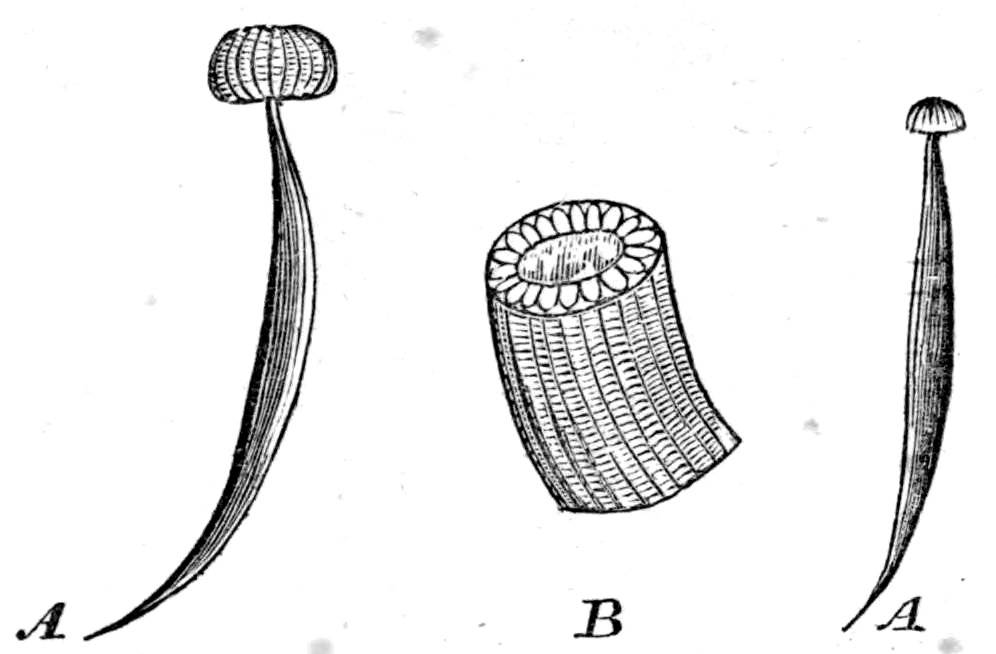
A, A, are spines of the hedgehog enlarged; B, a segment, to show the numerous tubes of communication.
The harvest mouse (mus messorius) in some seasons is common with us, but, like other species of mice, varies much in the numbers found. I have seen their nests as late as the middle of September, containing eight young ones entirely filling the little interior cavity. These nests vary in shape, being round, oval, or pearshaped, with a long neck, and are to be distinguished from those of any other mouse, by being generally suspended on some growing vegetable, a thistle, a beanstalk, or some adjoining stems of wheat, with which it rocks and waves in the wind; but to prevent the young from being dislodged by any violent agitation of the plant, the parent closes up the entrance so uniformly, with the whole fabric, that the real opening is with difficulty found.
100
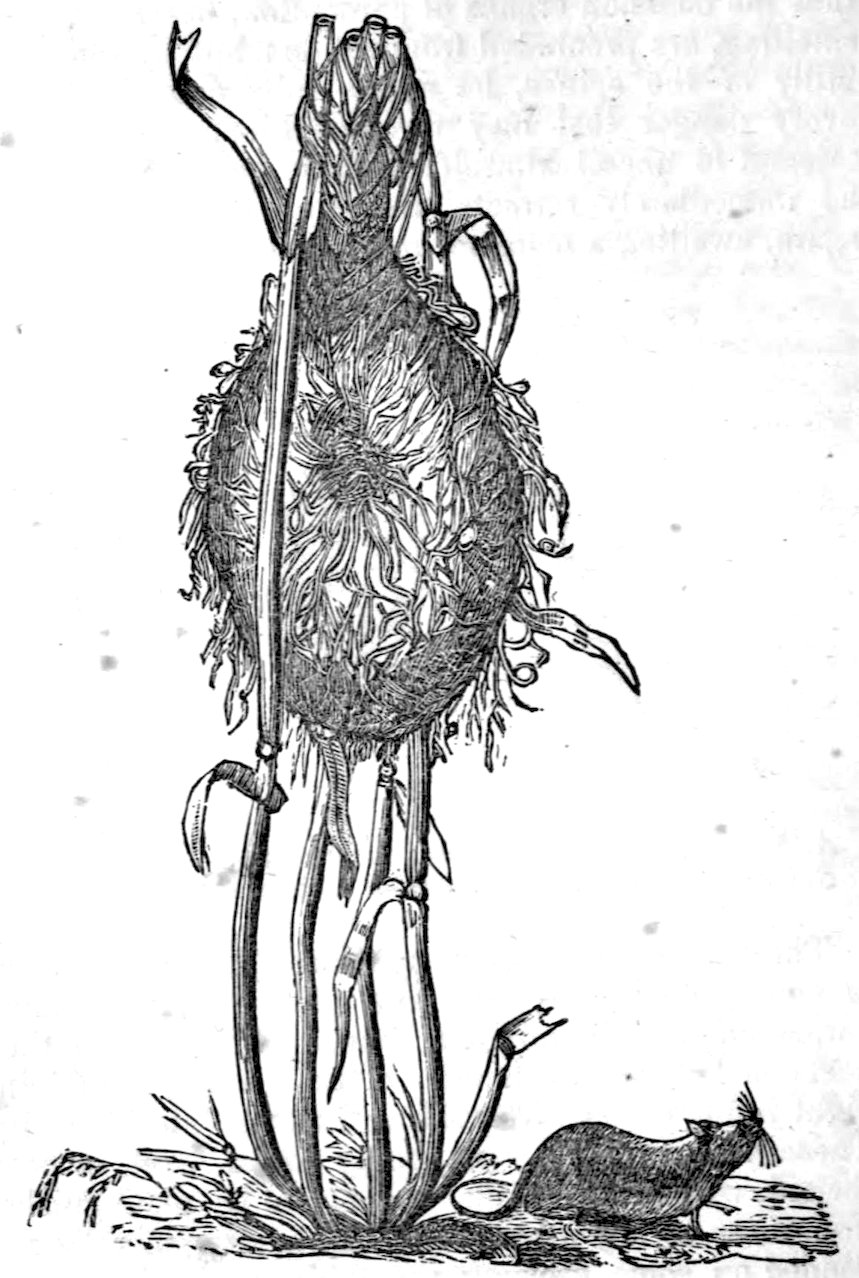
The Harvest Mouse and Nest.
They are the most tame and harmless of little creatures; and, taking shelter in the sheaves when in the field, are often brought home with the crop, and found in little shallow burrows on the ground after the removal of a bean-rick. Those that remain in the field form stores for the winter season, and congregate in 101small societies in holes under some sheltered ditch-bank. An old one, which I weighed, was only one dram and five grains in weight.
Mankind appear to be progressively increasing. It was an original command of his Creator, and the animals domesticated by him, and fostered for his use, are probably multiplied in proportion to his requirements; but we have no reason to suppose that this annual augmentation proceeds in a proportionate degree with the wild creatures upon the surface of the globe; and we know that many of them are yearly decreasing, and very many that once existed have even become extinct. That there are years of increase and decrease ordained for all the inferior orders of creation, common observation makes manifest. In the years 1819 and 1820, all the country about us was overrun with mice; they harbored under the hassocks of our coarse grasses (aira cæspitosa), perforated the banks of ditches, occasioned much damage by burrowing into our potato heaps, and coursed in our gardens from bed to bed even during daylight. The species were the short-tailed meadow-mouse, and the long-tailed garden mouse, and both kinds united in the spring to destroy our early-sown pease and beans. In the ensuing summer, however, they became so greatly reduced, that few were to be seen, and we have not had any thing like such an increase since that period. It is probable that some disease afflicted them, and that they perished in their holes, for we never found their bodies, and any emigration of such large companies would certainly have been observed; yet the appearance and disappearance of creatures of this kind leads us to conclude that they do occasionally change their habitations.
A large stagnant piece of water in an inland county, with which I was intimately acquainted, and which I very frequently visited for many years of my life, was one summer suddenly infested with an astonishing number of the short-tailed water rat, none of which had previously existed there. Its vegetation was the common products of such places, excepting that the larger portion of it was densely covered with its usual crop, 102the smooth horsetail (equisetum limosum). This constituted the food of the creatures, and the noise made by their champing it we could distinctly hear in the evening at many yards’ distance. They were shot by dozens daily; yet the survivors seemed quite regardless of the noise, the smoke, the deaths, around them. Before the winter, this great herd disappeared, and so entirely evacuated the place, that a few years after I could not obtain a single specimen. They did not disperse, for the animal is seldom found in the neighborhood, and no dead bodies were observed. They had certainly made this place a temporary station in their progress from some other; but how such large companies can change their situations unobserved in their transits, is astonishing. Birds can move in high regions and in obscurity, and are not commonly objects of notice; but quadrupeds can travel only on the ground, and would be regarded with wonder, when in great numbers, by the rudest peasant.[40]
That little animal the water shrew (sorex fodiens) appears to be but partially known, but is probably more generally diffused than we imagine. The common shrew in particular seasons gambols through our hedge-rows, squeaking and rustling about the dry foliage, and is observed by every one; but the water shrew inhabits places that secrete it from general notice, and appears to move only in the evenings, which occasions its being so seldom observed. That this creature was an occasional 103resident in our neighborhood was manifest from the dead bodies of two or three having occurred in my walks; but it was some time before I discovered a little colony of them quietly settled in one of my ponds, overshadowed with bushes and foliage. It is very amusing to observe the actions of these creatures, all life and animation in an element they could not be thought any way calculated for enjoying; but they swim admirably, frolicking over the floating leaves of the pondweed, and up the foliage of the flags, which, bending with their weight, will at times souse them in the pool, and away they scramble to another, searching apparently for the insects that frequent such places, and feeding on drowned moths (phalæna potamogeta) and similar insects. They run along the margin of the water, rooting amid the leaves and mud with their long noses for food, like little ducks, with great earnestness and perseverance. Their power of vision seems limited to a confined circumference. The smallness of their eyes, and the growth of the fur about them, are convenient for the habits of the animal, but impediments to extended vision; so that, with caution, we can approach them in their gambols, and observe all their actions. The general blackness of the body, and the triangular spot beneath the tail, as mentioned by Pennant, afford the best ready distinction of this mouse from the common shrew. Both our species of sorex seem to feed by preference on insects and worms; and thus, like the mole, their flesh is rank and offensive to most creatures, which reject them as food. The common shrew, in spring and summer, is ordinarily in motion even during the day from the sexual attachment, which occasions the destruction of numbers by cats, and other prowling animals; and thus we find them strewed in our paths, by gateways, and in our garden walks, dropped by these animals in their progress. It was once thought that some periodical disease occasioned this mortality of the species; but I think we may now conclude that violence alone is the cause of their destruction in these instances. The bite of this creature was considered by the ancients as peculiarly noxious, 104even to horses and large cattle, and a variety of the most extraordinary remedies for the wound, and preventives against it, are mentioned by Pliny and others. The prejudices of antiquity, long as they usually are in keeping possession of the mind, have not been remembered by us; and we only know the hardy shrew now as a perfectly harmless animal, though we still retain a name for it expressive of something malignant and spiteful.
I think we have reason for suspecting that a shrew new to Britain exists in this neighborhood. A pale blue shrew (sorex Daubentonii? Cuvier) has been seen about the margins of our reenes, and the deep marsh ditches cut for draining the water from the low lands of the Severn; and something of the same kind, in a half-digested state, has been found in the stomach of the heron. If it exist with us, a similar tract of land in more fenny countries may contain it plentifully, though it has as yet escaped detection.
The mole,[41] want, mouldwarper or mouldturner (talpa europea), is common with us, as it appears to be in most places; and no creature gives more certain indication of its presence, haunting, from preference, such places as its predecessors have done, though years may have intervened since they were frequented, and rains, and the treading of heavy cattle, have compressed to solid earth the ancient runs; and however assiduously we may destroy them, should they appear again, it will probably be in the same places that have been formerly perforated by others. The earth that these animals eject from their runs, being obtained from very near the surface, and finely pulverized, has tempted me more than once to have it collected for my green-house plants, but not with the success that I had conjectured. Some persons have advocated the cause of moles, as being beneficial to vegetation, by loosening the soil about the roots of plants. Evelyn and others, again, censure them as injurious creatures; and there is a strange narration in Buffon, accusing them of eating all the acorns of a newly-set soil.[42] I am not aware of any benefit occasioned by their presence; their warpings certainly give our 105pastures in the spring a very unsightly appearance, and in grounds designed to be mowed, occasion much trouble, by obliging us frequently to spread and remove them; and in newly-sown corn-lands, they disturb by their runnings the earth at the roots of the grain. But, perhaps, these trifling complaints, these almost imaginary grievances, are the only evils that can be attributed to them. In those wild creatures that are not immediately applicable to our use or amusement, we are more generally inclined to seek out their bad than their good qualities; and though I cannot produce any instance in which the utility of the mole is manifested, yet it is reasonable to conclude, that they are eminently so, either directly or collaterally, nature having provided in an especial manner for a constant supply,[43] and their increase is prodigious when they are not molested. I have killed for two years in succession, between forty and fifty each season, in a very few acres of ground; and notwithstanding all our stratagems for their destruction, and the ease with which they are entrapped, still plenty always remain to recruit our annual waste of them. These creatures are supposed to have a very imperfect vision, and, like insects, have not any external ear, or manifest organ through which sounds can be received; yet we can in no way for a moment suppose that they have been created with any deficiency of power to accomplish all the objects of their being, but that every possible exigency has been provided for. Perceptions may be conveyed in very many instances by intelligences unknown to us, and unquestionably are so. The defect of one power is frequently supplied by the increased activity of another; and the sense of smelling in the mole must be unusually acute, to enable it to pursue and capture its prey with the facility that it does. Its sole food, we believe, is worms; and these sensitive creatures retire immediately upon the smallest moving of the earth in which they reside. Now, as it follows them through all their meanderings, in which neither eyes nor ears would assist it, a fine 106sense of smelling seems necessary to enable it to catch them; and that its success is equal to its wants, and that it feeds plentifully, is manifest by the excellent condition in which the mole is at all seasons of the year. It will penetrate banks of earth after worms lodged in their interior, hunt for them in the richest parts of the field, or on the edges of dung-heaps: in all which pursuits some unknown faculties may direct it; but no sense, that we are acquainted with, could promote its objects so effectually as that of smell. My talparius, a very skilful capturer of these animals, is so sensible of the power that moles are gifted with of readily discriminating smells, that his constant practice is, to draw the body of a captured animal through his traps, and the adjoining runs, and passages, to remove all suspicious odors, which might arise from the touch of his fingers. Its feeling, too, must be acute; as, when casting up the earth, it is sensible of the pressure of a very gentle foot; and, unless our approaches are conducted with great caution, it ceases from its operation, and instantly retires. Should I be censured for needless prolixity in detailing these sensations of a common mole, and “telling of the mouldwarp and the ant,” I trust forgiveness may be granted me, as endeavoring to remove all conceptions, should they exist, that any thing, however vile and worthless it may seem to be, could be created with powers or means inadequate to supply its wants. Whoever will examine the structure of the body of a mole will, perhaps, find no creature more admirably adapted for all the purposes of its life. The very fur on the skin of this animal manifests what attention has been bestowed upon the creature, in providing for its necessities and comforts. This is singularly, most impalpably, fine, yielding in every direction, and offering no resistance to the touch. By this construction the mole is in no degree impeded in its retreat from danger while retiring backwards, as it always does upon suspicion of peril, not turning round, which the size of its runs does not permit, its tail foremost, until it arrives at some collateral gallery, when its flight is head foremost, as with other creatures. If this fur 107had been strong, as in the rat, or mouse, in these retreats for life it would have doubly retarded the progress of the creature; first by its resistance, and then acting as a brush, so as to choke up the galleries, by removing the loose earth from the sides and ceilings of the arched ways; thus impeding at least, if not absolutely preventing, retreat; but the softness of the fur obviates both these fatal effects.
The construction of the hair and fur of different creatures is very various and beautiful; and if we believe in the beneficence of the All-wise Creator, we must conclude that such peculiar fabrications were resorted to for the purpose of being immediately useful, or as necessary to the condition of the animal. In a mere sketch like this, it would conduct me infinitely beyond my intentions, to enumerate the many varieties of hair that are rendered manifest by the microscope; but three or four may be mentioned. The fur or clothing of the mole is internally composed of collateral bars. In man the hairs have at times a central tube, for the conveyance of medullary matter, as in bones, or some nutriment analogous to it; but in the mole there appears to be no communication with the body of the animal, unless the perspirable matter is conducted alternately from side to side along the bars. The fur of the bat has knots like the rudiments of branches. The hairs of the hamster mouse have a central perforation, apparently uninterrupted throughout their whole length. Some of the caterpillars (callimorpha caja) have spines proceeding from the hair that invests their bodies.[44] All these, and the other various contrivances so manifest in the coverings of animals, are probably designed to convey off the perspirable fluids conducive to health in an 108appropriate manner; to discharge the superabundant heat, and keep the body temperate in some cases: in others, again, to retard perspiration, and thus augment the warmth, by every possible gradation, or to increase the sensibility and perceptions of the animal. Many instances of these effects and modifications might be advanced, deserving a more extensive consideration.
The smell of the flesh of the mole is remarkably rank and offensive, as, from the nature of its food, might be expected; and it taints the fingers, which have touched it, with its peculiar odor, so that one washing does not remove it. It is reported of a late very eccentric nobleman, but with what truth I do not know, who essayed himself the flavor of every living thing, even to the eating of the large dew-worm, that the mole alone remained untasted by him, his stomach recoiling with disgust at the nauseous smell of the flesh of this creature. Foxes eat moles, and will at times dig out the traps containing them. The brown owl, too, feeds on them, when it can meet with them outside of their runs hunting after dew-worms; and probably the smaller vermin do the same: but the cat and the dog turn from them with manifest aversion as food; though they will hunt and kill them as objects of the chase.
These animals, we might suppose, while in their subterranean dwellings, would be secure from all injury by such as generally pursue their prey upon the surface of the earth; but I have several times known the weasel caught in the mole-traps, making it manifest, that it hunts after the mole for its food, and in doing so, according to our comprehensions, must encounter infinite danger from suffocation; but it is more probable that so active a creature as the weasel is endowed with powers to accomplish its object with impunity, which we are not acquainted with.
109During the course of a life passed much in the country, and perambulating the woods, the hedges, and the fields, I have contracted almost insensibly an acquaintance with the creatures that frequent them. Some have engaged my attention by their actions and manners; others have interested me by their innocency, and the harmlessness of their lives; and, perhaps, there is some little partial bearing toward others from long association, or from unknown, undefined causes. I tolerate, in despite of all their noise, and all their litter, a colony of rooks,[45] which have taken a liking to some tall elms near my dwelling. Not being ancient denizens there, they can claim no hereditary rights; but their contrivances, their regularity, and even their squabbles, are amusing; and, perhaps, there is mingled with this some little compassion for these dark, half-domesticated families of the grove, driven by the ax from an old abode, which may influence my forbearance.
The hedge-sparrow, or shufflewing, (motacilla modularis), is a prime favorite. Not influenced by season or caprice to desert us, it lives in our homesteads and our orchards through all the year, our most domestic bird. In the earliest spring it intimates to us by a low and plaintive chirp, and that peculiar shake of the wing, which at all times marks this bird, but then is particularly observable, the approach of the breeding season; for it appears always to live in pairs, feeding and moving in company with each other. It is nearly the first bird that forms a nest; and this being placed in an almost leafless hedge, with little art displayed in its concealment, generally becomes the booty of every prying boy, and the blue eggs of the hedge-sparrow are always found in such numbers on his string, that it is surprising how any of the race are remaining, especially when we consider the many casualties to which the old birds are obnoxious from their tameness, and the young that are hatched, from their situation. The plumage of this motacilla is remarkably sober and grave, and all its actions are quiet and comformable to its appearance. Its song is short, sweet, and gentle. Sometimes it is prolonged; but generally the bird perches on the summit 110of some bush, utters its brief modulation, and seeks retirement again. Its chief habitation is some hedge in the rick-yard, some cottage garden, or near society with man. Unobtrusive, it does not enter our dwellings like the redbreast, but picks minute insects from the edges of drains and ditches, or morsels from the door of the poorest dwelling in the village. As an example of a household or domestic bird, none can be found with better pretensions to such a character than the hedge-sparrow.
I always hear with delight the earliest chirpings of that pretty harbinger of spring, the willow wren (motacilla trochillus), trilling its wild and gleeful “chiffchaffs,” as it chases the insects round the branches of the old oak in the copse, or on the yellow catkins of the sallow, itself almost like a colored catkin too. But this elegant little bird is noticed only by the lovers and frequenters of the country; it animates the woods by its constant activity; the frequent repetition of its most cheerful modulation contributes essentially to the pleasing harmony of the grove; and its voice is most sprightly and frequent, when the morning is illumined with one of those mild, walk-enticing gleams, that render this short season the most delightful of our year. It builds its nest, and rears its young with us; visits our gardens, but is no plunderer there, living almost entirely upon insect food; and its whole life is passed in harmlessness and innocence. As it is the earliest that arrives, so it is the last, I believe, of our feathered choir that leaves us, except a few lingering, irresolute swallows; and we hear it piping its final autumnal farewell even in October at times, and sporting with hilarity and joy, when all its congeners are departed.
It is a difficult matter satisfactorily to comprehend the object of this bird in quitting another region, and passing into our island. The chief motives for migration seem to be food, a milder climate, and quiet during the period of incubation and rearing their young: but the willow wren, and some others of our insectivorous birds, appear to have other purposes to accomplish by their annual migrations. These little creatures, the 111food of which is solely insects, could assuredly find a sufficient supply of such diet during the summer months, in the woods and thickets of those mild regions, where they passed the season of winter, and every bank and unfrequented wild would furnish a secure asylum for them and their offspring during the period of incubation. The passage to our shores is a long and dangerous one, and some imperative motive for it must exist; and, until facts manifest the reason, we may perhaps, without injury to the cause of research, conjecture for what object these perilous transits are made. We know that all young creatures require particularly compounded nutriment during their infant state; and nature, as far as we are acquainted with it, has made in every instance provision for a supply of fitting aliment. In many instances, where the removal of station could not be conveniently accomplished, instinct has been given the parent to provide the fitting aliment for its new-born young. Thus insects, in some cases, store their cells with food ready for the animation of their progeny; in others, place their eggs in such situations, as will afford it when they are hatched. The mammalia, at least the quadrupeds belonging to this class, which could least conveniently move their station, have supplies given them of a milky secretion for this purpose. Birds have nothing of this nature, and make no provision for their young; but they of all creatures, except fishes, can seek what may be required in distant stations with most facility. A sufficiency of food for the adult parent may be found in every climate, yet the aliment necessary for its offspring may not. Countries and even counties produce insects that differ, if not in species, at least in numbers; and many young birds we cannot succeed in rearing, or do it very partially, by reason of our ignorance of the requisite food. Every one, who has made the attempt, well knows the various expedients he has resorted to, of boiled meats, bruised seeds, hard eggs, boiled rice, and twenty other substances, that nature never presents, in order to find a diet that will nourish them; but Mr. Montague’s failure in being able to 112raise the young of the cirl bunting,[46] until he discovered that they required grasshoppers, is a sufficient instance of the manifest necessity there is for a peculiar food in one period of the life of birds; and renders it probable that, to obtain a certain aliment, this willow wren, and others of the insect and fruit-feeding birds, direct their flight to distant regions, and is the principal cause of their migrations.
It is some stimulus like this, which urges that little creature, the golden-crested wren (motacilla regulus), that usually only flits from tree to tree, and never attempts upon common occasions a longer flight, to traverse the vast distance from the Orkneys to the Shetland Isles over stormy seas that admit no possible rest during its long passage of above fifty miles! There it breeds its young; but this one object accomplished, it leaves those isles, dares again this tedious flight, and seeks a milder clime. With us it never migrates, lives much in our fir groves during the winter, and breeds in our shrubberies in summer. Peculiar necessities, such as these, may incite the migration of many birds; but that certain species, which lead solitary lives, or associate only in very small parties, should at stated periods congregate from all parts to one spot, and there hold council on a removal, in which the very sexes occasionally separate, is one of the most extraordinary procedures that we meet with among animals.
If the sober, domestic attachments of the hedge-sparrow please us, we are not less charmed with the innocent, blithesome gaiety of the linnet (fringilla linota). But this songster is no solitary visiter of our dwellings: it delights and lives in society, frequenting open commons and gorsy fields, where several pairs, without the least rivalry or contention, will build their nests and rear their offspring in the same neighborhood, twittering and warbling all the day long. This duty over, the families unite, and form large associations, feeding and moving in company as one united household; and, resorting to the head of some sunny tree, 113they will pass hours in the enjoyment of the warmth, chattering with each other in a low and gentle note, and they will thus regularly assemble during any occasional bright gleam throughout all the winter season,—
“and still their voice is song,”
which, heard at some little distance, forms a very pleasing concert, innocent and joyous. The linnet is the cleanliest of birds, delighting to dabble in the water and dress its plumage in every little rill that runs by. The extent of voice in a single bird is not remarkable, being more pleasing than powerful; yet a large field of furze, in a mild sunny April morning, animated with the actions and cheering music of these harmless little creatures, united with the bright glow and odor of this early blossom, is not visited without gratification and pleasure.
The bull-finch (loxia pyrrhula) has no claims to our regard. It is gifted with no voice to charm us; it communicates no harmony to the grove: all we hear from it is a low and plaintive call to its fellows in the hedge. It has no familiarity or association with us, but lives in retirement in some lonely thicket ten months in the year. At length, as spring approaches, it will visit our gardens, an insidious plunderer. Its delight is in the embryo blossoms wrapped up at this season in the bud of a tree; and it is very dainty and curious in its choice of this food, seldom feeding upon two kinds at the same time. It generally commences with the germs of our larger and most early gooseberry; and the bright red breasts of four or five cock-birds, quietly feeding on the leafless bush, are a very pretty sight, but the consequences are ruinous to the crop. When the cherry buds begin to come forward, they quit the gooseberry, and make tremendous havoc with these. I have an early wall cherry, a mayduke by reputation, that has for years been a great favorite with the bull-finch family, and its celebrity seems to be communicated to each successive generation. It buds profusely, but is annually so stripped of its promise by these feathered rogues, 114that its kind might almost be doubted. The orleans and green-gage plums next form a treat, and draw their attention from what remains of the cherry. Having banqueted here awhile, they leave our gardens entirely, resorting to the fields and hedges, where the sloe bush in April furnishes them with food. May brings other dainties, and the labors and business of incubation withdraw them from our observation.
The idea that has been occasionally entertained, that this bird selects only such buds as contain the embryo of an insect, to feed on it, and thus free us of a latent colony of caterpillars, is certainly not correct. It may confer this benefit accidentally, but not with intention. The mischief effected by bull-finches is greater than commonly imagined, and the ground beneath the bush or tree, on which they have been feeding, is commonly strewed with the shattered buds, the rejectments of their banquet; and we are thus deprived of a large portion of our best fruits by this assiduous pillager, this “pick-a-bud,” as the gardeners call it, without any redeeming virtues to compensate our loss. A snowy, severe winter makes great havoc with this bird. It feeds much in this season upon the fruit of the dog-rose, “hips,” as we call them. When they are gone, it seems to pine for food, and is starved, or perhaps frozen on its roost, as few are observed to survive a long inclement winter. But it is not the buds of our fruit-bearing trees only that these destructive birds seek out; yet in all instances I think it will be observed that such buds as produce leaves only are rejected, and those which contain the embryo of the future blossom selected: by this procedure, though the tree is prevented from producing fruit, yet the foliage is expanded as usual; but had the leaves, the lungs of the plant, been indiscriminately consumed, the tree would probably have died, or its summer growth been materially injured: we may thus lose our fruit this year, yet the tree survives, and hope lives, too, that we may be more fortunate the next. The Tartarian honeysuckle (lonicera Tart.) and corchorus Japonicus, when growing in the shrubbery, are very commonly stripped of their bloom by bull-finches: the first incloses many 115separated blossoms in its calyx before expansion, and in that particular is analogous to the buds of icosandrious trees in the garden; and the full-petalled swelling bloom of the latter affords a fine treat for their feasts; but we may permit these pretty birds to banquet here, though, if we expect a supply of summer fruit, we must unsparingly drive them away from the branches of our frugiferous trees. The blossoms of the peach, nectarine, and almond, I have never observed to be injured by these birds: the sparrow will pick away the buds of trees against walls when they frequent such places, but, with this exception, I know none but the bull-finch which resort to that food as a regular supply.
The robin (motacilla rubecola) associated with malignants is not, perhaps, in the place where it generally would be sought; but sad truths might be told of it too. It might be called pugnacious, jealous, selfish, quarrelsome, did I not respect ancient feelings, and long-established sentiments. A favorite by commiseration, it seeks an asylum with us; by supplication and importunity it becomes a partaker of our bounty in a season of severity and want; and its seeming humbleness and necessities obtain our pity: but it slights and forgets our kindnesses the moment it can provide for itself, and is away to its woods and its shades. Yet it has some little coaxing ways, and such fearless confidence, that it wins our regard; and its late autumnal song, in evening’s dusky hour, as a monologue is pleasing, and redeems much of its character. The universality of this bird in all places, and almost at all hours, is very remarkable; and perhaps there are few spots so lonely, in which it would not appear, did we commence digging up the ground. I have often been surprised in the midst of woods, where no suspicion of its presence existed, when watching some other creature, to see the robin inquisitively perched upon some naked spray near me; or, when digging up a plant in some very retired place, to observe its immediate descent upon some poor worm that I had moved. The robin loses nearly all the characteristic color from its breast in the summer, when it moults, and only recovers it on the approach of 116autumn; which in some measure accounts for the extraordinary assertion of Pliny, that the redbreast is only so in winter, but becomes a firetail in summer.
The object of the song of birds is not agreed upon by ornithologists, and we will not now think of it, but merely in passing note how singularly timed the song of the robin is. The blackbird, and the thrush, in mild seasons, will sing occasionally throughout the winter; but the robin, after having been absent all the summer, returns to us late in autumn, and then commences its song, when most others of our feathered choristers are silent. An apparent contention in harmony ensues among them; at length the rivals approach, menace, and fight, with a seeming vexation at each other’s prowess. The song of no one bird is, perhaps, more observed and remembered than the autumnal and, at times, melancholy sounding farewell of the robin.
The chaffinch (fringilla cœlebs) appears to be universally spread throughout the English counties, and the male bird is remarkable for the cleanliness and trimness of his plumage, which, without having any great variety or splendor of coloring, is so composed and arranged, and the white on his wings so brilliant, as to render him a very beautiful little creature. The female is as remarkable for the quiet, unobtrusive tintings of her dress; and, when she lies crouching on her nest, elegantly formed of lichens from the bark of the apple tree, and faded mosses, she would hardly be perceptible, but for her little bright eyes, that peep with suspicious vigilance from her covert. With us the sexes do not separate at any period of the year, the flocks frequenting our barn doors and homesteads in winter being composed of both. In the northern parts of Europe, however, the females are said to migrate to milder regions, which induced Linnæus to bestow the name of “cœlebs” upon this species. In Gloucestershire and some of the neighboring counties, they are little known by the name of chaffinches; but, from the constant repetition of one note, when alarmed or in danger, they have acquired the name of “twinks,” and “pinks;” yet during incubation the song of the male bird, though 117without any variation of tune, is very pleasing in the general concert, as most vernal notes, if not harsh and wearisome from monotony, are. These birds make sad havoc with some of our spring flowers; and the polyanthus, in March, in our sheltered borders, is very commonly stripped of all its blossoms by these little plunderers, I suppose to obtain the immature seeds at the base of their tubes. They will deflorate too the spikes or whorls of the little red archangel (lamium purpureum); and we see them feeding in the waste places where this plant is found in the spring, their little mouths being filled with the green seeds of this dead nettle. At this period too they are sad plunderers in our kitchen gardens, and most dexterously draw up our young turnips and radishes, as soon as they appear upon the surface of the soil; but after this all depredation ceases, the rest of their days being past in sportive innocence. I have observed these birds, in very hot seasons, to wet their eggs, by discharging moisture from their bills upon them, or at least perform an operation that appeared to be so.
We still continue here that very ancient custom of giving parish rewards for the destruction of various creatures included in the denomination of vermin. In former times it may have been found necessary to keep under or reduce the numbers of many predaceous animals, which in a thickly wooded country, with an inferior population, might have been productive of injury; and we even find parliamentary statutes enacted for this purpose: but now, however, our losses by such means have become a very petty grievance; our gamekeepers do their part in removing pests of this nature, and the plow and the ax leave little harbor for the few that escape; and thus we war on the smaller races of creation, and call them vermin. An item passed in one of our late church-wardens’ accounts was, “for seventeen dozen of tom-tits’ heads!” In what evil hour, and for what crime, this poor little bird (parus cæruleus) could have incurred the anathema of a parish, it is difficult to conjecture. I know hardly any small animal that lives a more precarious life than the little blue tom-tit. Indeed 118it is marvellous how any of the insectivorous birds, that pass their winter with us, are supplied with food during inclement seasons, unless they have greater powers of abstinence than we are aware of: but our small birds are generally much more active than those of a larger bulk; the common wren is all animation, its actions and movements bespeak hilarity and animal spirits; and that minute creature, too, the golden-crested wren, is always in motion, flitting from the yew hedge to the fir, or darting away to taller trees with a spring and a power we could not expect from its size. These muscular exertions must greatly counteract the effects of seasons, and enable these atoms of animals to support so cheerfully and gaily the winters of our climate. But in truth this tom-tit perishes in severe winters in great numbers. It roosts under the eaves of our haystacks, and in little holes of the mows, where we often find it dead, perished by cold or hunger, or conjointly by both; yet the race survives, and this annual waste is recruited by the prolificacy of the creature, the nest of which will frequently contain from seven to nine young ones. Its chief subsistence is insects, which it hunts out with unwearied perseverance. It peeps into the nail-holes of our walls, which, though closed by the cobweb, will not secrete the spider within; and draws out the chrysalis of the cabbage butterfly from the chinks in the barn: but a supply of such food is precarious, and becomes exhausted. It then resorts to our yards, and picks diminutive morsels from some rejected bone, or scraps from the butcher’s stall: yet this is the result of necessity, not choice; for no sooner is other food attainable, than it retires to its woods and thickets. In summer it certainly will regale itself with our garden pease, and shells a pod of marrowfats with great dexterity; but this, we believe, is the extent of its criminality. Yet for this venial indulgence do we proscribe it, rank it with vermin, and set a price upon its head, giving four-pence for the dozen, probably the ancient payment when the groat was a coin. However powerful the stimulus was then, we yet find it a sufficient inducement 119to our idle bat-fowling boys to bring baskets of poor toms’ heads to our church-warden’s door.
The wiles and stratagems of every creature are deserving of attention, because they are, for the most part, the impulse of the weak and feeble, instinctive efforts to preserve their own existence, or more generally to secure or defend that of their offspring. Few are able to effect these objects by bodily power; but all creatures probably exert a faculty of some kind, to ward off injury from their young, though not observed by, or manifested to us. This poor little blue tom-tit, which has neither beak, claws, nor any portion of strength to defend itself from the weakest assailant, will nevertheless make trial by menace to scare the intruder from its nest. It builds almost universally in the hole of a wall, or a tree; and its size enables it to creep through so small a crevice, that it is pretty well secured from all annoyances, but those of bird-nesting boys; and these little plunderers the sitting bird endeavors to scare away, by hissing and puffing in a very extraordinary manner from the bottom of the hole, as soon as a finger is introduced, and so perfectly unlike the usual voice of a bird, that many a young intruder is deterred from prosecuting any farther search, lest he should rouse the vengeance of some lurking snake or adder.
They who have seen much of birds, and attended to their actions, will in general be certain of the creature that flits past, by the manner of its flight; or that utters its note unseen by the peculiarity of voice; but the tribe of titmice[47] (parus), especially in the spring of the year, emit such a variety of sounds, that they will occasionally surprise and disappoint us. Hearing an unusual voice, and creeping with caution to observe the stranger from which it proceeds, we perceive only our old acquaintance, the large tom-tit (parus major), searching for food amid the lichens on the bough of an apple-tree. This bird, and that little dark species the “coal,” or “colemouse” (parus ater), in particular, will often acquire or compound a note, become delighted with it, and repeat it incessantly while sporting about the catkins 120of the alder, for an hour or so, then seem to forget or be weary of it, and we hear it no more.
Our tall hedge-rows and copses are frequented by a very amusing little bird, the long-tailed titmouse (parus caudatus). Our boys call it the long-tailed tom-tit, long tom, poke-pudding, and various other names. It seems the most restless of little creatures, and is all day long in a state of progression from tree to tree, from hedge to hedge, jerking through the air with its long tail like a ball of feathers, or threading the branches of a tree, several following each other in a little stream; the leading bird uttering a shrill cry of twĭt, twĭt, twĭt, and away they all scuttle to be first, stop for a second, and then are away again, observing the same order and precipitation the whole day long. The space travelled by these diminutive creatures in the course of their progresses from the first move till the evening roost must be considerable; yet, by their constant alacrity and animation, they appear fully equal to their daily task. We have no bird more remarkable for its family association than this parus. It is never seen alone, the young ones continuing to accompany each other from the period of their hatching until their pairing in spring. Its food is entirely insects, which it seeks among mosses and lichens, the very smallest being captured by the diminutive bill of this creature. Its nest is as singular in construction as the bird itself. Even in years long passed away, when, a nesting boy, I strung my plunder on the benty grass, it was my admiration; and I never see it now without secretly lauding the industry of these tiny architects. It is shaped like a bag, and externally fabricated of moss and different herbaceous lichens, collected chiefly from the sloe (lichen prunastri), and the maple (lichen farinaceus); but the inside contains such a profusion of feathers, that it seems rather filled than lined with them, a perfect feather-bed! I remember finding fourteen or sixteen pealike eggs within this downy covert, and many more were reported to have been found. The excessive labor of the parent birds in the construction and collection of this mass of materials is exceeded by none that I know of; and the 121exertions of two little creatures in providing for, and feeding, with all the incumbrances of feathers and tails, fourteen young ones, in such a situation, surpasses in diligence and ingenuity the efforts of any other birds, persevering as they are, that I am acquainted with.
We might naturally suppose that by the end of winter, all those little birds which are solely supported by insect food would find some difficulty in providing for their wants, having consumed by their numbers and exertions nearly all that store of provision which had been provided in the summer and deposited in safety; but I have found the stomachs of the tree-creeper, and this small titmouse, even in February, quite filled with parts of coleopterous creatures, which by their activity and perseverance they had been enabled to procure beneath the mosses on the branches, and from the chinks in the bark of trees, where they had retired in autumn. Such plenty being procurable after the supply of so many months, renders it apparent that there is no actual deficiency of food at any one period of the year. The small slugs, and some few insects, may perhaps be consumed by the severity of winter, but the larger portion of them are so constituted, as to derive no injury from the inclemency of that season, but afford during many months provender to other creatures, multitudes yet remaining to continue their races and animate the air, when the warm days of spring shall waken them to active life.
The construction and selected situations of the nests of birds are as remarkable, as the variety of materials employed in them; the same forms, places, and articles, being rarely, perhaps never, found united by the different species, which we should suppose similar necessities would direct to a uniform provision. Birds that build early in the spring seem to require warmth and shelter for their young, and the blackbird and the thrush line their nests with a plaster of loam, perfectly excluding, by these cottage-like walls, the keen icy gales of our opening year; yet should accident bereave the parents of their first hopes, they will construct another, even when summer is far advanced, upon the model 122of their first erection, and with the same precautions against severe weather, when all necessity for such provision has ceased, and the usual temperature of the season rather requiring coolness and a free circulation of air. The house-sparrow will commonly build four or five times in the year, and in a variety of situations, under the warm eaves of our houses and our sheds, the branch of the clustered fir, or the thick tall hedge that bounds our garden, &c.; in all which places, and without the least consideration of site or season, it will collect a great mass of straws and hay, and gather a profusion of feathers from the poultry-yard to line its nest. This cradle for its young, whether under our tiles in March or in July, when the parent bird is panting in the common heat of the atmosphere, has the same provision made to afford warmth to the brood; yet this is a bird that is little affected by any of the extremes of our climate. The wood-pigeon and the jay, though they erect their fabrics on the tall underwood in the open air, will construct them so slightly, and with such a scanty provision of materials, that they seem scarcely adequate to support their broods, and even their eggs may almost be seen through the loosely connected materials: but the goldfinch, that inimitable spinner, the Arachnè of the grove, forms its cradle of fine mosses and lichens, collected from the apple or the pear-tree, compact as a felt, lining it with the down of thistles besides, till it is as warm as any texture of the kind can be, and it becomes a model for beautiful construction. The golden-crested wren, a minute creature, perfectly unmindful of any severity in our winter, and which hatches its young in June, the warmer portion of our year, yet builds its most beautiful nest with the utmost attention to warmth; and, interweaving small branches of moss with the web of the spider, forms a closely compacted texture nearly an inch in thickness, lining it with such a profusion of feathers, that, sinking deep into this downy accumulation, it seems almost lost itself when sitting, and the young, when hatched, appear stifled with the warmth of their bedding and the heat of their apartment; while the whitethroat, the 123blackcap, and others, which will hatch their young nearly at the same period, or in July, will require nothing of the kind. A few loose bents and goose-grass, rudely entwined with perhaps the luxury of some scattered hairs, are perfectly sufficient for all the wants of these; yet they are birds that live only in genial temperatures, feel nothing of the icy gales that are natural to our pretty indigenous artists, but flit from sun to sun and we might suppose would require much warmth in our climate during the season of incubation; but it is not so. The green-finch places its nest in the hedge with little regard to concealment; its fabric is slovenly and rude, and the materials of the coarsest kinds: while the chaffinch, just above it in the elm, hides its nest with cautious care, and moulds it with the utmost attention to order, neatness, and form. One bird must have a hole in the ground; to another a crevice in a wall, or a chink in a tree, is indispensable. The bull-finch requires fine roots for its nest; the gray flycatcher will have cobwebs for the outworks of its shed. All the parus tribe, except the individual above-mentioned, select some hollow in a tree or cranny in a wall, and, sheltered as such places must be, yet will they collect abundance of feathers and warm materials for their infants’ beds. Endless examples might be found of the dissimilarity of requirements in these constructions among the several associates of our groves, our hedges, and our houses; and yet the supposition cannot be entertained for a moment that they are superfluous, or not essential for some purpose with which we are unacquainted.[48] By how many of the ordinations of supreme 124intelligence is our ignorance made manifest! Even the fabrication of the nests of these little animals exceeds our comprehension—we know none of the causes or motives of that unbodied mind that willed them thus.
One notice more of the parus tribe (the parus cæruleus), and these little creatures may retire to their leafy shades and be forgotten. I was lately exceedingly pleased in witnessing the maternal care and intelligence of this bird; for the poor thing had its young ones in the hole of a wall, and the nest had been nearly all drawn out of the crevice by the paw of a cat, and part of its brood devoured. In revisiting its family, the bird discovered a portion of it remaining, though wrapped up and hidden in the tangled moss and feathers of their bed, and it then drew the whole of the nest back into the place from whence it had been taken, unrolled and resettled the remaining little ones, fed them with the usual attentions, and finally succeeded in rearing them. The parents of even this reduced family labored with great perseverance to supply its wants, one or the other of them bringing a grub, caterpillar, or some insect, at intervals of less than a minute through the day, and probably in the earlier part of the morning more frequently; but if we allow that they brought food to the hole every minute for fourteen hours, and provided for their own wants also, it will admit of perhaps a thousand grubs a day for the requirements of one, and that a diminished brood; and give us some comprehension of the infinite number requisite for the summer nutriment of our soft-billed birds, and the great distances gone over by such as have young ones, in their numerous trips from hedge to tree in the hours specified, when they have full broods to support. A climate of moisture 125and temperature like ours is peculiarly favorable for the production of insect food, which would in some seasons be particularly injurious, were we not visited by such numbers of active little friends to consume it.
The raven (corvus corax) does not build with us. A pair indeed attempted to raise a brood in our wych elm; but they love retirement and quiet, and were soon scared away, and made no second trial. Ravens visit us, however, frequently, and always during the lambing season, watching for any weak and deserted creature, which, when perceived, is instantly deprived of its eyes; but they make no long stay in our pastures. They abide nowhere in fact, but move from place to place, where food may chance to be found. Should an animal die, or a limb of fresh carrion be on the hooks in the tree, the hoarse croak of the raven is sure immediately to be heard, calling his congeners to the banquet. We see it daily in its progress of inspection, or high in the air on a transit to other regions, hastening, we conjecture, to some distant prey. With the exception of the snipe, no bird seems more universally spread over the surface of our globe than the raven, inhabiting every zone, the hot, the temperate, the severe—feeding upon, and removing noxious substances from the earth, of which it obtains intimation by means of a faculty we have little conception of. Sight it cannot be; and we know not of any fetor escaping from an animal previous to putrescence, so subtile as to call these scavengers of nature from the extremity of one county to that of another; for it is manifest, from the height which they preserve in their flight, and the haste they are making, that their departure has been from some far distant station, having a remote and urgent object in contemplation.
In England the raven does not seem to abound; but it is most common on the shores of harbors, or near great rivers, where animal substances are more frequently to be met with than in inland places. In Greenland, and Iceland, where putrescent fishy substances abound, they appear to be almost domesticated. Horace calls the raven “annosa cornix;” and in a tame 126state it has attained a very long life. How long extended its existence may be, when roaming in an unrestricted state, we have no means of ascertaining. This liberty may be most favorable to longevity; yet, from the numerous contingencies attending the condition of these creatures, it is probable that few of them live out all their days, so as to become the “bird of ages.” However, the supposed longevity they have attained, their frequent mention and agency in holy writ, the obscure knowledge we possess of their powers and motives, with the gravity of their deportment, like an “all-knowing bird,” have acquired for them, from very remote periods, the veneration of mankind. The changes in our manners and ideas, in respect to many things, have certainly deprived them of much of this reverence; yet the almost supernatural information which they obtain of the decease, or approaching dissolution, of an animal, claims still some admiration for them. This supposed faculty of “smelling death” formerly rendered their presence, or even their voice, ominous to all, as
“The hateful messengers of heavy things,
Of death and dolor telling;”
and the unusual sound of their harsh croak, still, when illness is in the house, with some timid and affectionate persons, brings old fancies to remembrance, savoring of terror and alarm. I am no friend to the superstition of converting natural transactions, or occasional events, into signs and indications of coming things; superstitions are wearing out, and shortly will waste away, and be no more heard of; but I fear, in their place, deism, infidelity, impiety, have started up, the offspring of intuitive wisdom: the first belief arises from weakness and ignorance; the latter disbelief is ingratitude, pride, wickedness.
Of the natural duration of animal life it is, from many circumstances, difficult to form an accurate statement, the wild creatures being in great measure removed from observation, and those in a condition of domestication being seldom permitted to live as long as their bodily strength would allow. It was formerly 127supposed that the length of animal life was in proportion to its duration in utero, or the space it remained in the parent from conception to birth, and the length of time it required to obtain maturity. This notion might have some support in reason and fact, occasionally, but in many cases was incorrect, and in regard to birds had no foundation. Herbivorous animals probably live longer than carnivorous ones, vegetable food being most easily obtainable in all seasons in a regular and requisite supply; whereas animals that subsist on flesh, or by the capture of prey, are necessitated at one period to pine without food, and at another are gorged with superfluity: and when the bodily powers of rapacious creatures become impaired, existence is difficult to support, and gradually ceases; but with herbivorous animals in the same condition, supply is not equally precarious, or wholly denied. Yet it is probable that few animals in a perfectly wild state live to a natural extinction of life. In a state of domestication, the small number of carnivorous creatures about us are sheltered and fed with care, seldom are in want of proper food, and at times are permitted to await a gradual decay, continuing as long as nature permits; and by such attentions many have attained to a great age; but this is rather an artificial than a natural existence. Our herbivorous animals, being kept mostly for profit, are seldom allowed to remain beyond approaching age; and when its advances trench upon our emoluments by diminishing the supply of utility, we remove them. The uses of the horse, though time may reduce them, are often protracted; and our gratitude for past services, or interest in what remains, prompts us to support his life by prepared food of easy digestion, or requiring little mastication, and he certainly by such means attains to a longevity probably beyond the contingencies of nature. I have still a favorite pony—for she has been a faithful and able performer of all the duties required of her in my service for upwards of two-and-twenty years—and, though now above five-and-twenty years of age, retains all her powers perfectly, without any diminution or symptom of decrepitude; the fineness of limb, brilliancy 128of eye, and ardor of spirit, are those of the colt and though treated with no remarkable care, she has never been disabled by the illness of a day, or sickened by the drench of the farrier. With birds it is probably the same as with other creatures, and the eagle, the raven, the parrot, &c., in a domestic state attain great longevity; and though we suppose them naturally tenacious of life, yet, in a really wild state, they would probably expire before the period which they attain when under our attention and care. And this is much the case with man who probably outlives most other creatures; for though excess may often shorten, and disease or misfortune terminate his days, yet naturally he is a long-lived animal. His “threescore years and ten” are often prolonged by constitutional strength, and by the cares, the loves, the charities, of human nature. As the decay of his powers awakens solicitude, duty and affection increase their attentions, and the spark of life only expires when the material is exhausted.
That rare bird the crossbill (loxia curvirostra) occasionally visits the orchards in our neighborhood, coming in little parties to feed upon the seeds of the apple; and, seldom as it appears, is always noticed by the mischief it does to the fruit, by cutting it asunder with its well-constructed mandibles, in order to obtain the kernels. A native of those extensive pine forests in the neighborhood of the Rhine, it makes excursions into various parts of Europe in search of change of food; and, though several instances are recorded of its visits to our island, I know but one mention of its having bred in England. A pair was brought to me very early in August, and the breast of the female being nearly bare of feathers, as is observable in sitting birds, it is very probable that she had a nest in the neighborhood.
Gesner has called the common rook (corvus frugilegus) a corn-eating bird. Linnæus has somewhat lightened this epithet by considering it only as a gatherer of corn; to neither of which names do I believe it entitled, as it appears to live solely upon grubs, various insects, and worms. It has at times great difficulty 129to support its life, for in a dry spring or summer most of these are hidden in the earth beyond its reach, except at those uncertain periods when the grub of the chaffer is to be found; and in a hot day we see the poor birds perambulating the fields, and wandering by the sides of the highways, seeking for, and feeding upon grasshoppers, or any casual nourishment that may be found. At those times, was it not for its breakfast of dew-worms, which it catches in the gray of the morning, as it is appointed the earliest of risers, it would commonly be famished. In the hot summer of 1825, many of the young brood of the season perished from want; the mornings were without dew, and consequently few or no worms were to be obtained; and we found them dead under the trees, having expired on their roostings. It was particularly distressing, for no relief could be given, to hear the constant clamor and importunity of the young for food. The old birds seemed to suffer without complaint; but the wants of their offspring were expressed by the unceasing cry of hunger, and pursuit of the parents for supply, and our fields were scenes of daily restlessness and lament. Yet, amid all this distress, it was pleasing to observe the perseverance of the old birds in the endeavor to relieve their famishing families, as many of them remained out searching for food quite in the dusk, and returned to their roosts long after the usual period for retiring. In this extremity it becomes a plunderer, to which by inclination it is not much addicted, and resorts to our newly-set potato-fields, digging out the cuttings. Ranks are seen sadly defective, the result of its labors, I fear; and the request of my neighbors now and then for a bird from my rookery, to hang up in terrorem in their fields, is confirmatory of its bad name. In autumn a ripe pear, or a walnut, becomes an irresistible temptation, and it will occasionally obtain a good share of these fruits. In hard frost, it is pinched again, visits for food the banks of streams, and in conjunction with its congener the “villain crow,” becomes a wayfaring bird, and seeks a dole from every passing steed. Its life, however, is not always dark and sombre: it has its 130periods of festivity also. When the waters retire from meadows and low lands, where they have remained any time, a luxurious banquet is provided for this corvus, in the multitude of worms which it finds drowned on them. But its jubilee is the season of the cockchaffer (melolantha vulgaris), when every little copse, every oak, becomes animated with it and all its noisy, joyful family feeding and scrambling for the insect food. The power or faculty, be it by the scent, or by other means, that rooks possess of discovering their food, is very remarkable. I have often observed them alight on a pasture of uniform verdure, and exhibiting no sensible appearance of withering or decay, and immediately commence stocking up the ground. Upon investigating the object of their operations, I have found many heads of plantains, the little autumnal dandelions, and other plants, drawn out of the ground and scattered about, their roots having been eaten off by a grub, leaving only a crown of leaves upon the surface. This grub beneath, in the earth, the rooks had detected in their flight, and descended to feed on it, first pulling up the plant which concealed it, and then drawing the larvæ from their holes. By what intimation this bird had discovered its hidden food we are at a loss to conjecture; but the rook has always been supposed to scent matters with great discrimination.
It is but simple justice to these often censured birds, to mention the service that they at times perform for us in our pasture lands. There is no plant that I endeavor to root out with more persistency in these places than the turfy hair-grass (aira cæspitosa). It abounds in all the colder parts of our grass lands, increasing greatly when undisturbed, and, worthless itself, overpowers its more valuable neighbors. The larger turfs we pretty well get rid of; but multitudes of small roots are so interwoven with the pasture herbage, that we cannot separate them without injury; and these our persevering rooks stock up for us in such quantities, that in some seasons the fields are strewed with the eradicated plants. The whole so torn up does not exclusively prove to be the hair-grass, but infinitely the larger 131portion consists of this injurious plant. The object of the bird in performing this service for us is to obtain the larvæ of several species of insects, underground feeders, that prey on the roots, as Linnæus long ago observed upon the subject of the little nard grass (nardus stricta). This benefit is partly a joint operation: the grub eats the root, but not often so effectually as to destroy the plant, which easily roots itself anew; but the rook finishes the affair by pulling it up to get at the larvæ, and thus prevents all vegetation; nor do I believe that the bird ever removes a specimen that has not already been eaten, or commenced upon, by the caterpillar.
The rook entices its young from the breeding trees, as soon as they can flutter to any other. These young, for a few evenings after their flight, will return with their parents, and roost where they were bred; but they soon quit their abode, and remain absent the whole of the summer months. As soon however as the heat of summer is subdued, and the air of autumn felt, they return and visit their forsaken habitations, and some few of them even commence the repair of their shattered nests; but this meeting is very differently conducted from that in the spring; their voices have now a mellowness approaching to musical, with little admixture of that harsh and noisy contention, so distracting at the former season, and seems more like a grave consultation upon future procedure; and as winter approaches they depart for some other place. The object of this meeting is unknown; nor are we aware that any other bird revisits the nest it has once forsaken. Domestic fowls, indeed, make use again of their old nests; but this is never, or only occasionally, done by birds in a wild state. The daw and rock-pigeon will build in society with their separate kindred: and the former even revisits in autumn the places it had nestled in. But such situations as these birds require, the ruined castle, abbey, or church tower, ledge in the rock, &c., are not universally found, and are apparently occupied from necessity. The rooks appear to associate from preference to society, as trees are common everywhere; but what motive they can have in view in lingering 132thus for a few autumnal mornings and counselling with each other around their abandoned and now useless nests, which before the return of spring are generally beaten from the trees, is by no means manifest to us.
The sense of smelling seems often to supply in animals the want of faculties they are not gifted with; and it is this power which directs them to their food with greater certainty, than the discernment of man could do. That we have every faculty given us necessary for the condition in which we are placed, is manifest; yet the mechanical talents and intuition of the insect, the powers that birds and beasts possess, and the superior acuteness of some of their senses, of which, perhaps, we have little conception, makes it evident that all created things were equally the objects of their Maker’s benevolence and care; the worm that creepeth, and the beast that perisheth, deserve our consideration, and claim from human reason mercy and compassion.
The tall tangled hedge-row, the fir grove, or the old, well-wooded inclosure, constitutes the delight of the magpie (corvus pica), as there alone its large and dark nest has any chance of escaping observation. We here annually deprive it of these asylums, and it leaves us; but it does not seem to be a bird that increases much anywhere. As it generally lays eight or ten eggs, and is a very wary and cunning creature, avoiding all appearance of danger, it might be supposed that it would yearly become more numerous. Upon particular occasions we see a few of them collect; but the general spread is diminished, and as population advances, the few that escape will retire from the haunts and persecutions of man. These birds will occasionally plunder the nests of some few others; and we find in early spring the eggs of our out-laying domestic fowls frequently dropped about, robbed of their contents. That the pie is a party concerned in these thefts, we cannot deny, but to the superior audacity of the crow we attribute our principal injury. However the magpie may feed on the eggs of others, it is particularly careful to guard its own nest from similar injuries by covering it with an impenetrable canopy of thorns, and is our 133only bird that uses such a precaution, securing it from all common depredation, though not from the hand of the bird-nesting boy. When a hatch is effected, the number of young demand a larger quantity of food than is easily obtained, and whole broods of our ducklings, whenever they stray from the yard, are conveyed to the nest. But still the “magot” is not an unuseful bird, as it frees our pastures of incredible numbers of grubs and slugs, which lodge themselves under the crusts formed by the dung of cattle. These the birds with their strong beaks turn over, and catch the lurking animals beneath, and then break them to search for more; by which means, during the winter they will spread the entire droppings in the fields; and by spring I have had, especially under the hedges, all this labor saved to me by these assiduous animals.
Natural affection, the love of offspring, is particularly manifested in birds; for in general they are timid and weak creatures, flying from apprehended dangers, and endowed with little or no power of defending themselves; but they will menace when injury is threatened to their brood, and incur dangers in order to obtain food for their young, that they will encounter in no other period of their lives.
The common jay (corvus glandarius) affords a good example of this temporary departure from general character. This bird is always extremely timid and cautious, when its own interest or safety is solely concerned; but no sooner does its hungry brood clamor for supply, than it loses all this wary character, and becomes a bold and impudent thief. At this period it will visit our gardens which it rarely approaches at other times, plunder them of every raspberry, cherry, or bean, that it can obtain; and will not cease from rapine as long as any of the brood or the crop remains. We see all the nestlings approach, and, settling near some meditated scene of plunder, quietly await a summons to commence. A parent bird from some tree surveys the ground, then descends upon the cherry, or into the rows, immediately announces a discovery by a low but particular call, and all the family flock in to the banquet, which having 134finished by repeated visits, the old birds return to the woods, with all their chattering children, and become the same wild, cautious creatures they were before. Some of our birds separate from their broods, as soon as they are able to provide for themselves; but the jay and its family associate during all the autumn and winter months, taking great delight in each other’s company, and only separate to become founders of new establishments. We see them in winter under the shelter of tall hedges, or on the sunny sides of woods and copses, seeking amid the dry leaves for acorns, or the crab, to pick out the seeds, or for the worms and grubs hidden under cowdung; feeding in perfect silence, yet so timid and watchful, that they seldom permit the sportsman to approach them. When disturbed, they take shelter in the depth of the thicket, calling to each other with a harsh and loud voice, that resounds through the covert. The Welsh call this creature “screch y coed,” the screamer of the wood. The jay is a very heavy, inelegant bird. Its general plumage is sober and plain, though its fine browns harmoniously blend with each other: but the beautiful blue-barred feathers, that form the greater coverts of the wings, distinguish it from every other bird, and, in the days when featherwork was in favor with our fair countrywomen, were in such request, that every gamekeeper, and schoolboy brother with his Christmas gun, persecuted the poor jay through all his retirements, to obtain his wings.
The great shrike, or butcher-bird (lanius excubitor), is not uncommon with us, and breeds annually near my dwelling. It is one of our late birds of passage, but its arrival is soon made known to us by its croaking, unmusical voice from the summit of some tree. Its nest is large and ill-concealed; and during the season of incubation the male bird is particularly vigilant and uneasy at any approach towards his sitting mate, though often by his clamorous anxiety he betrays it and her to every bird-nesting boy. The female, when the eggs are hatched, unites her vociferations with those of the male, and facilitates the detection of the brood. Both parents are very assiduous in their attentions to their offspring, 135feeding them long after they have left the nest; for the young appear to be heavy, inactive birds, and little able to capture the winged insects, that constitute their principal food. I could never observe that this bird destroyed others smaller than itself, or even fed upon flesh. I have hung up dead young birds, and even parts of them, near their nests; but never found that they were touched by the shrike. Yet it appears that it must be a butcher too; and that the name “lanius,” bestowed on it by Gesner two hundred and fifty years ago, was not lightly given. My neighbor’s gamekeeper kills it as a bird of prey; and tells me he has known it draw the weak young pheasants through the bars of the breeding coops; and others have assured me that they have killed them when banqueting on the carcass of some little bird they had captured. All small birds have an antipathy to the shrike, betray anger, and utter the moan of danger, when it approaches their nest. I have often heard this signal of distress, and, cautiously approaching to learn the cause, have frequently found that this butcher-bird occasioned it. They will mob, attack, and drive it away, as they do the owl, as if fully acquainted with its plundering propensities. Linnæus attached to it the trivial epithet “excubitor,” a sentinel; a very apposite appellation, as this bird seldom conceals itself in a bush, but sits perched upon some upper spray, or in an open situation, heedful of danger, or watching for its prey. This shrike must be most mischievously inclined, if not a predatory bird.—May 23d:—A pair of robins have young ones in a bank near my dwelling: the anxiety and vociferation of the poor things have three times this day called my attention to the cause of their distress, and each time have I seen this bird watching near the place, or stealing away upon my approach; and then the tumult of the parents subsided; but had they not experienced injury, or been aware that it was meditated, all this terror and outcry would not have been excited.
Many birds are arranged in our British ornithology not known as permanent inhabitants, but which have occasionally visited our shores during inclement seasons, 136or been driven from their general stations by tempestuous weather. An event like this, the violent gale of All-hallows eve, in 1824, brought to us the stormy petrel[49] (procellaria pelagica); a bird that resides far in the depths of the ocean, does not approach our shores, it is believed, except for the purposes of incubation, and we know only one place, the Isle of Sky, that it haunts even for this short period. It is a creature
——“that roams on her sea-wing,
Unfatigued, and ever sleeps,
Calm, upon the toiling deeps.”
It is a pretty good manifestation of the strength and extent of that hurricane, which could catch up a bird with a wing so powerful as to enable it to riot in the whirlwind and enjoy the storm, and bear it away irresistibly, perhaps, from the Atlantic waves, over such a space of land and ocean, and then dash it down on a rather elevated common in this parish, whence it was brought to me in a very perfect state. This little creature, scarcely as big again as a swallow, and the smallest of all our web-footed birds, has, like all the others of its genus, that extraordinary tube on its upper mandible, through which it spirts out an oily matter when irritated; but the real object of this singular provision seems unknown. Our seamen amuse themselves during the monotony of a voyage with the vagaries of “mother Carey’s chickens,” as they have from very early times called this bird. The petrels seem to repose in a common breeze, but upon the approach, or during the continuation, of a gale, they surround a ship, and catch up the small animals which the agitated ocean brings near the surface, or any food that may be dropped from the vessel. Whisking with the celerity of an arrow through the deep valleys of the abyss, and darting away over the foaming crest of some mountain wave, they attend the laboring bark in all her perilous course. When the storm subsides they retire to rest, and are no more seen. The presence of this petrel was thought in times past to predict a storm, and it was consequently looked upon as an unwelcome visitant.
137The wryneck (jynx torquilla) visits us annually, but in very uncertain numbers, and, from some unknown cause, or local changes, in yearly diminishing quantities. In one short season after its arrival we hear its singular monotonous note at intervals through half the day. This ceases, and we think no more about it, as it continues perfectly mute; not a twit or a chirp escapes to remind us of its presence during all the remainder of its sojourn with us, except the maternal note or hush of danger, which is a faint, low, protracted hissing, as the female sits clinging by the side or on the stump of a tree. Shy and unusually timid, as if all its life were spent in the deepest retirement away from man, it remains through the day on some ditch-bank, or basks with seeming enjoyment, in any sunny hour, on the ant-hills nearest to its retreat; and these it depopulates for food, by means of its long glutinous tongue, which with the insects collects much of the soil of the heaps, as we find a much larger portion of grit in its stomach than is usually met with in that of other birds. When disturbed it escapes by a flight precipitate and awkward, hides itself from our sight, and, were not its haunts and habits known, we should never conjecture that this bustling fugitive was our long-forgotten spring visitant the wryneck. The winter or spring of 1818 was, from some unknown cause, singularly unfavorable for this bird. It generally arrives before the middle of April; and its vernal note, so unlike that of any of its companions, announces its presence throughout all the mild mornings of this month, and part of the following; but during the spring of that year it was perfectly silent, or absent from us. The season, it is true, was unusually cheerless and ungenial.
Some of our birds are annually diminishing in numbers; others have been entirely destroyed, or no longer visit the shores of Britain. The increase of our population, inclosure, and clearage of rude and open places, and the drainage of marshy lands, added to the noise of our fire-arms, have driven them away, or rendered their former breeding and feeding stations no longer eligible to many, especially to the waders and aquatic 138birds. The great Swan Pool, near the city of Lincoln, on which I have seen at one time forty of these majestic creatures sailing in all their dignity, is, I am told, no longer a pool; the extensive marshes of Glastonbury, which have afforded me the finest snipe shooting, are now luxuriant corn farms; and multitudes of other cases of such subversions of harbor for birds are within memory. An ornithological list made no longer ago than the days of Elizabeth would present the names of multitudes now aliens to our shores. The nightingale was common with us here a few years past; the rival songs of many were heard every evening during the season, and in most of our shady lanes we were saluted by the harsh warning note of the parent to its young; but from the assiduity of bird-catchers, or some local change that we are not sensible of, a solitary vocalist or so now only delights our evening walk. The egg of this bird is rather singularly colored, and not commonly to be obtained. Our migrating small birds incur from natural causes great loss in their transits; birds of prey, adverse winds, and fatigue, probably reduce their numbers nearly as much as want, and the severity of the winter season, does those that remain; and in some summers the paucity of such birds is strikingly manifest. Even the hardy rook is probably not found in such numbers as formerly, its haunts having been destroyed or disturbed by the felling of trees, in consequence of the increased value of timber, and the changes in our manners and ideas. Rooks love to build near the habitation of man: but their delight, the long avenue, to caw as it were in perspective from end to end, is no longer the fashion; and the poor birds have been dispersed to settle on single distant trees, or in the copse, and are captured and persecuted.
“Old-fashioned halls, dull aunts, and croaking rooks,”
a modern Zephalinda would scarcely find now to anticipate with dread. In many counties very few rookeries remain, where once they were considered as a necessary appendage, and regularly pointed out the abbey, the hall, the court-house, and the grange.
139The starling (sturnus vulgaris) breeds with us, as in most villages in England. Towards autumn the broods unite, and form large flocks; but those prodigious flights, with which, in some particular years, we are visited, especially in parts of those districts formerly called the “fen counties,” are probably an accumulation from foreign countries. We have seldom more than a pair, or two, which nestle under the tiling of an old house, in the tower of the church, the deserted hole of the woodpecker, or some such inaccessible place. The flights probably migrate to this country alone, as few birds could travel long, and continue such a rapid motion as the starling. The Royston crow, the only migrating bird with which it forms an intimate association, is infinitely too heavy of wing to have journeyed with the stare. The delight of these birds in society is a predominant character; and to feed they will associate with the rook, the pigeon, or the daw; and sometimes, but not cordially, with the fieldfare: but they chiefly roost with their own families, preferring some reedy, marshy situation. These social birds are rarely seen alone, and should any accident separate an individual from the companions of its flight, it will sit disconsolate on an eminence, piping and plaining, till some one of its congeners join it. Even in small parties they keep continually calling and inviting associates to them, with a fine clear note, that, in particular states of the air, may be heard at a considerable distance. This love of society seems to be innate; for I remember one poor bird, that had escaped from domestication, in which it had entirely lost, or probably never knew, the language or manners of its race, and acquired only the name of its mistress; disliked and avoided by its congeners, it would sit by the hour together, sunning on some tall elm, calling in a most plaintive strain, Nānny, Nānny, but no Nanny came; and our poor solitary either pined itself to death, or was killed, as its note ceased. They vastly delight, in a bright autumnal morning, to sit basking and preening themselves on the summit of a tree, chattering all together in a low song-like note. There is something singularly curious and mysterious 140in the conduct of these birds previous to their nightly retirement, by the variety and intricacy of the evolutions they execute at that time. They will form themselves perhaps into a triangle, then shoot into a long, pearshaped figure, expand like a sheet, wheel into a ball, as Pliny observes, each individual striving to get into the centre, &c., with a promptitude more like parade movements, than the actions of birds. As the breeding season advances, these prodigious flights divide, and finally separate into pairs, and form their summer settlements; but probably the vast body of them leaves the kingdom. Travellers tell us, that starlings abound in Persia and the regions of Caucasus.
No birds, except sparrows, congregate more densely than stares. They seem continually to be running into clusters, if ever so little scattered; and the stopping of one, to peck at a worm, immediately sets all its companions hastening to partake. This habit in the winter season brings on them death, and protracted sufferings, as every village popper notices these flocks, and fires at the poor starlings. Their flesh is bitter and rank, and thus useless when obtained; but the thickness of the flights, the possibility of killing numbers, and manifesting his skill, encourages the trial. The flight of these birds, whether from feeding to roost, or on their return to feed, is so rapid, that none with any impediment can keep company; and in consequence we see many, which have received slight wing or body wounds, lingering about the pastures long into spring, and pining after companions they cannot associate with.
These birds are very assiduous in their attentions to their young, and in continual progress to collect worms and insects for them. However strong parental affection may be in all creatures, yet the care which birds manifest in providing for their nestlings is more obvious than that of other animals. The young of beasts sleep much; some are hidden in lairs and thickets nearly all the day, others take food only at intervals or stated periods, the parent ruminating, feeding, or reposing too: but birds, the young of which remain in their nests, as most of them do, excepting the gallinaceous 141and aquatic tribes, have no cessation of labor from early morning till the close of eve, till the brood can provide for themselves. What unceasing toil and perseverance are manifest in the rooks, and what distances do they travel to obtain nourishment for their clamorous brood! It is a very amusing occupation for a short time, to attend to the actions of a pair of swallows, or martens, the family of which have left the nest, and settled upon some naked spray, or low bush in the field, the parents cruising around, and then returning with their captures to their young: the constant supply which they bring, the celerity with which it is given and received, and the activity and evolutions of the elder birds, present a pleasing example of industry and affection. I have observed a pair of starlings for several days in constant progress before me, having young ones in the hole of a neighboring poplar tree, and they have been probably this way in action from the opening of the morning—thus persisting in this labor of love for twelve or thirteen hours in the day! The space they pass over in their various transits and returns must be very great, and the calculation vague; yet, from some rude observations it appears probable that this pair in conjunction do not travel less than fifty miles in the day, visiting and feeding their young about a hundred and forty times, which consisting of five in number, and admitting only one to be fed each time, every bird must receive in this period eight-and-twenty portions of food or water! This excessive labor seems entailed upon most of the land birds, except the gallinaceous tribes, and some of the marine birds, which toil with infinite perseverance in fishing for their broods; but the very precarious supply of food to be obtained in dry seasons by the terrestrial birds renders theirs a labor of more unremitting hardship than that experienced by the piscivorous tribes, the food of which is probably little influenced by season, while our poor land birds find theirs to be nearly annihilated in some cases. The gallinaceous birds have nests on the ground; the young leave them as soon as they escape from the shell, are led immediately from the hatch to fitting 142situations for food and water, and all their wants are most admirably attended to; but the constant journeyings of those parent birds that have nestlings unable to move away, the speed with which they accomplish their trips, the anxiety they manifest, and the long labor in which they so gaily persevere, is most remarkable and pleasing, and a duty consigned but to a few.
We have no bird more assiduous in attentions to their young, than the red-start, (steort, Saxon, a tail,) one or other of the parents being in perpetual action, conveying food to the nest, or retiring in search of it; but as they are active, quick-sighted creatures, they seem to have constant success in their transits. They are the most restless and suspicious of birds during this season of hatching and rearing their young; for when the female is sitting, her mate attentively watches over her safety, giving immediate notice of the approach of any seemingly hostile thing, by a constant repetition of one or two querulous notes, monitory to her or menacing to the intruder: but when the young are hatched, the very appearance of any suspicious creature sets the parents into an agony of agitation, and perching upon some dead branch or a post, they persevere in one unceasing clamor till the object of their fears is removed; a magpie near their haunts, with some reason, excites their terror greatly, which is expressed with unremitting vociferation. All this parental anxiety, however, is no longer in operation than during the helpless state of their offspring, which, being enabled to provide their own requirements, gradually cease to be the objects of solicitude and care; they retire to some distant hedge, become shy and timid things, feeding in unobtrusive silence.
The brown starling, or solitary thrush (turdus solitarius), is not an uncommon bird with us. It breeds in the holes and hollows of old trees, and, hatching early, forms small flocks in our pastures, which are seen about before the arrival of the winter starling, for which bird, by its manners and habits, it is generally mistaken. It will occasionally, in very dry seasons, enter our gardens for food, which the common stares never do; and this 143year (1826) I had one caught in a trap, unable to resist the tempting plunder of a cherry tree, in conjunction with half the thrushes in the neighborhood. I have seen a few, small, thrushlike birds associate and feed with the missel-thrush in our summer pastures, which I suspect to be solitary starlings: but, wild and wary like them, they admit no approach to verify the species; and they appear likewise to follow and mix with this bird, when it visits us in autumn, to gather the berries of the yew and the mountain ash. I am not certain where it passes its winter season, but apprehend it mingles in the large flights of the common species. It returns to our pastures, however, for a short period in the spring, in small parties of six or ten individuals. The common stare, when disturbed, rises and alights again at some distance, most generally on the ground; but the brown starling settles frequently on some low bush, or small tree, before it returns to its food. I know of no description that accords so well with our bird as that in Bewick’s supplement, excepting that the legs of those which I have seen are of a red brown color, the bill black, and the lower mandible margined with white; but age and sex occasion many changes in tints and shades. This species possesses none of those beauties of plumage so observable in the common starling, and all those fine prismatic tintings that play and wander over the feathers of the latter are wanting in the former. Its whole appearance is like that of a thrush, but it presents even a plainer garb; its browns are more dusky and weather-beaten; and for the beautiful mottled breast of the throstle, it has a dirty white, and a dirtier brown. I scarcely know any bird less conspicuous for beauty than the solitary thrush: it seems like a bleached, wayworn traveller, even in its youth.