JOURNAL OF A NATURALIST. (continued 5)
Reading edition
But here I must close my notes of birds, lest their actions and their ways, so various and so pleasing, should lure me on to protract
“My tedious tale through many a page;”
for I have always been an admirer of these elegant creatures, their notes, their nests, their eggs, and all the economy of their lives; nor have we, throughout the orders of creation, any beings that so continually engage our attention as these our feathered companions. Winter takes from us all the gay world of the meads, the sylphs that hover over our flowers, that steal our sweets, that creep, or gently wing their way in glittering splendor around us; and of all the miraculous creatures that sported their hour in the sunny beam, the winter gnat[57] (tipula hiemalis) alone remains to frolic in some rare and partial gleam. The myriads of the pool are dormant, or hidden from our sight; the quadrupeds, few and wary, veil their actions in the glooms of night, and we see little of them; but birds are with us always, they give a character to spring, and are identified with it; they enchant and amuse us all summer long with their sports, animation, hilarity, and glee; they cluster round us, suppliant in the winter of our year, and, unrepining through cold and want, seek their scanty meal amidst the refuse of the barn, the stalls of the cattle, or at the doors of our house; or, flitting hungry from one denuded and bare spray to another, excite our pity and regard; their lives are patterns of gaiety, cleanliness, alacrity, and joy.
190There are very many subjects and employments of mankind, which, if we would obtain a competent knowledge of them, will require an almost undivided attention; yet, after all our “rising early and late taking rest,” we shall know too little to be weighed in competition with what is beyond our attainment or comprehension. As in ascending mountainous regions we may reach the summit of one hill with comparative ease, that of a higher with more laborious efforts, and a still higher is attained by a gifted few, beyond which our breath fails us, our natural powers become inadequate; so a small number may ascend the Alps of science, but pant, unable to attain the Himmala ranges of their wishes. If proficiency be the object, all the branches of natural history require undivided attention; but amusement, admiration, and intelligence, may be obtained by even superficial observation; and of all these departments, perhaps entomology, or the investigation of the insect world, from the variety it embraces, the season, the subjects, and the vigilance necessary to catch every momentary action, requires from its followers an homage more absolute, an attention more devoted, than most others. Amid those few branches of science on which I have sought for blossoms, that of entomology I have least investigated; yet, perhaps it may be said, that such slight notices as the foregoing need not have usurped the time that the study of this department required. To this truth I cannot but assent, and say with the eminent man, whose “Centuries of Experiments” I have often quoted, that they are indeed more the suggestions of “light than of fruit;” proficiency was beyond my powers; I have sought for amusement, and gratefully record the many peaceful hours, and oblivion of pain, which the perusal of nature’s volume gave me, superficial as that perusal was.
On whatever side we turn our attention in this world of wonders by which we are surrounded, we constantly find some subject that calls forth our admiration; and, as far as our very imperfect vision is permitted to penetrate, we observe the same unremitting order and provision 191for a seemingly mean and worthless purpose, as is bestowed upon a higher and apparently more worthy object. We consider insects as one of the lower orders of creation, but are as perfectly unacquainted, generally speaking, with the objects of their being, though they have for ages crawled and winged their way around us, as the first man Adam was; yet there is a care manifested for the preservation and accommodation of these, which we often designate as contemptible creatures, that is most elaborate and wonderful. The forethought with which many of them have been furnished to deposit their eggs in safety from the contingencies of seasons and hostile incidents, and precisely in the situation most fitting, must call forth the admiration of all who have observed it. Some of these are lodged in summer and autumn deep in the earth, on that part of a plant which in due time is to be raised up, constituting a stalk or blade, bearing with it by gentle steps these eggs, to be vivified by the summer’s air and warmth. Others fix them on some portion of an herb hidden beneath the mud in the pool; and this being elevated by the warmth of spring, conveys them with its growth above the element that protected them, and they hatch, the infants feeding on the substance that has borne them to the air. In their chrysalis state, a cradle of preparation for a final change, the same wisdom and care are more particularly obvious from their size and frequent occurrence: but to enlarge sufficiently upon the contrivances and manifestations of regard brought to our observance in all the stages of an insect’s life, would almost require a detail of the race.
A particularly curious covering for a moth, or butterfly, (phalæna pavonia?) fell into my hands, which might be well known to a more experienced entomologist, but was new to me. The species I do not know, as it never arrived at perfection. This case was formed of the fine silky substance that wraps up so many of the race. The summit for some cause was less closed than usual; but to obviate any injury to the creature from this circumstance, a conical hood of similar materials was placed over the exposed part of the aurelia, through 192which it received air in perfect security. This veil being formed of elastic threads, and opening upon pressure, would constitute no impediment to the escape of the fly when perfected. More care and forethought than these contrivances manifest, we are not acquainted with for any order of beings. I conjecture it would have produced the emperor moth.
June 16.—I this day captured in a neighboring meadow a fine specimen of the four-spotted dragon-fly (libellula quadrimaculata), and note this for my entomological friends; being the first certain instance I am acquainted with of its being taken in England of late years, for Ray mentions it. Another, I believe, escaped by its shyness. It is a handsome creature, about three inches in breadth between the extremities of its wings. The two dark linear marks on the upper margin of each wing, and tapering downy body, distinguish this fly from any other. I can add nothing regarding its history or manners.
The ghost moth[58] (hepialus humuli) is commonly seen here, as I believe it to be in most other places, but is mentioned to point out to any young person unacquainted with this insect its singular habit when on the wing, which at once distinguishes it from any other moth. The larva which produces this creature is hidden in the ground during the season of winter; the fly being formed in the month of May, and soon rising from the soil, then commences its short career. At this time one or more of them may frequently be observed under some hedge in a mead, or some low place in a damp pasture, only a few feet from the ground, persevering for a length of time together in a very irregular flight, rising, and falling, and balancing about in a space not exceeding a few yards in circumference, an action not observable in any other, and fully indicating this moth. This procedure is not the meanless vagary of the hour, but a frolicsome dance, the wooing of its mate, which lies concealed in the herbage over which it sports. The two insects are something similar in their general form, but very differently marked. The male exhibitor is known by its four glossy, satiny, white wings, bordered with buff; the lady reposer has her upper wings of a tawny yellow, spotted and banded with deep brown. They are very inert creatures, easily captured, and their existence appears to be of very short duration, as we soon cease to observe them, either in action or at rest. The male probably becomes the prey of every bird that feeds by night; his color and his actions rendering him particularly obnoxious to dangers of this nature, and the frequency with which we find his wings scattered about, points out the cause of death to most of them. The bat pursues with great avidity all those creatures that fly in the evening; and by its actions it seems to meet with constant employment, and has greater probability of success, than some insectivorous birds that feed by day, as all the myriads which abound at this time are the sole prey of itself and a few nocturnal ramblers. From this singular flight in the twilight hour, haunting as it were one particular spot, the fancy of some collector, considering it as a spectrelike action, named it the “ghost moth.”
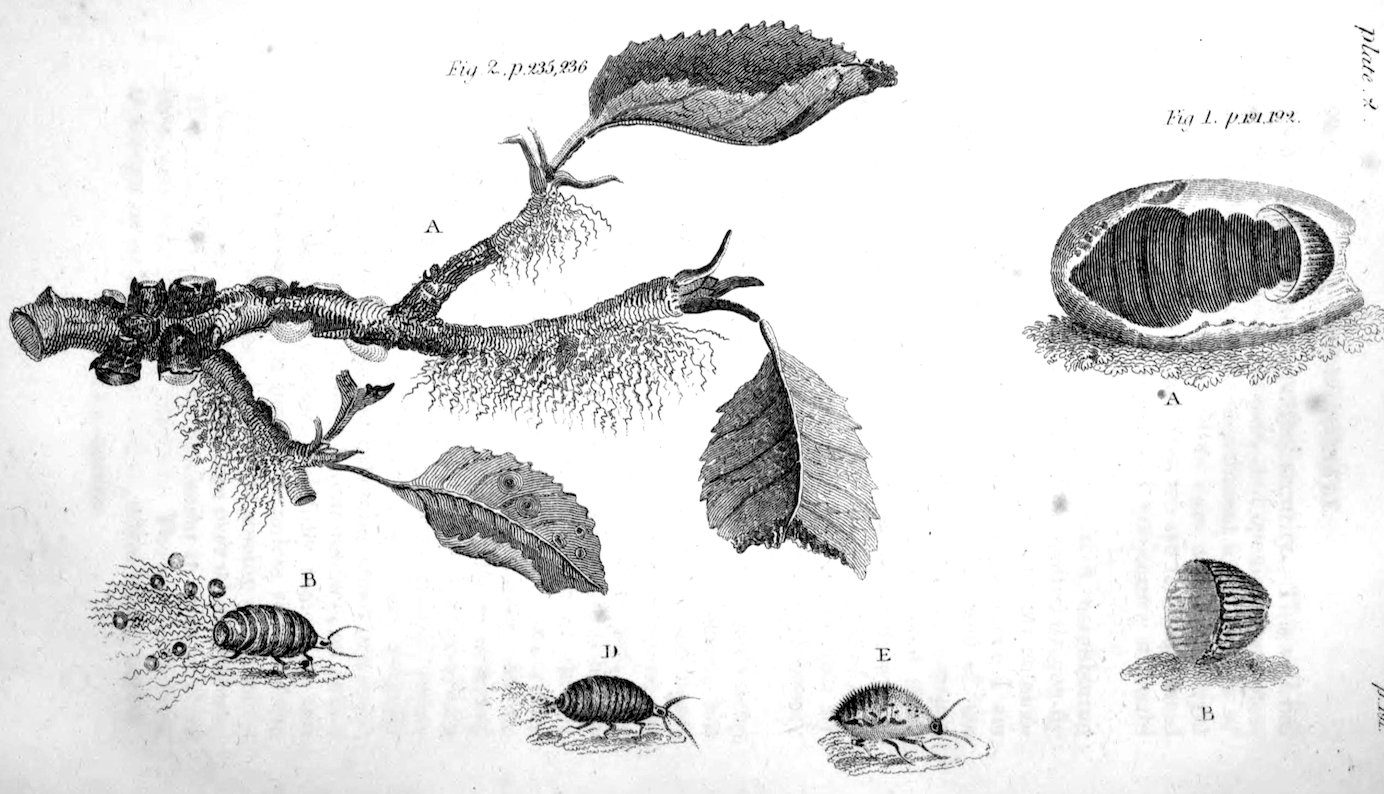
plate. 2. p. 192. Fig. 1. p. 191, 192. Fig. 2. p. 235, 236.
193The fern owl,[59] but chiefly, I conjecture, the larger bats, are the creatures that have caused me to experience at times both envy and regret, when I have observed scattered in some woodland path, amidst the fragments of their nightly banquet, the relics of such beautiful insects as the emperor of the woods, the verdigris moth, and twenty other rare insects, to be obtained only after the patience of years, or fortune of the hour; and yet our merciless birds devour these choice dainties without compunction or regard. This ghost moth discharges her eggs in a very singular manner, and frequently immediately upon capture, not deliberately protruding them, but dismissing them from the oviduct in rapid succession, until it is exhausted, with a slight elastic force, that conveys them clear from the abdomen. They are perfectly dry and unadhesive.
It requires more than usual delicate management to preserve an uninjured specimen of the male of this species, as the slightest touch robs the wings of the fine scaly plumage which is affixed to their film or substance 194by an extreme point, as is the case with most others of our moths, but in this instance so loosely, that a very gentle friction rubs it off. The plumage which covers the wings and bodies of many of our lepidopterous insects is variously colored, and like the feathers of birds, gives them their splendor: in the butterflies I have not observed it to vary greatly in form, but in the moths the same uniformity does not appear to be maintained, as a few specimens will manifest:—
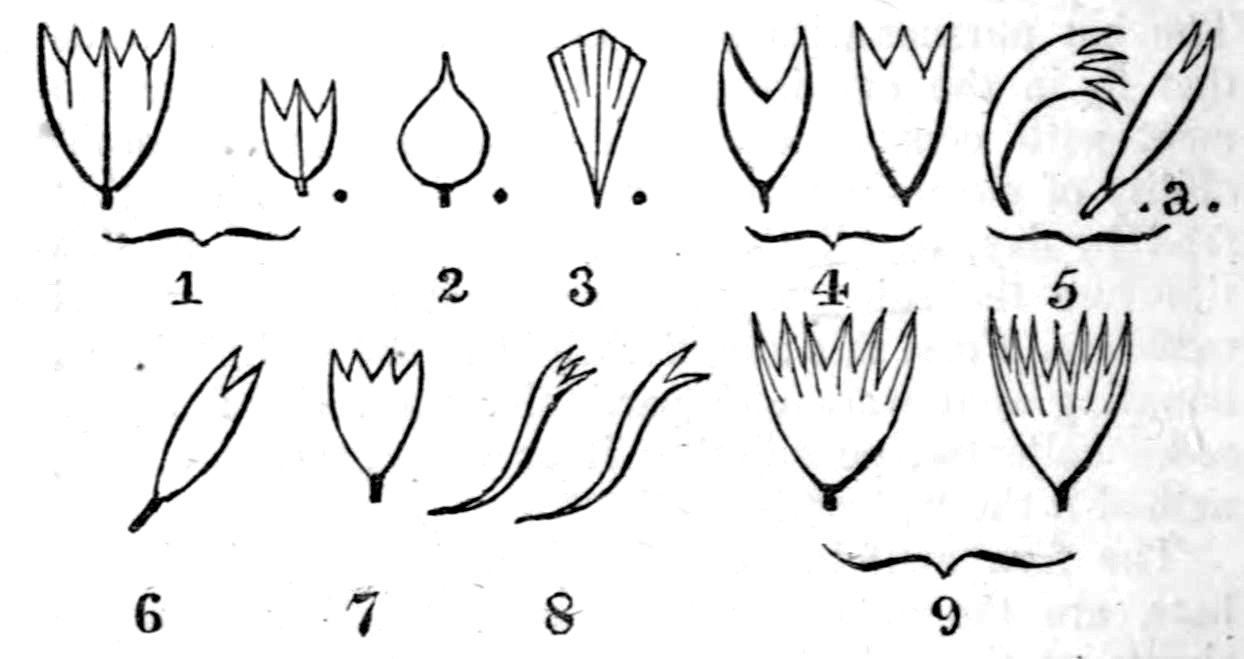
No. 1. Scales from wings of phalæna pronuba—yellow under-wing. 2. Ghost moth. 3. Phalæna bucephala—buff tip. 4. Ph. vinula—puss moth. 5. Ph. potatoria, a, the female—drinker moth. 6. Papilio brassicæ—great white. 7. Pap. Napi—green-veined butterflies. 8. Large brown moth (name omitted). 9. Acherontia atropos—death’s head.
But the variety of clothing with which insects are decorated, is most admirable and curious! The upper and the under vestiture of the wings, their fringes, that which covers the body in different parts, varies greatly; the bird, splendidly habited as he sometimes is, frequently will be found draped with less variety of form and color than the insect which escapes our notice by his actions, and the power of our eyes by the smallness of its parts. Our lepidopterous creatures seem to be most characteristically framed and constituted for the different hours and places in which they delight to move; so much so, that I think if we were to invert the order of their appearance, the singular unfitness of 195many of them for their stations would be immediately manifest to us. The butterfly, light, airy, joyous, replete with life, sports in the sunshine, wantons on the flower, and trips from bloom to bloom, gay as the brilliant morn, and cheerful as the splendor of heaven: heat and light appear to be the very principle of his being; in a cloudy or a chilly atmosphere his energies become suspended, and, closing his wings, reposes like a sickly thing upon some drooping flower: but let the cloud disperse, the sun break out, he springs again to active life; associating with the birds of day, and denizen of the same scenes, he only seems of a less elevated order. But the moth, though possessing at times sufficient activity for self-preservation, is less buoyant, less sprightly on the wing, avoids the heat and light, the higher ranges of the air, and seeks his mate or his food in the shelter of the hedge or the ditch, amidst foliage and shade, where we may see him hovering sedately around some flower, or passing on his way with quiet steady flight, accordant with the silence and twilight of the hour: companion of the owl and the bat, his grave actions are quite unsuitable to the gaiety, the flutter of a summer’s sun; the former is emblematic of levity and display, the latter of retirement and shade. And thus each, though but slightly seen, is in admirable harmony with the season in which it moves, manifesting the peculiar fitness of things to their several stations in this vast world of wisdom; an observation obvious to all, and a truth everywhere admitted, yet, as a Christian moralizer I could not pass by unheeded any evidence of foresight and of power.
Basking in the glare of an August or a July sun, in our pastures we see the little elegant blue argus butterfly (papilio argus), noted and admired by all, now warmed into active life. A few of our lepidopterous creatures, especially the common white butterflies of our gardens, are contentious animals, and drive away a rival from their haunts. We see them progressively ascending into the air, in ardent unheeding contest; and thus they are observed, captured, and consumed in a moment by some watchful bird: but we have few 196more jealous and pugnacious than this little argus. When fully animated, it will not suffer any of its tribe to cross its path, or approach the flower on which it sits, with impunity; even the large admiral (vanessa atalanta) at these times it will assail and drive away. There is another small butterfly (papilio phlæas), however, as handsome, and perhaps still more quarrelsome, frequenting too the same station and flowers; and a constant warfare exists between them. We shall see these diminutive creatures, whenever they come near each other, dart into action, and continue buffeting one another about till one retires from the contest; when the victor returns in triumph to the station he had left. Should the enemy again advance, the combat is renewed; but should a cloud obscure the sun, or a breeze chill the air, their ardor becomes abated, and contention ceases.
The papilio phlæas enjoys a combat even with its kindred. Two of them are seldom disturbed, when basking on a knot of asters in September, without mutual strife ensuing. Being less affected by cold and moisture than the argus, they remain with us longer, and these contentions are protracted till late in the autumn. The pugnacious disposition of the argus butterfly soon deprives it of much of its beauty; and, unless captured soon after its birth, we find the margins of its wings torn and jagged, the elegant blue plumage rubbed from the wings, and the creature become dark and shabby.
This spring, 1827, fostered into active life an insect unknown in our district, or at least unnoticed before by me; a pretty little blue butterfly, for which I know no common appellation, and so have named it the “spring azure,” (papilio argiolus). It appeared quite at the end of April, and in some numbers, but was yet a transient visitor with us, as after the first week in May only a lingering specimen or so was visible. Few wild flowers are then in bloom; but, leaving all herbaceous plants, it frequented chiefly the holly, the laurel, and the black currant, feeding on the honey secreted by the nectaries in their blossoms. If this butterfly be anywhere common, 197it may be mistaken by indifferent observers for the little blue argus of our pastures; but it appears some months earlier than that insect is accustomed to do; does not flit from blossom to blossom, and bask upon the disks of the lowly herbs; and, though a feebler creature on the wing, takes a much higher range in flight, and sports in altitudes which the argus, with all its animation, is very rarely inclined to attempt. When in captivity, the dark margins of the upper wings, the black specks, not eyes, and the pale blue of the reverse, without any other character, render it perfectly distinguishable from the papilio argus, corydon, or any other butterfly found with us. A small hatch again takes place about the end of July, and this pretty insect haunts anew our currant bushes; but, enlivened by the warmth of the season, it becomes more wild and wary, and avoids our approach.
The hummingbird hawk-moth (sphinx stellatarum) visits us annually, and occasionally in some numbers, frisking about all the summer long, and in very fine seasons continues with us as late as the second week in October. The vigilance and animation of this creature are surprising, and seem to equal those of its namesake, that splendid meteoric bird of the tropics, “that winged thought,” as some one has called it; though our plain and dusky insect can boast none of its glorious hues. Our little sphinx appears chiefly in the mornings and evenings of the day, rather avoiding the heat of the mid-day sun, possibly roused from its rest by the scent, that “aromatic soul of flowers,” which is principally exhaled at these periods; delighting in the jasmine, marvel of Peru, phlox, and such tubular flowers; and it will even insert its long, flexible tube into every petal of the carnation, to extract the honey-like liquor it contains. It will visit our geraniums and green-house plants, and, whisking over part of them with contemptuous celerity, select some composite flower that takes its fancy, and examine every tube with rapidity, hovering over its disk with quivering wings, while its fine hawklike eyes survey all surrounding dangers. The least movement alarms it, and it darts away with the 198speed of an arrow; yet returns, and with suspicious vigilance continues its employ, feeding always on the wing. Nature seems to have given this creature some essential requisites for its safety; its activity, when on the wing, renders its capture difficult; and when it rests, it is on a wall, the bark of a tree, or some dusky body, that assimilates so nearly to its own color, as to render it almost invisible, though watched to its settlement; and the larva is seldom found. We sometimes see it enter our rooms, attracted by flowers in the open windows; but it seems to be immediately aware of its danger, disappears in an instant, and is safe from capture. Wild and fearful as this creature is by nature, yet continued gentle treatment will remove much of its timidity, and render it familiar to our presence. Perfectly free from any annoyance as they are when ranging from sweet to sweet on my borders, and accustomed to a close inspection of all their operations, I have frequently touched their wings with my fingers, while hovering over a flower, and dipping their long tubes into the corolla of a geranium: they would retire a little, confused with such freedoms and interruptions, but, experiencing no harm, they would return and finish their meal, unmindful of such petty annoyances. I have known this creature, like some other insects, counterfeit death when apprehensive of danger, fall on its back, and appear in all respects devoid of life when in a box; and, as soon as a fit opportunity arrived, dart away with its usual celerity.
On the blue heads of the pasture scabious (scabiosa succisa) we occasionally see, toward the end of the summer, the painted lady butterfly (papilio cardui); but this is a creature that visits us at very uncertain periods, and is vivified by causes infinitely beyond the comprehension of the entomologist, seeming to require a succession and variety of seasons and their change, and then springing into life we know not how. This was particularly obvious in the summer of 1815, and the two following, which were almost unceasingly cold and rainy; scarcely a moth or butterfly appeared. And in the early part of 1818, the season was not less ungenial; 199a few half-animated creatures alone struggled into being; yet this “painted lady” was fostered into life, and became the commonest butterfly of the year: it has, however, but very partially visited us since that period. The keenest entomologist, perhaps, would not much lament the absence of this beauty, if such cheerless seasons were always requisite to bring it to perfection. Some years ago a quantity of earth was raised in cutting a canal in this county; and, in the ensuing summer, on the herbage that sprang up from this new soil on the bank, this butterfly was found in abundance, where it had not been observed for many years before.
The marble butterfly (papilio galathea) is an equally capricious visitant of our fields. I have known intervals of ten or twelve years when none could be found, and in some following seasons it would be a prevailing species.
The common wasp (vespa vulgaris) is infinitely uncertain in its numbers. A mild winter, and a dry spring or summer, we might conclude to be favorable circumstances for the increase of this creature; yet such is not always the case. Years productive of the plum are said to be congenial likewise to the wasp. A local rhyme will have it, that
“When the plum hangs on the tree,
Then the wasp you’re sure to see.”
Amid the tribes of insects so particularly influenced by seasons, there are a few which appear little affected by common events; the brown meadow butterfly (papilio janira), so well known to every one, I have never missed in any year; and in those damp and cheerless summers, when even the white cabbage butterfly is scarcely to be found, this creature may be seen in every transient gleam, drying its wings, and tripping from flower to flower with animation and life, nearly the sole possessor of the field and its sweets. Dry and exhausting as the summer may be, yet this dusky butterfly is uninjured by it, and we see it in profusion hovering about the sapless foliage. In that arid summer of 1826, the abundance of these creatures, and of the lady-bird 200(coccinella septem punctata), was so obvious, as to be remarked by very indifferent persons.
There is a large yellow under-wing moth (phalæna pronuba), too, which is generally abundant. It hides itself during the day in the thickest foliage, and screens itself from the light in the moist grass crops of the mead, where it is perpetually disturbed, and roused from its rest, by the scythe of the mower. That elegant little bird, the yellow wagtail, is a great destroyer of this insect. It is very soon apprized of these movements, and will often attend the steps of the mower, fearless of harm, to watch for its prey. As soon as the moth rises, it is chased; and its exertions and shiftings to escape, and the activity and perseverance of the bird to capture it, are very amusing.
Our lepidopterous insects feed upon various substances in their several states, and most of our butterflies, when perfected, appear to extract the sweet liquor from the tubes or nectaries of plants, and many of our moths obtain their nourishment by similar means: but one butterfly alone, the admirable (v. Atalanta), and at times the peacock (v. Io), feeds upon the juices of our autumnal fruits; and in the months of September and October we may frequently see these beautiful creatures basking and regaling themselves upon the rejected fragments of our wall fruit. They seldom prey upon the growing produce, like the hornet, wasp, and hive bee, but when it has fallen and advanced to a state of fermentation, it becomes the most grateful to them. Nothing can be less injurious than this propensity, and it seems that fruit in such a state is requisite for them by some constitutional formation, as they appear only at the termination of a season when the product of our trees is in a state of great ripeness and decay. The life of this creature appears to be remarkably short, and we have more certain means of ascertaining its duration, than are afforded us for others of the race. It very rarely appears until late in September, and then so perfect and fresh in its plumage as to manifest its recent production from the chrysalis. In some years they abound, and we may see twenty of these beautiful creatures 201expanding and closing their brilliant wings under the fruit trees on our walls, or basking upon the disk of some autumnal flower; and at another, perhaps, hardly a specimen is to be obtained: nor do they seem like the wasp to be scarce or abundant according to the deficiency or plenty of the season, but influenced by other causes. Many of our butterflies are produced by successive hatches, supplying the places of those which have been destroyed, and hence it is difficult to mark the duration of an individual; and others, as the nettle, peacock and wood tortoise, in many instances survive the winter, hidden in some recess or sheltered apartment, appearing in the spring time-worn and shabby. But van. atalanta appears only in the autumn, not as a preserved creature, but a recent production; and hence we can ascertain the period of its life to be comprised only between those few days that intervene from the end of September to the end of October, by which time its food in our gardens has pretty well disappeared. Some sheltered wall, garnished with the bloom of the ivy, may prolong its being a little longer, but the cold and dampness of the season soon destroy it; rendering the life of this creature, the most beautiful of our lepidopterous tribes, of very brief duration.
The gamma moth (phalæna gamma) is also another creature, that seems in no way affected by moist seasons, which retard the appearance, or apparently destroy so many others of its kind. This creature has imprinted on its dark wings a white character, something like the letter Y, but more like the small Greek gamma, and hence has received a pertinent name. Like Cain, it bears with it, in all its wanderings, a mark that distinguishes it from others of its race. Its habits also are quite unlike those of other moths, as it feeds principally in the day-time; and we see it late in the summer whisking about with all the activity and action of the hummingbird sphinx. Like the latter it keeps its wings, while feeding, in a constant state of vibration; haunts clover-fields, and the yellow blossoms of the wild mustard, and the heads of the pasture scabious. It seems little mindful of the common frosts of October, retiring 202from us with such reluctance, that, should the autumn be fine, we not uncommonly find it in some piece of aftergrass, enjoying there the few flowers which linger out the approaches of November.
In the autumn of the year 1827, the larvæ of the goat moth (phalæna cossus) abounded beyond any customary proportion, and we could commonly see the traces made by these creatures in the dust. They had apparently fed during the summer in the earth, and were now proceeding in search of a retreat during winter to some old hedge-row tree, a part to repose, and those which approached maturity, to abrade the softer wood, and form their cases, preparatory to changing to a final perfect state in the spring. At times we observed them coursing along our paths with great strength and activity; and when not seen, that peculiar subtle smell, which proceeds from them, and has been thought to resemble that of the goat, was perceptible in all our walks. The object and seat of this odor seem not well understood. Some have conjectured it to proceed from a fluid evacuated from the mouth, and discharged to soften the wood in which they burrow. But it seems inconsistent with any probability, that this creature, which is furnished with such very powerful mandibles, should be gifted with an auxiliary aid to accomplish its object; while of the many insects that perforate timber, most of them with inferior means, no other possesses an equivalent agent to facilitate its labors; for not one of them, as far as we know, is so supplied. Besides, if such were the purpose, the discharge would be made only when required, and thus this unpleasant odor not always perceptible. The microscope too does not manifest the exudation of any fluid. The larva is furnished with eight curious retractile processes on its under side, in the manner of what entomologists call the “prolegs.” These are encircled with little hooks, made use of probably to remove the fragments of the wood, when broken off by the mandibles above, and clear the passages. The strength of these jaws is so great, that they will very soon destroy any common chip box in which the animal may be placed, by abrading 203the edges, to effect its escape. With us they chiefly inhabit the ash; and we very commonly see at the roots of our aged trees the fragments removed by them in forming their passages. In breaking up the decayed pollards, we not unusually find the grub in all the stages of its growth; but more generally observe them without inhabitants, yet perforated with paths large enough to admit the finger. I suspect that these “augerworms” are the primary cause of the decay of the tree; having often observed their perforations, and found them, both large and small, in the solid spur or root of the tree, when the upper portion, having been bored and in a state of decline, is abandoned by them. Those that are full fed appear to form their cases in that part which has lost coherency, while the younger and imperfected creatures mine their way, and obtain nutriment in the solid timber, thus killing the tree by inches; when rain and moisture find lodgment, and complete the dissolution. One year’s preparation is the period usually assigned to the larvæ of most insects, before they arrive at their perfect state; but by the goat moth three years are required before it attains its winged state from the egg. Consequently, for the larger portion of its life it is occupied in these destructive operations; and thus this creature becomes a very powerful agent in reducing these Titans of the vegetable world, crumbling them away to their original dust: for what was decreed to be the termination and punishment of man is found in active operation throughout the whole chain of nature’s works, which are but dust, and unto dust return, continuing an endless series of production and decay, of restoration and of change. All these larvæ which I have observed in the colder portions of our year, were hard, stiff, and torpid, but soon became relaxed and animated by the warmth of the hand: thus they probably remain quiet during the winter months, but revive in spring, and recommence their ravage in the tree. The caterpillar of this moth I believe to be the largest of any of those of the British lepidopteræ; and when full fed exceeds in size that of the death’s-head sphinx. To those who dislike the appearance of things of this nature, 204it is particularly disgusting; not only from its magnitude and smell, but from its color, which is a lurid red, so compounded with a dingy yellow, as to give it a lividness of look, conveying the idea of something raw. Common as the grub is in some years, I have seldom been able to obtain the moth, without the often tedious process of feeding the larvæ, and waiting for its change.
Of those caterpillars which feed upon the foliage of vegetation, a considerable portion are picked off and consumed by the numerous little birds which are constantly hunting after them, as food for themselves or their young ones; and many of those which are supported by the roots of plants, and remain covered in the soil, are detected by the perception of rooks, and birds of that order; but those which feed upon the internal parts of trees seem exempted from any of these causes of destruction. This is possibly a reason that the larvæ of phalæna cossus is so plentifully found; but yet it is pretty certain that some other and equally fatal visitation assails them, and reduces their numbers during the long period which is required to perfect their state: for though, by feeding and care, (for they are very impatient of confinement,) we can obtain the moth in numbers, yet few seem to survive and become perfected by the common processes of nature, at least I have seldom found them in this state, though the larvæ is so plentifully seen.
The designs of supreme intelligence in the creation and preservation of the insect world, and the regulations and appointments whereby their increase or decrease is maintained, and periodical appearance prescribed, are among the most perplexing considerations of natural history. That insects are kept in reserve for stated seasons of action, we know, being commonly made the agents of Providence in his visitations of mankind. The locust, the caterpillar, the palmer-worm, the various family of blights, that poison in the spring all the promise of the year, are insects. Mildew, indeed, is a vegetable; but the wireworm destroys the root, the thrips the germ of the wheat, and hunger and famine ensue. Many of the coleopteræ remove nuisances, others 205again encumbrances, and worms manure the soil; but these are trite and isolated cases in the profusion of the animal world; and, left alone, as we are, in the desert of mere reason and conjecture, there is no probability that much satisfactory elucidation will be obtained. They are not perhaps important objects of inquiry; but when we see the extraordinary care and attention that has been bestowed upon this part of creation, our astonishment is excited, and forces into action that inherent desire in our minds to seek into hidden things. In some calm summer’s evening ramble, we see the air filled with sportive animated beings: the leaf, the branch, the bark of the tree, every mossy bank, the pool, the ditch, all teeming with animated life, with a profusion, an endless variety of existence; each creature pursuing its own separate purpose in a settled course of action, admitting of no deviation or substitution, to accomplish or promote some ordained object. Some appear occupied in seeking for the most appropriate stations for their own necessities, and exerting stratagems and wiles to secure the lives of themselves or their offspring against natural or possible injuries, with a forethought equivalent or superior to reason; the aim in some others we can little perceive, or, should some flash of light spring up, and give us a momentary glimpse of nature’s hidden ways, immediate darkness closes round, and renders our ignorance more manifest. We see a wonderfully fabricated creature struggling from the cradle of its being, just perfected by the elaboration of months or years, and decorated with a vest of glorious splendor; it spreads its wings to the light of heaven, and becomes the next moment, perhaps, with all its marvellous construction, instinct, and splendor, the prey of some wandering bird! and human wisdom and conjecture are humbled to the dust. That these events are ordinations of supreme intelligence, for wise and good purposes, we are convinced; but are blind, beyond thought, as to secondary causes; and admiration, that pure source of intellectual pleasure, is almost alone permitted to us. If we attempt to proceed beyond this, we are generally lost in the mystery with 206which the divine Architect has thought fit to surround his works; and perhaps our very aspirations after knowledge increase in us a sense of our ignorance: every deep investigator into the works of nature can scarcely possess other than an humble mind.
In all our pursuits we shall find in nature, wheresoever we can penetrate, a formation, a faculty adapted to all the wants and comforts of the creature, yet the objects of infinite wisdom in the creation of this world of matter, animate and inanimate, will probably never be made known to mankind; for though knowledge is in a constant progressive state, and the attainments of science in latter years have been comparatively prodigious, yet these acquirements are in fact but entanglements: they lead us deeper into surprise and perplexity, and the little perceptions of light which we obtain serve to show how hopeless any attempt must be to penetrate the secrets of infinity, a conviction, if we “dwell deep in the valley of humility,” that will in no manner discourage our pursuits, but rather incite our ardor to investigate so exhaustless a store, which will lead us, from contemplation, to admiration, to devotion.
That pretty sparkler of our summer evenings, so often made the plowboy’s prize, the only brilliant that glitters in the rustic’s hat, the glow-worm[60] (lampyris noctiluca), is not found in such numbers with us, as in many other places, where these signal tapers glimmer upon every grassy bank; yet, in some seasons, we have a reasonable sprinkling of them. Every body probably knows, that the male glow-worm is a winged, erratic animal, yet may not have seen him. He has ever been a scarce creature to me, meeting perhaps with one or two in a year; and, when found, always a subject of admiration. Most creatures have their eyes so placed as to be enabled to see about them; or, as Hook says of the house fly, to be “circumspect animals;” but this male glow-worm has a contrivance by which any upward or side vision is prevented. Viewed when at rest, no portion of his eyes is visible, but the head is margined with a horny band, or plate, being a character of one of the genera of the order coleoptera, under which the 207eyes are situate. This prevents all upward vision; and blinds, or winkers, are so fixed at the sides of his eyes as greatly to impede the view of all lateral objects. The chief end of this creature in his nightly peregrinations is to seek his mate, always beneath him on the earth; and hence this apparatus appears designed to facilitate his search, confining his view entirely to what is before or below him. The first serves to direct his flight, the other presents the object of his pursuit: and as we commonly, and with advantage, place our hand over the brow, to obstruct the rays of light falling from above, which enables us to see clearer an object on the ground, so must the projecting hood of this creature converge the visual rays to a point beneath. This is a very curious provision for the purposes of the insect, if my conception of its design be reasonable. Possibly the same ideas may have been brought forward by others; but, as I have not seen them, I am not guilty of any undue appropriation, and no injury can be done to the cause I wish to promote, by detailing again such beautiful and admirable contrivances.
Glow-worms emit light only for a short period in the year; and I have but partially observed it after the middle of July. I have collected many of these pretty creatures on a bank before my house, into which they retire during the winter, to shine out again when revived by the summer’s warmth; but in this latter season, I have frequently missed certain of my little protegés, and have reason to apprehend that they formed the banquet of a toad, that frequented the same situation.
Observing above, that the glow-worm does not emit light after the 14th of July, I mean thereby that clear, steady light, which has rendered this creature so remarkable to all persons; for I have repeatedly noticed, deep in the herbage, a faint evanescent light proceeding from these creatures, even as late as August and September. This was particularly manifested September the 28th, 1826. The evening was warm and dewy, and we observed on the house-bank multitudes of these small evanescent sparks in the grass. The light displayed 208was very different from that which they exhibit in the warm summer months. Instead of the permanent green glow that illumines all the blades of the surrounding herbage, it was a pale transient spot, visible for a moment or two, and then so speedily hidden that we were obliged, in order to capture the creature, to employ the light of a candle. The number of them, and their actions, creeping away from our sight, contrary to that half-lifeless dullness observed in summer, suggested the idea that the whole body had availed themselves of this warm, moist evening, to migrate to their winter station. A single spark or so was to be seen some evenings after this, but no such large moving parties were discovered again. If we conclude, that the summer light of the glow-worm is displayed as a signal taper, the appearance of this autumnal light can have no such object in view, nor can we rationally assign any use of it to the creature itself, unless, indeed, it serves as a point of union in these supposed migrations, like the leading call in the flight of night-moving birds. The activity and numbers of these insects, in the above-mentioned evening, enabled me to observe the frequent presence and disappearance of the light of an individual, which did not seem to be the result of will, but produced by situation. During the time the insect crawled along the ground, or upon the fine grass, the glow was hidden; but on its mounting any little blade, or sprig of moss, it turned round and presented the luminous caudal spot, which, on its falling or regaining its level, was hidden again.
My laborer this day, July the 18th, in turning over some manure, laid open a mass of snake’s eggs (coluber natrix), fifteen only, and they must have been recently deposited, the manure having very lately been placed where they were found. They were larger than the eggs of a sparrow, obtuse at each end, of a very pale yellow color, feeling tough and soft like little bags of some gelatinous substance. The interior part consisted of a glareous matter like that of the hen, enveloping the young snake, imperfect, yet the eyes and form sufficiently defined. Snakes must protrude their eggs singly, 209but probably all at one time, as they preserve no regular disposition of them, but place them in a promiscuous heap. At the time of protrusion they appear to be surrounded with a clammy substance, which, drying in the air, leaves the mass of eggs united wherever they touch each other. I have heard of forty eggs being found in these deposits; yet, notwithstanding such provision for multitudes, the snake, generally speaking, is not a very common animal. The kite, the buzzard, and the raven, which prey on it occasionally, are too seldom found greatly to reduce the race; and its deep retirement in the winter seems to secure it from fatal injuries by the severity of the weather: yet in the warm days of spring, when it awakens from its torpidity and basks upon our sunny banks, the numbers that appear are not proportionate to what might be expected from the number of eggs produced. Few creatures can assail it in its dormitory, yet its paucity proves that it is not exempt from mortality and loss. The mole may follow it in its retirement, but would hardly attempt to seize so large an animal. The polecat and the weasel too can enter its runs; are sufficiently bold and strong to attempt the conquest; and not improbably in the winter season resort to such food, the poor snake having no power of defending itself, or of avoiding the assault. The common snake of this country is a very harmless, unobtrusive creature; so timid, as to avoid the presence of man whenever he appears, hiding itself as much as possible in bushes and rugged places from his sight. At times a strong fetor proceeds from it; but this appears to be sexual, or made use of as the means of annoying its enemies. It possesses no power to commit injury, and has apparently no inclination to molest any thing beyond its requirements for food, as frogs and mice. When a young man, I have repeatedly handled it with impunity; and though often bitten, a temporary swelling, with slight inflammation, was the only result; but in these experiments the viper must not be mistaken for the common snake. Yet this poor creature, under the curse of ignorance and cruelty, never escapes unscathed from power and opportunity. All the snake tribe, innocuous 210and pernicious, seem to be viewed with horror and aversion by mankind. This horror, from the knowledge of their power of inflicting harm in countries where such kinds are found, is natural, and often preservative of life; but the aversion generally felt, and that shuddering occasionally noticed at the sight of our harmless snake, is like a deep-rooted principle. We imbibe in infancy, and long retain in remembrance the impression of injuries from the wiles of the serpent; and the “enmity between it and the seed of the woman” appears still in full operation, and is possibly more extensively and insensibly diffused among mankind than we are aware of. The harmless nature of our snake seems to be fully known to the little birds of the hedge, as they in no way give intimation of its presence by any warning of avoidance to their young, or that insulting vociferation so observable when any really injurious creature is perceived, but hop and sport about the basking snake without fear or notice.
All the human race seem to have inherited the original anathema against this creature; for though the capricious cruelty of man is very frequently exerted to the injury of many that his power enables him to tyrannize over, yet the serpent appears to be a peculiar object of his enmity, as if it was understood to be an absolute duty to “bruise his head,” whenever the opportunity should be afforded.
It is very remarkable how few noxious creatures, animals which annoy man, inhabit with us; beasts and birds we have none, for the petty depredations occasionally made on his property are undeserving of attention. The gnat, and perhaps a few insects, may at times puncture our skin, but the period of action is brief, the injury only temporary. The wasp and the hornet, I believe, very rarely use their weapons wantonly, only in self-defence and when persecuted; thus leaving the balance incalculably in favor of innocency and harmlessness. But of all the guiltless beings which are met with, we have none less chargeable with criminality than the poor slow-worm[61] (anguis fragilis), yet none are more frequently destroyed than it—included as it is in the 211general and deep-rooted prejudice attached to the serpent race. The viper and the snake, though they experience no mercy, escape often by activity of action; but this creature, from the slowness of his movements, falls a more frequent victim. We call it a ‘blind-worm,’ possibly from the supposition that as it makes little effort to escape, it sees badly; but its eyes, though rather small, are clear and lively, with no apparent defect of vision. The natural habits of the slow-worm are obscure; but living in the deepest foliage, and the roughest banks, he is generally secreted from observation; and loving warmth, like all his race, he creeps half torpid from his hole, to bask in spring time in the rays of the sun, and is, if seen, inevitably destroyed. Exquisitely formed as all these gliding creatures are, for rapid and uninterrupted transit through herbage and such impediments, it is yet impossible to examine a slow-worm without admiration at the peculiar neatness and fineness of the scales with which it is covered. All separate as they are, yet they lap over, and close upon each other with such exquisite exactitude, as to appear only as faint markings upon the skin, requiring a magnifier to ascertain their separations; and, to give him additional facility of proceeding through rough places, these are all highly polished, appearing lustrous in the sun, the animal looking like a thick piece of tarnished copper wire. When surprised in his transit from the hedge, contrary to the custom of the snake or viper, which writhe themselves away into the grass in the ditch, he stops, as if fearful of proceeding, or to escape observation by remaining motionless, but if touched he makes some effort to escape: this habit of the poor slow-worm becomes frequently the cause of his destruction.
Of all the active, vigilant creatures that animate our paths, we have none superior to the little, bee-like bombylius (bombylius medius); but this creature is to be seen only in the mornings of a few bright days in spring, seeming to delight in the hot, windy gleams of that season, presenting an emblem of that portion of our year, fugitive and violent. It is, I believe, plentiful 212nowhere. Particularly solicitous of warmth, it seeks the dry sunny reflection of some sheltered gravel-walk, or ditch-bank in a warm lane; and here it darts and whisks about, in seeming continual suspicion or danger; starting away with angry haste, yet returning immediately to the spot it had left; buffeting and contending with every winged fly that approaches, with a jealous, pugnacious fury, that keeps it in constant agitation. This action, its long projecting proboscis, and its pretty, spotted wings, placed at right angles with its body, distinguish our bombylius from every other creature. It appears singularly cautious of settling on the ground. After long hovering over and surveying some open spot, with due deliberation and the utmost gentleness it commits its long, delicate feet to the earth; but on the approach of any winged insect, or on the least alarm, is away again to combat or escape. Associates it has none: the approach even of its own race excites its ire, and, darting at them with the celerity of thought, it drives them from its haunts. When a captive it becomes tame and subdued, and loses all its characteristic bustling and activity, the inspiration of freedom.
The great black ant (formica fuliginosa) is commonly found in all little copses, animating by its numbers those large heaps of vegetable fragments, which it collects and is constantly increasing with unwearied industry and perseverance as a receptacle for its eggs. The game-fowl, the woodpecker, the wryneck, and all the birds that feed upon the little red ant, and soon depopulate the hillocks which they select, do not seem equally to annoy this larger species. These systematic creatures appear always to travel from and return to their nests in direct lines, from which no trifling obstacle will divert them; and any interruption on this public highway they resent, menacing the intruder with their vengeance. A neighbor related to me an instance of this unyielding disposition, which he witnessed in one of our lanes. Two parties of these black ants were proceeding from different nests upon a foraging expedition, when the separate bodies happened to meet each other. Neither would give way; and a violent contest 213for the passage ensued. After a time the combat ceased, and all animosity subsided, each party retiring to its nest, carrying with it its dead and maimed companions. This encounter seemed quite accidental, and the disposition to move in a uniform line, which their meeting prevented, the sole cause of their hostility, combat, and mutual injury. The strength of some creatures, especially insects, considering the smallness of their size, is in several instances prodigious. Man, by his reason and power, calls to his aid mechanical means, and other agents, to effect his objects; but unreasoning beings accomplish their purposes by contrivance and bodily powers. The strength of these black ants is manifested by the quantity and magnitude of the materials which they collect for their heaps; but the common little red ant (formica rubea), a much smaller creature, gives daily proofs of its abilities to remove heavy substances, equal to any that we meet with. One of these little creatures, thirty-six of which only weigh a single grain, I have seen bear away the great black fly as its prize, equal to a grain in weight, with considerable ease; and even the wasp, which exceeds forty times its own weight, will be dragged away by the labor and perseverance of an individual emmet. These little ants are occasionally and profusely deprived of their lives by some unknown visitation. In the year 1826, in particular, and again in the following year, I observed, in the month of August, a lane strewed with their bodies. They had bred during the summer in an adjoining bank; but some fatality had overwhelmed them when absent from their nests, and nearly annihilated the fraternity, as only a few scattered survivors were to be seen feebly inspecting the bodies of their associates. The task of removal, however, with all their industry, appeared beyond their powers to accomplish, as on the ensuing day few had been taken away. Had these creatures been destroyed in combat by rival contention, the animosity must have been excessive; but it is more probable that they met their death by some other infliction.
One year, on the 3d of March, my laborer being employed in cutting up ant-hills, or tumps, as we call 214them, exposed to view multitudes of the yellow species (formica flava) in their winter’s retirement. They were collected in numbers in little cells and compartments, communicating with others by means of narrow passages. In many of the cells they had deposited their larvæ, which they were surrounding and attending, but not brooding over or covering. Being disturbed by our rude operations, they removed them from our sight to more hidden compartments. The larvæ were small. Some of these ant-hills contained multitudes of the young of the woodlouse (oniscus armadillo), inhabiting with perfect familiarity the same compartments as the ants, crawling about with great activity with them, and perfectly domesticated with each other. They were small and white; but the constant vibration of their antennæ, and the alacrity of their motions, manifested a healthy vigor. The ants were in a somewhat torpid state; but on being removed into a temperate room, they assumed much of their summer animation. How these creatures are supported during the winter season it is difficult to comprehend, as in no one instance could we perceive any store or provision made for the supply of their wants. The minute size of the larvæ manifested that they had been recently deposited; and consequently that their parents had not remained during winter in a dormant state, and thus free from the calls of hunger. The preceding month of February, and part of January, had been remarkably severe; the frost had penetrated deep into the earth, and long held it frozen; the ants were in many cases not more than four inches beneath the surface, and must have been inclosed in a mass of frozen soil for a long period; yet they, their young, and the onisci, were perfectly uninjured by it; affording another proof of the fallacy of the commonly received opinion, that cold is universally destructive to insect life. Some creatures may be injured or destroyed by frost, but the larger portion of them nature has provided with constitutions to which it is innocuous, or furnished with instinct to prevent its harming them. These emmets had probably received no substance, or required any, from the time of their retirement in the autumn, a 215period of full six months; were inclosed during the space of thirty days in a mass of frozen earth, and yet remained perfectly uninjured by this long abstinence and frost.
Water, in a state of rest over decayed and putrescent vegetable matter, is peculiarly favorable for the residence of many of the insect world. The eggs that are lodged there remain undisturbed by the agitation of the element, and the young produced from them, or deposited there by viviparous creatures, remain in quiet, tolerably secure from accidental injuries; but there are natural causes which render these apparent asylums the fields of ravenousness and of death. To these places resort many of those voracious insects and other creatures, which prey upon the smaller and helpless; for all created things seem subordinate to some more powerful or irresistible agent, from the hardly visible atom that floats in the pool, to man, who claims and commands the earth as his own. But we have no animal that seems to commit greater destruction in these places than the common newt (lacertus aquaticus). In some of these well-stored magazines this reptile will grow to a large size, and become unusually warty, and bloated with repletion; feeding and fattening upon the unresisting beings that abound in those dark waters wherein it loves to reside. It will take a worm from the hook of those that angle in ponds; and in some places I have seen the boys in the spring of the year draw it up by their fishing-lines, a very extraordinary figure, having a small shell-fish (tellina cornea) attached to one or all of its feet; the toes of the newt having been accidentally introduced into the gaping shell, in its progress on the mud at the bottom of the pool, or designedly put in for the purpose of seizure, when the animal inhabitant closed the valves and entrapped the toes. But from whatever causes these shells became fixed, when the animal is drawn up hanging and wriggling with its toes fettered all round, it affords a very unusual and strange appearance.
Water, quiet, still water, affords a place of action to a very amusing little fellow (gyrinus natator), which 216about the month of April, if the weather be tolerably mild, we see gamboling upon the surface of the sheltered pool; and every schoolboy, who has angled for a minnow in the brook, is well acquainted with this merry swimmer in his shining black jacket. Retiring in the autumn, and reposing all the winter in the mud at the bottom of the pond, it awakens in the spring, rises to the surface, and commences its summer sports. They associate in small parties of ten or a dozen, near the bank, where some little projection forms a bay, or renders the water particularly tranquil; and here they will circle round each other without contention, each in his sphere, and with no apparent object, from morning until night, with great sprightliness and animation; and so lightly do they move on the fluid, as to form only some faint and transient circles on its surface. Very fond of society, we seldom see them alone, or, if parted by accident, they soon rejoin their busy companions. One pool commonly affords space for the amusement of several parties; yet they do not unite, or contend, but perform their cheerful circlings in separate family associations. If we interfere with their merriment they seem greatly alarmed, disperse, or dive to the bottom, where their fears shortly subside, as we soon again see our little merry friends gamboling as before.
This lively little animal, arising from its winter retreat shortly after the frog, at times in March, continues its gambols all the summer long, remaining visible generally until the middle of October, thus enjoying a full seven months of being; a long period of existence for insects, which are creatures subject to so many contingencies, that their lives appear to be commonly but brief, and the race continued by successive productions. All these water creatures must be endowed with much perception. Cold as this element is in early spring, when the ice of winter is hardly dissolved, and the fluid only 6 or 7 degrees above freezing, yet they become immediately sensible of this temperature, and are excited to animation and the vocations of their being. I have never observed the larvæ of this creature in any state. When they retire in the autumn, these insects 217appear of a uniform size, and emerging in the spring they are all apparently full grown, and during the summer none of smaller dimensions associate with the family parties. This plain, tiny, gliding water-flea seems a very unlikely creature to arrest our young attentions; but the boy with his angle has not often much to engage his notice; and the social, active parties of this nimble swimmer, presenting themselves at these periods of vacancy, become insensibly familiar to his sight, and by many of us are not observed in after life without recalling former hours, scenes of perhaps less anxious days: for trifles like these, by reason of some association, are often remembered, when things of greater moment pass off, and leave no trace upon our mind.
July 29.—We frequently notice in our evening walks the murmuring passage, and are often stricken by the heedless flight, of the great dorr beetle[63] (scarabæus stercorarius), clocks,[62] as the boys call them. But this evening my attention was called to them in particular by the constant passing of such a number as to constitute something like a little stream; and I was led to search into the object of their direct flight, as in general it is irregular and seemingly inquisitive. I soon found that they dropped on some recent nuisance: but what powers of perception must these creatures possess, drawn from all distances and directions by the very little fetor, which in such a calm evening could be diffused around! and by what inconceivable means could 218odors reach this beetle in such a manner as to rouse so inert an insect into action! But it is appointed one of the great scavengers of the earth, and marvellously endowed with powers of sensation, and means of effecting this purpose of its being. Exquisitely fabricated as it is to receive impressions, yet probably it is not more highly gifted than any of the other innumerable creatures, that wing their way around us, or creep about our path, though by this perceptible faculty, thus “dimly seen,” it excites our wonder and surprise. “How wondrous then the whole!”
This creature affords us a good example of that extraordinary artifice, to which some insects have recourse upon the apprehension of danger, the counterfeiting of death. The dorr, with a violent and noisy flight, proceeds on its way, or circles around with an apparent fearlessness of harm; yet the instant it is touched, or interrupted in its progress, though in no way injured, it will immediately fall to the ground, generally prostrate on its back, its limbs extended, stiff, and seemingly devoid of life, and suffering itself to be handled without manifesting any signs of animation. In time, finding no harm ensues, it resumes its former state. If our conjectures be correct, that the object of this stratagem is to preserve its life, it is difficult to comprehend how far it can be successful. Several birds feed on it, as we observed; and that others do so likewise is evident from their castings. Of these, the owl and the nightjar catch it when on the wing; and the crows, rooks, magpies, &c., seem to have no hesitation in picking it to pieces, as well as all the other beetles, that put on the semblance of death, in whatever state they find them. One or two beasts, it is said, when captured, feign death. With these exceptions, we remember none of the other orders of creation, that have recourse to such an expedient upon any emergency; but with insects it is by no means an uncommon procedure, most probably resorted to by them for a motive we are not fully acquainted with, and which is in all likelihood attended with the success it was designed to effect.
The perfect cleanliness of these creatures is a very 219notable circumstance, when we consider that nearly their whole lives are passed in burrowing in the earth, and removing nuisances; yet such is the admirable polish of their coating and limbs, that we very seldom find any soil adhering to them. The meloe, and some of the scarabæi, upon first emerging from their winter’s retreat, are commonly found with earth clinging to them; but the removal of this is one of the first operations of the creature; and all the beetle race, the chief occupation of which is crawling about the soil, and such dirty employs, are notwithstanding remarkable for the glossiness of their covering, and freedom from defilements of any kind. But purity of vesture seems to be a principal precept of nature, and observable throughout creation. Fishes, from the nature of the element in which they reside, can contract but little impurity. Birds are unceasingly attentive to neatness and lustration of their plumage. All the slug race, though covered with slimy matter calculated to collect extraneous things, and reptiles, are perfectly free from soil. The fur and hair of beasts in a state of liberty and health is never filthy, or sullied with dirt. Some birds roll themselves in dust, and occasionally, particularly beasts, cover themselves with mire; but this is not from any liking or inclination for such things, but to free themselves from annoyances, or to prevent the bites of insects. Whether birds in preening, and beasts in dressing themselves, be directed by any instinctive faculty, we know not; but they evidently derive pleasure from the operation, and thus this feeling of enjoyment, even if the sole motive, becomes to them an essential source of comfort and of health.
It may be noted probably by some, how frequently I recur to the causes and objects of the faculties, manners, and tendencies of animate and inanimate things. This recurrence springs from no cavil at the wisdom, no suspicion of the fitness of the appointment, nor, I trust, from any excitement to presumptuous pryings into paths which are in the great deep, and not to be searched out; but are humbly indulged, from the pleasure which the contemplation of perfect wisdom, even in a state 220of ignorance, affords; and if by any consideration we can advance one point nearer to the comprehension of what is hidden, we infinitely increase our satisfaction and delight.
May 24, 1827.—Abundance of cockchaffers (melolantha vulgaris) are flying about, yet by no means in the profusion of some years. How much at times the interest of man and the wild creatures about him are at variance! Those that are domesticated and precluded from obtaining food but by his permission, have their welfare in part identified with his—they may share in his abundance, or pine from his parsimony; but the independents of the field are differently circumstanced. The appearance of these chaffers, in any numbers, is very uncertain and partial, but in those summers when they abound, very extensive injuries frequently ensue. In the grub state, they will entirely destroy the pastures where they inhabit, by consuming the roots of the grasses; acres and fields are deprived of their produce, becoming brown as stubbles, with only a sprig or tuft of green useless vegetation observable in them; the grain crop likewise totally fails when the larvæ of this chaffer feeds in the field. Upon assuming their winged state, they devour the foliage of the oak and other trees so effectually, that entire copses may be seen early in June defoliated by their depredations. So much for their injury to man: but now the feast of the wilding commences—the plow in April dislodges multitudes of these long white grubs. Dogs then seek them eagerly to eat, but they seem to be surfeited by the food; for, though fattened at first, they afterwards become diseased, and lose their hair. Rooks and crows are running over the ridges, busily seeking for this larvæ; the swine find it out, and come in for their share, and having finished here, they commence grubbing in the grass lands. The insect now soon takes wing, and then every tree in the wood or the brake becomes a scene of plunder and delight to all the train from the rookery—the cats will eat him—every sparrow that flies by has a chaffer in its mouth, captured on the wing or snatched from the spray, and now to be pecked to pieces on the 221ground—the thrush feasts too, and all the poultry in the yard are running after chaffers, or chasing each other for the prize; and thus this insect supplies in one state or another a general feast to many.
Surrounded as we are by wonders of every kind, and existing only by a miraculous concurrence of events, admiration seems the natural avocation of our being; nor is it easy to pronounce amidst such a creation what is most wonderful. But few things appear more incomprehensible than the constant production and reabsorption of matter, impressed upon us even by these very dorrs. An animal falls to the ground and dies; myriads of creatures are now summoned by a call, by an impulse of which we have no perception, to remove it, and prepare it for a new combination; chemical agencies, fermentation, and solution, immediately commence their actions to separate the parts, and in a short time, of all this great body, nothing remains but the framework or bones, perhaps a little hair or some wool, and all the rest is departed we know not whither! Worms and insects have done their parts; the earth has received a portion, and the rest, converted into gases, and exhalable matters, has dispersed all over the region, which, received into vegetable circulation, is again separated and changed, becomes modified anew, and nourishes that which is to continue the future generations of life. The petal of the rose; the pulp of the peach; the azure and the gold on the wing of the insect; all the various productions of the animal and vegetable world; the very salts and compounds of the soil, are but the changes some other matters have undergone, which have circulated through innumerable channels since the first production of all things, and no particle been lost; bearing in mind this assured truth, that all these combinations have not been effected by chance or peculiarity of circumstances, but by the predetermination of an Almighty Intelligence, who sees the station, progress, and final destination of an atom, what an infinity of power and intellective spirit does this point out! an omnipotence, which the bodied minds of us poor creatures cannot 222conceive. Truly may we say, “who can find out the Almighty to perfection?”
Our extensive cultivation of the potato furnishes us annually with several specimens of that fine animal the death’s-head moth[64] (acherontia atropos), and in some years I have had as many as eight brought me in the larva or chrysalis state. Their changes are very uncertain. I have had the larva change to a chrysalis in July, and produce the moth in October; but generally the aurelia remains unchanged till the ensuing summer. The larvæ or caterpillars, “strange ungainly beasts,” as some of our peasantry call them, excite constant attention when seen, by their extraordinary size and uncommon mien, with horns and tail, being not unusually five inches in length, and as thick as a finger. This creature was formerly considered as one of our rarest insects, and doubtful if truly indigenous; but for the last twenty years, from the profuse cultivation of the potato, is become not very uncommon in divers places. Many insects are now certainly found in England, which former collectors, indefatigable as they were, did not know that we possessed; while others again have been lost to us moderns. Some probably might be introduced with the numerous exotic plants recently imported, or this particular food may have tended to favor the increase of rarely existent natives; but how such a creature as this could have been brought with any plant is quite beyond comprehension. We may import continental varieties of potatoes, but the death’s-head moth we have never observed to have any connexion with the tuber itself, or inclination for it. As certain soils will produce plants by exposure to the sun’s rays, or by aid of peculiar manures, when no pre-existent root or germ could rationally be supposed to exist; so will peculiar and long intervening seasons give birth to insects from causes not to be divined. We may perhaps conclude, that some concurrence produced this sphinx, and then its favorite food, the potato plant, nourished it, to the augmentation of its species.
Superstition has been particularly active in suggesting causes of alarm from the insect world; and where man 223should have seen only beauty and wisdom, he has often found terror and dismay. The yellow and brown tailed moths, the deathwatch, our snails, as mentioned in p. 231, and many others, have all been the subjects of his fears; but the dread excited in England by the appearance, noises, or increase of insects, are petty apprehensions, when compared with the horror that the presence of this acherontia occasions to some of the more fanciful and superstitious natives of northern Europe, maintainers of the wildest conceptions. A letter is now before me from a correspondent in German Poland, where this insect is a common creature, and so abounded in 1824, that my informer collected fifty of them in the potato-fields of his village, where they call them the “death’s-head phantom,” the “wandering death-bird,” &c. The markings on its back represent to these fertile imaginations the head of a perfect skeleton, with the limb bones crossed beneath; its cry becomes the voice of anguish, the moaning of a child, the signal of grief; it is regarded not as the creation of a benevolent being, but the device of evil spirits, spirits enemies to man, conceived and fabricated in the dark; and the very shining of its eyes is thought to represent the fiery element whence it is supposed to have proceeded. Flying into their apartments in the evening, it at times extinguishes the light, foretelling war, pestilence, hunger, death to man and beast. We pity, rather than ridicule these fears; their consequences being painful anxiety of mind and suffering of body. However, it seems these vain imaginations are flitting away before the light of reason and experience. In Germany as in England, they were first observed on the jasmine, but now exclusively upon the potato, though they will enter the bee-hives, to feed on the honey found in them. This insect has been thought to be peculiarly gifted in having a voice, and squeaking like a mouse, when handled or disturbed; but in truth no insect that we know of has the requisite organs to produce a genuine voice. They emit sounds by other means, probably all external. The grasshopper and the cricket race effect their well-known and often wearisome chirpings by grating their 224spiny thighs against their rigid wings; and this acherontia atropos appears to produce the noise it at times makes, which reminds us of the spring call of the rail or corncrake, by scratching its mandible, or the instrument that it perforates with, against its horny chest. The object of this noise is apparently a mere sexual call. Heavy and unwieldly creatures, they travel badly, and from the same cause fly badly and with labor; and as they commonly hide themselves deep in the foliage and obscurity, without some such signal of their presence a meeting of the parties would seldom be accomplished.
Another of the ravenous creatures that infest our pools is the great water-beetle (ditiscus marginalis); and perhaps it is the most ferocious of any of them, being adapted by every provision for a life of rapine, endued with great muscular power, armed with a thick and horny case over its body, and having its eyes large to observe all the creatures about it, and powerful mandibles to seize and reduce them to fragments. It riots on the polyphemus of the pool; and having thinned its herd in one place, is supplied with wings to effect a removal to a fold better furnished. It even eats the young of the frog; and its bite is so powerful, as to be painfully felt by the hand that holds it a captive, though defended by a glove. In the larvæ state it is almost equally destructive; it swims admirably; its hinder legs are long and brawny, beside being aided by a fringe of hairs, so that they are powerful oars to propel its body with celerity and ease. Nor must we omit a peculiarity attending the constitution of this beetle, which marks it as a creature especially endowed for the station in which it is placed. Multitudes of insects exist in the larva state for a certain space of time in water, and, having accomplished a given period in this state perfecting their forms, they take wings and become aërial creatures, after which a return to the element whence they sprang would be death to them. But this beetle, when it has passed from the larva state and obtained its wings, still lives in that water which nourished it to this state of perfection, without any inconvenience, 225as long as it suits its inclination; when weary of this place, or its food becoming scarce, it wings its way to another pool, into which it immediately plunges, and recommences its life of rapine. Having deposited its eggs in autumn, we suppose it to die in the winter; yet many may survive this season, and, arising from the mud in the spring, be undistinguished from the recently perfected larvæ. Such little notices and indications of the habits of these obscure creatures, though certainly unimportant, are not perhaps wholly unprofitable; for we so darkly see our way, and proceed so slowly in acquiring intelligence of the paths of nature, that nothing should be considered as beneath regard that we meet with in them, and every advancing step must elevate the mind, as it affords additional knowledge of the solicitude and provision of the great Architect of creation in the appointment and endowment of his creatures; since, though we are very rarely able to comprehend even the object of existence, we see sufficient to convince us, that such care and such powers were not bestowed except for some wise and good purpose. It seems hardly possible that mankind can ever obtain anything approaching to the comprehension of the motives of Providence, because they have not, as far as is apparent to us, individual and separate bearings, but are connecting and in concordance with a series of influences, and consequently the whole should be seen, fitly to understand a part; and this mighty mechanism what human mind can embrace? Heaven metes out to man by degrees something of its laws and ordinances; but no life, no period, can exhaust that store of hidden wisdom, by which these mandates have been decreed, every little transitory view that we obtain should be received with gratitude as an advance in knowledge, a progress in the wisdom of Him who hath ordained all things in truth.
The eye of the naturalist, prying about in places where those of indifferent persons are rarely fixed, sees many things, that others do not notice, or observe without interest, from forming no connexion with any previous subject of pursuit. Few perhaps would stay to 226inspect the clay hairworm (gordius argillaceus), yet it is a very curious creature. We find it at the bottoms of drains and ditches, chiefly in the spring of the year. Its color is a pale yellow; and it appears like some long vegetable fibre, or root, coiled up and twisted together. The whole body of the animal consists of numerous annulations, or rings, by means of which it has the power of contracting its substance, as it has likewise of extending it, until it becomes nearly a foot in length, and smooth as a wire. The extreme points are transparent and tapering, formed of apparently harder materials than the body. The designation of most of our small land and water creatures, in the economy of creation, is very obscure; and owing to the places they frequent, and the secrecy of their actions, amidst mud and vegetation, we have little opportunity of becoming acquainted with their habits. This hairworm, however, is rather less mysterious in its movements than some others; and there is cause to suppose that its chief occupation is that of forming perforations and openings in clayey soils, admitting by this means water to pervade the mass, and open it; the finer roots of vegetables then find entrance, and part it yet more, or decay in it, and meliorate and fertilize the substance.
Wonderful as all the appointments and endowments of insects are, there is no part of their economy more extraordinary than the infinite variety of forms and materials to which they have recourse in the fabrication of their nests; and, as far as we can comprehend, their expediency for the various purposes required. Among those, with which I am acquainted, none pleases me more than that of a solitary wasp (vespa campanaria), which occasionally visits us here. It is not a common insect; but I have met with their nests. One was fixed beneath a piece of oak bark, placed in a pile; another was pendent in the hollow of a bank of earth. The materials, which composed these abodes, seemed to be articles scraped or torn from the dry parts of the willow, sallow, or some such soft wood, and cemented again by animal glue, very similar in texture to that provided by the common wasp, which makes great use of the halfdecayed 227wood of the ash, and will penetrate through crevices in the bark, to abrade away the dry wood beneath. They seem to have but small families, ten or twelve cells only being provided. These are situate at the bottom of an egg-shaped cup, contracted at the lower end, where an orifice is left for the entrance. This again is covered, in the part where the cells are placed, by a loose hood, or shed, extending about halfway down the inner one. The pendent situation of the whole, and this external hood, round which the air has a free circulation, are admirably contrived for securing the cells from injury by water. The nest, when hanging in its proper situation, is like the commencement of some paper-work flower, and can never be observed but with admiration at the elegance of its structure; and the unusual appearance of the whole must excite the attention of the most incurious observer of such things.
Every-day events manifest to very superficial observation, that no created being, from the monster of the ocean, “that makes the deep boil like a pot of ointment,” to the insect that feebly creeps on the ground, exists free from the persecutions or annoyance of another. Some may be subject to fewer injuries than others, but none are wholly exempt: the strong assail by power, and become assaulted themselves by the minute or weak. This year (1826) the hornet (vespa crabro) abounded with us in unusual numbers, and afforded constant evidence of its power and voracity, that could not have been exceeded by any ravenous beast. In our gardens the imperious murmur of four or five of them at a time might be frequently heard about our fruit trees. They would occasionally extract the sweet liquor from the gage, or other rich plums; but the prime object of their visit was to seize the wasps, that frequented the same places. This they not only did when the creature was feeding on the fruit, but would hawk after them when on the wing; capture them with a facility, to which their heavy flight seemed unequal; bear them to some neighboring plant, and there feed on the insect, which seemed perfectly overpowered by the might of the 228hornet. The first operation was to snip off the head, then to cut away the lower part by the waist; and, when near, we could hear them shearing away the outer coat from the body, and crushing it with their strong mandibles; sometimes devouring it, but generally only sucking the juices it contained. Their avidity for this sort of food is very manifest when the grape ripens on the wall: being commonly the only remaining fruit, the wasp abounds there; the hornets flock to the prey, and we may see them in constant progress, bearing their victims from the bunches. The wasp itself seizes the house fly; but this seems rather the display of wanton power than for food, as it bears the fly about with it for a length of time, and drops it unconsumed. The fly, in its turn, is conducive after its manner to the death of many an animal. We know not any insect that destroys the hornet; but its power and being are terminated by some very effective agent, as in particular years it is almost unknown.[65] Though we may not often perceive the means by which certain races are reduced in number, more than their multiplication effected, yet we are frequently sensible that it is accomplished.
I do not recollect any creature less obnoxious to harm than the common snail (helix aspersa) of our gardens. A sad persevering depredator and mangler it is; and when we catch it at its banquet on our walls, it can expect no reprieve from our hands. But our captures are partial and temporary; and, secured in its strong shell, it seems safe from external dangers; yet its time comes and one weak bird destroys it in great numbers. In the winter season, the common song-thrush feeds sparingly upon the berries of the white thorn, and the hedge 229fruits, but passes a great portion of its time at the bottoms of ditches, seeking for the smaller species of snails (helix hortensis and hel. nemoralis), which it draws out from the old stumps of the fence with unwearied perseverance, dashing their shells to pieces on a stone; and we frequently see it escaping from the hedge bank with its prize, which no little intimidation induces it to relinquish. The larger kind at this season are beyond its power readily to obtain; for as the cold weather advances, they congregate in clusters behind some old tree, or against a sheltered wall, fixing the openings of their shells against each other, or on the substance beneath, and adhering so firmly in a mass, that the thrush cannot by any means draw them wholly, or singly, from their asylum. In the warmer portion of the year, they rest separate, and adhere but slightly; and should the summer be a dry one, the bird makes ample amends for the disappointment in winter, intrudes its bill under the margin of the opening, detaches them from their hold, and destroys them in great numbers. In the summers of 1825 and 1826, both hot and dry ones, necessity rendered the thrush unusually assiduous in its pursuits; and every large stone in the lane, or under the old hedge, was strewed with the fragments of its banquet. This has more than once reminded me of the fable of the “Four Bulls;” united invincible, when separated an easy prey; but, with the exception of this season, and this bird, I know no casualty to which the garden snail is exposed.
Ignorant as we are of the scope, limitation, and even existence, of certain faculties in animals, we can frequently do little more than conjecture the means whereby they perform many of the functions of life. This ignorance leads us naturally at times to refer these powers to the agency of senses like our own; but, in most instances, probably without any foundation in truth. No creature seems less qualified to commit the depredations which it does, than the garden snail. We grieve to see our fruit mangled and disfigured by these creatures, but cannot readily comprehend by what means they obtain the knowledge that its maturity is 230approaching—though we find that they must be endued with some faculty capable of accomplishing the purpose; for no sooner does a plum, a fig, a nectarine, or other fruit, begin to ripen on the wall, and long before any sensible odor can be diffused from it, even before an experienced eye can detect the approach to maturity, than those creatures, the slug and the snail, will advance from their asylums, though remotely situate, and proceed by very direct paths to the object. This cannot probably be by the guidance of any known faculty. Eyesight was once considered to be situate on the summit of their horns; but this is now known to be erroneous, and we do not know that they have any vision. The acoustic organ of worms and insects is unknown; and it is not by any means ascertained that these creatures ever hear.[66] If they possess the faculty of smelling, in them it must be a very exquisite sense, beyond any delicacy we can comprehend. Thus, excluding human means of comprehension, which appear inadequate, we more reasonably conclude them to be endowed with intelligences for effecting intentions, of which we have no perception, and which we have no capacity for defining. The contemplative man finds pleasure in viewing the ways and artifices of creatures to accomplish a purpose, though he knows not the directing means; and it fortifies the convictions of the believer, by giving him fresh evidences of the universal superintendence of his Maker, that even the slug and the snail, which are arranged so low in the scale of creation, are yet, equally with all, the object of his benevolence and care.
Connected with this subject of snails, a circumstance that took place in this neighborhood is brought to my remembrance, which discovered yet latent in a few of us, notwithstanding our boasted enlightenment, some leaven of the superstition of darker ages; and that any occurrence, not the event of every coming day, may be made a subject of wonder by the ignorant, and a means 231for the artful to deceive the credulous. A little banded snail (helix virgata) is a very common species on most of our arid, maritime pastures, and the sheep-downs of many inland places. It happened, from some unknown cause, that those inhabiting a dry field in an adjoining parish were in one season, a few years ago, greatly increased, so as to become an object of notice to a few, then to more, till at length this accumulation was noised about as a supernatural event. The field was visited by hundreds daily from neighboring villages and distant towns. People who could not attend purchased the snails at a half-penny each; and there were persons who made five shillings a day by the sale of them. As this increase of the creature was not certainly to be accounted for, some had the impudence to assert that they had witnessed their fall from the clouds; and many declared their belief that some great public or private misfortune was indicated by it. The proprietor of the field being supposed not to maintain the same sentiments as the commonalty upon a political circumstance, which at that moment greatly agitated the country, it was considered as a manifestation of heavenly displeasure, precursive of malady, misfortune, death. However, autumn came, these snails retired to their holes in the banks, and the worthy man lived on,—and long may he live, esteemed and respected by all, unscathed by snails or misfortunes.
Little obnoxious to injury as this garden snail appears to be, there is another creature, and that a very important one in the operations of nature, that is surrounded by dangers, harassed, pursued unceasingly, and becomes the prey of all: the common earth-worm (lumbricus terrestris). This animal, destined to be the natural manurer of the soil, and the ready indicator of an improved staple, consumes on the surface of the ground, where they soon would be injurious, the softer parts of decayed vegetable matters, and conveys into the soil the more woody fibres, where they moulder, and become reduced to a simple nutriment, fitting for living vegetation. The parts consumed by them are soon returned to the surface, 232whence, dissolved by frosts, and scattered by rains they circulate again in the plants of the soil,
“Death still producing life.”
Thus eminently serviceable as the worm is, it yet becomes the prey of various orders of the animal creation, and perhaps is a solitary example of an individual race being subjected to universal destruction. The very emmet seizes it when disabled, and bears it away as its prize: it constitutes throughout the year the food of many birds; fishes devour it greedily; the hedgehog eats it; the mole pursues it unceasingly in the pastures, along the moist bottoms of ditches, and burrows after it through the banks of hedges, to which it retires in dry seasons: secured as the worm appears to be by its residence in the earth from the capture of creatures inhabiting a different element, yet many aquatic animals seem well acquainted with it, and prey on it as a natural food, whenever it falls in their way; frogs eat it; and even the great water-beetle (ditiscus marginalis) I have known to seize it when the bait of the angler, and it has been drawn up by the hook. Yet notwithstanding this prodigious destruction of the animal, its increase is fully commensurate to its consumption, as if ordained the appointed food of all; and Reaumur computes, though from what data it is difficult to conjecture, that the number of worms lodged in the bosom of the earth exceeds that of the grains of all kinds of corn collected by man.
Worms, generally speaking, are tender creatures, and water remaining over their haunts for a few days drowns them; they easily become frozen, when a mortification commences at some part, which gradually consumes the whole substance, and we find them on the surface a mucilaginous mass: and their retiring deeper in the soil is no bad indication of approaching cold weather; but no sooner is the frost out of the earth, than they approach the surface to feed on decayed vegetable matter. Greatly beneficial as these creatures are, by drawing leaves and decayed matters into the earth, where their dissolution is accomplished, yet they are sad tormentors 233to us gardeners, and occasion the loss of more young plants than even the slug, by drawing in the leaf, which throws out the root; so that in the morning we find our nursling inverted. It is the same propensity, or ordination, for removing decayed matters, that influences them in these actions; as they are the faded leaves that are seized by them, such as newly removed plants present before the root draws nutriment from the earth. Even stones of some magnitude are at times drawn over their holes. The horticulturist perhaps encounters more mortification and disappointment than any other laborer upon the earth from insects, elementary severity, the slug, and the worm; yet, if the depredations of this last creature do at times excite a little of our irascibility, we must still remember the nightly labors, and extensive services, that are performed for the agriculturist by this scavenger of the earth, and manurer of the soil.