Tea Cloths, Tray Cloths, and Bureau Scarfs.
Reading edition
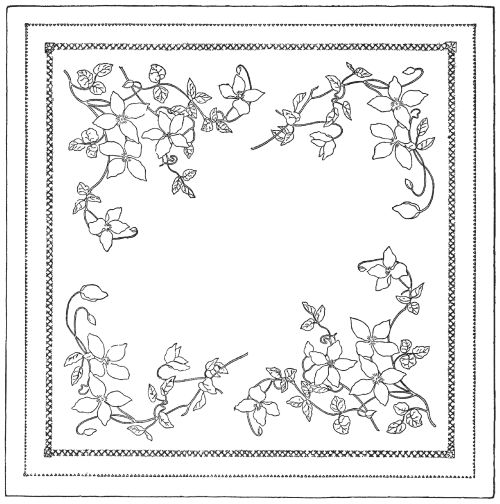
Purple Clematis Tea Cloth Design No. 437 A.
Purple Clematis Tea Cloth Design No. 437 A.
Drawn Work and Hemstitched Edge.
By Elizabeth Moore Hallowell.
Materials—Tea Cloth 45 x 45 inches: Corticelli Filo Silk, 6 skeins 729; 5 skeins 728; 4 skeins 727; 3 skeins each 725, 726, 781, 782, 783, 784, 785; 1 skein each 621, 622, 779.5, 780. The smaller size takes less silk. Dealers can furnish hemstitched stamped linen of this design, with drawn work edge, in two sizes, as follows: 436 A, 36 × 36 inches, 437 A, 45 × 45 inches. See page 92.
Use same instructions for embroidering this tea cloth as given for Purple Clematis Design No. 56, page 55, and illustrated by Colored Plate XXII. (Not Difficult.)
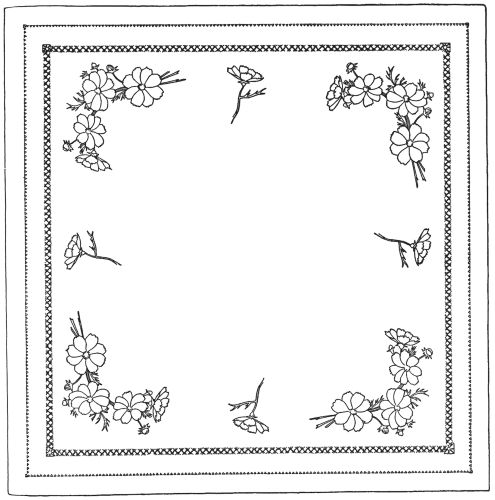
Cosmos Tea Cloth Design No. 437 B.
Cosmos Tea Cloth Design No. 437 B.
Drawn Work and Hemstitched Edge.
Materials—Tea Cloth 45 × 45 inches: Corticelli Filo Silk, 6 skeins each 655.7, 655.8; 5 skeins 655.9; 4 skeins 616.5; 2 skeins each 109, 110, 123, 504, 506, 781, and 782. The smaller size takes less silk. Dealers can furnish hemstitched stamped linen of this design, with drawn work edge, in two sizes as follows: 436 B, 36×36 inches; 437 B, 45×45 inches. See page 92.
Flowers.—Work solid. For the edge of petals use 655.7, 655.8, shading lighter gradually to the center with 616.5, 123. Give a touch of Pink, 655.9, to some of the petals to give an effect of shadow where the petals lap; but not too much, as the flowers should be quite pale. In the center work a number of short stamens with Green, 781, and make French knots at the points of stamens in Yellow, 504 and 506. Work the buds and half flowers in the same manner, although choose the darker shades for the very small buds. Work the upper part of calyx with Green, 781, and the part near the stem with 782.
Leaves.—Slant the stitches downward as you would to work stems. Tip the points of the leaves with Green, 781, shading gradually darker toward the stems with 782, 109, 110. Work the stems with 109, 110. (Not Difficult.)
Sweet Pea Tea Cloth Design No. 407 G.
Hemstitched and Silk Corded Edge.
Colored Plate XXVII.
(See Illustration on Page 81.)
By Amalia Smith.
Materials—Corticelli Filo Silk: 2 skeins each 501, 502, 503, 616, 616.5, 678, 679, 680, 681, 725, 726, 727, 729, 757, 780, 781, 782, 783, 784. Dealers can furnish hemstitched stamped linen of this design, 36 × 36 inches. See page 92.
Sweet peas grow in such a variety of exquisite colorings that the utmost license is available in selecting the colors for each flower. However, be careful to avoid startling combinations. The following suggestions for a color scheme will be found to give a very pretty effect.
Flowers.—Work solid, being careful to start the stitches in the right direction. Begin the edge of the petal with a dark shade, shade gradually lighter to the stem. The stitches should be taken in a downward curve to the stem. Make some flowers pink on the edge and yellow near the stem; make others shade from pink to violet; still another flower violet and yellow, and again working some all of one color, shading from dark on edge to light near the stem. Work the calyx in Green, 781, 782, the darker shade near the stem.
Leaves.—Work solid, using Green, 781, 782, 783, 784, making the points of the leaves light and shading darker near the center, using two shades in a leaf. Make the larger leaves near the base of the spray in the darker shades of green. Use 757 for the stems. For tendrils choose 780 and 781.
Carefully examine Colored Plate XXVII. This shows the proper stitch direction and the shading of the flowers and leaves. Unless you thoroughly understand "long and short" stitch and "feather stitch," make a study of the article on "Embroidery Stitches—Described and Illustrated," especially of pages 11 and 12. (Difficult.)
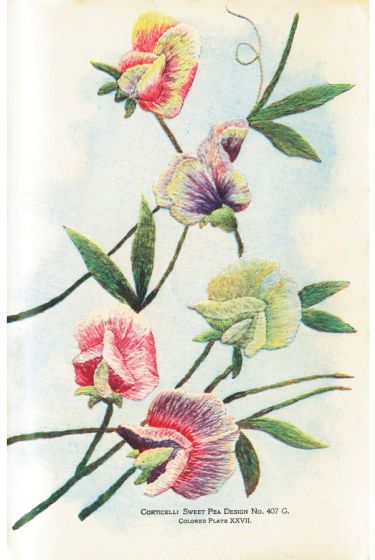
Corticelli Sweet Pea Design No. 407 G.
Colored Plate XXVII.
[See larger version]
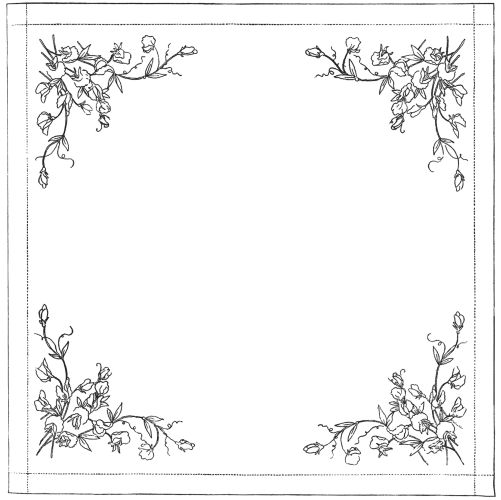
Sweet Pea Tea Cloth Design No. 407 G.
Wild Rose Bureau Scarf Design No. 434 B.
Hemstitched and Drawn Work Edge.
Materials—Corticelli Filo Silk, 2 skeins each 639, 782; 1 skein each 504, 636, 637, 638, 640, 655.7, 755, 780, 781, 783. Dealers can furnish stamped linen of this design with hemstitched and drawn work edge, 18 × 36 inches. See page 92.
Roses and Leaves.—Use same instructions as given for Wild Rose Design No. 603 E, page 28, and illustrated by Colored Plate IX. If desired the petals of the roses may be worked "half solid," using the long and short stitch. The leaves also can be worked in the same manner. The more effective way, however, is to work both roses and leaves solid, as described in the instructions to which reference is given.
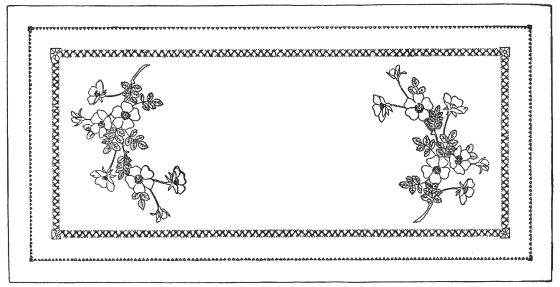
Wild Rose Bureau Scarf Design No. 434 B.
Rabbit Chafing Dish Tray Cloth Design No. 53 A.
Colored Plate XXVI.
Materials—Corticelli Filo Silk: 2 skeins each 134, 136, 137, 779.5, 781, 782; 1 skein each 105, 140, 534, 561, 645, 646, 647, 656, 783, 784. Corticelli Persian Floss, 10 skeins 781. Dealers can furnish stamped linen of this design, 18×27 inches. See page 92.
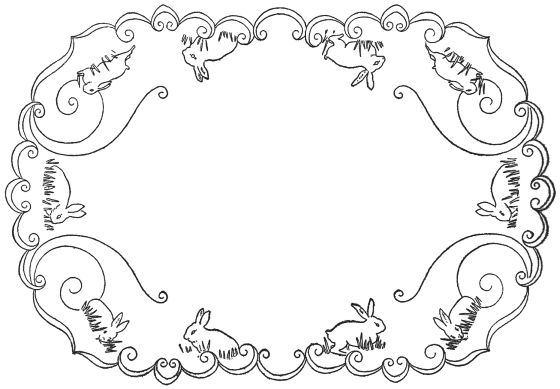
Rabbit Chafing Dish Tray Cloth Design No. 53 A.
A Chafing Dish is to be found in nearly every home, and many are the choice concoctions that owe their existence to the little alcohol lamp and the simmering pan of water. The design shown here is especially appropriate for a chafing dish tray cloth.
Use the same instructions as given for working Design No. 53, page 68, and illustrated by Colored Plate XXVI.
Daisy Tray Cloth Design, No. 406 D.
Hemstitched Edge.
Materials—For Silk necessary to embroider this tray cloth, and instructions for same, see Daisy Design, page 65. Made in sizes, 18 x 27 and 18 x 36 inches. Also for bureau scarfs, 17×54 and 17×72. Dealers can furnish stamped linen, with hemstitched edge, of this design, in all of the above sizes. See page 92.
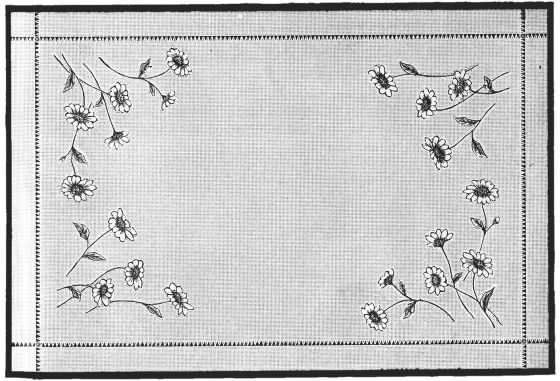
Daisy Tray Cloth Design No. 406 D.
Hemstitched linen, similar to Daisy Tray Cloth Design No. 406 D, can also be furnished by dealers in the above sizes, stamped with the following designs: 406 A, Apple Blossom; 406 B, Buttercup; 406 C, Chrysanthemum; 406 E, Sweet Pea; 406 F, Forget-me-not. For instructions for working and silk required, see pages 63, 64, 65, and 66.
Sofa Pillow Design No. 508.
Materials—1 piece plaid cambric, 24 x 48 inches, stamped with a wide colored check, with 5 yards double ruffling of same material; Corticelli Roman Floss, 9 skeins (6 of the light shade, and 3 of the dark shade). For colors see below. Dealers can furnish all of above material. See page 92.
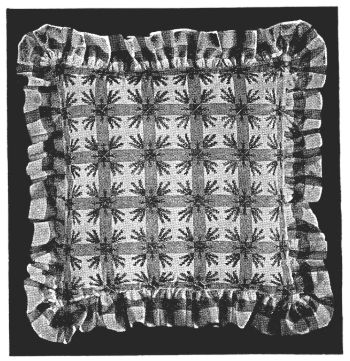
Sofa Pillow Design No. 508.
For Green Pillow use Corticelli Roman Floss, 549, 551.
For Yellow Pillow use Corticelli Roman Floss, 743, 743.6.
For Blue Pillow use Corticelli Roman Floss, 793, 796.
This pillow is a pretty one for summer use. The material is plaid cambric, a white ground with a colored check. The check comes in three different colors: green, yellow, and blue.
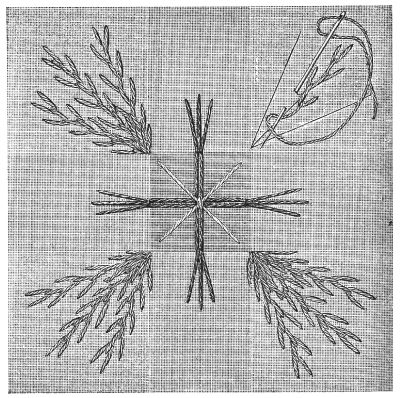
Showing Method of Working Sofa Pillow.
The engraving shows exactly how the work is done, using the lighter shade of silk and the seamstress' feather stitch for the four corners around each square. The center figure is worked in the darker shade of silk, with the X in the lighter shade. When the decoration is complete, finish the pillow as follows: Gather the ruffle double on the raw edge, and, putting it between the front and back pieces of the cushion, sew together on the wrong side on three sides of the pillow. Blind-stitch the fourth side after the down cushion has been placed inside. Other figures and methods of working will suggest themselves to every needleworker. This pillow is a very inexpensive one. (Easy.)