Corticelli Doily Book.
Reading edition
Materials—Corticelli Filo Silk: 3 skeins each of two shades. (See below.) 1 piece linen, either Blue, Green, Tan, or Terra Cotta, 12 x 20 inches, stamped with this design; 1 Doily Book. Dealers can furnish all the above material. See page 92.
For Blue Linen use Corticelli Filo Silk, Yellow, 741, 743.5, or Pink, 678, 680.
For Green Linen use Corticelli Filo Silk, Green, 693, 695, or Purple, 650, 651.5.
For Tan Linen use Corticelli Filo Silk, Scarlet, 537, 539, or Pink, 572, 573.5.
For Terra Cotta Linen use Corticelli Filo Silk, Pink, 635.5, 638, or Green, 124, 127.
When working either Blue, Green, or Terra Cotta Colored Linen the proper color numbers can easily be substituted in the following instructions.
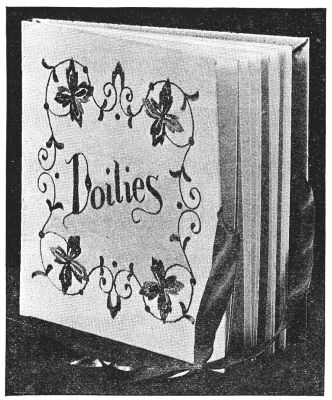
Corticelli Doily Book.
Every needleworker usually has several choice doilies that when not in use should be kept in some clean place where they will remain smooth and flat. This book holds twelve doilies. It contains thirteen leaves of tinted cardboard, each measuring 8-1/2 by 8-1/2 inches. The covers are stiff and the binding is strong.
Tan Linen and Scarlet Silk.—For the word "Doilies" use the darkest shade (539) Corticelli Filo Silk. First stuff the letters with embroidery cotton (or better still with Corticelli Roman Floss of same shade as silk) similar to the manner of working jewels. (See page 62.) Then cover the filling in satin stitch. The letters should appear as if raised. Work the four corner figures with long and short stitch in two shades of silk, using the lightest (537) for the outside and the darkest (539) for the inside, which includes the dot in the center. Work the stem or scroll in outline stitch in the lightest shade (537), and make the leaves running from it solid, in long and short stitch, with alternating shades of silk. The jewels in the scroll and the four just inside it should be first stuffed and then covered similar to the letters in the word "Doilies."
When completed, stretch the linen firmly over the stiff pasteboard covers and glue down on the inside. Sew two short ribbons, the color of the silk, to the linen on the inside, for tying the covers together. (Not Difficult.)
Initials and Monograms.
By Della V. Whipple.
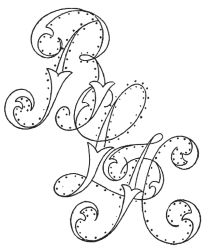
The newest way for marking handkerchiefs is one's own writing transferred with carbon, then worked in a very narrow satin stitch, with a decided slant to the stitches. The accompanying monogram is a pretty and practical one. Embroider the single lines same as described above, fill in the broad portions with perpendicular stitches, piling high, and cover with satin stitch same slant as the lines. Make the dots in French knots. If one is partial to French knots a good way is to outline all of the lines of letters, using Kensington outline stitch and fill in the broad parts with the knots.
The initial letters shown on the opposite page were drawn for 1898 Corticelli Home Needlework by a St. Louis artist. They are specially adapted to the purpose for which they are intended and are very pretty when worked according to the following instructions.
All letters look best if given a raised effect. To do this stuff the space between the lines with Corticelli Roman Floss, after the manner of working jewels (see page 62), taking care to have the stitches of the filling laid in the opposite direction to that which the covering stitches will take. With two threads of Corticelli Filo Silk cover the stuffing in satin stitch. Color 615, White, is usually used, although some prefer Cream White, 616, or Cream, 616.5. The Roman Floss used for stuffing should be of the same shade as the Filo Silk. A pretty way for making very small letters is to just follow the outline with small cross stitches.
Marking Clothing.
While the neatest way to mark clothing is by one's initials embroidered in Corticelli Filo Silk, as above suggested, this is not practical for many articles. Tablecloths, napkins, sheets, pillow cases, white spreads, towels, shirts, collars, and cuffs, also, must be plainly marked for convenience in sorting and identifying personal articles in the family wash and to avoid being lost when entrusted to public laundries. For this nothing is better than Payson's Indelible Ink. With a bottle of this ink and a common pen one can easily mark all necessary articles. A good idea is to keep on hand a few yards of linen tape, on which your name is written many times with this ink. Cut the tape as wanted and sew on to stockings, or other articles having too rough a surface for pen work.
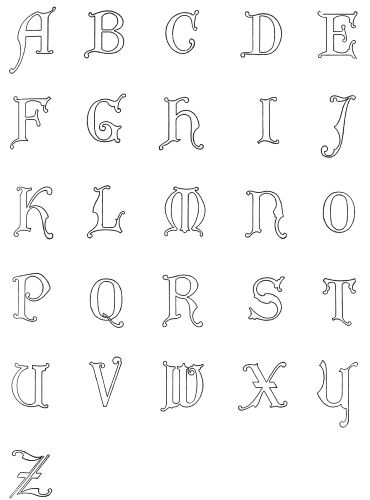
Corticelli Initial Letters.
See opposite page for directions for embroidering.
The original letters from which the above engravings were made measure 11⁄4 inches high. If the size shown above is large enough for your work transfer the letters direct from the book to the linen with carbon paper. If, however, the larger sized letters are desired get your dealer to order the perforated pattern for you, or, if he refuses to do this send direct to the Nonotuck Silk Co., Florence, Mass. Perforated pattern of the entire set of twenty-six letters, 11⁄4 inches high, costs 20 cents, postpaid. Perforated patterns of single letters cost 10 cents each, postpaid.