Hints Upon the Selection of Material.
Reading edition
Often the most difficult task for many women is choosing the proper shades of silk to embroider a certain stamped linen. Usually the dealer from whom you purchase your Corticelli Silk will advise you in regard to this, but when one lives in one of the smaller towns no store will be found which carries a good stock of embroidery materials from which to make a selection. In this case the best thing to do is to send six 2 cent stamps to the Nonotuck Silk Co., Bridge Street, Florence, Mass., for a Corticelli Color Card, showing over 325 different shades in which Corticelli Wash Silk is made. The card also shows samples of the various silks, as Filo Silk, Roman Floss, Persian Floss etc. The owner of a Color Card can order by number Corticelli Silk from her storekeeper, either by mail or in person. Few realize what a convenience this is.
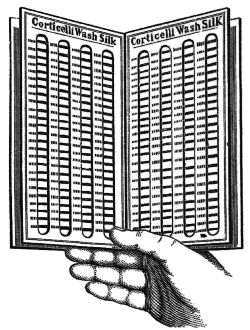
Corticelli Color Card.
Mailed to any address for six 2 cent stamps.
Many do not understand the great difference in embroidery silks, and often inferior kinds are sold them by unscrupulous clerks. Corticelli Silk is smooth working, of high luster, and is free from imperfections in stock or finish, while the dyes used are remarkable for brilliancy and absolute fastness of color. Magnificent mills, modern machinery, and sixty years experience in manufacturing silk enable the Nonotuck Silk Company to produce as perfect embroidery silk and floss as can be made.
Many realize only too late that they should have been more careful in buying the right brand of Wash Silk. The old saying, "The best is always the cheapest," comes back to those who have had some disappointing experience with a patiently worked centerpiece or doily which failed to stand the final test—the test of washing. Corticelli Silk took the highest award at the Cotton States and International Exposition held at Atlanta, Ga., 1895, as well as first prize at the Chicago World's Fair, 1893, and at the California Midwinter Exposition, 1894. Besides this we call your attention to the large number of well known needlework authorities that recommend its use. These facts alone should induce you to give Corticelli a trial in case you have never done so.
For fine and delicate shading on any smooth closely woven material, especially linen, use Corticelli Filo Silk (sometimes called Filo Floss). Owing to its fine size and loose twist a skillful worker can blend the shades with the utmost nicety, so that flowers, leaves, fruits, or other objects are most faithfully reproduced.
Corticelli Persian Floss is a silk of two strands, loosely twisted and of high luster, for work where two threads of Filo would ordinarily be required. Persian Floss is used extensively for the buttonhole edges of doilies and centerpieces, first padding the scallops with a few stitches as shown in Fig. VI a, page 17; or the buttonhole edge may be worked without padding as desired. Corticelli Filo Silk and Corticelli EE Embroidery Silk are also sometimes used for this work.
Corticelli Roman Floss is somewhat coarser than Corticelli Persian Floss and is intended for embroidering large designs on heavier material. Curtains, counterpanes, and cushions are worked with this thread, although for very bold designs Corticelli Rope Silk is preferable.
Corticelli Etching Silk, as its name implies, is for outline embroidery and etching. Corticelli Lace Embroidery Silk should be used for Honiton and lace work of similar nature. Corticelli EE Embroidery Silk is best suited for general fancy work and crazy patchwork. This silk is quite hard twisted and is therefore very durable.
To Wash Embroidered Linens.[1]
By L. Barton Wilson.
Avoid all risk of rust or stain by using an earthen wash bowl in preference to a tin or wooden tub. Wash by dipping in suds as hot as the hand can comfortably bear, made with "Ivory" or any other pure soap.
If there are any spots on the article wash them out first, before wetting the entire piece. Beyond this do not rub or fold, but plunge the linen up and down in the suds. If it is very much soiled or yellow, a half teaspoonful of borax may be added without the least danger to the silk. Carefully avoid washing powders and cheap soaps. When clean rinse by plunging up and down in several tepid waters or until the water remains perfectly clear. If the soap is not entirely removed by rinsing, the linen will yellow quickly.
Dry partially by laying between two soft cloths or towels for a few minutes. A new and very successful method for drying and pressing, especially small sized linens, is as follows: Lay them close and smooth on a marble slab or board. The woof and warp should be drawn perfectly straight and the stitches of the embroidery should be brought into position—that is, so they will lie as placed when worked. To dry a large article, place a sheet on the carpet and pin the piece through it to the carpet straight by the edges, stretching a little. The drying may be hastened by fanning or by holding a hot iron within half an inch of the surface. Doilies pinned to a board or frame may be dried in a minute by holding them in front of a register, and thus treated they should need no pressing with an iron.
Larger linens may be placed on a fine sheet, face downward, and "touched up" with a moderately hot iron; the marks of the pins may be removed by dampening and pressing. Imperfections in the linen's smoothness may be dampened but the silk should not be wet. The hem will likely need firm pressing; fringe should be brushed and lightly combed out; it will then likely need a little trimming.
All Corticelli Silk will remain fast in color if these directions for washing are followed, and the laundered embroidery will appear no different from that just finished. The peculiar luster, or bloom, of this beautiful silk will be retained if the new method of quick drying, under tension, is carried out.
To set embroidery for the first time, dampen the linen and silk on the wrong side and dry quickly before removing from the hoop. In all cases of fabrics that are not washable set embroidery by pasting on the reverse side.
The Size of Needle to Use.
By Mlle. G. Corsini.
Many ladies who embroider frequently complain that wash silk does not work smoothly, that the silk snarls or ravels, making a bad-looking piece of work, without saying anything about trying one's patience.
"Now, what makes my silk snarl?" is heard only too often. They frequently assign the cause of the trouble to the silk, when, in reality it is the fault of the needle they are using.
Some teachers recommend the use of an ordinary sewing needle with a round eye, but I prefer the long eye or "Crewel" needle. If you want to do fine work, shading closely, and are using double (two threads of) Corticelli Filo Silk, use a No. 8 "Crewel" needle. For single (one thread of) Corticelli Filo Silk use a No. 9 or a No. 10 needle, depending on the material upon which you are working. Generally speaking, use a No. 10 needle, especially for bolting cloth, Chinese linen, or grass linen. Corticelli Persian Floss requires a No. 8 needle. In working Corticelli Etching Silk choose a No. 7 needle. For Corticelli Roman Floss use a No. 6 needle. Use a No. 3 or a No. 6 needle for Corticelli Rope Silk.
Harper's Queen Crewel Needles are the best, and I advise all needleworkers to insist upon having them.
By following the above instructions there will be no excuse for unsatisfactory working of Corticelli Silk.
Note.—If you cannot buy the needles you want in your city, send six cents to the Nonotuck Silk Company, Bridge Street, Florence, Mass., and they will send you four Queen Crewel needles each, of sizes 7, 9, and 10.
Silk Required to Work a Piece of Given Size.
As a matter of fact no two needleworkers will use the same quantity of silk to work the same centerpiece or doily. One will require nearly or quite twice as much as another, perhaps, owing to the method of treatment or the way the shading is done. It is therefore almost impossible to advise customers just how much silk they will need.
In nearly all the instructions we have given the maximum quantity of silk required to embroider a 22 inch centerpiece. You may not need as much as the directions call for. Of course smaller sizes of linen will take less silk to work them, and the necessary quantity can readily be estimated.
If you are in doubt as to how much material you will want, you can order from your dealer one skein of some shades, and two of others, even if the instructions called for three or four skeins of a shade, and then order again when you find you will require more. However, it is always safer to buy at one time all the silk necessary for one piece, and we cannot too strongly recommend this plan.
Points for Beginners.
Embroidery is very fascinating work, but to attain perfection one must study the subject. We have been fortunate in securing so well known an authority on Art Needlework as Mrs. L. Barton Wilson to furnish a chapter on Embroidery Stitches. This article, which even the experienced worker will be glad to read, is especially valuable to beginners, who will find no difficulty in making the different stitches by following the directions and examining the illustrations.
Beginners should read "Hints upon the Selection of Material," and "The Size of Needle to Use," as well as "To Wash Embroidered Linens." In shading flowers in which many colors are required, have a separate needle threaded with each shade; in fact, this is a good plan even if you are using only a few shades.
Choose a simple design to begin with, such as a Violet, a Buttercup, or a Daisy, and get a small size stamped linen, not over nine inches square. At the end of the instructions for each design we have printed the words (Easy), (Not Difficult), (Somewhat Difficult), or (Difficult), which show the degree of skill necessary to embroider each piece successfully.
No printed instructions can help a beginner as much as a lesson, or better still a course of lessons, under a good teacher. However, we have tried to make the instructions explicit, and we think further details will be unnecessary; still, should you find trouble in working any of the designs, or want to know where materials can be obtained, we will gladly answer questions and give you any desired information. A stamp should be enclosed for reply.
[See larger version]