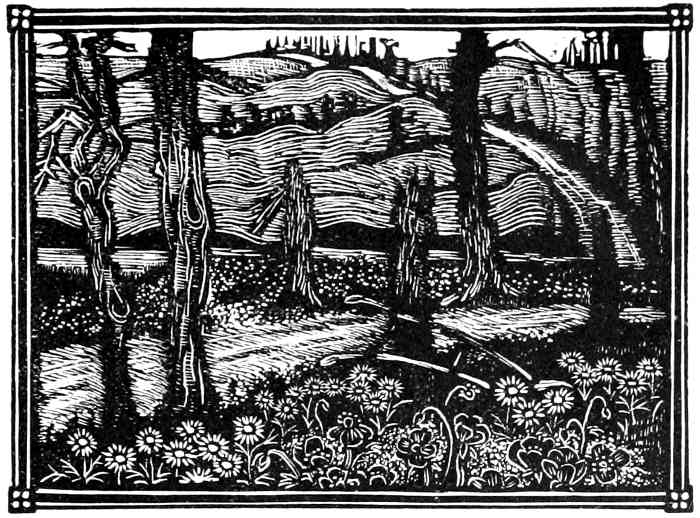
SUMMER : GREENWOOD SOLITUDE.
Reading edition
141
THE HUNT IS UP
The hunt is up, the hunt is up, And it is well nigh day; And Harry our King is gone hunting To bring his deer to bay. The east is bright with morning light, And darkness it is fled; And the merry horn wakes up the morn To leave his idle bed. Behold the skies with golden dyes Are glowing all around; The grass is green, and so are the treen All laughing at the sound. The horses snort to be at sport, The dogs are running free, The woods rejoice at the merry noise Of Hey tantara tee ree! The sun is glad to see us clad All in our lusty green, And smiles in the sky as he riseth high To see and to be seen. Awake all men, I say again, Be merry as you may; For Harry our King is gone hunting, To bring his deer to bay.
142
THE CHEERFUL HORN
The cheerful arn he blaws in the marn, And we'll a-'untin' goo; The cheerful arn he blaws in the marn, And we'll a-'untin' goo, And we'll a-'untin' goo, And we'll a-'untin' goo ... Var all my vancy dwells upon Nancy, And I'll zing Tally ho! Var all my vancy dwells upon Nancy, And I'll zing Tally ho! The vox jumps awer the 'edge zo 'igh, An' the 'ouns all atter un goo; Var all my vancy dwells upon Nancy, And I'll zing Tally ho! Then never despoise the soldjer lod, Thof 'is ztaition be boot low; Var all my vancy dwells upon Nancy, And I'll zing Tally ho! Then push about the coop, my bwoys, An' we will wumwards goo, Var all my vancy dwells upon Nancy, And I'll zing Tally ho! If you áx me the zénze of this zóng vur to téll, Or the reäzon vur to zhow; Woy, I doän't exacaly knoo, Woy, I doän't exacaly knoo: Var all my vancy dwells upon Nancy, And I'll zing Tally ho! Var all my vancy dwells upon Nancy, And I'll zing Tally ho!
143
JOHN PEEL
D'ye ken John Peel with his coat so gay? D'ye ken John Peel at the break of the day? D'ye ken John Peel when he's far, far away, With his hounds and his horn in the morning? 'Twas the sound of his horn called me from my bed, And the cry of his hounds has me oft-times led, For Peel's View-hollo would awaken the dead, Or a fox from his lair in the morning. D'ye ken that bitch whose tongue is death? D'ye ken her sons of peerless faith? D'ye ken that a fox with his last breath Cursed them all as he died in the morning? Yes, I ken John Peel and Ruby too Ranter and Royal and Bellman as true; From the drag to the chase, from the chase to a view, From a view to the death in the morning. And I've followed John Peel both often and far O'er the rasper-fence and the gate and the bar, From Low Denton Holme up to Scratchmere Scar, When we vied for the brush in the morning. Then here's to John Peel with my heart and soul, Come fill—fill to him another strong bowl: And we'll follow John Peel through fair and through foul, While we're waked by his horn in the morning. 'Twas the sound of his horn called me from my bed, And the cry of his hounds has me oft-times led, For Peel's View-hollo would awaken the dead Or a fox from his lair in the morning. John Woodcock Graves
144
THE SCHOOLBOY
I love to rise in a summer morn When the birds sing on every tree; The distant huntsman winds his horn, And the skylark sings with me. O! what sweet company. But to go to school in a summer morn, O! it drives all joy away; Under a cruel eye outworn, The little ones spend the day In sighing and dismay. Ah! then at times I drooping sit, And spend many an anxious hour, Nor in my book can I take delight, Nor sit in learning's bower, Worn thro' with the dreary shower. How can the bird that is born for joy Sit in a cage and sing? How can a child, when fears annoy, But droop his tender wing, And forget his youthful spring? O! father and mother, if buds are nipped, And blossoms blown away, And if the tender plants are stripped Of their joy in the springing day, By sorrow and care's dismay, How shall the summer arise in joy, Or the summer fruits appear? Or how shall we gather what griefs destroy, Or bless the mellowing year, When the blasts of winter appear? William Blake
145
A BOY'S SONG
Where the pools are bright and deep, Where the grey trout lies asleep, Up the river and over the lea, That's the way for Billy and me. Where the blackbird sings the latest, Where the hawthorn blooms the sweetest, Where the nestlings chirp and flee, That's the way for Billy and me. Where the mowers mow the cleanest, Where the hay lies thick and greenest, There to track the homeward bee, That's the way for Billy and me. Where the hazel bank is steepest, Where the shadow falls the deepest, Where the clustering nuts fall free, That's the way for Billy and me. Why the boys should drive away Little sweet maidens from their play, Or love to banter and fight so well, That's the thing I never could tell. But this I know, I love to play Through the meadow, among the hay; Up the water and over the lea, That's the way for Billy and me. James Hogg
146
MARKET DAY
Who'll walk the fields with us to town, In an old coat and a faded gown? We take our roots and country sweets, Where high walls shade the steep old streets, And golden bells and silver chimes Ring up and down the sleepy times. The morning mountains smoke like fires; The sun spreads out his shining wires; The mower in the half-mown lezza Sips his tea and takes his pleasure. Along the lane slow waggons amble. The sad-eyed calves awake and gamble; The foal that lay so sorrowful Is playing in the grasses cool. By slanting ways, in slanting sun, Through startled lapwings now we run Along the pale green hazel-path, Through April's lingering aftermath Of lady's smock and lady's slipper; We stay to watch a nesting dipper. The rabbits eye us while we pass, Out of the sorrel-crimson grass; The blackbird sings, without a fear, Where honeysuckle horns blow clear— Cool ivory stained with true vermilion, And here, within a silk pavilion, Small caterpillars lie at ease. The endless shadows of the trees Are painted purple and cobalt; Grandiloquent, the rook-files halt, Each one aware of you and me, And full of conscious dignity. Our shoes are golden as we pass With pollen from the pansied grass. Beneath an elder—set anew With large clean plates to catch the dew— On fine white cheese and bread we dine. The clear brook-water tastes like wine. If all folk lived with labour sweet Of their own busy hands and feet, Such marketing, it seems to me, Would make an end of poverty. Mary Webb
147
UNDER THE GREENWOOD TREE
Under the greenewood tree, Who loves to lye with me, And turne his merrie Note Unto the sweet Bird's throte: Come hither, come hither, come hither, Heere shall he see no enemie But Winter and rough Weather. Who doth ambition shunne And loves to live i' the Sunne, Seeking the food he eates And pleased with what he gets: Come hither, come hither, come hither, Here shall he see no enemie But Winter and rough Weather. William Shakespeare
148
IN SUMMER
In somer when the shawes be sheyne,[75] And leves be large and long, Hit[76] is full merry in feyre foreste To here the foulys[77] song. To se the dere draw to the dale And leve the hillės hee, And shadow him in the levės grene Under the green-wode tree. Hit befell on Whitsontide Early in a May mornyng, The Sonne up fairė gan shyne, And the briddis mery gan syng. "This is a mery mornyng," said Litulle Johne, "By Hym that dyed on tree; A more mery man than I am one Lyves not in Christiantė. "Pluk up thi hert, my dere mayster," Litulle Johne can say, "And thank hit is a fulle fayre tyme In a mornynge of May."
149
LUBBER BREEZE
The four sails of the mill Like stocks stand still; Their lantern-length is white On blue more bright. Unruffled is the mead, Where lambkins feed And sheep and cattle browse And donkeys drowse. Never the least breeze will The wet thumb chill That the anxious miller lifts, Till the vane shifts. The breeze in the great flour-bin Is snug tucked in; The lubber, while rats thieve, Laughs in his sleeve. T. Sturge Moore
150
A SUMMER'S DAY
"The ample heaven of fabrik sure, In cleannes dois surpas The chrystall and the silver pure, Or clearest poleist[78] glas. The shadow of the earth anon Removes and drawės by, Sine in the east, when it is gon, Appears a clearer sky. Quhilk sune[79] perceives the little larks, The lapwing and the snyp, And tune their sangs, like Nature's clarks Our medow, mure and stryp.[80] The time sa tranquil is and still, That na where sall ye find, Saife on ane high and barren hill, Ane aire of peeping wind. All trees and simples[81] great and small, That balmie leife do beir, Nor thay were painted on a wall, Na mair they move or steir[82]...." Alexander Hume
151
LEISURE
What is this life if, full of care, We have no time to stand and stare? No time to stand beneath the boughs And stare as long as sheep or cows. No time to see, when woods we pass, Where squirrels hide their nuts in grass. No time to see, in broad daylight, Streams full of stars, like skies at night. No time to turn at Beauty's glance, And watch her feet, how they can dance. No time to wait till her mouth can Enrich that smile her eyes began. A poor life this if, full of care, We have no time to stand and stare. William H. Davies
152
THE HAPPY COUNTRYMAN
Who can live in heart so glad As the merry country lad? Who upon a fair green balk[83] May at pleasure sit and walk, And amid the azure skies See the morning sun arise,— While he hears in every spring How the birds do chirp and sing: Or before the hounds in cry See the hare go stealing by: Or along the shallow brook, Angling with a baited hook, See the fishes leap and play In a blessèd sunny day: Or to hear the partridge call, Till she have her covey all: Or to see the subtle fox, How the villain plies the box: After feeding on his prey, How he closely sneaks away, Through the hedge and down the furrow Till he gets into his burrow: Then the bee to gather honey, And the little black-haired coney, On a bank for sunny place, With her forefeet wash her face: Are not these, with thousands moe[84] Than the courts of kings do know, The true pleasing spirit's sights That may breed true love's delights?... Nicholas Breton
153
"O FOR A BOOKE"
O for a Booke and a shadie nooke, eyther in-a-doore or out; With the grene leaves whispering overhede, or the Streete cryes all about. Where I maie Reade all at my ease, both of the Newe and Olde; For a jollie goode Booke whereon to looke, is better to me than Golde.
154
GREEN BROOM
There was an old man lived out in the wood, His trade was a-cutting of Broom, green Broom; He had but one son without thrift, without good, Who lay in his bed till 'twas noon bright noon. The old man awoke, one morning and spoke, He swore he would fire the room, that room, If his John would not rise and open his eyes, And away to the wood to cut Broom, green Broom. So Johnny arose, and he slipped on his clothes, And away to the wood to cut Broom, green Broom, He sharpened his knives, for once he contrives To cut a great bundle of Broom, green Broom. When Johnny passed under a lady's fine house, Passed under a lady's fine room, fine room, She called to her maid, "Go fetch me," she said, "Go fetch me the boy that sells Broom, green Broom." When Johnny came in to the lady's fine house, And stood in the lady's fine room, fine room; "Young Johnny," she said, "Will you give up your trade, And marry a lady in bloom, full bloom?" Johnny gave his consent, and to church they both went, And he wedded the lady in bloom, full bloom, At market and fair, all folks do declare, There is none like the Boy that sold Broom, green Broom.
155
THE TWELVE OXEN
I have twelfė oxen that be faire and brown, And they go a grasing down by the town. With hey! with how! with hoy! Saweste not you mine oxen, you litill prety boy? I have twelfė oxen, and they be faire and white, And they go a grasing down by the dyke. With hey! with how! with hoy! Saweste not you mine oxen, you litill prety boy? I have twelfė oxen, and they be faire and blak, And they go a grasing down by the lake. With hey! with how! with hoy! Saweste not you mine oxen, you litill prety boy? I have twelfė oxen, and they be faire and rede, And they go a grasing down by the mede With hey! with how! with hoy! Saweste not you mine oxen, you litill prety boy?
156
LAVENDER'S BLUE
Lavender's blue, dilly dilly, lavender's green, When I am king, dilly dilly, you shall be queen Who told you so, dilly dilly, who told you so? 'Twas mine one heart, dilly dilly, that told me so. Call up your men, dilly dilly, set them to work, Some with a rake, dilly dilly, some with a fork, Some to make hay, dilly dilly, some to thresh corn, Whilst you and I, dilly dilly, keep ourselves warm....
157
THE GARDEN
... What wondrous life is this I lead! Ripe apples drop about my head; The luscious clusters of the vine Upon my mouth do crush their wine; The nectarine and curious peach Into my hands themselves do reach; Stumbling on melons, as I pass, Ensnared with flowers, I fall on grass. Meanwhile the mind, from pleasure less, Withdraws into its happiness; The mind, that ocean where each kind Does straight its own resemblance find; Yet it creates, transcending these, Far other worlds and other seas, Annihilating all that's made To a green thought in a green shade. Here at the fountain's sliding foot Or at some fruit-tree's mossy root, Casting the body's vest aside My soul into the boughs does glide: There, like a bird, it sits and sings, Then whets[85] and claps its silver wings, And, till prepared for longer flight, Waves in its plumes the various light.... Such was the happy Garden-state While man there walked without a mate: After a place so pure and sweet, What other help could yet be meet! But 'twas beyond a mortal's share To wander solitary there: Two paradises 'twere in one, To live in Paradise alone.... Andrew Marvell
158
CHERRY-RIPE
Cherrie Ripe, Ripe, Ripe, I cry, Full and faire ones; come and buy: If so be you ask me where They doe grow? I answer, There, Where my Julia's lips doe smile; There's the Land, or Cherrie Ile: Whose Plantations fully show All the yeare, where Cherries grow. Robert Herrick
159
CHERRY-RIPE
There is a Garden in her face Where Roses and white Lillies grow; A heav'nly paradice is that place, Wherein all pleasant fruits doe flow. There Cherries grow, which none may buy, Till Cherry Ripe themselves doe cry. Those Cherries fayrely doe enclose Of Orient Pearle a double row, Which when her lovely laughter showes, They look like Rose-buds filled with snow. Yet them nor Peere nor Prince can buy, Till Cherry Ripe themselves doe cry. Her Eyes like Angels watch them still; Her Browes like bended bowes doe stand, Threat'ning with piercing frownes to kill All that approach with eye or hand These sacred Cherries to come nigh, Till Cherry Ripe themselves doe cry. Thomas Campion
160
SONG
What is there hid in the heart of a rose, Mother-mine? Ah, who knows, who knows, who knows? A Man that died on a lonely hill May tell you, perhaps, but none other will, Little child. What does it take to make a rose, Mother-mine? The God that died to make it knows It takes the world's eternal wars, It takes the moon and all the stars, It takes the might of heaven and hell And the everlasting Love as well, Little child. Alfred Noyes
161
THE MYSTERY
He came and took me by the hand Up to a red rose tree, He kept His meaning to Himself But gave a rose to me. I did not pray Him to lay bare The mystery to me, Enough the rose was Heaven to smell, And His own face to see. Ralph Hodgson
162
THE ROSE
A Rose, as fair as ever saw the North, Grew in a little garden all alone; A sweeter flower did Nature ne'er put forth, Nor fairer garden yet was never known: The maidens danced about it morn and noon, And learnèd bards of it their ditties made; The nimble fairies by the pale-faced moon Watered the root and kissed her pretty shade. But well-a-day!—the gardener careless grew; The maids and fairies both were kept away, And in a drought the caterpillars threw Themselves upon the bud and every spray. God shield the stock! If heaven send no supplies, The fairest blossom of the garden dies. William Browne
163
SONG
Ask me no more, where Jove bestows When June is past the fading rose; For in your beauty's orient deep These flowers, as in their causes, sleep. Ask me no more, whither do stray The golden atoms of the day; For in pure love heaven did prepare Those powders to enrich your hair. Ask me no more, whither doth haste The nightingale when May is past; For in your sweet dividing throat She winters and keeps warm her note. Ask me no more, where those stars light[86] That downwards fall in dead of night; For in your eyes they sit and there Fixèd become as in their sphere. Ask me no more if east or west The Phœnix builds her spicy nest; For unto you at last she flies, And in your fragrant bosom dies. Thomas Carew
164
THE BOWER OF BLISS
(The "daintie Paradise of the Enchauntresse" whereinto the Palmer brought Sir Guyon.)
... And in the midst of all, a fountaine stood, Of richest substaunce that on earth might bee, So pure and shiny, that the silver flood Through every channell running, one might see; Most goodly it with pure imageree Was over-wrought, and shapes of naked boyes, Of which some seemed with lively jollitee To fly about, playing their wanton toyes, Whiles others did them selves embay in liquid joyes. And over all, of purest gold was spred A trayle of yvie in his native hew: For the rich mettall was so colouréd, That wight, who did not well-advised it vew, Would surely deeme it to be yvie treu. Lowe his lascivious arms adown did creepe, That themselves dipping in the silver dew, Their fleecy flowres they tenderly did steepe, Which drops of Cristall seemd for wantonnes to weepe. Infinit streames continually did well Out of this fountaine, sweet and faire to see, The which into an ample laver fell, And shortly grew to so great quantitie, That like a little lake it seemed to bee; Whose depth exceeded not three cubits hight, That through the waves one might the bottom see, All paved beneath with Jaspar shining bright That seemd the fountaine in that sea did sayle upright. And all the margent round about was set With shady lawrell-trees, thence to defend The sunny beames, which on the billows bet, And those which therein bathèd, mote[87] offend.... Eftsoones they heard a most melodious sound, Of all that mote delight a daintie eare, Such as att once might not on living ground, Save in this Paradise, be heard elswhere: Right hard it was, for wight, which did it heare, To read, what manner musicke that mote bee: For all that pleasing is to living care, Was there consorted in one harmonie, Birdes, voyces, instruments, windes, waters, all agree. The joyous birdes, shrouded in cheareful shade, Their notes unto the voice attempred sweet; Th' Angelicall soft trembling voyces made To th' instruments divine respondence meet: The silver sounding instruments did meet With the base murmure of the waters fall: The waters fall with difference discreet, Now soft, now loud, unto the wind did call: The gentle warbling wind low answerèd to all. Edmund Spenser
165
SMALL FOUNTAINS
... Jarring the air with rumour cool, Small fountains played into a pool With sound as soft as the barley's hiss When its beard just sprouting is; Whence a young stream, that trod on moss, Prettily rimpled the court across. And in the pool's clear idleness, Moving like dreams through happiness, Shoals of small bright fishes were; In and out weed-thickets bent Perch and carp, and sauntering went With mounching jaws and eyes a-stare; Or on a lotus leaf would crawl, A brinded loach to bask and sprawl, Tasting the warm sun ere it dipt Into the water; but quick as fear Back his shining brown head slipt To crouch on the gravel of his lair, Where the cooled sunbeams broke in wrack, Spilt shattered gold about his back.... Lascelles Abercrombie
166
THE INVITATION, TO JANE
Best and brightest, come away! Fairer far than this fair Day, Which, like thee to those in sorrow, Comes to bid a sweet good-morrow To the rough Year just awake In its cradle on the brake. The brightest hour of unborn Spring, Through the winter wandering, Found, it seems, the halcyon Morn To hoar February born; Bending from Heaven, in azure mirth, It kissed the forehead of the Earth, And smiled upon the silent sea, And bade the frozen streams be free. And waked to music all their fountains, And breathed upon the frozen mountains, And like a prophetess of May Strewed flowers upon the barren way, Making the wintry world appear Like one on whom thou smilest, dear.... Radiant sister of the Day, Awake! arise! and come away! To the wild woods and the plains, And the pools where winter rains Image all their roof of leaves, Where the pine its garland weaves Of sapless green and ivy dun Round stems that never kiss the sun; Where the lawns and pastures be, And the sand-hills of the sea;— Where the melting hoar-frost wets The daisy-star that never sets, The wind-flowers, and violets, Which yet join not scent to hue, Crown the pale year weak and new; When the night is left behind In the deep east, dun and blind, And the blue noon is over us, And the multitudinous Billows murmur at our feet, Where the earth and ocean meet, And all things seem only one In the universal sun. Percy Bysshe Shelley
167
THE RECOLLECTION
... We wandered to the Pine Forest That skirts the Ocean's foam; The lightest wind was in its nest, The tempest in its home. The whispering waves were half asleep, The clouds were gone to play, And on the bosom of the deep The smile of Heaven lay; It seemed as if the hour were one Sent from beyond the skies, Which scattered from above the sun A light of Paradise! We paused amid the pines that stood The giants of the waste, Tortured by storms to shapes as rude As serpents interlaced, And soothed by every azure breath, That under heaven is blown, To harmonies and hues beneath, As tender as its own: Now all the tree-tops lay asleep Like green waves on the sea, As still as in the silent deep The ocean woods may be. How calm it was!—The silence there By such a chain was bound That even the busy woodpecker Made stiller with her sound The inviolable quietness; The breath of peace we drew With its soft motion made not less The calm that round us grew. There seemed, from the remotest seat Of the white mountain waste To the soft flower beneath our feet, A magic circle traced,— A spirit interfused around, A thrilling, silent life— To momentary peace it bound Our mortal nature's strife;— And still I felt the centre of The magic circle there Was one fair form that filled with love The lifeless atmosphere.... Percy Bysshe Shelley
168
THE GOAT PATHS
The crooked paths go every way Upon the hill—they wind about Through the heather in and out Of the quiet sunniness. And there the goats, day after day, Stray in sunny quietness, Cropping here and cropping there, As they pause and turn and pass, Now a bit of heather spray, Now a mouthful of the grass. In the deeper sunniness, In the place where nothing stirs, Quietly in quietness, In the quiet of the furze, For a time they come and lie Staring on the roving sky. If you approach they run away, They leap and stare, away they bound, With a sudden angry sound, To the sunny quietude; Crouching down where nothing stirs In the silence of the furze, Couching down again to brood In the sunny solitude. If I were as wise as they, I would stray apart and brood, I would beat a hidden way Through the quiet heather spray To a sunny solitude; And should you come I'd run away, I would make an angry sound, I would stare and turn and bound To the deeper quietude, To the place where nothing stirs In the silence of the furze. In that airy quietness I would think as long as they; Through the quiet sunniness I would stray away to brood By a hidden beaten way In a sunny solitude, I would think until I found Something I can never find, Something lying on the ground, In the bottom of my mind. James Stephens
169
UNDER A WILTSHIRE APPLE TREE
Some folks as can afford, So I've heard say, Set up a sort of cross Right in the garden way To mind 'em of the Lord. But I, when I do see Thik[88] apple tree An' stoopin' limb All spread wi' moss, I think of Him And how He talks wi' me. I think of God And how He trod That garden long ago; He walked, I reckon, to and fro And then sat down Upon the groun' Or some low limb What suited Him, Such as you see On many a tree, And on thik very one Where I at set o' sun Do sit and talk wi' He. And, mornings, too, I rise and come An' sit down where the branch be low; A bird do sing, a bee do hum, The flowers in the border blow, And all my heart's so glad and clear As pools be when the sun do peer, As pools a-laughing in the light When mornin' air is swep' an' bright, As pools what got all Heaven in sight, So's my heart's cheer When He be near. He never pushed the garden door, He left no footmark on the floor; I never heard 'Un stir nor tread And yet His Hand do bless my head, And when 'tis time for work to start I takes Him with me in my heart. And when I die, pray God I see At very last thik apple tree An' stoopin' limb, And think of Him And all He been to me. Anna Bunston de Bary
170
WONDER
How like an Angel came I down! How bright were all things here! When first among His works I did appear O how their Glory me did crown! The world resembled His Eternity, In which my soul did walk; And every thing that I did see Did with me talk. The skies in their magnificence, The lively, lovely air, Oh how divine, how soft, how sweet, how fair! The stars did entertain my sense, And all the works of God, so bright and pure, So rich and great did seem, As if they ever must endure In my esteem.... The streets were paved with golden stones, The boys and girls were mine, Oh how did all their lovely faces shine! The sons of men were holy ones, In joy and beauty they appeared to me, And every thing which here I found, While like an Angel I did see, Adorned the ground. Rich diamond and pearl and gold In every place was seen; Rare splendours, yellow, blue, red, white and green, Mine eyes did everywhere behold. Great wonders clothed with glory did appear, Amazement was my bliss, That and my wealth was everywhere; No joy to this!... Thomas Traherne
171
SONG
How sweet I roamed from field to field And tasted all the summer's pride, Till I the Prince of Love beheld Who in the sunny beams did glide! He showed me lilies for my hair, And blushing roses for my brow; He led me through his gardens fair Where all his golden pleasures grow. With sweet May dews my wings were wet, And Phoebus fired my vocal rage; He caught me in his silken net, And shut me in his golden cage. He loves to sit and hear me sing, Then, laughing, sports and plays with me; Then stretches out my golden wing, And mocks my loss of liberty. William Blake
172
THE BOOK
Of this fair volume which we World do name If we the sheets and leaves could turn with care, Of Him who it corrects and did it frame, We clear might read the art and wisdom rare: Find out His power which wildest powers doth tame, His providence extending everywhere, His justice which proud rebels doth not spare, In every page, no period of the same. But silly we, like foolish children, rest Well pleased with coloured vellum, leaves of gold, Fair dangling ribbands, leaving what is best, On the great Writer's sense ne'er taking hold; Or, if by chance we stay our minds on aught, It is some picture on the margin wrought. William Drummond
173
TETHY'S FESTIVAL
Are they shadows that we see? And can shadows pleasure give? Pleasures only shadow's be, Cast by bodies we conceive; And are made the things we deem In those figures which they seem. But those pleasures vanish fast, Which by shadow's are exprest; Pleasures are not, if they last; In their passing is their best: Glory is more bright and gay In a flash, and so away. Feed apace then, greedy eyes, On the wonder you behold: Take it sudden, as it flies, Though you take it not to hold. When your eyes have done their part Thought must length'n it in the heart. Samuel Daniel