ABOUT AND ROUND ABOUT (continued 4)
Reading edition
This is a patchwork of stanzas from three versions of the old ballad. In one version the "Golden Vanity" is said to be the " Sweet Trinity," and to have been built by Sir Walter Raleigh in the Netherlands. According to yet another, the Cabin-boy, after threatening to sink the "Goulden Vanitie" as he had "sunk the French gallee," is taken on board and the Captain and merchant adventurers proved "far better than their word." But if stanza 12 is any witness, this seems unlikely. Can one not actually see the cold faces mocking down upon the water?
412.
To an eye and ear new to them, these old Scottish ballads may seem a little difficult and forbidding. But read on, and their enchantment has no match—the very strangeness of the words, the rare music, the colour and light and clearness and vehemence, and, besides these, a wildness and ancientness like that of an old folk-tune which seems to carry with its burden as many lost memories as an old churchyard has gravestones. The stories they tell are world wide. How they came into that world (for of some of them there are as many as twenty to thirty different versions), how they have fared in their long journey, and even when and by whom they were made, are still questions on which even scholars are not yet agreed.
"Kevels" in line 5 of "Brown Robyn," means lots, and recalls a far older story:
"Now the word of the Lord came unto Jonah the son of Amittai, saying, Arise, go to Nineveh, that great city, and cry against it; for their wickedness is come up before me. But Jonah rose up to flee unto Tarshish from the presence of the Lord, and went down to Joppa; and he found a ship going to Tarshish, so he paid the fare thereof, and went down into it, to go with them unto Tarshish from the presence of the Lord. But the Lord sent out a great wind into the sea, and there was a mighty tempest in the sea, so that the ship was like to be broken. Then the mariners were afraid, and cried every man unto his god, and cast forth the wares that were in the ship into the sea, to lighten it of them. But Jonah was gone down into the sides of the ship; and he lay, and was fast asleep.... And they said every one to his fellow, Come, and let us cast lots, that we may know for whose cause this evil is upon us. So they cast lots, and the lot fell upon Jonah.... Then said they unto him, What shall we do unto thee, that the sea may be calm unto us? for the sea wrought, and was tempestuous. And he said unto them, Take me up, and cast me forth into the sea; so shall the sea be calm upon you: for I know that for my sake this great tempest is upon you.... So they took up Jonah, and cast him forth into the sea; and the sea ceased from her raging."
415. "A Seal My Father Was."
Notes of music for the enticement of seals, with other beautiful old Gaelic airs and poems and tales, will be found in Journals 23/5 of The Folk-Song Society, collected by Mr. Martin Freeman.
418. "Sir Patrick Spence."
The longer version of the ballad into which the genius of Sir Walter Scott wove a few new stanzas is the better known. But this, I think, is the best. Indeed, the secret art of this naked and lovely poetry seems nowadays to be lost: its marvel is how much it tells by means of the little it says.
"Late, Late Yestreen." (stanza 7)
With money in his pocket and bewaring of glass, the Man of Superstitions bows low and seven times to the new moon. If he sees a dim cindrous light filling in the circle of which this crescent is the edge, he "looks out for squalls"—the new moon has "the auld moone in hir arme." That light is the earth-shine. The sun illumines the earth; the earth like a looking-glass reflects his radiance upon the moon; and she thus melancholily returns it; whereas the silver blaze on her eastern edge is light direct: eyes looking upward thence into her black skies are lit with her prodigious mornings.
419. "Allison Gross."
Here I have changed only two words of the original.
420. "Sir Hugh."
If this ballad tells of a fact, then the young Sir Hugh was beguiled out of his life by the dark beautiful Jewess in the year 1255. The story comes from a monastery, and it is historically certain that the wealthiest Jews of Lincoln were in this year crucified on this charge. True or false, what a clear, pellucid picture the ballad builds up in the imagination—the ancient town; the boys at their game; the narrow, gabled, cobbled streets; the evening gold on roof and wall; night; lamentation; and the clanging of the bells.
421. "Edward."
The spelling of this ballad usually begins "Why dois your brand sae dripp wie bluid," and so on. This spelling Professor Child thought "affectedly antique." But since, as he says, mere antiquated "spelling will not make an old ballad, so it will not unmake one." And "Edward" in any guise is "one of the noblest" of the popular ballads. Here it is, then, in our own spelling for proof.
422. "I will sing."
The king in the third line is James the Sixth of Scotland and the First of England—the king, according to the old waggery, "who never said a foolish thing and never did a wise one." But see Green. The "wanton laird of young Logie" is John Wemyss who plotted against him with the Earl of Bothwell in 1592. His bold, crafty and merry young wife, May Margaret, says Mr. Sidgwick, had one of these four delectable maiden names—Vinstar, Weiksterne, Twynstoun, or Twinslace. It is dubious which.
All ladies in those old days carried knives at their girdles. The one in stanza 8 was clearly a wedding gift. And to judge from the ballads, doughty uses they sometimes put them to.
423. "Fair Annie."
In the margins of Mr. Nahum's copy of this ballad, two exquisite damosels were painted in green, blue and amethyst on gold (as in a monk's work), and between their fingers hung a linen napkin seemingly broidered with pearls and in the midst of it a sleeping dove. Whatever he may have meant by this, I confess that at first reading I fell in love with both these ladies. My feelings for the "noble knight" who ransomed fair Annie, then wearied of her, were different. It was strange to find a noble knight so hard a gentleman, not so much because he wearied of her (since to weary of one so true, intelligent and tender was even more of a punishment than a misfortune) but most particularly, with regard to his craving for "gowd and gear." He reminds me of a similar piece of humanity described in three short stanzas which were found by Mr. Macmath written on the fly-leaf of a little volume printed at Edinburgh about 1670, and which I found in Child's Ballads:
"He steps full statly on the street, He hads the charters of him sell, In to his cloathing he is complete, In Craford's mure he bears the bell.... "I wish I had died my own fair death, In tender age, when I was young; I would never [then] have broke my heart For the love of any churl's son. "Wo be to my parents all, That lives so farr beyond the sea! I might have lived a noble life, And wedded in my own countrée."
425. "But think na' ye my Heart was sair?" (line 21)
Down in yon garden sweet and gay Where bonnie grows the lily, I heard a fair maid sighing say, "My wish be wi' sweet Willie!" "Willie's rare, and Willie's fair, And Willie's wondrous bonny; And Willie hecht to marry me Gin e'er he married ony. "O gentle wind, that bloweth south From where my Love repaireth, Convey a kiss frae his dear mouth And tell me how he fareth! "O tell sweet Willie to come doun And hear the mavis singing, And see the birds on ilka bush And leaves around them hinging. "The lav'rock there, wi' her white breast And gentle throat sae narrow; There's sport eneuch for gentlemen On Leader haughs and Yarrow. "O Leader haughs are wide and braid And Yarrow haughs are bonny; There Willie hecht to marry me If e'er he married ony. "But Willie's gone, whom I thought on, And does not hear the weeping Draws many a tear frae's true love's e'e, When other maids are sleeping. "Yestreen I made my bed fu' braid, The night I'll mak' it narrow, For a' the lee-lang winter night I lie twined o' my marrow. "O came ye by yon water-side? Pu'd you the rose or lily? Or came you by yon meadow green, Or saw you my sweet Willie?" She sought him up, she sought him down, She sought him braid and narrow; Syne, in the cleaving of a crag, She found him drowned in Yarrow!
Hecht (line 6) means vowed; haughs are water-meadows; and to be twined o' one's marrow, is to be separated from one's loved one.
427. The Twa Sisters.
Here is another ballad—"The Water o Wearie's Well,"—of a similar pattern. But in this the drowner of the King's daughters himself finds a "watery grave":
There came a bird out o a bush, On water for to dine, An sighing sair, says the king's daughter, "O wae's this heart o mine!" He's taen a harp into his hand, He's harped them all asleep, Except it was the king's daughter, Who one wink couldna get. He's luppen on his berry-brown steed, Taen 'er on behind himsell, Then baith rede down to that water That they ca Wearie's Well. "Wide in, wide in, my lady fair, No harm shall thee befall; Oft times I've watered my steed Wi the water o Wearie's Well." The first step that she steppèd in, She stepped to the knee; And sighend says this lady fair, "This water's nae for me." "Wide in, wide in, my lady fair, No harm shall thee befall; Oft times I've watered my steed Wi the water o Wearie's Well." The next step that she stepped in, She stepped to the middle; "O," sighend says this lady fair, "I've wat my gowden girdle." "Wide in, wide in, my lady fair, No harm shall thee befall; Oft times have I watered my steed Wi the water o Wearie's Well." The next step that she steppèd in, She stepped to the chin; "O," sighend says this lady fair, "They sud gar twa loves twin!" "Seven king's daughters I've drownd there, In the water o Wearie's Well, And I'll make you the eight o them, And ring the common bell." "Since I am standing here," she says, "This dowie death to die, One kiss o your comely mouth I'm sure wad comfort me." He louted him oer his saddle bow, To kiss her cheek and chin; She's taen him in her arms twa, And thrown him headlong in. "Since seven king's daughters ye've drowned there, In the water o Wearie's Well, I'll make you bridegroom to them a', An ring the bell mysell." And aye she warsled, and aye she swam, And she swam to dry lan; She thankèd God most cheerfully The dangers she oercame.
428. "Sweet William and May Margaret."
Hermione.Come Sir, now I am for you againe: Pray you sit by us, and tell's a Tale. Mamillius (her son).Merry, or sad, shal't bee? Hermione.As merry as you will. Mamillius.A sad Tale's best for Winter: I have one of Sprights, and Goblins. Hermione.Let's have that, good Sir. Come-on, sit downe, come-on, and doe your best To fright me with your Sprights: you're powrefull at it. Mamillius.There was a man.... Hermione.Nay, come sit downe: then on. Mamillius.Dwelt by a Churchyard: I will tell it softly, Yond Crickets shall not heare it. Hermione.Come on then, and giv't me in mine eare.... The Winter's Tale
429. "That birk Grew fair eneugh." (stanza 6)
The strangest feature of these ballads is that the stories they tell, the customs, beliefs, lore they refer to, may be found scattered up and down all over the world. In Russia, for one small instance, the birk or birch tree is honoured in this fashion: A little before Whitsuntide, says Sir James Fraser in The Golden Bough, the young women, with dancing and feasting, cut down a living birch-tree, deck it with bright clothes or hang it with ribbons; then set it up as an honoured guest in one of the village houses. On Whit Sunday itself they fling it, finery and all, into a stream for a charm.
And now for England: "Thirty years ago," says Mrs. Wright, "it was still customary in some west-Midland districts to decorate village churches on Whit Sunday with sprigs of birch stuck in holes bored in the tops of the pews. I can remember this being done by an old village clerk in Herefordshire, but when he was gathered to his fathers in the same profession, the custom died with him." How happy must he have been then—as happy as for that one evening was the Wife of Usher's Well herself—to lift his eyes upon a silver birch brushing with its green tresses the very gates of Paradise!
433. "A spangle here."
Dew sate on Julia's haire, And spangled too, Like leaves that laden are With trembling dew: Or glittered to my sight, As when the Beames Have their reflected light, Daunc't by the Streames. Robert Herrick
If the daisies are not to shut their eyes until Julia shut hers, should they not most assuredly wait also until "dear love Isabella," shut hers? She was the bosom friend and aunt of Marjorie Fleming, Sir Walter Scott's little friend, who was born in 1803, and who, having written her few tim-tam-tot little rhymes, died in 1811. And here is Isabel:
Here lies sweet Isabell in bed, With a night-cap on her head; Her skin is soft, her face is fair, And she has very pretty hair; She and I in bed lies nice, And undisturbed by rats or mice; She is disgusted with Mr. Worgan, Though he plays upon the organ. Her nails are neat, her teeth are white, Her eyes are very, very bright; In a conspicuous town she lives, And to the poor her money gives; Here ends sweet Isabella's story, And may it be much to her glory.
434.
Bunyan's "Comparison" for this poem runs thus:
Our Gospel has had here a Summers day; But in its Sun-shine we, like Fools, did play, Or else fall out, and with each other wrangle, And did instead of work not much but jangle. And if our Sun seems angry, hides his face, Shall it go down, shall Night possess this place? Let not the voice of night-Birds us afflict, And of our mis-spent Summer us convict.
437.
From the "Songs of Innocence"; and this is from the "Songs of Experience":
When the voices of children are heard on the green And whisp'rings are in the dale. The days of my youth rise fresh in my mind, My face turns green and pale. Then come home, my children, the sun is gone down, And the dews of night arise; Your spring and your day are wasted in play, And your winter and night in disguise.
For to grow old and look back on one's childhood, though in much it is a happy thing, may be also a thing full of dread and regret. The old poets never wearied of bidding youth gather its roses, seize its fleeting moments. But not all roses are fresh and fragrant in the keeping, and "lilies that fester smell far worse than weeds."
440. "Afterwards."
Every fine poem says much in little. It packs into the fewest possible words—by means of their sound, their sense, and their companionship—a wide or rare experience. So, in particular, with such a poem as this. It tells of a man thinking of the day when he shall have bidden goodbye to a world whose every live and lovely thing—Spring, hawk, evening, wintry skies—he has dearly loved. And if what it tells of is to be seen as clearly and truly as if it were before one's very eyes, it must be read intently—all one's imagination alert to gather up the full virtue of the words, and to picture in the mind each fleeting and living object in turn.
As I write these lines I cannot refrain from suggesting how thankful we should be to be living in a day when three great poets, who have been long in the world, are adding to the riches of English poetry—Thomas Hardy, Charles Doughty, and the Poet Laureate, Robert Bridges. It is but a little while, too, since the death of that exquisite writer, and lover of all things true and beautiful, Alice Meynell, and of W. H. Hudson, who was no less a poet because he wrote not in verse but in prose.
To compare the great things of one age with the great things of another is an exceedingly difficult task (and to pit poet against poet, or imagination against imagination, an exceedingly stupid one). But that in Elizabeth's day England was indeed a "nest of singing birds" may be realised by the fact that when Shakespeare was finishing his last play, The Tempest, in the Spring, apparently, of 1611—when, that is, he himself was aged 47 (and his Queen had been eight years dead), Sir Walter Raleigh was 59, Anthony Munday 58, Samuel Daniel 49, Michael Drayton 48, Thomas Campion 44, Thomas Dekker (?) 41, John Donne and Ben Jonson were 38, John Fletcher was 32, Francis Beaumont 27, William Drummond 26, John Ford 25, William Browne and Robert Herrick 20, Francis Quarles 19, George Herbert 18, Thomas Carew (?) 16, James Shirley 15, and John Milton (and Sir John Suckling) were 2. It was seven years before the birth of Richard Lovelace and Abraham Cowley, ten before Marvell's, and eleven before Vaughan's. Edmund Spenser had been twelve years dead, Sir Philip Sidney twenty-five—and Chaucer 211.
Two hundred and fifty years afterwards—in 1861—another great queen was on the Throne, Victoria. It was the year in which the Prince Consort died, and Edward, Prince of Wales, came of age. Nor was England's garden silent then: for in that year William Barnes and Cardinal Newman were 60, Edward Fitzgerald and Tennyson were 52, Robert Browning 49, Charles Kingsley 42, Matthew Arnold 39, Coventry Patmore 38, William Allingham 37, Dante Gabriel Rossetti and George Meredith were 33, Christina Rossetti was 31, William Morris 27, Algernon Swinburne 24, Mr. Thomas Hardy was 21, Mr. Robert Bridges 17, Robert Louis Stevenson 11, and Francis Thompson was 2. Other great writers, in English, then alive were Carlyle, Thackeray, Dickens, Ruskin, Darwin and Huxley; Emerson, Hawthorne, Longfellow and Walt Whitman. So the strange flame of genius fitfully burns in this world. And 1611 knew as little of 1861 as 1861 knew of 2111. (But would that 1923 could leave to the future one-tenth part of such a legacy as did 1611—the English Bible!)
But to return to Shakespeare. He was born in April 1564. About 1591 he wrote the first of his plays, Love's Labour's Lost. By 1611 he had finished the last of them; 34 in all as they appear in the first Folio, 37 as they now appear in the Canon. And apart from these, his Poems. There followed a strange silence. On the 25th of March, 1616, "in perfect health and memory (God be praised!)," he made his will. On St. George's Day, 1616, he died. To reflect for a moment on that brief lifetime, on that twenty years' work which is now a perennial fountain of happiness, light and wisdom to the whole world, is to marvel indeed. The life-giving secret of this supreme genius none can tell. We know not even our own. But there is a story told by Thomas Campbell: "It was predicted of a young man lately belonging to one of our universities, that he would certainly become a prodigy because he read sixteen hours a day. 'Ah, but,' said somebody, 'how many hours a day does he think?' It might have been added, 'How many hours does he feel?'" So of Shakespeare. As, then, said his old friends and fellow-players, John Heminge and Henry Condell in their Preface to the Folio: "Reade him, therefore; and againe, and againe: And if then you doe not like him, surely you are in some manifest danger...."
441. "With such a Sky."
It is a beauteous Evening, calm and free, The holy time is quiet as a Nun Breathless with adoration; the broad sun Is sinking down in its tranquillity; The gentleness of heaven broods o'er the Sea: Listen! the mighty Being is awake, And doth with his eternal motion make A sound like thunder—everlastingly.... William Wordsworth
442. "Shepherds all, and Maidens fair, Fold your Flocks."
The curfew tolls the knell of parting day, The lowing herd winds slowly o'er the lea, The ploughman homeward plods his weary way, And leaves the world to darkness and to me. Now fades the glimmering landscape on the sight, And all the air a solemn stillness holds, Save where the beetle wheels his droning flight. And drowsy tinklings lull the distant folds:...
These lines and the stanzas that follow them in the Elegy in a Country Churchyard are as familiar as any in English, and may be found in almost every collection of poems. Here, "a figure on paper"—from a letter to a friend written by the author of them, Thomas Gray, on November 19, 1764, is a description—not of evening after the setting of the sun— but of a sun-rise as vivid as if one's own naked eye had watched its "Levee":
I must not close my letter without giving you one principal event of my history; which was, that (in the course of my late tour) I set out one morning before five o'clock, the moon shining through a dark and misty autumnal air, and got to the sea-coast time enough to be at the Sun's Levee. I saw the clouds and dark vapours open gradually to right and left, rolling over one another in great smoky wreathes, and the tide (as it flowed gently in upon the sands) first whitening, then slightly tinged with gold and blue; and all at once a little line of unsufferable brightness that (before I can write these five words) was grown to half an orb, and now to a whole one, too glorious to be distinctly seen. It is very odd it makes no figure on paper; yet I shall remember it, as long as the sun, or at least as long as I endure. I wonder whether anybody ever saw it before? I hardly believe it."
So each day, one remembers, the sun rises, indeed is rising always above some watchful eye's horizon, and we come so to expect its rising, and so to be assured of it, as though it were no less certain than that twice two are four. But, in fact, it is only just certain enough to prevent night from being a dreadful apprehension, and life from becoming a mere routine. As Coleridge says in his Table Talk:
"Suppose Adam watching the sun sinking under the western horizon for the first time; he is seized with gloom and terror, relieved by scarce a ray of hope that he shall ever see the glorious light again. The next evening, when it declines, his hopes are stronger, but still mixed with fear; and even at the end of a thousand years, all that a man can feel is a hope and an expectation so strong as to preclude anxiety."
... High among the lonely hills, While I lay beside my sheep, Rest came down and filled my soul, From the everlasting deep. Changeless march the stars above, Changeless morn succeeds to even; Still the everlasting hills Changeless watch the changeless heaven.... Charles Kingsley
444. "The children are going to bed."
Hush-a-ba, birdie, croon, croon, Hush-a-ba, birdie, croon. The Sheep are gane to the siller wood, And the cows are gane to the broom, broom. And it's braw milking the kye, kye, It's braw milking the kye, The birds are singing, the bells are ringing, And the wild deer come galloping by, by. And hush-a-ba, birdie, croon, croon, Hush-a-ba, birdie, croon. The Gaits are gane to the mountain hie, And they'll no be hame till noon, noon.
This for the littlest ones, the cradle-creatures. But for the rest:
Boys and Girls, come out to play, The Moon doth shine as bright as day; Come with a whoop, come with a call, Come with a goodwill or don't come at all; Lose your supper and lose your sleep— So come to your playmates in the street.
And if you should want actually to bring that Moon to earth, this is how Quince managed it in A Midsummer Night's Dream:
The Rehearsal. Snout.Doth the Moone shine that night wee play our play? Bottom.A Calender, a Calender, looke in the Almanack, finde out Moone-shine, finde out Moone-shine. Quince.Yes, it doth shine that night. Bottom.Why then may you leave a casement of the great chamber window (where we play) open, and the Moone may shine in at the casement. Quince.Ay, or else one must come in with a bush of thorns and a lanthorne, and say he comes to disfigure, or to present the person of Moone-shine.... The Play. Lysander.Proceed, Moone. Moone.All that I have to say, is to tell you, that the Lanthorne is the Moone; I, the man in the Moone; this thorne bush, my thorne bush; and this dog, my dog....
And here is a stanza from a very old poem about that same "man in the Moone":
Mon, in the mone, stond ant streit, On is bot-forke is burthen he bereth: Hit is muche wonder that he na down slyt, For doute leste he valle he shoddreth ant shereth: When the frost freseth muche chele he byd, The thornes beth kene is hattren to-tereth; Nis no wytht in the world that wot wen he syt, Ne, bote hit bue the hegge, whet wedes he wereth.
which means, I gather, that
the Man in the Moon stands up there stark and still in her silver, carrying his thornbush on his pitchfork. It's a marvel he doesn't slide down; he's shuddering and shaking at the thought of it. When the frost sharpens, he'll be frozen to his marrow. The prickles stick out to tear his clothes; but nobody in the world has seen him sit down, or knows apart from his thornbush what he has on.
I see the Moon, The Moon sees me; God bless the sailors, And bless me.
449. "That busy Archer." (line 4)
Though I am young and cannot tell Either what Love or Death is well, Yet I have heard they both bear darts And both do aim at human hearts.... Ben Jonson
"Are Beauties there as proud as here they be." (line 11)
... The palace of her father the King, was on that side the Moon no mortal sees, and of such an enchantment was her cold beauty that on earth none resembles it. Yet all her flattery and pride was but to win the idolatrous love of far-travelling Princes, or even of wanderers of common blood; for the sake of that love and admiration only. And many perished in those rock-bound deserts and parched and icy lunar wildernesses on account of this proud damsel; before a strange fate befell her....
Here, too, is a fragment (from a thirteenth century MS.), to be found in A Medieval Garner:
"What shall we say of the ladies when they come to feasts? Each marks well the other's head; they wear bosses like horned beasts, and if any have no horns, she is a laughing stock for the rest. Their arms go merrily when they come into the room; they display their kerchiefs of silk and cambric, set on their buttons of coral and amber, and cease not their babble so long as they are in the bower.... But however well their attire be fashioned, when the feast is come, it pleases them nought; so great is their envy now and so high grows their pride, that the bailiff's daughter counterfeits the lady.'"
450. "She hath no Air." (line 5)
—and that being so:
".... There will be no sounds on the moon.... Even a meteor shattering itself to a violent end against the surface of the moon would make no noise. Nor would it herald its coming by glowing into a 'shooting star,' as it would on entering the earth's atmosphere. There will be no floating dust, no scent, no twilight, no blue sky, no twinkling of the stars. The sky will be always black and the stars will be clearly visible by day as by night. The sun's wonderful corona, which no man on earth, even by seizing every opportunity during eclipses, can hope to see for more than two hours in all, in a long lifetime, will be visible all day. So will the great red flames of the sun.... There will be no life (since) for fourteen days there is continuous night, when the temperature must sink away down towards the absolute cold of space. This will be followed without an instant of twilight by full daylight. For another fourteen days the sun's rays will bear straight down, with no diffusion or absorption of their heat, or light, on the way...."
This is a matter-of-fact fragment out of "The Outline of Science," edited by Professor J. Arthur Thompson; but it would not be easy to say exactly how in its magical effect on the mind it differs from poetry. Indeed, there can hardly be a quicker journey to the comprehension of scientific fact than by way of the imagination. Moonless mountainous Hesper, the Evening Star, is an even lovelier thing to watch shining in the fading rose and green of sunset when we realise that at her most radiant—a radiance that casts an earthly shadow even—it is but a slim crescent of the planet that we see, a planet, too, almost sister in magnitude to the earth, but whose briefer year is of an ardour that might be happiness to fiery sprite and salamander, but would be unendurable to watery creatures like ourselves. Nor could language be used more scientifically (concisely, pregnantly and exactly), than in the words moving, human, mask, in the following sonnet by John Keats—a sonnet written in mortal illness and in immortal sorrowfulness:
Bright star, would I were stedfast as thou art— Not in lone splendour hung aloft the night And watching, with eternal lids apart, Like nature's patient, sleepless Eremite, The moving waters at their priestlike task Of pure ablution round earth's human shores, Or gazing on the new soft-fallen mask Of snow upon the mountains and the moors— No—yet still stedfast, still unchangeable, Pillowed upon my fair love's ripening breast, To feel for ever its soft fall and swell, Awake for ever in a sweet unrest, Still, still to hear her tender-taken breath, And so live ever—or else swoon to death. John Keats
455. "Right good is rest."
Come, Sleep, and with thy sweet deceiving Lock me in delight awhile; Let some pleasing dreams beguile All my fancies: that from thence I may feel an influence All my powers of care bereaving! Though but a shadow, but a sliding, Let me know some little joy! We that suffer long annoy Are contented with a thought Through an idle fancy wrought: O let my joys have some abiding! John Fletcher
457. Before Sleeping.
I have pieced this rhyme together from well-known versions and fragments. But the Angels?—
"And after that, I sawe iiij Angels stande on the iiij corners of the erth holdynge the foure wyndes of the erth, that the wyndes shuld not blowe on the erth, nether on the see, nether on eny tree."
The Revelation of S. John the Divine (1539).
"And I beheld, and I heard the voice of many angels round about the throne and the beasts and the elders: and the number of them was ten thousand times ten thousand, and thousands of thousands."
The Same (1611).
Of these Angels, having their fitting place among the hierarchies—Seraphim, Cherubim, Thrones; Dominations, Virtues, Powers; Principalities, Archangels, Angels—no names are given. But Michael and Gabriel are archangels named in the Bible, and in the Apocrypha and elsewhere, Raphael, Zadkiel, Uriel, Chamuel, Jophiel. These too; steadfast or fallen: Samael, Semalion, Abdiel and gigantic Sandalphon, Rahab, Prince of the Sea; Ridia, Prince of the Rain; Yurkemi, Prince of the Hail; Af of Anger; Abaddona of Destruction; Lailah of Night. And in Paradise Lost:
Now had night measured with her shadowy cone Halfway up-hill this vast sublunar vault; And from their ivory port the Cherubim Forth issuing, at the accustomed hour, stood armed....
Then speak together Gabriel, Uzziel, Ithuriel, Zephon. And last—not the most distant from mortal love—strangely-angelled Poe's shrill-tongued Israfel:
In Heaven a spirit doth dwell Whose heart-strings are a lute; None sing so wildly well As the angel Israfel, And the giddy stars (so legends tell), Ceasing their hymns, attend the spell Of his voice, all mute.... Yes, Heaven is thine; but this Is a world of sweets and sours; Our flowers are merely—flowers, And the shadow of thy perfect bliss Is the sunshine of ours. If I could dwell Where Israfel Hath dwelt, and he where I, He might not sing so wildly well A mortal melody, While a bolder note than this might swell From my lyre within the sky.
Oh speake againe bright angell, for thou art As glorious to this night being ore my head, As is a wingèd messenger of heaven Unto the white upturned wondring eyes Of mortalls that fall backe to gaze on him. Romeo and Juliet
In paint and wood and words and stone Man has for centuries made pictures and images for symbols of angelic might and beauty. But what does he know of these Beings in themselves?—"That there are distinct orders of Angels, assuredly I believe, but what they are I cannot tell.... They are creatures that have not so much of a body as flesh is, as froth is, as a vapour is, as a sigh is; and yet with a touch they shall moulder a rock into less atoms than the sand that it stands upon, and a millstone into smaller flour than it grinds. They are creatures made, and yet not a minute older than when they were first made, if they were made before all measures of time begun; nor, if they were made in the beginning of time, and be now six thousand years old, have they one wrinkle of age in their face, one sob of weariness in their lungs. They are primogeniti Dei, God's eldest sons...."
John Donne
459.
This is the Song sung by his guardian Angel to a young sleeping Prince who has been cheated of his inheritance. It was printed by Charles Lamb in his English Dramatic Poets, from a Tragedy entitled The Conspiracy, written by Henry Killigrew when he was seventeen.
460. The Legend of St. Mark.
The relics of this Saint, who for his miracles was thought to be a sorcerer, and was murdered by a mob, were interred in Alexandria. Hundreds of years afterwards these relics were coveted by the Venetians by reason of the story that the Saint had once visited their city and had heard speak to him an angel: Pax tibi, Marce. Hic requiescet corpus tuum. At length two Venetian merchants, having persuaded the Alexandrians that the sacred bones lay in danger of the raiding Saracens, travelled back with them to their own city, where they were reinterred with solemn ceremony in St. Mark's. This church was afterwards burned to the ground, and the relics were lost. A century passed; a wondrously beautiful church had arisen from the ashes of the old, and during the ceremony held in the faith that it would be revealed where they lay hid, suddenly a light shone forth from one of the great piers, there was a sound of falling masonry, and, lo, the body of the Saint, with arm outstretched, as if at finger's touch he had revealed his secret resting-place.
"Doves of Siam, Lima mice, And legless birds of Paradise." (p. 470.)
What particular kinds of doves and mice Keats had in mind here I cannot yet discover. But, according to Topsell, mice are of these kinds: the short, small, fearful, peaceable, ridiculous, rustik, or country mouse, the urbane or citty mouse, the greedy, wary, unhappy, harmefull, black, obscene, little, whiner, biter, and earthly mouse. Mice, too, he says, are "sometimes blackish, sometimes white, sometimes yellow, sometimes broune and sometimes ashe colour. There are white mice amonge the people of Savoy, and Dolphin in France, called alaubroges, which the inhabitants of the country do beleev that they feede upon snow." Then, again, "the field mouse, the farie, with a long snout; and the sleeper, that is of a dun colour and will run on the edge of a sword and sleep on the point."
What Topsell meant by "whiner" I am uncertain, but it may be he refers to the mouse that sings. That is a habit quite distinct from the common squeaking, shrilling and shrieking. It resembles the slow low trill of a very distant and sleepy canary, but sweeter and more domestic, and is as pleasant a thing to hear behind a wainscot, as it is to watch the creatures gambolling. Why women are apt to fear these tiny beasts is a mystery. But whatever mischief their ravagings may cause, may I never live under a roof wherein (Cat or no Cat) there is no inch of house-room for Mistress Mouse!
The fable that the Bird of Paradise is "legless" was set abroad by travellers who had seen in old days its exquisite dismembered carcase prepared for merchandise. It is hard to explain that Man, capable of imagining a bird "whose fixed abode is the region of the air," sustaining itself "solely on dew," can also slaughter it and tie it up in bundles for feminine finery. But so it is.
"At Venice...." (p. 471)
So Keats left—unfinished—this, one of the happiest of his poems. There are others in this volume: but not the Eve of St. Agnes, or Hyperion, or the odes, to a Nightingale, on a Grecian Urn, or the strange On Melancholy. Nor are any of his Letters here—as full a revelation of the powers and understanding of that rare mind, as the poems are of his imagination.
466. "Low in the South the 'cross'."
We peoples of the Northern hemisphere, from the Chinese and Chaldaeans until this last flitting hour have the joy of so many brilliant and neighbouring stars in our night sky that for us it is now full of stories, and thronged with constellations of our own fantasy and naming. The Chair of Cassiopeia, for instance, is but a feigned passing picture. Nevertheless, how pleasant it is to recognise it set zigzag in the night. For this reason the peoples of the Southern hemisphere, with their Crown and Net, their Phoenix and Peacock, hold dear the Southern Cross. It marks their very home.
And, once more, let me repeat what Miss Taroone said to me: Learn the common names of every thing you see, Simon; and especially of those that please you most to remember: then give them names also of your own making and choosing—if you can. Mr. Nahum has thousands upon thousands of words and names in his mind and yet he often fails to understand what I say to him. Nor does he always remember that though every snail is a snail and a Hoddydoddy, and every toad is a toad and a Joey, and every centipede is a centipede and a Maggie-monyfeet, each is just as much only its own self as you, Simon, are You.
469. "Once a Dream did weave a Shade."
Full in the passage of the vale, above, A sable, silent, solemn, forest stood, Where nought but shadowy forms was seen to move, As idless fancy'd in her dreaming mood; And up the hills, on either side, a wood Of blackening pines, ay waving to and fro, Sent forth a sleepy horror thro' the blood; And where this valley winded out, below, The murmuring main was heard, and scarcely heard, to flow. A pleasing land of drowsy-head it was, Of Dreams that wave before the half-shut eye, And of gay Castles in the clouds that pass, For ever flushing round a summer sky.... James Thomson
470. "Awake, Awake!"
"I thank God for my happy dreams," wrote Sir Thomas Browne in the Religio Medici, "as I do for my good rest.... And surely it is not a melancholy conceit [or fancy] to think we are all asleep in this world, and that the conceits of this life are as mere dreams to those of the next as the phantasms of the night to the conceits of the day. There is an equal delusion in both, and the one doth but seem to be the emblem or picture of the other; we are somewhat more than ourselves in our sleeps, and the slumber of the body seems to be but the waking of the soul...."
The Door of Death is made of gold, That Mortal Eyes cannot behold; But, when the Mortal Eyes are closed, And cold and pale the Limbs reposed, The Soul awakes; and, wondering sees In her mild Hand the golden Keys: The Grave is Heaven's golden Gate, And rich and poor around it wait; O Shepherdess of England's Fold, Behold this Gate of Pearl and Gold!... I give you the end of a golden string; Only wind it into a ball, It will lead you in at Heaven's gate, Built in Jerusalem's wall. William Blake
473. "Does the Road wind Up-hill all the Way."
"Gentle herdsman, tell to me, Of courtesy I thee pray, Unto the town of Walsingham Which is the right and ready way." "Unto the town of Walsingham The way is hard for to be gone; And very crooked are those paths, For you to find out all alone...."
Not so Babylon:
How many Miles to Babylon? Three score and ten. Can I get there by candle-light? Ay: and back again.
477.
This poem for its full beauty must be read very slowly. Eve in long memory is musing within herself, hardly able to utter the words, because of her grief and sorrow, and of the heavy sighs between them.
"Death is the Fruit."
I am Eve, great Adam's wife, 'Tis I that outraged Jesus of old; 'Tis I that robbed my children of Heaven, By rights 'tis I that should have gone upon the Cross.... There would be no ice in any place, There would be no glistening windy winter, There would be no hell, there would be no sorrow, There would be no fear, if it were not for me. Tr. Kuno Meyer
"The kind Hart's Tears were falling." (stanza 7)
To day my Lord of Amiens, and my selfe, Did steale behinde him as he lay along Under an oake, whose anticke roote peepes out Upon the brooke that brawles along this wood. To the which place a poore sequestred Stag That from the Hunter's aime had tane a hurt, Did come to languish; and indeed my Lord The wretched annimall heaved forth such groanes That their discharge did stretch his leatherne coat Almost to bursting, and the big round teares Coursed one another downe his innocent nose In pitteous chase.... As You Like It
483. "This is the Key."
And so—like the mediaeval traveller who had made a complete circuit of the world without knowing it—we have come back to the place which we started from. "The Elephant," says Topsell, in his Historie of Foure-footed Beastes, "is delighted above measure with sweet savours, ointments, and smelling flowers, for which cause their Keeper will in the summer time lead them into the meadows of flowers, where they of themselves will by the quickness of their smelling, choose out and gather the sweetest flowers, and put them into a basket if their Keeper have any....
(Having sought) out water (wherewith) to wash themselves, (they will) of their own accord return back again to the basket of flowers, which, if they find not, they will bray and call for them. Afterward, being led into their stable, they will not eat meat until they take off their flowers and dress the brims of their manger therewith, and likewise strew their room or standing place, pleasing themselves with their meat, because of the savour of the flowers stuck about their cratch." Mr. Nahum himself, it seems to me, might have written that. What was his Other Worlde but such "a Basket of Flowers": the forthshowing in formal beauty—in this world's soil, and beneath ministering rain, sunshine and dew—of the imaginations of men? Even Miss Taroone could have uttered a secret word or two in the great ear of the Elephants at their cratch: and were there not in her garden at Thrae flowers beyond telling?—William Blake's:
First ere the morning breaks joy opens in the flowery bosoms, Joy even to tears.... First the Wild Thyme And Meadow-sweet downy and soft waving among the reeds Light springing on the air lead the sweet Dance: they wake The Honeysuckle sleeping on the Oak: the flaunting beauty Revels along upon the wind: the White-thorn, lovely May, Opens her many lovely eyes: listening the Rose still sleeps: None dare to wake her: soon she bursts her crimson curtained bed, And comes forth in the majesty of beauty: every Flower, The Pink, the Jessamine, the Wall-flower, the Carnation, The Jonquil, the mild Lilly opes her heavens: every Tree And Flower and Herb soon fill the air with an innumerable Dance. Yet all in order sweet and lovely....
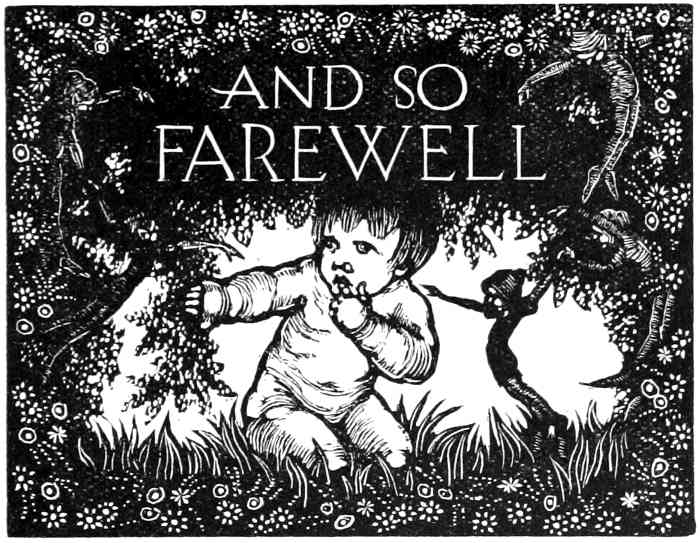
And so, Farewell.