COLUMBUS (continued 5)
Reading edition
A REMINISCENCE OF COLUMBUS.
Randall N. Saunders, Claverack, N. Y., in the School Journal.
* * * What boy has not felt a thrill of pride, for the sex, at the dogged persistence with which Columbus clung to his purpose and to Isabella after Ferdinand had flung to him but stony replies.
Methinks I am starting from Palos. I see the pale, earnest face set in its steadfast resolution from prophetic knowledge. I see the stern lines of care, deeper from the contrast of the hair, a silver mantle refined by the worry; the "midnight oil" that burned in the fiery furnace of his ambition. I see the flush of pleasure at setting out to battle with the perilous sea toward the consummation of life's grand desire. I feel the waverings between hope and despair as the journey lengthens, with but faint promise of reward, and with those around who would push us into the overwhelming waves of defeat and remorse. Amid all discouragements, amid the darkest gloom, I am inspired by his words, "Sail on, sail on"; and sailing on with the grand old Genoese, I yet hope to know and feel his glorious success, and with him to return thanks on the golden strand of the San Salvador of life's success.
THE DENSE IGNORANCE OF THOSE DAYS.
The Reverend Minot Judson Savage, an American clergyman. Born at Norridgewock, Maine, June 10, 1841. Pastor of Unity Church, Boston. From his lecture, "The Religious Growth of Three Hundred Years."
Stand beside Columbus a moment, and consider how much and how little there was known. It was commonly believed that the earth was flat and was flowed round by the ocean stream. Jerusalem was the center. With the exception of a little of Europe, a part of Asia, and a strip of North Africa, the earth was unknown country. In these unknown parts dwelt monsters of every conceivable description. Columbus indeed cherished the daring dream that he might reach the eastern coast of Asia by sailing west; but most of those who knew his dreams regarded him as crazy. And it is now known that even he was largely impelled by his confident expectation that he would be able to discover the Garden of Eden. The motive of his voyage was chiefly a religious one. And, as a hint of the kind of world in which people then lived, the famous Ponce de Leon searched Florida in the hope of discovering the Fountain of Perpetual Youth. At this time Copernicus and his system were unheard of. The universe was a little three-story affair. Heaven, with God on his throne and his celestial court about him, was only a little way overhead—just beyond the blue dome. Hell was underneath the surface of the earth. Volcanoes and mysterious caverns were vent-holes or gate-ways of the pit; and devils came and went at will. Even after it was conceded that the earth revolved, there were found writers who accounted for the diurnal revolution by attributing it to the movements of damned souls confined within, like restless squirrels in a revolving cage. On the earth's surface, between heaven and hell, was man, the common battleground of celestial and infernal hosts. At this time, of course, there was none of our modern knowledge of the heavens, nor of the age or structure of the earth.
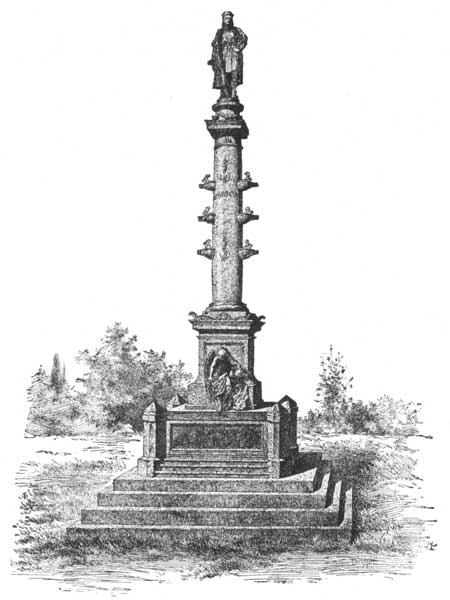
From Harper's Weekly. Copyright, 1892, by Harper & Brothers. THE COLUMBUS MONUMENT, NEW YORK CITY. Presented by the Italian Citizens. (See page 243.)
SENECA'S PROPHECY.
Lucius Annæus Seneca, an eminent Roman stoic, philosopher, and moralist. Born at Corduba, Spain, about 5 B. C.; committed suicide 65 A. D.
Venient annis Sæcula seris, quibus Oceanus Vincula rerum laxet, et ingens Pateat teilus, Tethysque novos Detegat orbes, nec sit terris Ultima Thule.
THE TOMB IN SEVILLE.
The following inscription is placed on the tomb of Hernando Columbus in the pavement of the Cathedral of Seville, Spain:
Aqui yaze el. M. Magnifico S. D. Hernando Colon, el qual aplicó y gastó toda su vida y hazienda en aumento de las letras, y juntar y perpetuar en esta ciudad todas sus libros de todas las ciencias, que en su tiempo halló y en reducirlo a quatro libros.
Falleció en esta ciudad a 12 de Julio de 1539 de edad de 50 años 9 meses y 14 dias, fue hijo del valeroso y memoráble S. D. Christ. Colon primero Almirante que descubrió las Yndias y nuevo mundo en vida de los Cat. R. D. Fernando, y. D. Ysabel de gloriosa memoria a. 11 de Oct. de 1492, con tres galeras y 90 personas, y partió del puerto de Palos a descubrirlas á 3 de Agosto antés, y Bolvió a Castilla con victoria á 7 de Maio del Año Siguente y tornó despues otras dos veces á poblar lo que descubrió. Falleció en Valladolid á 20 de Agosto de 1506 anos—[56]
Rogad á Dios por ellos.
(In English.) Here rests the most magnificent Señor Don Hernando Colon, who applied and spent all his life and estate in adding to the letters, and collecting and perpetuating in this city all his books, of all the sciences which he found in his time, and in reducing them to four books. He died in this city on the 12th of July, 1539, at the age of 50 years, 9 months, and 14 days. He was son of the valiant and memorable Señor Don Christopher Colon, the First Admiral, who discovered the Indies and the New World, in the lifetime of their Catholic Majesties Don Fernando and Doña Isabel of glorious memory, on the 11th of October, 1492, with three galleys and ninety people, having sailed from the port of Palos on his discovery on the 3d of August previous, and returned to Castille, with victory, on the 7th of May of the following year. He returned afterward twice to people that which he had discovered. He died in Valladolid on the 20th of August, 1506, aged ----.
Entreat the Lord for them.
Beneath this is described, in a circle, a globe, presenting the western and part of the eastern hemispheres, surmounted by a pair of compasses. Within the border of the circle is inscribed:
Á Castillo, y á Leon Mundo nuevo dió Colon.
(To Castille and Leon, Columbus gave a new world.)
ONWARD! PRESS ON!
Johann Christoph Friedrich Schiller, one of Germany's greatest poets. Born at Marbach (about eight miles from Stuttgart), November 11, 1759; died, May 9, 1805, at Weimar.
COLUMBUS.
(1795.)
Steure, muthiger Segler! Es mag der Witz dich verhöhen Und der Schiffer am Steur senken die lässige Hand. Immer, immer nach West! Dort muss die Küste sich zeigen, Liegt sie doch deutlich und liegt schimmernd vor deinen Verstand. Traue dem leitenden Gott und folge dem schweigenden Weltmeer! War sie noch nicht, sie stieg' jetzt aus dem Fluten empor. Mit dem Genius steht die Natur in ewigem Bunde Was der Eine verspricht leistet die Andre gewiss.
Metrically translated (1843) by Sir Edward George Earle Lytton, Bulwer-Lytton, Baronet (afterward first Lord Lytton. Born at Heydon Hall, Norfolk, May 25, 1803; died, January 18, 1873), in the following noble lines:
COLUMBUS.
Steer on, bold sailor! Wit may mock thy soul that sees the land, And hopeless at the helm may droop the weak and weary hand, Yet ever, ever to the West, for there the coast must lie, And dim it dawns, and glimmering dawns before thy reason's eye; Yea, trust the guiding God—and go along the floating grave, Though hid till now—yet now, behold the New World o'er the wave. With Genius Nature ever stands in solemn union still, And ever what the one foretells the other shall fulfill.
Señor Emilio Castelar, the talented Spanish orator and statesman, in the fourth of a series of most erudite and interesting articles upon Christopher Columbus, in the Century Magazine for August, 1892, thus masterly refers to the above passages:
He who pens these words, on reading the lines of the great poet Schiller upon Columbus, found therein a philosophical thought, as original as profound, calling upon the discoverer to press ever onward, for a new world will surely arise for him, inasmuch as whatever is promised by Genius is always fulfilled by Nature. To cross the seas of Life, naught suffices save the bark of Faith. In that bark the undoubting Columbus set sail, and at his journey's end found a new world. Had that world not then existed, God would have created it in the solitude of the Atlantic, if to no other end than to reward the faith and constancy of that great man. America was discovered because Columbus possessed a living faith in his ideal, in himself, and in his God.
THE NORSEMAN'S CLAIM TO PRIORITY.
Mrs. John B. Shipley's "Leif Erikson."
Father Bodfish, of the cathedral in Boston, in his paper, read a year ago before the Bostonian Society, on the discovery of America by the Northmen, is reported to have quoted, "as corroborative authority, the account given in standard history of the Catholic Church of the establishment of a bishopric in Greenland in 1112 A. D., and he added the interesting suggestion that as it is the duty of a bishop so placed at a distance to report from time to time to the Pope, not only on ecclesiastical matters, but of the geography of the country and character of the people, it is probable that Columbus had the benefit of the knowledge possessed. It is [he said] stated in different biographies of Columbus that when the voyage was first proposed by him he found difficulty in getting Spanish sailors to go with him in so doubtful an undertaking. After Columbus returned from a visit to Rome with information there obtained, these sailors, or enough of them, appear to have had their doubts or fears removed, and no difficulty in enlistment was experienced."
COLUMBUS BEFORE THE UNIVERSITY OF SALAMANCA.
Lydia Huntley Sigourney, an American poet and miscellaneous writer. Born at Norwich, Conn., September 1, 1791; died, June 10, 1865.
St. Stephen's cloistered hall was proud In learning's pomp that day, For there a robed and stately crowd Pressed on in long array. A mariner with simple chart Confronts that conclave high, While strong ambition stirs his heart, And burning thoughts of wonder part From lip and sparkling eye. What hath he said? With frowning face, In whispered tones they speak; And lines upon their tablet's trace Which flush each ashen cheek. The Inquisition's mystic doom Sits on their brows severe, And bursting forth in visioned gloom, Sad heresy from burning tomb Groans on the startled ear. Courage, thou Genoese! Old Time Thy splendid dream shall crown. Yon western hemisphere sublime, Where unshorn forests frown; The awful Andes' cloud-rapt brow, The Indian hunter's bow. Bold streams untamed by helm or prow, And rocks of gold and diamonds thou To thankless Spain shalt show. Courage, world-finder, thou hast need. In Fate's unfolding scroll, Dark woes and ingrate wrongs I read, That rack the noble soul. On, on! Creation's secrets probe. Then drink thy cup of scorn, And wrapped in fallen Cæsar's robe, Sleep like that master of the globe, All glorious, yet forlorn.
COLUMBUS A MARTYR.
Samuel Smiles, the celebrated British biographer. Born at Haddington, Scotland, about 1815. From his volume, "Duty."
Even Columbus may be regarded in the light of a martyr. He sacrificed his life to the discovery of a new world. The poor wool-carder's son of Genoa had long to struggle unsuccessfully with the petty conditions necessary for the realization of his idea. He dared to believe, on grounds sufficing to his reason, that which the world disbelieved, and scoffed and scorned at. He believed that the earth was round, while the world believed that it was flat as a plate. He believed that the whole circle of the earth, outside the known world, could not be wholly occupied by sea; but that the probability was that continents of land might be contained within it. It was certainly a Probability; But the Noblest Qualities of the Soul Are Often Brought Forth by the Strength of Probabilities That Appear Slight To Less Daring Spirits. In the Eyes of His Countrymen, Few Things Were More Improbable Than That Columbus Should Survive the Dangers of Unknown Seas, and Land On The Shores of a New Hemisphere.
DIFFICULTIES BY THE WAY.
Royall Bascom Smithey, in an article. "The Voyage of Columbus," in St. Nicholas, July, 1892.
So the voyage progressed without further incident worthy of remark till the 13th of September, when the magnetic needle, which was then believed always to point to the pole-star, stood some five degrees to the northwest. At this the pilots lost courage. "How," they thought, "was navigation possible in seas where the compass, that unerring guide, had lost its virtue?" When they carried the matter to Columbus, he at once gave them an explanation which, though not the correct one, was yet very ingenious, and shows the philosophic turn of his mind. The needle, he said, pointed not to the north star, but to a fixed place in the heavens. The north star had a motion around the pole, and in following its course had moved from the point to which the needle was always directed.
Hardly had the alarm caused by the variation of the needle passed away, when two days later, after nightfall, the darkness that hung over the water was lighted up by a great meteor, which shot down from the sky into the sea. Signs in the heavens have always been a source of terror to the uneducated; and this "flame of fire," as Columbus called it, rendered his men uneasy and apprehensive. Their vague fears were much increased when, on the 16th of September, they reached the Sargasso Sea, in which floating weeds were so densely matted that they impeded the progress of the ships. Whispered tales now passed from one sailor to another of legends they had heard of seas full of shoals and treacherous quicksands upon which ships had been found stranded with their sails flapping idly in the wind, and manned by skeleton crews. Columbus, ever cheerful and even-tempered, answered these idle tales by sounding the ocean and showing that no bottom could be reached.
DESIGN FOR THE SOUVENIR COINS.[57]
A decision has been reached by the World's Fair management in relation to the designs for the souvenir coins authorized by Congress at its last session, and a radical change has been determined upon regarding these coins. Several days ago Secretary Leach of the United States Mint sent to the Fair officials a copy of the medal struck recently at Madrid, Spain, in commemoration of Columbus' discovery of America. This medal was illustrated in a Spanish-American paper of July, 1892, and showed a remarkably fine profile head of the great explorer. It was deemed superior to the Lotto portrait previously submitted for the obverse of the coin, and the Fair directors have concluded that the Madrid medal furnishes the best head obtainable, and have accordingly adopted it. For the reverse of the coin a change has also been decided upon by the substitution of a representation of the western continent instead of a fac-simile of the Government building at Jackson Park, as originally intended. It was suggested by experts, artists, and designers at the Philadelphia mint that the representation of a building would not make a very good showing on a coin, and in consequence of these expressions of opinion it was decided to make the change proposed. Now that the Director of the Mint knows what the Fair management wishes for a souvenir coin, he will inaugurate the preparations of the dies and plates as promptly as possible. Just as soon as the designs are finished, work will be begun on the coins, which can be struck at the rate of 60,000 daily, and it is quite likely that the deliveries of the souvenir coins will be completed early in the spring.
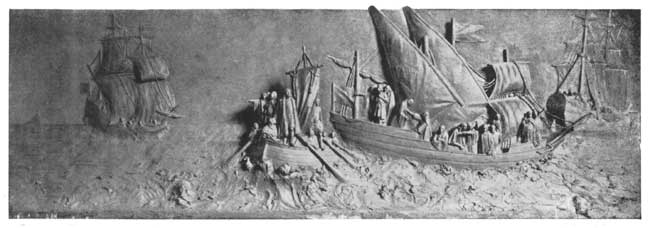
From Harper's Weekly. Copyright, 1892, by Harper & Brothers. BAS-RELIEF—THE SIGHTING OF THE NEW WORLD. From the Columbus Monument in New York City. (See page 244.)
The announcement that the Director of the Mint has decided upon the Madrid portrait of Columbus for the obverse side of the souvenir coin, with this hemisphere on the reverse, was a surprise to many interested in the designs. When the design was first presented, C. F. Gunther's portrait, by Moro, and James W. Ellsworth's, by Lotto, were also presented. Then a controversy opened between the owners of the two last-named portraits, and, rather than extend this, Mr. Ellsworth withdrew his portrait, with the suggestion that whatever design was decided upon should first be submitted to the artists at the World's Fair grounds. This was done, and they severely criticised the Madrid picture. Notwithstanding this, the design was approved and sent to Washington to be engraved. While Mr. Ellsworth, who is a director of the Fair, will not push his portrait to the front in this matter, he regrets that the Madrid portrait was selected. He said, "I think that the opinion of the World's Fair artists should have had some weight in this matter and that a portrait of authenticity should have been selected."
THE DARKNESS BEFORE DISCOVERY.
Charles Sumner, an American lawyer and senator. Born in Boston, Mass., January 6, 1811; died, March 11, 1874. From his "Prophetic Voices Concerning America." By permission of Messrs. Lee & Shepard, Publishers, Boston.
Before the voyage of Columbus in 1492, nothing of America was really known. Scanty scraps from antiquity, vague rumors from the resounding ocean, and the hesitating speculations of science were all that the inspired navigator found to guide him.
GREATEST EVENT.
The discovery of America by Christopher Columbus is the greatest event of secular history. Besides the potato, the turkey, and maize, which it introduced at once for the nourishment and comfort of the Old World, and also tobacco—which only blind passion for the weed could place in the beneficent group—this discovery opened the door to influences infinite in extent and beneficence. Measure them, describe them, picture them, you can not. While yet unknown, imagination invested this continent with proverbial magnificence. It was the Orient, and the land of Cathay. When, afterward, it took a place in geography, imagination found another field in trying to portray its future history. If the golden age is before, and not behind, as is now happily the prevailing faith, then indeed must America share, at least, if it does not monopolize, the promised good.—Ibid.
THE DOUBTS OF COLUMBUS.
Prof. David Swing, a celebrated American preacher. Born in Cincinnati in 1830; graduated at Miami University in 1852; was for twelve years Professor of Languages at this university. In 1866 he became pastor of a Presbyterian church in Chicago. He was tried for heresy in 1874, was acquitted, and then withdrew from the Presbyterian church, being now independent of denominational relations.
Columbus was not a little troubled all through his early life lest there might be over the sea some land greater than Spain, a land unused; a garden where flowers came and went unseen for ages, and where gold sparkled in the sand.
THE ERROR OF COLUMBUS.
From a sermon by Prof. Swing, printed in Chicago Inter Ocean,1892.
The present rejoices in the remembrance that Columbus was a student, a thinker; that he loved maps and charts; that he was a dreamer about new continents; but after enumerating all these attractive forms of mental activity, it comes with pain upon the thought that he was also a kind of modified pirate. His thoughts and feelings went away from his charts and compasses and touched upon vice and crime. Immorality ruins man's thought. Let the name be Columbus, or Aaron Burr, or Byron, a touch of immorality is the death of thought. "Whatsoever things are true, whatsoever things are beautiful, whatsoever things are of good report," these seek, say, and do, but when the man who would discover a continent robs a merchant ship or steals a cargo of slaves, or when a poet teaches gross vulgarity, then the thinker is hemmed and degraded by criminality. It is the glory of our age that it is washing white much of old thought. What is the emancipation of woman but the filtration of old thought? Did not Columbus study and read and think, and then go out and load his ship with slaves? Did not the entire man—man the thinker, the philosopher, the theologian—cover himself with intellectual glory and then load his ship with enslaved womanhood? Was not the scholar Columbus part pirate? What was in that atmosphere of the fifteenth century which could have given peculiar thoughts to Columbus alone? Was he alone in his piracy? It is much more certain that the chains that held the negro held also all womanhood. All old thought thus awaited the electric process that should weed ideas from crime. Our later years are active in disentangling thought from injustice and vulgarity.
THE TRIBUTE OF TASSO.
Torquato Tasso, a celebrated Italian epic poet. Born at Sorrento March 11, 1544; died in Rome, April, 1595.
Tu spiegherai, Colombo, a un novo polo Lontane sì le fortunate antenne, Ch'a pena seguirà con gli occhi il volo La Fama ch' hà mille occhi e mille penne Canti ella Alcide, e Bacco, e di te solo Basti a i posteri tuoi ch' alquanto accenne; Chè quel poco darà, lunga memoria Di poema degnissima e d'istoria.[58] —Gerusalemme Liberata, canto XV
KNOWLEDGE OF ICELANDIC VOYAGES.
Bayard Taylor, a distinguished American traveler, writer, and poet. Born in Chester County, Pa., in 1825; died at Berlin, December 19, 1878. From a description of Iceland.
It is impossible that the knowledge of these voyages should not have been current in Iceland in 1477, when Columbus, sailing in a ship from Bristol, England, visited the island. As he was able to converse with the priests and learned men in Latin, he undoubtedly learned of the existence of another continent to the west and south; and this knowledge, not the mere fanaticism of a vague belief, supported him during many years of disappointment.
GLORY TO GOD.
The Rev. George L. Taylor, an American clergyman of the present century. From "The Atlantic Telegraph."
Glory to God above, The Lord of life and love! Who makes His curtains clouds and waters dark; Who spreads His chambers on the deep, While all its armies silence keep; Whose hand of old, world-rescuing, steered the ark; Who led Troy's bands exiled, And Genoa's god-like child, And Mayflower, grandly wild, And now has guided safe a grander bark; Who, from her iron loins, Has spun the thread that joins Two yearning worlds made one with lightning spark.
TENNYSON'S TRIBUTE.
Alfred Tennyson, Baron Tennyson D'Eyncourt of Aldworth, the poet laureate of England. Born, 1809, at Somerby, Lincolnshire; raised to the peerage in 1883.[59] From his poem, "Columbus."
There was a glimmering of God's hand. And God Hath more than glimmer'd on me. O my lord, I swear to you I heard his voice between The thunders in the black Veragua nights, "O soul of little faith, slow to believe, Have I not been about thee from thy birth? Given thee the keys of the great ocean-sea? Set thee in light till time shall be no more? Is it I who have deceived thee or the world? Endure! Thou hast done so well for men, that men Cry out against thee; was it otherwise With mine own son?" And more than once in days Of doubt and cloud and storm, when drowning hope Sank all but out of sight, I heard his voice, "Be not cast down. I lead thee by the hand, Fear not." And I shall hear his voice again— I know that he has led me all my life, I am not yet too old to work His will— His voice again. Sir, in that flight of ages which are God's Own voice to justify the dead—perchance Spain, once the most chivalric race on earth, Spain, then the mightiest, wealthiest realm on earth, So made by me, may seek to unbury me, To lay me in some shrine of this old Spain, Or in that vaster Spain I leave to Spain. Then some one standing by my grave will say, "Behold the bones of Christopher Colòn, "Ay, but the chains, what do they mean—the chains?" I sorrow for that kindly child of Spain Who then will have to answer, "These same chains Bound these same bones back thro' the Atlantic sea, Which he unchain'd for all the world to come."
The golden guess is morning star to the full round of truth.—Ibid.
NEW YORK CELEBRATED THE TERCENTENARY.
The managers of the World's Columbian Exposition have prided themselves upon being the first to celebrate any anniversary of the Columbian discovery, but this credit really belongs to the Tammany Society of New York, and the second place of honor belongs to the Massachusetts Historical Society of Boston. The Tammany Society met in the great wigwam on the 12th day of October, 1792 (old style), and exhibited a monumental obelisk, and an animated oration was delivered by J. B. Johnson, Esq.
The Massachusetts Historical Society met at the house of the Rev. Dr. Peter Thacher, in Boston, the 23d day of October, 1792, and, forming in procession, proceeded to the meeting-house in Brattle Street, where a discourse was delivered by the Rev. Jeremy Belknap upon the subject of the "Discovery of America by Christopher Columbus." He gave a concise and comprehensive narrative of the most material circumstances which led to, attended, or were consequent on the discovery of America. The celebration commenced with an anthem. Mr. Thacher made an excellent prayer. Part of a psalm was then sung, and then Mr. Belknap delivered his discourse, which was succeeded by a prayer from Mr. Eliot. Mr. Thacher then read an ode composed for the occasion by Mr. Belknap, which was sung by the choir. This finished the ceremony.
The facts were brought to light by World's Fair Commissioner John Boyd Thacher, New York. The account is taken from "a journal of a gentleman visiting Boston in 1792." The writer is said to have been Nathaniel Cutting, a native of Brookline, Mass., and who, in the following year, was appointed by Washington, upon the recommendation of Thomas Jefferson, on a mission to the Dey of Algiers.
It is interesting to note that the Massachusetts Historical Society, in assuming to correct the old style date, October 12th, was guilty of the error of dropping two unnecessary days. It dropped eleven days from the calendar instead of nine, and at a subsequent meeting it determined to correct the date to October 21st, "and that thereafter all celebrations of the Columbian discovery should fall on the 21st day of October."
The proclamation of the President establishing October 21st as the day of general observance of the anniversary of the Columbian discovery, and the passage of Senator Hill's bill fixing the date for the dedication of the buildings at Chicago, it is believed will forevermore fix October 21st as the Columbian day.
COLUMBUS' SUPREME SUSPENSE.
Maurice Thompson, an American poet and novelist. Born at Fairfield, Ind., September 9, 1844. From his "Byways and Bird-notes."
What a thrill is dashed through a moment of expectancy, a point of supreme suspense, when by some time of preparation the source of sensation is ready for a consummation —a catastrophe! At such a time one's soul is isolated so perfectly that it feels not the remotest influence from any other of all the universe. The moment preceding the old patriarch's first glimpse of the promised land; that point of time between certainty and uncertainty, between pursuit and capture, whereinto are crowded all the hopes of a lifetime, as when the brave old sailor from Genoa first heard the man up in the rigging utter the shout of discovery; the moment of awful hope, like that when Napoleon watched the charge of the Old Guard at Waterloo, is not to be described. There is but one such crisis for any man. It is the yes or no of destiny. It comes, he lives a lifetime in its span; it goes, and he never can pass that point again.
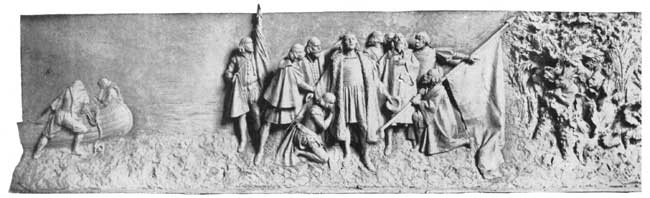
Harper's Weekly. Copyright, 1892, by Harper & Brothers. THE LANDING OF COLUMBUS. Bas-relief on the New York Monument. (See page 244.)
GREAT WEST.
Henry David Thoreau, an American author and naturalist. Born in Concord, Mass., in 1817; died, 1862. From his "Excursions," published by Houghton, Mifflin & Co.
Every sunset which I witness inspires me with the desire to go to a west as distant and as far as that into which the sun goes down. He appears to migrate westward daily, and tempt us to follow him. He is the Great Western Pioneer whom the nations follow. We dream all night of those mountain ridges in the horizon, though they may be of vapor only, which were last gilded by his rays. The Island of Atlantis, and the islands and gardens of the Hesperides, a sort of terrestrial paradise, appear to have been the Great West of the ancients, enveloped in mystery and poetry. Who has not seen in imagination, when looking into the sunset sky, the gardens of the Hesperides, and the foundation of all those fables?
Columbus felt the westward tendency more strongly than any before. He obeyed it, and found a new world for Castille and Leon. The herd of men in those days scented fresh pastures from afar.
And now the sun had stretched out all the hills, And now was dropped into the western bay; At last he rose, and twitched his mantle blue; To-morrow to fresh woods and pastures new.
THE ROUTE TO THE SPICE INDIES.
Paolo del Pozzo Toscanelli, a celebrated Italian astronomer. Born at Florence, 1397; died, 1482. From a letter to Columbus in 1474.
I praise your desire to navigate toward the west; the expedition you wish to undertake is not easy, but the route from the west coasts of Europe to the spice Indies is certain if the tracks I have marked be followed.
A VISIT TO PALOS.
George Alfred Townsend. In a letter to the Philadelphia Times.
From one of the hillocks behind the hotel at Huelva you can see in the distance East Rábida, Palos, Moguer, San Juan del Porto, and the sea, where the three birds of good omen went skimming past in the vague morning light 400 years ago, lest they might be seen by the Portuguese. Columbus means dove, and the arms of Columbus contained three doves. From Huelva I sailed to Rábida first. Rábida is on the last point of the promontory, nearest the sea, and Palos is inland from it three miles north, and is near half a mile from the Tinto. Passing down the oozy Odiel, we soon saw a watering place on the beach outside just where Columbus put to sea. We could also see the scaffolding around the Columbus monument they were building by Rábida.
After inspecting the convent at Rábida, I bade my skipper wait for flood tide to sail round to Palos, while I proceeded by land.
They brought me at Palos an old man who was extremely polite, but not one word could we understand of each other, until finally I took him by the arm and walked him in the direction of the church, whereupon suppressed exclamations of delight broke forth; the American savage had guessed the old man out. In point of fact, this old man was waiting all the time to take me to the church, and was the father of the boy behind whom I had ridden. Between the church and the beach rose a high hillock covered with grass, and as high as the church tower. In old times this was a mosque of military work, and it had not very long been Christian when Columbus came here; possibly it had been Christian in his day 150 years. It stands quite alone, is of rude construction, and has at the back of it some few graves—perhaps of priests. In the back part is a very good Moorish arch, which they still show with admiration. The front proper has a big door, barred strongly, as if the church might have been in piratical times a place of refuge for the population up in the hills. To the right of the entrance is the tower, which is buttressed, and its spire is made of blue and colored tiles, which have thoroughly kept their colors. A bell in this tower may have rung the inhabitants to church when Columbus announced that he meant to impress the Palos people to assist him in his voyage. I entered the church, which was all whitewashed, and felt, as I did at Rábida, that it was a better monument than I had reason to expect.
Its walls were one yard thick, its floors of tiles laid in an L form. As I measured the floor it seemed to me to be sixty-six feet wide and sixty-six feet long, but to the length must be added the altar chapel, bringing it up to ninety feet, and to the width must be added the side chapels, making the total width about eighty feet. The nave has a sharper arched top than the two aisles, which have round arches. The height of the roof is about thirty-five feet. The big door by which I entered the church is fifteen feet high by eight feet wide. Some very odd settees which I coveted were in the nave. The chief feature, however, is the pulpit, which stands at the cross of the church, so that persons gathered in the transepts, nave, or aisles can hear the preacher. It has an iron pulpit of a round form springing from one stem and railed in, and steps lead up to it which are inclosed. It looks old, and worn by human hands, and is supposed to be the identical pulpit from which the notary announced that, as a punishment of their offenses, the Queen's subjects must start with this unknown man upon his unknown venture. Those were high times in Palos, and it took Columbus a long while to get his expedition ready, and special threats as of high treason had to be made against the heads of families and women. But when Columbus returned, and the same day Pinzon came back after their separation of weeks, Palos church was full of triumph and hosannas. The wild man had been successful, and Spain found another world than the apostle knew of.
The grown boy, as he showed the building, went into an old lumber room, or dark closet, at one corner of the church, and when I was about to enter he motioned me back with his palm, as if I might not enter there with my heretic feet. He then brought out an image of wood from four to five feet high, or, I might say, the full size of a young woman. It was plain that she had once been the Virgin worshiped here, but age and moisture had taken most of the color from her, and washed the gilt from her crown, and now we could only see that in her arm she bore a child, and this child held in its hand a dove or pigeon. The back of the female was hollow, and in there were driven hooks by which she had once been suspended at some height. This was the image, I clearly understood, which Columbus' men had knelt to when they were about to go forth upon the high seas.
Strangely enough, the church is named St. George, and St. George was the patron saint of Genoa, where Columbus was born; and the Genoese who took the Crusaders to Jaffa had the satisfaction of seeing England annex their patron saint.
BIBLE.
The Rev. Luther Tracy Townsend, D. D., an American divine. Born at Orono, Maine, September 27, 1838. From "The Bible and the Nineteenth Century."
When Luther in the sixteenth century brought the truths of the Bible from the convent of Erfurth, and gave them to the people, he roused to mental and moral life not only the slumbering German nationality, but gave inspiration to every other country in Europe. "Gutenburg with his printing press, Columbus with his compass, Galileo with his telescope, Shakspere with his dramas, and almost every other man of note figuring during those times, are grouped, not around some distinguished man of science, or man of letters, or man of mechanical genius, or man famous in war; but around that monk of Wittenberg, who stood with an unchained Bible in his hand."
TESTIMONY OF A CONTEMPORARY AS TO THE TREATMENT OF COLUMBUS.
From a letter of Angelo Trivigiano, of Granada, Spain, dated August 1, 1501.
I have seen so much of Columbus that we are now on a footing of great friendship. He is experiencing at present a streak of bad luck, being deprived of the King's favor, and with but little money.
THE VALPARAISO STATUE.
At Valparaiso, Chili, a bronze statue of Columbus has been erected on a marble pedestal. The figure, which is of heroic size, stands in an advancing attitude, holding a cross in the right hand.
COLUMBUS AND THE EGG.
Dr. P. H. Van der Weyde. In an article in the Scientific American, June, 1892.
The stupid anecdote of the egg was a mere trifling invention, in fact a trick, and it is surprising that intelligent men have for so many years thoughtlessly been believing and repeating such nonsense. For my part, I can not believe that Columbus did ever lower himself so far as to compare the grand discovery to a trick. Surely it was no trick by which he discovered a new world, but it was the result of his earnest philosophical convictions that our earth is a globe, floating in space, and it could be circumnavigated by sailing westward, which most likely would lead to the discovery of new lands in the utterly unknown hemisphere beyond the western expanse of the great and boisterous Atlantic Ocean; while thus far no navigator ever had the courage to sail toward its then utterly unknown, apparently limitless, western expanse.
THE MAN OF THE CHURCH.
Padre Giocchino Ventura, an eloquent Italian preacher and theologian. Born at Palermo, 1792; died at Versailles, August, 1861.
Columbus is the man of the Church.
ATTENDANT FAME SHALL BLESS.
The Venerable George Waddington, Dean of Durham, an English divine and writer. Died, July 20, 1869. From a poem read in Cambridge in 1813.
And when in happier days one chain shall bind, One pliant fetter shall unite mankind; When war, when slav'ry's iron days are o'er, When discords cease and av'rice is no more, And with one voice remotest lands conspire, To hail our pure religion's seraph fire; Then fame attendant on the march of time, Fed by the incense of each favored clime, Shall bless the man whose heav'n-directed soul Form'd the vast chain which binds the mighty whole.
Columbus continued till death eager to extend his discoveries, and by so doing to promote the glory of his persecutors.
VANDERLYN'S PICTURE AT WASHINGTON.
The first of the eight pictures in the rotunda of the Capitol at Washington, D. C., and the first in point of event, is the "Landing of Columbus at San Salvador in 1492," by John Vanderlyn; its cost was $12,000. This picture represents the scene Washington Irving so admirably describes in his "Voyages of Columbus," occurring the morning the boats brought the little Spanish band from the ships to the shore of Guanahani. "Columbus first threw himself upon his knees; then, rising, drew his sword, displayed the royal standard, and, assembling around him the two captains, with Rodrigo de Escobedo, notary of the armament; Rodrigo Sanchez (the royal inspector), and the rest who had landed, he took solemn possession of the island in the name of the Castilian sovereigns." The picture contains the picture of Columbus, the two Pinzons, Escobedo, all bearing standards; Sanchez, inspector; Diego de Arana, with an old-fashioned arquebus on his shoulder; a cabin-boy kneeling, a mutineer in a suppliant attitude, a sailor in an attitude of veneration for Columbus, a soldier whose attention is diverted by the appearance of the natives, and a friar bearing a crucifix.
COLUMBUS STATUE AT WASHINGTON, D. C.
The Columbus statue stands at the east-central portico of the Capitol, at Washington, D. C., above the south end of the steps, on an elevated block. It consists of a marble group, by Signor Persico, called "The Discovery," on which he worked five years, and is composed of two figures: Columbus holding the globe in his hand, triumphant, while beside him, wondering, almost terror-stricken, is a female figure, symbolizing the Indian race. The suit of armor worn by Columbus is said to be a faithful copy of one he actually wore. The group cost $24,000.
THE WATLING'S ISLAND MONUMENT RAISED BY THE CHICAGO "HERALD."
With true Chicago enterprise, the wideawake Chicago Herald dispatched an expedition to the West Indies in 1891 to search out the landing place of Columbus. The members of the party, after careful search and inquiry, erected a monument fifteen feet high on Watling's Island bearing the following inscription:
ON THIS SPOT CHRISTOPHER COLUMBUS FIRST SET FOOT ON THE SOIL OF THE NEW WORLD.
Erected by The Chicago Herald, June 15, 1891.
COLUMBUS. FOR THE FESTIVAL AT HUELVA.
Á Castillo, y á Leon Nuevo Mundo dió Colon.
Theodore Watts, in the Athenæum (England).
To Christ he cried to quell Death's deafening measure, Sung by the storm to Death's own chartless sea; To Christ he cried for glimpse of grass or tree When, hovering o'er the calm, Death watch'd at leisure; And when he showed the men, now dazed with pleasure, Faith's new world glittering star-like on the lee, "I trust that by the help of Christ," said he, "I presently shall light on golden treasure." What treasure found he? Chains and pains and sorrow. Yea, all the wealth those noble seekers find Whose footfalls mark the music of mankind. 'Twas his to lend a life; 'twas man's to borrow; 'Twas his to make, but not to share, the morrow, Who in love's memory lives this morn enshrined.
WEST INDIAN STATUES.
Cardenas, Cuba.—At Cardenas, Cuba, a statue by Piguer of Madrid has been erected by a Cuban lady, an authoress, and wife of a former governor.
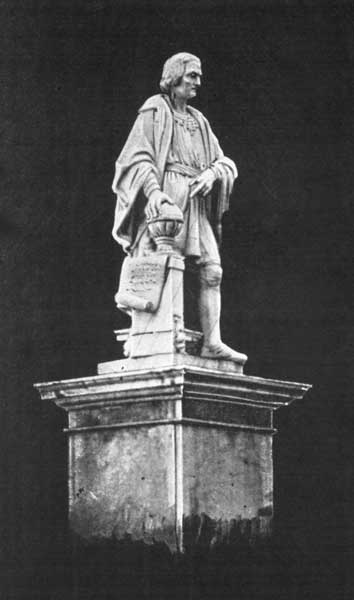
STATUE OF COLUMBUS In the Courtyard of the Captain-General's Palace, Havana, Cuba (See page 313.)
Cathedral of Havana, Cuba.—In the Cathedral of Havana there is a plain marble bas-relief, about four feet high, representing in a medallion a very apocryphal portrait of Columbus, with an inscription as follows:
O restos é Ymajen del grande Colon! Mil siglos durad guardados en la urna Y en la remembranza de nuestra Nacion. (O remains and image of the great Columbus! For a thousand ages endure guarded within this urn And in the remembrance of our nation.)
Proposed Tomb—Havana Cathedral.—In February, 1891, by royal decree, all Spanish artists were invited to compete for a design for a sepulcher in which to preserve the Havana remains of Columbus; several were submitted to a jury, who awarded the first prize to Arthur Melida, with a premium of $5,000.
The sepulcher is now being erected in the cathedral. The design represents a bier covered with a heavily embroidered pall, borne upon the shoulders of four heralds, in garments richly carved to resemble lace and embroidered work. The two front figures bear scepters surmounted by images of the Madonna and St. James, the patron saint of Spain. On the front of their garments are the arms of Castille and Leon.
The two bearers represent Aragon and Navarre, the former being indicated by four red staffs on a gold field, and the fourth has gold-linked chains on a red field. The group is supported on a pedestal ornamented about its edge with a Greek fret.
Havana, Cuba.—In the court-yard of the Captain-General's palace, in Havana, is a full-length figure of Columbus, the face modeled after accepted portraits at Madrid.
Havana, Cuba.—In the inclosure of the "Templete," the little chapel on the site of which the first mass was celebrated in Cuba, there is a bust of Columbus which has the solitary merit of being totally unlike all others.
Nassau.—At Nassau, in the Bahamas, a statue of Christopher Columbus stands in front of Government House. The statue, which is nine feet high, is placed upon a pedestal six feet in altitude, on the north or seaward face of which is inscribed:
COLUMBUS, 1492.
It was presented to the colony by Sir James Carmichael Smyth, Governor of the Bahamas, 1829-1833, was modeled in London in 1831, is made of metal and painted white, and was erected May, 1832.
Santo Domingo Cathedral.—Above the boveda, or vault, in the Cathedral of Santo Domingo, from which the remains of Columbus were taken in 1877, is a marble slab with the following:
Reposaron en este sitio los restos de Don Cristobal Colon el célebre descrubridor del Nuevo Mundo, desde el año de 1536, en que fueron trasladados de España, hasta el 10 de Setiembre 1877, en que se desenterraron para constatar su autenticidad. Y á posteridad la dedica el Presbitero Billini.
(There reposed in this place the remains of Christopher Columbus, the celebrated discoverer of the New World, from the year 1536, in which they were transferred from Spain, until the 10th September, 1877, in which year they were disinterred for the purpose of identification. Dedicated to posterity by Padre Billini) (curate in charge when the vault was opened.)
In the cathedral there is also preserved a large cross of mahogany, rough and uneven, as though hewn with an adze out of a log, and then left in the rough. This, it is claimed, is the cross made by Columbus and erected on the opposite bank of the Ozama River, where the first settlement in the West Indies was made. In a little room by itself they keep a leaden casket, which Santo Domingoans claim contains the bones of Christopher Columbus, and, in another, those of his brother.
Plaza of Santo Domingo.—Humboldt once wrote that America could boast of no worthy monument to its discoverer, but since his time many memorials have been erected, not only in the New World, but the Old. In the plaza in front of the cathedral, in the city of Santo Domingo, stands a statue, heroic, in bronze, representing Columbus pointing to the westward. Crouched at his feet is the figure of a female Indian, supposed to be the unfortunate Anacaona, the caciquess of Xaragua, tracing an inscription:
Yllustre y Esclarecido Varon Don Cristoval Colon.
The statue was cast in France, a few years ago, and stands in the center of the plaza, in front of the cathedral.
COLUMBUS LORD NORTH'S "BÊTE NOIR."
Edwin Percy Whipple, a distinguished American critic and essayist. Born at Gloucester, Mass., 1819; died, June 16, 1886.
Lord North more than once humorously execrated the memory of Columbus for discovering a continent which gave him and his ministry so much trouble.
HARDY MARINERS HAVE BECOME GREAT HEROES.
Daniel Appleton White, a distinguished American jurist and scholar. Born at Lawrence, Mass., June 7, 1776; died, March 30, 1861.
Hardy seamen, too, who have spent their days in conflict with the storms of the ocean, have found means to make themselves distinguished in science and literature, as well as by achievements in their profession. The life of Columbus gloriously attests this fact.
TASSO'S TRIBUTE IN ENGLISH SPENSERIAN STANZA.
Jeremiah Holmes Wiffen, an English writer and translator. Born at Woburn, 1792. Many years librarian and private secretary to the Duke of Bedford. Died, 1836. From his translation of Tasso's "Jerusalem Delivered" (1830). (See ante, TASSO.)