COLUMBUS (continued 2)
Reading edition
The red granite base for the fountain has been received at the custom house. It was made in Turin, Italy, and cost $3,300. Under the law, the stone came in duty free, as it is intended as a gift to the municipality.
DREAM.
John William Draper, a celebrated American chemist and scientist. Born near Liverpool, England, 1811; died January 4, 1882. From his "Intellectual Development of Europe," 1876. By permission of Messrs. Harper & Brothers, Publishers, New York.
Columbus appears to have formed his theory that the East Indies could be reached by sailing to the west about A. D. 1474. He was at that time in correspondence with Toscanelli, the Florentine astronomer, who held the same doctrine, and who sent him a map or chart constructed on the travels of Marco Polo. He offered his services first to his native city, then to Portugal, then to Spain, and, through his brother, to England; his chief inducement, in each instance, being that the riches of India might be thus secured. In Lisbon he had married. While he lay sick near Belem, an unknown voice whispered to him in a dream, "God will cause thy name to be wonderfully resounded through the earth, and will give thee the keys of the gates of the ocean which are closed with strong chains." The death of his wife appears to have broken the last link which held him to Portugal, where he had been since 1470. One evening, in the autumn of 1485, a man of majestic presence, pale, careworn, and, though in the meridian of life, with silver hair, leading a little boy by the hand, asked alms at the gate of the Franciscan convent near Palos—not for himself, but only a little bread and water for his child. This was that Columbus destined to give to Europe a new world.
A PEN-PICTURE FROM THE SOUTH.
The Right Rev. Anthony Durier, Bishop of Natchitoches, La., in a circular letter to the clergy and laity of the diocese, printed in the New Orleans Morning Star, September 10, 1892.
We cherish the memory of the illustrious sailor, also of the lady and of the monk who were providential instruments in opening a new world to religion and civilization.
HEAD OF COLUMBUS. Designed by H. H. Zearing of Chicago.
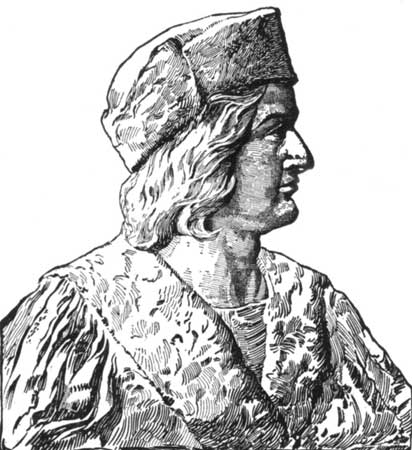
Honor to the sailor, Christopher Columbus, the Christ-bearing dove, as his name tells, gentle as a dove of hallowed memory as Christ-bearer. In fact, he brought Christ to the New World. Look back at that sailor, 400 years ago, on bended knees, with hands uplifted in prayer, on the shores of Guanahani, first to invoke the name of Jesus in the New World; in fact, as in name, behold the Christ-bearing dove. Columbus was a knight of the cross, with his good cross-hilted sword, blessed by the church. The first aim and ambition of a knight of the cross, at that time, was to plant the cross in the midst of heathen nations, and to have them brought from "the region of the shadow of death" into the life-giving bosom of Mother Church.
Listen to the prayer of Columbus, as he brings his lips to, and kneels on, the blessed land he has discovered, that historic prayer which he had prepared long in advance, and which all Catholic discoverers repeated after him: "O Lord God, eternal and omnipotent, who by Thy divine word hast created the heavens, the earth, and the sea! Blessed and glorified be thy name and praised Thy majesty, who hast deigned by me, thy humble servant, to have that sacred name made known and preached in this other part of the world."
Behold the true knight of the cross, with cross-hilted sword in hand, the name of Jesus on his lips, the glory of Jesus in his heart. He does not say a word of the glory which, from the discovery, is bound to accrue to the name of Spain and to his own name; every word is directed to, and asking for, the glory of the name of Jesus.
The great discoverer has knelt down, kissed the ground, and said his prayer; now, look at that Catholic Spanish sailor standing up, in commanding dignity, and planting his Catholic cross and his Spanish flag on the discovered land; what does it mean? It means—the Spanish flag in America for a time, and the Catholic cross in America forever.
Hail, flag of the discoverer! Spanish flag, the flag of the noble and the daring. That Spanish flag came here first, had its glorious day, and still in glory went back. Hail, Catholic cross! the cross of the discoverer. That cross is not to go back, as the Spanish flag; no, not even in glory. About that cross, only two simple words, and that settles it; that Catholic cross is here to stay. Hail, American flag! star-spangled banner; the banner of the brave and of the free. That one, our own flag, came long after the Spanish flag, but we trust came to stay as long as the Catholic cross—until doom's-day.
Honor to the lady, Queen Isabella the Catholic. Among all illustrious women, Isabella alone has been graced with the title of "the Catholic,"—a peerless title! And truly did she deserve the peerless title, the lady who threw heart and soul, and, over and above, her gold, in the discovery by which, out of the spiritual domains of the Catholic church, the sun sets no more; the lady who paved the way over the bounding sea to the great discoverer. Bright and energetic lady! She at once understood Columbus and stood resolute, ready to pave him the way even with her jewels. Listen to her words: "I undertake the enterprise for my own crown of Castille, and I will pledge my jewels to raise the necessary funds."
The generous lady had not to pledge her jewels; yet her gold was freely spent, lavished on the expedition; and she stood by Columbus, in storm and sunshine, as long as she lived. Isabella stood by Columbus, in his success, with winsome gentleness, keeping up his daring spirit of enterprise; and, in his reverses, with the balm of unwavering devotion healing his bruised, bleeding heart. Isabella stood by Columbus, as a mother by her son, ever, ever true to her heroic son.
Honor to the humble monk, John Perez, Father John, as he was called in his convent. That monk whose name will live as long as the names of Columbus and Isabella; that monk, great by his learning and still better by his heart; that humble, plain man inspired the sailor with perseverance indomitable, the lady with generosity unlimited, and sustained in both sailor and lady that will power and mount-removing faith the result of which was to give "to the Spanish King innumerable countries and to God innumerable souls." As the Spanish poet, Lope de Vega, beautifully puts it:
Al Rey infinitas tierras, Y á Dios infinitas almas.
It is the Spanish throne which backed Columbus; but, mind! that monk was "the power behind the throne."
We Louisianians live, may be, in the fairest part of the New World discovered by Columbus. When Chevalier La Salle had explored the land, he gave it the beautiful name of Louisiana, and he wrote to his king, Louis XIV., these words: "The land we have explored and named Louisiana, after your Majesty's name, is a paradise, the Eden of the New World." Thanks be to God who has cast our lot in this paradise, the Eden of the New World, fair Louisiana! Let us honor and ever cherish the memory of the hero who led the way and opened this country to our forefathers. Louisiana was never blessed with the footprints of Columbus, yet by him it was opened to the onward march of the Christian nations.
To the great discoverer, Christopher Columbus, the gratitude of Louisiana, the Eden of the New World.
BARTOLOMEO COLUMBUS.
Rev. L. A. Dutto of Jackson, Miss., in an article, "Columbus in Portugal," in the Catholic World, April, 1892.
Columbus in 1492, accompanied by a motley crew of sailors of different nationalities, crossed the Atlantic and discovered America. Hence the glory of that event, second only in importance to the incarnation of Christ, is attributed very generally solely to him. As reflex lights of that glory, history mentions the names of Queen Isabella, of the Pinzon brothers, the friar Juan Perez. There is another name that should be placed at head of the list. That is, Bartolomeo Columbus, the brother of Christopher. From the beginning there existed a partnership between the two in the mighty undertaking; the effect of a common conviction that the land of spices, Cipango and Cathay, the East, could be reached by traveling west. Both of them spent the best years of their life in privation, hardship, and poverty, at times the laughing stock of the courts of Europe, in humbly begging from monarchies and republics the ships necessary to undertake their voyage. While Christopher patiently waited in the antechambers of the Catholic monarchs of Spain, Bartolomeo, map in hand, explained to Henry VII. of England the rotundity of the earth, and the feasibility of traveling to the antipodes. Having failed in his mission to the English king, he passed to France to ask of her what had been refused by Portugal, Spain, Venice, England, and Genoa. While he was there, Columbus, who had no means of communicating with him, sailed from Palos. Had there been, as now, a system of international mails, Bartolomeo would now share with his brother the title of Discoverer of America. Las Casas represents him as little inferior to Christopher in the art of navigation, and as a writer and in things pertaining to cartography as his superior. Gallo, the earliest biographer of Columbus, and writing during his lifetime, has told us that Bartolomeo settled in Lisbon, and there made a living by drawing mariners' charts. Giustiniani, another countryman of Columbus, says in his polyglot Psalter, published in 1537, that Christopher learned cartography from his brother Bartolomeo, who had learned it himself in Lisbon. But what may appear more surprising is the plain statement of Gallo that Bartolomeo was the first to conceive the idea of reaching the East by way of the West, by a transatlantic voyage, and that he communicated it to his brother, who was more experienced than himself in nautical affairs.
FIRST GLIMPSE OF LAND.
Charles H. Eden, English historical writer and traveler. From "The West Indies."
Nearly four centuries ago, in the year 1492, before the southern point of the great African continent had been doubled, and when the barbaric splendor of Cathay and the wealth of Hindustan were only known to Europeans through the narratives of Marco Polo or Sir John Mandeville—early on the morning of Friday, October 12th, a man stood bareheaded on the deck of a caravel and watched the rising sun lighting up the luxuriant tropical vegetation of a level and beautiful island toward which the vessel was gently speeding her way. Three-and-thirty days had elapsed since the last known point of the Old World, the Island of Ferrol, had faded away over the high poop of his vessel; eventful weeks, during which he had to contend against the natural fears of the ignorant and superstitious men by whom he was surrounded, and by the stratagem of a double reckoning, together with promises of future wealth, to allay the murmuring which threatened to frustrate the project that for so many years had been nearest his heart. Never, in the darkest hour, did the courage of that man quail or his soul admit a single doubt of success. When the terrified mariners remarked with awe that the needle deviated from the pole star, their intrepid Admiral, by an ingenious theory of his own, explained the cause of the phenomenon and soothed the alarm that had arisen. When the steady trade-winds were reached, and the vessels flew rapidly for days toward the west, the commander hailed as a godsend the mysterious breeze that his followers regarded with awe as imposing an insuperable barrier to their return to sunny Spain. When the prow of the caravel was impeded, and her way deadened by the drifting network of the Sargasso Sea, the leader saw therein only assured indications of land, and resolutely shut his ears against those prophets who foresaw evil in every incident.
Now his hopes were fulfilled, the yearnings of a lifetime realized. During the night a light had been seen, and at 2 o'clock in the morning land became, beyond all doubt, visible. Then the three little vessels laid to, and with the earliest streak of dawn made sail toward the coast. A man stood bareheaded on the deck of the leading caravel and feasted his eyes upon the wooded shore; the man was Christopher Columbus, the land he gazed on the "West Indies."
SAN SALVADOR, OR WATLING'S ISLAND.
San Salvador, or Watling's Island, is about twelve miles in length by six in breadth, having its interior largely cut up by salt-water lagoons, separated from each other by low woody hills. Being one of the most fertile of the group, it maintains nearly 2,000 inhabitants, who are scattered about over its surface. Peculiar interest will always attach itself to this spot as being the first land on which the discoverer of the New World set foot.—Ibid.
THE MYSTERY OF THE SHADOWY SEA.
Xerif Al Edrisi, surnamed "The Nubian," an eminent Arabian geographer. Born at Ceuta, Africa, about 1100. In "A Description of Spain" (Conde's Spanish translation, Madrid, 1799). He wrote a celebrated treatise of geography, and made a silver terrestrial globe for Roger II., King of Sicily, at whose court he lived.
The ocean encircles the ultimate bounds of the inhabited earth, and all beyond it is unknown. No one has been able to verify anything concerning it, on account of its difficult and perilous navigation, its great obscurity, its profound depth, and frequent tempests; through fear of its mighty fishes and its haughty winds; yet there are many islands in it, some peopled, others uninhabited. There is no mariner who dares to enter into its deep waters; or, if any have done so, they have merely kept along its coasts, fearful of departing from them. The waves of this ocean, although they roll as high as mountains, yet maintain themselves without breaking, for if they broke it would be impossible for ship to plow them.
PALOS.
Prof. Maurice Francis Egan. From an article, "Columbus the Christ-Bearer," in the New York Independent, June 2, 1892.
The caravels equipped at Palos were so unseaworthy, judged by the dangers of the Atlantic, that no crew in our time would have trusted in them. The people of Palos disliked this foreigner, Columbus. No man of Palos, except the Pinzons, ancient mariners, sympathized with him in his hopes. The populace overrated the risks of the voyage; the court, fortunately for Columbus, underrated them. The Admiral's own ships and his crew were not such as to inspire confidence. His friends, the friars, had somewhat calmed the popular feeling against the expedition; but ungrateful Palos never approved of it until it made her famous.
AN UNDISCOVERED COUNTRY.
Samuel R. Elliott, in the Century Magazine, September, 1892.
You have no heart? Ah, when the Genoese Before Spain's monarchs his great voyage planned, Small faith had they in worlds beyond the seas— And your Columbus yet may come to land!
SAGACITY.
Ralph Waldo Emerson, the well-known American essayist, poet, and speculative philosopher. Born in Boston, May 25, 1803; died at Concord, April 27, 1882. From his essay on "Success," in Society and Solitude. Copyright, by Messrs. Houghton, Mifflin & Co., publishers, Boston, and with their permission.
Columbus at Veragua found plenty of gold; but, leaving the coast, the ship full of one hundred and fifty skillful seamen, some of them old pilots, and with too much experience of their craft and treachery to him, the wise Admiral kept his private record of his homeward path. And when he reached Spain, he told the King and Queen, "That they may ask all the pilots who came with him, Where is Veragua? Let them answer and say, if they know, where Veragua lies. I assert that they can give no other account than that they went to lands where there was abundance of gold, but they do not know the way to return thither, but would be obliged to go on a voyage of discovery as much as if they had never been there before. There is a mode of reckoning," he proudly adds, "derived from astronomy, which is sure and safe to any who understands it."
THE VOICE OF THE SEA.
From a poem, "Seashore," by Ralph Waldo Emerson. Houghton, Mifflin & Co., Boston.
I with my hammer pounding evermore The rocky coast, smite Andes into dust, Strewing my bed, and, in another age, Rebuild a continent of better men. Then I unbar the doors; my paths lead out The exodus of nations; I disperse Men to all shores that front the hoary main. I too have arts and sorceries; Illusion dwells forever with the wave. I know what spells are laid. Leave me to deal With credulous and imaginative man; For, though he scoop my water in his palm, A few rods off he deems it gems and clouds. Planting strange fruits and sunshine on the shore, I make some coast alluring, some lone isle, To distant men, who must go there, or die.
COLUMBUS AS A STUDENT AT PAVIA. From the Drake Drinking Fountain, Chicago. (See page 118 .)
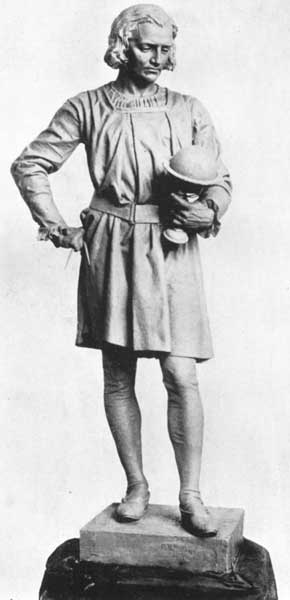
THE REASONING OF COLUMBUS.
Columbus alleged, as a reason for seeking a continent in the West, that the harmony of nature required a great tract of land in the western hemisphere to balance the known extent of land in the eastern.—Ibid.
STRANGER THAN FICTION.
Edward Everett, a distinguished American orator, scholar, and statesman. Born at Dorchester, Mass., April 11, 1794; died, January 15, 1865. From a lecture on "The Discovery of America," delivered at a meeting of the Historical Society of New York in 1853.
No chapter of romance equals the interest of this expedition. The most fascinating of the works of fiction which have issued from the modern press have, to my taste, no attraction compared with the pages in which the first voyage of Columbus is described by Robertson, and still more by our own Irving and Prescott, the last two enjoying the advantage over the great Scottish historian of possessing the lately discovered journals and letters of Columbus himself. The departure from Palos, where a few years before he had begged a morsel of bread and a cup of water for his way-worn child; his final farewell to the Old World at the Canaries; his entrance upon the trade-winds, which then for the first time filled a European sail; the portentous variation of the needle, never before observed; the fearful course westward and westward, day after day and night after night, over the unknown ocean; the mutinous and ill-appeased crew; at length, when hope had turned to despair in every heart but one, the tokens of land—the cloud banks on the western horizon, the logs of driftwood, the fresh shrub floating with its leaves and berries, the flocks of land birds, the shoals of fish that inhabit shallow water, the indescribable smell of the shore; the mysterious presentment that seems ever to go before a great event; and finally, on that ever memorable night of October 12, 1492, the moving light seen by the sleepless eye of the great discoverer himself from the deck of the Santa Maria, and in the morning the real, undoubted land swelling up from the bosom of the deep, with its plains and forests, and hills and rocks and streams, and strange new races of men. These are incidents in which the authentic history of the discovery of our continent exceeds the specious wonders of romance, as much as gold excels tinsel, or the sun in the heavens outshines the flickering taper.
THE COLUMBUS OF THE HEAVENS—SCORNED.
Dominicans may deride thy discoveries now; but the time will come when from two hundred observatories, in Europe and America, the glorious artillery of science shall nightly assault the skies; but they shall gain no conquests in those glittering fields before which thine shall be forgotten. Rest in peace, great Columbus of the heavens![36] like him scorned, persecuted, broken-hearted.—Ibid.
FAME.
We find encouragement in every page of our country's history. Nowhere do we meet with examples more numerous and more brilliant of men who have risen above poverty and obscurity and every disadvantage to usefulness and honorable name. One whole vast continent was added to the geography of the world by the persevering efforts of a humble Genoese mariner, the great Columbus; who, by the steady pursuit of the enlightened conception he had formed of the figure of the earth, before any navigator had acted upon the belief that it was round, discovered the American continent. He was the son of a Genoese pilot, a pilot and seaman himself; and, at one period of his melancholy career, was reduced to beg his bread at the doors of the convents in Spain. But he carried within himself, and beneath a humble exterior, a spirit for which there was not room in Spain, in Europe, nor in the then known world; and which led him on to a height of usefulness and fame beyond that of all the monarchs that ever reigned.—Ibid.
TRIFLING INCIDENT.
The Venerable Frederic William Farrar, D. D., F. R. S., Archdeacon of Westminster. Born in Bombay, August 7, 1831. From his "Lectures and Addresses."
There are some who are fond of looking at the apparently trifling incidents of history, and of showing how the stream of centuries has been diverted in one or other direction by events the most insignificant. General Garfield told his pupils at Hiram that the roof of a certain court house was so absolute a watershed that the flutter of a bird's wing would be sufficient to decide whether a particular rain-drop should make its way into the Gulf of St. Lawrence or into the Gulf of Mexico. The flutter of a bird's wing may have affected all history. Some students may see an immeasurable significance in the flight of parrots, which served to alter the course of Columbus, and guided him to the discovery of North and not of South America.
EXCITEMENT AT THE NEWS OF THE DISCOVERY.
John Fiske, a justly celebrated American historian. Born at Hartford, Conn., March 30, 1842. From "The Discovery of America."[37]
It was generally assumed without question that the Admiral's theory of his discovery must be correct, that the coast of Cuba must be the eastern extremity of China, that the coast of Hispaniola must be the northern extremity of Cipango, and that a direct route—much shorter than that which Portugal had so long been seeking—had now been found to those lands of illimitable wealth described by Marco Polo. To be sure, Columbus had not as yet seen the evidences of this oriental splendor, and had been puzzled at not finding them, but he felt confident that he had come very near them and would come full upon them in a second voyage. There was nobody who knew enough to refute these opinions, and really why should not this great geographer, who had accomplished so much already which people had scouted as impossible—why should he not know what he was about? It was easy enough now to get men and money for the second voyage. When the Admiral sailed from Cadiz on September 25, 1493, it was with seventeen ships, carrying 1,500 men. Their dreams were of the marble palaces of Quinsay, of isles of spices, and the treasures of Prester John. The sovereigns wept for joy as they thought that such untold riches were vouchsafed them, by the special decree of Heaven, as a reward for having overcome the Moors at Granada and banished the Jews from Spain. Columbus shared these views, and regarded himself as a special instrument for executing the divine decrees. He renewed his vow to rescue the Holy Sepulcher, promising within the next seven years to equip at his own expense a crusading army of 50,000 foot and 4,000 horse; within five years thereafter he would follow this with a second army of like dimensions.
Thus nobody had the faintest suspicion of what had been done. In the famous letter to Santangel there is of course not a word about a new world. The grandeur of the achievement was quite beyond the ken of the generation that witnessed it. For we have since come to learn that in 1492 the contact between the eastern and the western halves of our planet was first really begun, and the two streams of human life which had flowed on for countless ages, apart, were thenceforth to mingle together. The first voyage of Columbus is thus a unique event in the history of mankind. Nothing like it was ever done before, and nothing like it can ever be done again. No worlds are left for a future Columbus to conquer. The era of which this great Italian mariner was the most illustrious representative has closed forever.
VINLAND.
John Fiske, an American historian. Born in Connecticut, 1842. From "Washington and his Country."[38]
Learned men had long known that the earth is round, but people generally did not believe it, and it had not occurred to anybody that such a voyage would be practicable. People were afraid of going too far out into the ocean. A ship which disappears in the offing seems to be going down hill; and many people thought that if they were to get too far down hill, they could not get back. Other notions, as absurd as this, were entertained, which made people dread the "Sea of Darkness," as the Atlantic was often called. Accordingly, Columbus found it hard to get support for his scheme.
About fifteen years before his first voyage, Columbus seems to have visited Iceland, and some have supposed that he then heard about the voyages of the Northmen, and was thus led to his belief that land would be found by sailing west. He may have thus heard about Vinland, and may have regarded the tale as confirming his theory. That theory, however, was based upon his belief in the rotundity of the earth. The best proof that he was not seriously influenced by the Norse voyages, even if he had heard of them, is the fact that he never used them as an argument. In persuading people to furnish money for his enterprise, it has been well said that an ounce of Vinland would have been worth a pound of talk about the shape of the earth.
CRITICAL DAYS.
John Milner Fothergill, M. D., an English physician. Born at Morland in Westmoreland, April 11, 1841; died, 1888.
Columbus was an Italian who possessed all that determination which came of Norse blood combined with the subtlety of the Italian character. He thought much of what the ancients said of a short course from Spain to India, of Plato's Atlantic Island; and conceived the idea of sailing to India over the Atlantic. He applied to the Genoese, who rejected his scheme as impracticable; then to Portugal; then to Spain. The fall of Granada led to his ultimate success; and at last he set out into the unknown sea with a small fleet, which was so ill-formed as scarcely to reach the Canaries in safety. Soon after leaving them, the spirits of his crew fell, and then Columbus perceived that the art of governing the minds of men would be no less requisite for accomplishing the discoveries he had in view than naval skill and undaunted courage. He could trust himself only. He regulated everything by his sole authority; he superintended the execution of every order. As he went farther westward the hearts of his crew failed them, and mutiny was imminent. But Columbus retained his serenity of mind even under these trying circumstances, and induced his crew to persevere for three days more. Three critical days in the history of the world.
AN APPROPRIATE HOUR.
John Foster, a noted English essayist and moralist. Born at Halifax, September 17, 1770; died at Stapleton, October, 1843.
The hour just now begun may be exactly the period for finishing some great plan, or concluding some great dispensation, which thousands of years or ages have been advancing to its accomplishment. This may be the very hour in which a new world shall originate or an ancient one sink in ruins.
RANGE OF ENTERPRISE.
Edward Augustus Freeman, a celebrated English historian. Born at Harborne, Staffordshire, 1823; died at Alicante, Spain, March 16, 1892. From an article on "The Intellectual Development of the English People," in the Chautauquan Magazine, May, 1891.
The discovery of a new world was something so startling as to help very powerfully in the general enlargement of men's minds. And the phrase of a new world is fully justified. The discovery of a western continent, which followed on the voyage of Columbus, was an event differing in kind from any discovery that had ever been made before. And this though there is little reason to doubt that the western continent itself had been discovered before. The Northmen had certainly found their way to the real continent of North America ages before Columbus found his way to the West India Islands. But the same results did not come of it, and the discovery itself was not of the same kind. The Old World had grown a good deal before the discovery of the New. The range of men's thoughts and enterprise had gradually spread from the Mediterranean to the Atlantic, the Baltic, and the northern seas. To advance from Norway to the islands north of Britain, thence to Iceland, Greenland, and the American continent, was a gradual process. The great feature in the lasting discovery of America, which began at the end of the fifteenth century, was its suddenness. Nothing led to it; it was made by an accident; men were seeking one thing and then found another. Nothing like it has happened before or since.
FRIDAY.
Of evil omen for the ancients. For America the day of glad tidings and glorious deeds.
Friday, the sixth day of the week, has for ages borne the obloquy of odium and ill-luck. Friday, October 5th, B. C. 105, was marked nefastus in the Roman calendar because on that day Marcus Mallius and Cæpio the Consul were slain and their whole army annihilated in Gallia Narbonensis by the Cimbrians. It was considered a very unlucky day in Spain and Italy; it is still deemed an ill-starred day among the Buddhists and Brahmins. The reason given by Christians for its ill-luck is, of course, because it was the day of Christ's crucifixion, though one would hardly term that an "unlucky event" for Christians. A Friday moon is considered unlucky for weather. It is the Mohammedan Sabbath and was the day on which Adam was created. The Sabeans consecrated it to Venus or Astarte. According to mediæval romance, on this day fairies and all the tribes of elves of every description were converted into hideous animals and remained so until Monday. In Scotland it is a great day for weddings. In England it is not. Sir William Churchill says, "Friday is my lucky day. I was born, christened, married, and knighted on that day, and all my best accidents have befallen me on a Friday." Aurungzebe considered Friday a lucky day and used to say in prayer, "Oh, that I may die on a Friday, for blessed is he that dies on that day." British popular saying terms a trial, misfortune, or cross a "Friday tree," from the "accursed tree" on which the Savior was crucified on that day. Stow, the historian of London, states that "Friday Street" was so called because it was the street of fish merchants who served the Friday markets. In the Roman Catholic church Friday is a fast day, and is considered an unlucky day because it was the day of Christ's crucifixion. Soames ("Anglo-Saxon Church," page 255) says of it, "Adam and Eve ate the forbidden fruit on Friday and died on Friday." Shakspere refers to the ill-omened nature of the day as follows: "The duke, I say to thee again, would eat mutton Friday" ("Measure for Measure," Act 3, Scene 2).
But to turn to the more pleasing side, great has been the good fortune of the land of freedom on this ill-starred day. On Friday, August 3, 1492, Christopher Columbus set sail from the port of Palos on his great voyage of discovery. On Friday, October 12, 1492, he discovered land; on Friday, January 4, 1493, he sailed on his return voyage to Spain. On Friday, March 14, 1493, he arrived at Palos, Spain, in safety. On Friday, November 22, 1493, he arrived at Española on his second voyage to America. On Friday, June 12, 1494, he discovered the mainland of America. On Friday, March 5, 1496, Henry VIII. gave John Cabot his commission to pursue the discovery of America. On Friday, September 7, 1565, Melendez founded St. Augustine, Florida, the oldest town in the United States. On Friday, November 10, 1620, the Mayflower, with the Pilgrim Fathers, reached the harbor of Provincetown. On Friday, December 22, 1620, the Pilgrim Fathers landed at Plymouth Rock. On Friday, February 22, 1732, George Washington was born. On Friday, June 16, 1755, Bunker Hill was seized and fortified. On Friday, October 17, 1777, Burgoyne surrendered at Saratoga. On Friday, September 22, 1780, Benedict Arnold's treason was discovered. On Friday, September 19, 1791, Lord Cornwallis surrendered at Yorktown. On Friday, July 7, 1776, a motion was made by John Adams that "the United States are and ought to be independent." On Friday, July 13, 1866, the Great Eastern steamship sailed from Valentia, Ireland, with the second and successful Atlantic cable, and completed the laying of this link of our civilization at Heart's Content, Newfoundland, on Friday, July 27, 1866. In Spanish history it is noteworthy that on Friday the Christians under Ferdinand and Isabella had won Granada from the Moors. On a Friday, also, the First Crusaders, under Geoffrey de Bouillon, took Jerusalem.
A PREVIOUS DISCOVERY.
Paul Gaffarel. Summarized from "Les Découvreurs Français du XIVme au XVIme Siècle," published at Paris in 1888.
Jean Cousin, in 1488, sailed from Dieppe, then the great commercial and naval port of France, and bore out to sea, to avoid the storms so prevalent in the Bay of Biscay. Arrived at the latitude of the Azores, he was carried westward by a current, and came to an unknown country near the mouth of an immense river. He took possession of the continent, but, as he had not sufficient crew nor material resources adequate for founding a settlement, he re-embarked. Instead of returning directly to Dieppe, he took a southeasterly direction—that is, toward South Africa—discovered the cape which has since retained the name of Cap des Aiguilles (Cape Agulhas, the southern point of Africa), went north by the Congo and Guinea, and returned to Dieppe in 1489. Cousin's lieutenant was a Castilian, Pinzon by name, who was jealous of his captain, and caused him considerable trouble on the Gold Coast. On Cousin's complaint, the admiralty declared him unfit to serve in the marine of Dieppe. Pinzon then retired to Genoa, and afterward to Castille. Every circumstance tends toward the belief that this is the same Pinzon to whom Columbus afterward intrusted the command of the Pinta.
GENIUS TRAVELS EAST TO WEST.
The Abbé Fernando Galiani, an Italian political economist. Born at Chieti, on the Abruzzi, 1728; died at Naples, 1787.
For five thousand years genius has turned opposite to the diurnal motion, and traveled from east to west.
OBSERVATION LIKE COLUMBUS.
The Rev. Cunningham Geikie, D. D., a noted English clergyman. Born at Edinborough, October 26, 1826.
Reading should be a Columbus voyage, in which nothing passes without note and speculation; the Sargasso Sea, mistaken for the New Indies; the branch with the fresh berries; the carved pole; the currents; the color of the water; the birds; the odor of the land; the butterflies; the moving light on the shore.
THE GENOA INSCRIPTION.
The following inscription is placed upon Columbus' house, No. 37, in the Vico Dritto Ponticello, Genoa, Italy:
NVLLA. DOMVS. TITVLO. DIGNIOR. HAEIC. PATERNIS. IN. AEDIBVS. CHRISTOPHVS. COLVMBVS. PRIMAQVE. JVVENTAM. TRANSEGIT. (No house deserved better an inscription. This is the paternal home of Christopher Columbus, where he passed his childhood and youth.)
THE GENOA STATUE.
"Genoa and Venice," writes Mr. Oscar Browning, in Picturesque Europe, "have much in common—both republics, both aristocracies, both commercial, both powerful maritime states; yet, while the Doge of Venice remains to us as the embodiment of stately and majestic pre-eminence, we scarcely remember, or have forgotten, that there ever was a Doge of Genoa. This surely can not be because Shakspere did not write of the Bank of St. George or because Genoa has no Rialto. It must be rather because, while Genoa devoted herself to the pursuits of riches and magnificence, Venice fought the battle of Europe against barbarism, and recorded her triumphs in works of art which will live forever. * * * Genoa has no such annals and no such art. As we wander along the narrow streets we see the courtyards of many palaces, the marble stairs, the graceful loggia, the terraces and the arches of which stand out against an Italian sky; but we look in vain for the magnificence of public halls, where the brush of Tintoretto or Carpaccio decorated the assembly-room of the rulers of the East or the chapter-house of a charitable fraternity."
The artistic monument of Columbus, situated in the Piazza Acquaverde, facing the railway station, consists of a marble statue fitly embowered amid tropical palms, and is composed of a huge quadrangular pedestal, at the angles of which are seated allegorical figures of Religion, Geography, Strength, and Wisdom. Resting on this pedestal is a large cylindrical pedestal decorated with three ships' prows, on which stands a colossal figure of Columbus, his left hand resting on an anchor. At his feet, in a half-sitting, half-kneeling posture, is an allegorical figure of America in the act of adoring a crucifix, which she holds in her right hand. The four bas-reliefs on the sides of the pedestal represent the most important events in the life of the great discoverer: (1) Columbus before the Council of Salamanca; (2) Columbus taking formal possession of the New World; (3) his flattering reception at the court of Ferdinand and Isabella; (4) Columbus in chains. It is as well that this, the saddest of episodes, should be remembered, because great actions are as often as not emphasized by martyrdom.
The first stone of the monument was laid September 27, 1846, and the completed statue formally dedicated in 1862. It bears the laconic but expressive dedication: "A Cristoforo Colombo, La Patria" (The Nation to Christopher Columbus).
Genoa claims, with the largest presumption of truth, that Christopher Columbus was born there. The best of historical and antiquarian research tends to show that in a house, No. 37, in the Vico Dritto Ponticello, lived Domenico Colombo, the father of Christopher, and that in this house the Great Admiral was born. In 1887 the Genoese municipality bought the house, and an inscription has been placed over the door. To give the exact date of Christopher's birth is, however, difficult, but it is believed to have occurred sometime between March 15, 1446, and March 20, 1447.
Whether Columbus was actually a native of Genoa or of Cogoletto—the latter is a sequestered little town a few miles west of the former—must ever remain a matter of conjecture. True enough, the house in which his father followed the trade of a wool-carder in Genoa is eagerly pointed out to a stranger; but the inscription on the marble tablet over the entrance does not state that the future discoverer was really born in it. This stands in a narrow alley designated the Vico di Morcento, near the prison of San Andrea.
On the other hand, the little town hall at Cogoletto contains a portrait of Columbus, more than 300 years old, whose frame is completely covered with the names of enthusiastic travelers. The room in which he is believed to have been born resembles a cellar rather than aught else; while the broken pavement shows how visitors have at various times taken up the bricks to preserve as relics. As if this undoubted evidence of hero worship were insufficient, the old woman in charge of the place hastens to relate how a party of Americans one day lifted the original door off its hinges and carried it bodily away between them.
As all the world knows, Columbus died at Valladolid on the 20th of May, 1506. It has always been a matter of intense regret to the Genoese that his body should have been permitted to be shipped across the seas to its first resting-place in San Domingo. More fortunate, however, were they in securing the remains of their modern kinsman and national patriot, Mazzini.
On the 29th of May, 1892, under the auspices of Ligurian Gymnastic Society Cristofore Columbo, a bronze wreath was placed at the base of the Columbus monument.
The Ligurian Gymnastic Society Cristofore Columbo is an association which cultivates athletic exercises, music, and, above all, patriotism and charity. To awaken popular interest in the coming exhibition, the society had a bronze wreath made by the well-known sculptor Burlando, and fitting ceremonies took place, with a procession through the streets, before affixing the wreath at the base of the monument. The wreath, which weighed some 500 pounds, was carried by a figure representing Genoa seated on a triumphal car. There were 7,000 members of the society present, with not less than fifty bands of music. The ceremonies, beginning at 10 A. M., were concluded at 4 P. M. The last act was a hymn, sung by 2,000 voices, with superb effect. Then, by means of machinery, the bronze crown was put in its proper position. Never was Genoa in a gayer humor, nor could the day have been more propitious. The streets were decorated with flowers and banners. There were representatives from Rome, Florence, Milan, Turin, Venice, Naples, Leghorn, Palermo, and visitors from all parts of Europe and America. In the evening only did the festivities close with a grand dinner given by the Genoese municipality.
In this, the glorification of the grand old city of Liguria, was united that of its most memorable man, Christopher Columbus, for that mediæval feeling, when cities had almost individual personalities, is still a civic sense alive in Genoa. She rejoices in the illustrious men born within her walls with a sentiment akin to that of a mother for her son.
In an artistic sense, nothing could have been more complete than this festival. Throwing the eye upward, beyond the figure of Columbus, the frame is perfect. The slanting ways leading up to the handsome houses on the background are wonderfully effective.
Genoa is rich in the relics of Columbus. In the city hall of Genoa is, among other relics, a mosaic portrait of the Admiral, somewhat modified from the De Bry's Columbus. Genoa is fortunate in possessing a number of authentic letters of Columbus, and these are preserved in a marble custodia, surmounted by a head of Columbus. In the pillar which forms the pedestal there is a bronze door, and the precious Columbus documents have been placed there.
GERMANY AND COLUMBUS.
The Geographical Society of Germany will shortly publish a volume commemorative of the 400th anniversary of the discovery of America by Columbus, which will, it is said, be one of the most elaborate publications ever issued by the society. Dr. Konrad Kretschmer, the editor of the forthcoming work, has visited all the principal libraries of Italy in search of material, and has had access to many rare manuscripts hitherto unused. The memorial volume will contain forty-five maps relating to the discovery of America, thirty-one of which are said to have never been published. Emperor William has contributed 15,000 marks toward the expenses of publication, etc., and the work will undoubtedly be a most valuable contribution to the early history of America. It is expected that it will leave the government printing office early in August.
GERMANY'S EXHIBIT OF RARITIES.
Germany proposes to loan a collection of Columbus rarities to the United States Government for exhibition at the Chicago Exposition, as will be seen by a communication to the State Department from Consul-general Edwards at Berlin. In his document, Mr. Edwards says:
HOUSE OF COLUMBUS. No. 37 Vico Dritto Ponticelli, Genoa, Italy. (See page 140 .)
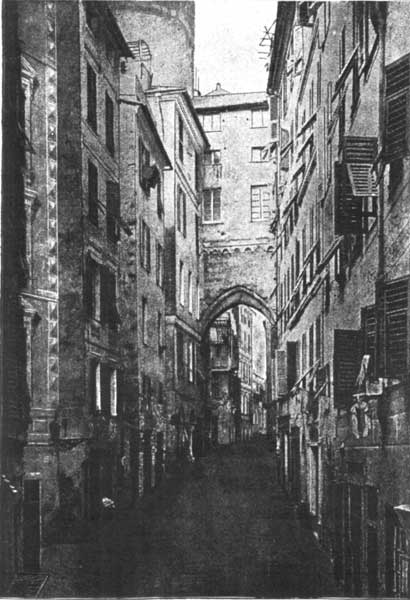
The German government, appreciating the fact that no time is to be lost in this matter, has begun to carry its generous and friendly proposals into practical operation by instituting a thorough search in the various galleries, museums, and libraries throughout Germany for works of art, objects, and rarities which are in any way identified with the Columbus period, and which the German government believes would be likely to be of general interest to the authorities of the World's Columbian Exposition as well as the visitors at that great show.
Among other works of art the German government consents to loan Pludderman's celebrated painting, "The Discovery of America by Columbus." Under the laws of Germany, as well as under the rules and regulations of the National Gallery, no person is permitted to lithograph, photograph, or make any sort of a copy of any picture or other work of art in the care or custody of any national gallery, in case when the artist has not been dead for a period of thirty years, without having first obtained the written permission of the legal representative of the deceased artist, coupled with the consent of the National Gallery authorities. Pludderman not having been dead thirty years, I have given assurances that this regulation will be observed by the United States Government.
THE REASON FOR SAILORS' SUPERSTITIONS.
His Eminence James Gibbons, D.D., a celebrated American ecclesiastic. Born in Baltimore, Md., July 23, 1834.
There is but a plank between a sailor and eternity, and perhaps the realization of that fact may have something to do with the superstition lurking in his nature.
ONCE THE PILLARS OF HERCULES WERE THE END OF THE WORLD.
William Gibson.
Thus opening on that glooming sea, Well seemed these walls[39] the ends of earth; Death and a dark eternity Sublimely symboled forth! Ere to one eagle soul was given The will, the wings, that deep to brave; In the sun's path to find a heaven, A New World—o'er the wave. Retraced the path Columbus trod, Our course was from the setting sun; While all the visible works of God, Though various else had one.
NEW LIGHT ON CHRISTOPHER COLUMBUS.
From the Glasgow Times.
The discovery by the Superintendent of the Military Archives at Madrid of documents probably setting at rest the doubts that formerly existed as to the birthplace of Columbus, must have awakened new interest in the history of the most renowned discoverer of the past. It is to be noted, however, that the documents only affirm tradition, for Genoa has always been the Admiral's accredited birthplace. But if the discovery should lead to nothing but a more careful investigation of the records of his later history it will have been of use.
The character of Columbus has been greatly misunderstood, and his 600 biographers have in turn invested him with the glory of the religious hero and the contumely of the ill-tempered and crack-brained adventurer. An impartial critic must admit, indeed, that he was something of both, though more of the hero than the adventurer, and that his biographers have erred considerably in what Mr. R. L. Stevenson would call their "point of view."
Educated, as it is supposed, in the local schools of Genoa, and for a short period at the University of Pavia, the youthful Columbus must have come in close contact with the scholars of the day. Naturally of a religious temperament, the piety of the learned would early impress him, and to this may possibly be attributed the feeling that he had been divinely selected, which remained with him until his death.
There is little doubt that he began his career as a sailor, at the age of fourteen, with the sole object of plunder. The Indies were the constant attraction for the natives of Venice and Genoa; the Mediterranean and the Adriatic were filled with treasure ships. In these circumstances it is not to be wondered that the sea possessed a wonderful fascination for the youth of those towns. This opulence was the constant envy of Spain and Portugal, and Columbus was soon attracted to the latter country by the desire of Prince Henry to discover a southern route to the Indies. It was while in Portugal that he began to believe that his mission on earth was to be the discoverer of a new route to the land of gold—"the white man's god." For two years he resided in Lisbon, from time to time making short voyages, but for the most part engaged drawing maps to procure himself a living. Here he married, here his son Diego was born, and here his wife, who died at an early age, was buried.
Toscanelli at this time advanced the theory that the earth was round, and Columbus at once entered into correspondence with him on the subject, and was greatly impressed with the views of the Florentine scientist, both as to the sphericity of the world and the wonders of the Asiatic region. Heresy-hunting was then a favorite pastime, and Columbus in accepting these theories ran no small risk of losing his life. Portugal and France in turn rejected his offers to add to their dependencies by his discoveries; and, though his brother found many in England willing to give him the necessary ships to start on his adventures, Spain, after much importuning on the part of the explorer, forestalled our own country.
Then followed his four eventful voyages with all their varying fortunes, and his death, when over seventy years of age, in a wretched condition of poverty. The ready consideration of theories, not only dangerous but so astounding in their character as to throw discredit on those who advanced them, shows him to have been a man of intellectual courage. Humility was another trait of his character, and in all his life it can not be said that he acted in any but an honest and straightforward manner toward his fellow-men.
It is true, no doubt, that his recognition of slavery somewhat dims his reputation. He sold many Indians as slaves, but it should be remembered that slavery prevailed at the time, and it was only on his second voyage, when hard pressed for means to reimburse the Spanish treasury for the immense expense of the expedition, that he resorted to the barter in human flesh. Indeed, his friendly relations with the natives show that, as a rule, he must have treated them in the kindly manner which characterized all his actions.
Throughout the reverses of his long career, whether received with sneers, lauded as a benefactor of his country, put in chains by crafty fellow-subjects, or defrauded, by an unscrupulous prince, of the profit of his discoveries, he continued a man of an eminently lovable character, kind to his family, his servants, and even his enemies. Americans are to do honor at the Columbian Exhibition to the name of him who, though not the first white man to land on the shores of the New World, was the first to colonize its fertile islands. Not only America, but the whole world, may emulate his virtues with advantage; for, even now, justice and mercy, courage and meekness, do not always abide together.
SECRET.
Frank B. Goodrich, an American author of several popular books. Born in Boston, 1826. From his "History of the Sea."
John II. of Portugal applied for an increase of power, and obtained a grant of all the lands which his navigators could discover in sailing from west to east. The grand idea of sailing from east to west—one which implied a knowledge of the sphericity of the globe—had not yet, to outward appearance, penetrated the brain of either pope or layman. One Christopher Columbus, however, was already brooding over it in secret and in silence.
THE PERIOD.
François Pierre Guillaume Guizot, a distinguished French statesman and historian. Born at Nîmes, October 4, 1787; died September 12, 1874. From his "History of Civilization" (5 vols., 1845).
The period in question was also one of the most remarkable for the display of physical activity among men. It was a period of voyages, travels, enterprises, discoveries, and inventions of every kind. It was the time of the great Portuguese expedition along the coast of Africa; of the discovery of the new passage to India, by Vasco de Gama; of the discovery of America, by Christopher Columbus; of the wonderful extension of European commerce. A thousand new inventions started up; others already known, but confined within a narrow sphere, became popular and in general use. Gunpowder changed the system of war; the compass changed the system of navigation. Painting in oil was invented, and filled Europe with masterpieces of art. Engraving on copper, invented in 1406, multiplied and diffused them. Paper made of linen became common. Finally, between 1436 and 1452, was invented printing—printing, the theme of so many declamations and commonplaces, but to whose merits and effect no commonplaces or declamations will ever be able to do justice.
MORNING TRIUMPHANT.
Rev. F. W. Gunsaulus, D. D., an American divine and able pulpit orator; at present, pastor of Plymouth Church, Chicago. From "New Testament and Liberty."
Look again! It has become so light now that it is easy to see. Yonder in the West a man has been pleading before courts, praying to God, thinking, and dreaming. His brave heart sends forth hot tears, but it will not fail. The genius of God has seized him. The Holy Ghost has touched him as the spirit of liberty. Humanity cries through him for more room. Emperors will not hear. But he gains one ear, at last, and with the mariner's needle set out for the unknown. Civilization has always walked by faith and not by sight. And do not forget to note, that, in that log-book, the first mark is, "In the name of our Lord Jesus Christ." On! brave man, on! over wastes of ocean, in the midst of scorn, through hate, rage, mutiny, even death—and despair, worse than death. On! there is an America on the other side to balance. Cheerless nights, sad days, nights dark with woe, days hideous with the form of death, weeks sobbing with pity; but in that heart is He whose name is written in the log-book. "Land ahead!" And Columbus has discovered a continent. Humanity has another world. Light from the four corners of heaven. Glory touching firmament and planet. It is morning! Triumphant, beautiful dawn!
TENDENCY.
Arnold Henry Guyot, Ph. D., LL. D., a meritorious writer on physical geography. Born near Neufchâtel, Switzerland, 1807. Professor of geology and physical geography at Princeton College from 1855 until his death, February 8, 1884. From "Earth and Man" (1849).
As the plant is made for the animal, as the vegetable world is made for the animal world, America is made for the man of the Old World. The man of the Old World sets out upon his way. Leaving the highlands of Asia, he descends from station to station toward Europe. Each of his steps is marked by a new civilization superior to the preceding, by a greater power of development. Arrived at the Atlantic, he pauses on the shore of this unknown ocean, the bounds of which he knows not, and turns upon his footprints for an instant; then recommences his adventurous career westward as in the earliest ages.
NEW LIFE.
Edward Everett Hale, D. D., a celebrated American author. Born in Boston, Mass., April 3, 1822. From an article, "Christopher Columbus," in the Independent, June 2, 1892.
What the world owes to him and to Isabella, who made his work possible, it is impossible in few words to say. The moment was one when Europe needed America as never before. She had new life, given by the fall of Constantinople, by the invention of printing, by the expulsion of the Moors; there was new life even seething in the first heats of the Reformation; and Europe must break her bonds, else she would die. Her outlet was found in America. Here it is that that Power who orders history could try, on a fit scale, the great experiments of the new life. Thus it was ordered, let us say reverently, that South America should show what the Catholic church could do in the line of civilizing a desert, and that North America should show what the coming church of the future could do. To us it is interesting to remember that Columbus personally led the first discovery of South America, and that he made the first effort for a colony on our half of the continent. Of these two experiments the North America of to-day and South America of to-day are the issue.
TRIUMPH OF AN IDEA.
The life of Columbus is an illustration constantly brought for the success which God gives to those who, having conceived of a great idea, bravely determine to carry it through. His singleness of purpose, his determination to succeed, have been cited for four centuries, and will be cited for centuries more among the noblest illustrations which history has given of success wrought out by the courage of one man.—Ibid.
THE EAST LONGED FOR THE WEST.
Edward Everett Hale, in Overland Monthly Magazine. An article on "A Visit to Palos."
Lord Houghton, following Freiligrath, has sung to us how the
Palm tree dreameth of the pine, The pine tree of the palm;
and in his delicate imaginings the dream is of two continents—ocean parted—each of which longs for the other. Strange enough, as one pushes along the steep ascent from the landing at Rábida, up the high bluff on which the convent stands, the palm tree and the pine grow together, as in token of the dream of the great discoverer, who was to unite the continents.
LIFE FOR LIBERTY.
Fitz-Greene Halleck, a noted American poet. Born in Guilford, Conn., July 8, 1790; died November 19, 1867.
Thy voice sounds like a prophet's word, And in its hollow tones are heard The thanks of millions yet to be. Come when his task of fame is wrought, Come with her laurel-leaf, blood-bought, Come in her crowning hour, and then Thy sunken eye's unearthly light To him is welcome as the sight Of sky and stars to prison'd men; Thy grasp is welcome as the hand Of brother in a foreign land; Thy summons welcome as the cry That told the Indian isles were nigh To the world-seeking Genoese, When the land wind, from woods of palm, And orange groves, and fields of balm, Blew o'er the Haytian seas.
GENOA.
Murat Halstead, an American journalist. Born at Ross, Ohio, September 2, 1829. From "Genoa—the Home of Columbus," a paper in Cosmopolitan, May, 1892.
The Italian coast all around the Gulf of Genoa is mountainous, and the mountains crowd each other almost into the sea. Land that can be built upon or cultivated is scarce, and the narrow strips that are possible are on the sunny southern slopes. The air is delicious. The orange trees in December lean over the garden walls, heavy with golden spheres, and the grass is green on the hills, and when a light snow falls the roses blush through the soft veil of lace, and are modest but not ashamed, as they bow their heads. The mountains are like a wall of iron against the world, and from them issues a little river whose waters are pure as the dew, until the washerwomen use them and spread clothing on the wide spaces of clean gravel to dry. The harbor is easily defended, and with the same expensive equipment would be strong as Gibraltar. It is in this isolation that the individuality of Genoa, stamped upon so many chapters of world-famous history, grew. There is so little room for a city that the buildings are necessarily lofty. The streets are narrow and steep. The pavements are blocks of stone that would average from two to three feet in length, one foot in width, and of unknown depth. Evidently they are not constructed for any temporary purpose, but to endure forever. When, for a profound reason, a paving-stone is taken up it is speedily replaced, with the closest attention to exact restoration, and then it is again a rock of ages.
THE CELEBRATION AT HAMBURG.
Among the celebrations of the 400th anniversary of the discovery of America, that of the city of Hamburg, in Germany, will occupy a prominent place. On October 1st an exhibition will be opened at which objects will be on view that bear on the history of the act of discovery, on the condition of geographical science of the time, and on the conditions of the inhabitants of America at the time of the discovery. Side by side with these will be exhibited whatever can show the condition of America at the present time. On the date of the discovery of the little Island of Guanahani—that is, October 12th—the celebration proper will take place. The exercises will consist of songs and music and a goodly array of speeches. In the evening, tableaux and processions will be performed in the largest hall of the city. The scenery, costumes, and implements used will all be got up as they were at the time of the discovery, so as to furnish a real representation of the age of Columbus.
SEEKER AND SEER—A RHYME FOR THE DEDICATION OF THE WORLD'S FAIR.
Edward J. Harding, in the Chicago Tribune, September 17, 1892.
I. What came ye forth to see? Why from the sunward regions of the palm, And piney headlands by the northern main, From Holland's watery ways, and parching Spain, From pleasant France and storied Italy, From India's patience, and from Egypt's calm, To this far city of a soil new-famed Come ye in festal guise to-day, Charged with no fatal "gifts of Greece," Nor Punic treaties double-tongued, But proffering hands of amity, And speaking messages of peace, With drum-beats ushered, and with shouts acclaimed, While cannon-echoes lusty-lung'd Reverberate far away?
IV. Our errand here to-day Hath warrant fair, ye say; We come with you to consecrate A hero's, ay a prophet's monument; Yet needs he none, who was so great; Vainly they build in Cuba's isle afar His sepulcher beside the sapphire sea; He hath for cenotaph a continent, For funeral wreaths, the forests waving free, And round his grave go ceaselessly The morning and the evening star. Yet is it fit that ye should praise him best, For ye his true descendants are, A spirit-begotten progeny; Wherefore to thee, fair city of the West, From elder lands we gladly came To grace a prophet's fame. V. Beauteous upon the waters were the wings That bore glad tidings o'er the leaping wave Of sweet Hesperian isles, more bland and fair Than lover's looks or bard's imaginings; And blest was he, the hero brave, Who first the tyrannous deeps defied, And o'er the wilderness of waters wide A sun-pursuing highway did prepare For those true-hearted exiles few The house of Liberty that reared anew. Nor fails he here of honor due. These goodly structures ye behold, These towering piles in order brave, From whose tall crests the pennons wave Like tropic plumage, gules and gold; These ample halls, wherein ye view Whate'er is fairest wrought and best— South with North vying, East with West, And arts of yore with science new— Bear witness for us how religiously We cherish here his memory. VI. Yet sure, the adventurous Genoese Did never in his most enlightened hours Forecast the high, the immortal destinies Of this dear land of ours. Nay, could ye call him hither from his tomb, Think ye that he would mark with soul elate A kingless people, a schismatic State, Nor on his work invoke perpetual doom? Though the whole Sacred College o'er and o'er Pronounce him sainted, prophet was he none Who to Cathaia's legendary shore Deemed that his bark a path had won. In sooth, our Western pioneer Was all as prescient as he Who cried, "The desert shall exult, The wild shall blossom as the rose," And to a passing rich result Through summer heats and winter snows Toiling to prove himself a seer, Accomplished his own prophecy. Lo, here a greater far than he, A prophet nation hath its dwelling, With multitudinous voice foretelling, "Man shall be free!" VII. Hellas for Beauty, Rome for Order, stood, And Israel for the Good; Our message to the world is Liberty; Not the rude freedom of anarchic hordes, But reasoned kindness, whose benignant code Upon the emblazoned walls of history We carved with our good swords, And crimsoned with our blood. Last, from our eye we plucked the obscuring mote, (Not without tears expelled, and sharpest pain,) From swarthy limbs the galling chain With shock on mighty shock we smote, Whereby with clearer gaze we scan The heaven-writ message that we bear for man. Not ours to give, as erst the Genoese, Of a new world the keys; But of the prison-world ye knew before Hewing in twain the door, To thralls of custom and of circumstance We preach deliverance. O self-imprisoned ones, be free! be free! These fetters frail, by doting ages wrought Of basest metals—fantasy and fear, And ignorance dull, and fond credulity— Have moldered, lo! this many a year; See, at a touch they part, and fall to naught! Yours is the heirship of the universe, Would ye but claim it, nor from eyes averse Let fall the tears of needless misery; Deign to be free! VIII. The prophets perish, but their word endures; The word abides, the prophets pass away; Far be the hour when Hellas' fate is yours, O Nation of the newer day! Unmeet it were that I, Who sit beside your hospitable fire A stranger born—though honoring as a sire The land that binds me with a closer tie Than hers that bore me—should from sullen throat Send forth a raven's ominous note Upon a day of jubilee. Yet signs of coming ill I see, Which Heaven avert! Nay, rather let me deem That like a bright and broadening stream Fed by a hundred affluents, each a river Far-sprung and full, Columbia's life shall flow By level meads majestically slow, Blessing and blest forever!
THE JESUIT GEOGRAPHER.
Jean Hardouin, a French Jesuit. Born at Quimper, 1646; died, 1729.
The rotation of the earth is due to the efforts of the damned to escape from their central fire. Climbing up the walls of hell, they cause the earth to revolve as a squirrel its cage.
COLUMBUS DAY.
By the President of the United States of America. A proclamation:
Whereas, By a joint resolution, approved June 29, 1892, it was resolved by the Senate and House of Representatives of the United States of America, in Congress assembled, "That the President of the United States be authorized and directed to issue a proclamation recommending to the people the observance in all their localities of the 400th anniversary of the discovery of America, on the 21st day of October, 1892, by public demonstration and by suitable exercises in their schools and other places of assembly."
Now, THEREFORE, I, Benjamin Harrison, President of the United States of America, in pursuance of the aforesaid joint resolution, do hereby appoint Friday, October 21, 1892, the 400th anniversary of the discovery of America by Columbus, as a general holiday for the people of the United States. On that day let the people, so far as possible, cease from toil and devote themselves to such exercises as may best express honor to the discoverer and their appreciation of the great achievements of the four completed centuries of American life.
Columbus stood in his age as the pioneer of progress and enlightenment. The system of universal education is in our age the most prominent and salutary feature of the spirit of enlightenment, and it is peculiarly appropriate that the schools be made by the people the center of the day's demonstration. Let the national flag float over every school-house in the country, and the exercises be such as shall impress upon our youth the patriotic duties of American citizenship.
In the churches and in the other places of assembly of the people, let there be expressions of gratitude to Divine Providence for the devout faith of the discoverer, and for the Divine care and guidance which has directed our history and so abundantly blessed our people.
In testimony whereof I have hereunto set my hand and caused the seal of the United States to be affixed.

Done at the city of Washington, this 21st day of July, in the year of our Lord one thousand eight hundred and ninety-two, and of the independence of the United States the one hundred and seventeenth.
Benjamin Harrison.
By the President. John W. Foster, Secretary of State.
THE ADMIRATION OF A CAREFUL CRITIC.
Henry Harrisse, a celebrated Columbian critic, in his erudite and valuable work, "Columbus and the Bank of St. George."
Nor must you believe that I am inclined to lessen the merits of the great Genoese or fail to admire him. But my admiration is the result of reflection, and not a blind hero-worship. Columbus removed out of the range of mere speculation the idea that beyond the Atlantic Ocean lands existed and could be reached by sea, made of the notion a fixed fact, and linked forever the two worlds. That event, which is unquestionably the greatest of modern times, secures to Columbus a place in the pantheon dedicated to the worthies whose courageous deeds mankind will always admire.
PORTRAIT OF COLUMBUS, BY SIR ANTONIO MORO. Used by Washington Irving to illustrate his "Life of Columbus." From the original in the possession of Mr. C. F. Gunther of Chicago. (See pages 52 and 113 .)
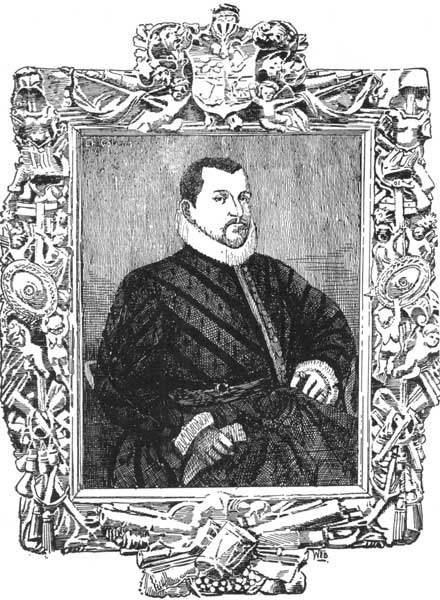
But our gratitude must not carry us beyond the limits of an equitable appreciation. Indiscriminate praise works mischief and injustice. When tender souls represent Columbus as being constantly the laughing-stock of all, and leading a life of misery and abandonment in Spain, they do injustice to Deza, to Cabrera, to Quintanilla, to Mendoza, to Beatrice de Bobadilla, to Medina-Celi, to Ferdinand and Isabella, and probably a host of others who upheld him as much as they could from the start. When blind admirers imagine that the belief in the existence of transatlantic countries rushed out of Columbus' cogitations, complete, unaided, and alone, just as Minerva sprang in full armor from the head of Jupiter, they disregard the efforts of numerous thinkers who, from Aristotle and Roger Bacon to Toscanelli, evolved and matured the thought, until Columbus came to realize it. When dramatists, poets, and romancers expatiate upon the supposed spontaneous or independent character of the discovery of America, and ascribe the achievement exclusively to the genius of a single man, they adopt a theory which is discouraging and untrue.
No man is, or ever was, ahead of his times. No human efforts are, or ever were, disconnected from a long chain of previous exertions; and this applies to all the walks of life. When a great event occurs, in science as in history, the hero who seems to have caused it is only the embodiment and resulting force of the meditations, trials, and endeavors of numberless generations of fellow-workers, conscious and unconscious, known and unknown.
When this solemn truth shall have been duly instilled into the minds of men, we will no longer see them live in the constant expectation of Messiahs and providential beings destined to accomplish, as by a sort of miracle, the infinite and irresistible work of civilization. They will rely exclusively upon the concentrated efforts of the whole race, and cherish the encouraging thought that, however imperceptible and insignificant their individual contributions may seem to be, these form a part of the whole, and finally redound to the happiness and progress of mankind.
THE CARE OF THE NEW WORLD.
David Hartley, a celebrated English physician and philosopher. Born at Armley, near Leeds, 1705; died, 1757.
Those who have the first care of this New World will probably give it such directions and inherent influences as may guide and control its course and revolutions for ages to come.
THE TRIBUTE OF HEINRICH HEINE.
Heinrich Heine. Born December 12, 1799, in the Bolkerstrasse at Dusseldorf; died in Paris, February 17, 1856.
Mancher hat schon viel gegeben, Aber jener hat der Welt Eine ganze Welt geschenkt Und sie heisst America. Nicht befreien könnt'er uns Aus dem orden Erdenkerker Doch er wusst ihn zu erweitern Und die Kette zu verlängern (Translation.) Some have given much already, But this man he has presented To the world an entire world, With the name America. He could not set us free, out Of the dreary, earthly prison, But he knew how to enlarge it And to lengthen our chain.
COLUMBUS' AIM NOT MERELY SECULAR.
George Wilhelm Friedrich Hegel, one of the most eminent philosophers of the German school of metaphysics. Born at Stuttgart in 1770; died in Berlin, 1831. From his "Philosophy of History."
A leading feature demanding our notice in determining the character of this period, might be mentioned that urging of the spirit outward, that desire on the part of man to become acquainted with his world. The chivalrous spirit of the maritime heroes of Portugal and Spain opened a new way to the East Indies and discovered America. This progressive step also involved no transgression of the limits of ecclesiastical principles or feeling. The aim of Columbus was by no means a merely secular one; it presented also a distinctly religious aspect; the treasures of those rich Indian lands which awaited his discovery were destined, in his intention, to be expended in a new crusade, and the heathen inhabitants of the countries themselves were to be converted to Christianity. The recognition of the spherical figure of the earth led man to perceive that it offered him a definite and limited object, and navigation had been benefited by the new-found instrumentality of the magnet, enabling it to be something better than mere coasting; thus technical appliances make their appearance when a need for them is experienced.
These events—the so-called revival of learning, the flourishing of the fine arts, and the discovery of America—may be compared with that blush of dawn which after long storms first betokens the return of a bright and glorious day. This day is the day of universality, which breaks upon the world after the long, eventful, and terrible night of the Middle Ages.
THE BELIEF OF COLUMBUS.
Sir Arthur Helps, a popular English essayist and historian. Born, 1813; died, March 7, 1875. From his "Life of Columbus" (1869).
Columbus believed the world to be a sphere; he underestimated its size; he overestimated the size of the Asiatic continent. The farther that continent extended to the east, the nearer it came round to Spain.
SPECULATION.
It has always been a favorite speculation with historians, and, indeed, with all thinking men, to consider what would have happened from a slight change of circumstances in the course of things which led to great events. This may be an idle and a useless speculation, but it is an inevitable one. Never was there such a field for this kind of speculation as in the voyages, especially the first one, of Columbus. * * * The gentlest breeze carried with it the destinies of future empires. * * * Had some breeze big with the fate of nations carried Columbus northward, it would hardly have been left for the English, more than a century afterward, to found those colonies which have proved to be the seeds of the greatest nation that the world is likely to behold.—Ibid.
RELIGION TURNS TO FREEDOM'S LAND.
George Herbert, an English poet. Born at Montgomery, Wales, 1593; died, 1632.
Religion stands on tiptoe in our land, Ready to pass to the American strand.
THE PERSONAL APPEARANCE OF COLUMBUS.
Antonio Herrera y Tordesillas, an eminent Spanish historian. Born at Cuellar in 1549; died, 1625.
Columbus was tall of stature, with a long and imposing visage. His nose was aquiline; his eyes blue; his complexion clear, and having a tendency to a glowing red; the beard and hair red in his youth, but his fatigues early turned them white.
AN INCIDENT OF THE VOYAGE.
Fernando Herrera, Spanish poet, 1534-1597.
Many sighed and wept, and every hour seemed a year.
THE EFFECT OF THE DISCOVERY.
C. W. Hodgin, professor of history in Earlham College, Indiana. From "Preparation for the Discovery of America."
The discovery of America by Columbus stands out in history as an event of supreme importance, both because of its value in itself and because of its reflex action upon Europe. It swept away the hideous monsters and frightful apparitions with which a superstitious imagination had peopled the unknown Atlantic, and removed at once and forever the fancied dangers in the way of its navigation. It destroyed the old patristic geography and practically demonstrated the rotundity of the earth. It overthrew the old ideas of science and gave a new meaning to the Baconian method of investigation. It revolutionized the commerce of the world, and greatly stimulated the intellect of Europe, already awakening from the long torpor of the Dark Ages. It opened the doors of a new world, through which the oppressed and overcrowded population of the Old World might enter and make homes, build states, and develop a higher ideal of freedom than the world had before conceived.
But this event did not come to pass by accident, neither was it the result of a single cause. It was the culmination of a series of events, each of which had a tendency, more or less marked, to concentrate into the close of the fifteenth century the results of an instinct to search over unexplored seas for unknown lands.
COLUMBUS THE FIRST DISCOVERER.
Friedrich Heinrich Alexander, Baron Von Humboldt, the illustrious traveler, naturalist, and cosmographer. Born in Berlin, September 14, 1769; died there May 6, 1859. He has been well termed "The Modern Aristotle."
To say the truth, Vespucci shone only by reflection from an age of glory. When compared with Columbus, Sebastian Cabot, Bartolomé Dias, and Da Gama, his place is an inferior one.
The majesty of great memories seems concentrated in the name of Christopher Columbus. It is the originality of his vast idea, the largeness and fertility of his genius, and the courage which bore up against a long series of misfortunes, which have exalted the Admiral high above all his contemporaries.
THE PENETRATION AND EXTREME ACCURACY OF COLUMBUS.
Columbus preserved, amid so many material and minute cares, which freeze the soul and contract the character, a profound and poetic sentiment of the grandeur of nature. What characterizes Columbus is the penetration and extreme accuracy with which he seizes the phenomena of the external world. He is quite as remarkable as an observer of nature as he is an intrepid navigator.
Arrived under new heavens, and in a new world, the configuration of lands, the aspect of vegetation, the habits of animals, the distribution of heat according to longitude, the pelagic currents, the variations of terrestrial magnetism—nothing escaped his sagacity. Columbus does not limit himself to collecting isolated facts, he combines them, he seeks their mutual relations to each other. He sometimes rises with boldness to the discovery of the general laws that govern the physical world.—Ibid.
A FLIGHT OF PARROTS WAS HIS GUIDING STAR.
Columbus was guided in his opinion by a flight of parrots toward the southwest. Never had the flight of birds more important consequences. It may be said to have determined the first settlements on the new continent, and its distribution between the Latin and Germanic races.—Ibid.
COLUMBUS A GIANT.
Columbus is a giant standing on the confines between mediæval and modern times, and his existence marks one of the great epochs in the history of the world.—Ibid.
THE MAJESTY OF GRAND RECOLLECTIONS.
The majesty of grand recollections seems concentered on the illustrious name of Columbus.—Ibid.
RELIGION.
John Fletcher Hurst, D. D., LL.D., a noted American Methodist bishop. Born near Salem, Md., August 17, 1834. From his "Short History of the Church in the United States." Copyright, 1889. By permission of Messrs. Harper & Brothers, Publishers.
When Columbus discovered the little West India Island of San Salvador, and raised upon the shore the cross, he dedicated it and the lands beyond to the sovereigns Ferdinand and Isabella. The "Gloria in Excelsis" was sung by the discoverer and his weary crew with as much fervor as it had ever been chanted in the cathedrals of Spain. The faith was Roman Catholic. On his second voyage, in 1494, Columbus took with him a vicar apostolic and twelve priests, and on the island of Haiti erected the first chapel in the western world.[40] The success of Columbus in discovering a new world in the West awakened a wild enthusiasm throughout Europe. Visions of gold inflamed the minds alike of rulers, knights, and adventurers. To discover and gather treasures, and organize vast missionary undertakings, became the mania of the times. No European country which possessed a strip of seaboard escaped the delirium.
ARMA VIRUMQUE CANO.
Washington Irving, one of the most distinguished American authors and humorists. Born in New York City, April 3, 1783. Died at Sunnyside on the Hudson, N. Y., November 28, 1859. From his "History of the Life and Voyages of Christopher Columbus" (4 vols., 1828). "This is one of those works," says Alexander H. Everett, "which are at the same time the delight of readers and the despair of critics. It is as nearly perfect as any work well can be."
It is my object to relate the deeds and fortunes of the mariner who first had the judgment to divine, and the intrepidity to brave, the mysteries of the perilous deep; and who, by his hardy genius, his inflexible constancy, and his heroic courage, brought the ends of the earth into communication with each other. The narrative of his troubled life is the link which connects the history of the Old World with that of the New.
To his intellectual vision it was given to read the signs of the times in the conjectures and reveries of the past ages, the indications of an unknown world, as soothsayers were said to read predictions in the stars, and to foretell events from the visions of the night.
PRACTICAL AND POETICAL.
He who paints a great man merely in great and heroic traits, though he may produce a fine picture, will never present a faithful portrait. Great men are compounds of great and little qualities. Indeed, much of their greatness arises from their mastery over the imperfections of their nature, and their noblest actions are sometimes struck forth by the collision of their merits and their defects.
In Columbus were singularly combined the practical and the poetical. His mind had grasped all kinds of knowledge, whether procured by study or observation, which bore upon his theories; impatient of the scanty aliment of the day, "his impetuous ardor threw him into the study of the fathers of the Church, the Arabian Jews, and the ancient geographers"; while his daring but irregular genius, bursting from the limits of imperfect science, bore him to conclusions far beyond the intellectual vision of his contemporaries. If some of his conclusions were erroneous, they were at least ingenious and splendid; and their error resulted from the clouds which still hung over his peculiar path of enterprise. His own discoveries enlightened the ignorance of the age, guided conjecture to certainty, and dispelled that very darkness with which he had been obliged to struggle.
In the progress of his discoveries, he has been remarked for the extreme sagacity and the admirable justness with which he seized upon the phenomena of the exterior world. As they broke upon him, these phenomena were discerned with wonderful quickness of perception, and made to contribute important principles to the stock of general knowledge. This lucidity of spirit, this quick convertibility of facts to principles, distinguish him from the dawn to the close of his sublime enterprise, insomuch that, with all the sallying ardor of his imagination, his ultimate success has been admirably characterized as a "conquest of reflection."—Ibid.
A VISIT TO PALOS.
I can not express to you what were my feelings on treading the shore which had once been animated by the bustle of departure, and whose sands had been printed by the last footstep of Columbus. The solemn and sublime nature of the event that had followed, together with the fate and fortunes of those concerned in it, filled the mind with vague yet melancholy ideas. It was like viewing the silent and empty stage of some great drama when all the actors had departed. The very aspect of the landscape, so tranquilly beautiful, had an effect upon me, and as I paced the deserted shore by the side of a descendant of one of the discoverers I felt my heart swelling with emotion and my eyes filling with tears.—Ibid.
COLUMBUS AT SALAMANCA.
Columbus appeared in a most unfavorable light before a select assembly—an obscure navigator, a member of no learned institution, destitute of all the trappings and circumstances which sometimes give oracular authority to dullness, and depending on the mere force of natural genius.
Some of the junta entertained the popular notion that he was an adventurer, or at best a visionary; and others had that morbid impatience which any innovation upon established doctrine is apt to produce in systematic minds. What a striking spectacle must the hall of the old convent have presented at this memorable conference! A simple mariner standing forth in the midst of an imposing array of professors, friars, and dignitaries of the Church, maintaining his theory with natural eloquence, and, as it were, pleading the cause of the New World.—Ibid.
A MEMORIAL TO COLUMBUS AT OLD ISABELLA.
From the Sacred Heart Review of Boston, Mass.
Early in September, 1891, the proposition of erecting a monument to Columbus on the site of his first settlement in the New World, at Old Isabella, in Santo Domingo, was first broached to the Sacred Heart Review of Boston by Mr. Thomas H. Cummings of that city. As the first house built by Columbus in the settlement was a church, it was suggested that such a monument would indeed fitly commemorate the starting-point and rise of Christian civilization in America. The Review entered heartily into the project, and steps were at once taken to secure a suitable plot of ground for the site of the monument. Plans were also drawn of a monument whose estimated cost would be from $3,000 to $5,000. A design which included a granite plinth and ball three feet in diameter, surmounting a pyramid of coral and limestone twenty feet high,[41] was transmitted, through the Dominican consul-general at New York to the Dominican government in Santo Domingo. Accompanying this plan was a petition, of which the following is a copy, setting forth the purpose of the Review, and asking certain concessions in return:
"Boston, Mass., October 7, 1891.
"Hon. Fco. Leonte Vazques, Dominican Consul-general, "New York City.
"Sir: The Sacred Heart Review of Boston is anxious to mark the spot with a suitable monument where Christian civilization took its rise in the New World, commonly known as Ancienne Isabelle, on the Island of Santo Domingo. We therefore beg the favor of your good offices with the Dominican government for the following concessions:
"First. Free entrance of party and material for monument at ports of Puerto Plata or Monte Christi, and right of transportation for same to Isabella free of all coast expense and duties.
"Second. Grant of suitable plot, not to contain more than 100 × 100 square yards, the present owner, Mr. C. S. Passailique of New York having already signified his willingness to concede same to us, so far as his rights under the Dominican government allowed him to do so.
"Third. The right of perpetual care of monument, with access to and permission to care for same at all times.
"Fourth. Would the government grant official protection to same; i. e., allow its representatives to aid and protect in every reasonable way the success of the enterprise, and when built guard same as public property, without assuming any legal liability therefor?
"Finally, in case that we find a vessel sailing to one of said ports above named willing to take the monument to Isabella, would government concede this favor—allowing vessel to make coast service free of governmental duties?"
"In exchange for above concessions on the part of the Dominican government, the undersigned hereby agree to erect, at their expense, and free of all charge to said government, a granite monument, according to plan herewith inclosed; estimated cost to be from $3,000 to $5,000.
"Awaiting the favor of an early reply, and begging you to accept the assurance of our highest respect and esteem, we have the honor to be,
"Very respectfully yours,
"Rev. John O'Brien and others in behalf of the Sacred Heart Review Monument Committee."
In reply to the above petition was received an official document, in Spanish, of which the following is a literal translation:
"Ulises Heureaux, Division General-in-Chief of the National Army, Pacificator of the Nation, and Constitutional President of the Republic:
"In view of the petition presented to the government by the directors of the Sacred Heart Review of Boston, United States of America, dated October 7, 1891, and considering that the object of the petitioners is to commemorate a historical fact of great importance, viz.: the establishment of the Christian religion in the New World by the erection of its first temple—an event so closely identified with Santo Domingo, and by its nature and results eminently American, indeed world-wide, in its scope—therefore the point of departure for Christian civilization in the western hemisphere, whose principal products were apostles like Cordoba, Las Casas, and others, defending energetically and resolutely the rights of the oppressed inhabitants of America, and themselves the real founders of modern democracy, be it
"Resolved, Article 1. That it is granted to the Sacred Heart Review of Boston, United States of America, permission to erect a monument on the site of the ruins of Old Isabella, in the district of Puerto Plata, whose purpose shall be to commemorate the site whereon was built the first Catholic church in the New World. This monument shall be of stone, and wholly conformable to the plan presented. It shall be erected within a plot of ground that shall not exceed 10,000 square yards, and shall be at all times solidly and carefully inclosed. If the site chosen belongs to the state, said state concedes its proprietary rights to the petitioners while the monument stands. If the site belongs to private individuals, an understanding must be reached with them to secure possession.
"Article 2. The builders of said monument will have perpetual control and ownership, and they assume the obligation of caring for and preserving it in good condition. If the builders, as a society, cease to exist, the property will revert to the municipality to which belongs Old Isabella, and on them will revert the obligation to preserve it in perfect repair.
"Article 3. The monument will be considered as public property, and the local authorities will give it the protection which the law allows to property of that class. * * * But on no condition and in no way could the government incur any responsibility of damage that might come to the monument situated in such a remote and exposed location.
"Article 4. We declare free from municipal and coast duties the materials and tools necessary for the construction of said monument, and if it is introduced in a ship carrying only this as a cargo, it will be permitted to said ship to make voyage from Monte Christi or Puerto Plata without paying any of said coast imposts. In view of these concessions the monument committee will present to the mayor of the city a detailed statement of the material and tools needed, so that this officer can accept or reject them as he sees fit.
"Article 5. Wherefore the Secretary of State, Secretary of the Interior, and other officers of the Cabinet are charged with the execution of the present resolution.
"Given at the National Palace of Santo Domingo, Capital of the Republic, on the twenty-fifth day of November, 1891, forty-eighth year of independence and the twenty-ninth of the restoration.
(Signed) "Ulises Heureaux, President. "W. Figuereo, Minister of Interior and Police. "Ignacio M. Gonzales, Minister of Finance and Commerce. "Sanchez, Minister of State.
'Copy exactly conforming to the original given at Santo Domingo, November 28, 1891.
"Rafael Y. Rodriguez, "Official Mayor and Minister of Public Works and Foreign Affairs."
With these concessions in hand, a committee, consisting of Capt. Nathan Appleton and Thomas H. Cummings, was appointed to go to Washington and secure recognition from the United States Government for the enterprise. The committee was everywhere favorably received, and returned with assurances of co-operation and support. Hon. W. E. Curtis, head of the Bureau of Latin Republics in the State Department, was added to the general monument committee.
Meanwhile the Sacred Heart Review, through Dr. Charles H. Hall of Boston, a member of the monument committee, put itself in communication with the leading citizens of Puerto Plata, requesting them to use every effort to locate the exact site of the ancient church, and make a suitable clearing for the monument, at its expense.
In answer to this communication, a committee of prominent citizens was organized at Puerto Plata, to co-operate with the Boston Columbus Memorial Committee. The following extract is taken from a local paper, El Porvenir, announcing the organization of this committee:
"On Saturday last, a meeting was held in this city (Puerto Plata) for the purpose of choosing a committee which should take part in the celebration. Those present unanimously resolved that such a body be immediately formed under the title of, 'Committee in Charge of the Centennial Celebration.'
"This committee then proceeded to the election of a board of management, composed of a president, vice-president, secretary, and four directors. The following gentlemen were elected to fill the above offices in the order as named: Gen. Imbert, Dr. Llenas, Gen. Juan Guarrido, Presbitero Don Wenceslao Ruiz, Don José Thomás Jimenez, Don Pedro M. Villalon, and Don José Castellanos.
"To further the object for which it was organized, the board counts upon the co-operation of such government officials and corporations of the republic as may be inclined to take part in this great apotheosis in preparation, to glorify throughout the whole world the work and name of the famous discoverer.
"As this is the disinterested purpose for which the above-mentioned committee was formed, we do not doubt that the public, convinced that it is its duty to contribute in a suitable manner to the proposed celebration, will respond to the idea with enthusiasm, seeing in it only the desire which has guided its projectors—that of contributing their share to the glorification of the immortal navigator."