COLUMBUS (continued 4)
Reading edition
In his latter years we see Columbus, although as full as ever of his great mission, thinking more and more of the transmission of his rights and his property intact to his children. He had always loved his home, and his amiable and affectionate disposition made many and lasting friendships in all ranks of life, from Queen Isabella and Archbishop Deza to the humblest grumete. We find his shipmates serving with him over and over again. Terreros, the Admiral's steward, and Salcedo, his servant, were with him in his first voyage and in his last. His faithful captains, Mendez and Fieschi, risked life and limb for him, and attended him on his deathbed. Columbus was also blessed with two loving and devoted brothers. In one of his letters to his son Diego, he said, "Never have I found better friends, on my right hand and on my left, than my brothers." Bartholomew, especially, was his trusty and gallant defender and counselor in his darkest hours of difficulty and distress, his nurse in sickness, and his helpful companion in health. The enduring affection of these two brothers, from the cradle to the grave, is most touching. Columbus was happy too in his handsome, promising young sons, who were ever dutiful, and whose welfare was his fondest care; they fulfilled all his hopes. One recovered the Admiral's rights, while the other studied his father's professional work, preserved his memorials, and wrote his life. Columbus never forgot his old home at Genoa, and the most precious treasures of the proud city are the documents which her illustrious son confided to her charge, and the letters in which he expressed his affection for his native town. Columbus was a man to reverence, but he was still more a man to love.
The great discoverer's genius was a gift which is only produced once in an age, and it is that which has given rise to the enthusiastic celebration of the fourth centenary of his achievement. To geographers and sailors the careful study of his life will always be useful and instructive. They will be led to ponder over the deep sense of duty and responsibility which produced his unceasing and untiring watchfulness when at sea, over the long training which could alone produce so consummate a navigator, and over that perseverance and capacity for taking trouble which we should all not only admire but strive to imitate. I can not better conclude this very inadequate attempt to do justice to a great subject than by quoting the words of a geographer, whose loss from among us we still continue to feel—the late Sir Henry Yule. He said of Columbus: "His genius and lofty enthusiasm, his ardent and justified previsions, mark the great Admiral as one of the lights of the human race."
A DISCOVERY GREATER THAN THE LABORS OF HERCULES.
Pietro Martire de Anghiera (usually called Peter Martyr), an Italian scholar, statesman, and historian. Born at Arona, on Lake Maggiore, in 1455; died at Granada, Spain, 1526.
To declare my opinion herein, whatsoever hath heretofore been discovered by the famous travayles of Saturnus and Hercules, with such other whom the antiquitie for their heroical acts honoured as Gods, seemeth but little and obscure if it be compared to the victorious labours of the Spanyards.
—Decad. ii, cap. 4, Lok's Translation.
GENIUS TRAVELED WESTWARD.
William Mason, an English poet. Born at Hull, 1725; died in 1797.
Old England's genius turns with scorn away, Ascends his sacred bark, the sails unfurled, And steers his state to the wide Western World.
MISSION AND REWARD.
J. N. Matthews, in Chicago Tribune, 1892.
Sailing before the silver shafts of morn, He bore the White Christ over alien seas— The swart Columbus—into "lands forlorn," That lay beyond the dim Hesperides. Humbly he gathered up the broken chain Of human knowledge, and, with sails unfurled, He drew it westward from the coast of Spain, And linked it firmly to another world. Tho' blinding tempests drove his ships astray, And on the decks conspiring Spaniards grew More mutinous and dangerous, day by day, Than did the deadly winds that round him blew, Yet the bluff captain, with his bearded lip, His lordly purpose, and his high disdain, Stood like a master with uplifted whip, And urged his mad sea-horses o'er the main. Onward and onward thro' the blue profound, Into the west a thousand leagues or more, His caravels cut the billows till they ground Upon the shallows of San Salvador. Then, robed in scarlet like a rising morn, He climbed ashore and on the shining sod He gave to man a continent new-born; Then, kneeling, gave his gratitude to God. And his reward? In all the books of fate There is no page so pitiful as this— A cruel dungeon, and a monarch's hate, And penury and calumny were his; Robbed of his honors in his feeble age, Despoiled of glory, the old Genoese Withdrew at length from life's ungrateful stage, To try the waves of other unknown seas.
EAGER TO SHARE THE REWARD.
Letter written by the Duke of Medina Celi to the Grand Cardinal of Spain, Pedro Gonzalez de Mendoza, dated March 19, 1493.
Most Reverend Sir: I am not aware whether your Lordship knows that I had Cristoforo Colon under my roof for a long time when he came from Portugal, and wished to go to the King of France, in order that he might go in search of the Indies with his Majesty's aid and countenance. I myself wished to make the venture, and to dispatch him from my port [Santa Maria], where I had a good equipment of three or four caravels, since he asked no more from me; but as I recognized that this was an undertaking for the Queen, our sovereign, I wrote about the matter to her Highness from Rota, and she replied that I should send him to her. Therefore I sent him, and asked her Highness that, since I did not desire to pursue the enterprise but had arranged it for her service, she should direct that compensation be made to me, and that I might have a share in it by having the loading and unloading of the commerce done in the port.
Her Highness received him [Colon], and referred him to Alonso de Quintanilla, who, in turn, wrote me that he did not consider this affair to be very certain; but that if it should go through, her Highness would give me a reward and part in it. After having well studied it, she agreed to send him in search of the Indies. Some eight months ago he set out, and now has arrived at Lisbon on his return voyage, and has found all which he sought and very completely; which, as soon as I knew, in order to advise her Highness of such good tidings, I am writing by Inares and sending him to beg that she grant me the privilege of sending out there each year some of my own caravels.
I entreat your Lordship that you may be pleased to assist me in this, and also ask it in my behalf; since on my account, and through my keeping him [Colon] two years in my house, and having placed him at her Majesty's service, so great a thing as this has come to pass; and because Inares will inform your Lordship more in detail, I beg you to hearken to him.
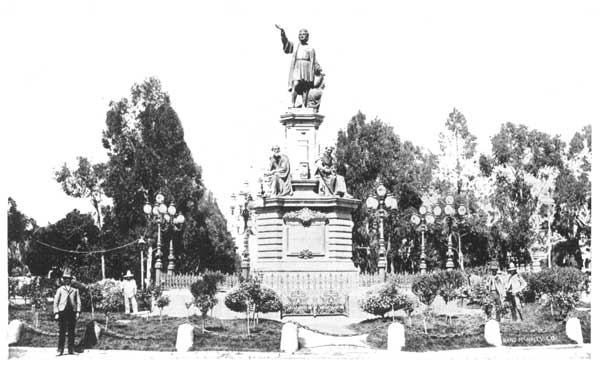
COLUMBUS STATUE, CITY OF MEXICO.
The Columbus monument, in the Paseo de la Reforma, in the City of Mexico, was erected at the charges of Don Antonio Escandon, to whose public spirit and enterprise the building of the Vera Cruz & Mexico Railway was due. The monument is the work of the French sculptor Cordier. The base is a large platform of basalt, surrounded by a balustrade of iron, above which are five lanterns. From this base rises a square mass of red marble, ornamented with four basso-relievos; the arms of Columbus, surrounded with garlands of laurels; the rebuilding of the monastery of Santa Maria de la Rábida; the discovery of the Island of San Salvador; a fragment of a letter from Columbus to Raphael Sanchez, beneath which is the dedication of the monument by Señor Escandon. Above the basso-relievos, surrounding the pedestals, are four life-size figures in bronze; in front and to the right of the statue of Columbus (that stands upon a still higher plane), Padre Juan Perez de la Marchena, prior of the Monastery of Santa Maria de la Rábida, at Huelva, Spain; in front and to the left, Padre Fray Diego de Deza, friar of the Order of Saint Dominic, professor of theology at the Convent of St. Stephen, and afterward archbishop of Seville. He was also confessor of King Ferdinand, to the support of which two men Columbus owed the royal favor; in the rear, to the right, Fray Pedro de Gante; in the rear, to the left, Fray Bartolomé de las Casas—the two missionaries who most earnestly gave their protection to the Indians, and the latter the historian of Columbus. Crowning the whole, upon a pedestal of red marble, is the figure of Columbus, in the act of drawing aside the veil that hides the New World. In conception and in treatment this work is admirable; charming in sentiment, and technically good. The monument stands in a little garden inclosed by iron chains hung upon posts of stone, around which extends a large glorieta.
THE TRIBUTE OF JOAQUIN MILLER.
Joaquin (Cincinnatus Heine) Miller, "the Poet of the Sierras." Born in Cincinnati, Ohio, November 10, 1842. From a poem in the New York Independent.
Behind him lay the gray Azores, Behind the gates of Hercules; Before him not the ghost of shores, Before him only shoreless seas. The good mate said, "Now must we pray, For lo! the very stars are gone. Brave Adm'ral, speak; what shall I say?" "Why say, 'Sail on! sail on! and on!'" "My men grow mutinous day by day; My men grow ghastly, wan and weak." The stout mate thought of home; a spray Of salt wave washed his swarthy cheek. "What shall I say, brave Adm'ral, say, If we sight naught but seas at dawn?" "Why, you shall say, at break of day, 'Sail on! sail on! sail on! and on!'" They sailed and sailed, as winds might blow, Until at last the blanched mate said, "Why, now not even God would know Should I and all my men fall dead. These very winds forget their way, For God from these dread seas is gone. Now speak, brave Adm'ral, speak and say—" He said, "Sail on! sail on! and on!" They sailed. They sailed. Then spoke the mate, "This mad sea shows its teeth to-night. He curls his lip, he lies in wait, With lifted teeth as if to bite. Brave Adm'ral, say but one good word; What shall we do when hope is gone?" The words leapt as a leaping sword, "Sail on! sail on! sail on! and on!" Then, pale and worn, he kept his deck, And peered through darkness. Ah, that night Of all dark nights! And then a speck— A light! A light! A light! A light! It grew, a starlit flag unfurled, It grew to be Time's burst of dawn. He gained a world; he gave that world Its grandest lesson—"On! and on!"
ADMIRAL OF MOSQUITO LAND.
D. H. Montgomery, author of "The Leading Facts of American History."
Loud was the outcry against Columbus. The rabble nicknamed him the "Admiral of Mosquito Land." They pointed at him as the man who had promised everything, and ended by discovering nothing but "a wilderness peopled with naked savages."
COLUMBUS AND THE INDIANS.
Gen. Thomas J. Morgan, Commissioner of Indian Affairs. In an article, "Columbus and the Indians," in the New York Independent, June 2, 1892.
Columbus, when he landed, was confronted with an Indian problem, which he handed down to others, and they to us. Four hundred years have rolled by, and it is still unsolved. Who were the strange people who met him at the end of his long and perilous voyage? He guessed at it and missed it by the diameter of the globe. He called them Indians—people of India—and thus registered the fifteenth century attainments in geography and anthropology. How many were there of them? Alas! there was no census bureau here then, and no record has come down to us of any count or enumeration. Would they have lived any longer if they had been counted? Would a census have strengthened them to resist the threatened tide of invaders that the coming of Columbus heralded? If instead of corn they had presented census rolls to their strange visitors, and exhibited maps to show that the continent was already occupied, would that have changed the whole course of history and left us without any Mayflower or Plymouth Rock, Bunker Hill or Appomattox?
INTENSE UNCERTAINTY.
Charles Morris, an American writer of the present day. In "Half Hours with American History."
The land was clearly seen about two leagues distant, whereupon they took in sail and waited impatiently for the dawn. The thoughts and feelings of Columbus in this little space of time must have been tumultuous and intense. At length, in spite of every difficulty and danger, he had accomplished his object. The great mystery of the ocean was revealed; his theory, which had been the scoff of sages, was triumphantly established; he secured to himself a glory durable as the world itself.
It is difficult to conceive the feelings of such a man at such a moment, or the conjectures which must have thronged upon his mind as to the land before him, covered with darkness. A thousand speculations must have swarmed upon him, as with his anxious crews he waited for the night to pass away, wondering whether the morning light would reveal a savage wilderness, or dawn upon spicy groves and glittering fanes and gilded cities, and all the splendor of oriental civilization.
THE FIRST TO GREET COLUMBUS.
Emma Huntington Nason. A poem in St. Nicholas, July, 1892, founded upon the incident of Columbus' finding a red thorn bush floating in the water a few days before sighting Watling's Island.
When the feast is spread in our country's name, When the nations are gathered from far and near, When East and West send up the same Glad shout, and call to the lands, "Good cheer!" When North and South shall give their bloom, The fairest and best of the century born. Oh, then for the king of the feast make room! Make room, we pray, for the scarlet thorn! Not the golden-rod from the hillsides blest, Not the pale arbutus from pastures rare, Nor the waving wheat from the mighty West, Nor the proud magnolia, tall and fair, Shall Columbia unto the banquet bring. They, willing of heart, shall stand and wait, For the thorn, with his scarlet crown, is king. Make room for him at the splendid fête! Do we not remember the olden tale? And that terrible day of dark despair, When Columbus, under the lowering sail, Sent out to the hidden lands his prayer? And was it not he of the scarlet bough Who first went forth from the shore to greet That lone grand soul at the vessel's prow, Defying fate with his tiny fleet? Grim treachery threatened, above, below, And death stood close at the captain's side, When he saw—Oh, joy!—in the sunset glow, The thorn-tree's branch o'er the waters glide. "Land! Land ahead!" was the joyful shout; The vesper hymn o'er the ocean swept; The mutinous sailors faced about; Together they fell on their knees and wept. At dawn they landed with pennons white; They kissed the sod of San Salvador; But dearer than gems on his doublet bright Were the scarlet berries their leader bore; Thorny and sharp, like his future crown, Blood-red, like the wounds in his great heart made, Yet an emblem true of his proud renown Whose glorious colors shall never fade.
COLUMBA CHRISTUM-FERENS—WHAT'S IN A NAME?
New Orleans Morning Star and Catholic Messenger, August 13, 1892.
The poet says that a rose by any other name would smell as sweet, but there is no doubt that certain names are invested with a peculiar significance. It would appear also that this significance is not always a mere chance coincidence, but is intended, sometimes, to carry the evidence of an overruling prevision. Christopher Columbus was not so named after his achievements, like Scipio Africanus. The name was his from infancy, though human ingenuity could not have conceived one more wonderfully suggestive of his after career.
Columba means a dove. Was there anything dove-like about Columbus? Perhaps not, originally, but his many years of disappointment and humiliation, of poverty and contempt, of failure and hopelessness, were the best school in which to learn patience and sweetness under the guiding hand of such teachers as faith and piety. Was anything wanting to perfect him in the unresisting gentleness of the dove? If so, his guardian angel saw to it when he sent him back in chains from the scenes of his triumph. He then and there, by his meekness, established his indefeasible right to the name Columbus—the right of conquest.
THE WEST INDIES. View larger image
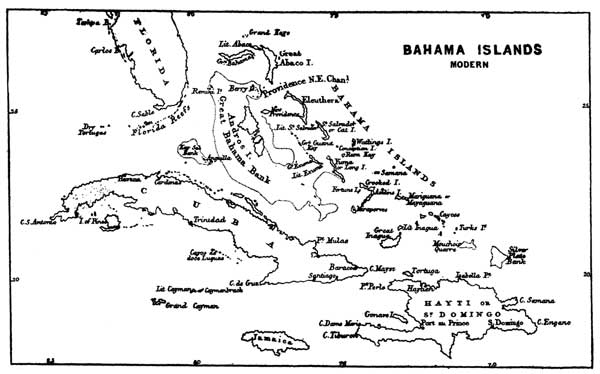
And Christopher—Christum-ferens—the Christ-bearer? A saint of old was so called because one day he carried the child Christ on his shoulders across a dangerous ford. People called him Christo-pher. But what shall we say of the man who carried Christ across the stormy terrors of the unknown sea? Wherever the modern Christopher landed, there he planted the cross; his first act was always one of devout worship. And now that cross and that worship are triumphant from end to end, and from border to border, of that New World. The very fairest flower of untrammeled freedom in the diadem of the Christian church is to-day blooming within the mighty domain which this instrument of Providence wrested from the malign sway of error. Shall not that New World greet him as the Christ-bearer? Indeed, there must have been more than an accidental coincidence when, half a century in advance of events, the priest, in pouring the sacred waters of baptism, proclaimed the presence of one who was to be truly a Christopher—one who should carry Christ on the wings of a dove.
CIRCULAR LETTER OF THE ARCHBISHOP OF NEW ORLEANS ON THE CHRISTOPHER COLUMBUS CELEBRATION.
From the Morning Star and Catholic Messenger, New Orleans, August 13, 1892.
Reverend and Dear Father: The fourth centenary of the discovery of America by Christopher Columbus is at hand. It is an event of the greatest importance. It added a new continent to the world for civilization and Christianity; it gave our citizens a home of liberty and freedom, a country of plenty and prosperity, a fatherland which has a right to our deepest and best feelings of attachment and affection. Christopher Columbus was a sincere and devout Catholic; his remarkable voyage was made possible by the intercession of a holy monk; and by the patronage and liberality of the pious Queen Isabella, the cross of Christ, the emblem of our holy religion, was planted on America's virgin soil, and the Te Deum and the holy mass were the first religious services held on the same; it is therefore just and proper that this great event and festival should be celebrated in a religious as well as in a civil manner.
Our Holy Father the Pope has appointed the 12th of October, and His Excellency the President of the United States has assigned the 21st of October, as the day of commemoration. The discrepancy of dates is based on the difference of the two calendars. When Columbus discovered this country, the old Julian calendar was in vogue, and the date of discovery was marked the 12th; but Pope Gregory XIII. introduced the Gregorian calendar, according to which the 21st would now be the date. We will avail ourselves of both dates—the first date to be of a religious, the second of a civil, character. We therefore order that on the 12th of October a solemn votive mass (pro gratiarum actione dicendo Missam votivam de S. S. Trinitate), in honor of the Blessed Trinity, be sung in all the churches of the diocese, at an hour convenient to the parish, with an exhortation to the people, as thanksgiving to God for all his favors and blessings, and as a supplication to Him for the continuance of the same, and that all the citizens of this vast country may ever dwell in peace and union.
Let the 21st be a public holiday. We desire that the children of our schools assemble in their Sunday clothes at their school-rooms or halls, and that after a few appropriate prayers some exercises be organized to commemorate the great event, and at the same time to fire their young hearts with love of country, and with love for the religion of the cross of Christ, which Columbus planted on the American shore. We further desire that the different Catholic organizations and societies arrange some programme by which the day may be spent in an agreeable and instructive manner.
For our archiepiscopal city we make these special arrangements: On the 12th, at half-past 7 o'clock P. M., the cathedral will be open to the public; the clergy of the city is invited to assemble at 7 o'clock, at the archbishopric, to march in procession to the cathedral, where short sermons of ten minutes each will be preached in five different languages—Spanish, French, English, German, and Italian. The ceremony will close with Benediction of the Blessed Sacrament and the solemn singing of the Te Deum. In order to celebrate the civil solemnity of the 21st, we desire that a preliminary meeting be held at St. Alphonsus' Hall, on Monday evening, the 22d of August, at 8 o'clock. The meeting will be composed of the pastors of the city, of two members of each congregation—to be appointed by them—and of the presidents of the various Catholic societies. This body shall arrange the plan how to celebrate the 21st of October.
May God, who has been kind and merciful to our people in the past, continue his favors in the future and lead us unto life everlasting.
The pastors will read this letter to their congregations.
Given from our archiepiscopal residence, Feast of St. Dominic, August the 4th, 1892.

Francis Janssens, Archbishop of New Orleans.
By order of His Grace: J. Bogaerts, Vicar-general.
THE COLUMBUS STATUE IN THE CITY OF NEW YORK
Stands at the Eighth Avenue and Fifty-ninth Street entrance to Central Park, and was erected October 12, 1892, by subscription among the Italian citizens of the United States, Canada, Mexico, and Central America. From a base forty-six feet square springs a beautiful shaft of great height, the severity of outline being broken by alternating lines of figures, in relief, of the prows, or rostra, of the three ships of Columbus, and medallions composed of an anchor and a coil of rope. In July, 1889, Chevalier Charles Barsotti, proprietor of the Progresso Italo-Americano, published in New York City, started a subscription to defray the cost, which was liberally added to by the Italian government. On December 10, 1890, a number of models were placed on exhibition at the rooms of the Palace of the Exposition of Arts in Rome, and the commission finally chose that of Prof. Gaetano Russo.
The monument is seventy-five feet high, including the three great blocks, or steps, which form the foundation; and, aside from the historical interest it may have, as a work of art alone its possession might well be envied by any city or nation. The base, of Baveno granite, has two beautiful bas-relief pictures in bronze, representing on one side the moment when Columbus first saw land, and on the other the actual landing of the party on the soil. Two inscriptions, higher up on the monument, one in English and one in Italian, contain the dedication. The column is also of Baveno granite, while the figure of the Genius of Geography and the statue proper of Columbus are of white Carrara marble, the former being ten feet high and the latter fourteen. There is also a bronze eagle, six feet high, on the side opposite the figure of Genius of Geography, holding in its claws the shields of the United States and of Genoa. The rostra and the inscription on the column are in bronze.
This great work was designed by Prof. Gaetano Russo, who was born in Messina, Sicily, fifty-seven years ago. Craving opportunities for study and improvement, he made his way to Rome when a mere lad but ten years old. In this great art center his genius developed early, and his later years have been filled with success. Senator Monteverde of Italy, one of the best sculptors of modern times, says that this is one of the finest monuments made during the last twenty-five years. On accepting the finished monument from the artist, the commission tendered him the following: "The monument of Columbus made by you will keep great in America the name of Italian art. It is very pleasant to convey to the United States—a strong, free, and independent people—the venerated resemblance of the man who made the civilization of America possible."
On the sides of the base, between the massive posts which form the corners, are found the inscriptions in Italian and English, composed by Prof. Ugo Fleres of Rome, and being as follows:
TO CHRISTOPHER COLUMBUS, THE ITALIANS RESIDENT IN AMERICA.
SCOFFED AT BEFORE; DURING THE VOYAGE, MENACED; AFTER IT, CHAINED; AS GENEROUS AS OPPRESSED, TO THE WORLD HE GAVE A WORLD.
JOY AND GLORY NEVER UTTERED A MORE THRILLING CALL THAN THAT WHICH RESOUNDED FROM THE CONQUERED OCEAN IN SIGHT OF THE FIRST AMERICAN ISLAND, LAND! LAND!
ON THE XII. OF OCTOBER, MDCCCXCII THE FOURTH CENTENARY OF THE DISCOVERY OF AMERICA, IN IMPERISHABLE REMEMBRANCE.
Near the base of the monument, on the front of the pedestal, is a representation of the Genius of Geography in white Carrara marble. It is a little over eleven feet high, and is represented as a winged angel bending over the globe, which it is intently studying while held beneath the open hand.
On the front and back of the base the corresponding spaces are filled with two magnificent allegorical pictures in bas-relief representing the departure from Spain and the landing in America of Columbus. The latter one is particularly impressive, and the story is most graphically told by the strongly drawn group, of which he is the principal figure, standing in at attitude of prayer upon the soil of the New World he has just discovered. To the left are his sailors drawing the keel of a boat upon the sand, and on the right the Indians peep cautiously out from a thicket of maize at the strange creatures whom they mistake for the messengers of the Great Spirit. Towering over all, at the apex of the column, stands the figure of the First Admiral himself, nobly portrayed in snowiest marble. The figure is fourteen feet in height and represents the bold navigator wearing the dress of the period, the richly embroidered doublet, or waistcoat, thrown back, revealing a kilt that falls in easy folds from a bodice drawn tightly over the broad chest beneath. Not only the attitude of the figure but the expression of the face is commanding, and as you look upon the clearly cut features you seem to feel instinctively the presence of the man of genius and power, which the artist has forcibly chiseled.
The Italian government decided to send the monument here in the royal transport Garigliano. Also, as a token of their good-will to the United States, they ordered their first-class cruiser, Giovanni Bausan, to be in New York in time to take part in the ceremonies attending the unveiling and also the ceremonies by the city and State of New York.
All the work on the foundation was directed gratuitously by the architect V. Del Genoese and Italian laborers. The materials were furnished free by Messrs. Crimmins, Navarro, Smith & Sons, and others.
The executive committee in New York was composed of Chevalier C. Barsotti, president; C. A. Barattoni and E. Spinetti, vice-presidents; G. Starace, treasurer; E. Tealdi and G. N. Malferrari, secretaries; of the presidents of the Italian societies of New York, Brooklyn, Jersey City, and Hoboken; and of sixty-five members chosen from the subscribers as trustees.
THE COLUMBUS MEMORIAL ARCH IN NEW YORK.
Richard M. Hunt, John Lafarge, Augustus St. Gaudens, L. P. di Cesnola, and Robert J. Hoguet of the Sub-Committee on Art of the New York Columbian Celebration, awarded on September 1, 1892, the prizes offered for designs for an arch to be erected at the entrance to Central Park at Fifty-ninth Street and Fifth Avenue.
The committee chose, from the numerous designs submitted, four which were of special excellence. That which was unanimously acknowledged to be the best was submitted with the identification mark, "Columbia," and proved to be the work of Henry B. Hertz of 22 West Forty-third Street. Mr. Hertz will receive a gold medal, and the arch which he has designed will be erected in temporary form for the Columbian celebration in October, 1892, and will be constructed as a permanent monument of marble and bronze to the Genius of Discovery if $350,000 can be secured to build it. The temporary structure is estimated to cost $7,500.
The design which the committee decided should receive the second prize was offered by Franklin Crosby Butler and Paul Emil Dubois of 80 Washington Square, East, and was entitled, "The Santa Maria." A silver medal will be given to the architects. The designs selected for honorable mention were one of Moorish character, submitted by Albert Wahle of 320 East Nineteenth Street, and one entitled "Liberty," by J. C. Beeckman of 160 Fifth Avenue.
Mr. Hertz' design was selected by the committee not alone for its artistic beauty, but because of its peculiar fitness. The main body of the arch is to be built of white marble, and with its fountains, its polished monolithic columns of pigeon-blood marble, its mosaic and gold inlaying, and the bas-relief work and surmounting group of bronze, the committee say it will be a monument to American architecture of which the city will be proud.
From the ground to the top of the bronze caravel in the center of the allegorical group with which the arch will be surmounted the distance will be 160 feet, and the entire width of the arch will be 120 feet. The opening from the ground to the keystone will be eighty feet high and forty feet wide. On the front of each pier will be two columns of pigeon-blood-red marble. Between each pair of columns and at the base of each pier will be large marble fountains, the water playing about figures representing Victory and Immortality. These fountains will be lighted at night with electric lights. The surface of the piers between the columns will be richly decorated in bas-relief with gold and mosaic. Above each fountain will be a panel, one representing Columbus at the court of Spain, and the other the great discoverer at the Convent of Rábida, just before his departure on the voyage which resulted in the discovery of America. In the spaces on either side of the crown of the arch will be colossal reclining figures of Victory in bas-relief.
The highly decorated frieze will be of polished red marble, and surmounting the projecting keystone of the arch will be a bronze representation of an American eagle. On the central panel of the attic will be the inscription: "The United States of America, in Memorial Glorious to Christopher Columbus, Discoverer of America." The ornamentation of the attic consists of representations of Columbus' entrance into Madrid. Crowning all is to be a group in bronze symbolical of Discovery. In this group there will be twelve figures of heroic size, with a gigantic figure representing the Genius of Discovery heralding to the world the achievements of her children.
Mr. Hertz, the designer, is only twenty-one years old, and is a student in the department of architecture of Columbia College.
THE SPANISH FOUNTAIN IN NEW YORK.
The Spanish-American citizens also wish to present a monument to the city in honor of the discovery. It is proposed to have a Columbus fountain, to be located on the Grand Central Park plaza, at Fifth Avenue and Fifty-ninth Street, in the near future. The statuary group of the fountain represents Columbus standing on an immense globe, and on either side of him is one of the Pinzon brothers, who commanded the Pinta and Niña. Land has been discovered, and on the face of Columbus is an expression of prayerful thanksgiving. The brother Pinzon who discovered the land is pointing to it, while the other, with hand shading his eyes, anxiously seeks some sign of the new continent.
It is proposed to cast the statuary group in New York of cannon donated by Spain and Spanish-American countries. The first of the cannon has already arrived, the gift of the republic of Spanish Honduras.
The proposed inscription reads:
A COLON y Los PINZONES Los Españoles E Hispaño-Americanos De Nueva York. To Columbus and the Pinzons, the Spaniards and Spanish-Americans of New York.
FESTIVAL ALLEGORY FOR THE NEW YORK CELEBRATION OF THE 400TH ANNIVERSARY OF COLUMBUS' DISCOVERY, 1892.
One of the features of the New York celebration of the Columbus Quadro-Centennial is to be the production, October 10th, in the Metropolitan Opera House, of "The Triumph of Columbus," a festival allegory, by S. G. Pratt.
The work is written for orchestra, chorus, and solo voices, and is in six scenes or parts, the first of which is described as being "in the nature of a prologue, wherein a dream of Columbus is pictured. Evil spirits and sirens hover about the sleeping mariner threatening and taunting him. The Spirit of Light appears, the tormentors vanish, and a chorus of angels join the Spirit of Light in a song of 'Hope and Faith.'"
Part II. shows "the historical council at Salamanca; Dominican monks support Columbus, but Cardinal Talavera and other priests ridicule him." Columbus, to disprove their accusations of heresy on his part, quotes "sentence after sentence of the Bible in defense of his theory."
Part III. represents Columbus and his boy Diego in poverty before the Convent La Rábida. They pray for aid, and are succored by Father Juan Perez and his monks.
Part IV. contains a Spanish dance by the courtiers and ladies of Queen Isabella's court; a song by the Queen, wherein she tells of her admiration for Columbus; the appearance of Father Juan, who pleads for the navigator and his cause; the discouraging arguments of Talavera; the hesitation of the Queen; her final decision to help Columbus in his undertaking, and her prayer for the success of the voyage.
Part V. is devoted to the voyage. Mr. Pratt has here endeavored to picture in a symphonic prelude "the peaceful progress upon the waters, the jubilant feeling of Columbus, and a flight of birds"—subjects dissimilar enough certainly to lend variety to any orchestral composition. The part, in addition to this prelude, contains the recitation by a sailor of "The Legend of St. Brandon's Isle"; a song by Columbus; the mutiny of the sailors, and Columbus' vain attempts to quell it; his appeal to Christ and the holy cross for aid, following which "the miraculous appearance takes place and the sailors are awed into submission"; the chanting of evening vespers; the firing of the signal gun which announces the discovery of land, and the singing of a Gloria in Excelsis by Columbus, the sailors, and a chorus of angels.
Part VI. is the "grand pageantry of Columbus' reception at Barcelona. A triumphal march by chorus, band, and orchestra forms an accompaniment to a procession and the final reception."
STRANGE AND COLOSSAL MAN.
From an introduction to "The Story of Columbus," in the New York Herald, 1892.
What manner of man was this Columbus, this admiral of the seas and lord of the Indies, who gave to Castille and Leon a new world?
Was he the ill-tempered and crack-brained adventurer of the skeptic biographer, who weighed all men by the sum of ages and not by the age in which they lived, or the religious hero who carried a flaming cross into the darkness of the unknown West, as his reverential historians have painted him?
There have been over six hundred biographers of this strange and colossal man, advancing all degrees of criticism, from filial affection to religious and fanatical hate, yet those who dwell in the lands he discovered know him only by his achievements, caring nothing about the trivial weaknesses of his private life.
One of his fairest critics has said he was the conspicuous developer of a great world movement, the embodiment of the ripened aspirations of his time.
His life is enveloped in an almost impenetrable veil of obscurity; in fact, the date and the place of his birth are in dispute. There are no authentic portraits of him, though hundreds have been printed.
There are in existence many documents written by Columbus about his discoveries. When he set sail on his first voyage he endeavored to keep a log similar to the commentaries of Cæsar. It is from this log that much of our present knowledge has been obtained, but it is a lamentable fact that, while Columbus was an extraordinary executive officer, his administrative ability was particularly poor, and in all matters of detail he was so careless as to be untrustworthy. Therefore, there are many statements in the log open to violent controversy.
TALES OF THE EAST.
It is probable that the letters of Toscanelli made a greater impression on the mind of Columbus than any other information he possessed. The aged Florentine entertained the brightest vision of the marvelous worth of the Asiatic region. He spoke of two hundred towns whose bridges spanned a single river, and whose commerce would excite the cupidity of the world.
These were tales to stir circles of listeners wherever wandering mongers of caravels came and went. All sorts of visionary discoveries were made in those days. Islands were placed in the Atlantic that never existed, and wonderful tales were told of the great Island of Antilla, or the Seven Cities.
The sphericity of the earth was becoming a favorite belief, though it must be borne in mind that education in those days was confined to the cloister, and any departure from old founded tenets was regarded as heresy. It was this peculiar doctrine that caused Columbus much embarrassment in subsequent years. His greatest enemies were the narrow minds that regarded religion as the Ultima Thule of intellectual endeavor. In spite of these facts, however, it was becoming more and more the popular belief that the world was not flat. One of the arguments used against Columbus was, that if the earth was not flat, and was round, he might sail down to the Indies, but he could certainly not sail up. Thus it was that fallacy after fallacy was thrown in argumentative form in his way, and the character of the man grows more wonderful as we see the obstacles over which he fought.
From utter obscurity, from poverty, derision, and treachery, this unflinching spirit fought his way to a most courageous end, and in all the vicissitudes of his wonderful life he never compromised one iota of that dignity which he regarded as consonant with his lofty aspirations.—Ibid.
A PROTEST AGAINST IGNORANCE.
New York Tribune, 1892.
The voyage of Columbus was a protest against the ignorance of the mediæval age. The discovery of the New World was the first sign of the real renaissance of the Old World. It created new heavens and a new earth, broadened immeasurably the horizon of men and nations, and transformed the whole order of European thought. Columbus was the greatest educator who ever lived, for he emancipated mankind from the narrowness of its own ignorance, and taught the great lesson that human destiny, like divine mercy, arches over the whole world. If a perspective of four centuries of progress could have floated like a mirage before the eyes of the great discoverer as he was sighting San Salvador, the American school-house would have loomed up as the greatest institution of the New World's future. Behind him he had left mediæval ignorance, encumbered with superstition, and paralyzed by an ecclesiastical pedantry which passed for learning. Before him lay a new world with the promise of the potency of civil and religious liberty, free education, and popular enlightenment. Because the school-house, like his own voyage, has been a protest against popular ignorance, and has done more than anything else to make our free America what it is, it would have towered above everything else in the mirage-like vision of the world's progress.
THE EARTH'S ROTUNDITY.
The Rev. Father Nugent of Iowa. From an address printed in the Denver Republican, 1892.
The theory of the rotundity of the earth was not born with Columbus. It had been announced centuries before Christ, but the law of gravitation had not been discovered and the world found it impossible to think of another hemisphere in which trees would grow downward into the air and men walk with their heads suspended from their feet. The theologians and scholars who scoffed at Columbus' theory had better grounds for opposing him, according to the received knowledge of the time, than he for upholding his ideal. They were scientifically wrong and he was unscientifically correct.
HANDS ACROSS THE SEA.
The President responds to a message from the Alcalde of Palos.
The following cable messages were exchanged this day:
La Rábida, August 3d. The President: To-day, 400 years ago, Columbus sailed from Palos, discovering America. The United States flag is being hoisted this moment in front of the Convent La Rábida, along with banners of all the American States. Batteries and ships saluting, accompanied by enthusiastic acclamations of the people, army, and navy. God bless America.
Prieto, Alcalde of Palos.
Department of State, Washington, D. C., August 3, 1892. Señor Prieto, Alcalde de Palos, La Rábida, Spain: The President of the United States directs me to cordially acknowledge your message of greeting. On this memorable day, thus fittingly celebrated, the people of the new western world, in grateful reverence to the name and fame of Columbus, join hands with the sons of the brave sailors of Palos and Huelva who manned the discoverer's caravels.
Foster, Secretary of State.
THE PAN-AMERICAN TRIBUTE.
The nations of North, South, and Central America in conference assembled, at Washington, D. C., from October 2, 1889, to April 19, 1890.
Resolved, That in homage to the memory of the immortal discoverer of America, and in gratitude for the unparalleled service rendered by him to civilization and humanity, the International Conference hereby offers its hearty co-operation in the manifestations to be made in his honor on the occasion of the fourth centennial anniversary of the discovery of America.[50]
THE GIFT OF SPAIN.
Theodore Parker, a distinguished American clergyman and scholar. Born at Lexington, Mass., August 24, 1810; died in Florence, Italy, May 10, 1860. From "New Assault upon Freedom in America."
To Columbus, adventurous Italy's most venturous son, Spain gave, grudgingly, three miserable ships, wherewith that daring genius sailed through the classic and mediæval darkness which covered the great Atlantic deep, opening to mankind a new world, and new destination therein. No queen ever wore a diadem so precious as those pearls which Isabella dropped into the western sea, a bridal gift, whereby the Old World, well endowed with art and science, and the hoarded wealth of experience, wed America, rich only in her gifts from Nature and her hopes in time. The most valuable contribution Spain has made to mankind is three scant ships furnished to the Genoese navigator, whom the world's instinct pushed westward in quest of continents.
COLUMBUS THE BOLDEST NAVIGATOR.
Capt. William H. Parker, an American naval officer of the nineteenth century. From "Familiar Talks on Astronomy."[51]
Let us turn our attention to Christopher Columbus, the boldest navigator of his day; indeed, according to my view, the boldest man of whom we have any account in history. While all the other seamen of the known world were creeping along the shore, he heroically sailed forth on the broad ocean.
When I look back upon my own voyages and recall the many anxious moments I have passed when looking for a port at night, and when I compare my own situation, supplied with accurate charts, perfect instruments, good sailing directions, everything, in short, that science can supply, and then think of Columbus in his little bark, his only instruments an imperfect compass and a rude astrolabe, sailing forth upon an unknown sea, I must award to him the credit of being the boldest seaman that ever "sailed the salt ocean."
Columbus, then, had made three discoveries before he discovered land—the trade-winds, the Sargasso Sea, and the variation of the compass.
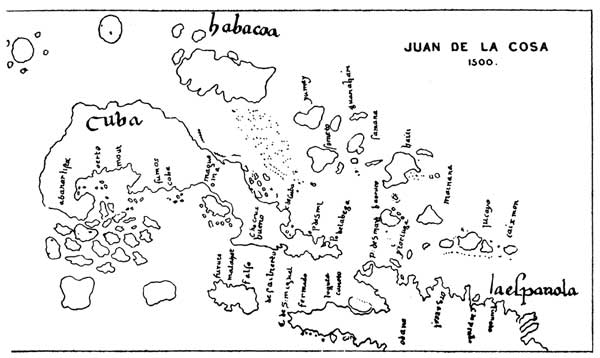
THE MAP OF COLUMBUS' PILOT, JUAN DE LA COSA. From the original in the Marine Museum, Madrid. (See page 228) View larger image
COLUMBUS THE PATRON SAINT OF REAL-ESTATE DEALERS.
At a banquet in Chicago of the real-estate brokers, a waggish orator remarked that Columbus, with his cry of "Land! Land!" was clearly the patron saint of American real-estate dealers.
THE MUTINY.
Horatio J. Perry, an American author. From "Reminiscences."
When those Spanish mutineers leaped upon their Admiral's deck and advanced upon him sword in hand, every man of them was aware that according to all ordinary rules the safety of his own head depended on their going clean through and finishing their work. No compromise that should leave Columbus alive could possibly have suited them then. Nevertheless, at the bottom of it all, the moving impulse of those men was terror. They were banded for that work by a common fear and a common superstition, and it was only when they looked in the clear face of one wholly free from the influences which enslaved themselves, when they felt in their marrow that supreme expression of Columbus at the point of a miserable death—only then the revulsion of confidence in him suddenly relieved their own terrors. It was instinctive. This man knows! He does not deceive us! We fools are compromising the safety of all by quenching this light. He alone can get us through this business—that was the human instinct which responded to the look and bearing of Columbus at the moment when he was wholly lost, and when his life's work, his great voyage almost accomplished, was also to all appearance lost. The instinct was sure, the response was certain, from the instinct that its motive was also there sure and certain; but no other man in that age could have provoked it, no other but Columbus could be sure of what he was then doing.
The mutineers went back to their work, and the ships went on. For three days previous, the Admiral, following some indications he had noted from the flight of birds, had steered southwest. Through that night of the 10th and through the day of the 11th he still kept that course; but just at evening of the 11th he ordered the helm again to be put due west. The squadron had made eighty-two miles that day, and his practiced senses now taught him that land was indeed near. Without any hesitation he called together his chief officers, and announced to them that the end of their voyage was at hand; and he ordered the ships to sail well together, and to keep a sharp lookout through the night, as he expected land before the morning. Also, they had strict orders to shorten sail at midnight, and not to advance beyond half speed. Then he promised a velvet doublet of his own as a present to the man who should first make out the land. These details are well known, and they are authentic; and it is true also that these dispositions of the Admiral spread life throughout the squadron. Nobody slept that night. It was only twenty-four hours since they were ready to throw him overboard; but they now believed in him and bitterly accused one another.
THE TRACK OF COLUMBUS.
From a paper in New England Magazine, 1892, taken originally from a volume of "Reminiscences" left by Horatio J. Perry, who made a voyage from Spain to New Orleans in 1847.
A fortnight out at sea! We are upon the track of Christopher Columbus. Only three centuries and a half ago the keels of his caravels plowed for the first time these very waters, bearing the greatest heart and wisest head of his time, and one of the grandest figures in all history.
To conceive Columbus at his true value requires some effort in our age, when the earth has been girdled and measured, when the sun has been weighed and the planets brought into the relation of neighbors over the way, into whose windows we are constantly peeping in spite of the social gulf which keeps us from visiting either Mars or Venus. It is not easy to put ourselves back into the fifteenth century and limit ourselves as those men were limited.
I found it an aid to my comprehension of Columbus, this chance which sent me sailing over the very route of his great voyage. It is not, even now, a frequented route. The bold Spanish and Portuguese navigators of the fifteenth and sixteenth centuries are no longer found upon it. The trade of the Indies has passed into other hands, and this is not the road from England to the West Indies or to America.
Thus you may still sail for weeks in these seas without ever meeting a ship. Leaving Madeira or the Canaries, you may even reach those western lands he reached without having seen or felt any other sign or incident except precisely such as were noted by him.
DEATH WAS COLUMBUS' FRIEND.
Oskar Ferdinand Peschel, a noted German geographer. Born at Dresden, March 17, 1826; died, August 31, 1875.
Death saved Columbus the infliction of a blow which he probably would have felt more than Bobadilla's fetters. He was allowed to carry to the grave the glorious illusion that Cuba was a province of the Chinese Empire, that Hispaniola was the Island Zipangu, and that only a narrow strip of land, instead of a hemisphere covered by water, intervened between the Caribbean Sea and the Bay of Bengal.
The discoverer of America died without suspecting that he had found a new continent. He regarded the distance between Spain and Jamaica as a third part of the circumference of the globe, and announced, "The earth is by no means as large as is popularly supposed."
The extension of the world by a new continent had no place in his conceptions, and the greatness of his achievement would have been lessened in his eyes if he had been permitted to discover a second vast ocean beyond that which he had traversed, for he would have seen that he had but half accomplished his object, the connection of Europe with the East.
PETRARCH'S TRIBUTE.
Francesco Petrarch, Italian poet. Born at Arezzo, in Tuscany, July 20, 1304; died at Arquá, near Padua, July 19, 1374.
The daylight hastening with wingéd steps, Perchance to gladden the expectant eyes Of far-off nations in a world remote.
COLUMBUS A VOLUMINOUS WRITER.
Barnet Phillips, in Harper's Weekly, June 25, 1892, on "The Columbus Festival at Genoa."[52]
It can not be questioned but that Christopher Columbus was a voluminous writer. Mr. Justin Winsor, who has made careful researches, says that "ninety-seven distinct pieces of writing by the hand of Columbus either exist or are known to have existed. Of such, whether memoirs, relations, or letters, sixty-four are preserved in their entirety." Columbus seems to have written all his letters in Spanish. Genoa is fortunate in possessing a number of authentic letters, and these are preserved in a marble custodia, surmounted by a head of Columbus. In the pillar which forms the pedestal there is a bronze door, and the precious Columbus documents have been placed there. (See p. 54, ante.)
HIS LIFE WAS A PATH OF THORNS.
Robert Pollok, a Scottish poet of some note. Born at Muirhouse, Renfrewshire, 1798; died near Southampton, September, 1827.
Oh, who can tell what days, what nights, he spent, Of tideless, waveless, sailless, shoreless woe! And who can tell how many glorious once, To him, of brilliant promise full—wasted, And pined, and vanished from the earth!
UNWEPT, UNHONORED, AND UNSUNG.
W. F. Poole, LL. D., Librarian of the Newberry Library, Chicago. From "Christopher Columbus," in The Dial for April, 1892. Published by The Dial Company, Chicago.
It had been well for the reputation of Columbus if he had died in 1493, when he returned from his first voyage. He had found a pathway to a land beyond the western ocean; and although he had no conception of what he had discovered, it was the most important event in the history of the fifteenth century. There was nothing left for him to do to increase his renown. A coat-of-arms had been assigned him, and he rode on horseback through the streets of Barcelona, with the King on one side of him and Prince Juan on the other. His enormous claims for honors and emoluments had been granted. His first letter of February, 1493, printed in several languages, had been read in the courts of Europe with wonder and amazement. "What delicious food for an ingenious mind!" wrote Peter Martyr. In England, it was termed "a thing more divine than human." No other man ever rose to such a pinnacle of fame so suddenly; and no other man from such a height ever dropped out of sight so quickly. His three later voyages were miserable failures; a pitiful record of misfortunes, blunders, cruelties, moral delinquencies, quarrels, and impotent complainings. They added nothing to the fund of human knowledge, or to his own. On the fourth voyage he was groping about to find the River Ganges, the great Khan of China, and the earthly paradise. His two subsequent years of disappointment and sickness and poverty were wretchedness personified. Other and more competent men took up the work of discovery, and in thirteen years after the finding of a western route to India had been announced, the name and personality of Columbus had almost passed from the memory of men. He died at Valladolid, May 20, 1506; and outside of a small circle of relatives, his body was committed to the earth with as little notice and ceremony as that of an unknown beggar on its way to the potter's field. Yet the Spanish court was in the town at the time. Peter Martyr was there, writing long letters of news and gossip; and in five that are still extant there is no mention of the sickness and death of Columbus. Four weeks later an official document had the brief mention that "the Admiral is dead." Two Italian authors, making, one and two years later, some corrections pertaining to his early voyages, had not heard of his death.
NEW STAMPS FOR WORLD'S FAIR YEAR.
From the New York Commercial Advertiser.
Third Assistant Postmaster-General Hazen is preparing the designs for a set of "Jubilee" stamps, to be issued by the Postoffice Department in honor of the quadri-centennial. That is, he is getting together material which will suggest to him the most appropriate subjects to be illustrated on these stamps. He has called on the Bureau of American Republics for some of the Columbian pictures with which it is overflowing, and he recently took a big portfolio of them down into the country to examine at his leisure.
One of the scenes to be illustrated, undoubtedly, will be the landing of Columbus. The Convent of La Rábida, where Columbus is supposed to have been housed just before his departure from Spain on his voyage of discovery, will probably be the chief figure of another. The head of Columbus will decorate one of the stamps—probably the popular 2-cent stamp. Gen. Hazen resents the suggestion that the 5-cent, or foreign, stamp be made the most ornate in the collection. He thinks that the American public is entitled to the exclusive enjoyment of the most beautiful of the new stamps.
Besides, the stamps will be of chief value to the Exposition, as they advertise it among the people of America. The Jubilee stamps will be one of the best advertisements the World's Fair will have. It would not be unfair if the Postoffice Department should demand that the managers of the World's Fair pay the additional expense of getting out the new issue. But the stamp collectors will save the department the necessity of doing that.
It may be that the issue of the current stamps will not be suspended when the Jubilee stamps come in; but it is altogether likely that the issue will be suspended for a year, and that at the end of that time the dies and plates for the Jubilee stamps will be destroyed and the old dies and plates will be brought out and delivered to the contractor again. These dies and plates are always subject to the order of the Postmaster-general. He can call for them at any time, and the contractor must deliver them into his charge.
While they are in use they are under the constant supervision of a government agent, and the contractor is held responsible for any plate that might be made from his dies and for any stamps that might be printed surreptitiously from such plates.
An oddity in the new series will be the absence of the faces of Washington and Franklin. The first stamps issued by the Postoffice Department were the 5 and 10 cent stamps of 1847. One of these bore the head of Washington and the other that of Franklin. From that day to this these heads have appeared on some two of the stamps of the United States. In the Jubilee issue they will be missing, unless Mr. Wanamaker or Mr. Hazen changes the present plan. It is intended now that only one portrait shall appear on any of the stamps, and that one will be of Columbus.
It will take some time to prepare the designs for the new stamps, after the selection of the subjects, but Gen. Hazen expects to have them on sale the 1st of January next. The subjects will be sent to the American Bank Note Company, which will prepare the designs and submit them for approval. When they are approved, the dies will be prepared and proofs sent to the department. Five engravings were made before an acceptable portrait of Gen. Grant was obtained for use on the current 5-cent stamp. Gen. Grant, by the way, was the only living American whose portrait during his lifetime was under consideration in getting up stamp designs.
THE CHARACTER OF COLUMBUS.
William Hickling Prescott, an eminent American historian. Born at Salem, Mass., May 4, 1796; died January 28, 1859. From "Ferdinand and Isabella."
There are some men in whom rare virtues have been closely allied, if not to positive vice, to degrading weakness. Columbus' character presented no such humiliating incongruity. Whether we contemplate it in its public or private relations, in all its features it wears the same noble aspect. It was in perfect harmony with the grandeur of his plans and their results, more stupendous than those which heaven has permitted any other mortal to achieve.
FROM PALOS TO BARCELONA—HIS TRIUMPH.
The bells sent forth a joyous peal in honor of his arrival; but the Admiral was too desirous of presenting himself before the sovereigns to protract his stay long at Palos. His progress through Seville was an ovation. It was the middle of April before Columbus reached Barcelona. The nobility and cavaliers in attendance on the court, together with the authorities of the city, came to the gates to receive him, and escorted him to the royal presence. Ferdinand and Isabella were seated with their son, Prince John, under a superb canopy of state, awaiting his arrival. On his approach they rose from their seats, and, extending their hands to him to salute, caused him to be seated before them. These were unprecedented marks of condescension to a person of Columbus' rank in the haughty and ceremonious court of Castille. It was, indeed, the proudest moment in the life of Columbus. He had fully established the truth of his long-contested theory, in the face of argument, sophistry, sneer, skepticism, and contempt. After a brief interval the sovereigns requested from Columbus a recital of his adventures; and when he had done so, the King and Queen, together with all present, prostrated themselves on their knees in grateful thanksgivings, while the solemn strains of the Te Deum were poured forth by the choir of the royal chapel, as in commemoration of some glorious victory.—Ibid.
THE CLAIM OF THE NORSEMEN.
From an editorial in Public Opinion, Washington.
Modern historians are pretty generally agreed that America was actually first made known to the Eastern world by the indefatigable Norsemen. Yet, in spite of this fact, Columbus has been, and still continues to be, revered as the one man to whose genius and courage the discovery of the New World is due. Miss Brown, in her "Icelandic Discoverers," justly says it should be altogether foreign to American institutions and ideas of liberty and honor to countenance longer the worship of a false idol. The author first proceeds to set forth the evidence upon which the claims of the Norsemen rest. The author charges that the heads of the Roman Catholic church were early cognizant of this discovery of the Norsemen, but that they suppressed this information. The motives for this concealment are charged to their well-known reluctance to allow any credit to non-Catholic believers, under which head, at that time, the Norsemen were included. They preferred that the New World should first be made known to Southern Europe by adherents to the Roman Catholic faith. Most damaging evidence against Columbus' having originated, unaided, the idea of a western world or route to India is furnished by the fact that he visited Iceland in person in the spring of 1477, when he must have heard rumors of the early voyages. He is known to have visited the harbor at Hvalfjord, on the south coast of Iceland, at a time when that harbor was most frequented, and also at the same time when Bishop Magnus is known to have been there. They must have met, and, as they had means of communicating through the Latin language, would naturally have spoken of these distant countries. We have no hint of the object of this visit of Columbus, for he scrupulously avoids subsequent mention of it; but the author pleases to consider it as a secret mission, instigated by the Church for the purpose of obtaining all available information concerning the Norse discoveries. Certain it is that soon after his return to Spain we find him petitioning the King and Queen for a grant of ships and men to further the enterprise; and he was willing to wait for more than fourteen years before he obtained them. His extravagant demands of the King and Queen concerning the rights, titles, and percentage of all derived from the countries "he was about to discover," can hardly be viewed in any other light than that of positive knowledge concerning their existence.
PULCI'S PROPHECY.
Luigi Pulci, an Italian poet. Born at Florence in 1431; died about 1487.
Men shall descry another hemisphere, Since to one common center all things tend; So earth, by curious mystery divine, Well balanced hangs amid the starry spheres. At our antipodes are cities, states, And thronged empires ne'er divined of yore.
CHRISTOPHER, THE CHRIST-BEARER.
George Payne Quackenbos, an American teacher and educational writer. Born in New York, 1826; died December 24, 1881.
Full of religious enthusiasm, he regarded this voyage to the western seas as his peculiar mission, and himself—as his name, Christopher, imports—the appointed Christ-bearer, or gospel-bearer, to the natives of the new lands he felt that he was destined to discover.
PLEADING WITH KINGS FOR A NEW WORLD.
The Rev. Myron Reed, a celebrated American clergyman of the present day.
Here is Columbus. Somehow I think he is more of a man while he is begging for ships and a crew, when he is in mid-ocean sailing to discover America, than when he found it.
LAST DAYS OF THE VOYAGE.
The last days of the voyage of Columbus were lonesome days. He had to depend on his own vision. I do not know what he had been—probably a buccaneer. We know that he was to be a trader in slaves. But in spite of what he had been and was to become, once he was great.—Ibid.
ROLL OF THE CREWS OF THE THREE CARAVELS.
Crew of the Santa Maria.—Admiral, Cristoval Colon; Master and owner, Juan de la Cosa of Santoña; Pilot, Sancho Ruiz; Boatswain, Maestre Diego; Surgeon, Maestre Alonzo of Moguer; Assistant Surgeon, Maestre Juan; Overseer, Rodrigo Sanchez of Segovia; Secretary, *Rodrigo de Escobedo[53]; Master at Arms, *Diego de Arana of Cordova; Volunteer, *Pedro Gutierrez, (A gentleman of the King's bedchamber); Volunteer, *Bachiller Bernardo de Tapia of Ledesma; Steward, Pedro Terreros; Admiral's Servant, Diego de Salcedo; Page, Pedro de Acevedo; Interpreter, Luis de Torres, (A converted Jew); Seamen, Rodrigo de Jerez, Garcia Ruiz of Santoña, Pedro de Villa of Santoña, Rodrigo Escobar, Francisco of Huelva, Ruy Fernandez of Huelva, Pedro Bilbao of Larrabezua, *Alonzo Velez of Seville, *Alonzo Perez Osorio; Assayer and Silversmith, *Castillo of Seville; Seamen of the Santa Maria, *Antonio of Jaen, *Alvaro Perez Osorio, *Cristoval de Alamo of Niebla, *Diego Garcia of Jerez, *Diego de Tordoya of Cabeza de Vaca, *Diego de Capilla of Almeden, *Diego of Mambles, *Diego de Mendoza, *Diego de Montalvan of Jaen, *Domingo de Bermeo, *Francisco de Godoy of Seville, *Francisco de Vergara of Seville, *Francisco of Aranda, *Francisco Henao of Avila, *Francisco Jimenes of Seville, *Gabriel Baraona of Belmonte, *Gonzalo Fernandez of Segovia, *Gonzalo Fernandez of Leon, *Guillermo Ires of Galway, *Jorge Gonzalez of Trigueros, *Juan de Cueva, *Juan Patiño of La Serena, *Juan del Barco of Avila, *Pedro Carbacho of Caceres, *Pedro of Talavera, *Sebastian of Majorca, *Tallarte de Lajes (Ingles).
The Crew of the Pinta.—Captain of the Pinta, Martin Alonzo Pinzon; Master, Francisco Martin Pinzon; Pilot of the vessel, Cristoval Garcia Sarmiento; Boatswain, Bartolomè Garcia; Surgeon, Garci Hernandez; Purser, Juan de Jerez; Caulker, Juan Perez; Seamen, Rodrigo Bermudez de Triana of Alcala de la Guadaira, Juan Rodriguez Bermejo of Molinos, Juan de Sevilla, Garcia Alonzo, Gomez Rascon (owner), Cristoval Quintero (owner), Diego Bermudez, Juan Bermudez, Francisco Garcia Gallegos of Moguer, Francisco Garcia Vallejo, Pedro de Arcos.
Crew of the Niña.—Captain of the Niña, Vicente Yañez Pinzon; Master and part owner of the vessel, Juan Niño; Pilots, Pero Alonzo Niño, Bartolomè Roldan; Seamen of the Niña, Francisco Niño, Gutierrez Perez, Juan Ortiz, Alonso Gutierrez Querido, *Diego de Torpa[54], *Francisco Fernandez, *Hernando de Porcuna, *Juan de Urniga, *Juan Morcillo, *Juan del Villar, *Juan de Mendoza, *Martin de Logrosan, *Pedro de Foronda, *Tristan de San Jorge.
COLUMBUS A THEORETICAL CIRCUMNAVIGATOR.
John Clark Ridpath, LL. D., an American author and educator. Born in Putnam County, Indiana, April 26, 1840. From "History of United States," 1874.
Sir John Mandeville had declared in the very first English book that ever was written (A. D. 1356) that the world is a sphere, and that it was both possible and practicable for a man to sail around the world and return to the place of starting; but neither Sir John himself nor any other seaman of his times was bold enough to undertake so hazardous an enterprise. Columbus was, no doubt, the first practical believer in the theory of circumnavigation, and although he never sailed around the world himself, he demonstrated the possibility of doing so.
The great mistake with Columbus and others who shared his opinions was not concerning the figure of the earth, but in regard to its size. He believed the world to be no more than 10,000 or 12,000 miles in circumference. He therefore confidently expected that after sailing about 3,000 miles to the westward he should arrive at the East Indies, and to do that was the one great purpose of his life.
AN IMPORTANT FIND OF MSS.
Juan F. Riaño. "Review of Continental Literature," July, 1891, to July, 1892. From "The Athenæum" (England), July 2, 1892.
The excitement about Columbus has rather been heightened by the accidental discovery of three large holograph volumes, in quarto, of Fr. Bartolomé de Las Casas, the Bishop of Chiapa, who, as is well known, accompanied the navigator in his fourth voyage to the West Indies. The volumes were deposited by Las Casas in San Gregorio de Valladolid, where he passed the last years of his life in retirement. There they remained until 1836, when, owing to the suppression of the monastic orders, the books of the convent were dispersed, and the volumes of the Apostle of the Indies, as he is still called, fell into the hands of a collector of the name of Acosta, from whom a grandson named Arcos inherited them. Though written in the bishop's own hand, they are not of great value, as they only contain his well-known "Historia Apologetica de las Indias," of which no fewer than three different copies, dating from the sixteenth century, are to be found here at Madrid, and the whole was published some years ago in the "Documentos Inéditos para la Historia de España."
The enthusiasm for Columbus and his companions has not in the least damped the ardor of my countrymen for every sort of information respecting their former colonies, in America or their possessions in the Indian Archipelago and on the northern coast of Africa. Respecting the former I may mention the second volume of the "Historia del Nuevo Mundo," by Cobo, 1645; the third and fourth volume of the "Origen de los Indios del Peru, Mexico, Santa Féy Chile," by Diego Andrés Rocha; "De las Gentes del Peru," forming part of the "Historia Apologetica," by Bartolomé de las Casas, though not found in his three holograph volumes recently discovered.
CHILDREN OF THE SUN.
William Robertson (usually styled Principal Robertson), a celebrated Scottish historian. Born at Bosthwick, Mid-Lothian, September 19, 1721; died June, 1793.
Columbus was the first European who set foot in the New World which he had discovered. He landed in a rich dress, and with a naked sword in his hand. His men followed, and, kneeling down, they all kissed the ground which they had long desired to see. They next erected a crucifix, and prostrating themselves before it returned thanks to God for conducting their voyage to such a happy issue.
The Spaniards while thus employed were surrounded by many of the natives, who gazed in silent admiration upon actions which they could not comprehend, and of which they could not foresee the consequences. The dress of the Spaniards, the whiteness of their skins, their beards, their arms, appeared strange and surprising. The vast machines in which the Spaniards had traversed the ocean, that seemed to move upon the water with wings, and uttered a dreadful sound, resembling thunder, accompanied with lightning and smoke, struck the natives with such terror that they began to respect their new guests as a superior order of beings, and concluded that they were children of the sun, who had descended to visit the earth.
To all the kingdoms of Europe, Christopher Columbus, by an effort of genius and of intrepidity the boldest and most successful that is recorded in the annals of mankind, added a new world.—Ibid.
THE COLUMBUS MONUMENT, Paseo de la Reforma, City of Mexico. Sculptor, M, Cordier.
THE BRONZE DOOR AT WASHINGTON.
This is the main central door of the Capitol at Washington, D. C., and on it is a pictured history of events connected with the life of Columbus and the discovery of America.
The door weighs 20,000 pounds; is seventeen feet high and nine feet wide; it is folding or double, and stands sunk back inside of a bronze casing, which projects about a foot forward from the leaves or valves. On this casing are four figures at the top and bottom, representing Asia, Africa, Europe, and America. A border, emblematic of conquest and navigation, runs along the casing between them.
The door has eight panels besides the semicircular one at the top. In each panel is a picture in alto-relievo.
It was designed by Randolph Rogers, an American, and modeled by him in Rome, in 1858; and was cast by F. Von Muller, at Munich, 1861.
The story the door tells is the history of Columbus and the discovery of America.
The panel containing the earliest event in the life of the discoverer is the lowest one on the south side, and represents "Columbus undergoing an examination before the Council of Salamanca."
The panel above it contains "Columbus' departure from the Convent of Santa Maria de la Rábida," near Palos. He is just setting out to visit the Spanish court.
The one above it is his "audience at the court of Ferdinand and Isabella."
The next panel is the top one of this half of the door, and represents the "starting of Columbus from Palos on his first voyage."
The transom panel occupies the semicircular sweep over the whole door. The extended picture here is the "first landing of the Spaniards at San Salvador."
The top panel on the other leaf of the door represents the "first encounter of the discoverers with the natives." In it one of the sailors is seen bringing an Indian girl on his shoulders a prisoner. The transaction aroused the stern indignation of Columbus.
The panel next below this one has in it "the triumphal entry of Columbus into Barcelona."
The panel below this represents a very different scene, and is "Columbus in chains."
In the next and last panel is the "death scene." Columbus lies in bed; the last rites of the Catholic church have been administered; friends and attendants are around him; and a priest holds up a crucifix for him to kiss, and upon it bids him fix his dying eyes.
On the door, on the sides and between the panels, are sixteen small statues, set in niches, of eminent contemporaries of Columbus. Their names are marked on the door, and beginning at the bottom, on the side from which we started in numbering the panels, we find the figure in the lowest niche is Juan Perez de la Marchena, prior of La Rábida; then above him is Hernando Cortez; and again, standing over him, is Alonzo de Ojeda.
Amerigo Vespucci occupies the next niche on the door.
Then, opposite in line, across the door, standing in two niches, side by side, are Cardinal Mendoza and Pope Alexander VI.
Then below them stand Ferdinand and Isabella, King and Queen of Spain; beneath them stands the Lady Beatrice Enriquez de Bobadilla; beside her is Charles VIII., King of France.
The first figure of the lowest pair on the door is Henry VII. of England; beside him stands John II., King of Portugal.
Then, in the same line with them, across the panel, is Alonzo Pinzon.
In the niche above Alonzo Pinzon stands Bartolomeo Columbus, the brother of the great navigator.
Then comes Vasco Nuñez de Balboa, and in the niche above, again at the top of the door, stands the figure of Francisco Pizarro, the conqueror of Peru.
Between the panels and at top and bottom of the valves of the door are ten projecting heads. Those between the panels are historians who have written Columbus' voyages from his own time down to the present day, ending with Washington Irving and William Hickling Prescott.
The two heads at the tops of the valves are female heads, while the two next the floor possess Indian characteristics.
Above, over the transom arch, looks down, over all, the serene grand head of Columbus. Beneath it, the American eagle spreads out his widely extended wings.
Mr. Rogers[55] received $8,000 for his models, and Mr. Von Muller was paid $17,000 in gold for casting the door. To a large portion of this latter sum must be added the high premium on exchange which ruled during the war, the cost of storage and transportation, and the expense of the erection of the door in the Capitol after its arrival. These items would, added together, far exceed $30,000 in the then national currency.
SANTA MARIA RÁBIDA, THE CONVENT—RÁBIDA.
Samuel Rogers, the English banker-poet. Born near London, July 30, 1763; died December, 1855. Translated from a Castilian MS., and printed as an introduction to his poem, "The Voyage of Columbus." It is stated that he spent $50,000 in the illustrations of this volume of his poems.
In Rábida's monastic fane I can not ask, and ask in vain; The language of Castille I speak, 'Mid many an Arab, many a Greek, Old in the days of Charlemagne, When minstrel-music wandered round, And science, waking, blessed the sound. No earthly thought has here a place, The cowl let down on every face; Yet here, in consecrated dust, Here would I sleep, if sleep I must. From Genoa, when Columbus came (At once her glory and her shame), 'T was here he caught the holy flame; 'T was here the generous vow he made; His banners on the altar laid. Here, tempest-worn and desolate, A pilot journeying through the wild Stopped to solicit at the gate A pittance for his child. 'T was here, unknowing and unknown, He stood upon the threshold stone. But hope was his, a faith sublime, That triumphs over place and time; And here, his mighty labor done, And here, his course of glory run, Awhile as more than man he stood, So large the debt of gratitude.
Who the great secret of the deep possessed, And, issuing through the portals of the West, Fearless, resolved, with every sail unfurled, Planted his standard on the unknown world.
—Ibid.
GENOA.
Thy brave mariners, They had fought so often by thy side, Staining the mountain billows. —Ibid.
LAUNCHED OUT INTO THE DEEP.
William Russell, American author and educationist. Born in Scotland, 1798; died, 1873. From his "Modern History."
Transcendent genius and superlative courage experience almost equal difficulty in carrying their designs into execution when they depend on the assistance of others. Columbus possessed both—he exerted both; and the concurrence of other heads and other hearts was necessary to give success to either; he had indolence and cowardice to encounter, as well as ignorance and prejudice. He had formerly been ridiculed as a visionary, he was now pitied as a desperado. The Portuguese navigators, in accomplishing their first discoveries, had always some reference to the coast; cape had pointed them to cape; but Columbus, with no landmark but the heavens, nor any guide but the compass, boldly launched into the ocean, without knowing what shore should receive him or where he could find rest for the sole of his foot.
STATUARY AT SACRAMENTO, CALIFORNIA.
One of the principal features in the State capitol at Sacramento is a beautiful and artistic group of statuary, cut from a solid block of purest white marble. It represents Columbus pleading the cause of his project before Queen Isabella of Spain. The Spanish sovereign is seated; at her left hand kneels the First Admiral, while an attendant page on the right watches with wonder the nobly generous action of the Queen. Columbus, with a globe in his hand, contends that the world is round, and pleads for assistance to fit out an expedition to discover the New World. The royal reply is, "I will assume the undertaking for my own crown of Castille, and am ready to pledge my jewels to defray its expense, if the funds in the treasury shall be found inadequate," The group, which is said to be a masterpiece of work, the only piece of its kind in the United States, was executed in Florence, Italy, by Larkin G. Mead of Vermont, an American artist of known reputation. Costing $60,000, it was presented to the State of California, in 1883, by Mr. D. O. Mills.
A MONUMENT NEAR SALAMANCA.
At Valcuebo, a country farm once belonging to the Dominicans of Salamanca, Columbus was entertained by Diego de Deza—prior of the great Dominican convent of San Esteban and professor of theology at Salamanca—while the Junta [committee] of Spanish ecclesiastics considered his prospects. His residence there was a peaceful oasis in the stormy life of the great discoverer. The little grange still stands at a distance of about three miles west of Salamanca, and the country people have a tradition that on the crest of a small hill near the house, now called "Teso de Colon" (i. e., Columbus' Peak), the future discoverer used to pass long hours conferring with his visitors or reading in solitude. The present owner, Don Martin de Solis, has erected a monument on this hill, consisting of a stone pyramid surmounted by a globe; it commemorates the spot where the storm-tossed hero enjoyed a brief interval of peace and rest.
HONOR TO WHOM HONOR IS DUE.
Manoel Francisco de Barros y Souza, Viscount Santarem, a noted Portuguese diplomatist and writer. Born at Lisbon, 1790; died, 1856.
If Columbus was not the first to discover America, he was, at least, the man who rediscovered it, and in a positive and definite shape communicated the knowledge of it. For, if he verified what the Egyptian priest indicated to Solon, the Athenian, as is related by Plato in the Timœus respecting the Island of Atlantis; if he realized the hypothesis of Actian; if he accomplished the prophecy of Seneca in the Medea; if he demonstrated that the story of the mysterious Carthaginian vessel, related by Aristotle and Theophrastus, was not a dream; if he established by deeds that there was nothing visionary in what St. Gregory pointed at in one of his letters to St. Clement; if, in a word, Columbus proved by his discovery the existence of the land which Madoc had visited before him, as Hakluyt and Powell pretended; and ascertained for a certainty that which for the ancients had always been so uncertain, problematical, and mysterious—his glory becomes only the more splendid, and more an object to command admiration.
THE SANTIAGO BUST.
At Santiago, Chili, a marble bust of Columbus is to be found, with a face modeled after the De Bry portrait, an illustration of which latter appears in these pages. The bust has a Dutch cap and garments.
THE ST. LOUIS STATUE.
In the city of St. Louis, Mo., a statue of Columbus has been erected as the gift of Mr. Henry D. Shaw. It consists of a heroic-sized figure of Columbus in gilt bronze, upon a granite pedestal, which has four bronze basso relievos of the principal events in his career. The face of the statue follows the Genoa model, and the statue was cast at Munich.
SOUTHERN AMERICA'S TRIBUTE.
At Lima, Peru, a fine group of statuary was erected in 1850, representing Columbus in the act of raising an Indian girl from the ground. Upon the front of the marble pedestal is the simple dedication: "Á Cristoval Colon" (To Christopher Columbus), and upon the other three faces are appropriate nautical designs.
THE STATUE IN BOSTON.
In addition to the Iasigi statue, Boston boasts of one of the most artistic statues to Columbus, and will shortly possess a third. "The First Inspiration of the Boy Columbus" is a beautiful example of the work of Signor G. Monteverde, a celebrated Italian sculptor. It was made in Rome, in 1871, and, winning the first prize of a gold medal at Parma, in that year, was presented to the city of Boston by Mr. A. P. Chamberlain of Concord, Mass. It represents Columbus as a youth, seated upon the capstan of a vessel, with an open book in his hand, his foot carelessly swinging in an iron ring. In addition to this statue, a replica of the Old Isabella statue (described on page 171, ante), is, it is understood, to be presented to the city.
STATUE AT GENOA.
In the Red Palace, Genoa, a statue of Columbus has been erected representing him standing on the deck of the Santa Maria, behind a padre with a cross. The pedestal of the statue is ornamented with prows of caravels, and on each side a mythological figure represents Discovery and Industry.
THE STATUE AT PALOS.
Now in course of erection to commemorate the discovery, and under the auspices of the Spanish government, is a noble statue at Palos, Spain. It consists of a fluted column of the Corinthian order of architecture, capped by a crown, supporting an orb, surmounted by a cross. The orb bears two bands, one about its equator and the other representing the zodiac. On the column are the names of the Pinzon brothers, Martin and Vicente Yañez; and under the prows of the caravels, "Colon," with a list of the persons who accompanied him. The column rests upon a prismatic support, from which protrude four prows, and the pedestal of the whole is in the shape of a tomb, with an Egyptian-like appearance.
THE STATUE IN PHILADELPHIA.
In Fairmount Park, Philadelphia, Pa., there is placed a statue of Columbus, which, originally exhibited at the Centennial Exposition, at Philadelphia, in 1876, was presented to the Centennial Commission by the combined Italian societies of Philadelphia.
THE STEBBINS STATUE.
In Central Park, New York City, is located an artistic statue, the gift of Mrs. Marshall O. Roberts, and the work of Miss Emma Stebbins. The figure of Columbus is seven feet high, and represents him as a sailor with a mantle thrown over his shoulder. The face is copied from accepted portraits of the Giovian type.
SANTO DOMINGOAN CANNON.
When Columbus was made a prisoner in Santo Domingo, the governor, who arrested him, feared there might be an attempt at rescue, so he trained a big gun on the entrance of the citadel, or castle, in which Columbus was confined. That cannon laid in the same place until Mr. Ober, a World's Fair representative, recovered it, and, with the permission of the Governor of Santo Domingo, brought it to the United States. It is on exhibition at the World's Fair.
THE SANTA MARIA CARAVEL.
A very novel feature of the historical exhibit at the Chicago World's Columbian Exposition will be a fac-simile reproduction of the little ship Santa Maria, in which Columbus sailed. Lieut. McCarty Little of the United States navy was detailed to go to Spain to superintend the construction of the ship by the Spanish government at the Carraca yard at Cadiz. The keel was laid on March 1, 1892. The caravel's dimensions are: Length at keel, 62 feet 4 inches; length between perpendiculars, 75 feet 5 inches; beam, 22 feet; draught, 14 feet 8 inches. Great care is being taken with details. It is manned by Spanish sailors in the costume of the time of Columbus, and is rigged as Columbus rigged his ship. There are on board copies of the charts that Columbus used, and fac-similes of his nautical instruments. The crew are of the same number, and included in it are an Englishman and an Irishman, for it is a well-founded historical fact that William Harris, an Englishman, and Arthur Lake, an Irishman, were both members of Columbus' crew. In fact, the reproduction is as exact as possible in every detail. The little ship, in company with her sisters, the Pinta and the Niña, which were reproduced by American capital, will make its first appearance at the naval review in New York, where the trio will be saluted by the great cruisers and war-ships of modern invention from all of the navies of the world. They will then be presented by the government of Spain to the President of the United States, and towed through the lakes to Chicago, being moored at the Exposition. It is proposed that the vessels be taken to Washington after the Exposition, and there anchored in the park of the White House.
The Spanish committee having the matter in charge have made careful examinations of all obtainable data to insure that the vessels shall be, in every detail which can be definitely determined, exact copies of the original Columbus vessels. In connection with this subject, La Ilustracion National of Madrid, to whom we are indebted for our first-page illustration, says:
"A great deal of data of very varied character has been obtained, but nothing that would give the exact details sought, because, doubtless, the vessels of that time varied greatly, not only in the form of their hulls, but also in their rigging, as will be seen by an examination of the engravings and paintings of the fifteenth century; and as there was no ship that could bear the generic name of 'caravel,' great confusion was caused when the attempt was made to state, with a scientific certainty, what the caravels were. The word 'caravel' comes from the Italian cara bella, and with this etymology it is safe to suppose that the name was applied to those vessels on account of the grace and beauty of their form, and finally was applied to the light vessels which went ahead of the ships as dispatch boats. Nevertheless, we think we have very authentic data, perhaps all that is reliable, in the letter of Juan de la Cosa, Christopher Columbus' pilot. Juan de la Cosa used many illustrations, and with his important hydrographic letter, which is in the Naval Museum, we can appreciate his ability in drawing both landscapes and figures. As he was both draughtsman and mariner, we feel safe in affirming that the caravels drawn in said letter of the illustrious mariner form the most authentic document in regard to the vessels of his time that is in existence. From these drawings and the descriptions of the days' runs in the part marked 'incidents' of Columbus' log, it is ascertained that these vessels had two sets of sails, lateens for sailing with bowlines hauled, and with lines for sailing before the wind.
"The same lateens serve for this double object, unbending the sails half way and hoisting them like yards by means of top ropes. Instead of having the points now used for reefing, these sails had bands of canvas called bowlines, which were unfastened when it was unnecessary to diminish the sails."
AT PALOS.
From the Saturday Review, August 6, 1892.
It was a happy notion, and creditable to the ingenuity of the Spaniards, to celebrate the auspicious event, which made Palos famous four hundred years ago, by a little dramatic representation. The caravel Maria, manned by appropriately dressed sailors, must be a sight better than many eloquent speeches. She has, we are told, been built in careful imitation of the flagship of Columbus' little squadron. If the fidelity of the builders has been thorough, if she has not been coppered, has no inner skin, and has to trust mainly to her caulking to keep out the water, we hope that she will have unbroken good weather on her way to New York. The voyage to Havana across the "Ladies' Sea" is a simple business; but the coast of the United States in early autumn will be trying to a vessel which will be buoyant enough as long as she is water-tight, but is not to be trusted to remain so under a severe strain. She will not escape the strain wholly by being towed. We are not told whether the Maria is to make the landfall of Columbus as well as take his departure. The disputes of the learned as to the exact spot might make it difficult to decide for which of the Bahamas the captain ought to steer. On the other hand, if it were left to luck, to the wind, and the currents, the result might throw some light on a vexed question. It might be interesting to see whether the Maria touched at Turk Island, Watling's Island, or Mariguana, or at none of the three.
The event which the Spaniards are celebrating with natural pride is peculiarly fitted to give an excuse for a centenary feast. The complaints justly made as to the artificial character of the excuses often chosen for these gatherings and their eloquence do not apply here. Beyond all doubt, when Columbus sailed from Palos on August 3, 1492, he did something by which the history of the world was profoundly influenced. Every schoolboy of course knows that if Columbus had never lived America would have been discovered all the same, when Pedro Alvarez Cabral, the Portuguese admiral, was carried by the trade-winds over to the coast of Brazil in 1500. But in that case it would not have been discovered by Spain, and the whole course of the inevitable European settlement on the continent must have been modified.
When that can be said of any particular event there can be no question as to its importance. There is a kind of historical critic, rather conspicuous in these latter days, who finds a peculiar satisfaction in pointing out that Columbus discovered America without knowing it—which is true. That he believed, and died in the belief, that he had reached Asia is certain. It is not less sure that Amerigo Vespucci, from whom the continent was named, by a series of flukes, misprints, and misunderstandings, went to his grave in the same faith. He thought that he had found an island of uncertain size to the south of the equator, and that what Columbus had found to the north was the eastern extremity of Asia. But the world which knows that Columbus did, as a matter of fact, do it the service of finding America, and is aware that without him the voyage from Palos would never have been undertaken, has refused to belittle him because he did not know beforehand what was only found out through his exertions.
The learned who have written very largely about Columbus have their serious doubts as to the truth of the stories told of his connection with Palos. Not that there is any question as to whether he sailed from there. The dispute is as to the number and circumstances of his visits to the Convent of Santa Maria Rábida, and the exact nature of his relations to the Prior Juan Perez de Marchena. There has, in fact, been a considerable accumulation of what that very rude man, Mr. Carlyle, called the marine stores of history about the life of Columbus, as about most great transactions. He certainly had been at La Rábida, and the prior was his friend. But, with or without Juan Perez, Columbus as a seafaring man would naturally have been in Palos. It lies right in the middle of the coast, which has always been open to attack from Africa and has been the starting point for attack on Africa. It is in the way of trade for the same reason that it is in the way of war. What are now fishing villages were brisk little trading towns in the fifteenth and sixteenth centuries. Palos did not only send out Columbus. It received Cortez when he came back from the conquest of Mexico. Palos does very well to remember its glories. And Spain does equally well to remember that she sent out Columbus. In spite of the platitudes talked by painfully thoughtful persons as to the ruinous consequences of the discovery to herself, it was, take it altogether, the greatest thing she has done in the world. She owes to it her unparalleled position in the sixteenth century, and the opportunity to become "a mother of nations." The rest of the world has to thank her for the few magnificent and picturesque passages which enliven the commonly rather colorless, not to say Philistine, history of America.