COLUMBUS (continued 3)
Reading edition
The following official communication was received from this committee:
"Puerto de Plata, March 19, 1892.
"Dr. Charles H. Hall, Member Boston Columbus Memorial Committee, Boston, Mass., U. S. A.
"Dear Sir: We have the honor of acquainting you that there exists in this city a committee for the celebration of the quadro-centennial whose purpose is to co-operate, to the extent of its ability, in celebrating here the memorable event.
"This committee has learned with the greatest satisfaction that it is proposed to erect a monument, on the site of Isabella, over the ruins of the first Catholic church in the New World. Here, also, we have had the same idea, and we rejoice that what we were unable to accomplish through lack of material means, you have brought to a consummation. And therefore we offer you our co-operation, and beg your acceptance of our services in any direction in which you may find them useful. With sentiments of high regard, we remain,
"Your very obedient servants,
"S. Imbert, President.
"Juan Guarrido, Secretary. Direction, Gen. Imbert, President de la "Junta Para de la Celebracion del Centenario."
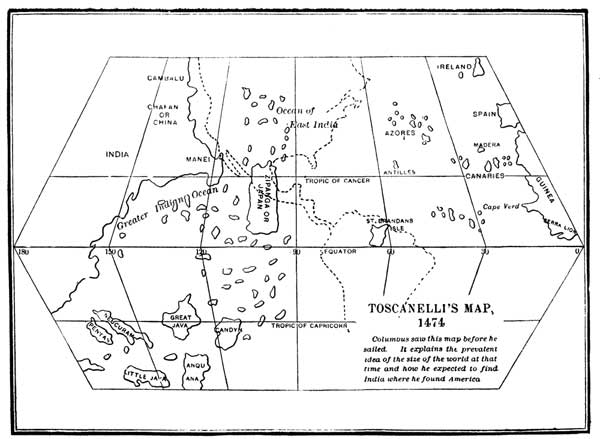
TOSCANELLI'S MAP View larger image
The statue consists of a bronze figure of Columbus eight feet two inches high, including the plinth, mounted on a pyramid of coral and limestone twelve feet high, and which, in its turn, is crowned by a capstone of dressed granite, on which the statue will rest.[42] The figure represents Columbus in an attitude of thanksgiving to God, and pointing, on the globe near his right hand, to the site of the first settlement in the New World. The statue and pedestal were made from designs drawn at the Massachusetts State Normal Art School by Mr. R. Andrew, under the direction of Prof. George Jepson, and the statue was modeled by Alois Buyens of Ghent.
The plaster cast of the monument, which has now been on exhibition at the Museum of Fine Arts at Boston for some time, has been removed to the foundry at Chicopee for casting. In a few months it will be transformed into enduring bronze, and the Columbus monument will no longer be a growing thought but a living reality. To say it has stood the critical test of art connoisseurs in the Boston public is to say but little; for, from every quarter, comments on the work of the sculptor have been highly commendatory—the bold and vigorous treatment of the Flemish school, of which Mr. Buyens is a disciple, being something of a novelty in these parts, and well calculated to strike the popular fancy, which always admires strength, especially when combined with gracefulness and high art. Not a few of the best critics have pronounced it superior to the average of similar statues to be found in and around Boston, and all unite in declaring it to be unquestionably a work of art, and one meriting great praise.
A recent communication from United States Consul Simpson, at Puerto Plata, announces that he has lately visited Isabella, in the interest of the monument. He made a careful survey of the site of the ancient town, and cleared the grounds of the trees and masses of trailing vines that encumbered the ruins, and after a thorough examination, assisted by the people of the neighborhood, he found the remains of the first church.
Other communications have been received from the Dominican government approving of the change of plan, substituting the statue for the simple stone monument, and offering the memorial committee the hospitalities of the island. And so the work goes on.
The monument, when erected, will commemorate two things—the establishment of Christianity and the rise of civilization in the New World. On the spot where it will stand Columbus built the first church 400 years ago.
One bronze relief shows the great discoverer in the fore-ground on bended knees with a trowel in his hand, laying the corner-stone. On the right, sits an ideal female figure, representing Mother Church, fostering a little Indian child, and pointing with uplifted hand to the cross, the emblem of man's salvation. Crouching Indians are at her feet, listening with astonishment to the strange story, while on the left of the cross are monks with bowed heads and lighted tapers, and in the distance are Spanish cavaliers and hidalgos.
The conception is thoroughly Catholic, Christian, simple, and artistic; it tells its own story with a pathos and directness not often found in works of this kind.
The second tablet is more ideal and more severely classical than the first. The genius of civilization, bearing gifts, is carried in a chariot drawn by prancing horses. The Admiral, at the horses' heads, with one hand points the way for her to follow, while with the other he hands the reins to Columbia, the impersonation of the New World. An Indian at the chariot wheels stoops to gather the gifts of civilization as they fall from the cornucopia borne by the goddess. And thus is told in enduring bronze, by the genius of the artist, the symbolic story of the introduction of civilization to the New World.
Upon the face of the pedestal, a third tablet bears the inscription which was written at the instance of Very Rev. Dr. Charles B. Rex, president of the Brighton Theological Seminary. Mgr. Schroeder, the author, interprets the meaning of the whole, in terse rhythmical Latin sentences, after the Roman lapidary style:
Anno. claudente. sæculum XV. Ex. quo. coloni. Christiani. Columbo. Duce Hic. post. oppidum. constitutum Primum. in. mundo. novo. templum Christo. Deo. dicarunt Ephemeris. Bostoniensis Cui. a. sacro. corde. est. nomen Sub. auspice. civium. Bostoniæ Ne. rei. tantæ. memoria. unquam. delabatur Hæc. marmori. commendavit. A. D. MDCCCLXXXXII. (Translation of the Inscription.) Toward the close of the fifteenth century, Christian colonists, under the leadership of Columbus, Here on this spot built the first settlement, And the first church dedicated To Christ our Lord In the new world. A Boston paper, called the Sacred Heart Review, Under the auspices of the citizens of Boston, That the memory of so great an event might not be forgotten, Hath erected this monument, A. D. 1892.
The question is sometimes asked why are Catholics specially interested, and why should the Review trouble itself to erect this monument. The answer is this: We wish to locate the spot with some distinctive mark where civilization was first planted and where Christianity reared its first altar on this soil, 400 years ago. By this public act of commemoration we hope to direct public attention to this modest birthplace of our Mother Church, which stands to-day deserted and unhonored like a pauper's grave, a monument of shame to the carelessness and indifference of millions of American Catholics.
Why should we be specially interested? Because here on this spot the Catholic church first saw the light of day in America; here the first important act of the white man was the celebration of the holy mass, the supreme act of Catholic worship; here the first instrument of civilization that pierced the virgin soil was a cross, and here the first Catholic anthems resounding through the forest primeval, and vying in sweetness and melody with the song of birds, were the Te Deum Laudamus and the Gloria in Excelsis. Sculptured marble and engraved stone we have in abundance, and tablets without number bear record to deeds and historical events of far less importance than this. For, mark well what these ruins and this monument stand for.
One hundred and twenty-six years before the Congregationalist church landed on Plymouth Rock, 110 years before the Anglican church came to Jamestown, and thirty-five years before the word Protestant was invented, this church was erected, and the gospel announced to the New World by zealous missionaries of the Catholic faith. No other denomination of Christians in America can claim priority or even equal duration with us in point of time. No other can show through all the centuries of history such generous self-sacrifice and heroic missionary efforts. No other has endured such misrepresentation and bitter persecution for justice's sake. If her history here is a valuable heritage, we to whom it has descended are in duty bound to keep it alive in the memory and hearts of her children. We have recently celebrated the centennial of the Church in the United States; but, for a still greater reason, we should now prepare to celebrate the quadro-centennial of the Church in America. And this is why Catholics should be specially interested in this monument. Columbus himself was a deeply religious man. He observed rigorously the fasts and ceremonies of the Church, reciting daily the entire canonical office. He began everything he wrote with the Jesu cum Maria sit nobis in via (May Jesus and Mary be always with us). And as Irving, his biographer, says, his piety did not consist in mere forms, but partook of that lofty and solemn enthusiasm which characterized his whole life. In his letter to his sovereigns announcing his discovery he indulges in no egotism, but simply asks "Spain to exhibit a holy joy, for Christ rejoices on earth as in heaven seeing the future redemption of souls." And so his religion bursts out and seems to pervade everything he touches. With such a man to commemorate and honor, there is special reason why Catholics, and the Review, which represents them, should busy themselves with erecting a Columbus monument.
But the name and fame and beneficent work of Columbus belong to the whole Christian world. While Catholics with gratitude recall his fortitude and heroism, and thank God, who inspired him with a firm faith and a burning charity for God and man, yet Protestants no less than Catholics share in the fruit of his work, and, we are glad to say, vie with Catholics in proclaiming and honoring his exalted character, his courage, fortitude, and the beneficent work he accomplished for mankind. Hence Dr. Edward Everett Hale, in his recent article on Columbus in the Independent, voices the sentiment of every thoughtful, intelligent Protestant when he says, "No wonder that the world of America loves and honors the hero whose faith and courage called America into being. No wonder that she celebrates the beginning of a new century with such tributes of pride and hope as the world has never seen before." It is this same becoming sentiment of gratitude which has prompted so many worthy Protestants to enroll their names on the list of gentlemen who are helping the Review to mark and honor the spot Columbus chose for the first Christian settlement on this continent.
Thus, so long as the bronze endures, the world will know that we venerate the character and achievements of Columbus, and the spot where Christian civilization took its rise in the New World.
FROM THE ITALIAN.
The daring mariner shall urge far o'er The western wave, a smooth and level plain, Albeit the earth is fashioned like a wheel.
SEARCHER OF THE OCEAN.
Samuel Jefferson, a British author. From his epic poem, "Columbus," published by S. C. Griggs & Co., Chicago.[43]
Thou searcher of the ocean, thee to sing Shall my devoted lyre awake each string! Columbus! Hero! Would my song could tell How great thy worth! No praise can overswell The grandeur of thy deeds! Thine eagle eye Pierced through the clouds of ages to descry From empyrean heights where thou didst soar With bright imagination winged by lore— The signs of continents as yet unknown; Across the deep thy keen-eyed glance was thrown; Thou, with prevailing longing, still aspired To reach the goal thy ardent soul desired; Thy heavenward soaring spirit, bold, elate, Scorned long delay and conquered chance and fate; Thy valor followed thy far-searching eyes, Until success crowned thy bold emprize.
FELIPA, WIFE OF COLUMBUS.
Annie Fellows Johnston. From a poem published in Harper's Weekly, June 25, 1892.[44]
More than the compass to the mariner Wast thou, Felipa, to his dauntless soul. Through adverse winds that threatened wreck, and nights Of rayless gloom, thou pointed ever to The north star of his great ambition. He Who once has lost an Eden, or has gained A paradise by Eve's sweet influence, Alone can know how strong a spell lies in The witchery of a woman's beckoning hand. And thou didst draw him, tidelike, higher still, Felipa, whispering the lessons learned From thy courageous father, till the flood Of his ambition burst all barriers, And swept him onward to his longed-for goal. Before the jewels of a Spanish queen Built fleets to waft him on his untried way, Thou gavest thy wealth of wifely sympathy To build the lofty purpose of his soul. And now the centuries have cycled by, Till thou art all forgotten by the throng That lauds the great Pathfinder of the deep. It matters not, in that infinitude Of space where thou dost guide thy spirit bark To undiscovered lands, supremely fair. If to this little planet thou couldst turn And voyage, wraithlike, to its cloud-hung rim, Thou wouldst not care for praise. And if, perchance, Some hand held out to thee a laurel bough, Thou wouldst not claim one leaf, but fondly turn To lay thy tribute also at his feet.
INCREASING INTEREST IN COLUMBUS.
John S. Kennedy, an American author.
The near approach of the 400th anniversary of the discovery of America has revived in all parts of the civilized world great interest in everything concerning that memorable event and the perilous voyage of the great navigator whom it has immortalized.
THE MECCA OF THE NATION.
Moses King, an American geographer of the nineteenth century.
I have read somewhere that in the northeastern part of Havana stands, facing an open square, a brown stone church, blackened by age, and dignified by the name of "cathedral." It is visited by every American, because within its walls lies buried all that remains of the great discoverer, Columbus.
THE CAUSE OF THE DISCOVERY.
Was it by the coarse law of demand and supply that a Columbus was haunted by the ghost of a round planet at the time when the New World was needed for the interests of civilization?—Ibid.
MAGNANIMITY.
Arthur G. Knight, in his "Life of Columbus."
Through all the slow martyrdom of long delays and bitter disappointments, he never faltered in his lofty purpose; in the hour of triumph he was self-possessed and unassuming; under cruel persecution he was patient and forgiving. For almost unexampled services he certainly received a poor reward on earth.
THE IDEAS OF THE ANCIENTS.
Lucius Lactantius, an eminent Christian author, 260-325 A. D.
Is there any one so foolish as to believe that there are antipodes with their feet opposite to ours; that there is a part of the world in which all things are topsy-turvy, where the trees grow with their branches downward, and where it rains, hails, and snows upward?
THE LAKE FRONT PARK STATUE OF COLUMBUS.
The World's Fair city is a close competitor with the historic cities of the Old World for the grandest monument to Columbus and the fittest location for it. At Barcelona, on the Paseo Colon, seaward, a snowy marble Admiral looks toward the Shadowy Sea. At Genoa, 'mid the palms of the Piazza Acquaverde, a noble representation of the noblest Genoese faces the fitful gusts of the Mediterranean and fondly guards an Indian maid. A lofty but rude cairn marks the Admiral's first footprints on the shores of the wreck-strewn Bahamas, and many a monument or encomiastic inscription denotes spots sacred to the history of his indomitable resolve. These all commemorate, as it were, but the inception of the great discovery. It remains for Chicago to perpetuate the results, and most fitly to place an heroic figure of the first Admiral viewing, and in full view of all.
On the Lake Front Park, in full view of the ceaseless commercial activity of the Great Lakes, and close by the hum of the hive of human industry, grandly will a bronze Columbus face the blasts from Michigan's bosom. There the greatest navigator stands,
Calm, his prescience verified,
proudly through the ages watching the full fruits of that first and fateful voyage over the waves of the seas of mystery, to found a nation where Freedom alone should be supreme. Just where the big monument will be located on Lake Front Park has not been decided, but a site south of the Auditorium, midway between the Illinois Central tracks and Michigan Boulevard, will perhaps be chosen. The statue proper will be twenty feet high. It will be of bronze, mounted on a massive granite pedestal, of thirty feet in height, and will serve for all time as a memorial of the Exposition.
The chosen artist, out of the many who submitted designs, was Mr. Howard Kretschmar, a Chicago sculptor of rare power and artistic talent.
The massive figure of Columbus is represented at the moment the land, and the glorious future of his great discovery, burst upon his delighted gaze. No ascetic monk, no curled cavalier, looks down from the pedestal. The apocryphal portraits of Europe may peer out of their frames in this guise, but it has been the artist's aim here to chisel a man, not a monk; and a noble man, rather than a cringing courtier. Above the massive pedestal of simple design, which bears the terse legend, "Erected by the World's Columbian Exposition, A. D. 1893," stands the noble figure of the Noah of our nation. The open doublet discloses the massive proportions of a more than well-knit man. The left hand, pressed to the bosom, indicates the tension of his feelings, and the outstretched hand but further intensifies the dawning and gradually o'erwhelming sense of the future, the possibilities of his grand discovery. One of the noblest conceptions in bronze upon this continent is Mr. Howard Kretschmar's "Columbus," and of it may Chicago well be proud.
COLUMBUS THE CIVILIZER.
Alphonse Lamartine, the learned French writer and politician. Born at Macon, 1792; died, 1869. From "Life of Columbus."
All the characteristics of a truly great man are united in Columbus. Genius, labor, patience, obscurity of origin, overcome by energy of will; mild but persisting firmness, resignation toward heaven, struggle against the world; long conception of the idea in solitude, heroic execution of it in action; intrepidity and coolness in storms, fearlessness of death in civil strife; confidence in the destiny—not of an individual, but of the human race; a life risked without hesitation or retrospect in venturing into the unknown and phantom-peopled ocean, 1,500 leagues across, and on which the first step no more allowed of second thoughts than Cæsar's passage of the Rubicon; untiring study, knowledge as extensive as the science of his day, skillful but honorable management of courts to persuade them to truth; propriety of demeanor, nobleness, and dignity in outward bearing, which afford proof of greatness of mind and attracts eyes and hearts; language adapted to the grandeur of his thoughts; eloquence which could convince kings and quell the mutiny of crews; a natural poetry of style, which placed his narrative on a par with the wonders of his discoveries and the marvels of nature; an immense, ardent, and enduring love for the human race, piercing even into that distant future in which humanity forgets those that do it service; legislative wisdom and philosophic mildness in the government of his colonies; paternal compassion for those Indians, infants of humanity, whom he wished to give over to the guardianship—not to the tyranny and oppression—of the Old World; forgetfulness of injury and magnanimous forgiveness of his enemies; and lastly, piety, that virtue which includes and exalts all other virtues, when it exists as it did in the mind of Columbus—the constant presence of God in the soul, of justice in the conscience, of mercy in the heart, of gratitude in success, of resignation in reverses, of worship always and everywhere.
Such was the man. We know of none more perfect. He contains several impersonations within himself. He was worthy to represent the ancient world before that unknown continent on which he was the first to set foot, and carry to these men of a new race all the virtues, without any of the vices, of the elder hemisphere. So great was his influence on the destiny of the earth, that none more than he ever deserved the name of a Civilizer.
His influence in civilization was immeasurable. He completed the world. He realized the physical unity of the globe. He advanced, far beyond all that had been done before his time, the work of God—the SPIRITUAL UNITY OF THE HUMAN RACE. This work, in which Columbus had so largely assisted, was indeed too great to be worthily rewarded even by affixing his name to the fourth continent. America bears not that name, but the human race, drawn together and cemented by him, will spread his renown over the whole earth.
THE PSALM OF THE WEST.
Sidney Lanier, an American poet of considerable talent. Born at Macon, Ga., February 3, 1842; died at Lynn, N. C., September 8, 1881. From his "Psalm of the West."[45] Lanier was the author of the "Centennial Ode."
Santa Maria, well thou tremblest down the wave, Thy Pinta far abow, thy Niña nigh astern; Columbus stands in the night alone, and, passing grave, Yearns o'er the sea as tones o'er under-silence yearn. Heartens his heart as friend befriends his friend less brave, Makes burn the faiths that cool, and cools the doubts that burn. "'Twixt this and dawn, three hours my soul will smite With prickly seconds, or less tolerably With dull-blade minutes flatwise slapping me. Wait, heart! Time moves. Thou lithe young Western Night, Just-crowned King, slow riding to thy right, Would God that I might straddle mutiny Calm as thou sitt'st yon never-managed sea, Balk'st with his balking, fliest with his flight, Giv'st supple to his rearings and his falls, Nor dropp'st one coronal star about thy brow, Whilst ever dayward thou art steadfast drawn Yea, would I rode these mad contentious brawls, No damage taking from their If and How, Nor no result save galloping to my Dawn. "My Dawn? my Dawn? How if it never break? How if this West by other Wests is pierced. And these by vacant Wests and Wests increased— One pain of space, with hollow ache on ache, Throbbing and ceasing not for Christ's own sake? Big, perilous theorem, hard for king and priest; 'Pursue the West but long enough, 'tis East!' Oh, if this watery world no turning take; Oh, if for all my logic, all my dreams, Provings of that which is by that which seems, Fears, hopes, chills, heats, hastes, patiences, droughts, tears, Wife-grievings, slights on love, embezzled years, Hates, treaties, scorns, upliftings, loss, and gain, This earth, no sphere, be all one sickening plain. "Or, haply, how if this contrarious West, That me by turns hath starved, by turns hath fed, Embraced, disgraced, beat back, solicited, Have no fixed heart of law within his breast; Or with some different rhythm doth e'er contest, Nature in the East? Why, 'tis but three weeks fled I saw my Judas needle shake his head And flout the Pole that, East, he lord confessed! God! if this West should own some other Pole, And with his tangled ways perplex my soul Until the maze grow mortal, and I die Where distraught Nature clean hath gone astray, On earth some other wit than Time's at play, Some other God than mine above the sky! "Now speaks mine other heart with cheerier seeming; 'Ho, Admiral! o'er-defalking to thine crew Against thyself, thyself far overfew To front yon multitudes of rebel scheming?' Come, ye wild twenty years of heavenly dreaming! Come, ye wild weeks, since first this canvas drew Out of vexed Palos ere the dawn was blue, O'er milky waves about the bows full-creaming! Come, set me round with many faithful spears Of confident remembrance—how I crushed Cat-lived rebellions, pitfalled treasons, hushed Scared husbands' heart-break cries on distant wives, Made cowards blush at whining for their lives; Watered my parching souls and dried their tears. "Ere we Gomera cleared, a coward cried: 'Turn, turn; here be three caravels ahead, From Portugal, to take us; we are dead!' 'Hold westward, pilot,' calmly I replied. So when the last land down the horizon died, 'Go back, go back,' they prayed, 'our hearts are lead.' 'Friends, we are bound into the West,' I said. Then passed the wreck of a mast upon our side. 'See (so they wept) God's warning! Admiral, turn!' 'Steersman,' I said, 'hold straight into the West.' Then down the night we saw the meteor burn. So do the very heavens in fire protest. 'Good Admiral, put about! O Spain, dear Spain!' 'Hold straight into the West,' I said again. "Next drive we o'er the slimy-weeded sea, 'Lo! here beneath,' another coward cries, 'The cursed land of sunk Atlantis lies; This slime will suck us down—turn while thou'rt free!' 'But no!' I said, 'freedom bears West for me!' Yet when the long-time stagnant winds arise, And day by day the keel to westward flies, My Good my people's Ill doth come to be; Ever the winds into the west do blow; Never a ship, once turned, might homeward go; Meanwhile we speed into the lonesome main. 'For Christ's sake, parley, Admiral! Turn, before We sail outside all bounds of help from pain.' 'Our help is in the West,' I said once more. "So when there came a mighty cry of Land! And we clomb up and saw, and shouted strong 'Salve Regina!' all the ropes along, But knew at morn how that a counterfeit band Of level clouds had aped a silver strand; So when we heard the orchard-bird's small song, And all the people cried, 'A hellish throng To tempt us onward, by the Devil planned, Yea, all from hell—keen heron, fresh green weeds, Pelican, tunny-fish, fair tapering reeds, Lie-telling lands that ever shine and die In clouds of nothing round the empty sky. 'Tired Admiral, get thee from this hell, and rest!' 'Steersman,' I said, 'hold straight into the West.'
"I marvel how mine eye, ranging the Night, From its big circling ever absently Returns, thou large, low star, to fix on thee. Maria! Star? No star; a Light, a Light! Wouldst leap ashore, Heart? Yonder burns a Light! 'Pedro Gutierrez, wake! come up to me. I prithee stand and gaze about the sea; What seest?' 'Admiral, like as land—a Light!' 'Well, Sanchez of Segovia come and try; What seest?' 'Admiral, naught but sea and sky!' 'Well, but I saw it. Wait, the Pinta's gun! Why, look! 'tis dawn! the land is clear; 'tis done! Two dawns do break at once from Time's full hand— God's East—mine, West! Good friends, behold my Land!'"
PASSION FOR GOLD.
Eugene Lawrence, an American historical writer. Born in New York, 1823. From "The Mystery of Columbus," in Harper's Magazine, May, 1892.[46]
In Columbus the passion for gold raged with a violence seldom known. He dreamed of golden palaces, heaps of treasure, and mines teeming with endless wealth. His cry was everywhere for gold. Every moment, in his fierce avarice, he would fancy himself on the brink of boundless opulence; he was always about to seize the treasures of the East, painted by Marco Polo and Mandeville. "Gold," he wrote to the King and Queen, "is the most valuable thing in the world; it rescues souls from purgatory and restores them to the joys of paradise."
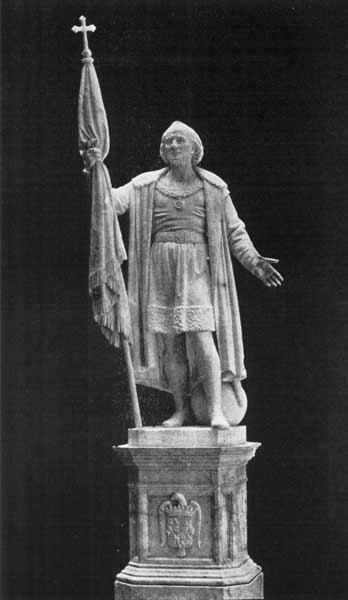
STATUE OF CHRISTOPHER COLUMBUS IN THE MARIÑOL (MINISTRY OF THE COLONIES), MADRID, SPAIN. Sculptor, Señor J. Samartin.
THE TRIBUTE AND TESTIMONY OF THE POPE.
Pope Leo XIII., the Supreme Pontiff of the Roman Catholic Church. From a letter in Chicago Inter Ocean, 1892.
While we see on all sides the preparations that are eagerly being made for the celebration of the Columbian quadri-centenary feasts in memory of a man most illustrious, and deserving of Christianity and all cultured humanity, we hear with great pleasure that the United States has, among other nations, entered this competition of praise in such a manner as befits both the vastness and richness of the country and the memory of the man so great as he to whom these honors are being shown. The success of this effort will surely be another proof of the great spirit and active energy of this people, who undertake enormous and difficult tasks with such great and happy dealing. It is a testimony of honor and gratitude to that immortal man of whom we have spoken, who, desirous of finding a road by which the light and truth and all the adornments of civil culture might be carried to the most distant parts of the world, could neither be deterred by dangers nor wearied by labors, until, having in a certain manner renewed the bonds between two parts of the human race so long separated, he bestowed upon both such great benefits that he in justice must be said to have few equals or a superior.
COLUMBUS THE GLORY OF CATHOLICISM.
The Pope held a reception at the Vatican on the occasion of the festival of his patron saint, St. Joachim. In an address he referred to Columbus as the glory of Catholicism, and thanked the donors of the new Church of St. Joachim for commemorating his jubilee.
THE POPE REVIEWS THE LIFE OF THE DISCOVERER.
The following is the text of the letter addressed by Leo XIII. to the archbishops and bishops of Spain, Italy, and the two Americas on the subject of Christopher Columbus.
LETTER OF OUR VERY HOLY FATHER, LEO XIII., POPE BY DIVINE PROVIDENCE, TO THE ARCHBISHOPS AND BISHOPS OF SPAIN, ITALY, AND OF THE TWO AMERICAS, UPON CHRISTOPHER COLUMBUS.
To the Archbishops and Bishops of Spain and Italy, and of the two Americas. Leo XIII., Pope.
Venerable Brothers, Greeting and Apostolic Benediction: From the end of the fifteenth century, since a man from Liguria first landed, under the auspices of God, on the transatlantic shores, humanity has been strongly inclined to celebrate with gratitude the recollection of this event. It would certainly not be an easy matter to find a more worthy cause to touch their hearts and to inflame their zeal. The event, in effect, is such in itself that no other epoch has seen a grander and more beautiful one accomplished by man.
As to who accomplished it, there are few who can be compared to him in greatness of soul and genius. By his work a new world flashed forth from the unexplored ocean, thousands upon thousands of mortals were returned to the common society of the human race, led from their barbarous life to peacefulness and civilization, and, which is of much more importance, recalled from perdition to eternal life by the bestowal of the gifts which Jesus Christ brought to the world.
Europe, astonished alike by the novelty and the prodigiousness of this unexpected event, understood little by little, in due course of time, what she owed to Columbus, when, by sending colonies to America, by frequent communications, by exchange of services, by the resources confided to the sea and received in return, there was discovered an accession of the most favorable nature possible to the knowledge of nature, to the reciprocal abundance of riches, with the result that the prestige of Europe increased enormously.
Therefore, it would not be fitting, amid these numerous testimonials on honor, and in these concerts of felicitations, that the Church should maintain complete silence, since, in accordance with her character and her institution, she willingly approves and endeavors to favor all that appears, wherever it is, to be worthy of honor and praise. Undoubtedly she receives particular and supreme honors to the virtues pre-eminent in regard to morality, inasmuch as they are united to the eternal salvation of souls; nevertheless, she does not despise the rest, neither does she abstain from esteeming them as they deserve; it is even her habit to favor with all her power and to always have in honor those who have well merited of human society and who have passed to posterity.
Certainly, God is admirable in His saints, but the vestiges of His divine virtues appear as imprinted in those in whom shines a superior force of soul and mind, for this elevation of heart and this spark of genius could only come from God, their author and protector.
It is in addition an entirely special reason for which we believe we should commemorate in a grateful spirit this immortal event. It is that Columbus is one of us. When one considers with what motive above all he undertook the plan of exploring the dark sea, and with what object he endeavored to realize this plan, one can not doubt that the Catholic faith superlatively inspired the enterprise and its execution, so that by this title, also, humanity is not a little indebted to the Church.
There are without doubt many men of hardihood and full of experience who, before Christopher Columbus and after him, explored with persevering efforts unknown lands across seas still more unknown. Their memory is celebrated, and will be so by the renown and the recollection of their good deeds, seeing that they have extended the frontiers of science and of civilization, and that not at the price of slight efforts, but with an exalted ardor of spirit, and often through extreme perils. It is not the less true that there is a great difference between them and him of whom we speak.
The eminently distinctive point in Columbus is, that in crossing the immense expanses of the ocean he followed an object more grand and more elevated than the others. This does not say, doubtless, that he was not in any way influenced by the very praiseworthy desire to be master of science, to well deserve the approval of society, or that he despised the glory whose stimulant is ordinarily more sensitive to elevated minds, or that he was not at all looking to his own personal interests. But above all these human reasons, that of religion was uppermost by a great deal in him, and it was this, without any doubt, which sustained his spirit and his will, and which frequently, in the midst of extreme difficulties, filled him with consolation. He learned in reality that his plan, his resolution profoundly carved in his heart, was to open access to the gospel in new lands and in new seas.
This may seem hardly probable to those who, concentrating all their care, all their thoughts, in the present nature of things, as it is perceived by the senses, refuse to look upon greater benefits. But, on the other hand, it is the characteristic of eminent minds to prefer to elevate themselves higher, for they are better disposed than all others to seize the impulses and the inspirations of the divine faith. Certainly, Columbus had united the study of nature to the study of religion, and he had conformed his mind to the precepts intimately drawn from the Catholic faith.
It is thus that, having learned by astronomy and ancient documents that beyond the limits of the known world there were, in addition, toward the west, large tracts of territory unexplored up to that time by anybody, he considered in his mind the immense multitude of those who were plunged in lamentable darkness, subject to insensate rites and to the superstitions of senseless divinities. He considered that they miserably led a savage life, with ferocious customs; that, more miserably still, they were wanting in all notion of the most important things, and that they were plunged in ignorance of the only true God.
Thus, in considering this in himself, he aimed first of all to propagate the name of Christianity and the benefits of Christian charity in the West. As a fact, as soon as he presented himself to the sovereigns of Spain, Ferdinand and Isabella, he explained the cause for which they were not to fear taking a warm interest in the enterprise, as their glory would increase to the point of becoming immortal if they decided to carry the name and the doctrine of Jesus Christ into such distant regions. And when, not long afterward, his prayers were granted, he called to witness that he wished to obtain from God that these sovereigns, sustained by His help and His mercy, should persevere in causing the gospel to penetrate upon new shores and in new lands.
He conceived in the same manner the plan of asking Alexander VI. for apostolic men, by a letter in which these words are found: "I hope that it will some day be given to me with the help of God to propagate afar the very holy name of Jesus Christ and his gospel." Also can one imagine him all filled with joy when he wrote to Raphael Sanchez, the first who from the Indies had returned to Lisbon, that immortal actions of grace must be rendered to God in that he had deigned to cause to prosper the enterprise so well, and that Jesus Christ could rejoice and triumph upon earth and in heaven for the coming salvation of innumerable people who previously had been going to their ruin. That, if Columbus also asks of Ferdinand and Isabella to permit only Catholic Christians to go to the New World, there to accelerate trade with the natives, he supports this motive by the fact that by his enterprise and efforts he has not sought for anything else than the glory and the development of the Christian religion.
This was what was perfectly known to Isabella, who, better than any other person, had penetrated the mind of such a great man; much more, it appears that this same plan was fully adopted by this very pious woman of great heart and manly mind. She bore witness, in effect, of Columbus, that in courageously giving himself up to the vast ocean, he realized, for the divine glory, a most signal enterprise; and to Columbus himself, when he had happily returned, she wrote that she esteemed as having been highly employed the resources which she had consecrated and which she would still consecrate to the expeditions in the Indies, in view of the fact that the propagation of Catholicism would result from them.
Also, if he had not inspired himself from a cause superior to human interests, where then would he have drawn the constancy and the strength of soul to support what he was obliged to the end to endure and to submit to; that is to say, the unpropitious advice of the learned people, the repulses of princes, the tempests of the furious ocean, the continual watches, during which he more than once risked losing his sight.
To that add the combats sustained against the barbarians; the infidelities of his friends, of his companions; the villainous conspiracies, the perfidiousness of the envious, the calumnies of the traducers, the chains with which, after all, though innocent, he was loaded. It was inevitable that a man overwhelmed with a burden of trials so great and so intense would have succumbed had he not sustained himself by the consciousness of fulfilling a very noble enterprise, which he conjectured would be glorious for the Christian name and salutary for an infinite multitude.
And the enterprise so carried out is admirably illustrated by the events of that time. In effect, Columbus discovered America at about the period when a great tempest was going to unchain itself against the Church. Inasmuch as it is permitted by the course of events to appreciate the ways of divine Providence, it really seems that the man for whom the Liguria honors herself was destined by special plan of God to compensate Catholicism for the injury which it was going to suffer in Europe.
To call the Indian race to Christianity, this was, without doubt, the mission and the work of the Church in this mission. From the beginning, she continued to fulfill it with an uninterrupted course of charity, and she still continues it, having advanced herself recently so far as the extremities of Patagonia.
Thus, when compelled by the Portuguese, by the Genoese, to leave without having obtained any result, he went to Spain. He matured the grand plan of the projected discovery in the midst of the walls of a convent, with the knowledge of and with the advice of a monk of the Order of St. Francis d'Assisi, after seven years had revolved. When at last he goes to dare the ocean, he takes care that the expedition shall comply with the acts of spiritual expiation; he prays to the Queen of Heaven to assist the enterprise and to direct its course, and before giving the order to make sail he invokes the august divine Trinity. Then, once fairly at sea, while the waters agitate themselves, while the crew murmurs, he maintains, under God's care, a calm constancy of mind.
His plan manifests itself in the very names which he imposes on the new islands, and each time that he is called upon to land upon one of them he worships the Almighty God, and only takes possession of it in the name of Jesus Christ. At whatever coast he approaches he has nothing more as his first idea than the planting on the shore of the sacred sign of the cross; and the divine name of the Redeemer, which he had sung so frequently on the open sea to the sound of the murmuring waves—he is the first to make it reverberate in the new islands in the same way. When he institutes the Spanish colony he causes it to be commenced by the construction of a temple, where he first provides that the popular fêtes shall be celebrated by august ceremonies.
Here, then, is what Columbus aimed at and what he accomplished when he went in search, over so great an expanse of sea and of land, of regions up to that time unexplored and uncultivated, but whose civilization, renown, and riches were to rapidly attain that immense development which we see to-day.
In all this, the magnitude of the event, the efficacy and the variety of the benefits which have resulted from it, tend assuredly to celebrate he, who was the author of it, by a grateful remembrance and by all sorts of testimonials of honor; but, in the first place, we must recognize and venerate particularly the divine project, to which the discoverer of the New World was subservient and which he knowingly obeyed.
In order to celebrate worthily and in a manner suitable to the truth of the facts the solemn anniversary of Columbus, the sacredness of religion must be united to the splendor of the civil pomp. This is why, as previously, at the first announcement of the event, public actions of grace were rendered to the providence of the immortal God, upon the example which the Supreme Pontiff gave; the same also now, in celebrating the recollection of the auspicious event, we esteem that we must do as much.
We decree to this effect, that the day of October 12th, or the following Sunday, if the respective diocesan bishops judge it to be opportune, that, after the office of the day, the solemn mass of the very Holy Trinity shall be celebrated in the cathedral and collegial churches of Spain, Italy, and the two Americas. In addition to these countries, we hope that, upon the initiative of the bishops, as much may be done in the others, for it is fitting that all should concur in celebrating with piety and gratitude an event which has been profitable to all.
In the meanwhile, as a pledge of the celestial favors and in testimony of our fraternal good-will, we affectionately accord in the Lord the Apostolic benediction to you, venerable brothers, to your clergy, and to your people.
Given at Rome, near St. Peter's, July 16th of the year 1892, the fifteenth of our Pontificate.
Leo XIII., Pope.
TO SPAIN.
Capel Lofft.
O generous nation! to whose noble boast, Illustrious Spain, the providence of Heaven A radiant sky of vivid power hath given, A land of flowers, of fruits, profuse; an host Of ardent spirits; when deprest the most, By great, enthusiastic impulse driven To deeds of highest daring.
WRAPPED IN A VISION GLORIOUS.
The Rev. John Lord, LL. D., a popular American lecturer and Congregational minister. Born in Portsmouth, N. H., December 27, 1810.
Wrapped up in those glorious visions which come only to a man of superlative genius, and which make him insensible to heat and cold and scanty fare, even to reproach and scorn, this intrepid soul, inspired by a great and original idea, wandered from city to city, and country to country, and court to court, to present the certain greatness and wealth of any state that would embark in his enterprise. But all were alike cynical, cold, unbelieving, and even insulting. He opposes overwhelming universal and overpowering ideas. To have surmounted these amid such protracted opposition and discouragment constitutes his greatness; and finally to prove his position by absolute experiment and hazardous enterprise makes him one of the greatest of human benefactors, whose fame will last through all the generations of men. And as I survey that lonely, abstracted, disappointed, and derided man—poor and unimportant; so harassed by debt that his creditors seized even his maps and charts; obliged to fly from one country to another to escape imprisonment; without even listeners and still less friends, and yet with ever-increasing faith in his cause; utterly unconquerable; alone in opposition to all the world—I think I see the most persistent man of enterprise that I have read of in history. Critics ambitious to say something new may rake out slanders from the archives of enemies and discover faults which derogate from the character we have been taught to admire and venerate; they may even point out spots, which we can not disprove, in that sun of glorious brightness which shed its beneficent rays over a century of darkness—but this we know, that whatever may be the force of detraction, his fame has been steadily increasing, even on the admission of his slanderers, for three centuries, and that he now shines as a fixed star in the constellation of the great lights of modern times, not only because he succeeded in crossing the ocean when once embarked on it, but for surmounting the moral difficulties which lay in his way before he could embark upon it, and for being finally instrumental in conferring the greatest boon that our world has received from any mortal man since Noah entered into the ark.
BY THE GRACE OF GOD HE WAS WHAT HE WAS.
Rossely de Lorgues, a Catholic biographer.
Columbus did not owe his great celebrity to his genius or conscience, but only to his vocation, to his faith, and to the Divine grace.
IN HONOR OF COLUMBUS.
Archbishop Janssens of New Orleans has issued a letter to his diocese directing a general observance of the 400th anniversary of the discovery of America. The opening paragraph reads:
"Christopher Columbus was a sincere and devout Catholic; his remarkable voyage was made possible by the intercession of a holy monk and by the patronage and liberality of the pious Queen Isabella. The cross of Christ, the emblem of our holy religion, was planted on America's virgin soil, and the Te Deum and the holy mass were the first religious services held on the same. It is, therefore, just and proper that this great event and festival should be celebrated in a religious as well as a civil manner."
The Pope having set the Julian date of October 12th for the celebration, and the President October 21st, the archbishop directs that exercises be held on both these days—the first of a religious character, the second civic. October 12th a solemn votive mass will be sung in all the churches of the diocese, with an exhortation, and October 21st in the city of New Orleans the clergy will assemble at the archiepiscopal residence early in the morning and march to the cathedral, where services will be held at 7.30 o'clock. Sermons of ten minutes each are to be preached in English, French, Spanish, German, and Italian.
THE IMPREGNABLE WILL OF COLUMBUS.
James Russell Lowell, an American poet. Born in Boston, 1819; died in Cambridge, 1891. From "W. L. Garrison." Houghton, Mifflin & Co., Boston.
Such earnest natures are the fiery pith, The compact nucleus, round which systems grow. Mass after mass becomes inspired therewith, And whirls impregnate with the central glow. O Truth! O Freedom! how are ye still born In the rude stable, in the manger nursed. What humble hands unbar those gates of morn Through which the splendors of the new day burst. Whatever can be known of earth we know, Sneered Europe's wise men, in their snail-shells curled; No! said one man in Genoa, and that no Out of the dark created this New World. Men of a thousand shifts and wiles, look here; See one straightforward conscience put in pawn To win a world; see the obedient sphere By bravery's simple gravitation drawn. Shall we not heed the lesson taught of old, And by the Present's lips repeated still, In our own single manhood to be bold, Fortressed in conscience and impregnable will?
COLUMBUS THE KING OF DISCOVERERS.
He in the palace-aisles of untrod woods Doth walk a king; for him the pent-up cell Widens beyond the circles of the stars, And all the sceptered spirits of the past Come thronging in to greet him as their peer; While, like an heir new-crowned, his heart o'erleaps The blazing steps of his ancestral throne.—Ibid.
Columbus, seeking the back door of Asia, found himself knocking at the front door of America.—Ibid.
THE PATIENCE OF COLUMBUS.
From "Columbus," a poem by the same author. Published by Houghton, Mifflin & Co.
Chances have laws as fixed as planets have; And disappointment's dry and bitter root, Envy's harsh berries, and the choking pool Of the world's scorn are the right mother-milk To the tough hearts that pioneer their kind, And break a pathway to those unknown realms That in the earth's broad shadow lie enthralled; Endurance is the crowning quality, And patience all the passion of great hearts; These are their stay, and when the leaden world Sets its hard face against their fateful thought, And brute strength, like a scornful conqueror, Clangs his huge mace down in the other scale, The inspired soul but flings his patience in, And slowly that outweighs the ponderous globe— One faith against a whole world's unbelief, One soul against the flesh of all mankind.
I know not when this hope enthralled me first, But from my boyhood up I loved to hear The tall pine forests of the Apennine Murmur their hoary legends of the sea; Which hearing, I in vision clear beheld The sudden dark of tropic night shut down O'er the huge whisper of great watery wastes.
I brooded on the wise Athenian's tale Of happy Atlantis, and heard Björne's keel Crunch the gray pebbles of the Vinland shore. Thus ever seems it when my soul can hear The voice that errs not; then my triumph gleams, O'er the blank ocean beckoning, and all night My heart flies on before me as I sail; Far on I see my life-long enterprise!
Lytton (Lord). See post, "Schiller."
VESPUCCI AN ADVENTURER.
Thomas Babington, Baron Macaulay, one of England's most celebrated historians. Born at Rothley Temple, Leicestershire, October 25, 1800; died, December 28, 1859.
Vespucci, an adventurer who accidentally landed in a rich and unknown island, and who, though he only set up an ill-shaped cross upon the shore, acquired possession of its treasures and gave his name to a continent which should have derived its appellation from Columbus.
COLUMBUS NEITHER A VISIONARY NOR AN IMBECILE.
Charles P. Mackie, an American author. From his "With the Admiral of the Ocean Sea." Published by Messrs. A. C. McClurg & Co., Chicago.
Whatever were his mistakes and shortcomings, Colon was neither a visionary nor an imbecile. Had he been perfect in all things and wise to the point of infallibility, we could not have claimed him as the glorious credit he was to the common humanity to which we all belong. His greatness was sufficient to cover with its mantle far more of the weaknesses of frail mortality than he had to draw under its protection; and it becomes us who attempt to analyze his life in these later days, to bear in mind that, had his lot befallen ourselves, the natives of the western world would still, beyond a peradventure, be wandering in undraped peace through their tangled woods, and remain forever ignorant of the art of eating meat. In his trials and distresses the Admiral encountered only the portion of the sons of Adam; but to him was also given, as to few before or since, to say with the nameless shepherd of Tempe's classic vale, "I, too, have lived in Arcady."
Colon did not merely discover the New World. He spent seven years and one month among the islands and on the coasts of the hemisphere now called after the ship-chandler who helped to outfit his later expeditions. For the greater part of that time he was under the constant burden of knowing that venomous intrigue and misrepresentation were doing their deadly work at home while he did what he believed was his Heaven-imposed duty on this side the Atlantic.
THE COLUMBUS MONUMENT IN MADRID.
At the top of the Paseo de Recoletos is a monument to Columbus in the debased Gothic style of Ferdinand and Isabella. It was unveiled in 1885. The sides are ornamented with reliefs and the whole surmounted by a white marble statue. Among the sculptures are a ship and a globe, with the inscription:
Á Castilla y á Leon Nuevo mundo dió Colon. (Translation.) To Castille and Leon Columbus gave a new world.
VISIT OF COLUMBUS TO ICELAND.
Finn Magnusen, an Icelandic historian and antiquary. Born at Skalholt, 1781; died, 1847.
The English trade with Iceland certainly merits the consideration of historians, if it furnished Columbus with the opportunity of visiting that island, there to be informed of the historical evidence respecting the existence of important lands and a large continent in the west. If Columbus should have acquired a knowledge of the accounts transmitted to us of the discoveries of the Northmen in conversations held in Latin with the Bishop of Skalholt and the learned men of Iceland, we may the more readily conceive his firm belief in the possibility of rediscovering a western continent, and his unwearied zeal in putting his plans in execution. The discovery of America, so momentous in its results, may therefore be regarded as the mediate consequence of its previous discovery by the Scandinavians, which may be thus placed among the most important events of former ages.
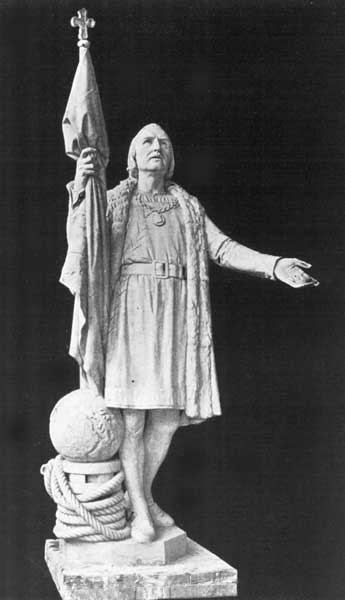
STATUE OF COLUMBUS, BY SENOR G. SUÑOL, ON THE MONUMENT IN THE PASEO DE RECOLETOS (DEVOTEES' PROMENADE), MADRID, SPAIN. Erected, 1885. (See page 209.)
SYMPATHY FOR COLUMBUS.
Richard Henry Major, F. S. A., late keeper of the printed books in the British Museum; a learned antiquary. Born in London, 1810; died June 25, 1891.
It is impossible to read without the deepest sympathy the occasional murmurings and half-suppressed complaints which are uttered in the course of his letter to Ferdinand and Isabella describing his fourth voyage. These murmurings and complaints were rung from his manly spirit by sickness and sorrow, and though reduced almost to the brink of despair by the injustice of the King, yet do we find nothing harsh or disrespectful in his language to the sovereign. A curious contrast is presented to us. The gift of a world could not move the monarch to gratitude; the infliction of chains, as a recompense for that gift, could not provoke the subject to disloyalty. The same great heart which through more than twenty wearisome years of disappointment and chagrin gave him strength to beg and buffet his way to glory, still taught him to bear with majestic meekness the conversion of that glory into unmerited shame.
We look back with astonishment and admiration at the stupendous achievement effected a whole lifetime later by the immortal Columbus—an achievement which formed the connecting link between the Old World and the New; yet the explorations instituted by Prince Henry of Portugal were in truth the anvil upon which that link was forged.
He arrived in a vessel as shattered as his own broken and careworn frame.
COLUMBUS HEARD OF NORSE DISCOVERIES.
Conrad Malte-Brun, a Danish author and geographer of great merit. Born at Thister in Jutland, 1775; died, December, 1826.
Columbus, when in Italy, had heard of the Norse discoveries beyond Iceland, for Rome was then the world's center, and all information of importance was sent there.
COLUMBUS AND COPERNICUS.
Helen P. Margesson, in an article entitled "Marco Polo's Explorations, and their Influence upon Columbus" (being the Old South First Prize Essay, 1891), published in the New England Magazine, August, 1892.
Columbus performed his vast undertaking in an age of great deeds and great men, when Ficino taught the philosophy of Plato, when Florence was thrilled by the luring words and martyrdom of Savonarola, when Michael Angelo wrought his everlasting marvels of art. While Columbus, in his frail craft, was making his way to "worlds unknown, and isles beyond the deep," on the shores of the Baltic a young novitiate, amid the rigors of a monastic life, was tracing the course of the planets, and solving the problem in which Virgil delighted[47]—problems which had baffled Chaldean and Persian, Egyptian and Saracen. Columbus explained the earth, Copernicus explained the heavens. Neither of the great discoverers lived to see the result of his labors, for the Prussian astronomer died on the day that his work was published. But the centuries that have come and gone have only increased the fame of Columbus and Copernicus, and proven the greatness of their genius.
COLUMBUS AND THE FOURTH CENTENARY OF HIS DISCOVERY.
Commander Clements Robert Markham, R. N., C. B., F. R. S., a noted explorer and talented English author. Midshipman in H. M. S. Assistance in the Franklin Search Expedition, 1850-51. Born July 20, 1830, at Stillingfleet, near York. From a paper read before the Royal Geographical Society of England, June 20, 1892.
In the present year the fourth centenary of the discovery of America by Columbus will be celebrated with great enthusiasm in Spain, in Italy, and in America. That discovery was, without any doubt, the most momentous event since the fall of the Roman Empire in its effect on the world's history. In its bearings on our science, the light thrown across the sea of darkness by the great Genoese was nothing less than the creation of modern geography. It seems fitting, therefore, that this society should take some share in the commemoration, and that we should devote one evening in this session to a consideration of some leading points in the life of the foremost of all geographers. * * *
Much new light has been thrown upon the birth and early life of Columbus, of late years, by the careful examination of monastic and notarial records at Genoa and Savona. At Genoa the original documents are still preserved. At Savona they no longer exist, and we are dependent on copies made two centuries ago by Salinerius. But both the Genoa and Savona records may be safely accepted, and we are thus furnished with a new and more interesting view of the early life of Columbus. Our thanks for this new light are mainly due to the laborious and scholarly researches of the Marchese Marcello Staglieno of Genoa, and to the work of Mr. Harrisse. We may take it as fully established that the original home of Giovanni Colombo, the grandfather of the great discoverer, was at Terrarossa, a small stone house, the massive walls of which are still standing on a hillside forming the northern slope of the beautiful valley of Fontanabuona. Here, no doubt, the father of Columbus was born; but the family moved to Quinto-al-Mare, then a fishing village about five miles east of Genoa. Next we find the father, Domenico Colombo, owning a house at Quinto, but established at Genoa as a wool weaver, with an apprentice. This was in 1439. A few years afterward Domenico found a wife in the family of a silk weaver who lived up a tributary valley of the Bisagno, within an easy walk of Genoa. Quezzi is a little village high up on the west side of a ravine, with slopes clothed to their summits in olive and chestnut foliage, whence there is a glorious view of the east end of Genoa, including the church of Carignano and the Mediterranean. On the opposite slope are the scattered houses of the hamlet of Ginestrato. From this village of Quezzi Domenico brought his wife, Susanna Fontanarossa, to Genoa, her dowry consisting of a small property, a house or a field, at Ginestrato.
About the home of Domenico and his wife at Genoa during at least twenty years there is absolute certainty. The old gate of San Andrea is still standing, with its lofty arch across the street, and its high flanking towers. A street with a rapid downward slope, called the Vico Dritto di Ponticelli, leads from the gate of San Andrea to the Church of S. Stefano; and the house of Domenico Colombo was in this street, a few doors from the gate. It was the weavers' quarter, and S. Stefano was their parish church, where they had a special altar. Domenico's house had two stories besides the ground floor; and there was a back garden, with a well between it and the city wall. It was battered down during the bombardment of Genoa in the time of Louis XIV., was rebuilt with two additional stories, and is now the property of the city of Genoa.
This was the house of the parents of Columbus, and at a solemn moment, shortly before his death, Columbus stated that he was born in the city of Genoa. No. 39 Vico Dritto di Ponticelli was therefore, in all probability, the house where the great discoverer was born, and the old Church of San Stefano, with its façade of alternate black and white courses of marble, and its quaint old campanile, was the place of his baptism. The date of his birth is fixed by three statements of his own, and by a justifiable inference from the notarial records. He said that he went to sea at the age of fourteen, and that when he came to Spain in 1485 he had led a sailor's life for twenty-three years. He was, therefore, born in 1447. In 1501 he again said that it was forty years since he first went to sea when he was fourteen; the same result—1447. In 1503 he wrote that he first came to serve for the discovery of the Indies—that is, that he left his home at the age of twenty-eight. This was in 1474, and the result is again 1447. The supporting notarial evidence is contained in two documents, in which the mother of Columbus consented to the sale of property by her husband. For the first deed, in May, 1471, the notary summoned her brothers to consent to the execution of the deed, as the nearest relations of full age. The second deed is witnessed by her son Cristoforo in August, 1473. He must have attained the legal age of twenty-five in the interval. This again makes 1447 the year of his birth.
The authorities who assign 1436 as the year of his birth rely exclusively on the guess of a Spanish priest, Dr. Bernaldez, Cura of Palacios, who made the great discoverer's acquaintance toward the end of his career. Bernaldez, judging from his aged appearance, thought that he might be seventy years of age, more or less, when he died. The use of the phrase "more or less" proves that Bernaldez had no information from Columbus himself, and that he merely guessed the years of the prematurely aged hero. This is not evidence. The three different statements of Columbus, supported by the corroborative testimony of the deeds of sale, form positive evidence, and fix the date of the birth at 1447.
We know the place and date of the great discoverer's birth, thanks to the researches of the Marchese Staglieno. The notarial records, combined with incidental statements of Columbus himself, also tell us that he was brought up, with his brothers and sister, in the Vico Dritto at Genoa; that he worked at his father's trade and became a "lanerio," or wool weaver; that he moved with his father and mother to Savona in 1472; and that the last document connecting Cristoforo Colombo with Italy is dated on August 7, 1473. After that date—doubtless very soon after that date, when he is described as a wool weaver of Genoa—Columbus went to Portugal, at the age of twenty-eight. But we also know that, in spite of his regular business as a weaver, he first went to sea in 1461, at the age of fourteen, and that he continued to make frequent voyages in the Mediterranean and the Archipelago—certainly as far as Chios—although his regular trade was that of a weaver.
This is not a mere question of places and dates. These facts enable us to form an idea of the circumstances surrounding the youth and early manhood of the future discoverer, of his training, of the fuel which lighted the fire of his genius, and of the difficulties which surrounded him. Moreover, a knowledge of the real facts serves to clear away all the misleading fables about student life at Pavia, about service with imaginary uncles who were corsairs or admirals, and about galleys commanded for King Réné. Some of these fables are due to the mistaken piety of the great discoverer's son Hernando, and to others, who seem to have thought that they were doing honor to the memory of the Admiral by surrounding his youth with romantic stories. But the simple truth is far more honorable, and, indeed, far more romantic. It shows us the young weaver loving his home and serving his parents with filial devotion, but at the same time preparing, with zeal and industry, to become an expert in the profession for which he was best fitted, and even in his earliest youth making ready to fulfill his high destiny.
I believe that Columbus had conceived the idea of sailing westward to the Indies even before he left his home at Savona. My reason is, that his correspondence with Toscanelli on the subject took place in the very year of his arrival in Portugal. That fact alone involves the position that the young weaver had not only become a practical seaman—well versed in all the astronomical knowledge necessary for his profession—a cosmographer, and a draughtsman, but also that he had carefully digested what he had learned, and had formed original conceptions. It seems wonderful that a humble weaver's apprentice could have done all this in the intervals of his regular work. Assuredly it is most wonderful; but I submit that his correspondence with Toscanelli in 1474 proves it to be a fact. We know that there were the means of acquiring such knowledge at Genoa in those days; that city was indeed the center of the nautical science of the day. Benincasa, whose beautiful Portolani may still be seen at the British Museum, and in other collections, was in the height of his fame as a draughtsman at Genoa during the youth of Columbus; so was Pareto. In the workrooms of these famous cartographers the young aspirant would see the most accurate charts that could then be produced, very beautifully executed; and his imagination would be excited by the appearance of all the fabulous islands on the verge of the unknown ocean.
When the time arrived for Columbus to leave his home, he naturally chose Lisbon as the point from whence he could best enlarge his experience and mature his plans. Ever since he could remember he had seen the inscriptions respecting members of the Pasagni family, as we may see them now, carved on the white courses of the west front of San Stefano, his parish church. These Genoese Pasagni had been hereditary Admirals of Portugal; they had brought many Genoese seamen to Lisbon; the Cross of St. George marked their exploits on the Portolani, and Portugal was thus closely connected with the tradition of Genoese enterprise. So it was to Lisbon that Columbus and his brother made their way, and it was during the ten years of his connection with Portugal that his cosmographical studies, and his ocean voyages from the equator to the arctic circle, combined with his genius to make Columbus the greatest seaman of his age.
Capt. Duro, of the Spanish navy, has investigated all questions relating to the ships of the Columbian period and their equipment with great care; and the learning he has brought to bear on the subject has produced very interesting results. The two small caravels provided for the voyage of Columbus by the town of Palos were only partially decked. The Pinta was strongly built, and was originally lateen-rigged on all three masts, and she was the fastest sailer in the expedition; but she was only fifty tons burden, with a complement of eighteen men. The Niña, so-called after the Niño family of Palos, who owned her, was still smaller, being only forty tons. These two vessels were commanded by the Pinzons, and entirely manned by natives of the province of Huelva. The third vessel was much larger, and did not belong to Palos. She was called a "nao," or ship, and was of about one hundred tons burden, completely decked, with a high poop and forecastle. Her length has been variously estimated. Two of her masts had square sails, the mizzen being lateen-rigged. The foremast had a square foresail, the mainmast a mainsail and maintopsail, and there was a spritsail on the bowsprit. The courses were enlarged, in fair weather, by lacing strips of canvas to their leeches, called bonetas. There appear to have been two boats, one with a sail, and the ship was armed with lombards. The rigs of these vessels were admirably adapted for their purpose. The large courses of the caravels enabled their commanders to lay their courses nearer to the wind than any clipper ship of modern times. The crew of the ship Santa Maria numbered fifty-two men all told, including the Admiral. She was owned by the renowned pilot Juan de la Cosa of Santoña, who sailed with Columbus on both his first and second voyages, and was the best draughtsman in Spain. Mr. Harrisse, and even earlier writers, such as Vianello, call him a Basque pilot, apparently because he came from the north of Spain; but Santoña, his birthplace, although on the coast of the Bay of Biscay, is not in the Basque provinces; and if Juan de la Cosa was a native of Santoña he was not a Basque. While the crews of the two caravels all came from Palos or its neighborhood, the men of the Santa Maria were recruited from all parts of Spain, two from Santoña besides Juan de la Cosa, which was natural enough, and several others from northern ports, likewise attracted, in all probability, by the fame of the Santoña pilot. Among these it is very interesting to find an Englishman, who came from the little town of Lajes, near Coruña.
Our countryman is called in the list, "Tallarte de Lajes" (Inglés). It is not unlikely that an English sailor, making voyages from Bristol or from one of the Cinque Ports to Coruña, may have married and settled at Lajes. But what can we make of "Tallarte"? Spaniards would be likely enough to prefix a "T" to any English name beginning with a vowel, and they would be pretty sure to give the word a vowel termination. So, getting rid of these initial and terminal superfluities, there remains Allart, or Alard. This was a famous name among the sailors of the Cinque Ports. Gervaise Alard of Winchelsea in 1306 was the first English admiral; and there were Alards of Winchelsea for several generations, who were renowned as expert and daring sailors. One of them, I believe, sailed with Columbus on his first voyage, and perished at Navidad.
Columbus took with him the map furnished by Toscanelli. It is unfortunately lost. But the globe of Martin Behaim, drawn in 1492—the very year of the sailing of Columbus—shows the state of knowledge on the eve of the discovery of America. The lost map of Toscanelli must have been very like it, with its islands in mid-Atlantic, and its archipelago grouped round Cipango, near the coast of Cathay. This globe deserves close attention, for its details must be impressed on the minds of all who would understand what were the ideas and hopes of Columbus when he sailed from Palos.
Friday, August 3, 1492, when the three little vessels sailed over the bar of Saltes, was a memorable day in the world's history. It had been prepared for by many years of study and labor, by long years of disappointment and anxiety, rewarded at length by success. The proof was to be made at last. To the incidents of that famous voyage nothing can be added. But we may, at least, settle the long-disputed question of the landfall of Columbus. It is certainly an important question. There are the materials for a final decision, and we ought to know for certain on what spot of land it was that the Admiral knelt when he sprang from the boat on that famous 12th of October, 1492.
The learned have disputed over the matter for a century, and no less than five islands of the Bahama group have had their advocates. This is not the fault of Columbus, albeit we only have an abstract of his journal. The island is there fully and clearly described, and courses and distances are given thence to Cuba, which furnish data for fixing the landfall with precision. Here it is not a case for the learning and erudition of Navarretes, Humboldts, and Varnhagens. It is a sailor's question. If the materials from the journal were placed in the hands of any midshipman in her Majesty's navy, he would put his finger on the true landfall within half an hour. When sailors took the matter in hand, such as Admiral Becher, of the Hydrographic Office, and Lieut. Murdoch, of the United States navy, they did so.
Our lamented associate, Mr. R. H. Major, read a paper on this interesting subject on May 8, 1871, in which he proved that Watling's Island was the Guanahani, or San Salvador, of Columbus. He did so by two lines of argument—the first being the exact agreement between the description of Guanahani, in the journal of Columbus, and Watling's Island, a description which can not be referred to any other island in the Bahama group; and the second being a comparison of the maps of Juan de la Cosa and of Herrera with modern charts. He showed that out of twenty-four islands on the Herrera map of 1600, ten retain the same names as they then had, thus affording stations for comparison; and the relative bearings of these ten islands lead us to the accurate identification of the rest. The shapes are not correct, but the relative bearings are, and the Guanahani of the Herrera map is thus identified with the present Watling's Island. Mr. Major, by careful and minute attention to the words of the journal of Columbus, also established the exact position of the first anchorage as having been a little to the west of the southeast point of Watling's Island.
I can not leave the subject of Mr. Major's admirable paper without expressing my sense of the loss sustained by comparative geography when his well-known face, so genial and sympathetic, disappeared from among us. The biographer of Prince Henry the Navigator, Major did more than any other Englishman of this century to bring the authentic history of Columbus within the reach of his countrymen. His translations of the letters of the illustrious Genoese, and the excellent critical essay which preceded them, are indispensable to every English student of the history of geographical discovery who is not familiar with the Spanish language, and most useful even to Spanish scholars. His knowledge of the history of cartography, his extensive and accurate scholarship, and his readiness to impart his knowledge to others, made him a most valuable member of the council of this society, and one whose place is not easy to fill; while there are not a few among the Fellows who, like myself, sincerely mourn the loss of a true and warmhearted friend.
When we warmly applauded the close reasoning and the unassailable conclusions of Major's paper, we supposed that the question was at length settled; but as time went on, arguments in favor of other islands continued to appear, and an American in a high official position even started a new island, contending that Samana was the landfall. But Fox's Samana and Varnhagen's Mayaguana must be ruled out of court without further discussion, for they both occur on the maps of Juan de la Cosa and Herrera, on which Guanahani also appears. It is obvious that they can not be Guanahani and themselves at the same time; and it is perhaps needless to add that they do not answer to the description of Guanahani by Columbus, and meet none of the other requirements.
On this occasion it may be well to identify the landfall by another method, and thus furnish some further strength to the arguments which ought to put an end to the controversy. Major established the landfall by showing the identity between the Guanahani of Columbus and Watling's Island, and by the evidence of early maps. There is still another method, which was adopted by Lieut. Murdoch, of the United States navy, in his very able paper. Columbus left Guanahani and sailed to his second island, which he called Santa Maria de la Concepcion; and he gives the bearing and distance. He gives the bearing and distance from this second island to the north end of a third, which he called Fernandina. He gives the length of Fernandina. He gives the bearing and distance from the south end of Fernandina to a fourth island named Isabella, from Isabella to some rocks called Islas de Arena, and from Islas de Arena to Cuba.
It is obvious that if we trace these bearings and distances backward from Cuba, they will bring us to an island which must necessarily be the Guanahani, or San Salvador, of Columbus. This is the sailor's method: On October 27th, when Columbus sighted Cuba at a distance of 20 miles, the bearing of his anchorage at sunrise of the same day, off the Islas de Arena, was N. E. 58 miles, and from the point reached in Cuba it was N. E. 75 miles. The Ragged Islands are 75 miles from Cuba, therefore the Islas de Arena of Columbus are identified with the Ragged Islands of modern charts. The Islas de Arena were sighted when Columbus was 56 miles from the south end of Fernandina, and E.N.E. from Isabella. These bearings show that Fernandina was Long Island, and that Isabella was Crooked Island, of modern charts. Fernandina was 20 leagues long N. N. W. and S. S. E.; Long Island is 20 leagues long N. N. W. and S. S. E. Santa Maria de la Concepcion was several miles east of the north end of Fernandina, but in sight. Rum Cay is several miles east of the north end of Long Island, but in sight. Rum Cay is, therefore, the Santa Maria of Columbus. San Salvador, or Guanahani, was 21 miles N. W. from Santa Maria de la Concepcion. Watling's Island is 21 miles N. W. from Rum Cay; Watling's Island is, therefore, proved to be the San Salvador, or Guanahani, of Columbus.
The spot where Columbus first landed in the New World is the eastern end of the south side of Watling's Island. This has been established by the arguments of Major, and by the calculations of Murdoch, beyond all controversy. The evidence is overwhelming. Watling's Island answers to every requirement and every test, whether based on the Admiral's description of the island itself, on the courses and distances thence to Cuba, or on the evidence of early maps. We have thus reached a final and satisfactory conclusion, and we can look back on that momentous event in the world's history with the certainty that we know the exact spot on which it occurred—on which Columbus touched the land when he sprang from his boat with the standard waving over his head.[48]
The discoveries of Columbus during his first voyage, as recorded in his journal, included part of the north coast of Cuba, and the whole of the north coast of Española. The journal shows the care with which the navigation was conducted, how observations for latitude were taken, how the coasts were laid down—every promontory and bay receiving a name—and with what diligence each new feature of the land and its inhabitants was examined and recorded. The genius of Columbus would not have been of the same service to mankind if it had not been combined with great capacity for taking trouble, and with habits of order and accuracy. In considering the qualities of the great Genoese as a seaman and an explorer, we can not fail to be impressed with this accuracy, the result of incessant watchfulness and of orderly habits. Yet it is his accuracy which has been called in question by some modern writers, on the ground of passages in his letters which they have misinterpreted, or failed to understand. In every instance the blunder has not been committed by Columbus, but by his critics.
The Admiral's letters do not show him to be either careless or inaccurate. On the contrary, they bear witness to his watchfulness, to his methodical habits, and to his attention to details; although at the same time they are full of speculations, and of the thoughts which followed each other so rapidly in his imaginative brain. It was, indeed, the combination of these two qualities, of practical and methodical habits of thought with a vivid imagination, which constituted his genius—a combination as rare as it is valuable. It created the thoughts which conceived the great discovery, as well as the skill and ability which achieved it.
Unfortunately, the journals and charts of Columbus are lost. But we have the full abstract of the journal of his first voyage, made by Las Casas, we have his letters and dispatches, and we have the map of his discoveries, except those made during his last voyage, drawn by his own pilot and draughtsman, Juan de la Cosa. We are thus able to obtain a sufficient insight into the system on which his exploring voyages were conducted, and into the sequence in which his discoveries followed each other. This is the point of view from which the labors of the Admiral are most interesting to geographers. The deficient means at the disposal of a navigator in the end of the fifteenth century increase the necessity for a long apprenticeship. It is much easier to become a navigator with the aid of modern instruments constructed with extreme accuracy, and with tables of logarithms, nautical almanacs, and admiralty charts. With ruder appliances Columbus and his contemporaries had to trust far more to their own personal skill and watchfulness, and to ways of handling and using such instruments as they possessed, which could only be acquired by constant practice and the experience of a lifetime. Even then, an insight and ability which few men possess were required to make such a navigator as Columbus.
MAP OF ANTONIO DE HERRERA, THE HISTORIAN OF COLUMBUS. (See page 220.) View larger image
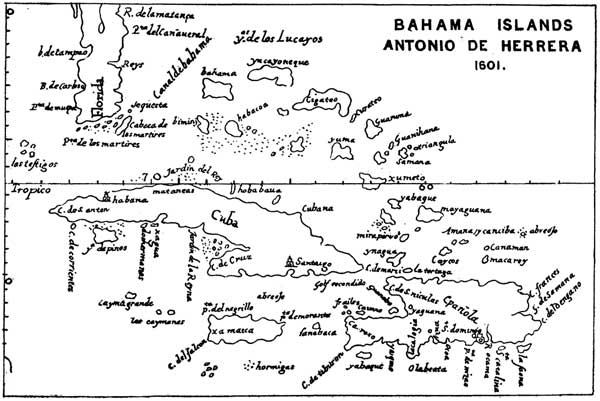
The first necessity for a pilot who conducts a ship across the ocean, when he is for many days out of sight of land, is the means of checking his dead reckoning by observations of the heavenly bodies. But in the days of Columbus such appliances were very defective, and, at times, altogether useless. There was an astrolabe adapted for use at sea by Martin Behaim, but it was very difficult to get a decent sight with it, and Vasco da Gama actually went on shore and rigged a triangle when he wanted to observe for latitude. If this was necessary, the instrument was useless as a guide across the pathless ocean. Columbus, of course, used it, but he seems to have relied more upon the old quadrant which he had used for long years before Behaim invented his adaption of the astrolabe. It was this instrument, the value of which received such warm testimony from Diogo Gomez, one of Prince Henry's navigators; and it was larger and easier to handle than the astrolabe. But the difficulty, as regards both these instruments,[49] was the necessity for keeping them perpendicular to the horizon when the observation is taken, in one case by means of a ring working freely, and in the other by a plummet line. The instruction of old Martin Cortes was to sit down with your back against the mainmast; but in reality the only man who obtained results of any use from such instruments was he who had been constantly working with them from early boyhood. In those days, far more than now, a good pilot had to be brought up at sea from his youth. Long habit could alone make up, to a partial extent, for defective means.
Columbus regularly observed for latitude when the weather rendered it possible, and he occasionally attempted to find the longitude by observing eclipses of the moon with the aid of tables calculated by old Regiomontanus, whose declination tables also enabled the Admiral to work out his meridian altitudes. But the explorer's main reliance was on the skill and care with which he calculated his dead reckoning, watching every sign offered by sea and sky by day and night, allowing for currents, for leeway, for every cause that could affect the movement of his ship, noting with infinite pains the bearings and the variation of his compass, and constantly recording all phenomena on his card and in his journal. Columbus was the true father of what we call proper pilotage.
It is most interesting to watch the consequences of this seaman-like and most conscientious care in the results of his voyages of discovery. We have seen with what accuracy he made his landfall at the Azores, on his return from his first and most memorable voyage. The incidents of his second voyage are equally instructive. He had heard from the natives of the eastern end of Española that there were numerous islands to the southeast inhabited by savage tribes of Caribs, and when he sailed from Spain on his second voyage he resolved to ascertain the truth of the report before proceeding to his settlement at Navidad. He shaped such a course as to hit upon Dominica, and within a few weeks he discovered the whole of the Windward Islands, thence to Puerto Rico. On his return his spirit of investigation led him to try the possibility of making a passage in the teeth of the trade-wind. It was a long voyage, and his people were reduced to the last extremity, even threatening to eat the Indians who were on board. One night, to the surprise of all the company, the Admiral gave the order to shorten sail. Next morning, at dawn, Cape St. Vincent was in sight. This is a remarkable proof of the care with which his reckoning must have been kept, and of his consummate skill as a navigator. On his third voyage he decided, for various reasons, to make further discoveries nearer to the equator, the result of his decision being the exploration of the Gulf of Paria, including the coast of Trinidad and of the continent. His speculations, although sometimes fantastic, and originating in a too vivid imagination, were usually shrewd and carefully thought out. Thus they led from one discovery to another; and even when, through want of complete knowledge, there was a flaw in the chain of his reasoning, the results were equally valuable.
A memorable example of an able and acute train of thought, based on observations at sea, was that which led to his last voyage in search of a strait. He had watched the gulf stream constantly flowing in a westerly direction, and he thought that he had ascertained, as the result of careful observation, that the islands in the course of the current had their lengths east and west, owing to erosion on their north and south sides. From this fact he deduced the constancy of the current. His own pilot, Juan de la Cosa, serving under Ojeda and Bastidas, had established the continuity of land from the Gulf of Paria to Darien. The Admiral himself had explored the coast of Cuba, both on the north and south sides, for so great a distance that he concluded it must surely be a promontory connected with the continent. The conclusion was that, as it could not turn to north or south, this current, ever flowing in one direction, must pass through a strait. The argument was perfectly sound except in one point—the continental character of Cuba was an hypothesis, not an ascertained fact.
Still, it was a brilliant chain of reasoning, and it led to a great result, though not to the expected result. Just as the search for the philosopher's stone led to valuable discoveries in chemistry, and as the search for El Dorado revealed the courses of the two largest rivers in South America, so the Admiral's heroic effort to discover a strait in the face of appalling difficulties, in advancing years and failing health, made known the coast of the continent from Honduras to Darien.
All the discoveries made by others, in the lifetime of Columbus, on the coasts of the western continent (except that of Cabral) were directly due to the first voyage of the Admiral, to his marvelous prevision in boldly sailing westward across the sea of darkness, and are to be classed as Columbian discoveries. This was clearly laid down by Las Casas, in a noble passage. "The Admiral was the first to open the gates of that ocean which had been closed for so many thousands of years before," exclaimed the good bishop. "He it was who gave the light by which all others might see how to discover. It can not be denied to the Admiral, except with great injustice, that as he was the first discoverer of those Indies, so he was really of all the mainland; and to him the credit is due. For it was he that put the thread into the hands of the rest by which they found the clew to more distant parts. It was not necessary for this that he should personally visit every part, any more than it is necessary to do so in taking possession of an estate; as the jurists hold." This generous protest by Las Casas should receive the assent of all geographers. The pupils and followers of Columbus, such as Pinzon, Ojeda, Niño, and La Cosa, discovered all the continent from 8 deg. S. of the equator to Darien, thus supplementing their great master's work; while he himself led the way, and showed the light both to the islands and to the continent.
Although none of the charts of Columbus have come down to us, there still exists a map of all discoveries up to the year 1500, drawn by the pilot Juan de la Cosa, who accompanied him in his first and second voyages, and sailed with Ojeda on a separate expedition in 1499, when the coast of the continent was explored from the Gulf of Paria to Cabo de la Vela. Juan de la Cosa drew this famous map of the world (which is preserved at Madrid) at Santa Maria, in the Bay of Cadiz, when he returned from his expedition with Ojeda in 1500. It is drawn in color, on oxhide, and measures 5 feet 9 inches by 3 feet 2 inches. La Cosa shows the islands discovered by Columbus, but it is difficult to understand what he could have been thinking about in placing them north of the tropic of cancer. The continent is delineated from 8 deg. S. of the equator to Cabo de la Vela, which was the extreme point to which discovery had reached in 1500; and over the undiscovered part to the west, which the Admiral himself was destined to bring to the knowledge of the world a few years afterward, Juan de la Cosa painted a vignette of St. Christopher bearing the infant Christ across the ocean. But the most important part of the map is that on which the discoveries of John Cabot are shown, for this is the only map which shows them. It is true that a map, or a copy of a map, of 1542, by Sebastian Cabot, was discovered of late years, and is now at Paris, and that it indicates the "Prima Vista," the first land seen by Cabot on his voyage of 1497; but it shows the later work of Jacques Cartier and other explorers, and does not show what part was due to Cabot. Juan de la Cosa, however, must have received, through the Spanish ambassador in London, the original chart of Cabot, showing his discoveries during his second voyage in 1498, and was enabled thus to include the new coast-line on his great map.
The gigantic labor wore out his body. But his mind was as active as ever. He had planned an attempt to recover the Holy Sepulcher. He had thought out a scheme for an Arctic expedition, including a plan for reaching the north pole, which he deposited in the monastery of Mejorada. It was not to be. When he returned from his last voyage, he came home to die. We gather some idea of the Admiral's personal appearance from the descriptions of Las Casas and Oviedo. He was a man of middle height, with courteous manners and noble bearing. His face was oval, with a pleasing expression; the nose aquiline, the eyes blue, and the complexion fair and inclined to ruddiness. The hair was red, though it became gray soon after he was thirty. Only one authentic portrait of Columbus is known to have been painted. The Italian historian, Paulus Jovius, who was his contemporary, collected a gallery of portraits of worthies of his time at his villa on the Lake of Como. Among them was a portrait of the Admiral. There is an early engraving from it, and very indifferent copies in the Uffizi at Florence, and at Madrid. But until quite recently I do not think that the original was known to exist. It, however, never left the family, and when the last Giovio died it was inherited by her grandson, the Nobile de Orché, who is the present possessor. We have the head of a venerable man, with thin gray hair, the forehead high, the eyes pensive and rather melancholy. It was thus that he doubtless appeared during the period that he was in Spain, after his return in chains, or during the last year of his life.