T. WEMYSS REID.
Reading edition
WITH ILLUSTRATIONS.

MACMILLAN AND CO. 1877.
[All Rights Reserved.]
THIRD EDITION.
CHARLES DICKENS AND EVANS, CRYSTAL PALACE PRESS.
To the Right Honourable THE LORD HOUGHTON, D.C.L. F.R.S. &c. THIS MEMORIAL OF A LIFE WHICH HAS ADDED A NEW GLORY TO THE LITERARY HISTORY OF YORKSHIRE IS RESPECTFULLY INSCRIBED BY HIS GRATEFUL FRIEND THE AUTHOR.
PREFACE.
I have spoken so freely in the opening chapter of this Monograph of the circumstances under which it has been written, that very little need be said by way of introduction here. This attempt to throw some fresh light upon the character of one of the most remarkable women of our age has not been a task lightly taken up, or hastily performed. The life and genius of Charlotte Brontë had long engaged my attention before I undertook, at the request of the lady to whom I am indebted for most of the original materials I have employed in these pages, the work which I have now completed. In executing that work I have had ample reason to feel and acknowledge my own deficiencies. With the knowledge that I was treading in the footsteps of so consummate a literary artist as Mrs. Gaskell, I have been compelled to refrain from writing not a few of the chapters in Charlotte Brontë's life which are necessary to a complete acquaintance with her character, simply because they had been written so well already. And whilst I necessarily shrink from any appearance of rivalry with Charlotte Brontë's original biographer, I have been additionally oppressed by the feeling that the pen which can do full justice to one of the most moving and noble stories in English literature has not yet been found. But I have been sustained both by the sympathy of many friends, known and unknown, who share my feelings with regard to the Brontës, and by the invaluable assistance rendered to me by those who were intimately acquainted with the household at Haworth Parsonage. Foremost among these must be mentioned Miss Ellen Nussey, the schoolfellow and life-long friend of Charlotte Brontë, who has freely placed at my disposal all the letters and other materials she possessed from which any light could be thrown upon the career of her old companion, and who has in addition aided me with much valuable counsel and advice in the decision of many difficult points. Miss Wooler, who was Charlotte's attached teacher, and who still happily survives in a green old age, has also placed me under obligations by her readiness to supply me with her pupil's letters to herself. Nor must I omit to mention my indebtedness to Lord Houghton for information upon questions which could only be decided by those who met "Currer Bell" during her brief visits to London at a time when she was one of the literary lions of society.
The additions made in this volume to the Monograph as it originally appeared in Macmillan's Magazine are numerous and considerable. It should be mentioned that a few of the letters now published (about twenty) were printed some years ago in an American magazine now extinct. The remainder, and by far the larger portion, will be entirely new to readers alike in England and the United States.
Headingley Hill, Leeds, February, 1877.
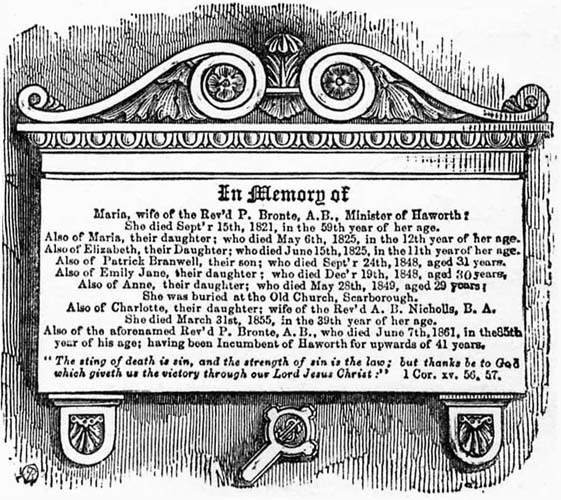
The New Brontë Tablet
CONTENTS.
PAGE
CHAPTER I.
Introductory 1
Mrs. Gaskell's "Memoir"—Charlotte Brontë's Letters.
CHAPTER II.
The Story of "Jane Eyre" 7
"Jane Eyre:" its Publication and Popularity; Unfavourable Criticisms —Mr. Thackeray and "Rochester"—Loose Gossip—The Truth.
CHAPTER III.
Early History of the Brontës 14
Charlotte Brontë's Surroundings: the True Charm of her Story— Haworth—Mr. Brontë: his Characteristics and Eccentricities—The Brontë Children—Charlotte's Escape to the Golden City—Juvenile Efforts—"The Play of the Islanders."
CHAPTER IV.
The Family at Haworth 29
Charlotte and her Friend—Bolton Bridge—A Family Sketch—Shyness of the Sisters—Varying Moods—The Youthful Politician—Branwell Brontë—Emily—Anne.
CHAPTER V.
Life as a Governess 45
Governess Life—A Mental Struggle—First offer of Marriage—Sympathy with others—Trials of her own Life.
CHAPTER VI.
The Turning-point 57
The Storm and Stress Period—Not what the World supposes it to have been—Visit to Brussels: its Influence upon her Life— Disillusioned—Return Home—A Fallen Idol—A Pleasant Meeting —Branwell's Disgrace.
CHAPTER VII.
Authorship and Bereavement 73
Branwell's Fall—Publication of the Poems—Emily's Poetry— Novel-writing begun—"The Professor"—"Wuthering Heights"— "Agnes Grey"—"Jane Eyre"—The Secret of the Authorship— Growth in Power—Branwell's Death—Decline and Death of Emily—Death of Anne.
CHAPTER VIII.
"Shirley" 99
The Bitterness of Bereavement—Visit to London—Meets Thackeray —Authors and Critics—"Shirley" published: its Reception by the Critics—Husbands and Wives—An Invitation.
CHAPTER IX.
Loneliness and Fame 112
Life at Home—Rumours of Marriage—Edits the Works of her Sisters —An offer of Marriage—Mr. Thackeray's Lectures—The Crystal Palace.
CHAPTER X.
"Villette" 127
"Villette" begun—Life and Letters whilst writing it—Great Depression of Spirits—Difficulty in writing—"Lucy Snowe"— "Villette" finished: its Private Reception; the Public Verdict: Waiting for The Times.
CHAPTER XI.
Marriage and Death 148
A Secret History—Mr. Nicholls—Offer of Marriage—Mr. Brontë's Opposition—A Cruel Struggle—Mr. Nicholls leaves Haworth—The High Church Party and "Villette"—Miss Martineau—A Trip to Scotland—Brighter Prospects—Engaged to Mr. Nicholls—New Out-look upon Life—The Wedding—Married Life—The Last Christmas—Illness and Death.
CHAPTER XII.
Posthumous Honours 183
A Nation's Mourning—Charlotte's Humility—Mrs. Gaskell's "Memoir:" Effect produced by it—Letter from Mr. Kingsley—Pilgrims to Haworth—An American Visitor—Death of Mr. Brontë—Devotion of Mr. Nicholls.
CHAPTER XIII.
The Brontë Novels 201
The Brontë Novels—"Wuthering Heights:" its Cleverness and Weirdness—Characters of the Story—Emily's Genius—Curious Foreshadowings—Mr. Brontë's Influence on Emily—Anne's Novels —"The Professor."
CHAPTER XIV.
Conclusion 228
Charlotte's Character—Sufferings and Work.
LIST OF ILLUSTRATIONS.
Rev. Patrick Brontë Frontispiece
PAGE
The New Brontë Tablet x
Haworth Village Facing 18
The House that Charlotte visited 44
The Roe Head School Facing 46
Haworth Parsonage and Graveyard " 82
The "Field Head" of Shirley " 101
The "Briarfield" Church of Shirley " 106
Fac-Simile Letter of Charlotte Brontë " 134
Haworth Church " 172
Interior of Haworth Church " 191
Organ Loft over the Brontë Tablet and Pew 200

Beside her sisters lay her down to rest, By the lone church that stands amid the moors; And let her grave be wet with moorland showers; Let moorland larks sing o'er her mouldering breast! Hers was the keen true spirit, that confest That she was nurtured in no garden bowers, Nor taught to deck her brow with cultured flowers, Nor by the soft and summer wind carest. Her words came o'er us, as in harvest-tide Come the swift rain-clouds o'er her native skies, Scattering the thin sheaves by the heather's side; So fared it with our tame hypocrisies: But lo! the clouds are past, and far and wide The purple ridges glow beneath our eyes.
W. H. Charlton.
Hesleyside, 1855.
CHARLOTTE BRONTË.
I.
INTRODUCTORY.
It is just twenty years since one of the most fascinating and artistic biographies in the English language was given to the world. Mrs. Gaskell's "Life of Charlotte Brontë" no sooner appeared than it took firm possession of the public mind; and it has ever since retained its hold upon all who take an interest in the career of one who has been called, in language which is far less extravagant in reality than in appearance, "the foremost woman of her age." Written with admirable skill, in a style at once powerful and picturesque, and with a sympathy such as only one artist could feel for another, it richly merited the popularity which it gained and has kept. Mrs. Gaskell, however, laboured under one serious disadvantage, which no longer exists in anything like the same degree in which it did twenty years ago. Writing but a few months after Charlotte Brontë had been laid in her grave, and whilst the father to whom she was indebted for so much that was characteristic in her life and genius was still living, Mrs. Gaskell had necessarily to deal with many circumstances which affected living persons too closely to be handled in detail. Even as it was she involved herself in serious embarrassment by some of her allusions to incidents connected more or less nearly with the life of Charlotte Brontë; corrections and retractations were forced upon her, the later editions of the book differed considerably from the first, and at last she was compelled to announce that any further correspondence concerning it must be conducted through her solicitors. Thus she was crippled in her attempt to paint a full-length picture of a remarkable life, and her story was what Mr. Thackeray called it, "necessarily incomplete, though most touching and admirable."
There was, moreover, another matter in which Mrs. Gaskell was at fault. She seems to have set out with the determination that her work should be pitched in a particular key. She had formed her own conception of Charlotte Brontë's character, and with the passion of the true artist and the ability of the practised writer she made everything bend to that conception. The result was that whilst she produced a singularly striking and effective portrait of her heroine, it was not one which was absolutely satisfactory to those who were the oldest and closest friends of Charlotte Brontë. If the truth must be told, the life of the author of "Jane Eyre" was by no means so joyless as the world now believes it to have been. That during the later years in which this wonderful woman produced the works by which she has made her name famous, her career was clouded by sorrow and oppressed by anguish both mental and physical, is perfectly true. That she was made what she was in the furnace of affliction cannot be doubted; but it is not true that she was throughout her whole life the victim of that extreme depression of spirits which afflicted her at rare intervals, and which Mrs. Gaskell has presented to us with so much vividness and emphasis. On the contrary, her letters show that at any rate up to the time of her leaving for Brussels, she was a happy and high-spirited girl, and that even to the very last she had the faculty of overcoming her sorrows by means of that steadfast courage which was her most precious possession, and to which she was so much indebted for her successive victories over trials and disappointments of no ordinary character. Those who imagine that Charlotte Brontë's spirit was in any degree a morbid or melancholy one do her a singular injustice. Intensely reserved in her converse with all save the members of her own household, and the solitary friend to whom she clung with such passionate affection throughout her life, she revealed to these
The other side, the novel Silent silver lights and darks undreamed of,
which were and have remained hidden from the world, but which must be seen by those who would know what Charlotte Brontë really was as a woman. Alas! those who knew her and her sisters well during their brief lives are few in number now. The Brontës who plucked the flower of fame out of the thorny waste in which their lots were cast survive in their books and in Mrs. Gaskell's biography. But the Brontës, the women who lived and suffered thirty years ago, and whose characters were instinct with so rare and lofty a nobility, so keen a sensitiveness, so pure a nobility, are known no longer.
Yet one mode of making acquaintance with them is still open to some among us. From her school-days down to the hour in which she was stretched prostrate in her last sickness, Charlotte Brontë kept up the closest and most confidential intercourse with her one life-long friend. To that friend she addressed letters which may be counted by hundreds, scarcely one of which fails to contain some characteristic touch worthy of the author of "Villette." No one can read this remarkable correspondence without learning the secret of the writer's character; none, as I believe, can read it without feeling that the woman who "stole like a shadow" into the field of English literature in 1847, and in less than eight years after stole as noiselessly away, was truer and nobler even than her works, truer and nobler even than that masterly picture of her life for which we are indebted to Mrs. Gaskell.
These letters lie before me as I write. Here are the faded sheets of 1832, written in the school-girl's hand, filled with the school-girl's extravagant terms of endearment, yet enriched here and there by sentences which are worthy to live—some of which have already, indeed, taken their place in the literature of England; and here is the faint pencil note written to "my own dear Nell" out of the writer's "dreary sick-bed," which was so soon to be the bed of death! Between the first letter and that last sad note what outpourings of the mind of Charlotte Brontë are embodied in this precious pile of cherished manuscript! Over five-and-twenty years of a blameless life this artless record stretches. So far as Charlotte Brontë's history as a woman, and the history of her family are concerned, it is complete for the whole of that period, the only breaks in the story being those which occurred when she and her friend were together. Of her early literary ventures we find little here, for even to her friend she did not dare in the first instance to betray the novel joys which filled her soul when she at last discovered her true vocation, and spoke to a listening world; but of her later life as an author, of her labours from the day when she owned "Jane Eyre" as the child of her brain, there are constant and abundant traces. Here, too, we read all her secret sorrows, her hopes, her fears, her communings with her own heart. Many things there are in this record too sacred to be given to the world. Even now it is with a tender and a reverent hand that one must touch these "noble letters of the dead;" but those who are allowed to see them, to read them and ponder over them, must feel as I do, that the soul of Charlotte Brontë stands revealed in these unpublished pages, and that only here can we see what manner of woman this really was who in the solitude and obscurity of the Yorkshire hill-parsonage built up for herself an imperishable name, enriched the literature of England with treasures of priceless value, and withal led for nearly forty years a life that was made sacred and noble by the self-repression and patient endurance which were its most marked characteristics.
Mrs. Gaskell has done her work so well that the world would scarcely care to listen to a mere repetition of the Brontë story, even though the story-teller were as gifted as the author of "Ruth" herself. But those who have been permitted to gain a new insight into Charlotte Brontë's character, those who are allowed to command materials of which the biographer of 1857 could make no use, may venture to lay a tribute-wreath of their own upon the altar of this great woman's memory—a tribute-wreath woven of flowers culled from her own letters. And it cannot be that the time is yet come when the name or the fame or the touching story of the unique and splendid genius to whom we owe "Jane Eyre," will fall upon the ears of English readers like "a tale of little meaning" or of doubtful interest.
II.
THE STORY OF "JANE EYRE."
In the late autumn of 1847 the reading public of London suddenly found itself called to admire and wonder at a novel which, without preliminary puff of any kind, had been placed in its hands. "'Jane Eyre,' by Currer Bell," became the theme of every tongue, and society exhausted itself in conjectures as to the identity of the author, and the real meaning of the book. It was no ordinary book, and it produced no ordinary sensation. Disfigured here and there by certain crudities of thought and by a clumsiness of expression which betrayed the hand of a novice, it was nevertheless lit up from the first page to the last by the fire of a genius the depth and power of which none but the dullest could deny. The hand of its author seized upon the public mind whether it would or no, and society was led captive, in the main against its will, by one who had little of the prevailing spirit of the age, and who either knew nothing of conventionalism, or despised it with heart and soul. Fierce was the revolt against the influence of this new-comer in the wide arena of letters, who had stolen in, as it were in the night, and taken the citadel by surprise. But for the moment all opposition was beaten down by sheer force of genius, and "Jane Eyre" made her way, compelling recognition, wherever men and women were capable of seeing and admitting a rare and extraordinary intellectual supremacy. "How well I remember," says Mr. Thackeray, "the delight and wonder and pleasure with which I read 'Jane Eyre,' sent to me by an author whose name and sex were then alike unknown to me; and how with my own work pressing upon me, I could not, having taken the volumes up, lay them down until they were read through." It was the same everywhere. Even those who saw nothing to commend in the story, those who revolted against its free employment of great passions and great griefs, and those who were elaborately critical upon its author's ignorance of the ways of polite society, had to confess themselves bound by the spell of the magician. "Jane Eyre" gathered admirers fast; and for every admirer she had a score of readers.
Those who remember that winter of nine-and-twenty years ago know how something like a "Jane Eyre" fever raged among us. The story which had suddenly discovered a glory in uncomeliness, a grandeur in overmastering passion, moulded the fashion of the hour, and "Rochester airs" and "Jane Eyre graces" became the rage. The book, and its fame and influence, travelled beyond the seas with a speed which in those days was marvellous. In sedate New England homes the history of the English governess was read with an avidity which was not surpassed in London itself, and within a few months of the publication of the novel it was famous throughout two continents. No such triumph has been achieved in our time by any other English author; nor can it be said, upon the whole, that many triumphs have been better merited. It happened that this anonymous story, bearing the unmistakable marks of an unpractised hand, was put before the world at the very moment when another great masterpiece of fiction was just beginning to gain the ear of the English public. But at the moment of publication "Jane Eyre" swept past "Vanity Fair" with a marvellous and impetuous speed which left Thackeray's work in the distant background; and its unknown author in a few weeks gained a wider reputation than that which one of the master minds of the century had been engaged for long years in building up.
The reaction from this exaggerated fame, of course, set in, and it was sharp and severe. The blots in the book were easily hit; its author's unfamiliarity with the stage business of the play was evident enough—even to dunces; so it was a simple matter to write smart articles at the expense of a novelist who laid himself open to the whole battery of conventional criticism. In "Jane Eyre" there was much painting of souls in their naked reality; the writer had gauged depths which the plummet of the common story-teller could never have sounded, and conflicting passions were marshalled on the stage with a masterful daring which Shakespeare might have envied; but the costumes, the conventional by-play, the scenery, even the wording of the dialogue, were poor enough in all conscience. The merest playwright or reviewer could have done better in these matters—as the unknown author was soon made to understand. Additional piquancy was given to the attack by the appearance, at the very time when the "Jane Eyre" fever was at its height, of two other novels, written by persons whose sexless names proclaimed them the brothers or the sisters of Currer Bell. Human nature is not so much changed from what it was in 1847 that one need apologise for the readiness with which the reading world in general, and the critical world in particular, adopted the theory that "Wuthering Heights" and "Agnes Grey" were earlier works from the pen which had given them "Jane Eyre." In "Wuthering Heights" some of the faults of the other book were carried to an extreme, and some of its conspicuous merits were distorted and exaggerated until they became positive blemishes; whilst "Agnes Grey" was a feeble and commonplace tale which it was easy to condemn. So the author of "Jane Eyre" was compelled to bear not only her own burden, but that of the two stories which had followed the successful novel; and the reviewers—ignorant of the fact that they were killing three birds at a single shot—rejoiced in the larger scope which was thus afforded to their critical energy.
Here and there, indeed, a manful fight on behalf of Currer Bell was made by writers who knew nothing but the name and the book. "It is soul speaking to soul," cried Fraser's Magazine in December, 1847; "it is not a book for prudes," added Blackwood, a few months later; "it is not a book for effeminate and tasteless men; it is for the enjoyment of a feeling heart and critical understanding." But in the main the verdict of the critics was adverse. It was discovered that the story was improper and immoral; it was said to be filled with descriptions of "courtship after the manner of kangaroos," and to be impregnated with a "heathenish doctrine of religion;" whilst there went up a perfect chorus of reprobation directed against its "coarseness of language," "laxity of tone," "horrid taste," and "sheer rudeness and vulgarity." From the book to the author was of course an easy transition. London had been bewildered, and its literary quidnuncs utterly puzzled, when such a story first came forth inscribed with an unknown name. Many had been the rumours eagerly passed from mouth to mouth as to the real identity of Currer Bell. Upon one point there had, indeed, been something like unanimity among the critics, and the story of "Jane Eyre" had been accepted as something more than a romance, as a genuine autobiography in which real and sorrowful experiences were related. Even the most hostile critic of the book had acknowledged that "it contained the story of struggles with such intense suffering and sorrow, as it was sufficient misery to know that any one had conceived, far less passed through." Where then was this wonderful governess to be found? In what obscure hiding-place could the forlorn soul, whose cry of agony had stirred the hearts of readers everywhere, be discovered? We may smile now, with more of sadness than of bitterness, at the base calumnies of the hour, put forth in mere wantonness and levity by a people ever seeking to know some new thing, and to taste some new sensation. The favourite theory of the day—a theory duly elaborated and discussed in the most orthodox and respectable of the reviews—was that Jane Eyre and Becky Sharp were merely different portraits of the same character; and that their original was to be found in the person of a discarded mistress of Mr. Thackeray, who had furnished the great author with a model for the heroine of "Vanity Fair," and had revenged herself upon him by painting him as the Rochester of "Jane Eyre!" It was after dwelling upon this marvellous theory of the authorship of the story that the Quarterly Review, with Pecksniffian charity, calmly summed up its conclusions in these memorable words: "If we ascribe the book to a woman at all, we have no alternative but to ascribe it to one who has for some sufficient reason long forfeited the society of her own sex."
The world knows the truth now. It knows that these bitter and shameful words were applied to one of the truest and purest of women; to a woman who from her birth had led a life of self-sacrifice and patient endurance; to a woman whose affections dwelt only in the sacred shelter of her home, or with companions as pure and worthy as herself; to one of those few women who can pour out all their hearts in converse with their friends, happy in the assurance that years hence the stranger into whose hands their frank confessions may pass will find nothing there that is not loyal, true, and blameless. There was wonder among the critics, wonder too in the gay world of London, when the secret was revealed, and men were told that the author of "Jane Eyre" was no passionate light-o'-love who had merely transcribed the sad experiences of her own life; but "an austere little Joan of Arc," pure, gentle, and high-minded, of whom Thackeray himself could say that "a great and holy reverence of right and truth seemed to be with her always." The quidnuncs had searched far and wide for the author of "Jane Eyre;" but we may well doubt whether, when the truth came out at last, they were not more than ever mystified by the discovery that Currer Bell was Charlotte Brontë, the young daughter of a country parson in a remote moorland parish of Yorkshire.
That such a woman should have written such a book was more than a nine days' wonder; and for the key to that which is one of the great marvels and mysteries of English literature we must go to Charlotte Brontë's life itself.
III.
EARLY HISTORY OF THE BRONTËS.
There is a striking passage in Mr. Greg's "Enigmas of Life," in which the influence of external circumstances upon the inner lives of men and women is dwelt upon somewhat minutely, and, by way of example, the connection between religious "conviction" and an imperfect digestion is carefully traced out. That we are the creatures of circumstance can hardly be doubted, nor that our destinies are moulded, just as the coral reefs are built, by the action of innumerable influences, each in itself apparently trivial and insignificant. But the habit which leads men to find a full explanation of the lives of those who have attained exceptional distinction in the circumstances amid which their lot has been cast cannot be said to be a very wholesome or happy one. Few have suffered more cruelly from this trick than the Brontë family. Graphic pictures have been presented to the world of their home among the hills, and of their surroundings in their early years; whilst the public have been asked to believe that some great shadow of gloom rested over their lives from their birth, and that to this fact, and to the influence of the moors, must be attributed, not only the peculiar bent of their genius, but the whole colour and shape of their lives. Those who are thus determined to account for everything that lies out of the range of common experience would do well, before they attempt to analyse the great mystery of genius, to reveal to us the true cause of the superlative excellence of this or that rare cru, the secret which gives Johannisberg or Château d'Yquem its glory in the eyes of connoisseurs. Circumstances apparently have little to do with the production of the fragrance and bouquet of these famous wines; for we know that grapes growing close at hand on similar vines and seemingly under precisely similar conditions, warmed by the same sun, refreshed by the same showers, fanned by the same breezes, produce a wine which is comparatively worthless. When the world has expounded this riddle, it will be time enough to deal with that deeper problem of genius on which we are now too apt to lay presumptuous and even violent hands.
The Brontës have suffered grievously from this fashion, inasmuch as their picturesque and striking surroundings have been allowed to obscure our view of the women themselves. We have made a picture of their lives, and have filled in the mere accessories with such pre-Raphaelite minuteness that the distinct individuality of the heroines has been blurred and confused amid the general blaze of vivid colour, the crowd of "telling" points. No individual is to be blamed for this fact. The world, as we have seen, was first introduced to "Currer Bell" and her sisters under romantic circumstances; the lives of those simple, sternly-honest women were enveloped from the moment when the public made their acquaintance in a certain haze of romantic mystery; and when all had passed away, and the time came for the "many-headed beast" to demand the full satisfaction of its curiosity, it would have nothing but the completion of that romance which from the first it had figured in outline for itself.
Who then does not know the salient points of that strange and touching story which tells us how the author of "Jane Eyre" lived and died? Who is not acquainted with that grim parsonage among the hills, where the sisters dwelt amidst such uncongenial and even weird influences; living like recluses in the house of a Protestant pastor; associated with sorrow and suffering, and terrible pictures of degrading vice, during their blameless maidenhood; constructing an ideal world of their own, and dwelling in it heedless of the real world which was in motion all around them? Who has not been amused and interested by those graphic pictures of Yorkshire life in the last century, in which the local flavour is so intense and piquant, and which are hardly the less interesting because they relate to an order of things which had passed away entirely long before the Brontës appeared upon the stage? And who has not been moved by the dark tragedy of Branwell Brontë's life, hinted at rather than explicitly stated, in Mrs. Gaskell's story, but yet standing out in such prominence that those who know no better may be forgiven if they regard it as having been the powerful and all-pervading influence which made the career of the sisters what it was? The true charm of the history of the Brontës, however, does not lie in these things. It is not to be found in the surroundings of their lives, remarkable and romantic as they were, but in the women themselves, and in those characteristics of their hearts and their intellects which were independent of the accidents of condition. Charlotte herself would have been the first to repudiate the notion that there was anything strikingly exceptional in their outward circumstances. With a horror of being considered eccentric that amounted to a passion, she united an almost morbid dread of the notice of strangers. If she could ever have imagined that readers throughout the world would come to associate her name, and still more the names of her idolised sisters, with the ruder features of the Yorkshire character, or with such a domestic tragedy as that amid which her unhappy brother's life terminated, her spirit would have arisen in indignant revolt against that which she would have regarded almost in the light of a personal outrage.
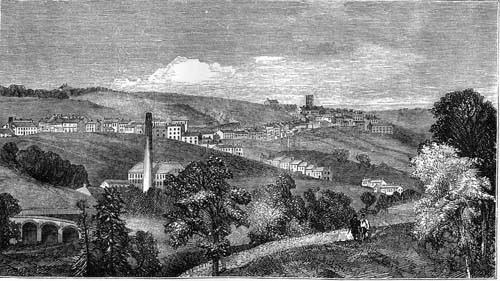
HAWORTH VILLAGE.
And yet if their surroundings at Haworth had comparatively little to do with the development of the genius of the three sisters, it cannot be doubted that two influences which Mrs. Gaskell has rightly made prominent in her book did affect their characters, one in a minor, and the other in a very marked degree. The influence of the moors is to be traced both in their lives and their works; whilst far more distinctly is to be traced the influence of their father. As to the first there is little to be said in addition to that which all know already. There is a railway station now at Haworth, and all the world therefore can get to the place without difficulty or inconvenience. Yet even to-day, when the engine goes, shrieking past it many times between sunrise and sunset, Haworth is not as other places are. A little manufacturing village, sheltered in a nook among the hills and moors which stretch from the heart of Yorkshire into the heart of Lancashire, it bears the vivid impress of its situation. The moors which lie around it for miles on every side are superb during the summer and autumn months. Then Haworth is in its glory; a gray stone hamlet set in the midst of a vast sea of odorous purple, and swept by breezes which bear into its winding street the hum of the bees and the fragrance of the heather. But it is in the drear, leaden days of winter, when the moors are covered with snow, that we see what Haworth really is. Then we know that this is a place apart from the outer world; even the railway seems to have failed to bring it into the midst of that great West Riding which lies close at hand with its busy mills and multitudes; and the dullest therefore can understand that in the days when the railway was not, and Haworth lay quite by itself, neglected and unseen in its upland valley, its people must have been blessed by some at least of those insular peculiarities which distinguished the villagers of Zermatt and Pontresina before the flood of summer tourists had swept into those comparatively remote crannies of the Alps. Nurtured among these lonely moors, and accustomed, as all dwellers on thinly-peopled hillsides are, to study the skies and the weather, as the inhabitants of towns and plains study the faces of men and women, the Brontës unquestionably drew their love of nature, their affection for tempestuous winds and warring clouds, from their residence at Haworth.
But this influence was trivial compared with the hereditary influences of their father's character. Few more remarkable personalities than that of the Rev. Patrick Brontë have obtruded themselves upon the smooth uniformity of modern society. The readers of Mrs. Gaskell's biography know that the incumbent of Haworth was an eccentric man, but the full measure of his eccentricity and waywardness has never yet been revealed to the world. He was an Irishman by birth, but when still a young man he had gone to Yorkshire as a curate, and in Yorkshire he remained to the end of his days. His real name was not Brontë—regarding the origin of which word there was so much unnecessary mystery when his daughter became famous—but Prunty. Born of humble parentage in the parish of Ahaderg, County Down, he was one of a large family, all of whom were said to be remarkable for their physical strength and personal beauty. Patrick Prunty was the most remarkable member of the family, and his talents were early recognised by Mr. Tighe, the rector of Drumgooland. This gentleman undertook part at least of the cost of his education, which was completed at St. John's College, Cambridge. As to the change of name from Prunty to Brontë, many fantastic stories have been told. Amongst them is one which represents the Brontës as having derived their name from that of the Bronterres, an ancient Irish family with which they were connected. The connection may possibly have existed, but there is no doubt upon one point. The incumbent of Haworth in early life bore the name of Prunty, and it was not until very shortly, before he left Ireland for England that he changed it, at the request of his patron, Mr. Tighe, for the more euphonious appellation of Brontë. He appears to have been a strange compound of good and evil. That he was not without some good is acknowledged by all who knew him. He had kindly feelings towards most people, and he delighted in the stern rectitude which distinguished many of his Yorkshire flock. When his daughter became famous, no one was better pleased at the circumstance than he was. He cut out of every newspaper every scrap which referred to her; he was proud of her achievements, proud of her intellect, and jealous for her reputation. But throughout his whole life there was but one person with whom he had any real sympathy, and that person was himself. Passionate, self-willed, vain, habitually cold and distant in his demeanour towards those of his own household, he exhibited in a marked degree many of the characteristics which Charlotte Brontë afterwards sketched in the portrait of the Mr. Helston of "Shirley." The stranger who encountered him found a scrupulously polite gentleman of the old school, who was garrulous about his past life, and who needed nothing more than the stimulus of a glass of wine to become talkative on the subject of his conquests over the hearts of the ladies of his acquaintance. As you listened to the quaintly-attired old man who chatted on with inexhaustible volubility, you possibly conceived the idea that he was a mere fribble, gay, conceited, harmless; but at odd times a searching glance from the keen, deep-sunk eyes warned you that you also were being weighed in the balance by your companion, and that this assumption of light-hearted vanity was far from revealing the real man to you. Only those who dwelt under the same roof knew him as he really was. Among the many stories told of him by his children, there is one relating to the meek and gentle woman who was his wife, and whose lot it was to submit to persistent coldness and neglect. Somebody had given Mrs. Brontë a very pretty dress, and her husband, who was as proud as he was self-willed, had taken offence at the gift. A word to his wife, who lived in habitual dread of her lordly master, would have secured all he wanted; but in his passionate determination that she should not wear the obnoxious garment, he deliberately cut it to pieces, and presented her with the tattered fragments. Even during his wife's lifetime he formed the habit of taking his meals alone; he constantly carried loaded pistols in his pockets, and when excited he would fire these at the doors of the outhouses, so that the villagers were quite accustomed to the sound of pistol-shots at any hour of the day in their pastor's house. It would be a mistake to suppose that violence was one of the weapons to which Mr. Brontë habitually resorted. However stern and peremptory might be his dealings with his wife (who soon left him to spend the remainder of his life in a dreary widowhood), his general policy was to secure his end by craft rather than by force. A profound belief in his own superior wisdom was conspicuous among his characteristics, and he felt convinced that no one was too clever to be outwitted by his diplomacy. He had also an amazing persistency, which led him to pursue any course on which he had embarked with dogged determination. It happened in later years, when his strength was failing, and when at last he began to see his daughter in her true light, that he quarrelled with her regarding the character of one of their friends. The daughter, always dutiful and respectful, found that any effort to stem the torrent of his bitter and unjust wrath when he spoke of the friend who had offended him, was attended by consequences which were positively dangerous. The veins of his forehead swelled, his eyes glared, his voice shook, and she was fain to submit lest her father's passion should prove fatal to him. But when, wounded beyond endurance by his violence and injustice, she withdrew for a few days from her home, and told her father that she would receive no letters from him in which this friend's name was mentioned, the old man's cunning took the place of passion. He wrote long and affectionate letters to her on general subjects; but accompanying each letter was a little slip of paper, which professed to be a note from Charlotte's dog Flossy to his "much-respected and beloved mistress," in which the dog, declaring that he saw "a good deal of human nature that was hid from those who had the gift of language," was made to repeat the attacks upon the obnoxious person which Mr. Brontë dared no longer make in his own character.
It was to the care of such a father as this, in the midst of the rude and uncongenial society of the lonely manufacturing village, that six motherless children, five daughters and one son, were left in the year 1821. The parson's children were not allowed to associate with their little neighbours in the hamlet; their aunt, who came to the parsonage after their mother's death, had scarcely more sympathy with them than their father himself; their only friend was the rough but kindly servant Tabby, who pitied the bairns without understanding them, and whose acts of graciousness were too often of such a character as to give them more pain than pleasure. So they grew up strange, lonely, old-fashioned children, with absolutely no knowledge of the world outside; so quiet and demure in their habits that, years afterwards, when they invited some of their Sunday scholars up to the parsonage, and wished to amuse them, they found that they had to ask the scholars to teach them how to play—they had never learned. Carefully secluded from the rest of the world, the little Brontë children found out fashions of their own in the way of amusement, and curious fashions they were. Whilst they were still in the nursery, when the oldest of the family, Maria, was barely nine years old, and Charlotte, the third, was just six, they had begun to take a quaint interest in literature and politics. Heaven knows who it was who first told these wonderful pigmies of the great deeds of a Wellington or the crimes of a Bonaparte; but at an age when other children are generally busy with their bricks or their dolls, and when all life's interests are confined for them within the walls of a nursery, these marvellous Brontës were discussing the life of the Great Duke, and maintaining the Tory cause as ardently as the oldest and sturdiest of the village politicians in the neighbouring inn.
There is a touching story of Charlotte at six years old, which gives us some notion of the ideal life led by the forlorn little girl at this time, when, her two elder sisters having been sent to school, she found herself living at home, the eldest of the motherless brood. She had read "The Pilgrim's Progress," and had been fascinated, young as she was, by that wondrous allegory. Everything in it was to her true and real; her little heart had gone forth with Christian on his pilgrimage to the Golden City, her bright young mind had been fired by the Bedford tinker's description of the glories of the Celestial Place; and she made up her mind that she too would escape from the City of Destruction, and gain the haven towards which the weary spirits of every age have turned with eager longing. But where was this glittering city, with its streets of gold, its gates of pearl, its walls of precious stones, its streams of life and throne of light? Poor little girl! The only place which seemed to her to answer Bunyan's description of the celestial town was one which she had heard the servants discussing with enthusiasm in the kitchen, and its name was Bradford! So to Bradford little Charlotte Brontë, escaping from that Haworth Parsonage which she believed to be a doomed spot, set off one day in 1822. Ingenious persons may speculate if they please upon the sore disappointment which awaited her when, like older people, reaching the place which she had imagined to be Heaven, she found that it was only Bradford. But she never even reached her imaginary Golden City. When her tender feet had carried her a mile along the road, she came to a spot where overhanging trees made the highway dark and gloomy; she imagined that she had come to the Valley of the Shadow of Death, and, fearing to go forward, was presently discovered by her nurse cowering by the roadside.
Of the school-days of the Brontës nothing need be said here. Every reader of "Jane Eyre" knows what Charlotte Brontë herself thought of that charitable institution to which she has given so unenviable a notoriety. There she lost her oldest sister, whose fate is described in the tragic tale of Helen Burns; and it was whilst she was at this place that her second sister, Elizabeth, also died. Only one thing need be added to this dismal record of the stay at Cowan Bridge. During the whole time of their sojourn there, the young Brontës scarcely ever knew what it was to be free from the pangs of hunger.
Charlotte was now the head of the little family; the remaining members of which were her brother Branwell and her sisters Emily and Anne. Mrs. Gaskell has given the world a vivid picture of the life which these four survivors from the hardships of Cowan Bridge led between the years 1825 and 1831. They spent those years at Haworth, almost without care or sympathy. Their father saw little in their lot to interest him, nothing to drag him out of his selfish absorption in his own pursuits; their aunt, a permanent invalid, conceived that her duty was accomplished when she had taught them a few lessons and insisted on their doing a certain amount of needlework every day. For the rest they were left to themselves, and thus early they showed the bent of their genius by spending their time in writing novels.
Mrs. Gaskell has given us some idea of the character of these juvenile performances in a series of extracts which sufficiently indicate their rare merit. She has, however, paid exclusive attention to Charlotte's productions. All readers of the Brontë story will remember the account of the play of "The Islanders," and other remarkable specimens, showing with what real vigour and originality Charlotte could handle her pen whilst she was still in the first year of her teens; but those few persons who have seen the whole of the juvenile library of the family bear testimony to the fact that Branwell and Emily were at least as industrious and successful as Charlotte herself. Indeed, even at this early age, the bizarre character of Emily's genius was beginning to manifest itself, and her leaning towards weird and supernatural effects was exhibited whilst she composed her first fairy tales within the walls of her nursery. It may be well to bear in mind the frequency with which the critics have charged Charlotte Brontë with exaggerating the precocity of children. What we know of the early days of the Brontës proves that what would have been exaggeration in any other person was in the case of Charlotte nothing but a truthful reproduction of her own experiences.
Only one specimen of these earliest writings of the Brontës can be quoted here: it is that to which I have already referred, the play of "The Islanders:"
June the 31st, 1829.
The play of "The Islanders" was formed in December, 1827, in the following manner. One night, about the time when the cold sleet and stormy fogs of November are succeeded by the snow-storms and high piercing night-winds of confirmed winter, we were all sitting round the warm blazing kitchen fire, having just concluded a quarrel with Tabby concerning the propriety of lighting a candle, from which she came off victorious, no candles having been produced. A long pause succeeded, which was at length broken by Branwell saying, in a lazy manner, "I don't know what to do." This was echoed by Emily and Anne.
Tabby. Wha, ya may go t' bed.
Branwell. I'd rather do anything than that.
Charlotte. Why are you so glum to-night, Tabby? Oh! suppose we had each an island of our own.
Branwell. If we had, I would choose the Island of Man.
Charlotte. And I would choose the Isle of Wight.
Emily. The Isle of Arran for me.
Anne. And mine shall be Guernsey.
We then chose who should be the chief men in our islands. Branwell chose John Bull, Astley Cooper, and Leigh Hunt; Emily, Walter Scott, Mr. Lockhart, Johnny Lockhart; Anne, Michael Sadler, Lord Bentinck, Sir Henry Halford. I chose the Duke of Wellington and two sons, Christopher North and Co., and Mr. Abernethy. Here our conversation was interrupted by the, to us, dismal sound of the clock striking seven, and we were summoned off to bed.
IV.
THE FAMILY AT HAWORTH.
The years have slipped away, and the Brontës are no longer children. They have passed out of that strange condition of premature activity in which their brains were so busy, their lives so much at variance with the lives of others of their age; they have even "finished" their education, according to the foolish phrase of the world, and, having made some acquaintances and a couple of friends at good Miss Wooler's school at Roehead, Charlotte is again at home, young, hopeful, and in her own way merry, waiting with her brother and her sisters till that mystery of life which seems filled with hidden charms to those who still have it all before them shall be revealed.
One bright June morning in 1833, a handsome carriage and pair is standing opposite the Devonshire Arms at Bolton Bridge, the spot loved by all anglers and artists who know anything of the scenery of the Wharfe. In the carriage with some companions is a young girl, whose face, figure, and manner may be conjured up by all who have read "Shirley," for this pleasant, comely Yorkshire maiden, as we see her on this particular morning, is identical with the Caroline Helston who figures in the pages of that novel. Miss N—— is waiting for her quondam schoolfellow and present bosom friend, Charlotte Brontë, who is coming with her brother and sisters to join in an excursion to the enchanted site of Bolton Abbey hard by. Presently, on the steep road which stretches across the moors to Keighley, the sound of wheels is heard, mingled with the merry speech and merrier laughter of fresh young voices. Shall we go forward unseen, and study the approaching travellers whilst they are still upon the road? Their conveyance is no handsome carriage, but a rickety dogcart, unmistakably betraying its neighbourship to the carts and ploughs of some rural farmyard. The horse, freshly taken from the fields, is driven by a youth who, in spite of his countrified dress, is no mere bumpkin. His shock of red hair hangs down in somewhat ragged locks behind his ears, for Branwell Brontë esteems himself a genius and a poet, and, following the fashion of the times, has that abhorrence of the barber's shears which genius is supposed to affect. But the lad's face is a handsome and a striking one, full of Celtic fire and humour, untouched by the slightest shade of care, giving one the impression of somebody altogether hopeful, promising, even brilliant. How gaily he jokes with his three sisters; with what inexhaustible volubility he pours out quotations from his favourite poets, applying them to the lovely scene around him; and with what a mischievous delight, in his superior nerve and mettle, he attempts feats of charioteering which fill the timid heart of the youngest of the party with sudden terrors! Beside him, in a dress of marvellous plainness and ugliness, stamped with the brand "home-made" in characters which none can mistake, is the eldest of the sisters. Charlotte is talking too; there are bright smiles upon her face; she is enjoying everything around her, the splendid morning, the charms of leafy trees and budding roses, and the ever-musical stream; most of all, perhaps, the charm of her brother's society, and the expectation of that coming meeting with her friend, which is so near at hand. Behind sit a pretty little girl, with fine complexion and delicate regular features, whom the stranger would at once pick out as the beauty of the company, and a tall, rather angular figure, clad in a dress exactly resembling Charlotte's. Emily Brontë does not talk so much as the rest of the party, but her wonderful eyes, brilliant and unfathomable as the pool at the foot of a waterfall, but radiant also with a wealth of tenderness and warmth, show how her soul is expanding under the influences of the scene; how quick she is to note the least prominent of the beauties around her, how intense is her enjoyment of the songs of the birds, the brilliancy of the sunshine, the rich scent of the flower-bespangled hedgerows. If she does not, like Charlotte and Anne, meet her brother's ceaseless flood of sparkling words with opposing currents of speech, she utters at times a strange, deep guttural sound which those who know her best interpret as the language of a joy too deep for articulate expression. Gaze at them as they pass you in the quiet road, and acknowledge that, in spite of their rough and even uncouth exteriors, a happier four could hardly be met with in this favourite haunt of pleasure-seekers during a long summer's day.
Suddenly the dogcart rattles noisily into the open space in front of the Devonshire Arms, and the Brontës see the carriage and its occupants. In an instant there is silence; Branwell contrasts his humble equipage with that which already stands at the inn door, and a flush of mortified pride colours his face; the sisters scarcely note this contrast, but to their dismay they see that their friend is not alone, and each draws a long deep breath, and prepares for that fiercest of all the ordeals they know, a meeting with entire strangers. The laughter is stilled; even Branwell's volubility is at an end; the glad light dies out of their eyes, and when they alight and submit to the process of being introduced to Miss N——'s companions, their faces are as dull and commonplace as their dresses. It is no imaginary scene we have been watching. Miss N—— still recalls that painful moment when the merry talk and laughter of her friends were quenched at sight of the company awaiting them, and when throughout a day to which all had looked forward with anticipations of delight, the three Brontës clung to each other or to their friend, scarcely venturing to speak above a whisper, and betraying in every look and word the positive agony which filled their hearts when a stranger approached them. It was this excessive shyness in the company of those who were unfamiliar to them which was the most marked characteristic of the sisters. The weakness was as much physical as moral; and those who suppose that it was accompanied by any morbid depression of spirits, or any lack of vigour and liveliness when the incubus of a stranger's presence was removed, entirely mistake their true character. Unhappily, first impressions are always strongest, and running through the whole of Mrs. Gaskell's story, may be seen the impression produced at her first meeting with Charlotte Brontë by her nervous shrinking and awkwardness in the midst of unknown faces.
It was not thus with those who, brought into the closest of all fellowship with her, the fellowship of school society, knew the secrets of her heart far better than did any who became acquainted with her in after life. To such the real Charlotte Brontë, who knew no timidity in their presence, was a bold, clever, outspoken and impulsive girl; ready to laugh with the merriest, and not even indisposed to join in practical jokes with the rest of her schoolfellows. The picture we get in the "Life" is that of a victim to secret terrors and superstitious fancies. The real Charlotte Brontë, when stories were current as to the presence of a ghost in the upper chambers of the old school-house at Roehead, did not hesitate to go up to these rooms alone and in the darkness of a winter's night, leaving her companions shivering in terror round the fire downstairs. When she had left school, and began that correspondence with Miss N—— which is the great source of our knowledge, not merely of the course of her life, but of the secrets of her heart, it must not be supposed that she wrote always in that serious spirit which pervades most of the letters quoted by Mrs. Gaskell. On the contrary, those who have access to the letters will find that even some of the passages given in the "Life" are allied to sentences showing that the frame of mind in which they were written was very different from that which it appears to have been. The following letter, written from Haworth in the beginning of 1835, is an example:
Well, here I am as completely separated from you as if a hundred, instead of seventeen, miles intervened between us. I can neither hear you nor see you nor feel you. You are become a mere thought, an unsubstantial impression on the memory, which, however, is happily incapable of erasure. My journey home was rather melancholy, and would have been very much so but for the presence and conversation of my worthy companion. I found him a very intelligent man. He told me the adventures of his sailor's life, his shipwreck and the hurricane he had witnessed in the West Indies, with a much better flow of language than many of far greater pretensions are masters of. I thought he appeared a little dismayed by the wildness of the country round Haworth, and I imagine he has carried back a pretty report of it.
What do you think of the course politics are taking? I make this inquiry because I now think you have a wholesome interest in the matter; formerly you did not care greatly about it. B——, you see, is triumphant. Wretch! I am a hearty hater, and if there is any one I thoroughly abhor it is that man. But the Opposition is divided. Red-hots and lukewarms; and the Duke (par excellence the Duke) and Sir Robert Peel show no signs of insecurity, although they have been twice beat. So "courage, mon amie!" Heaven defend the right! as the old Cavaliers used to say before they joined battle. Now, Ellen, laugh heartily at all that rodomontade. But you have brought it on yourself. Don't you remember telling me to write such letters to you as I wrote to Mary? There's a specimen! Hereafter should follow a long disquisition on books; but I'll spare you that.
Those who turn to Mrs. Gaskell's "Life" will find one of the sentences in this letter quoted, but without the burst of laughter over "all that rodomontade" at the end which shows that Charlotte's interest in politics was not unmingled with the happy levity of youth. Still more striking as an illustration of her true character, with its infinite variety of moods, its sudden transitions from grave to gay, is the letter I now quote:
Last Saturday afternoon, being in one of my sentimental humours, I sat down and wrote to you such a note as I ought to have written to none but M——, who is nearly as mad as myself; to-day, when I glanced it over, it occurred to me that Ellen's calm eye would look at this with scorn, so I determined to concoct some production more fit for the inspection of common sense. I will not tell you all I think and feel about you, Ellen. I will preserve unbroken that reserve which alone enables me to maintain a decent character for judgment; but for that I should long ago have been set down by all who know me as a Frenchified fool. You have been very kind to me of late, and gentle; and you have spared me those little sallies of ridicule which, owing to my miserable and wretched touchiness of character, used formerly to make me wince as if I had been touched with a hot iron; things that nobody else cares for enter into my mind and rankle there like venom. I know these feelings are absurd, and therefore I try to hide them; but they only sting the deeper for concealment, and I'm an idiot. Ellen, I wish I could live with you always, I begin to cling to you more fondly than ever I did. If we had but a cottage and a competency of our own, I do think we might live and love on till death, without being dependent on any third person for happiness.
Mrs. Gaskell has made a very partial and imperfect use of this letter, by quoting merely from the words "You have been very kind to me of late," down to "they only sting the deeper for concealment." Thus it will be seen that an importance is given to an evanescent mood which it was far from meriting, and that lighter side to Charlotte's character which was prominent enough to her nearest and dearest friends is entirely concealed from the outer world. Again, I say, we must not blame Mrs. Gaskell. Such sentences as those which she omitted from the letter I have just given are not only entirely inconsistent with that ideal portrait of "Currer Bell" which the world had formed for itself out of the bare materials in existence during the author's lifetime, but are also utterly at variance with Mrs. Gaskell's personal conception of Charlotte Brontë's character, founded upon her brief acquaintance with her during her years of loneliness and fame.
The quick transitions which marked her moods in converse with her friends may be traced all through her letters to Miss N——. The quotations I have already made show how suddenly on the same page she passes from gaiety to sadness; and so her letters, dealing as they do with an endless variety of topics, reflect only the mood of the writer at the moment that she penned them, and it is only by reading and studying the whole, not by selecting those which reflect a particular phase of her character, that we can complete the portrait we would fain produce.
Here are some extracts from letters which are not to be found in the "Life," and which illustrate what I have said. They were all written between the beginning of 1832 and the end of 1835:
Tell M—— I hope she will derive benefit from the perusal of Cobbett's lucubrations; but I beg she will on no account burden her memory with passages to be repeated for my edification, lest I should not fully appreciate either her kindness or their merit, since that worthy personage and his principles, whether private or political, are no great favourites of mine.
I am really very much obliged to you—she writes in September, 1832—for your well-filled and very interesting letter. It forms a striking contrast to my brief meagre epistles; but I know you will excuse the utter dearth of news visible in them when you consider the situation in which I am placed, quite out of the reach of all intelligence except what I obtain through the medium of the newspapers, and I believe you would not find much to interest you in a political discussion, or a summary of the accidents of the week…. I am sorry, very sorry, that Miss —— has turned out to be so different from what you thought her; but, my dearest Ellen, you must never expect perfection in this world; and I know your naturally confiding and affectionate disposition has led you to imagine that Miss —— was almost faultless…. I think, dearest Ellen, our friendship is destined to form an exception to the general rule regarding school friendships. At least I know that absence has not in the least abated the sisterly affection which I feel towards you.
Your last letter revealed a state of mind which promised much. As I read it, I could not help wishing that my own feelings more nearly resembled yours; but unhappily all the good thoughts that enter my mind evaporate almost before I have had time to ascertain their existence. Every right resolution which I form is so transient, so fragile, and so easily broken, that I sometimes fear I shall never be what I ought.
I write a hasty line to assure you we shall be happy to see you on the day you mention. As you are now acquainted with the neighbourhood and its total want of society, and with our plain, monotonous mode of life, I do not fear so much as I used to do, that you will be disappointed with the dulness and sameness of your visit. One thing, however, will make the daily routine more unvaried than ever. Branwell, who used to enliven us, is to leave us in a few days, and enter the situation of a private tutor in the neighbourhood of U——. How he will like to settle remains yet to be seen. At present he is full of hope and resolution. I, who know his variable nature and his strong turn for active life, dare not be too sanguine. We are as busy as possible in preparing for his departure, and shirt-making and collar-stitching fully occupy our time.
April, 1835.
The election! the election! that cry has rung even among our lonely hills like the blast of a trumpet. How has it been round the populous neighbourhood of B——? Under what banner have your brothers ranged themselves? the Blue or the Yellow? Use your influence with them; entreat them, if it be necessary on your knees, to stand by their country and religion in this day of danger!… Stuart Wortley, the son of the most patriotic patrician Yorkshire owns, must be elected the representative of his native province. Lord Morpeth was at Haworth last week, and I saw him. My opinion of his lordship is recorded in a letter I wrote yesterday to Mary. It is not worth writing over again, so I will not trouble you with it here.
Even these brief extracts will show that Charlotte Brontë's life at this time was not a morbid one. These years between 1832 and 1835 must be counted among the happiest of her life—of all the lives of the little household at Haworth, in fact. The young people were accustomed to their father's coldness and eccentricity, and to their aunt's dainty distaste for all Northern customs and Northern people, themselves included. Shy they were and peculiar, alike in their modes of life and their modes of thought; but there was a wholesome, healthy happiness about all of them that gave promise of peaceful lives hereafter. Some literary efforts of a humble kind brightened their hopes at this time. Charlotte had written some juvenile poems (not now worth reprinting), and she sought the opinion of Southey upon them. The poet laureate gave her a kindly and considerate answer, which did not encourage her to persevere in these efforts; nor was an attempt by Branwell to secure the patronage of Wordsworth for some productions of his own more successful. Had anybody ventured into the wilds of Haworth parish at this new year of 1835, and made acquaintance with the parson's family, it is easy to say upon whom the attention of the stranger would have been riveted. Branwell Brontë, of whom casual mention is made in one of the foregoing letters, was the hope and pride of the little household. All who knew him at this time bear testimony to his remarkable talents, his striking graces. Small in stature like Charlotte herself, he was endowed with a rare personal beauty. But it was in his intellectual gifts that his chief charm was found. Even his father's dull parishioners recognised the fire of genius in the lad; and any one who cares to go to Haworth now and inquire into the story of the Brontës, will find that the most vivid reminiscences, the fondest memories of the older people in the village, centre in this hapless youth. Ambitious and clever, he seemed destined to play a considerable part in the world. His conversational powers were remarkable; he gave promise of more than ordinary ability as an artist, and he had even as a boy written verses of no common power. Among other accomplishments, more curious than useful, of which he could boast, was the ability to write two letters simultaneously. It is but a small trait in the history of this remarkable family, yet it deserves to be noticed, that its least successful member excelled Napoleon himself in one respect. The great conqueror could dictate half-a-dozen letters concurrently to his secretaries. Branwell Brontë could do more than this. With a pen in each hand, he could write two different letters at the same moment.
Charlotte was Branwell's senior by one year. In 1835, when in her nineteenth year, she was by no means the unattractive person she has been represented as being. There is a little caricature sketched by herself lying before me as I write. In it all the more awkward of her physical points are ingeniously exaggerated. The prominent forehead bulges out in an aggressive manner, suggestive of hydrocephalus, the nose, "tip-tilted like the petal of a flower," and the mouth are made unnecessarily large; whilst the little figure is clumsy and ungainly. But though she could never pretend to beauty, she had redeeming features, her eyes, hair, and massive forehead all being attractive points. Emily, who was two years her junior, had, like Charlotte, a bad complexion; but she was tall and well-formed, whilst her eyes were of remarkable beauty. All through her life her temperament was more than merely peculiar. She inherited not a little of her father's eccentricity, untempered by her father's savoir faire. Her aversion to strangers has been already mentioned. When the curates, who formed the only society of Haworth, found their way to the parsonage, she avoided them as though they had brought the pestilence in their train. On the rare occasions when she went out into the world, she would sit absolutely silent in the company of those who were unfamiliar to her. So intense was this reserve that even in her own family, where alone she was at ease, something like dread was mingled with the affection felt towards her. On one occasion, whilst Charlotte's friend was visiting the parsonage, Charlotte herself was unable through illness to take any walks with her. To the amazement of the household, Emily volunteered to accompany Miss N—— on a ramble over the moors. They set off together, and the girl threw aside her reserve, and talked with a freedom and vigour which gave evidence of the real strength of her character. Her companion was charmed with her intelligence and geniality. But on returning to the parsonage Charlotte was found awaiting them, and, as soon as she had a chance of doing so, she anxiously put to Miss N—— the question, "How did Emily behave herself?" It was the first time she had ever been known to invite the company of any one outside the narrow limits of the family circle. Her chief delight was to roam on the moors, followed by her dogs, to whom she would whistle in masculine fashion. Her heart, indeed, was given to these dumb creatures of the earth. She never forgave those who ill-treated them, nor trusted those whom they disliked. One is reminded of Shelley's "Sensitive Plant" by some traits of Emily Brontë:
If the flowers had been her own infants, she Could never have nursed them more tenderly;
and, like the lady of the poem, her tenderness and charity could reach even
——the poor banished insects, whose intent, Although they did ill, was innocent.
One instance of her remarkable personal courage is related in "Shirley," where she herself is sketched under the character of the heroine. It is her adventure with the mad dog which bit her at the door of the parsonage kitchen whilst she was offering it water. The brave girl took an iron from the fire, where it chanced to be heating, and immediately cauterised the wound on her arm, making a broad, deep scar, which was there until the day of her death. Not until many weeks after did she tell her sisters what had happened. Passionately fond of her home among the hills, and of the rough Yorkshire people among whom she had been reared, she sickened and pined away when absent from Haworth. A strange untamed and untamable character was hers; and none but her two sisters ever seem to have appreciated her remarkable merits, or to have recognised the fine though immature genius which shows itself in every line of the weird story of "Wuthering Heights."
Anne, the youngest of the family, had beauty in addition to her other gifts. Intellectually she was greatly inferior to her sisters; but her mildness and sweetness of temperament won the affections of many who were repelled by the harsher exteriors of Charlotte and Emily.
This was the family which lived happily and quietly among the hills during those years when life with its vicissitudes still lay in the distance. Gay their existence could not be called; but their letters show that it was unquestionably peaceful, happy, and wholesome.
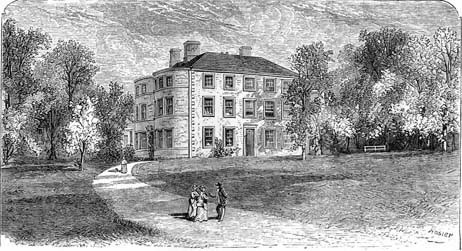
THE HOUSE THAT CHARLOTTE VISITED.
V.
LIFE AS A GOVERNESS.
Moved by the hope of lightening the family expenses and enabling Branwell to get a thorough artistic training at the Royal Academy, Charlotte resolved to go out as a governess. Her first "place" was at her old school at Roehead, where she was with her friend, Miss Wooler, and where she was also very near the home of her confidante, Miss N——. Emily went with her for a time, but she soon sickened and pined for the moors, and after a trial of but a few months she returned to Haworth. A great deal of sympathy has been bestowed upon the Brontës in connection with their lives as governesses; nor am I prepared to say that this sympathy is wholly misplaced. Their reserve, their affection for each other, their ignorance of the world, combined to make "the cup of life as it is mixed for the class termed governesses"—to use Charlotte's own phrase—particularly distasteful to them. But it is a mistake to suppose that they were treated with harshness during their governess life, or that Charlotte, at least, felt her trials to be at all unbearable. It was decidedly unpleasant to sacrifice the independence and the family companionship of Haworth for drudgery and loneliness in the household of a stranger; but it was a duty, and as such it was accepted without repining by two, at least, of the sisters. Emily's peculiar temperament made her quite unfitted for life among strangers; she made many attempts to overcome her reserve, but all were unavailing; and after a brief experience in one or two families in different parts of Yorkshire, she returned to Haworth to reside there permanently as her father's housekeeper. There is no need to dwell upon this episode in the lives of the Brontës. They were living among unfamiliar faces, and had little temptation to display themselves in their true characters, but extracts from a few of Charlotte's letters to her friends will show something of the course of her thought at this time. With the exception of a detached sentence or two these letters will be quite new to the readers of Mrs. Gaskell's "Life:"
I have been waiting for an opportunity of sending a letter to you as you wished; but as no such opportunity offers itself, I have at length determined to write to you by post, fearing that if I delayed any longer you would attribute my tardiness to indifference. I can scarcely realise the distance that lies between us, or the length of time which may elapse before we meet again. Now, Ellen, I have no news to tell you, no changes to communicate. My life since I saw you last has passed away as monotonously and unvaryingly as ever—nothing but teach, teach, teach, from morning till night. The greatest variety I ever have is afforded by a letter from you, a call from the T——s, or by meeting with a pleasant new book. The "Life of Oberlin," and Legh Richmond's "Domestic Portraiture," are the last of this description I have perused. The latter work strongly attracted and strangely fascinated my attention. Beg, borrow, or steal it without delay, and read the "Memoir of Richmond." That short record of a brief and uneventful life I shall never forget. It is beautiful, not on account of the language in which it is written, not on account of the incidents it details, but because of the simple narration it gives of the life and death of a young, talented, sincere Christian. Get the book, Ellen (I wish I had it to give you), read it, and tell me what you think of it. Yesterday I heard that you had been ill since you were in London. I hope you are better now. Are you any happier than you were? Try to reconcile your mind to circumstances, and exert the quiet fortitude of which I know you are not destitute. Your absence leaves a sort of vacancy in my feelings which nothing has as yet offered of sufficient interest to supply. I do not forget ten o'clock. I remember it every night, and if a sincere petition for your welfare will do you any good you will be benefited. I know the Bible says: "The prayer of the righteous availeth much," and I am not righteous. Nevertheless I believe God despises no application that is uttered in sincerity. My own dear E——, good-bye. I can write no more, for I am called to a less pleasant avocation.
Dewsbury Moor, Oct. 2, 1836.
I should have written to you a week ago, but my time has of late been so wholly taken up that till now I have really not had an opportunity of answering your last letter. I assure you I feel the kindness of so early a reply to my tardy correspondence. It gave me a sting of self-reproach…. My sister Emily is gone into a situation as teacher in a large school of near forty pupils, near Halifax. I have had one letter from her since her departure. It gives an appalling account of her duties. Hard labour from six in the morning till near eleven at night, with only one half-hour of exercise between. This is slavery. I fear she will never stand it. It gives me sincere pleasure, my dear Ellen, to learn that you have at last found a few associates of congenial minds. I cannot conceive a life more dreary than that passed amidst sights, sounds, and companions all alien to the nature within us. From the tenor of your letters it seems that your mind remains fixed as it ever was, in no wise dazzled by novelty or warped by evil example. I am thankful for it. I could not help smiling at the paragraphs which related to ——. There was in them a touch of the genuine unworldly simplicity which forms part of your character. Ellen, depend upon it, all people have their dark side. Though some possess the power of throwing a fair veil over the defects, close acquaintance slowly removes the screen, and one by one the blots appear; till at last we see the pattern of perfection all slurred over with stains which even affection cannot efface.
The affectionate commendations of her friend are constantly accompanied by references of a very different character to herself.
If I like people—she says in one of her letters—it is my nature to tell them so, and I am not afraid of offering incense to your vanity. It is from religion that you derive your chief charm, and may its influence always preserve you as pure, as unassuming, and as benevolent in thought and deed as you are now. What am I compared to you? I feel my own utter worthlessness when I make the comparison. I'm a very coarse, commonplace wretch! I have some qualities that make me very miserable, some feelings that you can have no participation in—that few, very few people in the world can at all understand. I don't pride myself on these peculiarities. I strive to conceal and suppress them as much as I can, but they burst out sometimes, and then those who see the explosion despise me, and I hate myself for days afterwards.
All my notes to you, Ellen, are written in a hurry. I am now snatching an opportunity. Mr. J—— is here; by his means it will be transmitted to Miss E——, by her means to X——, by his means to you. I do not blame you for not coming to see me. I am sure you have been prevented by sufficient reasons; but I do long to see you, and I hope I shall be gratified momentarily, at least, ere long. Next Friday, if all be well, I shall go to G——. On Sunday I hope I shall at least catch a glimpse of you. Week after week I have lived on the expectation of your coming. Week after week I have been disappointed. I have not regretted what I said in my last note to you. The confession was wrung from me by sympathy and kindness, such as I can never be sufficiently thankful for. I feel in a strange state of mind; still gloomy, but not despairing. I keep trying to do right, checking wrong feelings; repressing wrong thoughts—but still, every instant I find myself going astray. I have a constant tendency to scorn people who are far better than I am. A horror at the idea of becoming one of a certain set—a dread lest if I made the slightest profession I should sink at once into Phariseeism, merge wholly in the ranks of the self-righteous. In writing at this moment I feel an irksome disgust at the idea of using a single phrase that sounds like religious cant. I abhor myself; I despise myself. If the doctrine of Calvin be true, I am already an outcast. You cannot imagine how hard, rebellious, and intractable all my feelings are. When I begin to study on the subject I almost grow blasphemous, atheistical in my sentiments. Don't desert me—don't be horrified at me. You know what I am. I wish I could see you, my darling. I have lavished the warmest affections of a very hot, tenacious heart upon you. If you grow cold it is over.
You will excuse a very brief and meagre answer to your kind note when I tell you that at the moment it reached me, and that just now whilst I am scribbling a reply, the whole house is in the bustle of packing and preparation, for on this day we all go home. Your palliation of my defects is kind and charitable, but I dare not trust its truth. Few would regard them with so lenient an eye as you do. Your consolatory admonitions are kind, Ellen; and when I can read them over in quietness and alone, I trust I shall derive comfort from them. But just now, in the unsettled, excited state of mind which I now feel, I cannot enter into the pure scriptural spirit which they breathe. It would be wrong of me to continue the subject. My thoughts are distracted and absorbed by other ideas. You do not mention your visit to Haworth. Have you spoken of it to the family? Have they agreed to let you come? But I will write when I get home. Ever since last Friday I have been as busy as I could be in finishing up the half-year's lessons, which concluded with a terrible fog in geographical problems (think of explaining that to Misses —— and ——!), and subsequently in mending Miss ——'s clothes. Miss —— is calling me: something about my protégée's nightcap. Good-bye. We shall meet again ere many days, I trust.
Here it will be seen that the religious struggle was renewed. The woman who was afterwards to be accused of "heathenism" was going through tortures such as Cowper knew in his darkest hours, and, like him, was acquiring faith, humility, and resignation in the midst of the conflict. But such letters as this are only episodical; in general she writes cheerfully, sometimes even merrily.
THE ROE HEAD SCHOOL.
What would the Quarterly reviewer and the other charitable people, who openly declared their conviction that the author of "Jane Eyre" was an improper person, who had written an improper book, have said had they been told that she had written the following letter on the subject of her first offer of marriage—written it, too, at the time when she was a governess, and in spite of the fact that the offer opened up to her a way of escape from all anxiety as to her future life?
You ask me whether I have received a letter from T——. I have about a week since. The contents I confess did a little surprise me; but I kept them to myself, and unless you had questioned me on the subject I would never have adverted to it. T—— says he is comfortably settled at ——, and that his health is much improved. He then intimates that in due time he will want a wife, and frankly asks me to be that wife. Altogether the letter is written without cant or flattery, and in common-sense style which does credit to his judgment. Now there were in this proposal some things that might have proved a strong temptation. I thought if I were to marry so —— could live with me, and how happy I should be. But again I asked myself two questions: Do I love T—— as much as a woman ought to love her husband? Am I the person best qualified to make him happy? Alas! my conscience answered "No" to both these questions. I felt that though I esteemed T——, though I had a kindly leaning towards him, because he is an amiable, well-disposed man, yet I had not and never could have that intense attachment which would make me willing to die for him—and if ever I marry it must be in that light of adoration that I will regard my husband. Ten to one I shall never have the chance again; but n'importe. Moreover, I was aware he knew so little of me he could hardly be conscious to whom he was writing. Why, it would startle him to see me in my natural home character. He would think I was a wild, romantic enthusiast indeed. I could not sit all day long making a grave face before my husband. I would laugh and satirise, and say whatever came into my head first; and if he were a clever man and loved me, the whole world weighed in the balance against his smallest wish would be light as air. Could I, knowing my mind to be such as that, conscientiously say that I would take a grave, quiet young man like T——? No; it would have been deceiving him, and deception of that sort is beneath me. So I wrote a long letter back in which I expressed my refusal as gently as I could, and also candidly avowed my reasons for that refusal. I described to him, too, the sort of character I thought would suit him for a wife.
The girl who could thus calmly decline a more than merely "eligible" offer, and thus honestly state her reasons for doing so to the friend she trusted, was strangely different from the author of "Jane Eyre" pictured by the critics and the public. Perhaps the full cost of the refusal related in the foregoing letter is only made clear when it is brought into contrast with such a confession as the following, made very soon afterwards:
I am miserable when I allow myself to dwell on the necessity of spending my life as a governess. The chief requisite for that station seems to me to be the power of taking things easily when they come, and of making oneself comfortable and at home wherever one may chance to be—qualities in which all our family are singularly deficient. I know I cannot live with a person like Mrs. ——; but I hope all women are not like her, and my motto is "Try again."
How thoroughly at all times she could sympathise alike with the joys and sorrows of others, is proved by many letters extending over the whole period of her life. The following is neither the earliest nor the most characteristic of those utterances of a tender and heartfelt sympathy with her special friend, which are to be found in her correspondence, but as Mrs. Gaskell has not made use of it, I may quote it here:
1838.
We were at breakfast when your note reached me, and I consequently write in great hurry. Your trials seem to thicken. I trust God will either remove them or give you strength to bear them. If I could but come to you and offer you all the little assistance either my head or hands could afford! But that is impossible. I scarcely dare offer to comfort you about —— lest my consolation should seem like mockery. I know that in cases of sickness strangers cannot measure what relations feel. One thing, however, I need not remind you of. You will have repeated it over and over to yourself before now: God does all for the best; and even should the worst happen, and Death seem finally to destroy hope, remember that this will be but a practical test of the strong faith and calm devotion which have marked you a Christian so long. I would hope, however, that the time for this test is not yet come, that your brother may recover, and all be well. It grieves me to hear that your own health is so indifferent. Once more I wish I were with you to lighten at least by sympathy the burden that seems so unsparingly laid upon you. Let me thank you for remembering me in the midst of such hurry and affliction. We are all apt to grow selfish in distress. This, so far as I have found, is not your case. When shall I see you again? The uncertainty in which the answer to that question must be involved gives me a bitter feeling. Through all changes, through all chances, I trust I shall love you as I do now. We can pray for each other and think of each other. Distance is no bar to recollection. You have promised to write to me, and I do not doubt that you will keep your word. Give my love to M—— and your mother. Take with you my blessing and affection, and all the warmest wishes of a warm heart for your welfare.
From one of her situations as governess in a private family (she had long since left the kind shelter of Miss Wooler's house) she writes in 1841 a series of letters showing how little she relished the "cup of life as it is mixed for the class termed governesses."
It is twelve o'clock at night; but I must just write you a word before I go to bed. If you think I'm going to refuse your invitation, or if you sent it me with that idea, you're mistaken. As soon as I had read your shabby little note, I gathered up my spirits directly, walked on the impulse of the moment into Mrs. ——'s presence, popped the question, and for two minutes received no answer. "Will she refuse me when I work so hard for her?" thought I. "Ye—e—es," drawled madam in a reluctant, cold tone. "Thank you, madam!" said I with extreme cordiality, and was marching from the room when she recalled me with "You'd better go on Saturday afternoon, then, when the children have holiday, and if you return in time for them to have all their lessons on Monday morning, I don't see that much will be lost." You are a genuine Turk, thought I; but again I assented, and so the bargain was struck. Saturday after next, then, is the day appointed. I'll come, God knows, with a thankful and joyful heart, glad of a day's reprieve from labour. If you don't send the gig I'll walk. I am coming to taste the pleasure of liberty; a bit of pleasant congenial talk, and a sight of two or three faces I like. God bless you! I want to see you again. Huzza for Saturday afternoon after next! Good-night, my lass!
During the last three weeks that hideous operation called "a thorough clean" has been going on in the house. It is now nearly completed, for which I thank my stars, as during its progress I have fulfilled the double character of nurse and governess, while the nurse has been transmuted into cook and housemaid. That nurse, by-the-bye, is the prettiest lass you ever saw…. I was beginning to think Mrs. —— a good sort of body in spite of her bouncing and toasting, her bad grammar and worse orthography; but I have had experience of one little trait in her character which condemns her a long way with me. After treating a person on the most familiar terms of equality for a long time, if any little thing goes wrong, she does not scruple to give way to anger in a very coarse, unladylike manner, though in justice no blame could be attached where she ascribed it all. I think passion is the true test of vulgarity or refinement. This place looks exquisitely beautiful just now. The grounds are certainly lovely, and all as green as an emerald. I wish you would just come and look at it.
VI.
THE TURNING-POINT.
The "storm and stress" period of Charlotte Brontë's life was not what the world believes it to have been. Like the rest of our race, she had to fight her own battle in the wilderness, not with one devil, but with many; and it was this sharp contest with the temptations which crowd the threshold of an opening life which made her what she was. The world believes that it was under the parsonage roof that the author of "Jane Eyre" gathered up the precious experiences which were afterwards turned to such good account. Mrs. Gaskell, who was carried away by her honest womanly horror of hardened vice, gives us to understand that the tragic turning-point in the history of the sisters was connected with the disgrace and ruin of their brother. We are even asked to believe that but for the folly of a single woman, whom it is probable that Charlotte never saw, "Currer Bell" would never have taken up her pen, and no halo of glory would have settled on the scarred and rugged brows of prosaic Haworth.