T. WEMYSS REID. (continued 4)
Reading edition
Haworth, May 14th.
I took the time of the Leeds, Keighley, Skipton trains from the February time-table, and when I got to Leeds found myself all wrong. The trains on that line were changed. One had that moment left the station—indeed, it was just steaming away; there was not another till a quarter after five o'clock; so I had just four hours to sit and twirl my thumbs. I got over the time somehow, but I was vexed to think how much more pleasantly I might have spent it at B. It was just seven o'clock when I reached home. I found Papa well. It seems he has been particularly well during my absence, but to-day he is a little sickly, and only preached once. However, he is better again this evening. I could not leave you, dear Ellen, with a very quiet mind, or take away a satisfied feeling about you. Not that I think that bad cough lodged in a dangerous quarter; but it shakes your system, wears you out, and makes you look ill. Take care of it, do, dear Ellen. Avoid the evening air for a time; keep in the house when the weather is cold. Observe these precautions till the cough is quite gone, and you regain strength, and feel better able to bear chill and change. Believe me, it does not suit you at present to be much exposed to variations of temperature. I send the mantle with this, but have made up my mind not to let you have the cushion now, lest you should sit stitching over it too closely. It will do any time, and whenever it comes will be your present all the same.
May 22nd.
I wonder how you are, and whether that harassing cough is better; but I am afraid the variable weather of last week will not have been favourable to improvement. I will not and do not believe the cough lies on any vital organ. Still it is a mark of weakness, and a warning to be scrupulously careful about undue exposure. Just now, dear Ellen, an hour's inadvertence might derange your whole constitution for years to come—might throw you into a state of chronic ill-health which would waste, fade, and wither you up prematurely. So, once and again, TAKE CARE. If you go to ——, or any other evening party, pack yourself in blankets and a feather-bed to come home, also fold your boa twice over your mouth, to serve as a respirator. Since I came home I have been very busy sketching. The little new room is got into order now, and the green and white curtains are up. They exactly suit the papering, and look neat and clean enough. I had a letter a day or two since, announcing that Mr. N. comes to-morrow. I feel anxious about him, more anxious on one point than I dare quite express to myself. It seems he has again been suffering sharply from his rheumatic affection. I hear this not from himself, but from another quarter. He was ill whilst I was at Manchester and B. He uttered no complaint to me, dropped no hint on the subject. Alas! he was hoping he had got the better of it; and I know how this contradiction of his hopes will sadden him. For unselfish reasons he did so earnestly wish this complaint might not become chronic. I fear—I fear—but, however, I mean to stand by him now, whether in weal or woe. This liability to rheumatic pain was one of the strong arguments used against the marriage. It did not weigh, somehow. If he is doomed to suffer, it seems that so much the more will he need care and help. And yet the ultimate possibilities of such a case are appalling. Well, come what may, God help and strengthen both him and me. I look forward to to-morrow with a mixture of impatience and anxiety. Poor fellow! I want to see with my own eyes how he is.
Haworth, June 7th.
I am very glad and thankful to hear that you continue better, though I am afraid your cough will have returned a little during the late chilly change in the weather. Are you taking proper care of yourself, and either staying in the house or going out warmly clad, and with a boa doing duty as a respirator? On this last point I incline particularly to insist, for you seemed careless about it, and unconscious how much atmospheric harm the fine thick hairs of the fur might ward off. I was very miserable about Papa again some days ago. While the weather was so sultry and electric, about a week since, he was suddenly attacked with deafness, and complained of other symptoms which showed the old tendency to the head. His spirits, too, became excessively depressed. It was all I could do to keep him up, and I own I was sad and depressed myself. However he took some medicine, which did him good. The change to cooler weather, too, has suited him. The temporary deafness has quite disappeared for the present, and his head is again clear and cool. I can only earnestly trust he will continue better. That unlucky —— continues his efforts to give what trouble he can, and I am obliged to conceal things from Papa's knowledge as well as I can, to spare him that anxiety which hurts him so much…. I feel compelled to throw the burden of the contest upon Mr. Nicholls, who is younger and can bear it better. The worst of it is, Mr. N. has not Papa's right to speak and act, or he would do it to purpose. I should then have to mediate, not rouse; to play the part of
Feather-bed 'twixt castle-wall And heavy brunt of cannon-ball.
June 16th.
My dear Miss W——,—Owing to certain untoward proceedings, matters have hitherto been kept in such a state of uncertainty that I could not make any approach towards fixing the day; and now, if I would avoid inconveniencing Papa, I must hurry. I believe the commencement of July is the furthest date upon which I can calculate; possibly I may be obliged to accept one still nearer—the close of June. I cannot quite decide till next week. Meantime, will you, my dear Miss W——, come as soon as you possibly can, and let me know at your earliest convenience the day of your arrival. I have written to Ellen, begging her to communicate with you…. Your absence would be a real and grievous disappointment. Papa also seems much to wish your presence. Mr. Nicholls enters with true kindness into my wish to have all done quietly; and he has made such arrangements as will, I trust, secure literal privacy. Yourself, Ellen, and Mr. S. will be the only persons present at the ceremony. Mr. and Mrs. G. are asked to the breakfast afterwards. I know you will kindly excuse this brief note, for I am and have been very busy, and must still be busy up to the very day. Give my sincere love to all Mr. C——'s family. I hope Mr. C. and Mr. Nicholls may meet some day. I believe mutual acquaintance would in time bring mutual respect; but one of them, at least, requires knowing to be appreciated. And I must say that I have not yet found him to lose with closer knowledge. I make no grand discoveries, but I occasionally come upon a quiet little nook of character which excites esteem. He is always reliable, truthful, faithful, affectionate; a little unbending, perhaps, but still persuadable and open to kind influence—a man never, indeed, to be driven, but who may be led.
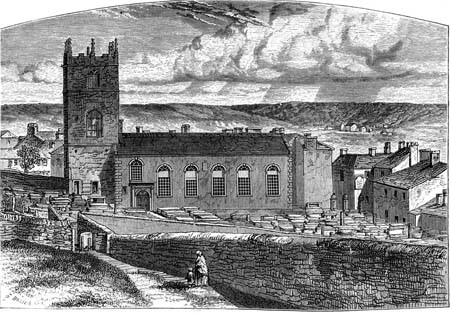
HAWORTH CHURCH.
The marriage took place on June 29th, 1854. A neighbouring clergyman read the service; Charlotte's "dear Nell" was the solitary bridesmaid; her old schoolmistress, whose friendship had ever been dear to her, Miss Wooler, gave her away; and visitors to Haworth who are shown the marriage register will see that these two faithful and trusted friends were the only witnesses. Immediately after the marriage the bride and bridegroom started for Ireland, to visit some of the relatives of Mr. Nicholls. "I trust I feel thankful to God for having enabled me to make a right choice; and I pray to be enabled to repay as I ought the affectionate devotion of a truthful, honourable, unboastful man," are words which appear in the first letter written from Ireland. A month later the bride writes as follows to her friend:
Dublin, July 28th, 1854.
I really cannot rest any longer without writing you a line, which I have literally not had time to do during the last fortnight. We have been travelling about, with only just such cessation as enabled me to answer a few of the many notes of congratulation forwarded, and which I dared not suffer to accumulate till my return, when I know I shall be busy enough. We have been to Killarney, Glen Gariffe, Tarbert, Tralee, Cork, and are now once more in Dublin again on our way home, where we hope to arrive next week. I shall make no effort to describe the scenery through which we have passed. Some parts have exceeded all I ever imagined. Of course, much pleasure has sprung from all this, and more, perhaps, from the kind and ceaseless protection which has ever surrounded me, and made travelling a different matter to me from what it has heretofore been. Dear Nell, it is written that there shall be no unmixed happiness in this world. Papa has not been well, and I have been longing, longing intensely sometimes, to be at home. Indeed, I could enjoy and rest no more, and so home we are going.
It was a new life to which she was returning. Wedded to one who had proved by years of faithfulness and patience how strong and real was his love for her, it seemed as though peace and sunshine, the brightness of affection and the pleasures of home, were at length about to settle upon her and around her. The bare sitting-room in the parsonage, which for six years of loneliness and anguish had been peopled only by the heart-sick woman and the memories of those who had left her, once more resounded with the voices of the living. The husband's strong and upright nature furnished something for the wife to lean against; the painful sense of isolation which had so long oppressed her vanished utterly, and in its place came that "sweet sense of depending" which is the most blessed fruit of a trustful love. A great calm seemed to be breathed over the spirit of her life after the fitful fever which had raged so long; and her friends saw new shoots of tenderness, new blossoms of gentleness and affection, peeping forth in nooks of her character which had hitherto been barren. Of her letters during these happy months of peace and expectation I cannot quote much; they are too closely intertwined with the life of those who survive to permit of this being done; but all of them breathe the same spirit. They show that the courage, the patience, the cheerfulness with which the rude buffetings of fate had been borne in that stormy middle-passage of her history, had brought their own reward; and that joy had come at last, not perhaps in the shape she had imagined in her early youth, but as a substantial reality, and no longer a mocking illusion.
August 9th, 1854.
—— will probably end by accepting ——; and judging from what you say, it seems to me that it would be rational to do so. If, indeed, some one else whom she preferred wished to have her, and had duly and sincerely come forward, matters would be different. But this it appears is not the case; and to cherish any unguarded and unsustained preference is neither right nor wise. Since I came home I have not had one unemployed moment. My life is changed indeed; to be wanted continually, to be constantly called for and occupied, seems so strange; yet it is a marvellously good thing. As yet I don't quite understand how some wives grow so selfish. As far as my experience of matrimony goes, I think it tends to draw you out and away from yourself…. Dear Nell, during the last six weeks the colour of my thoughts is a good deal changed. I know more of the realities of life than I once did. I think many false ideas are propagated, perhaps unintentionally. I think those married women who indiscriminately urge their acquaintance to marry, much to blame. For my part I can only say with deeper sincerity and fuller significance, what I always said in theory: Wait God's will. Indeed, indeed, Nell, it is a solemn and strange and perilous thing for a woman to become a wife. Man's lot is far, far different…. Have I told you how much better Mr. Nicholls is? He looks quite strong and hale. To see this improvement in him has been a great source of happiness to me; and, to speak truth, a source of wonder too.
Haworth, September 7th, 1854.
I send a French paper to-day. You would almost think I had given them up, it is so long since one was despatched. The fact is they had accumulated to quite a pile during my absence. I wished to look them over before sending them off, and as yet I have scarcely found time. That same time is an article of which I once had a large stock always on hand; where it is all gone to now it would be difficult to say, but my moments are very fully occupied. Take warning, Ellen. The married woman can call but a very small portion of each day her own. Not that I complain of this sort of monopoly as yet, and I hope I never shall incline to regard it as a misfortune, but it certainly exists. We were both disappointed that you could not come on the day I mentioned. I have grudged this splendid weather very much. The moors are in their glory; I never saw them fuller of purple bloom; I wanted you to see them at their best. They are fast turning now, and in another week, I fear, will be faded and sere. As soon as ever you can leave home, be sure to write and let me know…. Papa continues greatly better. My husband flourishes; he begins indeed to express some slight alarm at the growing improvement in his condition. I think I am decent—better certainly than I was two months ago; but people don't compliment me as they do Arthur—excuse the name; it has grown natural to use it now.
Haworth, September 16th, 1854.
My dear Miss ——,—You kindly tell me not to write while Ellen is with me; I am expecting her this week; and as I think it would be wrong long to defer answering a letter like yours, I will reduce to practice the maxim: "There is no time like the present," and do it at once. It grieves me that you should have had any anxiety about my health; the cough left me before I quitted Ireland, and since my return home I have scarcely had an ailment, except occasional headaches. My dear father, too, continues much better. Dr. B—— was here on Sunday, preaching a sermon for the Jews, and he gratified me much by saying that he thought Papa not at all altered since he saw him last—nearly a year ago. I am afraid this opinion is rather flattering; but still it gave me pleasure, for I had feared that he looked undeniably thinner and older. You ask what visitors we have had. A good many amongst the clergy, &c., in the neighbourhood, but none of note from a distance. Haworth is, as you say, a very quiet place; it is also difficult of access, and unless under the stimulus of necessity, or that of strong curiosity, or finally, that of true and tried friendship, few take courage to penetrate to so remote a nook. Besides, now that I am married, I do not expect to be an object of much general interest. Ladies who have won some prominence (call it either notoriety or celebrity) in their single life, often fall quite into the background when they change their names. But if true domestic happiness replace fame, the change is indeed for the better. Yes, I am thankful to say that my husband is in improved health and spirits. It makes me content and grateful to hear him, from time to time, avow his happiness in the brief but plain phrase of sincerity. My own life is more occupied than it used to be; I have not so much time for thinking: I am obliged to be more practical, for my dear Arthur is a very practical as well as a very punctual, methodical man. Every morning he is in the national school by nine o'clock; he gives the children religious instruction till half-past ten. Almost every afternoon he pays visits amongst the poor parishioners. Of course he often finds a little work for his wife to do, and I hope she is not sorry to help him. I believe it is not bad for me that his bent should be so wholly towards matters of real life and active usefulness—so little inclined to the literary and contemplative. As to his continued affection and kind attentions, it does not become me to say much of them; but as yet they neither change nor diminish. I wish, my dear Miss ——, you had some kind, faithful companion to enliven your solitude at R——, some friend to whom to communicate your pleasure in the scenery, the fine weather, the pleasant walks. You never complain, never murmur, never seem otherwise than thankful; but I know you must miss a privilege none could more keenly appreciate than yourself.
There are other letters like the foregoing, all speaking of the constant occupation of time, which once hung heavily, all giving evidence that peace and love had made their home in her heart, all free from that strain of sadness which was so common in other years. One only of these letters, that written on the morrow of her last Christmas Day, need be quoted, however.
Haworth, December 26th.
I return Mrs. ——'s letter: it is as you say, very genuine, truthful, affectionate, maternal, without a taint of sham or exaggeration. She will love her child without spoiling it, I think. She does not make an uproar about her happiness either. The longer I live the more I suspect exaggerations. I fancy it is sometimes a sort of fashion for each to vie with the other in protestations about their wondrous felicity—and sometimes they fib! I am truly glad to hear you are all better at B——. In the course of three or four weeks now I expect to get leave to come to you. I certainly long to see you again. One circumstance reconciles me to this delay—the weather. I do not know whether it has been as bad with you as with us; but here for three weeks we have had little else than a succession of hurricanes…. You inquire after Mrs. Gaskell. She has not been here, and I think I should not like her to come now till summer. She is very busy now with her story of "North and South." I must make this note very short. Arthur joins me in sincere good wishes for a happy Christmas and many of them to you and yours. He is well, thank God, and so am I; and he is "my dear boy" certainly—dearer now than he was six months ago. In three days we shall actually have been married that length of time.
There was not much time for literary labours during these happy months of married life. The wife, new to her duties, was engaged in mastering them with all the patience, self-suppression, and industry which had characterised her throughout her life. Her husband was now her first thought; and he took the time which had formerly been devoted to reading, study, thought, and writing. But occasionally the pressure she was forced to put upon herself was very severe. Mr. Nicholls had never been attracted towards her by her literary fame; with literary effort, indeed, he had no sympathy, and upon the whole he would rather that his wife should lay aside her pen entirely than that she should gain any fresh triumphs in the world of letters. So she submitted, and with cheerful courage repressed that "gift" which had been her solace in sorrows deep and many. Yet once "the spell" was too strong to be resisted, and she hastily wrote a few pages of a new story called "Emma," in which once more she proposed to deal with her favourite theme—the history of a friendless girl. One would fain have seen how she would have treated her subject, now that "the colour of her thoughts" had been changed, and that a happy marriage had introduced her to a new phase of that life which she had studied so closely and so constantly. But it was not to be. On January 19, when she had returned to Haworth, after a visit to Sir J. K. Shuttleworth's, she wrote to her friend as follows. This letter was the last written in ink to her schoolfellow:
Haworth, January 19th, 1855.
Since our return from Gawthorpe we have had Mr. B——, one of Arthur's cousins, staying with us. It was a great pleasure. I wish you could have seen him and made his acquaintance: a true gentleman by nature and cultivation is not, after all, an everyday thing…. I very much wish to come to B——, and I hoped to be able to write with certainty and fix Wednesday, the 31st January, as the day; but the fact is I am not sure whether I shall be well enough to leave home. At present I should be a most tedious visitor. My health has really been very good ever since my return from Ireland, till about ten days ago. Indigestion and continual faint sickness have been my portion ever since. I never before felt as I have done lately. I am rather mortified to lose my good looks and grow thin as I am doing, just when I thought of going to B——. Poor J——! I still hope he will get better, but A—— writes grievous though not always clear or consistent accounts. Dear Ellen, I want to see you, and I hope I shall see you well.
Those around her were not alarmed at first. They hoped that before long all would be well with her again; they could not believe that the joys of which she had just begun to taste were about to be snatched away. But her weakness grew apace; the sickness knew no abatement; and a deadly fear began to creep into the hearts of husband and father. She was soon so weak that she was compelled to remain in bed, and from that "dreary bed" she wrote two or three faint pencil notes which still exist—the last pathetic chapters in that life-long correspondence from which we have gathered so many extracts. In one of them, which Mrs. Gaskell has published, she says: "I want to give you an assurance which I know will comfort you—and that is that I find in my husband the tenderest nurse, the kindest support, the best earthly comfort that ever woman had. His patience never fails, and it is tried by sad days and broken nights." In another, the last, she says: "I cannot talk—even to my dear, patient, constant Arthur I can say but few words at once." One dreary March morning, when frost still bound the earth and no spring sun had come to gladden the hearts of those who watched for summer, her friend received another letter, written, not in the neat, minute hand of Charlotte Brontë, but in her father's tremulous characters:
Haworth, near Keighley, March 30th, 1855.
My dear Madam,—We are all in great trouble, and Mr. Nicholls so much so that he is not sufficiently strong and composed as to be able to write. I therefore devote a few lines to tell you that my dear daughter is very ill, and apparently on the verge of the grave. If she could speak she would no doubt dictate to us whilst answering your kind letter. But we are left to ourselves to give what answer we can. The doctors have no hope of her case, and fondly as we a long time cherished hope, that hope is now gone; and we have only to look forward to the solemn event with prayer to God that He will give us grace and strength sufficient unto our day.
Ever truly and respectfully yours,
P. Brontë.
The following day, March 31st, 1855, the blinds were drawn once again at Haworth Parsonage; the last and greatest of the children of the house had passed away; and the brilliant name of Charlotte Brontë had become a name and nothing more! "We are left to ourselves," said Mr. Brontë in the letter I have just quoted—and so it was. Not the glory only, but the light, had fled from the parsonage where the childless father and the widowed husband sat together beside their dead. Of all the drear and desolate spots upon that wild Yorkshire moorland there was none now so dreary and so desolate as the house which had once been the home of Charlotte Brontë.
XII.
POSTHUMOUS HONOURS.
There is a deeper truth in the maxim which bids us judge no man happy till his death than most of us are apt to perceive. For sometimes the happiness of a life is crowned by death itself; and that which to the superficial gaze seems but the dreary and tragic close of the play, is really the welcome release from the burden which had become too heavy to be borne longer. But where life and breath fail suddenly in the moment of fullest hope, apparently in the moment also of greatest bliss, the strain upon our faith is almost too severe, and blinded and bewildered, we see nothing and feel nothing but the awful stroke of fate which has laid the loved one low, and the great gap which remains at the table and the hearth. It was with such a feeling as this that the outer world heard of that Easter-day tragedy which had been enacted to the bitter end among the Yorkshire hills. Those who knew the little household at Haworth had been watching, as has already been told, for that fulness of joy which seemed close at hand. They had seen the lonely authoress developing into the trustful happy wife, and they looked forward to no distant day when children should be gathered at her knee, and a new generation, born amid happier circumstances, freed from the strain and stress which had been laid upon her, should perpetuate a great name, and perhaps something of a great genius.
The announcement that all these hopes had been brought to nothing fell upon the world as a blow not easily to be borne. When it was made known that the author of "Jane Eyre" was dead, there rose up even from those who had been her bitter critics during her lifetime, a cry of pain and regret which would have astonished nobody more than herself had she been able to hear it. The genuine unaffected modesty which had enabled her to preserve the simplicity of her character amid all the temptations which thronged round her at the height of her fame, had prevented her from ever feeling herself to be a person of consequence in the world. What she did in the way of writing she did because she could not escape the commanding authority of her own genius; but the idea that by doing this she had made herself conspicuously great never once occurred to her. There is not a letter extant from her which shows that she thought anything of the fame or the fortune she had acquired. On the contrary everything that remains of her inner life proves that to the very last she esteemed herself as humbly as ever she did during the days of her "governessing" in Yorkshire or at Brussels. She knew of course that she attracted attention wherever she went; but her own unfeigned belief seems to have been that this attention was due solely to curiosity, and to curiosity of a not very pleasant or flattering kind. Brought up as she had been among those who regarded any literary pursuit, and above all the writing of a book, as something beyond the proper limits of the rights and duties of her sex, she had never quite escaped from the notion that in putting pen to paper she was in some vague way offending against the proprieties of society. It has been shown by an extract from one of her letters, how keenly and indignantly she repudiated the notion that she had ever written anything of which she needed to be ashamed. Her pure heart vindicated her absolutely upon that point. But, from first to last, she seemed during her literary career to feel that in writing novels she had sinned against the conventional canons, and that she was in consequence looked upon not as a great woman who had taken a lofty place in the republic of letters, but as a social curiosity who had done something which made her for the time-being notorious. How ready she was to forget her success as a writer is shown by a thousand passages in her correspondence, many of these passages being too tender or sacred for quotation. It is impossible to read her letters without seeing that, with the exception of a solitary friend, the companions of her daily life in Yorkshire did not feel at all drawn towards her by her literary fame. With her accustomed humility she accepted herself at their valuation, and whilst the nations afar off were praising her, she herself was perfectly ready to take a humble place in the circle of her friends at home. The tastes of her husband had unquestionably something to do in maintaining this simple and sincere modesty up to the end of her life. He was resolute in putting aside all thought of her literary achievements; his whole anxiety—an anxiety arising almost entirely from his desire for her happiness—was that she should cease entirely to be the author, and should become the busy, useful, contented wife of the village clergyman. It would be wrong to hide the fact that she was compelled to place a severe strain upon herself in order to comply with her husband's wishes; and once, as we have seen, her strength of self-repression gave way, and she indulged in the forbidden luxury of work with the pen. But it is not surprising that, surrounded by those who, loving her very dearly, yet withheld from her all recognition of her position as one of the great writers of the day, she should have accepted their estimate of her place with characteristic humility, and believed herself to be of little or no account outside the walls of her own home.
In this belief she lived and died. Among the letters before me, but from which I must forbear to quote, are not a few written during that last sad illness when the end began to loom before her vision. In these, whilst there are many anxious inquiries after the friends of early days, and many remarks upon their varying fortunes, many allusions, too, to her husband and father, and to parish work at Haworth, there is not a line which speaks of her own feelings as an author, or of the work which she had accomplished during the brief closing years of her life. The novelist has passed entirely out of sight, and only the wife, the friend, the expectant mother, remains. I know nothing which more touchingly shows one how small a thing is great fame, how little even the most marked and marvellous successes can affect the realities of life, than the last chapters of Charlotte Brontë's correspondence do. Her death, all unknown to the great world outside; her quiet funeral, treated only as the funeral of the clergyman's daughter, the curate's wife; the modest announcement of her end sent to the local papers—all these are in keeping with her own low estimate of herself.
But death, the great touchstone of humanity, revealed her true position to the world, and to her surviving relatives and friends. Copies of the newspapers of that sad March week in 1855 lie before me, carefully treasured up by loving hands. They speak with an eloquence which is not always that of mere words, of a nation's mourning for a great soul gone prematurely to its account. Of all these tributes of loving admiration, there are two which must be singled out for special mention. One is Miss Martineau's generous though not wholly satisfactory notice of "Currer Bell" in The Daily News, and the other the far more sympathetic article by "Shirley," which appeared in Fraser's Magazine a few months later.
Her father, her husband, her life-long friend, were wonderfully touched and moved when they found how closely the simple, modest woman, who had been so long a sweet and familiar presence to them, had wound herself round the great heart of the reading public. But they were slow to grasp all the truth. When it was proposed that some record of this noble life should be preserved, and when Mrs. Gaskell was named as the fittest among all Charlotte's literary acquaintances to undertake the office, there was strong and keen opposition on the part of those who had been nearest and dearest to her. With a natural feeling, to which no word of blame can be attached, but which again throws light upon the character of her surroundings in life, they objected to any revelation to the world of the real character and career of the lost member of their household. Happily, their scruples were overcome, and the world was permitted to read the story of the Brontës as told by one who was herself a woman of genius and of the highest moral worth. The reader of this monograph will not, it is to be hoped, imagine that the writer has presumed to set himself up as a rival to Mrs. Gaskell. He can no more pretend to equal her in the treatment of his subject than in the freshness of the interest attaching to it. And if he has found himself obliged to differ from her on some points not wholly unimportant, it must be borne in mind that the writer of to-day is free from not a few of the difficulties and restraints which weighed upon the writer of twenty years ago. Mrs. Gaskell had, indeed, to labour under serious disadvantages in her task. Not only was she unable to obtain full and ready access to all the materials which she needed to employ, but she was also compelled to introduce much irrelevant and even hurtful matter into a delightful and beautiful story. When, after gathering up the bare outline of the life she proposed to write, she complained to Mr. Brontë that there were not incidents enough in the history of his daughter to make an interesting narrative of the ordinary length, his reply was a characteristic one: "If there are not facts enough in Charlotte's life to make a book, madam, you must invent some." There is no need to say that Mrs. Gaskell declined to follow this advice; but none the less was she hampered all through her work by the necessity of introducing topics which had but little to do with her main theme; and we see the result in the fact that the plain unadorned tale of Charlotte Brontë and her sisters has been interwoven with dismal episodes with which properly it had no concern.
The publication of Mrs. Gaskell's biography came, however, as a revelation upon the world. Readers everywhere had learned to admire the writings of "Currer Bell," and to mourn over the premature extinction of her genius, but few of them had imagined that the life and personal character of the author of "Jane Eyre" had been what it was.
The following letter from Charles Kingsley to Mrs. Gaskell sufficiently indicates the revulsion of feeling wrought in many minds by the publication of the "Memoir:"
St. Leonards, May 14, 1857.
Let me renew our long-interrupted acquaintance by complimenting you on poor Miss Brontë's "Life." You have had a delicate and a great work to do, and you have done it admirably. Be sure that the book will do good. It will shame literary people into some stronger belief that a simple, virtuous, practical home life, is consistent with high imaginative genius; and it will shame, too, the prudery of a not over cleanly though carefully white-washed age, into believing that purity is now (as in all ages till now) quite compatible with the knowledge of evil. I confess that the book has made me ashamed of myself. "Jane Eyre" I hardly looked into, very seldom reading a work of fiction—yours, indeed, and Thackeray's, are the only ones I care to open. "Shirley" disgusted me at the opening, and I gave up the writer and her books with a notion that she was a person who liked coarseness. How I misjudged her! and how thankful I am that I never put a word of my misconceptions into print, or recorded my misjudgments of one who is a whole heaven above me.
Well have you done your work, and given us the picture of a valiant woman made perfect by sufferings. I shall now read carefully and lovingly every word she has written, especially those poems, which ought not to have fallen dead as they did, and which seem to be (from a review in the current Fraser) of remarkable, strength and purity. [1]
The effect of the portrait was heightened by the admirable skill with which the background was drawn; and the story of the life gained a popularity which hardly any other recent English biography has attained. Yet, from the first, people were found here and there who, whilst acknowledging the skill, the sympathy, and the entire sincerity displayed by Mrs. Gaskell, yet whispered that the Charlotte Brontë of the story was not in all particulars the Charlotte Brontë they had known.
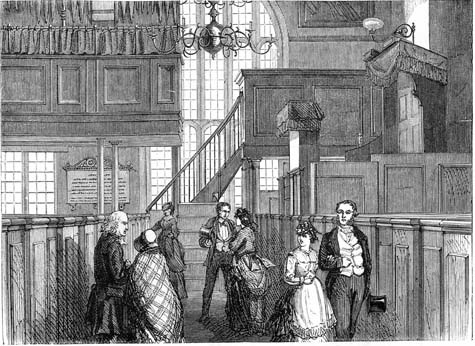
INTERIOR OF HAWORTH CHURCH.
One great change resulted immediately from the publication of Mrs. Gaskell's work. Haworth and its parsonage became the shrine to which hundreds of literary pilgrims from all parts of the globe began to find their way. To see the house in which the three sisters had spent their lives and done their work, to stand at the altar at which Charlotte was married, and beneath which her ashes now rest, and to hear her aged father preach one of his pithy, sensible, but dogmatic sermons, was what all literary lion-hunters aspired to do. In Yorkshire, indeed, the stolid people of the West Riding were not greatly moved by this enthusiasm. Just as Charlotte herself had seemed an ordinary and rather obscure person to her Yorkshire friends, so Haworth was still regarded as being a very dull and dreary village by those who lived near it. But the empire of genius knows no geographical boundaries, and if at her own doors Charlotte Brontë's sway was unrecognised, from far-distant quarters of the world there came the free and full acknowledgment of her power. No other land, however, furnished so many eager and enthusiastic visitors to the Brontë shrine as the United States, and the number of Americans who found their way to Haworth during the ten years immediately following the death of the author of "Jane Eyre" would, if properly recorded, astonish the world. The bleak and lonely house by the side of the moors, with its dismal little garden stretching down to the churchyard, where the village dead of many a generation rest, and its dreary out-look upon the old tower rising from its bank of nettles, the squalid houses of the hamlet, and the bare moorlands beyond, received almost as many visitors from the other side of the Atlantic during those years as Abbotsford or Stratford-upon-Avon. Mr. Brontë and Mr. Nicholls, though they were anxious to avoid the pertinacious intrusion of these curious but enthusiastic guests, could not entirely escape from meeting them. It followed that many an American lady and gentleman wandered through the rooms where the three sisters had dwelt together in love and unity, and where Charlotte had laboured alone after the light of her life had fled from her, and many an American magazine and newspaper contained the record of the impressions which these visits left upon the minds of those who made them.
In only one case does it seem necessary to recall those impressions. The late Mr. Raymond, for many years editor of The New York Times, visited Haworth, and wrote an account of his visit, some passages of which may well be reproduced here. He tells us how on his railway journey to Keighley, at that time the nearest railway station to Haworth, he "astonished an intelligent, sociable, and very agreeable English lady, his sole companion in the railway carriage, by telling her the errand which had brought him to Yorkshire. She lived in the neighbourhood, had read the 'Jane Eyre' novels, and 'supposed the girls were clever;' but 'she would not go ten steps to see where they lived, nor could she understand how a stranger from America should feel any interest in their affairs.'" Arrived at Haworth, and having satisfied himself as to the appearance of the parsonage and the character of the surrounding neighbourhood, Mr. Raymond went to the Black Bull Inn to dine and sleep. "As I took my candle to go to my chamber, I stepped for a moment into the kitchen, where the landlord and landlady were having a comfortable chat over pipes and ale, with a companionable rustic of the place, who proved to be a nephew of the old servant Tabby, who lived so long, and at last died in the service of the Brontë family. I joined the circle, and sat there till long after midnight. Branwell was clearly the hero of the village worship. A little red-headed fellow, the landlord said, quick, bright, abounding in stories, in jokes, and in pleasant talk of every kind; he was a general favourite in town, and the special wonder of the Black Bull circles. Small as he was, it was impossible to frighten him. They had seen him volunteer during a mill-riot to go in and thrash a dozen fellows, any one of whom could have put him in his pocket and carried him off at a minute's notice. Indeed a characteristic of the whole family seems to have been an entire insensibility to danger and to fear. Emily and Charlotte, these people told me, were one day walking through the street, when their great dog, Keeper, engaged in a fight with another dog of equal size. Whilst everybody else stood aloof and shouted, these girls went in, caught Keeper by the neck, and by dint of tugging, and beating him over the head, succeeded in dragging him away." I extract this passage because of the confirmation which it gives, on the authority of one who made his inquiries very soon after the death of Charlotte Brontë, of the account of some of the family characteristics which appear in these pages; nor will the story of Mr. Raymond's interview with Mr. Brontë, told as it is with American directness, be without its interest and its value.
The next morning I prepared to call at the parsonage. I was told that Mr. Brontë and Mr. Nicholls declined to receive strangers, having a great aversion to visits of curiosity, and being exceedingly retiring and reserved in their habits. I sent in my card, however, and was shown into the little library at the right of the entrance, where I was asked to await Mr. Nicholls's appearance. The room was small, very plainly furnished, with small bookcases round the walls, the one between the windows containing copies of the Brontë novels. Mr. Nicholls soon came in and made me welcome. To my apologies for my intrusion he assured me that while they were under the necessity of declining many visits, both he and his father were always happy to see their friends, and that the words "New York" upon my card were quite sufficient to insure me a welcome. Mr. Brontë, he said, was not up when I called, but had desired him to detain me until he could dress and come down, as he did soon after. I had an exceedingly pleasant conversation of half an hour with them both…. Mr. Brontë's personal appearance is striking and peculiar. He is tall, thin, and rather muscular, has a quick energetic manner, a reflective and by no means unpleasant countenance, and a resolute promptness of movement which indicated marked decision and firmness of character. The extraordinary stories told by Mrs. Gaskell of his inflammable temper, of his burning silk dresses belonging to his wife which he did not approve of her wearing, of his sawing chairs and tables, and firing off pistols in the back-yard by way of relieving his superfluous anger, find no warrant certainly in his present appearance, and are generally considered exaggerations. I remarked to him that I had been agreeably disappointed in the face of the country and the general aspect of the town, that they were less sombre and repulsive than Mrs. Gaskell's descriptions led me to expect. Mr. Nicholls and Mr. Brontë smiled at each other, and the latter remarked: "Well, I think Mrs. Gaskell tried to make us all appear as bad as she could." Mr. Brontë wears a very wide white neckcloth, and usually sinks his chin so that his mouth is barely visible over it. This gives him rather a singular expression, which is rendered still more so by spectacles with large round glasses enclosed in broad metallic rims. Though over eighty years old and somewhat infirm, he preaches once every Sunday in his church…. As I rose to take my leave Mr. Nicholls asked me to step into the parlour and look at Charlotte's portrait. It is the one from which the engraving in the "Life" is made; but the latter does no justice to the picture, which Mr. Nicholls said was a perfect likeness of the original. I remarked that the engraving gives to the face, and especially to the eyes, a weird, sinister, and unpleasant expression which did not appear in the portrait. He said he had observed it, and that nothing could be more unjust, for Charlotte's eyes were as soft and affectionate in their expression as could possibly be conceived.
Slight as these scraps from the pen of an American "interviewer" may seem, they have their value as contemporary records of scenes and incidents the memory of which is fast fading away. Yet even to-day old men and women are to be found in Haworth who can regale the curious stranger with many a reminiscence, more or less original, of the family which has given so great a glory to the place.
Mr. Brontë lived six years after the death of Charlotte. In spite of his great age he preached regularly in the church till within a few months of his death; and when at last he took to his bed, he retained his active interest in the affairs of the world. The newspapers which Charlotte mentions in one of her juvenile lucubrations as being regularly "taken in" at the patronage—The Leeds Mercury and The Intelligencer—were still brought to him, and read aloud. Every scrap of political information which he could gather up he cherished as a precious morsel; and any visitor who could tell him how the currents of public life were moving in the great West Riding towns around him, was certain to be welcome. But the chief enjoyment of his later years was connected with the public respect shown for his daughter's memory. The tributes to her virtues and her genius which were poured from the press after the publication of Mrs. Gaskell's work were valued by him to the latest moment of his life; and in the end he at last understood something of the character and the inner life of the child who had dwelt so long a stranger under her father's roof.
One point I must notice ere I quit the subject of Charlotte Brontë's father. Some of those who knew him in his later years, including one who is above all others entitled to an opinion on the subject, have objected to the portrait of him presented in these pages, as being over-coloured. So far as his early life and manhood are concerned, I cannot admit the force of the objection; for what has been told of Mr. Brontë in these pages has been gathered from the best of all sources—from the letters of his children and the recollections of those who saw much of him during that period. But it is perfectly true that in old age, after the marriage, and still more after the death of Charlotte, he was wonderfully softened in character. The fierce outburst of opposition to the engagement between his daughter and Mr. Nicholls was almost the last trace of that vehement passion which consumed him during his earlier years; and those visitors who, like Mr. Raymond, first became acquainted with him in the closing days of his life, found it difficult to believe that the stories told of his propensities in youth and middle-age could possibly be true. Time did its work at last, even on his adamantine character, softening the asperities, and wearing away the corners of a disposition, the angular eccentricities of which had long been so noticeable. Nor ought mention of the closing scenes of Mr. Brontë's life to be made without some reference to the part which Mr. Nicholls played at Haworth during those last sad years. The faithful husband remained under the parsonage roof in the character of a faithful son. The two men, bound together by so tender and sacred a tie, were not lightly to be separated, now that the living and visible link had been taken away. To some it may seem strange that Charlotte Brontë should have given her heart to one who was little disposed to sympathise with the overmastering passion inspired by her genius. But if in her husband she had found one who was not likely to have helped her in her literary work, she had also found in him a friend whose steadfastness even to the death was nobly proved. During all these sad and lonely years, whilst the father of the Brontës waited for the summons which should call him once more into their company, Charlotte's husband lived with him, the patient companion of his hours of pain and weariness, the faithful guardian of that living legacy which had been bequeathed to him by the woman whom he loved. And by this self-sacrificing life he did greater honour to the memory of Charlotte Brontë than by the most tender and vivid appreciation of her intellectual greatness.
There is a strange sad harmony between the closing chapter of the Brontë story and the earlier ones. The brightness had fled for ever from the parson's house; the gaiety which it had once witnessed was gone; even its fame as the home of one who was a living force in English literature had departed; but there still remained one to bear witness in his own person to the nobleness of that entire devotion to duty of the necessity of which Charlotte was so fully convinced. The friendship by which Mr. Nicholls soothed the last days of Mr. Brontë is a touching episode in the Haworth story, and it is one which cannot be allowed to pass unnoticed.
When Mr. Brontë died there was a general wish, not only among those who were impressed by the claims of all connected with his family upon Haworth, but by the parishioners themselves, that his son-in-law should succeed him, and that the relationship of the Brontës to the place where their lives had been spent and their work accomplished, should thus not be absolutely severed. But the bestowal of church patronage is not always influenced by considerations of this kind. The incumbency of Haworth was given to a stranger; Mr. Nicholls returned to Ireland; and new faces and a new life filled the parsonage-house in which "Jane Eyre" and "Wuthering Heights" were written.
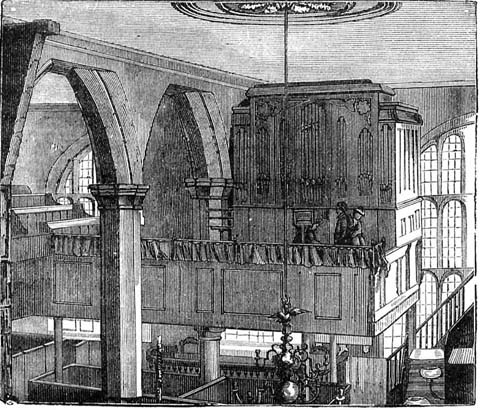
THE ORGAN LOFT, OVER THE BRONTË TABLET AND PEW.
XIII.
THE BRONTË NOVELS.
The Brontë novels continued to sell largely for some time after Charlotte's death. The publication of Mrs. Gaskell's "Life" added not a little to the sale, and both at home and abroad the fame of the three sisters was greatly increased. But in recent years the disposition has been almost to ignore these books; and though fresh editions have recently been issued they have had no circulation worthy of being compared with that which they maintained between 1850 and 1860. Yet though there has not been the same interest in these remarkable performances as that which formerly prevailed, they continue from time to time to attract the attention of literary critics both in this and other countries, the works of "Currer Bell" naturally holding the foremost place in the critiques upon the writings of the sisters.
"Wuthering Heights," the solitary prose work of Emily Brontë, is now practically unread. Even those who admire the genius of the family, those who have the highest opinion of the qualities displayed in "Jane Eyre" or "Villette," turn away with something like a shudder from "that dreadful book," as one who knew the Brontës intimately always calls it. But I venture to invite the attention of my readers to this story, as being in its way as marvellous a tour de force as "Jane Eyre" itself. It is true that as a novel it is repulsive and almost ghastly. As one reads chapter after chapter of the horrible chronicles of Heathcliff's crimes, the only literary work that can be recalled for comparison with it is the gory tragedy of "Titus Andronicus." From the first page to the last there is hardly a redeeming passage in the book. The atmosphere is lurid and storm-laden throughout, only lighted up occasionally by the blaze of passion and madness. The hero himself is the most unmitigated villain in fiction; and there is hardly a personage in the story who is not in some shape or another the victim of mental or moral deformities. Nobody can pretend that such a story as this ever ought to have been written; nobody can read it without feeling that its author must herself have had a morbid if not a diseased mind. Much, however, may be said in defence of Emily Brontë's conduct in writing "Wuthering Heights." She was in her twenty-eighth year when it was written, and the reader has seen something of the circumstances of her life, and the motives which led her to take up her pen. The life had been, so far as the outer world could judge, singularly barren and unproductive. Its one eventful episode was the short visit to Brussels. But Brussels had made no such impression upon Emily as it made upon Charlotte. She went back to Haworth quite unchanged; her love for the moors stronger than ever; her self-reserve only strengthened by the assaults to which it had been exposed during her residence among strangers; her whole nature still crying out for the solitary life of home, and the sustenance which she drew from the congenial society of the animals she loved and the servants she understood. When, partly in the forlorn hope of making money by the use of her pen, but still more to give some relief to her pent-up feelings, she began to write "Wuthering Heights," she knew nothing of the world. "I am bound to avow," says Charlotte, "that she had scarcely more practical knowledge of the peasants amongst whom she lived than a nun has of the country people who sometimes pass her convent gates." Love, except the love for nature and for her own nearest relatives, was a passion absolutely unknown to her—as any one who cares to study the pictures of it in "Wuthering Heights" may easily perceive. Of harsh and brutal, or deliberate crime, she had no personal knowledge. She had before her, it is true, a sad instance of the results of vicious self-indulgence, and from that she drew materials for some portions of her story. But so far as the great movements of human nature were concerned—of those movements which are not to be mastered by book learning, but which must come as the tardy fruits of personal experience—she was in absolute ignorance. Little as Charlotte herself knew at this time of the world, and of men and women, she was an accomplished mistress of the secrets of life, in comparison with Emily.
When a woman has lived such a life as that of "Ellis Bell," her first literary effort must be regarded as the attempt of an innocent and ignorant child. It may be full of faults; all the conditions which should govern a work of art may have been neglected; the book itself, so far as story, tone, and execution are concerned, may be an entire mistake; but it will nevertheless give us far more insight into the real character of the author than any more elaborate and successful work, constructed after experience has taught her what to do and what to avoid in order to secure the ear of the public.
"Wuthering Heights," then, is the work of one who, in everything but years, was a mere child, and its great and glaring faults are to be forgiven as one forgives the mistakes of childhood. But how vast was the intellectual greatness displayed in this juvenile work! The author seizes the reader at the first moment at which they meet, holds him thrilled, entranced, terrified perhaps, in a grasp which never relaxes, and leaves him at last, after a perusal of the story, shaken and exhausted as by some great effort of the mind. Surely nowhere in modern English fiction can more striking proof be found of the possession of "the creative gift" in an extraordinary degree than is to be obtained in "Wuthering Heights." From what unfathomed recesses of her intellect did this shy, nervous, untrained girl produce such characters as those which hold the foremost place in her story? Mrs. Dean, the faithful domestic, we can understand; for her model was at Emily's elbow in the kitchen at Haworth. Joseph, the quaint High Calvinist, whose fidelity to his creed is unredeemed by a single touch of fellow-feeling with the human creatures around him, was drawn from life; and vigorous and powerful though his portrait is, one can understand it also. But Heathcliff, and the two Catherines, and Hareton Earnshaw—none of these ever came within the ken of Emily Brontë. No persons approaching them in originality or force of character were to be found in her circle of friends. Here and there some psychologist, learned in the secrets of morbid human nature, may have conceived the existence of such persons—evolved them from an inner consciousness which had been enlightened by years of studious labour. But no such slow and painful process guided the pen of Emily Brontë in painting these weird and wonderful portraits. They come forth with all the vigour and freshness, the living reality and impressiveness, which can belong only to the spontaneous creations of genius. They are no copies, indeed, but living originals, owing their lives to her own travail and suffering.
Regarded in this light they must, I think, be counted among the greatest curiosities of literature. Their very repulsiveness adds to their force. I have said that Heathcliff is the greatest villain in fiction. The reader of the story is disposed to echo the agonised cry of his wife when she asks: "Is Mr. Heathcliff a man? If so, is he mad? And if not, is he a devil?" It is not pleasant to see such a character obtruded upon us in a novel; but I repeat, it is far more difficult to paint a consummate villain of the Heathcliff type than to draw any of the more ordinary types of humanity. The concentration of power required in performing the task is enormous. At every moment the writer is tempted to turn aside and relieve the darkness by some touch of light; and the risk which the artist must encounter if he gives way to this temptation is that of destroying the whole effect of the picture. Light and shade there must be, or the portrait becomes a mere daub of blackness; and the man whom the author has desired to create stands forth as a monster, unrecognisable as a creature belonging to the same race as ourselves. But unless these lighter shades are introduced with a tact and a self-command which belong rather to genius than to art, there must, as I have said, be complete failure. Now, Emily Brontë has not failed in her portrait of Heathcliff. He stands, indeed, absolutely alone in that great human portrait-gallery which forms one of the chambers in the noble edifice of English literature. We can compare him to nobody else among the creatures of fiction. We cannot even trace his literary pedigree. He is a distinct being, not less original than he is hateful. But this circumstance does not alter the fact that we accept him at once as a real being, not a merely grotesque monster. He stands as much alone as Frankenstein's creature did; but we recognise within him that subtle combination of elements which gives him kinship with the human race. Here, then, Emily Brontë has succeeded; and girl as she was when she wrote, she has succeeded where some of the most practised writers have failed entirely. Compare "Wuthering Heights," for example, with the fantastic horrors of Lord Lytton's "Strange Story," and you feel at once how much more powerful and masterly is the touch of the woman. Lord Lytton's villain, though he has been drawn with so much care and skill, is often absurd and at last entirely wearisome. Emily Brontë's is consistent, terrible, fascinating, from beginning to end. Then, again, the writer never tries to frighten her reader with a bogey. She never hints at the possibility of supernatural agencies being at work behind the scene. Even when she is showing us that Heathcliff is for ever haunted by the dead Catherine, she makes it clear by the words she puts into his own mouth that his belief on the subject is nothing more than the delusion of a disordered brain, worried by a guilty conscience. "I knew no living thing in flesh and blood was by," says Heathcliff, describing how he dug down into Catherine's grave on the night after she had been buried; "but as certainly as you perceive the approach to some substantial body in the dark, so certainly I felt that Cathy was there: not under me, but on the earth. A sudden sense of relief flowed from my heart through every limb. I relinquished my labour of agony, and turned consoled at once—unspeakably consoled. Her presence was with me; it remained while I refilled the grave and led me home. You may laugh if you will; but I was sure I should see her there. I was sure she was with me, and I could not help talking to her. Having reached the Heights I rushed eagerly to the door. It was fastened; and I remember that accursed Earnshaw and my wife opposed my entrance. I remember stopping to kick the breath out of him, and then hurrying upstairs to my room and hers. I looked round impatiently—I felt her by me—I could almost see her, and yet I could not! I ought to have sweat blood then, from the anguish of my yearning—from the fervour of my supplications to have but one glimpse! I had not one. She showed herself, as she often was in life, a devil to me. And, since then, sometimes more and sometimes less, I've been the sport of that intolerable torture…. When I sat in the house with Hareton, it seemed that on going out I should meet her; when I walked on the moors I should meet her coming in. When I went from home I hastened to return. She must be somewhere at the Heights, I was certain! And when I slept in her chamber—I was beaten out of that. I couldn't lie there; for the moment I closed my eyes, she was either outside the window, or sliding back the panels, or entering the room, or even resting her darling head on the same pillow as she did when a child; and I must open my lids to see. And so I opened and closed them a hundred times a night—to be always disappointed!" Here is a picture of a man who is really haunted. No supernatural agency is invoked; no strain is put upon the reader's credulity. We are asked to believe in the suspension of no law of nature. In one word, we can all understand how a wicked man, whose brain has, as it were, been made drunk with the fumes of his own wickedness, can be persecuted throughout his whole life by terrors of this kind; and just because we are able to conceive and understand it, this haunting of Heathcliff by the ghost of his dead mistress is infinitely more terrible than if it had been accompanied either by the paraphernalia of rococo horrors which Mrs. Radcliffe habitually invoked, or by those refined and subtle supernatural phenomena which Lord Lytton employs in his famous ghost story.
This strict honesty which refused to allow the writer of the weirdest story in the English language to avail herself of the easiest of all the modes of stimulating a reader's terrors, is shown all through the novel. The workmanship is good from beginning to end, though the art is crude and clumsy. She never allows a date to escape her memory, nor are there any of those broken threads which usually abound in the works of inexperienced writers. All is neatly, clearly, carefully finished off. Every date fits into its place, and so does every incident. The reader is never allowed to wander into a blind alley. Though at the outset he finds himself in a bewildering maze, far too complicated in construction to comply with the canons of literary art, he has only to go straight on, and in the end he will find everything made plain. Emily permits no fact however minute to drop from her grasp. Irrelevant though it may seem at the moment when the reader meets with it, a place has been prepared for it in the edifice which the patient hands are rearing, and in the end it will be fitted into that place. Thus there is no scamped work in the story; nor any sacrifice of details in order to obtain those broad effects in which the tale abounds.
Let the reader turn to "Wuthering Heights," and he will find many a simple innocent revelation of the character of the author peeping out from its pages in unexpected places. We know how the story was written, and how day by day it was submitted to the revision of Charlotte and Anne. We may be sure under these circumstances that Emily did not allow too much of her true inner nature to appear in what she wrote. Even from her sisters she habitually concealed some of the strongest and deepest emotions of her heart. But such passages as the following, when read in the light of her history, as we know it now, are of strange and abiding interest:
He said the pleasantest manner of spending a hot July day was lying from morning till evening on a bank of heath in the middle of the moors, with the bees humming dreamily about among the bloom, and the larks singing high up over head, and the blue sky and bright sun shining steadily and cloudlessly. That was his most perfect idea of heaven's happiness. Mine was rocking in a rustling green tree, with a west wind blowing, and bright white clouds flitting rapidly above; and not only larks, but throstles and blackbirds and linnets and cuckoos, pouring out music on every side, and the moors seen at a distance broken into cool dusky dells; but close by great swells of long grass undulating in waves to the breeze; and woods and sounding water, and the whole world awake and wild with joy. He wanted all to lie in an ecstasy of peace. I wanted all to sparkle and dance in a glorious jubilee. I said his heaven would be only half alive; and he said mine would be drunk. I said I should fall asleep in his; and he said he could not breathe in mine.
For "he," read "Anne," and accept Emily as speaking for herself, and we have in this passage a vivid description of the opposing tastes of the two sisters.
The abhorrence which Charlotte felt for the High Calvinism, which was the favourite creed around her, was felt even more strongly by Emily. Her poems throw not a little light upon this feature of her character; but we also gain some from her solitary novel. Joseph, the old man-servant, was a study from life, and he represented one of a class whom the author thoroughly disliked, but for whom at the same time she entertained a certain respect. Again and again she breaks forth with all the force of sarcasm she can command against "the wearisomest, self-righteous pharisee that ever ransacked a Bible to rake the promises to himself and fling the curses to his neighbours." Yet there is no character in the story over whom she lingers more lovingly than Joseph, and it is only in painting his portrait that she allows herself to be betrayed into the display of any of that humour which, according to her sisters, always lurked very near the surface of her character, ever ready to show itself when no stranger was at hand. Few who have read "Wuthering Heights" can have forgotten Joseph's quaint remark when the boy Heathcliff has disappeared, and the others are speculating on his fate.
Nay, nay, he's noan at Gimmerton. I's never wonder but he's at t' bottom of a bog-boile. This visitation worn't for nowt, and I wod hev ye to look out, miss. Yah muh be t' next. Thank Hivin for all! All works togither for gooid to them as is chozzen, and piked out fro' th' rubbidge. Yah knaw whet t' Scripture ses.
There is one passage in the story which furnishes so strange a foreshadowing of Emily's own death, that it is difficult to believe that she did not bear it in her mind during those last hours when she faced the dread enemy with such unwavering resolution. She is writing of the death of Mrs. Earnshaw.
Poor soul! till within a week of her death that gay heart never failed her; and her husband persisted doggedly, nay furiously, in affirming her health improved every day. When Kenneth warned him that his medicines were useless at that stage of the malady, and he needn't put him to further expense by attending her, he retorted:
"I know you need not. She's well; she does not want any more attendance from you! She never was in a consumption. It was a fever, and it is gone: her pulse is as slow as mine now, and her cheek as cool!"
He told his wife the same story, and she seemed to believe him. But one night while leaning on his shoulder, in the act of saying she thought she should be able to get up to-morrow, a fit of coughing took her—a very slight one—he raised her in his arms; she put her two hands about his neck, her face changed, and she was dead.
Strange and inscrutable, indeed, are the mysteries of the human heart! Let the reader turn from the passage I have quoted to that letter in which Charlotte laments that "Emily is too intractable," and let him read how she refused to believe that she was ill until death caught her as suddenly as it did the wife of Earnshaw. The blindness to the approach of danger, which she describes so clearly in her story, was but a few months afterwards displayed even more fully by herself. In this last quotation, which I venture to make from a book now seldom opened, we see the author speaking evidently out of the fulness of her heart on a subject on which in conversation she was specially reserved.
I don't know if it be a peculiarity in me, but I am seldom otherwise than happy when watching in the chamber of death, should no frenzied or despairing mourner share the duty with me. I see a repose that neither earth nor hell can break, and I feel an assurance of the endless and shadowless hereafter—the Eternity they have entered—where life is boundless in its duration, and love in its sympathy, and joy in its fulness. I noticed on that occasion how much selfishness there is even in a love like Mr. Linton's, when he so regretted Catherine's blessed release! To be sure, one might have doubted, after the wayward and impatient existence she had led, whether she merited a haven of peace at last. One might doubt in seasons of cold reflection; but not then in the presence of her corpse. It asserted its own tranquillity, which seemed a pledge of equal quiet to its former inhabitant.
Even these fragments, culled from the pages of "Wuthering Heights," are sufficient to show how little the story has in common with the ordinary novel. Differing widely in every respect from "Jane Eyre," dealing with characters and circumstances which belong to the romance rather than the reality of life, it is yet stamped by the same originality, the same daring, the same thoughtfulness, and the same intense individuality. It is a marvel to all who know anything of the secrets of literary work, that Haworth Parsonage should have produced "Jane Eyre;" but how is the marvel increased, when we know that at the same time it produced, from the brain of another inmate, the wonderful story of "Wuthering Heights." Brimful of faults as it may be, that book is alone sufficient to prove that a rare and splendid genius was lost to the world when Emily Brontë died.
All interested in the story of the Brontës must be curious to know whence Emily derived the materials for this romance. I have said that Heathcliff and the other prominent characters of the story are creations of her own; and indeed the book in its originality is almost unique. But this does not affect the fact that somewhere, and at some period during her life, the seed which brought forth this strange fruit must have been sown. It has been suggested by some—strangely ignorant, surely, of the conditions of West Riding life during the present century—that Emily obtained the skeleton of her plot from her own observation of people around her. But the life round Haworth was really tame and commonplace. Josephs and Mrs. Deans could be found in and about the village in abundance; but there were no people round whose lives hung anything of the mystery which attaches to Heathcliff. It was, so far as I can learn, during her early girlhood that Emily's mind was filled with those grim traditions which she afterwards employed in writing "Wuthering Heights." Mr. Brontë, in addition to his other gifts, had the faculty of storytelling highly developed, and his delight was to use this faculty in order to awaken superstitious terrors in the hearts of his children.
Though he habitually took his meals alone, he would often appear at the table where his daughters, with possibly their one female friend, were breakfasting, and, without joining in the repast, would entertain the little company of schoolgirls with wild legends not only relating to life in Yorkshire during the last century, but to that still wilder life which he had left behind him in Ireland. A cold smile would play round his mouth as he added horror to horror in his attempts to move his children; and his keen eyes sparkled with triumph when he found he had succeeded in filling them with alarm. Emily listened to these stories with bated breath, drinking them, in eagerly. She could repeat them afterwards by the hour together to her sisters; and no better proof of the deep root they took in her sensitive nature can be desired, than the fact that they led her to write "Wuthering Heights." Thus the paternal influence, strong as it was in the case of all the daughters, was peculiarly strong as regarded Emily; and we can gauge the nature of that influence in the weird and ghastly story which was brought forth under its shadow.
It is with a feeling of curious disappointment that one rises from the perusal of the writings of Anne Brontë. She wrote two novels, "Agnes Grey" and "The Tenant of Wildfell Hall," neither of which will really repay perusal. In the first she sought to set forth some of the experiences which had befallen her in that patient placid life which she led as a governess. They were not ordinary experiences, the reader should know. I have resolutely avoided, in writing this sketch of Charlotte Brontë and her sisters, all unnecessary reference to the tragedy of Branwell Brontë's life. But it is a strange sad feature of that story, that the pious and gentle youngest sister was compelled to be a closer and more constant witness of his sins and his sufferings than either Charlotte or Emily. She was living under the same roof with him when he went astray and was thrust out in deep disgrace. I have said already that the effect of his career upon her own was as strong and deep as Mrs. Gaskell represents it to have been. Branwell's fall formed the dark turning-point in Anne Brontë's life. So it was not unnatural that it should colour her literary labours. Accordingly, whilst "Agnes Grey" gives us some of the scenes of her governess life, dressed up in the fashion of the ordinary romances of thirty years ago, "The Tenant of Wildfell Hall" presents us with a dreary and repulsive picture of Branwell Brontë's condition after his fall. Charlotte, in her brief memoir of her sisters, does bare justice to Anne when she speaks in these words upon the subject:
"The Tenant of Wildfell Hall," by "Acton Bell," had likewise an unfavourable reception. At this I cannot wonder. The choice of subject was an entire mistake. Nothing less congruous with the writer's nature could be conceived. The motives which dictated this choice were pure, but, I think, slightly morbid. She had in the course of her life been called on to contemplate, near at hand, and for a long time, the terrible effects of talents misused and faculties abused; hers was naturally a sensitive, reserved, and dejected nature; what she saw sank very deeply into her mind; it did her harm. She brooded over it till she believed it to be a duty to reproduce every detail (of course with fictitious characters, incidents, and situations) as a warning to others. She hated her work, but would pursue it. When reasoned with on the subject, she regarded such reasonings as a temptation to self-indulgence. She must be honest; she must not varnish, soften, or conceal. This well-meant resolution brought on her misconception and some abuse, which she bore, as it was her custom to bear whatever was unpleasant, with mild steady patience. She was a very sincere and practical Christian, but the tinge of religious melancholy communicated a sad hue to her brief blameless life.
What a picture one gets of this third and least considered of the Brontë sisters in the passage which I have quoted! A lovable, fair-featured girl, leading a blameless life, lighted up by few hopes of any brighter future—for the one little romance of her own heart had been destroyed ere this by the unrelenting hand of death—and not inspired as her sisters were by the passion of the artist or the creator; a girl whose simple faith was still unmoved from its first foundations; whose delight was in visiting the poor and helping the sick, who had no sustaining conviction of her own strength such as maintained Charlotte and Emily in their darkest hours, and whose very piety was "tinged with melancholy." This is the girl who, not from any of the irresistible impulses which attend the exercise of the creative faculty, but from a simple sense of duty, set herself the hard task of depicting in the pages of a novel the consequences of a shocking vice with which her brother's degradation had brought her into close and abiding contact. Of course she failed. It is not by hands so weak as those of Anne Brontë that effective blows are struck at such sins as she assailed. But whilst we acknowledge her failure, let us do justice both to the self-sacrificing courage and the fervent piety which led her to undertake this painful work.
Of Charlotte Brontë's novels, as a whole, I shall say nothing at this point; but something may very properly be said here of the story which she wrote at the time when her sisters were engaged in writing "Wuthering Heights" and "Agnes Grey." It was not published until after her death, and after the world had learned from Mrs. Gaskell's pages something of the truth about her life. Its interest to the ordinary reader was to a considerable extent discounted by the fact that the author had so largely used the materials in her last great work, "Villette." But even as a mere novel "The Professor" has striking merits, and would well repay perusal from that point of view alone; whilst as a means of gaining fresh light with regard to the character of the writer, it is not less valuable than "Wuthering Heights" itself. True, "The Professor" is not really a first attempt. "A first attempt it certainly was not," says Charlotte in reference to it, "as the pen which wrote it had previously been worn a good deal in a practice of some years." But the previous writings, of which hardly a trace now remains—those early MSS. having been carefully destroyed, with the exception of the few which Mrs. Gaskell was permitted to see—were in no respect finished productions, nor had they been written with a view to publication. The first occasion on which Charlotte Brontë really began a prose work which she proposed to commit to the press was on that day when, seated by her two sisters, she joined them in penning the first page of a new novel.
To all practical intents, therefore, "The Professor" is entitled to be regarded as a first work; and certainly nothing can show Charlotte's peculiar views on the subject of novel-writing more clearly or strikingly than this book does. The world knows how resolutely in all her writings she strove to be true to life as she saw it. In "Jane Eyre" there are, indeed, romantic incidents and situations, but even in that work there is no trespassing beyond the limits always allowed to the writer of fiction; whilst it must not be forgotten that "Jane Eyre" was in part a response to the direct appeal from the publishers for something different in character from "The Professor." In that first story she determined that she would write a man's life as men's lives usually are. Her hero was "never to get a shilling he had not earned;" no sudden turns of fortune were "to lift him in a moment to wealth and high station;" and he was not even to marry "a beautiful girl or a lady of rank." "As Adam's son he should share Adam's doom, and drain throughout life a mixed and moderate cup of enjoyment."
Very few novel-readers will share this conception of what a novel ought to be. The writer of fiction is an artist whose accepted duty it is to lift men and women out of the cares of ordinary life, out of the sordid surroundings which belong to every lot in this world, and to show us life under different, perhaps under fantastic, conditions: a life which by its contrast to that we ourselves are leading shall furnish some relief to our mental vision, wearied and jaded by its constant contemplation of the fevers and disappointments, the crosses and long years of weary monotony, which belong to life as it is. We know how a great living writer has ventured to protest against this theory, and how in her finest works of fiction she has shown us life as it is, under the sad and bitter conditions of pain, sorrow, and hopelessness. But Charlotte Brontë wrote "The Professor" long before "George Eliot" took up her pen; and she must at least receive credit for having been in the field as a reformer of fiction before her fellow-labourer was heard of.
She was true to the conditions she had laid down for herself in writing "The Professor." Nothing more sober and matter-of-fact than that story is to be found in English literature. And yet, though the landscape one is invited to view is but a vast plain, without even a hillock to give variety to the prospect, it has beauties of its own which commend it to our admiration. The story, as everybody knows, deals with Brussels, from which she had just returned when she began to write it. But it is sad to note the difference between the spirit of "The Professor" and that which is exhibited in "Villette." Dealing with the same circumstances, and substantially with the same story, the author has nevertheless cast each in a mould of its own. Nor is the cause of this any secret to those who know Charlotte Brontë. When she wrote "The Professor," disillusioned though she was, she was still young, and still blessed with that fervent belief in a better future which the youthful heart can never quite cast out, even under the heaviest blows of fate. She had come home restless and miserable, feeling Haworth to be far too small and quiet a place for her; and her mind could not take in the reality that under that modest roof the remainder of her life was destined to be spent. Suffering and unhappy as she was, she could not shut out the hope that brighter days lay before her. The fever of life racked her; but in the very fact that it burnt so high there was proof that love and hope, the capacity for a large enjoyment of existence, still lived within her. So "The Professor," though a sad, monotonous book, has life and hope, and a fair faith in the ultimate blessedness of all sorrowful ones, shining through all its pages; and it closes in a scene of rest and peace.
Very different is the case with "Villette." It was written years after the period when "The Professor" was composed, when the hard realities of life had ceased to be veiled under tender mists of sentiment or imagination, and when the lonely present, the future, "which often appals me," made the writer too painfully aware that she had drunk the cup of existence almost to the dregs. As a piece of workmanship there is no comparison between it and the earlier story. On every page we see traces of the artist's hand. Genius flashes forth from both works it is true, but in "Villette" it is genius chastened and restrained by a cultivated taste, or working under that high pressure which only the trained writer can bring to bear upon it. Yet, whilst we must admit the immense superiority of the later over the earlier work, we cannot turn from the one to the other without being painfully touched by the sad, strange difference in the spirit which animates them. The stories, as I have said, are nearly the same. With some curious transformations, in fact, they are practically identical. But they are only the same in the sense in which the portrait of the fair and hopeful girl, with life's romance shining before her eyes, is the same as the portrait of the worn and solitary woman for whom the romance is at an end. A whole world of suffering, of sorrow, of patient endurance, lies between the two. I have spoken of the mood in which "The Professor" was written—Hope still lingered at that time in the heart, breathing its merciful though illusory suggestions of something brighter and better in the future. All who have passed through the ordeal of a life's sorrow will be able to understand the distinction between the temperament of the author at that period in her life, and her temperament when she composed "Villette." For such suffering ones know, how, in the first and bitterest moment of sorrow, the heart cannot shut out the blessed belief that a time of release from the pain will come—a time far off, perhaps, but in which a day bright as that which has suddenly been eclipsed will shine again. It is only as the years go by, and as the first ache of intolerable anguish has been lulled into a dreary rest by habit, that the faith which gave them strength to bear the keenest smart, takes flight, and leaves them to the pale monotony of a twilight which can know no dawn. It was in this later and saddest stage of endurance that "Villette" was written. The sharpest pangs of the heart-experiences at Brussels had vanished. The author, no longer full of the self-consciousness of the girl, could even treat her own story, her own sorrows of that period, with a lighter hand, a more artistic touch, than when she first wrote of them; but through all her work there ran the dreary conviction that in those days of mingled joy and suffering she had tasted life at its best, and that in the future which lay before her there could be nothing which should renew either the strong delights or keen anguish of that time. So the book is pitched, as we know, in a key of almost absolute hopelessness. Nothing but the genius of Charlotte Brontë could have saved such a work from sinking under its own burden of gloom. That this intense and tragic study of a soul should have had power to fascinate, not the psychologist alone, but the vast masses of the reading world, is a triumph which can hardly be paralleled in recent literary efforts. In "The Professor" we move among the same scenes, almost among the same characters and incidents, but the whole atmosphere is a different one. It is a dull, cold atmosphere, if you will, but one feels that behind the clouds the sun is shining, and that sooner or later the hero and heroine will be allowed to bask in his reviving rays. Set the two stories together, and read them in the light of all that passed between the years in which they were written—the death of Branwell, of Emily, and of Anne, the utter shattering of some fair illusions which buoyed up Charlotte's heart in the first years of her literary triumph, the apparent extinction of all hope as to future happiness—and you will get from them a truer knowledge of the author's soul than any critic or biographer could convey to you.
Ere I part from "The Professor," which, naturally enough, never gained much attention from the public, I must extract from it one passage, a parallel to which may be found in many of Charlotte Brontë's letters. It describes, as none but one who had suffered could do, one of those seasons of mental depression, arising from bodily illness, by which she was visited at intervals, and under the influence of which not a little of her work was done. Reading it, we get some idea of the true origin of much in her character that was supposed to be morbid and unnatural:
Man is ever clogged with his mortality, and it was my mortal nature which now faltered and plained; my nerves which jarred and gave a false sound, because the soul, of late rushing headlong to an aim, had overstrained the body's comparative weakness. A horror of great darkness fell upon me; I felt my chamber invaded by one I had known formerly but had thought for ever departed. I was temporarily a prey to hypochondria. She had been my acquaintance, nay, my guest, once before in boyhood; I had entertained her at bed and board for a year; for that space of time I had her to myself in secret; she lay with me, she ate with me, she walked out with me, showing me nooks in woods, hollows in hills, where we could sit together, and where she could drop her drear veil over me, and so hide sky and sun, grass and green tree; taking me entirely to her death-cold bosom and holding me with arms of bone. What tales she would tell me at such hours! What songs she would recite in my ears! How she would discourse to me of her own country—the grave—and again and again promise to conduct me there ere long; and drawing me to the very brink of a black sullen river, show me on the other side shores unequal with mound, monument, and tablet, standing up in a glimmer more hoary than moonlight. "Necropolis!" she would whisper, pointing to the pale piles, and add, "it contains a mansion prepared for you." But my boyhood was lonely, parentless; uncheered by brother or sister; and there was no marvel that, just as I rose to youth, a sorceress, finding me lost in vague mental wanderings, with many affections and few objects, glowing aspirations and gloomy prospects, strong desires and tender hopes, should lift up her illusive lamp to me in the distance, and lure me to her vaulted home of horrors.
It was when, under the influence of occasional spells of physical suffering such as she here describes, that Miss Brontë gave those who saw her the impresion that her mind was naturally a morbid one; and, as I have said before, the same influence is at times perceptible in her writings. One of the purposes with which this little book has been written is to show the world how much of the gloom and depression which are now associated with her story, must be attributed to purely physical or accidental causes.