T. WEMYSS REID. (continued 3)
Reading edition
August 1st, 1850.
My dear E.,—I have certainly felt the late wet weather a good deal, and been somewhat bothered with frequently-returning colds, and so has Papa. About him I have been far from happy: every cold seems to make and leave him so weak. It is easy to say this world is only a scene of probation, but it is a hard thing to feel. Your friends the ——s seem to be happy just now, and long may they continue to be so! Give C. Brontë's sincere love to R—— and tell her she hopes Mr. —— will make her a good husband. If he does not, woe be to him! I wish a similar wish for Q——; and then I do really think there will be a kind of happiness. That proposition about remaining at H—— sounds like beginning life sensibly, with no showy dash—I like it. Are you comfortable amongst all these turtle-doves? I could not maintain your present position for a day; I should feel de trop, as the French say; that is in the way. But you are different to me. My portrait is come from London, and the Duke of Wellington's, and kind letters enough. Papa thinks the portrait looks older than I do. He says the features are far from flattered, but acknowledges that the expression is wonderfully good and life-like. I left the book called "Social Aspects" at B——; accept it from me. I may well give it you, for the author has kindly sent me another copy…. You ask for some promise: who that does not know the future can make promises? Not I.
September 2nd, 1850.
Poor Mrs. A—— it seems is gone; I saw her death in the papers. It is another lesson on the nature of life, on its strange brevity, and in many instances apparent futility…. V—— came here on Saturday last; T——, who was to have accompanied him, was prevented from executing his intention. I regretted his absence, for I by no means coveted the long tête-à-tête with V——. However, it passed off pretty well. He is satisfied now with his own prospects, and this makes him—on the surface—satisfied with other things. He spoke of Q—— with content and approbation. He looks forward to marriage as a sort of harbour where he is to lay up his now somewhat battered vessel in quiet moorings. He has seen all he wants to see of life; now he is prepared to settle. I listened to all with equanimity and cheerfulness—not assumed but real—for Papa is now somewhat better; his appetite and spirits are improved, and that eases my mind of cankering anxiety. My own health, too, is, I think, really benefited by the late changes of air and scene; I fancy, at any rate, that I feel stronger. Still I mused in my own way on V——'s character—its depth and scope, I believe, are ascertained.
I saw the governess at ——; she looked a little better and more cheerful. She was almost as pleased to see me as if we had been related; and when I bid her good-bye expressed an earnest hope that I would soon come again. The children seem fond of her, and on the whole obedient—two great alleviations of the inevitable evils of her position.
Cheer up, dear Nell, and try not to stagnate; or, when you cannot help it, and when your heart is constricted and oppressed, remember what life is and must be to all: some moments of sunshine alternating with many of overclouded and often tempestuous darkness. Humanity cannot escape its fate, which is to drink a mixed cup. Let us believe that the gall and the vinegar are salutary.
Sept. 14th, 1850.
I wish, dear Ellen, you would tell me what is the "twaddle" about my marrying, which you hear. If I knew the details I should have a better chance of guessing the quarter from which such gossip comes. As it is I am quite at a loss. Whom am I to marry? I think I have scarcely seen a single man with whom such a union would be possible since I left London. Doubtless there are men whom, if I chose to encourage, I might marry. But no matrimonial lot is even remotely offered me which seems to me truly desirable. And even if that were the case there would be many obstacles. The least allusion to such a thing is most offensive to Papa. An article entitled "Currer Bell" has lately appeared in The Palladium, a new periodical published in Edinburgh. It is an eloquent production, and one of such warm sympathy and high appreciation as I had never expected to see. It makes mistakes about authorship, &c, but those I hope one day to set right. Mr. X—— (the little man) first informed me of this article. I was somewhat surprised to receive his letter, having concluded nine months ago that there would be no more correspondence from that quarter. I enclose a note from him received subsequently, in answer to my acknowledgment. Read it, and tell me exactly how it impresses you regarding the writer's character, &c. He is deficient neither in spirit nor sense.
October 14th, 1850.
I return Q——'s letter. She seems quite happy and fully satisfied of her husband's affection. Is this the usual way of spending the honeymoon? To me it seems as if they overdo it. That travelling, and tugging, and fagging about, and getting drenched and muddled, by no means harmonises with my notions of happiness. Besides, the two meals a day, &c, would do one up. It all reminds me too sharply of the few days I spent with V—— in London nearly ten years since, when I was many a time fit to drop with the fever and the faintness resulting from long fasting and excessive fatigue. However, no doubt a bride can bear such things better than others. I smiled to myself at some passages. She has wondrous faith in her husband's intellectual powers and acquirements. V——'s illusions will soon be over, but Q——'s will not—and therein she is happier than he…. I suppose —— will probably discover that he, too, wants a wife. But I will say no more. You know I disapprove of jesting and teasing on these matters. Idle words sometimes do unintentional harm.
December, 1850.
I got home all right yesterday soon after two o'clock, and found Papa, thank God, well and free from cold. To-day some amount of sickliness and headache is bothering me, but nothing to signify…. The Christmas books waiting for me were, as I expected, from Thackeray, Mrs. Gaskell, and Mr. Ruskin. No letter from Mr. W——. It is six weeks since I heard from him. I feel uneasy, but do not like to write. The Examiner is very sore about my Preface, because I did not make it a special exception in speaking of the mass of critics. The soreness is unfortunate and gratuitous, for in my mind I certainly excepted it. Another paper shows painful sensitiveness on the same account; but it does not matter, these things are all transitory.
The "Preface" to which she alludes in the foregoing letter, was that to her collected edition of Emily and Anne Brontë's works, in which she makes allusion to the fact that the "critics failed to do justice" to "Wuthering Heights" and "Agnes Grey" when they were published.
Jan. 20th, 1851.
Thank you heartily for the two letters I owe you. You seem very gay at present, and provided you only take care not to catch cold with coming home at night, I am not sorry to hear it; a little movement, cheerfulness, stimulus, is not only beneficial, but necessary. Your last letter but one made me smile. I think you draw great conclusions from small inferences. I think those "fixed intentions" you fancy are imaginary. I think the "under-current" amounts simply to this, a kind of natural liking and sense of something congenial. Were there no vast barrier of age, fortune, &c, there is perhaps enough personal regard to make things possible which now are impossible. If men and women married because they like each other's temper, look, conversation, nature, and so on—and if, besides, years were more nearly equal—the chance you allude to might be admitted as a chance; but other reasons regulate matrimony—reasons of convenience, of connection, of money. Meantime I am content to know him as a friend, and pray God to continue to me the common sense to look on one so young, so rising, and so hopeful in no other light. The hint about the Rhine disturbs me; I am not made of stone and what is mere excitement to others is fever to me. However it is a matter for the future, and long to look forward to. As I see it now, the journey is out of the question—for many reasons—I rather wonder he should think of it. Good-bye. Heaven grant us both some quiet wisdom and strength, not merely to bear the trial of pain, but to resist the lure of pleasure when it comes in such a shape as our better judgment disapproves.
Feb. 26th, 1851.
You ought always to conclude that when I don't write it is simply because I have nothing particular to say. Be sure that ill news will travel fast enough, and good news too when such commodity comes. If I could often be or seem in brisk spirits, I might write oftener, knowing that my letters would amuse. But as times go, a glimpse of sunshine now and then is as much as one has a right to expect. However, I get on very decently. I am now and then tempted to break through my resolution of not having you to come before summer, and to ask you to come to this Patmos in a week or two. But it would be dull—very dull—for you…. What would you say to coming here the week after next to stay only just so long as you could comfortably bear the monotony? If the weather were dry, and the moors fine, I should not mind it so much—we could walk for change.
About this time it is clear that Miss Brontë was suffering from one of her periodical attacks of nervous exhaustion. She makes repeated references in her letters to her ailments, attributing them generally to her liver, and she also mentions frequently an occurrence which had given her not a little anxiety and concern. This was an offer of marriage from a business man in a good position, whom she had already met in London. The following letters, which are inserted here without regard to the precise date, and of which Mrs. Gaskell has merely used half-a-dozen lines, relate to this subject:
You are to say no more about "Jupiter" and "Venus." What do you mean by such heathen trash? The fact is no fallacy can be wilder, and I won't have it hinted at, even in jest because my common sense laughs it to scorn. The idea of X—— shocks me less; it would be a more likely match, if "matches" were at all in question, which they are not. He still sends his little newspaper, and the other day there came a letter of a bulk, volume, pith, judgment, and knowledge, worthy to have been the product of a giant.
X—— has been, and is gone; things are just as they were. I only know, in addition to the slight information I possessed before, that this Australian undertaking is necessary to the continued prosperity of his firm, that he alone was pronounced to possess the power and means to carry it out successfully, that mercantile honour, combined with his own sense of duty, obliged him to accept the post of honour and of danger to which he has been appointed, that he goes with great personal reluctance, and that he contemplates an absence of five years. He looked much thinner and older. I saw him very near, and once through my glass. The resemblance to Branwell struck me forcibly; it is marked. He is not ugly, but very peculiar. The lines in his face show an inflexibility, and, I must add, a hardness of character, which does not attract. As he stood near me, as he looked at me in his keen way, it was all I could do to stand my ground tranquilly and steadily, and not to recoil as before. It is no use saying anything if I am not candid. I avow then that on this occasion, predisposed as I was to regard him very favourably, his manners and his personal appearance scarcely pleased me more than at the first interview. He gave me a book at parting, requesting in his brief way that I would keep it for his sake, and adding hastily: "I shall hope to hear from you in Australia; your letters have been and will be a greater refreshment than you can think or I can tell." And so he is gone, and stern and abrupt little man as he is, too often jarring as are his manners, his absence and the exclusion of his idea from my mind, leave me certainly with less support and in deeper solitude than before. You see, dear Nell, we are still precisely on the same level. You are not isolated. I feel that there is a certain mystery about this transaction yet, and whether it will ever be cleared up to me, I do not know. However, my plain duty is to wean my mind from the subject, and if possible to avoid pondering over it…. I feel that in his way he has a regard for me; a regard which I cannot bring myself entirely to reciprocate in kind, and yet its withdrawal leaves a painful blank. I have just got your note. Above, you have all the account of my visitor. I dare not aver that your kind wish that the visit would yield me more pleasure than pain has been fulfilled. Something at my heart aches and gnaws drearily. But I must cultivate fortitude.
Thank you for your kind note. It was kind of you to write it, though it was your school-day. I never knew you to let a slight impediment stand in your way when doing a friendly action. Certainly I shall not soon forget last Friday, and never, I think, the evening and night succeeding that morning and afternoon. Evils seldom come singly, and soon after X—— was gone Papa grew much worse. He went to bed early. Was sick and ill for an hour, and when at last he began to doze and I left him, I came down to the dining-room with a sense of weight, fear, and desolation hard to express and harder to endure. A wish that you were with me did cross my mind; but I repelled it as a most selfish wish. Indeed it was only short-lived; my natural tendency in moments of this sort is to get through the struggle alone; to think that one is burdening others makes all worse. You speak to me in soft, consolatory accents; but I hold far sterner language to myself, dear Nell. An absence of five years; a dividing expanse of three oceans; the wide difference between a man's active career and a woman's passive existence. These things are almost equivalent to a life-long separation. But there is another thing which forms a barrier more difficult to pass than any of these. Would X—— and I ever suit? Could I ever feel for him enough love to accept of him as a husband? Friendship, gratitude, esteem, I have; but each moment that he came near me, and that I could see his eyes fastened upon me, my veins ran ice. Now that he is away I feel far more gently towards him; it is only close by that I grow rigid. I did not want to be proud nor intend to be proud, but I was forced to be so. Most true is it that we are overruled by One above us, that in His hands our very will is as clay in the hands of the potter.
I trust Papa is not worse; but he varies. He has never been down to breakfast but once since you left. The circumstance of having him to think about just now is good for me in one way; it keeps my thoughts off other matters which have been complete bitterness and ashes; for I do assure you a more entire crumbling away of a seeming foundation of support and prospect of hope than that which I allude to can scarcely be realised.
I have heard from X—— to-day, a quiet little note. He returned to London a week since on Saturday. He leaves England next month. His note concludes with asking whether he has any chance of seeing me in London before that time. I must tell him that I have already fixed June for my visit, and, therefore, in all human probability we shall see each other no more. There is still a want of plain mutual understanding in this business, and there is sadness and pain in more ways than one. My conscience, I can truly say, does not now accuse me of having treated X—— with injustice or unkindness. What I once did wrong in this way I have endeavoured to remedy both to himself and in speaking of him to others. I am sure he has estimable and sterling qualities; but with every disposition—with every wish—with every intention even to look on him in the most favourable point of view at his last visit, it was impossible for me in my inmost heart to think of him as one that might one day be acceptable as a husband…. No, if X—— be the only husband fate offers to me, single I must always remain. But yet at times I grieve for him; and perhaps it is superfluous, for I cannot think he will suffer much—a hard nature, occupation, change of scene will befriend him.
I have had a long, kind letter from Miss Martineau lately. She says she is well and happy. Also I have had a very long letter from Mr. ——, the first for many weeks. He speaks of X—— with much respect and regret, and says he will be greatly missed by many friends. I discover with some surprise that Papa has taken a decided liking to X——. The marked kindness of his manner to him when he bade him good-bye, exhorting him to be "true to himself, his country, and his God," and wishing him all good wishes, struck me with some astonishment at the time; and whenever he has alluded to him since, it has been with significant eulogy…. You say Papa has penetration. On this subject I believe he has indeed. I have told him nothing, yet he seems to be au fait to the whole business. I could think at some moments his guesses go further than mine. I believe he thinks a prospective union, deferred for five years, with such a decorous, reliable personage, would be a very proper and advisable affair. However I ask no questions, and he asks me none; and if he did I should have nothing to tell him.
The summer following this affair of the heart witnessed another visit to London, where she heard Mr. Thackeray's lectures on the humourists. How she enjoyed listening to her idol, in one of his best moods, need not be told. Some there are still living who remember that first lecture, when all London had assembled to listen to the author of "Vanity Fair," and the rumour suddenly ran round the room that the author of "Jane Eyre" was among the audience. Men and women were at fault at first, in their efforts to distinguish "Currer Bell" in that brilliant company of literary and social notabilities; but at last she was discovered hiding under the motherly wing of a chaperon, timid, blushing, but excited and pleased—not at the attention she herself attracted, but at the treat she had in prospect. One or two gentlemen sought and obtained introductions to her—amongst them Lord Carlisle and Mr. Monckton Milnes. They were not particularly impressed by the appearance or the speech of the parson's daughter. Her person was insignificant, her dress somewhat rustic, her language quaintly precise and formal, her manner odd and constrained. Altogether this was a woman whom even London could not lionise; somebody outwardly altogether too plain, simple, unpretending, to admit of hero-worship. Within there was, as we know, something entirely exceptional and extraordinary; but, like Lucy Snowe, she still kept her real self hidden under a veil which no casual friend or chance acquaintance was allowed to lift. It was but a brief visit to the "Big Babylon," and then back to Haworth, to loneliness and duty! In July, 1851, she writes from the parsonage to one of her friends as follows:
My first feeling on receiving your note was one of disappointment, but a little consideration sufficed to show me that "all was for the best." In truth it was a great piece of extravagance on my part to ask you and Ellen together; it is much better to divide such good things. To have your visit in prospect will console me when hers is in retrospect. Not that I mean to yield to the weakness of clinging dependently to the society of friends, however dear; but still as an occasional treat I must value and even seek such society as a necessary of life. Let me know then whenever it suits your convenience to come to Haworth, and, unless some change I cannot now foresee occurs, a ready and warm welcome will await you. Should there be any cause rendering it desirable to defer the visit, I will tell you frankly. The pleasures of society I cannot offer you; nor those of fine scenery. But I place very much at your command—the moors, some books, a series of quiet "curling-hair-times," and an old pupil into the bargain. Ellen may have told you that I spent a month in London this summer. When you come you shall ask what questions you like on that point, and I will answer to the best of my stammering ability. Do not press me much on the subject of the Crystal Palace. I went there five times, and certainly saw some interesting things, and the coup d'œil is striking and bewildering enough. But I never was able to get up any raptures on the subject, and each renewed visit was made under coercion rather than my own free will. It is an excessively bustling place; and after all, its wonders appeal too exclusively to the eye, and rarely touch the heart or head. I make an exception to the last assertion in favour of those who possess a large range of scientific knowledge. Once I went with Sir David Brewster, and perceived that he looked on objects with other eyes than mine.
X.
"VILLETTE."
With the autumn of 1851 another epoch in the life of Charlotte Brontë was ushered in. She began to write "Villette." Something has already been said of the true character of that marvellous book, in which her own deepest experiences and ripest wisdom are given to the world. Of the manner in which it was written her readers know nothing. Yet this, the best-beloved child of her genius, was brought forth with a travail so bitter that more than once she was tempted to lay aside her pen and hush her voice for ever. Every sentence was wrung from her as though it had been a drop of blood, and the book was built up bit by bit, amid paroxysms of positive anguish, occasioned in part by her own physical weakness and suffering, but still more by the torture through which her mind passed as she depicted scene after scene from the darkest chapter in her own life, for the benefit of those for whom she wrote. It is from her letters that at this time also we get the best indications of what she was passing through. Few, perhaps, reading these letters would suppose that their writer was at that very time engaged in the production of a great masterpiece, destined to hold its own among the ripest and finest fruits of English genius. But no one can read them without seeing how true the woman's soul was, how deep her sympathy with those she loved, how keen her criticisms of even the dull and commonplace characters around her, how vivid and sincere her interest in everything which was passing either in the great world which lay afar off, or in the little world the drama of which was being enacted under her own eyes. Even the ordinary incidents mentioned in her letters, the chance expressions which drop from her pen, have an interest when we remember who it is that speaks, and at what hour in her life this speech falls from her.
September, 1851.
I have mislaid your last letter, and so cannot look it over to see what there is in it to answer; but it is time it was answered in some fashion, whether I have anything to say or not. Miss ——'s note is very like her. All that talk about "friendship," "mutual friends," "auld lang syne," &c., sounds very like palaver. Mrs. —— wrote to me a week or a fortnight since—a well-meaning, amiable note, dwelling a good deal, excusably perhaps, on the good time that is coming. I mean, to speak plain English, on her expectation of soon becoming a mother. No doubt it is very natural in her to feel as if no woman had ever been a mother before; but I could not help inditing an answer calculated to shake her up a bit. A day or two since I had another note from her, quite as good as usual, but I think a trifle nonplussed by the rather unceremonious fashion in which her terrors and the expected personage were handled…. It is useless to tell you how I live. I endure life; but whether I enjoy it or not is another question. However, I get on. The weather, I think, has not been very good lately; or else the beneficial effects of change of air and scene are evaporating. In spite of regular exercise the old headaches and starting, wakeful nights are coming upon me again. But I do get on, and have neither wish nor right to complain.
October, 1851.
I am not at all intending to go from home at present. I have just refused successively, Miss Martineau, Mrs. Gaskell, and Mrs. Forster. I could not go if I would. One person after another in the house has been ailing for the last month and more. First Tabby had the influenza, then Martha took it and is ill in bed now, and I grieve to say Papa too has taken cold. So far I keep pretty well, and am thankful for it, for who else would nurse them all? Some painful mental worry I have gone through this autumn; but there is no use in dwelling on all that. At present I seem to have some respite. I feel more disinclined than ever for letter-writing…. Life is a struggle.
November, 1851.
Papa, Tabby, and Martha are at present all better, but yet none of them well. Martha especially looks feeble. I wish she had a better constitution. As it is, one is always afraid of giving her too much to do; and yet there are many things I cannot undertake myself; and we do not like to change when we have had her so long. The other day I received the enclosed letter from Australia. I had had one before from the same quarter, which is still unanswered. I told you I did not expect to hear thence—nor did I. The letter is long, but it will be worth your while to read it. In its way it has merit—that cannot be denied—abundance of information, talent of a certain kind, alloyed (I think) here and there with errors of taste. This little man with all his long letters remains as much a conundrum to me as ever. Your account of the H—— "domestic joys" amused me much. The good folks seem very happy; long may they continue so! It somewhat cheers me to know that such happiness does exist on earth.
November, 1851.
All here is pretty much as usual…. The only events of my life consist in that little change occasional letters bring. I have had two from Miss W—— since she left Haworth, which touched me much. She seems to think so much of a little congenial company, a little attention and kindness. She says she has not for many days known such enjoyment as she experienced during the ten days she stayed here. Yet you know what Haworth is—dull enough. Before answering X——'s letter from Australia I got up my courage to write to —— and beg him to give me an impartial account of X——'s character and disposition, owning that I was very much in the dark on these points and did not like to continue correspondence without further information. I got the answer which I enclose. Since receiving it I have replied to X—— in a calm, civil manner. At the earliest I cannot hear from him again before the spring.
December, 1851.
I hope you have got on this last week well. It has been very trying here. Papa so far has borne it unhurt; but these winds and changes have given me a bad cold; however, I am better now than I was. Poor old Keeper (Emily's dog) died last Monday morning, after being ill one night. He went gently to sleep; we laid his old faithful head in the garden. Flossy is dull, and misses him. There was something very sad in losing the old dog; yet I am glad he met a natural fate. People kept hinting that he ought to be put away, which neither Papa nor I liked to think of. If I were near a town, and could get cod-liver oil fresh and sweet, I really would most gladly take your advice and try it; but how I could possibly procure it at Haworth I do not see…. You ask about "The Lily and the Bee." If you have read it, you have effected an exploit beyond me. I glanced at a few pages, and laid it down hopeless, nor can I now find courage to resume it. But then, I never liked Warren's writings. "Margaret Maitland" is a good book, I doubt not.
At this point the illness of which she makes light in these letters increased to such an extent as to alarm her father, and at last she consented to lay aside her work and allow herself the pleasure and comfort of a visit from her friend. The visit was a source of happiness whilst it lasted; but when it was over the depression returned, and there was a serious relapse. Something of her sufferings at this time—whilst "Villette" was still upon the stocks—will be gathered from the following letter, dated January 1852:
I wish you could have seen the coolness with which I captured your letter on its way to Papa, and at once conjecturing its tenor, made the contents my own. Be quiet. Be tranquil. It is, dear Nell, my decided intention to come to B—— for a few days when I can come; but of this last I must positively judge for myself, and I must take my time. I am better to-day—much better; but you can have little idea of the sort of condition into which mercury throws people to ask me to go from home anywhere in close or open carriage. And as to talking—four days ago I could not well have articulated three sentences. Yet I did not need nursing, and I kept out of bed. It was enough to burden myself; it would have been misery to me to have annoyed another.
March, 1852.
The news of E. T.'s death came to me last week in a letter from M——, a long letter, which wrung my heart so in its simple, strong, truthful emotion, I have only ventured to read it once. It ripped up half-scarred wounds with terrible force—the death-bed was just the same—breath failing, &c. She fears she will now in her dreary solitude become "a stern, harsh, selfish woman." This fear struck home. Again and again I have felt it for myself; and what is my position to M——'s? I should break out in energetic wishes that she would return to England, if reason would permit me to believe that prosperity and happiness would there await her. But I see no such prospect. May God help her as God only can help!
To another friend she writes as follows, in reply to an invitation to leave Haworth for a short visit:
March 12th, 1852.
Your kind note holds out a strong temptation, but one that must be resisted. From home I must not go unless health or some cause equally imperative render a change necessary. For nearly four months now (i.e. since I first became ill) I have not put pen to paper; my work has been lying untouched, and my faculties have been rusting for want of exercise; further relaxation is out of the question, and I will not permit myself to think of it. My publisher groans over my long delays; I am sometimes provoked to check the expression of his impatience with short and crusty answers. Yet the pleasure I now deny myself I would fain regard as only deferred. I heard something about your purposing to visit Scarborough in the course of the summer; and could I by the close of July or August bring my task to a certain point, how glad should I be to join you there for a while!… However, I dare not lay plans at this distance of time; for me so much must depend, first, on Papa's health (which throughout the winter has been, I am thankful to say, really excellent), and, second, on the progress of work—a matter not wholly contingent on wish or will, but lying in a great measure beyond the reach of effort, or out of the pale of calculation.
As the summer advanced her sufferings were scarcely abated, and at last, in search of some relief, she made a sudden visit by herself to Filey, inspired in part by her desire to see the memorial-stone erected above her sister's grave at Scarborough.
Filey Bay, June, 1852.
My dear Miss ——,—Your kind and welcome note reached me at this place, where I have been staying three weeks quite alone. Change and sea-air had become necessary. Distance and other considerations forbade my accompanying Ellen to the South, much as I should have liked it had I felt quite free and unfettered. Ellen told me some time ago that you were not likely to visit Scarborough till the autumn, so I forthwith packed my trunk and betook myself here. The first week or ten days I greatly feared the seaside would not suit me, for I suffered almost incessantly from headache and other harassing ailments; the weather, too, was dark, stormy, and excessively—bitterly—cold. My solitude under such circumstances partook of the character of desolation; I had some dreary evening hours and night vigils. However, that passed. I think I am now better and stronger for the change, and in a day or two hope to return home. Ellen told me that Mr. W—— said people with my tendency to congestion of the liver should walk three or four hours every day; accordingly, I have walked as much as I could since I came here, and look almost as sunburnt and weather-beaten as a fisherman or a bathing-woman, with being out in the open air. As to my work, it has stood obstinately still for a long while; certainly a torpid liver makes a torpid brain. No spirit moves me. If this state of things does not entirely change, my chance of a holiday in the autumn is not worth much; yet I should be very sorry not to meet you for a little while at Scarborough. The duty to be discharged at Scarborough was the chief motive that drew me to the east coast. I have been there, visited the churchyard, and seen the stone. There were five errors; consequently I had to give directions for its being re-faced and re-lettered.
The sea-air did her good; but she was still unable to carry her great work forward, in spite of the urgent pressure put upon her by those who in this respect merely expressed the impatience of the public.
Haworth, July, 1852.
I am again at home, where (thank God) I found all well. I certainly feel much better than I did, and would fain trust that the improvement may prove permanent…. The first fortnight I was at Filey I had constantly recurring pain in the right side, and sick headache into the bargain. My spirits at the same time were cruelly depressed—prostrated sometimes. I feared the miseries and the suffering of last winter were all returning; consequently I am now indeed thankful to find myself so much better…. You ask about Australia. Let us dismiss the subject in a few words, and not recur to it. All is silent as the grave. Cornhill is silent too; there has been bitter disappointment there at my having no work ready for this season. Ellen, we must not rely upon our fellow-creatures—only on ourselves, and on Him who is above both us and them. My labours, as you call them, stand in abeyance, and I cannot hurry them. I must take my own time, however long that time may be.
August, 1852.
I am thankful to say that Papa's convalescence seems now to be quite confirmed. There is scarcely any remainder of the inflammation in his eyes, and his general health progresses satisfactorily. He begins even to look forward to resuming his duty ere long, but caution must be observed on that head. Martha has been very willing and helpful during Papa's illness. Poor Tabby is ill herself at present with English cholera, which complaint, together with influenza, has lately been almost universally prevalent in this district. Of the last I have myself had a touch; but it went off very gently on the whole, affecting my chest and liver less than any cold has done for the last three years…. I write to you about yourself rather under constraint and in the dark; for your letters, dear Nell, are most remarkably oracular, dropping nothing but hints which tie my tongue a good deal. What, for instance, can I say to your last postscript? It is quite sibylline. I can hardly guess what checks you in writing to me. Perhaps you think that as I generally write with some reserve, you ought to do the same. My reserve, however, has its origin not in design, but in necessity. I am silent because I have literally nothing to say. I might, indeed, repeat over and over again that my life is a pale blank, and often a very weary burden, and that the future sometimes appals me; but what end could be answered by such repetition, except to weary you and enervate myself? The evils that now and then wring a groan from my heart lie in my position—not that I am a single woman and likely to remain a single woman, but because I am a lonely woman and likely to be lonely. But it cannot be helped, and therefore imperatively must be borne, and borne, too, with as few words about it as may be. I write this just to prove to you that whatever you would freely say to me you may just as freely write. Understand that I remain just as resolved as ever not to allow myself the holiday of a visit from you till I have done my work. After labour, pleasure; but while work was lying at the wall undone, I never yet could enjoy recreation.
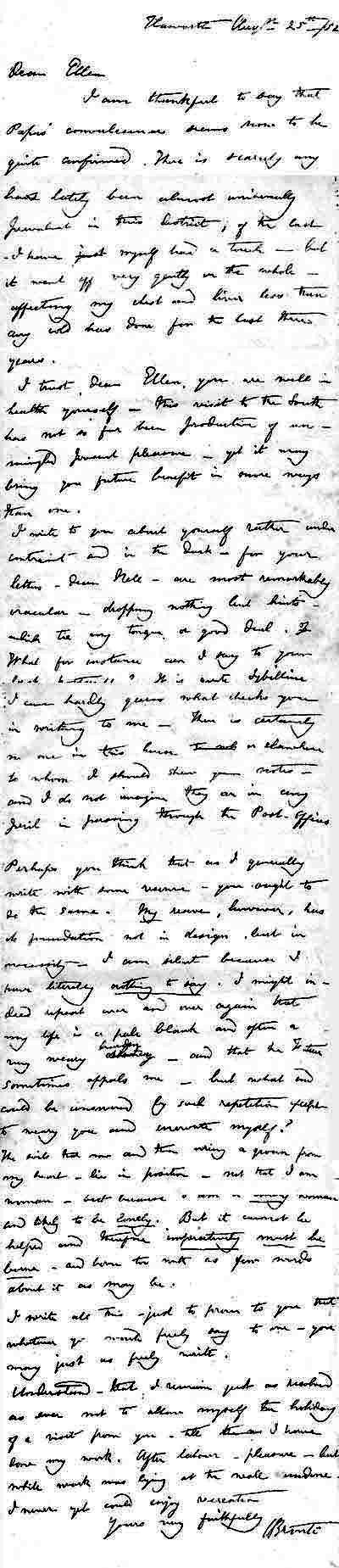
SIMILE LETTER OF CHARLOTTE BRONTË.
Slowly page after page of "Villette" was now being written. The reader sees from these letters that the book was composed in no happy mood. Writing to her publisher a few weeks after the date of the last letter printed above, she says: "I can hardly tell you how I hunger to hear some opinions beside my own, and how I have sometimes desponded and almost despaired, because there was no one to whom to read a line, or of whom to ask a counsel. 'Jane Eyre' was not written under such circumstances, nor were two-thirds of 'Shirley.' I got so miserable about it that I could bear no allusion to the book. It is not finished yet; but now I hope." But though her work pressed so incessantly upon her, and her feverish anxiety to have it done weighed so heavily upon her health and spirits, she could still find time to answer her friend's letters in a way which showed that her interest in the outer world was as keen as ever:
September, 1852.
Thank you for A——'s notes. I like to read them, they are so full of news, but they are illegible. A great many words I really cannot make out. It is pleasing to hear that M—— is doing so well, and the tidings about —— seem also good. I get a note from —— every now and then, but I fear my last reply has not given much satisfaction. It contained a taste of that unpalatable commodity called advice—such advice, too, as might be, and I dare say was, construed into faint reproof. I can scarcely tell what there is about —— that, in spite of one's conviction of her amiability, in spite of one's sincere wish for her welfare, palls upon one, satiates, stirs impatience. She will complacently put forth opinions and tastes as her own which are not her own, nor in any sense natural to her. My patience can really hardly sustain the test of such a jay in borrowed plumes. She prated so much about the fine wilful spirit of her child, whom she describes as a hard, brown little thing, who will do nothing but what pleases himself, that I hit out at last—not very hard, but enough to make her think herself ill-used, I doubt not. Can't help it. She often says she is not "absorbed in self," but the fact is, I have seldom seen anyone more unconsciously, thoroughly, and often weakly egotistic. Then, too, she is inconsistent. In the same breath she boasts her matrimonial happiness and whines for sympathy. Don't understand it. With a paragon of a husband and child, why that whining, craving note? Either her lot is not all she professes it to be, or she is hard to content.
In October the resolute determination to allow herself no relaxation until "Villette" was finished broke down. She was compelled to call for help, and to acknowledge herself beaten in her attempt to crush out the yearning for company:
October, 1852.
Papa expresses so strong a wish that I should ask you to come, and I feel some little refreshment so absolutely necessary myself, that I really must beg you to come to Haworth for one single week. I thought I would persist in denying myself till I had done my work, but I find it won't do. The matter refuses to progress, and this excessive solitude presses too heavily. So let me see your dear face, Nell, just for one reviving week. Could you come on Wednesday? Write to-morrow, and let me know by what train you would reach Keighley, that I may send for you.
The visit was a pleasant one in spite of the weariness of body and mind which troubled Charlotte. She laid aside her task for that "one little week," went out upon the moors with her friend, talked as of old, and at last, when she was left alone once more, declared that the change had done her "inexpressible good." Writing to her friend immediately after the latter had left her, she says:
Your note came only this morning. I had expected it yesterday, and was beginning actually to feel weary—like you. This won't do. I am afraid of caring for you too much. You must have come upon —— at an unfavourable moment, seen it under a cloud. Surely they are not always or often thus, or else married life is indeed but a slipshod paradise. I only send The Examiner, not having yet read The Leader. I was spared the remorse I feared. On Saturday I fell to business, and as the welcome mood is still decently existent, and my eyes consequently excessively tired with scribbling, you must excuse a mere scrawl. Papa was glad to hear you had got home well—as well as we…. I do miss my dear bed-fellow; no more of that calm sleep.
Her pen now began to move more quickly, and the closing chapters of "Villette" were written with comparative ease, so that at last she writes thus, on November 22nd:
Monday morning.
Truly thankful am I to be able to tell you that I finished my long task on Saturday, packed and sent off the parcel to Cornhill. I said my prayers when I had done it. Whether it is well or ill done I don't know. D. V., I will now try to wait the issue quietly. The book, I think, will not be considered pretentious, nor is it of a character to excite hostility. As Papa is pretty well, I may, I trust, dear Nell, do as you wish me, and come for a few days to B——. Miss Martineau has also urgently asked me to go and see her. I promised, if all were well, to do so at the close of November or the commencement of December, so that I could go on from B—— to Westmoreland. Would Wednesday suit you? "Esmond" shall come with me—i.e. Thackeray's novel.
Every reader knows in what fashion "Villette" ends, and most persons also know from Mrs. Gaskell that the reason why the actual issue is left in some uncertainty was the author's filial desire to gratify her father. Charlotte herself was firmly resolved that she would not make Lucy Snowe the happy wife of Paul Emanuel. She never meant to "appoint her lot in pleasant places." Lucy was to bear the storm and stress of life in the same manner as that in which her creator had been compelled to bear it; and she was to be left in the end alone, robbed for ever of the hope of spending the happy afternoon of her existence in the sunshine of love and congenial society. But Mr. Brontë, altogether unconscious of that tragedy of heart-sickness and soul-weariness which was being enacted under his own roof, and which furnished so striking a parallel to the story which ran through "Villette," would not brook a gloomy ending to the tale, and by protestations and entreaties induced his daughter at least so far to alter her plan as to leave the issue in doubt.
So "Villette" went its way, as "Jane Eyre" and "Shirley " had done before it, from the secluded parsonage at Haworth up to the busy publishing-house in Cornhill, and thence out into the world. There was some fear on Charlotte's part when the MS. had been despatched. She herself was gradually forming that which remained the fixed conviction of her life—the conviction that in "Villette" she had done her best, and that, for good or for ill, by it her reputation must stand or fall. But she was intensely anxious, as we have seen, to have the opinions of others upon the story. Nor was it only a general verdict on its merits for which she called. She was uneasy upon some minor points. According to her wont, she had taken most of her characters from life, and it was not during her stay at Brussels alone that she had studied the models which she employed when writing the book. Naturally, she was curious to know whether she had painted her portraits too literally. So "Villette" was allowed to pass, whilst still in MS., into the hands of the original of "Dr. John." When that gentleman had read the story, and criticised all the characters with the freedom of unconsciousness, her mind was set at rest, and she knew that she had not transgressed the bounds which divide the story-teller from the biographer.
In the meantime, her work done, she hurried away from Haworth to spend a well-earned holiday at B—— with her friend. "Esmond" accompanied her, and the quiet afternoons were spent in reading it aloud. On December 9th she writes from Haworth, announcing her safe return to her own home:
I got home safely at five o'clock yesterday afternoon, and, I am most thankful to say, found Papa and all the rest quite well. I did my business satisfactorily in Leeds, getting the head-dress rearranged as I wished. It is now a very different matter to the bushy, tasteless thing it was before. On my arrival I found no proof-sheets, but a letter from Mr. S——, which I would have enclosed, but so many words are scarce legible you would have no pleasure in reading it. He continues to make a mystery of his "reason"; something in the third volume sticks confoundedly in his throat; and as to the "female character" about which I asked, he responds that "she is an odd, fascinating little puss," but affirms that "he is not in love with her." He tells me also that he will answer no more questions about "Villette." This morning I have a brief note from Mr. Williams, intimating that he has not yet been permitted to read the third volume. Also there is a note from Mrs. ——, very kind. I almost wish I could still look on that kindness just as I used to do: it was very pleasant to me once. Write immediately, dear Nell, and tell me how your mother is. Give my kindest regards to her and all others at B——. Everybody seemed very good to me this last visit. I remember it with corresponding pleasure.
The private reception of "Villette" was not altogether that for which its author had hoped. Her publisher had objections to urge against certain features of the story, and those who saw the book in manuscript were not slow to express their own disapproval. It was evident that there was disappointment at Cornhill; and the proud spirit of Miss Brontë was keenly troubled. The letters in which she dwells on what was passing at that time need not be reproduced here, for their purport is sufficiently indicated by that which has just been given. But it is worth while to notice the scrupulous modesty with which she listened to all that was said by those who found fault, her careful anxiety to understand their objections, such as they were, and her perfect readiness to discuss every point raised with them. Of irritability under this criticism there is no trace, only a certain sadness and sorrow at the discovery that she had not succeeded in impressing others as she had hoped to do. Yet she is scarcely surprised that it is so. Had she not written years before, when "Shirley" was first produced, these words?—
No matter, whether known or unknown, misjudged or the contrary, I am resolved not to write otherwise. I shall bend as my powers tend. The two human beings who understood me, and whom I understood, are gone. I have some that love me yet, and whom I love without expecting, or having a right to expect, that they shall perfectly understand me. I am satisfied, but I must have my own way in the matter of writing…. I am thankful to God who gave me the faculty; and it is for me a part of my religion to defend this gift and to profit by its possession.
So now she is not astonished at finding herself misunderstood. Nor is she angry. She is perfectly ready to explain her real meaning to those who have misjudged her, but she is resolute in abiding by what she has written. The work wrung from her during those two years of pain and sorrow is not work which can be altered at will to please another. Even to meet the entreaties of her father she had refused to do more than draw a veil over the catastrophe in which the plot ends; and she cannot introduce new incidents, or lay on new colours, because the little circle of critics sitting in judgment on her manuscript have pronounced it to be imperfect. "I fear they" (the readers) "must be satisfied with what is offered. My palette affords no brighter tints; were I to attempt to deepen the reds or burnish the yellows, I should but blotch." Yet she admits that those who judge the book only from the outside have some reason to complain that it is not as other novels are:
You say that Lucy Snowe may be thought morbid and weak, unless the history of her life be more freely given. I consider that she is both morbid and weak at times; her character sets up no pretensions to unmixed strength, and anybody living her life would necessarily become morbid. It was no impetus of healthy feeling which urged her to the confessional, for instance; it was the semi-delirium of solitary grief and sickness. If, however, the book does not express all this, there must be a great fault somewhere. I might explain away a few other points, but it would be too much like drawing a picture and then writing underneath the name of the object intended to be represented.
Happily, the heart of the great reading world is bigger and truer as a whole than any part of it is. What those who read the manuscript of "Villette" failed to see at the first glance was seen instantly by the public when the book was placed in its hands. From critics of every school and degree there came up a cry of wonder and admiration, as men saw out of what simple characters and commonplace incidents genius had evoked this striking work of literary art. Popular, perhaps, the book could scarcely hope to be, in the vulgar acceptation of the word. The author had carefully avoided the "flowery and inviting" course of romance, and had written in silent obedience to the stern dictates of an inspiration which, as we have seen, only came at intervals, leaving her between its visits cruelly depressed and pained, but which when it came held her spell-bound and docile. Yet out of the dull record of humble woes, marked by no startling episodes, adorned by few of the flowers of poetry, she had created such a heart-history as remains to this day without a rival in the school of English fiction to which it belongs.
I bring together a batch of notes, not all addressed to the same person, which give her account of the reception and success of the book:
February 11th, 1853.
Excuse a very brief note, for I have time only to thank you for your last kind and welcome letter, and to say that, in obedience to your wishes, I send you by this day's post two reviews—The Examiner and The Morning Advertiser—which, perhaps, you will kindly return at your leisure. Ellen has a third—The Literary Gazette—which she will likewise send. The reception of the book has been favourable thus far—for which I am thankful—less, I trust, on my own account than for the sake of those few real friends who take so sincere an interest in my welfare as to be happy in my happiness.
February 15th.
I am very glad to hear that you got home all right, and that you managed to execute your commissions in Leeds so satisfactorily. You do not say whether you remembered to order the Bishop's dessert; I shall know, however, by to-morrow morning. I got a budget of no less than seven papers yesterday and to-day. The import of all the notices is such as to make my heart swell with thankfulness to Him who takes note both of suffering and work and motives. Papa is pleased too. As to friends in general, I believe I can love them still without expecting them to take any large share in this sort of gratification. The longer I live, the more plainly I see that gentle must be the strain on fragile human nature. It will not bear much.
I have heard from Mrs. Gaskell. Very kind, panegyrical, and so on. Mr. S—— tells me he has ascertained that Miss Martineau did write the notice in The Daily News. J. T. offers to give me a regular blowing-up and setting down for £5, but I tell him The Times will probably let me have the same gratis.
March 10th, 1853.
I only got The Guardian newspaper yesterday morning, and have not yet seen either The Critic or Sharpe's Magazine. The Guardian does not wound me much. I see the motive, which, indeed, there is no attempt to disguise. Still I think it a choice little morsel for foes (Mr. —— was the first to bring the news of the review to Papa), and a still choicer morsel for "friends" who—bless them!—while they would not perhaps positively do one an injury, still take a dear delight in dashing with bitterness the too sweet cup of success. Is Sharpe's small article like a bit of sugar-candy, too, Ellen? or has it the proper wholesome wormwood flavour? Of course I guess it will be like The Guardian. My "dear friends" will weary of waiting for The Times. "O Sisera! why tarry the wheels of thy chariot so long?"
March 22nd.
Thank you for sending ——'s notes. Though I have not attended to them lately, they always amuse me. I like to read them; one gets from them a clear enough idea of her sort of life. ——'s attempts to improve his good partner's mind make me smile. I think it all right enough, and doubt not they are happy in their way; only the direction he gives his efforts seems of rather problematic wisdom. Algebra and optics! Why not enlarge her views by a little well-chosen general reading? However, they do right to amuse themselves in their own way. The rather dark view you seem to take of the general opinion about "Villette" surprises me the less, as only the more unfavourable reviews seem to have come in your way. Some reports reach me of a different tendency; but no matter; time will show. As to the character of Lucy Snowe, my intention from the first was that she should not occupy the pedestal to which "Jane Eyre" was raised by some injudicious admirers. She is where I meant her to be, and where no charge of self-laudation can touch her.
XI.
MARRIAGE AND DEATH.
Every book, as we know, has its secret history, hidden from the world which reads only the printed pages, but legible enough to the author, who sees something more than the words he has set down for the public to read. Thackeray tells us how, reading again one of his smaller stories, written at a sad period of his own life, he brought back all the scene amid which the little tale was composed, and woke again to a consciousness of the pangs which tore his heart when his pen was busy with the imaginary fortunes of the puppets he had placed upon the mimic stage. Between the lines he read quite a different story from that which was laid before the reader. I have tried to show how largely this was the case with Charlotte Brontë's novels. Each was a double romance, having one meaning for the world, and another for the author. Yet she herself, when she wrote "Shirley" and "Villette," had no conception of the strange blending of the secret currents of the two books which was in store for her, or of the unexpected fate which was to befall the real heroine of her last work—to wit, herself.
I have told how fixed was her belief that "Lucy Snowe's" fate was to be a tragic one—a life the closing years of which were to be spent in loneliness and anguish, and amid the bitterness of withered hopes. Very few readers can have forgotten the closing passage of "Villette," in which the catastrophe, though veiled, can be readily discovered:
The sun passes the equinox; the days shorten, the leaves grow sere; but—he is coming.
Frosts appear at night; November has sent his fogs in advance; the wind takes its autumn moan; but—he is coming.
The skies hang full and dark—a rack sails from the west; the clouds cast themselves into strange forms—arches and broad radiations; there rise resplendent mornings—glorious, royal, purple as a monarch in his state; the heavens are one flame; so wild are they, they rival battle at its thickest—so bloody, they shame Victory in her pride. I know some signs of the sky; I have noted them ever since childhood. God, watch that sail! Oh! guard it!
The wind shifts to the west. Peace, peace, Banshee—"keening" at every window! It will rise—it will swell—it shrieks out long: wander as I may through the house this night, I cannot lull the blast. The advancing hours make it strong: by midnight, all sleepless watchers hear and fear a wild south-west storm….
Peace, be still! Oh! a thousand weepers, praying in agony on waiting shores, listened for that voice, but it was not uttered—not uttered till, when the hush came, some could not feel it; till, when the sun returned, his light was night to some!
In darkness such as here is shadowed forth, Charlotte Brontë believed that her own life would close; all sunshine gone, all joys swept clean away by the bitter blast of death, all hopes withered or uprooted. But the end which she pictured was not to be. God was more merciful than her own imaginings; and at eventide there was light and peace upon her troubled path.
Those who turn to the closing passage of "Shirley" will find there reference to "a true Christian gentleman," who had taken the place of the hypocrite Malone, one of the famous three curates of the story. This gentleman, a Mr. McCarthy, was, like the rest, no fictitious personage. His original was to be found in the person of Mr. Nicholls, who for several years had lived a simple, unobtrusive life at Haworth, as curate to Mr. Brontë, and whose name often occurs in Charlotte's letters to her friend. In none of these references to him is there the slightest indication that he was more than an honoured friend. Nor was it so. Whilst Mr. Nicholls, dwelling near Miss Brontë, and observing her far more closely than any other person could do, had formed a deep and abiding attachment for her, she herself was wholly unconscious of the fact. Its first revelation came upon her as something like a shock; as something also like a reproach. Whilst she had thought herself alone, doomed to a life of solitude and pain, a tender yet a manly love had all the while been growing round her.
It is obvious that the letters which she addressed at this time (December, 1852) to her friend cannot be printed here. Yet no letters more honourable to the woman, the daughter, and the lover have ever been penned. There is no restraint now in the outpourings of her heart. Her friend is taken into her full confidence, and every hope and fear and joy is spoken out as only women who are pure and truthful and entirely noble can venture to speak out. Mrs. Gaskell has briefly but distinctly stated the broad features of this strange love story, giving such promise at the time, so happy and beautiful in its brief fruition, so soon to be quenched in the great darkness. Mr. Brontë resented the attentions of Mr. Nicholls to his daughter in a manner which brought to light all the sternness and bitterness of his character. There had been of late years a certain mellowing of his disposition, which Charlotte had dwelt upon with hopeful joy, as her one comfort in her lonely life at Haworth. How much he owed to her none knew but himself. When he was sinking under the burden of his son's death, she had rescued him; when, for one dark and bitter interval, he had sought refuge from grief and remorse in the coward's solace, her brave heart, her gentleness, her unyielding courage, had brought him back again from evil ways, and sustained and kept him in the path of honour; and now his own ambitions were more than satisfied by her success; he found himself shining in the reflected glory of his daughter's fame, and sunned himself, poor man, in the light and warmth. But all the old jealousy, the intense acerbity of his character, broke out when he saw another person step between himself and her, and that other no idol of the great world of London, but simply the honest man who had dwelt almost under his own roof-tree for years.
When, having heard with surprise and emotion, the story of Mr. Nicholls's attachment, Charlotte communicated his offer to her father, "agitation and anger disproportionate to the occasion ensued. My blood boiled with a sense of injustice. But Papa worked himself into a state not to be trifled with. The veins on his forehead started up like whipcord, and his eyes became suddenly bloodshot. I made haste to promise that on the morrow Mr. Nicholls should have a distinct refusal." It so happened that very soon after this, that is to say when "Villette" was published, Miss Martineau caused deep pain to its writer by condemning the manner in which "all the female characters in all their thoughts and lives" were represented as "being full of one thing—love." The critic not unjustly pointed out that love was not the be-all and the end-all of a woman's life. Perhaps her pen would not have been so sharp in touching on this subject, had she known with what quiet self-sacrifice the author of "Villette" had but a few weeks before set aside her own preferences and inclinations, and submitted her lot to her father's angry will. This truly must be reckoned as another illustration of the extent to which the Quarterly reviewer of 1848 had formed an accurate conception of the character of "Currer Bell."
Not only was the struggle which followed sharp and painful, it was also stubborn and prolonged. Mr. Nicholls resigned the curacy he had held so many years, and prepared to leave Haworth. Mr. Brontë not only showed no signs of relenting, but openly exulted in his departure, and lost no opportunity of expressing in bitterly sarcastic language his opinion of his colleague's conduct. How deeply Charlotte suffered at this time is proved by the letters before me. Firmly convinced that her first duty was to the parent whose only remaining stay she was, she never wavered in her determination to sacrifice every wish of her own to his comfort. But her heart was racked with pity for the man who was suffering through his love for her, and her indignation was roused to fever-heat by the gross injustice of her father's conduct.
Compassion or relenting is no more to be looked for from Papa than sap from firewood. I never saw a battle more sternly fought with the feelings than Mr. N. fights with his, and when he yields momentarily, you are almost sickened by the sense of the strain upon him. However, he is to go, and I cannot speak to him or look at him or comfort him a whit—and I must submit. Providence is over all; that is the only consolation.
In all this—she says, after speaking again of the severity of the struggle—it is not I who am to be pitied at all, and of course nobody pities me. They all think in Haworth that I have disdainfully refused him. If pity would do him any good he ought to have, and I believe has, it. They may abuse me if they will. Whether they do or not I can't tell.
I thought of you on New Year's Day, and hope you got well over your formidable tea-making. I am busy, too, in my little way, preparing to go to London this week—a matter which necessitates some little application to the needle. I find it quite necessary I should go to superintend the press, as Mr. S—— seems quite determined not to let the printing get on till I come. I have actually only received three proof-sheets since I was at Brookroyd. Papa wants me to go too, to be out of the way, I suppose; but I am sorry for one other person whom nobody pities but me…. They don't understand the nature of his feelings, but I see now what they are. Mr. N—— is one of those who attach themselves to very few, whose sensations are close and deep, like an underground stream, running strong but in a narrow channel. He continues restless and ill. He carefully performs the occasional duty, but does not come near the church, procuring a substitute every Sunday. A few days since he wrote to Papa requesting permission to withdraw his resignation. Papa answered that he should only do so on condition of giving his written promise never again to broach the obnoxious subject either to him or to me. This he has evaded doing, so the matter remains unsettled. I feel persuaded the termination will be, his departure for Australia. Dear Nell, without loving him, I don't like to think of him suffering in solitude, and wish him anywhere so that he were happier. He and Papa have never met or spoken yet.
During this crisis in her life, when suffering had come to her in a new and sharp form, but when happily the black cloud was lit up on the other side by the rays of the sun, she went up to London to spend a few weeks. From the letters written during her visit I make these extracts:
January 11th, 1853.
I came here last Wednesday. I had a delightful day for my journey, and was kindly received at the close. My time has passed pleasantly enough since I came, yet I have not much to tell you; nor is it likely I shall have. I do not mean to go out much or see many people. Sir J. S—— wrote to me two or three times before I left home, and made me promise to let him know when I should be in town, but I reserve to myself the right of deferring the communication till the latter part of my stay. All in this house appear to be pretty much as usual, and yet I see some changes. Mrs. —— and her daughter look well enough; but on Mr. —— hard work is telling early. Both his complexion, his countenance, and the very lines of his features are altered. It is rather the remembrance of what he was than the fact of what he is which can warrant the picture I have been accustomed to give of him. One feels pained to see a physical alteration of this kind; yet I feel glad and thankful that it is merely physical. As far as I can judge, mind and manners have undergone no deterioration—rather, I think, the contrary.
January 19th, 1853.
I still continue to get on very comfortably and quietly in London, in the way I like, seeing rather things than persons. Being allowed to have my own choice of sights this time I selected the real rather than the decorative side of life. I have been over two prisons, ancient and modern, Newgate and Pentonville; also the Bank, the Exchange, the Foundling Hospital; and to-day, if all be well, I go with Dr. Forbes to see Bethlehem Hospital. Mrs. —— and her daughters are, I believe, a little amazed at my gloomy tastes; but I take no notice. Papa, I am glad to say, continues well. I enclose portions of two notes of his which will show you better than anything I can say how he treats a certain subject. My book is to appear at the close of this month. Mrs. Gaskell wrote to beg that it should not clash with "Ruth," and it was impossible to refuse to defer the publication a week or two.
The visit to London did good; but it could not remove the pain which she suffered during this period of conflict.
Haworth, May 19th, 1853.
It is almost a relief to hear that you only think of staying at G—— a month; though of course one must not be selfish in wishing you to come home soon…. I cannot help feeling satisfaction in finding that the people here are getting up a subscription to offer a testimonial of respect to Mr. N—— on his leaving the place. Many are expressing both their commiseration and esteem for him. The churchwardens recently put the question to him plainly: Why was he going? Was it Mr. Brontë's fault or his own? His own, he answered. Did he blame Mr. Brontë? No, he did not: if anybody was wrong, it was himself. Was he willing to go? No; it gave him great pain. Yet he is not always right. I must be just. Papa addressed him at the school tea-drinking with constrained civility, but still with civility. He did not reply civilly; he cut short further words. This sort of treatment is what Papa never will forget or forgive. It inspires him with a silent bitterness not to be expressed…. It is a dismal state of things. The weather is fine now, dear Nell. We will take these sunny days as a good omen for your visit.
May 27th, 1853.
You will want to know about the leave-taking. The whole matter is but a painful subject, but I must treat it briefly. The testimonial was presented in a public meeting. Mr. F—— and Mr. G—— were there. Papa was not very well, and I advised him to stay away, which he did. As to the last Sunday, it was a cruel struggle. Mr. N—— ought not to have had to take any duty. He left Haworth this morning at six o'clock. Yesterday evening he called to render into Papa's hands the deeds of the National School, and to say good-bye. They were busy cleaning, washing the paint, &c., so he did not find me there. I would not go into the parlour to speak to him in Papa's presence. He went out, thinking he was not to see me; and indeed till the very last moment I thought it best not. But perceiving that he stayed long before going out at the gate, and remembering his long grief, I took courage, and went out, trembling and miserable. I found him leaning against the garden door…. Of course I went straight to him. Very few words were interchanged; those few barely articulate: several things I should have liked to ask him were swept entirely from my memory. Poor fellow! but he wanted such hope and such encouragement as I could not give him. Still I trust he must know now that I am not cruelly blind and indifferent to his constancy and grief. For a few weeks he goes to the South of England—afterwards he takes a curacy somewhere in Yorkshire, but I don't know where. Papa has been far from strong lately. I dare not mention Mr. N——'s name to him. He speaks of him quietly and without opprobrium to others; but to me he is implacable on the matter. However, he is gone—gone—and there's an end of it! I see no chance of hearing a word about him in future, unless some stray shred of intelligence comes through Mr. G—— or some other second-hand source.
The remainder of the year 1853 was a chequered one. Mr. Nicholls left Haworth; Charlotte remained with her father. Those who saw her at this time bear testimony to the unfailing, never-flagging devotion she displayed towards one who was wounding her cruelly. But she bore this sorrow, like those which had preceded it, bravely and cheerfully. To her friend she opened her heart at times, revealing something of what she was suffering; but to all others she was silent.
Haworth, April 13th, 1853.
My dear Miss ——,—Your last kind letter ought to have been answered long since, and would have been, did I find it practicable to proportion the promptitude of the response to the value I place upon my correspondents and their communications. You will easily understand, however, that the contrary rule often holds good, and that the epistle which importunes often takes precedence of that which interests. My publishers express entire satisfaction with the reception which has been accorded to "Villette." And, indeed, the majority of the reviews has been favourable enough. You will be aware, however, that there is a minority, small in character, which views the work with no favourable eye. "Currer Bell's" remarks on Romanism have drawn down on him the condign displeasure of the High Church party, which displeasure has been unequivocally expressed through their principal organs, The Guardian, The English Churchman, and The Christian Remembrancer. I can well understand that some of the charges launched against me by these publications will tell heavily to my prejudice in the minds of most readers. But this must be borne; and for my part, I can suffer no accusation to oppress me much which is not supported by the inward evidence of Conscience and Reason. "Extremes meet," says the proverb; in proof whereof I would mention that Miss Martineau finds with "Villette" nearly the same fault as the Puseyites. She accuses me of attacking Popery "with virulence," of going out of my way to assault it "passionately." In other respects she has shown, with reference to the work, a spirit so strangely and unexpectedly acrimonious, that I have gathered courage to tell her that the gulf of mutual difference between her and me is so wide and deep, the bridge of union so slight and uncertain, I have come to the conclusion that frequent intercourse would be most perilous and unadvisable, and have begged to adjourn sine die my long-projected visit to her. Of course she is now very angry, but it cannot be helped. Two or three weeks since I received a long and kind letter from Mr. ——, which I answered a short time ago. I believe he thinks me a much better advocate for change, and what is called "political progress," than I am. However, in my reply I did not touch on these subjects. He intimated a wish to publish some of his own MSS. I fear he would hardly like the somewhat dissuasive tendency of my answer; but really, in these days of headlong competition, it is a great risk to publish.
April 18th, 1853.
If all be well, I think of going to Manchester about the close of this week. I only intend staying a few days; but I can say nothing about coming back by B——. Do not expect me; I would rather see you at Haworth by-and-by. Two or three weeks since, Miss Martineau wrote to ask why she did not hear from me, and to press me to go to Ambleside. Explanations ensued; the notes on each side were quite civil; but, having deliberately formed my resolution on substantial grounds, I adhered to it. I have declined being her visitor, and bid her good-bye. It is best so; the antagonism of our natures and principles was too serious to be trifled with.
This difference with Miss Martineau is not a thing to dwell on now. The pity is that two women so truthful, so sincere, so bold in their utterances should ever have differed. Charlotte Brontë had known how to stand bravely by Miss Martineau when she believed that the latter was suffering because of her honestly-formed opinions; she had known how to speak on her behalf with timely generosity and force. But her sensitive nature was wounded to the quick by criticisms which she believed to be unjust; and so these two great women parted, and met again no more.
To the mental pain which she was now suffering from her father's conduct there was added keen physical torture. During this summer of 1853 many of her letters contain sentences like this: "I have been suffering most severely for ten days with continued pain in the head—on the nerves it is said to be. Blistering at last seems to have done it some good; but I am yet weak and bewildered." A visit from Mrs. Gaskell, who came to see how Haworth looked in its autumn robe of splendour, did her some good; but still more was gained by a journey to the seaside in the company of her old friend and schoolmistress, Miss Wooler, before which she had addressed to her the following letter:
Haworth, August 30th, 1853.
My dear Miss W.,—I was from home when your kind letter came, and, as it was not forwarded, I did not get it till my return. All the summer I have felt the wish and cherished the intention to join you for a brief period at the seaside; nor do I yet entirely relinquish the purpose, though its fulfilment must depend on my father's health. At present he complains so much of weakness and depressed spirits, that no thoughts of leaving him can be entertained. Should he improve, however, I would fain come to you before autumn is quite gone.
My late absence was but for a week, when I accompanied Mr. and Mrs. —— and baby on a trip to Scotland. They went with the intention of taking up their quarters at Kirkcudbright, or some watering-place on the Solway Firth. We hardly reached that locality, and had stayed but one night, when the baby (that rather despotic member of modern households) exhibited some symptoms of indisposition. To my unskilled perception its ailments appeared very slight, nowise interfering with its appetite or spirits; but parental eyes saw the matter in a different light. The air of Scotland was pronounced unpropitious to the child, and consequently we had to retrace our steps. I own I felt some little reluctance to leave "bonnie Scotland" so soon and so abruptly, but of course I could not say a word, since, however strong on my own mind the impression that the ailment in question was very trivial and temporary (an impression confirmed by the issue), I could not be absolutely certain that such was the case; and had any evil consequences followed a prolonged stay, I should never have forgiven myself.
Ilkley was the next place thought of. We went there, but I only remained three days, for, in the hurry of changing trains at one of the stations, my box was lost, and without clothes I could not stay. I have heard of it twice, but have not yet regained it. In all probability it is now lying at Kirkcudbright, where it was directed.
Notwithstanding some minor trials, I greatly enjoyed this little excursion. The scenery through which we travelled from Dumfries to Kirkcudbright (a distance of thirty miles, performed outside a stage-coach) was beautiful, though not at all of a peculiarly Scottish character, being richly cultivated and well wooded. I liked Ilkley, too, exceedingly, and shall long to revisit the place. On the whole, I thought it for the best that circumstances obliged me to return home so soon, for I found Papa far from well. He is something better now, yet I shall not feel it right to leave him again till I see a more thorough re-establishment of health and strength.
With some things to regret and smile at, I saw things to admire in the small family party with which I travelled. Mr. —— makes a most devoted father and husband. I admired his great kindness to his wife; but I rather groaned (inwardly) over the unbounded indulgence of both parents towards their only child. The world does not revolve round the sun; that is a mistake. Certain babies, I plainly perceive, are the important centre of all things. The papa and mamma could only take their meals, rest, and exercise at such times and in such manner as the despotic infant permitted. While Mrs. —— eat her dinner, Mr. —— relieved guard as nurse. A nominal nurse, indeed, accompanied the party, but her place was a sort of anxious waiting sinecure, as the child did not fancy her attendance. Tenderness to offspring is a virtue, yet I think I have seen mothers who were most tender and thoughtful, yet in very love for their children would not permit them to become tyrants either over themselves or others.
I shall be glad and grateful, my dear Miss W., to hear from you again whenever you have time or inclination to write—though, as I told you before, there is no fear of my misunderstanding silence. Should you leave Hornsea before winter sets in, I trust you will just come straight to Haworth, and pay your long-anticipated visit there before you go elsewhere. Papa and the servants send their respects. I always duly deliver your kind messages of remembrance, because they give pleasure.
December came, and she writes to this friend expressing her wonder as to how she is spending the long winter evenings—"alone, probably, like me." It was a dreary winter for her; but the spring was at hand. Mr. Brontë, studying his daughter with keen eyes, could not hide from himself the fact that her health and spirits were drooping now as they had never drooped before. All work with the pen was laid aside; and household cares, attendance upon her father or on the old servant, who now also needed to be waited upon, occupied her time; but her heart was heavy with a burden such as she had never previously known. At last the stern nature of the man was broken down by his genuine affection for his daughter. His opposition to her marriage was suddenly laid aside; he asked her to recall Mr. Nicholls to Haworth, and with characteristic waywardness he now became as anxious that the wedding should take place as he had ever been that it should be prevented.
There was a curious misadventure regarding the letter inviting Mr. Nicholls to Haworth, which is explained in the first of the letters I now quote.
Haworth, March 28th, 1854.
The enclosure in yours of yesterday puzzled me at first, for I did not immediately recognise my own handwriting. When I did, the sensation was one of consternation and vexation, as the letter ought by all means to have gone on Friday. It was intended to relieve him from great anxiety. However, I trust he will get it to-day; and, on the whole, when I think it over, I can only be thankful that the mistake was no worse, and did not throw the letter into the hands of some indifferent and unscrupulous person. I wrote it after some days of indisposition and uneasiness, and when I felt weak and unfit to write. While writing to him I was at the same time intending to answer your note; which I suppose accounts for the confusion of ideas shown in the mixed and blundering address.
I wish you could come about Easter rather than at another time, for this reason. Mr. Nicholls, if not prevented, proposes coming over then. I suppose he will be staying at Mr. ——'s, as he has done two or three times before; but he will be frequently coming here, which would enliven your visits a little. Perhaps, too, he might take a walk with us occasionally. Altogether, it would be a little change for you, such as you know I could not always offer. If all be well, he will come under different circumstances to any that have attended his visits before. Were it otherwise, I should not ask you to meet him, for when aspects are gloomy and unpropitious, the fewer there are to suffer from the cloud, the better. He was here in January, and was then received…. I trust it will be a little different now. Papa has breakfasted in bed to-day, and has not yet risen. His bronchitis is still troublesome. I had a bad week last week, but am greatly better now, for my mind is a little relieved, though very sedate, and rising only to expectations the most moderate. Some time, perhaps in May, I may be in your neighbourhood, and shall then hope to come to B.; but, as you will understand from what I have now stated, I could not come before. Think it over, dear E., and come to Haworth if you can.
April 11th, 1854.
The result of Mr. Nicholls's visit is that Papa's consent is gained and his respect won, for Mr. Nicholls has in all things proved himself disinterested and forbearing. He has shown, too, that, while his feelings are exquisitely keen, he can freely forgive…. In fact, dear Ellen, I am engaged. Mr. Nicholls in the course of a few months will return to the curacy of Haworth. I stipulated that I would not leave Papa, and to Papa himself I proposed a plan of residence which should maintain his seclusion and convenience uninvaded, and in a pecuniary sense bring him gain instead of loss. What seemed at one time impossible is now arranged, and Papa begins really to take a pleasure in the prospect. For myself, dear E——, while thankful to One who seems to have guided me through much difficulty, much and deep distress and perplexity of mind, I am still very calm…. What I taste of happiness is of the soberest order. Providence offers me this destiny. Doubtless, then, it is the best for me; nor do I shrink from wishing those dear to me one not less happy. It is possible that our marriage may take place in the course of the summer. Mr. Nicholls wishes it to be in July. He spoke of you with great kindness, and said he hoped you would be at our wedding. I said I thought of having no other bridesmaid. Did I say right? I mean the marriage to be literally as quiet as possible. Do not mention these things as yet. Good-bye. There is a strange, half-sad feeling in making these announcements. The whole thing is something other than the imagination paints it beforehand—cares, fears, come mixed inextricably with hopes. I trust yet to talk the matter over with you.
So at length the day had dawned, and every letter now is filled with the hopes and cares of the expectant bride.
April 15th.
I hope to see you somewhere about the second week in May. The Manchester visit is still hanging over my head; I have deferred it and deferred it, but have finally promised to go about the beginning of next month. I shall only stay about three days; then I spend two or three days at H., then come to B. The three visits must be compressed into the space of a fortnight, if possible. I suppose I shall have to go to Leeds. My purchases cannot be either expensive or extensive. You must just resolve in your head the bonnets and dresses: something that can be turned to decent use and worn after the wedding-day will be best, I think. I wrote immediately to Miss W——, and received a truly kind letter from her this morning. Papa's mind seems wholly changed about this matter; and he has said, both to me and when I was not there, how much happier he feels since he allowed all to be settled. It is a wonderful relief for me to hear him treat the thing rationally, and quietly and amicably to talk over with him themes on which once I dared not touch. He is rather anxious that things should get forward now, and takes quite an interest in the arrangement of preliminaries. His health improves daily, though this east wind still keeps up a slight irritation in the throat and chest. The feeling which has been disappointed in Papa was ambition—paternal pride—ever a restless feeling, as we all know. Now that this unquiet spirit is exorcised, justice, which was once quite forgotten, is once more listened to, and affection, I hope, resumes some power. My hope is that in the end this arrangement will turn out more truly to Papa's advantage than any other it was in my power to achieve. Mr. N. only in his last letter refers touchingly to his earnest desire to prove his gratitude to Papa by offering support and consolation to his declining age. This will not be mere talk with him. He is no talker, no dealer in mere professions.
April 28th.
Papa, thank God! continues to improve much. He preached twice on Sunday, and again on Wednesday, and was not tired. His mind and mood are different to what they were; so much more cheerful and quiet. I trust the illusions of ambition are quite dissipated, and that he really sees it is better to relieve a suffering and faithful heart, to secure in its fidelity a solid good, than unfeelingly to abandon one who is truly attached to his interests as well as mine, and pursue some vain empty shadow.
Hemsworth, May 6th.
I came here on Thursday afternoon. I shall stay over Saturday and Sunday, and, if all be well, I hope to come to B. on Monday, after dinner, and just in time for tea. I leave you to judge by your own feelings whether I long to see you or not. —— tells me you are looking better. She tells me also that I am not—rather ugly, as usual. But never mind that, dear Nell—as, indeed, you never did. On the whole, I feel very decently at present, and within the last fortnight have had much respite from headache. You are kind in being so much in earnest in wishing for Mr. N. to come to B., and I am sorry that circumstances do not favour such a step. But, knowing how matters stood, I did not repeat the proposal to him, for I thought it would be like tempting him to forget duty.
In the following letters, in addition to the pleasing side-lights which they throw upon her life in its new aspect, there is another feature which deserves to be noticed—that is, the exceeding tenderness with which the writer watches over her friend. The new love entering into her heart has but made the old love stronger, and she lavishes upon the sole remaining companion of her youth the care and affection which can no longer be bestowed upon sisters of her own blood.