T. WEMYSS REID. (continued 2)
Reading edition
It is not so. There may be disappointment among those who have been nurtured on the traditions of the Brontë romance when they find that the reality is different from what they supposed it to be; some shallow judges may even assume that Charlotte herself loses in moral stature when it is shown that it was not her horror at her brother's fall which drove her to find relief in literary speech. But the truth must be told; and for my part I see nothing in that truth which affects, even in an infinitesimal degree, the fame and the honour of the woman of whom I write.
It was Charlotte's visit to Brussels, then, first as pupil and afterwards as teacher in the school of Madame Héger, which was the turning-point in her life, which changed its currents, and gave to it a new purpose and a new meaning. Up to the moment of that visit she had been the simple, kindly, truthful Yorkshire girl, endowed with strange faculties, carried away at times by burning impulses, moved often by emotions the nature of which she could not fathom, but always hemmed in by her narrow experiences, her limited knowledge of life and the world. Until she went to Belgium, her sorest troubles had been associated with her dislike to the society of strangers, her heaviest burden had been the necessity under which she lay of tasting that "cup of life as it is mixed for governesses" which she detested so heartily. Under the belief that they could qualify themselves to keep a school of their own if they had once mastered the delicacies of the French and German languages, she and Emily set off for this sojourn in Brussels.
One may be forgiven for speculating as to her future lot had she accepted the offer of marriage she received in her early governess days, and settled down as the faithful wife of a sober English gentleman. In that case "Shirley" perhaps might have been written, but "Jane Eyre" and "Villette" never. She learnt much during her two years' sojourn in the Belgian capital; but the greatest of all the lessons she mastered whilst there was that self-knowledge the taste of which is so bitter to the mouth, though so wholesome to the life. Mrs. Gaskell has made such ample use of the letters she penned during the long months which she spent as an exile from England, that there is comparatively little left to cull from them. Everybody knows the outward circumstances of her story at this time. For a brief period she had the company of Emily; and the two sisters, working together with the unremitting zeal of those who have learned that time is money, were happy and hopeful, enjoying the novel sights of the gay foreign capital, gathering fresh experiences every day, and looking forward to the moment when they would return to familiar Haworth, and realise the dream of their lives by opening a school of their own within the walls of the parsonage. But then Emily left, and Charlotte, after a brief holiday at home, returned alone. Years after, writing to her friend, she speaks of her return in these words: "I returned to Brussels after aunt's death against my conscience, prompted by what then seemed an irresistible impulse. I was punished for my selfish folly by a total withdrawal for more than two years of happiness and peace of mind." Why did she thus go back "against her conscience?" Her friends declared that her future husband dwelt somewhere within sound of the chimes of St. Gudule, and that she insisted upon returning to Brussels because she was about to be married there. We know now how different was the reality. The husband who awaited her was even then about to begin his long apprenticeship of love at Haworth. Yet none the less had her spirit, if not her heart, been captured and held captive in the Belgian city. It is not in her letters that we find the truth regarding her life at this time. The truth indeed is there, but not all the truth. "In catalepsy and dread trance," says Lucy Snowe, "I studiously held the quick of my nature…. It is on the surface only the common gaze will fall." The secrets of her inner life could not be trusted to paper, even though the lines were intended for no eyes but those of her friend and confidante. There are some things, as we know well, that the heart hides as by instinct, and which even frank and open natures only reveal under compulsion. Writing to her friend from Brussels in October, 1843, she says: "I have much to say, Ellen; many little odd things, queer and puzzling enough, which I do not like to trust to a letter, but which one day, perhaps, or rather one evening, if ever we should find ourselves again by the fireside at Haworth, or at B——, with our feet on the fender, curling our hair, I may communicate to you." One of the hardest features of the last year she spent at Brussels was the necessity she was under of locking all the deepest emotions of her life within her own breast, of preserving the calm and even cold exterior, which should tell nothing to the common gaze, above the troubled, fevered heart that beat within.
When do you think I shall see you?—she cries to her friend within a few days of her final return to Haworth—I have, of course, much to tell you, and I dare say you have much also to tell me—things which we should neither of us wish to commit to paper…. I do not know whether you feel as I do, but there are times now when it appears to me as if all my ideas and feelings, except a few friendships and affections, are changed from what they used to be. Something in me which used to be enthusiasm is tamed down and broken. I have fewer illusions. What I wish for now is active exertion—a stake in life. Haworth seems such a lonely, quiet spot, buried away from the world. I no longer regard myself as young; indeed, I shall soon be twenty-eight, and it seems as if I ought to be working and braving the rough realities of the world, as other people do. It is, however, my duty to restrain this feeling at present, and I will endeavour to do so.
Yes; she was "disillusioned" now, and she had brought back from Brussels a heart which could never be quite so light, a spirit which could never again soar so buoyantly, as in those earlier years when the tree of knowledge was still untasted, and the mystery of life still unrevealed. This stay in Belgium was, as I have said, the turning-point in Charlotte Brontë's career, and its true history and meaning is to be found, not in her "Life" and letters, but in "Villette," the master-work of her mind, and the revelation of the most vivid passages in her own heart's history. "I said I disliked Lucy Snowe," is a remark which Mrs. Gaskell innocently repeats in her memoir of Charlotte Brontë. One need not be surprised at it. Lucy Snowe was never meant to be liked—by everybody; but none the less is Lucy Snowe the truest picture we possess of the real Charlotte Brontë; whilst not a few of the fortunes which befell this strange heroine are literal transcripts from the life of her creator. One little incident in "Villette"—Lucy's impulsive visit to a Roman Catholic confessor—is taken direct from Charlotte's own experience. During one of the long lonely holidays in the foreign school, when her mind was restless and disturbed, her heart heavy, her nerves jarred and jangled, she fled from the great empty schoolrooms to seek peace in the street; and she found, not peace perhaps, but sympathy at least, in the counsels of a priest, seated at the Confessional in a church into which she wandered, who took pity on the little heretic, and soothed her troubled spirit without attempting to enmesh it in the folds of Romanism. It was from experiences such as these, with a chastened heart and a nature tamed down, though by no means broken, that she returned to familiar Haworth, to face "the rough realities of the world."
Rough, indeed, those realities were in her case. Her brother, once the hope of the family, had now become its burden and its curse; and from that moment he was to be the prodigal for whom no fatted calf would ever be killed. Her father was fast losing his eyesight; she and her sisters were getting on in life, and "something must be done." Charlotte had returned home, but her heart was still in Brussels, and the wings of her spirit began to beat impatiently against the cage in which she found herself imprisoned. It was only the old story. She had gone out into the world, had tasted strange joys, and drunk deep of waters the very bitterness of which seemed to endear them to her. Returning to Haworth she went back a new woman, with tastes and hopes which it was hard to reconcile with the monotony of life in the parsonage which had once satisfied her completely.
"If I could leave home I should not be at Haworth," she says soon after her return. "I know life is passing away, and I am doing nothing, earning nothing; a very bitter knowledge it is at moments, but I see no way out of the mist." And then, almost for the first time in her life, something like a cry of despair goes up from her lips: "Probably, when I am free to leave home, I shall neither be able to find place nor employment. Perhaps, too, I shall be quite past the prime of life, my faculties will be wasted, and my few acquirements in a great measure forgotten. These ideas sting me keenly sometimes; but whenever I consult my conscience, it affirms that I am doing right in staying at home, and bitter are its upbraidings when I yield to an eager desire for release."
But this outburst of personal feeling was exceptional, and was uttered in one ear only. Within the walls of her home Charlotte again became the house-mother, busying herself with homely cares, and ever watching for some opportunity of carrying her plan of school-keeping into execution. Nor did she allow either the troubles at home, or that weight at her own heart which she bore in secrecy, to render her spirit morbid and melancholy. Not a few who have read Mrs. Gaskell's work labour under the belief that this was the effect that Charlotte Brontë's trials had upon her. As a matter of fact, however, she was far too strong, brave, cheerful—one had almost said manly—to give way to any such selfish repinings. She never was one of those sickly souls who go about "glooming over the woes of existence, and how unworthy God's universe is to have so distinguished a resident." Even when her own sorrows were deepest, and her lot seemed hardest, she found a lively pleasure in discussing the characters and lots of others, and expended as much pains and time in analysing the inner lives of her friends as our sham Byrons are wont to expend upon the study of their own feelings and emotions. Indeed, of that self-pity which is so common a characteristic of the young, no trace is to be found in her correspondence. Let the following letter, hitherto unpublished, written at the very time when the household clouds were blackest, speak for her freedom from morbid self-consciousness, as well as for her hearty interest in the well-being of those around her:
You are a very good girl indeed to send me such a long and interesting letter. In all that account of the young lady and gentleman in the railway carriage I recognise your faculty for observation, which is a rarer gift than you imagine. You ought to be thankful for it. I never yet met with an individual devoid of observation whose conversation was interesting, nor with one possessed of that power in whose society I could not manage to pass a pleasant hour. I was amused with your allusions to individuals at ——. I have little doubt of the truth of the report you mention about Mr. Z—— paying assiduous attention to ——. Whether it will ever come to a match is another thing. Money would decide that point, as it does most others of a similar nature. You are perfectly right in saying that Mr. Z—— is more influenced by opinion than he himself suspects. I saw his lordship in a new light last time I was at ——. Sometimes I could scarcely believe my ears when I heard the stress he laid on wealth, appearance, family, and all those advantages which are the idols of the world. His conversation on marriage (and he talked much about it) differed in no degree from that of any hackneyed fortune-hunter, except that with his own peculiar and native audacity he avowed views and principles which more timid individuals conceal. Of course I raised no argument against anything he said. I listened, and laughed inwardly to think how indignant I should have been eight years since if anyone had accused Z—— of being a worshipper of Mammon and of Interest. Indeed, I still believe that the Z—— of ten years ago is not the Z—— of to-day. The world, with its hardness and selfishness, has utterly changed him. He thinks himself grown wiser than the wisest. In a worldly sense he is wise. His feelings have gone through a process of petrifaction which will prevent them from ever warring against his interest; but Ichabod! all glory of principle, and much elevation of character are gone! I learnt another thing. Fear the smooth side of Z——'s tongue more than the rough side. He has the art of paying peppery little compliments, which he seems to bring out with a sort of difficulty, as if he were not used to that kind of thing, and did it rather against his will than otherwise. These compliments you feel disposed to value on account of their seeming rarity. Fudge! They are at any one's disposal, and are confessedly hollow blarney.
Still more significant, however, is the following letter, showing so kindly and careful an interest in the welfare of the friend to whom it is addressed, even whilst it bears the bitter tidings of a great household sorrow:
July 31, 1845.
I was glad to get your little packet. It was quite a treasure of interest to me. I think the intelligence about G—— is cheering. I have read the lines to Miss ——. They are expressive of the affectionate feelings of his nature, and are poetical, insomuch as they are true. Faults in expression, rhythm, metre, were of course to be expected. All you say about Mr. —— amused me much. Still, I cannot put out of my mind one fear, viz. that you should think too much about him. Faulty as he is, and as you know him to be, he has still certain qualities which might create an interest in your mind before you were aware. He has the art of impressing ladies by something involuntary in his look and manner, exciting in them the notion that he cares for them, while his words and actions are all careless, inattentive, and quite uncompromising for himself. It is only men who have seen much of life and of the world, and who are become in a measure indifferent to female attractions, that possess this art. So be on your guard. These are not pleasant or flattering words, but they are the words of one who has known you long enough to be indifferent about being temporarily disagreeable, provided she can be permanently useful.
I got home very well. There was a gentleman in the railroad carriage whom I recognised by his features immediately as a foreigner and a Frenchman. So sure was I of it that I ventured to say to him, "Monsieur est français, n'est-ce pas?" He gave a start of surprise, and answered immediately in his own tongue. He appeared still more astonished and even puzzled when, after a few minutes' further conversation, I inquired if he had not passed the greater part of his life in Germany. He said the surmise was correct. I guessed it from his speaking French with the German accent.
It was ten o'clock at night when I got home. I found Branwell ill. He is so very often, owing to his own fault. I was not therefore shocked at first. But when Anne informed me of the immediate cause of his present illness I was very greatly shocked. He had last Thursday received a note from Mr. —— sternly dismissing him…. We have had sad work with him since. He thought of nothing but stunning or drowning his distressed mind. No one in the house could have rest, and at last we have been obliged to send him from home for a week with someone to look after him. He has written to me this morning, and expresses some sense of contrition for his frantic folly. He promises amendment on his return, but so long as he remains at home I scarce dare hope for peace in the house. We must all, I fear, prepare for a season of distress and disquietude. I cannot now ask Miss —— or anyone else.
The gloom in the household deepened; but Charlotte was still strong enough and brave enough to meet the world, to retain her accustomed interest in her friends, and to discuss as of yore the characters and lives of those around her. Curious are the glimpses one gets of her circle of acquaintances at this time. Little did many of those with whom she was brought in contact think of the keen eyes which were gazing out at them from under the prominent forehead of the parson's daughter. Yet not the least interesting feature of her correspondence is the evidence it affords that she was gradually gaining that knowledge of character which was afterwards to be lavished upon her books. A string of extracts from letters hitherto unpublished will suffice to show how the current of her life and thoughts ran in those days of domestic darkness, whilst the dawn of her fame was still hidden in the blackest hour of the night:
I have just read M——'s letters. They are very interesting, and show the original and vigorous cast of her mind. There is but one thing I could wish otherwise in them, and that is a certain tendency to flightiness. It is not safe, it is not wise; and will often cause her to be misconstrued. Perhaps flightiness is not the right word; but it is a devil-may-care tone, which I do not like when it proceeds from under a hat, and still less from under a bonnet.
I return you Miss ——'s notes with thanks. I always like to read them. They appear to me so true an index of an amiable mind, and one not too conscious of its own worth. Beware of awakening in her this consciousness by undue praise. It is a privilege of simple-hearted, sensible, but not brilliant people that they can be and do good without comparing their own thoughts and actions too closely with those of other people, and thence drawing strong food for self-appreciation. Talented people almost always know full well the excellence that is in them…. You ask me if we are more comfortable. I wish I could say anything favourable; but how can we be more comfortable so long as Branwell stays at home and degenerates instead of improving? It has been lately intimated to him that he would be received again on the same railroad where he was formerly stationed if he would behave more steadily, but he refuses to make an effort. He will not work, and at home he is a drain on every resource, an impediment to all happiness. But there's no use in complaining.
I thank you again for your last letter, which I found as full or fuller of interest than either of the preceding ones—it is just written as I wish you to write to me—not a detail too much. A correspondence of that sort is the next best thing to actual conversation, though it must be allowed that between the two there is a wide gulf still. I imagine your face, voice, presence very plainly when I read your letters. Still imagination is not reality, and when I return them to their envelope and put them by in my desk I feel the difference sensibly enough. My curiosity is a little piqued about that countess you mention. What is her name? you have not yet given it. I cannot decide from what you say whether she is really clever or only eccentric. The two sometimes go together, but are often seen apart. I generally feel inclined to fight very shy of eccentricity, and have no small horror of being thought eccentric myself, by which observation I don't mean to insinuate that I class myself under the head clever. God knows a more consummate ass in sundry important points has seldom browsed the green herb of His bounties than I. O Lord, Nell, I'm in danger sometimes of falling into self-weariness. I used to say and to think in former times that X—— would certainly be married. I am not so sanguine on that point now. It will never suit her to accept a husband she cannot love, or at least respect, and it appears there are many chances against her meeting with such a one under favourable circumstances; besides, from all I can hear and see, money seems to be regarded as almost the Alpha and Omega of requisites in a wife. Well, if she is destined to be an old maid I don't think she will be a repining one. I think she will find resources in her own mind and disposition which will help her to get on. As to society, I don't understand much about it, but from the few glimpses I have had of its machinery it seems to me to be a very strange, complicated affair indeed, wherein nature is turned upside down. Your well-bred people appear to me, figuratively speaking, to walk on their heads, to see everything the wrong way up—a lie is with them truth, truth a lie, eternal and tedious botheration is their notion of happiness, sensible pursuits their ennui. But this may be only the view ignorance takes of what it cannot understand. I refrain from judging them, therefore, but if I were called upon to swop—you know the word, I suppose—to swop tastes and ideas and feelings with ——, for instance, I should prefer walking into a good Yorkshire kitchen fire and concluding the bargain at once by an act of voluntary combustion.
I shall scribble you a short note about nothing, just to have a pretext for screwing a letter out of you in return. I was sorry you did not go to W——, firstly, because you lost the pleasure of observation and enjoyment; and secondly, because I lost the second-hand indulgence of hearing your account of what you had seen. I laughed at the candour with which you give your reason for wishing to be there. Thou hast an honest soul as ever animated human carcase, and a clean one, for it is not ashamed of showing its inmost recesses: only be careful with whom you are frank. Some would not rightly appreciate the value of your frankness, and never cast pearls before swine. You are quite right in wishing to look well in the eyes of those whom you desire to please. It is natural to desire to appear to advantage (honest not false advantage of course) before people we respect. Long may the power and the inclination to do so be spared you; long may you look young and handsome enough to dress in white; and long may you have a right to feel the consciousness that you look agreeable. I know you have too much judgment to let an over-dose of vanity spoil the blessing and turn it into a misfortune. After all though, age will come on, and it is well you have something better than a nice face for friends to turn to when that is changed. I hope this excessively cold weather has not harmed you or yours much. It has nipped me severely—taken away my appetite for a while, and given me toothache; in short put me in the ailing condition in which I have more than once had the honour of making myself such a nuisance both at B—— and ——. The consequence is that at this present speaking I look almost old enough to be your mother—gray, sunk, and withered. To-day, however, it is milder, and I hope soon to feel better; indeed, I am not ill now, and my toothache is quite subsided; but I experience a loss of strength and a deficiency of spirit which would make me a sorry companion to you or anyone else. I would not be on a visit now for a large sum of money.
June, 1846.
I hope all the mournful contingencies of death are by this time removed from ——, and that some little sense of relief is beginning to be experienced by its wearied inmates. —— suffered greatly, I make no doubt; and I trust, and even believe, that his long sufferings on earth will be taken as sufficient expiation for his errors. One shudders for him, but it is his relations—his mother and sisters—whom I truly and permanently pity.
July 10th, 1846.
Dear Ellen,—Who gravely asked you whether Miss Brontë was not going to be married to ——? I scarcely need say that there never was rumour more unfounded. It puzzles me to think how it could possibly have originated. A cold, far-away sort of civility, are the only terms on which I have ever been with Mr. ——. I could by no means think of mentioning such a rumour to him, even as a joke. It would make me the laughing-stock of himself and his fellow-curates, for half a year to come. They regard me as an old maid; and I regard them, one and all, as highly uninteresting, narrow, and unattractive specimens of the "coarser sex."
VII.
AUTHORSHIP AND BEREAVEMENT.
The reader has seen that it was not the degradation of Branwell Brontë which formed the turning-point in Charlotte's life. Mrs. Gaskell, anxious to support her own conception of what should have been Charlotte's feelings with regard to her brother's ruin, has scarcely done justice either to herself or to her heroine. Thus she makes use of a passage in one of the letters quoted in the foregoing chapter, but in doing so omits what are perhaps the most characteristic words in it. "He" (Branwell) "has written this morning expressing some sense of contrition; … but as long as he remains at home I scarce dare hope for peace in the house." This is the form in which the passage appears in the "Biography," whereas Charlotte had written of her brother's having expressed "contrition for his frantic folly," and of his having "promised amendment on his return." Mrs. Gaskell could not bring herself to speak of such flagrant sins as those of which young Brontë had been guilty under the name of "folly," nor could she conceive that there was any possibility of amendment on the part of one who had fallen so low in vice. Moreover, one of her objects was to punish those who had shared the lad's misconduct, and to whom she openly attributed not only his ruin but the premature deaths of his sisters. Thus she felt compelled to take throughout her book a far deeper and more tragic view of this miserable episode in the Brontë story than Charlotte herself took. Having read all her letters written at this period of her life to her two most confidential friends, I am justified in saying that the impression produced on Charlotte by Branwell's degrading fall was not so deep as that which was produced on Mrs. Gaskell, who never saw young Brontë, by the mere recital of the story. Yet Charlotte, though too brave, healthy, and reasonable in all things to be utterly weighed down by the fact that her brother had fallen a victim to loathsome vice, was far from being insensible to the sadness and shamefulness of his condition. What she thought of it she has herself told the world in the story of "The Professor" (p. 198):
Limited as had yet been my experience of life, I had once had the opportunity of contemplating near at hand an example of the results produced by a course of interesting and romantic domestic treachery. No golden halo of fiction was about this example; I saw it bare and real, and it was very loathsome. I saw a mind degraded by the practice of mean subterfuge, by the habit of perfidious deception, and a body depraved by the infectious influence of the vice-polluted soul. I had suffered much from the forced and prolonged view of this spectacle; those sufferings I did not now regret, for their simple recollection acted as a most wholesome antidote to temptation. They had inscribed on my reason the conviction that unlawful pleasure, trenching on another's rights, is delusive and envenomed pleasure—its hollowness disappoints at the time, its poison cruelly tortures afterwards, its effects deprave for ever.
Upon the gentle and sensitive mind of Anne Brontë the effect of Branwell's fall was such as Mrs. Gaskell depicts. She was literally broken down by the grief she suffered in seeing her brother's ruin; but Charlotte and Emily were of stronger fibre than their sister, and their predominant feeling, as expressed in their letters, is one of sheer disgust at their brother's weakness, and of indignation against all who had in any way assisted in his downfall. This may not be consistent with the popular conception of Charlotte's character, but it is strictly true.
We must then dismiss from our minds the notion that the brother's fate exercised that paramount influence over the sisters' lives which seems to be believed. Yet, as we have seen, there was a very strong though hidden influence working in Charlotte during those years in which their home was darkened by Branwell's presence. Her yearning for Brussels and the life that now seemed like a vanished dream, continued almost as strong as ever. At Haworth everything was dull, commonplace, monotonous. The school-keeping scheme had failed; poverty and obscurity seemed henceforth to be the appointed lot of all the sisters. Even the source of intercourse with friends was almost entirely cut off; for Charlotte could not bear the shame of exposing the prodigal of the family to the gaze of strangers. It was at this time, and in the mood described in the letters quoted in the preceding chapter, that she took up her pen, and sought to escape from the narrow and sordid cares which environed her by a flight into the region of poetry. She had been accustomed from childhood to write verses, few of which as yet had passed the limits of mediocrity. Now, with all that heart-history through which she had passed at Brussels weighing upon her, she began to write again, moved by a stronger impulse, stirred by deeper thoughts than any she had known before. In this secret exercise of her faculties she found relief and enjoyment; her letters to her friend showed that her mind was regaining its tone, and the dreary out-look from "the hills of Judæa" at Haworth began to brighten. It was a great day in the lives of all the sisters when Charlotte accidentally discovered that Emily also had dared to "commit her soul to paper." The younger sister was keenly troubled when Charlotte made the discovery, for her poems had been written in absolute secrecy. But mutual confessions hastened her reconcilement. Charlotte produced her own poems, and then Anne also, blushing as was her wont, poured some hidden treasures of the same kind into the eldest sister's lap. So it came to pass that in 1846, unknown to their nearest friends, they presented to the world—at their own cost and risk, poor souls!—that thin volume of poetry "by Currer, Ellis, and Acton Bell," now almost forgotten, the merits of which few readers have recognised and few critics proclaimed.
Strong, calm, sincere, most of these poems are; not the spasmodic or frothy outpourings of Byron-stricken girls; not even mere echoes, however skilful, of the grand music of the masters. When we dip into the pages of the book, we see that these women write because they feel. They write because they have something to say; they write not for the world, but for themselves, each sister wrapping her own secret within her own soul. Strangely enough, it is not Charlotte who carries off the palm in these poems. Verse seems to have been too narrow for the limits of her genius; she could not soar as she desired to do within the self-imposed restraints of rhythm, rhyme, and metre. Here and there, it is true, we come upon lines which flash upon us with the brilliant light of genius; but, upon the whole, we need not wonder that Currer Bell achieved no reputation as a poet. Nor is Anne to be counted among great singers. Sweet, indeed her verses are, radiant with the tenderness, resignation, and gentle humility which were the prominent features of her character. One or two of her little poems are now included in popular collections of hymns used in Yorkshire churches; but, as a rule, her compositions lack the vigorous life which belongs to those of her sisters. It is Emily who takes the first place in this volume. Some of her poems have a lyrical beauty which haunts the mind ever after it has become acquainted with them; others have a passionate emphasis, a depth of meaning, an intensity and gravity which are startling when we know who the singer is, and which furnish a key to many passages in "Wuthering Heights" which the world shudders at and hastily passes by. Such lines as these ought to make the name of Emily Brontë far more familiar than it is to the students of our modern English literature:
Death! that struck when I was most confiding In my certain faith of joy to be— Strike again, Time's withered branch dividing From the fresh root of Eternity! Leaves upon Time's branch were growing brightly, Full of sap and full of silver dew; Birds beneath its shelter gathered nightly; Daily round its flowers the wild bees flew. Sorrow passed, and plucked the golden blossom; Guilt stripped off the foliage in its pride; But within its parent's kindly bosom Flowed for ever Life's restoring tide. Little mourned I for the parted gladness, For the vacant nest and silent song— Hope was there, and laughed me out of sadness, Whispering, "Winter will not linger long!" And behold! with tenfold increase blessing, Spring adorned the beauty-burdened spray; Wind and rain and fervent heat, caressing, Lavished glory on that second May! High it rose—no winged grief could sweep it; Sin was scared to distance by its shine; Love, and its own life, had power to keep it From all wrong—from every blight but thine, Cruel Death! The young leaves droop and languish; Evening's gentle air may still restore— No! the morning sunshine mocks my anguish— Time, for me, must never blossom more! Strike it down, that other boughs may flourish Where that perished sapling used to be; Thus at least its mouldering corpse will nourish That from which it sprung—Eternity.
The little book was a failure. This first flight ended only in discomfiture; and Currer, Ellis, and Acton Bell were once more left to face the realities of life in Haworth parsonage, uncheered by literary success. This was in the summer and autumn of 1846; about which time they were compelled to think of cares which came even nearer home than the failure of their volume of poems. Their father's eyesight was now almost gone, and all their thoughts were centred upon the operation which was to restore it. It was to Manchester that Mr. Brontë was taken by his daughters to undergo this operation. Many of the letters which were written by Charlotte at this period have already been published; but the two which I now quote are new, and they serve to show what were the narrow cares and anxieties which nipped the sisters at this eventful crisis in their lives:
September 22nd, 1846.
Dear Ellen,—I have nothing new to tell you, except that papa continues to do well, though the process of recovery appears to me very tedious. I daresay it will yet be many weeks before his sight is completely restored; yet every time Mr. Wilson comes, he expresses his satisfaction at the perfect success of the operation, and assures me papa will, ere long, be able both to read and write. He is still a prisoner in his darkened room, into which, however, a little more light is admitted than formerly. The nurse goes to-day—her departure will certainly be a relief, though she is, I daresay, not the worst of her class.
September 29th, 1846.
Dear Ellen,—When I wrote to you last, our return was uncertain indeed, but Mr. Wilson was called away to Scotland; his absence set us at liberty. I hastened our departure, and now we are at home. Papa is daily gaining strength. He cannot yet exercise his sight much, but it improves, and I have no doubt will continue to do so. I feel truly thankful for the good insured and the evil exempted during our absence. What you say about —— grieves me much, and surprises me too. I know well the malaria of ——, it is an abominable smell of gas. I was sick from it ten times a day while I stayed there. That they should hesitate to leave from scruples about furnishing new houses, provokes and amazes me. Is not the furniture they have very decent? The inconsistency of human beings passes belief. I wonder what their sister would say to them, if they told her that tale? She sits on a wooden stool without a back, in a log-house without a carpet, and neither is degraded nor thinks herself degraded by such poor accommodation.
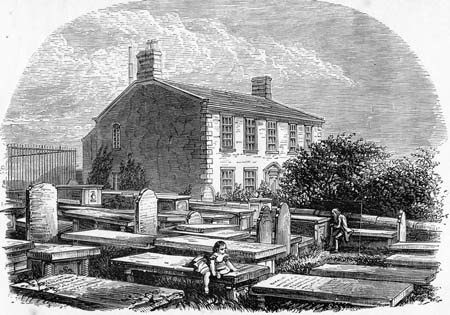
HAWORTH PARSONAGE AND GRAVEYARD.
It was about the time when this journey to Manchester was first projected, and very shortly after they had become convinced that their poems were a failure, that the sisters embarked upon another and more important literary venture. The pen once taken up could not be laid down. By poetry they had only lost money; but the idea had occurred to them that by prose-writing money was to be made. At any rate, in telling the stories of imaginary people, in opening their hearts freely upon all those subjects on which they had thought deeply in their secluded lives, they would find relief from the solitude of Haworth. Each of the three accordingly began to write a novel. The stories were commenced simultaneously, after a long consultation, in which the outlines of the plots, and even the names of the different characters, were settled. How one must wish that some record of that strange literary council had been preserved! Charlotte, in after life, spoke always tenderly, lovingly, almost reverentially, of the days in which she and her well-beloved sisters were engaged in settling the plan and style of their respective romances. That time seemed sacred to her, and though she learnt to smile at the illusions under which the work was begun, and could see clearly enough the errors and crudities of thought and method which all three displayed, she never allowed any one in her presence to question the genius of Emily and Anne, or to ridicule the prosaic and business-like fashion in which the novel-writing was undertaken by the three sisters. Returning to the old customs of their childhood, they sat round the table of their sitting-room in the parsonage, each busy with her pen. No trace of their occupation at this time is to be found in their letters; and on the rare occasions on which the father or the brother came into their room, nothing was said as to the work that was going on. The novel-writing, like the writing and publishing of the poems, was still kept profoundly secret. "There is no gentleman of the name in this parish," said Mr. Brontë to the village postman, when the latter ventured to ask who the Mr. Currer Bell could be for whom letters came so frequently from London. But every night the three sisters, as they paced the barely-furnished room, or strained their eyes across the tombstones, to the spot where the weather-stained church-tower rose from a bank of nettles, told each other what the work of the day had been, and criticised each other's labours with the freedom of that perfect love which casts out all fear of misconception. And here I may interpolate two letters written whilst the novel-writing was in progress, which are in some respects not altogether insignificant:
Dear Nell,—Your last letter both amused and edified me exceedingly. I could not but laugh at your account of the fall in B——, yet I should by no means have liked to have made a third party in that exhibition. I have endured one fall in your company, and undergone one of your ill-timed laughs, and don't wish to repeat my experience. Allow me to compliment you on the skill with which you can seem to give an explanation, without enlightening one one whit on the question asked. I know no more about Miss R.'s superstition now, than I did before. What is the superstition?—about a dead body? And what is the inference drawn? Do you remember my telling you—or did I ever tell you—about that wretched and most criminal Mr. J. S.? After running an infamous career of vice, both in England and France, abandoning his wife to disease and total destitution in Manchester, with two children and without a farthing, in a strange lodging-house? Yesterday evening Martha came upstairs to say that a woman—"rather lady-like," as she said—wished to speak to me in the kitchen. I went down. There stood Mrs. S., pale and worn, but still interesting-looking, and cleanly and neatly dressed, as was her little girl who was with her. I kissed her heartily. I could almost have cried to see her, for I had pitied her with my whole soul when I heard of her undeserved sufferings, agonies, and physical degradation. She took tea with us, stayed about two hours, and frankly entered into the narrative of her appalling distresses. Her constitution has triumphed over her illness; and her excellent sense, her activity, and perseverance have enabled her to regain a decent position in society, and to procure a respectable maintenance for herself and her children. She keeps a lodging-house in a very eligible part of the suburbs of —— (which I know), and is doing very well. She does not know where Mr. S. is, and of course can never more endure to see him. She is now staying a few days at E——, with the ——s, who I believe have been all along very kind to her, and the circumstance is greatly to their credit.
I wish to know whether about Whitsuntide would suit you for coming to Haworth. We often have fine weather just then. At least I remember last year it was very beautiful at that season. Winter seems to have returned with severity on us at present, consequently we are all in the full enjoyment of a cold. Much blowing of noses is heard, and much making of gruel goes on in the house. How are you all?
May 12th, 1847.
Dear Ellen,—We shall all be glad to see you on the Thursday or Friday of next week, whichever day will suit you best. About what time will you be likely to get here, and how will you come—by coach to Keighley, or by a gig all the way to Haworth? There must be no impediments now. I could not do with them; I want very much to see you. I hope you will be decently comfortable while you stay. Branwell is quieter now, and for a good reason. He has got to the end of a considerable sum of money, of which he became possessed in the spring, and consequently is obliged to restrict himself in some degree. You must expect to find him weaker in mind, and the complete rake in appearance. I have no apprehension of his being at all uncivil to you, on the contrary he will be as smooth as oil.
I pray for fine weather, that we may be able to get out while you stay. Good-bye for the present. Prepare for much dulness and monotony. Give my love to all at B——.
Is it needful to tell how the three stories—"The Professor," "Wuthering Heights," and "Agnes Grey"—are sent forth at last from the little station at Keighley, to fare as best they may in that unknown London which is still an ideal city to the sisters, peopled not with ordinary human beings, but with creatures of some strangely-different order? Can any one be ignorant of the weary months which passed whilst "The Professor" was going from hand to hand, and the stories written by Emily and Anne were waiting in a publisher's desk until they could be given to the world on the publisher's own terms? Charlotte had failed, but the brave heart was not to be baffled. No sooner had the last page of "The Professor" been finished than the first page of "Jane Eyre" was begun. The whole of that wondrous story passed through the author's busy brain whilst the life around her was clad in these sombre hues, and disappointment, affliction, and gloomy forebodings were her daily companions. The decisive rejection of her first tale by Messrs. Smith, Elder, and Co. had been accompanied by some kindly words of advice; so it is to that firm that she now entrusts the completed manuscript of "Jane Eyre." The result has already been told. On August 24, 1847, the story is sent from Leeds to London; and before the year is out, all England is ringing with the praises of the novel and its author.
Need I defend the sisters from the charge sometimes brought against them that they were unfaithful to their friends in not taking them into their confidence? Surely not. They had pledged themselves to each other that the secret should be sternly guarded as something sacred, kept even from those of their own household. They were not working for fame; for again and again they give proof that personal fame is the last thing to which they aspire. But they had found their true vocation; the call to work was irresistible; they had obeyed it, and all that they sought now was to leave their work to speak for itself, dissevered absolutely from the humble personality of the authors.
In a letter from Anne Brontë, written in January, 1848, at which time the literary quidnuncs both of England and America were eagerly discussing contradictory theories as to the authorship of "Jane Eyre," and of the two other stories which had appeared from the pens of Ellis and Acton Bell, I find the following passage: "I have no news to tell you, for we have been nowhere, seen no one, and done nothing (to speak of) since you were here, and yet we contrive to be busy from morning till night." The gentle and scrupulously conscientious girl, whilst hiding the secret from her friend, cannot violate the truth even by a hairbreadth. The italics are her own. Nothing that can be spoken of has been done. The friend had her own suspicions. Staying in a southern house for the winter, the new novel about which everybody was talking was produced, fresh from town. One of the guests was deputed to read it aloud, and before she had proceeded far Charlotte Brontë's schoolfellow had pierced the secret of the authorship. Three months before, Charlotte had been spending a few days at Miss N——'s house, and had openly corrected the proof-sheets of the story in the presence of her hostess; but she had given the latter no encouragement to speak to her on the subject, and nothing had been said. Now, however, in the surprise of the moment, Miss N—— told the company that this must have been written by Miss Brontë; and astute friends at once advised her not to mention the fact that she knew the author of "Jane Eyre" to any one, as her acquaintance with such a person would be regarded as a reflection on her own character! When Charlotte was challenged by her friend, she uttered stormy denials in general terms, which carried a complete confirmation of the truth; and when, in the spring of 1848, Miss N—— visited Haworth, full confession was made, and the poems brought forth and shown to her, in addition to the stories.
Those who read Charlotte Brontë's letters will see that even before this avowal of her flight in authorship there is a distinct change in their tone. Not that she is less affectionate towards her early friend, or that she shows the smallest abatement of her interest in the fortunes of her old companions. On the contrary, it would almost seem as though the great event, which had altered the current of her life, had only served to bind her more closely than before to those whom she had known and loved in her obscurity. But there is a perceptible growth of power and independence in her mode of handling the topics, often trivial enough in themselves, which arise in any prolonged correspondence, which shows how much her mind had grown, how greatly her views had been enlarged, by the intellectual labours through which she had passed. The following was the last letter written by her to her schoolfellow whilst the authorship of "Jane Eyre" was still a secret, and it will, I think, bear out what I have said:
April 25th, 1848.
I was not at all surprised at the contents of your note. Indeed, what part of it was new to us? V—— has his good and bad side, like most others. There is his own original nature, and there are the alterations the world has made in him. Meantime, why do B—— and G—— trouble themselves with matching him? Let him, in God's name, court half the country-side and marry the other half, if such procedure seem good in his eyes, and let him do it all in quietness. He has his own botherations, no doubt; it does not seem to be such very easy work getting married, even for a man, since it is necessary to make up to so many ladies. More tranquil are those who have settled their bargain with celibacy. I like Q——'s letters more and more. Her goodness is indeed better than mere talent. I fancy she will never be married, but the amiability of her character will give her comfort. To be sure, one has only her letters to judge from, and letters often deceive; but hers seem so artless and unaffected. Still, were I in your place I should feel uneasy in the midst of this correspondence. Does a doubt of mutual satisfaction in case you should one day meet never torment you?… Anne says it pleases her to think that you have kept her little drawing. She would rather have done it for you than for a stranger.
Very quietly and sedately did "Currer Bell" take her sudden change of fortune. She corresponded freely with her publishers, and with the critics who had written to her concerning her book; she told her father the secret of her authorship, and exhibited to him the draft which was the substantial recompense of her labours; but in her letters to her friend no difference of tone is to be detected. Success was very sweet to her, as we know; but she bore her honours meekly, betraying nothing of the gratified ambition which must have filled her soul. She had not even revealed her identity to the publisher till, by an accident, she became aware of the rumour that the writer had satirised Mr. Thackeray under the character of Rochester, and had even obtruded on the sorrows of his private life. Shocked at this supposition, she went to London by the night train, accompanied by Anne, and having breakfasted at the station, walked to the establishment in Cornhill, where she had much difficulty in penetrating to the head of the house, having stated that he would not know her by her name. At last he came into the shop, saying, with some annoyance: "Young woman, what can you want with me?" "Sir, we have come up from Yorkshire. I wish to speak to you privately. I wrote 'Jane Eyre.'" "You wrote 'Jane Eyre!'" cried the delighted publisher; and taking them into his office, insisted on their coming to the house of his mother, who would take every care of them. Charlotte related afterwards the strange contrast between the desolate waiting at the station in the early morning, and their loneliness in the crowd of the great city, and finding themselves in the evening seated among the brilliant company at the Opera House, listening to the performance of Jenny Lind.
But her thoughts were soon turned from her literary triumphs. Branwell, who had been so long the dark shadow in their "humble home," was taken from them without any lengthened preliminary warning. Sharing to the full the eccentricity of the family, he resolved to die as nobody else had ever died before; and when the last agony came on he rose to his feet, as though proudly defying death itself to do its worst, and expired standing. In the following letter, hitherto unpublished, to one of her friends—not to her old schoolfellow—Charlotte thus speaks of the last act in the tragedy of her brother's life:
Haworth, October 14th, 1848.
The event to which you allude came upon us indeed with startling suddenness, and was a severe shock to us all. My poor brother has long had a shaken constitution, and during the summer his appetite had been diminished and he had seemed weaker; but neither we, nor himself, nor any medical man who was consulted on his case, thought it one of immediate danger: he was out of doors two days before his death, and was only confined to bed one single day. I thank you for your kind sympathy. Many, under the circumstances, would think our loss rather a relief than otherwise; in truth, we must acknowledge, in all humility and gratitude, that God has greatly tempered judgment with mercy; but yet, as you doubtless know from experience, the last earthly separation cannot take place between near relations without the keenest pangs on the part of the survivors. Every wrong and sin is forgotten then; pity and grief share the heart and the memory between them. Yet we are not without comfort in our affliction. A most propitious change marked the few last days of poor Branwell's life; his demeanour, his language, his sentiments, were all singularly altered and softened, and this change could not be owing to the fear of death, for within half an hour of his decease he seemed unconscious of danger. In God's hands we leave him! He sees not as man sees. Papa, I am thankful to say, has borne the event pretty well. His distress was great at first. To lose an only son is no ordinary trial. But his physical strength has not hitherto failed him, and he has now in a great measure recovered his mental composure; my dear sisters are pretty well also. Unfortunately illness attacked me at the crisis, when strength was most needed; I bore up for a day or two, hoping to be better, but got worse; fever, sickness, total loss of appetite and internal pain were the symptoms. The doctor pronounced it to be bilious fever—but I think it must have been in a mitigated form; it yielded to medicine and care in a few days; I was only confined to my bed a week, and am, I trust, nearly well now. I felt it a grievous thing to be incapacitated from action and effort at a time when action and effort were most called for. The past month seems an overclouded period in my life.
Alas! the brave woman who felt it to be "a grievous thing" that she could not bear her full share of the family burden, little knew how terribly that burden was to be increased, how much heavier and blacker were the clouds which awaited her than any through which she had yet passed. The storm which even then was gathering upon her path was one which no sunshine of fame or prosperity could dissipate. The one to whom Charlotte's heart had always clung most fondly, the sister who had been nearest to her in age and nearest to her in affection, Emily, the brilliant but ill-fated child of genius, began to fade. "She had never," says Charlotte, speaking in the solitude of her fame, "lingered over any task in her life, and she did not linger now." Yet the quick decline of Emily Brontë is one of the saddest of all the sad features of the story. I have spoken of her reserve. So intense was it that when dying she refused to admit even to her own sisters that she was ill. They saw her fading before their eyes; they knew that the grave was yawning at her feet; and yet they dared not offer her any attention such as an invalid needed, and such as they were longing to bestow upon her. It was the cruellest torture of Charlotte's life. During the brief period of Emily's illness, her sister writes as follows to her friend:
I mentioned your coming to Emily as a mere suggestion, with the faint hope that the prospect might cheer her, as she really esteems you perhaps more than any other person out of this house. I found, however, it would not do; any, the slightest excitement or putting out of the way, is not to be thought of, and indeed I do not think the journey in this unsettled weather, with the walk from Keighley and back, at all advisable for yourself. Yet I should have liked to see you, and so would Anne. Emily continues much the same: yesterday I thought her a little better, but to-day she is not so well. I hope still, for I must hope; she is as dear to me as life. If I let the faintness of despair reach my heart I shall become worthless. The attack was, I believe, in the first place, inflammation of the lungs; it ought to have been met promptly in time; but she would take no care, use no means, she is too intractable. I do wish I knew her state and feelings more clearly. The fever is not so high as it was, but the pain in the side, the cough, the emaciation are there still.
The days went by in the parsonage, slowly, solemnly, each bringing some fresh burden of sorrow to the broken hearts of Charlotte and Anne. Emily's resolute spirit was unbending to the last. Day after day she refused to own that she was ill, refused to take rest or medicine or stimulants; compelled her trembling hands to labour as of old. And so came the bitter morning in December, the story of which has been told by Mrs. Gaskell with simple pathos, when she "arose and dressed herself as usual, making many a pause, but doing everything for herself," even going on with her sewing as at any time during the years past; until suddenly she laid the unfinished work aside, whispered faintly to her sister: "If you send for a doctor I will see him now," and in two hours passed quietly away.
The broken father, supported on either side by his surviving daughters, followed Emily to her grave in the old church. There was one other mourner—the fierce old dog whom she had loved better almost than any human being.
Yes—says Charlotte, writing to her friend—there is no Emily in time or on earth now. Yesterday we put her poor wasted mortal frame quietly under the church pavement. We are very calm at present. Why should we be otherwise? The anguish of seeing her suffer is over. We feel she is at peace. No need now to tremble for the hard frost and the keen wind. Emily does not feel them. She died in a time of promise. We saw her taken from life in its prime. But it is God's will, and the place where she is gone is better than that she has left.
It was in the very month of December, 1848, when Charlotte passed through this fierce ordeal, and wrote these tender words of love and resignation, that the Quarterly Review denounced her as an improper woman, who "for some sufficient reason" had forfeited the society of her sex!
Terrible was the storm of death which in three short months swept off two of the little household at Haworth; but it had not even yet exhausted all its fury. Scarcely had Emily been laid in the grave than Anne, the youngest and gentlest of the three sisters, began to fade. Very slowly did she droop. The winter passed away, and the spring came with a glimmer of hope; but the following unpublished letter, written on the 16th of May, shows with what fears Charlotte set forth on that visit to Scarborough which her sister insisted upon undertaking as a last resource:
Next Wednesday is the day fixed for our departure; Ellen accompanies us at her own kind and friendly wish. I would not refuse her society, but dared not urge her to go, for I have little hope that the excursion will be one of pleasure or benefit to those engaged in it. Anne is extremely weak. She herself has a fixed impression that the sea-air will give her a chance of regaining strength. That chance therefore she must have. Having resolved to try the experiment, misgivings are useless, and yet when I look at her misgivings will rise. She is more emaciated than Emily was at the very last, her breath scarcely serves her to mount the stairs, however slowly. She sleeps very little at night, and often passes most of the forenoon in a semi-lethargic state. Still she is up all day, and even goes out a little when it is fine. Fresh air usually acts as a temporary stimulus, but its reviving power diminishes.
I am indebted to the faithful friend and companion to whom allusion is made above, for the following account of the sad journey to Scarborough, and of its tragic end:
On our way to Scarborough we stopped at York, and after a rest at the George Hotel, and partaking of dinner, which she enjoyed, Anne went out in a bath-chair, and made purchases, along with Charlotte, of bonnets and dresses, besides visiting the minister. The morning after her arrival at Scarborough, she insisted on going to the baths, and would be left there with only the attendant in charge. She walked back alone to her lodgings, but fell exhausted as she reached the garden-gate. She never named this, but it was discovered afterwards. The same day she had a drive in a donkey carriage, and talked with the boy-driver on kindness to animals. On Sunday she wanted again to be left alone, and for us to go to church. Finding we would not leave her, she begged that she might go out, and we walked down towards the saloon, she resting half way, and sending us on with the excuse that she wanted us to see the place, this being our first visit, though not hers. In the evening, after again asking us to go to church, she sat by the sitting-room window, enjoying a very glorious sunset. Next morning (the day she died) she rose by seven o'clock and dressed herself, refusing all assistance. She was the first of the little party to be ready to go downstairs; but when she reached the head of the stairs, she felt fearful of descending. Charlotte went to her and discovered this. I fancying there was some difficulty, left my room to see what it was, when Anne smilingly told me she felt afraid of the steps downward. I immediately said: "Let me try to carry you;" she looked pleased, but feared for me. Charlotte was angry at the idea, and greatly distressed, I could see, at this new evidence of Anne's weakness. Charlotte was at last persuaded to go to her room and leave us. I then went a step or two below Anne, and begged her to put her arms round my neck, and I said: "I will carry you like a baby." She still feared, but on my promising to put her down if I could not do it, she consented to trust herself to me. Strength seemed to be given for the effort, but on reaching the foot of the stairs, poor Anne's head fell like a leaden weight upon the top of mine. The shock was terrible, for I felt it could only be death that was coming. I just managed to bear her to the front of her easy-chair and drop her into it, falling myself on my knees before her, very miserable at the fact, and letting her fall at last, though it was into her chair. She was shaken, but she put out her arms to comfort me, and said: "You know it could not be helped, you did your best." After this she sat at the breakfast-table and partook of a basin of boiled milk prepared for her. As 11 A.M. approached, she wondered if she could be conveyed home in time to die there. At 2 P.M. death had come, and left only her beautiful form in the sweetest peace.
She rendered up her soul with that sweetness and resignation of spirit which had adorned her throughout her brief life, even in the last hour crying: "Take courage, Charlotte, take courage!" as she bade farewell to the sister who was left.
Before me lie the few letters which remain of Emily and Anne. There is little in them worth preserving. Both make reference to the fact that Charlotte is the great correspondent of the family, and that their brief and uninteresting epistles can have no charm for one who is constantly receiving letters from her. Yet that modest reserve which distinguished the greatest of the three is plainly visible in what little remains of the correspondence of the others. They had discovered before their death the real power that lay within them; they had just experienced the joy which comes from the exercise of this power; they had looked forward to a future which should be sunny and prosperous, as no other part of their lives of toil and patient endurance had been. Suddenly death had confronted them, and they recognised the fact that they must leave their work undone. Each faced the dread enemy in her own way, but neither shrank even from that blow. Emily's proud spirit refused to be conquered, and, as we have seen, up to the last agony she carried herself as one sternly indifferent to the weaknesses of the flesh, including that final weakness which must conquer all of us in the end. Anne found consolation, pure and deep, in her religious faith, and she died cheerfully in the firm belief that she was but entering upon that fuller life which lay beyond the grave. The one was defiant, the other resigned; but courage and fortitude were shown by each in accordance with her own special idiosyncrasy.
VIII.
"SHIRLEY."
Charlotte went back from Scarborough to Haworth alone. Her father met her with unwonted demonstrations of affection, and she "tried to be glad" that she was once more under the familiar roof. "But this time joy was not to be the sensation." Yet the courage which had held her sisters to the end supported her amid the pangs of loneliness and bereavement. Even now there was no bitterness, no morbid gloom in the heart which had suffered so keenly. Quietly but resolutely setting aside her own sorrow, refusing all the invitations of her friend to seek temporary relief in change of scene, she sat down to complete the story which was intended to tell the world what the lost Emily had seemed to be in the eyes of her fond sister. By herself, in the room in which a short year ago three happy sisters had worked together, within the walls which could never again echo with the old voices, or walking on the moors, which would never more be trodden by the firm, elastic step of Emily, she composed the brilliant story of "Shirley"—the brightest and healthiest of her works. As she writes she sometimes sends forth messages to those who love her, which tell us of the spirit of the hero or the martyr burning within the frail frame of the solitary woman. "Submission, courage, exertion when practicable—these seem to be the weapons with which we must fight life's long battle;" and that these are no mere words she proves with all her accustomed honesty and sincerity, by acting up to them to the very letter. But at times the burden presses upon her till it is almost past endurance. Strangely enough, it is a comparative trifle, as the world counts it, the illness of a servant, that occasions her fiercest outburst of open grief:
You have to fight your way through labour and difficulty at home, it appears, but I am truly glad now you did not come to Haworth. As matters have turned out you would have found only discomfort and gloom. Both Tabby and Martha are at this moment ill in bed. Martha's illness has been most serious. She was seized with internal inflammation ten days ago; Tabby's lame leg has broken out, she cannot stand or walk. I have one of Martha's sisters to help me, and her mother comes up sometimes. There was one day last week when I fairly broke down for ten minutes, and sat down and cried like a fool. Martha's illness was at its height; a cry from Tabby had called me into the kitchen, and I had found her laid on the floor, her head under the kitchen-grate. She had fallen from her chair in attempting to rise. Papa had just been declaring that Martha was in imminent danger; I was myself depressed with headache and sickness that day; I hardly knew what to do or where to turn. Thank God, Martha is now convalescent; Tabby, I trust, will be better soon. Papa is pretty well. I have the satisfaction of knowing that my publishers are delighted with what I sent them—this supports me, but life is a battle. May we all be enabled to fight it well.
This letter is dated September 24, 1849, at which time "Shirley" is written, and in the hands of her publishers. She has painted the character of Emily in that of Shirley herself; and her friend Ellen is shadowed forth to the world in the person of Caroline Helston. When the book, with its vivid pictures of Yorkshire life at the beginning of the century, and its masterly sketches of characters as real as those which Shakespeare brings upon the stage, is published, there is but one outcry of praise, even from the critics who were so eager to condemn "Jane Eyre." Up to this point she had preserved her anonymity, but now she is discovered, and her admirers in London persuade her at last to visit them, and make acquaintance with her peers in the Republic of Letters, the men and women whose names were household words in Haworth Parsonage long before "Currer Bell" had made her first modest appeal to the world.
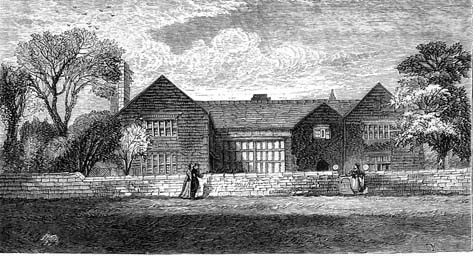
THE "FIELD HEAD" OF SHIRLEY.
A passage from one of the following letters, written during this first sojourn in London, has already been published; but it will well bear reprinting:
December, 1849.
I have just remembered that as you do not know my address you cannot write to me till you get it. I came to this big Babylon last Thursday, and have been in what seems to me a sort of whirl ever since; for changes, scenes, and stimulus, which would be a trifle to others, are much to me. I found when I mentioned to Mr. —— my plan of going to Dr. ——'s it would not do at all. He would have been seriously hurt: he made his mother write to me, and thus I was persuaded to make my principal stay at his house. So far I have found no reason to regret this decision. Mrs. —— received me at first like one who has had the strictest orders to be scrupulously attentive. I had fire in my bedroom evening and morning, two wax candles, &c., and Mrs. —— and her daughters seemed to look on me with a mixture of respect and alarm. But all this is changed; that is to say, the attention and politeness continue as great as ever, but the alarm and estrangement are quite gone; she treats me as if she liked me, and I begin to like her much. Kindness is a potent heart-winner. I had not judged too favourably of —— on a first impression—he pleases me much: I like him better as a son and brother than as a man of business. Mr. W—— too is really most gentlemanly and well-informed; his weak points he certainly has, but these are not seen in society. Mr. X—— (the little man) has again shown his parts. Of him I have not yet come to a clear decision. Abilities he has, for he rules his firm and keeps forty young men under strict control by his iron will. His young superior likes him, which, to speak the truth, is more than I do at present. In fact, I suspect that he is of the Helston order of men—rigid, despotic, and self-willed. He tries to be very kind, and even to express sympathy sometimes, and he does not manage it. He has a determined, dreadful nose in the middle of his face, which, when poked into my countenance, cuts into my soul like iron. Still he is horribly intelligent, quick, searching, sagacious, and with a memory of relentless tenacity: to turn to—after him is to turn from granite to easy down or warm fur. I have seen Thackeray.
As to being happy, I am under scenes and circumstances of excitement, but I suffer acute pain sometimes—mental pain, I mean. At the moment Mr. Thackeray presented himself I was thoroughly faint from inanition, having eaten nothing since a very slight breakfast, and it was then seven o'clock in the evening. Excitement and exhaustion together made savage work of me that evening. What he thought of me I cannot tell. This evening I am going to meet Miss Martineau; she has written to me most kindly; she knows me only as Currer Bell; I am going alone; how I shall get on I do not know. If Mrs. —— were not kind, I should sometimes be miserable; but she treats me almost affectionately, her attentions never flag. I have seen many things; I hope some day to tell you what. Yesterday I went over the new Houses of Parliament with Mr. ——. An attack of rheumatic fever has kept poor Mr. X—— out of the way since I wrote last. I am sorry for his sake. It grows quite dark. I must stop. I shall not stay in London a day longer than I first intended. On those points I form my resolutions, and will not be shaken. The thundering Times has attacked me savagely.
The following letters (with one exception not previously published) belong to the spring of 1850, when Charlotte was at home again, engaged in attending to her father and to the household cares which shared her attention with literary work and anxieties. The first, which refers exclusively to her visit to London, was addressed to one of her old friends in Yorkshire:
Ellen it seems told you that I spent a fortnight in London last December. They wished me very much to stay a month, alleging that I should in that time be able to secure a complete circle of acquaintance, but I found a fortnight of such excitement quite enough. The whole day was usually devoted to sight-seeing, and often the evening was spent in society; it was more than I could bear for any length of time. On one occasion I met a party of my critics—seven of them. Some of them had been my bitter foes in print, but they were prodigiously civil face to face. These gentlemen seemed infinitely grander, more pompous, dashing, showy, than the few authors I saw. Mr. Thackeray, for example, is a man of very quiet, simple demeanour; he is, however, looked upon with some awe and even distrust. His conversation is very peculiar, too perverse to be pleasant. It was proposed to me to see Charles Dickens, Lady Morgan, Mesdames Trollope, Gore, and some others; but I was aware these introductions would bring a degree of notoriety I was not disposed to encounter; I declined therefore with thanks. Nothing charmed me more during my stay in town than the pictures I saw; one or two private collections of Turner's best water-colours were indeed a treat. His later oil paintings are strange things—things that baffle description. I have twice seen Macready act; once in "Macbeth," and once in "Othello." I astounded a dinner-party by honestly saying I did not like him. It is the fashion to rave about his splendid acting; anything more false and artificial, less genuinely impressive than his whole style, I could scarcely have imagined. The fact is, the stage system altogether is hollow nonsense. They act farces well enough; the actors comprehend their parts and do them justice. They comprehend nothing about tragedy or Shakespeare, and it is a failure. I said so, and by so saying produced a blank silence, a mute consternation. I was indeed obliged to dissent on many occasions, and to offend by dissenting. It seems now very much the custom to admire a certain wordy, intricate, obscure style of poetry, such as Elizabeth Barrett Browning writes. Some pieces were referred to, about which Currer Bell was expected to be very rapturous, and failing in this he disappointed. London people strike a provincial as being very much taken up with little matters, about which no one out of particular town circles cares much. They talk too of persons, literary men and women, whose names are scarcely heard in the country, and in whom you cannot get up an interest. I think I should scarcely like to live in London, and were I obliged to live there I should certainly go little into company—especially I should eschew the literary critics.
I have, since you went, had a remarkable epistle from Thackeray, long, interesting, characteristic; but it unfortunately concludes with the strict injunction, Show this letter to no one; adding that if he thought his letters were seen by others, he would either cease to write, or write only what was conventional. But for this circumstance I should have sent it with the others. I answered it at length. Whether my reply will give satisfaction or displeasure remains yet to be ascertained. Thackeray's feelings are not such as can be gauged by ordinary calculation: variable weather is what I should ever expect from that quarter. Yet in correspondence, as in verbal intercourse, this would torment me.
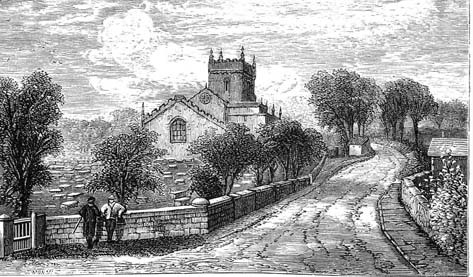
THE "BRIARFIELD" CHURCH OF SHIRLEY.
I believe I should have written to you before, but I don't know what heaviness of spirit has beset me of late, made my faculties dull, made rest weariness, and occupation burdensome. Now and then the silence of the house, the solitude of the room has pressed on me with a weight I found it difficult to bear, and recollection has not failed to be as alert, poignant, obtrusive, as other feelings were languid. I attribute this state of things partly to the weather. Quicksilver invariably falls low in storms and high winds, and I have ere this been warned of approaching disturbance in the atmosphere by a sense of bodily weakness, and deep, heavy mental sadness, which some would call presentiment. Presentiment indeed it is, but not at all supernatural. The Haworth people have been making great fools of themselves about "Shirley;" they take it in the enthusiastic light. When they got the volumes at the Mechanics' Institution, all the members wanted them; they cast lots for the whole three, and whoever got a volume was only allowed to keep it two days, and to be fined a shilling per diem for longer detention. It would be mere nonsense and vanity to tell you what they say. I have had no letters from London for a long time, and am very much ashamed of myself to find, now that that stimulus is withdrawn, how dependent upon it I had become. I cannot help feeling something of the excitement of expectation till post-hour comes, and when day after day it brings nothing I get low. This is a stupid, disgraceful, unmeaning state of things. I feel bitterly enraged at my own dependence and folly. It is so bad for the mind to be quite alone, to have none with whom to talk over little crosses and disappointments, and laugh them away. If I could write I daresay I should be better, but I cannot write a line. However (D. V.), I shall contend against the idiocy. I had rather a foolish letter from Miss —— the other day. Some things in it nettled me, especially an unnecessarily earnest assurance that in spite of all I had gone and done in the writing line I still retained a place in her esteem. My answer took strong and high ground at once. I said I had been troubled by no doubts on the subject, that I neither did myself nor her the injustice to suppose there was anything in what I had written to incur the just forfeiture of esteem. I was aware, I intimated, that some persons thought proper to take exceptions at "Jane Eyre," and that for their own sakes I was sorry, as I invariably found them individuals in whom the animal largely predominated over the intellectual, persons by nature coarse, by inclination sensual, whatever they might be by education and principle.
I enclose a slip of newspaper for your amusement. Me it both amused and touched, for it alludes to some who are in this world no longer. It is an extract from an American paper, and is written by an emigrant from Haworth. You will find it a curious mixture of truth and inaccuracy. Return it when you write again. I also send you for perusal an opinion of "Jane Eyre," written by a working man in this village; rather, I should say, a record of the feelings the book excited in the poor fellow's mind; it was not written for my inspection, nor does the writer now know that his little document has by intricate ways come into my possession, and I have forced those who gave it to promise that they will never inform him of this circumstance. He is a modest, thoughtful, feeling, reading being, to whom I have spoken perhaps about three times in the course of my life; his delicate health renders him incapable of hard or close labour; he and his family are often under the pressure of want. He feared that if Miss Brontë saw what he had written she would laugh it to scorn. But Miss Brontë considers it one of the highest, because one of the most truthful and artless tributes her work has yet received. You must return this likewise. I do you great honour in showing it to you.
Once more we can see that the healthy, happy interest she takes in the welfare of others is beginning to assert itself. For a time, under the keen smart of the wounds death had inflicted on her, she had found little heart to discuss the affairs of her circle of friends in her correspondence; but now the outer world vindicates its claim to her renewed attention, and she again begins to discuss and analyse the characters of her acquaintances with a skill and minuteness which make them as interesting even to strangers as any of the most closely-studied characters of fiction can be.
I return Q——'s letter. The business is a most unpleasant one to be concerned in. It seems to me now altogether unworthy in its beginning, progress, and ending. Q—— is the only pure thing about it; she stands between her coarse father and cold, unloving suitor, like innocence between a pair of world-hardened knaves. The comparison seems rather hard to be applied to V——, but as I see him now he merits it. If V—— has no means of keeping a wife, if he does not possess a sixpence he is sure of, how can he think of marrying a woman from whom he cannot expect she should work to keep herself? V——'s want of candour, the twice-falsified account he gave of the matter, tells painfully and deeply against him. It shows a glimpse of his hidden motives such as I refrain from describing in words. After all he is perhaps only like the majority of men. Certainly those men who lead a gay life in their youth, and arrive at middle life with feelings blunted and passions exhausted, can have but one aim in marriage—the selfish advancement of their interest. And to think that such men take as wives—as second selves—women young, modest, sincere, pure in heart and life, with feelings all fresh and emotions all unworn, and bind such virtue and vitality to their own withered existence, such sincerity to their own hollowness, such disinterestedness to their own haggard avarice! to think this, troubles the soul to its inmost depths. Nature and justice forbid the banns of such wedlock. This note is written under excitement. Q——'s letter seems to have lifted so fraudulent a veil, and to show both father and suitor lurking behind in shadow so dark, acting from motives so poor and low, so conscious of each other's littleness, and consequently so destitute of mutual respect! These things incense me, but I shall cool down.
I cannot find your last letter to refer to, and therefore this will be no answer to it. You must write again by return of post if possible, and let me know how you are progressing. What you said in your last confirmed my opinion that your late attack had been coming on for a long time. Your wish for a cold-water bath, &c, is, I should think, the result of fever. Almost everyone has complained lately of some tendency to slow fever. I have felt it in frequent thirst and in frequent appetite. Papa too, and even Martha, have complained. I fear this damp weather will scarcely suit you; but write and say all. Of late I have had many letters to answer; and some very bothering ones from people who want opinions about their books, who seek acquaintance, and who flatter to get it; people who utterly mistake all about me. They are most difficult to answer, put off, and appease, without offending; for such characters are excessively touchy, and when affronted turn malignant. Their books are too often deplorable.
In June, 1850, she is induced to pay another visit to London, going upon this occasion whilst the season is at its height, though she has stipulated before going that she is "not to be lionised."
I came to London last Thursday. I am staying at ——. Here I feel very comfortable. Mrs. —— treats me with a serene, equable kindness which just suits me. Her son is as before—genial and friendly. I have seen very few persons, and am not likely to see many, as the agreement was that I was to be very quiet. We have been to the exhibition of the Royal Academy, to the opera, and the Zoological Gardens. The weather is splendid. I shall not stay longer than a fortnight in London; the feverishness and exhaustion beset me somewhat, but I think not quite so badly as before—as indeed I have not yet been so much tired.
I am leaving London if all be well on Tuesday, and shall be very glad to come to you for a few days if that arrangement still remains convenient to you. My London visit has much surpassed my expectations this time. I have suffered less, and enjoyed more than before; rather a trying termination yet remains to me. Mrs. ——'s youngest son is at school in Scotland, and her eldest is going to fetch him home for the vacation. The other evening he announced his intention of taking one of his sisters with him, and the evening after he further proposed that Miss Brontë should go down to Edinburgh and join them there, and see that city and its suburbs. I concluded he was joking, laughed and declined. However, it seems he was in earnest, and being always accustomed to have his will, he brooks opposition ill. The thing appearing to me perfectly out of the question, I still refused. Mrs. —— did not at all favour it, but her worthy son only waxed more determined. This morning she came and entreated me to go; G—— wished it so much, he had begged her to use her influence, &c. &c. Now, I believe that he and I understand each other very well, and respect each other very sincerely. We both know the wide breach time has made between us. We do not embarrass each other, or very rarely. My six or eight years of seniority, to say nothing of lack of all pretensions to beauty, &c, are a perfect safeguard. I should not in the least fear to go with him to China. I like to see him pleased. I greatly dislike to ruffle and disappoint him; so he shall have his mind, and if all be well I mean to join him in Edinburgh, after I have spent a few days with you. With his buoyant animal spirits and youthful vigour he will make severe demands on my muscles and nerves; but I daresay I shall get through somehow.
IX.
LONELINESS AND FAME.
Charlotte Brontë's letters during 1850 and 1851 are among the most valuable illustrations of the true character of the woman which we possess. Stricken as she had been by successive bereavements, which had robbed her of her dearest friends and companions, and left her the sole prop of the dull house on the moors and of its aged head, she had yet recovered much of her peace of mind and even of her vitality and cheerfulness. She had now, also, begun to see something of life as it is presented, not to despised governesses, but to successful authoresses. Her visits to London had brought her into contact with some of the leaders of the literary world. Who can have forgotten her interview with Thackeray, when she was "moved to speak to the giant of some of his shortcomings?" Haworth itself had become a point of attraction to curious persons, and not a few visitors found their way under one pretence or another to the old parsonage, to be received with effusive courtesy by Mr. Brontë, and with shy indifference by his daughter. Her correspondence, too, became widely-spread among men and women of distinction in the world and in Society. Altogether it was a different life upon which she now looked out from her remote eyrie among the hills—a life with many new interests in it, with much that was calculated to awaken chords in her heart hitherto untouched, and to bring to light new characteristics of her temper and genius. One would fain speculate upon what might have been, but for the desolation wrought in her home and heart by that tempest of death which raged during the autumn of 1848 and the spring of 1849. As it was, no novelty could make her forget what had been; no new faces, however welcome, could dim the tender visions of the faces that were seen no more, or could weaken in any degree the affection with which she still clung to the friend of her school-days. Simplicity and sincerity are the prevailing features of her letters, during this critical time in her life, as during all the years which had preceded it. They reflect her mind in many moods; they show her in many different situations; but they never fail to give the impression of one whose allegiance to her own conscience and whose reverence for truth and purity remain now what they had been in her days of happy and unworldly obscurity. The letters I now quote are quite new to the public.
July 18th, 1850.
You must cheer up, for your letter proves to me that you are low-spirited. As for me, what I said is to be taken in this sense: that, under the circumstances, it would be presumptuous in me to calculate on a long life—a truth obvious enough. For the rest, we are all in the hands of Him who apportions His gifts, health or sickness, length or brevity of days, as is best for the receiver: to him who has work to do time will be given in which to do it; for him to whom no task is assigned the season of rest will come earlier. As to the suffering preceding our last sleep, the sickness, decay, the struggle of flesh and spirit, it must come sooner or later to all. If, in one point of view, it is sad to have few ties in the world, in another point of view it is soothing; women who have husbands and children must look forward to death with more pain, more fear, than those who have none. To dismiss the subject, I wish (without cant, and not in any hackneyed sense) that both you and I could always say in this matter, the will of God be done. I am beginning to get settled at home, but the solitude seems heavy as yet. It is a great change, but in looking forward I try to hope for the best. So little faith have I in the power of any temporary excitement to do real good that I put off day by day writing to London to tell them I have come home; and till then it was agreed I should not hear from them. It is painful to be dependent on the small stimulus letters give. I sometimes think I will renounce it altogether, close all correspondence on some quiet pretext, and cease to look forward at post-time for any letters but yours.