XI MALVERN AMONG HER HILLS
Reading edition
FROM the 10th to the 20th of July the heat was as great in London as the nerves ever register in New York. It was much more continuous, for our heat seldom lasts a week, and there it lasted nearly a fortnight, with a peculiar closeness from the damp and thickness from the smoke. That was why we left London, and went to Great Malvern, for a little respite.
Our run was through a country which frankly confessed a long drouth, such as parches the fields at home in exceptional summers. Rain had not fallen during the heat from which we were escaping, and the grain had been cut and stacked in unwonted safety from mould. There is vastly more wheat grown in England than the simple American, who expects to find it a large market-garden, imagines, and the yield was now so heavy that the stacked sheaves served to cover half the space from which they had been reaped. The meadow-lands were burned by the sun almost as yellow as the stubble; the dry grass along the railroad banks had caught fire from the sparks of the locomotive, and the flames had run through the hedges, into the pasturage and stubble, and at one place they had kindled the stacks of wheat, which farm-hands were pulling apart and beating out. The air was full of the pleasant smell of their burning, and except that the larks were spiring up into the dull-blue sky, and singing in the torrid air, it was all very like home.
I ventured to say as much to the young man whom I found sleeping in the full blaze of the sun in his corner of our carriage, and to whom I apologized for the liberty I had taken in drawing his curtain so as to shade his comely fresh face. He pardoned me so gratefully that I felt warranted in thinking he might possibly care to know of the resemblance I had noted. He said, “Ah!” in the most amiable manner imaginable, “which part of America?” But just as I was going to tell him, the train drew into the station at Oxford, and he escaped out of the carriage.
Before this he had remarked that we should find the drouth much worse as we went on, for we were now in the Valley of the Thames, which kept the land comparatively moist. But I could not see that the levels of harvest beyond this favored region were different. Still the generous yield of grain half covered the ground; the fires along the embankments continued in places; in places the hay was just mown, and women were tossing it into windrows; at a country station where we stopped there were fat, heavy-fleeced sheep panting wofully in the cattle-pens; but the heat was no worse than it had been. The landscape grew more varied as we approached Worcester, where we meant to pass the night; low hills rose from the plain, softly wooded; and I find from my note-book that the weather was much mitigated by the amenity of all the inhabitants we encountered. I really suppose that the underlined record, “universal politeness,” related mainly to the railway company’s servants, but there must have been some instances of kindness from others, perhaps fellow-travellers, which I grieve now to have forgotten.
I have not forgotten the patience with which the people at the old inn-like hotel in Worcester bore our impatience with the rooms which they showed us, and which we found impossibly stuffy, and smelling of the stables below. The inn was a survival of the coaching days, when the stables formed an integral part of the public-house, but did not perfume the fiction which has endeared its ideal to readers. The dining-room was sultry, and abounded with the flies which love stables of the olden times, or indeed of any date. We sat by our baggage in an outer room till a carriage could be called, and then we drove back to the station, through the long, hot, dusty street by which we had come, with a poorish, stunted type of work-people crowding it on the way home to supper.
Somewhere in the offing we were aware of cathedral roofs and towers, and we were destined later to a pleasanter impression of Worcester than that from which we now gladly fled by the first train for Great Malvern. Our refuge was only an hour away, and it duly received us in a vast, modern hotel, odorous only of a surrounding garden into which a soft rain was already beginning to fall. A slow, safe elevator, manned by the very oldest and heaviest official in full uniform whom I have ever seen in the like charge, mounted with us to upper chambers, where we knew no more till we awoke in the morning to find the face of nature washed clean by that gentle rain, and her breath fresh and sweet, coming from the grateful lips of the myriad flowers which embloom most English towns.
I may as well note at once that it was not a bracing air which we inhaled from them, and I do not suppose that the air is any more an adjunct of the healing waters at Great Malvern than the air at Carlsbad, for instance, where it is notoriously relaxing. The companionable office-lady at our hotel, who was also a sort of lady-butler, and carved the cold meats, candidly owned that the air at Great Malvern was lifeless, and she boldly regretted the two years she had passed in New England, as matron of a boys’ reformatory. She said, quite in the teeth of an English couple paying their bill at the same time, that she was only living to get back there. They took her impatriotism with a large imperial allowance; and I shall always be sorry I did not ask them what kind of bird it was they had with them in a cage; I think they would have told me willingly, and even gladly, before they drove away.
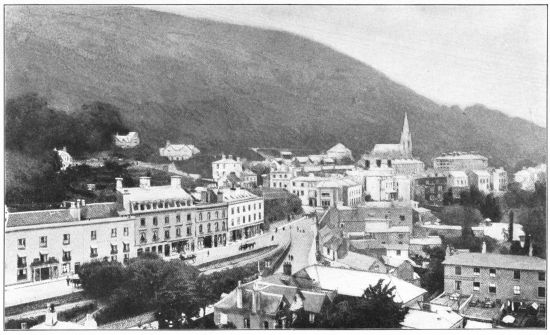
We were ourselves driving away in search of lodgings, which, whether you like them or not after you find them, it is always so interesting to look up in England. It was our fate commonly to visit places in their season when lodgings were scarce and dear; and it was one of the surprises that Great Malvern had in store for us that it was in the very height of its season. We should never have thought it, but for the assurance of the lodging-house landladies, who united in saying so, and in asking twice their fee as an earnest of good faith. The charming streets, which were not only laterally but vertically irregular, and curved and rose and fell in every direction, were so far from thronged that we were often the only people in them besides the unoccupied drivers of other flies than ours, and the boys who had pony chairs for hire, and demanded height-of-the-season prices for them. Perhaps the fellow-visitors whom we missed from the street were thronging in-doors: the hotels were full up; the boarding-houses could offer only a choice of inferior rooms; the lodgings had nearly all been taken at the rates which astonished if they did not
MALVERN—THE TOWN
dismay us. But we found the pleasantest apartment left at last, and were immediately as much domesticated in it as if we had lived there ever since it was built. In front it faced, across the street, a wooded and gardened steep; in the rear, from the window of our stately sitting-room, we looked out over a vast plain, of tilth and grass and groves, cheered everywhere with farm villages or farm cottages, and the grander edifices of the local nobility and gentry, and the spires of churches. Farther off where the Cotswold Hills began to be blue, glimmered Cheltenham, where we could, with a glass strong enough, have seen the retired military and civil employés of the India service who largely inhabit the place, basking in a summer heat of familiar tropical fervor, and a cheapness suited to their pensions. In the same quarter there was also sometimes visible a blur of dim towers and roofs which the guide-book knew as Tewkesbury; in the opposite direction, Worcester with its cathedral more boldly defined itself. The landscape seemed so altogether, so surpassingly English, that one day when I had nothing better to do—as was mostly the case with me in Malvern—I set down its amiable features, which I wish I could assemble here in a portrait. First, there were orchard and garden trees of our own house (one of a dozen houses on the same curving terrace), with apples, pears, and plums belted in by the larches and firs that deepened towards the foot of the hill. Pretty, well-kept dwellings of more or less state, showed their chimneys and slated or tiled roofs everywhere through the trees and shrubs at the beginning of what looked the level from our elevation. From these the plain stretched on, with hotels and churches salient from rows of red brick and gray stone cottages. Fields, now greening under the rains, but still keeping the warmer colors which the long drouth had given them, were parted into every angular form by rigid hedge-rows. They were fields of oats and grass, and sometimes wheat; but there were no recognizable orchards; and the trees that dotted the fields, singly and in clumps, massed themselves in forest effects in the increasing distance. They covered quite a third of the plain, which stretched twenty miles away on every hand, and were an accent of dark, harsh green amid the yellower tone of the meadows. The Cotswolds rising to the height of the Malvern Hills against the dull horizon (often rainy, now, but dull always), ended the immense level, where, coming or going, the little English railway trains, under their long white plumes of smoke, glided in every direction; and somewhere through the scene the unseen Severn ran.
Not to affront the reader’s intelligence, but to note my own ignorance, until an unusually excellent local guide-book partially dispersed it, will I remind him that all this region was once a royal chase. Half a dozen forests, of which Malvern Forest was chief, spread “a boundless contiguity of shade” over the hills and plains in which the cruel kings, from Canute down to Charles I., hunted the deer consecrated to their bows and spears, and took the lives or put out the eyes of any other man that slew them without leave. But in virtue of the unwritten law by which the people’s own reverts to them through the very pride of their expropriators, the dwellers in and about Malvern Chase had insensibly grown to have such rights and privileges in the wilderness that when Charles proposed to sell the woods they made a tumultuous protest; they rose in riot against the king’s will, and he had to give them two-thirds of the Chase for commons, before he could turn the remaining third into the money he needed so much.
THE PRIORY CHURCH—NORTH VIEW
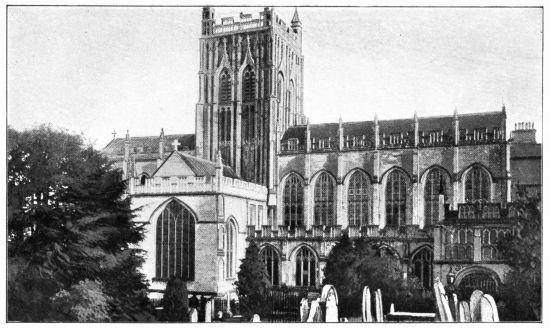
In the very earliest times Malvern seems to have been a British stronghold against the Romans, and perhaps, again, the Saxons; but otherwise its peaceful history is resumed in that of its beautiful Priory church, an edifice which is fabled to have begun its religious life as a Druid temple. On one of the three Beacons, as the chief of the Malvern Hills are called, after the three counties of Worcester, Gloucester, and Hereford in which they rise,
“Twelve fair counties saw the blaze”
which signaled the approach of the Spanish Armada. But the local history is not of that dense succession of events, against whose serried points the visitor so often dashes himself in vain elsewhere in England. He can let his fancy roam up and down the vague past, with nothing, except the possible surrender of Caractacus to the Romans, very definitely important to hinder it, from the dawn of time to the year 1842, when the Priessnitz system of water-cure chose Malvern the capital of English hydropathy. The Wells of Malvern had always been famous for their healing properties, and now modern faith added itself to ancient superstition, and from the centre of belief thus established, a hydropathic religion spread throughout England. Its monuments still confront one everywhere in the minor hotels or major boarding-houses which briefly call themselves Hydros, but probably do not attempt working the old miracles. There is still a commodious shrine for the performance of these in the heart of Malvern; but the place was plainly no longer the Mecca of the pilgrims of thirty or fifty years ago. The air of its hills indeed invites the ailing, who so abound in England, but the waters have found the level which even medicinal waters seek, and flow away in the obscurity attending the decline of so many once thronged and honored Spas.
I do not know that I particularly like ruinous ruins, but a decay that is still in tolerable repair is greatly to my mind. The better the repair, the greater my pleasure in it, and when we were once posited in our lodgings, I began to take comfort in the perfect neatness, the unfailing taste, the pious care with which the spirit of that dead Malvern guarded its sepulchre. There was all the apparatus of a social gayety beneficial to invalids, but not, so far as I could note, an invalid to profit by it, if it had been running. In a certain public garden, indeed, in the centre of the town, there was a sound of revelry emitted by a hidden band, in the afternoon and evening, but I had never the heart to penetrate its secret; within, the garden might not have looked so gay as it sounded. There were excellent large and little shops, including a book and periodical store, where you could get almost anything you wanted, or did not want, at watering-place prices. There was an Assembly building, always locked fast, and a very good public library where I resorted for books of reference, and for a word of intellectual converse with the kind assistant librarian who formed my social circle in Malvern. From somewhere in the dim valley at night there came bursts of fragmentary minstrelsy, which we were told by the maid was the professional rejoicing of Pierrots, a gleeful tribe summer England has borrowed from the French tradition almost as lavishly as the crude creations of our own burnt-cork opera. Wherever you go, among her thronged and thronging watering-places, these strongly contrasted figures meet and cheer you; even in Malvern there were strains of rag-time, mingling with the music of the Pierrots, which gave assurance of these duskier presences somewhere in the dark.
One afternoon we went to a politer entertainment in a lower room of the Assembly building, given by a company which had so vividly plastered the dead walls (if this is specific) of Malvern with the announcements of their coming, that we hastened to be among the earliest at the box-office lest we should not get seats. To make sure of seeing and hearing we took two-shilling seats, which were at the front, and it was well we did so, for before the curtain rose, a multitude of fourteen people thronged to the one-shilling benches behind us. This number I knew from deliberate count, for the curtain, as if in a sad prescience of adversity, was long in rising. I do not think that company of artists would have been very cheerful under the best conditions; as it was they afforded us the very sorrowfulest amusement I have ever enjoyed. In that pathetic retrospect it seems to me that one man and woman of them sang at different times comic duets with tears in their voices. There were also from time to time joyless glees, and there was an interlude of dancing, so very, very blameless that it was all but actively virtuous in its modesty. A sense of something perpetually provincial, something irretrievably amateurish in the performers, penetrated the American spectators; and it is from a heart still full of pity that I recall how plain they were, poor girls, how floor-walkerish they were, poor fellows. They were as one family in their mutual disability and forbearance; if perhaps they each knew how badly the others were doing, they did nothing to show it; and in their joint weakness they were unable to spare us a single act of their programme. I have seldom left a hall of mirth in so haggard a frame, but perhaps if I had been more inured to Malvern I could have borne my pleasure better.
If this was not, strictly speaking, a concert, that was certainly a concert which I attended one evening at a Baptist chapel, where a company of Welsh miners sang like a company of Welsh angels. I was in hopes they would have sung in Welsh, which, as is well known, was the language of Paradise, but they sang in English as good as English ever can be in comparison; and instead of Bardic measures, it was all terribly classic, or when not classic, religious. As I say, though, the voices were divine, and I asked myself if such heavenly sounds could issue, at this remove, from the bowels of the Welsh mountains, what must be the cherubinic choiring from their tops! It was a very simple-hearted affair, that concert, and well encouraged by a large and cordial audience, thanks mostly, perhaps, to the vigilance of the lady pickets stationed down the lane leading to the chapel, and quite into the street, with tickets for sale, who let no hesitating passers escape. I myself pleaded a sovereign in defence, but one of the fair pickets changed it with instant rapture, and I was left without excuse for the indecision in which I had gone out to see whether I would really go to the concert.
For the matter of that we were without excuse for staying on in Malvern, save that it was so very, very pleasant though so very, very dull. It was there, I think, that I formed the Spanish melon habit, which I indulged thereafter throughout that summer, till the fogs of London reformed me at end of September, when no more melons came from Spain. The average of Spanish melons in England is so much better than that of our cantaloupes at home that I advise all lovers of the generous fruit to miss no chance of buying them. The fruiterer who sold me my first in Malvern, said that in the palmy days of the place many Americans used to come, and he mentioned a New York millionaire of his acquaintance so confidently that I almost thought he was mine, and felt much more at home than before. I had more talk with this kind fruiterer than with any one else in Malvern, though I will not depreciate an interview with a jobbing mechanic from far Norfolk, who spent an afternoon washing our windows, and was conversible when once you started his torpid flow. He did not grasp ultra-Norfolk ideas readily, and he altogether lacked the brilliant fancy of the gay, rusty, frowsy ragged tramp who came one afternoon with a bunch of cat-tail rushes for sale, and who had vividly conceived of himself as a steel-polisher out of work. He might not have been mistaken; but if he was it could not spoil my pleasure in him, or in the weather which had now begun to be very beautiful, with blue skies almost cloudless, and quite agreeably hot. It being the 12th of August, a bank holiday fell on that day, and the town filled up with trippers (mysteriously much objected to in England), who seemed mostly lovers, and who arm in arm passed through our street. One indeed there was who passed without companionship, playing the accordeon, his eyes fixed in a rapture with his own music.
On several other days the town seemed the less reasoned resort of crowds of harmless young people, who perhaps thought they were seeing the world there, since it was the height of the Malvern season. They were at one time more definitely attracted by the Flower Show at the neighboring seat of a great nobleman, which was opened by his lady with due ceremonies, and which enjoyed a greater popular favor. I myself followed with the trippers there, partly because I had long read of that kind of English thing without seeing it, and because in the spacious leisure of Malvern it was difficult to invent occupations that would fill the time between luncheon and dinner, even with an hour out for an afternoon nap.
It was just a pleasant drive to the nobleman’s place, and my progress was attended by a sentiment of circus-day in the goers and comers on foot and in fly, and the loungers strewn on the grass of the road-sides and the open lots. At the gate of the nobleman’s grounds, we paid a modest entrance, and there were still modester fees for several of the exhibits. One of these was a tent where under a strong magnifying-glass a community of ants were offering their peculiar domestic and social economy to the study of the curious. But, if I rightly remember, the pavilion which sheltered the flower-show was free to all who could walk through its sultry air without stifling; it was really not so much a show of flowers as of fruits and vegetables, which indeed bore the heat better. Another free performance was the rivalry, apparently of amateurs, in simple feats of carpentry and joiner-work as applied to fence-building; but this was of a didactic effect from which it was a relief to turn to the idle and useless adventures of the people who lost themselves in a maze, or labyrinthine hedge and shared the innocent hilarity of the spectators watching their bewilderment from a high ground hard by. All the time there was a band playing, which when it played a certain familiar rag-time measure was loudly applauded and forced to play it again and again. It was a proud moment for the exile from a country whose black step-children had contributed these novel motives to the world’s music, in the intervals of being lynched.
The scene was all very familiar and very strange, with qualities of a subdued county fair at home, but more ordered and directed than such things are with us. As I say, I had long known its like in literature, and I was now glad to find it so realistic. My pleasure in it overflowed when the nobleman who had lent his premises for the show, came walking out among the people, bareheaded, in a suit of summer gray, with his lady beside him, and paused to speak, amid the general emotion, with a neat old woman of humble class, whose hand his lady had shaken. That, I said to myself, was quite as it should be in its allegiance to immemorial tradition and its fidelity to fiction; it could have formed the initial moment of a hundred thousand English novels. If it could not have formed a like moment in American romance, it is because our millionaires, in their shyness of subpœnas or of interviews, do not yet open their private grounds for flower-shows. It needs many centuries to mellow the conditions for the effect I had witnessed, and we must not be impatient.
The lord and his lady had come out of a mansion that did not look very mediæval, though it had a moat round it, with ducks in the moat, and in the way to its portal a force of footmen to confirm any comer in his misgiving that the house was closed to the public, and to direct him to the pleasaunce beyond. This was a lawned and gardened place, enclosed with a green wall of hedge, and guarded on one side with succession of pedestals bearing classic busts. It was charming in the afternoon sun, with groups of people seriously, if somewhat awe-strickenly, enjoying themselves. The inferiors in England never take that ironical attitude towards their superiors which must long delay a real classification of society with us.
When there one accepts the situation, and becomes at least gentry if one can, with all the assumptions and responsibilities which station implies. I had a curious illustration of this in my own case when once I came to pay the driver of my fly at the end of an excursion. It had always been my theory that if only the people who exact tips would say what tip they expected, it would greatly simplify and clarify the affair. But now when this good-fellow said the fly would be twelve shillings for the two hours, which I mutely thought too much, and then added, “And two shillings for me,” I did not like it as well as my theory should have supported me in doing. Had I possibly been meaning to offer him one shilling? Heaven knows; but I found myself on the point of lecturing him for his greed, when I reflected that it would be of no use, at least in Malvern, for in Malvern when I went to a stable to engage a fly for other excursions, they always said it would be so much, and so much more for the driver. His tip, a good third of the whole cost, seemed an unwritten part of the tariff, but it was an inflexible law.
It is strong proof of the pleasantness of the drives that this novel feature could not spoil them for us, and we were always going them. There were pretty villages lurking all about in the shades of that lovely plain, which if you passed through them on a Sunday afternoon, for example, had their people out in their best, with comely girls seen through the open doors of the above cottages, apparently waiting for company, or, in its defect, sitting on benches in their flowery door-yards and making believe to read.
The way was sometimes between tall ranks of trees, sometimes through lines of hedge, opening at the hamlets and closing beyond them. Once it ran by a vast
BRITISH CAMP, SHOWING ROMAN INTRENCHMENTS
enclosure, which looked like a neglected nursery, losing itself in a forest beyond. But we had really chanced upon one of the most characteristic features of English civilization. This neglected nursery was in fact a plantation of all woodland growths, for a game-preserve where later the gentleman who owned it would have the pleasure of killing the wild things resorting to it. We came to it fresh from our satisfaction with another characteristic feature: a village of low houses fronting on a green common, where geese and sheep were grazing, and poultry were set about in coops in the grass. Children were playing over it; men were smoking at the doors, and women doubtless were working within. The evening fire sent up its fumes from the chimneys, and a savory smell of cooking was in the air. It all looked very sociable, and if a little squalid, not the less friendly for that reason. It is from our literary associations with such scenes that we derive our heartaches when we first leave our humble homes in America, where we have really no such villages, but only solitary farms, or bustling communities on the way to be business centres. A village like that could easily become a “Deserted Village,” and an image of it, reflected in Goldsmith’s dear and lovely poem, recurred to me from my far youth,
“On Erie’s banks, where tigers steal along, And the dread Indian chants his warlike song,”
and mixed with the reality as I drove through it.
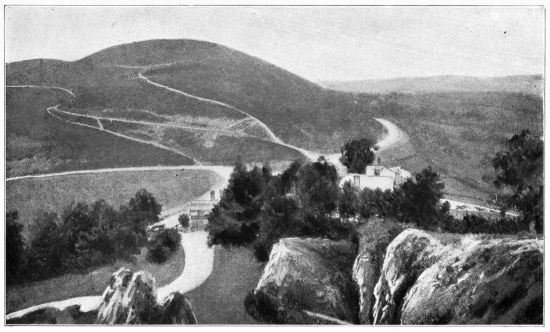
The three great summits which are chief of the Malvern Hills are the Beacons of Worcestershire, Gloucestershire, and Herefordshire; and nearest the town they are everywhere traversed by the paths which the founders of the water-cure taught to stray over their undulations in the fashion of the German spas, and on which the patients walked themselves into a wholesome glow after their douches, sprays, and drenches. They are very noble tops indeed, from which one may everywhere command a lordly prospect, but the most interesting, and the loftiest, is the Worcestershire Beacon, a brow of which the Britons fortified against the Romans. You can drive the greater part of the way to their earthwork, and if you make the climb to it you will not envy either enemy its possession. The views from it are enchanting, and the fortifications, with companies of sheep grazing sidelong on their glacis and escarpments, can still be easily traced by the eye of military science; but perhaps their chief attraction to the civilian is that they seem impregnable to the swarming flies which infest the road almost throughout its rise, and at the point where you leave your carriage are a quite indescribable pest. One could imagine the Romans hurrying up the steep to be rid of them, and beating the Britons out of their stronghold in order to secure themselves from the insect enemy on the breezy height. They must have bitten the bare legs of the legionaries fearfully and really rendered retreat impossible, while the Britons had no choice but to submit; for if it was at this point that the brave Caractacus surrendered with his following, rather than be forced down among those flies, he yielded to a military necessity, and I should be the last to blame him for it. I wondered how my driver was getting on among them, till I found that he had taken refuge in the opportune inn from which he issued, wiping his mouth, on my descent from the embattled height; but the inn could not have been there in the Roman times.
The best of the excursion was coming home by the Wyche, a tremendous cut through beetling walls of rock, which are truly, in the old eighteenth-century literary sense, horrid. Here, as several times before and after, I had to admire at that ignorance of mine in which I had supposed the British continent to be made up of a mild loveliness alone. It has often a bold and rugged beauty which may challenge comparison with our much less accessible grandeurs. It takes days for us to go to the Grand Cañon, or the Yellowstone, or the Yosemite, but one can reach the farthest natural wonder in England by a morning train from London. This handiness of the picturesque and the marvellous is in keeping with the scheme of English life, which is so conveniently arranged that you have scarcely to make an effort for comfort in it. One excepts, of course, the matter of in-door warmth; but out-doors you can always be happy, if you have an umbrella.
I could not praise too much the meteorological delightfulness of that fortnight in Great Malvern, when we had the place so much to ourselves, except for the incursionary trippers, who were, after all, so transient. What contributed greatly to our pleasure was the perfect repair in which the whole place was kept. Apparently the source of its prosperity and certainly its repute, was at the lowest ebb; but the vigilant municipality did not suffer the smallest blight of neglect to rest upon it; the streets were kept with the scruple which is universal in England and which in the retrospect makes our slattern towns and ruffian cities look so shameful; and all was maintained in a preparedness in which no sudden onset of invalids could surprise a weak point. The private premises were penetrated by the same spirit of neatness, and the succession of villas and cottages everywhere showed behind their laurel and holly hedges paths so trim and cleanly that if Adversity haunted their doors she could approach their spotless thresholds without wetting her feet or staining her skirts. It is gratuitous, of course, to suppose the inhabitants all dependent upon hydropathy for their prosperity, but it was certainly upon hydropathy that Malvern increased to her fifteen thousand; and the agreeable anomaly remains.
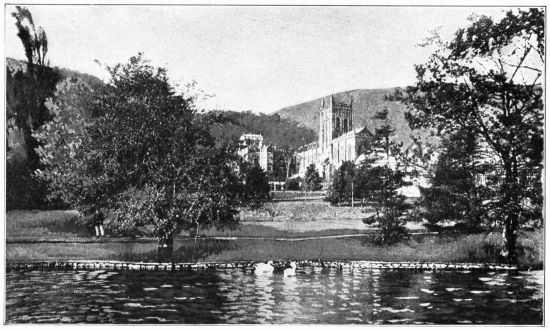
If ever the tide of sickness sets back there—and somehow I wish it might—the cultivated sufferer will find an environment so beautiful that it will console him even for not getting well. Nothing can surpass the picturesqueness of those up and down hill streets of Malvern, or the easy variety of the walks and drives about it, up the hills, and down the valleys, and over the plains. If the sufferer is too delicate for much exercise, there is the prettiest public garden in which to smoke or sew, with a peaceful pond in it, and land and water growths which I did interrogate too closely for their botanical names, but which looked friendly if not familiar. Above all, if the sufferer is cultivated and of a taste for antique beauty, there is the Priory Church, which to a cultivated sufferer from our Priory Churchless land will have an endless charm.
At least, I found myself, who am not a great sufferer, nor so very cultivated, and with a passion for antiquity much sated by various travel in many lands, going again and again to the Priory Church in Malvern, and spending hours of pensive pleasure among the forgetting graves without, and the vaguely remembering monuments within. But not among these alone, for some of the most modern of the sculptures are the most beautiful and touching. In a church which dates easily from Early Norman times and not difficultly from Saxon days, a tomb of the Elizabethan century may be called modern, and I specially commend to the visitor that of
PRIORY CHURCH—SWAN POOL IN FOREGROUND
the Knotesford family to which the Priory passed after the dissolution of the monasteries. The good “Esquire, servant to King Henry the Eight,” lies beside his wife, and at their sides kneel four of their daughters, with the fifth, who raised the monument to them, at her father’s head. Nothing can mark the simple piety and filial sweetness of the whole group, which is of portraits in the realistic spirit of the time; but there is a softer, a sublimer exaltation in that ideal woman’s figure, on a monument of our day, rising from her couch to hail her Saviour with “Even so, come, Lord Jesus.” This work, in the spirit of Chantry, is in the spirit of all ages; and yet has my reader heard of Robert Hollins of Birmingham? If he has not, it will have for him the pathos which attaches to so much art bearing to the beholder no claim of the mind that conceived or the hand that wrought; and the Priory Church of Malvern is rich in such work of every older date. If the reader has a great deal of leisure, he will wish to study the fifteenth-century tiles which record so many sacred and profane histories, and the quaintly carven stalls with the grotesques of their underseats, and doubtless to do what he can with the stained-windows which survive, in almost unrivalled beauty, the devastation through malice and conscience, of so many others in England. A hundred, or for all I know, a thousand reverend and imperative details will keep him and recall him, day after day, and doubtless he will begin to feel a veneration for the zeal and piety which has restored at immense cost this and so many other temples in every part of the country. You cannot have beauty and the cleanliness next to holiness, you cannot even have antiquity, without paying for it, and the English have been willing to pay. That is why Malvern is still so fair and neat, and why if her Hydropathy should fail at last to attract a single sufferer, her Priory Church may continue to entreat the foot of the Pilgrim in good health. If the monastery, of which the Priory Gateway is a sole relic, was, as seems probable, really once the home of Langland, the author of “Piers Ploughman’s Vision,” he could visit no shrine more worthy the reverence of any lover of his kind, any friend of the poor.