V AFTERNOONS IN WELLS AND BRISTOL
Reading edition
EVEN the local guide-book, which is necessarily optimistic, owns that the railroad service between Bath and Wells leaves something to be desired. The distance is twenty miles, and you can make it by the Great Western in something over two hours, but if you are pressed for time, the Somerset and Dorset line will carry you in two. As we were nationally in a hurry, though personally we had time to spare, we went and came by this line, mostly in a sort of vague rain, which favored the blossoming of the primroses along the railroad bank. Not that any part of the way needed rain; great stretches of the country lay soaking in the rainfall of the year before, which had not had sun enough to diminish its depth or breadth. In fact, on the eve of the sunniest and loveliest summer which perhaps England ever saw, the whole West looked in March as if wringing it out and hanging it up to dry in a steam-laundry could alone get the wet out of it. The water lay in wide expanses in the meadows, the plethoric streams swam chokeful; in the ditches men were at work with short scythes cutting the rank weeds out to give the flood a little course, but where it was to run was a question which did not answer itself.
We were in a third-class compartment, and we had the advantage of the simple life getting in and out of a train that seemed to stop oftener than it started. Our ever-changing fellow-passengers were mostly mothers of large little families: babies in arms, and babies slightly bigger, sisters and brothers pendent at arm’s-length from the mother-hands, all with flaring blue eyes and flaming red cheeks, and flaxen hair and mild, sweet faces. Everybody was good, and helped these helpless families to mount and dismount; the kindly porters came and went with their impracticable bundles, and the passengers handed the brothers and sisters after the baby-burdened mother, or took them from her so that she might stumble into the carriage without falling upon her detached offspring. They were beautifully polite in word and deed, so that it was a consolation to hear and see them.
Shortly after our journey began, our tram was apparently run down by an old man and his granddaughter who got in blown and panting from their chase of half a mile before overtaking us. They were of the thin blond type of some English country folks, with a milder color in their cheeks than usual, and between his age and her youth they had about a third of the natural allowance of teeth. Agriculture is apparently nowhere favorable to the preservation of teeth; the rustic theory is that when a tooth offends one should pluck it out; but in England they never expect to replace it, while with us they pluck out all the others and replace them with new ones from the dentist’s, so that when you see good teeth in a country mouth you know where they come from. Their want of teeth did not prevent the old man and the little girl from beginning to eat as soon as they could get their breath. They were going on a visit to her aunt, it seemed, and she was provisioned against the chances of famine in the hour’s journey by a plentiful supply of oranges and apples and cakes in a net bag. “Us ’ad a ’ard chase, didn’t us?” the old man asked her, with a sociable glance round the place. The little girl nodded with her mouth full, while her fingers explored the bag for more cakes to fill it when it should be empty, and the old man leaned tenderly towards her and suggested, “Couldn’t your little ’and find something for me, too?” She drew forth an orange and a cake and gave them to him. Then they munched on, he garrulously, she silently; with what teeth they had between them they must have managed to masticate their food, and there is every probability that they reached their journey’s end without famishing.
We had only two changes to make in our twenty miles, and as we were on the swift train that made the distance in two hours, we did not mind some delay at each change. It was just lunch-time when we reached Wells, and had ourselves driven in the hotel omnibus, a tremendously rackety vehicle, to The Swan. This bird’s plumage was much disarranged by some sort of Easter preparations, and there were workmen taking down and hanging up decorations. But there was quiet in the coffee-room, where over a cold, cold, luncheon we shivered in sympathy with the icy gloom of the basement entrance of the inn, where an office-lady darkled behind her office-window, apparently in winter-long question whether she would be warmer with it shut or open. It was an inn of the old type, now happily obsolescent, which if it cannot smell directly of a stable-yard, does what it can by smelling of the stable-boy in its doorway. We had not, however, come to Wells for the Swan, but for the cathedral, and as we could look out at its loveliness from the window where we ate lunch, we had really nothing to complain of. We had indeed something specially to be glad of, for we could there get our first glimpse of the cathedral through the Dean’s Eye, or if this is not quite honest, from over the Dean’s Eyebrow, so to call the top of the fifteenth-century gate, which commands the finest approach to the cathedral. When you have passed through the Dean’s Eye it may not be quite as if you had passed through the Needle’s Eye; but if I were an American millionaire who had my doubts of the way I was going I might have fancied myself achieving a feat even more difficult than the camel’s, and to be entering the Kingdom as I crossed the lawn inside the gate, and moved in my rapture towards the divine edifice. All the English cathedrals are beautiful, but among those which are most beautiful the Wells cathedral is next to the cathedral of Ely, in my memory. I am not speaking of stateliness or grandeur, but of that more refined and exquisite something which makes a supreme appeal in, say, the Church of St. Mark’s at Venice. I came away from the Wells cathedral saying to myself that there was a loveliness in it for which there was no word but feminine; and if this conveys any notion to the reader’s mind, I shall be glad to leave him for the rest to any pictures of it he can find.
Of course we followed the verger through it in the usual way, but I could not make any one follow me with as much profit. It had its quaint details, and its grotesque details, from the bursting fun of the ages of faith, as well as its expressions of simple reverence, all blending to the sort of tender beauty I have tried to intimate, and it had its great wonder of an inverted arch, through which one looked at its glories as with one’s head held upside down. I do not know but the 1325 clock of Peter Lightfoot, monk of Glastonbury, is as great a wonder as the inverted arch.
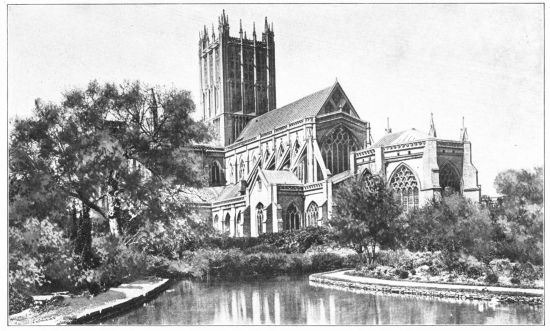
WELLS CATHEDRAL, FROM SOUTHEAST
We were so fortunate as to be present when it struck the hour, and so we saw the four knights on horseback go riding round, and the seated man kick two small bells with his heels, as he has been doing every fifteen minutes for nigh six hundred years. For the ordinary lay-mind on its travels, I suppose, this active personage is one of the great attractions of the cathedral next after the toothache-man in one of the capitals who pulls his mouth open to show his aching tooth. He has been much photographed, of course, but he is to be seen in situ just above that bishop’s tomb which is sovereign, through the bishop’s merits, for the toothache. The verger, who told us this, left us to suppose that the tomb had been too difficult of application to the tooth of the sufferer above, and that this was why he was still appealing to the public sympathy.
We offered him a mute condolence after we had sated ourselves with the beauty of the most beautiful chapter-house in the world, ascending and descending by the foot-worn wide crossing sweep of the unique stairway, and then walking through into the Vicar’s Close, and the two rows of Singers’ Houses, like cottages in a particularly successful stage perspective. As we passed one of these histrionic habitations, each with its lifelike dooryard and its practicable gate, three of the clerical students, who have an immemorial right to lodge with the singers, came out gayly challenging one another which way they should walk, and deciding on Tor Hill, wherever that was, and then starting off at a good round pace in the rain. The doubting day had sorrowed and sowed to that effect, and when the verger had led us through the cloister aisle into the gardens of the bishop’s palace the grounds were so much like waters that there seemed no reason why the ducks should not have been sailing on the lawn as well as the moat. This, with the embattled wall, is said, and probably fabled, to have formed the defence of his house for a certain bishop whose life was threatened by the monks of Bath, who if they had waited five hundred years in the idea of suddenly descending upon him by our swift train, would have found him prepared to give them a warm reception. But the day of our visit there were no belligerent monks; the place was almost peacefully picturesque, with no protection needed but an umbrella against the rain heavily dripping from the ivy of the ruined cloister arches, and goloshes against the water of the sopping earth.
It was the idea of one of us who had found an ancient almshouse very amusingly characteristic on a former English journey, that we could not do better, after the cathedral, than go to one of the several time-honored charitable foundations in Wells. We had our choice of several, including one for six poor men, and one for twelve poor men and two poor women. But we must have selected the largest, where both poor men and poor women dwell. Such people do not end their days in the snugness of such places with anything of the disgrace which attaches to paupers with us. Their lot is rather a coveted honor, and on their level is felt to add dignity to the decline of life. Each old woman has her kitchen, and each old man his kitchen garden (always edged with simple flowers); and they have a stated income, generally six or seven shillings a week, with which they provision themselves as they please.
We did not find the matron of the place we chose without some difficulty, or some apologetic delay for her want of preparation. But she was really well enough, when she came, though it was charing-day, and the whole house was even better prepared, which was the essential thing. I cannot say that the inmates seemed especially glad to see their poor American relations, but there was no active opposition to our visit, and we did our best to win the favor of three old men shown as specimens in the large common room where they were smoking by the chimney, and, if I am any judge of human nature, criticising the management down to the motives of the original benefactor in the fourteenth century. We had some brief but not unfriendly parley, and after offering a modest contribution towards the general tobacco-fund, we said good-bye to these meritorious old men, who made a show of standing up, but did not really do so, I think. The matron would have left the door open, but I bethought me to ask if they would not rather have it shut, and they said with one voice that they would. I closed it with the conviction that they would instantly begin talking about us, and not to our advantage, but I could not blame them. Age is censorious, poverty is apt to be envious, infirmity is not amiable and we were not praiseworthy. Upon the whole I hope they gave it us good and strong; for I am afraid that the next pensioner whom we visited thought better of us than we deserved. I got the notion that she was in some sort a show pensioner, and that therefore we had not taken her unawares. Her room was both parlor and kitchen, and was decorated no less with her cooking apparatus than the china openly set about the wall on shelves. She was full of smiles and little polite bobs, and most willing to have her room admired, even to the bed that crowded her table towards her grate, and left a very snug fit for her easy-chair. One could see that the matron prized her, and expected us to do so, and we did so, especially when she showed us a flower in a pot which her son had given her. Perhaps we exaggerated the comforts of her room in congratulating her upon it, but this was an error in the right direction, and we did what we could to repair it by the offer of a shilling. If it is permitted to the spirits of benefactors in heaven to take pleasure in their good deeds on earth, it must have been a source of satisfaction for five hundred years (as they count time here) to the founder of this charity when he thought of how many humble fellow-creatures he had helped, and was helping. Perhaps they do not care, up there; but the chance is worth the attention of people looking about for a permanent investment. I think every one ought to earn a living, and when past it ought to be pensioned by the state, and let live in comfort after his own fancy; but failing this ideal, I wish the rich with us would multiply foundations after the good old English fashion, in which the pensioners, though they dwelt much in common, could keep a semblance of family life and personal independence.
Of course Wells, as its name says, was once a watering-place, though never of so much resort as Bath; but now its healing springs bubble or ooze forth in forgottenness, with not a leper or even a rheumatic to avail of them. It was very, very anciently a mining-town, and long afterwards a shoe-town, with an interval of being a place of weavers, but it was never an industrial centre. It has never even been very historical, though Henry VII. stopped there in his campaign against the Pretender Perkin Warbeck, and after centuries the followers of another pretender—the luckless, worthless, but otherwise harmless bastard of Charles II., the Duke of Monmouth, who was making war against his uncle, James II.—occupied the city and stripped the lead from the
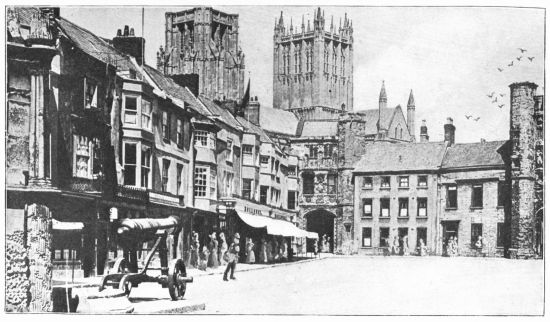
MARKET-PLACE, WELLS
cathedral roof for bullets; they otherwise dishonored its edifice, Cromwell’s soldiers having failed to do so. By the beginning of this century the population of the town had dwindled to less than five thousand. But these, in their flat streets of snug little houses, we thought well supplied with good shops, and the other comforts of life, and we found them of an indefatigable civility in telling and showing us our way about. We had still some time to spare when finally their kindness got us to the station of the Somerset and Dorset line, where, as a friendly old man whom we found there before us justly remarked, “Us must wait for the train; it won’t wait for we.”
There was another old man there, in a sort of farmer’s gayety of costume, with leathern gaiters reaching well to his knees, and a jaunty, low-crowned hat, who promptly made our acquaintance and told us that he was eighty years old, and that he had lately led the singing of a Methodist revival-meeting. “And every one said my voice was as strong in the last note as the first.” He then sang us a verse from a hymn in justification of the universal opinion, and in spite of his functional piety was of an organic levity which, with his withered bloom and his lively movement on his feet, recalled the type of sage eternized by Mr. Hardy in Granfer Cantle. Upon the whole we were glad to be rid of him when he quitted the train on which we started together, and left us to the sadder society of a much younger man. He too was a countryman, and he presently surprised me by owning that he had once been a fellow-countryman. He had indeed lived two years in a part of Northern Ohio where I once lived, and the world shrank in compass through our meeting in the Somerset and Dorset line. “And didn’t you like it?” “Oh, yes; I liked it. After I came back I was the homesickest man! But my wife couldn’t get her health there.” Privately, I thought I would have preferred Glastonbury, where this kindly man got out, to Orwell, Ashtabula County, Ohio; but we all have our tastes, and I made him a due show of sympathy in his regret for my native land.
When our two hours of travel were rather more than up, we found ourselves again in Bath after a day which I felt to have been full of exciting adventure. But I ask almost as little of life as of literature in the way of incident, and perhaps the reader will not think my visit to Wells especially stirring. In that case I will throw in the fact of a calf tied at one of the stations where we changed, and lamentably bellowing in the midst of its fellow-passengers, but standing upon its rights quite as if it had booked first-class. When I add that there was a sign up at this station requiring all persons to cross the track by the bridge, and that without exception we contumaciously trooped over the line at grade, I think the cup of the wildest lover of romance must run over.
Of our subsequent afternoon in Bristol, what remains after this lapse of time except a pleasing impression? We chose a wet day because there were no dry days to choose from. But a wet day of the English spring is commonly better than it promises, and this one made several unexpected efforts to be fine, and repeatedly succeeded. Bristol is no nearer Bath than Wells is, but there are no changes, and we arrived in half an hour and drove at once through the rather uninteresting streets to the beautiful old church of St. Mary Redcliffe. There we found the verger (or perhaps one should say the sexton) as ready to receive us, having just finished mopping the floor, as if he had been expecting us from
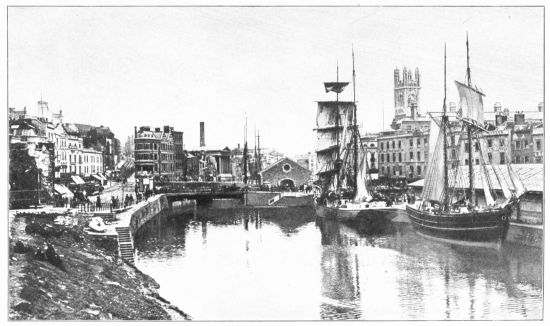
BRISTOL HARBOR AND DRAWBRIDGE
the foundation of the church in the thirteenth century. One has not often such a welcome, even from a verger, and I make this occasion to say that few things add more to the comfort of sight-seeing travel than an appreciative verger. He imparts a quality of his church or cathedral to the sight-seer, who feels himself Early English or at least Perpendicular Gothic under his flattering ministrations, and he supplements the dry facts of the guide-book with those agreeable touches of fable which really give life to history.
St. Mary Redcliffe is so rich in charming associations, however, as scarcely to need the play of the sacristan’s imagination for the adornment of her past. She is easily, as Queen Elizabeth so often-quotedly said, “the fairest, the goodliest, and most famous parish church in England,” and is more beautiful and interesting than the cathedral of her city, if not more graceful in form and lovely in detail than any other church in Europe. One scarcely knows which of her claims on the reader’s interest to mention first, but perhaps if the reader has a feeling heart for genius and sorrow he will care most for St. Mary Redcliffe because Chatterton lies buried in her shadow. Or, if he is not buried there, but at St. Andrews, Holborn, in London, as Peter Cunningham claims, there is at least his monument at St. Mary’s Redcliffe to give validity to the verger’s favorite story. The bishop forbade the poor suicide to be buried in the church-yard, and he was interred in a space just outside; but later the vestry bought this lot and enclosed it with the rest, and so beat the bishop on his own consecrated ground. I could not give a just sense of how much the verger triumphed in this legend, but apparently he could not have been prouder of it if he had invented it. He pointed out, at no great remove, a house in or near which Chatterton was born; and he must have taken it for granted that we knew the boy had pretended to find the MS. of his poems in an old chest in the muniment-room, over the beautiful porch of the church, for he did not mention it. He was probably so absorbed in the interest which Chatterton conferred upon St. Mary Redcliffe that he did not think to remind us that both Coleridge and Southey were married in the church. Southey was born in Bristol, and they both formed part of a little transitory provincial literary centre, which flourished there before the rise of the Lake School under the fostering faith of Joseph Cottle, the publisher, himself an epic poet of no mean area.
But St. Mary Redcliffe has peculiar claims upon the reverence of Americans from its monument of Admiral Penn, father of him who founded the Commonwealth of Pennsylvania. The formidable old sailor’s gauntlets, cuirass, and helmet hang upon the wall above the monument, and near by is the rib of a whale which John Cabot is said to have slain in Labrador. Less endearing associations for us, and less honorable to the city are those of the slave-trade which Bristol long carried on to her great gain and shame. Slavery was common there, not only in the Saxon and Norman days, but practically far down the centuries into the eighteenth. In the earlier times youths and maidens were roped together and offered for sale in the market; people sold their own children abroad; and in the later times, Bristol prospered so greatly in the exportation of young men and women to the colonies, that when this slavery was finally put an end to, it was found just to compensate her merchants and ship-owners in the sum of nearly a million dollars for their loss in the redemptioners whom they used to carry out and sell for their passage-money.
In the strange contemporaneity of the worst and the best things Bristol grew in grace; beautiful churches rose, and then her people fought the fight out of Romanism into Protestantism; in the civil war she held for the Parliament against the King, and was taken by Rupert and retaken by Cromwell. A hundred years after, the great religious awakening to be known as Methodism, began in and about Bristol. Whitefield preached to the miners at Kingswood, and then Wesley, whose help he had invoked, came and preached to all classes, in the town and out, moving them so powerfully to seek salvation, that many who heard him fell down in swounds and fits, and “roared for the disquietness of their hearts,” while tens of thousands were less dramatically saved from their sins. Yet another hundred years and the spirit miraculously responded to the constant prayer of George Müller for means to found the Orphanages, which witness the wonder at this day to any tourist willing to visit them. Without one specific or personal appeal, alms to the amount of three million dollars flowed in upon him, and helped him do his noble work.
Riches abounded more and more in Bristol, but the city continued almost to the nineteenth century in a mediæval inconvenience, discomfort, and squalor. A horse and cart could not pass through her tortuous streets, and trucks drawn by dogs transported her merchandise; down to 1820 heavy wagons were not permitted for fear of damaging the arches of the sewers, and sledges were used. All the same, there was from the beginning a vehement and powerful spirit of enterprise, and Bristol is connected with our own history not only by the voyages of the Cabots to our savage northern shores in the fifteenth century, but by the venture of the Great Western, which, in 1838, made the first steam passage of the Atlantic Ocean. In honor of the relations established by her mariners between the old world and the new, I over-ruled our driver’s genteel reluctance from the seafaring quarter of the town, and had him take us to as much of the port of Bristol as possible. I am not sure that I found the points from which either the Matthew sailed for America in 1497, or the Great Western in 1838, but I am sure that nothing more picturesque could have rewarded my vague search. Among the craft skirting the long quays there was every type of vessel except the Atlantic liner which had originated there; but the steamers, which looked coast-wise and river-going, contributed their full share to the busy effect. This for the moment was intensified by the interest which a vast crowd of people were taking in the raising of a sunken barge. Their multitude helped to embarrass our progress through the heaps of merchandise, and piles of fish, and coils of chain and cordage, and trucks backing and filling; but I would not have had them away, and I only wish I knew, as they must later have known, whether that barge was got up in good shape.
On one shore were ranks of warehouses, and on the other, the wild variety of taverns and haunts of crude pleasure, embracing many places for the enjoyment of strong waters, such as everywhere in the world attract the foot wandering ashore at the end of a sea-leg. Their like may have allured that Anglicized Venetian, John Cabot, when he returned from finding Newfoundland, and left his ship to enjoy the ten pounds which Henry VII. had handsomely sent him for that purpose, as an acknowledgment of his gift of a continent. It is not to be supposed that there were then so many and so
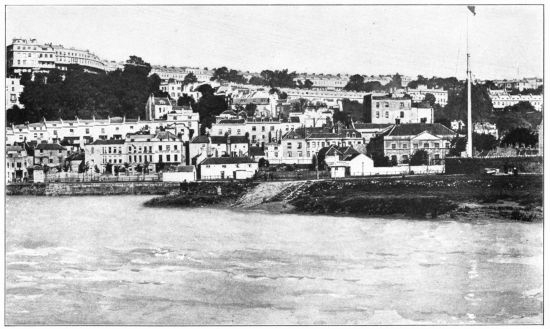
CLIFTON, FROM ASHTON MEADOWS
large shops as now intersperse the pleasure-resorts in the port of Bristol; I question whether Cabot, if he had strained his eyes over-seas by looking out for new hemispheres, could have found there a whole building lettered over with the signs of an optician, and I do not yet see just why such a semi-scientist should so abound there now. But I shall always be sorry I did not go to him to replace the eye-glasses I had broken, instead of poorly driving to the shop of an optician in one of the best city streets. It was a very handsome street full of shops, such as gave a due notion of the sufficiency of Bristol to all demands of wealth and ease, and I got an excellent pair of glasses; but if I had bought my glasses in the port, I might perhaps have seen the whole strenuous past of the famous place through them, and even “stared at the Pacific” with the earliest of her circumnavigating sons. However, we cannot do everything, and we did not even see that day the cathedral which St. Mary Redcliffe so much surpasses, for anything we know to the contrary. We could and did see the beautiful Norman gateway of the Abbey, which it is no treason to our favorite church to allow she has none to equal, and passing under its sumptuously carven arches into the cathedral we arrived at the side of the regretful verger. He bade us note that the afternoon service was going on, and how the Elder Lady Chapel with its grotesque sculptures in the mediæval taste, which used to have fun in the decoration of sacred places with all sorts of mocking fancies, was impossible to us at the moment.
But the Bristol cathedral is not one of the famous English cathedrals, and our regret was tempered by this fact, though the verger’s was not. I tried to appease him with a promise to come again, which I should like nothing better than to keep, and then we drove off. We were visiting almost without a plan this storied and noble city, which so much merited to be carefully and intelligently seen, and it was by mere grace of chance that we now happened upon one of the most interesting houses in it. In the graveyard of St. Peter’s church the hapless poet, Richard Savage, who was buried at the cost of the jailer of the debtors’ prison where he died, and we must have passed the tablet to his memory in finding our unheeding way to St. Peter’s Hospital behind the church. This is one of the most splendid survivals of the statelier moods of the past in that England which is full of its records. A noted alchemist built it, whether for his dwelling or whether for the mystic uses of his art, in the thirteen-hundreds, but it is gabled and timbered now in the fashion of the sixteenth century, and serves as the official home of the Bristol Board of Guardians. Once it belonged to a company of merchant adventurers, and their ships used to float up to its postern-gate, and show their spars through the leaden sash of its windows, still kept in their primal picturesqueness. The whole place within is a wonder of carven mantels and friezes and ceilings; and so sound that it might well hold its own for yet five hundred years longer.
It was the first of those mediæval houses which gave us a sense of English comfort hardly yet surpassed in modern English interiors; and here first we noted the devotion of the English themselves to the monuments of their past. The Americans who visit objects of interest on the continent are apt to find themselves equalling in number, if not outnumbering their fellow-Anglo-Saxons of English birth; but in England they are a most insignificant minority. The English are not merely globe-trotters, they are most incessant travellers in their own island. They are always going and coming in it, and as often for pleasure as business, apparently. At any rate the American who proposes coming into a private heritage of the past when he visits his ancestral country finds himself constantly intruded upon by the modern natives, who seem to think they have as good right to it as he. This is very trying when he does not think them half so interesting as himself, or half so intelligently appreciative. He may be the most dissident of dissenters, the most outrageously evangelical of low-churchmen, but when he is pushed by a clerical-looking family of English country folk, father, mother, sister-in-law, and elderly and younger daughters, almost out of hearing of the vergeress’s traditions of St. Peter’s Hospital, he cannot help feeling himself debarred of most of the rights established by our Revolution. It is perhaps a confusion of emotions; but it will be a generous confusion if he observes, amidst his resentment, the listless inattention of the young girl, dragged at the heels of her family, and imaginably asking herself if this is their notion of the promised holiday, the splendid gayety of the long-looked-for visit to Bristol!
Before my own visit to that city my mind was much on a young Welsh girl whose feet used to be light in its streets, more than a hundred years ago, and who used in her garb of Quaker grandmother to speak of her childhood days there. She had come an orphan from Glamorganshire, to the care of an aunt and uncle at Bristol, and there she grew up, and one day she met a young Welshman from Breconshire who had come on some affair of his father’s woollen-mills to the busy town. She was walking in the fields, and when they passed, and she looked back at him, she found he was looking back at her; and perhaps if it were not for this surprising coincidence, some other hand than mine might now be writing this page. In her Bristol days she did not wear the white kerchief crossed at her neck above the gown of Quaker drab, nor the cap hiding the gray hair, but some youthful form of the demure dress in which one could better fancy her tripping across the field and looking back, in the path where she still pauses, in a dear and gentle transmutation of girlhood and grandmotherhood.
It might have been over the very field where she walked that we drove out to the suburb of Clifton, where Bristol mostly lives. It is the more beautiful Allegheny City of a less unbeautiful Pittsburg, but otherwise it bears the same relation to Bristol as the first of these American towns bears to the last. Nobody dwells in Bristol who can dwell in Clifton, and Clifton has not only the charm of pleasant houses and gardens, with public parks and promenades, and schools and colleges, and museums and galleries, as well as almost a superabundance of attractive hotels, but it is in the midst of nature as grand as that of the Niagara River below the falls. The Avon’s currents and tides flow between cliffs, spanned by Brunel’s exquisite and awful suspension-bridge, that rise thickly and wildly wooded on one side, and on the other, built over to its stupendous verge with shapes of the stately and dignified architecture, civic and domestic, which characterizes English towns. The American invader draws a panting breath of astonishment in the presence of scenery which eclipses his native landscape in savage grandeur as much as in civilized loveliness, and meekly wonders, on his way through that mighty gorge of the Avon, how he could have come to England with the notion that she was soft and tame in her most spectacular moods. He does not call upon the
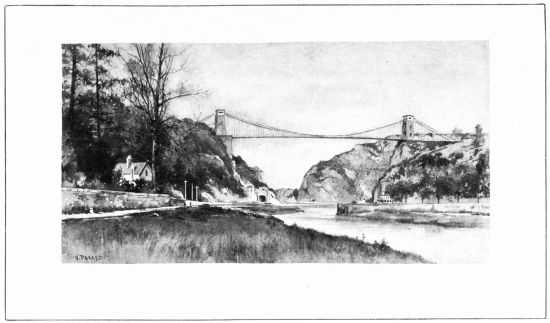
GORGE OF THE AVON, WITH ST. VINCENT’S ROCKS
hills to hide his shame, lest the cliffs that beetle dizzyingly above him should only too complaisantly comply. But he promises himself, if he gets back to Bath alive, to use the first available moment for taking a reef in his national vanity where it has flapped widest. Of course it will not do in Bath to wound the local susceptibilities by dwelling upon the surviving attractions of Clifton as a watering-place, but he may safely and modestly compare them with those of Saratoga.