VI BY WAY OF SOUTHAMPTON TO LONDON
Reading edition
WE left Bath on the afternoon of a day which remained behind us in doubt whether it was sunny or rainy; but probably the night solved its doubt in favor of rain. It was the next to the last day of March, and thoughtful friends had warned us to be very careful not to travel during the impending Bank holidays, which would be worse than usual (all Bank holidays being bad for polite travellers), because they would also be Easter holidays. We were very willing to heed this counsel, but for one reason or another we were travelling pretty well all through those Easter Bank holidays, and except for a little difficulty in finding places in the train up from Southampton to London, we travelled without the slightest molestation from the holiday-makers. The truth is that the leisure classes in England are so coddled by the constitution and the by-laws that they love to lament over the slightest menace of discomfort or displeasure, and they go about with bated breath warning one another of troubles that never come.
Special trains are run on all lines at Bank holiday times, and very particularly special trains were advertised for those Easter Bank holidays in the station at Bath, but as we were taking a train for Southampton on the Saturday before the dread Monday which was to begin them, we seemed to have it pretty much to ourselves. The Midland road does not run second-class cars, and so you must go first or third, and we being as yet too proud to go third, sought a first-class non-smoking compartment. The most eligible car we could find was distinctly lettered “Smoking,” but the porter said he could paste that out, and by this simple device he changed it to non-smoking, and we took possession.
We were soon running through that English country which is always pretty, and seems prettiest wherever you happen to be, and though we did not and never can forget Bath, we could not help tricking our beams a little, in response to the fields smiling through the sunny rain, or the rainy sun. It was mostly meadowland, with the brown leafless hedges dividing pasture from pasture, but by-and-by there began to be ploughed fields, with more signs of habitation. Yet it was as lonely as it was lovely, like all the English country, to which the cheerfulness of our smaller holdings is wanting. What made it homelike, in spite of the solitude, was the occurrence in greater and greater number of wooden buildings. We conjectured stone villages somewhere out of sight, huddled about their hoary churches, but largely the gray masonry of the West of England had yielded to the gray weather-boarding of the more southeasterly region, where at first only the barns and out-buildings were of wood; but soon the dwellings themselves were frame-built.
Was it at otherwise immemorable Shapton we got tea, running into the cleanly, friendly station from the slopes of the shallow valleys? It must have been, for after that the sky cleared, and nature in a cooler air was gayer, as only tea can make nature. They trundled a little cart up to the side of the train, and gave us our cups and sandwiches, bidding us leave the cups in the train, as they do all over England, to be collected at some or any other station. After that we were in plain sight of the towers and spires of Salisbury, the nearest we ever came, in spite of much expectation and resolution, to the famous cathedral; and then we were in the dear, open country again, with white birches, like those of New England, growing on the railroad banks; and presently again we were in sight of houses building, and houses of pink brick already built, and then, almost without realizing it, we were in the suburbs of Southampton, and driving in a four-wheeler up through the almost American ugliness of the main business street, and out into a residence quarter to the residential hotel commended to us.
It was really very much a private house, for it was mainly formed of a stately old mansion, which with many modern additions, actual and prospective, had been turned to the uses of genteel boarding. But it had a mixed character, and was at moments everything you could ask a hotel to be; if it failed of wine or spirits, which could not be sold on the premises, these could be brought in from some neighboring bar. The transients, as our summer hotels call them, were few, and nearly all the inmates except ourselves were permanent boarders, in the scriptural and New England proportion of seven women to one man. It was a heterogeneous company of insular and colonial English, but always English, whether from the immediate neighborhood, or Canada, or South Africa, or Australia. At separate small tables in an older dining-room, cooled by the ancestral grate, or in a newer one, warmed by steam-radiators just put in, we were served abundant breakfasts of bacon and eggs and tea and toast, and table d’hôte luncheons and dinners, with afternoon tea and after-dinner coffee in the drawing-room. For all this, with rooms and lights and service, we paid ten shillings a day, and I dare say the permanents paid less. Bedroom fires were of course extra, but as they gave out no perceptible heat, they ought not to be counted, though they had a certain illuminating force, say a five candle-power, and rendered the breath distinctly visible.
We had come down to Southampton in a superstition that, being to the southward, it would be milder than Bath, where the spring was from time to time so inclement, but finding it rather colder and bleaker, we experimented a little farther to the southward, a day or two after our arrival, and went to the Isle of Wight. The sail across the Solent, or whatever water is was we crossed, was beautiful, but it was not balmy, and when we reached Cowes, after that dinner aboard which you always get so much better in England than in like conditions with us, we found it looking not so tropical as we could have liked, but doubtless as tropical as it really was. The pretty town curved round its famous yacht harborage in ranks of summer hotel-like houses, with green lattices and a convention of out-door life in their architecture, such as befitted a mild climate; but we were keeping on to the station where you take train for Ventnor, on the southern shore of the island, which has to support the reputation of being the English Riviera. We did not know then how bad the Italian Riviera could be, and doubtless we blamed the English one more than we ought. We ought, indeed, to have been warmed for it by the sort of horseback exercise we had on the roughest stretch of railway I can remember, in cars whose springs had been broken in earlier service on some mainland line of the monopoly now employing them on the Isle of Wight, and defying the public to do anything about it, as successfully as any railroad of our own republic. We had a hope and an intention of seeing flowers, which we fulfilled as we could with the unprofitable gayety of the blossomed furze by the waysides; and more and more we fancied a forwardness in the spring which was doubtless mainly of our invention. From our steamer we had a glimpse of Osborne Castle, the favorite seat of the good queen who is gone, and we wafted our thoughts afar to Carisbrooke, where the hapless Charles I. was for a time captive, playing fast and loose, in feeble bad faith, with the victorious Parliament, when it would have been willing to treat with him. But you cannot go everywhere in England, especially in one day, though home-keeping Americans think it is so small, and we had to leave Newport and its Carisbrooke castle aside in our going and coming between Ryde and Ventnor.
It was well into the afternoon when we reached Ventnor, and took a fly for the time left us, which was largely tea-time, by the reckoning of the girl in the nice pastry-shop where we stopped for refreshment. She said that the season in Ventnor was July and August, but the bathing was good into October, and we could believe the pleasant Irishman in our return train who told us that it was terribly hot in the summer at Ventnor. The lovely little town, which is like an English water-color, for the rich, soft blur of its grays, and blues and greens, has a sea at its feet of an almost Bermudian variety of rainbow tints, and a milky horizon all its own, with the sails of fishing-boats, drowning in it, like moths that had got into the milk. The streets rise in amphitheatrical terraces from the shore, and where they cease to have the liveliness of watering-place
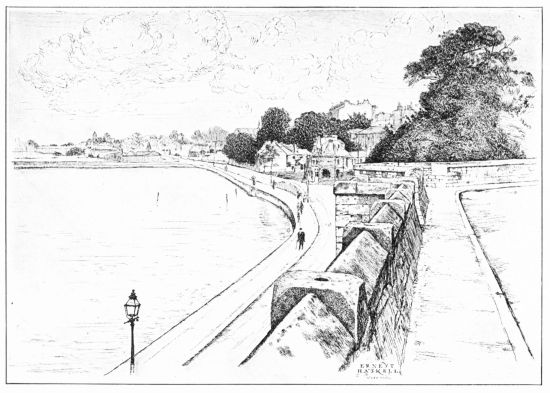
THE SOUTH SHORE, SOUTHAMPTON
shops, they have the domesticity of residential hotels and summer boarding-houses, and private villas set in depths of myrtle and holly and oleander and laurel; some of the better-looking houses were thatched, perhaps to satisfy a sentiment for rusticity in the summer boarder or tenant. The intelligent hunchback who drove our fly, and instructed us in things of local interest far beyond our capacity, named prices at these houses which might, if I repeated them, tempt an invasion from our own resorts, if people did not mind suffering in July and August for the sake of the fine weather in November. Doubtless there are some who would not mind being shut southward by the steep and lofty downs which prevent the movement of air as much in summer as in winter at Ventnor. The acclivities are covered with a short, wiry grass, and on the day of our visit the boys of Ventnor were coasting down them on a kind of toboggans. Besides this peculiar advantage, Ventnor has the attraction, common to so many English towns and villages, of a Norman church, and of those seats and parks of the nobility and gentry which one cannot long miss in whatever direction one goes, in a land where the nobility and gentry are so much cherished.
The day had been hesitating between rain and sun as usual, but it had decided for rain when we left Ventnor, where we had already found it very cold in-doors, over the tea and bread and butter, which they gave us so good. By the time we had got back to Ryde, the frigidity of the railway waiting-room, all the colder for the fire that had died earlier in the day, was such that it seemed better to go out and walk up and down the platform, in the drive of the rain, as hard and fast as one could, than to stay within. In these conditions the boat appeared to be longer in coming than it really was, and when it came it was almost too well laden with the Bank-holiday folk whom we had been instructed to dread. At Cowes, more young men and young girls of a like sort came on board, but beyond favoring us with their loud confidences they did us no harm, and it was quite practicable to get supper. They were of the chorus-girl level of life, apparently, and there was much that suggested the stage in their looks and behavior, but they could not all have been of the theatre, and they were better company than the two German governesses who had travelled towards Ventnor with us, and filled the compartment with the harsh clashing of their native consonants. The worst that you could say of the trippers was that they were always leaving the saloon door open, and letting in the damp wind, which had now become very bitter, but English people of every degree are always leaving the door open, and these poor trippers were only like the rest of their nation in that. One young lady lay with her feet conspicuously up on the lounge which she occupied to the exclusion of four or five other persons, but by-and-by she took her feet down, and the most critical traveller could not have affirmed that it was characteristic of Easter Bank-holiday ladies to stretch themselves out with their feet permanently up on the cushions. When we landed at Southampton, and drove away in a cab, we had an experience which was then novel, but ceased to be less and less so. It seemed that the pier was a private enterprise, and you must pay toll for its use, or else not arrive or depart on that boat.
So many of our fellow-countrymen come ashore from their Atlantic liners at Southampton, and rush up to London in two hours by their steamer trains, without
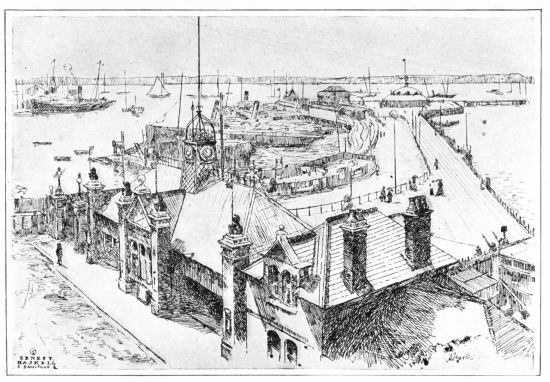
“THE PIER WAS A PRIVATE ENTERPRISE”
any other sense of the place than as a port of entry, that I feel as if I were making an undue claim upon their credulity in proposing it as a city having a varied literary and historical interest. Yet Southampton is a city of no mean memories, with a history going back into the dark of the first invasions, and culminating early in the fable of King Canute’s failure to browbeat the Atlantic. The men who won Cressy, Poictiers and Agincourt set sail from it, and fifty ships and more made ready there for the Armada. In turn it was much harried by the French, but the Dutch, whom Alva drove into exile, settled in the town and helped prosper it with their industries, till the Great Plague brought it such adversity that the grass, which has served the turn of so much desolation, grew in its streets. With the continuous wars of England and France it rose again, and now it is what every American traveller fails to see as he hurries through it. I have not thought it needful to mention that in the ages when giants abounded in Britain, Southampton had one of the worst of that caitiff race, who was baptized against his will, but afterwards eloping with his liege lady, was finally slain.
The place was so attractive socially, a hundred-odd years ago, that Jane Austen’s family, when they came away from Bath, could think of no pleasanter sojourn. She wrote some of her most delightful letters from Southampton, and of course we went and looked up the neighborhood where she had lived. No trace of that precious occupancy is now left beside the stretch of the ancient city wall from which the Austens’ garden overlooked a beautiful expanse of the Solent, but we made out the place, and for the rest we gave ourselves to the pleasure of following the course of the old city wall, which, with its ivied arches, its towers and battlements all agreeably mouldering and ruinous, is better, as far as it goes, than the walls of either Chester or York, conscious of their entirety, and of their claim upon the interest of travel. Southampton is so very modern in the prosperity which has made it the rival of Liverpool as the chief port of entry from our country, that we ought rather to have devoted ourselves to its docks than its walls, and we did honestly try for them. But there is always something very disappointing about docks, and though I went more than once for a due impression of them at Southampton, I constantly failed of it. I tried coming upon them casually at first; at last I drove expressly to them, and when I dismounted from my cab, and cast about me for the sensation they should have imparted, and demanded of my cabman, “Where are the docks?” and he said, “Here they are, sir,” I could not make them out, and was forced to conclude that they had been taken in for the time.
I had no such difficulty with the prison into which Dr. Isaac Watts’s father was put for some of those opinions which in former times were always costing people their personal liberty. In my mind’s eye I could almost see his poor wife bringing their babe and suckling the infant hymnologist under the father’s prison window; and I was in such rich doubt of Dr. Watts’s birthplace in French Street, that with two houses to choose from, I ended by uncovering to both. I think it was not too much honor to that kind, brave soul, who got no little poetry into his piety, and was neither very severe about theology on earth, nor exigent of psalm-singing in heaven, where he imagined a pleasing conformity in the conditions to the tastes and habits of the several saints in this life. If the reader thinks that I overdid my reverence in the case of this poet, let him set against it my total failure to visit either the birthplace or the baptismal church of another Southampton poet, that Charles Dibdin, namely, whose songs were much on British tongues when Britain was making herself mistress of the seas, and which possibly breathe still from the lips of
“The sweet little cherub who sits up aloft, Keeping watch o’er the life of poor Jack.”
Early in my English travels I found it well to leave something to the curiosity of after-seekers, and there is so much to see in every English city, town, village, country neighborhood, road, and lane that I could always leave unseen far more than I saw. I suppose it was largely accidental that I gave so much of my time to the traces of the Watts family, but perhaps it was also because both the prison and the house (in which, whichever it was, the mother kept a boarding-house while she nurtured her nine children, and the good doctor began his Greek and Latin at five years of age), were in the region of the old church of St. Michael’s which will form another compensation at Southampton for the American who misses the docks. Its architecture was amongst my earliest Norman, and was of the earliest Norman of any, for the church was built in 1100 by monks who came over from Normandy. It was duly burned by the French two centuries later in one of their pretty constant incursions; they burned only the nave of the church, but they left the baptismal font rather badly cracked, and with only the staple of the lock which used to fasten the lid to keep the water from being stolen. I do not know why the baptismal water should have been stolen, but perhaps in those ages of faith it was a specific against some popular malady, leprosy or the black death, or the like. The sacristan who showed me the font, showed me also the tomb of a bad baronet of the past, a very great miscreant, whose name he could not remember, but who had done something awful to his wives; and no doubt he could easily have told me why people stole the water. He was himself an excellent family man, or at least highly domesticated, if one might judge from his manner with his own wife, who came in demanding a certain key of him. Husband-like, he denied having it; then he remembered, and said, “Oh, I left it in the pocket of my black coat.” He was not at all vexed at being interrupted in telling me about the bad baronet, whose tomb, he made me observe, had not a leaf or blossom on it, though it was Easter Sunday, and the old church, which was beautifully rough and simple within, was decked with flowers for the festival.
Outside, the prevalence of Easter was so great that we had failed of a street cab, and had been obliged to send to the mews (so much better than a livery-stable, though probably not provided now with falcons) for a fly, and we felt by no means sure that we should be admitted to the beautiful old Tudor house, facing the church of St. Michael’s, which goes by the name of King Henry VIII.’s Palace. They are much stricter in England concerning the holy days of the church than the non-conforming American imagines. On Good Friday there were neither cabs nor trams at Southampton in the morning, and only Sunday trains were run on the Great Southwestern to London; though on the other hand the shops were open, and mechanics were working; perhaps they closed and stopped in the afternoon. But we summoned an unchurchly courage for the Tudor house, and when we rang at the postern-gate—it ought to have been a postern-gate, and at any rate I will call it so—it was opened to us by a very sprightly little old lady, with one tooth standing boldly up in the centre of her lower jaw, unafraid amid the surrounding desolation. She smiled at us so kindly that we apologized for our coming, and said that we did not suppose we could see the palace, and then she looked grave, and answered, “Yes, but you’ll have to pay a fee, sir,” I undertook that the fee should be paid, and then she smiled again, and led the way from her nook in it, through one of the most livable houses I was in anywhere in England. I will use the privilege of the superficial and cursory observation of the hurried tourist, to which we are so well accustomed in English travellers among ourselves, and say that the English did not know what domestic comfort was till the times of the Tudors, and were apparently forgetful of it afterwards. This palace of Henry VIII., which is rather simple for a palace, but may very well have been the sojourn of Anne Boleyn and her daughter Queen Elizabeth in their visits to Southampton, was divided above and below into large rooms, wainscotted in oak, of a noble shapeliness, and from cellar to attic was full of good air, without the draughts which the earlier and later English have found advantageous in perpetuating the racial catarrh and rheumatism. The apartments were of varying dignity from the ground floor up, and the basement was so wholesome, that before the time of the present owner, who had restored it to its former state, a family with eleven children lived there in the greatest health as long as they were allowed to stay. Even in the attic, the rooms, though rough, were pleasant, and there were so many that one of them had got lost and could never be found, though the window of it still shows plainly from the outside. This and much more the friendly dame recounted to us in our passage through a mansion, which we found so attractive that we of course tacitly proposed to buy it and live in it always. Then she led us out into her kitchen-garden, running to the top of the ancient city wall, and undermined, as she told us, by submarine passages.
But we could only find a flight of stone steps descending to the street level below, where, if the reader is of a mind to follow, he will find the wall falling wholly away at times, and at times merging itself in the modern or moderner buildings, and then reappearing in arches, topped with quaint roofs and chimneys, and here and there turned to practical uses in little workshops, much as old walls are in the dear Italian towns which we Americans know rather better than the English, though the English ruins are befriended by a softer summer, prolonging itself with its mosses and its ivy never sere deep into winters almost as mild as Italy’s. In an avenue reluctantly leaving the ancient wall and winding deviously into the High Street, are the traces, in humbler masonry, of the jambs and spandrels of far older arches in the façade of an edifice presently a cow stable, but famed to have been the palace of that King Canute who was mortified to find his power inferior to the sea’s, and sharply rebuked his courtiers when they had induced him to set his chair in reach of the tides which would not ebb at his bidding. The tides have now permanently ebbed from the scene of the king’s discomfiture, and as this royal Dane was otherwise so able and shrewd a prince as to have made himself master of England if not of her seas, we may believe as little as we like of the story. For my part, I choose to believe it every word, as I always have believed it, and I think it should still be a lesson to royalty, which is altogether too credulous of its relative importance to the rest of the universe.
In the most conspicuous niche of the beautiful old Bargate, which remains sole of the seven portals of the city, and still spans with its archway the High Street hard by where Porter’s Lane creeps into it from Canute’s cow stable, is the statue of another British prince who was to take a seat even farther back than Canute’s, under an overruling providence. In this effigy George III. naturally wears the uniform of a Roman warrior, but perhaps the artificial stone of which it is composed more aptly symbolizes the extremely friable nature of human empire. One never can look at any presentment of the poor, good, mistaken man without the softness of regret for his long sufferings, or without gratitude for what he involuntarily did for us as a people in forcing us to rid ourselves of royalty for good and all; yet with our national prejudice, it is always a surprise for the American to find him taken seriously in England. On the Bargate he seems to stand between us and the remoter English antiquity to which we willingly yield an unbroken allegiance. When I looked on the mediæval work of the Bargate, I easily felt myself, in a common romantic interest, the faithful subject of Edward III. or Richard III., but when I came down to George III. I had to draw the line; and yet he was a better and not unwiser man than either of the others. You can say of Edward III. that he was luckier in war than George III., but then he had not the Americans to fight against as the allies of the French.
We were so well advised not to fail of seeing the ruins of Netley Abbey, which is such a little way off from Southampton across the river Itchen, that I should strongly counsel, in my turn, all fellow-countrymen arriving on whatever line, to keep half a day from London, and give it to that most beautiful and pathetic place. It was our first ruin in England, but though we saw ruins afterwards of great merit, none ever surpassed it in charm, and none remains so sweet and pensive a memory. From the strenuous modern city you reach this dim, mediæval shadow by way of what they poetically call at Southampton the Floating Bridge, and which, before we came to it, we fancied some form of stately pontoon, but found simply the sort of ferry-boat common in earlier times on American rivers East and West, forced by the tide on supporting chains from one shore to the other. At our landing on the farther side we agreed with the driver of a fly, who justly refused to abate his reasonable charge, to carry us along the borders of the Itchen in a rapture which might have been greater if the wind had not been so bitter. But it was great enough, and when we dismounted at the gate of the abbey, and made our way to its venerable presence over turf that yielded perhaps too damply to the foot, we had our content so absolute, that not the sunniest day known to the English climate could have added sensibly to it. I do not believe that we could have been happier in it even if we had known all the little why and how together with the great when of its suppression by Henry VIII. Even now I cannot supplement the conjecture of the moment by anything especially dramatic from history. Netley Abbey, like the rest of the religious houses which Henry hammered down, was suppressed in the general hope of pillage, defeated by the fact that its income was rather less than a hundred and fifty pounds a year, which even in the money of the
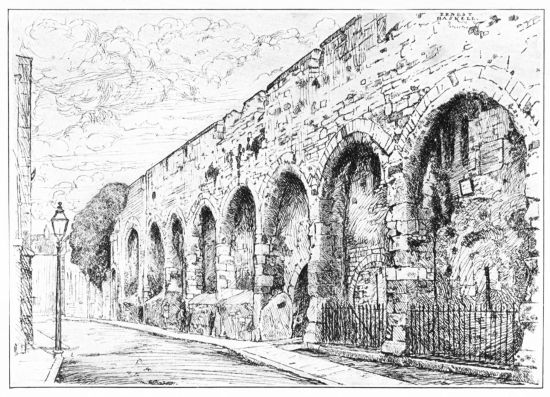
THE OLD TOWER WALL
time was no great booty. The king had as little to envy those Cistercian monks in their life as their income, except perhaps their virtues, which he would not have wished to share. For, as our faithful guide-book told us, they slept hard on the plank of wooden boxes, and unless food were given them in alms they ate neither fish, flesh, fowl, eggs, butter nor cheese, but only a spare porridge—twice a day, and in Lent once. They never spoke except sometimes in their parlor, on religious topics, and on a journey they could only ask questions, which they must ask if possible by signs. They that transgressed the rules were whipped, or stretched upon the stone floor during mass. For their greater humiliation the heads of the order were entirely shaven, which if the wind blew from the sea in their day, as piercingly as it blew in ours, was not so comfortable as it was picturesque for the monks going about bareheaded in their white robes. Yet their hospitality was great and constant, and their guest-hall was so often full that Horace Walpole, in his much-quoted letter about their ruined house, could speak with insinuation of their “purpled abbots,” as if these perhaps led a life of luxury not shared by the humbler brethren. His picture of the abbey is so charming and so true that one may copy it once again, as still the best thing that could be said of it: “How shall I describe Netley to you? I can only tell you that it is the spot in the world which I and Mr. Chute wish. The ruins are vast and retain fragments of beautiful fretted roofs, pendent in the air, with all variety of Gothic patterns of windows topped round and round with ivy. Many trees have sprouted up among the walls, and only want to be increased by cypresses. A hill rises above the Abbey, enriched with wood. The fort in which we would build a tower for habitation, remains with two small platforms. This little castle is buried from the Abbey, in the very centre of a wood, on the edge of a wood hill. On each side breaks in the view of the Southampton Sea, deep, blue, glittering with silver and vessels. In short, they are not the ruins of Netley, but of Paradise. Oh, the purpled abbots! What a spot they had chosen to slumber in! The scene is so beautifully tranquil, yet so lively that they seem only to have retired into the world.”
What can one have to say of Netley after this, even to the romantic touch of the absent cypresses? We came suddenly upon the ruin, and with little parley at the porter’s lodge where they charge admittance and sell photographs, we stood within its densely ivied walls, the broken arches beetling overhead, and the tall trees repairing their defect with a leafless tracery showing fine against a gray sky hesitating blue, and the pale sun filtering a wet silver through the clouds. In places the architecture still kept its gracious lines of Gothic or Norman design; there were whole breadths of wall to testify of the beauty and majesty that had been, and where walls were marred or shattered, the ivy had bound up their wounds, or tufts of soft foliage distracted the eye from their wrongs. Underfoot the damp grass was starred with the earliest flowers of spring, violets, celandine, primrose; and among the flocks of pigeons that made their homes in the holes of the masonry left by the rotting joists, the golden-billed English blackbirds fluttered and sang. You could trace the whole shape of the edifice, and see it almost as it once stood, but the ivy which holds it up is also pulling it down. The decay seems mostly from the winds and rains, and the insidious malice of vegetation, but men have aided from time to time in the destruction, though not without the censure of their fellow-men. It is told, indeed, that a purchaser of the ruin, two hundred years ago, was so wrought upon by the blame of his friends when he wished to use its hallowed stone for other building, that he began to dream of his own death by a keystone falling from one of the arches he was destroying; his death actually happened, though it was a heavy timber, and not a stone that crushed him. Everything in the neighborhood of the ruin was in keeping with it: a baronial mansion among the woods of an adjoining hill, villas within their shrubbery, and when we came to drive back to the ferry, many pleasant farms and pretty cottages behind their hedges of holly and whitethorn. An unusual number of these were thatched, in the tradition of rustic roofs which is slowly, though very slowly, dying out. The machine-threshed straw is so broken that it does not make a good thatch, and the art of the thatcher is passing with the quality of his material. Still we saw some new thatches, with occasionally an old one so rotten that it must have been full of the vermin which such shelters collect, and which could have walked away with it. Now and then we met country people on our way, looking rather sallow and lean, but our driver, perhaps from his contact with town-bred luxury, had a face of the right purple, and here and there was a rustic visage of the rich, south-of-England color showing warm in the pale sunset light.
When we had seen Netley Abbey, all the rest of the Southampton region was left rather impoverished of the conventional touristic interest, but any friend of man could still find abundant pleasure in it by mounting a tram-top and riding far out towards the Itchen, along winding streets of low brick houses, each with its little garden at the front or side, and with its hedge of evergreen. Often these kindly looking homes were overhung by almond-trees, palely pink, in bloom, and sometimes when they were more pretentious, though they were never arrogant, they stood apart, all planted round with shrubs and trees, like the dwellings in Hartford. The tram’s course was largely through umbrageous avenues, or parklike spaces such as seem to abound at Southampton, with now and then a stretch of gleaming water, and here and there an open field with people playing cricket in it. Swarms of holiday-makers strolled up and down, and though it might be a Sunday, with no signs of a bad conscience in their harmless recreations. There was much evidence of church-going in the morning, but little or nothing in the afternoon. The aspect of the crowd was that of comfortable wage-earners or shopkeepers for the most part, such as the flourishing port maintains in ever-increasing multitude, with none of the squalor which seems so inseparable from prosperity in Liverpool. The crowd affirms the modern advance of Southampton in its rivalry with the commercial metropolis of the north, but we were well content in one of our walks to lose ourselves from it, and come upon a neighborhood of fine old houses, standing in wide grounds, now run wild with neglected groves, but speaking with the voices of their secular rooks of the social glory which has long departed. These mansions meant that once there was a local life of ease and splendor which could hold its own against London, as perhaps the life of no other place in England now does. If you took them at twilight, their weed-grown walks simply swarmed with ghosts of quality, in a setting transferred bodily from the pages of old novels.
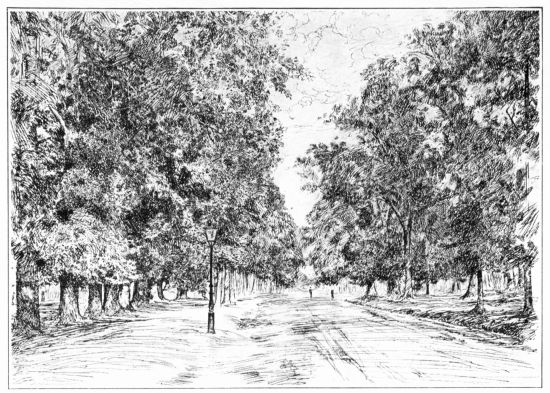
“THE TRAM’S COURSE WAS LARGELY THROUGH UMBRAGEOUS AVENUES”
We had not the strength, social or moral, which their faded gentility represented, to resist the pull of the capital, and in a few days, shrivelled each to less than its twenty-four hours by the chill spring air, we yielded, and started for London on the maddest, merriest afternoon of all the glad Bank holidays of that Easter time. They have apparently not so much leisure for good manners at Southampton as at Bath, or even at Plymouth; the booking-clerk at the station met inquiries about trains as snubbingly as any ticket-seller of our own could have done, and so we chanced it with one of the many expresses, on first-class tickets that at any other time would have insured us a whole compartment. As it was they got us two seats more luxurious than money could buy in an American train, and we were fain to be content. We were the more content, because, presently, we were running through a forest greater than I can remember as in these latter days bordering any American railroad. Miles and miles of country were thickly wooded on either side, with only such cart-tracks and signs of woodcraft as make the page of Thomas Hardy so wild and primitive after twenty centuries of Briton, Roman, Saxon, Dane, and Norman, in that often mastered but never wholly tamed England. We came now and then to a wooden farm-house with its wooden barns and outhouses, in an image of home which we would not have had more like if we could: we had not come to England to be back in America. Yet such is the perversity of human nature, that I who here am always idealizing a stone house as the fittest habitation of man, and longing to live in one, exulted in these frame cottages, and would have preferred one for my English dwelling; even the wood-built stations we whisked by had a charm because they were like the clapboarded depots, freight and passenger, at our rustic junctions. Everywhere in England one sees building of wood to an amazing extent, though the lumber for it is not cut from English woods, but comes rather from Norway and elsewhere in the densely timbered north. Of course it did not characterize the landscape even in the region of the New Forest, which but for its name we should think so old, but the gray stone of the West-of-England farmsteads and cottages had more and more given way to the warm red brick of the easterly south. This, as we drew near London, paled to the Milwaukee yellow, here and there, and when this color prevailed it was smirched and smutted with the smoke holding the metropolis hidden from us till we could, little by little, bear its immensity.