IV A COUNTRY TOWN AND A COUNTRY HOUSE
Reading edition
THERE were so many pleasing places within easy reach of Bath that it was hard to choose among them, and Bath itself was so constantly pleasing that it was a serious loss to leave it for a day, for an hour. I do not know, now, why we should have gone first, when we gathered force to break the charm, to Bradford-on-Avon. If we did not go first to Wells it was perhaps because we balanced the merits of an eighth-century Saxon Chapel against those of a twelfth-century Cathedral, and felt that the chapel had prior claim. Possibly, spoiled as we were by the accessibility of places in England, and relaxed as we were by the air of Bath, we shrank from spending five or six hours in the run to Wells when we could get to and from Bradford in little or no time. Wells is one of the exceptions to the rule that in England everything is within easy reach from everywhere, or else Bath is an exception among the places that Wells is within easy reach of. At any rate we were at Bradford almost before we knew it, or knew anything of its history, which there is really a good deal of.
The best of this history seems to be that when in the year 652 the Saxon King of Wessex overcame the Britons in a signal victory, he did not exterminate the survivors, but allowed them to become the fellow-subjects of their Saxon conquerors under his rule. Just how great a blessing this was it would not be easy to say at the actual distance of time, but it seems to have been thought a good deal of a blessing for a King of Wessex to bestow. To crown it, some fifty years later, a monastery was founded in Bradford, by St. Aldhelm, a nephew of the King. A chapel was built on the site of the uncle’s battle with the Britons, and such as it was then such we now saw it, the vicar of the parish having not long ago rescued it from its irreligious uses as a cottage dwelling and a free school, and restored it spiritually and materially to its original function. It is precious for being the only old church in England which is wholly unchanged in form, and though very small and very rude it is pathetically interesting. It seemed somehow much older than many monuments of my acquaintance which greatly antedated it; much older, say, than the Roman remains at Bath, for it is a relic of the remote beginning of an order of things, and not the remnant of a fading civilization. No doubt the Saxons who built it on the low hill slope where it stands, in a rude semblance of the Roman churches which were the only models of Christian architecture they could have seen, thought it an edifice of the dignity since imparted to it by the lapse of centuries. Without, the grass grew close to its foundations, in the narrow plot of ground about it, and the sturdy little fabric showed its Romanesque forms in the gray stone pierced by mere slits of windows, which gave so faint a light within that, after entering, one must wait a moment before attempting to move about in the cramped, dungeon-like space. With the simple altar, and the chairs set before it for worshippers, it gave an awful sense of that English continuity on which political and religious changes vainly
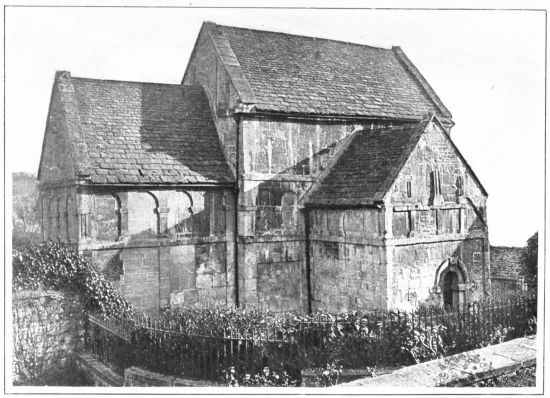
SAXON CHAPEL AT BRADFORD
Wholly unchanged in form since it was built in the eighth century
break: the parts knit themselves together again, and transmit the original consciousness from age to age. The type of beauty in the child who sold us permits to see the chapel and followed us into it was in like manner that of the Saxon maids whose hulking fathers had beaten in battle the fierce, dark little Britons on that spot twelve hundred years before: the same blazing red cheeks, the same blue, blue eyes, the same sunny hair which has always had to make up for the want of other sunniness in that dim clime, falling round the fair neck. No doubt the snuffles with which the pretty creature suffered were also of the same date and had descended from mother to daughter in the thirty generations dwelling in just such stone-cold stone cottages as that where we found her. It was one of a row of cottages near the chapel, of a red-tiled, many-gabled, leaden-sashed, diamond-paned picturesqueness that I have never seen surpassed out of the theatre, or a Kate Greenaway picture, and was damp with the immemorial dampness that inundated us from the open door when we approached. What perpetuity of colds in the head must be the lot of youths in such abodes; how rheumatism must run riot among the joints of age in the very beds and chimney-corners! Better, it sometimes seemed, the greatest ugliness ever devised by a Yankee carpenter in dry and comfortable wood than the deadly poetry of such dwellings.
But there were actually some wooden houses in Bradford, or partially wooden, which the driver of our fly took us to see when we had otherwise exhausted the place. They had the timbered gables of the Tudor times when the English seemed to build with an instinct for domestic comfort earlier unknown and later lost; but otherwise Bradford was of stone, stony. It studded the slopes of its broken uplands with warts and knots of little dwellings, and had a certain foreignness, possibly imparted by the long abode of the Flemish cloth-workers whom an enterprising manufacturer invited to the place centuries before, and whose skill established its ancient industry in a finer product and a greater prosperity. Now, one reads, the competition of the same art in Yorkshire has reduced the weavers of Bradford to a fifth of their number fifty years ago. But the presence of the Flemings was so influential in the seventeenth century that they had a quarter of their own, and altogether there were intimations in Bradford so Continental, the raw rainy day of our visit, that I thought if it could have had a little sun on it there were moments when it might have looked Italian.
Perhaps not, and I do not mean that in its own way it was not delightful. We wandered from the station into it by a bridge over the Avon that was all a bridge could be asked to be by the most exacting tourist, who could not have asked more, midway, than a guardhouse which had become a chapel, and then a lock-up, and finally an object of interest merely. When we had got well into the town, and wanted a carriage, we were taken in charge by the kindest policeman that ever befriended strangers. If not the only policeman in Bradford, he was the only one on duty, and his duty was mainly, as it seemed, to do us any pleasure he could. He told us where we could find a fly, and not content with this, he went in person with us to the stable-yard, and did not leave us till he had made a boy come out and promise us a fly immediately. Never, even when girdled by the protecting arm of a blue giant resolved to bring my gray hairs in safety to some thither side of Fifth Avenue or Broadway, have I known such sweetness in a minister of the law. We could only thank him again and again, and vainly wish that we might do something for him in return. But what can one do for a policeman except offer him a cigar? But if one does not smoke?
The stable-boy seemed a well-grown lad in that character, but when he put on a metal-buttoned coat and a top-hat, and coachman’s boots in honor of us, he shrank into the smallest-sized man. It seemed the harder, therefore, that when he proposed to bow us into the fly with fit dignity, and pulled open the door, it should come off its hinge and hang by its handle from his grasp. But we did what we could to ignore the mortifying incident, and after that we abetted him in always letting us out on the other side.
His intelligence was creditable to him as a large boy, if not as a small man, and but for him we should not have seen those timbered houses which were in a street dreadfully called, with the English frankness which never spares the sensibilities of strangers, The Shambles. With us shambles are only known in tragic poetry; in real life they veil their horror in delicate French and become abattoirs; but as that street in Bradford was probably the Shambles in 652, the year of the great Saxon victory over the Britons, it was still so called in the year of our visit, 1904. We did not complain; the houses were not so wooden as we could have wished for the sake of the rheumatism and snuffles within, but they must have been drier than houses entirely of stone. Besides we had just come warm from the Italian aspect of one of the most charming houses I saw in England, and we did not really much mind the discomfort of others. The house was that Kingston House, world-famous for having been reproduced in papier-maché at the last Universal Exposition in Paris, which a wealthy cloth-manufacturer had had built for himself about 1600 by Giovanni of Padua, and it was full of beautiful Italian feeling in an English environment. Masses of cold, cold evergreen shrubs hide it from the street, but at the moment the rain was briefly intermitting, and we surprised it, as it were, in a sort of reverie of the South under an afternoon sky, hesitating from gray to blue. At this happy instant the place was embellished by a peacock, sweeping with outspread tail the farthest green of a long velvet lawn, and lending the splendor of his color to a picture richly framed by a stretch of balustrade. The house, with English shyness (which it surely might have overcome after being shown as the most beautiful house in England), faced away from the street, towards a garden which sloped downward from it, towards a dove-cote with pigeons in red and mauve cooing about its eaves and roofs, and mingling their deep-throated sighs with the murmur of a mill somewhere beyond the Avon.
There were other beautiful and famous houses not far from Bradford, but our afternoon was waning, and we consoled ourselves as we could with the old Barton Barn, which was built two hundred years after King Etheldred had given the manor to the abbess of Shaftesbury, and became locally known as the tithe-barn from its use in receiving the dues of the church in kind during the long simple centuries when they were so paid. It is a vast, stately structure, and is now used for the cow-barn of a dairy farmer, whose unkempt cattle stood about, knee-deep in the manure, with the caked and clotted hides which the West of England cattle seem to wear all winter. It did not look such a place as one would like to get milk from in America, but if we could have that
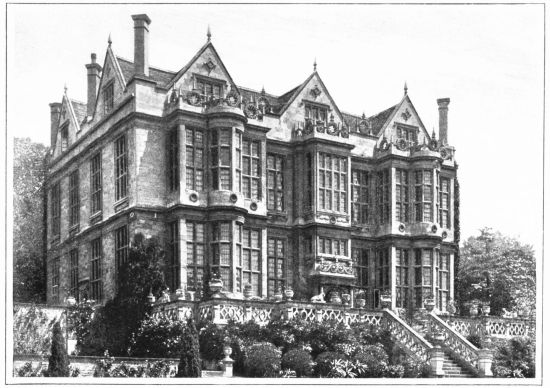
KINGSTON HOUSE, BRADFORD
Built by Giovanni of Padua, about 1600
old cow-barn, without the cows, at home, I think we might gainfully exchange our neatest and wholesomest dairy for it. The rich superabundance of the past in England is what always strikes one, and the piety with which the past is preserved and restored promises more and more of antiquity. I am sure the Barton Barn at Bradford is only waiting for some public-spirited magnate who will yet drive the untidy kine from its shelter, clean up, and sod and plant its yard, and with the help of some reverent architect renew it in the image of its prime, and stock it as a museum with the various kinds of tithes which in the ages of faith the neighboring churls used to pay into it for the comfort of the clergy here, and the good of their own souls hereafter.
When we got well away from the tithe-barn we felt the need of tea, and we walked back from the station where our large boy, or little man, had put us down, to the shop of a green-grocer, which is probably the most twentieth-century building in Bradford. It is altogether of wood, and behind the shop, where the vegetables vaunted themselves in all the variety of cabbage, there is a clean little room, with the walls and roof sheathed in matched and painted pine. In this cheerful place, two rustics, a man and a boy, were drinking tea at the only table, but at our coming they politely choked down all the tea that was in their cups, and in spite of our entreaties hurried out with their cheeks bulged by what was left of their bread and butter. It was too bad, we murmured, but our hostess maintained that her late guests had really done, and she welcomed us with a hospitality rendered precious by her dusting off the chairs for us with her apron: I do not know that I had ever had that done for me before, and it seemed very romantic, and very English. The tea and butter were English too, and excellent, as they almost unfailingly are in England, no matter how poor the place where they are supplied, and the bread was no worse than usual. In a morsel of garden under the window some gillyflowers were in bloom, and when we expressed our surprise, the kind woman went out and gathered some for us: they bloomed pretty well all the winter, there, she said; but let not this give the fond reader too glowing an idea of the winter’s warmth in the West of England. It only proves how sturdy the English flowers are, and how much raw cold they can stand without turning a petal.
Before our train went, we had time to go a longish walk, which we took through some pleasant, rather new, streets of small houses, each with its gardened front-yard hedged about it with holly or laurel, and looking a good, dull, peaceful home. It may really have been neither, and life may have been as wild, and bad, and fascinating in those streets as in the streets of any American town of the same population as Bradford. There was everything in the charming old place to make life easy; good shops, of all kinds, abundant provisions, stores, and not too many licensed victuallers, mostly women, privileged to sell wine and spirits. Yet, as the twilight began to fall, Bradford seemed very lonely, and we thought with terror, what if we should miss our train back to Bath! We got to the station, however, in time to cower half an hour over a grate in which the Company had munificently had a fire early in the day; and to correct by closer observation of an elderly pair an error which had flattered our national pride at the time of our arrival. In hurrying away to get the only fly at the station the lady had then fallen down and the gentleman had kept on, leaving her to pick herself up as she could, while he secured the fly. Perhaps he had not noticed her falling, but we chose to think the incident very characteristically middle-class English; for all we knew it might be a betrayal of the way all the English treated their wives. Now the same couple arrived to take the train with us for Bath, and we heard them censuring its retard in accents unmistakably American! We fell from our superiority to our English half-brothers instantly; and I think the little experience was useful in confirming me in the resolution throughout my English travels to practise that slowness in sentencing and executing offenders against one’s native ideals and standards which has always been the conspicuous ornament of English travellers among ourselves.
The day that we drove out from Bath to a certain charming old house which I wish I could impart my sense of, but which I will at once own the object of a fond despair, was apparently warm and bright, but was really dim and cold. That is, the warmth and brightness were superficial, while the cold and dimness were structural. The fields on either side of the road were mostly level, though here and there they dipped or rose, delicately green in their diaphanous garment of winter wheat, or more substantially clad in the grass which the winter’s cold had not been great enough to embrown. Here and there were spaces of woodland, withdrawn rather afar from our course, except where the trees of an avenue led up from the highway to some unseen mansion. To complete the impression you must always, under the tender blue sky, thickly archipelagoed with whity-brown clouds, have rooks sailing and dreamily scolding, except where they wake into a loud clamor among the leafless tops surrounding some infrequent roof. There are flights of starlings suddenly winging from the pastures, where the cows with their untidily caked and clotted hides are grazing, and the sheep are idling over the chopped turnips, and the young lambs are shivering with plaintive cries. Amid their lamentations the singing of birds makes itself heard; the singing of larks, or the singing of robins, Heaven knows which, but always angelically sweet. The bare hedges cross and recross the fields, and follow the hard, smooth road in lines unbroken save near some village of gray walls and red roofs, topped by an ancient church. In the background, over a stretch of embankment or along the side of a low hill, sweeps a swift train of little English cars, with a soft whirring sound, as unlike the giant roar of one of our expresses as it is unlike the harsh clatter of a French rapide. The white plumes of steam stretch after it in vain; break, and float thinner and thinner over the track behind.
There were, except in the villages, very few houses; and we met even fewer vehicles. There was one family carriage, with the family in it, and a sort of tranter’s wagon somewhere out of Hardy’s enchanted pages, with a friendly company of neighbors going to Bath inside it. At one exciting moment there was a lady in a Bath chair driving a donkey violently along the side of the road. A man slashing and wattling the lines of hedge, or trimming the turf beside the foot-path, left his place in literature, and came to life as the hedger and ditcher we had always read of. Beneath the hedges here and there very “rathe primroses” peered out intrepidly, like venturesome live things poising between further advance and retreat. The road was admirable, but it seemed strange that so few people used it. The order in which it was kept was certainly worthy of constant travel, and we noted that from point to point there was a walled space beside it for the storage of road-mending material. At home we should dump the broken stone in the gutter near the place that needed mending, or on the face of the highway, but in England, where everything is so static, and the unhurried dynamic activities are from everlasting to everlasting, a place is specially provided for broken stone, and the broken stone is kept there.
The drive from Bath to our destination was twelve miles, and the friend who was to be our host for the day had come as far on his wheel to ask us. It was the first of many surprises in the continued use of the bicycle which were destined to confound strangers from a land whose entire population seemed to go bicycle-mad a few years ago, and where now they are so wholly recovered that the wheel is almost as obsolete as the russet shoe. As both the wheel and the russet shoe are excellent things in their way, though no American could now wear the one or use the other without something like social suicide, the English continue to employ them with great comfort and entire self-respect. They fail so wholly to understand why either should have gone out with us that one becomes rather ashamed to explain that it was for the same reason that they came in, merely because everybody had them.
Our friend had given us explicit directions for our journey, and it was well that he did so, for we had two turnings to take on that lonely road, and there were few passers whom we could ask our way. We really made the driver ask it, and he did not like to do it, for he felt, as we did, that he ought to know it. I am afraid he was not a very active intelligence, and I doubt if he had ever before been required to say what so many birds and flowers were. I think he named most of them at random, and when it came at last to a very common white flower, he boldly said that he had forgotten what it was. As we drew near the end of our journey he grew more anxiously complicated in the knowledge of our destination which he acquired. But he triumphed finally in the successive parleys held to determine the site of a house which had been in its place seven or eight hundred years, and might, in that time have ceased to be a matter of doubt even among the farther neighbors. It was with pride on his part and pleasure on ours that suddenly and most unexpectedly, when within a few yards of it, he divined the true way, and drove into the court-yard of what had at times been the dower-house, where we were to find our host and guide to the greater mansion.
As this house is a type of many old dower-houses I will be so intimate as to say that you enter it from the level of the ground outside, such a thing as under-pinning to lift the floor from the earth and to make an air-space below being still vaguely known in England, and in former times apparently unheard of. But when once within you are aware of a charm which keeps such houses in the inviolate form of the past; and this one was warmed for us by a hospitality which refined itself down to the detail of a black cat basking before the grate: a black cat that promptly demanded milk after our luncheon, but politely waited to be asked to the saucer when it was brought. From the long room which looked so much a study that I will not call it differently, the windows opened on the shrubberies and lawns and gardens that surround such houses in fiction, and keep them so visionary to the comer who has known them nowhere else that it would be easy to transgress the bounds a guest must set himself, and speak as freely of the people he met there as if they were persons in a pleasant book. Two of them, kindred of the
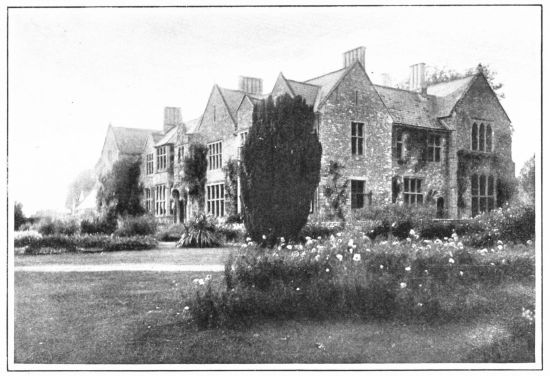
SUTTON COURT, ONE OF ENGLAND’S HISTORIC HOUSES
manor-house and of the great house near, had come from three or four miles away on their wheels. Our host himself, the youngest son of the great house, was a painter, by passion as well as by profession, and a reviewer of books on art, such as plentifully bestrewed his table and forbade us to think of the place in the ordinary terms as a drawing-room. It seemed to me characteristic of the convenient insular distances that here, far in the West, almost on the Welsh border, he should be doing this work for a great London periodical, in as direct touch with the metropolis as if he dwelt hard by the Park, and could walk in fifteen minutes to any latest exhibition of pictures.
When he took us after luncheon almost as long a walk to his studio, I fancied that I was feeling England under my feet as I had not before. We passed through a gray hamlet of ten or a dozen stone cottages, where, behind or above their dooryard hedges, they had gradually in the long ages clustered near the great house, and a little cottage girl, who was like a verse of Wordsworth, met us, and bidding us good-day, surprised us by dropping a courtesy. It surprised even our friends, who spoke of it as if it were almost the last courtesy dropped in England, and made me wish I could pick it up, and put it in my note-book, to grace some such poor page as this: so pretty was it, so shy, so dear, with such a dip of the suddenly weakening little knees.
We were then on our way to see first the small gray church which had been in its place among the ancient graves from some such hoary eld as English churches dream of in like places all over the land, and make our very faith seem so recent a thing. It was in a manner the family chapel, but it was also the spiritual home of the lowlier lives of village and farm, and was shared with them in the reciprocal kindness common in that English world of enduring ties. There for ages the parish folk had all been christened, and all married, and all buried, and there in due time they had been or would be forgotten. The edifice was kept in fit repair by the joint piety of rich and poor, with the lion’s share of the expense rightfully falling to the rich, as in such cases it always does in England; and within and without the church the affection of the central family had made itself felt and seen, since the Christian symbols were first rudely graven in the stone of the square church-tower.
The name of the family always dwelling in that stately old house whither we were next going had not always been the same, but its nature and its spirit had been the same. An enlightened race would naturally favor the humane side in all times, and the family were Parliamentarian at the time England shook off the Stuart tyranny, and revolutionist when she finally ridded herself of her faithless Jameses and Charleses. In the archives of the house there are records of the hopes vainly cherished by a son of it who was then in New York, that our own revolt against the Georgian oppression might be composed to some peaceful solution of the quarrel. It was not his fault that this hope was from the first moment too late, but it must be one of his virtues in American eyes that he saw from the beginning the hopelessness of any accommodation without a full concession of the principles for which the colonies contended. In the negotiation of the treaty at Versailles in 1783 he loyally did his utmost for his country against ours at every point of issue, and especially where the exiled American royalists were concerned. Our own commissioners feared while they respected him, and John Adams wrote of him in his diary, “He pushes and presses every point as far as it can possibly go; he has a most eager, earnest, pointed spirit.”
This was the first baronet of his line, but the real dignity and honor of the house has been that of a race of scholars and thinkers. Their public spirit has been of the rarer sort which would find itself most at home in the literary association of the place, and it has come to literary expression in a book of singular charm. In the gentle wisdom of sympathies which can be universal without transcending English conditions, the Talk at a Country House, as the book modestly calls itself, strays to topics of poetry, and politics, and economics, and religion, yet keeps its allegiance to the old house we were about to see as a central motif. It was our first English country house, but I do not think that its claim on our interest was exaggerated by its novelty, and I would willingly chance finding its charm as potent again, if I might take my way to it as before. We came from the old church now by the high-road, now through fringes of woodland, and now over shoulders of pasturage, where the lesser celandine delicately bloomed, and the primrose started from the grass, till at last we emerged from under the sheltering boughs of the tall elms that screened the house from our approach. There was a brook that fell noisily over our way, and that we crossed on a rustic bridge, and there must have been a drive to the house, but I suppose we did not follow it. Our day of March had grown gray as it had grown old, and we had not the light of a day in June, such as favored an imaginary visitor in Talk at a Country House, but we saw the place quite so much as he did that his words will be better than any of my own in picturing it.
“The air was resonant with rooks as they filled the sky with the circles in which they wheeled to and fro, disappearing in the distance to appear again, and so gradually reach their roosting trees.... I might call them a coruscation of rooks.... On my left I saw ... the old battlemented wall, and a succession of gables on either side ... and one marked by a cross which I knew must be the chapel.... The old, battlemented wall had a flora of its own: ferns, crimson valerian, snap-dragons, and brier-roses ... and an ash and a yew growing on the battlements where they had been sown no doubt by the rooks. And as I passed through an archway of the road, the whole house came in view. It was not a castle nor a palace, but it might be called a real though small record of what men had been doing there from the time of the Doomsday Book to our own.”
As we grew more acquainted with it, we realized that at the front it was a building low for its length, rising gray on terraces that dropped from its level in green, green turf. Some of the long windows opened down to the grass, with which the ground floor was even. Above rose the Elizabethan, earlier Tudor, and Plantagenet of the main building, the wings, and the tower of the keep. The rear of the house was enclosed by a wall of Edward II.’s time, and beyond this was a wood of elms, tufted with the nests of that eternal chorus of coruscating rooks. At first we noticed their multitudinous voices, but in a little while they lost all severalty of sound, like waves breaking on the shore, and I fancied one being so lulled by them that one would miss them when out of hearing, and the sense would ache for them in the less soothing silence.
The family was away from home, and there were no reserves in the house, left in the charge of the gardener, as there must have been if it were occupied. But I do not hope to reproduce my impressions of it. I can only say that a sense of intellectual refinement and of liberal thought was what qualified for me such state as characterized the place. The whole structure within as well as without was a record of successive temperaments as well as successive tunes. Each occupant had built up or pulled down after his fancy, but the changes had left a certain physiognomy unchanged, as the mixture of different strains in the blood still leaves a family look pure. The house, for all its stateliness, was not too proud for domesticity; its grandeur was never so vast that the home circle would be lost in it. The portraits on the walls were sometimes those of people enlarged to history in their lives, but these seemed to keep with the rest their allegiance to a common life. The great Bess of Hardwicke, the “building Bess,” whose architectural impulses effected themselves in so many parts of England, had married into the line and then married out of it (to become, as Countess of Shrewsbury, one of the last jailers of Mary Queen of Scots), and she had left her touch as well as her face on its walls, but she is not a more strenuous memory in it than a certain unstoried dowager. She, when her son died, took half the house and left half to her daughter-in-law, whom she built off from herself by a partition carried straight through the mansion to the garden wall, with a separate gate for each.
In her portrait she looks all this and more; and a whole pathetic romance lives in the looks of that lady of the first Charles’s time who wears a ring pendent from her neck, and a true-lovers’ knot embroidered on the back over her heart, and who died unwedded. There were other legends enough; and where the pictures asserted nothing but lineage they were still very interesting. They were of people who had a life in common with the house, wives and mothers and daughters, sons and husbands and fathers, married into it or born into it, and all receiving from it as much as they imparted to it, as if they were of one substance with it and it shared their consciousness that it was the home of their race. We have no like terms in America, and our generations, which are each separately housed, can only guess at the feeling for the place of their succession which the generations of such an English house must feel. It would be easy to overestimate the feeling, but in view of it I began to understand the somewhat defiant tenderness with which the children of such a house must cherish the system which keeps it inalienably their common home, though only the first-born son may dwell in it. If there were no law to transmit it to the eldest brother they might well in their passion for it be a law unto themselves at any sacrifice and put it in his hands to have and hold for them all.
In my own country I had known too much graceless private ownership to care to offer the consecrated tenure of such an ancestral home the violence of unfriendly opinions of primogeniture. But if I had been minded to do so, I am not sure that this house and all its dead and living would not have heard me at least tolerantly. In England, with the rigid social and civic conformity, there has always been ample play for personal character; perhaps without this the inflexible conditions would be insufferable, and all sorts of explosions would occur. With full liberty to indulge his whim a man does not so much mind being on this level or that, or which side of the social barrier he finds himself. But it is not his whim only that he may freely indulge: he may have his way in saying the thing he thinks, and the more frankly he says it the better he is liked, even when the thing is disliked. These are the conditions, implicit in everything, by which the status, elsewhere apparently so shaky, holds itself so firmly on its legs. They reconcile to its contradictions those who suffer as well as those who enjoy, and dimly, dumbly, the dweller in the cottage is aware that his rheumatism is of one uric acid with the gout of the dweller in the great house. Every such mansion is the centre of the evenly distributed civilization which he shares, and makes each part of England as tame, and keeps it as wild, as any other. He knows that hut and hall must stand or fall together, for the present, at least; and where is it that there is any longer a future?
It seems strange to us New-Worldlings, after all the affirmation of history and fiction, to find certain facts of feudalism (mostly the kindlier facts) forming part of the status in England as they form no part of it with us. It was only upon reflection that I perceived how feudal this great house was in its relation to the lesser homes about it through many tacit ties of responsibility and allegiance. From eldest son to eldest son it had been in the family always, but it had descended with obligations which no eldest son could safely deny any more than he could refuse the privileges it conferred. To what gentlest effect the sense of both would come, the reader can best learn from the book which I have already named. This, when I had read it, had the curious retroactive power of establishing the author in a hospitable perpetuity in the place bereft of him, so that it now seems as if he had been chief of those who took leave of us that pale late afternoon of March, and warned us of the chill mists which shrouded us back to Bath. As we drove along between the meadows where the light was failing and the lambs plaintively called through the gloaming, we said how delightful it had all been, how perfectly, how satisfyingly, English. We tried again to realize the sentiment which, as well as the law, keeps such places in England in the ordered descent, and renders it part of the family faith and honor that the ancestral house should always be the home of its head. I think we failed because we conceived of the fact too objectively, and imagined conscious a thing that tradition has made part of the English nature, so that the younger brother acquiesces as subjectively in the elder brother’s primacy as the elder brother himself, for the family’s sake. We fancied that in their order one class yielded to another without grudging and without grasping, and that this, which fills England with picturesqueness and drama, was the secret of England. In the end we were not so sure. We were not sure even of our day’s experience; it was like something we had read rather than lived; and in this final unreality, I prefer to shirk the assertion of a different ideal, which all the same I devoutly hold.